Category: Burnout

expert on her computer

Wondering if you’re experiencing imposter syndrome? Our Imposter Syndrome Quiz is designed to help you find out. If you’ve ever felt like a fraud, convinced that despite your achievements, someone will eventually discover you’re not capable or deserving of where you are, you’re not alone. Imposter syndrome is a silent epidemic impacting many of us. Research published in the International Journal of Behavioral Science indicates that about 70% of individuals will experience imposter syndrome during their professional lives—but my coach’s intuition tells me that number is even higher. Imposter syndrome creates a cycle of self-doubt, anxiety, and negative self-talk that can hold you back from embracing new opportunities and achieving career success. It can even affect your mental health. If these feelings resonate with you, it’s time to take action. Take our Imposter Syndrome Quiz now to uncover how imposter syndrome manifests for you. Start breaking free from the mental barriers standing in the way of your success! Throughout this article, we use the spelling “imposter syndrome,” though you’ll also see it written as “impostor syndrome.” Both are commonly used interchangeably to describe the same experience. We use “impostor” when directly referencing the work of others who have used that spelling. For example, Dr. Valerie Young, who identified and introduced the five types of Impostor Syndrome in her book. What is Imposter Syndrome? Imposter syndrome is the persistent feeling that you’re not as competent or talented as others believe you to be—despite clear evidence of your achievements. How does experiencing imposter syndrome feel? It often shows up as self-doubt, anxiety, and fear of being “exposed” as a fraud, even among high achievers who have a strong track record of success. This internal struggle fuels negative self-talk and can make it difficult to fully embrace accomplishments or take actionable steps forward in life. What Causes Imposter Syndrome? The imposter phenomenon, a term from clinical psychology, stems from a mix of personal experiences, societal expectations, and workplace pressures. While anyone can experience imposter feelings, research shows that high-achieving women are especially vulnerable. A recent meta-analysis of over 100 studies confirmed that women experience imposter feelings more often than men, highlighting just how widespread this is. This builds on the original work by psychologists Pauline Clance and Suzanne Imes, who first identified the “impostor phenomenon” in 1978, noting that many successful women attribute their achievements to luck rather than to their own abilities. Several factors contribute to the development of imposter syndrome: Upbringing & Parenting Styles Growing up with impossibly high standards, excessive praise, or constant comparisons can shape the belief that success is never enough—or simply a stroke of luck. Parents who emphasize achievement may unintentionally instill a fear of failure and patterns of negative self-talk. Work Environment & Cultural Expectations As a career and life coach, I believe early work experiences strongly shape our beliefs about career potential. Competitive job markets, perfectionist cultures, and limited diversity in leadership often reinforce imposter feelings—especially for high-achieving women, who may feel constant pressure to prove their worth. Perfectionism & Overworking “You can be anything if you try hard enough.” It’s a familiar mantra, but it often fuels overwork and the belief that effort must be endless to be worthy. This mindset is linked to stress, burnout, and depression—common outcomes of internalized perfectionism. External Factors & Social Conditioning Cultural norms, gender expectations, and other environmental factors can set unrealistic standards of success and amplify feelings of imposter syndrome. These narratives can lead individuals to downplay their accomplishments and live in fear of being “found out.” Overcoming imposter syndrome begins with recognizing the influences and other external factors that shape our self-doubt. When we acknowledge these pressures while focusing on what we can control, our mindset, we unlock incredible potential. By challenging negative thoughts, reframing limiting beliefs, and fostering a more empowering workplace culture, we can break free from “impostor feelings” and step into leadership with confidence. How Imposter Syndrome Sabotages Your Career Imposter syndrome is not a diagnosis, but rather a thought pattern. These thought patterns can create mental roadblocks that hinder confidence, professional growth, and leadership potential. When you feel like an imposter, it’s not just an internal struggle—it actively leads to self-sabotage, holding you back from advancing in your career. Imposter syndrome can create a self-fulfilling prophecy, reinforcing the belief that you’re not good enough, even when you have the skills and experience to succeed. Over time, this mindset can limit your growth, impact your confidence, and prevent you from seizing new opportunities. Imposter syndrome can sabotage your career success in many ways. Here are a few examples that might sound familiar: Reluctance to Apply for a New Job Many professionals hesitate to go after new opportunities, believing that because they don’t meet 100% of the qualifications, they can’t apply. This is fear of rejection or “not being ready” and can keep you stuck in roles that don’t challenge or fulfill you. Hesitation to Negotiate Salary or Ask for Promotions When doubt creeps in, you may struggle to advocate for yourself. Imposter syndrome convinces you that you’re lucky to have your position and should just be grateful, making it difficult to ask for the raise or promotion you deserve. Avoidance of Leadership Roles Many high performers feel frustrated watching less-experienced colleagues move into leadership positions because they don’t see themselves as “leadership material.” Part of this is avoiding going after the next leadership opportunity because imposter syndrome may cause a fear of being exposed as a fraud or fear of failure. Withdrawing from Networking or Speaking Opportunities A toxic work environment can reinforce imposter syndrome, making individuals afraid to voice their opinions in meetings or avoid networking events where they feel they don’t belong. Over time, this self-doubt and withdrawal can isolate you and limit your professional growth. By recognizing these patterns, you can start to challenge the negative beliefs that are holding you back. So, what’s the first step to breaking free? Understanding how imposter syndrome manifests in your life. Take

Read More
young women looking at computer while writing

Whether you’ve been looking for work for a while or you’ve just started, you’ve probably experienced some job search frustration, and you’re not alone. The current job market is competitive, the search process can be confusing and mysterious, and applying for jobs can be time consuming and repetitive. Repeated rejections can be painful, but are better than hearing nothing at all. And it can be overwhelming to deal with well-intentioned family and friends wanting updates on the job hunt and giving career advice that isn’t necessarily helpful in the current job market. So if you are feeling frustrated by the job search process, we’ve been there (and so have many of our clients!). That being said, giving in to that frustration can be extremely harmful and lead to a sense of burnout before you can even find that next role! Read on to find strategies to combat the frustration of the job search so that you can move on to the next phase of your career. The Hidden Dangers of Job Search Frustration If there is one thing that most job seekers can agree on, it’s that the job search process is frustrating! The job market today is more competitive than ever before and good positions are hard to find. Getting a new job is no easy task, and the longer you’re in the job market, the harder it can be to stay both positive and motivated. And considering over 40% of job seekers have been looking for work for more than a year, that sense of frustration at the process is not only understandable, but also very common. However, while common, it can lead to several risks that may derail your job hunt. Here are some of the most common: Doubting Your Abilities Job search frustration can chip away at your confidence over time, especially when rejections or the lack of responses start to pile up. This self-doubt can make you question whether you’re truly qualified for the roles you want. The risk here? You may start to avoid applying for jobs altogether or talk yourself out of applying to roles you’re actually qualified for, missing out on valuable opportunities. Rushing Through Applications View this post on Instagram A post shared by Ama La Vida | Online Career Coaches (@alvcoaching) Frustration often leads job seekers to rush through the job search just to get it over with. You might find yourself speeding through applications without effectively tailoring your resume or cover letter to each role, significantly reducing your chances of standing out to hiring managers. This rushed approach can also cause you to overlook important details or even apply for jobs that don’t align with your long-term goals. Settling for the First Offer Perhaps the biggest danger of all is the temptation to accept the first job offer that comes your way, even if it’s not the right fit. In a moment of frustration, you might convince yourself that “any job is better than no job.” However, settling for a role that doesn’t align with your values, career goals, or skill set can leave you feeling unfulfilled and searching for a new job again sooner than expected. Don’t Worry, There is Hope on the Horizon! You do not have to let job search frustration affect your mindset and actions. As soon as you feel it creep in, the best strategy is to deal with it immediately and directly. There are some effective strategies you can use to combat job search fatigue and burnout, based on what has worked for successful job seekers in the current market. Mindset Shift: What Story Are You Telling Yourself? Your mindset can have a huge effect on the job search process, and while a positive outlook does not guarantee success in the job search, limiting beliefs can definitely hold you back and keep you from growing professionally. Luckily, limiting beliefs are just stories we tell ourselves, and we can change them at any time. Shift your mindset by telling yourself a different story. Below are some examples of limiting beliefs along with new and more productive ways of thinking about the job hunt process. “No one is hiring right now.” This statement is so drastic and negative, it could lead you to quit the job hunting process entirely. And it’s not true at all. The truth is that even in tough times, companies are still hiring, and finding the right role is possible. According to the Bureau of Labor Statistics, employers hired 2.7 million people in 2023. You could reframe this by saying that jobs are less visible and tougher to find, but that finding one is possible. You need to believe in the job possibilities available to you in order to stay motivated! “This is taking too much time,” or “Finding a job should take 3 months or less.” This may be painful to hear, but there is no time limit on the job search process, and despite your best efforts, you can’t fully control when you get a job. When the uncertainty gets too frustrating, focus on what you can control by networking, adding to your resume, or working with a career coach. “This isn’t the right time,” or “This is firing season,” or “I’ll just wait until…” The best time is now. Especially because the job search process could take some time, it’s best to start as soon as possible to plant seeds of opportunity. Many job offers come from “seeds” planted weeks or months earlier. For example, a hiring manager or recruiter may remember you from a previous application and contact you with a position that would be a better fit for you. Waiting to start the job search process is the only way to prolong the process and ensure that you don’t get hired. Practical Tips to Stay Motivated While job search frustration may make it difficult to stay motivated, there are a few simple things you can do to keep moving forward: Navigating the Emotional Rollercoaster of Job

Read More
young professional working on laptap and taking notes

The decision to quit a job is a significant one, often fraught with mixed emotions. While it might seem like the only escape from a toxic work environment, burnout, or career stagnation, it’s worth exploring other options before making a drastic change. This blog post will delve into five strategies to help you reevaluate your current situation and potentially find fulfillment within your existing role. Is Quitting Really the Answer? The urge to quit often stems from a mismatch between your personal and professional needs. Common reasons for job dissatisfaction include feeling undervalued, lacking growth opportunities, experiencing poor work-life balance, or simply being bored. Before you resign, take some time to pinpoint the exact issues causing your discontent. Are they specific to your role, your team, or the company culture as a whole? Understanding the root cause can help you determine the best course of action. To gain clarity on your reasons for wanting to leave, try journaling or discussing your feelings with a trusted friend or mentor. Reflect on your job satisfaction over time. Have there been periods of fulfillment? What changed? Identifying patterns can provide valuable insights into your career goals and priorities. Set Boundaries and Honor Them Feeling overwhelmed and burnt out? Setting clear boundaries between your work and personal life can significantly improve your job satisfaction. Establishing limits on your workload, availability, and after-hours communication can help prevent burnout and create a healthier work-life balance. View this post on Instagram A post shared by Ama La Vida | Online Career Coaches (@alvcoaching) Start by analyzing your current schedule. Are you consistently working long hours? Are you taking breaks? Are you dedicating enough time to personal activities and hobbies? Once you identify areas for improvement, begin implementing changes. Communicate your new boundaries to your colleagues and manager, and be firm in upholding them. Remember, setting boundaries isn’t selfish; it’s essential for your well-being and productivity. Try this! Create a weekly schedule that includes work hours, personal time, and dedicated relaxation activities. Be realistic about your workload and avoid overcommitting. Change Your Environment Sometimes, a change of scenery can revitalize your job satisfaction. If you’re feeling stuck in a rut, consider making adjustments to your work environment. This could involve reorganizing your workspace, finding a new spot to work remotely, or even taking a short break to recharge. Think about what elements of your environment contribute to your productivity and well-being. Do you prefer a quiet space or a bustling atmosphere? Do you need access to natural light? Experiment with different settings to find what works best for you. Remember, even small changes can have a big impact on your overall mood and motivation. Try this! Create a list of factors that influence your work environment, such as noise level, temperature, lighting, and decor. Identify areas for improvement and brainstorm potential solutions. Redesign Your Role If you enjoy your company culture and colleagues but find your current role unfulfilling, consider exploring opportunities for role redesign. By taking on new responsibilities or projects, you can gain new skills, challenge yourself, and find greater satisfaction in your work. Start by identifying your strengths, interests, and career goals. Discuss your aspirations with your manager and explore potential opportunities within the company. Be open to taking on additional responsibilities or projects that align with your career path. Remember, role redesign is a collaborative process, so be willing to compromise and find solutions that benefit both you and the company. View this post on Instagram A post shared by Ama La Vida | Online Career Coaches (@alvcoaching) Try this! Create a list of tasks and responsibilities you enjoy and excel at. Identify areas where you would like to develop new skills. Discuss your career goals with your manager and explore potential opportunities for role expansion. Lean into Social Capital Your professional network can be a valuable resource for career growth and development. Building strong relationships with colleagues can open doors to new opportunities, provide mentorship, and create a supportive work environment. Take the initiative to connect with colleagues from different departments and levels of the organization. Attend company events and participate in team-building activities. Seek out mentors who can offer guidance and support. By investing in your relationships, you can create a more fulfilling and rewarding work experience. Try this! Identify key individuals in your company who can serve as mentors or sponsors. Reach out to them and request a meeting to discuss your career goals and aspirations. Redefine Your Why Sometimes, the key to job satisfaction lies in finding meaning and purpose outside of work. If your job is no longer fulfilling your personal or professional goals, it might be time to redefine your “why.” This could involve pursuing hobbies, volunteering, or spending more time with loved ones. Take some time to reflect on your values and priorities. What truly brings you joy and fulfillment? How can you incorporate these elements into your life, both inside and outside of work? By finding meaning and purpose beyond your job, you can gain a new perspective and approach your work with renewed energy and enthusiasm. Try this! Create a list of your personal values and goals. Identify ways to incorporate these into your daily life, both at work and at home. Remember, leaving a job is a major decision. By exploring these strategies, you may discover new opportunities for growth and satisfaction within your current role. If you ultimately decide to pursue a new job, the insights gained from this process will help you find a position that better aligns with your career goals and personal values.

Read More
woman working a desk in front of laptop thinking

As leaders, we are time constrained to the max. We are making sure our direct reports have what they need, our superiors or peers have insight to our work, all while trying to get something on our own checklist accomplished here and there. It’s easy to go go go and forget to pause and reflect. The risk of this is, without taking the time to reflect and question our actions, we can find that we’ve run a million miles an hour in the wrong direction. Or that the direction was right but we missed something or someone along the way. These 5 questions are critical for leaders to be regularly asking themselves to help ensure their time is well spent, their team is well aligned and their wellbeing is taken care of. What can only I do? Leader or not, we are all wrestling with a never ending challenge to prioritize our time and activities. Especially in small companies, you may find yourself doing things, not because they make sense for you to do, but because there is simply no one else to do them. It’s easy to get sucked into stuff because there is a need, but without putting those asks through some sort of filter, they can quickly consume all of your time, leaving nothing left for your priorities. Ask yourself, “What can only I do?” What are the things that you uniquely have knowledge, relationships or expertise around? These are the things you need to prioritize. Which also means you’ll need to figure out how to delegate or let go of some others. It can be difficult to let something slip that ought to be done. But if those things collectively are preventing you from doing the things that need to be done by you, they’ve got to go. Does everyone know the one big thing? At any given point in a business, there is a major headline. It might be a focus on preparing to go public. It might be a season of cost-cutting and profitability. It might be building brand awareness at just about any cost. Regardless of which team you lead, your team should know the headline. Everyone should know the “one big thing” and how their work contributes to it. If you ask three people on your team, they should say the same thing. And they should have a general sense of how well that thing is going. If they aren’t sure, and especially if you aren’t sure, it’s a great time to refocus on the key priority and ensure your communication is clear and repeated regularly. Who needs attention? Especially in a remote or hybrid environment, it can be difficult to sense when someone on your team is struggling. And if it’s not top of mind to be checking in and considering who might need support, your team members could be feeling alone on an island. Regularly ask yourself who on your team needs attention. Attention might mean recognition. It might mean a chance to grow in a new way if they’ve been doing the same thing for quite some time. It might be reassurance that they are doing a good job, even in the face of challenges. It might mean some additional hand-holding and feedback if they are falling short. Make sure you have regular one-on-ones and pulse check with your direct reports on these categories. While not with the same intensity, consider how you can support those who report into your direct reports. Skip levels can be powerful both to help you support your managers but also to motivate those below them. You might be surprised at how much a quick 30-minute meeting or pulling someone into a project can do to drive engagement and excitement for the work. What am I missing? This is tricky because in most cases, if there was something else to be done to move the business forward, we would have done it already! It’s not easy to see your blind spots personally and strategically. Challenge yourself with even deeper questions about what you might be missing. What’s happening outside our 4 walls in the world or industry that might impact us in the near future? What have I been so sure about that I’ve forgotten to pressure test my assumptions? What have we been doing simply because that’s what’s always been done? When trying to push initiatives or results forward, our temptation is often to apply more pressure, to put more fuel on the fire rather than take a step back to determine where we can remove friction. Could that be more impactful? Is there a different approach altogether? Even just taking this brief moment to challenge your work and assumptions and consider what you might be missing can unlock a new burst of genius. How am I taking care of myself? Leadership can be a lonely job. It can feel isolating to keep a team of people motivated and engaged when facing difficult or uncertain times. It can be exhausting to not just drive work and initiatives forward, but to be responsible for people’s emotions and the team morale as well. Make sure you are taking care of you. Ask yourself, “What do I need?” That might mean being in community with other leaders. It might mean seeking support from a coach or therapist. It might mean some time off. All of these options require time and investment, but we know that without prioritizing your wellbeing along with your work, burnout is sure to follow. Take the time to pause and ask these key questions. Better yet, build it into a habit like something you do on your train ride to work or something you do every Friday as you wrap up the week. Systematize your reflection so it becomes part of your work routine. I promise, you’ll never regret taking the time to stop and question. A brief pause to check in and recalibrate can prevent so much rework or regret

Read More
person holding calendar filled with appointments

In the midst of hectic schedules and competing work priorities, it’s easy to feel overwhelmed and disconnected from what truly matters to you. That’s where working with a coach comes in. When you’re busy, it may seem counterintuitive to add another commitment to your plate. You may look at your week and think that there’s simply no way to add one more thing to your calendar. But the truth is, taking time to engage with your coach can be the game-changer you need to let go of the overwhelm and instead focus on what’s most important so you can progress toward your goals. At Ama La Vida, we know that how you’re feeling in one area of your life directly impacts how you’re feeling the rest of the time. Our innovative coaching approach is designed to help you navigate a never-ending to-do list while creating meaningful, measurable change. In this blog post, we’re going to unpack the unexpected benefits working with a coach can bring when you’re very busy, and how it can transform your approach to life and work. The Importance of Coaching Let’s be clear: coaching conversations are not the same as regular conversations, which is why conversations with your coach are so different from those you have with any of the other relationships you have. Coaching training programs teach coaches to ask good questions so they can get to the root of your motivation and clarify what you need and want to move forward in the direction of your goals. A conversation with your coach isn’t about getting advice. Instead, they’ll help you identify what works for you so that you can get out of your own way and become the person you always hoped you could be. If you invest your time in coaching when busy, you’re creating the opportunity to open doors you never expected or thought possible. So, with that, here are just a few of the ways that working with a coach can help improve your performance and ease your overwhelm. 1. Prioritization Support The first thing a coach will help you gain clarity on are your priorities. When things are feeling hectic and overwhelming, it’s easy to lose sight of what truly matters. The very first part of working with your coach is to identify your core passions, skills, values, goals, and aspirations. By understanding what is most important to you, you can allocate your time and energy accordingly. This focused approach empowers you to tackle the most crucial tasks first and make progress toward the future you want to build. This process is about optimizing your performance, so you can spend time on what truly matters to you and where you’ll make the biggest impact so that you can optimize your time and energy to bring you the results that matter. 2. Clarity on Your Goals When your world is feeling overwhelming or chaotic, it’s easy to lose sight of what truly matters most to you. Conversations with your coach act as a guiding light, illuminating your path toward what aligns with your values and aspirations. Through thought-provoking conversations and insightful questioning, coaches dive deep into understanding your core values, ambitions, and long-term vision. With this heightened self-awareness, you can make informed decisions about how to allocate your time and energy to your advantage. Your coach will help you differentiate between urgent tasks and those that contribute to your long-term goals. By gaining goal clarity, you can experience a newfound sense of direction and purpose. At Ama La Vida, we set EPIC goals that will not only keep you on track but also inspire you and move you further toward your personal and professional purpose. These goals will serve as your compass, keeping you focused and driven in your daily endeavors. Remember, goal clarity is not about following someone else’s agenda or societal expectations. It’s about gaining a deep understanding of what brings you joy, fulfillment, and a sense of purpose. 3. Time Management Mastery Yes, certain circumstances are outside your control. However, when it comes to managing your time efficiently, a coach can be your secret weapon. They offer personalized support and guidance to help you navigate the demands of a busy schedule. Coaching provides a unique opportunity to develop effective time management skills. Your coach can introduce you to proven strategies and techniques, but more importantly, they can help you identify a process that’s unique to you and your needs and ways of working. They will help you streamline your processes, eliminate time-wasting activities, and find innovative ways to boost your productivity. With their guidance, you’ll learn how to prioritize effectively, delegate tasks, and make the most of the resources available to you, so that your weeks become productive and meaningful. Your coaching sessions will help you to transform your relationship with time. Say goodbye to feeling overwhelmed and hello to a more balanced, fulfilling life. 4. Make Better Decisions Take a moment and just imagine how much time you’d save if you could make decisions faster. Or make better decisions faster, with fewer mistakes and less rework. This is exactly why coaching is so very valuable. Your coach can assist you in developing a systematic approach to decision-making. During your coaching sessions, they’ll help you explore your options, consider potential outcomes, and weigh the pros and cons so you’ll be able to make informed choices aligned with your goals and values. Additionally, during your sessions, you can also explore how to manage uncertainty and navigate risks. Your coach will assist you in evaluating the potential consequences and identifying potential obstacles. With their support, you can develop contingency plans and mitigate potential obstacles, allowing you to move forward with confidence. Moreover, coaching provides a valuable sounding board for exploring different scenarios and potential results. It will help you envision the short-term and long-term implications of your choices, as well as seeing things differently. Through this process, you can gain clarity on the path that aligns with your aspirations

Read More
woman reading book and journaling

I don’t have time for self-care. That statement often comes up whenever I speak within organizations about self-care at work. I empathize with that sentiment. We struggle to keep up with the ever-quickening pace of work. The interconnected nature of our roles can make it feel as if we’re always on the clock, even during our personal time or during our sick days. And the world is changing at a rate we’re not used to. Companies often bring me in to support employees’ health in the face of workplace stress, with the stated goal of creating a “productive workforce.” I absolutely encourage employees to take advantage of whatever things employers are able to provide, but there is so much more care needed beyond an on-site workshop to support personal wellness and create a healthy work environment. How are we supposed to practice self-care when we can barely keep our heads above water at work, let alone find that elusive “work-life balance” we’ve all been told so much about? To answer that question, I’ll first pose another question. What is self-care? In my work as the founder and author of Inner Workout, I find that so many people don’t believe self-care is accessible to them because they’re working with an incomplete definition of self-care. These well-intentioned, but misguided, definitions of self-care often center on buying expensive products, spending luxurious amounts of time, spa days, and following particular formulas of rote healthy habits prescribed by wellness programs in order to do self-care “the right way.” In reality, self-care is so much more than just a trend. Instead, I offer Inner Workout’s definition of self-care as a refreshing alternative: Simply put, self-care is listening within and responding in the most loving way possible. This definition has unlocked insights and new possibilities for countless people because it shifts self-care away from being another to-do list and frames it as an ongoing conversation with yourself. Self-care is not a task on your list to check off for mental and physical health. It is a skill you build. You listen and practice mindfulness. You respond with love using the resources available to you. Your self-care routine doesn’t need to happen in a particular setting or for a certain amount of time in order for it to count as self-care and support your emotional well-being. The key here is being aligned with your authentic self so that you can recognize what emotional health and well-being look like in your life and work. Though self-care can happen anywhere, I see people assume self-care has to happen outside of the workplace during their limited free time. When we use the definition of self-care I offered, the opposite is true. Self-care belongs at work. In fact, the skill of self-care can become a competitive advantage for your career. Before we go further into self-care tips or practices, let’s take a step back and look at why this matters. Why is self-care important at work? Yes, it can seem easier to avoid self-care in the workplace in hopes of maximizing your productivity. However, long term there are some true (measurable!) benefits to creating space. If you are listening within and responding in the most loving way possible to yourself at work, you will be able to: It can be tempting to put your head down and focus solely on the tasks of your job, but by integrating this simple self-care approach and creating a habit where you practice mindfulness, you’re setting the stage for longer-term success, both personally and professionally. How do you practice self-care in the workplace? So let’s get to it. There are two types of self-care I encourage everyone in the workplace to develop: proactive and responsive self-care. The first self-care initiatives are habits that you can integrate for your own health and work-life balance and schedule into your day. The second are mental health practices that will allow you to maintain your emotional well-being during times of acute stress, and involve both healthy boundaries and also relaxation techniques to bring your body back into a state of homeostasis. Proactive self-care in the workplace Proactive self-care practices are practices you plan ahead of time to guide you toward a desired outcome. It’s vital to intentionally incorporate self-care initiatives into your everyday work routine to support emotional well-being, which not only will help you feel productive, but can even stave off potential health issues. Here are some ideas many employees have adopted to support their mental and physical health: Photo by Firmbee.com on Unsplash As you think about what proactive self-care practices you might integrate into your work life, be sure you’re considering both your present and your future selves. Proactive self-care is a powerful way to make life easier and more aligned for our future selves. Responsive self-care in the workplace Responsive self-care practices come in handy when life doesn’t go as planned. This is what you turn to when your colleague makes a snide remark, a client decides to change the direction of a project, or you’re just struggling to focus. The key to responsive practices is to build your metaphorical toolkit of responsive practices before you need them. When I’m practicing responsive self-care, I like to go for practices or relaxation techniques that are short, sweet, and centering so I can do them even during work hours. Responsive practices don’t get rid of the difficulty, but they do bring you to a place where you’re better able to deal with whatever curveball life threw at you. Here are some responsive practices you might add to your self-care toolkit: Practicing self-care doesn’t have to take a lot of time to be effective. Give yourself a few moments of proactive or reactive self-care, and watch it transform your workday. How do you promote self-care for employees? If you’re a leader at an organization looking for ways you can support your staff, both for productivity as well as employee engagement, there are certainly a few additional things you

Read More

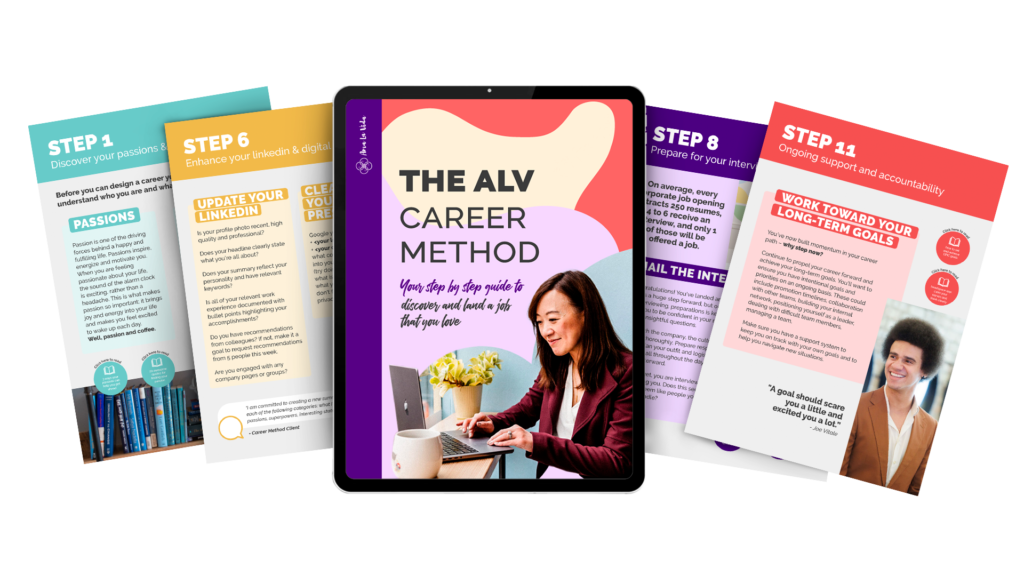
Download our comprehensive step-by-step guide to design and land a job you love!

Images from The ALV Career Method Guide
ALV Method Downloadable Guide

person writing in a notebook

When you feel like it’s time to start looking for a new job, it can be hard to know what to do next. Before quitting your current job, I suggest creating two simple lists. These are lists you can revisit as you continue to work and consider what you want to do next. When you start them, brain dump everything you can think of, then as you move forward, come back and add to them when anything else comes to mind.  These lists will help you prepare for your job search and create clarity about what you’d like to pursue next. You’ll thank yourself later!  List #1 – Everything I Do Now  If you’re thinking about finding a new job, you know what you’re going to have to do – update your resume. Making this list will help you prepare to create your resume and represent your current role in future interviews.  Write down everything you do in your current role – I mean EVERYTHING. Go beyond your job description. Get down to the nitty-gritty. Think about meetings you run, how you prepare for presentations, reports you create, how you manage projects and people, reminders and communications you coordinate, the initiatives you oversee, tasks you perform proactively or without prompting, etc.  Consider all the tasks you do:  This will start as a tactical list. As you jot down everything you currently do, go back and add the impact. What metrics can you share which show your value in this role? How did you personally impact your team’s/department’s/company’s goals? Ask others about your impact if you can’t see it yourself.  The more specific you get, the better. Recruiters and interviewers will ask you about these aspects of your role in the future. Be kind to future you and gather this information while it’s still fresh.  Creating this comprehensive list gives you a holistic picture of what you’ve done in this position and an incredible resource to help support you for future interviews.  List #2 – What I Want Next  There’s a reason (or a few) you’re thinking about leaving your current job. That’s what this list is for. Make two columns for this list. In the first column, keep track of “What I Want Next.” In the second column, list “What I DON’T Want Next.” For your “What I Want Next” column, consider all the ideal aspects of your next job, including:  In your “What I DON’T Want Next” column, think about:  While you’re thinking about what comes next for you, add to this list anytime a new realization comes to mind. Refer back to this as a checklist to remind you what’s important as you move forward.  While relatively simple, the act of capturing this information for future use is a proactive way to save you stress and time when you decide to start your job search. Plus, creating these lists while you’re still actively in your current job makes your preparation more accurate than if you were to complete them in retrospect. Now you have two fabulous guides to help you update your resume and confidently share about your current job during future interviews. 

Read More
co-workers sitting together talking

When I hear the words “people pleaser” my gut reactions used to be, “of course”, “why not”, and “so what?” Then, I became a coach and I learned how being a people pleaser can drain us, take us out of our comfort zone and away from our values, get us in over our heads (with work for sure!), and distract us from our priorities. If people-pleasing is a behavior you are comfortable with, my guess is that it has felt like it worked well for you in the past. Maybe your people-pleasing behavior smoothed out rough edges in your family or with a roommate. Perhaps when you began a new job people-pleasing made you feel like you would be included and liked more quickly. But now… you are moving your career forward and this habit is getting in the way of your growth.   Here are five tips to help you avoid people-pleasing: Ask yourself: What are the circumstances or feelings that lead you to ”people-pleasing” behavior at work? For many of us we feel most comfortable when we avoid: When and why do you step into people-pleasing at work? Get clear about the personal impact of your people-pleasing habits at work: What are the feelings that arise from your people-pleasing? What do you notice when you are in people-pleasing mode at work? Focus on your strengths and determine how you can best demonstrate value to the team and organization: Being open minded and agreeable can be beneficial at work. There may be opportunities we are presented with that will stretch us, enhance our skillset or help us expand our network and influence. When you feel yourself leaning into “automatic yes,” take a pause to consider the implications of your answer. Often in coaching we encourage our clients to become individuals who are acting in response to circumstances as opposed to reacting without thinking. But, if you are being pushed out of your comfort zone for any reason consider saying no. Practice: If you decide that people-pleasing is no longer serving you, you’ll want  to practice the difficult conversations that will feel uncomfortable. Consider gathering scenarios from your recent past when you were stepping into people-pleasing mode.  Then find a friend, co-worker, mentor or coach to talk those situations through. Assess: What is the opposite of people-pleasing? A not so nice word may come up for you.   Working with a coach to step away from people-pleasing habits is extraordinarily helpful. Your coach will help you understand why people-pleasing has felt comfortable to you and identify practices to help you make self advocacy your new habit. At Ama La Vida, we work with our clients every day to help them gain the awareness, skills and confidence they need to take charge of their careers. Reach out to us here to schedule a free consultation call to learn how we can help support you.

Read More
woman smiling with balloon

There is a toxic behavior that is invading our culture known as people-pleasing. I’ve coached countless people-pleasers over the years. In fact, I myself am a recovering people-pleaser. It’s a tendency I’ve worked hard on rewiring within myself, and so I enjoy helping others do the same. Through my experience, I’ve found most people-pleasers genuinely love to help others. Service, empathy, compassion and connection are often what my clients who fall into people-pleasing would identify as their core values. These are all virtues that we seek in other humans. These values don’t go away by taming your inner people-pleaser. In fact, by taming your inner people-pleaser you’ll have more time and energy to make empowered choices about how you honor your core values.  People-pleasing implies that there is no reciprocity for the people-pleaser. They give and give and give and often this leads to damaging impacts to their emotional and mental well-being. If you find yourself giving to the point of exhaustion or resentment, you are not living into your core values. The biggest thing for people-pleasers to reconcile is that when they can authentically live into their values, everyone involved gains something from the exchange, boundaries are honored, and there are no hidden agendas. You can tame your people-pleasing tendencies while still being true to yourself.  The first step in taming your people-pleasing tendencies is to recognize that we all have an inner critic that sabotages us and keeps us from showing up in the way we want to. There are several signs that your inner critic is sabotaging you: If you identified with some or all of the items listed above, you likely have a people-pleasing inner critic. While it might feel impossible to change this dynamic, it ultimately will lead to burnout and become an unsustainable way to live.  So what do you do to tame your people-pleasing inner critic while still being true to yourself? Here are a few tips:  Awareness:Start by noticing what brings out your inner critic and realize you have a choice. Awareness is the first step toward change. Non-negotiables: Identify your priorities and the type of people you want to surround yourself with. By starting here, you can easily discern that something is a no when it doesn’t align with your life’s goals.  Boundaries: Set healthy boundaries. Know your limits. Boundaries are the ultimate expression of self- love. Once you know your boundaries, communicate those needs to the people you love. Don’t be surprised when connections fade. The people who stick with you will applaud you and appreciate your ability to live an authentic life. Affirmations: I’m a firm believer in the power of affirmations. Posting an affirmation somewhere that it is visible, like on your phone background or your mirror, can help reinforce your belief. Some people-pleasing mantras to experiment with include “No is a complete sentence” or “I am choosing to protect my peace” or “I don’t owe anyone an explanation.” Keep these affirmations visible and repeat them daily to reinforce your new belief. Say No:Come up with a list of all the different ways you can say no. Read them often and start to notice and listen to the people in your life who use them often. They might sound like “No, thank you” “I’d love to,m but I can’t” or “I’m so happy for you, I unfortunately can’t be there.”  Ask for Time: This means delaying the yes. It’s perfectly okay to say, “I have to check my calendar and get back to you.” The important thing about this is it gives you more time to evaluate your decision and see if it aligns with your goals.  Acceptance: Regardless of how empathetic you are, you can be there for everyone. Once you can accept you can’t win everyone over and release that expectation the closer you can get to self-acceptance.  Get Comfortable with Discomfort: I’m not going to sugarcoat this, taming your inner people pleaser is not easy. At first it might trigger feelings of rejection, abandonment, or feeling imperfect. The truth is these emotions are part of the journey. The more you can sit with those emotions and embrace the discomfort, the less that can take power of you and your actions.  Progress over perfection:Start small. This could mean experimenting saying no with a close friend or role playing scenarios with a family member. Recognize that little by little by little by little is a lot. Incremental change will bring progress.  Celebrate the wins:As you make these incremental changes, recognize that taming your people-pleaser is HARD work. You’re doing the hard work and sitting with the discomfort that comes with setting boundaries and honoring your non-negotiables. Take time to celebrate your successes along the way.  Save a “Recovering from People-pleasing” List:Start a list in your phone of all the ways you’re learning how to stop being a people-pleaser. Each time you need a boost of confidence, refer to it. Seek Support:All of us can benefit from the support of a trusted neutral party. Working with an ALV coach can be a helpful next step in helping you Tame your people pleasing tendencies while still being true to you

Read More
woman smiling sitting outside

Over the last few years, the conversation around mental health has been shifting from silent and stigmatized to open and commercialized and everything in between. I, for one, am so glad we’re starting to talk about mental health. It’s not just about being healthy or struggling with mental illness, there is a big area in the middle that tends to be forgotten.  Today, we’re going to talk about improving your mental health the way you would improve your physical health if you’re already a relatively healthy individual. How do you show up to the “mental gym” and what sorts of things do you do to flex muscles that may be a little weak? Let’s dive in! Note: Mental health is on a spectrum and before we dive into some ways you can improve and care for your mental health, we want to call out that sometimes the best answer to this is to seek help. If you feel like you need professional help with your mental health, please call a mental health provider or seek out immediate help through the SAMHSA National Help Hotline.  1. Lower Your Expectations Every time I say this to my clients, they laugh. Lower my expectations? Why? Well, odds are that your expectations of yourself are way too high. Much higher than the expectations you hold of others or anyone else holds of you. So, lower them.  We expect ourselves to give our 100% ALL of the time and if we don’t, we beat ourselves up for not doing enough or being enough. So I say, lower your expectations. A good way to frame this is by coming up with your goal and then breaking it down into three categories.  Your first category is your expectation of yourself when you’re feeling your best – this can be your “ideal”  The second category is your expectation of yourself if something else were to come up – a busy week, a last-minute deadline, or a head cold And the final category is your expectation of yourself if something major happens – a family emergency or a more serious illness like the flu or covid Now, that third category is your new goal.  Anything beyond that, categories 2 and 1, is exceeding your expectations, not meeting them. Anything you do that’s the third category or more, you celebrate! If you don’t meet that level of expectation, you reflect: what happened, what got in the way, what type of support do I need? In none of these circumstances, do you ever beat yourself up. Got it? 2. Stay Present “If you are depressed you are living in the past. If you are anxious you live in the future. But if you are at peace you are in the present” Lao Tzu Living in the moment or mindfulness has been and still is a hot topic of conversation. We all know we should do it, but how do we do it when our minds are reeling, going a million miles a minute? One of my favorite mindfulness practices is a practice called “Orienting.” It’s simple and you can do it anywhere, anytime. I encourage you to have scheduled moments in which you orient (set an alarm or match it up to a thing you do every day like drinking coffee, eating lunch, or brushing your teeth).  Before starting this exercise, pay attention to your breathing. Take slow, deep, long breaths – in through your nose and out through your mouth. Breathe deeply for about 3-5 breaths and then go through the following steps: 5: Acknowledge FIVE things you see around you. It can be anything, don’t worry about judging it or bringing any memories or stories in. Don’t start thinking “I see my room, it’s so messy and there is clutter and I should’ve cleaned it” Simply acknowledge 5 things. Ex. I see a pen. I see a plant. I see a computer. I see a tree. I see a couch. 4: Acknowledge FOUR things you can touch around you. It could be your hair, a pillow, or the ground under your feet. Again, no judgment or stories just state facts. Ex. I can feel the ground on my feet, it feels cold and solid. I feel the pillow in my hand, it is soft and fuzzy.  3: Acknowledge THREE things you hear. This could be any external sound around you or near you.  Ex. I can hear the whirring of a helicopter. The sizzle of a pan. I hear my dog snoring. 2: Acknowledge TWO things you can smell. Maybe you are in your office and smell pencils, or maybe you are in your kitchen and smell food. If you need to take a brief walk to find a scent you could smell soap in your bathroom, or nature outside. Ex. I smell my coffee, it is nutty and strong. I smell my shampoo, it smells like coconut. 1: Acknowledge ONE thing you can taste. What does the inside of your mouth taste like—gum, coffee, or the sandwich from lunch? Ex. I can taste my toothpaste.  Once you acknowledge these things, bring your focus back to your breath. How do you feel now? Where do you feel those feelings in your body?  You can also do this exercise in the moment when you feel anxiety, stress, or any other intense emotion come in. This simple exercise gets you out of your thinking brain into your feeling body and hopefully supports you in de-escalating emotions that may be too intense or negatively affecting you in your day to day. 3. Move Your Body Moving our bodies has proven benefits for our minds and bodies. It helps release endorphins, move emotions through our bodies, strengthens the mind-body connection, and get us out of our heads. Like everything, there are helpful and harmful ways to do this and for the sake of improving your mental health, we want to focus today on intuitive movement, what it means, and how to embrace

Read More

“If you tie your self worth to your career, the successes and failures you experience will directly affect your self-worth.” Anne Wilson (professor of psychology at Wilfrid Laurier University) When I considered a career transition out of the HR profession, I initially feared that once I was no longer in a role as an HR Business Partner as I had been for so many years, that I would be lost without direction and not know who I was anymore. This idea, that my identity was directly tied to my job in HR, made me feel like if I were to leave my role or start over and make a change, that I would no longer be valued by myself or anyone else.  A pivotal moment for me… was when I realized that I had developed the critical skills and capabilities to be a successful HR professional, but that was not my identity. Whether or not I was employed with the title of HR Business Partner, I was still the same person that had all of the experiences that had led to the growth and development of my skills. I would continue to build meaningful connections with people by leading with curiosity and empathy. Active listening and clear communication would always be strategies I would utilize to solve problems in whatever role I found myself in. This awareness of who I am as a person and the experiences that I have had that have gotten me to this point in my career help me see how I contribute and add value to people and organizations in other capacities. In this way, I continue to work toward changing my pattern of thinking. Instead of deriving my self worth from my current career/title/role, I find it more helpful to focus on my achievements, experiences, and skills developed that have brought me this far. These are the critical parts of me that I will never leave behind. ~ Kristin

Read More