Category: Personal Branding

woman looking at computer writing down notes in her journal

Most of us entered the workforce thinking that just putting our heads down and doing the work would get us noticed and promoted. Fast forward a few years, we find ourselves in a work environment that is not inspiring, fulfilling, or (even worse) meeting our financial needs! The Big Lie about career success Even though times are changing, many companies are still not explicitly encouraging employees to be proactive in taking ownership of your career at work. The reality is, as an employee, it is no one’s job but your own to ensure your needs are met. The key to finding success in your career is letting go of the idea that someone is coming in to save you. Yes, there are employees who get lucky with wonderful bosses who support and advocate for them. But the reality is, if you’re waiting for the perfect manager, you’re putting your fate in someone else’s hands. Whether you’re seeking a leadership role, looking for more autonomy, hoping to work on a dream project, or maybe even just looking for a better work-life balance, taking ownership for your own success at work is crucial. By taking ownership of your own career progression, you can break out of this cycle and create real change. Why is taking ownership of your career path important? The reality is, if you’re leaving your fate in the hands of a manager, you’re at risk. You might not get the promotion you’ve been working toward for years. You might get laid off with no prospects on the horizon (as so many job seekers are experiencing these days!). You might just end up hating your job with no way out. So many employees think this is the only way to move through their careers, but the reality is you can take ownership of your work experience, and at the end of the day, you are the only one with responsibility for your own success. By taking ownership of your work, you can become accountable for achieving your career goals and also potentially instigate change within the culture of your organization. What ownership looks like at work Taking ownership at work goes beyond just managing your projects proactively and problem-solving effectively. Instead, when you have true ownership of your full career you have options and control over your work-life, rather than feeling stuck if your job goes south (or away!). To take ownership is to know: And then setting goals and systems to move you in the direction of those things. So, how do you take ownership of your career? It can seem overwhelming, but taking ownership of your career is absolutely possible. With the right strategies, you can take control of your professional life. Here are five steps you can take to assume responsibility for your work trajectory and build a job you love. 1. Craft your career vision The very first step to taking ownership of your career is to define what success would look like for you. View this post on Instagram A post shared by Ama La Vida | Online Career Coaches (@alvcoaching) Remember that work is a resource to serve your life, not the other way around. Having a clear perspective on what success means to you is the foundation for setting professional goals that align with your personal values and ambitions. Consider the bigger picture, think beyond just your job title or salary, and instead consider the impact you want to have on your industry, your community, or even the world. Set aside time to develop a sense of what matters most to you in life, how you want to contribute, and what you want to achieve. Then write it down. 2. Create alignment between your behavior and your vision Once you have a clear understanding of your personal vision for success, the next step is to bring your job into alignment with your goals. Here are a few ways to bring your job into alignment with where you’re going: Job crafting Even if your current job role doesn’t necessarily match your dream, it doesn’t mean you need to quit. Consider job crafting, where you and your manager redesign your job responsibilities to better align with your strengths and interests. It’s true—bringing your job into alignment with your vision for success will require good communication with your manager, and even your teammates or direct reports. While it’s important to be respectful of company goals and culture, you can also discuss how gaining additional experience in certain areas can benefit both you and the organization. This might include new projects, new job roles, and (hopefully!) more growth opportunities for you! Many companies are excited at the prospect of employees taking ownership at work because it often means that their employees feel empowered and will do great work, rather than just the bare minimum. Setting boundaries Too often we see employees who are burned out, miserable and deeply frustrated with their company culture—only to realize that they are part of the problem! This isn’t to take accountability away from a bad boss or toxic workplace, but setting boundaries can go a long way. View this post on Instagram A post shared by Ama La Vida | Online Career Coaches (@alvcoaching) Setting boundaries is about establishing clear guidelines for how you want to be treated, when and how you’re willing to work or what tasks you are willing to take on—and establishing how you will enforce them. If you’re establishing new boundaries, it’s important to communicate these to your manager to get buy-in and ask for support in maintaining them. By having open and honest communication with your manager, you can work together to find a solution that meets both your needs and the company’s goals. Honoring your own boundaries is essential to avoid burnout and ensure that you are making progress toward your bigger-picture goals. 3. Show up (authentically) as your personal brand As you bring your current job into alignment with the long-term vision for

Read More
personal brand to the next level

Your personal brand is much more than a logo or a catchy tagline – it’s an identity. When done right, personal branding can help you win new business and advance your career. But building your personal brand doesn’t come overnight. It requires commitment and dedication to working with the channels that yield the best results. The question is, how do you determine these channels? With the wide choice of options out there, choosing where to focus your efforts can be really hard. If you’ve already established a personal brand and you’re ready to take your personal brand to the next level, the following tips will help steer you in the right direction. Create Valuable Content Bill Gates once used the phrase “content is king” to describe the future of the Internet as a marketplace for content. Well, the future is here!  Content gives you an opportunity for shareability, social influence, and revenue generation. So, if you want to grow your online following, you need to focus on creating high-quality, valuable content and share it on social media and on your website. Build Relationships Your personal brand is not what you say it is; it’s what people say it is. And when it comes to personal branding, building relationships and engaging can make a huge difference in how people perceive you. Logically, social media is the best place to start. Here are some ideas you can use: Publish whatever type of content you create, from videos and photos to infographics and articles. Participate in conversations on topics and industries you care about on Facebook and Twitter. Join specific niche groups on Facebook and LinkedIn, or take it one step further and consider joining Slack teams. Giving away resources, downloadables, free access, etc., is also a great way to engage your audience. Whichever strategy you choose, the key is to be genuine and stay human. Contributing only for the sake of extending your brand isn’t enough. You need to show that you really care about the topic and the community. And if the groups you join reflect the same or similar concerns as your brand, this should come naturally. Focus on How You Share Your Expertise You probably create lots of stuff and share it with the world for free. Now it’s time to think about how you can use it to your advantage. Here are a couple of tips to help you strengthen your reputation as an expert in your field: Creating educational content is the best way to position yourself as an expert in your industry. If writing articles is your thing, consider taking your best works and turning them into a series or even an ebook. Consider paying for getting published. Whether you’re publishing your content on Medium, Dribble, Facebook, or Instagram, you’ve probably noticed that getting any attention is hard. So, change the tactic and start pitching esteemed industry publications that would be interested in publishing your stuff in exchange for some cash. You can also create an email course to share your knowledge. Pick a topic you’re an expert in, then take your best existing content on that topic and edit it down to about 500 words for each day of your mini-course. Use an outreach automation tool to send a free multi-part email course and track which parts of your course subscribers are engaging with the most. Offer Your Help The best sign that your personal brand is really taking off is when other professionals in your field start asking for your opinion. This means that people have noticed your expertise and that they value your experience. Remember the communities we discussed joining before? Use that! Offer people in those communities your help. Whether it’s reviewing somebody’s landing page or editing their newest blog post, make sure to provide extensive feedback that will be truly helpful.   And this is not where your help ends. You can also consider doing some free-of-charge work for nonprofits and participate in community projects. Even though this won’t bring you any financial satisfaction, think of it as working for influence. By sitting down face-to-face with people looking for help, you become an influencer, and those people will help spread the word that you are good at what you do. Be Ready to Invest Some Money Your content might be of the highest quality and super-entertaining but what good is it to you if nobody knows it exists? The world of content publishing is crowded so, as we mentioned earlier, sometimes paying for exposure is essential. Set aside some money to promote your best work, whether it’s an ebook or that email course you built. Or even better, promote your videos. Do Facebook Live with valuable content and use paid advertising to push those videos to a wider audience. This is a great way to build your online presence and connect with people to build the ‘know, like, trust’ factor quickly. But investing in your personal brand doesn’t necessarily have to be connected to promoting your content. Consider hiring a great developer to redesign your site, a graphic designer who will create a custom logo for you or a content writer who will rewrite the copy on your website. As people say, you have to spend money in order to make money! Sure You’re Everywhere Once you have done all of this, you need to ensure that it all counts. Start by Googling yourself and if you’re not happy with the results, do everything you can to enhance your personal brand. Here are some ideas to help you: Refine your profile on LinkedIn. But be careful not to sound too promotional; instead, focus your profile on outlining clearly how you serve others. Have a website or personal blog where people who search for you online can see who you are and what you do. Go through slide decks from older presentations and ensure they are on Slideshare. Reach out to blogs in your niche and see if you can write something

Read More

As a Career Coach, I am always asked, “Are cover letters required?” The question when preparing your job materials (resume, LinkedIn, interview prep) seems to be one at large. Then comes further questions, “Where do I begin when writing a cover letter? Is a cover letter relevant or important today?” Since these are questions I’m frequently asked, today, I’ll be sharing with you, my ultimate guide to writing cover letters. Reframe this part of the job process The investment I see in myself and the awesome skills I have developed, projects I have worked on, etc is not going to be shared otherwise. I need to share it with someone!  Well, I hope you are always sharing your career experiences with someone. What a great reminder that the cover letter is a document to do just that, share your career experiences (paid and unpaid, any experience that is relevant), your accomplishments, but more importantly, why it was so important for you to develop that skill, what you learned from overseeing a project on the team, or why it was important that you managed a team.  You can view the cover letter (also known as letter of intent/interest) as a personal letter. It helps recruiters place a face and the human you, to paper. According to Glassdoor, the average job opening attracts 250 resumes! Can you believe it?! Therefore attaching a cover letter with your resume can give you an extra space to stand out. While sharing relevant experience related to the job description and share the essence of who you are.  Here is where the fun begins. I want to inform you of how to get started, what to do before you start writing, and a simple breakdown of what to include on this one-page document.  Before you begin… Review, review, review! Review the company’s website, LinkedIn page, and any news updates about the company to get an overall sense of their values, their mission and upcoming projects (bonus points for aligning yourself with these goals-they want to see that you are paying attention and this shows that you are already interested, giving some of your investment to the company).  Have the job description handy, and you may even want to drop your job description into a word cloud generator like this one here to see which keywords stand out, to include both on your cover letter and resume.  See how you match Next, you want to closely read the job description, highlighting the qualifications you have, but look for what the employer is seeking in a candidate beyond the qualifications. Study the company’s values and learn more about the company in the news. Is there anything that they are doing that is directly aligning with your work values and purpose that is important to you? If so, include this in your letter to make that connection for them and again, show how you will add value to their company.  Don’t be stingy on the details. Be confidently specific and strategic when discussing your experiences with specific focus on things such as keywords that are used in the job description and your personal story. A great example of this is that I once worked with a client who was applying to a Marketing Director role for a well-known food product company. She wove in her personal story with her marketing experience, sharing that she is a mom with a pantry full of their specific brands, where she shares with other moms and kids her pantry and love of the brands.  Understand your “Why” Give yourself time to brainstorm. Before you begin writing the letter, think about how you will connect your past experiences and the interest you have for the company and position, and to understand your “why” for wanting to pursue this position.  Formatting The Cover Letter: Contact Information: One of the first and easy steps, your contact information. Always include your contact information either in the heading (a heading that matches your resume heading) or below your signature, which will close the letter.  Salutation: Include a salutation. I know we all have super investigation skills. We can thank Facebook for teaching us how to stalk. Do yourself a favor and do some background investigation on the department via LinkedIn, the company website. Consider reaching out to any of your direct contacts to find a hiring manager for the position. If all else fails, you can direct your letter to the department that is hiring such as, “Dear Marketing Department Hiring Committee”  Introduction:  Hello, my name is Eden and I am applying for the X position at your company. Wrong. This is too generic, and I know you can introduce yourself with more bravado and grab the reader’s attention. You want to begin your letter with a convincing read me.  Here goes another try: “This last month, I was immersed in an article on the growing number of life coaches that would need to fill the market to solve every human’s problem. This struck me, as I want to help people not only solve problems for themselves but live a life in their careers with engagement, ease, and growth. As I fully invest in the coaching process with my clients, I want to also be part of a team of coaches to support one another with enriching our clients’ lives, all of which is why I want to be part of your dedicated and growing coaching team.”  Middle paragraph (s):  Show your enthusiasm in connecting your experience directly to the job description duties and preferred qualifications. The job asks that you have cross-team collaboration. Great. Share a direct experience that showcases a project you delivered while working cross-functionally with teams to deliver on this project/timeline/etc. You want to be sure you can easily connect the dots for the person reading the letter. Connecting the dots means that the reader can quickly comprehend that your past experience aligns with the common job duties and functions the role entails. It also

Read More

Welcome to part 3, my friends! Now that you know your professional purpose, that one thing you’re known for, that feels meaningful and inspiring to you, here’s how you go about actually making it into a brand. But first, let’s review! In part 1, we talked about what actually is a personal brand and why should you want one. Quick recap: your personal brand is what you want to be known for (usually in the professional world), and it’s important because it helps you connect to other people in meaningful ways. Then in part 2, we discussed how to find your personal brand, which is ultimately the way you are best suited to contribute to an organization; how you best help people. Throughout this article, I’ll refer to you doing “your thing.” That “thing” is your personal brand. If you don’t remember or haven’t defined your brand yet, you should go back to Part 2. Great. Let’s rock and roll. Hold up, why do I need to do this part? Very fair question. Short answer: so you can do the thing you love to do more and better. So you can connect with other people who either are doing the same thing, or who want to help you do your thing, or who want to give you a job doing that thing.  You’re establishing yourself as the person who knows a lot about it. Who cares a lot about it. You’re the expert. It’s your thing. You want people to know.  Become an expert I don’t really care how you consume information, but you need to start consuming information. That might be the radio, podcasts, magazines, books, blogs, YouTube videos, documentaries…there’s a lot of ways to do it. This shouldn’t be painful or hard for you, tbh. You’ve picked the topic that you love the most, that gets you the most excited, in some way, shape, or form, I hope you enjoy learning more about it. If it’s not, please revisit our last post and start over. Remember, it can be music or sports or fashion. It can also be gene-splicing. Whatever gets you excited and happy to dig into the subject in your free time!  Pick your channels Oof. Channels. What the heck are those? Well, if nothing else, when you’re talking about your job, it’s probably LinkedIn and maybe Twitter. Let’s keep it simple, shall we? Channels are ways to talk to other people. LinkedIn and Twitter are the best-known and most widely used of them for networking purposes. Depending on your industry, it could also be Instagram, maybe YouTube, maybe TikTok? I don’t know, I heard it’s something the kids are using these days. Don’t make it complicated. Unless you have reason to believe you need to use something else, stick to LinkedIn. Twitter if you feel so compelled and want to post a whole lot. Your newsletter or blog if you have one. And I hope it goes without saying, it’s also every person you talk to in the real world. At a party, at the grocery store, everywhere. Talk about it Share the information you learned that’s interesting to you! Do it on LinkedIn. Maybe Twitter. In the lunchroom. Definitely with your boss and at that networking event. Talk about it at the grocery store and when you’re stuck between floors on an elevator. You are a wealth of knowledge dedicated to helping people and the world through your very special subject. Don’t be shy! Read, form an opinion, and help others by telling them what you know. And it’s true, not everyone will appreciate it, but that’s ok. You are broadcasting to everyone that you are passionate and knowledgeable about things that excite you. Over time this will open doors to new opportunities for you that will continually excite you and help you grow your career in a direction you actually want to grow. Questions? Thoughts? My two favorite subjects are branding and your career, so please drop a comment below if you’d like to connect. Until next time, my friends! XO, Libby

Read More
sitting down to define your personal brand

How do I know what my personal brand should be? Welcome back, my friends! In case you missed it, last time we dug into what actually is a personal brand and why should you want one. Quick recap: your personal brand is what you want to be known for (usually in the professional world), and it’s important because it helps you connect to other people in meaningful ways. This week, we’re moving on to what your personal brand should actually be and how to define it. And if you don’t know, how do you decide? Great questions. Let’s dig in, shall we? How do you define your personal brand? Again, knowing that your brand is what you want to be known for, it can be made up of a few things: Backing up. We all have that friend, right? She’s known since she was a kid that she wanted to be a police officer and has followed that dream doggedly every day until she reached her goal. Or maybe your friend is an environmental rights activist who cares so much about global warming he carries metal straws with him everywhere and gives you a look any time he sees you accept a plastic one at brunch. For better or worse, that’s their brand. And to their credit, these people know who they are and what they’re passionate about. And maybe that’s you! If you can quickly and easily name what you’re passionate about, that’s a big part of your brand.  If you’re just not completely sure what your professional passions are (which is really common), it’s time to get really reflective about some key questions: This is just a jumping-off point, hopefully, you get the idea, though if you’re finding these questions hard to answer, Ama La Vida has a wonderful career membership that helps you dig in a little deeper to your passions, gifts, and values to uncover your purpose. Just sayin’. Put it all together Now that you’ve pulled together all that data, find your key themes. It might just be one, but I wouldn’t go more than 4 or 5.  Write them down. Pick the one that’s most relevant to your career, particularly how you want to contribute to a company, organization, or the world. Maybe it’s a mashup of 2 or 3 that fit together nicely, like a specific group of people you want to help and a specific topic on which you can help them within a key industry. I’m getting ahead of myself. Here’s your framework: I help [group of people] to [do this thing]. So, for example, as a coach, “I help young professionals to create careers that are meaningful and fulfilling to them so they can create lives they love.” A police officer might say, “I help the citizens of my town to feel safe by enforcing the law.” An investment banker would say, “I help startups in my niche industry to raise capital by issuing stock to fund their future growth.” This is your brand. It’s what you stand for. People in your professional circles know that this one thing is the thing you enjoy doing more than anything else and are really, really good at. When they need someone who does this thing, they think of you. When you meet people and they ask you what you do for a living, that sentence is what you tell them.  Your personal brand is the one thing you’re known for, make sure you define it. It enables people to easily connect with you and support you in your mission to make the world a better place by doing the thing you love to do and do best. Now that you know what your brand is, what’s next? Great question again! Let’s talk about that next time. XO! Libby Looking for more resources? Try this Forbes article about personal brands!

Read More
someone working on their personal brand

What is a personal brand and why should you want one? Over the past few years, personal branding has become a catch phrase taking the internet and surely your LinkedIn feed by storm. Everyone from Gary Vaynerchuk to Simon Sinek has their own take on what a “personal brand” is and how to create one. Which, yes. Having a personal brand is a very good idea. But before we dig in to how to create a personal brand. Let’s start with what it is and why it matters. What actually is a personal brand? Great question, my friend. IMO, there are a few ways to think about this question. First of all. A brand when it comes to a company or corporation is an identifying mark that becomes a representation for the company itself. This is key for corporations, right? Because they need a way for people to find them and also to distinguish themselves from their competition. Really good brands go beyond just a logo or a name and start to represent ideologies or core philosophies. You can name them easily, I’ll spare you the list. These are the products you love and maybe even wear on t-shirts or hats. If you want to know more about that, look back at Simon Sinek’s Ted Talk. It’s amazing. Next up, personal branding. Obviously you already have a name you can start with. Your logo is probably your face for all intents and purposes, so you’re already two steps ahead, in many ways. To take it to the next level, however, your personal brand is what you’re known for. I think the easiest way to think about it is: If a stranger typed your name into Google and was actually able to find you, what would they know about you from what they found? When you meet someone on the street and talk to them for 5 minutes, how would they describe you to their friend later that day? If everyone you met only knew one thing about you after talking to you for 5 minutes, what would it be? Because the reality is, people search for you (yes, you!) regularly on the internet. You meet people every single day. They might be your new coworker, a prospective employer, a prospective client, or just your friendly barista who’s been making your half-caf iced oat milk latte every weekday morning for a year and half. So why is personal brand important? Another excellent question! Especially for those of you whose name isn’t easily Google-able, it’s easy to slip into the comfort of anonymity.  When you’re name is typed into that search bar and 100,000 other people show up, why does it matter? Well, a few reasons my friends. First, people want to connect with you. Yes, you! Human connection is a basic biologically-driven human need. We function best in tribes. We enjoy being part of a community. Connecting feels good. People want to help you. They want to know how you can help them. Plain and simple.This brings me to my second point, though. People are busy and lazy. Maybe both? Connecting with people, helping people, getting support from people — it all feels good. But actually taking the time to know someone? How often do you forget even someone’s name in the first few seconds of meeting them? You’re not alone. It’s ok. No need to judge. So if people want to connect with you and help you (which they do), but also don’t want to put in a lot of effort to do it (which they don’t), how can you get their help? Have a personal brand! A personal brand is your most sure-fire way to make connecting with others easy, and I daresay fulfilling, maybe even fun. It’s honestly not just about what comes up in that Google or LinkedIn search, though that is important. It’s about knowing who you are and what you stand for, so that you can more easily connect with others and support them in a way that’s meaningful to you. And so that they can do the same for you. But how do I define it? That’s the million dollar question. So, if personaling brand is what you want people to know about you in a 5-minute conversation so that you can more easily connect and support each other…how do you get there? Short answer: know yourself. Longer answer: tune in next time! XO! Libby

Read More

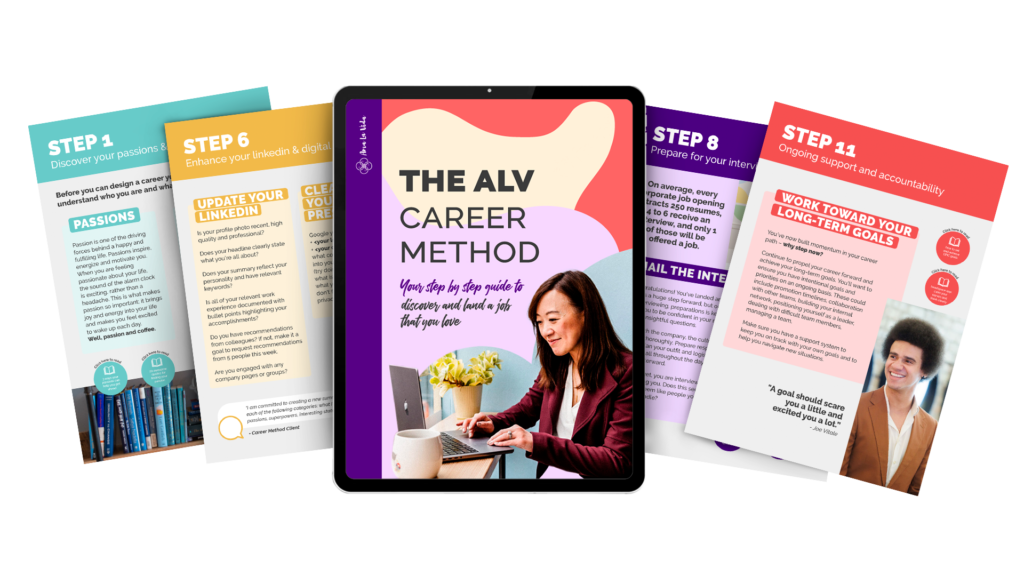
Download our comprehensive step-by-step guide to design and land a job you love!

Images from The ALV Career Method Guide
ALV Method Downloadable Guide