Calling all job seekers! We’re back with 9 cool jobs for you to check out. Even if you’re in the beginning phases of your job search, give these a look. You may find a new idea or inspiration! Our clients and community are looking for unique jobs in a fun environment. These jobs should reside within organizations which prioritize people and culture and provide exciting ways to make an impact beyond the mundane 9-5. We are particularly interested in positions which don’t neatly fit into an obvious career path box (e.g., doctor, lawyer, accountant). If you know of a job that you think would be great for us to share with our community of driven career-transitioners, you can submit it here for us to consider for a future post! Title: Associate Director, Market Research Company: Exact Sciences Location: Madison, WI Why we like it: In this position you’ll play a critical role in advancing Exact Sciences’ mission of detecting cancer at its earliest, most treatable stages. Direct from a source within the company, Exact Sciences really embodies a people centric culture where growth and development are a key focus. They’ve done experience maps, there’s an in-office book club (most recently on on Senge’s 5th Discipline) and they take annual Gallup surveys to heart (e.g. the avg. PTO increased by 1 week for all employees based on last year’s feedback). This is a place where you voice is truly heard. Read more and apply here. Title: Operations Coordinator Company: New Moms Location: Chicago, IL Why we like it: New Moms is an organization we at ALV have been supporters of for a long time. They provide young mothers and their children with safe and stable housing, a path to employment, and the tools they need to learn and develop strong parenting skills. This unique, wrap-around approach results in deep and lasting change and interrupts the cycle of poverty for two generations. This position provides high visibility as it reports to the Director of HR & Operations, and works closely with all staff to ensure seamless service delivery across all New Moms locations. Read more and apply here. Title: Experience Ambassador Company: Dabble Location: Multi Why we like it: If your idea of a fun Saturday is a pottery class with friends, this opportunity may be a dream come true! Dabble is a community marketplace for people to list, discover, and book unique experiences in their local city. Dabble Experience Ambassadors are energetic networkers with a keen eye for fresh, exciting, and unique learning and local experiences. They have diverse interests and experiences, giving their perspectives a distinctive edge. Dabble Ambassadors have a good sense of their city and the people who live there. They jump on creative, new chances to share ideas and skills by curating classes and experiences with engaging and knowledgeable teachers and hosts in interesting locations. If you want to unleash your creativity and get on board with a fast-growing, female founded company, look no further. Read more and apply here. Title: Audio Marketing Coordinator Company: SeatGeek Location: New York, NY Why we like it: Love marketing and podcasts? Well this position might just be made for you. As an Audio Marketing Coordinator, you’ll be focused on driving SeatGeek’s position as a leading audio advertiser. You’ll guide the growth of their audio advertising program and stay on top of the latest developments in podcasting, radio and digital audio. Some of the perks include $120/mo to spend on live events tickets and annual subscriptions to Citibike, Spotify and meditation services! Read more and apply here. Title: Papa Pal Company: Papa Location: Multiple Why we like it: Do you absolutely love grandparents? Us too. What a wealth of knowledge, experience and joy comes from our interactions with the seniors in our lives. Geared toward college students, Papa provides companionship and support for senior citizens. As a Papa Pal, you can earn some cash while enhancing the lives of those around who you may not have other family nearby. Our hearts are full just thinking about you clicking that apply button! Read more and apply here. Title: Human Resources Manager Company: CTI Location: San Rafael, CA (remote work a possibility) Why we like it: As we mentioned in this blog post, CTI is one of the top coach training programs in the world, and we highly recommend it. This job provides you with the opportunity to become involved with the very exciting coaching industry as CTI helps others pursue their coaching dreams. As an advocate of the People and Culture function, the HR Manager will be a key player in the recruitment of staff, and in supporting the organization’s ongoing transformation into a leadership development company. In this role, you’ll have flexibility to work partially remotely. Read more and apply here. Title: Senior Manager Company: Peritius Location: Chicago, IL Why we like it: At Peritius you get the dynamic, challenging work of management consulting with the laid back culture of a 40-hour work week. Peritius takes a human-centered approach to consulting, where the impact on people is as important as the impact on the business. If you enjoy the nature of traditional consulting work, but you are looking for a different cultural and environmental experience, this could be the perfect place to do it. You’ll also be supporting a women-owned small business. Read more and apply here. Title: Digital Product Manager of Mobile Loyalty Company: McDonald’s Location: Chicago, IL Why we like it: Have you heard about McDonald’s amazing new West Loop office? With monthly organized events, massive outdoor spaces, an 8000 square foot gym, and an onsite McDonald’s serving international favorites, this office helps the team connect with each other like never before.  In addition to the fun atmosphere, this position gives you the opportunity to shape the future of McDonald’s loyalty program and help to bring that program to live via its mobile app. Read more and apply here. Title: Associate Manager, CX Operations Company: Glossier Location: New York, NY Why we like it: If you’re anything like us, you’ve been continually accumulating every one of Glossier’s product. Joining this company means you’ll be getting on board with a female-founded startup which is

Read More

Is it hard for you to say no? Do you sometimes find yourself spending an excessive amount of time making your work products just right? Are you commonly rushing from one task to the next? Do you commonly neglect celebrating yourself and your successes? If so, congratulations! You might be a perfectionist, you are most certainly a human being, and you fit right in with the overachievers here in our ALV community. The thing about responsibilities, though, is that they will just keep coming whether or not we have the time or mental capacity for them. And, if you have a dream or a vision or a wild passion, you don’t want them to stop! However, a growth-oriented life doesn’t mean you have to run yourself ragged. Sure, you might have late nights or stressful days, but those can’t be the norm – they simply aren’t sustainable. It helps to have strategies that combat the need to always-be-doing. For me, I need to constantly switch up my routine. A tool that helped me refocus a month ago might not be what I need right now. In case you’re someone who also benefits from a ton of tools in your toolbox, I’ve included some of the ways I’m slowing down below. Taking 60 seconds for deep breaths. When I set this goal for myself, I felt overwhelmed by finding the time to fit it in – and then almost immediately, felt like that was the wake-up call I needed. Even one simple minute of deep breathing or mindfulness can make a huge difference in my day. At work, I’m a go-to for lots of issues, so it can be hard to have uninterrupted time. My strategy has been to set timers – 4 throughout the day, scheduled around meetings and other obligations – and when those go off, I take a quick walk to fill up my water bottle or escape to the restroom and make the time to breathe. Practicing time blocking. We’ve all seen the articles that warn us about multitasking – specifically, that it doesn’t work. Argh! Time blocking is a powerful alternative that helps me actually get things done. In a nutshell, time blocking is the simple practice of dedicating certain amounts of time (I work best in 1-3 hour time spans) on a single task or project. This helps to keep your attention on what’s truly important instead of being faced with constant distractions and task-switching. At the beginning of each week, I look at the projects I need to complete and find blocks of time in my schedule (rare!), then physically set a block on my calendar to work on them. When the time comes, I turn off email, put on a playlist that gets me in the zone, and fully turn myself over to the work. Getting enough sleep. I can’t overstate the importance of sleep for my personal productivity. I don’t notice a huge burst in energy after my second cup of coffee, but I do fall victim to the 2 pm slump if I haven’t gotten enough rest the night before. I also notice that in general, I have a harder time concentrating and digging into my creative side if I’m feeling sleep deprived. Making sure that I’m getting enough zzz’s can require some sacrifice – perhaps I shorten (or skip!) my workout, I grab healthy takeout instead of cooking dinner, or my dirty laundry sits in the basket for another night. Once I’m back on track with my sleep, I can get back on track with everything else in life. Life happens, and that’s what’s exciting and beautiful about it. It’s okay to take a step back to remind yourself of what truly matters. Don’t be afraid to slow down, recharge, and get ready to dig into the work that’s really important. This week’s challenge This one can be done right here, right now. Get your phone out and set a timer for 60 seconds. Close your eyes, breathe, and allow your thoughts to wander where they may. When the timer goes off, take your final deep breath – and then get back to work. In our insanely hectic lives, getting one minute to yourself to simply be is such a treat. Give that gift to yourself. Repeat as necessary and reap the benefits. We know you want to learn more. Here are some of our favorite additional resources: Unpacking this controversial concept: “Finding the type of self-care that resonates with you is key. But what comes next?” Yes, it’s awkward. Yes, you still need to do it: 4 Mindset Changes That’ll Make Networking Feel Way Less Fake and Horrible Listen, implement, repeat: On Saying Yes If you’re in it for the long haul: Toxic Workers Are More Productive, But the Price Is High

Read More

It was 2017, and I was a seasoned SF resident living in one of the most sought after neighborhoods, working in a high-paying job in the tech industry. I had lived in the city for over 6 years and was way past the post-college city life honeymoon stage. I had gone through huge career transitions, fallen in and out of love, experienced different neighborhoods, and bounced around bars and restaurants. I was living in a beautiful apartment in the heart of the Marina, making a great salary and surrounded by all of my best friends. What more could I have asked for?? Exactly… yet I felt like something was missing. I found myself struggling to get up in the morning, throwing myself together and dragging myself to my stable 9-6 job. I was feeling uninspired in my career, demotivated and lacking direction or growth. I noticed my biggest concerns on a weekly basis were when I could book my next mani/pedi, who my ex was now dating, or what I was going to wear out that night. No joke, first world problems. I was noticing a pattern with my life in San Francisco, and this wasn’t the first time I had this feeling. It was a feeling of being stagnant, stuck, trapped, and outright bored. I was constantly searching for something to look forward to and filling the gaps with nights out, city events, or weekend getaways with friends. However, I came to learn these were all just temporary fixes. The feeling started two years back when I was working in a previous role. My company was acquired and I was lucky enough to receive a generous severance package. I was antsy and itching for a change and used the severance as an opportunity to find adventure, booking a one-way ticket to Spain for my first solo trip. It was the most amazing month of new cities, new friends, new experiences, and Spanish immersion. I traveled throughout the country, learning the history of each city and connecting with like-minded travelers. I came back reinvigorated and excited to re-assimilate into SF life with stories to share. I thought I was there to stay. Fast-forward a year and a half later, there I was again with the all too familiar stuck and stagnant feeling, wasting my weekends recovering from a night out or scrolling my social feeds and comparing myself to what this or that friend was doing. I was consuming myself with the smallest problems and once again craving a change. Luckily, all it took was one conversation at a friend’s birthday to plant the seed for my best plan to date. While chatting with a friend about my situation (unhappy in my job, over SF life, wanting to travel, move cities, etc etc) he put it so simply – “If you’re moving cities, why not just leave your job, pack up your things, travel, and come back and figure it out?” It sounded so obvious, yet so terrifying and exciting. It sounded perfect. As you can imagine, leaving a stable salaried job, home base, and a comfortable lifestyle was not the easiest decision. My inner critic was at an all-time high. Is this a poor career choice? How will I explain this when I return and look for a new opportunity? Am I letting my team down? What will my family think? As someone who is career-driven and a bit of a perfectionist, these thoughts were cycling through my head. I had to reflect on the root cause of the stagnant feeling. I was in a role with no growth opportunity in my desired career direction and living in a city I knew like the back of my hand. I soon learned that when you follow your passions/dreams, the universe and all others support you. So after a lot of self-reflection and internal freakouts, I made a plan. The main goal, initially, was to spend time in a Spanish speaking country for an extended period of time. I asked a close friend and avid traveler for advice and, “Lake Atitlán in Guatemala”, he said, “you’ve got to go.” That was all it took and then the universe did the rest of the work. I saw how it supported me as one after another thing fell into place once the decision was made. One-way ticket to Guatemala: booked. Notice to work: given. Apartment move-out date: confirmed. Life in a backpack: packed. Bittersweet hugs & goodbyes, an emotional airport drop-off and…I was off. It’s amazing what happens when you push past the barrier of fear and head into the unknown. Little did I know, this decision would forever change my life. The first step was taking the leap. If you’re finding yourself in a similar place, dreaming of an adventure but scared to take the leap, here is my advice: When you’re feeling stagnant, narrow in on the root cause of the feeling and start working on actionable steps. The situation will not change until you make moves to change your circumstances. I wish I had learned this earlier and focused on how I could change my situation instead of focusing on what I disliked about my life in San Francisco. Be your own advocate. Don’t be afraid to be selfish with big decisions. Think of your personal goals, dreams, and aspirations. Try not to let others’ judgments cloud your vision or hold you back. Follow your intuition – your gut feeling knows best. Trust it. Taking the Leap & Leaning into Fear We are often afraid of the things we want most. It took leaning into my fears for me to finally take the leap. I was terrified that leaving my stable job would hurt my career and finances. This experience taught me that this was far from true. “Everything you want is on the other side of fear.” – Jack Canfield Be honest and transparent about your decision. Working on a close-knit team, I was dreading giving notice. However,

Read More

Chase your dreams. All around us we see inspiration and advice to shoot for the moon and not hold back. So we go for it. But our dreams are difficult to achieve and they sometimes feel so far away. Enjoy the journey. If chasing our dreams wasn’t enough, now they tell us to enjoy the journey too! Do they know how difficult that is? Do they know how it feels to dream of building a successful blog while struggling to get traffic to their site? Have they dreamed of making partner but exhaust themselves working 80 hour weeks? Have they tried launching a business while having everyone around them tell them they are nuts? You have probably realized that following your dreams looks a little less like floating in a starlit sky toward neverland and more like an obstacle course that goes on for miles and miles. This is completely okay because you have already realized that you’d choose that obstacle course without hesitation because dreaming without doing only gets you so far. However, only doing isn’t the most productive way to go about it. The balance of dreaming and doing is crucial, we need both, and as the saying goes, “where there is no vision people perish.” Now, before you fall into the 24/7 hustle and grind lifestyle that is often celebrated by society today, and easily pursued when what you are doing is your passion; read through this list to note how you can chase your dream, AND celebrate every curveball or bump life wants to present on the way. HOLD THE VISION, TRUST THE PROCESS In order to chase the dream, help yourself out by knowing your vision. You’ll miss all the shots you don’t take, but taking shots with little aim will bring you the same results. Many of my clients focus so much on what they don’t want, they are moving through life dodging those things as opposed to being driven toward goals. If you don’t know where you want to land, how do you know if you’re there? Name what you want, work with what you know, then get to work. See it in your mind, and then WRITE IT OUT Dreams and thoughts can take outrageous forms while floating in the abyss of your mind. Bring it to earth, write it down. Name your dream, detail what it is, articulate what it would feel like to have accomplished it. It’s hard to aim without targets, we’re making targets! Create a vision board Light a candle, take your written dreams, and start building the vision! A vision board serves as a physical representation through pictures, pins, or motivational words that represent your dreams. Everything should “spark joy” or energize when you to look at it. These images will bring your dreams into your reality and your day to day so place it somewhere you’ll see it without thinking too hard! Curious about how to start? One of my favorite YouTubers, Lavendaire explains this a little bit more.   RELISH THE JOURNEY Dreams don’t happen overnight, as a result, the grind will burn you out before you even realize it. Start these practices to celebrate where you are as you’re working towards where you want to be.   Break it down into smaller wins, goals Now that you have your big dream, you’ll want to break it down with mile markers, so you’re celebrating every step of the way! One of the main reasons resolutions aren’t kept is that people aren’t looking at the daily efforts needed to accomplish their grand visions. In a marathon, 26 miles feels daunting, but as you reach each mile marker you know how much closer you’re getting to that gratifying finish line. Write your breakdown of mini goals that lead to your big dream. Each time you reach a goal, decide how you will celebrate that! Share it with friends? Treat yourself with something that will motivate you towards the next, RIDE THE MOMENTUM! Daily Gratitude Start the practice of being thankful for every bump and break in the road! There is no success without learning and failing, this is where growth gets to happen. Be thankful throughout all of it, or you’ll trade the journey for a discouraged less inspired and more comfortable path. Fostering a positive outlook on stressful situations can be hard, start by listing 3 things you are grateful for each day, maybe in a planner or on your phone, it’ll keep you motivated. Yes’s and No’s You can do all things, just not all at once. It’s tempting to overcommit to all engagements with enthusiasm, only to find that you’re strained in all directions. Busy has become a celebrated symbol of success in our society. Be so intentional about marching against that beat. Burning out for the sake of your dream is also something that will delay your success and maybe, leave you with a less energized version of yourself when you get there. Create realistic boundaries around how many commitments you can make and do WELL in for that month or week. Honor that deal and say no to the rest. Overcommitment is a quick way to derail you of the health and quality of work it takes to reach your potential. Praise reports In my planner, there is a page at the end of each month dedicating praise. I welcome the first of each month with the acknowledgment of all the brave and proud things I did in the month before. This mindset helps me greet the new month with the same intentions and so forth. We receive praise from others when we do well, it’s even more important to remind ourselves and offer praise when we do well! Recruit your squad Any endeavor and dream chasing needs a cheer squad. It’s a tough journey, who are the people who will help you keep growing when you’re wanting to quit? An important piece of advice from Steve Harvey is “Don’t share your

Read More

What words come to mind when you think about doing something you’re passionate about?  Happy… Alive… Joyful… Energized… Excited…  When we think about the concept of embracing our passions, it is typically driven by the desire for more happiness and fulfillment in our lives.  And for good reason.  Introducing more of your passions into your life and work will most certainly bring you greater fulfillment.  But, it will also do something else, and that is what I want to focus on. Pursuing your passion builds skills that are often overlooked. Outside of the feelings of joy and excitement, these skills will help you smash your goals and accelerate your career. Let’s dive a little deeper: Motivation Motivation is your driving fuel. When your fuel is running out, you start to slow down and if it depletes completely, you guessed it – you stop. It becomes pretty obvious then that we can’t speed ahead without any gas.  Think about the last time that you were doing something that bored you. Were you focused, energized and motivated? Or were you watching the clock? Now think about the last time you did something you were truly passionate about. Did you get up early to finish it and work even when you weren’t supposed to?  Passion is what gives you the fuel you need to truly step on it! Resilience This is one of the most crucial, and often underestimated, skills critical to your success. When life gets hard – which we all know it does – it is resilience that helps us dust ourselves off, get back up and keep on movin’.  So what does passion have to do with resilience?  Passion makes things all worthwhile. It keeps us determined and committed.  If I am working on a project that hardly interests me and my computer crashes and I lose it, how inclined am I going to be to start again? Or if I’m giving a presentation on something I don’t care about and I totally choke, will I want to talk on that topic again?  The answer to both of these questions is likely “no.”  Sure, if I have to get the work done, then I will. But I may do it with a lot of groaning, frustration and only just do enough to get by. But what if the project was something close to my heart, or the presentation was something I was truly passionate about? Chances are that, even though I would feel upset and frustrated, I would start over or try again because it’s worth it! Passion makes it worth it, and when it’s worth it… we get back up! Creativity When we’re passionate about something, chances are we spend a lot more time thinking about it than when we’re working on something that bores us.  And when we spend time reflecting and caring to make it better, we arrive at innovative ideas and solutions The most creative concepts are born from passion.  The Wright Brothers were infatuated by aviation.  Bill Gates was obsessed with computers.  Rarely will you find an entrepreneurial success story whose main character was not driven by passion. Passion drives innovation and innovation drives transformation, so if you’re looking to make a meaningful impact, your best bet is to first find your passion! When we look back over these three powerful qualities – Motivation, Resilience, and Creativity – we notice that they are three of the most crucial drivers of success Think about any successful people you know. Do they do something they hate? Or do they do something they’re wildly passionate about? Your passions are more than a nice way to catch a little more joy in life. They are the vehicle that will drive your success.  So, I would like to leave you with two questions to think about: Are you currently doing something you are truly passionate about? If not, what opportunities for success are you missing out on and how can you better align your career to your passions? What are you doing on a daily basis to incorporate your passions into your life? What more can you do and how might this improve both your happiness and They say that people with great passion can make the impossible happen. I challenge you to test that theory.

Read More

Starting a business has been the most difficult thing I’ve ever done. I knew it would be hard. Cognitively you understand that when you set out to build a business. But I don’t think I fully grasped how this business would impact every aspect of my life, from my finances to my marriage to my friendships to my confidence… in such challenging but also such beautiful ways. It has grown me in ways I don’t think any other situation could. It has brought me close to people I otherwise wouldn’t have met. It has allowed me to make learning my full-time job. It has given me the humbling opportunity to help others reach their goals. It has been a wild ride already, and it has been worth every bit. Whether you’re developing an app, starting an auto shop or launching a clothing line, there are certain traits I see great founders having. I think these are amplified for female founders. We’ve all seen the stats that women receive 2% of venture funding, and so the creativity and drive it requires to start a successful business as a woman is even more astounding. Here are three of those traits: Stubborn. I mean this in the best possible way. To even want to start a business means that you were unhappy with the way something in the world existed. You have to be stubborn enough to not be able to get it out of your head that this thing could be better and bold enough to think that you’re the one who can change it. You need to have that relentless drive when everyone else tells you you’re nuts. You need to be so fixated on your idea and your dream that you’re willing to make big sacrifices and take scary risks to see it come to fruition and not give up when things get really tough. Scrappy. There’s a level of resourcefulness required, particularly for those with little or no funding. You have to find a way to create something from nothing. Quite literally. Whether it’s googling your way into a new skillset, hustling your way into an event or finding a way to piece something together that looks a lot more expensive than it was, you’ve got to get creative and know that there’s always a solution just waiting to be thought of. Saleswoman. Like it or not, as a business owner you are always selling. Even if you’re not selling your product or service yourself, you’re likely selling your vision to investors. You’re selling your company to employees. You’re selling your impact to the media. As a founder, you can try and fight this reality or you can embrace it. You can shamelessly sell what you’re building to everyone you meet. I know you believe it or you wouldn’t be doing what you’re doing, so it’s simply a matter of getting comfortable putting yourself out there and telling the world why it needs to be a part of what you’re building. I mention this all to you as we prepare to launch a new series on our blog, Founding Females: I Declare My Independence the first week of March. I can’t wait to share the stories of some perfectly stubborn female entrepreneurs. Stay tuned and stay scrappy! This week’s challenge This one’s a two part-er!  Channel your inner founder and start something new. It could be a new Employee Resource Group at work or a new tradition for your family to partake in around the dinner table. Think of something you feel could be enhanced or that is missing in your life or work and create it!  Nominate your favorite #foundingfemales for our new blog series! We want to showcase the stories and voices of the brave women who are out there building businesses. Send them to this short interview page to tell their story! We know you want to learn more. Here are some of our favorite additional resources: Get innovative: 5 Ways You Can Become an Intrapreneur For those founders thinking about funding, an alternate perspective: Venture Capital Kills Businesses Listen to new episodes: Season 3 of the Masters of Scale Podcast is Here  In case your inbox has been building up: No, You Can’t Ignore Email. It’s Rude.

Read More

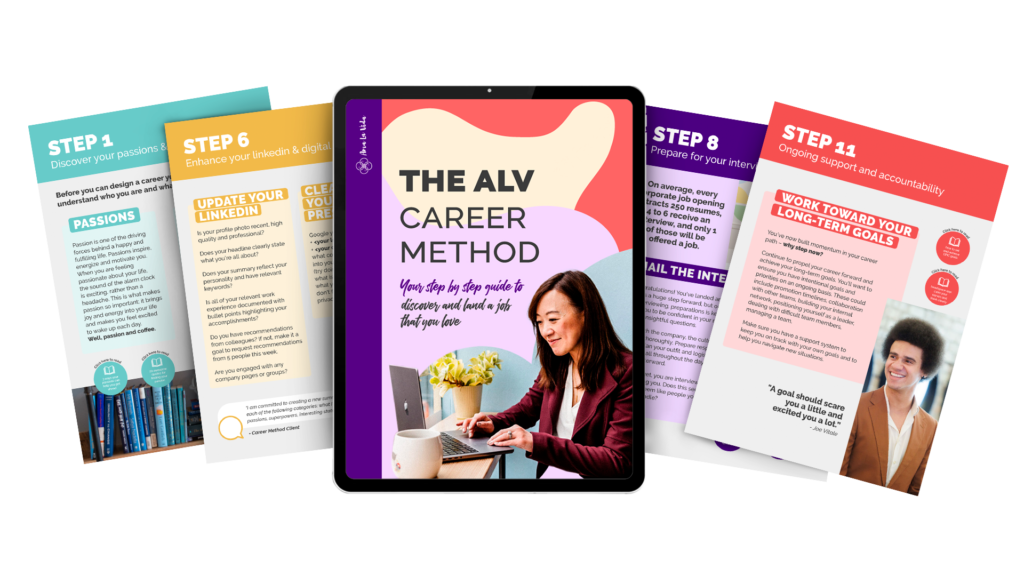
Download our comprehensive step-by-step guide to design and land a job you love!

Images from The ALV Career Method Guide
ALV Method Downloadable Guide

Do you love hopelessly skimming through radio stations on repeat to find something—anything—to listen to? How about never having enough sit-down time to focus on learning something new? If you answered with a concrete ‘NO!’ to both, then rest assured, you’re not alone. To fill that void, podcasts arrived at the scene, seemingly sweeping through the nation in recent years with hit shows like Serial, This American Life, The Joe Rogan Experience, and too many more to count. In fact, there are now over 500,000 podcasts available on iTunes, and the number of weekly podcast listeners went up by 6 million last year. It shouldn’t really come as a surprise, of course. Podcasts serve a variety of functions. Whether you’re in need of entertainment for long commutes or are looking to keep your mind sharp with educational content, podcasts have your back. And if you’re a creator (like me) then you can utilize them as an outlet to share your big ideas in greater detail that engages your audience while solidifying your voice in your given industry. So how do you do it? It isn’t as easy as pressing a button, but it’s not calculus, either. At the end of this post, you’ll know not only how to launch a podcast, but also how to avoid the walls that I ran into when starting out.  Choose a topic This step is straight forward, but you may want to give it extra thought. You don’t want to pile a bunch of ideas together followed by picking one out of a hat; if you’re serious about starting a podcast, the topic must be something you’re willing to commit to. When I was at this stage, these were the types of questions and answers I found myself with: What are you interested in? Stories, psychology, living purposely in a practical manner… Why make a podcast about those things? I’m curious about them and want to understand them on a deeper level. The truth that I unearth from my intellectual digging will enrich my lifestyle, and sharing said truth with my audience might do the same for them. When deciding on your topic, you want to begin with ideas you’re passionate about, but afterward, try to filter those with topics on which you have some knowledge. Once you’re there, consider whether your topic’s niche is over-saturated because, if it is, you’re going to be fighting an uphill battle for people’s attention.  Decide on your podcast’s name If you have a blog or a business, giving your podcast the same title would make a lot of sense, but you’re also allowed be creative. The process for deciding my own title looked like this: What are you doing with your podcast? I’m considering ideas, human behavior, and the relationship between the two. How do you do that? By asking ‘why’ when confronted with perplexing concepts until I get to the core of what’s going on. After thinking it through, I took a step back, poured myself a 3rd cup of coffee, and decided that Considering Why was good enough for me.   Another important note to consider (one that I didn’t at the time) is that iTunes is a search engine. When you’re hoping to get your podcast found, it’s not a bad idea to include relevant keywords in your title. For instance, if you were making a podcast about Life Coaching, a good search engine optimized (SEO) title might be Empowerment: Learn to Grow Your Best Life. That way, if someone were to open iTunes and search for “learn to grow” or “best life,” your podcast would be more likely to show up.  Figure out your format and style What should you do about format? Is an interview set up the best to use, or would a solo or co-hosted show be better? Interviews are popular and great for acquiring a ton of new listeners (especially if the person you’re meeting with is a thought leader), but remember to consider all your options. Some people say that there’s a strict format for how you should structure your podcast. When it comes down to it, I say do whatever works for you and run with it. You can always revise as you go along. Personally, I opted for a mostly solo style, much of my inspiration coming from a little-known show called Let’s Know Things by Colin Wright.   Design your cover art Your cover art dictates the first impression people will get as they browse through different podcast apps like Stitcher, Apple Podcasts, or more recently, Spotify. What I did for my cover was, firstly, going to this website to obtain a free, high-quality image. Some of my best thoughts have been had over a good cup-o-joe, so I decided to go with this: a minimalist picture of coffee. After that, I took the image to this free online photo-editing site and, after making some subtle changes, slapped my stylized title on the image. Behold, the finished product: It was that easy. Of course, I’m a minimalist, so I wasn’t looking for anything too fancy. However, should you require something with a bit more zest (and have a small budget to invest in cover art), I’d advise you to check out the services offered at 99designs.com.  Get a microphone This step is important. One of the worst things you can do to your listeners is force them to strain to hear what you’re saying. Do yourself and your audience a favor by getting a decent microphone. If you don’t have one built into your computer that produces a quality sound, then a good one to start out with is the Audio-Technica ATR 2100 USB. You can get it for less than $100 over here. Record your first 3 episodes Why the first three, you ask? When you find a show on Netflix that you like, do you prefer to watch just one and be done? Or do you prefer to go through the entire

Read More

Before one embarks on any major change or transition in life, it’s important to make space for the possibility by clearing the clutter to declutter your life. “Stuff” has the capacity to keep us stuck where we are, regardless of whether or not we’re happy with it. And I’m not just talking about physical stuff, but mental and emotional stuff. The first step in moving forward in any direction is to cleanse your life of the stuff that no longer serves you. Accept that letting go is an integral part of the process, so you can move forward in a more fulfilling direction with greater ease. Start by taking an honest look at your current lifestyle and examine those areas that seem to hold you back, whether it be your home or work environment, your health, relationships, or finances. It’s important to start by taking note of where and when you feel stress, overwhelm, and lacking in energy. Even though they’re negative feelings, you can thank them for bringing awareness to areas that may need to change. The following are some common areas that keep people stuck where they are. If any of them resonate with you, make an action plan to clear the clutter and create space for new possibilities. Work Environment Maybe you’ve heard before that your external environment reflects your internal world. Excess clutter has the potential to clutter the mind, making it difficult to cultivate any meaningful change. The first place to start making space for possibility is to physically clear out the stuff you no longer need or use. Start with one of these ideas: Do you have stacks of papers that you haven’t even looked at for months cluttering your desk at work? File it or get rid of it. Is your email inbox out of control with subscriptions you don’t even click on? Unsubscribe. A clean workspace and a clean slate declutters the mind, so you can think clearly about necessary steps toward your next achievement.   Health – Nutrition Say you recently had an epiphany and said, “This is the year I’ll get my health on track. I’ll eat the right foods and exercise at home for 20 minutes a day.” Ambitious goals, but it can be done if you just create the space. Your home environment may need a cleanse if you want a healthy life. Kitchen cabinets and refrigerators have a tendency to collect stuff over time. Have some fun and throw out all the junk and processed food that’s most definitely expired or just plain bad for you. Then have even more fun filling that space with fruits and veggies, proteins and essentially nutritious, non-processed items. You’ll feel lighter when you do and motivated to make healthy meals. Even better, you won’t be tempted by the Oreos… Need help? Ask a health coach! Health – Exercise You also decided to work out at home, but where? Pick an area of the house that might currently be cluttered, but unused space. It’s just a storage area for stuff you don’t need. Clear that space and create your own personal workout room with whatever equipment you’ll need to stick to your routine. Decorate it if you need extra motivation and transform it into a place you surprisingly want to be. Time How many instances during a week do you say, “I don’t have the time!”? Well, I don’t believe that’s true. What it really means is you may be overcommitting or hesitating out of fear. What activities in your life magically take up valuable time without you noticing? “Netflix and chill”, anyone? (And don’t get me started on social media.) Of course, relaxing on the couch may be necessary for self-care when you’ve had a rough day, but notice how often you make that excuse. Is it really true? The hard part is learning where the line is between self-care and excuses. Some of our favorite ways to audit our schedules are: Taking a look at your schedule and think about the commitments you make. Are they contributing in any meaningful way to your bigger picture goals? If not, you can probably let those go to make time for more important things. Give yourself some compassion and let go of the guilt you may feel when saying “no.” It can be a powerful word. Finances I know, no one really wants to talk about their finances. What you may not know is that statistics show that 55% of Americans are “financially coping.” It’s actually a lot more common than you would think. If you struggle to manage money and budgets, it’s best to simplify your financial life. I find it most effective to: Organize all of your financial documents in easy to find folders and shred or delete any documents you no longer need. Reduce the number of open accounts you have and consolidate debt. Automate payment on all of your bills and consistently monitor your bank accounts. Simplifying your financial life will also save you valuable time. Relationships Are there people in your life that seem to live in a perpetual state of negativity? Do you notice that you have less energy when you’re with them? Do they have you second-guessing your potential? Ask yourself if these relationships are serving you in any way. You most likely won’t be able to cut the cord on every draining relationship. However, you do have the choice to: Spend less time with them, or ask them to adjust their attitude when you do spend time together. Seek out and spend more time with people who believe in what’s possible for you. Having relationships that build you up is essential. They will lift you up when you feel you’re not making much progress, encouraging you to keep going. They want to see you succeed. Success in any endeavor is more likely to occur when one is surrounded by supportive relationships. Negative Thinking Sometimes it’s your own mind that’s the culprit in holding you

Read More

The practice of yoga is dynamic. Yoga offers strength and lessons that can be adapted to many areas in our lives.  Yoga has become integrated into our culture as more than a physical practice. It also offers mental health benefits in connecting the mind and body.   For those of you that are new to the practice or idea of yoga, you can start at any time and find a style that works for you! I personally practice two specific types of yoga. One more so for the mental and physical elements that it provides, and the other for meditative and spiritual experiences. When engaged with yoga, I find myself becoming stronger as I flow with intention. But on the same account, I am gentle toward my limitations. I soften my expectations and express gratitude toward myself through the difficult poses, knowing that I can come to my mat to let my life unfold (literally!). Yoga and Your Career As I share with you the benefits of yoga, I will also guide you through some of my personal takeaways and how I incorporate yoga into career planning as a Career Specialist. I want to guide you through my own practice and essence of a yoga practice. All of which can help you find calmness and resolution with your career goals. Here are some of the most powerful lessons I’ve taken from yoga (and you can too!): 1. Be intentional. Yoga begins and ends with intentions. What is your intention, today? That is a question I often ask myself, as I am often asked to set an intention every time I enter a yoga class. As I write this, my intention is to share my loving, sometimes gentle, and sometimes a bit intense (I’ve been known to take 2 classes a day!) practice of yoga with you. It’s the why behind the practice, and how these practices can be integrated with your career. Such as decision-making and transitioning, the job search and everything in between. My practice offers balance among the physical, emotional and mental areas of my life. The depth of where yoga can transform thinking and physical limits in a certain amount of time is what continues to bring me back to the practice, to the present moment and to a space of gratitude. Being intentional is incredibly important in our lives and careers. Time can pass by so quickly when we just sit back and let life happen to us without taking an active and intentional role in shaping our career paths. When I work with clients who are lost in their path or struggling to land a job, the first thing I often do is take a pause to help them think through what they want their career to be about, to feel like and the impact they want to make. This makes the path forward much clearer. If you’ve been caught up in the hustle and bustle, take a minute today to reflect and consider, “What impact do I want to make in my career?” and then start acting with intention. 2. Find your calm. Allow yourself time away from your mental processing. Statistics show that on average we move through 48 thoughts per minute. Yoga fosters mindfulness, awareness to our thoughts with a focus on allowing those thoughts to pass and enter a state of mental calmness. Where in your life is there added stress? Not surprisingly, most people have stress around their careers. Whether that is related to the role itself, often due to lack of flexibility or work and life imbalance. In order to help de-stress, where in your day can you find your sense of calm? Now that we have some intention in our careers, what’s one word that brings you back to that clarity? When you are feeling stressed at work or overwhelmed by career decisions, you can find your calm by focusing on that word. 3. Engage with your breath, Pranayama. I like to practice deep breathing. Why? It is intentional and integrates mindfulness. This is a process of deep inhalation followed by deep exhalation, sometimes pausing in between, eyes closed, allowing to feel the breath move to the belly, then to the lungs, within and out. This has been the most powerful tool I have come to find. What is powerful about the breath is that it can be practiced strengthening the mind! The breath opens spaces in our capacity to stretch a bit longer and allow our mind to stay focused on the current pose. What a great practice to integrate literally and figuratively. Challenge yourself to take a pause throughout the day. Taking just 5 deep breaths throughout the day will help you keep focus and will re-energize you for your work. 4. Don’t be afraid of the challenge poses. What is unique about yoga is that you have what can be a demanding physical practice. Especially if it is taught in a heated room. Most often you find yourself trying to keep pace with fellow yogis that surround you. I truly enjoy when I find myself in sync with the others next to me and can keep the “flow” and breath moving together. Holding each other accountable to follow and finish the flow as one. What counters this is that yoga is very individualized. Your body may need to lay flat on the mat while the class continues to move through poses. Challenge yourself but also know your limitations. Challenge yourself to try something new in your career. Think big and outside of the box to deliver a wild idea or create time to work on a project in your current role that would allow you to flex more creativity or ownership. I challenge you to set aside any doubts and push yourself outside of your current comfort zone. 5. Radical Acceptance. When I fall in yoga, I often laugh it off and try again. That makes it easier to transition into the next pose,

Read More

Congratulations on surviving the polar vortex of 2019! If you didn’t experience the sub-zero temperatures and feet of snow, consider yourself lucky. Since we’re nowhere near the end of winter, here are my recommendations for the next time you’re working through a bout of bad weather. Use your commute for good. I used to have an epic drive to and from work – it was so extreme that I would routinely hear gasps when I told coworkers where I lived. I also absolutely hate driving, but there were no public transit opportunities available to me. This was a bad combination! I quickly learned to make the best of my commute and was able to put this skill to use as I spent time stuck in snowy traffic over the last week. Utilizing podcasts and audiobooks helps me to work on personal development even when trapped in my Honda Civic (and driving is the only way I can focus on listening to something). For our entrepreneurs, I highly recommend The Pitch by Gimlet Media, Side Hustle School, and RISE by Rachel Hollis to help stretch your creative muscles. Get clear about work-from-home expectations. As Nicole mentioned in her last letter, remote work is on the rise, though this isn’t yet a standard for every employer. If you’re unsure about how to handle work when the roads are bad (or if your children don’t have school for the third day in a row, or your car dies because it’s so cold…), ask! Some employers are willing to make exceptions based on extraordinary circumstances, and we saw a lot of that happening over the last two weeks. Some basics for sporadic remote work: Make sure you have an Internet connection and can access all necessary documents and computer programs (perhaps you can use your home computer, or you’ll need to take a work laptop home) Stay in contact with your team (sending your cell number out as the day begins and staying logged onto any Skype/Slack/Messenger programs is helpful) Communicate what you’re working on with your boss (so she knows you’re not just sipping tea and watching the snow fall). Use found time to focus on what matters. In the case of bad weather, things tend to slow down around the office. Perhaps your coworkers are deemed non-essential and don’t need to come in, or customers are unable to make their appointments. When you find pockets of quiet time during these chaotic days, make use of them. I was able to get some work done on a long-term project since I finally had some uninterrupted time to focus, and I was able to thoughtfully check-in with some of my newer team members about the growth I’d seen in them lately. Last but not least – I called my grandma. Talking to her is always the highlight of my day, and I loved escaping to the break room and taking in a peaceful view of snowy trees while laughing with her and making sure she was safe at home. Cheers to knowing that warmer weather will eventually come our way again – but until then, leaning into the coziness and slower pace that winter can bring. This week’s challenge This recent wild weather has me considering the value of hygge – I certainly can’t pronounce it right, but I know the concept is all about embracing the freezing cold (instead of fighting it!) and giving yourself what feels good and cozy throughout the winter season. What else are you fighting? What current state of being would be easier to accept instead of resist? I’m not talking about monumental issues that deserve advocacy, but smaller ones – like hating your commute, or dreading your email inbox. This week, identify one aspect of life you’ve been dreading to accept – and then lean in and embrace it. We know you want to learn more. Here are some of our favorite additional resources: Embracing vulnerability over perfection…: Do You Keep a Failure Résumé? Here’s Why You Should Start. …while making sure you don’t get too vulnerable: “When does sharing become oversharing?“ The latest from LinkedIn: New Ways to Keep a Pulse on the Companies You Care About Because love is in the air: This American Life | Episode #486: Valentine’s Day

Read More

The ALV Career Method is our comprehensive career transition coaching program. There’s a lot to it. So I want to share with you exactly how it works and why it works. But before I do, it’s important for you to know why we even built it in the first place! How We Got Here Not too long ago, I was sitting in a crappy hotel room somewhere in Kentucky. I was a management consultant. So finding myself in crappy hotel rooms, not entirely sure where I was, was not an uncommon occurrence for me. When I first got into consulting, I thought, “I’m young and don’t have a lot of responsibility. It’s okay if I live on planes and work all the time.” After a few years, I found myself thinking, “I’m young and don’t have a lot of responsibility. Why am I wasting my life being miserable, alone in a hotel room, doing work I don’t care about?” And in that hotel room, I had decided enough was enough. I decided life was too short to allow myself to stay unhappy. Consulting was a fantastic place to start my career, but I learned that it wasn’t my forever job. And once I did, I felt lost. I had worked so hard to get there. I had done all the “right” things. It was, by many standards, a great job. Why wasn’t I happy? Was I just being ungrateful? Should I stick it out? If not, then what now? Is it possible to find a job you’re passionate about that also pays well? Or is that just a pipe dream? I was questioning myself and my decisions. I didn’t seek help to find answers because I didn’t even know there was a help to be sought. Luckily, around the same time, I was given a leadership coach by my employer. And to be honest, I wasn’t excited about it. Coaching sounded like a hippie, made-up job to me. I was wrong. I found coaching to be so valuable that I continued working with my coach independent of my organization for years. And to take it about a million steps further, I found it so valuable that I eventually quit my job to start a coaching business. Why We Built the ALV Method The coaching that I had was incredibly powerful. I felt energized and inspired by my sessions. They helped me find calm and clarity. But something was missing: structure. While I was learning a lot about myself and starting to envision an ideal future, I didn’t always know where the sessions were headed. It was sometimes difficult to keep moving forward without some sort of process to follow to apply all of my insights to the actual job search. Many of my peers were going through a similar career transition and had an experience on the opposite end of the spectrum. Every career quiz and assessment felt so binary and limiting. Are you an introvert or extrovert? Oh, you like to help people? Then you should be a nurse. Analytical? You should be an accountant. These assessments felt outdated. Oversimplified. They didn’t seem to take into account how complex we are as people and that there is a lot more that goes into finding a fulfilling career path than just a few personality traits. Most career tests out there provide multiple choice questions and use an algorithm to box you into a “type” which determines your career direction. Seven billion people and unlimited career paths do not fit into one of 16 types. My business partner, Foram, had also made her way to coaching from consulting. She was being trained in leadership and executive coaching and saw that most clients were in the C-suite. “Why wasn’t coaching being made available for people earlier on in their careers?” she thought. Why did it feel so stuffy and inaccessible? How could we bring coaching to anyone at any time? The two of us teamed up to create Ama La Vida and our first signature career transition program, The ALV Career Method. We wanted to… take the best pieces from each of our experiences and create a process to help people navigate career transitions, no matter where they were in their careers or in the world. help people reconnect with themselves in an authentic way and craft a career path that was uniquely designed for them. arm them with the collateral, confidence and accountability to land roles they thought were out of reach. spark that excitement in them that would get them to take action and make the change they had been longing for. And we wanted to do it all in a way that was affordable. How The ALV Method Works The ALV Career Method is a comprehensive, 4-phase career transition coaching program that takes you step-by-step through the process of identifying the right career path for you and landing a job in your new chosen field. You’ll start with a multi-week intensive where you’ll be meeting with your coach frequently. Your sessions will then taper off over time as we move from discovery and planning to execution and support. Before each session, you’ll complete online exercises in our proprietary eCoaching platform. Then you meet with your certified career coach to dive deep into your findings and ensure you are progressing toward your goal of an exciting new career path. Here is everything you need to know about the program phases you’ll progress through: Phase One: Planning. One mistake we regularly see people make is finding themselves unhappy in their work and then going straight to the job boards to find a new position. Most often a position quite like their current one. They don’t take the time to sit back and reflect. To understand why they are unhappy in the first place. Or think about the components of their job that they do enjoy. To get clear on what impact they want to make in their career and what

Read More

Have you just landed an interview for a killer job? Or are you currently in the job search process and hope to land that interview soon? Or are you considering a career change? If yes, then I highly encourage you to take some time to gauge company culture in an interview. Your happiness, within and outside of work, can be determined by the behaviors, policies, and environment of a company. On average, most people spend over 8 hours per day or 30-40 hours per week (often more!) at their workplace, which equates to a lot of time at your job. Why would you spend nearly half of your life at a place you don’t like? You probably wouldn’t invest in a car before you test drove it, did some research about the make of the car, or asked for recommendations from others before purchasing. Why would it be any different when investing in your career? So what is company culture anyway? And why should I care? Company culture is not just comprised of one thing. And you cannot necessarily “touch” company culture, but rather, you can recognize it in a multitude of ways. A company’s culture can include: The way people interact with one another How they dress What they do after work hours Expectations while at the office The company’s mission Volunteer or community service efforts Interaction with the leadership team The physical office space Hiring practices Flexibility of working hours And to put it simply, just the way that things are done at that company. Evaluating a job offer entails thinking about the job title, the salary, benefits, vacation time, sick days, etc. While these are very important pieces to consider, many people overlook company culture. Keeping in mind that 40+ hours are typically the time spent at the workplace per week, you can see why considering company culture is a crucial piece to the offer evaluation. Your well-being and work satisfaction depends on gathering this information. You probably don’t enjoy the job search process, so if it can be avoided, why run the risk of repeating it? Get informed, gather information, and ask the question to ensure your workplace happiness! Since you cannot break company culture down into one simple question, here are some ways that you can assess a company’s culture before accepting that job offer. Guage Culture Before the Interview First and foremost, assess your own needs. Obviously, everyone’s needs are different. While one person may thrive at a company where the expectation is to work nights, weekends, and over time, another person may crave more structure and defined work hours. While one person may love working in an open space with no doors or closed offices, another may be overwhelmed, distracted, or irritable without privacy. Before you head into that interview, reflect and jot down a few things that make you feel happy while at work. Start with your previous experiences. A great place to start in your assessment is your current position or previous work experiences. What have you liked or disliked about your workplace? Were you happy or dissatisfied? Take stock of what worked for you and what didn’t. And get specific! Talk to a mentor. Are you new to the working world? If you don’t have previous work experience to gauge workplace culture, find a mentor. If you don’t have a mentor, consider engaging in informational interviews to gain insight. Talk to older professionals about their experiences. What have they noticed within the field, particular companies they have worked at, or perspectives they may have regarding current trends within the industry? Do your homework! Be sure to research the companies where you will be interviewing. Not only will this help you excel in the interview, but it will also reveal information about the company culture that will be important in your decision-making process should you receive an offer. Don’t forget to research the leadership team too! The company’s leaders often set the tone of the company and culture is created from their behaviors, practices, or policies. Who is the face of the company? Do you feel aligned with them? Could you see yourself in their shoes? Do you aspire to be like them? These are vital questions to ask yourself as you are doing your company research. Need a few resources to help you with your company research? Check out the following: Glassdoor.com for company reviews. Remember that like all reviews, the reviews on Glassdoor tend to be polarized. Try to focus less on whether the person assigned 1 or 5 stars and more on how they describe the company and what it’s like to work there. LinkedIn.com to not only view the company’s profile, but also the profiles of the leadership team, people in your prospective department, or people you may know who have previously worked at that company or have connections there. Google the company’s name, then click on “news” to see any recent articles regarding the company. Review the company’s website, including bios, the about us page, the mission statement, etc. Pay attention to the communication process leading up to your interview. If you have been invited to interview with a company, pay special attention to this process. Are they communicating with you via phone, email, or text message? Is the process clear and concise? Are interactions easy? Did you get a response, or get in touch with the onboarding committee, recruiter, or HR team? Is there one point person or many? Does the communication feel awkward or comfortable? Is their preferred communication style in alignment with yours? It is important to reflect on even the small things that lead up to your interview. While you are not trying to nitpick every move they make, you are simply taking stock of what works for you and what might not. Find someone who works for (or previously worked for) the company. Do you know anyone who is currently working for this company? Or perhaps someone who may know

Read More