Author: Nicole Wood

coach peggy working on the computer

The benefits of coaching span far beyond what most people initially envision when they find themselves Googling “career coach near me” late at night after a frustrating day at work. Our clients typically come to us with a specific and fairly surface-level goal in mind, like hitting their career goals or finally feeling aligned in both their personal and professional life. But what inevitably happens is that a great coaching program helps you not just accomplish what you want but also address the things you need in order to thrive in both your personal and professional development. This might be building your confidence, getting clarity about your career path or overcoming analysis paralysis. They are all enablers of goal achievement that coaching quickly dials in on to help you get where you want to go. The Real Benefits of Coaching (That Might Surprise You) 76% of our clients have never worked with a coach before when they reach out to us. They have a vague idea of what a coaching relationship can do for them, but they’re not entirely sure. Before we dive into specific types of coaching, let’s pull back the curtain on what coaching actually looks like. Whether it’s career, life, or leadership coaching, the coaching process creates a powerful container for personal and professional growth, career development, and good old-fashioned self reflection. It’s not about getting advice—it’s about having the space to think clearly, challenge yourself, and grow in ways you didn’t expect. A Safe Space with Zero Judgment (and 100% Truth Bombs) While many of us are lucky to have wonderful support systems around us of friends and family, each of these people has a distinct perspective on our lives which is shaped by their relationship with us. Coaches, however, have no such bias. Coaches are there solely to help us achieve success and personal growth on our own terms. In a professional environment, we often can’t explore ideas with colleagues and bosses due to the impact it may have on them, and we may not feel comfortable opening up about our insecurities. Having a safe space in a coaching session to explore these ideas, test new behaviors and evaluate different decisions is an invaluable resource. A client shared with me, “As a leader I love that I have a safe space to say what is on my mind and either get validation or feedback to think through.” Coaching is often the only space where employees develop the confidence to talk through the hard stuff—no office politics, just honest insight. This helps empower individuals to find to their own answers (not just take advice) and boosts individual performance, which is one of the most unexpected benefits of coaching. Accountability That Doesn’t Feel Like a Shame Spiral Many of our clients have shared that they initially felt embarrassed that they needed their coach to keep them accountable. They would say things like, “Shouldn’t I just be able to do that on my own?” No! External accountability is critical for most people to accomplish what they set out to do. This is especially true in today’s busy world with many competing demands for our attention. Throughout your youth, external accountability was abundant: school deadlines, parents holding us accountable, guidance counselors reminding us of due dates. But in adulthood, we are largely on our own to set deadlines and accomplish our goals. Having a coach support you with this is a smart strategy to ensure you stay on task. The focus with your coach isn’t pressure, it’s progress, with actionable steps tailored to help you move forward confidently. But it’s also so much more than just project management. It’s about doing the right things, not just checking a box. When we are moving a million miles an hour, we often measure our contributions in terms of how many things we crossed off the to-do list. But moving from one task to the next without taking time to reflect can actually cause you to miss opportunities to learn, derive insights and make better decisions in the future. Dedicated time for reflection helps you better plan for the future. Coaching creates a space in your day where you can slow down and be both reflective and intentional. It can break down a behavioral pattern you’ve sunk into and allow you to purposefully design a more optimal behavior. Instead of just moving along to the next thing and potentially repeating the same mistakes, dedicating this time to reflection with a skilled professional can help you generate frameworks and philosophies that lead to better decisions going forward. Better Problem Solving (Without the Mental Ping-Pong) So much of life’s angst comes from stressing about what might happen. Whether it’s making a big life decision or figuring out how to tackle a problem at work, a prolonged mental swirl can bring about a lot of unnecessary anxiety. These decisions are tough to make, and there is always fear about making the wrong choice. Coaching combats this challenge head on. It brings clarity to overthinkers, helping to structure decision-making, and boosting creative thinking, especially in high-stakes situations. I tend to be an overthinker and a ruminator. I often enter my coaching sessions with a cacophony of thoughts swirling around my brain that are exhausting me. This causes me to not show up as my best self for my team. Coaching helps me make sense of the noise, organize my thinking, and make decisions with more self-confidence and clarity. I often say that my favorite coaching sessions are the ones where nothing has changed and yet everything has changed. I didn’t actually do the thing I’ve been swirling about during my coaching session. But I walked in completely overwhelmed and stressed, and I walked out with clarity and a confident path forward. It truly makes all the difference when it comes to time management, problem solving and decision making. Shine a Flashlight for Your Blindspots You don’t know what you don’t know—until a coach helps you

Read More
Nicole and Foram speaking at the Ama La Vida Chicago office

Becoming a leader reminds me of bringing your first baby home from the hospital. You can’t help but think, “Shouldn’t there have been more training for this? You’re trusting me with the well-being of this other human?” And even once you get your feet under you, leadership is not for the faint of heart. You are endlessly wedged between seemingly contradictory forces pushing you to drive performance while also supporting each individual’s unique needs. It can be confusing. It can be exhausting. And it can also be so meaningful and rewarding. If you’re lucky, you can think of that great boss you had who inspired you, challenged you, and made you feel seen. This person may have even changed the trajectory of your career. We each have the opportunity to be that person for someone else. But the path to get there isn’t always clear. That’s why personalized leadership coaching is so critical. The support, feedback, and guidance that you need to be a great leader is undoubtedly different from what your peer requires or what I need. And it’s also why we here at Ama La Vida launched the Honest Leadership series. We have access to some top leaders and brilliant minds in the leadership space, and we want to download the lessons they’ve learned over time into our own brains. You don’t have to navigate through leadership alone, and this event series is a great way to connect with other leaders, take some of the insights shared by these experts, and apply them to your own work and leadership style. In every single interview I conducted this year, I had ah-ha moments that I took back with me and integrated into my approach to leading Ama La Vida. I’m a more confident leader and Ama La Vida is a better place to work as a result. Here are some of those highlights for me: Kelly Balch – Celebrity Photographer and Author Be intentional and maintain your energy throughout your various life seasons. I loved when Kelly thoughtfully corrected me for asking about “managing” burnout (which in and of itself sounds like a burden) and instead reframed it to maintaining energy and passion. They explained how the various seasons throughout the year impact business and allow Kelly to be in a headspace that matches the need. We chatted about how it’s okay to have seasons in your life and career beyond business seasonality where you shift more to certain aspects of your life over another. You can attract the types of people you want to work with and that makes all the difference in terms of your well-being and how much you enjoy your work. What ****you put out in the world is what you get back. That’s why it’s so important to be clear on your truth and what you stand for. It’s not your job to manage other people’s reactions. Your job is to share authentically. The people who engage are your people, and working with them will be fun and joyful because they are already friends. Natalie Franke – Bestselling Author and Head of Community at Flodesk No two people experience the same event in the same way. It is always put through a personal filter which might lead to two totally different conclusions about what occurred. Keep this in mind when building connections, especially with your team. There is no universal truth. There is only each person’s truth. Building connection starts with vulnerability, which has inherent risk involved; you’re opening yourself up to both good and bad reactions. It has a disarming effect, and the other person typically starts to let their guard down too. Their response is not your responsibility. Your job is simply to share a piece of you and open the space for them to connect with what you’ve shared. You’ll be surprised that people connect with your emotions even if not your specific experience. Atarah Styles – Award-Winning Plus Size Wardrobe Stylist Treat your internal monologue like a soundtrack. I love how Atarah mentioned that when you listen to something over and over, it sticks with you. You remember the tone and the cadence. The same is true for how you talk to yourself. Small rejections strengthen you for higher stakes. It’s inevitable that rejection will come at some point in your career. If you aren’t getting small doses of it along the way, it might crush you when it comes at a high-stakes time. Keep track of the little rejections you receive and see how you evolve over time. Things that really hurt years ago won’t even make you flinch as you continue to strengthen that muscle. Jill Eid – Executive Director of Girls on the Run – Chicago You don’t have to be the expert to be the leader. In fact, challenge yourself not to be. When Jill stepped into her first official leadership role with AmeriCorps, she had zero experience with the activities her team was tasked with. In not being able to rely on having the answers, she grew her leadership muscle to build team camaraderie and tap into the expertise of her team members. She learned how to lead with and through versus spouting out answers from the top. Create space for humanity. It’s not just right, it’s good business. I completely agree with Jill that human-centered workplaces where people can bring their full selves and feel safe to do so are ideal. But I had never thought about it as also a means of efficiency. It takes a ton of mental energy to try to mask who you are or be someone you’re not. Being exactly who you are frees up your brain space to focus on the task at hand. L’Oreal Thompson Payton – Award-Winning Journalist, Brand Storyteller, Author and Speaker We’re all walking around doubting if we’re good enough. From Michelle Obama to your writer idol to your absolutely incredible best friend, we all have self-doubt. You don’t have to wait for

Read More
two colleagues talking about performance reviews

Performance reviews can be a stressful experience for both the person being reviewed and the reviewer. A lot can be riding on them including compensation and promotions, so it’s a heightened experience, often with a lot of emotions surrounding it. Frequently as managers, we are not given any training as to how to handle these most effectively and to make them as productive an experience as possible. Here are some important guidelines for how to really maximize performance reviews as a manager and set your team up for success. Be Prepared It doesn’t feel great when you’ve spent a ton of time thinking about your review and writing your self-appraisal only to meet with your boss and realize that they haven’t even read it. This process may be very meaningful for your employees and their careers, so in most cases they have likely taken this seriously. To demonstrate your respect and appreciation for them, it’s critical to come prepared having read their submissions and organized your own thoughts. Just like we would instruct an individual to be tracking their accomplishments in real time to make performance reviews more streamlined, you can do the same as a manager. Start a document or tracker of some sort for each of your direct reports with a running list of accomplishments, improvements and development opportunities. It’s easy to suffer from recency effect or draw a complete blank about what your team has been up to when the performance cycle comes. This will be a great cheat sheet to help you prepare. In addition to preparing your own thoughts and talking points, try to anticipate what your direct report might say or how they will respond. Ama La Vida Coach Maddie Deamer says, “Anticipate what the response/reaction may be – consider all the possibilities and go with an open mind to manage your own reactions.” She adds that before the meeting you should “consider what biases you may have.” Minimize Surprises This process and conversation should be a focused opportunity for a deeper discussion but not one that hasn’t happened prior. Ama La Vida Coach Kristin Simon says, “This should NOT be the first time that you have discussed any of the points that you are providing. The performance review is just that, a REVIEW and summary of the past feedback and conversations that have happened throughout the year.” The worst thing you can do is blindside someone with constructive feedback that you’ve been holding onto for this moment. This should be a time for reflection and a summary of key themes, not a time to air grievances. Coach Maddie says, “Direct reports should always know where they stand and how they can be growing, so they aren’t caught off guard in a review.” Best practice is to provide feedback in real-time and regularly have coaching conversations with your direct reports. It’s important that in those conversations you and your direct report consistently realign on expectations. “Having set the right expectations from the outset of the performance management cycle is important. You and your report should be operating with the same understanding of what good (and great) looks like,” shares Ama La Vida Coach Stephanie Bilodeau. “Learning about each other’s communication style is a good way to minimize surprises.” Ama La Vida Coach Peggy Wu Consider the Emotional State of Your Direct Report Even if there is a healthy culture in your organization, your employee may be bringing baggage from previous organizations and managers. Perhaps they have been burned in the past or felt that reviews were merely a check-the-box activity. They may not be approaching them from the same mindset that you are, and so it’s important to challenge your assumptions and be mindful that this may be an incredibly scary experience for them. Coach Peggy Wu shares, “The timing of the review makes a difference for a direct report who’s dealing with a tough life issue. Can the review wait? If not, show acknowledgement of the direct report’s situation and let the direct report tell you if they feel they have the capacity for a meaningful conversation at this time about their performance.” If you get into the conversation and unexpected emotions arise, pause for a minute. You can check in with your employee and ask them what they are feeling and if they would prefer to pick up the conversation again later. Encourage Them to Take the Lead This process is about your team’s growth and development, not about you giving them a report card. You may need to ask questions to prompt the conversation, and of course this is a time to deliver feedback, but they should be doing the majority of the talking. For more junior employees or those who have had different experiences in the past, this may not be obvious. “Help them understand their role in the performance review, what you expect of them and HOW they can prepare, even if it’s just a list of questions for them to answer on their own before coming to the conversation. Guide them with some self-reflection structured homework. Then the employee will know WHAT they can do to prepare and feel more confident when you encourage them to take the lead in the conversation,” says Ama la Vida Coach Brenna Chambliss. Ama La Vida Coach Betsy Westhoff encourages us to be intentional about what questions we do ask both in preparation and in the meeting. “It is so easy to get in our own heads and be in a single minded perspective. What kinds of questions might you consider asking your direct reports so that they are as open as they can be in sharing what is really going on for them?” Elizabeth Martinez, who leads our Client Success team here at Ama La Vida, reminds us that by letting your employee drive the conversation, you are enabling them to take ownership of their career path. “Empowering your employees to lead their performance reviews, granting them ownership, fostering self-assessment,

Read More
team gathered around listening to the leader

Congratulations! You’ve landed the big job you’ve been wanting. Now the real work begins. Starting any new role can be intimidating, but this can be exacerbated when the person who held it before you left big shoes to fill. Perhaps that person was an absolute rockstar at their job or maybe they had been there forever and were a total legend or maybe they had a big personality that everyone loved. So how can you step into this role gracefully, successfully and pick up where they left off in a way that makes an impact while feeling authentic to you? Here are some tips to get you started: Remember, you have to be you. It’s tempting to constantly compare yourself to your predecessor and assume any delta in your performance or approach is a shortcoming. But that’s simply not the case! Don’t try to mimic their style; enhance yours! Take the time to really understand your strengths and leadership style and lean into them. Separate competence from experience. Know that just because you don’t have the same historical knowledge doesn’t mean you don’t have the same capabilities. I’ve seen this become crippling for new leaders, especially in industries where deep expertise and years of experience are valuable. It’s easy to make the mental leap from, “Wow they know so much” to “I’ll never be as good as them.” This is also challenging when you’re stepping into a role where your direct reports have more subject matter expertise than you do. You were hired or promoted for a reason. You bring critical thinking, innovation, and new context to the role. The subject matter can and will be learned in time, and I guarantee your predecessor didn’t know much more in their first week and months either. Be a quick study. Part of your 90-day plan should be to figure out the gaps in your knowledge and craft a roadmap to learn what you don’t. This could be everything from acronyms to stakeholders and contacts to new technology. Build relationships with people who can help you gain the knowledge you need, and don’t let your ego prevent you from asking questions. Find someone you trust to ask the “silly” stuff. Resist the urge to come in and shake everything up. A new leader can bring new ideas, new solutions, and new energy to the team which can really reinvigorate a group. And also, coming in and changing a bunch of stuff all at once with little context can feel disrespectful. It can send the message that you know best or better without taking the time to first learn. When you initially step into your role, be patient. Of course, add value and solve problems where you can, but spend most of your early days asking questions and learning what people are doing. Be a fly on the wall before implementing new stuff. If you have direct reports, take the time to meet with each person and gain context and feedback including insights on what was working well and what could be better. Then, formulate your plans for the future. These will be shaped by context and empathy after having gotten to really understand the needs of the team. Build a relationship with your predecessor (if it’s appropriate). Of course, there will be circumstances where this might not be appropriate, and in that case, skip to the next tip as a proxy. But in the event this person retired or moved up in the company or even left for a different company, reach out to them! How wonderful to get to have a sounding board in someone who knows your role better than anyone else. Be respectful of their time (learning is still your responsibility), but draw from their wisdom to help you navigate these new waters… even when they’re not new anymore. Connect with your new peers. Tap into LinkedIn, professional associations, or networking groups to find peers to connect with. There is so much to be learned from others in your role at various organizations: what they’re doing, what they’re buying, and who they’re hiring. Try to specifically seek out folks who are not just in your department but at your seniority. They will understand the upward and downward pressures you’re facing. Get a coach. From understanding what your authentic leadership style even is to navigating those tricky workplace relationships, your coach is your lifeline. Leadership coaching helps you gain self-awareness, make big decisions and stay accountable to goals. Even the most elite athletes have coaches, and you deserve one for your craft too. If you can, negotiate this as part of your promotion or new hire package so that your employer sponsors it. This is an exciting time and a wonderful opportunity for you. You get to shape the future of the team, not try to shape yourself to fit the past. If you bring humility, a growth mindset, and a hunger for connection you’ll be well on your way to success.

Read More
a boss holding a coffee with a laptop open with statistics listening intently to their colleague

As a leader of an organization that has a wellbeing orientation, it can be tempting for me to over-index on empathy and prioritize employee happiness and wellbeing above all else. I truly do care about my team and fundamentally believe that what’s good for people is good for business. But what’s good doesn’t necessarily mean what’s easy. Or comfortable. Or popular. Your team needs to be challenged. Your team needs to be held accountable. Your team needs to be stretched. Your team’s incentives need to be aligned with business performance. And some of these things, while incredibly important, don’t always feel good in the moment. It’s easy to point to the problems with the extremes in either direction, but as with so many aspects of leadership, the right answer lies somewhere in the middle between two seemingly contradictory forces and behaviors. You have to prioritize wellbeing and lead with empathy while also holding folks accountable and driving business results. It’s no easy task. Here are a few tips I’ve learned over time in building an organization that cares deeply about people but also is on a high-growth trajectory: Communicate context and intent. Communication is always key, but it’s critical when delivering unpopular or challenging news. That might be in clearly stating what is required to hit a goal or even when you might have to change a person’s role or income in an unfavorable way. Anchor folks around the why of these decisions, how they enable business success and how they were carefully evaluated. Without context, people can quickly jump to misguided assumptions, making a difficult transition much worse. Flex your approach to the individual’s style and needs. Some people on your team might need to really understand how a change impacts their future while others simply just need to be clearly told what to do, and they will do it. Consider your audience and their style and preferences when communicating goals and holding team members accountable to them. Remember that people are motivated by different things so challenge yourself to really understand what drives each team member and consider those motivators in how you drive performance. Celebrate effort, but don’t lose sight of results. It’s the absolute worst, as an individual contributor and as a leader, when hard work doesn’t pay off in terms of results. We want to believe that effort guarantees outcomes, but that’s not always the case. As a leader, it’s important to recognize this. We should be celebrating our teams when we see dedication and hard work. And also, it’s important not to celebrate the effort so much that the message that we’re still falling short gets lost. No one wants to feel unappreciated, so call out the right behaviors whether or not they lead to the optimal outcomes. And also don’t water down your message with fluffy, celebratory language. Be clear about where the organization is missing the mark and what needs to happen going forward. Be both principled and practical. It’s important as a leader to have principles, guardrails that keep you on a proven path. You might have firm stances in what you approve, how you compensate and what you reprimand. And also, sometimes you need to be practical and bend your own rules to get a job done or support a specific person in an unusual scenario. Don’t be so principled that you get in your own way. And do be so wishy washy that you bend to every plea and request. Trust your gut to know when each is appropriate. Pay attention to seasons and cycles. No one can operate at 110% all the time. Humans crave starts and finishes, periods of intensity and periods of relief. There will be times in business when you need all hands on deck to hit a target or launch an initiative. Make sure everyone knows the importance of that. And also, though no time is ever “easy,” sense when there’s space to exhale and invite your team to enjoy it. Remind them to take vacation, encourage them to reflect on and celebrate wins, give them permission to downshift. This might be a time when you can focus a team meeting on connection or self-awareness versus business activity and outcomes. Tune into your team’s cycles of energy and output, and try to align messaging, content and direction with the current need. Do what you can when you can. It’s easy to feel like an investment in wellbeing and recognition needs to be formal or expensive. But sometimes the small, personal touches go a lot further than the formal reviews or company-wide programs. A $100 spot bonus or a $10 venmo for a cup of coffee goes such a long way. Sending an email to celebrate someone’s work or telling your direct report to take the day off when they are going through something difficult can make such an impact. Don’t wait for the big moments to invest in wellbeing – the smaller the better. Remember that business performance is an enabler of wellbeing. When a mentor of mine said this very directly to me, it rocked my world. I had been thinking about these things as contradictory: either your team is happy and relaxed and the business suffers or you’re working them to death and the business is doing well. Those are certainly two common scenarios, but they aren’t the only ones. It is really difficult for employees to truly have wellbeing at work when the business is struggling and not meeting goals. What happens? Perks get cut. People become reactive. Stress rises. It may feel more challenging in the moment to work harder, receive tough feedback or try a new approach, but if those are the things driving positive business outcomes, then they are also drivers of wellbeing. Balancing empathy and accountability is no easy task and it can be confusing at times to determine what is “right.” Working with a coach can help you test your assumptions, right-size problems and move

Read More
woman working a desk in front of laptop thinking

As leaders, we are time constrained to the max. We are making sure our direct reports have what they need, our superiors or peers have insight to our work, all while trying to get something on our own checklist accomplished here and there. It’s easy to go go go and forget to pause and reflect. The risk of this is, without taking the time to reflect and question our actions, we can find that we’ve run a million miles an hour in the wrong direction. Or that the direction was right but we missed something or someone along the way. These 5 questions are critical for leaders to be regularly asking themselves to help ensure their time is well spent, their team is well aligned and their wellbeing is taken care of. What can only I do? Leader or not, we are all wrestling with a never ending challenge to prioritize our time and activities. Especially in small companies, you may find yourself doing things, not because they make sense for you to do, but because there is simply no one else to do them. It’s easy to get sucked into stuff because there is a need, but without putting those asks through some sort of filter, they can quickly consume all of your time, leaving nothing left for your priorities. Ask yourself, “What can only I do?” What are the things that you uniquely have knowledge, relationships or expertise around? These are the things you need to prioritize. Which also means you’ll need to figure out how to delegate or let go of some others. It can be difficult to let something slip that ought to be done. But if those things collectively are preventing you from doing the things that need to be done by you, they’ve got to go. Does everyone know the one big thing? At any given point in a business, there is a major headline. It might be a focus on preparing to go public. It might be a season of cost-cutting and profitability. It might be building brand awareness at just about any cost. Regardless of which team you lead, your team should know the headline. Everyone should know the “one big thing” and how their work contributes to it. If you ask three people on your team, they should say the same thing. And they should have a general sense of how well that thing is going. If they aren’t sure, and especially if you aren’t sure, it’s a great time to refocus on the key priority and ensure your communication is clear and repeated regularly. Who needs attention? Especially in a remote or hybrid environment, it can be difficult to sense when someone on your team is struggling. And if it’s not top of mind to be checking in and considering who might need support, your team members could be feeling alone on an island. Regularly ask yourself who on your team needs attention. Attention might mean recognition. It might mean a chance to grow in a new way if they’ve been doing the same thing for quite some time. It might be reassurance that they are doing a good job, even in the face of challenges. It might mean some additional hand-holding and feedback if they are falling short. Make sure you have regular one-on-ones and pulse check with your direct reports on these categories. While not with the same intensity, consider how you can support those who report into your direct reports. Skip levels can be powerful both to help you support your managers but also to motivate those below them. You might be surprised at how much a quick 30-minute meeting or pulling someone into a project can do to drive engagement and excitement for the work. What am I missing? This is tricky because in most cases, if there was something else to be done to move the business forward, we would have done it already! It’s not easy to see your blind spots personally and strategically. Challenge yourself with even deeper questions about what you might be missing. What’s happening outside our 4 walls in the world or industry that might impact us in the near future? What have I been so sure about that I’ve forgotten to pressure test my assumptions? What have we been doing simply because that’s what’s always been done? When trying to push initiatives or results forward, our temptation is often to apply more pressure, to put more fuel on the fire rather than take a step back to determine where we can remove friction. Could that be more impactful? Is there a different approach altogether? Even just taking this brief moment to challenge your work and assumptions and consider what you might be missing can unlock a new burst of genius. How am I taking care of myself? Leadership can be a lonely job. It can feel isolating to keep a team of people motivated and engaged when facing difficult or uncertain times. It can be exhausting to not just drive work and initiatives forward, but to be responsible for people’s emotions and the team morale as well. Make sure you are taking care of you. Ask yourself, “What do I need?” That might mean being in community with other leaders. It might mean seeking support from a coach or therapist. It might mean some time off. All of these options require time and investment, but we know that without prioritizing your wellbeing along with your work, burnout is sure to follow. Take the time to pause and ask these key questions. Better yet, build it into a habit like something you do on your train ride to work or something you do every Friday as you wrap up the week. Systematize your reflection so it becomes part of your work routine. I promise, you’ll never regret taking the time to stop and question. A brief pause to check in and recalibrate can prevent so much rework or regret

Read More

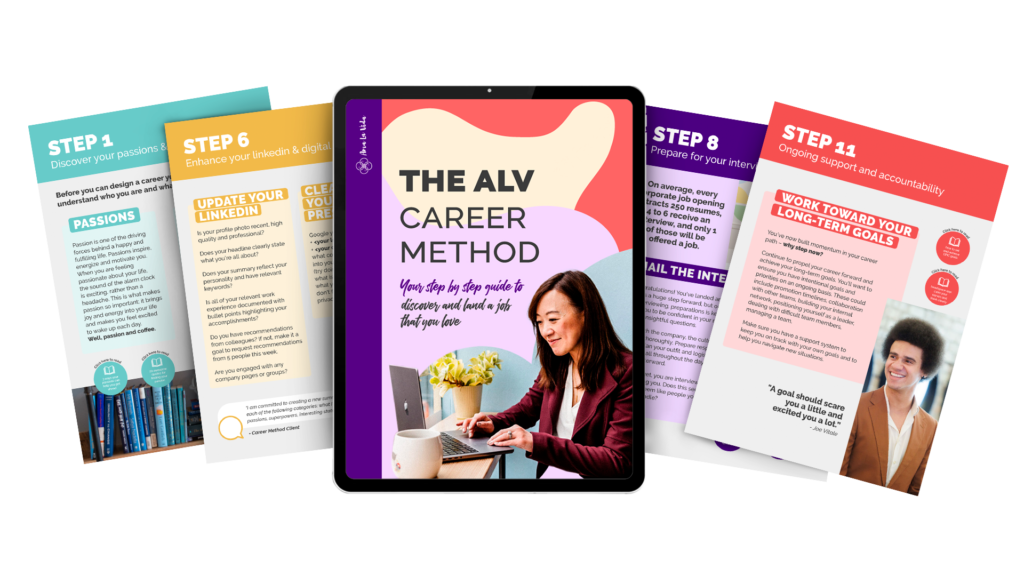
Download our comprehensive step-by-step guide to design and land a job you love!

Images from The ALV Career Method Guide
ALV Method Downloadable Guide

colleagues talking

As you continue to rise the ranks as a leader, you’ll gain all sorts of skills and get exposed to many new aspects of business. Do you understand the P&L (profit and loss statement)? Do you know how to manage a poor performer? Can you build and deliver a compelling presentation? Can you build your network and influence internally? While many of these things might not come naturally to you, I’m happy to see more and more companies investing in training for both hard and soft skills for leaders. We’ve certainly come a long way in equipping leadership to be effective in their roles versus just promoting them to new roles and wishing them well. And also, as I reflect on where I am regularly stretched as a leader and where I see many other leaders get tripped up, these skills get a lot less air time. Context switching Some people are really really good at executing upon one specific thing. They can handle one type or category of tasks at a time, and they need repeatable work habits to thrive. I don’t mean repeatable tasks like entering in data over and over again. I mean repeatable styles of working and related cadences, like assembling reports that go out monthly or showing up and presenting in lots of meetings. So often I’ll see that when you ask someone to add a new way of working to their plate, they truly struggle to deliver on expectations. As you move up in your career, what’s needed from you at work becomes less predictable and more varied. You might start your day working on a report, then have to go run to 3 different presentations, then handle an HR escalation all before preparing a budget. This requires tremendous context switching, flexibility and relentless prioritization. You inevitably have to work on things that need to be answered today and long-term projects that will never get done if you don’t carve out time for them. The transition from very clear, repeatable work styles to a more adaptable approach is a leadership skill that is often overlooked. Noticing This sounds so simple that it’s almost silly, but it’s less common than you’d think. So often people show up, do their work and sign off. They aren’t observing what else is going on in the world or the business that’s influencing business outcomes. Great leaders have an almost sixth sense about when something is off in the business, when something is going on with one of their team members or when something has shifted externally, and they pause to assess the situation. This might look something like, “I noticed that we had a lot of leads come in that didn’t convert this week, so I did some digging to see what has changed.” “I noticed that Riley hasn’t spoken up in the team meeting the last two weeks. This is unlike her.” “I noticed our competitors keep hiring people with this skill set. I wonder if we’re missing something in terms of the opportunity there.” Removing your own blinders and paying more attention to what is happening around you isn’t easy but is crucial for leaders. To start, I suggest building some checkpoints for yourself to evaluate the health of your team and its goals, and assessing those on a weekly basis. Getting the ball rolling A lot of people have great ideas, but presenting an idea to someone without any related action plan is actually more harmful than helpful. You’ve now just distracted this person and made your idea their responsibility versus yours. If you want to do a gut check or get approval or buy-in, that is fine, but also think 3 steps ahead to what you’ll do should you get the green light and communicate that as well. Other leaders might get stuck when it comes time to put pen to paper. Staring at a white page can be intimidating. How do you go from something conceptual to something that exists? It requires creativity and risk. And others may be great at execution, but only on what’s been clearly prescribed to them. They can absolutely implement and operate for the world today, but they struggle to envision what will be needed in the future. If you want to move up as a leader in the organization, it’s time to make the shift from, “I was thinking that we could… ” to “I took the liberty of building out this new process. I want to get your thoughts before we implement something.” When you start to prove that you are someone who can get something self-generated and forward-thinking done, especially when that thing requires other people or cross-functional teams, you’ll also start to prove that you are ready for more advanced leadership. Being the bad guy When people think about leadership, they often think about inspiration. They think about vision. They think about the glorified parts of the job. No one thinks about delivering bad news. About having to tell someone they’re not performing. About having to make decisions that feel very painful today but will lead to positive outcomes in the future. If you have people-pleasing tendencies or are used to being a high performer and getting a lot of recognition throughout your career, the transition to occasional bad guy can cause emotional turmoil. As you move up, there are fewer and fewer people left applauding your work and more and more people bringing their grievances. I don’t want to paint leadership in a negative light because it is truly so rewarding and you have the ability to make such a positive impact. But I also want to be clear that it isn’t all rainbows and butterflies. You won’t always be liked. Your news definitely won’t always be liked. You simply have to be clear and fair. Navigating unclear territory and toeing the line of contradictions I often describe leadership as a “job of contradictions.” Be authentic but polished. Hold people accountable but

Read More
woman holding a journal with a flower in it

Enough is as good as a feast. I’ve been thinking about this quote a lot. A little while back I wrote about my recent molar pregnancy experience. It’s a rare chromosomal abnormality in a pregnancy that leads to you growing a tumor instead of a fetus. Not only did I lose the pregnancy that I had been so desperately trying for, but my type of molar pregnancy presented a 20-25% chance that the pregnancy tissue would become malignant and evolve into a form of cancer.  The way they can track if the cells are growing or not is by measuring your HCG levels (pregnancy hormone) in your blood. Ideally, this level drops from sky-high to 0 over the course of the next couple months after the issue is identified and the tissue is removed surgically. The first few weeks after surgery my HCG level was dropping, dropping, dropping. I was moving past the pregnancy loss and starting to get hopeful again about the future. And then… It jumped up.  I got the test results on a Saturday morning and didn’t hear from my doctor until Monday. For those 48 hours, I was an absolute lunatic. I devoured every blog post, clinical study, and medical document the internet had to offer. I talked to everyone I knew who had medical expertise even remotely relevant to my situation. I recalibrated my future plans knowing that I was headed for chemo and with that came a very prolonged timeline for when I could try for a baby again. I cried. A lot. Monday came and doc said we won’t head straight for chemo. We will wait at least another week to see how my blood work continues to evolve. The next week, my level went down.  Then it went up again. Then down again. Then up. Then it stalled. I was eventually referred to the oncologist. I’m happy to report that after 14 weeks, my HCG finally dropped to 0. There’s still a chance it could reappear, but for now, this is great news.  This experience was a special form of torture for me. I’m a pretty adaptable person. I can change course quickly and don’t get too hung up on the past. I can face anything in front of me. I just need to know what it is.  For me, the waiting is what’s miserable. The not knowing if I’d be doing chemo or not. A 6 month wait to try for another baby or a year-and-a-half long wait. Any of these options was manageable. I just hated waiting and waiting and waiting to find out which one it would be. When I first wrote about my molar pregnancy, my biggest fear was that I’d get so fixated on it, and trying for a second child, that I’d miss out on the joy of spending time with my two-year-old. I don’t think I’ve done that. I’ve been having so much fun with her and managing to remain present as a parent. But I largely sank into a slump. If anyone asked, “How are you doing?” they had better brace for impact. “Not great and here’s why.” Couple this oversharer with an ongoing health issue that occupied a tremendous amount of brain space, and anybody and everybody was going to get a lesson in pregnancy hormones.  I had become so one note. It had become my excuse for everything. I was over me. And reaching that point is usually a good catalyst for change. In my mind, I was incredibly justified in feeling crappy. And to some extent that’s true. I have been through a lot and I need to give myself grace for not always being at my best. And simultaneously, things can not be perfect and still be good. I can be going through something tough and still be joyful. I can get out of survival mode and thrive even when life doesn’t go my way.  Because what is thriving? Is it abundance? Is it having everything you want? Or is it your posture toward life? Is it a headspace you occupy?  So I keep coming back to, “Enough is as good as a feast.” It’s not about having everything; it’s about having your needs met. And being grateful for that. I’ve always been a striver. Working toward that next goal. Pushing myself a little bit harder. And while that characteristic is largely what’s made me successful, it’s also responsible for making me unhappy. And so I’m working to balance ambition and vision with gratitude and contentment. It’s starting to become clear to me in so many aspects of my life. Am I back to my pre-baby physique or weight? No. But I’m healthy (I mean ish. Molar pregnancy aside). I can carry my daughter. I can fulfill my responsibilities. For today, that’s enough. Is my business making money hand over fist? No. But it’s growing. It’s making an impact in people’s lives. It’s creating long-lasting friendships. For today, that’s enough.  Am I pregnant with my second child, rounding out my ideal four-person family? No. But I love the three of us together. If another child never comes, that will always be enough. Our coaches will tell you that while you can’t always control your thoughts, you can control the power and validity you give them. You can control which thoughts become the narrative you share. And the narrative you share so often becomes the reality you see. Last year when people would ask me how business was, I would often say, “It’s really hard.” And it felt hard. And the more I said it, the harder it felt. And I was so drained by that. Things haven’t gotten easier this year on paper, but they’ve become lighter for me emotionally because I’ve intentionally changed that narrative. I can tackle difficult challenges but still do them with a sense of ease.  I’m working on making this same shift personally. I can be in this weird, long, scary health thing and

Read More
Nicole speaking with microphone

My husband often describes himself as a “toes in the sand” kind of person. He means that he doesn’t get pre-excited for vacations because it’s not real for him yet. It’s not until his toes are literally in the sand that it feels real and he starts to get excited about the fun that lies ahead. I’m the opposite. Half of the enjoyment for me is in the anticipation and planning. I get excited thinking about the experience, researching things I want to do and places I want to eat. It feels real for me from the second I say out loud that we’re going. These roles hold true for us during pregnancy and are exacerbated by the fact that I’m the one who is physically feeling how real it is. From the second I think I might be pregnant, my brain races. I’m envisioning this person. I’m planning their room. I’m planning our lives. Throughout the entire day, as I feel all the changes in my body, the reality of this future life vision gets solidified. It makes the let down of pregnancy loss that much more challenging. I’m not just losing this person I’ve grown for a few days or weeks or months, I’m losing an entire life I’ve built with them in my mind. And the grief that comes with that is very real. The all-consuming nature of this experience can make focusing on work challenging. You’re physically there, but your mind is elsewhere. You’re often grieving something without most people around you even knowing about it. Coping with pregnancy loss at work can feel like bottling up the emotions that come with deep loss because it’s taboo to discuss or it feels like the expectation is you should be able to carry on like normal. If you’re anything like me and you’ve experienced a miscarriage, you will say, “I’m fine.” And you will feel mostly fine. And you will keep things moving mostly fine. And you are mostly fine. Until you’re not. Until it bubbles over and you break down. Until you’re forced to realize that maybe you weren’t as fine all along as you thought you were. Now having gone through two pregnancy losses, I’ve learned a bit about what helps me cope when returning to work. These steps help me grieve in a healthy way and not get to the point where things boil over.  With my most recent pregnancy, I learned that it wasn’t viable at my first prenatal appointment at about 8.5 weeks. I was supposed to come into the office that day, and my team knew I was headed to this appointment first. After receiving the news that I was experiencing a Molar Pregnancy, I just couldn’t bring myself to go to the office that day. I gave myself the rest of the day off to be sad.  For me, I just needed an afternoon and then looked forward to getting back to work. I knew that I couldn’t be productive that day or have regular conversations without crying and also that I like to stay busy when I’m going through something tough. For you, this might look different. You may wish to take a few days to yourself – if that is feasible for you, do it. Taking time to acknowledge your feelings can give you the space to grieve without forcing yourself to get right back to it and act like nothing happened. You may not feel comfortable sharing what you’re experiencing if you are newer to a role, don’t have trusting relationships with colleagues, or were very early on in your pregnancy. That’s okay. You have to trust your gut in terms of what you feel comfortable sharing and with whom. For me, sharing my experience was a key part of my recovery and a way I allowed my colleagues to have a glimpse into my headspace and behavior. Days when I seemed short, sad, or distracted, I probably was. And this sharing allowed them to fully consider what might be on my mind and not internalize it as a reflection of them.  The outpouring of support I received when I shared very openly about my loss (via a blog post) was truly heartwarming and helped me to connect with others and feel less alone. Even the experience of writing my feeling down was cathartic. If you’re not up for sharing it, journaling what you’re going through might be helpful in and of itself. I asked a colleague, Shelby Davis, what helped her after having a late-stage pregnancy loss. “I think feeling open to talk about it is what helped me the most so I didn’t feel like I had to stuff it all down and act like everything was fine and nothing happened. I had conversations with my direct boss and his boss to let them know what had happened and that it would take me some time to be back to my normal bubbly self. They told me to take the time I needed and if I needed anything throughout the process to let them know. They were very understanding, and my team that I managed was so thoughtful.” While opening up can be extremely scary and uncomfortable, you might be surprised at the support you receive and who provides it. Pregnancy loss and infertility are so pervasive that many people, even those you don’t suspect, have had their own journey with these experiences and are incredibly empathetic. People’s reactions will vary widely when they learn of your news, and some people won’t have the capacity or awareness to support you how you’d like. This can be very disappointing. At the same time as I mentioned above, others may show up for you in ways you never expected.  Many of my closest friends responded with “Oh so sorry” and not a whole lot else because they didn’t know what to say or probably didn’t think much about it after the initial news. That’s okay! Not

Read More
person drawing renovation plans

We’ve been renovating my condo for a year and a half. It pains me to say this, as my husband and I thought it would be a 3-month job.  We’ve done some of the work ourselves and have hired out a few things to specialists, but the vast majority of the work has been done by our contractor, George. George has been in construction just about his whole life. He has built homes from the ground up. He knows everything. Electrical, plumbing, woodworking, you name it. He’s magical. Throughout this project, my husband, Ed, has been George’s apprentice. Ed is a pretty handy guy to begin with, but he’s learned so much from working with George. Ed is the most meticulous person you’ll ever meet. If something is a millimeter off, it will drive him insane. He will go nuts over a scratch or a smudge that I can’t even see. He wants everything to be just so. In front of our house, a few stairs come up from the street to our front porch and front door. Under those stairs is a strange space that doesn’t really have much of a purpose right now. We got the idea to clear it out and make a little wine room with a wet bar. The first step was to build a reservoir for the future sink we’d install, add some plumbing and then pour a concrete floor. I was honestly in shock watching this process take place. You feel like it should be so official. That there’s a right piece of equipment to use for this reservoir and a right way to attach the piping. Maybe even an Ikea-style kit for putting this thing together. Nope. They used a bucket. One of those orange 5-gallon buckets you get a home depot. They cut some holes in it to attach some pvc pipes and caulked around the edges to make it waterproof. No offense to Ed and George, but this thing looked like a kid’s science fair project. And not even a good one. But it worked just fine. When I took a second to relax the look of shock from my face and reflect a bit, I started to realize that this is what I do at work too. And what I am constantly talking to my team about. We all want there to be a right way to do things. We want insights to the nth degree before building the marketing campaign. We want 40 years of historical data before building the budget. We want the Ikea kit to help us build the new product. We want the perfect solution to execute or automate the process. But that’s just not reality. We don’t have the time or money for the level of research we want to do. We’ve only been around for 6 years and each has been so different, so we just don’t have the historicals we’d want. No technology exists to do the thing we’re trying to do, so a frankenstein solution may be our best bet. Just like with building the house, so much comes down to accepting that there’s no perfect solution and having the courage to go for it anyway. Here’s what I’ve learned from building my business and from George: 1. Rely on principles and frameworks, not memorization. While the bucket solution may have looked haphazard, it wasn’t a random guess. There needed to be something to collect water, a tube for the water to flow and a mechanism to seal it. Though they creatively put something together with materials we could easily acquire that would meet our needs, there was a thorough understanding of the physics at play and the systems required to meet the goal. I’m not saying you should go making stuff up and entirely winging it. Learn principles, learn history, understand best practices and methodologies. And then use the resources you have to create a solution that works for you and your business. Don’t completely wing it, and also don’t try to memorize exactly what worked someplace else and expect it to work for you too. Understand theory and then adapt. 2. Find people who’ve seen it before and know when to challenge their thinking. Having guidance and insights from those who have expertise in your area or who have done something similar before is invaluable. They not only can teach you lessons and tactics, they are tremendous at putting things in perspective. When an issue with our construction feels catastrophic, George always has an anecdote that helps right size the problem. Business mentors and coaches can do the same. Be as open minded and curious as possible and soak up as much knowledge as you can. But don’t take every single thing as gospel. Countless times throughout this project, Ed’s newbie status has served him. George will have a tried and true approach, and Ed will ask, “Wait, can’t we just…” Sometimes there will be a reason we can’t, but often Ed’s fresh take will actually find a better, more efficient solution. Regularly seek out the wisdom of others, but also put it through your own critical thinking filter. 3. Get data, proxies and customer insights, but challenge your temptation to want 100% perfection. We always want to be making data informed decisions. We should absolutely be striving to gather data, conduct research and talk to our customers instead of just hypothesizing. And also, this can be a slippery slope. Especially in cash constrained, quickly moving startups, we don’t have the luxury of taking months and months to gather information before acting. We have to do what we can and then make the best decision possible with the information on hand. I often say it’s easy to disguise procrastination as research. Be honest with yourself about when you truly need more information to be able to move forward and when your fear of being wrong is actually what’s holding you back. 4. Figure out small ways to test

Read More
team working together

In my career, I’ve managed everyone from very young professionals straight out of school to seasoned leaders with decades of experience. Despite the wide variety in experience and background, I continue to find that almost all employees struggle with the same thing: proactive upward communication. This sounds buzz-wordy and like it’s just corporate jargon used to describe the way you navigate internal politics. That’s not what I mean at all. This isn’t a performative act to get your boss to think you’re great (though them thinking you’re great is a byproduct of doing this well!).  What I mean is at any given time, does your boss know what you’re working on, how you’re progressing toward goals, what you need from them and what they can mentally archive? In most cases, the answer is no.  I’ve had countless conversations with other leaders struggling with this same thing with their team members. It seems almost universal that this is a skill that’s not only not taught but one that many are reluctant to develop. Why is this so challenging? It’s not natural to announce your activities like some kind of news reporter. You are focused on what you need to do, keeping yourself organized and getting your work done. It’s usually not top of mind to be sharing how meetings went, giving frequent status updates and occupying space in your brain to think about what someone else might need to know. It takes intention and time to build habits to do this well and not have it feel burdensome. It can toe the line with micro-management. The pushback I have heard time and time again both when asking for this type of communication from employees and when coaching folks who are dealing with this friction with their boss is that it feels micro-managery. I completely understand that, and it can definitely get close to micro-management at times. However, I’d argue that providing extreme transparency and temporarily overcommunicating more than feels comfortable to you actually results in more passive management because your manager now knows what’s going on. They won’t feel they need to be so in the weeds. This is especially true if the relationship is new – trust is often earned, not just given. What’s the result if behavior doesn’t change? I have seen a number of work relationships devolve over time into messy arrangements where there is a lack of trust and frustration on both sides mainly due to poor upward communication. The boss is frustrated because they don’t know what the employee is doing with their time, and they jump to the conclusion that they aren’t doing enough. The employee is frustrated because they feel unappreciated and like their boss isn’t recognizing their efforts and their ability to do their job. No one wants this. What’s the result when behavior does change? When an employee begins to master this, there is a sigh of relief from everyone. The boss feels more at ease knowing what’s going on and not worrying that there will be an emergency a the 11th hour. There is increased trust and with that comes increased autonomy. The boss slowly disengages, freeing up time for both them and their employee.  How to do it. 1. Give updates in real-time. You may have spent a week prepping for a meeting with your boss. It went great. You’re buzzing coming out of the meeting and have your next steps ready to rock. Hooray! Your boss, however, is left wondering, “How did it go?” This is a perfect example of something that may not be natural or top of mind to you, but a quick Slack message or text would be perfect to say something like, “Meeting went great. I’ll update you more in our 1:1 tomorrow.” You don’t need perfectly packaged reports or well-written emails to give updates to your manager. Think about the simplest way you can communicate key information to them throughout the day or week. This regular flow of communication frees their brain space from wondering how you’re doing to focusing on what they need to be doing. 2. Provide visibility to plans and delays, not just results. Very often I’ll hear from team members that they didn’t provide an update because there was no movement on a project or because the goal hadn’t been reached yet. No! This is when you should be communicating even more. This might be something as simple as saying, “My week got crazy busy with an influx of sales calls, but I wanted to let you know I haven’t forgotten about that project. I have two hours blocked off on Friday to work on it.”   This also means escalating either for support or simply transparency when you encounter a roadblock. “I know we wanted the dashboards live by Monday. I realized a challenge with the way the system is set up, but I think I have a work around. Unfortunately this means that we will likely not go live until Wednesday.”  Or perhaps your boss asked you to help with something that was a bit nebulous and requires some planning. Maybe the expectation is that it won’t be complete for a month, but that doesn’t mean that they don’t expect to hear about it for a month. A great starting point is a plan for how you plan to go about the project (this might be just a couple sentence email). Even better, you might assemble a task list or project plan that you share with them so they can follow along with your progress in real-time without you having to share an update and without them having to ask. 3. Really own your one-on-ones. Your boss should not have to drive your one-on-ones. I repeat: your boss is not responsible for your one-on-ones. You are! I recommend having a shared location (a Google Doc, a project management tool, etc.) where you each can add agenda items in advance of your meetings. You should own: A. Providing updates

Read More
nicole wood smiling looking up to the sky

I just had my second miscarriage.  I went in for my first OB appointment of the pregnancy at 8.5 weeks as is standard practice. With my daughter, we thought on that first scan that she looked like the cutest little gummy bear. While nervous given the last pregnancy didn’t work out, I was so excited to see that wiggly, tiny little baby on the screen. Already at this point, I was in deep. I had: I walked into that appointment buzzing with excitement to see my baby for the first time. Instead, in the span of 15 minutes, I received a whirlwind of news that left me with no baby and a cancer scare instead. I had a rare occurrence called a molar pregnancy. It’s a chromosomal abnormality that leads to your body growing a mass of cells instead of an embryo. There’s no chance of a viable pregnancy, and instead there’s a real risk that, even after a d&c, those cells continue to grow (cancer) and require chemo to combat. Through my research and consultation with my doctor, I was made aware that no matter what happened post-d&c, this is a very treatable condition, and I will ultimately be totally fine. That’s certainly a relief. I know I’m going to be okay.  But it is unsafe for me to try to conceive again for many months, potentially over a year, depending on the course of my treatment and recovery. And who knows what will happen then.  The summer maternity leave I was planning for… gone. The 2.5 year apart siblings growing up together… gone. The family of four I thought I’d soon have… gone. And quickly replaced with massive doubt that it will ever come. So what now? I’m giving myself some time to be sad. And angry. And jealous. And heartbroken. Because I am all of those things and they deserve a space in this process. And then… I’m putting one foot in front of the other and continuing to move forward. With each day it gets easier. I’m spontaneously crying less… so that’s something. But my biggest fear in all of this isn’t that I’ll have cancer or even that I’ll never be able to have another child. It’s that I’ll squander years of my life, precious years of my daughter’s toddlerhood, waiting and wanting for something else. That I’ll be so focused on the next step toward recovery and trying for the next baby that I’ll be unable to fully enjoy the one I have right in front of me. And I can’t let that happen. I know my situation is unique, but in so many ways it’s not. You’ve felt this before. The struggle of trying to enjoy life when you feel like you’re waiting for a big part of it to start. You’ve had your version of it. Maybe you’re living it now. Waiting to land that amazing job so you can ease your financial strains and be able to contribute your talents meaningfully. Waiting to get through this seemingly never-ending project at work so things can calm down and you can make plans again. Waiting for your business to find solid footing so you can prove that your idea wasn’t crazy. Waiting to find the one so your life with a partner can begin. Waiting to get even that first positive test so you can become the parent you know you were meant to be. Waiting for something to happen that may almost entirely be out of your control, that you feel is standing in the way of you living the life that you truly want for yourself. It sucks. It really sucks. This isn’t a “5 Steps to Overcome…” type of post. Today, I have no advice. All I have is my story.  All I can do is share that if you are feeling similarly, I see you, I have hope for both of us, and I believe that no matter how difficult it is, our lives today are worth living fully just as they are. I can remind us that no matter what’s missing, there’s so much good stuff here already. I can tell you that you’re justified in cursing the world for its injustice, just as I am. And that you’re not foolish for holding onto hope for what might be. I unfortunately cannot tell the future. I don’t know if or when what each of us wants will come our way. But my wish for you today and always is that in the midst of the waiting, you don’t forget to keep living.

Read More