Author: Nicole Wood

person writing in a notebook at a cafe

I had a bit of time before a flight the other day so I stopped at a little airport café. Instead of tucked off to one side or another of the terminal, the café sat right in the middle of the hallway directly between gates on either side. One side of the café had a glass display with the pizzas, sandwiches and salads for sale. There was a cash register but no one manning it. The other side was a wrap around bar with one bartender fielding orders from people coming at him from all directions. He was hustling. I sat down in the only remaining open barstool and pretty quickly got a feel for what was going on. There were cooks to make the food but no one there to take orders but him. So he was simultaneously making drinks and taking care of the bar patrons while also serving the role of the to-go item cashier. Upon further inspection, it got so much worse. He only had one stained and crumpled paper drink menu. He was shuffling it around among the people at the bar. He had no food menu. He was rattling it off from memory when anyone asked. He had to keep an eye on the food coming out of the kitchen and make sure it got to the appropriate bar patron or to-go customer. There was a little area where the cash register was where he was trying to corral all the to-go people, but they kept coming at him from all angles trying to place orders. Repeatedly, he’d ask them to come around to the other side. It really was the only way to tame the chaos. And then there were the customers. Oh the customers. We all know people become the worst versions of themselves when they step foot in an airport. I saw a glimpse of it while sitting at that bar for all of 25 minutes. One woman was so particular, edging toward nasty. I’ve never heard someone ask so many questions to order a margherita pizza. I felt bad for this guy. He was sweating. He was visibly stressed. He was not set up for success. I way over-tipped him. Was his service the best I’ve ever received? Of course not. But because I could see the full picture of the odds he was up against, it was my small way of saying, “I see you, and I appreciate what you’re doing,” Then something hit me. Was his situation all that different from what most corporate employees face on a daily basis? Sure there’s a difference in the physicality of it which is certainly demanding. But what about the stress? What about being set up to struggle? How often are your employees trying to do their jobs with one crumbled menu? Trying to achieve more, better, faster with insufficient tools and resources. How often are your employees trying to do the job of many? Especially as many organizations continue to face layoffs and thinning teams. How often are your employees trying desperately to get people to order from the other side? Trying to get people to follow the process that makes their life easier. That gets them the data they need. That keeps the process manageable. How often are your employees dealing with people who don’t recognize that 48 questions about a pizza is ridiculous and rude? That lack EQ. That can’t read the room. How often do you stop and say, “I see you?” Maybe it’s time to start over-tipping. Here are three quick ways to do this today. I firmly believe that almost everyone shows up to work with good intentions and a genuine interest in doing a great job. Then the challenges arrive: the glitchy systems, the limited resources, the difficult personalities, the lack of data. As leaders it’s our job not necessarily to understand but to appreciate the full picture of what our teams are facing. It’s our job to regularly stop and say, “I see you, and I appreciate you.” And it’s our responsibility to invest every dollar we can in our teams and no less. They deserve it.

Read More
woman with eyes closed standing outside

My daughter turns two very soon. The classic “the days are long, but the years are short” is probably the truest parenting cliché of them all. The hours before bedtime often feel like an eternity (especially during nights like last night where she decided the tub was a fantastic place to poop), but these years have gone by in an instant.  I was reflecting on this time in my coaching session this week with my amazing coach, Betsy Westhoff, and I was struggling to articulate how I’ve been feeling. It came out as, “I feel like a squishy, insecure version of myself, both inside and out.”  I really felt like I was going into parenting with my eyes wide open. I had heard it all: the delivery stories, the sleepless nights, the teething. One of the benefits of having kids later than many of my friends was collecting a ton of information. I knew it would be hard. I knew I would be exhausted. I thought I had managed my expectations as well as anyone could. I was sort of right… and a lot wrong. I was focused so much on the physicality of it all. How my body might feel. How tired I might be. The challenges breastfeeding could present. And I handled those all fairly happily (well, as happy as someone can be pumping in the office for the 3rd time that day). What I completely failed to ask about and prepare myself for was how I would be rocked emotionally. What it’s truly like to go from booking trips on a whim to not being able to go to CVS on my own. How badly it hurts when the person you grew, delivered and fed from your body wants Daddy instead of you. The disgust you feel when your ass looks terrible in every pair of jeans because you haven’t figured out how the heck moms find time to exercise. The helplessness you experience when you can’t catch up at work and you’re questioning yourself and your skill set in ways you never have. The last two years have been incredible. And they’ve also been really, really hard. Betsy helped me articulate my challenge in a new way. While I’ve gained so much beauty and fulfillment in my life, I’ve lost a bit of my power. And I am ready to get it back. To not long for the person I once was, but to become a newer, stronger version of myself. To accept that pieces of me will be squishy at times and also to strengthen those I’d been neglecting. So what now?  Betsy walked me through some reflections to help me identify what’s been missing. A few themes emerged from our discussion. I like creating stuff. I often say what attracted me to entrepreneurship is building something from nothing. Be it a business, an art project, a blog post or a new design for my home, I like to make things. How can I build this into my routine? I need to move my body. We talked about how for 15 years, I was a serious competitive dancer. For anyone who has a former life as a competitive athlete or performer, you know it often leaves a big hole in your life, difficult to fill in your current world. Becoming a parent expanded this gap for me, as I stopped exercising all together. What’s the smallest thing I can commit to to get moving? I find joy in doing stuff that only I can do to build the business. I love writing. I love sharing my journey with others. And yet these things are never the priority when I open my computer in the morning. I’m sucked into the needs of the business that day, and the stuff I love gets put on the back burner. Forever. What if I started to prioritize contributing to the business in ways I love and that only I can? I don’t feel guilt for being away from my child or work, but I want to feel like I’m doing something valuable in each place. I have a special flavor of mom guilt where I don’t feel bad for the time I spend away from my child or my business. Instead I feel bad for feeling like I’m doing each one shittily. Less time is okay. More impactful is necessary. What does that look like for me? These are not nice to have. As parents we are told constantly to “put our oxygen masks on first” and that you “can’t pour from an empty cup.” These have become major eye-rolls for me – I’m so sick of hearing them. And yet… what I need to do is listen, not just hear. I keep postponing rejoining Classpass. I keep accompanying my husband and daughter to swim class to make his life easier when it’s the perfect opportunity for me time. I keep prioritizing everyone else’s Slack pings over my own goals. Who could I be if I made these non-negotiables? So to summarize the process and to give you a checklist because who doesn’t love a checklist: The in-betweens are the hardest. When you have the awareness that you’re no longer happy to stay where you were, but you’re not quite sure where you’re headed just yet. These in-betweens pop up in your career, your business, your relationships and yourself. And they are all-consuming. I’m in one now. I’m not the confident 20-something who’d strike up a conversation with anyone at a bar and who quit her corporate job to start a business. I’m not the wise mother who knows the right thing to say and always gets her laundry into the dryer on the first try without having to rewash it. I’m in a messy middle, painfully growing into the person, mother and leader I’ll soon become. But thanks to my coach and the incredible support system I’m lucky enough to have around me, I’m finding my way

Read More
woman writing in a notebook

Even as the leader of a coaching company, I still need ongoing support to develop my own leadership capabilities. Even though I talk about leadership principles much of the day, I still need a third party to help me see my blindspots and overcome obstacles.  Leading people is hard, messy and things are constantly changing. I’m so grateful to work with my incredible leadership coach, Betsy Westhoff. She helps me build a roadmap for how I personally need to evolve alongside my team and business. She listens to my monologues about what I think needs to change in my business, reminds me to take a deep breath, and then helps me channel it into something productive. In fact, this just happened about 30 minutes ago. Why I Needed this Exercise In the early days of Ama La Vida, my co-founder Foram and I did everything, so we had intimate knowledge of every single aspect of the business. That of course was unsustainable and undesirable, as we did things because we had to, not because we were particularly good at them or interested in them. Over time, we hired a team to start tackling each of these fundamental business functions. We hired talented people to do marketing, HR, client success, sales and more. And still, we were small enough that we knew the vast majority of what was going on. We could probe, push and drive things forward based on what we knew to be happening and where we saw our direct reports needed support. Now that those people have hired teams below them and the complexity of the business has continued to grow, it has become clear that it’s time for us to level up our leadership once again. Foram and I have found ourselves busier than ever because we’re still in the weeds in a lot of areas where we feel our direct reports need more support, haven’t fully stepped up yet, or where the departmental goals are not being met. And the volume is even greater now, meaning we’re stretched thinner than ever before.  It has constantly felt like we can’t let go. People seem stumped in meetings, so we jump in to guide. Balls get dropped or things are left to the last minute if we aren’t constantly checking in on progress. This can get chicken and egg-y. If I’m in the meeting, my team will often defer to me. If I share an opinion, it carries weight due to my title. If people know I’m involved in a project, they will rely on me to guide it. So how does one ever escape? How do you get your team to give you what you need to fully trust that they can execute without your oversight? It’s what we all want. Recently, my coach gave me an assignment to help me elevate my leadership that I’ve found tremendously valuable and want to share with you. Now this exercise isn’t just for entrepreneurs or those building startups. This is helpful for any leader, especially if you are new to the team, have people in new roles or have perfectionist tendencies. It helps you clearly articulate what you need from your team to free your brain and calendar for other things, more strategic things that you’d like to be doing. How to Do the Exercise So here’s the exercise. Go team by team and determine what you need to feel, know, and see/measure to be able to take a less active role in that team. That’s it! The beauty of it is it’s not a hack or so complex that it becomes meaningless. It’s a way to clearly articulate a need and get your team to co-build with you the most effective way to meet it. I found success in first outlining my expectations in a Google Doc (yes, I know, not another Google Doc), but this can be done in any medium of your choice. I then highlighted each item as red, yellow or green to indicate how well I felt we were doing in each category. Once I took a first pass, I reviewed the doc with each of my direct reports in an upcoming one-on-one and tweaked it according to our discussion. We then discussed how to make the reds and yellows green. Let’s look in more detail at each of these areas. Feel – When observing this team and its behaviors, what do I need to feel? This is the most nebulous of the categories, but it lays a solid foundation for the ‘why” behind each of your subsequent asks. Beyond the very tangible metrics and information you’ll of course want to know, there’s a certain sense you get from a team, how they are performing and what they are prioritizing. What do you need to feel from that team to feel that they are on the right track? For example, as I worked through this exercise for my Marketing team, I wrote that I needed to feel we were “balancing long-term strategy with immediate needs to bring in business,” “thinking outside the box” and that “the team is in a good place.” Know – When not with this team and its leader, what do I need to know? If I’m not in meetings, conversations, decisions, what information needs to make its way to me? I find this category most challenging because it can easily slip into micromanager territory if you’re not careful, and also it’s the most critical for most managers to be able to let go. And of course, it tends to be the most difficult one for team members to do successfully.  This exercise allows you to clearly spell out the: Decisions that should be brought to you Cadence and content of updates you need, both about the business and the team Pathways to get your questions answered To continue with the marketing example, here were some of the things I indicated that I wanted to know: Key projects/priorities and progress

Read More
team looking at their boss talking

It was an absolute joy speaking with my friend and mentor, Disha Gulati, the founder of Here Here Market, for our Founding Females interview series. Disha is brilliant, generous and perhaps what I love most, keeps it very real. Here are my key takeaways from our conversation on How to Motivate Your Team When You Can’t Throw Money at the Problem. Before we got to the discussion around motivating your team, I, of course, wanted to know more about her entrepreneurial journey. Entrepreneurship is objectively an insane career path. Why does anyone subject themselves to something so risky, exhausting and all-consuming? And even if you do decide to pursue it anyway, how do you make it happen? 1. The way in which you work is more important than what you do. I talk to Ama La Vida clients about this all the time. People tend to focus on the company, the job title and the job description. But so often, those things just describe “what” and completely ignore “how.” Do you like to work on a team or independently? Are you okay with ambiguous instruction, or do you need the steps spelled out? Can you thrive in a long-term project environment, or do you need to see wins on the board and boxes checked each day or week?  For Disha, even though the exact business idea was fuzzy, it didn’t matter. She knew that she wanted to be a business owner and wanted the style of work that allows you to move around different departments and problems all day long. This is as important as being passionate about the business idea itself. 2. Create a glide path. There is so much you can do while still employed to build your business and create the pathway that leads you to be a full-time entrepreneur. You can build your network, identify resources, run tests, and build a community. All of these things are invaluable as a business owner, and it makes it a lot less scary to quit your job and make the transition when you already have a network and resources behind you.  But be careful not to go into analysis paralysis. As Disha says, the “business plan goes out the window on day 3.” Don’t create a “zombie business plan” that’s hundreds of pages long and keeps getting tweaked. You need to actually take action and start something before you can tell if your hypotheses are true. There will be a time when you do need to go full-time, so get it as far as you can and then take the leap. “Very few side projects have ever become unicorns.” 3. A big part of starting a company is the village that you have to support you. When Disha started her first business, she had no idea how to find developers, had no clue that investors in her type of business largely don’t reside in the Midwest, and wasn’t super connected in the space she was entering. Now, as a veteran entrepreneur, she sees how valuable having that village around you is. They are the ones who give you feedback, open doors, provide resources, and help you stay on track. Building your network is something you can do now and for free to set you up for success in the future. We then moved on to discuss Disha’s style as a leader and how she motivates her team. While Here Here Market has secured external capital, it in no way compares to the budgets large companies have. She has had to get creative with how to motivate her team, especially when her entire business model got turned upside down during the pandemic. 4. Transparency is key. Here Here Market, initially started a group dining app. When COVID hit, not only did group dining disappear; it became illegal. Imagine trying to get a business off the ground when overnight its ability to operate gets completely erased. Instead of sweeping her fears under the rug, Disha was open with her team. She recognized that no one, not even CEOs, knew what was going to happen. Instead, she invited her team to rethink the business with her. “We rebuilt this company together.” The fact that the team wasn’t in the dark or lied to encouraged them to work hard to figure out how to keep the thing going.  5. Anchor on the mission. One of the many benefits of Here Here is the opportunities it creates for restaurant owners, chefs, mixologists, and others in the food and beverage industry. It’s a new outlet to bring their products to consumers and one that was actually an option when restaurants were closed and quickly going out of business. Disha always reminds her team about that mission. Her whole team knows that each day they show up to work, they are there to help the hospitality industry. She said, “If we can make money that’s great.” But even if not, they were doing something to help this industry and the people in it. That helped every employee to feel and act not just like an owner in the business but in the outcome, we are creating in the world.  Not every business has an altruistic mission or is changing the world, but this lesson can still apply. I recently toured Buffalo Trace distillery and loved a quote they had on the wall. “We make fine bourbon. At a profit, if we can. At a loss, if we must. But always fine bourbon.” In this case, they aren’t saving the world or keeping businesses afloat. They are making whiskey. But the employees here know that the mission is to create an incredible product, and that’s why they come to work and how they show up. 6. Motivation is not one size fits all. You have to understand what motivates each and every team member in the organization. Disha mentioned that for some of her employees that motivation comes from the mission, transforming the industry. For others,

Read More
team laughing and having fun

“So often in life, things that you regard as an impediment turn out to be great, good fortune.” Ruth Bader Ginsburg So much has happened over the past couple years that has companies confused, fearful and reactive. From the Great Resignation to back-to-office campaigns, companies are desperate to get employees excited about the organization and engaged with their peers. Recently I’ve seen everything from offering Sonos speakers to providing daily free lunch to increasing salaries by 30% before an employee has even started try and solve these problems. Now I like free stuff, fun stuff and money as much as the next person, but I am certain that these perks themselves are just not enough to get people to care. Employees need to feel cared about, not bribed, to care about the company in return. Fortunately for startups like Ama La Vida and Here Here Market, the online marketplace (like Etsy) for chefs and culinary creators, throwing money at the issue was never an option. We just don’t have the budgets that the big players have to offer fancy things and fat salaries. And while that feels like a major disadvantage, in some ways I feel it may be a blessing in disguise. Frankly it’s easier to give everyone cool new swag than it is to work out each team member’s flexible work schedule. It’s easier to order lunch for the group than it is to pick up the slack when someone is struggling. It’s easier to host a happy hour than it is to provide support for managers leading remote teams for the first time. It’s easier to ask, “Do you like the ice cream?” than it is to ask, “How are you honestly doing?” But what matters to people more? Perks and high compensation are great. Keep ’em coming if you can. But they aren’t a replacement for humanity. Disha Gulati, Here Here Market’s CEO and co-founder, is one of the most genuine and authentic founders and leaders I know. She truly cares about her team and ensures that she’s regularly checking in with them and supporting them as people, and in turn they support her and her businesses vision. They choose to work for her early-stage startup when they could be someplace with snazzier perks and a better view because they feel valued and appreciated in the way the company behaves … not just in what it gives. I had the incredible honor of sitting down with Disha to learn more about her approach to motivating her team and to share some key learnings for leaders at any type of company. Click here to listen in on the full conversation. When you can’t throw money at employees, you tend to do the hard work of tailoring your workplace to them and supporting them as whole human beings. Turns out that might be much more valuable.

Read More

My business partner, Foram, and I started ALV with a modest investment of $8k each. Six years, a pandemic and many pivots later, we are still going strong, and bootstrapping our way to success. As I’ve reflected on what’s gotten us here and what will enable us to get to the next level, I keep coming back to one thing: decision making. As a non-technical founder, I don’t actually do anything. I don’t write code. I don’t coach our clients. I don’t prepare our tax returns.  Let’s be clear—I do a ton of stuff because we are small and scrappy, but I’m not an expert in any of it, and it’s not a long-term plan. I’m convinced that my job description could be boiled down to one sentence: make the right decisions at the right time. And the effectiveness with which I can execute  this job description dictates how successful we become. So how do you as a leader make good decisions quickly? Well, countless studies show that human beings are inherently pretty bad at making decisions. We are extremely biased and can be swayed by something as small as our level of hunger at any given moment. “The unavoidable conclusion is that professionals often make decisions that deviate significantly from those of their peers, from their own prior decisions, and from rules that they themselves claim to follow.” Kahneman, Rosenfield, Gandhi, Blaser So the knee-jerk reaction tends to be, let’s eliminate the human elements and rely more heavily on data. This sounds great conceptually, and I am all for continually pushing for better data sets from which to inform decisions.  But there are downfalls here too when over-indexing on data. It takes a lot of time and energy and may be more expensive than is feasible. Data is constantly changing, and you get stuck in analysis paralysis. Don’t forget that timing is key. Having consulted for some of the largest companies in the world, even with seemingly unlimited resources, you never have the exact data you need. Data can be interpreted in many different ways, and so there is often still a human element of numbers driven analysis. “We like to think we make complicated decisions based on rational analysis, but most of the time, we actually make an emotional decision and then invent a rational analysis to justify it.” Seth Godin Relying on data exclusively is unrealistic. I feel that as leaders we need to learn to balance data and intuition to make sound decisions rapidly. Back in my consulting days, a partner once drew this diagram and said to me, “When you’re just starting out as an Associate, you need this many data points to draw a conclusion and make a decision. Later in your career, by the time you’re a Partner, you need this many.” I think about this often and have found it to be so very true as I’ve matured in my business career. I typically get a spidey sense that something is off or needs some attention. I don’t always act on it right away, but I’ll start forming a hypothesis and figure out what I need to do to test it. Now “spidey sense” sounds incredibly fluffy, but I don’t actually mean just an unjustified feeling. This might look like: Preliminary data, like a few days or weeks worth, instead of months. A few data points coupled with repeated, strong anecdotal evidence. Really compelling qualitative data when you aren’t able to measure it just yet (e.g., when people write a ton in your inquiry forms they tend to be better leads than when they just put a few words). Gather enough data to be able to draw conclusions and challenge biases (and of course be careful of confirmation bias). And also trust your gut because you’ll inevitably never have the data you need, and a lack of data does not equate to a lack of reason. “Never make a decision with less than 40% of the information available and never gather more than 70% of the information available.” Colin Powell If you’re not sure where to begin when facing a decision or choosing what (or what not) to pursue, ask these four questions: How am I evaluating success? What data points do I need to see to be able to determine if this thing is working or not? Note: if you can’t articulate what additional data you need to make any given decision, you might be disguising your procrastination as analysis. What are my biases? Check yourself on what could be shaping your hypotheses to try and give each idea/option a fair shot. Who else needs to reach this decision alongside me? You are likely not alone in this. How are you involving and inspiring your team in the process? What do I know to be true? What unique insight do you have as a leader that makes your gut worth listening to? Maybe this is a past experience or being informed of another similar but different data set or initiative that others aren’t privy to. Then, make the decision as soon as you (intelligently) can. When you do it, keep in mind: You will be wrong much of the time. The sooner you decide, the sooner you can pivot. Factor in relative importance, not just direction. You might be swirling on a decision that doesn’t actually matter all that much either way; you’re just concerned about getting it right. Free your brain space to think about more strategic and important matters. Conduct a premortem. What’s the best and worst-case scenario for each option? You’ll likely find the worst case isn’t all that bad and probably better than doing nothing. It takes courage to place a bet and stand behind it. Being a leader is scary, but it’s your unique skill set that has equipped you to be the right one to make this call. Data that comes thereafter is simply that… data. It is not a reflection of your value as

Read More

Download our comprehensive step-by-step guide to design and land a job you love!

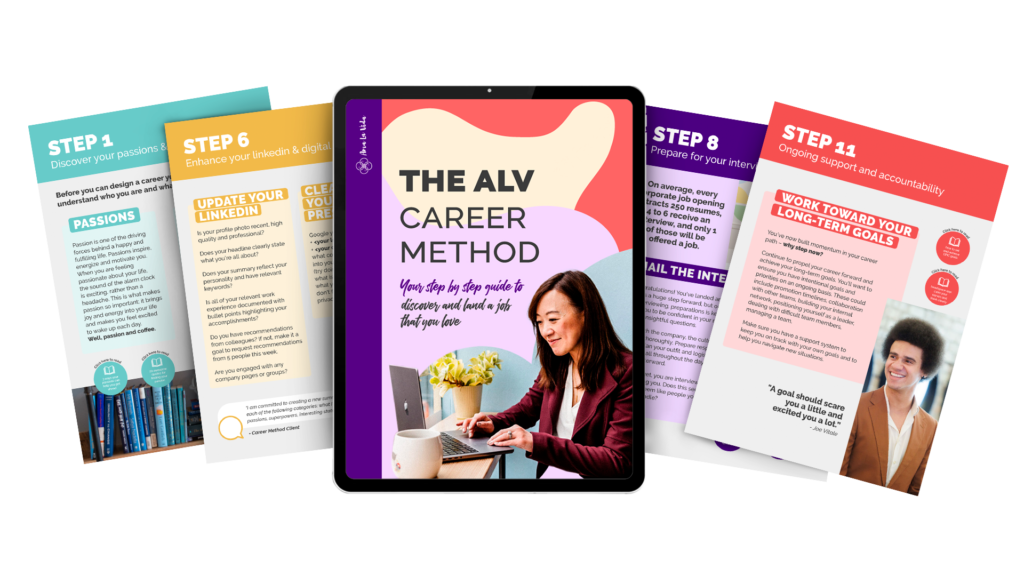
Images from The ALV Career Method Guide
ALV Method Downloadable Guide

“You know what’s fire? Cultivating relationships with people who genuinely want to see you win and pouring that same type of love back into them. Building community with the right people.” Michell C Clark The most confident I ever was in my idea, my business plan and myself was the day I left my corporate job to work on Ama La Vida full time. I was convinced that the world needed what ALV was providing and that I was scrappy and stubborn enough to build it into a successful business. Every day since, I’ve doubted myself. I’ve doubted my ability to steer this ship. I’ve questioned why people would want to work for ALV. I’ve worried if we would make it financially. At times I’ve even gotten so lost in the nuance and slog of the day-to-day that I’ve forgotten why we were doing this in the first place. Building a business is a ridiculously difficult undertaking. I don’t care how experienced you are or how well-funded you are. It can feel like a constant battle, and it’s easy to get lost in your own mind. What brings me back to a place of clarity, sanity and optimism is almost never the numbers on the page or the dollars in the bank. It’s the people around me. What’s even gotten the numbers on the page and the dollars in the bank in the first place is not the brilliant business plan I wrote. It’s the people around me. In addition to having the good fortune of an amazing co-founder, I’m surrounded by other smart, caring and generous humans. My group text with some of my closest girlfriends is filled not only with “I believe in you’s” but also with “I’m recruiting for this role. Know anyone’s?” and “I’m struggling to get this deal closed. What advice do you have for this meeting’s?” It’s these ladies that give me the willpower to keep going when it all feels too much.  From legal to sales to PR, I’ve had friends donate time, energy and connections to help get ALV off the ground and continue to grow. When I’ve needed a creative approach to recruiting or a new software to fill a gap, it’s people in my network who have given me answers, solutions and resources. When I’m having one of those – why the heck did I even do this days – it’s other founders who lift me back up and encourage me to stay the course. Networking can feel like a chore. No one hates small talk and awkward exchanges more than I do. But building friendships, alliances and your community is anything but awkward… it’s life-giving. It’s not just an extracurricular activity to do when you have time. It *is* your job. My network (or honestly I prefer to just call them my friends) has given me more answers than Google, more leads than ads and more motivation than any quote on the wall. It’s the people who know us, love us and want us to success that will help ensure it is so. So when you’re ruthlessly trying to decide how to prioritize the bazillion possible things you as a founder can do with your time today, make sure connecting with friends, old and new, is at the top of the list. And the upcoming Founding Females event featuring Disha Gulati, of Here Here Market, will be a perfect opportunity to not only get your questions answered, but be in community with other entrepreneurs and grow your network. Be sure to join us! With love,Nicole

Read More

We are all well aware that these are “unprecedented times” and that there is no playbook for how to navigate them. That has left many of our clients confused about how to approach next steps in their careers. How do I approach the job search in a pandemic? Can I still negotiate my salary? Do I have to go back to the office? We’ve rounded up a list of the most common and pressing questions from our career coaching clients. Our amazing team of coaches have provided answers to these questions so that you can keep progressing toward your goals. Job Search Questions I’m seeing postings for interesting jobs that I feel under/overqualified for. Should I still apply? Yes. Why do you need anything else?  That’s the whole answer.  Okay, more seriously… absolutely you should. You’re not always the best, most impartial judge of your own abilities, and writing qualifications for a job posting is far from a scientific process. The reality is that if you can create value, that’s the only real qualification – so don’t eliminate yourself! –John Roccia How do I not submit applications 800 times?  The unfortunate answer is being super intentional with networking and crafting applications. Use it as a test – if you’re not interested in the job enough to spend time on the application, skip it. Don’t treat it like a to-do list with prescribed checkboxes. There’s no “right” way to do things, only effective and ineffective ways.  Effective ways aren’t one-size-fits-all, they’re customized.  Make friends and conversations, not applications. Throwing spaghetti at the wall to see what sticks doesn’t get you any closer to a job, especially a meaningful one. Those fire-and-forget applications drain your morale and energy but add nothing to your process. Don’t get pulled into the trap of thinking this is a numbers game – it isn’t.  – John Roccia Does anyone read my cover letter?  Yes, your cover letter is getting read. And not only by the recruiter or hiring manager. Sometimes your cover letter has been forwarded to your potential boss, or another department altogether. It is important to include a cover letter as it gives the reader the basic information about who you are, why you are interested in the company and what you have to offer. In some instances, a cover letter makes you distinctive as other applicants won’t/can’t be bothered with it. Check out some cover letter resources here.  –Shari Santoriello Does my resume format matter?  Yes!!! If you are applying through a “apply now” button, just know that your materials are going through an applicant tracking system (ATS). The best format for any online application is a word document, void of graphics, column, tables and borders. Use of bullets and commas are okay. While the online application may say that a PDF file is okay, I would still avoid it, if possible. I know there are so many stylized resume formats to adopt and they look great, but unfortunately not all of them can be parsed through an ATS system. That puts you out of the running before you get started. Watch out for these resume mistakes!  For those in a creative field, having two different-formatted resumes is a great idea. You can have one straight Word document for online applications. Then craft a second stylized, creative resume for sending directly to people, or highlighting on your website.   -Shari Santoriello I know I’m a skilled person. Why can’t I get a job?  This is my least favorite yet most commonly asked question these days.  The tough reality is it may be timing. The world is tough right now. Things are changing rapidly.  Companies that appear to be hiring may just be recalling laid off or furloughed employees back. Companies you see growth in may have formerly asked employees to take pay cuts and are finally able to increase salaries and grow their current staff. So even when you see growth out there it may not have the outwardly impact you’re expecting. Patience is critical in these times. It may not happen overnight, or as rapidly as it has for you in previous booming employment years. It’s important to remember that a delay in hiring doesn’t mean you’re not a great, high-skilled employee.  Tips: Make sure you take your time and apply for every job with intention, tailoring your resume and cover letter.  Work hard to find a connection in the company (six-degrees of separation) so you can get your name to them in multiple ways. Network, network, network, and when you are sick of networking, network some more.  Most jobs are being found these days through networking. This doesn’t mean tracking down a stranger on LinkedIn and asking them to get you a job. This means letting people in your network know you’re looking and asking them to help connect you with other people. Then, let it grow from there.  Treat every conversation you have as a possible opportunity and just see where everyday life leads you! A high skilled VP client of mine recently was very frustrated with the job hunt process. She wasn’t getting any bites and was feeling very stuck in a job she was miserable in.  I told her to pause. Take a break from all the searching and applying. Just take a break, take a breath and when ready just have a couple simple networking calls with people you already know so the pressure is low. She did precisely this, and two weeks later at our next session she told me they had connected her with someone in their network. She had a job interview that week. No applying, no surfing the internet, just a simple conversation with someone she knew. Tap into that network, keep your head high and your confidence up.  –Jennifer Maynard Should I negotiate my offer even in the midst of the pandemic?  Yes! There may not be a budget for what you request, but you should always try. Even if they cannot

Read More

Our motto here at Ama La Vida is “always be bettering.” It reflects our internal desire to always be learning and growing as individuals and our passion for supporting our clients to improve themselves and their lives. When our Leadership Coaching team developed a new assessment to help individuals identify their leadership style, I couldn’t take it fast enough. I couldn’t wait to uncover a new dimension of my personality and leadership and learn how it could help me most effectively lead my team and grow my business. Why Assessments Matter We are all on a never ending journey of self-discovery – it’s important to have self awareness. This helps you understand how you are perceived by others, what your strengths and blindspots are, and how to best collaborate with your team. If you are a leader or aspiring leader, it’s crucial to know your default leadership style and your natural tendencies. That way, they can be enhanced and you can supplement the areas that don’t come as naturally to you.  Relying on assessments, rather than making assumptions can be incredibly helpful to get an unbiased perspective. This can prevent you from gaming the system, even unintentionally.  The Leadership Style Assessment While there are many facets of someone’s style as a leader, this assessment focuses on two main areas: People First   You naturally focus on your team’s needs and emotions and consider these when making decisions. This may come at the expense of business goals. Get Sh*t Done  You tend to focus on task and project execution and impact on company goals. This may cause you to miss emotional cues from your team. No score is right, wrong, good or bad. But ideally, in this assessment, you want a high score in both areas, and you want your scores pretty close together. This means that you have high competencies in both styles. And it shows that you balance prioritizing your team’s needs with getting things done for the business. Learning About Your Leadership Style I scored higher on the People First scale than on the Get Sh*t Done scale. I found it interesting that I was not surprised by this outcome, but my team was.  That might mean that I have some blindspots in terms of how I deliver my People First approach, and there was also an important distinction I came to make. I am a Get Sh*t Done person; I will crank out work with the best of ‘em, and I am quite structured and process oriented in terms of how I operate. However, I still have some work to do in developing my Get Sh*t Done leadership; I still feel bad asking things of my team and holding them accountable to goals and priorities. It’s something I’m working on. After you receive your score, here are some things to think about: Do you think this accurately reflects your style? What would your team say? What makes you great at your default style? How can you really lean into this strength? What are your blindspots regarding your non-default style? How can you develop in those areas or lean on others for support? How can you use this knowledge to better communicate and collaborate with others? Using This With Your Team While this assessment is valuable for anyone to take and reflect on individually, I also wanted to utilize it as a tool to collaborate more effectively as a team. And so, I asked each leader on my team to complete the assessment prior to our weekly meeting. Then in our meeting, ALV Leadership Coach Jennifer facilitated a discussion around the assessment. While I’m lucky to be surrounded by facilitation pros, you can absolutely utilize these questions to facilitate a discussion with your own team. Also note that you do not need to be a people manager to take this assessment. We all have leadership capabilities even before becoming leaders in title. Questions Coach Jennifer asked: What was your style, and were you surprised by it? Are you surprised by anyone else’s style? Which strengths resonated most with you? Which blindspots resonated with you? How do you think knowing the styles of everyone else on the team will benefit you? What I learned It was a lively and engaging discussion. Here were my key takeaways: Your default as an individual may be different from your default as a leader.  As with my score, I have a different operating system for myself versus when I’m leading a team. It’s important to understand these differences and understand why you may hold yourself and others to different standards. It is helpful to collaborate with people who have a different default style than you.  Maybe you are a People First leader and struggle to see things through to execution or to hold others accountable. Try partnering with someone with a Get Sh*t Done style to help you execute on your vision. Or perhaps your default is Get Sh*t Done. It may not be natural or obvious to you to think about how your team feels or will react to certain situations. Bounce ideas off a People First leader and ask them how certain ideas or feedback will land. Share your leadership style when beginning collaborations.  Acknowledging that you have different styles at the onset of a project will undoubtedly help you appreciate one another and collaborate more effectively. Don’t underestimate the power of also calling it out when you have the same style. This will help you collectively recognize blindspots and avoid butting heads. You’re never done learning about yourself and your team.  It’s amazing that even when you work closely with people every day and feel like you have a good sense for how they operate, there is always something new to learn. I was surprised by some of my team’s results, and I got more insight into their personalities as they explained why they believed they scored the way they did. Additionally, people are always changing. So even when you’re

Read More

Maternity leave is an important time for you as a parent to bond with your new addition and for your family to adjust to an exciting, albeit exhausting, new normal.  We have a long way to go in this country, but it has been great to see more and more companies providing substantial parental leave policies to birthing parents and non-birthing parents. However, breaks from work that last weeks or months are often coupled with stress. Stress around how to plan and ensure goals are still met in your absence.  These steps will help you effectively prepare for your leave so that your team can thrive while you’re gone. And also so that you can focus your time and attention on your family. Understand Your Benefits and Follow Procedures Before you can plan thoughtfully, you should fully understand what you are entitled to in terms of time off and benefits. This can be quite confusing as it differs by state and employer. This article provides a great summary of the various methods of securing paid or unpaid time off for maternity leave. Connect with HR at your work to understand your benefits in full. Also, ensure that you fill out the proper paperwork to secure your leave according to your employer’s policies and processes. Start Early Once you know how long you’ll be taking off and when you plan to start (some parents begin their leave prior to their due date, and some wait until the baby arrives to try to maximize time with the child), you can begin preparing for your time away. If you’ve ever left for vacation and realized 2 hours before you signed off that you didn’t have a coverage plan in place, you know the panic that can set in. Don’t set yourself up for that panic (times a million) by waiting until the last minute, or even the last week or two. Start planning early for your leave (babies can be unpredictable!). Luckily in most cases, you know that maternity leave is coming months in advance. This gives you ample time to think through your strategy and put a comprehensive coverage plan in place. Start taking note of tasks as you complete them, meetings you lead or attend and any extracurricular involvement you have. If you are only paying attention for a week or two, you will likely miss some of your important, less frequent tasks. Starting to build awareness and document your role months in advance will allow you to catch all of those additional responsibilities. Make Life Easy For Those Covering Document processes and procedures. Ideally, someone would be able to pick up your documentation and perform the task without having to ask any questions. That’s the goal! Try and get this level of detail in your documentation whenever possible. Loom is a great free tool for recording short video tutorials including screen recordings. This can make your process documentation a lot easier. Try not to leave a mess! In the hustle and bustle of the day-to-day, all of our inboxes, processes and to-do-lists can get a bit dizzying. It’s extremely difficult, if not impossible, to hand over a perfectly clean set of responsibilities to someone else. However, making your best effort to tidy things up before training your replacement will make their life easier. This might include: Schedule transition meetings to walk people through what you need of them and to give them a chance to ask you any clarifying questions. This includes determining temporary changes in reporting structure and bringing stand-in managers up to speed on what they need to manage your direct reports in your absence. Use it as an Opportunity to Identify Gaps You may not even realize until you go to document your processes or train someone else on them that certain aspects could be improved upon or that the processes in place don’t even make sense anymore. Use this exercise as an opportunity to identify areas of improvement for the future. You can even suggest to the person covering for you that they keep track of their own questions and suggestions so that you can have their fresh perspective in addition to your own when you return and can address it. Determine Your Communication Plan Hopefully you will be able to truly disconnect, delete your Slack, chat and email apps and focus on your family. However, there may be a few scenarios where it makes sense for you to be kept in the loop. Think through the following, and determine your preferred communication strategy: Once you’ve come up with your answers to these, take the time to document them along with the rest of your coverage plan and communicate it to your team. Expect the Unexpected Babies don’t follow our plans and may arrive a week late or 3 weeks early. While of course you can’t account for every scenario, try to make your plan for maternity leave as flexible as possible so you can adjust to whatever is required.  Some things to think about: Think about Your Reengagement Strategy Playing catch-up is always tricky. Remember that the world you are returning to will look completely different from the one you left. Here are some things to consider: You won’t be able to plan for every detail because you won’t know all of them until you’re living it. But thinking through some of this in advance may make the transition a bit smoother. Seek Support They say “it takes a village” for a reason. No one can do it all alone, and community can help you be educated and more importantly, stay sane. This could be something as simple and informal as buddying up with other recent/expecting parents at work or joining some local parenting Facebook groups. Or you may also want to seek some more structured support. Some of our favorite providers include Partum Health, which provides postpartum coaching, support and care coordination and Kunik, which provides community and resources for working parents. Seeking

Read More

I don’t think I need to tell anyone that this year didn’t go as planned. For some, that meant unforeseen income and success, but for most of us, our businesses and wallets took a major hit. If you’re in a leadership position of any kind, you’ve likely felt the pressure to keep your team motivated to be all-hands-on-deck and in survival mode while they are simultaneously dealing with very real stressors at home and at large. As a leader, keeping your team motivated over this very long period of uncertainty and turbulence may feel like a losing battle. You recognize that your people are stressed, overwhelmed, and exhausted. And yet, you still need them hustling hard to hit goals if the business is going to survive. So how do you encourage a supportive and healthy workplace while not shying away from the need for accountability to business outcomes? These 10 tips will help you keep your team focused and motivated when times are tough. Acknowledge External Influences In most cases, I would encourage leaders and team members to focus on what is within their control and not make excuses based on external factors. However, sometimes you just can’t separate business performance from environmental conditions, and now is one of those times. Your team may be doing absolutely everything in its power to sell, but the demand just isn’t there. Or they may be extremely budget conscious and strategic with sourcing, but supply costs have simply doubled. It’s important to acknowledge efforts as well as external factors so your team members don’t feel their work is futile. They can continue to mitigate impacts of the outside environment and prepare for a strong rebound in the future, but it’s important to ensure that they don’t feel like a failure in the meantime. Anchor On Purpose Any time work gets difficult and stressful, it’s easy to get bogged down in the details and lose sight of why you’re doing what you’re doing in the first place. There’s a reason you and your employees took this job or started this business: an impact you wanted to make, a segment you wanted to serve, or a mission you wanted to achieve. To keep your team motivated, constantly remind your team (and yourself!) of why we are all here. ALV Chief Coaching Officer Foram Sheth says, “Remind people why they come to work every day. It’s the why that gets us through the toughest times because we know “we’re doing this for a reason that matters to us.” Don’t Shy Away From Difficult Conversations (and over-communicate) Don’t deal with difficult situations by avoiding them. People know and can feel when things aren’t going well. Not addressing challenges head on creates a culture of fear and can often be a catalyst for a rumor mill. Make sure you communicate the facts to your team without sugar coating them. Be as transparent as you can without invoking fear. Specifically address what the company is doing to pivot, adjust, pull through and then add what you need from them to support these efforts. ALV Career Specialist Shari Santoriello adds, “Communicate….a lot. In fact, over-communicate.” This does a few things. It helps your team members feel that they are “in the know” and involved with the business moving forward. It also helps to dispel any assumptions. Workers will tend to rely on their own (negative) thoughts if they aren’t given other information. This feeds into low morale and low engagement, two things that are a disaster for growth. An added bonus for over-communicating in the land of remote teams is that it may touch a person who tends to be quieter and give him the boost he needs to come forward and engage at a higher level. Don’t Make Every Conversation A Difficult One ALV Director of Career Services John Roccia says, “Be wary of the unintentional curse of “Every Meeting Is Bad.” This is something that can happen to any business. The businesses that are most vulnerable are those with remote teams and those under external stress. That’s a LOT of businesses right now!  The “Every Meeting Is Bad” curse is exactly what it sounds like – every meeting where you interact with someone else in your company is about not hitting goals, lack of performance, dangers we’re facing, etc. These conversations are all real and necessary, but their compound effect is brutal on the team. Think about your team like a garden. If you have an especially brutal winter, your goal shouldn’t be to tell all your flowers how bad it is and how much they need to grow despite the hardship. Your goal is to build a greenhouse – an environment where your garden can do its best growing while shielded from the bulk of the bad.” Stay Human When facing challenges, many leaders go into execution mode which can come across as robotic and insensitive. While your company needs you to be a strong operator now more than ever, your team members also need to know that you are a human being who is right there beside them struggling too. Feel free to show some emotion. Talk about the things that are challenging for you personally right now. The goal here isn’t to make this about you or to moan and complain. It’s about showing glimpses of your humanity, so your team knows you are feeling similar stress. You are choosing to continue showing up each day and building toward a brighter future. Provide More Support Than Usual (and tailor it to the employee) Your team is used to operating in “normal” times. For many of them, they may not have worked through an economic downturn before, let alone an economic downturn resulting from a pandemic. The regular playbook doesn’t apply, and your team members may be floundering. ALV Leadership Coach Jennifer Maynard says, “Don’t be afraid to increase the number of direct one-on-one conversations you’re having. Let each person know you are there with

Read More

Sometimes, it can feel like you can’t manage to do anything right, especially in new roles or when working with new people. Your to-do list can become overwhelming, leading to a lot of stress and tension. You might see some of your peers being put on a pedestal as company golden children. What do they have that you don’t?! These are completely understandable and relatable feelings. I guarantee that there is no difference between you and these so-called all-stars. They have simply mastered a few techniques that make them respected and appreciated by leadership. You can too! No matter your role, here are some fool-proof ways to quickly become your boss’s favorite. Take Extreme Ownership No one expects you to know everything or know how to do everything that’s assigned of you. On-the-job learning is much more common than coming in knowing exactly how to do your role. What is expected of you, however, is to completely own your domain and area of responsibility. Figure out how to get things done even if you don’t know the answers yourself. If your boss sends you an email and says, “Can you please look into this?” Become the boss’s favorite by replying within 24 hours confirming receipt and that you are on it. Then do it and let your boss know of your findings. If something comes up related to your work area that you don’t really know how to handle, don’t just hope the problem goes away or someone else deals with it. Escalate the issue. Your boss doesn’t have enough brain space to keep track of every little thing they delegated your way. That’s the point of delegation! So make sure they know when they send something over to you, they can remove it from their mental to-do list because you have it covered. Taking things off you’re boss’s plate is sure to help you become the favorite. What this might look like in action: Taking the liberty of creating a new report that you think will help you analyze something in a new way. Seeking input from others who play a part in a task you are working on. Scheduling time with your boss to talk through challenges you are facing and get their input on how to approach them.  Provide Proactive Updates This is so basic, and I say it to every junior employee, but you’d be surprised at how many senior level leaders struggle also with this. If your boss has to ask you, “Hey, how is xyz project going?” then you’re already behind the eight ball. Become the boss’s favorite and don’t make them ask you! Stay in front of updates so you can put your boss’s mind at ease. This isn’t just a kindness. They are responsible for anything that’s been assigned to you, so if for some reason you don’t get it done or miss a deadline, they often have to deal with the consequences. Proactively updating them on your progress helps them know that the project is moving along. It allows them to offer guidance along the way to avoid rework and gives them an opportunity to support you. Remember, your boss is on your side and is there to help you! These updates are important even when you have to say, “I’m struggling.” What this might look like in action: A daily or weekly wrap-up with some quick documentation of what you accomplished. Throwing 15 minutes on their calendar to talk about a project you’ve been working on. Copying your boss on critical update emails so they have visibility to progress. Maintain Perspective This one is tricky. Independent of anyone else’s experiences, your experiences, feelings and challenges matter and can’t be force-ranked against anyone else’s. It is, however, important to practice empathy with your boss, just like you want them to practice empathy with you. They may have come from a previous generation where work boundaries and wellbeing expectations looked different. They may be under extreme pressure to hit numbers or meet objectives that you may not be fully privy to. Your needs and boundaries should never be sacrificed. And at the same time, it’s important to put yourself in their shoes and maintain perspective regarding the challenges they’ve faced in their career and how that may make their sense of normalcy different from yours. What this might look like in action: Thanking them for taking the time to teach you something. Keeping complaining/gossip to a minimum. Thinking about all the things that are on your boss’s plate and what pressure they may be under before reacting to a request. Put in the Time Flexibility is the future. I personally am not a stickler when it comes to the specific hours a person works or where/when/how they get their work done. All I care about is that the work gets done and that employees are present enough to build strong connections and provide the support that others need from them during reasonable work hours. I tell everyone who works at ALV that some weeks you’ll work 30 hours and some you’ll work 50. We also have an unlimited PTO policy. Taking time off is incredibly important to maintain wellbeing and long-term motivation. All that being said, there are times when no matter how well you manage your time and priorities, there is just a large volume of work that needs to get done. It happens, especially if your company is rolling out a new product or program or another major change. I struggle when I see people more than happy to enjoy the 30 hour week but never actually putting in the 50. If you’re getting everything done, good for you. But if you’re telling your boss that deadlines will be pushed or that you’re stressed and overwhelmed by your to-do-list, they will expect you to spend the extra time to catch up. What this might look like in action: Staying late to get something done when it is time sensitive.

Read More