Author: Cait Swamy

expert on her computer

Wondering if you’re experiencing imposter syndrome? Our Imposter Syndrome Quiz is designed to help you find out. If you’ve ever felt like a fraud, convinced that despite your achievements, someone will eventually discover you’re not capable or deserving of where you are, you’re not alone. Imposter syndrome is a silent epidemic impacting many of us. Research published in the International Journal of Behavioral Science indicates that about 70% of individuals will experience imposter syndrome during their professional lives—but my coach’s intuition tells me that number is even higher. Imposter syndrome creates a cycle of self-doubt, anxiety, and negative self-talk that can hold you back from embracing new opportunities and achieving career success. It can even affect your mental health. If these feelings resonate with you, it’s time to take action. Take our Imposter Syndrome Quiz now to uncover how imposter syndrome manifests for you. Start breaking free from the mental barriers standing in the way of your success! Throughout this article, we use the spelling “imposter syndrome,” though you’ll also see it written as “impostor syndrome.” Both are commonly used interchangeably to describe the same experience. We use “impostor” when directly referencing the work of others who have used that spelling. For example, Dr. Valerie Young, who identified and introduced the five types of Impostor Syndrome in her book. What is Imposter Syndrome? Imposter syndrome is the persistent feeling that you’re not as competent or talented as others believe you to be—despite clear evidence of your achievements. How does experiencing imposter syndrome feel? It often shows up as self-doubt, anxiety, and fear of being “exposed” as a fraud, even among high achievers who have a strong track record of success. This internal struggle fuels negative self-talk and can make it difficult to fully embrace accomplishments or take actionable steps forward in life. What Causes Imposter Syndrome? The imposter phenomenon, a term from clinical psychology, stems from a mix of personal experiences, societal expectations, and workplace pressures. While anyone can experience imposter feelings, research shows that high-achieving women are especially vulnerable. A recent meta-analysis of over 100 studies confirmed that women experience imposter feelings more often than men, highlighting just how widespread this is. This builds on the original work by psychologists Pauline Clance and Suzanne Imes, who first identified the “impostor phenomenon” in 1978, noting that many successful women attribute their achievements to luck rather than to their own abilities. Several factors contribute to the development of imposter syndrome: Upbringing & Parenting Styles Growing up with impossibly high standards, excessive praise, or constant comparisons can shape the belief that success is never enough—or simply a stroke of luck. Parents who emphasize achievement may unintentionally instill a fear of failure and patterns of negative self-talk. Work Environment & Cultural Expectations As a career and life coach, I believe early work experiences strongly shape our beliefs about career potential. Competitive job markets, perfectionist cultures, and limited diversity in leadership often reinforce imposter feelings—especially for high-achieving women, who may feel constant pressure to prove their worth. Perfectionism & Overworking “You can be anything if you try hard enough.” It’s a familiar mantra, but it often fuels overwork and the belief that effort must be endless to be worthy. This mindset is linked to stress, burnout, and depression—common outcomes of internalized perfectionism. External Factors & Social Conditioning Cultural norms, gender expectations, and other environmental factors can set unrealistic standards of success and amplify feelings of imposter syndrome. These narratives can lead individuals to downplay their accomplishments and live in fear of being “found out.” Overcoming imposter syndrome begins with recognizing the influences and other external factors that shape our self-doubt. When we acknowledge these pressures while focusing on what we can control, our mindset, we unlock incredible potential. By challenging negative thoughts, reframing limiting beliefs, and fostering a more empowering workplace culture, we can break free from “impostor feelings” and step into leadership with confidence. How Imposter Syndrome Sabotages Your Career Imposter syndrome is not a diagnosis, but rather a thought pattern. These thought patterns can create mental roadblocks that hinder confidence, professional growth, and leadership potential. When you feel like an imposter, it’s not just an internal struggle—it actively leads to self-sabotage, holding you back from advancing in your career. Imposter syndrome can create a self-fulfilling prophecy, reinforcing the belief that you’re not good enough, even when you have the skills and experience to succeed. Over time, this mindset can limit your growth, impact your confidence, and prevent you from seizing new opportunities. Imposter syndrome can sabotage your career success in many ways. Here are a few examples that might sound familiar: Reluctance to Apply for a New Job Many professionals hesitate to go after new opportunities, believing that because they don’t meet 100% of the qualifications, they can’t apply. This is fear of rejection or “not being ready” and can keep you stuck in roles that don’t challenge or fulfill you. Hesitation to Negotiate Salary or Ask for Promotions When doubt creeps in, you may struggle to advocate for yourself. Imposter syndrome convinces you that you’re lucky to have your position and should just be grateful, making it difficult to ask for the raise or promotion you deserve. Avoidance of Leadership Roles Many high performers feel frustrated watching less-experienced colleagues move into leadership positions because they don’t see themselves as “leadership material.” Part of this is avoiding going after the next leadership opportunity because imposter syndrome may cause a fear of being exposed as a fraud or fear of failure. Withdrawing from Networking or Speaking Opportunities A toxic work environment can reinforce imposter syndrome, making individuals afraid to voice their opinions in meetings or avoid networking events where they feel they don’t belong. Over time, this self-doubt and withdrawal can isolate you and limit your professional growth. By recognizing these patterns, you can start to challenge the negative beliefs that are holding you back. So, what’s the first step to breaking free? Understanding how imposter syndrome manifests in your life. Take

Read More
woman working on computer

If you’re feeling discouraged at work, you’re far from alone. In fact, Gallup’s State of the Global Workplace study found that only 23% of employees feel engaged at work—a stark reminder that workplace discouragement is more common than you might think. The real challenge? Discouragement isn’t just a feeling—it can quietly disrupt your productivity, drain your career satisfaction, and even spill into other areas of your life. As tough as it is, discouragement is part of the journey when you’re striving for something meaningful, and often surfaces when expectations don’t match your results, when progress feels slow, or when goals seem out of reach. But here’s the good news: it doesn’t have to hold you back. By normalizing the feeling and using a few proactive strategies, you can transform discouragement into determination—and start moving forward today! Signs you Might be Feeling Discouraged at Work Workplace discouragement can manifest in subtle yet impactful ways, often creeping in without us fully realizing it. While it’s normal to experience ups and downs in your career, persistent feelings of disengagement or frustration may point to something deeper. As leadership and career coaches, we often see tell-tale signs that our clients are feeling discouraged at work—like being disconnected, feeling unmotivated, or just going through the motions. View this post on Instagram A post shared by Ama La Vida | Online Career Coaches (@alvcoaching) Recognizing these signs is the first step toward regaining clarity and motivation. So, here are some common ways discouragement might show up in your work life: Lack of Motivation and Energy One of the most noticeable signs of discouragement is a lack of motivation. Tasks and new projects that once excited you might now feel like a burden. You may find yourself procrastinating, struggling to focus, or feeling drained before the workday even begins. It’s more than just being tired—it’s a sense of dread or disinterest that makes it hard to stay engaged. Feeling Disconnected from Your Team Workplace discouragement often leads to a sense of isolation. You might withdraw from team conversations, skip meetings, or avoid casual interactions with colleagues. Maybe you’re “ghosting” Slack channels or finding excuses to bow out of team-building activities. Feeling disconnected from those around you can compound the sense of frustration and make collaboration feel even harder. Going Through the Motions When you’re feeling discouraged, you might find yourself on autopilot—completing tasks mechanically, with little sense of purpose or fulfillment. It’s not that you’re doing a bad job, but the spark of passion or satisfaction is missing. This can leave you wondering if your work truly matters or aligns with your goals. Increased Irritability or Tension During Work Interactions Do you find yourself reacting more strongly to minor frustrations, whether it’s an unexpected email or a coworker’s offhand comment? If irritability is showing up in situations that wouldn’t normally bother you, or you’ve noticed you’re feeling sad or frustrated after meetings, there may be something deeper going on that needs attention. Decline in Work Quality When you’re feeling unmotivated or discouraged, it’s common for the quality of your work to slip. You might rush through projects, make more mistakes, or feel like you’re just meeting the minimum requirements instead of excelling. You may even catch yourself saying things like, “I’m just not good enough” or “What’s the point?” Negative self-talk often accompanies feelings of discouragement, creating a cycle that impacts your confidence, productivity and work quality. Why are we Feeling Discouraged At Work Anyway? There are several common reasons why this feeling creeps in—and understanding the root causes is crucial to addressing them. From overwhelming workloads to feeling undervalued, discouragement at work often stems from a misalignment between our expectations and reality. View this post on Instagram A post shared by Ama La Vida | Online Career Coaches (@alvcoaching) Even the most successful people have faced tough times throughout their careers. So if you find yourself feeling isolated in these feelings, remember that normalizing your experience is necessary in order to shift out of discouragement. Let’s explore some of the main reasons you might get discouraged at work: Misalignment of Values Feeling disconnected from your company’s mission or culture can take a toll. When your personal values clash with the organization’s goals, it’s hard to stay motivated. For instance, if collaboration is one of your core values but your workplace fosters competition, discouragement can quickly follow. Acknowledging this misalignment is the first step to deciding whether the situation can be improved—or if it’s time to seek a better fit. Too Much on Your Plate Juggling too many projects without adequate support is one of the fastest routes to feeling discouraged at work. Overwhelm can manifest in a lot of ways, such as constantly working after-hours, worrying about deadlines, or feeling like there’s no light at the end of the tunnel. When you’re always “on,” it’s tough to stay focused or productive. This cycle not only leads to burnout but also makes it harder to find satisfaction in your work. The Recognition Void Nothing undermines morale faster than feeling like your efforts are invisible. Employees who don’t receive recognition for their contributions often feel undervalued, which erodes both confidence and enthusiasm. According to ActivTrak’s State of the Workplace report, one in five employees feel disengaged due to skill underutilization. When your potential isn’t being tapped—or acknowledged—it’s easy to question your role and feel discouraged. Stalled Career Growth Feeling stuck in your career is another major contributor to workplace discouragement. When promotions, training, or new challenges seem out of reach, it’s easy to lose excitement for your job. Lack of growth opportunities doesn’t just impact your career—it affects your mood and mindset. Without a clear path forward, your daily tasks can feel meaningless, leaving you feeling disengaged and stagnant. Lack of Autonomy Autonomy is a powerful motivator, yet many employees feel micromanaged or excluded from key decisions. When you have little control over your projects or your ideas are routinely ignored, discouragement is bound to follow. As

Read More
woman waving her hand at the computer

The names and circumstances behind this case study have been altered to maintain client confidentiality.  When you need career advice, where do you typically turn? Do you consult a close friend for guidance on how to navigate a difficult situation at work? Do you ask your partner what they would do if they weren’t getting promoted at work? Maybe you turn to Google to understand how to heal from Corporate Trauma. The truth is our friends, partners, and the internet are not always qualified resources to support you in the way that you need because they don’t have the expertise to help you achieve your personal goals. Career Coaching is a mechanism to take hold of your career and hold yourself accountable for achieving your career goals so you can reach your personal and professional potential. A career coach is a neutral third party that has been trained in helping clients look objectively at their current situation to further their professional development. Beyond that, working with the right coach can help you define your career path, align your work with your personal life, and truly become a trusted partner for you as you build your dream career. Good career coaches meet you where you are in your career journey and help you see your career as a creative process. But how exactly does coaching help you boost your career?  When most of us think of career coaching, we think about assistance with career changes and the job search: resume building, writing cover letters, updating your LinkedIn profile, and interview preparation. At Ama La Vida we do all that, but there are so many other ways beyond helping job seekers in that hiring a career coach can help you with your career journey. In a world where we are flooded with content and knowledge is at our fingertips, it can be hard to see the why you’d actually need to hire a career coach. The many benefits of working with a certified career coach make it a worthwhile investment into your career and your future. To demonstrate these benefits, I want to introduce you to a former client of mine and explain just how this young woman’s life and relationship to her career shifted because of career coaching.    Meet Rio. Rio is a young professional in her second job out of college. She was feeling stuck navigating that challenging crossroads many young professionals find themselves in when they have enough experience to not be entry-level, but not enough to be promoted into leadership. At this in-between point, it can be hard for many professionals to effectively position themselves for the next step. Their managers often say, “You’re doing a great job, but you’re just not quite ready for that next step.” Rio’s job situation is a perfect example of when working with a career coach can be extremely helpful, even if you’re not job searching. Your professional goals can be bigger than getting a new job! Your career growth is important at all stages of your career. She came to career coaching to understand how she could develop in her current role without the promise that she would be promoted due to budget constraints in her organization.  Career coaching can help you build confidence & connection.  In my initial call with Rio it was clear her confidence was low. She doubted her abilities because work came quite easily to her. Was there something she was missing? Generally speaking, with my clients seeking to build confidence, I always start with what is right with them: Their strengths. Through this positive psychology approach, Rio was able to recognize her strengths and where she could utilize them better at work. The tasks that were coming easily to her aligned with her strengths. What was missing was her ability to leverage her Strategic Thinking strength on a daily basis. Through further coaching sessions, we were able to recognize special project opportunities where Rio might leverage Strategic Thinking on a more regular basis which increased her confidence. She was better able to recognize the aspects of her work that she connected with and aligned with her strengths to rebuild her motivation and confidence.  Career coaching can help you enhance your skills.  There is no doubt that we are facing uncertain economic times. From uncertainty in the job market to the overall economy. Even if you’re fortunate to be employed like my client Rio, it can feel daunting and demotivating when your manager keeps saying that you’re exceeding expectations, but your pay isn’t matching your exceptional performance and you’re not seeing the career advancement you know you’re ready for. With Rio, we explored the skillsets she’d like to further explore to better understand where she might go next in her career progression. What we found through the exploration is that there was a desire to be exposed to other departments where she could learn and develop new skills. Through targeted 1-1 conversations with her manager, she was able to identify opportunities to work cross-functionally with other departments to enhance the skills she wanted to hone. While a promotion was not likely in the near future, these opportunities allowed Rio to grow and learn while building connections with other departments for future potential job opportunities. Career coaching can empower you with knowledge & wisdom  When navigating tricky conversations with your manager about your career development, a career coach can fill in those knowledge gaps so that you can feel confident about taking the reins on your career. While Rio’s boss supported her with finding special projects and cross-functional work, he very rarely offered Rio the feedback she needed to grow and develop. She wanted to build her leadership skills, but without clear direction, she didn’t know where to start. PSA: Telling your employee “You’re just not ready for that promotion yet” is NOT good feedback. Through providing our Ama La Vida Feedback Framework, Rio was able to be equipped with the knowledge to manage up with her leader,

Read More
woman smiling with balloon

There is a toxic behavior that is invading our culture known as people-pleasing. I’ve coached countless people-pleasers over the years. In fact, I myself am a recovering people-pleaser. It’s a tendency I’ve worked hard on rewiring within myself, and so I enjoy helping others do the same. Through my experience, I’ve found most people-pleasers genuinely love to help others. Service, empathy, compassion and connection are often what my clients who fall into people-pleasing would identify as their core values. These are all virtues that we seek in other humans. These values don’t go away by taming your inner people-pleaser. In fact, by taming your inner people-pleaser you’ll have more time and energy to make empowered choices about how you honor your core values.  People-pleasing implies that there is no reciprocity for the people-pleaser. They give and give and give and often this leads to damaging impacts to their emotional and mental well-being. If you find yourself giving to the point of exhaustion or resentment, you are not living into your core values. The biggest thing for people-pleasers to reconcile is that when they can authentically live into their values, everyone involved gains something from the exchange, boundaries are honored, and there are no hidden agendas. You can tame your people-pleasing tendencies while still being true to yourself.  The first step in taming your people-pleasing tendencies is to recognize that we all have an inner critic that sabotages us and keeps us from showing up in the way we want to. There are several signs that your inner critic is sabotaging you: If you identified with some or all of the items listed above, you likely have a people-pleasing inner critic. While it might feel impossible to change this dynamic, it ultimately will lead to burnout and become an unsustainable way to live.  So what do you do to tame your people-pleasing inner critic while still being true to yourself? Here are a few tips:  Awareness:Start by noticing what brings out your inner critic and realize you have a choice. Awareness is the first step toward change. Non-negotiables: Identify your priorities and the type of people you want to surround yourself with. By starting here, you can easily discern that something is a no when it doesn’t align with your life’s goals.  Boundaries: Set healthy boundaries. Know your limits. Boundaries are the ultimate expression of self- love. Once you know your boundaries, communicate those needs to the people you love. Don’t be surprised when connections fade. The people who stick with you will applaud you and appreciate your ability to live an authentic life. Affirmations: I’m a firm believer in the power of affirmations. Posting an affirmation somewhere that it is visible, like on your phone background or your mirror, can help reinforce your belief. Some people-pleasing mantras to experiment with include “No is a complete sentence” or “I am choosing to protect my peace” or “I don’t owe anyone an explanation.” Keep these affirmations visible and repeat them daily to reinforce your new belief. Say No:Come up with a list of all the different ways you can say no. Read them often and start to notice and listen to the people in your life who use them often. They might sound like “No, thank you” “I’d love to,m but I can’t” or “I’m so happy for you, I unfortunately can’t be there.”  Ask for Time: This means delaying the yes. It’s perfectly okay to say, “I have to check my calendar and get back to you.” The important thing about this is it gives you more time to evaluate your decision and see if it aligns with your goals.  Acceptance: Regardless of how empathetic you are, you can be there for everyone. Once you can accept you can’t win everyone over and release that expectation the closer you can get to self-acceptance.  Get Comfortable with Discomfort: I’m not going to sugarcoat this, taming your inner people pleaser is not easy. At first it might trigger feelings of rejection, abandonment, or feeling imperfect. The truth is these emotions are part of the journey. The more you can sit with those emotions and embrace the discomfort, the less that can take power of you and your actions.  Progress over perfection:Start small. This could mean experimenting saying no with a close friend or role playing scenarios with a family member. Recognize that little by little by little by little is a lot. Incremental change will bring progress.  Celebrate the wins:As you make these incremental changes, recognize that taming your people-pleaser is HARD work. You’re doing the hard work and sitting with the discomfort that comes with setting boundaries and honoring your non-negotiables. Take time to celebrate your successes along the way.  Save a “Recovering from People-pleasing” List:Start a list in your phone of all the ways you’re learning how to stop being a people-pleaser. Each time you need a boost of confidence, refer to it. Seek Support:All of us can benefit from the support of a trusted neutral party. Working with an ALV coach can be a helpful next step in helping you Tame your people pleasing tendencies while still being true to you

Read More
woman waving at computer screen

The names and circumstances behind this case study have been altered to maintain client confidentiality.  Can working with a coach help me move past my people-pleasing tendencies? What is your success rate in enabling your clients to set healthy boundaries? What are some examples of transformational stories that you’ve had in working with clients who struggle with people-pleasing?  ​​I get asked these types of questions all the time when meeting with prospective clients.  So today, I want to share with you all a case study in just how life coaching can help individuals to recover from people-pleasing.  Coaching enables individuals to articulate their goals and aspirations and bring awareness to where in life they want to (and need to) make improvements or changes. People-pleasing is one of those behaviors that we often don’t realize is hindering our potential. Pleasing others is innate to our human nature because it is rooted in the need for belonging. People-pleasing keeps us safe. One can never run out of people to please whether that be at work or in their personal lives. However, while belonging and safety are the upside of people-pleasing, this behavior doesn’t come without damaging impacts to one’s mental health. People-pleasers may worry so much about earning approval that they don’t vocalize their own needs or set healthy boundaries. Because saying no is so extremely difficult for people-pleasers, others often walk all over them. Outwardly they appear to lack confidence and conviction and when criticized they often take it personally.  Bottom line: People-pleasing, if left untreated, can evolve into a toxic cycle that can be detrimental to our emotional and mental well-being.  So how does one know if they are a people-pleaser and how does one recover from this toxic behavior?  The truth is, talking through this behavior with a coach is an essential part of the recovery process. A coach can help provide input and tools to enable the client to recognize how to set healthy boundaries and learn how to say no. This type of coaching requires the client to be open to feedback and to be challenged to change behaviors that have become a default to their identity. I’d be lying if I said this work was easy. What I know to be true is that for every client I’ve helped in healing their people-pleasing tendencies they have all said without a doubt the work was hard, but it was worth it.   “Can working with a coach help me move past my people-pleasing tendencies?” “What is your success rate in enabling your clients to set healthy boundaries?” “What are some examples of transformational stories that you’ve had in working with clients who struggle with people-pleasing?”  These are all great questions, so let’s dive into it using a real life client success story. I’m going to outline at a high level some questions that I asked my client in order to enable her to move from people-pleasing to empowering herself to set healthy and honest boundaries.  Meet Audrey. Audrey has spent her entire twenties attending bachelorette parties and weddings for her friends. She’s traveled across the country and the world more times than she can count and hasn’t said no once. Wearing the title of “great friend” like a badge of honor, she rarely says no. She’s been a bridesmaid 33 times. She regularly checks in with her friends and remembers all the little details of their lives. In her early thirties she’s realizing that her friends aren’t reciprocating this same time of behavior toward her and she’s finding herself being resentful. “Cait, why is it that I show up continuously for everyone and when I ask people to show up for me they seem to be going on with their own lives?”  Many of us can connect with Audrey’s story. In fact, research shows that about 49% of Americans self-identify as people-pleasers and the statistics are even higher for women.  Many women say that people-pleasing comes naturally to them, but they also argue that society has conditioned them to participate in people-pleasing behavior. We are conditioned as women to put our needs last ahead of our communities, our friendships, our partners and our children. This is where people-pleasing can become a toxic cycle that leads to overcommitment, resentment, and exploitation.  What do you gain in “showing up” for  everyone? Throughout our sessions, Audrey realized that her people-pleasing tendency was rooted in her need for belonging. When she “showed up” for others meaning she said yes to what they needed, she was rewarded by her friends saying “she’s the best” or “Audrey is my ride or die.” She also found that this led to an often crammed social calendar which led her feeling energized at times, but more recently it had left her feeling depleted and growing resentful of her friends who weren’t showing her the same way.  Now, as a coach, this story is familiar. What I sensed beneath the surface is that Audrey’s non-negotiables have shifted. It’s common for our non-negotiables to change as we evolve and our lives change. A non-negotiable is a value that you use to guide many of life’s complicated decisions. While values are often broad terms, such as security, education, loyalty, and connections, a non-negotiable may be a concrete activity that exemplifies a value. For example, if a broad value is “Family,” then a non-negotiable might be one-hour of distraction-free family time.  It sounds like your needs have shifted from your twenties into your early thirties. What do you need to be your best at this stage in your life?  “I need space. I need alone time. I need to feel like I can release my expectations of others to show up in the same way that I do for them. I need to release this pressure I put on myself because it’s leading to resentment.”  Audrey, naming our non-negotiables can be a powerful step in helping us identify where and how we can set healthy boundaries. Where can you set

Read More
woman smiling in front of a wall of colorful heart shapes

“Owning our story and loving ourselves through that process is the bravest thing that we’ll ever do.” Brené Brown The most important relationship you’ll have in your life is the one you have with yourself. Think of all the relationships you encounter in your lifetime. Whether it be the one with a partner, your friends, your siblings, your co-workers, or society as a whole, each one is affected by one common denominator: You. The way we think, engage, listen, love, and react is all derived from the relationship we have developed and cultivated within ourselves. Similar to how the connection and relationship we have with other people takes time and investment, so does the one we have with ourselves. This is especially true for the people we care about the most. We seek to care for them, protect them, and nurture them. It’s common to put ourselves last and not extend the same love and compassion we do for others to ourselves. The benefit of building a relationship with yourself is an undervalued and underutilized skill. Here are 5 tips to help you build a better relationship with yourself because let’s face it, it is the longest relationship you’ll ever have. Tip #1: Trust yourself. This means trusting yourself and your intuition. You have the answers inside yourself. Acknowledging this will get you closer to your purpose and help you live in alignment with your values. Tip #2: Love Yourself. This means knowing your flaws, knowing who you are (your core values, your strengths), and believing that your capabilities are limitless. Tip #3: Challenge yourself. With any great relationship, you need someone who is going to challenge you to grow so you can be the best version of yourself. If you stay in your comfort zone, you won’t develop character, strength, patience, humility, or confidence. Tip #4: Treat Yourself the Way You Deserve to be Treated. You set the bar of how others treat you based on how you treat yourself. Do you value yourself and all the things that make you unique? You teach people how to treat you based on the way you treat yourself so be kind to yourself. Tip #5: See Yourself Through the Lens of Another. Being in a relationship with yourself is a lifelong journey. Our lives are filled with ups and downs. We all make mistakes. We are human. If you can’t see that you are lovable or even likable, try to view yourself through someone else’s eyes. Experiment with bringing to mind someone who loves you, who always has your back. Embody them. Whether you know it or not, you are truly valued by someone in this lifetime. Want to get closer to building and cultivating the relationship you have with yourself? Life coaching might be exactly what you need. Book a free consultation here. ~ Coach Cait

Read More

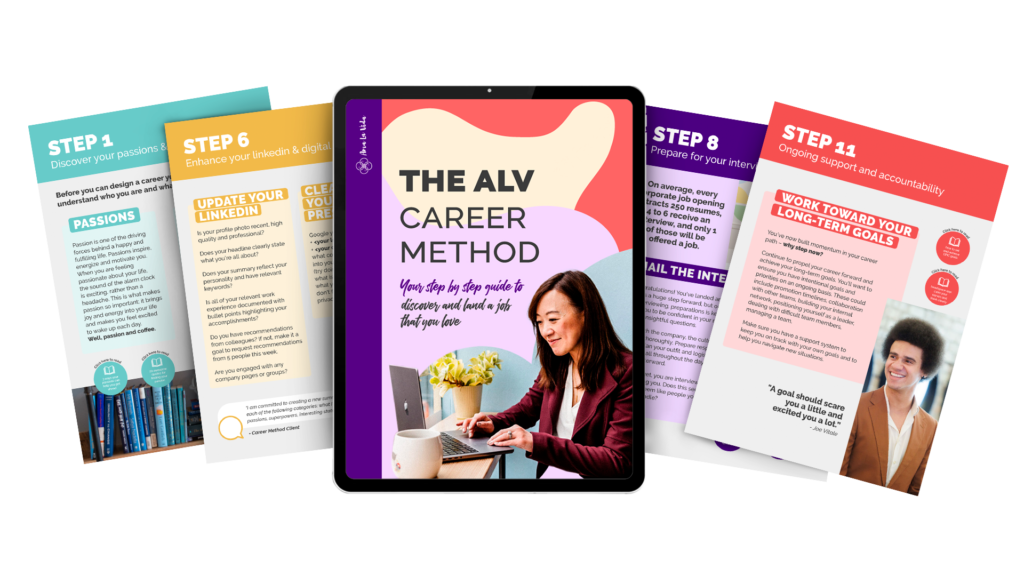
Download our comprehensive step-by-step guide to design and land a job you love!

Images from The ALV Career Method Guide
ALV Method Downloadable Guide

woman smiling looking away from computer

The names and circumstances behind this case study have been altered to maintain client confidentiality.  Can working with a coach help boost your confidence? What is your success rate in improving the confidence level of your clients? What are some examples of transformational stories that you’ve had in working with clients who struggle with Imposter Syndrome?  ​​I get asked these types of questions all the time when meeting with prospective clients.  So today, I want to share with you all a case study in just how life coaching can help to boost your confidence and overcome imposter syndrome.  Before I dive in, I think it’s important to understand the distinction between Confidence and Imposter Syndrome. Confidence is something that we are all born with. It’s a muscle that we can strengthen and weaken over time. In essence, confidence is having faith in yourself. Confidence is a result of how we’ve been brought up and what we’ve been taught about the world. Our confidence is a result of our experiences and the people who have influenced us along our journey. Because of this, confidence is a feeling that is individualized, and it can mean a lot of different things to different people. Confidence is not static. Our confidence can increase and decrease over time, and some days we will feel more confident than others.  Imposter syndrome is defined as doubting your accomplishments, skills, or talents, and feeling like you don’t deserve to be where you are. This idea of being an imposter comes directly from the inner dialogue of our inner critic. Ultimately, imposter syndrome is fear. The inner critic tries to keep us safe from fear, but it can prevent us from taking the necessary steps to living a fulfilled life. In order to get to where we want to go, we must address this inner dialogue and befriend our inner critic by acknowledging them as our inner imposter. Through doing so, we build the muscle of confidence and learn to get out of our way.  There are many reasons people want to boost their confidence and overcome imposter syndrome. From advancing in your career to having the courage to go on a date, being more confident in yourself will not only open up multiple opportunities, but it will also help you get more out of life. By being able to combat imposter syndrome, you’ll be able to step out of self-doubt and live the life you deserve.  Bottom line: Building your confidence can be life changing. The truth is, no one will build confidence through talking about their insecurities alone, but that is a critical part of how coaching can help boost your confidence and combat your imposter syndrome. Now I realize that so many people run (or want to run) away from tough conversations. Coaching requires a level of vulnerability and openness in order to be effective. This work is not a quick fix, one size fits all approach.  “Can working with a coach help boost your confidence?”  “What is your success rate in improving the confidence level of your clients?”  “What are some examples of transformational stories that you’ve had in working with clients who struggle with Imposter Syndrome? These are all great questions, so let’s dive into it using a real life client success story.  Meet Claudia. Claudia has been a professor for 15 years. She’s been an expert in her field, but she’s noticed that now when she stands in front of her classroom she trips over her words, can’t think on her feet, and shakes uncontrollably. This has been going on for 4 years now. Claudia feels like an imposter, like she doesn’t have any of the answers or expertise, despite over a decade of experience and receiving countless accolades for her research. She has an unwavering fear that she will be found out, that she’d somehow tricked her colleagues and her students that she was capable, and that anything she said would demonstrate that she is a fraud and an imposter.  Many of us can connect with Claudia’s story. In fact, research indicates that 70% of humans experience imposter syndrome at some point in their lives. My first step with Claudia was to truly understand what is happening, and helping Claudia understand her triggers and beliefs that are unintentionally hindering her performance.  When do you feel the imposter syndrome coming in?  What happens in your body when you feel it?  When can you remember first experiencing this sensation?  Through a series of inquiries, Claudia realized that this sensation first stemmed from an experience where a professor, who she perceived was a lot smarter than her, challenged her in the classroom. She froze. She was “found out.” Finally, someone had validated the insecurities that were deep within her. From that moment forward, she felt paralyzed. That experience had embedded a belief that she wasn’t a skilled professor, and she certainly didn’t know what she was talking about.  Now, I’m not going to get into too many details here, but here’s where I get into deep work with my clients: understanding limiting beliefs. A limiting belief is defined as a state of mind, belief, or conviction that you think is true that limits you in some way. It could be something about you, how you interact with other people, or the world as a whole. Over time, these beliefs negatively impact us. They keep us from making positive decisions, taking on new opportunities, and most importantly, they inhibit us from reaching our full potential. You can learn more about limiting beliefs and confidence here.  Claudia recognized that that experience had created a belief that was limiting her and hindering her well-being. It meant a great deal to be able to overcome this limiting belief to step into her confidence and combat her imposter syndrome. Instead of dwelling on the past, coaching seeks to focus on the client’s present and how they want to move forward and be in the future, and that’s exactly what

Read More

“Sometimes, it’s the journey that teaches you a lot about your destination.” Drake Big goals can be exciting, but they don’t come to fruition overnight. It’s easy to say, “I’m going to travel to 5 countries this year” or “I’m going to land that promotion this quarter,” but that doesn’t tell us what we are going to do today. Thinking about the journey is essential especially at the beginning when we are setting out to achieve our goals. Let’s take the example of traveling. If you’re setting out on a travel adventure, you’d need to do some preparation prior to the trip. What do you take on this trip? What do you need to do in preparation? You’d have to figure out the flights, accommodation, who’d you’d be traveling with, where you’d be going, and what you’d be doing. Focusing on the journey helps us map out the milestones and sub-goals we’ll need to achieve along the way. At the outset if we focus solely on the final destination we can feel discouraged and overwhelmed especially if we don’t have our bags packed and a clear path forward. Setting milestones gives us immediate direction, allows us to celebrate wins along the way, and helps us determine what we enjoy about the journey and what is right for us in the next phase of the journey. A journey mindset refers to enjoying the journey and celebrating progress along the way. A destination mindset refers to the notion that you’ll be happy once you reach a destination. Are you going to be happy once your trip is over and behind you or are you going to enjoy each step of the journey? You are right here, now. There’s so much to learn and be grateful for about where you are today. As you explore your path, having a coach to help you navigate your options and stay on track can be an incredible resource. If you’re ready to take the next step on your journey, get matched with a coach today.

Read More

I am a recovering people-pleaser. There was a time in my life when I was afraid to say no because I wanted everyone to like me. I avoided conflict to a fault. I didn’t speak up for myself. I subscribed to this toxic mindset because I saw this type of behavior equal success. Over the years, I’ve met countless people-pleasers just like me who have come to me for coaching. Over time, people-pleasing became the default for them. When discussing their reluctance to change often they’d say things like, “I just want to be a good person and say yes,” or “I want them to like me,” or “I have to say yes because I don’t want to hurt their feelings.” This unhealthy behavior over time wears on People-pleasers. Consequently, people take advantage of this type of behavior. Over time, through this repeated behavior, people-pleasers realize that they aren’t pleasing anyone at all. While people-pleasing can be a hard habit to break, with some good coaching and identifying the right tools that are going to support you, you can recover from this toxic mindset.  What is people-pleasing? At the core, people-pleasing means putting someone else’s needs before your own. People-pleasers are naturally in touch with the needs of others and are agreeable, helpful, and kind. Helpfulness and kindness are generally positive traits we want to see in other human beings, but taking it too far has its pitfalls. People-pleasers are known for doing whatever it takes to make others happy. Going too far to please others can leave one feeling emotionally drained, stressed, and anxious. As a result, people-pleasers may struggle with self-advocacy, which can lead to harmful patterns of self-neglect and self- sabotage. The Risks of People-pleasing: We can’t talk about how to overcome people-pleasing until we fully understand the risks. While it might seem harmless to be a people-pleaser, overtime this behavior can have damaging consequences. It can lead to serious mental and physical health risks.  The Signs You Might Be A People-pleaser: There are several signs that you might be a people-pleaser. In order to know how to recover from people-pleasing it’s important to answer these questions. Do you… If you answered yes to most of these questions, chances are you suffer from people-pleasing. Learning How to Say No Putting an end to people-pleasing requires us to learn how to say No. There are several reasons why we must learn to say no: Now you know why, it’s important to learn how to say no. Here are a few tips: 7 Tips to Recover From People-Pleasing  While saying no is a critical step in healing from people-pleasing, there are a number of other steps you can take to recover. These steps will help you learn how to find a healthy balance in helping others without sacrificing your own needs.  1. Establish Boundaries In order to recover from people-pleasing it’s important to know your limits and communicate those limits. Boundaries are for us. Be clear and specific about what you are willing to say yes to. If it feels like someone is asking too much, let them know it’s beyond your limits of what you are willing to do and say no. We have a great resource on how to establish boundaries which can be found here.  2. Small Steps For people-pleasers these behavioral changes will feel big because they are. You have to retrain your conscious response pattern while also teaching those around you to honor your boundaries. Because of the complexity, it can be helpful to start small. That might sound like practicing saying no to smaller requests or challenging yourself to ask for something small that you need. Every time you take a small step away from your tendency to please, you’ll gain confidence.  3. Positive Self-Talk This is one of my favorite tools in building confidence, and can be applied to people-pleasers. If you start to feel overwhelmed or tempted to say yes when you really mean no, remind yourself that you deserve to have time for yourself. You deserve joy. You deserve to spend time and energy on the things that get you closer to your goals.  4. Set goals Name your priorities. Where do you want to spend your time? What goals are you trying to accomplish? Who do you want to spend time with? If something or someone is depleting your energy go back to your boundaries.  5. Pause Similar to the notion of “blaming your calendar,” when someone asks for a favor, tell them you will think about it and get back to them. Saying yes without pausing can lead you to feeling obligated and overcommitted. By giving yourself space to respond you can decide if it’s something that you really want to do. Furthermore, research shows that a pause between making a choice increases-decision making accuracy. Ask yourself, “Is this something I really want to do and if I say yes how stressed will I be?”  6. Reciprocity It’s important to remember that strong, healthy relationships involve reciprocity. If you’re the one always giving and the other person is taking, that is no way to live. Even if you truly enjoy pleasing the other person, it’s important to remember that relationships are about give and take and they should give you something in return.  7. Help You don’t have to give up being helpful and kind and you don’t have to say no to everything for the sake of saying no. The key is to understand your intentions. Don’t help only because you want approval. Keep doing kind things, but do it on your own terms. It will demonstrate greater authenticity on your behalf and you’ll be able to live a more congruent life.  None of us are perfect. If your people-pleasing is standing in the way of your own happiness, it’s crucial that you set boundaries and take back your time. You’re human. You can’t possibly please everyone. Working with an Ama La Vida certified life coach

Read More

In coaching leaders to evolve as Servant Leaders, how to be humble is often at the forefront of the conversation. How do we develop as confident and humble Servant Leaders? While some see humility as a strength, many view it as a weakness. We stereotype the humble leader as submissive and unassertive. On the other hand, a confident leader is someone who is self-assured and powerful. Confidence is nearly always measured as a positive leadership trait. In order to be a Servant Leader, we have to walk the line between confidence and humility, which presents a conundrum. How do we step into confidence and yet remain humble enough to serve? How do we stay humble and remain confident in who we are, our unique gifts, and what we offer?  Walking the Line Between Confidence and Humility In my past life, I led Global Talent Programs for a Fortune 50 company where I was in charge of recruiting top talent into early career rotational programs. I often had to have coaching conversations with program participants on how to be humble. They were all self-assured and overly confident, but they were also driven, well-spoken, and highly intelligent. They had reasons to be confident. At the same time, there is a fine line when self assurance and confidence can be perceived as arrogance. This experience showed me that humility can be taught.  On the other hand, I’ve coached senior executive leaders who have told me that they don’t want to be too self-assured and that they often feel like impostors in their jobs. They lack self-confidence. They make themselves small to avoid standing out. While humility is a strength, if we aren’t simultaneously building confidence, how on earth can we expect to be able to lead? These experiences have taught me that confidence is a muscle that can be strengthened (or weakened) overtime. Many leaders struggle to stay humble without sacrificing their confidence. To help you think about how to do both, I’ve outlined some key strategies on how to navigate this difficult conundrum. These tips and tricks will help you walk the line between confidence and humility as a Servant Leader.  Always Be Open to Feedback.  Humility requires us to understand who we are and how we are perceived. Humble leaders are open to feedback. They welcome the opinions of others. Being open is the key. When we are open to receiving feedback, we can listen to it and choose which parts to keep and which parts to leave. Humble and confident leaders never stop learning, they are always open to being coached. They celebrate their strengths while simultaneously being aware of their weaknesses and opportunities.  Practice Gratitude.  Humility and confidence go hand in hand with gratitude. Humble and confident leaders recognize that they are insignificant in comparison to the world at large. Humility is rooted in the desire to serve others. Servant Leadership is about wanting to give back and strive to contribute to the greater good. Humble and confident leaders find ways to be thankful so they can make the world a better place through their leadership.  Admit There’s More to Learn.  Humility means accepting you don’t have all the answers. If you believe you’re an expert and that there’s no more room to learn, you are lacking humility. Humility requires us to recognize that we are constantly learning and that we can always improve. Through learning, we build confidence.  Take Ownership of Your Mistakes.  There’s no better way to demonstrate humility than by taking ownership of your mistakes. There’s often a fear that people will be angry, dislike you or be frustrated. The truth is that no one is perfect. People appreciate a leader who is willing to admit that they aren’t perfect. Taking ownership means accountability. It’s owning up to mistakes and using them as a learning opportunity to improve yourself, the situation and the team you lead.  Don’t Be Afraid of Failure.  Walking the line between confidence and humility is all about understanding that everyone makes mistakes. By not trying something new based on fear of failure, your team will never move forward, learn and grow. This doesn’t mean intentionally making mistakes. The humble leader always tries to avoid obvious mistakes. However, they aren’t afraid to try new methods of accomplishing the end goal.  Offer Help and Appreciation.  The confident and humble Servant Leader appreciates the individuals on their team and shows them that they care. They appreciate the talents and uniqueness of each individual. They demonstrate respect by offering to help. There’s an old saying that when you can help others who cannot help you in return, you’ve learned humility. The humble and confident leader offers help and appreciation with no expectation that they will get anything in return.  Remain Curious. Humble leaders recognize that there is always an opportunity to learn. They are curious and remain students throughout their lives. They recognize that leadership is a lifelong journey. Leaders realize that there is always more to learn. And they inspire this curiosity in others and confidently approach all situations as opportunities to learn and grow.  Give Credit Where Credit is Due.  The leader who walks the line between confidence and humility doesn’t take credit for the work of the team. They recognize that they would be nowhere without the support of the people they serve. They know that their organization is only as good as its employees. If employees feel undervalued, then their work will be negatively affected. Humble leaders always give credit where credit is due and build the confidence of their people by recognizing their contributions.  What’s next?  A great leader is able to walk the line between confidence and humility. They recognize that this is a dance that requires continuous and intentional effort each and every day. They look for moments to demonstrate their confidence and know when to step into humility. And they recognize that humility is a strength and know they don’t have to sacrifice their confidence to demonstrate

Read More

It’s no mystery that building daily habits is difficult. We create lists of all the things we “should” be making a priority and never seem to find the time to get around to them. We make excuses. We let fear take over. We blame busyness. The truth is, often the anticipation of creating a new habit or the act of thinking about instilling a new habit can be far worse than actually doing it.  Habits become easier through repetition and through patience. It’s about pushing through the “this is difficult” phase and making them a part of your routine. Studies show that it can take on average 66 days to build a new habit. From my experience, this can vary, and the number of days doesn’t really matter. Ultimately, there’s a reason you’re reading this and it’s likely because you want to do something about your current behavior. These five daily habits are small improvements that overtime have the power to change your life.  Habit #1: Reading a Book If you’re reading this article, you’re on the right track. How many times have you been asked, “What was the last book you read?” Most people would say, “I can’t remember.” We have information at our fingertips all the time between blogs, tweets, Facebook rants, but reading a book is different. It takes time and patience. It is essential to support our brain health.  The best way I’ve found to create a habit of reading is to have it take the place of the “mindless scrolling” time. That could look like bringing a book with you so it’s handy during waiting times. When you’re waiting in line at the grocery store or the dentist, you could pull out your book. When you’re on the subway, instead of mindlessly scrolling, pick up your book. Anywhere you’d mindlessly check your phone, pick up your book instead. Over time, reading will become an escape and something you love to do.  Habit #2: Waking Up Early  If you’re not a morning person, you’re properly reading this one and thinking “no way.” Of all the habits we “should” do, this one is on most people’s list. As a life coach, I’m constantly talking about the importance of routines to my clients. Many people go wrong in the “waking up early” habit when they set their alarm for 5am, but still go to bed at midnight. 5am rolls around and your bed is warm and your inner voice says, “absolutely not.”  When working to instill this daily habit, people think it’s all about waking up early. It’s actually about going to bed earlier. Waking up early truly starts the night before. Set a routine that allows you to wind down. Give yourself the permission to slow yourself down. Read a book instead of scrolling, meditate or take a shower. Do the things that are intended to relax and move you into sleep so you can wake up fresh the next morning. Over time, waking up early will be something you “just do.”  Habit #3: Setting 3 Daily Priorities  Focus brings us closer to achieving our goals. The problem is our days are filled with endless distractions. This habit is more about productivity than anything else. Limiting our options is how we focus in a world full of distractions. Each morning, ask yourself what you want to achieve. Then commit to 3 essential tasks. Take everything above and beyond that list as a bonus.  In creating the Daily Priority habit, start the day before. Write down the 3 essential tasks for tomorrow. This can be a particularly effective way to close the day and transition from work to home. From there, make sure this list is visible the next day. By limiting our focus to 3 priorities, we increase our chances of success.  Habit #4: Walking for 30 minutes Walking is good for you and keeps your body moving. As an avid walker, I’ve found it breaks up the monotony of daily life. There’s nothing wrong with the daily monotony but getting outside forces you to engage with the outer world. It heightens your senses. You feel the air in your lungs, you start to notice the cyclical pattern of the seasons.  Many people find walking first thing in the morning to be the best because they don’t procrastinate or skip it as they might later in the day. Others find it helpful to incorporate walking into their workday by taking calls on the go or leveraging their lunch break for this time. Some find it is helpful to walk in the afternoon or evening to clear their minds after their day. Go alone or with a friend, but either way get out and enjoy. It will soon become a refreshing daily habit.  Habit #5: Practice Presence  So many of us are focused on the future that we forget to enjoy the present moment. We say, “I’ll be happy when….” Don’t get me wrong. As coaches, we live in the future possibilities. At the same time, the future can bring up anxiety and isn’t always guaranteed. Studies show that an individual’s disposition to staying present is linked to numerous health benefits including lower levels of perceived stress, anxiety and depression, improved mood, and a sense of improved well-being. Because we are so focused on “what’s next,” we forget to enjoy the present moment. A tip I offer my clients in practicing presence is finding a trigger that brings you back to the present moment when you feel yourself being stuck in the future. This could be a quick check in with your five senses and naming what you see, hear, feel, taste and smell. Once you start to think of being in the present moment as a conscious practice, your approach will start to change. The moments when you are frustrated become opportunities to react mindfully.  You can change your life, starting now.  Daily habits don’t change overnight. Who you are and the way you react to

Read More

4 Tips to Effectively Receiving Feedback How to Effectively Receive Feedback: One of the biggest challenges leaders face is that they aren’t equipped with the tools to effectively deliver feedback. Therefore, when feedback comes our way, we don’t always know how to receive it. This misstep creates a loop that negatively impacts team development. Leaders owe it to their employees to be able to receive constructive feedback so that they can inspire growth in the people they serve. This is part of how leaders develop effective and collaborative teams.  Have you ever asked for feedback and the response is, “You’re doing great!” or “You could have done better with ___.” Neither of these comments are helpful nor do they inspire you to be better. In this post, I’m going to provide you with some high-level recommendations on how to receive feedback so that you can be more of who you already are. If you’re interested in learning more about how to deliver feedback, please check out the blog on How To Give Effective Feedback.  The Magic Questions.  There is no one size fits all solution on how to effectively provide feedback. Not everyone wants to hear feedback in the same way. Understanding our preferences will increase the likelihood that we will find feedback helpful and that we will be more willing to act on it. It all boils down to preference. Most of us aren’t mind readers, so consider the following magic questions:  Do you want immediate feedback, or do you prefer to postpone it?  Do you prefer email/Slack or an in-person/video talk? If it’s the latter, should it be in your workspace, theirs, or a neutral spot? Once you’ve answered these questions, it’s important to provide this context to your leaders so that they know what’s the best approach for your personality. This helps build trust and ultimately builds psychological safety so you are more willing to hear the feedback when it comes your way.   Feedback should always be considered a learning opportunity. I encourage all my clients to see feedback as a gift. We don’t always see our blind spots. Feedback can help reinforce strengths, align goals, and help us develop into better leaders.  Receiving Feedback Effectively.  Feedback doesn’t have to be scary. After all, it is information that helps us grow when we have the right mindset. The choice lies with us on what we decide to do with the information. We can protect ourselves from information that is irrelevant and not panic when our manager says, “Can I give you some feedback.”  With that in mind, here’s four tips on how you can make the most of the feedback you receive. Tip #1: SIFT  Dr. Shanita Williams, the incredible coach, professor and author of Feedback Mentality coined the acronym SIFT, which stands for Source, Impact, Frequency, and Trends. According to her, leaders should consider each of these when receiving feedback to make the best decision on what you’d like to do with it.  Ask yourself the following when you have gotten feedback:  Source: Who is the source of feedback? Is it someone whose opinion matters?  Impact: What is the impact of feedback? Is it related to your work relationships or about changing the font on a PowerPoint?  Frequency: How often am I hearing this feedback? Is this a common trend?  Trends: Is this showing up at work or in other areas of my life?  Tip #2: Listen Empathetically, Understand the Message & Be Aware of Your Response  Listening empathetically means truly hearing the other, not interrupting, and not making assumptions. You can ask questions like, “this is what I’m hearing, can you please clarify?” Listen actively by repeating key points so that you know you have interpreted the feedback correctly. This helps clarify that you understand the feedback.  The important thing here is to not get defensive in your response. Body language and tone often speak louder than words, so avoid putting up barriers. Working with a Corporate Coach can help develop your capacity for listening as it’s an essential leadership skill.  Tip #3: Practice Openness This means being receptive to new ideas and different opinions. Often, there is more than one way of doing something and others may have a completely different viewpoint on a given topic. You may learn something worthwhile. Openness requires us to observe, understand, express our feelings and then decide what we want to do with the information. By expressing openness with our feelings, we can then decide what the best next steps are for ourselves. Tip #4: Ask for Time to Process & Follow Up It’s okay to ask for time to process the feedback you are getting. Tell the person delivering the feedback that you want to revisit this feedback later. Take notes for clarity. You can always say, “thank you for this. I’d love some time to think about it and get back to you.” You can follow-up then in a number of ways, such as with a follow-up conversation, or it could simply involve implementing the suggestions given to you.  Feedback is a Gift.  There is always going to be a level of discomfort with receiving feedback. It’s probably not going to be your favorite moment when someone says, “hey, can I give you some feedback?” These practical tips and suggestions will help alleviate any stress when it comes to receiving feedback and remind you that feedback is and always should be treated as a gift. Treating feedback as a gift can be a useful tool in becoming the best leader you can be.

Read More