Author: Jill Dreisilker

Whenever life feels stagnant or I feel like I’ve plateaued working towards a goal, it’s easy to fall into a spiral of critical thoughts. Instead of beating ourselves up trying to figure out what we’re doing wrong, what if we just flip the script and ask different, more intentional questions to help improve our self-awareness?  Researchers love to study happiness and daily habits of successful people. What studies consistently uncover is that people who reach the end of their lives feeling grateful and fulfilled with limited regrets do so by being intentiona in how they show up every day and in their relationship with others. But more importantly, in their relationship with themselves. Here are some self-reflection questions that can help us improve our self-awareness and be more honest with how we’re showing up and the directions we’re taking. Questions to Improve Your Self-Awareness 1. Am I doing this for myself or for the opinions of others? Anytime clients come to me to work on self-confidence, this is always one of the first questions I ask them to honestly answer. Living in a society that puts so much pressure on performance and appearance, it’s easy to fall into the trap of making choices based on how we want people to see us. But when we depend on others to make us feel a certain way, those external opinions end up controlling a lot of our lives. Take back your power and start making decisions for yourself. It might feel weird to refer to yourself first and what you truly want, but self-confidence and self-awareness is a muscle. We have to use it to strengthen it! 2. Are my goals my own or influenced by other people? For any goal you set for yourself, always get brutally honest and ask yourself this question. Setting goals is a huge part of life, but if we’re choosing them because we think it’s what we should be doing, or because we think we want what other people want, those goals probably won’t feel too inspiring or motivating.  Take a good look at your goals. If there are any that don’t feel inspiring, ask if these are goals you really want to be working towards.  3. Why are each of my life goals important to me? You’d be surprised how many people have a hard time answering this question. When it comes to any goals, asking “why” can help determine if this what we truly want or not. Uncovering your “why” creates an emotional connection to your goals. Our “why” is what gets us out of bed in the morning. It helps us maintain habits. It’s what lights a fire in bellies to take action when our brain is trying to convince us otherwise.  4. Am I afraid of failing or am I really afraid of succeeding? Failure is a regular part of life. It’s normal and it happens all the time. Think about this, we arbitrarily make up a goal in our head, and then we decide what’s going to happen. But if the goal doesn’t happen, we get upset and can be hard on ourselves. In reality, the definition of failure is almost always self-invented. So the question is, are we really afraid of failing, or are we self-sabotaging because we’re actually afraid of succeeding? If success isn’t something we’re used to, we might actually fear that more than failure.  Next time you fear failure, envision what it would feel like to actually succeed and see what comes up for you. 5. What do I need to say “no” to in order to protect my “yes”? We’ve heard it before “‘No’ is the new ‘Yes’,“ but are we actually practicing that? The pandemic forced a lot of us to reconsider how we spend our time, with who and doing what. Of all the things we used to schedule, what do we actually miss, if anything? Take a look at your calendar and see if there are any social plans that you aren’t thrilled about. If you were to cancel, what would you rather be spending your time doing? How can intentionally saying ‘no’ allow for more of what you want in life? 6. Am I being true to my values? Have you ever felt that nagging feeling in your gut like something just feels off? Whenever our behaviors go against our values, our body can sense that, hence the gut feeling. If spending quality time with our family and loved ones is one of our core values, working late can create conflict and trigger that nagging feeling.  Pay attention to when those feelings surface. When they do, just check-in to see if your behaviors are aligned with your values.  7. How can I be grateful for what I have, while still working towards what I want? Gratitude is Queen. Besides numerous studies proving that gratitude literally rewires your brain for happiness, improves anxiety, stress, overwhelm, sleep, mood, energy, and endless other health benefits, it just feels really darn good. Like really good. If we only find ourselves expressing gratitude for achievements or major life milestones, those moments might only come a handful of times. But if we find ourselves being grateful every day for the small and big things, that’s an entire lifetime of little moments of happiness.  There is tremendous power in being grateful for what is right now, even if we’re working towards something else. Remember, consistency and intentionality is the key.  Asking the hard questions can feel uncomfortable, but we can’t learn or improve our self-awareness by sticking with what’s comfortable. Embrace the uncomfortableness because that’s where the real change is. 

Read More

Self-confidence isn’t something that happens overnight and it certainly doesn’t happen through a magic diet pill. We’ve been conditioned to believe that confidence comes from how people see us – our appearance, titles, wealth, achievements, etc. But when we depend on external validation or people to make us feel confident, that feeling becomes conditional. If we lose that job, relationship or waist size, all that confidence gets swept away. Confidence needs to come from within, a source that can’t be taken away. There’s a reason why it’s called “self” confidence.  Micro-Decisions A quick and efficient way to help us build more self-confidence is with our decision-making skills – learning to trust ourselves to make choices that feel best for us. We make a ton of decisions throughout our day that impact our lives, whether it’s choosing our exercise, how we respond to a colleague or smiling at a stranger. I like to call these “micro-decisions.” If we can feel confident in our day-to-day choices, we begin to feel more confident in ourselves. Since we spend most of our days making decisions, if we aren’t confident in ourselves, we can often feel anxious and overwhelmed. When we “make” these “micro-decisions,” the answer may seem instinctive and automatic, but we’re still faced with a choice: is this decision in alignment with the best version of myself? Will this action bring me closer or farther from my end goal? Those small decisions we make throughout the day may seem meaningless, but they can profoundly impact our lives.  Think about saving $1 each day. Today, $1 doesn’t seem like anything at all. But save $1 every day for a year and you get $365. That’s a round-trip flight somewhere with a beach!  It’s the compound effect – little by little by little creates a lot. Questions to Ask Yourself: So how do we practice being more confident in our micro-decisions? Here are a few questions to help guide you: Is this bringing me closer or farther from my goals and vision?  It’s really challenging to feel confident in your decisions when you don’t know where you’re going or what’s important to you. When we wander through life without a guiding compass to keep us focused on moving forward, things might feel untethered, chaotic, and confusing. When you’ve clearly defined your goals and what it will feel like when you’ve achieved them, this helps us navigate micro-decisions more confidently. Check out this blog to help you clearly define your goals. How does this decision make me feel?  When we lack the confidence to make decisions on our own, we tend to go to others for help. Sure, there will be times in our lives when we need to go to loved ones to help make a tough decision. But if we’re going to others for a majority of our decisions, we aren’t giving ourselves a chance to build that self-confidence on our own.  When you’re confronted with a decision, instead of going to someone else for guidance, see what you come up with on your own. How does that decision feel? If it feels right, act on it. Be decisive! And if it doesn’t work out, great. That’s more research and evidence that gets stored away for future decisions. You learn and move forward, now with more data in your arsenal. Am I doing this for myself or for the opinions of others?  This question tends to be the most challenging for my female clients to answer. And I am right there with them. Women not only have to deal with the pressure from society to uphold appearances every single day, but we also hold the burden that generations of women before us had to carry as well.  If you find yourself making decisions based on how others will see you, that’s okay! We’re human. All we have to do is acknowledge it without judgment. Ask yourself: How did that choice feel? What would you have rather chosen? We always have the option to choose again because there are no right or wrong choices in life. Remember, progress is not linear. The more times we fall off course, the more resilient we become.  Remember… Self-confidence isn’t achieved overnight. It can feel discouraging thinking about how far we have to go. But when we focus on the small actions one day at a time, the journey seems a little less daunting. We can’t get distracted by how far you have to go, how much you have to learn, everything you have to do,  just focus on what you can do today. When we release the expectations around how long something will take or what it will look like, it gives us a little more freedom to enjoy the journey and how everything feels. At the end of the day, it’s a feeling we’re really chasing, right  Big results come from doing the little things right and celebrating your wins and your failures. How are your micro-decisions serving you and your goals? 

Read More

What is Health & Wellness Coaching? Is it nutrition? Fitness? Meditation? Weightloss? Palo santo, healing crystals and full moon parties? Everyone has their own definition of what health and wellness is because “good health” feels different for everyone. Our bodies are vastly different and we all need different things to make us feel good.  But the message that health and wellness is individualistic gets lost in society’s standards of what “health” should look like. Social media, movies, ads, the wellness industry as a whole all project unrealistic expectations of “health,” and that can be overwhelming, stressful, confusing, frustrating and defeating. That’s where Health and Wellness coaching with Ama La Vida comes in – to help you define what health and wellness feels like for you and you only. Let’s bring those goals to life, shall we?  A Year With a Health & Wellness Coach The goal of our health and wellness coaching is true transformation – mind, body and soul. We believe health coaching isn’t just about losing weight or getting fit. It’s about building a long-term happy, healthy relationship with your body and mind. Together with your coach you’ll develop the tools and resources you need to take back your health, so you can live a happier, more productive and fulfilling life. Whether you have clear goals you want to accomplish or you have no idea what you want but you just know you want to feel better than you do right now, we’ve got you! Some other things that clients come to us for are: reframing negative self-talk, creating healthier habits, finding more balance and purpose in their life, feeling more confident in themselves, repairing relationships to food and just feeling worthy of living a life you truly love. Here are a few major focus areas that we’ll work on together: 1. Redefine Health Goals Like I mentioned above, health and wellness is and should be individualistic. Let’s release everything you think health should look like. How do you want to feel? What goals do you want to create for yourself? And if you don’t know, that’s okay! Most people don’t. In fact, we have a solution just for that. One of my favorite eCoaching modules is setting EPIC Goals (EPIC stands for Elevating, Practical, Impactful, and Clear). These goals are where we get to turn your vision into reality. We start by creating clear milestones and action steps that you can follow that will help you achieve your goals and visions. 2. Expertise You may have studied Finance or Law or Education. And yet, you are asking yourself to also be an expert in your own health and wellbeing. We bring in experts to support us with our taxes, plumbing, or cleaning our teeth. It’s okay to bring in an expert in to help you with something outside of your wheelhouse. Bring in a coach to help you improve your physical, emotional, spiritual and social well-being! In addition to being rigorously trained in top certification programs, our health coaches have years of experience in coaching. They are experts in their craft and can help you to prioritize and hone in on the areas where you need the most support. 3. Accountability We have processes and deadlines at work or school that keep us on track and ensure we get things done. When those deadlines are lacking in our personal lives, it is easy to let things slip through the cracks. Weeks, months, and even years can go by without us making the changes we need to be happier and healthier. Working with a coach provides you with a structured approach to your health and wellbeing. There is a built-in accountability system to keep you on track. Even when you encounter roadblocks or struggle to stay motivated, we’re here with you every step of the way to help you get back up and keep moving forward. 4. Sustainable Change Coaching is not a quick fix, as much as we would like for it to be. It’s not an overnight miracle (or a product claiming that it is!). Coaching is a way to create sustainable change in your life. A lot of people come to us knowing where they want to be (or don’t want to be) but are just missing the tools and frameworks to help get them to a healthier, happier place in life. A year of coaching will provide you more than enough practices that help continue to strengthen that sustainable change long after our work together is done. Maximizing This Upcoming Year A year of coaching might sound like a big commitment. That’s because it is! But you are here and are ready to commit to changing your life. And sometimes, that’s the hardest part. Sure, instances have come up that have forced us to put a lot of goals on hold, but that doesn’t mean we have to completely give up. So much of health and wellness coaching is inner work and that doesn’t have to stop for anything. We only get one life, so why not make it the best it can possibly be?  Are you ready to start living your best, healthiest life? Sign up with a certified professional coach who will help you create a roadmap to success. To get started, book a free consultation with one of our Relationship Strategists. In this 30-minute call, they’ll learn more about your goals and current situation, help you decide if coaching is right for you, and then get you matched with a coach.

Read More

The other day I was talking with a client about body image. She said to me “it’s just really hard to love parts of my body sometimes.” I agreed. Even when we try to “love all our imperfections,” it’s still indicating that we have undesirable features we have to force ourselves to love. That doesn’t have to be the case. So I said: “What if we stopped forcing ourselves to love the parts of our bodies that we just simply don’t? What if we worked for body neutrality instead?” Lightbulb. There are a lot of great movements that promote self-love. However, it’s not always easy to practice when we live in a society that idolizes thin, fit bodies and reminds us that our flaws should be and can be fixed. And then there are diets being disguised as “lifestyles” but still tell you what you should and shouldn’t eat. And weight loss programs relabeled as “wellness” tells you in order to be well, you must be a certain size. These mixed messages are dangerous and can be misunderstood as “love your body, but only if it looks a certain way.” What is Body Neutrality? It’s difficult trying to change your entire mindset to loving your body when you’ve been at war with it for so long. Body neutrality is about shifting away from self-hate and critiquing our bodies without forcing ourselves to love all parts of our bodies. It’s about getting to respecting our bodies without focusing on the negative thoughts. We don’t have to love or hate our bodies. We can work towards accepting them just as they are.  When we focus on neutrality instead of forcing love, we’re able to remove that added stress and worry. We can make room for things that actually bring us joy and happiness. So how do we begin practicing “body neutrality?” Values Values are our personal judgments about what’s most important to us in life. They are our principles and standards of why we do the things we do. When we uncover our values, it helps us see where our energy and focus should be. It helps us make decisions that are aligned with the life we really want to be living. When we observe parts of our bodies that society tells us are undesirable, we can instead shift our attention to the things that mean the most to us. For example, whenever I observe my rolls and squishy parts, I might have a judgmental thought. But then I remind myself of all the things that are more important to me than a flat stomach and thigh gap. “I see you, soft parts. You’re okay! What I value most is spending time with friends and family, not restricting myself anymore and celebrating life with food, drinks, travel, trying new things. I value living my life to its fullest. Worrying about how I look to others is no longer important. I will always choose my dream life over my dream body.“ Focus on your values and what’s really truly important to you in life over negative body observation. Gratitude Gratitude has been scientifically proven to rewire our brain patterns to focus on the good in life. It helps us to focus on everything that we’ve accomplished instead of all the things we haven’t. Practicing gratitude for what our bodies do for us can help us take our focus off how we look and shift our energy to focusing on how we feel, what our body does for us, how she keeps us alive, how she heals us, comforts us and lets us know what’s wrong and what is right.  “Hey there, thighs. I love how strong you are for all the activities and movement I enjoy. You allow me to seek adventure and seek places that I wouldn’t have without you.” Focusing on gratitude is how we begin to shift from forcing love to embracing body neutrality. Compassion There is nothing easy about undoing an entire lifetime of believing that our bodies need to look a certain way in order for us to be happy. We’re used to working against our body for so long, restricting, counting, weighing, critiquing. It can feel overwhelming and resistant! Compassion helps us ease into changing our thoughts and beliefs about our bodies. I like to think about compassion as my best friend who comforts me when I’m having an off day. She’s always encouraging, comforting and appreciates all the work I put towards my own happiness. When we fall off track or stumble into old habits (which we will!), compassion helps us be less judgmental of ourselves and learn from our failures so we can get back up again and keep going.  “Wow, today was not my best, and that’s okay. Bad days don’t determine my worth. What did I learn today that will help me be better tomorrow?” Body neutrality gives us peace to just be as we are. It allows us to stop worrying about fixing the parts of us that are natural, like cellulite, rolls and squishiness. To stop wasting time and energy trying to shrink ourselves to look like the unrealistic body types that society and diet culture idolize. Body neutrality allows us to focus on doing things in life that actually bring us joy and happiness. It releases the pressure we put on ourselves: if we don’t love our bodies, then we’re doing something wrong. It untangles the confusion around “what does my body have to look like in order to love it?” We don’t have to love everything about our bodies, but we don’t have to hate them either. Instead, let’s just be as we are so we can focus on the joys in life.

Read More

When life feels like it’s spiraling out of control, it’s normal to find anything that gives us even the smallest sense of power. There are healthy and not-so-healthy ways to cope with uncertainty and chaos, but sometimes we just have to do what we can to survive. One thing that has kept me afloat during traumatic times are creating routines and forming healthy habits. It’s taken a lot of failure and practice, but I’m finally at a place where my daily routines give me energy, peace, clarity and purpose, which is vital for my mental health. Routines help create structure, a sense of accomplishment and can let us know how we are doing mentally, physically and emotionally.  Turning new routines into habits isn’t easy, but it’s definitely not impossible. Even if you’ve attempted new routines a million times before, you can still find a routine that works for you! Here are 6 steps to forming healthy habits and ensuring you stay committed: Understand Your Why Before we dig into how to effectively create new routines, we have to be brutally honest and ask ourselves why these new habits and routines are important to us. When we don’t set clear intentions for our actions, it can be easy to steer off course. Think about the new routine you want to implement and ask yourself these questions: The more specific you get with Your Why, the stronger that connection will be to help you stay committed. I like to think of our Why as our accountability partner. It’s what gets us up in the morning. It’s what motivates us to show up even on the days we can barely get out of bed. Our Why keeps us grounded, even during the most untethering times.  Observe Past Routines If there was one thing I wish I knew years ago when I started creating new routines is that you will fail and there will be habits you don’t keep. However, we can use those failures to improve for next time! So that’s my next step: without judgment, observe what didn’t work before so you can try something different this time. If you find yourself writing down routines that you’ve tried before, this is a great opportunity to observe what prevented you from forming healthy habits last time so you do it right this time. For example, I tried to wake up early for as long as I can remember, but it wasn’t until I got to the root cause that I was able to change my approach: Why can’t I wake up early? Because I’m too tired Why am I too tired? Because I’m not getting to bed on time Why am I not getting to bed on time? Because I’m eating too late, watching TV and scrolling on social media before bed Why am I eating too late, watching TV and social media before bed? Because I thought I should have a morning routine, instead of creating a routine I wanted. I did not understand My Why and had no action plan. Getting to the root cause showed me that I didn’t have any emotional connection to this new habit – I was missing my Why! It took me a while, but once I began to change my story around routines and implement these steps, I was able to make these routines stick for good. Change Your Story Something else I wish I knew back when I was exploring new routines is to check in with the stories I was telling myself. If stories aren’t benefiting you and your new goals, challenge them!  Because I had failed more times than I can recall, it was easy for me to say “I’m terrible with routines and I can’t ever commit to them.” But is that actually true? Am I really terrible? Do I have zero routines in my life? Of course not! I brush my teeth in the mornings and evenings, I go to bed at a decent time each night, I read before bed, I drink coffee in the morning while I journal (yay for morning routines!) and I meditate. Okay cool, so I CAN do routines! If you truly want to create change in your life through healthy routines and habits (Your Why!), you’ll find a way to do so. Sometimes that starts with simply observing where our thoughts are. When you think about creating a new routine, what thoughts come to mind? If they’re self-doubting thoughts, challenge them. Practice thinking new thoughts to support the outcome you wish to create.  One of my favorite ways to introduce new ways of thinking is by saying “I am in the process of…” and filling in the blank with whatever goal you’re wishing to accomplish.  “I am in the process of creating and sticking to my new, healthy habits and routines.” “I am in the process of becoming a morning person.” “I am in the process of _______________________.” Prioritize Implementing several new routines at a time is overwhelming! Humans tend to be hardwired to resist change, so we need to be easy on ourselves, be patient and stay consistent. Part of our brain, the amygdala, detects change as a threat and releases the hormones for fear, fight or flight into our bodies. Our body is actually protecting us from change, even when change is healthy and positive.  Studies show that the average time it takes for a new behavior to become automatic is 66 days. Now, don’t let that number discourage you from achieving your goals. This timeframe can vary depending on the level of challenge/difficulty of the new habit or routine, but it helps to know about how long you should give yourself grace and patience to create a new routine. Now that we know about how long it takes to create a new habit, let’s prioritize your new routines. Ask yourself: which one is most important for you to work on right now and why? You might choose the one that’s

Read More
compassion in a crisis

“We are in the same storm but not the same boat.” – Anonymous This global pandemic is the storm of the century, and we’re not all in the same boat. While many of us are doing our best to weather the storm, the harsh reality is some are doing better than others, to no fault of their own. For some, this is more like a vacation. They no longer have to go to a job they hate, and they’re getting paid to relax, enjoy daily virtual happy hours and tend to their hobbies. For others, this is destroying their families and putting them in the most dangerous position of their lives, mentally, physically, emotionally and financially. There might be elements of commonality – we are all in the same storm – but at the end of the day, we’re still individuals trying to survive in our different boats. Because our circumstances are different, our needs are different. We’re coping, grieving, expressing and surviving in our own ways. For some, this is the most productive they’ve ever been, while others can’t seem to accomplish the most simple task. Some might be practicing deep, spiritual healing, while others find themselves on an emotional rollercoaster that won’t seem to end. No matter how we look at this storm, it’s important for us all to recognize that we’re each experiencing and processing this storm in our own way. It’s easy to compare ourselves to others, but remember that we don’t know what it’s like on their boat. With this in mind, let’s focus on compassion, ease and grace.  And while we take care of ourselves, let’s also make sure we take care of each other. A few easy ways to do this are: Share If you have extra money, food or supplies, share with those who don’t. You can talk to your neighbors and community or you can donate to food banks and local drives who are accepting cleaning supplies, clothes and other essentials.  Volunteer virtually  Plenty of organizations and nonprofits are still working to help provide for those in need. Idealist.org is a great place to look for COVID-19 and remote volunteer opportunities. You can also search for nonprofits in your area and see what virtual or contactless options they have available. Here is another list of nonprofit organizations that need our help – How You Can Help – Washington Post Shop local A lot of our local and small businesses won’t make it out on the other end of this. Visit your local grocery stores and small businesses before you hit the bigger stores. Small businesses need our love and support more than ever. If you can’t afford to shop local or spend the extra cash, you can still support your favorite local small businesses by liking and commenting on their social media content, sharing their posts and telling your friends about them. Ask Reach out to friends and family regularly. Send a text, email, write a letter or schedule virtual happy hours. A simple message can go a long way. Talk to your neighbors and see if anyone needs help getting groceries and supplies. You can also post signs around your neighborhood with your contact information offering help for those in need. Kindness We all could use a little more love and kindness right now. Say hi to your neighbors and smile when you can. Thank your local businesses and everyone who still has to go to work. They are putting their health at risk to save ours. Spreading positive energy benefits us and those around us as well. We can’t change the past and we can’t predict the future but we can appreciate today. Let’s focus on how we can show up right now, for ourselves, our families and our communities. We might be weathering this storm in different boats, but we are all in this together. 

Read More

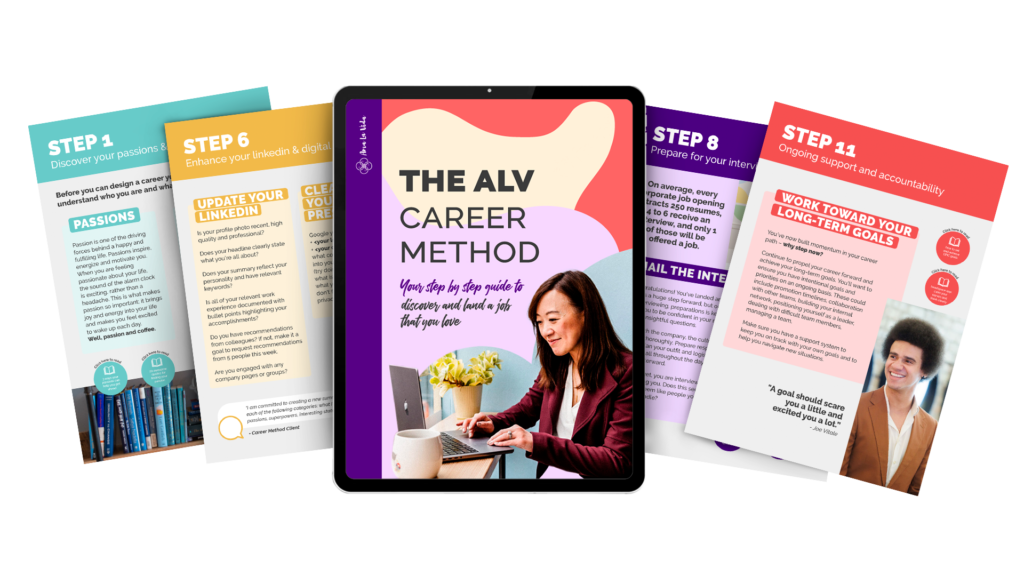
Download our comprehensive step-by-step guide to design and land a job you love!

Images from The ALV Career Method Guide
ALV Method Downloadable Guide

5 things to do instead of emotional eat

Current events have turned our lives upside down. We’re facing unprecedented circumstances and uncertainty. We’re mostly stuck inside, many of us have lost our jobs, we’ve been forced to create an entirely new way of living, and day by day it is becoming harder to see a future that is certain and “normal” again. Stress at this magnitude can bring a lot of emotions to the surface, some more unpleasant than others. In response to this uncertainty and if you’re like most of us, you might seek comfort in a familiar place: the kitchen. Eating when we feel emotions can be one of the easiest and most immediate ways to make ourselves feel better in stressful times, but if we continue to ignore certain emotions, bigger issues might arise down the road. Think about it this way: you wouldn’t fill your gas tank with water and expect your car to run properly, right?  You probably wouldn’t put more gas in your tank than your car could handle either. Cars require maintenance and care just like humans do. If we ignore the “check engine” light long enough, our car will start making funny noises, other parts will stop working, and we could eventually break down. Think of emotions like stress, anxiety and overwhelm like a “check engine” light. It’s our body’s way of letting us know it’s time to check under the hood.  Food is a huge part of our lives.  It’s a necessary part of our existence and for many, our culture. We eat to celebrate. We express ourselves through food. Usually, we share love through food. We gather with friends and family over food. It can bring so much happiness and excitement into our lives, which is why it’s natural for us to resort to food when we’re sad and want to feel joy. Psychologically, eating comfort food when things get tough can help us feel better, also called emotional or stress eating. However, this is only a temporary solution. Our “check engine” light might stop flashing for a little bit, but it’s not fixing the actual problem. Biologically, eating can also help regulate energy levels when feeling stressed and overwhelmed. Stress is associated with changes in cortisol levels so we tend to crave foods higher in fat and simple carbohydrates because our bodies crave additional energy to function while under stress. If you’ve noticed any changes in your eating patterns since the start of this uncertain and overwhelming time, your body is doing a great job of keeping you alive. Our external environment can affect how we feel internally, so if there is fear and scarcity around the availability and accessibility to food, it can affect our eating patterns. Take this for example: one might be likely to eat more than normal when feeling overwhelmed as a means to cope. Some might find themselves snacking throughout the day, while others might severely restrict food intake in an attempt to feel in control.   Although emotional eating feels good at the time, it’s not helping us get to the root cause of our stress or unpleasant emotions.  If we continue to suppress those emotions with comfort food, we’re creating more health problems. For example, when we find ourselves emotionally eating food with little nutrition and minimal health benefits, it can weaken our immune systems, deplete our energy levels and affect our mental health at a time when protecting our bodies and our mindset is particularly important. If we don’t take care of ourselves and fuel our bodies with proper nutrition, we will suffer. Have you ever felt “butterflies” in your stomach when you’re nervous or looking forward to something? Have you ever dreaded doing something that feels “gut-wrenching?” This communication between our brain and our stomach is called our “gut-brain connection,” which explains how what we eat affects our mental health. A healthy, well-functioning gut has a balance of “good” and “bad” bacteria.  When we overeat food that lacks nutritional value, like processed foods, added sugar and simple carbohydrates, it increases the amount of “bad” bacteria in our gut. Since “bad” bacteria feeds off unhealthy foods, the more we consume those foods, the more intense our cravings become. That’s why when we eat fast food, we tend to crave more of it. Stress is another factor that depletes good bacteria. Since 70% of our serotonin production is in our gut, when the “good” and “bad” bacteria are out of balance, it can create more stress in our bodies, which affects our brain. This doesn’t mean that we should avoid unhealthy foods all together. It means that we should observe how certain food affects our mood and energy so we can create a healthy balance that works with our lifestyle.  So how do we fix the “check engine” light? When we have a thought, our brain sends neurochemicals and hormones to our bodies, which creates emotions. Our emotions influence our actions and behaviors, which in turn creates our reality. If we want to prevent those unpleasant emotions from negatively impacting our lives, we have to find ways to release our emotions.  My physics teacher always told us “what we resist persists.”  If we use food or other distractions to suppress our emotions, they will always surface. Think about it this way: when we’re happy and excited, we express our excitement by cheering, yelling, sharing with friends and family, celebrating, doing things we enjoy. This is how we release our emotions. Even when we experience unpleasant feelings, we want to vent to friends and family because we usually feel better after doing so. But when we hold onto stress, anxiety, worry, fear, it stays bottled up inside us. That emotional energy needs to be released. It’s physics! Every day we should be checking in with our emotions and observing how we’re feeling throughout the day. Pay attention to your hunger cues. When you feel hungry, choose nutritious food that’s enjoyable and will keep you energized. If you find yourself emotional eating,

Read More
body confidence

Do you find yourself having to “be good” after a “bad” weekend? Have you tried every diet under the sun only to gain the weight back and end up right where you started? Or maybe you’ve been dieting for most of your life and have no clue how to eat “normally.” Do you wish you could just feel healthy, confident and secure in your body without comparing yourself to others? Do you wish you could eat your favorite foods again?  Yep. Me too. I was stuck in Dietland for most of my adult life. I was a pro at convincing myself every “new diet” was going to be the one that changed everything for me. But time and time again, I failed at staying committed to my weight loss goals.  It was exhausting, frustrating and so defeating because all I wanted was to feel good about myself and stop obsessing over food. But no matter which diet I tried or how much weight I lost, my insecurities followed me. The reason why most diets fail is because we have been taught to resolve internal problems with external fixes. Trying to change things on the outside is a whole lot easier than looking inwards. It’s like going to the car wash hoping it will fix the engine problem. It might seem cheaper and faster, but it won’t get to the root cause of the problem.  Growing up, no one taught us how to heal our emotions. We also weren’t taught how to improve our mindset or how to shift unhealthy habits. It’s overwhelming and intimidating, and so naturally we avoid the uncomfortable work. Sometimes the best way to go about challenging ourselves and embracing real, sustainable change is by working with a coach.  My story took a drastic turn when I hired a coach. It changed my life. It allowed me to compassionately look at areas of my life that needed the most work, areas that I had been avoiding for so long. I knew where I wanted to be, but I just didn’t know how to get there or what tools to use to help me. Coaching provided me all of that and so much more. What exactly is coaching? Coaching is a way for you to connect with someone who has often been in your shoes, someone who has shared similar challenges. Through personal experience and professional training, we are properly equipped with the best tools and practices to help you get unstuck and hit the ground running towards your health and wellness goals.  The intention of Ama La Vida’s health and wellness coaching is to help transform you from the inside out; emotionally, physically, spiritually and socially. We get to work with you to help you take back your health. This way you can continue to grow and live your happiest, healthiest and most confident life. You’ll be mindfully paired with a coach to help you define what health means for you and customize a personalized plan to help you achieve your health and wellness goals. No matter what blocks, challenges or resistance you might experience, your coach will be there to guide you and keep you motivated, accountable and excited. I know how important this is for you because I have been there. I’ve walked in your shoes and I will do whatever I can to help you reach a balanced, healthy, confident life. Why the Process Matters Although health coaching is customizable to your own needs and lifestyle, the one thing that has helped my clients consistently achieve their goals is having a proven process in place. It helps us stay focused and track progress so we can see what works and what doesn’t. Because health is so unique to each individual and the amount of information out there is endless, it can be difficult and overwhelming to find the right health plan for you.. It’s hard to navigate that space on your own, which is why we have a process in place that works.  Here are 3 reasons why: Structure: It seems like there’s a new fad diet circulating the internet every day. Because of the volume of information out there that’s mostly influenced by diet culture, it’s easy to feel overwhelmed and have no idea where to begin. Having a process in place gives you the structure you need to stay focused on your goals, track your progress and quit the guessing game. No matter where you are on your journey to living a healthier, more confident life, trying something new might feel like you’re starting over. We’ve helped hundreds of clients better their lives through our proven process, and we know we can help you too. Personalized: No two people’s bodies are the same. No two people’s past experiences are the same. Your goals, dreams and desires are unique to you, which is why our process is personalized to fit with your lifestyle and meet your goals. Life happens and things might change along the way, but no matter what, we have the flexibility to adapt our process to what you need most. Sustainable change In an instant gratification society, we’re conditioned to want the “magic pills” to fix our problems. But most of us know that those quick fixes are simply band-aids and only leave us with temporary change. Coaching is not a quick fix. It’s also not a linear process. There will be ups and downs, but it’s all part of the growth process and it allows you to learn so much more about yourself. Coaching is a way for you to get to the root cause of whatever you’re looking to change so we can clear out the old habits and beliefs and make room for new, healthier ones. If coaching were an easy fix, everyone would be doing it. It’s not always easy but the rewards are life-changing. So cheers to you for being here. You’re stepping outside your comfort zone, and you’re ready for real change. The

Read More