Category: Career Enrichment

mornings ready to be mastered

The following is Part 1 of a Master Your Morning series meant to help you start each day the right way. Over the coming articles, I’ll introduce a handful of keys habits to implement to your morning routine. Adjust these ideas to match your age, interests, and ability to start each day proactive, positive and present. It’s a choice to let excuses, ego or lack of effort get in the way. Once you manage to overcome these blocks and master your morning you open the door to a new realm of personal power, freedom, and growth. Feels good, doesn’t it? What are you waiting for? Let’s get started! Why Did I Want To Master My Morning I spent all last spring selling nearly everything I own. I sold my car, gave away clothes and purchased a one-way ticket to Costa Rica with no real plans on when I’d return. For a full year before I decided to walk away from what I once thought was my dream career, I was depressed, overstressed, and overwhelmed. I felt stuck in a career and I couldn’t imagine living this way for the next 20+ years. Really, I was unhappy with myself. I dreaded the day and hated the life I had created. It seemed I was at the mercy of my bad mood and, after a back injury kept me from the gym, I crumbled to the lowest point of my life.  I was sick of living life looking forward to retirement. I was desperate. It wasn’t until I stumbled across a video that described the power of a morning routine did I realize I could start to break away from my bad mood and attitude if I set out to create a routine for myself. I realized I was living a life dictated by chance and circumstance, not one that I consciously created. I learned in that video that it’s rarely some big break that makes someone successful, but rather a set of planned habits, routines, and behaviors that they start up to build and sustain their success over time. There is a method behind the magic. I learned that in order to climb out of the hole I had dug for myself, I’d need to take complete ownership of myself and the best place to start was my habits. It’s true, either you make your habits or your habits will make you so I dove in an attempt to take back control of my life. It worked. How I Started Mastering My Mornings I started to build my morning routine and have worked to master it every day since. This simple yet life-changing daily practice laid a foundation of freedom that carried me on what ended up being a 10-month around the world backpacking trip. The trip was so incredibly rich with experience and growth. It was truly better than I could have ever imagined, and I’m a completely different person than I once was, but none of it would have happened, had I not made the decision to take back my life nearly 2 years ago. If I would have not begun to master my mind, body, and mood when I was at the lowest point of my life, none of this would have ever happened. In the age of information, ignorance is a choice and I was ignorant. I was ignorant to the fact that I, and I alone, was in charge of creating a life that I love. This morning routine laid the foundation for me to do just that and more. I’m more focused, productive, patient and positive than ever before because I am now no longer living a life dictated by bad mornings and moods. I’ve instead consciously created habits that get my mind, body, and motivation on track so I can go out and have an amazing day. Although quitting your job and moving away might not be for all of you, intentionally initiating this morning routine is. After some trial and error, I created habits that first pulled me out of my darkest days and then pushed me on a trip around the world. I’d like to share it with you. We’re going to start with mindset. Mindset – Gratitude What? The habit of gratitude is a subtle yet incredibly powerful practice that shifts your perspective to all things positive.  It allows you to direct your focused awareness to and actively look out for the good things going on in your life. By training your brain to notice the good things about each day, like some sort of magic, more things to be grateful for appear. No matter where you are, what has happened or how you feel, there is always something to be grateful for. Do not miss this opportunity! Why? Gratitude increases energy and empathy and reduces anger and aggression. It can improve your sleep and increase your self-esteem. By saying “thank you” and being grateful we can strengthen our relationships and resiliency and even make new friends. Who wants to be friends with someone who can’t manage common courtesies? Don’t let that be you. There are a number of subtle yet serious health benefits that come along with this habit not including the fact that it is absolutely free. With gratitude, you get to create your life by choosing what to focus on and there’s no personal freedom as powerful as that. How? It’s time to acknowledge how far you’ve come. It’s time to appreciate your unique skills, strengths, and abilities. Now is the time to acknowledge the people in your life and all of the opportunities that have made you who you are at this exact moment in time. Each morning after you jump out of bed write, type or tell someone the 3 things you’re most grateful for in your personal and professional life. Next, take time to acknowledge 3 things you are grateful for about yourself. There’s a reason you’re here and the reason you’re reading this.

Read More


Working for Ama La Vida, a coaching company, I was bound to pick up some coaching skills of my own. Even though I’m not coaching clients myself, the environment is what we like to call a “coaching culture”. This means that coaching and development is a critical component of how we operate as an organization. So I thought it would be a good idea to talk about how to give effective feedback! First, I want you to take a second and think about the last time someone gave you feedback… If you can’t remember, you aren’t alone! 65% of employees say they want more feedback. So why aren’t people giving it as often as they should? It can be uncomfortable. They have a perception that it takes too much time. We want to be well-liked. We fear retaliation. We assume they already know. We don’t want to hurt someone’s feelings. We just don’t know how! If you can remember, what kind of feedback was it? Negative? Positive? When most people think about giving feedback, they think of the negative. They think about it as addressing a problem or issue. Feedback doesn’t all have to be negative, and 69% of employees say they would actually work harder if their efforts were better recognized. I really love to give positive feedback when someone displayed a behavior I appreciated, maybe they stretched themselves outside of their comfort zone, or they helped out another team member. I also think it’s important to call out times when they are going above and beyond in their role, whether it’s a day, a week, or a month if they are working hard, my advice is to tell them. If delivered correctly, giving feedback isn’t going to hurt your organization or your team. It’s only going to make your people more engaged, more intentional, and more productive.  The key here is giving effectivefeedback, not just any kind of feedback. So how do you give effective feedback? Well, I am so glad you asked! Ama La Vida has a 5-step feedback framework that works to ensure the feedback you’re giving is respectful, well rounded, and thorough. Reiterate their identity.   When giving feedback, especially negative feedback, it’s important to reinforce and recognize the character of the person before getting into the negative behavior you’re giving feedback on. Here is an example of how to start a feedback conversation, “Hey <name>, do you have a few minutes to chat? I wanted to let you know that I love the way you’re so intentional about engaging with our clients! It really makes them feel valued, appreciated, and heard.” If you’re giving positive feedback, this could be the end of the conversation. If you need to give someone constructive feedback it’s important to follow the other 4 steps to ensure they walk away from the conversation with clear action steps and no hurt feelings. Provide context.   Have you ever received feedback from someone and walked away not knowing what the heck they were talking about? Because, same. It’s important to provide context to the exact situation you’re giving feedback on so there is no ambiguity. In our example feedback conversation, the next point could go something like this… “I overheard you in the lunchroom chatting with <other employee name> the other day. You were talking about a situation you encountered with <insert another employee name>.” Now that you have provided context, it’s important to move to step 3! Explain the behavior.   This is about taking an almost diplomatic approach to the conversation. You want to state what you saw without jumping to conclusions as to why it occurred. The goal is, to tell the truth, and nothing but it. It could sound something like this… “You were speaking really negatively towards an amazing project they are working on.” Clear cut, no fluffy, no self-imposed opinions or views, just the facts. Then you move on to explain why it matters. Explain the impact. This is where learning how to give effective feedback starts to become tactical. You want to explain the impact the behavior had on yourself, the people around, potentially the client depending on the situation, and the company as a whole. This step is important because when referring to behaviors around company culture you’re either adding to it or destroying it. You want to make the person aware of the impact they are making. In our example conversation it may sound like this… “Our company values collaboration and that really hurt me to know you talk about your co-workers like that behind their back. <Co-worker name> heard and it really affected their confidence regarding their ability to complete the project. It’s now going to miss the deadline and our client won’t be exceptionally pleased.” Moving into step 5 is where our framework is set apart from others. This is where the rubber meets the road! Provide suggestions.   Most feedback falls apart when people just explain a situation or behavior they don’t like. It’s really important to provide a suggestion or ideas for how this could be handled differently moving forward. Stating that you don’t like something isn’t helpful to someone unless you tell them what you do like. So, in our example situation here are a few great suggestions for the future… “Next time you’re feeling this way, I would love if you talked to me or <other manager name> about it so we can come up with a way to express your ideas to <co-worker name> without hurting their feelings.” Overall, it’s important to remember that feedback doesn’t have to be overly formal, and it doesn’t have to be negative. It can be informal and positive feedback can be just as impactful as negative if used correctly.  This week I challenge you to think about someone you need to give feedback to and use this model to do it. Pay attention to the way the conversation shifts when you’re less focused on what went wrong and

Read More

Apart from being addicted to books and Adidas sneakers, I’ve discovered that I’m addicted to learning. It’s not really about collecting credentials, although I am really proud of my university degrees, it’s more about being curious. My recent Google searches include, but are not limited to: How to screen print a t-shirt? Why is there aluminium in deodorant? Can dogs get hairballs? How do I  train for a 5k (don’t judge me, I’m not a runner people)? What scissors do I need to give myself a haircut? You get the picture. I’m all over the place. But I just want to KNOW – I’ll never stop learning! Learning is so much more than adding bits of knowledge to our brain cells. It’s progression, development, and self-discovery. It makes us more interesting, more well rounded, and probably more open to new ideas and opinions. I think learning goes far beyond the classroom and diplomas; it should be a lifelong pursuit. Currently, I’m learning Italian, working on my knitting skills, and dabbling in Photoshop. I’m not pursuing these things to build my resume, I’m learning them because I WANT to learn them and I’m having fun doing it! Full disclosure, I’m the first to admit that I’ve started and quit a million different hobbies and courses. I could probably pay off my student loans with the money I’ve wasted. But even through the trying and failing I’m learning what works for me. But I never want to stop learning, and now I’m learning how to learn them more efficiently and cost effectively! 4 Things to Consider 1. What are you going to do with your new skillset once you’ve acquired it? I once woke up at 5am on a Saturday (ew), drove to Lexington, Kentucky for the day, and spent approximately $500.00 to become a certified Zumba instructor. And then I promptly never taught a single Zumba class in my life. I could have saved myself some sleep and just lit $500.00 on fire to get the same outcome. I REALLY enjoyed Zumba and was going to class 4-5 times a week and had been a dancer in high school. So it just seemed like a natural fit to learn how to do something you love, get a great workout, and make a little side hustle of cash. I didn’t factor into the decision that a) I was way too shy to get up in front of a bunch of women and teach them how to shake it, b) I worked a lucrative full-time job and I really valued my free-time, I didn’t want to spend that time working even more, c) one day of Zumba training is not enough to know what the heck you’re doing. So the moral of the story is that before you sign up for a 5am Zumba Instructor training course on a Saturday, think about what you’ll actually DO with that certification once it’s in your hand. Maybe it’s better to remain a participant rather than become the teacher. Maybe talk to your instructor first and understand their path to teaching and what they’d recommend for you. Outline your plan before you act on it. Know your “why” first. 2. Do I need to know EVERYTHING about the thing to do the thing? Fun fact, I own a book called Learn Ancient Greek. I’m not kidding. I bought it when I was working on my master’s thesis that focused on some ancient Greek art. I thought, “hmm, I’ll probably need to know Ancient Greek to do my research”, and then I promptly bought the book on Amazon. It took me about .2 seconds from looking at the first page to know that this literally was never going to happen. Who in their right mind thinks they’ll learn Ancient Greek from reading a little book they just bought on Amazon?!?! Also, I didn’t need to know a word of the language to write a successful thesis because NEWS FLASH books have been translated into English. Would it have been nice to know Ancient Greek and opened access to more research resources? Yes. Was it necessary? No. Sometimes you can do a thing without knowing everything. It’ll save you time and about $5.70 in some cases. 3. How do I learn best? For me, I really struggle to read an instruction guide and mimic what it’s telling me to do. I need to watch someone do it and then I can do it pretty much right away! I’m a visual learner. Some people learn by listening, some by seeing, some by doing, and some by reading about it. I think a combination of the different learning styles is the best, but the key here is that if you find your groove for learning then you’ll be able to decipher if you need to buy a book, download a video, or go see a demonstration. You’ll save yourself time and money by choosing the correct method of learning from the get-go, not starting with a demo, then trying a video, and then finally buying the book because you learn best through reading. If you reflect on previous things you’ve learned, try to remember how it came easiest to you, then rinse and repeat! 4. Is it necessary to take a course or get a degree to learn and do what I want to do? If you want to learn about healthcare so that you can become a doctor, then obviously you’re going to need to drop bank and go to lots of school. It’s an investment and it’ll be worth it in the end. But if you want to learn graphic design to improve your art or marketing skills, you really don’t need to spend any money (except to buy the software perhaps). The Internet is a beautiful thing. I’ve taught myself how to knit and how to edit photos in Photoshop just with YouTube videos. I’m slowly learning and realizing that I don’t need to go back to

Read More

*Kiss on the cheek* welcome to the company…*kiss on the cheek* onboarding session…*kiss on the cheek* new coworker…*kiss on the cheek* training…*kiss on the cheek*…team lunch. While the kiss on the cheek is a cultural greeting here that I love, it was a bit overwhelming on Day 1 of my new HR technology role in Argentina. There were so many new people to meet, so much onboarding to be done, and on top of that, deciding: “Do I go in for it or not?!” Well, this was just the beginning of drastic change – months full of challenges and discomfort branching outside of my comfort zone along with months of learning and growth. But wasn’t this what I came here for? What was my intuition telling me? Change can be overwhelming This isn’t always a negative thing, but people often view it as scary and intimidating. When going through significant change, you might crave familiarity and comfort. However, once it calms and you settle in, you’ll be able to reflect on all of your learnings and growth. Then gratitude follows. The difficult things become easier, your biggest fears calm and you come out stronger than before. You could say that is a brief summary of my first few months living and working in a new country. It involved a lot of deep breaths and a “You’ve got this!” mantra. I was overwhelmed with a flurry of new people, a new work culture, and the challenge of a technical role that involved almost 100% self-training. I said I wanted a challenge, and oh boy, did I get one – I entered the role thinking this was my dream job in my dream location. Despite this, in my first few weeks, I had a gut feeling that something didn’t feel right. Why wasn’t I excited to walk in every morning? Why did I feel so out of place? Where was the passion? I quieted the messages from my intuition and reassured myself that this would all come in time. After all, I was still una nueva (a newbie) and these feelings are surely part of any learning curve. Inner Voice However, months passed and my inner voice only grew louder. I found myself fearing walking into the office door in the morning. I was taking quick bathroom breaks to get a good cry out before my next challenging technical call. And I was rushing out the door at 7 to make my evening tutor sessions, still with a long list of open items to finish later that night. At my Spanish sessions, I was too mentally drained to get out much more than a “Hola, como estás?” “Estoy muy cansada.” I’ve talked about the familiar “stuck” feeling I’ve had in the past that was my signal to make a change. However, this felt different. I felt out of place and out of alignment. The tech workplace had once felt like my home, but now I felt like an outsider. Self Check-In The New Year rolled around and I kicked off 2019 with a serious self check-in. As I drafted my intentions and goals for 2019, I realized that I’d need to make some big changes to accomplish the list I had set out for myself.  About two years before moving to Argentina, I fell in love with the self-development space. I read books, followed blogs and utilized the tools I gained to better myself, create mindset shifts, and make significant changes in my life. My fascination with the coaching space led me to take myself on as a personal project, starting with the move to Argentina. I documented all of the struggles, challenges, and realizations with the hopes of later using them in a coaching practice for others. As I sat down to write my intentions for 2019, I wrote out “complete a coaching certification program.” It was time for a reality check. I knew there was no way to enjoy an abroad experience, complete a coaching certification, and work in a role that often required 10-11 hour days. So, I decided to dig deep into the root cause of why I felt out of place and unhappy in my current role. I realized a huge part of my struggles in the role came down to misalignment of values and lack of mission. While the company offered an amazing HR platform, it did not have a mission working towards a greater social good, and I wasn’t seeing the larger impact of the work I was putting in each day. I also felt that some of the company’s practices had contradicted my values of honesty, transparency, and empathy. For the first time in my career, I realized how vital mission and values alignment were to my happiness and success in a role. After the harsh realization that none of this would change, I knew the only answer was to leave. Leaving Stability Leaving a stable role in your home country is scary, so you can imagine how terrifying it is to leave a role in a foreign country where your community and friendships are centered around work. However, over the years I’ve learned that my biggest dreams and aspirations have been on the other end of the most terrifying leaps. So, after a lot of thought and reflection, I leaped once again. Thankfully, I kept my friendships with colleagues and hustled to find a temporary job teaching English online. Going from corporate calls to video lessons with young children using basic English was certainly a change of pace. I also started coaching local candidates on interview preparation in English. The energy and fulfillment I get from coaching confirmed that it is the right path for me, and I’ve added, “find a 100% remote role that aligns with my passions and values, and allows me to work towards a coaching certification” to my 2019 intentions. My end goal is to become a certified coach and support others in finding work that aligns with

Read More
team of people that give a shit

No matter what your job or title, as a manager, there is one thing that should always be top of mind: helping your team care. Care about the work they’re doing. Care about supporting their peers. About doing more. Care about making things better. Simply care. There is a lot that goes into getting someone to deeply and genuinely care about something. It’s a  lot of work and you might be thinking, “Why is it my job to make someone else care? Shouldn’t they care on their own?” And I agree. The ideal scenario is that they care, but what they care about might not be aligned with you need them to care about. We polled our some of our clients and people in our networks who are respected team leaders and asked them what their secret sauce is when it comes to helping inspire their teams to care. We’ve seen first hand how these leaders motivate and engage their teams through the toughest times and through complex change and are excited to share their expertise with you! Here’s how to help your team give a shit: Aligning incentives Everyone has something that drives them. Figure out what that is for the individual. It can be as simple as asking your team, “What motivates you?” If someone is motivated and driven by recognition, then use recognition as a motivator to help someone care about what they are doing. I see managers live by the philosophy that no news is good news. If someone lives for the recognition and reward, then in their mind, they’re doing an average job. This is demotivating and deflating for the individual. It can lead to disengagement and unfulfillment. Another way to think about incentives is by rewarding the right type of behavior. If someone goes above and beyond for their client, recognize her or give her a bonus. This positive reinforcement signals to the individual that I must keep doing this because it leads to positive outcomes. Focus on the why It’s month end and your team is falling 25% behind their target goals. On top of that, your organization is going through a huge restructuring. It is pure chaos. Your employees are trying to keep their heads above water and in their silos, churning and burning, losing steam and getting to the danger zone. I bet your team has forgotten what they’re doing or why. They’re just focused on trying to hit their numbers. This is where we’re failing the team. As leaders, you know the ultimate destination and have to remind the team every single day where you’re headed, why it matters and how they’re helping to get there. Jason Lindauer, Managing Partner at Verizon, is no stranger to change. He works tirelessly to help his team stay motivated and provide the best results to their clients, especially during times of change. He first explains that “Without change, we are just waiting around to fail.”  The goal is always to make improvements in one way or another that position us to improve on performance, provide additional value, or become more financially efficient.  Either way, if we don’t make sure that our team understands the big picture, they will not be ready to embrace it. Show them you care Tim Fagan, Chief Revenue Officer of TEGNA, tells us, “The notion of ‘giving a shit’ is a pillar of my entire management philosophy. It was Teddy Roosevelt who said, “Nobody cares how much you know until they know how much you care.” This couldn’t be more true, both in business as well as in your personal life.” Tim contributes their client success to the employees demonstrating that they care about the client. This is a very important note and it’s worth repeating. As a leader, you show your team that you care, and in turn, they care. They care about their clients and put their heart and soul into what they do. This is what leads to satisfied clients and an increase in revenue. To emphasize the importance of this, we asked our own CEO, Nicole Wood. She says,  “I’m an actions speak louder than words person, and I like to lead by example. If I want my team to give a shit about their work and my company, then I need to give a shit about them. Not just as employees but as people. If you support your team in their personal and professional goals, make meeting with them a priority and intentionally direct work to them that you know they will enjoy, then you show that you are listening and that you care about their happiness. As a result, they will care about yours and will demonstrate that through great work.” Be positive It’s hard to care when you are surrounded by negativity. It’s important to stay positive and to spread your infectious energy to others. Jason shares a story with us about how he uses positivity to win over clients, “I recently showed this with a few of my team members when I took them out to prospect into their new territories. We stopped into approximately 20 locations and all I asked is that every place we walk into with just the biggest smile on our faces. In doing so, they experienced the best outcome they had in a while. Why? Because it is hard for someone to be rude to you when you are so happy.” As Jason points out, positivity is infectious. Even through the phone, one can recognize if the other person is smiling. Being positive helps you and the team navigate through tough times and stay in the discomfort where innovation and change happen. Get on the same page When done right, this helps to eliminate a lot of miscommunication. We’re referring to setting expectations, being open, vulnerable and understanding one another. We spoke with Bob Tweedie,  Director of Learning and Development at Blackstone, who did a powerful exercise with his team. “We created a simple team

Read More

Choosing what kind of career to have in the future is an important life decision. More often than not, the career you’ll choose will be the basis for your course or major in college, and the organizations you’ll join while studying. As much as possible, you want your academic life to become the stepping stone for you to reach your career goals, right? It’ll be easier for you to experience all of these things once you study for your career goals. Everything you’ll learn during this phase can play a significant role in helping you end up with a career that you actually want and enjoy. To paint a clearer picture, here are just some of the reasons why studying for your career goals is important: 1. You’ll gain valuable knowledge. This is one of the most obvious reasons why you should study for your future career goals. When you take an undergraduate or graduate degree based on the career you’d want to have in the future, you’ll have the avenue to learn practical skills and knowledge that you can apply in your workplace. For example, if you want to work as an accountant, taking a course in accountancy or other financial-related degrees can be a good start. You should also look for ways to beat procrastination and focus on making the best out of these degrees. And because the things you’ll learn in school are both factual and practical, applying these lessons in real life can become a breeze. 2. You’ll be able to enhance your soft skills. Although this system is commonly used in Australia, an ATAR guide can help you determine which subject you perform well in and which ones need improvement. Other countries, such as the US, also have a similar system. If you are a student who doesn’t have any idea on what course to take or what career to have in the future, the information you can get from these systems can be a powerful tool. You can use this information to know what your areas for improvement are and how you can improve, which are factors that can influence your career. Aside from your academic excellence, you should also take the time to enhance your soft skills. And you can do just that by studying for your career goals. These soft skills can include your ability to communicate with other people, work within a team, and practice critical thinking. All of these skills can make you a valuable asset to any organization and, eventually, pave the way for promotion. 3. You can demonstrate a strong work ethic. Gone are the days when employers are only looking for skills in their applicants. Today, more and more employers are choosing applicants who have a strong work ethic, even though their skills still need to be honed. If you want to cope with this demand, study for your career goals. Your educational achievement will be something your future employers will value as this can display your drive and initiative to expand your knowledge. This kind of mindset can be beneficial to an organization in the long run. This is especially true if you choose to pursue a master’s or doctorate. 4. You’ll boost your confidence. Aside from your skills and work ethic, confidence can also make or break your chances of building a career. If you’re not confident, even if you have the skills, you might not clearly express yourself during a job interview. Lack of confidence can become the reason for you to be turned down from a job. Fortunately, you can steer away from this direction by studying for your career goals. Because of the things you’ll learn in school—skills, experiences, problem solving, and communication—you’ll eventually increase your confidence, which can radiate in your body language. 5. You can grow your social network. No matter how good your grades are, you can never create a career on your own. More often than not, you’ll need the help of other people for you to reach the peak of success. Studying for your career goals enables you to meet people every day. These people can help you land a stable job, and build a career in the future. Your professor might recommend you to apply within an organization managed by his colleague. Or your classmate might give you advice on which companies are suitable for your skill set. The real world requires networking, so you should start as early as possible. 6. You’ll be able to grow personally and professionally. No one wants to be stuck in the same lifestyle or routine throughout their entire lives. As much as possible, you would want to improve and move forward. But how can you do this if you don’t have any idea how and where? Studying for your career goals can provide answers to these questions. When you have realistic career goals, you’ll know what to strive for and look for ways you can achieve these goals. The information you’ll learn while studying will mold you to become a better person, both in your personal and professional community. You’ll also stray from failure once you properly set your career goals. Most importantly, when you study for your future career, you’ll have the motivation to stay on the right track, learning new things about your career every day. This can inspire you to do more and keep going. 7. You’ll have higher chances of falling into your dream job. You’ll likely have your own passion and interests. You might love socializing with other people, creating intricate programs for companies or marketing products to a specific audience. More often than not, you’ll consider these factors whenever choosing the course or major you’ll take in college. The earlier you’ve decided on your career goals, the higher chances you’ll have of falling into your dream job. Deciding early will give you more time to know more about your career and learn appropriate skills. Everything you’ll learn during this phase can make

Read More

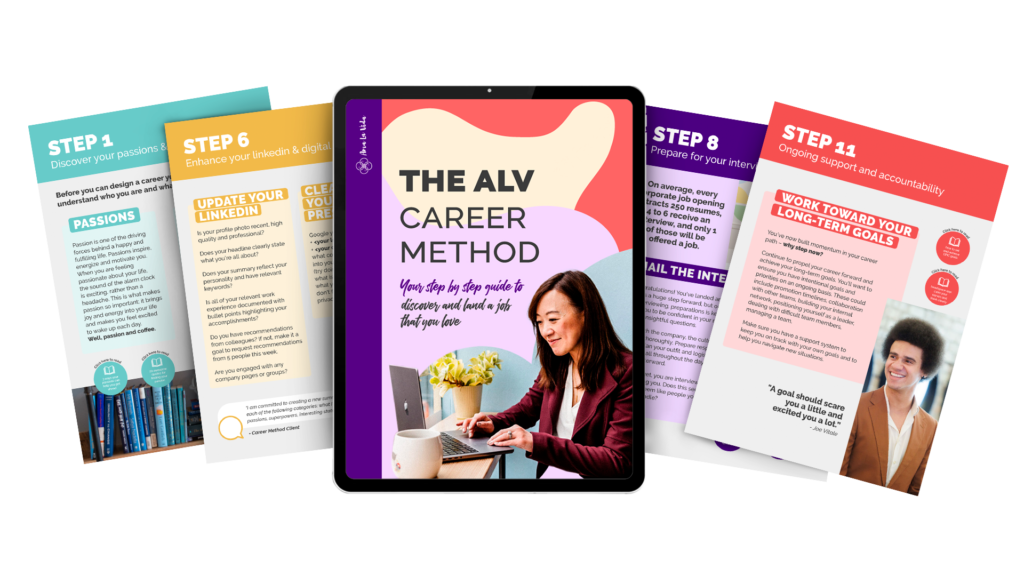
Download our comprehensive step-by-step guide to design and land a job you love!

Images from The ALV Career Method Guide
ALV Method Downloadable Guide

We’re back! It’s been a blast chatting with you about networking and networking groups. If you missed it here’s Networking 101 (with a feature of networking groups in Chicago) and here’s Networking 102 (with a feature of networking groups in Seattle). I’m not going to spend too much time chatting about what once was, because today, we’re moving right along into Networking 103 with a feature of networking groups in Sacramento! Let’s talk about the typical networking questions that never seem to sustain the conversation and ways to replace them with some creative and informative ones. Instead of… “So, what do you do?” Try… ”What’s your passion project?” I hate being asked “so, what do you do?” What does that even mean? What do I do in the mornings? At work? On the weekends? With a broad question like that you may as well ask someone to pour out their life story to you. Now passion projects, we all have them. Or if you don’t, we can at least talk about what you are passionate about. The purpose of this question is to get people talking, and while I may do a lot of things, I’m not equally passionate about them all. When someone asks me what my passion project is, the answer is simple! Photography. Which usually gets us on a conversation about how I got into, what I shoot, and where they can see my work. Before long I usually have a new lifelong IG friend. Instead of… “What does your company do?” Try… “How does your company make a difference in the world today?” The thing with this question is that they ask virtually the same thing, but if you asked me to describe what Ama La Vida does, I usually say coaching. Whereas if you asked me how we’re making a difference, I would say we’re creating ways to people to love every aspect of their lives through coaching. You suddenly know a lot more about the work we do instead of the industry we’re working in. Instead of… “What do you want to be doing in 5 years?” Try… “If you had unlimited time and resources how would you spend your days?” Anyone else not know what they want to be doing in 5 years? Because truthfully, I’m not always sure what I’ll be doing in 5 minutes! (You feel me on this one?) So, instead of stalling a conversation because someone doesn’t have an answer, why not ask about what keeps them going? Let’s get past the awkwardness of the unknown and lean into the things we already love doing! Instead of… “What are your hobbies?” Try… “If you could only do one thing every day until you died, what would you do?” This is one of my favorites because truth be told we all have a lot of hobbies, but how many of them actually invigorate and fuel us? Chances are, not all of them. This question is a super great one that makes people come alive when they start thinking about what they would do. Instead of… “What do you like to do in your free time?” Try… “What gets you out of bed on a Sunday Morning?” This question is so vague I don’t always know where to start. Are you talking about my free time at work? My free time on my commute? My free time in the evenings? The answer to all those times is sadly pretty boring, it’s usually spent scrolling social networks. But, if you’re looking to understand me as a whole, asking a question directly to free time that we all have, Sunday Mornings is a big deal. We each choose to spend Sunday mornings differently, so this is a much more insightful and deep ask. So be bold, I have faith you’ll make a more friends this way! And lastly, instead of… “What’s your favorite part about the work you’re doing? Try… “What’s an accomplishment that makes you proud?” Let’s face it. We all do some cool stuff that we like to talk about, but those cool things aren’t always what make us the proudest. For me, I do lots of cool stuff, but the moments that make me feel the proudest are the little things I do! I love making our clients feel really valued and ensuring they have an amazing experience. If I can accomplish that it makes me prouder than running 15 miles, or moving to a new city, or reading 12 books. All those things are cool, but they don’t resonate with me as much as loving people well. I want to provide one cautionary tip with all of these questions. Use them with care. The conversations that these questions will prompt will be radically different than the networking you’re used to. Only ask if you’re really ready to change the tune and get to know people in a whole new way! Now it’s time to put all these into practice! Below are my top picks for Networking groups in Sacramento. Group Name: WeMeet Where You Can Find Them: WeMeet Eventbrite! Why I like it: WeMeet is on a mission to bring social back to networking. It makes perfect sense that they are typically events hosted over happy hour to get people They meet every month and admission is free. If you’re looking to get connected to a group of focused, determined, and fun individuals grab a friend and get your name on the list! Group Name: Broad Room Where You Can Find Them: @broad_room Why I like it: Broad room is a unique networking opportunity for women. There is a group that meets every Sunday to practice self-care, and they hold tons of creative events ranging from artist events, to diy’s, and so many more! They’re a community space slash creative working space slash wellness center so really you can’t go wrong checking them out. Group Name: Urban Hive Where You Can Find Them: Urban Hive Why I like it:

Read More

In my role as a coach, I have the unique opportunity to understand workplace issues from multiple perspectives. I help executives develop clear messaging and thoughtful plans for the future. I work with new college grads as they navigate what exactly it means to have a 9-5. From CEO’s to those in their first job, I help people get to where they want to go. Your Employees Matter It’s easy to feel like needs and wants “the boss” and “the newbie” are at different ends of the spectrum. But in this role, I’ve realized that across the board, they can be incredibly similar. One of the issues that comes up over and over is the idea of making people feel cared about. Higher-ups want to retain talent, and people on lower rungs of the career ladder want to feel like they matter. However, I’ve seen some really funky ways to invest in employees that don’t always land well. I’m constantly thinking about how to incorporate humanity into all aspects of the workplace, so the concept of investing in employees and promoting well-being is often at the top of my mind. The New England Journal of Medicine breaks down this issue nicely when it comes to healthcare, though the lessons can be translated to almost any profession. Avoiding burnout comes from a combination of efficiency of practice, a culture of wellness and personal resilience – yet, so often initiatives to engage overworked employees focus solely on the “personal resilience” portion of this equation. Understandably, some feel resentment when they are told to meditate more or carve out time to take a walk as a way to prevent burnout, when contributing factors such as inadequate staffing or a culture that promotes excessive amounts of overtime make it nearly impossible to practice these techniques. Invest in your employees – it absolutely matters. But how you invest is just as important. Their Time  Respect your employees time. Don’t arrive 15 minutes late to meetings as your employees idly wait, and schedule time to provide meaningful and constructive feedback to the people on your team. Their Resources and Training Help your employees when it comes to their training and career advancement. Perhaps your employees can use a yearly tuition budget to cover the cost of interesting and non-mandatory workshops, or don’t count time away in classes toward their PTO bank. Their Advocacy  Systemic changes make a difference (see “efficiency of practice” and “culture of wellness” items above) and they are worth fighting for. I believe we all want what’s best for each other, both personally and professionally. With a bit of thought and intentionality, we can invest our time and energy into what will truly make a difference. This week’s challenge Ask yourself – how do I invest in employees and the people I care about? It doesn’t matter if you’re not a boss (or heck, if you even have a job). Lucky for you, this challenge applies to anyone. Take stock in how you treat others and if you’re really appreciating them in a way that works for them (and not just you!). If you don’t know how to best show that you care, just ask. I bet it will spark some great conversation. We love that you always want more. Here are some of the best articles that crossed our newsfeeds this week: “I am a human being and I need connection with other human beings on a deeper, much more complicated level than what the internet can provide for me.” How to Level-Up Your Emotional Intelligence “It might seem strange to think that the roller-coaster world of entrepreneurship helped me recover from burnout and depression, but it did.” Lizzo’s ‘Cuz I Love You’ is True Self-Care

Read More
getting unstuck in your career with signs at a crossroads

Stuck. By definition means, unable to move, or set in a particular position, place, or way of thinking. We all know that feeling. That unmotivated, toxic, negative space where we feel drained as we figuratively run in place. We are innately built to grow and evolve, as a result, feeling STUCK serves as a sign that it’s time for a change. Through the course of your career, you’ll probably feel stuck about a dozen times. Each time, your work and career path will evolve in some way, shape, or form. Stuck is a tricky feeling because the less you act on it, the more intense it grows to be. So you’re probably wondering what to do about it. I bet the question rushing through your mind is, how do you get unstuck in your career? Figure out why you feel stuck Ask yourself these questions and then think about it, even more, the object of this exercise is to get to the root of it. Are you an internal processor? Write this out. External/verbal processor? Talk this out with a trusted friend or mentor. A lot of times stuck happens in one area of life and then bleeds into all the other categories. Lean into what you’re feeling with direct questions so you can identify and solve the root issue. For instance, if you’re actually dreaming about a move to another state but choose to change your job because it feels like less of a risk, you’re missing the point, and STUCK will follow you!Now bring that altogether by asking: What am I missing from my current work situation?  Frame Your Mind Now, this is pretty obvious, unstuck would be to move. Are you swinging back and forth between leaving and staying? Waiting for the perfect opportunity before you decide to move? Are you in your own way? Are you held by back fear? Empower yourself to see that there is something you can do. It might not be perfect or your mind’s ideal situation, but there comes a point where you have to decide if the risk is worth staying or leaving, and what that could do to your current work situation or relationships. I didn’t realize this until I met with many more clients, but the solution to stuck isn’t always to leave your current job. Sometimes, it can be a conversation with your boss about increasing your responsibilities or wages. Sometimes, it’s a matter of re-igniting your excitement for your work by networking with someone who is more advanced in your career path. These things can really help you feel unstuck in your career. Map Your Moves Now that you have dissected why you’re feeling stuck, solutions to this should come a little more organically. You might find that you’ll fall under two different categories. 1. Stay and move to make it better2. Leave and move to find better. Let’s break this down.   Stay, Make It Better If you’re realizing that this company has more to offer and you’re energized about staying, change what is in your control. Re-inspire yourself by attending a conference. Conferences are a great way to connect with like-minded individuals who are likely to be energized by the same work you are. This is a great opportunity to learn more about advances in your career field and generate ideas with others in different organizations. Connect with and become friends with people who don’t work directly with you. Sometimes it is nice to talk to others about things other than work, and easier to feel a part of the bigger company when you have a circle broader than your direct team members. Talk to your boss. Sometimes our needs aren’t met at work, but they really could be if we vocalized them. It’s not always the case, but we recommend giving leadership a chance to show up for you. If you’re looking for more challenging work or wanting more leadership responsibilities? See how much of that you can have already. Wanting to work remotely? Ask. If there is nothing your boss can do, revisit those questions above and see if that reinforces your stuck. Pursue a side hustle. It might be unrealistic, the expectations we have for just one job to have all the elements we want. Instead of trying to change your current job to fit what you’re missing, create a passion project or side hustle that encompasses that. For instance, I’ve had a job that didn’t draw out the level of creativity and ingenuity that I would appreciate. I found the perfect side hustle that allowed space for that. Revamp your space. Space is so much more important than we realize when it comes to our mental states. Has your office looked the same in the last 5 years? Change it up. Re-imagine new configurations and try them out. Creating a new space might be the catalyst for even more new ideas or re-charge you to find new ways to achieve even better work results. Leave, Find Better Sometimes, stuck is a signal for “let’s go”. You’ve been in the same work for a while and stifled for far too long. It’s time to get unstuck in your career and GO. Here are some steps to follow to unstuck out of this! List the things you like about your current job. Chances are, there are things about your job you probably still like, we want to make sure your new opportunity also has these elements. Think about what you would grieve when you leave your current job. Think of what you’re missing. The whole point is to be in a better place than you were before. So, note the reason why you’re feeling stuck, is there a lack of growth? Is it not what you want to do? Write what kind of work you are looking for, write out what this new job will have that your current doesn’t. Network. Start connecting with people. Connection is key and job searches thrive

Read More

Doing the work to make a company more diverse and working to create inclusive teams can sometimes feel as if we are climbing a mountain. On top of that, true change as an organization will take years. I am a bit impatient so I started thinking about what are ways we can make an immediate impact around me. In 2015, Google released findings from Project Aristotle, an internal research project spanning 2 years to answer the question “What makes an effective team at Google?” Google found the most important factor contributing to effective teams is psychological safety. Psychological safety, defined by Harvard Business School professor Amy Edmondson, is a belief that you will not be punished or humiliated for speaking up with ideas, questions, concerns or mistakes. In short, it is how comfortable individuals with taking risks and being vulnerable with their team. What might psychological safety have to do with diversity and inclusion? Everything. The old adage we hear is people don’t leave companies, they leave bad managers. I do not disagree, but I would argue being on a bad team is a major factor we don’t talk enough about. Diversity and inclusion starts at the team level. Managers have a responsibility to ensure they hire a diverse team. Research has shown when you work with people who are different from you, they challenge your thinking and sharpen your performance which leads to having a smarter team. However, when you have a team of people with a whole lot of opinions, good outcomes cannot happen without inclusion. Inclusion is the job of every single member on a team and a core part of inclusion is creating psychological safety for your team members. How to create inclusive teams: Be curious. It is important to recognize every person on your team brings with them a unique set of characteristics and experiences that influences how they might show up at work. Most of what you will not be able to infer based on observations. I don’t know about you, but from my corporate experience, I tend to be hesitant about voluntarily sharing aspects of myself in the workplace. However, when someone is genuinely curious and asks me questions, I am much more willing to share. Be the curious person on the team and lead by example. Start simple by finding out how they can contribute more to the team, questions could be:– What part of the job gets you most excited?– What are some strengths you bring to the team?– What’s something you’ve done recently that you are proud of? Listen and help others be heard. Asking a good question is a good start but you also need to actively listen to the answer. When you feel heard, you are willing to continue sharing information. It’s part of human nature, therefore the response you provide someone who voices an opinion helps to conditions them for the next time. Listening becomes increasingly important when you work on a diverse team because there’s a higher likelihood conflict will arise. Showing that you’re willing to listen, especially when you’re not in agreement with someone takes practice. However, those conflicts, when handled well could turn into innovative ideas and new ways to collaborate. Reframe failures. Let us be honest here, you’re a unicorn if you never make mistakes. Everyone makes mistakes, some are minor and some have a large financial impact. Failure is hard to grapple with internally but can be even more brutal when there are witnesses. If it’s so common, why does it make us so embarrassed? The norms we’ve learned is to hide failures, keep silent and don’t push back – if we don’t see it, then how would we know if it’s common. We focus so heavily on execution when it comes to work, we would be better off if we think of it as a learning journey. The next time you make a mistake think about what happened? What can you do better? What bigger mistake did you avoid because of what you did? How will the incident help you in the future? Share what you learn and ask others for ideas on how you could have done it better. When others share with you a mistake, respond by asking them the same questions. Creating this dialogue opens the doors for others to be empowered to share their own experiences. Building a psychologically safe work environment and working to create inclusive teams requires a leader. The leader can be you, whether you have the title or not. This takes courage on your part but if you don’t do it, who will? Being on a good team makes all the difference at work to people individually. If we’re going to achieve corporate diversity and inclusion goals, we have to start with individuals and teams, to give them an example of how effective it is when people feel their unique perspective matters and is heard.

Read More

It’s 4:59 pm, you’ve been watching the clock like a hawk, you’re exhausted, you’re irritable, and 5:00 pm couldn’t come soon enough so you can break out of the jail cell also known as your office. Or maybe you’re headed into work on Monday morning and you make a beeline to your office, hurriedly shut the door, grip your latte for dear life, and pray that no one comes to ask you how your weekend went. Or perhaps you’re in the work parking lot, sitting in your car, repeating mantras to yourself, pumping yourself up like a football coach until you can muster the courage to open the car door and drag yourself into work. Does this feeling of dread sound familiar? If you have read this far, you’re probably feeling some sort of discontentment in your work. Maybe you can’t put your finger on it, but something is just not quite right. Let’s be honest, there are negatives to nearly every job, and it is likely that you will have days that you just don’t feel like working. However, how do you decipher between a temporary restlessness in your job and a full-on rut? Diving into a job search or considering a career change is a big decision and should be taken seriously. Here are 6 signs that starting a job search might be your next best step. Are you lacking support? – Similar to the examples shared above, dreading going into the office is one of the first signs that you might be ready for a change. I am not talking about the feeling of wanting to take a sick or personal day here and there. I am speaking about persistent anxiety that makes going to work every day a true struggle. Do you have a boss or supervisor that respects, challenges, and trusts you? Poor leadership is a very common reason that people feel the need to jump ship. Google spent 10 years researching this phenomenon in a study called Project Oxygen. An Inc.com article summarizes this study into 10 behaviors that make a great leader. If you are missing most of these characteristics in your boss or leadership team, it might be time to take a look at whether this is the problem. – Or if there are frequent changes in your leadership team, this can cause discontentment as well. Are you regularly adjusting to new protocols, rules, or policies? Is there confusion among the team? Constantly trying to adapt to a new leadership environment can cause instability and ultimately lead to feelings of insecurity about your job, maybe even your career. Do you find yourself distracted or do you frequently procrastinate while at work? – After you chug your first cup of coffee, give yourself a pep talk, and chat with your colleagues for 45 minutes about a serious case of the Mondays, do you then find yourself off in la la land? Is it hard to tackle your to-do list? You might think that you will get your tasks completed later, but right now you deserve to look at your social media feeds for the 700th time. This is a sign that you are not fulfilled, challenged or interested in the tasks at hand. Again, not every work task is going to be something you want to leap out of bed for every morning, but if you routinely leave at the end of the day and cannot think of one thing you have accomplished, this is a sign that you are distracted or highly bored. Have you considered talking to your boss or leadership team about taking on additional or other types of roles? If possible, take the initiative to find the job duties that do make you feel more fulfilled. If this is not received well by leadership or is not possible within your position, it might be time to consider the severity of these distractions. – Perhaps you are distracted by looking through various job boards on a daily basis? Clearly, job searching, while at work, is a sign that you’re ready for something new. Maybe you’re not the only one though. Are your colleagues also job searching and openly talking about it? Is there a high turnover rate in your organization? All of these things can be incredibly distracting, disconcerting, and another reason to consider a transition. Are you looking for ways to call in sick? – What happens when that alarm goes off in the morning? Are you ready to put your game face on or crawl back into bed and think of any excuse to call in sick? Let’s be honest here, most of us want to snooze a couple of times and get more shut-eye, but if you have that feeling of dread every morning, this could be an issue. Again, taking a sick or personal day here and there to take a break, or to truly rest when you are ill, is perfectly fine. It is that persistent feeling of apprehension that should be examined. – This might also be a critical time to evaluate whether you are experiencing anxiety, depression, or another mental health issue. Perhaps your work is so demanding or stressful, that your health has become impacted.Take this brief assessment, by Mental Health America, to determine if you might be experiencing a mental health issue. You can also visit the American Psychological Association’s Help Center to learn more about ways to deal with mental health issues, including how to find support and assistance. Do you complain about work to loved ones? – A loved one calls to check in on you and asks about work, do you have positive things to say? Or do you talk their ear off for an hour about how overwhelmed you are, or how much you hate your boss, or how hearing Jody nose breath on the other side of your cubicle makes you want to rip your eyelashes out? Listen, we’ve all had those conversations where we

Read More

One of your top team members sends you that cryptic, “Do you have time to talk this week?” email. You, of course, get a meeting on the books as soon as you can. Then the bomb drops. They tell you that they’re leaving the company. What?! Why?! They are such a solid performer. I thought they were happy here. I wonder if there is anything I can do to get them to stay! Maybe. But by this point, it is probably too late. You need to identify signs that your employee is about to quit far in advance when there is still time for you to do something about it. Of course, you’re not a mind reader, and we’re not expecting you to be. You’ll never know with 100% certainty how everyone is feeling all of the time. You can, however, proactively engage your team members in ongoing dialogue about their goals. This helps ensure they are constantly learning, growing and being rewarded. These are all key components of retaining your team. So to start, who might be a flight risk? How can you tell if your employee is about to quit in advance? Signs Your Employee Is About To Quit They haven’t gotten a significant raise in a while Money is not everything. I repeat – money is not everything. It is, however, very important. It is important not just because it is our livelihood, but also because it is a quantifiable reflection of our worth. If you have a team member who has continued to up their skills and contributions, who has recently received additional education or training, who has taken on additional responsibilities – all of these are worthy of a raise. Not just a cost of living bump, but a significant raise. If your top team members aren’t being financially rewarded for their continued contributions, they will likely start to look externally to find someplace that will reward them. If you have a team member who is a high performer that you don’t want to lose, proactively advocate for budget to continue to increase their pay or award them a bonus. Or if that isn’t financially feasible, identify other ways to reward them. Maybe you can include them in a high profile meeting. Or provide them with additional training or even award them with additional vacation time. Acknowledge their worth, and do what is in your power to demonstrate that to them. They’ve made requests about their role within the company Coaching people through career transitions is a specialty of ours at Ama La Vida. We are sure to capture data about their decision to leave so we get the full picture. More than half of our career transition clients have spoken with someone within their organization about their desire for things to change before seeking support from a coach to help them determine their next move. That means that more than half of your employees aren’t leaving you guessing at all. They are actually coming to you and saying, “Here’s what I want.” “Here are changes I’d like to see.” “Here are opportunities I’d like to be involved with.” Sure, they might not pepper onto the end “or else I’ll leave,” but what if you thought about it that way? I don’t want you running around fearful that people are leaving every time they make a comment. But I do want you to take their requests seriously. Of our career transition clients, 14% say they would want to stay with their employer if their role was improved. So sure, that’s not everyone, but a 14% improvement in retention is nothing to scoff at. When your employees come to you expressing interest in gaining new experience or working through some challenges, listen to them. Take their feedback to heart and do what you can to create the opportunities they are looking for. It is better for the organization to retain them than having them leave and have to train someone brand new. They are disengaged. If someone starts missing meetings and deadlines, passing on optional events and raising their hand less, they could be an employee checking out and are about to quit. This is especially true if this is a new pattern of behavior. It is possible that they are just going through something personally or are totally slammed. But more often than not, they are beginning to disengage from the company. If someone’s energy and enthusiasm toward their role begins to shift or if they start to have a drastic change in mood, it could be a sign that they are disengaging. Have a conversation with them to check in. Ask what is going on and what has caused this shift. Ask what they need to feel more engaged in their work. Set an action plan for yourself and for them to help reinvigorate them. Suspicious calls and appointments If you’ve ever interviewed for jobs while still in one, you might be able to recognize this behavior when you see it. If one of your team members starts regularly taking private calls or leaving for appointments, it could be a sign that they are interviewing elsewhere. However, it is also possible that they are dealing with some personal or family issues, so don’t jump to conclusions or become accusatory. When you are in a private space and having a one-on-one conversation, you can ask them directly. You can say that you’ve noticed this pattern of behavior and that you are concerned about them. Ask them if they are okay. But also express that you respect their privacy, and they of course should only share anything they are comfortable with. In most cases if it has gotten to this point, they likely won’t share with you are they are interviewing. And that’s okay. You can still try to implement changes which will entice them to stay. And, if nothing else, show them that you are invested in them and care about their career and

Read More