Category: Career Enrichment

hands with yellow sweater and silver bracelets tying on a laptop

I have worked with people finding, building and changing careers for many many years. I know there are thousands (if not millions) of resources and tips out there telling you what to do and what not to do.  I’m not suggesting mine are any better than anyone else’s, but what I do know is that these ones actually work. These ones actually make all the difference. I know this, because I have seen it first hand. Of course, if you follow these five, you are not a shoe-in for your dream job (you also need to have a kick-ass resume, great interview skills, a stand-out online profile and polished professional etiquette). These are the things that are less spoken about and, from my experience, less known. But once you know them, and once you do them, it really will make all of the difference. 1. Start your job search from the inside out. Often when people are searching for a job, the first place they look is the job boards. This may sound like a logical approach, however without knowing exactly what you’re looking for, you risk landing a job that you later realize is completely misaligned with your passions and strengths. The key is to first understand who you are, where you can add value and what exactly you are looking for. It is crucial to identify your passions, your gifts, your core values and your purpose before starting the job search. This way, you will have a far clearer understanding of the types or roles and companies that will bring you fulfillment and success. 2. Try a non-traditional approach to job hunting.  When you apply for a job through the standard process, you are up again hundreds, if not thousands of other applicants. Often the company even ends up hiring internally and you never hear back which can be bother draining and defeating.  I encourage people to reflect on which companies they most want to work for and to write a list of their top 10 to 20. Then, find the relevant contact at that organization and send a thoughtful letter including who you are, why you want to work for them and how you believe you could add value.  This shows initiative, intention and will help you stand out against the crowd. Even if you don’t land a job, perhaps you’ll make a valuable contact.  And after all, you’ve got nothing to lose. 3. Network network network.  It’s no secret that most people build their career through their network not through standard job sites.  It’s never too soon to start networking. Remember that networking doesn’t need to happen at traditional networking events.  Networking can happen in a coffee shop or on the bus – you never know where you are going to meet people that could become incredibly valuable contacts.  Also remember that those people don’t need to be directly related to your field. They may know just the right person to put you in touch with.  Treat every person as if they are just the person you need to know in that moment and watch you network grow and expand in powerful ways. 4. Make time for self-care.  The job application process can be incredibly draining and defeating. Make sure to take care of yourself mentally, emotionally and physically. This is not only important for your well-being, but it is also important for you to perform at your best in applications and interview. Identify what you need to do and schedule time in your calendar to make time for it. Perhaps it’s a 20 minute run each day or 30 minutes to watch an inspiration TED talk. There is no wrong or right as long as you make time to recharge. 5. Shift your mindset – job searching is a marathon not a sprint.  Remember that you may not get the first job you apply for (or the second or the third or the eighth) and that is ok.  You career is going to be long. Very long.  Think carefully about your vision for your career and what you want it to look like in five years or ten years time. As long as you are meeting the right people and moving in the right direction, it doesn’t matter if one specific job fell through.  Just keep your eye on the longer vision and take proactive steps to achieve it.

Read More

I recently returned home from my second trip to Belize. Absolutely stunning country. Bursting with interesting history, a curious mix of cultures and ocean views to die for. But while abundant in beauty, it’s lacking in options. There’s certainly no Silicon Valley. Barely a university. No Home Depot. Not even a McDonald’s. Its people, however, are kind and proud. They will gladly show you the sites and welcome you into their homes, as our newly made friends down there did this trip. Our friend Mirsa invited us over. While I sat and played with her dog, her little cousin Shanies walked into the living room and went straight to grab something from the kitchen. Shanies lived in a separate unit in the same building. Knock on the front door? Don’t be ridiculous. She simply climbed over the barrier on the balcony and walked right in the open doorway. At only 15 years old, she was gorgeous. But I got the feeling she didn’t know it yet. Ed, my husband, teased her from the moment she walked in, as is typical for him to do, and she didn’t so much as flinch. I liked her already. After a 13-hour workday on her feet, Shanies’s mom came home, and we had a nice chat. She bragged about how smart Shanies was. “She makes all A’s in school!” I turned to Shanies and said, “That’s incredible! What do you want to be when you grow up?” Given my profession and being a privileged white person in America, it was a natural question to ask. With a shrug, “I don’t know.” My initial thought was “Ah teenagers…don’t think these things through.” But very quickly I realized, there wasn’t much thinking to do. Shanies’s mom went on to explain that college is not an option. Tuition is far too high. With minimum wage at $1.65/hr in Belize, mom could work as many 13-hour shifts as her feet could handle and never come close to paying for higher education. In fact, only 75% of students in Belize even make it to high school, with less finishing all four years. So Shanies would likely go on to cook. Or serve at a restaurant. Or work at a hotel. All perfectly fine professions. But what angered me was that her options were so limited. I wanted to stuff her in my suitcase and take her home with me. It was only a few hours on a plane separating her from top-notch education and endless opportunity. Who knows if she would have even wanted it. I’m not so US-centric that I can’t see that there are many ways life in Belize is preferable to life here. I just wanted her to have the choice. Shanies might be the next Oprah. Or Elon Musk. Or Tory Burch. Or Sheryl Sandberg. I don’t know who or what she could be, but I know that she has the right to try. Thinking about her on my plane ride home and gearing up for a full day of work in the morning, I realized that it is my duty to build my business for her. It is my duty to help my clients achieve all they can. To help our coaches prosper and make an impact. To work with the same hustle and endurance as Shanies’s mom does. Simply because I can. Because I was given the gift of being born in a place and family where I was taught to dream about my future and was told that college was expected. Because I was given the choice. And I’m going to make the right one. I’m not sure yet how Ama La Vida will help Shanies and the many young women around the world like her, but I’m for damn sure going to explore it. For now, I’ll put my head down and keep working. Keep building my business so it can afford me with a greater platform to make a change in the hopefully not-so-distant future. But know I’m thinking of you. I’m scheming. And you can bet your asses I’ll be back.

Read More

I have worked at companies or on specific projects where I would come up with an idea that I thought was pretty good.  An idea to solve a business problem. To attempt to fill a hole that would otherwise sit there and gobble up time and money. So, in a burst of inspiration, I’d take charge and propose a solution. Perhaps not a perfect solution but a starting point. I’d begin to discuss it with others whose approval I’d require or whose functional expertise I’d need to draw on. And the more I’d discuss it with others, the worse the idea would become. I’d hear “no” after “no” – all reasons why the idea wasn’t perfect. All obstacles standing in the way of it filling the hole. All completely valid statements, for the record, but unproductive ones. So I’d have to change the idea to keep it moving, lest it die right then and there. With each “no” the idea would get more watered down, to the point that it became unrecognizable, and at the end it was hardly an idea at all. While at first my plan was to fill the hole, the idea had become more like laying a piece of paper over it. Why bother. At Ama La Vida, coming up with ideas is fun. We have no shortage of business problems; everywhere we look there are holes to be filled.  But now when I propose a solution, even a mediocre or outlandish one, I have faith it will grow into something that fills the hole and solves the problem. I’ll share the idea with my team, and the more I talk to others about it, the bigger and better it becomes. It gets more power behind it. The crappy parts get striped away. It gets shinier and shinier as it gains momentum. Before you know it, it becomes real. The difference in the experiences is represented by this visual: If you want to make progress, be innovative, beat the competition and keep your customers happy, you want your company to be an Idea Fueler not an Idea Diluter. Sure it’s much easier to be a Fueler when you are still very small. Fewer stakeholders. Fewer customers impacted. Fewer approvals required. But if you care enough, you can be a Fueler at any size. And if you aren’t careful, you can be a Diluter at any size too. Here are some ways ALV has built a culture of idea fueling that I welcome you to explore. We’re obsessed with our customer – The more you care about your customer, the more the holes to be filled are even visible to you. And the less you’re willing to tolerate them being around, especially if they are harming your customer experience. When I let a customer down, and of course this is inevitable, I treat it like I let my best friend or family member down, regardless of how well I know them or how much they spend with us. I fix the problem, I’m transparent and I’m apologetic. I put my heart into making it right and then some, not just because I want to preserve the relationship but because I truly give a shit about that person’s life. And the whole ALV team operates this way. The first step to fueling ideas to fix business problems for you and your customer is to build a culture of people who are obsessed with solving them. A culture of people who take business problems personally. We talk about idea fueling and practice it – It may seem unnatural to try and teach your team this behavior, but if you don’t discuss it, you can’t expect them to do it. I have talked to my team very directly about the importance of fueling each other’s ideas, and I have led them in exercises to help us practice it in a safe environment. We create a safe space – Whenever someone presents an idea, no matter how seemingly crazy or unrealistic, we entertain it. Even if we don’t immediately accept it, we approach it with curiosity and encourage the idea generator to tell us more. This creates a space where people feel comfortable, even excited, to share their ideas. We call out bad behavior – Sometimes your knee-jerk reaction will still be to shoot down an idea. To jump right to the “we can’t’s’” instead of the “what if’s.” To immediately reply that the idea is just too out there or too expensive. It happens. It happens to us sometimes. But when we make that mistake, someone on the teams calls it out. “Hey guys, you just crapped on my idea. That’s not how we do things here.” And we all acknowledge that person’s feelings and assessment of the situation. They’re right. We apologize and give them the floor. We make the same call out for one another if we see idea diluting happening to a peer. If you want to build a good behavior as standard practice, you can’t let the bad behavior fly. We’re faced with unreasonable challenges – As a self-funded startup with an incredibly lean team, we face challenges on a daily basis which are beyond unreasonable for us to solve with so few people and resources. But we get creative, and we work our butts off to solve them every time. I hope as we grow, we continue to have more resources to make more delicate and seamless solutions. But I want to ensure that we never lose that scrappiness. That ability to create something from nothing because nothing’s all we had to work with at the time. I will continue to challenge my team to propose solutions and build them with not enough time, people or money. It’s the opposite of spending a budget because you have it. It’s building a solution with less than you have because it’s possible. Don’t forget, the more you dilute ideas, the less likely your people are to

Read More

“The two most important days in your life are the day you are born and the day you find out why.” — Mark Twain When we think about why we do what we do, it sometimes scares us or makes us feel uncomfortable. We may think, I’m not Mother Teresa or Martin Luther King or Mahatma Gandhi or Nelson Mandela with a grand sense of Purpose. That’s okay. You and I are not expected or required to have a magnificent Purpose statement. We simply need to understand our Purpose, big or small, own it and live it. Purpose is a very personal thing – it’s why you do the things you do, whether at work, home or in your community. It’s the ultimate driving motivator for you. Purpose provides clarity, meaning and direction and is your constant around everything you have done and will do. This doesn’t mean that your Purpose is the same throughout life; a common misconception about Purpose is that it is just one definitive thing. It isn’t. Purpose can take many different forms – some people may be finding their Purpose for the first time while others may be re-Purposing. Let me provide an example. Remember when you were in college and you were trying to figure out what you wanted to do and why you want do it? To answer those questions, you were thinking about your Purpose possibly for the first time. As we go through life, major events change our perception and how we view ourselves in the world. When kids leave the nest house, parents feel alone at home or when we are on the verge of retirement, we may ask ourselves, what is my Purpose now? As life changes and events occur, your Purpose may take another form or iteration. Allow yourself to explore that and understand how you can live out your Purpose in your current reality. So how does one find their Purpose? We’ve already given you the definition of Purpose but haven’t provided the background on how to get there. In order to understand your Purpose, we suggest thinking about what we at GenIN Solutions have identified to be the three core elements of Purpose: Passions – Understanding what makes you excited and gives you energy To understand your Passions, ask yourself, what are the things I do that make me lose track of time? Gifts – Understanding your unique strengths and talents To understand your Gifts, ask yourself, what do I get complimented on often? Values – Understanding your guiding principles To understand your Values, ask yourself, when faced with tough decisions, what factors do I consider to make the decision? Passions, gifts and values all work together to inform your Purpose and help you live your Purpose. When looking at it individually, passions fuel your Purpose, gifts support your Purpose and your values guide your Purpose. By articulating these three elements, you can begin to arrive at your Purpose. This Purpose should be a narrative that’s unique to you, informed by your strengths, your passions and your values. Purpose doesn’t have to be only one thing – it can be divided into Purpose at work and home. Let it be simple, let it be unique to you; there is no wrong or right Purpose, as long as it connects with you and what you want your life to be about. When you define your Purpose, you’ll find that you are more engaged at work, you have a greater sense of meaning and fulfillment both in life and at work. The Purpose movement is real – we are shifting from doing what society says we should do to finding our own path and creating our own map to get there. We urge you find your Purpose, own it, and live it.    [wd_hustle id=”webinar-sign-up”]

Read More

Job description sounds good. Check! Salary is a-o-kay. Check! Commute is easy. Check! What more could you want? Take the job! Right? Hold up – let’s pump the brakes. While the role may sound great on paper, the values and culture of the company you are considering will have a significant impact on your job satisfaction, ability to succeed and personal well-being. And yet, values alignment is such an undervalued criterion for most people when selecting a job… if they consider it at all. The difference between a good and bad day at work usually isn’t because your job description changed. Sure sometimes you may work on something you’re more passionate about, but within any given week, where your work remains fairly consistent, you can have extremely good days and extremely bad days based solely on the behavior of those around you. And that behavior is a reflection of professional values. Professional values are more than just the inspiring words written on the office wall, the themes in your employee handbook given to you on day one or the words rattled off by executives in town hall meetings. They are the observable behaviors of your colleagues. Of leadership.  Not just what they say but how they act. They are what drives decision making and Are their behaviors ones you want to be around? Ones you want to emulate? Ones that inspire you to do your best work? Values have the ability to drive culture and behavior so much more than rules. It’s the difference between doing something because you believe in it and doing something because you’re told to. When strong, positive values are instilled at a company, and when those values align with your own, you are highly motivated to work and achieve. The environment brings out your best qualities, and you are excited to work toward the company’s mission. On the flip side, conflicting values can be so damaging that you are unable to work for the company. Perhaps you don’t agree with the way the company treats its customers or the environment. Perhaps the company values achievement so much more than work/life balance that you have to put your family second. Perhaps the company shows no value for innovation and so your new ideas are always turned down. Values alignment is the difference between empowering and suffocating. Between energizing and demoralizing. Between inspiring and unsettling. It is the key factor behind your ability to be proud of where you work. So when you’re interviewing, here are some things to be on the lookout for: What do people wear? How is the office arranged? Where does leadership sit? On their own floor, in offices, with the staff? What does the energy feel like? What time are people coming and going? How many people are in meetings versus working independently? What are people’s emotions as they exit meetings? What kind of amenities does the office have? What type of equipment do people have on their desks? How are your interviewers and the employees treating each other? And here are some things to directly ask in an interview: What are the company’s values? And what are some examples of how those values show up? How would you describe the culture here? What are the characteristics of people who typically succeed here? How is performance evaluated? What behaviors get rewarded? How are promotions determined? What do you like most or dislike most about working here? When it comes to our happiness and motivation, the way we do work is often much more important than what we do.  When you’re interviewing a company, you may have to read between the lines. Study the behavior more than the words. Seek out companies which promote values that align with your own. When it’s a match, you’ll be on the fast-track. When it’s not, it likely won’t be long before you’re on the hunt for a new job again.

Read More

I, like many others I know, have a tendency to want what I don’t already have. Not necessarily in material goods, but in attributes and skills. When I moved to the US at a young age, I noticed the increased level of creativity my fellow classmates exhibited. They seemed so skilled at creating beautiful art and making cool crafts. I could never get my art to look like theirs. I didn’t have the same extraordinary imagination, the eye for colors, the technique to paint (inside) the lines. While I tried and tried, but I was barely mediocre. I would get frustrated that I couldn’t do what the other kids could. I questioned myself and my abilities – why am I not as good? After all, society and people often give you feedback on what you need to be better at, not what you’re already good at. I invested all of my energy and time into practicing and trying to be better, but that only frustrated me more. I would get upset and feel crappy that I wasn’t as good as the other kids. After observing my habits for years, my dad (who continues to be a big influence and my coach in life) sits with me and says:  “You have your weaknesses and you have your strengths. While you need to improve your weaknesses, don’t spend your life trying to make up for them. Do something that uses your strengths and people will recognize you and you’ll be happier.“ He was right. No matter how hard I try, I will never be Picasso. Nor will I be anything close to my talented classmates. It just isn’t my thing. I find that when we only focus on our weaknesses and ignore our gifts, we start losing confidence and feel more frustrated – I see this almost daily with my clients. What Are Your Strengths? As a coach, the majority of my conversations with clients start with them saying, “Here are all of the things I need to work on.” They then give me a plethora of things they want to work on. And while that’s great self awareness and dedication to improve, I respond back with, “Tell me about your strengths. What are they?” This catches my clients off guard.  They respond with uncertainty and hesitation, eventually providing me a list with a few strengths.  This list is typically half of the size of the things they want to improve on. I encourage my clients to flush out their strengths and once we have a comprehensive list of both strengths and weaknesses, we discuss how they can use those strengths to work on the things that need improving. For example, I recently had a client who wanted to be more assertive. This client identified empathy as a big strength, which led us to set strategies on how to be assertive while using empathy. She became particularly skilled at being assertive when needed while making sure it was done in a way that made the recipient feel heard and respected. Where Is Your Energy? In life – at work, at home – we all need to work on the things that we’re not good at. There’s no denying that. I often hear from clients that they need to be better with having difficult conversations. That’s a critical skill to have at work and outside of work and you should absolutely have the skills to have those difficult conversations. The problem I encounter is when all of the energy and effort is put into making the weakness a strength. You can work months and months on being able to have a difficult conversation; you do it so it’s not a detriment to you and your work and personal life. At the end of it, most likely, you’re not going to transform into the expert in having difficult conversations. Realistically, it might still be uncomfortable for you but manageable and no longer a detriment to you and your development. But all this time, what happened to your strengths? They were put on the backburner while you focused only on your weaknesses. Embrace Yourself: Be More Of Who You Are Now think Sheryl Sandberg. What comes to mind? Probably her remarkable book Lean In, her leadership at Facebook and her advocacy to build resilience and support women. Rightfully so – you recognized her for what she’s known for. One of Sheryl’s greatest strengths is being authentic. She embraces her strengths and she acknowledges her weaknesses. What if Sheryl spent all of her time working on her weaknesses? What if she didn’t use her strength of being authentic and speaking out against gender bias? If Sheryl Sandberg did not embrace her gift for being authentic and standing up for what she believes in, I’m not sure if Lean In would have been published. I’m not sure if the movement she created would exist. Sheryl Sandberg spent more time on her strengths rather than only focusing on her weaknesses and this contributed to the impact she has today. Often times I tell my clients to think of strengths as a muscle. You have to keep working it out so that it gets stronger and more defined. The more time and effort you can put into your strengths, defining it and refining it, the more you will be happier, confident and successful. After all, your strengths are what make you unique. Your strengths give you recognition. They make you more confident. We all know what Sheryl Sandberg is known for. What are you known for? “You cannot be anything you want to be – but you can be a whole lot more of who you already are.” ― Tom Rath

Read More

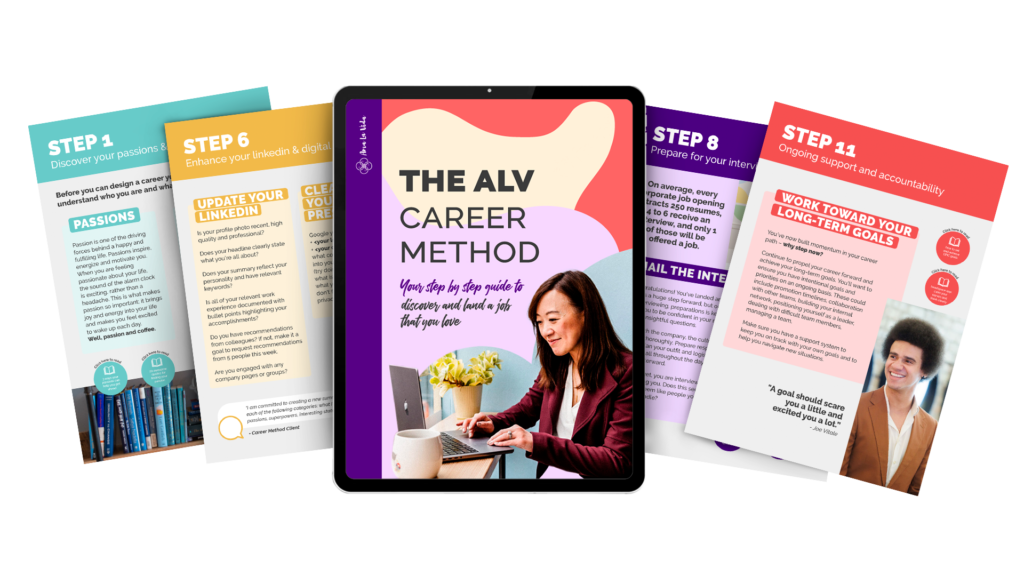
Download our comprehensive step-by-step guide to design and land a job you love!

Images from The ALV Career Method Guide
ALV Method Downloadable Guide

Everyone has big dreams. Some bury theirs deeper than others. Deep down under a lifetime of experiences telling them their dreams aren’t possible. Some days the dreamer in you might take over and think, “Wouldn’t it be incredible if…,” but you shut it down right away before that dream can even manifest itself into a goal. You discredit it as crazy and unrealistic in an effort of self-preservation, so you’re not disappointed if it does not come to fruition. You force yourself to forget about the incredible and return to the “good enough.” Henry Miller once wrote, “One of the reasons why so few of us ever act, instead of react, is because we are continually stifling our deepest impulses.” He questioned, “Why are we so full of restraint? Why do we not give in all directions? Is it fear of losing ourselves? Until we do lose ourselves there is no hope of finding ourselves.” Fear is a powerful motivator. It is scary to make a change or pursue a dream. Allowing our dreamer to be heard by the world makes us vulnerable. For she is a reflection of our truest self, the one without a restraint-driven façade. When we finally let go and allow ourselves to get lost in the dream, that is when we really start to create something special. Life often has a dilution effect on dreams. When we were younger we let the dreamer have a voice. We’d say, “I want to be president.” Or “I want to be a famous artist.” Or “I want to be an inventor.” But societal pressures take over, and we are taught to believe that the dreamer in us is not the voice of brilliance but rather the voice of irresponsibility. And this leads us to settling for a watered down version of our vision. But what if we gave our dreamer a platform? What if we let her speak? What would our lives look like? After years of silencing my dreamer, I decided to give her a mic. I quit my well-paying job and my upward career trajectory to start back at the bottom, building my own business from nothing more than an idea. The journey has not been easy, but it has been oh so worth it. Every day now feels like I’m adventuring around my own personal playground. Sure, sometimes I still fall and skin my knee, but I get right back up and swirl around a colorful slide with a big ole smile on my face. It’s my playground. And I’ve built it to have all the things I want in it. I’m no longer going down the same straight metal slide over and over again in some public park. Sure, leaving the comfort of a slide already built and a consistent ride was scary, but for me the thought of going down that same metal slide for 30 or 40 more years was even scarier. There’s a recipe for building the life you want which I tapped into to craft my ideal workday. I have to be passionate about what I’m doing. I have to read about my industry out of choice, not obligation. Because I’m so passionate about my work, I don’t struggle to find motivation to work but rather struggle to keep boundaries in place for when to shut down. I have to be utilizing my unique skills, the things which make me shine, feel valued, feel accomplished. I have to work in an environment which aligns with my values. For me, I need an organizational culture which fosters innovation, demands authenticity, celebrates humor.  And I have to know that more days than not, my work is directly correlated with my personal purpose, what I want my life to be about and how I want to make an impact on this world. Now that I have built a life where I am following my passion, engaging my skills, honoring my values, and living my purpose, I sleep better. I laugh more. I care more. I show up more. I’m more the person I want to be because I’m living the life I want to live. You don’t need to quit your job to do this. You just need to start listening to that little voice you’ve told to “shh” for so long. You need to muster the courage. And then, you need to get building. I don’t want your dreams to be diluted versions of what they once were. I want to help you make them potent. Palpable. Unable to be ignored. I don’t want you to succumb to practicality instead of passion. Not anymore. Let’s let your dreamer sing. Let’s entertain the what if’s. Because when you build them into reality, and you will, it sure is incredible.  

Read More

Have you ever walked into your colleague’s office looking for that very important time sensitive document only to find yourself in front of piles and piles of documents and scattered food remains? Imagine it – what’s going through your head? If you’re anything like me, you’re feeling anxious, stressed out about meeting your deadline, frustrated, and you curse out your colleague. How can he be so messy?! Now let’s imagine another scenario. You walk into your colleague’s office looking for that very important time sensitive document. You see the shelf with labeled binders and folders. You quickly search for the folder name, retrieve the document – find other documents that might help – and rush over to your desk to complete your task. How are you feeling now? What are you thinking? Besides the obvious of an organized workplace allowing for quick retrieval of documents, there are several physical and mental benefits, such as: It compartmentalizes your work. Consider our example above with an organized office – the document was quickly found because it was in its rightful, clearly labeled folder. And there were additional supporting documents that were not even considered before, which turned out to be helpful. Organizing your office/desk/cubicle helps separate the clutter of the many simultaneous deadlines, projects, and clients, allowing us to focus on the specific client or project at hand. It reduces stress. The physical appearance of clutter brings about anxiety, therefore leading to stress, a sense of feeling overwhelmed and frustrated. An organized workplace allows for quick retrieval of the right document at the right time not only for yourself but for others in the office such as coworkers, bosses and clients. It shows you care. You don’t ever walk into the office with disheveled hair. Why not? You don’t want to look sloppy and of course you want to show off your beautiful hair. Your physical workplace is a reflection of you. And others form perceptions of you based on your workplace. An organized workplace shows pride, loyalty, a sense of caring and responsibility. Next time you contemplate whether or not you want to organize your workplace, think about that one person in the office who is always dressed immaculately. Either you hate this person for being so damn put together or you’re this person. Either way – people know you care about yourself, how you look, and you seem very polished. And that’s just an outfit. Imagine what people may perceive when the workplace is organized. It saves time. You had your Friday outfit all planned on Thursday night. You wake up Friday morning and walk over to your closet for that new shirt. You can’t find it. You frantically start looking everywhere and you still don’t find it. You then go through the 5 stages of grief – you even negotiate to skip happy hour to find that top but you still don’t find it. You’re left with no choice and you pick another outfit, ruining your whole day. Pretty rough day, huh? Similarly, with an organized workplace, you’ll find things more quickly, you feel less frustration, and you’ll find yourself saving time that would have otherwise been wasted looking for that lost document. Tip 1: Organize your digital life I remember an instance where I needed to create a deliverable for a client. I had done something very similar at a previous project so I search my laptop, my emails and of course I couldn’t find it. I spent three hours putting together a document that I had already done before. I was so irritated. This is when I got my butt into gear and decided to organize my files. Take a look at your desktop right now. Do you have files covering every inch of your screen? Do you struggle to find documents or have short term memory like me and don’t remember where you saved something? This can be fixed by organizing your digital life. Here’s how: Step 1: Categorize all projects and recurring actions Think about your day yesterday. What were you doing? How did you spend your time? You may be involved in several projects, some internal initiatives, and you have to submit time and expenses. For all recurring projects and activities, create folders with clear labels for easy access. Step 2: Create a filing system For any emails or documents pertaining to a category created, be sure to file only under that folder. This organized system will help you review documents at a glance, put together summaries or refresh your memory when you need it. This filing system will save you time, energy and chaos of seeing 291293 emails in your inbox, leaving you with only the very important follow up emails in your inbox and space on your screensaver for those very cute golden retrievers. Step 3: Have a consistent naming convention I can’t stress this one enough. There will be times that you forget where you stored that document. By labeling your documents the same way every time, it also avoids any version control issues. My suggestion for naming convention is this: TOPIC_TITLE_ _DATE_VERSION. Having a version such as draft_v2 will prevent you (hopefully) from working on draft_v1 – an outdated draft. Trust me, this may happen when you’re working late nights so avoid the hassle by being diligent about your naming convention. Doing this will not only save you HOURS of time from having to reinvent the wheel but it will also save you a lot of frustration and stress. You’ll also look like the hero when you respond to an email right away because you were able to find the exact information you needed. Not to mention, the next time your boss asks for a document while hovering over you, you can get it to him immediately so he backs off, allowing you to do more important work, like stalking your ex on Facebook. Tip 2:  Organize your to-do list: When you walk into the office in the morning,

Read More

I’m happy and I’m sad. I like being with people and I like to be alone. I like risks and I am cautious.  Do I sound like a confused teen who doesn’t know who she is? Perhaps. But I think I don’t have to be one thing or the other. I can be both and so can you. We don’t have to be boxed into thinking that we have to be this or that. No. Life isn’t that simple and shit is complicated. People are complicated. I recently read a great book called Decisive: How to Make Better Choices in Life and Work by Heath and Heath and they talk about this concept of widening your options. To get away from using the word OR and replace that with AND. This can be applied to work – you’re being presented some options and they say you can go with option A or option B. Well if we reframe the way we think, then we can ask why not both or why not an alternate option – like option C? The same goes with people. You can feel and be multiple things at any given time and that’s okay. Just because you’re a happy person and you like to be with people doesn’t mean you also don’t have days where you don’t care about anything and you want to be alone. That’s not an “off” day – that’s just you being you. People and society like labels. They like perfect words and descriptions of who people are so that they can predict how they’ll act. If I said I was an extrovert, what comes to mind? I enjoy being with people, I like to talk out loud, I like to try new things. Now what if I liked being alone after a long day at work? What if I needed time to process things? Are you going to call me an introvert? You’ve labeled me to fit me into one box because that’s your schema of how things work and who people are. We can’t approach life with labeling people with one descriptor and we also don’t have to label ourselves that way. You have unlimited words to define yourself and the more context you can provide as to who you are and what you like and don’t like, the better people can understand you and not make assumptions. If there is anything you should take away from this, it is not to be limited by the OR options and the OR people of the world. You can be it all. You do not fit into a simple term – you are not introverted or extroverted. You are not type A or type B. You are not a hippie or a cowboy. You can be introverted and extroverted – it’s your preference who to be when. When you label as one or the other, you play into that role and you start seeing things the way you are asked to see it. That’s not you. You are complicated and you are unique and you are you. As Heath and Heath say, widen your options. Because if you don’t, I guarantee you’ll miss an opportunity. You gotta do you. All of you. Want more from Ama La Vida? Sign up for our newsletter 🙂

Read More