Category: Career Enrichment

The ALV Career Method is our comprehensive career transition coaching program. There’s a lot to it. So I want to share with you exactly how it works and why it works. But before I do, it’s important for you to know why we even built it in the first place! How We Got Here Not too long ago, I was sitting in a crappy hotel room somewhere in Kentucky. I was a management consultant. So finding myself in crappy hotel rooms, not entirely sure where I was, was not an uncommon occurrence for me. When I first got into consulting, I thought, “I’m young and don’t have a lot of responsibility. It’s okay if I live on planes and work all the time.” After a few years, I found myself thinking, “I’m young and don’t have a lot of responsibility. Why am I wasting my life being miserable, alone in a hotel room, doing work I don’t care about?” And in that hotel room, I had decided enough was enough. I decided life was too short to allow myself to stay unhappy. Consulting was a fantastic place to start my career, but I learned that it wasn’t my forever job. And once I did, I felt lost. I had worked so hard to get there. I had done all the “right” things. It was, by many standards, a great job. Why wasn’t I happy? Was I just being ungrateful? Should I stick it out? If not, then what now? Is it possible to find a job you’re passionate about that also pays well? Or is that just a pipe dream? I was questioning myself and my decisions. I didn’t seek help to find answers because I didn’t even know there was a help to be sought. Luckily, around the same time, I was given a leadership coach by my employer. And to be honest, I wasn’t excited about it. Coaching sounded like a hippie, made-up job to me. I was wrong. I found coaching to be so valuable that I continued working with my coach independent of my organization for years. And to take it about a million steps further, I found it so valuable that I eventually quit my job to start a coaching business. Why We Built the ALV Method The coaching that I had was incredibly powerful. I felt energized and inspired by my sessions. They helped me find calm and clarity. But something was missing: structure. While I was learning a lot about myself and starting to envision an ideal future, I didn’t always know where the sessions were headed. It was sometimes difficult to keep moving forward without some sort of process to follow to apply all of my insights to the actual job search. Many of my peers were going through a similar career transition and had an experience on the opposite end of the spectrum. Every career quiz and assessment felt so binary and limiting. Are you an introvert or extrovert? Oh, you like to help people? Then you should be a nurse. Analytical? You should be an accountant. These assessments felt outdated. Oversimplified. They didn’t seem to take into account how complex we are as people and that there is a lot more that goes into finding a fulfilling career path than just a few personality traits. Most career tests out there provide multiple choice questions and use an algorithm to box you into a “type” which determines your career direction. Seven billion people and unlimited career paths do not fit into one of 16 types. My business partner, Foram, had also made her way to coaching from consulting. She was being trained in leadership and executive coaching and saw that most clients were in the C-suite. “Why wasn’t coaching being made available for people earlier on in their careers?” she thought. Why did it feel so stuffy and inaccessible? How could we bring coaching to anyone at any time? The two of us teamed up to create Ama La Vida and our first signature career transition program, The ALV Career Method. We wanted to… take the best pieces from each of our experiences and create a process to help people navigate career transitions, no matter where they were in their careers or in the world. help people reconnect with themselves in an authentic way and craft a career path that was uniquely designed for them. arm them with the collateral, confidence and accountability to land roles they thought were out of reach. spark that excitement in them that would get them to take action and make the change they had been longing for. And we wanted to do it all in a way that was affordable. How The ALV Method Works The ALV Career Method is a comprehensive, 4-phase career transition coaching program that takes you step-by-step through the process of identifying the right career path for you and landing a job in your new chosen field. You’ll start with a multi-week intensive where you’ll be meeting with your coach frequently. Your sessions will then taper off over time as we move from discovery and planning to execution and support. Before each session, you’ll complete online exercises in our proprietary eCoaching platform. Then you meet with your certified career coach to dive deep into your findings and ensure you are progressing toward your goal of an exciting new career path. Here is everything you need to know about the program phases you’ll progress through: Phase One: Planning. One mistake we regularly see people make is finding themselves unhappy in their work and then going straight to the job boards to find a new position. Most often a position quite like their current one. They don’t take the time to sit back and reflect. To understand why they are unhappy in the first place. Or think about the components of their job that they do enjoy. To get clear on what impact they want to make in their career and what

Read More


Remote work is part of our future. Period. In this article, I talked about how 63% of employers now have remote employees and how you can still create a strong culture even if your team is spread out. But so many people I know are still trying to fight it. They want the butt in the chair. They want the false sense of security that accompanies keeping an eye on people. And I can tell you for certain that a physical presence does NOT mean an employee is working. It All Comes Down To a Lack of Trust If you don’t trust your people to get their work done no matter where they are then: You shouldn’t have hired them in the first place You as a leader have created an environment where people are motivated by the wrong things Change isn’t easy. But the best leaders are the ones who recognize its importance and force themselves to evolve their practices even when it’s uncomfortable. I’m a big fan of Jellyvision’s CEO, Amanda Lannert. I was listening to her speak once, and an audience member asked this question: “I can’t stand that my employees are always on their phones in my weekly team meeting. This new generation just can’t put them down. How do you get your team members to put the phone down and focus on what you’re saying to them?” Amanda said, “That’s a battle you won’t win. Can you make the meeting more engaging? Does it even need to be an hour-long meeting at all or can it be a 15-minute Slack frenzy?” The audience member looked stunned and somewhat disappointed. I think she was hoping for some shared moaning and groaning about these youngsters. But instead, she got innovation. A new way to even think about how to get the job done. In my head, I gave Amanda’s response a big ole “amen!” So we can all moan and groan about the way to the world is evolving. About people wanting to stay home and work in their sweatpants.  We Can Embrace Remote Work There are new ways to motivate and engage our teams. We can celebrate the positives of no commutes and flexible schedules. We can coach our team members and hold them accountable to their commitments whether they are in Baltimore or Buenos Aires. Hybrid schedules of some in-person days and some remote days can be created. We can tailor schedules to the times when people are most productive. There will always be business objectives to accomplish, and so I’m not saying it should be a complete free for all. We still need to find times to check in, to collaborate, to have meetings. I’m simply saying it’s time to open our minds. Consider new ways to get the job done. It’s time to evolve our thinking about remote work, or sooner or later, we will be the ones left at home. This week’s challenge Think about one thing you do each week that has just ‘always been done that way.’ Challenge yourself to think of a new way to approach it. Maybe the meeting can be accomplished in 20 minutes instead of 60. Perhaps a time-consuming process isn’t relevant anymore and should be tweaked or eliminated. Maybe a new technology can help you do something more efficiently. This week, really challenge yourself to evolve forward. We know you want to learn more. Here are some of our favorite additional resources: If you’re changing careers: 12 Companies that Let You Work Remotely Watch a TED Talk by Air BnB Exec Chip Conley: What Baby Boomers Can Learn from Millennials – And Vice Versa Start innovating: How to Train Your Brain to be More Innovative Get your own toolkit: Download a Digital Design Thinking Toolkit from IDEO

Read More

If you don’t know much about me, my name is Randalyn and I just moved to Chicago a few months ago to work at Ama La Vida. I don’t know about you, but networking in a place you’re familiar with always feels more comfortable than networking when in a new city. So here are few of my favorite networking tips to help you restart your network when you move. 1. Have realistic expectations. If we’re being honest, you can meet a lot of great people at networking events, but you probably won’t meet the CEO of a huge company just by chance. Most people that you really want to meet are too busy to attend most networking events or are invited speakers who don’t stick around to mingle. Which brings me to #2. 2. Get connected in other ways. Join meetup, slack channels, facebook groups, attend community events and make it a point to make one new friend at every event. The beauty of making friends is that everyone you meet has friends; you can easily go from no friends to having a full-blown community without much time in between. 3. Identify your interests! When it comes to networking most people get overwhelmed because they have nothing in common with the people they are trying to get to know. The easiest way to avoid not having something in common with people is to attend groups focused around your interests. Find groups that were created for photographers, hikers, yogis, etc. Also – reach out to the Alumni network of your school. Chances are you know one or two people in the city! 4. Leverage your background. Every person is different, and because of that, you have interesting stories to tell. Spend some time picking through the memories and find a few key stories that reveal something interesting about the way you were raised, how you got to where you are, or how you used to have an irrational fear of revolving doors. (Or maybe that’s just me.) Now identifying these memories can be hard so I recommend asking yourself questions like: 5. Ask good questions. I recently read a book, Don’t Do Stuff You Hate; the premise is quite obvious but the concept is a little wider. Basically, it talks about learning to identify and reframe the things you inherently hate. I used to hate networking because of the shallow small talk that ensued. Now, I think it’s great because I learned to ask questions that matter. Don’t be afraid to ask people different questions. Here are a few of my favorites: Looking for more networking tips? Check out this video by ALV Coach Danielle on how to networking best practices! So, now that you have all the networking tips, let’s talk about networking groups in Chicago. I love groups that cultivate community outside of the work world. Most of these groups have professional events along with personal events to help you achieve success in the areas you choose. These groups leave me feeling productive, inspired, and most of all ready to come back! Networking Groups Group Name: EvolveHer Group Name: General Assembly Group Name: Ms. Tech Group Name: 1871 Group Name: She Says Group Name: Built In Chicago Group Name: Creative Women’s Co

Read More

I’m not ashamed to point out my flaws – I don’t exercise regularly enough, I take on way too many projects and then get cranky, and I’m always a consistent 5 minutes late to meetings. However, I never hesitate to pat myself on the back when it comes to my reading habits. Books have always been friends to me – I love transporting myself into new worlds, learning new concepts, and living the world through someone else’s eyes. I love spending a few quiet moments each morning with a hot cup of coffee and a chapter of a book, and wake up hours before the sun rises in order to make this happen. Creating that space for myself is a non-negotiable. In no particular order, here are three books that were worth waking up for as I made my way through them over the last few weeks. Refinery29 Money Diaries: Everything You’ve Ever Wanted To Know About Your Finances… And Everyone Else’s by Lindsey Stanberry. I’m an avid reader of the Refinery29 Money Diaries series, probably because it satisfies my need to be nosy into other people’s lives. However, I loved the book version of this project as it weaved in important financial lessons along with comprehensive records of how people spend their money. I particularly appreciate the focus on women’s financial success as Stanberry walks you step-by-step through the process of getting your money (and life) together. An American Marriage by Tayari Jones. To be honest, I’m not even sure where to begin with telling you about this book. My appetite for this novel was absolutely insatiable and I found myself creating pockets of time to get through just a few more pages. However, when I realized I was approaching the final chapter, I closed the book and it sat on my coffee table for almost a week – because I just wasn’t ready for it to end. This novel is devastating and raw, and I highly recommend it (so does Oprah, as it was one of her 2018 Book Club selections). Dare to Lead by Brené Brown. If you’re a client of mine, or – let’s be real – if we’ve ever even had a brief conversation, you know how much of an influence Brené Brown has had on me. When I learned she was writing a book focused on leadership, I was embarrassingly excited. Her data-driven and heart-led work asks us to be courageously vulnerable role models at work and to be willing to dig in and do this difficult exploration alongside each and everyone one of your team members. In particular, I truly appreciate her Engaged Feedback Checklist and have utilized this powerful tool when I know I need to check myself. If you’re not convinced, let me share this last tidbit – each of my family members got a book by Brown for the holidays and were conveniently subjected to a mini-lecture about how much I love her and how they need to as well. This week’s challenge Books are the way I learn new things and explore concepts unknown to me. They align with my commitment to ongoing personal growth and development. How about you – how do you learn and grow and experiment with fresh ideas? This week, engage in whatever helps you progress. If it’s a walk in the woods with a good podcast, a silly chat with your toddler by which you can see the magic of the world through their eyes, or a phone call to a wise older relative, make that happen this week. Keep learning, growing, and receiving new knowledge that takes you outside of your comfort zone. We know you want to learn more. Here are some of our favorite additional resources: When you realize it’s time for a bold move: How I Used a Cold Email to Find My Dream Career Mentor We loved this no-nonsense interview: “A lot of businesses, though, however, typically they hold things close to their chest. They think everything’s proprietary and important, and it’s not. So we just share.” If you’re ready for creative growth: Morning Pages by Julie Cameron Shoutout to CEO Nicole’s alma mater: “Research suggests that about 40 percent of our well-being and happiness is within our control, something we can adapt through our actions and the way we behave.”

Read More

Culture – the heart and soul of an organization. Culture is the anchor that keeps the organization from drifting. It’s the unifying thread that holds a company together – the people, processes, and strategies. As the saying goes, at the end of the day, “culture eats strategy for breakfast.” In fact, it permeates every aspect of an organization. Therefore, we must protect and evolve our culture after we nurture it and intentionally develop it into what we want it to be. Without a strong culture, an organization has no meaning. People don’t know why they do what they do, how they should act, feel or think about their work. The organization is lifeless. Even worse, the kiss of death is an organization with a toxic culture. Imagine an environment where people gossip, don’t care about what they are doing and you’re treated like a number. No one wants that, and companies won’t survive that. When you don’t pay attention to your culture, it can easily become a toxic environment. You are responsible for shaping your culture and leading the charge.   As a coaching company, we work with career transitioners and leaders from organizations of all sizes. The top reason we have found for individuals looking to switch jobs is because the company isn’t a right fit culturally. The roles and responsibilities were fine, but the culture wasn’t aligned with what they wanted, so they leave a stable, well-paying job to go someplace else. When coaching leaders, a common theme is leaders wanting to build a good company culture. This is a broad statement and means different things to each individual. So a good starting point is, how do you shift a culture – whether that’s large scale for the whole organization or the culture within your team? And let me point out that you don’t need a grand title to influence the culture. Everyone influences and contributes to the culture. Let’s talk about how to cultivate a culture you want. How to be a culture shifting leader 1. Know where you are today and where you want to go Ask yourself, what type of culture do you have today? How would you describe how your company operates? This is the unwritten rule book of how you function as an organization. I suggest asking others from different roles and levels how they would describe the culture with questions like: When you think of <company name> what is the first word that comes to mind? What does working here feel like? What do you think this company truly values? Which types of people tend to succeed here? Listen carefully to the words they say look for common themes. Once you’ve defined your current state culture, then ask yourself, what do I want people to say about working at this organization? Ask the same questions as above but in an aspirational sense. (e.g., What do you want it to feel like to work here?) There must be a shared language and vision for what the culture should be. This is your goal post. Keep it top of mind. 2. Gap Analysis My consulting brain can’t help itself. Now that you’ve defined where you are and where you want to go, it’s time to see what aspects of the culture already exist and what needs to be created. For the elements of the culture that are already there, write down how you’ll continue to preserve build on them. Be specific and describe the actions that you want to continue to see. For the missing components, write down a detailed action plan on how you’ll get to the desired state. Again, be specific and describe the exact behaviors. For example, if you want a culture that empowers people, perhaps you want to see people speaking up more for what they want. Be sure to include a timeframe and the specific next steps you’ll take to encourage the behaviors. 3. Celebrate success You have to reinforce the behaviors you want. Celebrate behaviors that support the culture you want. Positive reinforcement will help people know what good looks like and to continue building on those actions. And this also builds positive energy and confidence. It’s a win-win.   4. Take action This is specifically for you. You have to walk the walk, not just talk the talk. Don’t expect people to change their behaviors if you aren’t doing it yourself. Demonstrate how you want others to behave, and lead by example. People are looking for someone to follow, and it only takes one person to lead the pack. 5. Check in frequently You have already defined the ideal culture and the steps on how you’ll get there. As time goes, check in on how the culture is shifting. Go back to bullet #1 – look at where you now and how far you’ve come from the starting point and how much further you need to go. Do your gap analysis again, and make sure you’re on the right path. Culture is a giant beast and it’s easy to get lost in the movement. Keep a pulse on your progress, keep getting feedback from your peers and re-work your plan to achieve your end goal. 6. Be consistent Culture happens with consistency. It’s not a one-time town hall meeting or a one-time behavior change. The same behaviors and actions have to be repeated over and over again. It only takes one misstep for everything to wash away; it’s easy to break culture. And it takes years to build it up and forever to maintain it. So be consistent in the desired behaviors and actions and reinforce it throughout the organization. 7. Sync up processes Culture sits at the center of the organization. Surrounding culture is people, process, products, strategy, etc. For example, let’s say you want to build a coaching culture – a culture that focuses on people development – then you might align your onboarding process to make sure the people you hire are people-focused.

Read More

I said it in last week’s newsletter, but it bears repeating – January is a month for growth and for determining how you want your year to look. This month’s coaching interview truly speaks to that need to look inward and uncover your “why,” while coupling those big dreams with thoughtful action steps to make them happen. We’re featuring Career Specialist Eden, an incredible member of our team who has a knack for helping her clients to address what they truly want out of life and work while equipping them with tangible skills to achieve epic career success. Let’s get started! First of all, let’s start this interview by saying that when we asked Eden what her signature party trick is, she responded, “I love to meditate, and will guide anyone who wants to give it a shot – any place, any time – through a guided visualization.” Eden, can you please invite all of us to whatever parties you’re going to? That quote truly sums up who Eden is; she is a coach who makes meaningful growth easy and accessible, and has some fun along the way. Eden made it clear that all of the buzzwords around purpose, doing what you love, and finding your purpose are truly meaningful as you think about your long-term career path. She notes, “Passion ignites us and drives us forward. It can keep us motivated in times when things may be uncertain.” Picture the moments when you’re the last one at the office or are feeling overwhelmed by everything on your plate. One driving factor that can keep you going is the reason you started this journey in the first place. Calling upon your “why” can be a powerful tool when it seems easier to simply give up. True to form, Eden didn’t only want to touch on purpose and passion in her interview. She also has some key interview tips to share with the ALV community. Key takeaways from our time together include: Prepare by practicing developed answers that you plan ahead of time. Review behavioral-based questions, as this is how employers learn about you from your past experiences, based on the behavior and the why behind your actions in your previous roles When providing examples, don’t forget to focus on your strengths and link your past experiences to the current role you are interviewing for. If you can bridge that connection, you make it easy for the employers to see why you are the right candidate for the position. Let them picture you in the role and understand exactly what you’ve done to prepare you for this new role. Know that interviewing is an investment on the employer’s side of things. The company spends valuable time and resources to interview potential new hires. Therefore, they’re likely not wasting their time in bringing you to their office to invest in potentially bringing you on board.  Interviewees make their first impression within the first couple of minutes. Look polished and professional, and engage with enthusiasm. A good handshake helps! Do not forget to follow-up by sending a professional thank you note after your interview (email is just fine) I truly loved this interview because it encompassed the purpose-driven work that we do here at Ama La Vida, as well as included actionable steps for our community to improve their job search skills. That’s where we find our sweet spot – developing people and equipping them with what they need to go after what they want. Thanks again, Eden, for sharing your wisdom and spirit. We’ll see the rest of you back here next week! This week’s challenge We’re mixing it up this week and incorporating a challenge that anyone in our community can take on. Feeling bummed that you won’t be at a party with Eden so you can practice her party trick? Have no fear! Guided meditation is free, easy, and convenient – and as an added bonus, science tells us it’s helpful for a variety of reasons. Some of our favorite resources for practicing are Simple Habit, Calm, and Yoga with Adriene. Your challenge this week is to give it a try. We can’t wait to hear what you think.   We know you want to learn more. Here are some of our favorite additional resources: Support your favorite local bookstore: Callings: The Purpose and Passion of Work by Dave Isay Give it a try: “In my journey, I have given myself permission slips to be imperfect and to make mistakes throughout the day.” If you’re on the job hunt: 7 Trends Job Seekers Can Expect in 2019 We’re loving this week: “We talk to various moms from across the US in various walks of life about their childcare, work-life balance, mom hacks, and more.”

Read More

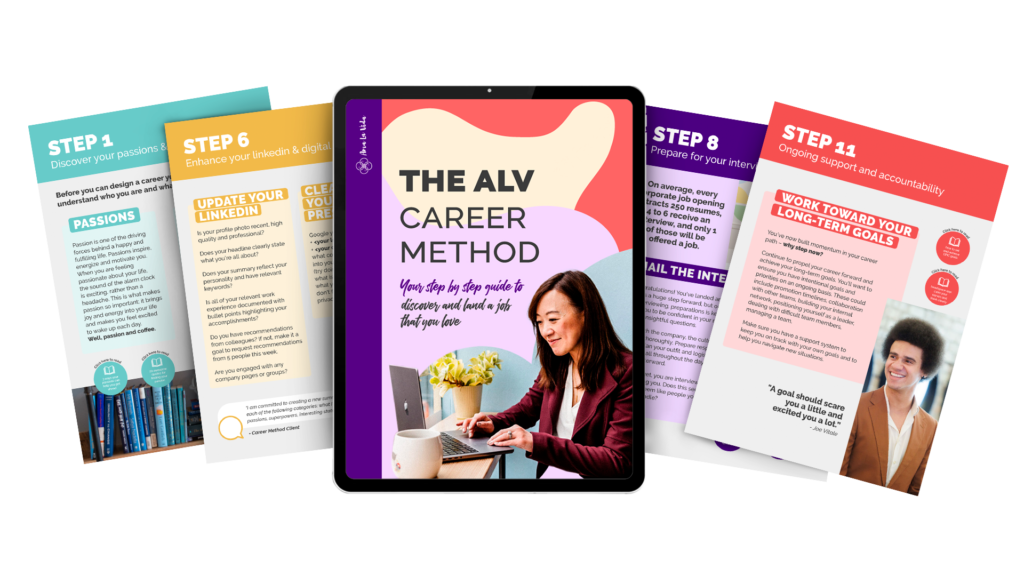
Download our comprehensive step-by-step guide to design and land a job you love!

Images from The ALV Career Method Guide
ALV Method Downloadable Guide

I often describe the coaching industry as the Wild West. No, we aren’t riding around on horses and hanging out in saloons, but it is unregulated, confusing and messy. Regardless of whether or not a person has been formally trained, they can call themselves a career coach. This means that as a consumer, a lot of responsibility falls on you to do your research. You want to ensure you’re investing your dollars in someone qualified who can actually support you. You’re probably wondering what to look for in a career coach? So, when you decide to invest in yourself and hire a career coach, I want to make sure you know exactly what to look for. I will break it all down for you to ensure that you are hiring someone who is not only qualified, but also is the right fit for you and your goals. 1. Make sure a career coach is actually what you want and need.  A career coach can be a great ally to support you in many ways throughout your career. Whether you are navigating a career transition, developing as a leader, or working on collaboration, a career coach can help. Your coach will help you gain clarity, set and achieve goals, make decisions and stay accountable. However, your coach is not there to give you advice or tell you what to do. Coaching is often confused with mentorship and other related disciplines like mentorship or therapy. This graphic pinpoints some of the key differences between career coaching, mentorship and therapy so you can determine if a coach is actually the type of support you are seeking. Therapy is oriented toward the past, helping you understand why you are the way you are. Coaching is future-oriented. Your career coach won’t spend much time digging into your past experiences. There is still certainly a self-awareness component. They want you understand who you are and why, but all with the intention of using that self-awareness for the future.  “Okay, I know these things about myself. How can I create strategies and habits to help me progress toward my career goals given all I’ve learned?” Unlike a mentor, a career coach is not there to offer guidance and advice based on his/her own experiences. Sure, they might occasionally offer a suggestion or two. For the most part, your career coach will ask powerful questions to help you find the right solutions for you. It’s important to note that none of these disciplines are any better or any worse than the others. You simply need to understand the differences and have appropriate expectations for what will be accomplished with each provider. 2. Assess their training, certification and experience. Coaching is based on scientific research, and well-trained coaches utilize evidence-based coaching models with their clients. In order to learn this research and practice these techniques, coaches need to go through an in-depth training program. Unlike therapy, there is very little regulation of the coaching industry. For example, to call yourself a therapist, you legally need to have certain training and hold an official credential. There is no equivalent regulation for coaches. However, there is an organization called the International Coach Federation (ICF). They accredit coach training programs and ensure they meet a certain standard. When you begin meeting with career coaches, ask them which training program they completed and if it is ICF accredited. At Ama La Vida, we only hire coaches who have been through an intensive coach training program; once they join our team, they undergo an additional 3-months of training on our proprietary methodologies and programs. Because coaching is about finding the right solution for each individual and not about giving advice, it is not necessarily important for your career coach to have experience working in your particular industry. It is more important that they have experience coaching people in situations like yours, so it can be helpful to ask about their prior coaching work. For example, we have coaches on our team who coach people through career transitions every day. They know where the challenges usually lie, and they are experts in the job search process. This experience is typically way more valuable than deep knowledge of a particular industry. 3. Evaluate their coaching style. Each career coach coaches differently based on their personality and training. While all well-trained coaches provide structure and accountability, some coaches’ sessions are very organized and agenda-based while others are more open and free flowing. Some coaches tend to be more warm, energetic and supportive while others can be more confronting and really challenge you. Ask your prospective coach how they would describe their style and then think about if that is the type of support you need at this point in your life to achieve your current goals. Think about how you like to receive feedback and collaborate with others and assess if your coach can provide this style of support. Many coaches will provide this information up front somewhere on their website. You can see in our coaches’ bios a section called, “This Is My Coaching Approach.” 4. Ask about their coaching methodologies and tools.  You want your coach to utilize proven coaching methodologies and techniques to ensure your sessions will be effective in helping you achieve your goals. Additionally, you want to ensure their approach resonates with you and fits what you are looking for. Our coaches utilize a variety of tools and techniques based on the coach and the client’s needs. That being said, we have an overarching methodology which we always follow called the ADIT model: Assess, Discover, Implement, Transition. Following this model ensures a consistent customer experience for our clients and provides a framework for our engagements to make them most effective. We also have a specific framework and approach for coaching people through career transitions (which is a particular specialty for us). We take our career transition clients through an approach to help them identify and land the right job for them: When

Read More

You just got to work, and you’ve opened up your calendar to see what’s on the agenda that day. You have four back-to-back one-on-ones and you also have a proposal that is due by the end of the day. What do you do? If you answered “reschedule the one-on-ones with your team” then you’re not alone. Many managers perceive their regular catch-ups with team members as being too frequent and/or less important than the other things on their plate. Research shows that they are wrong. Managers are responsible for 70% of the variance in employee engagement and employees who don’t have regular one-on-one meetings with their manager are four times more likely to be disengaged. We all know the cost of disengagement! On the flip slide, managers that support regular one-on-one meetings see a huge improvement in performance and engagement.  For example, when Adobe moved away from performance reviews and toward biweekly one-on-one catch-ups, they saw a 30% reduction in voluntary turnover. When GE made a similar move, they saw a fivefold productivity increase in twelve months! There is no denying the value of on-on-ones with your team members. But not all one-on-one meetings are created equal. How can you ensure that your one-on-one meetings with your team members are as productive as possible? Here are seven key tips: Have an agenda (that you can both contribute to) Let’s start with the obvious – agendas! Even though it may sound obvious, it’s amazing how often they are neglected. The last thing you want to do is enter a one-on-one meeting (or any meeting for that matter!) with no idea about how you’re going to use the time. To make the one-on-one as productive as possible, ensure to have a shared running agenda where you and your report can add agenda items. It’s important that you’re not writing the agenda and monopolizing the time. This is for them, not you. Make sure they have the ability to add discussion points to the agenda so that you know what they need from you. Applications like Soapbox are great for this as they make meeting preparation quick, easy and, dare I say, even fun. Once you have all of your agenda items, don’t forget to spend a few minutes before the meeting prioritizing your list. Chances are, you won’t get through everything in your time together, so make sure to start with the things that matter most so that they definitely get addressed. Create a safe space It doesn’t matter what you talk about, what questions you ask or what feedback you give if your employees don’t trust you and feel safe. Research shows that high performing teams have one thing in common – psychological safety! Psychological safety is a whole new article in and of itself, but the best way to figure out how to create a safe space for your team members is to think about which managers have created a safe space for you (and which haven’t!). What common themes arise? How do they address challenges? How do they respond to mistakes? Do they encourage or discourage your thoughts and ideas? Think about a manager that you have had that you have trusted, admired and respected. A manager that has made you feel safe and supported. Now write down everything about them that made you feel that way, and do everything in your power to replicate that list.   Don’t lose sight of the bigger picture During one-on-one meetings, it’s easy to get bogged down in the day-to-day tasks and projects. Did that email get sent? Did Client A respond? Where are we with Client B’s proposal? Yes, these things are all important. But don’t lose sight of the bigger picture. What are your direct report’s big goals? What is the team’s vision? How are they (and you) progressing on these? It’s a good idea to carve out time periodically in your one-on-ones to talk big picture as well as time to talk about the day-to-day. In saying that, even when you’re talking about the day-to-day seemingly little things, don’t forget to tie them back to the bigger goals and vision. Engagement is driven by purpose – what is the “why” behind every little task they do? How will their work impact the team and organization? Why is what they are working on important? Vision will help provide them with that “why.” Talk, talk talk. Then act. Meetings are great, but not unless they lead to action. It’s not enough to just assume that miraculous change will result from your one-on-ones with your team. Make sure you help set your team up for success by discussing what comes after your one-on-one. What are their current challenges? Their goals? What are the immediate action steps that need to be taken to overcome those challenges and achieve those goals? Make sure they finish every one-on-one meeting with at least two or three specific action steps and deadlines to complete them. It’s a great idea for you to also walk away with some action steps for either how you can improve as their manager and support their development.   Be A Coach Often times it’s really easy to tell our team what to do. However, when we take time to challenge them to step outside of what they normally would do we can actually see them grow. We can build confidence, develop trust and strengthen the company culture when our team is actively being challenged to grow. Your team will go very far under your leadership, but it’s one of those teach a man to fish scenarios. Let’s equip them to be good leaders as they move into leadership roles in the future. Don’t forget to follow-through and follow-up! Ensure you document the key meetings points and action steps at the end of every catch-up. Ideally, send them to your direct report in an email (or have them manage these and send them to you) or store them in a meeting management

Read More
number 12 hanging on a wall

12 years. 12 years is the average length of time between when individuals are promoted to management, and when they receive their first personalized leadership training. When employees are promoted their responsibilities include managing others, driving goals, engaging and developing their team. Most new managers don’t have any idea how to effectively accomplish any of these tasks. Why do we wait so long to invest in our managers when they are first given this responsibility? That is like helping your kid learn how to ride a bike at 17 years old after they’ve had 12 years on their own to figure it out and develop habits that they thought made sense. Can you image your kid at the age of 5 on their own trying to figure out how to balance, move the pedals, navigate the handles, and understand the right speed? I bet it’s nerve-wracking, chaotic and frightening. That’s similar to what new managers are feeling when they are given this enormous yet exciting responsibility of helping others succeed. Time and time again we see a common set of challenges when a new manager is promoted without appropriate personalized leadership training:  Bad habits set in. Similar to the bike example, Coach Katie warns, ”If you teach yourself to ski (or play tennis or anything else) without proper training, you build bad habits that become hard to break. That becomes your way of doing things. The same is true for managers. It’s easier to build good habits than it is to break bad ones and building good habits requires proper training and development.”  They are lost in their new role. An individual is typically promoted when she is successful in her role as an individual contributor; she has mastered the tactical aspects of her job. Once mastery is achieved, we naturally think it’s time to move on to the next challenge – to enable other people to be high achieving individual contributors towards a collective goal. While this comes with a better title and a pay bump, the newly promoted manager is off to the races trying to understand her new role, redefine what success looks like as a manager, what success looks like for her team, understand how to motivate her team members, along with learning how to have difficult conversations and the list goes on. Coach Teague adds, “New managers who are promoted into this role because they were successful in what they were doing often have zero training in how to actually manage. This can be disastrous!” ALV CEO Nicole experienced this and says, “I was fortunate enough to receive a lot of training on certain managerial topics: how to run a meeting, what to do if you have an HR issue, how to project manage. But I feel like these didn’t end up being the things I struggled with as a new manager like being promoted to lead a group of my former peers who were all older than I was. I wish I had more one-on-one support to navigate those types of situations.” By investing in your new managers in a personalized way, like through coaching, you are not just investing in their personal development – you’re improving the experience of their employees and ultimately impacting your company’s success.  They get frustrated. Newly promoted managers get frustrated and feel like they have been set up to fail because they aren’t excelling when that’s all they are used to. Due to the frustration and lack of training, newly promoted managers negatively impact team morale, the organizational culture and are likely to be a flight risk. Coach Sara says, “Too often companies wait until there is an issue before investing in developing the new manager.” By this time, emotions and conflicts have heightened and it takes more time and money to get back on track. They negatively impact the people around them. When an individual contributor is struggling on the job, it often just impacts their work product. But when a manager is struggling, that means a whole team of people is often impacted. This can be detrimental to the organization’s culture, morale, and team retention. It only takes one under-developed manager to cause turmoil and cost the organization more money than what it would cost to invest in coaching. We wholeheartedly believe that new managers need personalized and in-depth coaching to learn the leadership skills needed to enable themselves, their team, and the organization to run effectively and function highly. New managers need to learn skills beyond how to conduct performance management reviews and run effective meetings. Today, most new managers undergo management training which consists of E-learnings and/or workshops. E-learnings have a completion rate of 13% and one-off workshops are not personal enough or consistent enough to develop good habits. Managers cannot be given one-time E-learning or workshop. They need personalized coaching to understand themselves as a leader and how to utilize their strengths to positively engage their team members. When newly promoted managers are given personalized leadership coaching, it results in:  Feeling supported. In our current workforce, everyone is looking to be developed to be the best they can be. They want to have an impact and enable those around them. When you provide the personal attention and support managers need, they feel supported to succeed in their new role. Coach Ngoc says, “Coaching is a mirror for them to talk through situations and reflect. They might not have that type of outlet or support at work. If people run into challenges, they need to talk through it or else frustration can get pent up, leading to unhealthy behaviors. It’s also a place of no judgment and allows them to work through their challenges instead of being given an answer.” When this happens, there is an increase in confidence and they know they’ve been provided the tools they need to be set up for success in their new role. This leads them to want to do more and go above and beyond for

Read More

“Everybody is a genius. But if you judge a fish by its ability to climb a tree, it will live its whole life believing that it is stupid.” – Albert Einstein Education is one of those seemingly simple but very complex situations. At the root, education is supposed to teach us something. Nowhere in its definition does it specify a place, a style, or a specific way that education is to be facilitated. The education system falls short when we attempt to take a vague definition and impress a closed system upon it. Like most people, I grew up in a broken education system. I was hurt at an early age by a system that told me I was too young to be that smart. It was a system that wanted to dictate my success based on my age, not my ability. It was a system that wanted this fish to climb a tree, not swim the ocean. The education system that I grew up in wasn’t a fan of me. To be successful, I was required to become a people pleaser. I was forced to think inside the box, to move at the speed of the class; I had to become something I wasn’t. This education system robbed me of my passion to learn. It stole my love of reading, and most of all it told me that I didn’t have options. Thankfully for me, I was never good at being told what to do. So, I learned how to operate outside of the box. As my time in high school was coming to a close, I began exploring post-secondary education options. I was terribly uncomfortable with the thought of going to college. I knew that I wouldn’t fit in the system, and I wasn’t sure I wanted to pay hundreds of thousands of dollars to be miserable. So I made a bold choice. I decided to take a gap year. If you’re interested in learning more about gap years and why you should consider them click here. For me, I was already open to exploring other options because of my experience with the education system. I really only had to ask myself one question before I decided to pursue it. – What did I have to lose? Nothing. I was 16, I wasn’t losing anything by taking time off. Check out this article if you’re wondering what you have to lose. After I decided that I wanted to go for it, I needed to make the time useful. I followed up by asking myself these questions which allowed me to really get the most out of it. – What was something in life that I wanted to pursue? For me, it was community involvement. So I got an internship under a lady that handled community involvement and relations at the church I was attending at the time. – What was something I needed to improve on? If we’re being honest, people are hard to handle; but interacting with them is critical in almost every career path, so I got a job that made me interact with people. In classic Randi style, I was looking for a challenge. So, instead of just interacting with them, I got a job as a lifeguard where my responsibilities included learning how to enforce and convey rules to keep people safe. – How was I going to practice creating value? I loved social media, so I also got a job managing social media for a local small business. Not only did it give me a chance to get some great experience, but it also allowed me to take something off the business owner’s plate; it was a win win scenario. I’m sure most of you haven’t had as terrible of an experience with the school system as I did, in which case a gap year could be intimidating. If you want a more in-depth resource, here is an article that gives you a bunch of FAQs about a gap year. To me, a gap year quickly became less about a period in time and more about a lifestyle. After my “year” I made another bold choice. I decided to opt out of college. In this article, Derek Magill states that the future of education is heading towards human-centric learning instead of programs. I couldn’t agree more. Humans are unique. We are created differently, and serving the same system to millions of people is just setting some of them up for failure. The challenge is learning to love yourself enough to be willing to find your ocean, not your tree. Now you may be thinking, “How is this chick doing anything with her life? She needs a degree!” The reality is, college has become such a norm that we have over-engineered the system. I don’t want to be a lawyer, a doctor, or an accountant, career paths which all require a degree. I just want to do work that is purposeful to me. This article really touches on the concept that college isn’t for everyone, and that’s totally okay! Did you know that a lot of very reputable companies no longer require degrees to be considered for employment? We’re not talking small potatoes; we’re talking Google, Apple, Whole Foods, IBM, Nordstrom and a few other big names you’ve probably heard of! I’m sure you’re wondering about whether you can be successful or be taken seriously without a degree. I really recommend checking out this blog post. It expands on 5 really common misconceptions about not going to college. I mean, who wouldn’t want to know how much you can make, or if you can actually find yourself without going to college?!  Maybe a salary goal isn’t what’s holding you back. It’s really the fact that the arguments people in your life make for college are really compelling. Well, this video series breaks some of the most popular arguments and gives you some solid points as to why not going can be more valuable

Read More

Welcome back to our three-part series on the art of working from home. In October’s installment, we focused on how to be productive when working remotely. This month, we’re doing a 180 and speaking to those of you who can’t seem to disconnect when your work day is over. This is an incredibly common issue that gets magnified when there are no clear boundaries between work and home. If you find yourself nodding as you hear that telecommuters often work longer hours than their in-house colleagues, you’re spot on, and this newsletter is for you. Studies show that 45% of Americans check their work email after business hours, and people who are able to successfully unplug from work are more likely to be physically and mentally healthier. Read on for my top three tips I give to clients who can’t seem to shut off when work and home are in the same place. Create a done-with-work ritual. Without a commute, walk to your car, or even a door to close behind you that signals you’re leaving your office, it can be really hard to declare the workday over. To combat this issue, develop a ritual you use every day to mark the end of one part of your day and the beginning of the next. Some people like to change clothes (even if it’s just from one athleisure outfit to another), others will listen to an upbeat song and have a mini dance-party, and still, others take it one step further and literally get outside to have a breath of fresh air. It doesn’t matter what this ritual or routine looks like, as long as it helps you and your brain realize that work is over. Establish a dedicated work area, and only make use of it during work hours. In an ideal world, you’ll have a full office in your home that can remain untouched with the door closed outside of normal business hours. However, that’s rarely possible – and that’s okay! There are still tons of options to create a space that is officially for work only. You might be able to snag a corner in a guest room (or even in your own bedroom), or perhaps you can claim a closet as your office. When I worked from home one day each week out of a 500-square-foot apartment, I would simply take my big file folder out of my work bag and set it on the counter, and mentally declare that my workspace for the day. When the clock hit 5, I closed my laptop and put that file folder away. You might have to get creative with your work-from-home setup, but carving out your own space is so worth it. What’s most important is that you don’t use that space when you’re not actually trying to work. Purposefully disconnect, and let your team know about that plan. When working from home, the boundaries can get blurry. It’s easy to convince yourself to just get started on emails right when your alarm goes off instead of waiting until your normal work hours begin. However, just as most employees in a traditional office setting are expected to do the bulk of their work when they’re in the office, you also are allowed to set those boundaries even though your office is only 10 steps away from your bed. Set clear expectations with your team members and staff to let them know you’re reachable via all means during business hours (you can figure out what exactly that looks like for you) and by phone for emergencies outside of that window. Once you have those guidelines in place, stick to them! This is role modeling appropriate work-life balance and also giving yourself some freedom from being connected. Creating a leaving work routine is a powerful tool whether you work remotely, in an office, or a combination of both. This article has some really great ideas (I loved the Mr. Rogers comparison) to get you started. We can’t wait to hear what you come up with! If you are interested in learning more, here are some of our favorite resources: Folk Rebellion’s Instagram account focuses on “finding freedom, IRL.” Remote Office Tours: A Look Into 10 Home Setups of Remote Workers “It is essential to understand what is important or what is just perceived to be so.” 7 Beautiful Coworking Spaces that Offer Babysitting, Too

Read More

The job search in and of itself is a job! It requires commitment in time and mental efforts. Scheduling your calendar to reflect the job search, connecting with your network, writing emails, drafting your documents to send to possible employers, etc. The time spent nourishing yourself during your efforts to find and secure a job will only add to the process. Today, we’re talking about how to practice self care during job search. Taking care of yourself during the job search is about creating a positive space for the search. Your positive outlook and the time you create for self-care are synonymous. Not having an established self-care practice, you may learn to go without, causing mental or emotional burnout. Having a positive, growth mindset around the job search, you are open to continuous learning and growth. In this case, we’re talking about learning to give yourself attention outside of the job search to connect with YOU. To learn more about strengthening your mental game, ALV Co-Founder Katie Bennett shares the power of the Mind Diet here. Self-Care Tips 1. Define your self-care Self-care looks and feels different for everyone. While the concept of self-care can be incorporated into every aspect of your daily routine, create time within your job search schedule to take mindful breaks. This may be a brief walk outside, surrounding yourself by nature, watching a Ted talk (I really love this one here!), or a one-hour break to read an inspirational book (or a combination of the two – go take your book outside!). This is your time to recharge and stay in a positive headspace during the job search. Additionally, what can you change about your job search routine? Instead of sinking hours and hours behind your computer screen, change your scene while keeping your network in mind: invite a friend to coffee, take some refreshing deep breathes, or meet someone for an informational interview at one of your favorite lunch spots. 2. Seek the truth within and have support around You are the most important part of your job search process. Staying true to yourself during this time will also allow you to stay committed to the job opportunities truly suited for you and your purpose. But you are not in this alone! Keep close to those who know your talents and strengths. Searching, applying, and interviewing for jobs can be long and disheartening at times. You may have moments where you question your self-worth and abilities. You might even forget what you have accomplished. Having people who know what you can do and how you add value will encourage you. They will remind you of all that you have to offer. In my past job searches, I have had a job-hunting accountability partner. This is someone you can turn to when the search is arduous and who also rightfully cheers you on to celebrate victories such as getting a call back from a company for an interview. Leaning on support during this time will keep you committed to your search and may, in fact, encourage you to recognize yourself even more, by focusing on your own strengths and taking ownership of the process. 3. Celebrate your wins! Celebrate your wins, whether big or small! The job search can be draining and at times defeating, so it is important to recognize little wins, whether it be a call back for an interview, or even just your effort and time commitment to the process. Have fun with this! Develop weekly and monthly job search goals and include rewards when reaching those goals. Maybe the weekly goal is to connect and meet with two individuals in your industry. My clients notice that when creating and reaching goals each week, they have increased motivation to stay committed to the process, while also shining a light on how they are showing up for themselves and doing the work, reward included! 4. Collect your thoughts and set intentions Self-care really is about you! You are the witness to your mental, emotional and physical well-being. You know yourself best. Therefore, document your feelings and thoughts around the job search; what is working, what are the challenges and how are these challenges helping you and/or limiting you? Take these thoughts to a journal where you can then also reflect on “3 Good Things” that occurred in that day. This can be related to the job search (you tailored your resume to fit your dream job or you spent 1 hour every day this week researching companies).  Remember that you are defining this process and it will look and feel how you want your job search to look. Ask yourself, “What is my intention today?” It may seem simple, but as you ask yourself this at the beginning of each day, it can help you create more space and compassion for yourself as you dig deeper in this process. 5. Visualize your outcome Get clear on your wants and needs during and after this search. This will help support a positive mindset. I encourage you to visualize what you are looking for in a job and understand what excites you about the industry you are most interested in. It is important to get clear and have a vision-which aligns with the process of taking care of yourself! In order to help you visualize rocking the interview, securing the position, completing the work tasks, and walking into the office, look at these vision board ideas to get started. And while creating this vision, I recommend you listen to this great guided career meditation to imagine all that is possible for your career. “You know yourself best” – my mantra to you as you explore and research job opportunities, network, interview and lean in to the entire process. Meet yourself wherever you are each day, continue to learn from yourself and those in your network, have fun and stay committed to this process. And not only for the job search process, but also having an established self-care practice. My intention is to support you in all ways with your job search, where we can explore how to create a positive space for your job search. If you are ready

Read More