Category: Career Enrichment

woman leading a meeting with colleagues

Engaging in activities for career development can be the key to unlocking your potential and boosting satisfaction at every stage of your career. Whether you’re exploring career paths, aiming for a promotion, or seeking fresh motivation, incorporating intentional development activities is a powerful way to stay on track and grow professionally. In this article, we’ll dive into a variety of practical activities for career development, from fun career exploration activities that allow you to learn about different professions to thought-provoking questions that help you uncover your transferable skills. Whether you’re after new challenges, need clarity in your path, or just want to rediscover your passions, these career development activities will set you on the path to success. Read on to reignite your passion and take tangible steps towards a fulfilling career! What is Career Development? Career development is a dynamic process of exploring and refining your professional path and includes any of the work you do to advance your career: learning a new skill, meeting with a career coach, or researching potential paths. It’s an ongoing journey of continuous growth that aligns your decisions with your career goals. View this post on Instagram A post shared by Ama La Vida | Online Career Coaches (@alvcoaching) As your life circumstances change over time, so do your interests and values. These changes can influence your professional choices, which is why career development is a lifelong process. And because you have different priorities at each point in your career, it can help to team up with a Career Coach to find the right activities and career options for you. Activities for Career Awareness and Exploration Career exploration activities lay the foundation for effective planning and decision making. This work helps you identify the professions and career pathways that are available to you, explore different industries and roles, and consider various potential career alternatives. Why is Career Exploration Important? Career exploration activities allow you to gain valuable insights and awareness to make informed decisions about your career path and future. They can also enrich your professional experience by helping you develop a sense of direction and purpose in your career journey. The activities for career development in this section encourage you to explore different careers, roles, and industries to gain valuable insights into paths aligned with your strengths, interests, and values. Self-Assessments: Discover Your Potential and Build Self-Awareness Jumpstart your self-discovery with a range of assessment tools, whether on your own or in partnership with a career coach. Options range from free tools like the Myers-Briggs Type Indicator (MBTI), The Princeton Review Career Quiz, and O*Net Interest Profiler which help identify transferable skills and narrow down career options, to in-depth assessments available through a certified Ama La Vida career coach. With expert guidance, you can explore assessments that delve into key aspects of your personality, strengths, and leadership potential. These assessments add an extra layer to coaching by providing ideas about different occupations and helping you identify career options that align with your strengths across various industries. Here are a few assessments available through Ama La Vida coaches: CliftonStrengths – Recognize and leverage your core strengths and growth opportunities. This assessment builds confidence in your unique contributions and comes with a personalized report to guide your development. Enneagram – Discover your primary Enneagram type to gain insight into your motivations, worldview, and interpersonal dynamics, enhancing both self-awareness and relational understanding. DiSC – Understand your communication and behavioral styles, helping you build more effective relationships and identify workplace cultures that support your well-being and productivity. Emotionally Intelligent Leadership – Evaluate your emotional intelligence across six key areas to enhance your leadership effectiveness and drive team performance. Mind Map Your Career: Connecting Passions to Professions Career mind mapping is a visual brainstorming activity that allows you to map out your interests, skills, and values in relation to potential career paths. A mind map starts with a central idea—your career aspirations—and branches out into different concepts, such as your passions, strengths, and the industries that resonate with you. This technique not only enhances creativity but also helps organize your thoughts in a structured way. By creating a career mind map, you can gain a clearer understanding of your valuable assets and how they align with various professions. This process encourages you to explore different paths you may not have considered and reveals connections between your personal values and potential positions. As you visualize the links between your skills and industries of interest, you can identify many opportunities that truly excite you. You can use a free tool, like Canva, to create your mind map, empowering you to take ownership of your potential career path. Informational Interviews: Gain Insights from Professionals Informational interviews are an invaluable tool for career exploration, offering you the chance for hands-on research through meaningful conversations with professionals in your field of interest. These discussions can provide insider insights into various roles and industries to clarify specific job functions, industry trends, and the skills required to succeed. View this post on Instagram A post shared by Ama La Vida | Online Career Coaches (@alvcoaching) This process not only helps you gather crucial information but also allows you to build your professional network. You can connect with professionals through platforms like LinkedIn, attend networking events, leverage your school’s alumni network, or engage with contacts from your social or family circles. Expanding your network in this way can uncover hidden opportunities and provide guidance on potential career transitions, making it easier to decide if a new job or going back to school is the right move for you. For a deeper dive into how to prepare for and conduct informational interviews, check out our article, Informational Interviewing: The Hidden Secret of Effective Job Searching. Activities for Career Planning and Goal Setting Once you have an idea of what you want your career to look like, it’s time to consider your long-term career pathway and goals. You can think of career planning as a road map to

Read More


woman looking at computer while writing down notes

The job market has shifted dramatically in recent years, leaving many traditional tips for job searching in the past. Digital transformations, remote work, and the rise of personal online branding have completely changed how we approach finding a new job. In 2025, job seekers need to revamp their tools, strategies, and skills to keep pace with a fast-moving, tech-driven workforce. While some job seekers see these changes as roadblocks, we at Ama La Vida view them as chances to help our clients stand out in a competitive market. Navigating the world of artificial intelligence (AI) and applicant tracking systems (ATS) is now a must, but as Harvard Business Review points out AI will actually create job opportunities, not diminish them. That’s why we’ve pulled together top tips from Ama La Vida’s Career Coaches, who stay on top of the latest trends to help you tackle your job search with confidence. With the right strategy, job hunting doesn’t have to feel like a full-time job! Don’t Do It Alone: Get the Support You Need for Your Job Hunt Before we dive into the Ama La Vida Coaches’ top tips for job searching, let’s take a quick step back. What we know for sure at Ama La Vida is that success with your job search isn’t just about checking tasks off your to-do list—it’s also important to align your job search goals with your values and long-term career path. We know, it’s a lot to consider. If even just opening this article feels overwhelming, or you’ve tried many of the following strategies and still feel stuck, it may be time to seek support. The key to a successful job search is honing in what works best for YOU. View this post on Instagram A post shared by Ama La Vida | Online Career Coaches (@alvcoaching) Ama La Vida Career & Leadership Coach Sophie Leroi sees job hunting as a team sport. She believes that reaching out to others and enlisting their help is a necessity that will make the job search process more efficient, less frustrating, and more enjoyable. Some tips from Sophie: So if you’re feeling stuck, unmotivated, or overwhelmed, don’t go at it alone. Book a call with Ama La Vida to find out how our Career Coaches can help make your journey more strategic, supportive, and successful. Outdated Tips for Job Searching That Don’t Apply Anymore Modern hiring practices are reshaping how candidates get noticed, and some old-school strategies just don’t cut it anymore. Let’s take a look at some familiar advice that may have been effective in the past, but today might actually be working against you. “Finding a job is a numbers game.” Flooding the job market with your resume in hopes of landing a job rarely works. Resume spamming with generic applications is a surefire way to land your materials in the “no-pile.” View this post on Instagram A post shared by Ama La Vida | Online Career Coaches (@alvcoaching) Most employers are using automated systems to scan applications, which means quality over quantity—so personalize your applications, research the company, and reach out to recruiters and hiring managers directly. It’s about standing out, not blending in. “All job openings can be found online.” While it’s true that many open jobs are posted online, relying solely on applications through job boards could be holding you back. In 2025, a successful job search will require a multi-faceted approach—networking, building relationships, and attending industry events are just as important as browsing online listings. Many positions are filled through connections, not postings. “One resume fits all.” Gone are the days of using a one-size-fits-all resume to sell your experience. With many organizations using AI-driven applicant tracking systems (ATS) to screen resumes before they ever reach a human, it’s essential to customize your resume for each position. You’ll need to fine-tune your experience to highlight the specific skills and keywords in the job listings to increase the chances your application materials will pass the initial screening and get in front of the hiring manager. “Strong application materials are the most important part of your job search.” While important, your resume and cover letter are just one piece of the puzzle. In today’s job market, your online presence—a robust LinkedIn profile, personal website, or portfolio—can be just as significant. Many recruiters use LinkedIn to source candidates before job openings are even made public, and some roles allow you to apply using just your LinkedIn profile. This all ties into the multi-faceted approach we mentioned earlier, ensuring you’re visible and accessible in all the right places. “You need to meet 100% of the job requirements to apply.” Think you need to meet every single qualification listed before you apply? This common myth holds many job seekers back from throwing their hat in the ring for positions they’re qualified for. Job postings often outline the skills and experience of their ideal candidate, but this list is not necessarily the minimum requirements. If you meet most of the core qualifications and have relevant experience, apply! Use your cover letter to showcase how your unique skills can bring value to the position. “Wait until you’re ready to leave before job hunting.” As Ama La Vida Leadership & Career Coach, Jen Maynard puts it, “One of the best career moves is to start searching for your next role while you’re still employed and not urgently needing a change. Most job seekers wait until they’re desperate to leave or have already lost a job, which can lead to rushed decisions or missed opportunities. By starting early, you can explore job opportunities thoughtfully, network strategically, and tailor your resume to each position without the pressure of needing immediate results.” View this post on Instagram A post shared by Ama La Vida | Online Career Coaches (@alvcoaching) Being proactive in your job search allows you to be more selective, focusing on finding the right fit for your skills, values, and goals. It also positions you to stay ahead of

Read More
young professionals talking at a coffee shop

“Networking” often brings to mind stuffy suits, formal events, and exchanging business cards like candy. But what if it didn’t have to be this way? Here at Ama La Vida we like to embrace creative networking strategies that involve thinking outside the box to make building connections more enjoyable and effective! In today’s career landscape, networking is an essential part of job searching and career growth. Gone are the days of submitting mass applications and waiting for opportunities to come knocking. Modern professionals are shifting their approach, realizing that building genuine connections is often more valuable than sending out dozens of resumes. By cultivating relationships, you create a network that supports your growth and opens doors to unexpected opportunities. What is Networking, Really, Anyway? Networking doesn’t have to fit into a traditional mold. Think of it as simply getting to know and connecting with others. Whether chatting at a coffee shop, attending a meetup, or sparking a conversation online, you’re networking. View this post on Instagram A post shared by Ama La Vida | Online Career Coaches (@alvcoaching) It’s not about wearing a suit or handing out business cards at a formal event—it’s about building genuine relationships wherever you are. By shifting your mindset and embracing the spontaneity of connection, you take the pressure off and make networking a natural, enjoyable part of your everyday life. Shift Your Mindset: Get Excited About Networking, Not Psyched Out When it comes to networking, many people feel anxious or overwhelmed. But by shifting your mindset, you can turn it into an enjoyable experience rather than a stressful obligation. Instead of focusing on gaining something right away, focus on building and strengthening relationships. View this post on Instagram A post shared by Ama La Vida | Online Career Coaches (@alvcoaching) Shifting your perspective can make networking more exciting and less daunting. By focusing on building genuine relationships rather than advancing your career, you create opportunities that foster both personal and business growth. Remove the pressure and enjoy the process of meeting new people in a way that feels natural and fulfilling. The more relaxed and authentic you are, the more likely you are to build meaningful and lasting connections. The Power of Creative Networking Creative networking allows you to connect with like-minded individuals who share your passions, making the process feel more personal and engaging. By showing enthusiasm and a genuine desire to learn more about others, you position yourself as someone people want to engage with. Wouldn’t it be great if networking felt less transactional and more authentic? When you think outside the box, you stand out from the crowd and form meaningful relationships that can lead to new opportunities, increasing your chances of accessing the hidden job market. In fact, according to CNBC, 70% of all jobs are even published publicly and as much as 80% of jobs are filled through connections. Unconventional Networking Events Traditional events like happy hours or professional workshops can be valuable, but they’re not the only way to network. Exploring unconventional settings may make it easier to build relationships in a more relaxed and fun environment. Here are some creative networking opportunities to consider: You could even start your own group where participants can connect around similar interests. When you’re part of a group that shares your passions, the conversation flows naturally, and meaningful connections are much easier to form. Being proactive in creating these spaces gives you the chance to interact on a personal level and foster collaborations that extend beyond the event itself. Remember, the goal of networking is to meet people who share your interests and passions. By stepping outside your comfort zone, you’ll cultivate a network that feels more authentic and aligned with your personal and professional goals. Leverage Social Media with Creative Networking Skills Social media platforms offer a wealth of opportunities for creative networking. In today’s digital world, networking is no longer confined to in-person events. LinkedIn, Twitter, Instagram, and Facebook offer spaces to build and nurture relationships globally. Leveraging social media for networking enables you to connect with more people in your field, maintain those connections, create more opportunities for yourself, and foster growth in your career. Here are some ways to creatively network through social media: Through social media, you can maintain and grow your networks by regularly interacting with your connections. Sharing articles, commenting on posts, or engaging in group discussions helps keep your relationships active and strengthens your professional ties. Creative Networking Tips for Introverts For introverts, networking can feel overwhelming and draining. However, there are creative ways to make it more comfortable. The key is to find environments and approaches that feel less intimidating. View this post on Instagram A post shared by Ama La Vida | Online Career Coaches (@alvcoaching) Here are a few creative networking strategies that work well for introverts: Another great tip for introverts is to prepare thoughtful conversation starters before attending a networking event. A well-thought-out question or comment can instantly break the ice and lead to flowing conversations. Stand Out with a Creative Introduction or Conversation Starter Your introduction is your first impression, and a creative one can make a lasting impact. Whether you’re meeting someone in person or online, having a unique introduction will help you stand out from the crowd. The point is to engage others in a way that showcases your personality and expertise, making connections that can expand your network and open up new opportunities. Here are some ideas for making a memorable first impression: A memorable introduction isn’t just about impressing people; it’s about connecting with those who share your interests. Follow Up with Flair: The Art of the Creative Follow-Up After a networking event, the follow-up is crucial to solidifying new connections. A well-crafted follow-up message can help you stand out and keep the relationship alive. Here are some creative ways to follow up: Maintaining and nurturing your network takes time and effort, but with creative follow-up methods, you can build lasting relationships

Read More
woman looking at computer writing down notes in her journal

Most of us entered the workforce thinking that just putting our heads down and doing the work would get us noticed and promoted. Fast forward a few years, we find ourselves in a work environment that is not inspiring, fulfilling, or (even worse) meeting our financial needs! The Big Lie about career success Even though times are changing, many companies are still not explicitly encouraging employees to be proactive in taking ownership of your career at work. The reality is, as an employee, it is no one’s job but your own to ensure your needs are met. The key to finding success in your career is letting go of the idea that someone is coming in to save you. Yes, there are employees who get lucky with wonderful bosses who support and advocate for them. But the reality is, if you’re waiting for the perfect manager, you’re putting your fate in someone else’s hands. Whether you’re seeking a leadership role, looking for more autonomy, hoping to work on a dream project, or maybe even just looking for a better work-life balance, taking ownership for your own success at work is crucial. By taking ownership of your own career progression, you can break out of this cycle and create real change. Why is taking ownership of your career path important? The reality is, if you’re leaving your fate in the hands of a manager, you’re at risk. You might not get the promotion you’ve been working toward for years. You might get laid off with no prospects on the horizon (as so many job seekers are experiencing these days!). You might just end up hating your job with no way out. So many employees think this is the only way to move through their careers, but the reality is you can take ownership of your work experience, and at the end of the day, you are the only one with responsibility for your own success. By taking ownership of your work, you can become accountable for achieving your career goals and also potentially instigate change within the culture of your organization. What ownership looks like at work Taking ownership at work goes beyond just managing your projects proactively and problem-solving effectively. Instead, when you have true ownership of your full career you have options and control over your work-life, rather than feeling stuck if your job goes south (or away!). To take ownership is to know: And then setting goals and systems to move you in the direction of those things. So, how do you take ownership of your career? It can seem overwhelming, but taking ownership of your career is absolutely possible. With the right strategies, you can take control of your professional life. Here are five steps you can take to assume responsibility for your work trajectory and build a job you love. 1. Craft your career vision The very first step to taking ownership of your career is to define what success would look like for you. View this post on Instagram A post shared by Ama La Vida | Online Career Coaches (@alvcoaching) Remember that work is a resource to serve your life, not the other way around. Having a clear perspective on what success means to you is the foundation for setting professional goals that align with your personal values and ambitions. Consider the bigger picture, think beyond just your job title or salary, and instead consider the impact you want to have on your industry, your community, or even the world. Set aside time to develop a sense of what matters most to you in life, how you want to contribute, and what you want to achieve. Then write it down. 2. Create alignment between your behavior and your vision Once you have a clear understanding of your personal vision for success, the next step is to bring your job into alignment with your goals. Here are a few ways to bring your job into alignment with where you’re going: Job crafting Even if your current job role doesn’t necessarily match your dream, it doesn’t mean you need to quit. Consider job crafting, where you and your manager redesign your job responsibilities to better align with your strengths and interests. It’s true—bringing your job into alignment with your vision for success will require good communication with your manager, and even your teammates or direct reports. While it’s important to be respectful of company goals and culture, you can also discuss how gaining additional experience in certain areas can benefit both you and the organization. This might include new projects, new job roles, and (hopefully!) more growth opportunities for you! Many companies are excited at the prospect of employees taking ownership at work because it often means that their employees feel empowered and will do great work, rather than just the bare minimum. Setting boundaries Too often we see employees who are burned out, miserable and deeply frustrated with their company culture—only to realize that they are part of the problem! This isn’t to take accountability away from a bad boss or toxic workplace, but setting boundaries can go a long way. View this post on Instagram A post shared by Ama La Vida | Online Career Coaches (@alvcoaching) Setting boundaries is about establishing clear guidelines for how you want to be treated, when and how you’re willing to work or what tasks you are willing to take on—and establishing how you will enforce them. If you’re establishing new boundaries, it’s important to communicate these to your manager to get buy-in and ask for support in maintaining them. By having open and honest communication with your manager, you can work together to find a solution that meets both your needs and the company’s goals. Honoring your own boundaries is essential to avoid burnout and ensure that you are making progress toward your bigger-picture goals. 3. Show up (authentically) as your personal brand As you bring your current job into alignment with the long-term vision for

Read More
Woman reflecting on career

Yes, you can leave a “good” job.  But I bet anytime you’ve expressed a desire to do so you’ve heard something to the tune of, “Oh, it would be a shame to leave such a cushy salary!” Or maybe it was, “Why would you willingly leave such a great company?!?” And then there’s my personal favorite, “Do you know how many people would kill to have that job?” Although those in our personal circles mean well, their responses are almost always based on their own experiences and perceived circumstances and not our best interests. They often can’t see past their own needs (and baggage—hello scarcity mindset!) long enough to understand our reasons for seeking different pastures. So yes, you can leave a job that others might call “good.” Here are nine reasons you may want to leave your current position, no matter how “good” that job may be. Reason 1: You achieved the goals you envisioned at your job Since the day you started your current job you’ve been laser-focused on your growth and development: You’ve been quite the busy bee!  Although there is almost always more you accomplish in any given role or company, only YOU can decide when you’ve done all you wanted to do. Reason 2: You were promoted but this new job isn’t part of your career plan anymore Congratulations! You worked hard, earned the leadership team’s respect, and have crossed the finish line into a promotion milestone.  Well done, you! But what happens when the role on the other side of the promotion celebration no longer aligns with the new career plan that’s slowly taking shape in your mind? Perhaps the responsibilities of the new role uncover a shift in your interests. Here’s an example from a friend that comes to mind: I checked in recently with a friend about a promotion they received three months ago. Me: “How’s the new job going?” Friend: “Eh, okay.” Me: “Just okay?  What’s going on?” Friend: “I miss the projects I got to work on as an individual contributor and am starting to feel like by taking this promotion I’ve strayed a bit from what I ultimately want to do long term.” Or, what if the new role shines the light on a burning professional passion you didn’t know existed? I’m going to draw from my own personal experience here.  When I was promoted to manager while working for one of the Big 4 consulting firms, one of my new responsibilities was to take on a small roster of coachees. I immediately fell in love with that part of my role! Although I didn’t fully realize it at the time, it utilized my key strengths, fueled my passions, and was in direct alignment with all of my top values. I also sought out some of the firm’s in-house leadership coaches and noticed that (in addition to being incredible human beings), they were all so fulfilled and satisfied with their jobs and put forth a constant aura of inner peace. It inspired me to reconsider my definition of success for myself. Cut to me recrafting my career plan, taking a step down to senior associate in order to work on programs that put me in close proximity to the firm’s coaching team (and taking an $8k salary cut to do so) and enrolling in an accredited Coach Training Program that helped me step into my dream job. If a promotion isn’t aligning with your new career goals, and stepping back into another role isn’t an option (or a desire), then it might be time to move on. Reason 3: You lack enthusiasm and dread Monday morning Ah, the Sunday Scaries. Who among us hasn’t fallen victim to their depressing grip. But there’s a difference between a rough patch or dreading a work week that promises too much, versus one that’s threatening not enough. That feeling of not enough might be rooted in boredom, or a lack of enthusiasm for what you’re doing. You might even just say you’re feeling “stuck” at work. Here are a few questions to ask yourself to gauge your lack of interest or excitement for the work: If your answers to the above do not elicit any full steam ahead excitement or enthusiastic energy there’s a possibility that the work is no longer enough for you, and it might be time look for a new position, new industry, or other new opportunities where you can tackle a new set of great things. And speaking of not enough… Reason 4: You have outgrown opportunities Most companies offer ample opportunities for growth and development. But what if you’ve already grown and developed in the areas within the opportunities being offered from your current employer? I’m currently working with a client who has been offered two new roles within their company, one of which would be a promotion. As we talked through each of the options I noticed they seemed less than enthused about either of them, despite wanting desperately to do something different. Me: “What are your honest thoughts about each of these roles? And, which of the roles do you have the most energy around?” Client: “That’s the problem, I don’t have any strong thoughts or energy around either of them.” Me: “Okay, tell me what’s behind that?” Client: “There’s nothing wrong with them, it’s just that I’ve done all this already.” Although both roles would be in new cities, working with different clients, and focusing on a different set of issues, for my client it was just more of the same. In short, there was no challenge for my client in either role. After sifting through all the fine points together, the choice to start a job search for their next career move became increasingly clear. Reason 5: The culture no longer aligns with your values It’s not just lack of opportunity or enthusiasm for the work that causes us to contemplate heading for the door. A company’s culture, values, and leaders play a significant role when it comes to,

Read More
woman typing on laptop at a cafe

In today’s dynamic and ever-evolving job market, the traditional notion of meticulously planning every step of your career journey and executing it flawlessly is becoming increasingly unrealistic. Instead, a more flexible and adaptive approach is necessary. This article explores the essential elements of career strategy—career goals, career paths, and career plans—and how to strategically navigate them to achieve career success. Creating a Career Strategy: Taking Ownership of Your Career Taking ownership of your career and consciously designing your life starts with creating a comprehensive strategy. This strategy comprises three key components: career goals, career paths, and career plans. Understanding and effectively leveraging these components will help you navigate the complexities of your professional development journey. What is the Difference Between Career Goals, Career Paths, and Career Plans? To build a successful career strategy, it’s important to understand the distinctions and interconnections between career goals, career paths, and career plans. Each plays a crucial role in your professional journey but serves different purposes. Career Goal: Imagine Your Future A career goal is about describing the strategic playing field for your desired career and the role you want to play within it. It answers the fundamental question: What do you want to do? Naming your goal involves identifying the industry or domain you wish to work in and the specific position or function you aim to achieve. Your career goal sets the direction and provides a clear target for your efforts. Here are a few examples of career goals to get you started: Take some time to reflect on your desired career future and clarify what you want. Career Path Definition A career path is about developing a sequence of career actions that you believe will get you from where you are to where you want to be in your professional life—your goal. Your career path acknowledges that there can be multiple ways to reach your long-term goals and involves mapping out possible routes to achieve them. A career path provides a framework for your professional journey. Here are some examples of career paths based on the goals we’re exploring: Career Plan Definition A career plan is about how you are going to move to the next step, and subsequent steps, of the path. It involves making strategic choices in your professional development about how to get from where you are to where you want to be. This part is about taking your long-term career goals and translating them into short-term goals. Making your career plan includes selecting which path to follow out of the potential options and detailing the specific actions you will take to progress. Your career plan outlines the tactical steps needed to achieve your career path and, ultimately, your career goal. Here are what career plans might look like for each of our scenarios: The Importance of Ongoing Research and Adaptability When you create a goal and a path, it’s based on what you know today. However, the information you have could be outdated, incomplete, or inaccurate. This is why your plan has to include ongoing research and adaptation. Making the most of resources like working with a career coach, conducting online research, and talking to people who work in the career fields that interest you are crucial steps. Conducting Ongoing Research Your career goal will have helped you create a path and a plan. The plan should help you refine your path, and it might lead to changing your goal if you find out that what you are aiming for isn’t what you thought it was. Stay open minded – maybe your dream career is something you’ve never heard of before! Strategy: The Foundation of Adaptable Planning What we’re talking about here ultimately is having a career strategy. Strategy is a framework for guiding your efforts to create outcomes in an uncertain and ever-changing world. It’s about making informed choices, exploring different career paths, and being adaptable. Developing your career strategy involves several key components, such as setting long-term career goals, identifying clear career objectives, and progressively taking on more responsibility. By focusing on these elements, you can navigate your career with intention and flexibility. Picking a Career Playing Field: Determine the Industry or Domain You Want to Explore Choosing a career field means identifying the broad area or industry where you want to build your career. This decision lays the groundwork for all your subsequent career advancement choices and actions. Here are some steps you can use to get a better idea of which career path is right for you: Identifying Key Beliefs: Understand What You Believe About Success in That Field, Which Shapes Your Career Goals Identifying your key beliefs about success in your chosen field helps shape your career goals and sets the direction for your professional journey. This involves: Considering Choices: Make Strategic Decisions on How to Start and Progress in Your Career Path Once you’ve identified your career goals and the field you want to explore, it’s time to make strategic decisions about how to start and progress on your career path today. This involves: Searching for the Next Step: Develop a Plan for Continuously Searching for and Identifying the Next Steps in Your Career Journey A successful career strategy involves continuously searching for and identifying the next steps in your professional and personal development journey. This process requires an adaptable mindset and a commitment to ongoing learning and growth: Conclusion Whether you’re looking to change careers, get a new job, or work toward a pay raise or leadership position, having these tools available can help with your goal-setting process and project management of your career. It’s important to remember that the key to a successful career is not just in meticulous planning, but doing enough thinking about your goals and path in order to create a plan—and then taking action! The point of creating the plan is to get you out there so you can gain experience and learn what you need to learn to update your thinking. It’s a

Read More

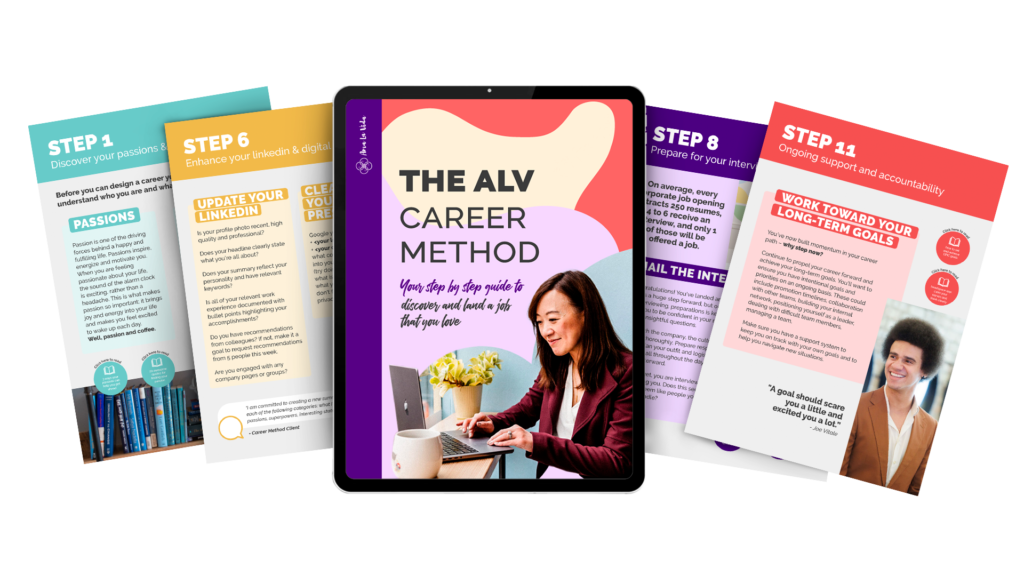
Download our comprehensive step-by-step guide to design and land a job you love!

Images from The ALV Career Method Guide
ALV Method Downloadable Guide

revitalize your career

Rip off the band-aid, make a clean break, and dump the old you! It’s time to give your career the fresh new style it deserves. Today, we’re going to share the tactics you need to put in place to help you revitalize your career! There’s a lot of benefit to doing a “complete makeover” when it comes to the job hunt. Whether you’re just looking for a new role or promotion or pivoting into a whole new career field, you want to do more than just what you did last time. Things change, and the job market is a dynamic place. The job you want now might not have existed five years ago. The job market has trends that ebb and flow, and you don’t want your profile to look like the equivalent of a 1980’s prom picture. You want to demonstrate that you’ve kept up with new skills, workplace trends, and relevant information. Revitalize Your Career My clients will tell you that I’m fond of dating and relationship analogies in career coaching. I think there are a lot of informative parallels to be drawn between an interview and a first date. And I think leaving a job to find a better one shares a lot of similarities with a post-breakup power surge. Have you or someone you know ever gotten out of a long relationship and realized that it was time to totally upgrade? New haircut, new wardrobe, new profile picture on your social media accounts. Rearrange the furniture in your apartment, or even get a new one! And use those things as inspiration to really re-examine what you truly want. The job hunt is just like that. If you’ve been away from the job market for a while, there are definitely changes you want to make in order to be a commodity again. Even if you’ve kept your job-relevant skills sharp and updated while working, you probably haven’t been paying much attention to your job-seeking skills. When was the last time you dusted off that resume? Went on an interview? Used LinkedIn? A quick pass over your resume to add your most recent job isn’t enough. That’s what you did last time, and if there is a saying I truly believe in, it’s this: “The things you did to get you to this step won’t be the things you need to get you to the next one.” If you want more, you’ll have to do more! It’s time for a total career rebrand So what does it look like to revitalize your career, or give yourself a “career makeover?” Like any rebranding effort, it has to be a complete and concerted effort. A new resume that points to the same old LinkedIn profile with work histories that don’t match won’t win you any points. Trendy buzzwords appearing only on the most recent role on your resume won’t help while the second page still lists “MS Word” as a core competency. And the way you communicate verbally has to match what you’ve written. In other words, the message across all channels must be consistent. Whether a potential employer first learns about you via LinkedIn networking, receiving a formal application, or meeting you in a coffee shop, they have to get the same impression. Just like with a company, consistent messaging is important.  In a way, you are a company!  Think of potential employers like they’re your potential customers, and you want to make sure all the marketing for “You, Inc.” sends the message you want it to send. Step 1: Your Resume What is a resume? It seems like a silly question to ask, and yet I talk to a surprising number of people who have no idea what a resume is for. Many people fall into the trap of thinking that a resume is meant to be an autobiography. That it’s supposed to tell the “complete history of you” and be so compelling that it gets you a job. It’s neither of those things. It can’t be an autobiography and it can’t get you a job. However, it can be a fantastic marketing flyer and it can get you a phone call. It should do both, in fact! A resume’s function is to give an overview of you; an impression. In the same way that the commercial for Cheerios doesn’t list their ingredients. It tells you about how good you’ll feel eating them—that’s what you want a resume to do. You want your resume to be like a flyer or advertisement, telling people you’re the right person for them and inviting them to learn more in order to see why. This task is tougher than it seems, and that’s why it can’t be done by simply adding a new line for your most recent job title. Each role you add increases the complexity of your resume, and more complex resumes are less effective. Conveying the total impression of you in a simple and effective manner is an art form and is the first step to helping you revitalize your career. Step 2: Your Online Presence One of the best ways to progress your own career is to open yourself to new possibilities. You never know what career success awaits you, and if the only thing you do is sit in your current role, you never will. We live in an age of information. There was a time when a company received your resume, perhaps called your references, and that was the only way they could learn about your accomplishments, responsibilities, talents, interests and skills. Now, potential employers have a vast wealth of information about you at their disposal. Some people are afraid of that, but you shouldn’t be—you should love it! Remember, you’re like a company or brand advertising to customers. What company says to themselves, “Gee, I hope there’s no information about us online for people to find?” Companies want there to be an absolute flood of information about them online, and so do you! You just want that information to all be carrying the proper message, which is “Hire Me!” That means doing

Read More
Woman sitting at desk thinking

Changing Careers When You Don’t Know What You Want Not knowing what job or career you want is typical. At some point in their life, most people find themselves at this crossroads, feeling stuck, discouraged, and saying, “I want to do something different, but I just don’t know what that is.” It’s OK to feel this way, you’re not alone. This moment is an opportunity to clarify your why, sharpen your observation skills, heighten your curiosity, and start experimenting. You don’t need to be in a dead end job, sacrificing your health or relationships or completely burned out to want to make a career change. Instead, actually, it is much better to start when you’re just beginning to feel the call for your next career move. Here are some practical steps to get you started as you get ready to change careers. Exploration Preparation for a Career Change First, relax your shoulders, breathe, and release any tension and pressure related to identifying what you want. Oftentimes, we put so much pressure on ourselves to have the answer, know the next steps, and achieve that next goal. Ironically, easing up and stressing less about finding the answer often leads us to it. Then, try replacing “work” or “career” with the word “contribution.” This small change can shift your perspective, expand possibilities, and ease any feelings of overwhelm. The truth is: we often know what we want. The challenge could be: Taking the time to explore who you are now in your professional life, understand what may be holding you back, identify what you need to thrive in your next career path, and clarify what you want is crucial! Curiosities, Interests, Preferences, Strengths How many times have we all heard, “Follow your passion and you’ll never work a day in your life?” If you’re like me, it’s a lot! Has this advice worked for some? Absolutely! Does this advice work for everyone? No! If the pressure to “do what you love,” “follow your passion,” or “follow your purpose” causes serious anxiety, you’re not alone. Create a list As a first step, start by creating a list of what you’re curious about, what you’re interested in, your preferences, times when you enjoyed what you were doing, situations where you feel appreciated, and what you’re good at (strengths). Sometimes, seeking out a so-called “dream job” is just too overwhelming. When you shift to simpler questions, the insights become easier. During this self-reflection, you can also include topics you’re interested in reading and listening to in your spare time. And, don’t forget to add what you’re drawn to when browsing social media, videos, streaming services, etc. This may be a great place to begin exploring. Free yourself of the limitations of your previous experience, and perhaps any limitations and assumptions (for now) around money, ability, or any other details that might hold you back from considering them. This is just about you and what you’re interested in exploring. Review and Assess Now, carefully review your list and honestly assess your curiosities, interests, preferences, and strengths. Consider if each aligns with what is valued in the marketplace. Write down your answers to the following ten questions: “How can I be useful, of what service can I be? There is something inside me, what can it be?” Vincent Van Gogh I Still Don’t Know What Career I Want, Now What? Dig deeper into a career reflection with our free Career Method Guide. Take a Career Assessment Career assessments or career aptitude tests focus on a variety of areas and are designed to help you identify a path that aligns with your curiosities, interests, preferences, and strengths. They go beyond personality type are designed to help you uncover jobs you may not have considered. Many people like the idea of career assessments because they seem so scientific. We do caution, though, that these tools are wonderful to help you find jobs you may not have considered, but they are not magic. No one, especially an online course or tool, can know you as well as you do! Trust your instincts about yourself and which career paths are right for you. That being said, an assessment is a wonderful place to start when you feel stuck. Explore one or more of the following to get started. Explore What’s Holding You Back Maybe you’re hesitant to pursue what you truly want due to external pressures from well-meaning loved ones, friends, or respected colleagues, or internal pressures like fear. Laurence G. Boldt in his book, Zen, and the Art of Making A Living, suggests that there are “’reasons’ why you might not want to know what your life’s work is.” He lists nine ways fear can show up that may be holding you hostage: Do one, two or more of these ring true for you? “Action is the antidote to fear. If you want to play the game, you have to act.” Diane Windingland It’s time to step out of paralysis and into action. Dive into learning and experimenting until you uncover what’s next. I’ve included a few ideas below. Take Advantage of Volunteer Opportunities Volunteering is a great way to explore new career paths without the same commitment of a full time job. Through volunteer work, you can also acquire and hone relevant new skills, and build relationships with professionals and organizations in different fields. Explore sites like GreatNonprofits.org and VolunteerMatch.org for suggestions and immediately available volunteer opportunities. Conduct Informational Interviews Wondering what it’s really like to work in an industry you’re curious about? Talk to people who are in your target role to get an idea of their background, day-to-day experience, and advice on getting into the industry. Their real life experience can save you a lot of time as you explore! How to do to an informational interview Tip #1: Tap into your network and identify several people who are engaged in work that you think you might be interested in. Tip #2: Whether directly or indirectly

Read More
Woman writing on sticky notes on window

Changing careers can feel overwhelming. Whether you’re considering a career change for personal growth or new opportunities, you might ask yourself if returning to school is necessary for your career shift. The answer isn’t always a simple yes or no. The fact is, you can change careers without going back to school. It’s important to assess the shifting job market, explore non-degree alternatives, and carefully weigh your options before making a decision. First, let’s explore some factors to consider: What Education is Necessary vs. Beneficial When you’re considering whether going back to school is the right career choice, it’s essential to consider if it is truly necessary or even beneficial for your career goals. View this post on Instagram A post shared by Ama La Vida | Online Career Coaches (@alvcoaching) For example, in some fields like accounting, finance, architecture, education, engineering, healthcare, law, research science, psychology, and counseling, specific degrees are often required for entry-level jobs, according to the (Bureau of Labor Statistics). If the job you want requires a solid understanding of core concepts, a degree program can provide that critical foundation. Gather Information About New Careers A great first step is to look at a job description for roles to understand the specific skills and qualifications employers seek. This will help you determine if additional education or certifications are necessary. If you aim for a career change with higher salary potential, remember that degrees often lead to higher-paying jobs. Research salary data for your target careers, both with and without more education. Remember: although a college degree is valuable, it is not always mandatory to change careers. Many exciting and lucrative careers are accessible without a traditional four-year or two-year degree. Make sure to consider options like community college or even completing coursework as part of your high school diploma. Understanding the requirements and benefits can guide you in making an informed decision about further education. Self-Discovery and Goals When you think about a new job, it can be easy get caught up thinking about career paths that you’ve heard are secure, pay well, or have great benefits. Maybe they even just seem glamorous to you. These are all good reasons to consider your career options, but before you go down that path, make sure to take into account what’s most important to you. If there are things you don’t like about your current job, what do you hope to find when you switch careers? These might be things like more autonomy, a new challenge, or more flexibility. Exploring what you truly want and value most is crucial when considering your next career move. The fact is, even the best paying job won’t always make you happy if it doesn’t match your own needs, interests and values. Consider what kind of work environment you are seeking. Do you crave the fast pace of a startup, the closer work environment of a small to mid-sized company, or the stability of a large corporation? If you have obligations outside of work, like taking care of family members, or even just want more flexibility, some work environments are more conducive to that than others. There is no right or wrong answer to any of these questions. Instead, it’s about what matters most for your life. Get practical about your new career. Think about your salary expectations. Certain careers offer higher earning potential, which might influence your decision. Will your future salary cover your investment into a new career? Additionally, how much time and money can you realistically invest in earning a new degree? Be sure your expectations align with your goals and current life situation. You can use online resources like the Bureau of Labor Statistics Occupational Outlook Handbook to research potential careers with promising growth and salary potential. Also, connect with professionals working in your desired field on platforms like LinkedIn or at networking events. Well-planned informational interviews can provide valuable insights into the daily aspects of a job. By aligning your career goals with your values and resources, you can create a clear path toward your career of choice. Now, let’s explore some alternatives. Skills-Based Careers There are many interesting and high-paying careers that don’t need a degree or prior experience. Fields such as web development, digital marketing, graphic design, or project management are worth considering. Switching to these careers may not happen overnight, but with a focus on transferable skills and some training and study on your own time, it’s very possible! You can look up labor statistics to explore which industries have the best job outlook, meaning they’re growing and have a larger number of open roles. Think outside the box. Many jobs in the trades have excellent prospects and do not require you go back to school. For example, jobs associated with wind turbines grew 45% in 2022. With the increasing presence of AI in the workplace, many view the jobs in the trades as more secure. For the average worker, this prospect can be very appealing for a career transition. If you’re going to change jobs, it’s good to know that role is in high demand! Here are a few other places to start. Look into skill development programs offered by community colleges or non-profit organizations, which provide targeted training without the commitment of a degree program. Become a web developer by learning in-demand programming languages like Python or JavaScript through boot camps and online courses. Master online advertising and social media marketing with courses and certifications offered by platforms like LinkedIn Learning, Google or Facebook. Or, develop your creative skills in graphic design software like Adobe Photoshop and Illustrator through online tutorials and certificate programs. By focusing on skill-based careers, you can build your resume in your free time and build a rewarding career without the need for grad school or even any other higher education. Grow at Your Current Company Most people assume that to switch careers or move to a different career path you need a completely new job. It’s

Read More
Woman talking to another woman near a window

“What I’d really love to do is X, but to do so I’d have to take a pay cut…so forget it” If I had $1 for every time I’ve heard that statement from a client, friend, or family member, I’d be typing this from a yacht in the South of France. Yes, there might be instances where making a career change or changing jobs does necessitate taking a pay cut. But before you start rationing your fancy wrinkle cream in sacrifice to your new career, let’s look at the bigger picture. There are a lot of resources out there to help you navigate the potential financial implications of a new career path (see Ama La Vida’s Instagram post on this very topic!). Before you begin your research, let’s take a step back and explore some of the reasons why we might anticipate a pay cut in the first place. View this post on Instagram A post shared by Ama La Vida | Online Career Coaches (@alvcoaching) Common reasons for pay cuts Anticipating a pay cut stems from both legitimate and perceived (hello limiting beliefs!) instances and scenarios. Here are some common instances where people are most likely to consider a pay cut (or think they’ll need to take a pay cut): More opportunities Let’s say you work for a small, family-owned company with 100 employees. The pay is great, but there are no clear opportunities for growth and advancement. Moving to a company of 1,000+ people, with multiple departments or functional areas and more long-term opportunities for promotion and career growth, might be a more attractive option, even if it requires a pay cut in the short term. More flexibility Perhaps you’re working for a company that requires staff to be in office 5 days a week, with a long commute on both ends of your work day. If achieving better work-life balance is one of your main drivers for seeking new employment, you might be comfortable taking a pay cut to work for a company that allows staff to work remotely. Better benefits Maybe your current company offers all the standard benefits (health insurance, vision, dental) you’d expect, but nothing more. You might be comfortable accepting a lower salary at a company whose benefits package includes things like: IVF fertility coverage, long-term care insurance, gym and fitness membership allowances, and reimbursement for your Ama La Vida career coaching membership. Switching industries Not all industries are incompatible when it comes to salary offerings and ranges. However, there are instances where you might need to accept a pay cut to move to your desired industry. Consider this example: You’re an ER doctor at a big city hospital, but it’s been your life-long dream to be a stand up comic. Moving from a doctor’s salary to that of a stand up comic who is just starting out in the industry might require a downgrade in pay. Not keen on taking a pay cut for a new job? There are ways to minimize the possibility. How to minimize (or avoid!) taking a pay cut for a new job There are things you can do to avoid taking a pay cut. Transferable skills Consider your current job and how the skills, tools, and strategies you regularly use align with the responsibilities of the role you’re looking to step into. Things like: These universal strengths can be applied to almost any job with just a small amount of customized upskilling based on industry or field. Upskilling Looking to pursue additional training as a means to beef up your resume and potentially mitigate the pay cut that might result from that skill gap? Check with your current employer to see if tuition reimbursement is an option. Stay put (sort of) Feeling stagnant in your role but love the company you’re working for? Consider looking internally for your next job. Leveraging your current salary and knowledge of the business work in your favor when negotiating a new salary internally. As covered in Ama La Vida’s Instagram post, it’s not always simply about salary. The above process helps clients uncover exactly what they want and create a strategy to attain it. How to negotiate your job offer to maximize your compensation package It’s important to think beyond salary and instead consider the full compensation package. The idea of a lower salary and having less money each month can be a scary thought for most of us. But, it’s important to evaluate the big picture to see what we might stand to gain outside of dollars and cents. For example, the bonuses and regular raises paid to employees at the new company you’re considering might be significantly higher than the annual percentages you’re entitled to at your current company. Or, maybe the amount of paid time off you’ll receive right out of the gate is double what you have at your current company. Another thing to consider is the amount of work you’ll have on your plate compared to what you have now. Will your workload and other responsibilities be reduced considerably? The new role may also bring a drastic difference in your out-of-pocket benefits expenditures. Will your health benefits come at a lower cost to you personally, with coverage that is in line, or even better, than what you have at your current company? Lastly, there’s always wiggle room to negotiate any of the above, in addition to salary, no matter what a recruiter or hiring manager tells you. Don’t be afraid to (gently) push back and advocate for yourself. So, what other questions might you need to ask yourself before considering a pay cut? Questions to ask yourself before taking a pay cut As with any financial decision, taking a pay cut is a deeply personal choice that requires thorough investigation into your own unique financial situation and circumstance. Honest introspection and exploratory work will ensure you’re accepting a pay cut with your eyes wide open. Whether you’re exploring new professional possibilities or navigating your existing

Read More
woman researching

So, you got the job. Hooray! Now you just need to do that job well and all your career dreams will come true. Right? Or maybe you’ve been in your role for a while, working hard and doing all the “right” things. It’s only a matter of time before you’re whisked away to the management circle. Right? Right? Well, not exactly. Career journeys don’t end the minute you get inside a company’s doors (or remote servers). And hard work alone won’t necessarily translate to guaranteed career progression. So what do you need to do to ensure your career path heads in the desired direction? Why do you need a career plan? Career paths aren’t magically generated gps outputs that determine the perfect roadmap to professional satisfaction and fulfillment. To achieve those things, you need a well thought out career plan. Career planning shouldn’t be limited to job seekers or those just entering the workforce. It can be a powerful tool at any stage of your career, and can facilitate: A clearly defined career plan empowers you to explore all possibilities and take action accordingly. Ama La Vida’s Career Planning Process Ama La Vida has created a career development process that utilizes a personalized approach for every career coaching client. The newly rolled out Blueprints™ function as a career planning process template and starting point for each coaching engagement. From there, coaches work together with their clients to tailor the blueprint to the client’s unique needs, goals, and circumstances. Ama La Vida offers two distinct blueprint options: The Career Transition Blueprint™ The above process helps clients uncover exactly what they want and create a strategy to attain it. The Career Growth Blueprint™ The above process aids clients with optimizing their current role and maximizing future possibilities. It’s not about one size fits all These Coaching Blueprints are far from a one-size-fits-all approach! Ama La Vida’s coaches take this process and personalize it to each client’s needs, timeline, and priorities. Whether you’re exploring new professional possibilities or navigating your existing career, next steps aren’t possible without a clear career vision. Step 1: Create your career vision Creating your career vision starts with self-exploration to identify what’s truly important to you. The first step in most coaching engagements is doing some deep values work. Your values are simply the things that are most important to you. Consider them your non-negotiables or your “North Stars.” When it comes to an ideal career, you’re most likely to find satisfaction and fulfillment if the work you’re doing (and who you’re doing it for) is in direct alignment with your most cherished values. Remember, your career needs to support your life, and what’s truly important to you, and not the other way around. In addition to focusing on what’s important to you, think about what interests you and where your strengths lie. Consider reflecting on the following: Exploring your values, career interests, and strengths will help you determine what it is you actually want. Step 2: Do your research Once you know what you want, it’s time to explore some jobs or industries that might help you get it. But where do you start? Free job boards can connect you with hundreds of open roles with minimal effort. Forbes recently compiled a list of the 10 Best Free Job Posting Sites of 2024. Use these sites to explore: Not sure where your skills and qualifications match up with what you’re looking to do? Do a deep dive on certification and training requirements for your desired position. Identify organizations that govern or oversee a particular industry or role to see what skill gaps you may need to close. If you’re looking to get more information on an industry, company, or specific role, consider seeking out informational interviews. Identify folks within and outside of your network who have experience in these spaces and ask them for 15 minutes of their time so that you can ask questions. Know someone who knows someone? Ask for an introduction! A half-opened door is even more likely to get you time on someone’s calendar. Part of the research and exploration process should include whether or not the possibilities you’ve uncovered are actually a good fit for you. It’s not just about what you can do, it’s about what you want to do. One way to do this is through career assessments and self-assessments. There are several assessments available in the marketplace that measure strengths, working styles and preferences, personality types, and more. Utilize these resources to suss out where you might excel or struggle, and where your talents and skills may be best suited. Be prepared for some deep introspection and perhaps even a reality check! You might be going into this research with a narrow vision of what’s tangible and attainable; keep an open mind and allow yourself to embrace your findings. Step 3: Set your career goals A big part of the career planning process involves setting clear and actionable goals for yourself. When coming up with your professional goals, consider the EPIC goals model: Some reflection questions to consider when setting career goals: Remember that your career goals are YOURS, and should be reflective of the things that you want to achieve and do not need to align with a “typical” trajectory within your career field. Step 4: Turn your career goals into a career action plan Now that you’ve established your career goals it’s time to take action! First, consider what career plan steps are necessary and which order makes the most sense for you. Thinking chronologically, a good first step might be to break things down by short-term goals and long-term goals. But, there are many ways to structure a career action plan. Planning a career change and need additional education or to learn new skills? Your first step might be to: Looking to change jobs but remain in your current industry or career field? Your first step might be to: Happy in your current role but

Read More

What are your professional goals? It’s a question that can make even the most seasoned professionals pause. Whether you’re just starting out or well into your career, setting professional goals is crucial. It’s about more than just climbing the corporate ladder. It’s worth taking the time to figure out your professional goals. This process is the first step to making a career plan which will be vital for your career success and personal happiness. Professional goals give direction to your career. They help you make informed decisions about job opportunities and skill development. But how do you set these goals? And once you’ve set them, how do you achieve them? In this comprehensive guide, we’ll dig into how to set career goals that are meaningful, and also how to write them so you’re set up for success. Whether you’re a recent graduate or a mid-career professional, this guide is for you. Understanding Professional Goals Professional goals are objectives you set to guide your career path. They’re milestones you aim to reach in your professional journey. These goals can be as broad as aspiring to a certain job title, or as specific as mastering a new skill within a set timeframe. Professional goals are unique to each individual. They’re shaped by your interests, values, and career aspirations. But regardless of what your goals are, they all serve a common purpose. They provide a roadmap for your career. Here are some examples of professional goals: When to Set New Career Goals Sometimes it can be hard to admit that your goals may have changed. It doesn’t make you a quitter, and it won’t get better if you just ride it out.⁣ Here are 6 signs it may be time to revisit your goals: View this post on Instagram A post shared by Ama La Vida | Online Career Coaches (@alvcoaching) Short-Term vs. Long-Term Career Goals Short-term and long-term career goals serve different purposes. But they’re both essential in your professional development. Long-term goals are your ultimate career aspirations. They’re what you aim to achieve in the long run, say in five, ten, or even twenty years. Short-term career goals are objectives you aim to achieve in the near future. This could be within the next few months or a couple of years. These goals are often stepping stones towards your long-term goals. As you’re considering your short-term career goals, it can be helpful to think about your long-term vision. Then consider what steps you can start now to help you along the path. Balancing short-term and long-term goals is key. It ensures you’re making progress while keeping your ultimate career objectives in sight. Still not sure what direction you want to take your career? Here is a great place to start when you don’t know what career you want. How to Identify Your Professional Goals Identifying your professional goals is a personal and introspective process. It requires self-reflection and a deep understanding of your career aspirations. Here are a few questions you can ask yourself to help you explore your career goals: Your answers to these questions can provide valuable insights. They can help you identify your unique professional goals. View this post on Instagram A post shared by Ama La Vida | Online Career Coaches (@alvcoaching) Once you have an idea of your personal career goals, the next step is to write them down to give you even more clarity and direction. Research shows that people who take the time to write down their goals are 1.2 to 1.4 times more likely to achieve them. Here’s how to start. Writing Your Professional Goals Statement Not sure how to write career goals? You’re not alone. A professional goals statement is a powerful tool. It articulates your career objectives and the steps you plan to take to achieve them. Writing a goals statement requires clarity and precision. You need to clearly define your goals and how you plan to achieve them. Your goals statement should be specific and measurable. It should outline the steps you plan to take and the timeline for achieving your goals. It should also be realistic and achievable. Set goals that challenge you, but are within your capabilities. At Ama La Vida, we take SMART goals even further. We call them EPIC goals. These are goals that are elevating, practical, impactful and clear. Before you take the time to create SMART job goals, check them against the EPIC framework. At the end of the day, it’s not just enough for your goals to be achievable, as the SMART framework lays out. They should also be impactful and inspiring to you personally. Tips for Writing a Compelling Goals Statement Writing a compelling goals statement can be challenging. Here are some tips to guide you: First, be specific. Clearly define your goals and the steps you plan to take to achieve them. Avoid vague statements and generalizations. Second, be concise. Your goals statement should be brief and to the point. Avoid unnecessary jargon and complex language. Finally, be authentic. Your goals statement should reflect your unique career path and personal values. It should resonate with who you are and what you aspire to be. Setting Your Career Goals with the SMART Framework The SMART framework is a popular tool for setting career goals. It stands for Specific, Measurable, Achievable, Relevant, and Time-bound. Specific goals are clear and well-defined. When you’re setting goals, make sure each one answers: What do I want to achieve? Why is it important? Who is involved? Where is it located? Measurable goals can be tracked and assessed. Answer, “How will I know when it is accomplished?” Achievable goals are realistic and within your capabilities. Ask yourself, “How can I accomplish this goal?” Relevant goals help you reach your bigger vision of success. Consider, ” How does this short-term career goal get me closer to my long-term goals?” Finally, time-bound goals have a deadline. Make sure you can answer, “When will I reach this goal?” Examples of

Read More