Category: Confidence

woman smiling looking at herself in the mirror

Self-doubt and overthinking are a bit of a chicken-and-egg situation. Self-doubt fuels overthinking, and overthinking, in turn, amplifies self-doubt. Self-doubt is the feeling of not trusting yourself—your voice, your ideas, or your ability to figure things out. Overthinking involves pondering on the “what ifs” and focusing on the possibility of things going out of control or what is lacking. They tend to grow louder when: Here’s the tricky part: self-doubt and overthinking don’t always shout. They often conspire with each other and show up as your brain’s way of protecting you. They hide behind beliefs like: They manifest through: When layers of doubt stack up, overthinking sets in. When you immerse yourself in endless “second thoughts,” self-doubt swallows you. You told yourself you were “being careful” or “being strategic about risks,” but in reality, you were trying to avoid the pain of not feeling enough. Real Client Stories Greg, a former athlete working in finance, often compared himself to others and worried about how he was perceived by them. If he wasn’t outperforming his peers, he felt like he was falling behind. Without external validation, his self-doubt grew louder. He felt stuck, measuring his worth by his achievements and comparing himself to others. Patty, an operations manager, believed that anything less than perfect meant failure. She would triple-check every email, over-prepare for meetings, and shut down when things felt chaotic. She doubted her ability to handle tough situations. The constant overthinking left her mentally and physically drained. Different stories, same struggle: self-doubt and overthinking. They worry about not being enough. What Causes Self-Doubt and Overthinking at Work? To understand the root cause of self-doubt and overthinking, you must first recognize that they affect all of us to some degree. Within a trauma-informed context, the analogy of the survival brain vs. the thinking brain shows how the brain prioritizes safety and bypasses rational thought. In moments we perceive as dangerous—physically or emotionally—the survival brain triggers the fight-or-flight response. Connecting the dots, self-doubt and overthinking are a form of psychological flight response. Maybe we were told, directly or indirectly, that making mistakes wasn’t okay. That being wrong meant something was wrong with us. If we were slower at learning, we were seen as less capable than those who were faster and sharper. We may have also witnessed others being judged or shamed for not conforming to our cultural norms, and we play it safe to follow all the rules. We started measuring our value through overachievement or external praise. We learned not to rock the boat or upset anyone to maintain a sense of control and perfection. If we grew up in a family affected by generational trauma, past pain, fear, or silent suffering, it can get passed down. No one talks about it, and we normalize it, live through it, and potentially pass it down to our next generation. Self-doubt and overthinking become even more prevalent in toxic work cultures and competitive environments where psychological safety is lacking. It can feel like others are constantly judging you and every day is a high-stakes performance. Eventually, burnout happens. Mental and physical depletion become a theme. Constant anxiety begins to compromise our overall well-being. The Vicious Cycle: Negative Thoughts and the “What Ifs” When self-doubt and overthinking take root, it creates an endless feeling of “not ready yet” or “I’m not enough yet.” No matter how careful you are, you still worry about doing it wrong. No matter what you accomplish, you downplay it. No matter how far you’ve come, you focus on what’s still missing. Your brain is wired to run through a list of “what ifs,” looking for flaws and chasing a moving target of “enoughness.” It’s a vicious cycle that slowly erodes your confidence. Another Real Client Story Charlotte has a harsh inner critic that constantly reminds her of her flaws. With that critical voice playing in the background, she struggles to celebrate wins or receive compliments without deflecting or downplaying them. She couldn’t bring herself to send out her resume because she didn’t think it was “ready.” She assumed her past work experience wasn’t enough. She spent hours revising, hesitating, and over-preparing, rather than actually applying. Staying stuck in this loop of negative self-talk holds Charlotte back and stops her from even giving herself the chance to let new opportunities become possible. How Self-Doubt Impacts Your Confidence (and Career) Self-doubt and overthinking might feel personal, but they’re incredibly common, especially in the workplace. You might feel like a fraud or constantly seek others’ opinions because you trust them more than yourself. These are classic signs of low self-esteem that often go unnoticed in high-achievers. You might find it hard to celebrate wins and harder to receive a genuine compliment without deflecting or diminishing it because you don’t think you truly earned it. Your work takes longer to complete as you spend too much time predicting every possible outcome. You are on high alert and fear failure, so you don’t raise your hand as the stake is too high to put yourself out there. If this resonates with you, you are not alone. These behaviors exist even in people you you see as more “successful” than you. However, these tendencies hurt your growth and impact your productivity. The biggest loss? Missed opportunities. You second-guess yourself and avoid challenges that could help you grow. The more uncertain you feel, the less motivated you are to pursue new possibilities. That inaction turns into regret, which then reinforces more doubt and frustration. Practical Strategies to Stop the Spiral Self-doubt and overthinking can’t be entirely eliminated—they’re part of your inner safety system. But they don’t have to run the show. Think of them as signals and reminders to pause, reflect, and make more conscious choices. When you find yourself going down the spiral, break away from your thoughts by taking a few deep breaths and bringing your attention back to the present moment. You can try noticing the five senses (sight, sound, smell, taste,

Read More
expert on her computer

Wondering if you’re experiencing imposter syndrome? Our Imposter Syndrome Quiz is designed to help you find out. If you’ve ever felt like a fraud, convinced that despite your achievements, someone will eventually discover you’re not capable or deserving of where you are, you’re not alone. Imposter syndrome is a silent epidemic impacting many of us. Research published in the International Journal of Behavioral Science indicates that about 70% of individuals will experience imposter syndrome during their professional lives—but my coach’s intuition tells me that number is even higher. Imposter syndrome creates a cycle of self-doubt, anxiety, and negative self-talk that can hold you back from embracing new opportunities and achieving career success. It can even affect your mental health. If these feelings resonate with you, it’s time to take action. Take our Imposter Syndrome Quiz now to uncover how imposter syndrome manifests for you. Start breaking free from the mental barriers standing in the way of your success! Throughout this article, we use the spelling “imposter syndrome,” though you’ll also see it written as “impostor syndrome.” Both are commonly used interchangeably to describe the same experience. We use “impostor” when directly referencing the work of others who have used that spelling. For example, Dr. Valerie Young, who identified and introduced the five types of Impostor Syndrome in her book. What is Imposter Syndrome? Imposter syndrome is the persistent feeling that you’re not as competent or talented as others believe you to be—despite clear evidence of your achievements. How does experiencing imposter syndrome feel? It often shows up as self-doubt, anxiety, and fear of being “exposed” as a fraud, even among high achievers who have a strong track record of success. This internal struggle fuels negative self-talk and can make it difficult to fully embrace accomplishments or take actionable steps forward in life. What Causes Imposter Syndrome? The imposter phenomenon, a term from clinical psychology, stems from a mix of personal experiences, societal expectations, and workplace pressures. While anyone can experience imposter feelings, research shows that high-achieving women are especially vulnerable. A recent meta-analysis of over 100 studies confirmed that women experience imposter feelings more often than men, highlighting just how widespread this is. This builds on the original work by psychologists Pauline Clance and Suzanne Imes, who first identified the “impostor phenomenon” in 1978, noting that many successful women attribute their achievements to luck rather than to their own abilities. Several factors contribute to the development of imposter syndrome: Upbringing & Parenting Styles Growing up with impossibly high standards, excessive praise, or constant comparisons can shape the belief that success is never enough—or simply a stroke of luck. Parents who emphasize achievement may unintentionally instill a fear of failure and patterns of negative self-talk. Work Environment & Cultural Expectations As a career and life coach, I believe early work experiences strongly shape our beliefs about career potential. Competitive job markets, perfectionist cultures, and limited diversity in leadership often reinforce imposter feelings—especially for high-achieving women, who may feel constant pressure to prove their worth. Perfectionism & Overworking “You can be anything if you try hard enough.” It’s a familiar mantra, but it often fuels overwork and the belief that effort must be endless to be worthy. This mindset is linked to stress, burnout, and depression—common outcomes of internalized perfectionism. External Factors & Social Conditioning Cultural norms, gender expectations, and other environmental factors can set unrealistic standards of success and amplify feelings of imposter syndrome. These narratives can lead individuals to downplay their accomplishments and live in fear of being “found out.” Overcoming imposter syndrome begins with recognizing the influences and other external factors that shape our self-doubt. When we acknowledge these pressures while focusing on what we can control, our mindset, we unlock incredible potential. By challenging negative thoughts, reframing limiting beliefs, and fostering a more empowering workplace culture, we can break free from “impostor feelings” and step into leadership with confidence. How Imposter Syndrome Sabotages Your Career Imposter syndrome is not a diagnosis, but rather a thought pattern. These thought patterns can create mental roadblocks that hinder confidence, professional growth, and leadership potential. When you feel like an imposter, it’s not just an internal struggle—it actively leads to self-sabotage, holding you back from advancing in your career. Imposter syndrome can create a self-fulfilling prophecy, reinforcing the belief that you’re not good enough, even when you have the skills and experience to succeed. Over time, this mindset can limit your growth, impact your confidence, and prevent you from seizing new opportunities. Imposter syndrome can sabotage your career success in many ways. Here are a few examples that might sound familiar: Reluctance to Apply for a New Job Many professionals hesitate to go after new opportunities, believing that because they don’t meet 100% of the qualifications, they can’t apply. This is fear of rejection or “not being ready” and can keep you stuck in roles that don’t challenge or fulfill you. Hesitation to Negotiate Salary or Ask for Promotions When doubt creeps in, you may struggle to advocate for yourself. Imposter syndrome convinces you that you’re lucky to have your position and should just be grateful, making it difficult to ask for the raise or promotion you deserve. Avoidance of Leadership Roles Many high performers feel frustrated watching less-experienced colleagues move into leadership positions because they don’t see themselves as “leadership material.” Part of this is avoiding going after the next leadership opportunity because imposter syndrome may cause a fear of being exposed as a fraud or fear of failure. Withdrawing from Networking or Speaking Opportunities A toxic work environment can reinforce imposter syndrome, making individuals afraid to voice their opinions in meetings or avoid networking events where they feel they don’t belong. Over time, this self-doubt and withdrawal can isolate you and limit your professional growth. By recognizing these patterns, you can start to challenge the negative beliefs that are holding you back. So, what’s the first step to breaking free? Understanding how imposter syndrome manifests in your life. Take

Read More
woman on a performance review

The mid-year review process typically causes employees to roll their eyes, feeling that their boss is just checking another box off their list. In fact, did you know that according to Gallup only 14% of employees are motivated and inspired by the outcome of a performance review? Here at Ama La Vida, we believe in reframing this mindset. After all, if we have to check the “mid-year review” box, why not turn them into a strategic tool for career growth instead of just going through the motions? Let’s explore what a mid-year review is and how you can be part of the 14% that not only enjoys the process but gains professional development from it. It’s your career, so you need to take an active role! And, if you are a manager that wants to ensure your employees fall into that 14% category, be sure to check out our article: Maximizing Performance Reviews as a Manager. What is a Mid-Year Review? Well, a mid-year review isn’t just an annual review split in half. 🤪 So then, what is it? Let’s start from your manager’s perspective. Hopefully they see the mid-year review as a check-in regarding goal progress, employee performance, and real-time positive feedback. It’s also an opportunity to discuss any areas for improvement. For you, the mid-year review should also include a discussion regarding your employee development and engagement, go through any support you may need on projects, and touch on any feedback you have for your manager. (This process goes both ways after all.) And, when needed, it allows you an opportunity to discuss course correction before the review cycle ends. Briefly Breaking Down the Review Process The mid-year review is the ideal time to evaluate if annual goals need to be tweaked, to have a transparent conversation regarding performance, to celebrate accomplishments, and to discuss professional development plans. The process should encourage a dialog regarding your performance. However, the key to having a successful outcome is for you to take ownership of the conversation. Typically, your company or manager will create a document to review the goal status for each direct report on a team, as well as share any acknowledgements received. These meetings tend to be less formal than an annual review and the flow tends to be focused on discussion about goals. Why Mid-Year Reviews Matter for Your Career As previously described, both the mid-year review and the annual performance reviews are often driven by your manager. Let’s focus on what a mid-year review looks like to you, the direct report. From Gallup, it has been discovered that 53% of employees don’t have a clear understanding of what is expected of them.  The mid-year review is your opportunity to gain clarity on expectations, align on priorities, and ensure you’re on the right track with your goals. The Role of Constructive Feedback in Career Growth Your boss will most likely want to provide both positive and constructive feedback, even if you take control of the mid-year review process. Keep in mind that actionable feedback is a gift that you get to choose how to use. Gaining your manager’s perspective on your performance will help you better understand the expectations for your role and identify key skills to develop for future growth within the organization. The reality is it can be hard to receive constructive feedback on your job performance, so learning how to receive feedback well is an important skill set. In this article, the acronym SIFT (Source, Impact, Frequency, and Trends) is shared to approach what to do with the feedback you receive. Once you receive the actionable feedback, thank your manager for sharing it with you. You can say something like “thank you for sharing this with me because I know it isn’t always easy. I want to take some time to digest what you have said.” This allows you to respond later after having thought it through. Leverage Employee Development Through Mid-Year Reviews Another way to leverage career growth through the mid-year review process is discussing your professional development plan. What opportunities will help you grow and expand your skills? Share a few options with your manager that focus on your skills development while supporting the goals of your team and the organization. For example, if you want to develop your data analysis skills and your organization has expanded into a new market, offer to work with the data analysis team to build market research insights. It’s a win-win: the company gains insights, and you get to network with the experts in data analytics. Common Mistakes to Avoid in Mid-Year Reviews There are some common mistakes that employees make during performance reviews. Being aware of and avoiding these missteps can help you turn your review into a productive conversation for both parties. Below, we’ll explore the mistakes we often see our clients make, and in the next section we’ll dive into strategies to ensure you come prepared for a meaningful discussion. Keep in mind that the best way to avoid any unwanted surprises during your mid-year review is to ask for consistent ongoing feedback from your manager frequently. Don’t wait until the evaluation or the mid-year review to discuss your performance. Let’s dive into what the mistakes are and how to handle them. Avoiding Difficult Conversations It might not be fun to receive constructive criticism; however, without it you won’t be able to achieve the success you desire. In their book *Difficult Conversations,* Stone, Patton, and Heen highlight the importance of sharing the impact a difficult conversation had on you and inquiring about the intention behind it. What this means is if your manager provides improvement suggestions, share with them the impact of that feedback and ask what their intention was in sharing it. Most managers have positive intent when sharing feedback but may struggle with how to deliver it sensitively and effectively. Reframing these discussions from being intimidating to thinking about feedback as a gift will help you succeed. Ignoring or Hiding Missed

Read More
young women looking at computer while writing

Whether you’ve been looking for work for a while or you’ve just started, you’ve probably experienced some job search frustration, and you’re not alone. The current job market is competitive, the search process can be confusing and mysterious, and applying for jobs can be time consuming and repetitive. Repeated rejections can be painful, but are better than hearing nothing at all. And it can be overwhelming to deal with well-intentioned family and friends wanting updates on the job hunt and giving career advice that isn’t necessarily helpful in the current job market. So if you are feeling frustrated by the job search process, we’ve been there (and so have many of our clients!). That being said, giving in to that frustration can be extremely harmful and lead to a sense of burnout before you can even find that next role! Read on to find strategies to combat the frustration of the job search so that you can move on to the next phase of your career. The Hidden Dangers of Job Search Frustration If there is one thing that most job seekers can agree on, it’s that the job search process is frustrating! The job market today is more competitive than ever before and good positions are hard to find. Getting a new job is no easy task, and the longer you’re in the job market, the harder it can be to stay both positive and motivated. And considering over 40% of job seekers have been looking for work for more than a year, that sense of frustration at the process is not only understandable, but also very common. However, while common, it can lead to several risks that may derail your job hunt. Here are some of the most common: Doubting Your Abilities Job search frustration can chip away at your confidence over time, especially when rejections or the lack of responses start to pile up. This self-doubt can make you question whether you’re truly qualified for the roles you want. The risk here? You may start to avoid applying for jobs altogether or talk yourself out of applying to roles you’re actually qualified for, missing out on valuable opportunities. Rushing Through Applications View this post on Instagram A post shared by Ama La Vida | Online Career Coaches (@alvcoaching) Frustration often leads job seekers to rush through the job search just to get it over with. You might find yourself speeding through applications without effectively tailoring your resume or cover letter to each role, significantly reducing your chances of standing out to hiring managers. This rushed approach can also cause you to overlook important details or even apply for jobs that don’t align with your long-term goals. Settling for the First Offer Perhaps the biggest danger of all is the temptation to accept the first job offer that comes your way, even if it’s not the right fit. In a moment of frustration, you might convince yourself that “any job is better than no job.” However, settling for a role that doesn’t align with your values, career goals, or skill set can leave you feeling unfulfilled and searching for a new job again sooner than expected. Don’t Worry, There is Hope on the Horizon! You do not have to let job search frustration affect your mindset and actions. As soon as you feel it creep in, the best strategy is to deal with it immediately and directly. There are some effective strategies you can use to combat job search fatigue and burnout, based on what has worked for successful job seekers in the current market. Mindset Shift: What Story Are You Telling Yourself? Your mindset can have a huge effect on the job search process, and while a positive outlook does not guarantee success in the job search, limiting beliefs can definitely hold you back and keep you from growing professionally. Luckily, limiting beliefs are just stories we tell ourselves, and we can change them at any time. Shift your mindset by telling yourself a different story. Below are some examples of limiting beliefs along with new and more productive ways of thinking about the job hunt process. “No one is hiring right now.” This statement is so drastic and negative, it could lead you to quit the job hunting process entirely. And it’s not true at all. The truth is that even in tough times, companies are still hiring, and finding the right role is possible. According to the Bureau of Labor Statistics, employers hired 2.7 million people in 2023. You could reframe this by saying that jobs are less visible and tougher to find, but that finding one is possible. You need to believe in the job possibilities available to you in order to stay motivated! “This is taking too much time,” or “Finding a job should take 3 months or less.” This may be painful to hear, but there is no time limit on the job search process, and despite your best efforts, you can’t fully control when you get a job. When the uncertainty gets too frustrating, focus on what you can control by networking, adding to your resume, or working with a career coach. “This isn’t the right time,” or “This is firing season,” or “I’ll just wait until…” The best time is now. Especially because the job search process could take some time, it’s best to start as soon as possible to plant seeds of opportunity. Many job offers come from “seeds” planted weeks or months earlier. For example, a hiring manager or recruiter may remember you from a previous application and contact you with a position that would be a better fit for you. Waiting to start the job search process is the only way to prolong the process and ensure that you don’t get hired. Practical Tips to Stay Motivated While job search frustration may make it difficult to stay motivated, there are a few simple things you can do to keep moving forward: Navigating the Emotional Rollercoaster of Job

Read More
woman looking at computer writing down notes in her journal

Most of us entered the workforce thinking that just putting our heads down and doing the work would get us noticed and promoted. Fast forward a few years, we find ourselves in a work environment that is not inspiring, fulfilling, or (even worse) meeting our financial needs! The Big Lie about career success Even though times are changing, many companies are still not explicitly encouraging employees to be proactive in taking ownership of your career at work. The reality is, as an employee, it is no one’s job but your own to ensure your needs are met. The key to finding success in your career is letting go of the idea that someone is coming in to save you. Yes, there are employees who get lucky with wonderful bosses who support and advocate for them. But the reality is, if you’re waiting for the perfect manager, you’re putting your fate in someone else’s hands. Whether you’re seeking a leadership role, looking for more autonomy, hoping to work on a dream project, or maybe even just looking for a better work-life balance, taking ownership for your own success at work is crucial. By taking ownership of your own career progression, you can break out of this cycle and create real change. Why is taking ownership of your career path important? The reality is, if you’re leaving your fate in the hands of a manager, you’re at risk. You might not get the promotion you’ve been working toward for years. You might get laid off with no prospects on the horizon (as so many job seekers are experiencing these days!). You might just end up hating your job with no way out. So many employees think this is the only way to move through their careers, but the reality is you can take ownership of your work experience, and at the end of the day, you are the only one with responsibility for your own success. By taking ownership of your work, you can become accountable for achieving your career goals and also potentially instigate change within the culture of your organization. What ownership looks like at work Taking ownership at work goes beyond just managing your projects proactively and problem-solving effectively. Instead, when you have true ownership of your full career you have options and control over your work-life, rather than feeling stuck if your job goes south (or away!). To take ownership is to know: And then setting goals and systems to move you in the direction of those things. So, how do you take ownership of your career? It can seem overwhelming, but taking ownership of your career is absolutely possible. With the right strategies, you can take control of your professional life. Here are five steps you can take to assume responsibility for your work trajectory and build a job you love. 1. Craft your career vision The very first step to taking ownership of your career is to define what success would look like for you. View this post on Instagram A post shared by Ama La Vida | Online Career Coaches (@alvcoaching) Remember that work is a resource to serve your life, not the other way around. Having a clear perspective on what success means to you is the foundation for setting professional goals that align with your personal values and ambitions. Consider the bigger picture, think beyond just your job title or salary, and instead consider the impact you want to have on your industry, your community, or even the world. Set aside time to develop a sense of what matters most to you in life, how you want to contribute, and what you want to achieve. Then write it down. 2. Create alignment between your behavior and your vision Once you have a clear understanding of your personal vision for success, the next step is to bring your job into alignment with your goals. Here are a few ways to bring your job into alignment with where you’re going: Job crafting Even if your current job role doesn’t necessarily match your dream, it doesn’t mean you need to quit. Consider job crafting, where you and your manager redesign your job responsibilities to better align with your strengths and interests. It’s true—bringing your job into alignment with your vision for success will require good communication with your manager, and even your teammates or direct reports. While it’s important to be respectful of company goals and culture, you can also discuss how gaining additional experience in certain areas can benefit both you and the organization. This might include new projects, new job roles, and (hopefully!) more growth opportunities for you! Many companies are excited at the prospect of employees taking ownership at work because it often means that their employees feel empowered and will do great work, rather than just the bare minimum. Setting boundaries Too often we see employees who are burned out, miserable and deeply frustrated with their company culture—only to realize that they are part of the problem! This isn’t to take accountability away from a bad boss or toxic workplace, but setting boundaries can go a long way. View this post on Instagram A post shared by Ama La Vida | Online Career Coaches (@alvcoaching) Setting boundaries is about establishing clear guidelines for how you want to be treated, when and how you’re willing to work or what tasks you are willing to take on—and establishing how you will enforce them. If you’re establishing new boundaries, it’s important to communicate these to your manager to get buy-in and ask for support in maintaining them. By having open and honest communication with your manager, you can work together to find a solution that meets both your needs and the company’s goals. Honoring your own boundaries is essential to avoid burnout and ensure that you are making progress toward your bigger-picture goals. 3. Show up (authentically) as your personal brand As you bring your current job into alignment with the long-term vision for

Read More
Woman reflecting on career

Yes, you can leave a “good” job.  But I bet anytime you’ve expressed a desire to do so you’ve heard something to the tune of, “Oh, it would be a shame to leave such a cushy salary!” Or maybe it was, “Why would you willingly leave such a great company?!?” And then there’s my personal favorite, “Do you know how many people would kill to have that job?” Although those in our personal circles mean well, their responses are almost always based on their own experiences and perceived circumstances and not our best interests. They often can’t see past their own needs (and baggage—hello scarcity mindset!) long enough to understand our reasons for seeking different pastures. So yes, you can leave a job that others might call “good.” Here are nine reasons you may want to leave your current position, no matter how “good” that job may be. Reason 1: You achieved the goals you envisioned at your job Since the day you started your current job you’ve been laser-focused on your growth and development: You’ve been quite the busy bee!  Although there is almost always more you accomplish in any given role or company, only YOU can decide when you’ve done all you wanted to do. Reason 2: You were promoted but this new job isn’t part of your career plan anymore Congratulations! You worked hard, earned the leadership team’s respect, and have crossed the finish line into a promotion milestone.  Well done, you! But what happens when the role on the other side of the promotion celebration no longer aligns with the new career plan that’s slowly taking shape in your mind? Perhaps the responsibilities of the new role uncover a shift in your interests. Here’s an example from a friend that comes to mind: I checked in recently with a friend about a promotion they received three months ago. Me: “How’s the new job going?” Friend: “Eh, okay.” Me: “Just okay?  What’s going on?” Friend: “I miss the projects I got to work on as an individual contributor and am starting to feel like by taking this promotion I’ve strayed a bit from what I ultimately want to do long term.” Or, what if the new role shines the light on a burning professional passion you didn’t know existed? I’m going to draw from my own personal experience here.  When I was promoted to manager while working for one of the Big 4 consulting firms, one of my new responsibilities was to take on a small roster of coachees. I immediately fell in love with that part of my role! Although I didn’t fully realize it at the time, it utilized my key strengths, fueled my passions, and was in direct alignment with all of my top values. I also sought out some of the firm’s in-house leadership coaches and noticed that (in addition to being incredible human beings), they were all so fulfilled and satisfied with their jobs and put forth a constant aura of inner peace. It inspired me to reconsider my definition of success for myself. Cut to me recrafting my career plan, taking a step down to senior associate in order to work on programs that put me in close proximity to the firm’s coaching team (and taking an $8k salary cut to do so) and enrolling in an accredited Coach Training Program that helped me step into my dream job. If a promotion isn’t aligning with your new career goals, and stepping back into another role isn’t an option (or a desire), then it might be time to move on. Reason 3: You lack enthusiasm and dread Monday morning Ah, the Sunday Scaries. Who among us hasn’t fallen victim to their depressing grip. But there’s a difference between a rough patch or dreading a work week that promises too much, versus one that’s threatening not enough. That feeling of not enough might be rooted in boredom, or a lack of enthusiasm for what you’re doing. You might even just say you’re feeling “stuck” at work. Here are a few questions to ask yourself to gauge your lack of interest or excitement for the work: If your answers to the above do not elicit any full steam ahead excitement or enthusiastic energy there’s a possibility that the work is no longer enough for you, and it might be time look for a new position, new industry, or other new opportunities where you can tackle a new set of great things. And speaking of not enough… Reason 4: You have outgrown opportunities Most companies offer ample opportunities for growth and development. But what if you’ve already grown and developed in the areas within the opportunities being offered from your current employer? I’m currently working with a client who has been offered two new roles within their company, one of which would be a promotion. As we talked through each of the options I noticed they seemed less than enthused about either of them, despite wanting desperately to do something different. Me: “What are your honest thoughts about each of these roles? And, which of the roles do you have the most energy around?” Client: “That’s the problem, I don’t have any strong thoughts or energy around either of them.” Me: “Okay, tell me what’s behind that?” Client: “There’s nothing wrong with them, it’s just that I’ve done all this already.” Although both roles would be in new cities, working with different clients, and focusing on a different set of issues, for my client it was just more of the same. In short, there was no challenge for my client in either role. After sifting through all the fine points together, the choice to start a job search for their next career move became increasingly clear. Reason 5: The culture no longer aligns with your values It’s not just lack of opportunity or enthusiasm for the work that causes us to contemplate heading for the door. A company’s culture, values, and leaders play a significant role when it comes to,

Read More

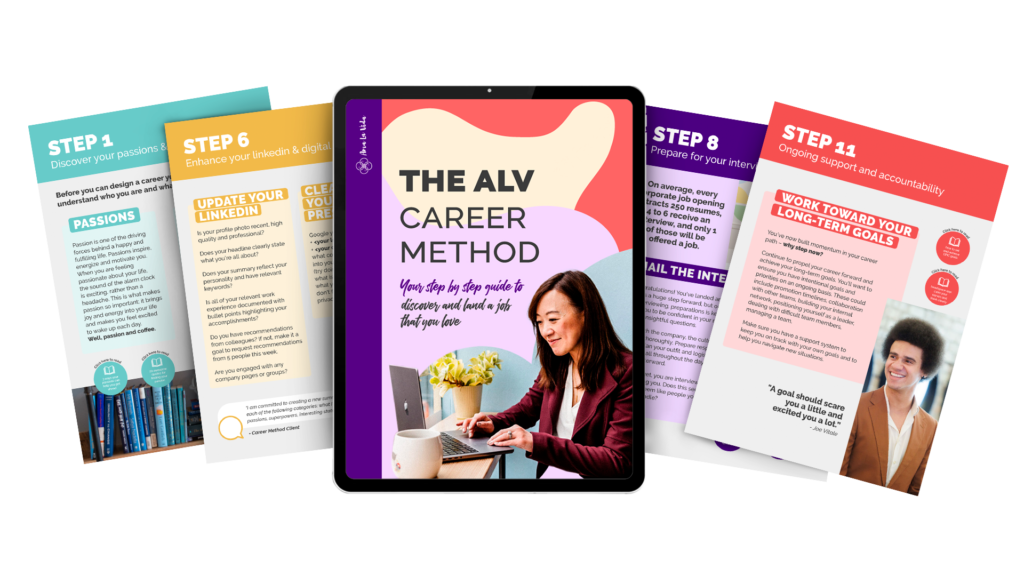
Download our comprehensive step-by-step guide to design and land a job you love!

Images from The ALV Career Method Guide
ALV Method Downloadable Guide

woman typing on laptop at a cafe

In today’s dynamic and ever-evolving job market, the traditional notion of meticulously planning every step of your career journey and executing it flawlessly is becoming increasingly unrealistic. Instead, a more flexible and adaptive approach is necessary. This article explores the essential elements of career strategy—career goals, career paths, and career plans—and how to strategically navigate them to achieve career success. Creating a Career Strategy: Taking Ownership of Your Career Taking ownership of your career and consciously designing your life starts with creating a comprehensive strategy. This strategy comprises three key components: career goals, career paths, and career plans. Understanding and effectively leveraging these components will help you navigate the complexities of your professional development journey. What is the Difference Between Career Goals, Career Paths, and Career Plans? To build a successful career strategy, it’s important to understand the distinctions and interconnections between career goals, career paths, and career plans. Each plays a crucial role in your professional journey but serves different purposes. Career Goal: Imagine Your Future A career goal is about describing the strategic playing field for your desired career and the role you want to play within it. It answers the fundamental question: What do you want to do? Naming your goal involves identifying the industry or domain you wish to work in and the specific position or function you aim to achieve. Your career goal sets the direction and provides a clear target for your efforts. Here are a few examples of career goals to get you started: Take some time to reflect on your desired career future and clarify what you want. Career Path Definition A career path is about developing a sequence of career actions that you believe will get you from where you are to where you want to be in your professional life—your goal. Your career path acknowledges that there can be multiple ways to reach your long-term goals and involves mapping out possible routes to achieve them. A career path provides a framework for your professional journey. Here are some examples of career paths based on the goals we’re exploring: Career Plan Definition A career plan is about how you are going to move to the next step, and subsequent steps, of the path. It involves making strategic choices in your professional development about how to get from where you are to where you want to be. This part is about taking your long-term career goals and translating them into short-term goals. Making your career plan includes selecting which path to follow out of the potential options and detailing the specific actions you will take to progress. Your career plan outlines the tactical steps needed to achieve your career path and, ultimately, your career goal. Here are what career plans might look like for each of our scenarios: The Importance of Ongoing Research and Adaptability When you create a goal and a path, it’s based on what you know today. However, the information you have could be outdated, incomplete, or inaccurate. This is why your plan has to include ongoing research and adaptation. Making the most of resources like working with a career coach, conducting online research, and talking to people who work in the career fields that interest you are crucial steps. Conducting Ongoing Research Your career goal will have helped you create a path and a plan. The plan should help you refine your path, and it might lead to changing your goal if you find out that what you are aiming for isn’t what you thought it was. Stay open minded – maybe your dream career is something you’ve never heard of before! Strategy: The Foundation of Adaptable Planning What we’re talking about here ultimately is having a career strategy. Strategy is a framework for guiding your efforts to create outcomes in an uncertain and ever-changing world. It’s about making informed choices, exploring different career paths, and being adaptable. Developing your career strategy involves several key components, such as setting long-term career goals, identifying clear career objectives, and progressively taking on more responsibility. By focusing on these elements, you can navigate your career with intention and flexibility. Picking a Career Playing Field: Determine the Industry or Domain You Want to Explore Choosing a career field means identifying the broad area or industry where you want to build your career. This decision lays the groundwork for all your subsequent career advancement choices and actions. Here are some steps you can use to get a better idea of which career path is right for you: Identifying Key Beliefs: Understand What You Believe About Success in That Field, Which Shapes Your Career Goals Identifying your key beliefs about success in your chosen field helps shape your career goals and sets the direction for your professional journey. This involves: Considering Choices: Make Strategic Decisions on How to Start and Progress in Your Career Path Once you’ve identified your career goals and the field you want to explore, it’s time to make strategic decisions about how to start and progress on your career path today. This involves: Searching for the Next Step: Develop a Plan for Continuously Searching for and Identifying the Next Steps in Your Career Journey A successful career strategy involves continuously searching for and identifying the next steps in your professional and personal development journey. This process requires an adaptable mindset and a commitment to ongoing learning and growth: Conclusion Whether you’re looking to change careers, get a new job, or work toward a pay raise or leadership position, having these tools available can help with your goal-setting process and project management of your career. It’s important to remember that the key to a successful career is not just in meticulous planning, but doing enough thinking about your goals and path in order to create a plan—and then taking action! The point of creating the plan is to get you out there so you can gain experience and learn what you need to learn to update your thinking. It’s a

Read More
revitalize your career

Rip off the band-aid, make a clean break, and dump the old you! It’s time to give your career the fresh new style it deserves. Today, we’re going to share the tactics you need to put in place to help you revitalize your career! There’s a lot of benefit to doing a “complete makeover” when it comes to the job hunt. Whether you’re just looking for a new role or promotion or pivoting into a whole new career field, you want to do more than just what you did last time. Things change, and the job market is a dynamic place. The job you want now might not have existed five years ago. The job market has trends that ebb and flow, and you don’t want your profile to look like the equivalent of a 1980’s prom picture. You want to demonstrate that you’ve kept up with new skills, workplace trends, and relevant information. Revitalize Your Career My clients will tell you that I’m fond of dating and relationship analogies in career coaching. I think there are a lot of informative parallels to be drawn between an interview and a first date. And I think leaving a job to find a better one shares a lot of similarities with a post-breakup power surge. Have you or someone you know ever gotten out of a long relationship and realized that it was time to totally upgrade? New haircut, new wardrobe, new profile picture on your social media accounts. Rearrange the furniture in your apartment, or even get a new one! And use those things as inspiration to really re-examine what you truly want. The job hunt is just like that. If you’ve been away from the job market for a while, there are definitely changes you want to make in order to be a commodity again. Even if you’ve kept your job-relevant skills sharp and updated while working, you probably haven’t been paying much attention to your job-seeking skills. When was the last time you dusted off that resume? Went on an interview? Used LinkedIn? A quick pass over your resume to add your most recent job isn’t enough. That’s what you did last time, and if there is a saying I truly believe in, it’s this: “The things you did to get you to this step won’t be the things you need to get you to the next one.” If you want more, you’ll have to do more! It’s time for a total career rebrand So what does it look like to revitalize your career, or give yourself a “career makeover?” Like any rebranding effort, it has to be a complete and concerted effort. A new resume that points to the same old LinkedIn profile with work histories that don’t match won’t win you any points. Trendy buzzwords appearing only on the most recent role on your resume won’t help while the second page still lists “MS Word” as a core competency. And the way you communicate verbally has to match what you’ve written. In other words, the message across all channels must be consistent. Whether a potential employer first learns about you via LinkedIn networking, receiving a formal application, or meeting you in a coffee shop, they have to get the same impression. Just like with a company, consistent messaging is important.  In a way, you are a company!  Think of potential employers like they’re your potential customers, and you want to make sure all the marketing for “You, Inc.” sends the message you want it to send. Step 1: Your Resume What is a resume? It seems like a silly question to ask, and yet I talk to a surprising number of people who have no idea what a resume is for. Many people fall into the trap of thinking that a resume is meant to be an autobiography. That it’s supposed to tell the “complete history of you” and be so compelling that it gets you a job. It’s neither of those things. It can’t be an autobiography and it can’t get you a job. However, it can be a fantastic marketing flyer and it can get you a phone call. It should do both, in fact! A resume’s function is to give an overview of you; an impression. In the same way that the commercial for Cheerios doesn’t list their ingredients. It tells you about how good you’ll feel eating them—that’s what you want a resume to do. You want your resume to be like a flyer or advertisement, telling people you’re the right person for them and inviting them to learn more in order to see why. This task is tougher than it seems, and that’s why it can’t be done by simply adding a new line for your most recent job title. Each role you add increases the complexity of your resume, and more complex resumes are less effective. Conveying the total impression of you in a simple and effective manner is an art form and is the first step to helping you revitalize your career. Step 2: Your Online Presence One of the best ways to progress your own career is to open yourself to new possibilities. You never know what career success awaits you, and if the only thing you do is sit in your current role, you never will. We live in an age of information. There was a time when a company received your resume, perhaps called your references, and that was the only way they could learn about your accomplishments, responsibilities, talents, interests and skills. Now, potential employers have a vast wealth of information about you at their disposal. Some people are afraid of that, but you shouldn’t be—you should love it! Remember, you’re like a company or brand advertising to customers. What company says to themselves, “Gee, I hope there’s no information about us online for people to find?” Companies want there to be an absolute flood of information about them online, and so do you! You just want that information to all be carrying the proper message, which is “Hire Me!” That means doing

Read More

In today’s competitive job market, mastering the art of managing up is essential for career advancement and success. But what exactly does it mean to manage up? And how can individuals navigate this skill to thrive in their professional lives? Understanding why managing up is hard can shed light on the intricacies involved in fostering effective relationships with your managers. Let’s debunk common myths, explore the benefits, and review the consequences of neglecting this vital skill. Then we can delve into the five best steps to empower you in how to manage up effectively and propel your career to new heights. Why Managing Up Is Hard Managing up isn’t merely about pleasing your manager; it involves aligning your efforts with their goals, preferences, and communication styles. The dynamic nature of workplace relationships, coupled with varying managerial personalities and expectations, can make navigating this terrain difficult. According to an article by Harvard Business Review, many employees are nervous about managing up because it sounds like extra time that most people don’t have in a day. Continue reading for actionable steps to make it easier. Debunking Myths About Managing Up Before diving into the actionable steps for successfully managing up, let’s address common misconceptions that can hinder your progress. By dispelling these myths, we can pave the way for a clearer understanding of what managing up truly means. Myth 1: Managing up is synonymous with brown-nosing. Reality: Managing up is about building rapport, trust, and collaboration with your superiors, which fosters a mutually beneficial relationship. According to Forbes, effective managing up involves advocating for your ideas and contributing to the success of the team. Myth 2: Managing up is only necessary for career climbers. Reality: A report by Gallup suggests that employees who have one meaningful conversation per week with their managers are more productive and fulfilled in their roles. When your manager sees your desire to support their goals, they will demonstrate more support towards you. Managing up is essential for professionals at all levels, ensuring effective communication, creating alignment, demonstrating your personal brand and productivity within teams. The Benefits of Effective Managing Up Now that we’ve debunked common myths about managing up, let’s explore the significant advantages that mastering this skill can bring to your career. By understanding these benefits, you’ll be motivated to invest time and effort into honing your managing up abilities. Enhanced Communication Skills: Mastering the art of managing up cultivates active listening, clear communication, and empathy, invaluable assets in any professional setting. In research published by Bucata and Rizescu (2017), they determined that effective communication with managers leads to greater organizational performance which is a benefit for you and your employer. Career Advancement Opportunities: A survey by Ladders (2019) found that 86% of “high-earning professionals” felt that managing up positively impacted their ability to be considered for promotions. Managing up will increase visibility, foster trust, and will position you as a valuable asset within your organization, paving the way for career growth and development. Improved Workplace Dynamics: Building strong relationships with your managers promotes a positive work environment, fosters collaboration, and enhances overall team productivity and satisfaction. Improving your manager relationship creates a more efficient workplace with greater team collaboration. Consequences of Ineffective Managing Up Neglecting to manage up effectively can have dire consequences. Miscommunication, misunderstandings, and a lack of alignment with your manager’s expectations can lead to decreased productivity, and missed opportunities for career advancement. Also, poor managing up skills can strain the manager/employee relationship by giving the impression that you are unresponsive, unreliable, or disengaged. This impacts your credibility with your colleagues and your manager. 5 Steps to Successfully Managing Up Now that we’ve explored the benefits of effectively managing up, let’s review five managing up strategies you can take to master this essential skill. By following these steps, you’ll be equipped with the tools and strategies needed to navigate your relationship with your manager and move your career forward. 1. Understand Your Manager’s Goals and Preferences: Take the time to familiarize yourself with your manager’s priorities, communication style, and expectations. Utilize tools like the DiSC assessment to gain insight into your manager’s behavioral preferences and adapt your approach accordingly. Another idea is to schedule a one-on-one meeting with your manager to discuss their short-term and long-term goals, and how you can align your efforts to support them. 2. Communicate Effectively: Maintain open lines of communication with your manager. This includes seeking feedback, and clarifying expectations as needed and, most important, providing proactive updates is key. For example, set up a weekly check-in meeting with your manager to provide updates on your projects and discuss any challenges or concerns you may have. Read this post for more ideas on what proactive communication might look like. 3. Build Trust and Credibility: Demonstrate reliability, accountability, and integrity in your actions, which will allow you to earn the trust and respect of your superiors as referenced in this post. A great tool to assess and enhance your trustworthiness is the ABCD Model by Ken Blanchard, Cynthia Olmstead, and Martha Lawrence. “A” stands for able and you demonstrate that you can complete the task. “B” refers to believable and this comes from your integrity. Being honest about your abilities and keeping your word supports this piece. Connected is what the “C” means in the model. Building connections requires not only your communications skills but also giving trust to others. Finally, the “D” is your demonstration of dependability. This requires that you follow through with what you say you are going to do. Using this model will allow you to build trust with your manager. 4. Adapt to Your Manager’s Style: Tailor your approach to fit your manager’s communication and leadership style, fostering better rapport and collaboration. For example, if your manager prefers concise communication, prepare brief status updates or reports for them instead of lengthy emails or presentations. 5. Be Solutions-Oriented: Instead of dwelling on problems, focus on identifying solutions and opportunities for improvement, showcasing your initiative and

Read More
women networking

Does the idea of working to develop strong networking skills make you feel uncomfortable? Many people react to the idea of going to a networking event with as much enthusiasm as taking a test – a test that they don’t know how to study for. And when you approach networking as if you’re a product that you’re trying to sell, it often leads to that cringe-y feeling of being a shameless self-promoter or a schmoozer. Regardless of how you might feel about it, professional networking provides the opportunity to make authentic connections with people. And if those connections are good ones, they lead to business opportunities and shared success. What if, instead of going to networking events with the intent to sell, you went to them with the intent to create connections that are based on mutual understanding and assistance? An authentic approach to networking This article isn’t about tricky techniques for building professional connections to shamelessly assist your job search or to weasel your way into relationships with companies you want as customers. Yes, networking skills will help you reach your professional goals, but this goes far beyond that. In this article, I’m going to challenge the way you think about professional networking so you can not just meet new contacts, but also build your confidence in networking situations, share your expertise, grow industry knowledge, and maybe even make some new friends. View this post on Instagram A post shared by Ama La Vida | Career, Life & Leadership Coaching (@alvcoaching) What are networking skills? Networking skills are communication skills, like being able to speak clearly and succinctly, being good at active listening, using and reading body language and facial expressions, and even navigating and making the most of social media. But if you don’t know what the purpose of networking is, no amount of skill-building will help you get the most out of it. Networking is, quite simply, the art of creating mutual understanding that enables the creation of mutual benefit. A complete list of networking skills includes knowing the logic behind what to ask and what to share. How to improve your ability to network Sometimes people measure their networking by how many business cards they collect or give away at local events. But if you don’t understand what’s important to the people you’re trading cards with, and if you don’t help other people understand what is important to you, you’re not really networking. Networking is simple to learn but takes practice to master. The first step is to know what the “mission” of networking is. There are three things at a minimum that you want to discover in any networking opportunity – and you want them to discover these things about you, too. 3 things to focus on when you meet people: It’s all about creating mutual understanding and finding shared interests. If you can answer these three questions about someone after talking to them, you know that you are doing well. And if the other person knows these things about you, then you’re on your way to mastery. The foundation of building and maintaining relationships Let’s say you’re networking and you meet someone who is, say, a manager for a local bank. As you make small talk you learn: After hearing this, you might think: “I know someone who does corporate training – maybe I could connect them.” Or maybe you do corporate training, and it’s an opportunity for you. Or maybe you have some advice and thoughts you could share from your unique perspective. No matter what comes to mind, it will be better and more relevant to the other person if you’ve taken the time to understand them first. By first understanding someone and only then trying to help them, you demonstrate your willingness to be of service – which makes a great impression and can be the beginning of a great relationship. What are your personal networking goals? When you network, you’re working to achieve mutual understanding and mutual benefit. You can prepare ahead of time by asking yourself: You might have more than one thing you’re trying to do, but for each thing you are trying to do (#1, above), be ready to talk about its corresponding #2 and #3. And when you talk about these things, be clear and concise. An elevator pitch is approximately 30 seconds to two-and-a-half minutes. Ideally, have a 30-second version, and longer versions if people show more interest. Develop authentic connections When you think of networking as a way to “sell” people on who you are, you miss the opportunity to make an authentic connection. You might hesitate to share what you’re grappling with and what you are looking for. Being vulnerable isn’t part of a typical sales pitch. But networking isn’t selling. It’s connecting. By sharing what you do, as well as your obstacles and aspirations, you give people the opportunity to trust you, understand you, and even to give you assistance, advice or introductions. If you like to help people, don’t forget to be generous and give other people the chance to help you! After all, if you like to help others, don’t you think they might like to help you? The Benjamin Franklin Effect When someone does a favor for another person, they are more likely to feel positively towards the person they helped. Benjamin Franklin once identified a rival legislator who he wanted to win over. Franklin asked if he could borrow a rare book from the legislator’s library. The legislator was flattered and sent the book immediately. Franklin returned it one week later with a thank-you note. The surprising outcome was that this simple request for a favor led to a significant shift in their relationship. They became friends from that point forward. Franklin concluded that the man, having done him a favor, convinced himself that he must like Franklin after all, because why else would he have done him a favor in the first place? By giving someone

Read More
women smiling looking at computer

Let’s face it, changing careers can be scary! But did you know that the average person spends 90,000 hours at a job? If you’ve been unhappy at work, sticking it out won’t get you a medal. Instead it can lead to frustration and burnout. Changing careers can be scary or overwhelming, especially if you’ve been in your current job for a long time, but we’re here to give you a concrete action plan to help you get started. Let’s dig into how to change to a career that makes those 90,000 hours go by a little smoother. How did we get here? Have you been thinking “I need a new career!” but feel stuck? You’re in good company—Oracle did a study that found that 75% of people feel stuck in their current job. There could be several reasons for feeling stuck. Maybe someone talked you into pursuing the career path you’re currently on. Maybe you were enticed because it was prestigious. Maybe you were already on the path and didn’t realize that you didn’t want it until it was “too late. Maybe the problem is just your current situation with a bad boss or bad culture. Maybe it’s just the wrong fit. There could be a myriad of reasons for this, but let’s face it, you need a change. Our career transition process Ama La Vida helps those who are looking for a career change from their current job. They have amazing coaches across numerous industries who will walk with their clients to help them determine their next career move. And it doesn’t hurt that they break it down into 10 easy steps to help their clients with this process that could feel daunting alone. 10 steps to make a career change Starting a career transition can feel like a really big change. This article will give you an overview of The Ama La Vida Career Method process, which walks you through 10 steps in a way that doesn’t feel overwhelming. Our process starts with you as the foundation to determine where to look, and then sees what careers lineup with you. Then we’ll walk you through specific steps to land a new role that aligns with who you are. We also have a team of career coaches who can help by coaching, providing resources, and creating action plans that move you toward your new career path. Ready? Let’s go! Step 1: Passions and gifts Let’s start easy: what do you like and what are you good at? The first step to determining your next career is identifying your passions and your gifts. Explore your passions When you think about your passion, think about what lights you up at work? Where do you lose track of time? What are you interested in doing or learning more about? These are your work passions that bring you energy. Identify your gifts When you think about your gifts, think about what comes naturally to you? What do others compliment you on? Where does your expertise shine? These are your gifts and skills that you bring to the table. Don’t rush this self-assessment – these are the things that you will likely want in your next role. View this post on Instagram A post shared by Ama La Vida | Career, Life & Leadership Coaching (@alvcoaching) Step 2: Values and purpose The next steps of this self-discovery portion are determining what your values are and what your purpose is. Define your values When you think about your values, think about the pillars that you need – if one of these pillars was missing, the house would not stand. You can usually determine what a value is by how you react when that value is violated. For this one, what are the areas of your life that are vital to your happiness or key to your view of the world? This might be family, endurance, loyalty, or grace. Name your purpose A purpose can feel like a very lofty thing, but let’s break it down. Ask yourself, what problem would you like to solve at work? What kind of impact do you enjoy making? What brings you that feeling of success? Use these answers as your starting point to determine what impact you’d like to make in your next role (your work purpose). Step 3: Explore and understand your options Once you’ve laid your foundation that is based on YOU, then you begin to explore your options in finding a new career. Brainstorm career options Start out by making a list of potential jobs. Go through each of the previous categories of personal traits you listed in steps 1 and 2, and write down every possible idea related to each of these. Keep an open mind and come up with a list of potential options – this is where we cast a wide net. Don’t forget to ask others for ideas and advice. Be sure to get input from those who know you best. Ask them what roles they think you’d be good at and why. When making this list, you can even think of roles you’ve previously worked to gather more ideas of what you want. Once you have that long list, you’ll want to narrow it down. Bring in your gifts, passions, values, and purpose to determine what is a good fit and what isn’t. Remember, you want to find a job that’s a good fit for YOU, not the other way around. Once you’ve created your list, you’ll want to understand the roles on your list. You should be able to answer what a day in the life is actually like and what the daily tasks and responsibilities are. You can do this by doing your research to learn the ins and outs of these jobs, asking for information interviews, etc. You’ll also want to fully understand the requirements. What training is required? Will you need to learn a new technology or obtain additional education? Will you have to go back

Read More
women colleagues talking

Raise your hand if you have a boss. That makes two of us! Everyone may not be a manager, but nearly everyone HAS a manager. So managing up is something almost all working people have to deal with. It’s awesome when you have an awesome manager. And at the same time, people are people, and people are flawed. Managers are not perfect, so sometimes it falls to us to “manage” them. It’s a delicate balance that can make a BIG difference for you and for your manager. What does it mean to manage up? Keep reading to learn: Let’s get started! The definition of managing up Managing up is “essentially managing your manager – doing what you can to get what you need from your manager to do the job to the best of your ability,” according to LEADx. When you’re ready to manage up, you’re ready to take control of your work. This is a great skill to learn for your own development and can sometimes even lead to your manager seeing your leadership potential. When you manage up, you’re taking control of the situation and your career. You’re speaking up about what you need, paving the way forward and helping your manager achieve success. What is managing up, really? Basically, managing up involves the things you do to work well with your boss, make their job easier and contribute to their success. Is your boss hard to get a hold of? Like many managers, they’re probably very busy and involved in several other areas of your organization, making their time a commodity. Busy managers can sometimes make their employees feel uncared for unintentionally. Just because they’re busy doesn’t mean you can’t build an effective working relationship with them and do a stellar job. Managing up is about how you use your time with them (and apart) to gain clarity on what success means to them and help them achieve it. It doesn’t just impact your relationship with them. Managing up filters up to your boss’ own manager and leaders across your company. What you do when you manage up can make your boss (and you) look great to upper management because it can make you achieve more, consistenly. Why managing up matters Managing up has lots of benefits across the board. Here are some of the biggest ones. Managing up helps your career development When you start actively managing up, you learn how to work with anyone on anything to get stuff done, which is amazing for your career development. This skill makes you a valuable player and an essential part of the team. It is a fantastic notch in your belt for leadership development (even if you’re not actually in a leadership role). It can also help you avoid surprises because you know what your boss is focused on and can keep your work and priorities in alignment. You can manage your time more wisely by focusing on what matters most and saying no to what takes away from that. Managing up also helps you build trust with your manager, which leads to a healthier relationship with your boss. Doing this makes you more intentional with your work, which means you’ll have an easier time cataloging your impact and success. This is PERFECT performance review fodder. So if you’re starting to manage up at work, be sure to keep track of what you accomplish so you rock your next performance review with strong examples to help you communicate all the awesomeness you’ve accomplished. Managing up builds trust with your manager When you learn to proactively communicate and achieve success with your manager or leader in a way that works for them, they start seeing you as a trusted resource who makes sure nothing slips through the cracks. You help them meet their goals and look good to their own boss. They feel supported and successful because of your contributions. Your manager knows they can rely on you, which is great for your future working relationship. Overall, this is one of the best ways to build a healthy relationship with your boss by making your boss’ life easier and catering to their style. (Plus, it likely makes your own life easier, too.) Managing up works at all levels Yes, it is called managing up but really, these are skills that will help you with everyone around you in your career, not just those higher up. Truly, this approach to work is about understanding how those around you work, what they need to do their job well, and how you can make their job easier with a more proactive and informed communication style. Whether you bring this topic to a meeting with your direct report, manager, or any other employee with whom you work closely, there is so much to learn. You can gain an understanding of the role you play in supporting your boss, team, department and organization hit their goals. This clarity helps you focus on what’s most important to your role so you can contribute in a more meaningful way than just putting out the fires of the day. Using these skills helps you build a positive relationship with people across your organization because this approach ensures both you and those around you are aligned on the work that is being done. It will give you a clear focus, which means you can be more strategic and thoughtful with your partnerships, pull in the right people to get the right things done and increase the visibility of both you and your work. Managing up is key for your reputation Proactive communication is crucial for building trust across your organization, especially with higher ups and senior leaders. By communicating your contributions clearly, you are demonstrating your leadership skills and how you are adding value to the organization as a whole. This approach is also vital if there is ever a mistake or problem with one of your projects. When you can get ahead of the problem

Read More