Category: Interviewing

Why are we as professionals worth what we’re paid? This question can have as many answers as there are people to ask it – and each of our own answers is unique, but there are similarities. Are you having difficulties with tricky salary negotiations? If you’re looking for advice on how to deal with a prospective employer who doesn’t seem to want to pay you what you’re asking for, here are some things to think about: Hard No Vs. Counter Offer Hard “no”s mean they no longer have an interest in you. But, if you’re getting a counter-offer, you’re hearing “we want you, but at this compensation.” Make sure you have clarity on this fundamental difference before going down any assumption rabbit holes. If it’s not clear from their words or behavior, you may need to ask them outright: “I’m not sure whether you’re rejecting my offer, or making me a counter-offer. Could you please clarify?” It’s perfectly acceptable to ask this, and will usually result in a more straightforward answer than their previous communication. Just remember: a hard rejection is different than a counter-offer. Realistic Salary Expectations There’s always the chance you’re asking for a higher salary than any company is willing to pay. Have you done your compensation research? If not, go search your target job title(s) on PayScale.com and Glassdoor.com/salaries. Make sure you’re within the right range. A note about location-based salaries: Location only matters if the company isn’t hiring remotely. If you’re negotiating salary with a fully remote company, do not let geography influence the number. It does not matter whether you decide to live in an expensive city or low-cost rural area. If you know your asking rate is in the correct range, it’s time to dig into why the employer isn’t thinking along the same lines as you. Understand Their Reasoning The better we understand others’ beliefs, motivations, and limitations, the better equipped we are to move forward towards an outcome we’re happy with. To understand why someone might not say “yes” to the salary you’re asking for, we need to first understand the factors that people use to make buying decisions. This isn’t a faceless company we’re referring to. This is one (or more) human being(s) reaching a conclusion based on the information they currently have. Based on the information you have, why do you believe they decided not to say “yes”? (If they shared their reasons, do they make sense to you?) Here are some common reasons they might be: They might simply be negotiating Negotiations are a game, not a war. We negotiate based on a belief that we can earn more—or pay someone less—and we’re usually right. You probably want more money, not less. And they’d like to pay less, not more—if they can. Basic supply and demand will dictate a general range of salaries, and buying decisions always mean “What I’m buying is worth more to me than what I’m paying for it.” Assume good intentions and try to play the game—not the war. They might not be able to afford your rate Sometimes, organizations can’t afford to pay us what we’re worth. This is common with local (“mom and pop”) businesses, early-stage tech startups, and nonprofits funded by grants and donors. There are usually alternative benefits to making less in these roles: local business owners can teach you a lot about business; startups offer equity—worth a lot if the company succeeds; nonprofits help you have your student loans forgiven. If an employer literally can’t afford what you’re asking, your decision will be: are you willing to take less? They might not think you’re worth it Though we don’t like talking about it, this is probably the most common one. We don’t always do the best job of “selling ourselves,” or, as Christopher Lochhead puts it: “being the only choice.” Think carefully about this part: Have you proven that you’re worth what you’re asking? This doesn’t necessarily come in the form of work experience on a résumé. You simply must make the other person believe that you’re going to be worth more to the company than they’re paying for you. Remember, we all make buying decisions based on a belief that “What I’m buying is worth more to me than what I’m paying for it.” The employer is no different, and will only agree to your rates if they believe you will “pay yourself off” over time. (By the way, this is not to belittle or reduce human beings to pure economic value—we are valuable far beyond the dollars we generate or save.) Make sure your personal website and online/social presence (at the very least, LinkedIn) are resounding testaments to the quality of work you’ve produced, the value and contributions you bring, and what it’s like to work with you. Then, make them an offer to prove it: “Let’s start with one project together, so I can prove I’m worth this rate. If you still feel otherwise afterward, pay me what you felt it was worth and we’ll part ways as friends.” This is incredibly powerful in tricky work and salary negotiations, and has personally resulted in some of the best professional relationships I’ve ever had. They might just be low-balling you Some companies string candidates along, make low-ball offers, and end up hiring the person who will take the least amount of money to do the job. Red flags can include: not providing clear reasons for rejecting your asking price; taking a long time to respond; appearing unprofessional in other ways throughout the interview experience. Ask yourself honestly whether the company (and the person(s) you’ve been interacting with) seem serious about this process. If you’re seeing some of these red flags, take Jenny’s advice and run, Forrest, run. Stay Confident During These Tricky Salary Negotiations Remember that there are other fish in the sea. Even when you’re navigating tricky salary negotiations with your absolute dream employer, remember there are just as great of companies out there. You may not know of

Read More

Interviews are happening again, and more than a few folks may be a little rusty. Time to shake the dust off of the interview technique and get prepared to answer these common foundational, but tricky interview questions. Each of these questions is one that I’ve asked in most of my recent interviews as a hiring manager, and my peers in the hiring world do the same. My job-seeker clients report getting asked these (or some variant) quite a bit as well, so I want you to be prepared for them! Tricky Interview Questions 1. Tell me about a time you failed to meet a goal Don’t: Try to avoid the spirit of the question with a clever dodge. Do: Engage honestly and tell a story about your growth as a professional Sounds like: “…and that failure taught me the importance of proactive communication, which is why I prioritize it today” Hiring managers ask this tricky interview question to see if you have the capacity to admit failure (since every single person has had failures, trying to dodge just makes you seem dishonest) as well as the ability to learn from them. This is a chance to show off an “origin story” for your awesomeness. 2. Have you used [specific software/tool] before? Don’t: Exaggerate your knowledge, or just say “no”. Do: Respond with a question about their use of the tool, and connect it to something you have used. Sounds like: “In my last role, we performed that function with a different tool. But it sounds like they’re very similar, so my proficiency with it should transfer over easily” Specific tool questions are rarely deal breakers by themselves. More likely, they’re just trying to get a picture of how easily you could integrate. Most business solutions or tools have multiple similar or equivalent examples, and you’ve probably used one. And smart questions make you seem easy to teach! 3. Why did you leave your last role? Don’t: Give a “safe” excuse (even COVID-19). Avoid fault isn’t selling yourself. Do: Talk about your goals that couldn’t be met at your previous role, even if you had stayed. Talk about the ones you’re excited about meeting in your new job! Sounds like: “Even though COVID-19 accelerated my timeline, I was outgrowing my role. I want to contribute more to a company that’s growing faster, which led to me apply here. WAY too many people look to avoid blame when they hear this question. But your hiring manager isn’t looking to blame you – they’re looking to see why you might leave them in the future. You want to give them reasons why you’ll work out great together!  Talk about the positives of working for them, not the negatives of working at your last job. 4. Can you tell me about your remote work experience? Don’t: Talk about how much you love “getting” to work from home. Do: Talk about how you’re prepared to handle the unique challenges of that situation. Sounds like: “I have a dedicated, quiet home office space that I’ve set up to be distraction-free and very conducive to high focus.” Remote work has pros and cons for everyone, and secretly we might think that wearing sweatpants to a meeting is the greatest thing ever. But it’s not a “best foot forward” answer. There are negatives to working remotely, and many managers are still nervous about those negatives. Assure them that you’re an asset that won’t be difficult to motivate or keep focused. 5. Where do you see yourself in five years? Don’t: Talk about using the role as a “stepping stone” to something totally different. Do: Talk about the skills and experiences you want to get “vertically” in that role and more senior versions. Sounds like: “I love public relations projects, so I hope to participate in increasingly more high-profile campaigns and eventually be trusted to run them.” So many people botch this question by basically saying some version of “Well, after you’ve invested a bunch of resources into me and developed me professionally, I’ll jump ship because I don’t really want to be doing this, I just need to kill time until I’m qualified for what I do want to do.”  You don’t have to lie, and you don’t have to make up a cheesy “I hope I’m still doing exactly this” sort of line. But find the middle ground about gaining valuable experience and continuing to grow. After all, if you don’t want to grow here – why apply here? There you have it, our top 5 tricky interview questions and how to best respond. If you’re ready for these questions, you’re in great shape for a lot of interviews! But if you still have more questions or need interview help, book a free consult here to start your work with a coach! Good luck on your next interview!

Read More

Once upon a time, the concept of a video interview was so strange that almost no one prepared for them. But even before 2020, some companies were starting to realize the benefit of interviewing candidates without having to drag them all into a central location. Now, video interviewing is everywhere! If you’re on the job hunt, chances are that you’ll have to interview over Zoom, Skype, Google Hangouts, or some other video platform. And you want to be ready! So we are doling out top video interview tips to help you land that job! Video interviewing has unique advantages – and challenges. In this article, I’m going to talk about five ways you can set yourself apart and give your best performance from a distance! Tip #1: Mirror, Mirror on the Wall When you’re talking to another human being, directly to their face, all your social instincts kick in. You become an interactive social creature yourself. Your face lights up, you become animated, and you follow all the subtle cues that help you connect with other people. We subconsciously use the facial cues of the other person to make adjustments to our own demeanor as we talk. On a video, that’s a lot harder. One big difference that most people don’t realize is that it’s more or less impossible to keep good eye contact when on a video call.  The camera aimed at you is by necessity, not at the same place as the video of the eyes of the person you’re talking to.  You can’t look at both at the same time. So if you’re looking at the other person’s face, you’re not looking into the camera, which is what you should be doing. What’s my secret solution and the first of our video interview tips? A mirror.  Get a small hand-held or cosmetic mirror and prop it, tape it, or otherwise position it right behind the webcam you’ll be using. That way, you can look at your own reflection while looking into the camera! This is an old trick for folks that have done telephone sales. In a call center, the best salespeople had mirrors at their desks for the same reason. When you can see – and talk to – your own face, you’ll smile more, pace yourself better, and generally present more effectively. And as a bonus, you’ll know if you have something in your teeth. Tip #2: Your Background Matters And no, I don’t mean your upbringing.  I mean what’s literally behind you! If you’re interviewing via video, it’s very likely that you’re doing it from your home.  Not everyone has a dedicated home office space – for many people, the interview space is your kitchen, bedroom, or some other area that isn’t optimized for interviewing. While a good hiring manager isn’t going to spy on you or judge you too harshly for what they spy in your background, that doesn’t mean you can’t put your best foot forward and avoid embarrassment by setting up an optimized interview space. I’ve conducted a lot of interviews and other meetings via video, and I’ve seen some crazy things: And plenty more! Your best bet is to put your back to a relatively neutral wall, make sure you aren’t brightly back-lit, and aim the camera towards you, instead of aiming it out into the room. However you manage it, just make sure you’re paying attention to what’s in frame while you’re on that call. Tip #3: Get to Eye Level Attention to detail matters! Few things make me shudder as a hiring manager quite like seeing the other person’s video open with a shot right up their nostril. Think about where your webcam is right now, as you’re reading this.  If you were to draw a perfectly horizontal line from it to you, chances are that it would hit you somewhere in the chest, not your face. You’re usually looking down on your camera, which means your camera is looking up at you. And as any professional photographer (or selfie-obsessed teenager) will tell you, that’s not a flattering angle. Because I’m on video calls all day, I have a setup that puts my webcam at eye level – if I look straight forward, that’s what I’m looking at. You can spend money on a nice setup, but you can also make one by just stacking some books (or anything sturdy – don’t use anything flimsy!). However you do it, make sure the image they see feels professional and natural, not like you’re looming over them, too close for comfort. You can expand on this a little, depending on both your comfort level and the space you have available. I have a tendency to talk with my hands, so I lean into it – I make sure my video is wide enough to capture that, and I’m not constantly gesturing out of frame. Some people speak better if they’re standing. If that’s you, then put your camera or laptop on a high shelf so you can stand. You have the ability here to craft your ideal environment, so do it! Tip #4: The Notebook Still Rules If you’re a professional interviewer, then you already know not to show up to an interview empty-handed. You should always have a notebook with you, pre-stocked with your own research and questions and with plenty of blank space to take notes during the meeting (this also helps reduce your interview anxiety). When you’re video interviewing, it can be tempting to skip the notebook and go right to the keyboard – after all, you’ve got access to all your word processing software right there! Don’t do it. The clacking of keys, the illumination of the white page of your note-taking software, the shaking of the attached camera while you type – these are all big distractions, both for you and your interviewer. Plus, any use of your computer beyond just allowing the video platform to run creates the risk of a mis-click or similar mishap that abruptly

Read More
job interview anxiety

After spending hours filling out one job application after another, you’ve finally managed to get an interview. Though some companies require a phone interview in the early stages, what really matters is the on-site interview when you get to sit down with the hiring committee. There’s nothing easy about putting yourself out there, especially in a professional setting. A job interview carries a lot of weight and there’s no shame in getting a little nervous. Just be careful not to let your nerves overwhelm you to the point that you bomb the interview. If you find that you don’t have as much time as you’d like to prep, read on for last-minute tips to shake-off your job interview anxiety so you can show up with confidence.  1. Have a Cheat Sheet  Before you set foot in the interview room, you should have a firm understanding of the job you’re applying for and should have some background on the company as well. If you can, gather information about the people who will be interviewing you as well as their positions and titles.  It’s also a good idea to review your resume (as if you haven’t read it a million times by now) with an eye toward predicting what details your interviewers might be most interested in…and what concerns they may have. Another important aspect of preparing for an interview is to consider your answers to common interview questions.  Here are some of the most commonly asked interview questions: Why do you want to work here?  What interests you most about this position?  What are your greatest strengths and weaknesses?  Where do you see yourself in five years?  Why should we hire you over any other candidate? You don’t necessarily need to write out your answers to these questions. But you should at least consider your answers, so you’re not caught completely off guard. If there are key details you want to be sure you mention, jot them down in a notebook. Create a “cheat sheet” for yourself to study before the interview. You should also include names and quick facts about your interviewers and the company.   The morning of your interview, refresh your memory using your cheat sheet. Go over your notes during your commute if you use public transportation or arrive early enough to reread your cheat sheet a couple of times.  2. Memorize Your Interviewers If you’re participating in an on-site interview, you may meet with as many as 5 or 6 different people. In some cases, you’ll move from one office to another for a series of individual interviews or you might end up in a room with everyone at once. Either way, pay attention when being introduced to people. A job interview can be a long and stressful process but it’s important to stay focused.  Don’t worry about memorizing every little detail about your interviewers but do make note of their name and their role. If you only have time for a quick introduction in an initial interview, jot down a few details about what they look like, so you’ll remember them in later rounds.  If you really want to impress your interviewers, show them that you were paying attention.  Most interviews end with an opportunity to ask questions – use that time to interview the interviewer. It’s the interviewer’s job to determine whether you’re a good fit for the company, but it’s just as important for you to decide if the company is a good fit for you and your goals.  Here are some questions to ask: What is the culture of the company like?  What are the biggest challenges facing the company right now? Where do you think the company is headed in the next five years?  What do you like best about working for this company?  What do the most successful employees here do differently? Take what you’ve learned about the interviewers, company, and position, and ask questions that get to the heart of this concern. It will ease your job interview anxiety by taking yourself out of the spotlight for a moment. It also shows your interviewers that you’re taking the opportunity seriously. After your questions have been answered, don’t forget to ask one more question: what are the next steps in the interview process?  3. Prep Yourself the Day Before You can’t expect to completely eradicate your pre-interview jitters, but you can mitigate them by being as prepared as you can. Don’t leave it to the last minute, either – do as much as you can the day before.  The night before your interview, pick out your outfit and make sure everything is clean and pressed. It wouldn’t hurt to try things on, just to make sure there aren’t any hidden stains or holes that might catch you by surprise in the morning.  In addition to planning your outfit, you should prepare the materials you’ll need for the interview. Plan to bring the following to your interview:  At least 5 copies of your resume A list of references  Pre-written questions for your interviewers A pen and pad of paper Make sure your resume and list of references are neat in a folder to keep them safe during your commute or, better yet, prepare multiple folders with important information so you can pass them out to your interviewers. You want to show them that you’re prepared, even if you still feel nervous on the inside. 4. Get Your “Tell Me About Yourself” Answer Ready  Many people combat anxiety by playing through potential scenarios in their head. This can help you reduce anxiety before an interview, but you can’t possibly cover all of the questions you might be asked. It’s a good idea to review the list of common interview questions above and at least think about your answer, but you don’t need to memorize an exhaustive list.  Instead of memorizing your answers to a dozen interview questions, focus on the one most interviewers start with: “Tell me about yourself.”  Without making your job

Read More
how to write a successful letter of interest

So, you’re ready to move on to the next chapter of your life and start working somewhere new? Great, but you need to make your future employer realize you’re interested. How? Writing a letter of interest is a sure-fire way to show them why you want to work for them, but more importantly why they want you. So how do you do it? Do Your Research You can’t just send the same letter of interest to every company and expect a response. The internet has made the first step easy, so there’s no excuse not to research the company. This way you’re able to find out what they want and how you fit the role. This also lets you know how they operate. Are they laid back or serious? Knowing this lets you make your letter of interest tailored towards their style and show them you’re already a good fit. Why You? Just because you know a bit about their marketing and style doesn’t mean you’re a good fit. So, show them. The point of a letter of interest is to make them interested in you. The key is to make it broad and related to the company.  “They don’t want to know that you’re good at marketing. They want to know you can’t wait to help them develop a new marketing strategy to help them break into a new market. Your cover letter is for being precise. Tell them your ideas for the company and what you want to help them with,” says Anna Felic, a career writer at AustralianReviewer and Essay Services. Scrutinize the company’s online presence, of course, to fully understand their mission and their values before beginning. But when you write, showcase how your experience and qualifications match to this set of values, and to the role’s job description. Give as much detail as you like, like anecdotes from your life about experiences with the company. Structure So how do you write it? First of all, introduce yourself. After all, if you turned up to an interview without saying hello or telling them your name, you’d leave a bad impression.  Since you have researched your company, you’ll be able to tell if you should start with a less formal ‘Hi blank’ or ‘Hello blank’. But be sure to address the hirer or recruiter, if this is possible. You could even add some contact information here, though this could go at the end, too. For example: Hello blank, My name is John Doe, a finance director in Chicago. I’m writing because I know we could both benefit from working together. So, you’ve introduced yourself. Now what? Get their attention. Make them realise you know what you’re talking about, that you’re fully qualified, and they need to take you seriously. Tell them you love their business and their ideas, but you know how to make it even better. “Show your value. What have you done that will make them want to hire you? Maybe you at your current job how you introduced a new account system that saved the company thousands. Or maybe you helped a new business develop a stable market base. They need to see proof that you’re all you say you are,” suggests Oliver Adams, a business blogger at Assignment Services and Dissertation Help.  So now you’ve written your letter, how do you end it? Like before, imagine finishing a job interview and just walking out after the last question. It would be rude to not say goodbye. Not only do you need to say goodbye you need to give them a reason to follow up and appreciate the time they spent reading it. For example: Thank you for taking the time to read this as I know how valuable your time is. When you have some time, I would love to talk about how we can work to improve your company as well as the open role of the finance director. All the best, John Doe. You can even use this conclusion space to clarify work history gaps, or a time when you changed career. Your letter shouldn’t make the hiring manager feel like they’re reading your novel. Keep it short – but hit them hard. You shouldn’t need pages and pages to show them that you’re the right fit. Just cover your relevant previous experience, maybe elaborating upon unusual job experience. But one-page max, or the hirer may not read your letter. When you’ve completely finished writing your letter of interest, now’s the time to check it for errors. Not just spelling mistakes and grammar, but also potential mistakes with the hirer’s, company’s and even job role’s name. If you’re applying to many jobs, these are easy mistakes to make, but are costly. As above, though you might be tempted to re-use your perfect specimen, copying and pasting your letter easily leads to mistakes like addressing the wrong person, or applying to a slightly different job role. So, it’s much better to write out a new letter from scratch for each job. Target it using what you know of the company’s ethos, and the job description. Sending the Letter So, you’ve written the perfect letter of interest. Where do you send it? You might have to call the company to find out. It’s best to send it straight to where it has to go.  When you call say, “I’m interested in the employment opportunity in your [department]. Can you tell me the name of the person in charge of hiring and the best ways to contact them?” By reaching out directly you’re showing your drive to get the job. Going through a recruiter is the same as applying online. A hiring manager is more likely to remember the person who emails them directly rather than someone who filled in boxes online.

Read More
weakness in an interview

We all hate that dreaded question when it inevitably comes up during a job interview; what would you describe as your weaknesses? What are you supposed to say? I mean, you could be brutally honest about what your weaknesses are. However, you’re only going to be left feeling as if you’re not going to get the job. Or you could go the other way and try to water down your weaknesses in a job interview. You could say something like ‘I work too hard’, which could be true, but is it what the employer wants to hear? In today’s post, we’re going to explore everything you need to know about framing up a weakness in a job interview. Understanding the Question Of course, when you’re asked this question, you want the answer you give to increase your chances of being hired, rather than ruining your chances. The most important thing to remember is that you’re being asked the question to see how well you will handle the job you’re applying for. This is why, before your interview, you’re going to want to sit down and brainstorm to see what limitations and weaknesses you come up with. These could include weaknesses you’ve experienced in past job roles. Or limitations you may see yourself facing in the job role you’re applying for. “Remember, the hiring manager isn’t going to try and catch you out. If you’re a really decent match for the job, then they could be asking this question to see how they can make you an even better fit into the business and make employing you a better experience for everyone involved” shares Jason Dunwich, a business writer at Write My X and Britstudent. Before the interview and with your brainstormed ideas, make sure you’re researching the job post thoroughly to ensure the weaknesses you’ve highlighted aren’t essential to the role you’re applying for. For example, if you’re applying to be a receptionist in an office, but you have poor computer or organizational skills, chances are you won’t get the job. Some Examples of Weaknesses Okay, let’s take a look at some of the key examples you might want to apply in your own life. Especially in situations when you are asked this question during an interview. A lack of experience with software or non-essential skills Nervousness or lack of confidence, especially with presenting or public speaking Unconfident when taking risks Lack of experience with writing skills Unconfident when delegating tasks Can get stressed when taking on too much responsibility With these examples, these are all things that may be weaknesses in your professional character. However, they are all things that can be adapted or improved over time. By mentioning them in your interview, adjustments and compromises can be made. This will ensure your entry into the business is seamless, and steps can be taken to get better. Taking the first example, if you’re moving to new a business, but you understand you don’t know the software they use very well, ask! You may be able to start training before becoming employed. Or you may be able to receive help and guidance. This will allow you to get better, thus addressing your weakness in the interview and ensuring it’s not a problem. Reframing Your Weaknesses Another approach you’ll need to think about is reframing your weaknesses and putting them into a positive light. Now that you have gone through the process above and defined what your weaknesses are it’s time to reframe them. You’ll then need to start thinking about how to turn them into a positive thing. Or, maybe how to be more positive in your approach to talk about them. For example, you can address the weakness by using positive language, or more accurately, avoiding the negative words. Instead of saying ‘I fail at talking to other people’, you could reframe it. ‘While I’m quite shy when talking in front of large groups, it’s something I’m working on.’ “The end of that sentence is the key. You need to make sure you’re actively addressing the fact you’re improving. Even giving examples of how you’ve got better in the past. In this example, you could say something like ‘I’m taking public speaking lessons’. Or ‘I’m proactively seeking out opportunities to get better and get more confident,’” expresses Jane Goodman, a career blogger at 1day2write and Nextcoursework. While you’ve been speaking about a weakness in an interview, you’ve now turned this into a positive thing that your employer is going to respect.

Read More

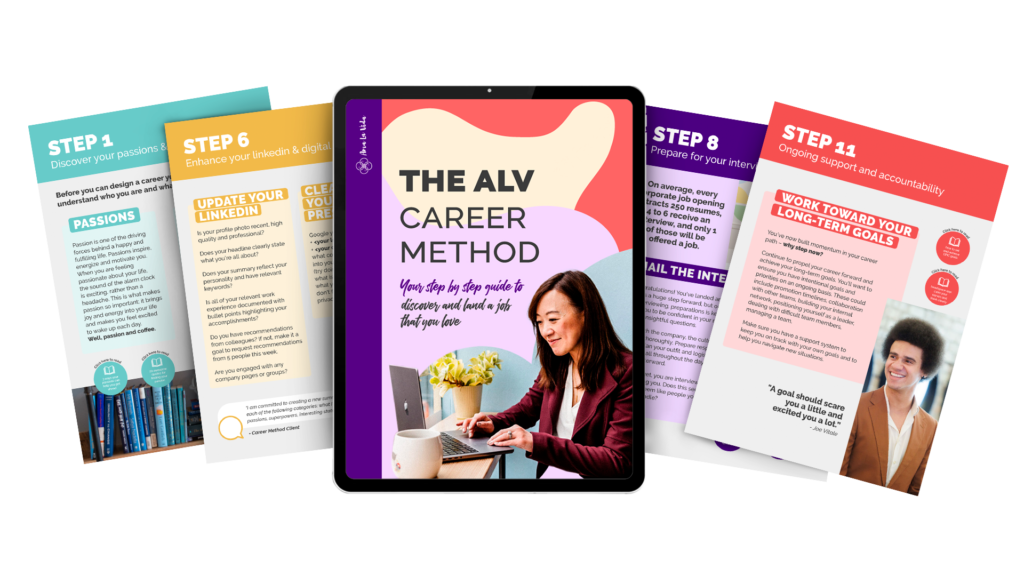
Download our comprehensive step-by-step guide to design and land a job you love!

Images from The ALV Career Method Guide
ALV Method Downloadable Guide

how to send a job interview follow up

Finding a job is a complex task, with many different steps and a lot of opportunity for failure. It’s simultaneously made more simple and more complex by technology. On the one hand, you are able to connect much more directly with potential employers and to find many more work opportunities. And yet, on the other hand, the more that you have to handle, the more difficult your life becomes as you try to navigate all of it. Each step of each application needs to be given the same care as the one prior to it and the one that comes after it. This attention also includes your effort and follow-through from the application to the job interview follow up. If you’re successful in managing your applications and cultivating a strong applicant profile, then you might find that you get an interview. Interviews are stressful since there’s a sense in which you have one shot to make an impact in person and to demonstrate to your potential employer that you would be a really good person to work with. However, getting the interview done isn’t the last step in your employment seeking process. Even though you will have finished the majority of what you are able to control, there’s still more you can do to ensure that you give yourself that extra little advantage: the ‘follow up’. Some applicants won’t bother with this. They may not think about it or think it unnecessary. Either way, that could play in your favor, as you may well stand out in front of applicants if you do go ahead with it. You want your potential employer to feel that you are invested in the job, that you are professionally courteous and that you understand the value and importance of networking and professional communication. It’s also a chance for you to refresh their memory of you. This is especially important if you were one of many different candidates. With all of that said, though, how does one follow up after a job interview in such a way as to capture all of these ideas and positive associations? Well, here are four tips to get you on your way. Understand The Timeline I hope you’re reading this before your interview, because this is one that you need to begin before your interview ends. Sometimes, amongst the stress and concentration of a job interview, it can be easy to find that you walk out of the room with no idea of what happens next. It likely won’t dawn on you straight away. Eventually, unless they’ve made it a point to tell you, you’ll realize that you don’t have any concept of when they’re making their decision or when you can expect to hear back. You need to have this information so that you can make an informed decision about the nature of your follow up to the interview. This means that you need to end your interview with a question about the timeline. Usually, an interviewer will end an interview with, ‘Do you have any questions for us?’. This is your opportunity to ask when you can expect to hear from them. Once you have that information, you can use it to decide when to follow up. If they say you won’t hear for a few weeks then you might want to delay your follow up slightly, so that you can give them a little reminder of your candidacy closer to the decision time. If they say a few days, then a near immediate follow up is appropriate. It also gives you a sense of when is appropriate to enquire. Once you have a timeframe given to you, you can get in touch if they are past when they said they would contact you. Don’t be too pushy, something like: ‘Dear X, I hope all’s well. I just wanted to get in touch about my application. I was given a sense that I would find out about my status a few days ago. Will I expect to hear soon? If there’s any other information I can offer you, do let me know.’ Send The Thank You Note This is the heart of your post-interview communication. It is really something that everyone ought to do, regardless of the role, the interview or the job. It’s simply a question of politeness and of eagerness. This is a great opportunity for you to show that you are keen on communication. Along with showing that you really want to work at their company. It’s also remarkably valuable when you consider how easy it is. “A job interview follow up email is the work of a few minutes. However, it’s a stamp of professionalism and enthusiasm. It’s so easy in fact that it reflects more poorly on you not doing it than it does positively on you for getting it done”, says Waldo Kingsmill, career blogger at Academized and StateOfWriting. They are, indeed, a simple task. Good thank you notes are brief, up-beat and memorable. The memorability factor will usually be handled by making a specific reference to something that happened in the interview. Here is an example: ‘Hi Jan, It was great to meet you today and to get a chance to look around the X offices. I’m excited at the prospect of getting to join the team. I particularly enjoyed talking to you about supply side economics and how that has influenced your policy at X. Very much looking forward to hearing from you. All the best’ Build A Relationship Increasingly, employers are looking to construct smart solutions to recruitment. “Rather than casting and re-casting the same giant net into the ocean of applicants for each position, companies are looking to cultivate a small pool of candidates into which they can drop a single fishing line, knowing that whoever bites will be a top candidate suited for their company”, says Anna Ko, business writer at PaperFellows and AustralianHelp. Don’t think about your interview as a black and white, yes or no situation.

Read More
how to interview: how to hit curve balls

In the first three installments of this series, we laid out the proper ways to prepare mentally for an interview, how to navigate the Q&A process, and how to effectively follow up with your interviewers.  Taken all together, that provides a nice road map for a clean process with no surprises. This edition we’re going to focus on hitting those curve balls in an interview, because the reality is that the planet I live on is FULL of surprises! That means the process is never going to go exactly like that outline.It’s essential to have a plan so you’re not just running around in the dark, but plenty of interviews will take unexpected turns. The hiring managers and recruiters who conduct interviews aren’t perfect.  They’re flawed humans, just like you are. They’re trying their best with often limited tools, attempting to make an accurate assessment of you in order to predict your future behavior and performance in that role.  Sometimes they’ll be very stressed, overworked, or lacking in knowledge of good interview techniques. All of these things can contribute to an interview that’s less than perfect, but still might be the gateway to a job you’d love. In this installment, I’m going to cover some of the common types of unexpected incidents I’ve encountered over the years, what’s usually going on behind the scenes when they happen, and how you can best navigate them.  Ready to hit some curve balls? Let’s dive in! 3 Types of Curve Balls Scenario 1: You walk into the interview, early and well-prepared.  You’ve done plenty of research and you know you’re a great fit for the role.  You’re excited! Your interviewer, on the other hand, seems like the opposite.  They’re scrambling and late, as if they just learned about this interview at the last possible minute, and right away it’s clear they don’t know a thing about you.  They ask your name and what position you applied for. They ask for a copy of your resume and rush to read it while you’re walking to the office. Overall, your confidence gets shot – clearly this interviewer doesn’t care about you or this interview.  So: what do you do when your interviewer isn’t prepared for the interview? The Reason:  It might be tempting to think this person just doesn’t care or is unprofessional, but even if it’s true that isn’t helping you any.  Instead, take a moment to consider what might be happening. A million perfectly natural things could have resulted in this person being told about your interview at the last minute. Maybe they weren’t the one that was originally supposed to interview you, but that person had an emergency.  Maybe the fact that they’re interviewing people at all is because they’re desperately short-staffed and stressed. The likelihood isn’t that the person is being intentionally disrespectful, but rather that they’re overwhelmed. Your Best Response: You might be perfectly within your rights to be annoyed or frustrated at being treated this way, but you also have a golden opportunity to be somebody’s superhero.  If you act put out by the frustrations of your interviewer, you miss the chance to be empathetic and supportive, which can immediately put you in a great position, especially relative to other candidates that might not behave this way.  Imagine the power of the following statement, said in response to everything happening in the above scenario: “I can tell that it’s a pretty hectic day in here! I’ve had plenty of those myself, usually because there were big changes happening. I’d love to hear more about the changes happening in this department. Where do we start?” Have you ever had an incredibly stressful day with far too many responsibilities and deadlines?  Of course you have. How would you have felt if one of your responsibilities got up and said something similar to you?  You’d probably be relieved and delighted, so giving your hiring manager that same gift is a big win. Not only do you show empathy and consideration, you also get to set the tone for the entire interview. You are able to frame it as a conversation instead of an interrogation.  So go ahead and make a friend! Scenario 2: You’re engaged in the interview process, and it’s been going well so far.  There’s been lots of discussion about your previous work, your skill set, and the future goals of the company.  You’ve felt great about all your answers as they relate to your area of expertise. Suddenly your interviewer grins slyly and asks, with their pen poised over their notepad… “If you could be any kind of tree, what kind of tree would you be?”  Not only do you have no idea how to answer, you don’t even understand the point of the question – so suddenly your whole flow and confidence are shot as you scramble to find something intelligent to say. So: what do you do when you get asked a nonsense question? The Reason:   For as long as there have been interviews, there have been people who think they’re clever in asking things like this.  Some of these questions are practically designed to trip you up, like asking “if you won the $10 million lottery would you still work for us?” (They actually want you to say ‘yes,’ by the way.) Others are designed just to try to see if you’ll come up with a Tweet-worthy answer. Like the person who answered “describe yourself in one word” with “hired.”.  Ultimately though, even though these questions are horrible and ineffective, hiring managers often still use them because they haven’t yet learned that they don’t reveal anything relevant. The interviewer is looking for some intangible quality in you. Your Best Response:   If you can figure out what the interviewer is actually trying to learn about you via this question, it can be possible to answer “correctly.”  Just like the lottery ticket question, “trick” or “trap” questions like that aren’t a great sign of good company culture.

Read More
How To Interview: The Follow Up

Welcome back to our How To Interview series!  In the last installment, I covered how to nail the all-important question-and-answer process that will make up the bulk of your interview experience.  But as any hiring manager will tell you, that process is only the first stage in winning the job. In order to explain why, I’m going to give you a “peek behind the curtain” and reveal a little about how a hiring manager thinks. This edition of how to interview is focused on the follow up. Let’s go! First, always remember that the interview process is inherently a competitive one – you don’t get to see your opponents, but you’re competing against them all the same.  The other candidates want the same job you want, but there are limited spaces available at any given company. That means (as I mentioned in Part 1!) that you’re not just trying to pass some test and get a good enough “grade” to get a job.  You have to be the best candidate out of all those that apply! That means the interview process has a few built-in disadvantages for you. Disadvantages: One. Every candidate gets an interview.  Yes, your performance can be better than theirs (and if you’re keeping up with all the resources we’re giving you, it will be!), but they still get to shoot their shot, the same as you.  The questions will be the same, they’ll get the same face time with the hiring manager. No matter how good you are, someone else might also be great. Two. In the mind of most hiring managers, the purpose of the interview is to eliminate candidates.  I don’t encourage this kind of thinking, but the fact remains that most hiring managers do it this way – if a hiring manager interviews ten people for one role, their goal is to disqualify nine candidates.  That means that if you “pass” this round, you’re in the same position still as everyone else sill in the process. That means that if you really want to land that job, you can’t “just” deliver a great interview.  You have to go above and beyond – so in addition to delivering fantastic performances in all the mandatory steps of the interview process, you have to do the things that aren’t mandatory to set yourself apart, and that’s what we’ll talk about here. The Extra Mile Here’s a simple thing to know: the more mandatory something is, the less credit you get for doing it. In other words, everything that’s mandatory becomes the “bare minimum,” and you don’t score points by just doing the bare minimum.  That’s just what you have to do to even qualify. You don’t get points for wearing clean clothes to the interview, but you sure lose points if you don’t. The way to get extra points is to do things you don’t, strictly speaking, have to do.  And if you do them well, you’ll give yourself a huge lead over your competition. First, the most basic of these steps: the follow-up email! I’m going to tell you a secret that may shock you – or at least, I hope it does.  I have conducted thousands upon thousands of interviews in my career. I have received a follow-up email from roughly 1% of them. That’s not a typo.  One percent. That’s because you don’t have to do them.  They’re not mandatory. But I’ll tell you another secret – the percentage of people who send a follow-up email that then advance to the next round is closer to 90%. Why are these so powerful?  Because they enormously improve your average.  My impression of you as a hiring manager is naturally limited; I’ve only gotten to know you via your initial application and resume, perhaps a brief phone call (if I was even the one to conduct the phone screen), and then a 30- to 60-minute conversation.  That’s not a lot of time to get to know someone, but I’ll make a judgment all the same. I have to; it’s my job. If you’ve ever left an interview feeling like you didn’t give your best self to the other person, and wished so hard that you could just show them who you really are… you can!  Send that email and improve your odds! If your interview was stellar, a follow-up email can’t hurt you unless it’s utterly atrocious (and don’t worry, I’m going to give concrete steps to make sure that doesn’t happen!), and if the interview was not, the email can be! More than the content of the email, however, is the simple fact that you sent it.  You spent additional, optional effort to reach out, connect yourself further, add more to the discourse.  You added more familiarity to your name in the mind of the interviewer. (And that’s important: Because of the Exposure Effect).  You demonstrated the exact skills almost every employer is looking for. Do’s and Don’ts for a great follow-up email! Do: Don’t: I’m going to put this all together for you and give you two examples.  First, a great example that a hiring manager would be thrilled to get, then a truly terrible follow-up email (one so bad it might actually count against you to send!). The Good… Dear Sandra, Thank you so much for the great conversation today!  I thoroughly enjoyed our verbal tour of the company, especially your role in the early growth.  I’ve attached that sales plan we discussed so you can take a look – I’d be thrilled to hear what you and your team think of its applicability to the role.  I can’t wait to meet the rest of your team after you come back from Disney World; have a wonderful time with your family! All the best, Randalyn The bad… Dear Mr. Rocia, I hope you didnt misunderstand my answer about my experience with databases. What I was trying to say is that I new them very well but it came out sounding like

Read More
Transition Tales: From Management to Associate

Welcome back to Transition Tales, where we hear the true stories behind people’s bold decisions to leave the comforts of work they know to pursue work they love. In this edition, we’re telling a transition tale from management to associate. What I admire about this Transition Taler’s (TT) story is that he was proactive and intentional about his career path all along. He didn’t sit back and wait to have things handed to him but instead was reflective about what he needed in his career and asked for it. At times when he didn’t receive it, he made the choice to look elsewhere. ALV: Why did you want to make a career transition? TT: I had made a transition into a new industry (mid market IT) from logistics. I went from a very large company to 2 very small companies. Each company promised me training, mentorship, and guidance. I ended up not receiving any help despite my communication and after a year and a half I was not learning and growing and I knew I had to make a very smart move that would help have a better future. ALV: Was there a “straw that broke the camel’s back” in terms of deciding to make the move? TT: After 2 months in the new role management did not provide any training and I had to constantly seek out guidance, feedback, and training! I also learned that most employees were never in the office and management rarely came in as well. Besides that, the company culture was horrifying. Everyone seemed so lethargic and unhappy at work and people did not practice good hygiene. This built up over time and I realized I needed to leave ASAP. *** It’s clear that learning and development opportunities were important cultural values for TT, and not only was he not receiving them directly; he didn’t see that any of his colleagues also valued these things. When a values conflict this significant arises, it can be difficult to stay motivated or envision a future in that organization. Before making a switch, TT spoke with some friends and family, and then also decided to seek out coaching support to help him find his next role. Given he had made two job changes fairly recently, he put a lot of pressure on himself to get this one right. TT: I really wanted to make a great career move. I was so scared of making anymore career mistakes and I wanted a great job with a great company and pave the way for a bright future. *** So TT now found himself in the position that many of our clients find themselves in and that I, myself, was in when I first worked with a coach. “I know I don’t want to do this anymore, but I’m not quite sure what I want to do instead. How do I know it will be better?” You can never know with 100% certainty what a role will actually be like until you get there, but you can take a thorough, logic-driven approach to help you identify what’s important to you and then select a position based on what is most aligned with you and your needs. ALV: How did you figure out what you wanted to do in your next role? TT: I had some ideas but they were not validated. The Ama La Vida modules really helped. It starts from taking things from a high level. What do you like doing? solving problems? Executing plans? Analyzing data?. Then it goes into the day to day and a lot of other broader ideas. Creating my list of what I was looking for validated what I wanted to and as well as what type of company I wanted to work for. When you keep things somewhat broad in terms of the type of work you want and the environment you need, it is easy then to find the right opportunities. ALV: And what did you discover? TT: I was looking for development, mentorship, and ambition. I have about 5 years of work experience, but I am still hungry to learn and grow and I wanted a company and a manager that would provide development and somewhat of a path for growth. As far as culture, I was looking for high energy and positive people who were also curious learners. *** It’s clear that for TT the way in which the work is done and the type of people he is surrounded by are just as important to him as the work itself. This helped him focus his job search around the cultural factors that were critical. Even though TT was clear on the companies he wanted to work for, that didn’t mean the job search process was going to be easy. It can be grueling, especially when you have something very specific in mind. TT: It is going to be challenging. There are times when you feel like you found the best job ever. Then you will learn something bad about the culture or you will not receive an offer when you really felt like you were going to get it. Interviewing is definitely a skill as well. The more you do the better you will become.  *** In total, TT applied to about 25 jobs and had 9 interviews. This feels like a lot because you are constantly putting yourself out there to be evaluated by strangers. However, it was worth it in the end for him to find the right position. And he learned some important lessons along the way. TT: The transition took about 5 months. I did apply for some “reach” roles in the beginning as well though. I felt empowered, hopeful, excited, happy but also scared, nervous, anxious, and hopeless when I did not receive any offers. My advice for you, do not waste your time interviewing for jobs you know you do not want. *** All that hard work and enduring the emotional ups and

Read More
informational interview

Thinking about a career transition, but not sure if you’re interested in an industry? Want to try a new job, but don’t know much about it? How about going back to school; is this the right move for you? Learn how to prepare for and use the informational interview as a tool to reach your next career goal. The easiest way to get answers is to ask questions. And getting the answers to your career questions is the foundation of the informational  interview. Sounds simple, yes? But often we feel uncomfortable and unsure of how to reach out and ask those types of questions. We feel that no one will be willing to give of their time and share their insights with us. This is where the informational interview comes in. What is an informational interview? An informational interview is an opportunity to speak informally with a professional who can give you some insight into a new industry, field of study, type of job or even a different company from where you are now.  To be clear, an informational interview is not an opportunity to ask for a job.  It is more like a media interview in that you are the interviewer, not the interviewee. You choose the questions, because you are the one who wants to know the “stuff” (no matter what the stuff is). Let me repeat…you are not there to ask for a job. Why not? I’m sure by now you are now wondering, “If I’m not asking for a job, what’s the point”? or maybe now you’re saying, “Isn’t this information available to me online, especially on a specific company website?”  The point is while you can get some of this foundational type of information from a website, there are critical differences that the informational interview provides you: Ok, so how do I do this? “Being flooded with information doesn’t mean we have the right information or that we’re in touch with the right people.” Bill Gates Scoring the right informational interview requires time and effort. You need to determine what you want to know. Make a list outlining your priorities of what information you want to gather. Don’t worry about crafting questions just yet. Start researching. What companies/job titles/career path/field of studies match with your list of what you want to know? Check your current network, and your expanded network. Do you know anyone who can connect you to a person at the right company, with the right job title, working in the career, teaching in the field of study? Or do you know anyone who knows someone? Besides LinkedIn, widen your search. Think about your friends and their friends, your parents’ friends, your children’s friends’ parents, your alumni association, other social medias. Are you in school? How about a teacher? Any person that you know or know of can be a connection for you. If yes, reach out in a friendly, professional way and ask for an introduction to the right contact. It’s important to be clear and concise in your ask. If this is a contact of a contact be sure to introduce yourself, otherwise you can get right to why you are asking for an introduction, note that you will respect the person’s time,  ask how they would like to handle the introduction (give you contact information, or reach out on your behalf) and always state that you would appreciate any effort on your behalf. (Manners are still important!) When you make your initial outreach to the expert, make sure you set very explicit goals for why you would like to speak with them, including how much time you think you will need. (Keep in mind an informational interview should be no more than 15 to 30 minutes.) Setting clear goals helps you stay on track to get the information you need and lets the expert know you are serious, organized and will be respectful of their time. Informational interviews can take on several different forms. Your first choice should be some type of face-to-face interaction, in-person is best, but a video call is a close second. If that is not a possibility, then a voice phone call will also work. If you can’t secure any of those, you can certainly have an email exchange. This isn’t ideal but is still more positive than having no interview. I got the right person, now what? Now you need to be sure you are asking the right questions. Go back to the original list with your priorities on them, this is your roadmap to identifying the right questions. What do you want to know? Formulate questions that give the expert the opportunity to expand the answer and fill in the important details from their own experience and perspective. Questions that can be answered with a yes or no aren’t usually going to work to your benefit. (These are known as closed ended questions, because they close the conversation.) You want to stick with open-ended questions; questions that can be answered with a narrative. Some examples of informational interviewing questions are: These questions can be adjusted to a company, career path or new field of study. Start with a longer list of questions and whittle it down until you have three to five key questions that can give you the most information about what you want to know. You want to maximize your time with your expert while being respectful of their time. This also shows your organizational skills, preparedness and sincerity level. And while this is not a job interview, hey, you never know?  How do I do this successfully? Like any other type of interview, you’ll need to prepare. It is important for the interviewee to feel that you are genuine. The conversation should flow and feel like an informal interchange and not like an interrogation. Tips for informational interviewing success: Before the interview: During the interview: After the interview: While you are not paying for their time, goodwill can go a

Read More
How To Interview Questions

Welcome to the second installment of the How to Interview series!  In the first installment, I discussed the right (and wrong!) mentalities to carry with you into the interview process.  That’s good to read first because having the right mindset will help everything else make sense and make you feel more prepared and confident. In this installment, we’re going to dive into the meat of the interview process: the questions & answers (& questions, as you’ll see)! Interview Questions & Answers… An exhaustive list of every question you could possibly be asked would be impossible to create.  Every interviewer has their own spin and style, and they’ll ask different things. Since that’s true, how can you possibly prepare? Well, the first step is to recognize that even though there are a nearly infinite number of possible questions, there are a few universal ones that you’ll get in virtually every interview.  Questions such as: “Can you tell me a little about yourself? I’m not sure there’s any question more dreaded in an interview process!  As a hiring manager, I’ve asked this question thousands of times, and I dread the answers as much as you do, believe me.  99 out of 100 candidates answer this horribly. Regardless of industry, role, or career level, I get the same response: First, that deer-in-the-headlights look of panic.  Then, a seemingly random list of inconsequential trivia about the candidate, like what town they were born in, how many siblings they had, where they went to school, the fact that they love dogs, skiing, or travel, or that they played some sport fifteen years ago.  They may or may not mention jobs they’ve had, but if they do it’ll just be a repeat or summary of their resume, which I already have. They’ll ramble until they fade away with an unenthusiastic wrap-up, or maybe a sheepish answer of “does that tell you what you want to know?” Sound familiar?  Every hiring manager I’ve ever spoken with tells me the same thing – despite how universal it is, people come into an interview totally unprepared to answer this question in a meaningful way. Fortunately for you, there is a method that turns the most awkward question in the process into an awesome opportunity for you to sell yourself! I once asked a candidate for a sales manager position to tell me a little about himself, and instead of the standard answer I’d come to dread, he gave me the best response I’d ever heard. “I’ve always been defined by ambition.  From the earliest days of my career I took on the most challenging and rewarding projects I could in order to prove myself.  Right now that ambition and drive has made me the number one sales rep in my company, but there’s no path for leadership advancement there.  That’s why I’m here – I want to join a company as ambitious as I am so we can grow together.” I was absolutely blown away by his answer (and needless to say, he got the job)!  After the interview, I spent some time breaking down exactly why his answer was so good, and created a formula so that anyone can duplicate it, regardless of who they are. First, start with a theme.  His theme was “ambition,” and it clearly shone through his entire statement.  He stated it early and often so I could easily connect him with that positive quality in my mind.  It kept him laser-focused and eliminated irrelevant information. And it made him stand out in my memory. Second, define your theme in terms of a journey with three steps – past, present and future.  After stating his theme (“I’ve always been defined by ambition”), he then gave me three concise sentences: one about where his journey began, one about what he’s doing now and why it needs to change, and one about his future – with my company.  All three sentences served the central theme and created a cohesive story. It lead him from where he began all the way to the seat in front of me. It was compelling, and it made me want to see how the rest of the story turned out! Third and last, he shut up!  He knew he’d delivered something powerful, and he didn’t dilute it by saying “so… yeah, that’s it” or anything like that.  He put the ball in my court, and I had to respond. He was controlling the conversation right from the start of the interview, which is what knowing when to shut up allows you to do. Practice this method!  Pick a theme you’d like to define you.  It could be Creativity, Dedication, Compassion, or anything else you feel is a reflection of your best self.  Once you’re ready to declare your theme, create three (and only three!) sentences that reflect that. A sentence about your past that shows where your journey began and why your theme is reflected in that journey.  A sentence about where you are now and how your theme contributed to that, but also why it needs to change. And then a sentence connecting that theme to your future with this company. Write it down and practice it a few times.  It’s a great elevator pitch and opening remark; if you nail this one thing, you’ll set the tone for a great interview! “Why are you looking to leave your current job/why did you leave your last job?” This will come up – there’s no avoiding it.  If you’re not currently working, the interviewer wants to know why your last role ended.  If you are working, they want to know why you want to leave. First, I want to dispel a common myth. It’s not necessarily a good thing if you have a “valid excuse” for your last role ending.  Sure, sometimes your role ends because of forces outside your control. Maybe a company shutting its doors or your position being moved overseas.  Sometimes candidates seem relieved to be able

Read More