Category: Overcoming Fear

coach peggy working on the computer

The benefits of coaching span far beyond what most people initially envision when they find themselves Googling “career coach near me” late at night after a frustrating day at work. Our clients typically come to us with a specific and fairly surface-level goal in mind, like hitting their career goals or finally feeling aligned in both their personal and professional life. But what inevitably happens is that a great coaching program helps you not just accomplish what you want but also address the things you need in order to thrive in both your personal and professional development. This might be building your confidence, getting clarity about your career path or overcoming analysis paralysis. They are all enablers of goal achievement that coaching quickly dials in on to help you get where you want to go. The Real Benefits of Coaching (That Might Surprise You) 76% of our clients have never worked with a coach before when they reach out to us. They have a vague idea of what a coaching relationship can do for them, but they’re not entirely sure. Before we dive into specific types of coaching, let’s pull back the curtain on what coaching actually looks like. Whether it’s career, life, or leadership coaching, the coaching process creates a powerful container for personal and professional growth, career development, and good old-fashioned self reflection. It’s not about getting advice—it’s about having the space to think clearly, challenge yourself, and grow in ways you didn’t expect. A Safe Space with Zero Judgment (and 100% Truth Bombs) While many of us are lucky to have wonderful support systems around us of friends and family, each of these people has a distinct perspective on our lives which is shaped by their relationship with us. Coaches, however, have no such bias. Coaches are there solely to help us achieve success and personal growth on our own terms. In a professional environment, we often can’t explore ideas with colleagues and bosses due to the impact it may have on them, and we may not feel comfortable opening up about our insecurities. Having a safe space in a coaching session to explore these ideas, test new behaviors and evaluate different decisions is an invaluable resource. A client shared with me, “As a leader I love that I have a safe space to say what is on my mind and either get validation or feedback to think through.” Coaching is often the only space where employees develop the confidence to talk through the hard stuff—no office politics, just honest insight. This helps empower individuals to find to their own answers (not just take advice) and boosts individual performance, which is one of the most unexpected benefits of coaching. Accountability That Doesn’t Feel Like a Shame Spiral Many of our clients have shared that they initially felt embarrassed that they needed their coach to keep them accountable. They would say things like, “Shouldn’t I just be able to do that on my own?” No! External accountability is critical for most people to accomplish what they set out to do. This is especially true in today’s busy world with many competing demands for our attention. Throughout your youth, external accountability was abundant: school deadlines, parents holding us accountable, guidance counselors reminding us of due dates. But in adulthood, we are largely on our own to set deadlines and accomplish our goals. Having a coach support you with this is a smart strategy to ensure you stay on task. The focus with your coach isn’t pressure, it’s progress, with actionable steps tailored to help you move forward confidently. But it’s also so much more than just project management. It’s about doing the right things, not just checking a box. When we are moving a million miles an hour, we often measure our contributions in terms of how many things we crossed off the to-do list. But moving from one task to the next without taking time to reflect can actually cause you to miss opportunities to learn, derive insights and make better decisions in the future. Dedicated time for reflection helps you better plan for the future. Coaching creates a space in your day where you can slow down and be both reflective and intentional. It can break down a behavioral pattern you’ve sunk into and allow you to purposefully design a more optimal behavior. Instead of just moving along to the next thing and potentially repeating the same mistakes, dedicating this time to reflection with a skilled professional can help you generate frameworks and philosophies that lead to better decisions going forward. Better Problem Solving (Without the Mental Ping-Pong) So much of life’s angst comes from stressing about what might happen. Whether it’s making a big life decision or figuring out how to tackle a problem at work, a prolonged mental swirl can bring about a lot of unnecessary anxiety. These decisions are tough to make, and there is always fear about making the wrong choice. Coaching combats this challenge head on. It brings clarity to overthinkers, helping to structure decision-making, and boosting creative thinking, especially in high-stakes situations. I tend to be an overthinker and a ruminator. I often enter my coaching sessions with a cacophony of thoughts swirling around my brain that are exhausting me. This causes me to not show up as my best self for my team. Coaching helps me make sense of the noise, organize my thinking, and make decisions with more self-confidence and clarity. I often say that my favorite coaching sessions are the ones where nothing has changed and yet everything has changed. I didn’t actually do the thing I’ve been swirling about during my coaching session. But I walked in completely overwhelmed and stressed, and I walked out with clarity and a confident path forward. It truly makes all the difference when it comes to time management, problem solving and decision making. Shine a Flashlight for Your Blindspots You don’t know what you don’t know—until a coach helps you

Read More


woman smiling looking at herself in the mirror

Self-doubt and overthinking are a bit of a chicken-and-egg situation. Self-doubt fuels overthinking, and overthinking, in turn, amplifies self-doubt. Self-doubt is the feeling of not trusting yourself—your voice, your ideas, or your ability to figure things out. Overthinking involves pondering on the “what ifs” and focusing on the possibility of things going out of control or what is lacking. They tend to grow louder when: Here’s the tricky part: self-doubt and overthinking don’t always shout. They often conspire with each other and show up as your brain’s way of protecting you. They hide behind beliefs like: They manifest through: When layers of doubt stack up, overthinking sets in. When you immerse yourself in endless “second thoughts,” self-doubt swallows you. You told yourself you were “being careful” or “being strategic about risks,” but in reality, you were trying to avoid the pain of not feeling enough. Real Client Stories Greg, a former athlete working in finance, often compared himself to others and worried about how he was perceived by them. If he wasn’t outperforming his peers, he felt like he was falling behind. Without external validation, his self-doubt grew louder. He felt stuck, measuring his worth by his achievements and comparing himself to others. Patty, an operations manager, believed that anything less than perfect meant failure. She would triple-check every email, over-prepare for meetings, and shut down when things felt chaotic. She doubted her ability to handle tough situations. The constant overthinking left her mentally and physically drained. Different stories, same struggle: self-doubt and overthinking. They worry about not being enough. What Causes Self-Doubt and Overthinking at Work? To understand the root cause of self-doubt and overthinking, you must first recognize that they affect all of us to some degree. Within a trauma-informed context, the analogy of the survival brain vs. the thinking brain shows how the brain prioritizes safety and bypasses rational thought. In moments we perceive as dangerous—physically or emotionally—the survival brain triggers the fight-or-flight response. Connecting the dots, self-doubt and overthinking are a form of psychological flight response. Maybe we were told, directly or indirectly, that making mistakes wasn’t okay. That being wrong meant something was wrong with us. If we were slower at learning, we were seen as less capable than those who were faster and sharper. We may have also witnessed others being judged or shamed for not conforming to our cultural norms, and we play it safe to follow all the rules. We started measuring our value through overachievement or external praise. We learned not to rock the boat or upset anyone to maintain a sense of control and perfection. If we grew up in a family affected by generational trauma, past pain, fear, or silent suffering, it can get passed down. No one talks about it, and we normalize it, live through it, and potentially pass it down to our next generation. Self-doubt and overthinking become even more prevalent in toxic work cultures and competitive environments where psychological safety is lacking. It can feel like others are constantly judging you and every day is a high-stakes performance. Eventually, burnout happens. Mental and physical depletion become a theme. Constant anxiety begins to compromise our overall well-being. The Vicious Cycle: Negative Thoughts and the “What Ifs” When self-doubt and overthinking take root, it creates an endless feeling of “not ready yet” or “I’m not enough yet.” No matter how careful you are, you still worry about doing it wrong. No matter what you accomplish, you downplay it. No matter how far you’ve come, you focus on what’s still missing. Your brain is wired to run through a list of “what ifs,” looking for flaws and chasing a moving target of “enoughness.” It’s a vicious cycle that slowly erodes your confidence. Another Real Client Story Charlotte has a harsh inner critic that constantly reminds her of her flaws. With that critical voice playing in the background, she struggles to celebrate wins or receive compliments without deflecting or downplaying them. She couldn’t bring herself to send out her resume because she didn’t think it was “ready.” She assumed her past work experience wasn’t enough. She spent hours revising, hesitating, and over-preparing, rather than actually applying. Staying stuck in this loop of negative self-talk holds Charlotte back and stops her from even giving herself the chance to let new opportunities become possible. How Self-Doubt Impacts Your Confidence (and Career) Self-doubt and overthinking might feel personal, but they’re incredibly common, especially in the workplace. You might feel like a fraud or constantly seek others’ opinions because you trust them more than yourself. These are classic signs of low self-esteem that often go unnoticed in high-achievers. You might find it hard to celebrate wins and harder to receive a genuine compliment without deflecting or diminishing it because you don’t think you truly earned it. Your work takes longer to complete as you spend too much time predicting every possible outcome. You are on high alert and fear failure, so you don’t raise your hand as the stake is too high to put yourself out there. If this resonates with you, you are not alone. These behaviors exist even in people you you see as more “successful” than you. However, these tendencies hurt your growth and impact your productivity. The biggest loss? Missed opportunities. You second-guess yourself and avoid challenges that could help you grow. The more uncertain you feel, the less motivated you are to pursue new possibilities. That inaction turns into regret, which then reinforces more doubt and frustration. Practical Strategies to Stop the Spiral Self-doubt and overthinking can’t be entirely eliminated—they’re part of your inner safety system. But they don’t have to run the show. Think of them as signals and reminders to pause, reflect, and make more conscious choices. When you find yourself going down the spiral, break away from your thoughts by taking a few deep breaths and bringing your attention back to the present moment. You can try noticing the five senses (sight, sound, smell, taste,

Read More
team gathered around listening to the leader

Congratulations! You’ve landed the big job you’ve been wanting. Now the real work begins. Starting any new role can be intimidating, but this can be exacerbated when the person who held it before you left big shoes to fill. Perhaps that person was an absolute rockstar at their job or maybe they had been there forever and were a total legend or maybe they had a big personality that everyone loved. So how can you step into this role gracefully, successfully and pick up where they left off in a way that makes an impact while feeling authentic to you? Here are some tips to get you started: Remember, you have to be you. It’s tempting to constantly compare yourself to your predecessor and assume any delta in your performance or approach is a shortcoming. But that’s simply not the case! Don’t try to mimic their style; enhance yours! Take the time to really understand your strengths and leadership style and lean into them. Separate competence from experience. Know that just because you don’t have the same historical knowledge doesn’t mean you don’t have the same capabilities. I’ve seen this become crippling for new leaders, especially in industries where deep expertise and years of experience are valuable. It’s easy to make the mental leap from, “Wow they know so much” to “I’ll never be as good as them.” This is also challenging when you’re stepping into a role where your direct reports have more subject matter expertise than you do. You were hired or promoted for a reason. You bring critical thinking, innovation, and new context to the role. The subject matter can and will be learned in time, and I guarantee your predecessor didn’t know much more in their first week and months either. Be a quick study. Part of your 90-day plan should be to figure out the gaps in your knowledge and craft a roadmap to learn what you don’t. This could be everything from acronyms to stakeholders and contacts to new technology. Build relationships with people who can help you gain the knowledge you need, and don’t let your ego prevent you from asking questions. Find someone you trust to ask the “silly” stuff. Resist the urge to come in and shake everything up. A new leader can bring new ideas, new solutions, and new energy to the team which can really reinvigorate a group. And also, coming in and changing a bunch of stuff all at once with little context can feel disrespectful. It can send the message that you know best or better without taking the time to first learn. When you initially step into your role, be patient. Of course, add value and solve problems where you can, but spend most of your early days asking questions and learning what people are doing. Be a fly on the wall before implementing new stuff. If you have direct reports, take the time to meet with each person and gain context and feedback including insights on what was working well and what could be better. Then, formulate your plans for the future. These will be shaped by context and empathy after having gotten to really understand the needs of the team. Build a relationship with your predecessor (if it’s appropriate). Of course, there will be circumstances where this might not be appropriate, and in that case, skip to the next tip as a proxy. But in the event this person retired or moved up in the company or even left for a different company, reach out to them! How wonderful to get to have a sounding board in someone who knows your role better than anyone else. Be respectful of their time (learning is still your responsibility), but draw from their wisdom to help you navigate these new waters… even when they’re not new anymore. Connect with your new peers. Tap into LinkedIn, professional associations, or networking groups to find peers to connect with. There is so much to be learned from others in your role at various organizations: what they’re doing, what they’re buying, and who they’re hiring. Try to specifically seek out folks who are not just in your department but at your seniority. They will understand the upward and downward pressures you’re facing. Get a coach. From understanding what your authentic leadership style even is to navigating those tricky workplace relationships, your coach is your lifeline. Leadership coaching helps you gain self-awareness, make big decisions and stay accountable to goals. Even the most elite athletes have coaches, and you deserve one for your craft too. If you can, negotiate this as part of your promotion or new hire package so that your employer sponsors it. This is an exciting time and a wonderful opportunity for you. You get to shape the future of the team, not try to shape yourself to fit the past. If you bring humility, a growth mindset, and a hunger for connection you’ll be well on your way to success.

Read More
woman holding a journal with a flower in it

Enough is as good as a feast. I’ve been thinking about this quote a lot. A little while back I wrote about my recent molar pregnancy experience. It’s a rare chromosomal abnormality in a pregnancy that leads to you growing a tumor instead of a fetus. Not only did I lose the pregnancy that I had been so desperately trying for, but my type of molar pregnancy presented a 20-25% chance that the pregnancy tissue would become malignant and evolve into a form of cancer.  The way they can track if the cells are growing or not is by measuring your HCG levels (pregnancy hormone) in your blood. Ideally, this level drops from sky-high to 0 over the course of the next couple months after the issue is identified and the tissue is removed surgically. The first few weeks after surgery my HCG level was dropping, dropping, dropping. I was moving past the pregnancy loss and starting to get hopeful again about the future. And then… It jumped up.  I got the test results on a Saturday morning and didn’t hear from my doctor until Monday. For those 48 hours, I was an absolute lunatic. I devoured every blog post, clinical study, and medical document the internet had to offer. I talked to everyone I knew who had medical expertise even remotely relevant to my situation. I recalibrated my future plans knowing that I was headed for chemo and with that came a very prolonged timeline for when I could try for a baby again. I cried. A lot. Monday came and doc said we won’t head straight for chemo. We will wait at least another week to see how my blood work continues to evolve. The next week, my level went down.  Then it went up again. Then down again. Then up. Then it stalled. I was eventually referred to the oncologist. I’m happy to report that after 14 weeks, my HCG finally dropped to 0. There’s still a chance it could reappear, but for now, this is great news.  This experience was a special form of torture for me. I’m a pretty adaptable person. I can change course quickly and don’t get too hung up on the past. I can face anything in front of me. I just need to know what it is.  For me, the waiting is what’s miserable. The not knowing if I’d be doing chemo or not. A 6 month wait to try for another baby or a year-and-a-half long wait. Any of these options was manageable. I just hated waiting and waiting and waiting to find out which one it would be. When I first wrote about my molar pregnancy, my biggest fear was that I’d get so fixated on it, and trying for a second child, that I’d miss out on the joy of spending time with my two-year-old. I don’t think I’ve done that. I’ve been having so much fun with her and managing to remain present as a parent. But I largely sank into a slump. If anyone asked, “How are you doing?” they had better brace for impact. “Not great and here’s why.” Couple this oversharer with an ongoing health issue that occupied a tremendous amount of brain space, and anybody and everybody was going to get a lesson in pregnancy hormones.  I had become so one note. It had become my excuse for everything. I was over me. And reaching that point is usually a good catalyst for change. In my mind, I was incredibly justified in feeling crappy. And to some extent that’s true. I have been through a lot and I need to give myself grace for not always being at my best. And simultaneously, things can not be perfect and still be good. I can be going through something tough and still be joyful. I can get out of survival mode and thrive even when life doesn’t go my way.  Because what is thriving? Is it abundance? Is it having everything you want? Or is it your posture toward life? Is it a headspace you occupy?  So I keep coming back to, “Enough is as good as a feast.” It’s not about having everything; it’s about having your needs met. And being grateful for that. I’ve always been a striver. Working toward that next goal. Pushing myself a little bit harder. And while that characteristic is largely what’s made me successful, it’s also responsible for making me unhappy. And so I’m working to balance ambition and vision with gratitude and contentment. It’s starting to become clear to me in so many aspects of my life. Am I back to my pre-baby physique or weight? No. But I’m healthy (I mean ish. Molar pregnancy aside). I can carry my daughter. I can fulfill my responsibilities. For today, that’s enough. Is my business making money hand over fist? No. But it’s growing. It’s making an impact in people’s lives. It’s creating long-lasting friendships. For today, that’s enough.  Am I pregnant with my second child, rounding out my ideal four-person family? No. But I love the three of us together. If another child never comes, that will always be enough. Our coaches will tell you that while you can’t always control your thoughts, you can control the power and validity you give them. You can control which thoughts become the narrative you share. And the narrative you share so often becomes the reality you see. Last year when people would ask me how business was, I would often say, “It’s really hard.” And it felt hard. And the more I said it, the harder it felt. And I was so drained by that. Things haven’t gotten easier this year on paper, but they’ve become lighter for me emotionally because I’ve intentionally changed that narrative. I can tackle difficult challenges but still do them with a sense of ease.  I’m working on making this same shift personally. I can be in this weird, long, scary health thing and

Read More
Nicole speaking with microphone

My husband often describes himself as a “toes in the sand” kind of person. He means that he doesn’t get pre-excited for vacations because it’s not real for him yet. It’s not until his toes are literally in the sand that it feels real and he starts to get excited about the fun that lies ahead. I’m the opposite. Half of the enjoyment for me is in the anticipation and planning. I get excited thinking about the experience, researching things I want to do and places I want to eat. It feels real for me from the second I say out loud that we’re going. These roles hold true for us during pregnancy and are exacerbated by the fact that I’m the one who is physically feeling how real it is. From the second I think I might be pregnant, my brain races. I’m envisioning this person. I’m planning their room. I’m planning our lives. Throughout the entire day, as I feel all the changes in my body, the reality of this future life vision gets solidified. It makes the let down of pregnancy loss that much more challenging. I’m not just losing this person I’ve grown for a few days or weeks or months, I’m losing an entire life I’ve built with them in my mind. And the grief that comes with that is very real. The all-consuming nature of this experience can make focusing on work challenging. You’re physically there, but your mind is elsewhere. You’re often grieving something without most people around you even knowing about it. Coping with pregnancy loss at work can feel like bottling up the emotions that come with deep loss because it’s taboo to discuss or it feels like the expectation is you should be able to carry on like normal. If you’re anything like me and you’ve experienced a miscarriage, you will say, “I’m fine.” And you will feel mostly fine. And you will keep things moving mostly fine. And you are mostly fine. Until you’re not. Until it bubbles over and you break down. Until you’re forced to realize that maybe you weren’t as fine all along as you thought you were. Now having gone through two pregnancy losses, I’ve learned a bit about what helps me cope when returning to work. These steps help me grieve in a healthy way and not get to the point where things boil over.  With my most recent pregnancy, I learned that it wasn’t viable at my first prenatal appointment at about 8.5 weeks. I was supposed to come into the office that day, and my team knew I was headed to this appointment first. After receiving the news that I was experiencing a Molar Pregnancy, I just couldn’t bring myself to go to the office that day. I gave myself the rest of the day off to be sad.  For me, I just needed an afternoon and then looked forward to getting back to work. I knew that I couldn’t be productive that day or have regular conversations without crying and also that I like to stay busy when I’m going through something tough. For you, this might look different. You may wish to take a few days to yourself – if that is feasible for you, do it. Taking time to acknowledge your feelings can give you the space to grieve without forcing yourself to get right back to it and act like nothing happened. You may not feel comfortable sharing what you’re experiencing if you are newer to a role, don’t have trusting relationships with colleagues, or were very early on in your pregnancy. That’s okay. You have to trust your gut in terms of what you feel comfortable sharing and with whom. For me, sharing my experience was a key part of my recovery and a way I allowed my colleagues to have a glimpse into my headspace and behavior. Days when I seemed short, sad, or distracted, I probably was. And this sharing allowed them to fully consider what might be on my mind and not internalize it as a reflection of them.  The outpouring of support I received when I shared very openly about my loss (via a blog post) was truly heartwarming and helped me to connect with others and feel less alone. Even the experience of writing my feeling down was cathartic. If you’re not up for sharing it, journaling what you’re going through might be helpful in and of itself. I asked a colleague, Shelby Davis, what helped her after having a late-stage pregnancy loss. “I think feeling open to talk about it is what helped me the most so I didn’t feel like I had to stuff it all down and act like everything was fine and nothing happened. I had conversations with my direct boss and his boss to let them know what had happened and that it would take me some time to be back to my normal bubbly self. They told me to take the time I needed and if I needed anything throughout the process to let them know. They were very understanding, and my team that I managed was so thoughtful.” While opening up can be extremely scary and uncomfortable, you might be surprised at the support you receive and who provides it. Pregnancy loss and infertility are so pervasive that many people, even those you don’t suspect, have had their own journey with these experiences and are incredibly empathetic. People’s reactions will vary widely when they learn of your news, and some people won’t have the capacity or awareness to support you how you’d like. This can be very disappointing. At the same time as I mentioned above, others may show up for you in ways you never expected.  Many of my closest friends responded with “Oh so sorry” and not a whole lot else because they didn’t know what to say or probably didn’t think much about it after the initial news. That’s okay! Not

Read More
person drawing renovation plans

We’ve been renovating my condo for a year and a half. It pains me to say this, as my husband and I thought it would be a 3-month job.  We’ve done some of the work ourselves and have hired out a few things to specialists, but the vast majority of the work has been done by our contractor, George. George has been in construction just about his whole life. He has built homes from the ground up. He knows everything. Electrical, plumbing, woodworking, you name it. He’s magical. Throughout this project, my husband, Ed, has been George’s apprentice. Ed is a pretty handy guy to begin with, but he’s learned so much from working with George. Ed is the most meticulous person you’ll ever meet. If something is a millimeter off, it will drive him insane. He will go nuts over a scratch or a smudge that I can’t even see. He wants everything to be just so. In front of our house, a few stairs come up from the street to our front porch and front door. Under those stairs is a strange space that doesn’t really have much of a purpose right now. We got the idea to clear it out and make a little wine room with a wet bar. The first step was to build a reservoir for the future sink we’d install, add some plumbing and then pour a concrete floor. I was honestly in shock watching this process take place. You feel like it should be so official. That there’s a right piece of equipment to use for this reservoir and a right way to attach the piping. Maybe even an Ikea-style kit for putting this thing together. Nope. They used a bucket. One of those orange 5-gallon buckets you get a home depot. They cut some holes in it to attach some pvc pipes and caulked around the edges to make it waterproof. No offense to Ed and George, but this thing looked like a kid’s science fair project. And not even a good one. But it worked just fine. When I took a second to relax the look of shock from my face and reflect a bit, I started to realize that this is what I do at work too. And what I am constantly talking to my team about. We all want there to be a right way to do things. We want insights to the nth degree before building the marketing campaign. We want 40 years of historical data before building the budget. We want the Ikea kit to help us build the new product. We want the perfect solution to execute or automate the process. But that’s just not reality. We don’t have the time or money for the level of research we want to do. We’ve only been around for 6 years and each has been so different, so we just don’t have the historicals we’d want. No technology exists to do the thing we’re trying to do, so a frankenstein solution may be our best bet. Just like with building the house, so much comes down to accepting that there’s no perfect solution and having the courage to go for it anyway. Here’s what I’ve learned from building my business and from George: 1. Rely on principles and frameworks, not memorization. While the bucket solution may have looked haphazard, it wasn’t a random guess. There needed to be something to collect water, a tube for the water to flow and a mechanism to seal it. Though they creatively put something together with materials we could easily acquire that would meet our needs, there was a thorough understanding of the physics at play and the systems required to meet the goal. I’m not saying you should go making stuff up and entirely winging it. Learn principles, learn history, understand best practices and methodologies. And then use the resources you have to create a solution that works for you and your business. Don’t completely wing it, and also don’t try to memorize exactly what worked someplace else and expect it to work for you too. Understand theory and then adapt. 2. Find people who’ve seen it before and know when to challenge their thinking. Having guidance and insights from those who have expertise in your area or who have done something similar before is invaluable. They not only can teach you lessons and tactics, they are tremendous at putting things in perspective. When an issue with our construction feels catastrophic, George always has an anecdote that helps right size the problem. Business mentors and coaches can do the same. Be as open minded and curious as possible and soak up as much knowledge as you can. But don’t take every single thing as gospel. Countless times throughout this project, Ed’s newbie status has served him. George will have a tried and true approach, and Ed will ask, “Wait, can’t we just…” Sometimes there will be a reason we can’t, but often Ed’s fresh take will actually find a better, more efficient solution. Regularly seek out the wisdom of others, but also put it through your own critical thinking filter. 3. Get data, proxies and customer insights, but challenge your temptation to want 100% perfection. We always want to be making data informed decisions. We should absolutely be striving to gather data, conduct research and talk to our customers instead of just hypothesizing. And also, this can be a slippery slope. Especially in cash constrained, quickly moving startups, we don’t have the luxury of taking months and months to gather information before acting. We have to do what we can and then make the best decision possible with the information on hand. I often say it’s easy to disguise procrastination as research. Be honest with yourself about when you truly need more information to be able to move forward and when your fear of being wrong is actually what’s holding you back. 4. Figure out small ways to test

Read More

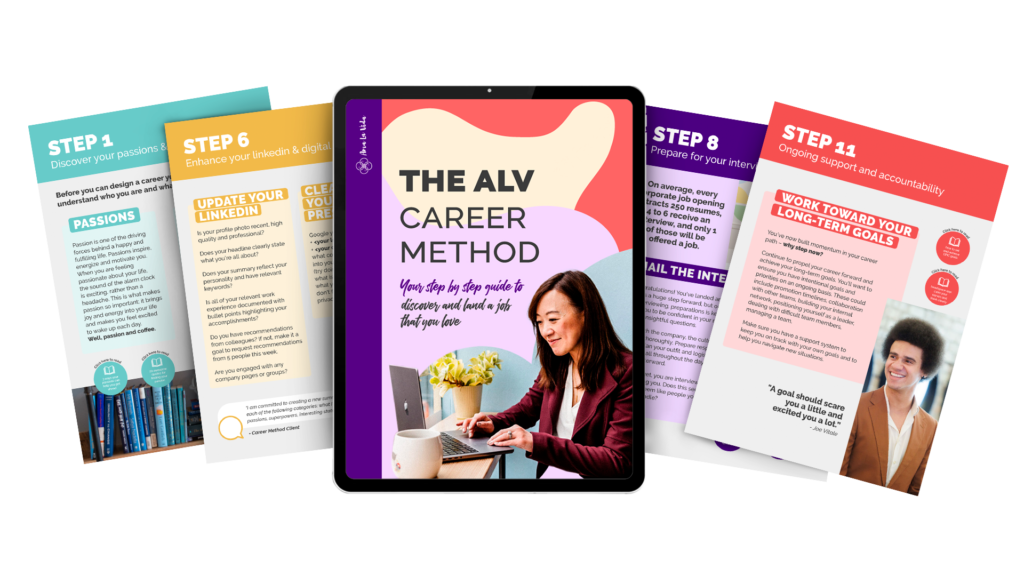
Download our comprehensive step-by-step guide to design and land a job you love!

Images from The ALV Career Method Guide
ALV Method Downloadable Guide

nicole wood smiling looking up to the sky

I just had my second miscarriage.  I went in for my first OB appointment of the pregnancy at 8.5 weeks as is standard practice. With my daughter, we thought on that first scan that she looked like the cutest little gummy bear. While nervous given the last pregnancy didn’t work out, I was so excited to see that wiggly, tiny little baby on the screen. Already at this point, I was in deep. I had: I walked into that appointment buzzing with excitement to see my baby for the first time. Instead, in the span of 15 minutes, I received a whirlwind of news that left me with no baby and a cancer scare instead. I had a rare occurrence called a molar pregnancy. It’s a chromosomal abnormality that leads to your body growing a mass of cells instead of an embryo. There’s no chance of a viable pregnancy, and instead there’s a real risk that, even after a d&c, those cells continue to grow (cancer) and require chemo to combat. Through my research and consultation with my doctor, I was made aware that no matter what happened post-d&c, this is a very treatable condition, and I will ultimately be totally fine. That’s certainly a relief. I know I’m going to be okay.  But it is unsafe for me to try to conceive again for many months, potentially over a year, depending on the course of my treatment and recovery. And who knows what will happen then.  The summer maternity leave I was planning for… gone. The 2.5 year apart siblings growing up together… gone. The family of four I thought I’d soon have… gone. And quickly replaced with massive doubt that it will ever come. So what now? I’m giving myself some time to be sad. And angry. And jealous. And heartbroken. Because I am all of those things and they deserve a space in this process. And then… I’m putting one foot in front of the other and continuing to move forward. With each day it gets easier. I’m spontaneously crying less… so that’s something. But my biggest fear in all of this isn’t that I’ll have cancer or even that I’ll never be able to have another child. It’s that I’ll squander years of my life, precious years of my daughter’s toddlerhood, waiting and wanting for something else. That I’ll be so focused on the next step toward recovery and trying for the next baby that I’ll be unable to fully enjoy the one I have right in front of me. And I can’t let that happen. I know my situation is unique, but in so many ways it’s not. You’ve felt this before. The struggle of trying to enjoy life when you feel like you’re waiting for a big part of it to start. You’ve had your version of it. Maybe you’re living it now. Waiting to land that amazing job so you can ease your financial strains and be able to contribute your talents meaningfully. Waiting to get through this seemingly never-ending project at work so things can calm down and you can make plans again. Waiting for your business to find solid footing so you can prove that your idea wasn’t crazy. Waiting to find the one so your life with a partner can begin. Waiting to get even that first positive test so you can become the parent you know you were meant to be. Waiting for something to happen that may almost entirely be out of your control, that you feel is standing in the way of you living the life that you truly want for yourself. It sucks. It really sucks. This isn’t a “5 Steps to Overcome…” type of post. Today, I have no advice. All I have is my story.  All I can do is share that if you are feeling similarly, I see you, I have hope for both of us, and I believe that no matter how difficult it is, our lives today are worth living fully just as they are. I can remind us that no matter what’s missing, there’s so much good stuff here already. I can tell you that you’re justified in cursing the world for its injustice, just as I am. And that you’re not foolish for holding onto hope for what might be. I unfortunately cannot tell the future. I don’t know if or when what each of us wants will come our way. But my wish for you today and always is that in the midst of the waiting, you don’t forget to keep living.

Read More
person working on computer

“Everyone has been made for some particular work, and the desire for that work has been put in every heart. Let yourself be silently drawn by the stronger pull of what you really love.” Rumi When we find ourselves at a crossroads with no destination to load into our work-life GPS, it’s so easy to get discouraged and conclude that these words by Rumi simply don’t apply to us. However, I believe they do. My fascination with loving one’s work began when I was a child. My dad was a truck driver; he hauled produce locally. The first time I went to work with him, I remember sitting in that humongous tractor-trailer, watching him shift those big gears while we bounced in our seats and rode high above everyone else. I observed as he interacted with farmers, fellow coworkers and customers with a smile and such joy. When he arrived home after a long day of work, he would head outside to engage in a variety of other activities that also seemed to bring him joy. To me, he modeled a love for his particular work, inside and outside the parameters of his paid employment. When I reflect on this experience, having spent a couple of decades studying work-life, I’m convinced that we just get tangled up in the titles, prestige and money, when it’s really about the work itself and our contribution. I cannot confidently say that driving a semi-truck was the work my dad loved, but he sure seemed to enjoy himself, and everyone he came in contact with seemed to enjoy him. He had a knack for interacting with others, he never seemed to meet a stranger, and he was a creative problem solver. For the record, he did love to drive just about anything – cars, motorcycles, vans and RVs – and he handled an 18-wheeler like the best of ‘em. I do believe the desire for our particular work has been put in our hearts. Isn’t this evident when we’re children? You can see it in our curiosities and everyday play. Our unique interests, way of exploring our world, and solving problems become clear quite early. So what happens? Oftentimes, that light, that fascination, those sparks get squashed. Well-meaning adults in our lives, for a variety of reasons, gently (or not so gently) nudge us in a different direction. Through their language, what they reward and criticize, and through their modeling deliver the message that we’re not on the right path. Their unrealized dreams, practicality, fears, judgment, etc. take hold, and they believe we “should” be doing something different than what we really want to lean into. The result: all of those shoulds add up to internal conflict, which can jumpstart a lifelong struggle with work-life decisions. The current zeitgeist is rife with misinformation, mutterings, misunderstandings and myth when it comes to work choice. As a result, many people are leery about veering away from the so-called “safe,” traditional path, or may discourage their loved ones from pursuing their particular work because that wasn’t what they were encouraged to do. It’s only when we release all of the shoulds from others that the internal conflict starts to subside. We all have key card access to work we really love, and we don’t need permission to begin swiping it. It takes commitment, persistence, some introspection, unlearning, exploring and uncovering to arrive at the point where we can comfortably, without guilt, pursue the work we love. And, we must remember that no choice is permanent. We can pivot, change it, or make a different decision at any time. When we know what we want to do and take action in that direction, the “being stuck” disappears, and we feel empowered. This is why I hosted a free coaching hour, “What If I Have No Clue What I Want To Do Next?” to help you learn how to figure out what your next steps should be, even when you have no clue what to do next in your career. The point is to make sure that you make space to be silently drawn by the stronger pull of what you really love, and I want to help you find what that is. ~ Coach Robbi

Read More
woman waving at computer screen

The names and circumstances behind this case study have been altered to maintain client confidentiality.  Can working with a coach help me move past my people-pleasing tendencies? What is your success rate in enabling your clients to set healthy boundaries? What are some examples of transformational stories that you’ve had in working with clients who struggle with people-pleasing?  ​​I get asked these types of questions all the time when meeting with prospective clients.  So today, I want to share with you all a case study in just how life coaching can help individuals to recover from people-pleasing.  Coaching enables individuals to articulate their goals and aspirations and bring awareness to where in life they want to (and need to) make improvements or changes. People-pleasing is one of those behaviors that we often don’t realize is hindering our potential. Pleasing others is innate to our human nature because it is rooted in the need for belonging. People-pleasing keeps us safe. One can never run out of people to please whether that be at work or in their personal lives. However, while belonging and safety are the upside of people-pleasing, this behavior doesn’t come without damaging impacts to one’s mental health. People-pleasers may worry so much about earning approval that they don’t vocalize their own needs or set healthy boundaries. Because saying no is so extremely difficult for people-pleasers, others often walk all over them. Outwardly they appear to lack confidence and conviction and when criticized they often take it personally.  Bottom line: People-pleasing, if left untreated, can evolve into a toxic cycle that can be detrimental to our emotional and mental well-being.  So how does one know if they are a people-pleaser and how does one recover from this toxic behavior?  The truth is, talking through this behavior with a coach is an essential part of the recovery process. A coach can help provide input and tools to enable the client to recognize how to set healthy boundaries and learn how to say no. This type of coaching requires the client to be open to feedback and to be challenged to change behaviors that have become a default to their identity. I’d be lying if I said this work was easy. What I know to be true is that for every client I’ve helped in healing their people-pleasing tendencies they have all said without a doubt the work was hard, but it was worth it.   “Can working with a coach help me move past my people-pleasing tendencies?” “What is your success rate in enabling your clients to set healthy boundaries?” “What are some examples of transformational stories that you’ve had in working with clients who struggle with people-pleasing?”  These are all great questions, so let’s dive into it using a real life client success story. I’m going to outline at a high level some questions that I asked my client in order to enable her to move from people-pleasing to empowering herself to set healthy and honest boundaries.  Meet Audrey. Audrey has spent her entire twenties attending bachelorette parties and weddings for her friends. She’s traveled across the country and the world more times than she can count and hasn’t said no once. Wearing the title of “great friend” like a badge of honor, she rarely says no. She’s been a bridesmaid 33 times. She regularly checks in with her friends and remembers all the little details of their lives. In her early thirties she’s realizing that her friends aren’t reciprocating this same time of behavior toward her and she’s finding herself being resentful. “Cait, why is it that I show up continuously for everyone and when I ask people to show up for me they seem to be going on with their own lives?”  Many of us can connect with Audrey’s story. In fact, research shows that about 49% of Americans self-identify as people-pleasers and the statistics are even higher for women.  Many women say that people-pleasing comes naturally to them, but they also argue that society has conditioned them to participate in people-pleasing behavior. We are conditioned as women to put our needs last ahead of our communities, our friendships, our partners and our children. This is where people-pleasing can become a toxic cycle that leads to overcommitment, resentment, and exploitation.  What do you gain in “showing up” for  everyone? Throughout our sessions, Audrey realized that her people-pleasing tendency was rooted in her need for belonging. When she “showed up” for others meaning she said yes to what they needed, she was rewarded by her friends saying “she’s the best” or “Audrey is my ride or die.” She also found that this led to an often crammed social calendar which led her feeling energized at times, but more recently it had left her feeling depleted and growing resentful of her friends who weren’t showing her the same way.  Now, as a coach, this story is familiar. What I sensed beneath the surface is that Audrey’s non-negotiables have shifted. It’s common for our non-negotiables to change as we evolve and our lives change. A non-negotiable is a value that you use to guide many of life’s complicated decisions. While values are often broad terms, such as security, education, loyalty, and connections, a non-negotiable may be a concrete activity that exemplifies a value. For example, if a broad value is “Family,” then a non-negotiable might be one-hour of distraction-free family time.  It sounds like your needs have shifted from your twenties into your early thirties. What do you need to be your best at this stage in your life?  “I need space. I need alone time. I need to feel like I can release my expectations of others to show up in the same way that I do for them. I need to release this pressure I put on myself because it’s leading to resentment.”  Audrey, naming our non-negotiables can be a powerful step in helping us identify where and how we can set healthy boundaries. Where can you set

Read More
two colleagues talking

When my oldest son got cut from the 7th grade basketball team, it was devastating.  He was a strong player and he simply felt that he was cut for reasons that had nothing to do with his performance.  He could have simply given up the sport, but we spent some time coaching him through what went wrong.  Truth is, some of what he figured out had been shared with him before, but this time, he chose to take it on board and work to improve.  He chose growth and continued playing basketball and is a college basketball coach today. I always think of that story when I am working with people placed on a Performance Improvement Plan (PIP).  Most people placed on a PIP by their manager or Human Resources team have had, in theory, numerous conversations about areas for growth.  But the formality of a PIP is what might ultimately startle the individual into taking the feedback seriously – perhaps for the first time.   Sadly, many people assume that being placed on a PIP is the employer’s unspoken way of saying “you are a few months from being fired…no matter what you do.” They view the PIP as mere documentation to support the employer’s decision.  However, when the PIP comes with an offer of coaching (a clear investment in the individual), the individual can often see a path to growth. It’s not unusual for someone placed on a PIP to feel hurt and angry and be in a bit of denial.  Initially, they may be defensive and convince themselves that there’s nothing they can do to improve their situation but, in my experience, once a person has the chance to vent to a neutral third party, they become more ready to consider the possibility that the outlined areas of improvement are worthy of their attention.   When coaching people who are feeling a PIP as a threat, the following 6 steps can help bring them to a growth mindset that leads to success:

Read More
woman with eyes closed standing outside

My daughter turns two very soon. The classic “the days are long, but the years are short” is probably the truest parenting cliché of them all. The hours before bedtime often feel like an eternity (especially during nights like last night where she decided the tub was a fantastic place to poop), but these years have gone by in an instant.  I was reflecting on this time in my coaching session this week with my amazing coach, Betsy Westhoff, and I was struggling to articulate how I’ve been feeling. It came out as, “I feel like a squishy, insecure version of myself, both inside and out.”  I really felt like I was going into parenting with my eyes wide open. I had heard it all: the delivery stories, the sleepless nights, the teething. One of the benefits of having kids later than many of my friends was collecting a ton of information. I knew it would be hard. I knew I would be exhausted. I thought I had managed my expectations as well as anyone could. I was sort of right… and a lot wrong. I was focused so much on the physicality of it all. How my body might feel. How tired I might be. The challenges breastfeeding could present. And I handled those all fairly happily (well, as happy as someone can be pumping in the office for the 3rd time that day). What I completely failed to ask about and prepare myself for was how I would be rocked emotionally. What it’s truly like to go from booking trips on a whim to not being able to go to CVS on my own. How badly it hurts when the person you grew, delivered and fed from your body wants Daddy instead of you. The disgust you feel when your ass looks terrible in every pair of jeans because you haven’t figured out how the heck moms find time to exercise. The helplessness you experience when you can’t catch up at work and you’re questioning yourself and your skill set in ways you never have. The last two years have been incredible. And they’ve also been really, really hard. Betsy helped me articulate my challenge in a new way. While I’ve gained so much beauty and fulfillment in my life, I’ve lost a bit of my power. And I am ready to get it back. To not long for the person I once was, but to become a newer, stronger version of myself. To accept that pieces of me will be squishy at times and also to strengthen those I’d been neglecting. So what now?  Betsy walked me through some reflections to help me identify what’s been missing. A few themes emerged from our discussion. I like creating stuff. I often say what attracted me to entrepreneurship is building something from nothing. Be it a business, an art project, a blog post or a new design for my home, I like to make things. How can I build this into my routine? I need to move my body. We talked about how for 15 years, I was a serious competitive dancer. For anyone who has a former life as a competitive athlete or performer, you know it often leaves a big hole in your life, difficult to fill in your current world. Becoming a parent expanded this gap for me, as I stopped exercising all together. What’s the smallest thing I can commit to to get moving? I find joy in doing stuff that only I can do to build the business. I love writing. I love sharing my journey with others. And yet these things are never the priority when I open my computer in the morning. I’m sucked into the needs of the business that day, and the stuff I love gets put on the back burner. Forever. What if I started to prioritize contributing to the business in ways I love and that only I can? I don’t feel guilt for being away from my child or work, but I want to feel like I’m doing something valuable in each place. I have a special flavor of mom guilt where I don’t feel bad for the time I spend away from my child or my business. Instead I feel bad for feeling like I’m doing each one shittily. Less time is okay. More impactful is necessary. What does that look like for me? These are not nice to have. As parents we are told constantly to “put our oxygen masks on first” and that you “can’t pour from an empty cup.” These have become major eye-rolls for me – I’m so sick of hearing them. And yet… what I need to do is listen, not just hear. I keep postponing rejoining Classpass. I keep accompanying my husband and daughter to swim class to make his life easier when it’s the perfect opportunity for me time. I keep prioritizing everyone else’s Slack pings over my own goals. Who could I be if I made these non-negotiables? So to summarize the process and to give you a checklist because who doesn’t love a checklist: The in-betweens are the hardest. When you have the awareness that you’re no longer happy to stay where you were, but you’re not quite sure where you’re headed just yet. These in-betweens pop up in your career, your business, your relationships and yourself. And they are all-consuming. I’m in one now. I’m not the confident 20-something who’d strike up a conversation with anyone at a bar and who quit her corporate job to start a business. I’m not the wise mother who knows the right thing to say and always gets her laundry into the dryer on the first try without having to rewash it. I’m in a messy middle, painfully growing into the person, mother and leader I’ll soon become. But thanks to my coach and the incredible support system I’m lucky enough to have around me, I’m finding my way

Read More
two people talking and looking at a computer

This is a true story of when I lost my job due to a lay off and the feelings, emotions, struggles and challenges I experienced when faced with losing my role. (Spoiler alert- there is a happy ending to this story- thanks to my former employer, who chose to do the right thing for me and their organization.) Several years back, the organization I worked for in an HR capacity, underwent a huge transformation following an acquisition which impacted thousands of employees over the course of approximately 18 months. I too was one of those impacted, but not until after 18 months of supporting the organization and its teams through this huge change and seeing first hand the immense toll that losing one’s job takes on individuals. I would describe this time as a period of turmoil. Upon the announcement of the acquisition, many if not all employees felt very insecure about the future in terms of the company and their continued employment, and rightfully so. Some employees did not want to deal with the uncertainty and jumped ship early on. Others decided to stick around however, not knowing how long they would work there pending future layoffs, there were many feelings of anxiety permeating the workplace and impacting productivity and morale. Personally, while I was a strong performer, I saw the writing on the wall in terms of how the new HR team would be structured and how my role would not be in alignment. Despite this foresight, on the day of my own layoff, I still felt all of the emotions that one experiences when they experience job loss. Some anger, of course, and some sadness of leaving behind those that I had worked with over the course of the last 5 years. The worst part though was the FEAR. The FEAR that you will not find a job that you will enjoy that is in alignment with your passions and purpose in life. The FEAR that if you do find a next role, you will not have the work-life balance to be able to take care of your family and personal well-being. The FEAR that you will use up all of your savings and have to start eating ramen for dinner every night.  Additionally, because you have spent your time working with the daily grind of your work schedule and deadlines, you can’t remember any of the achievements that you have had in the past 10 years. You are unable to think of any of your strengths that have gotten you to this point in your career. You DEFINITELY can’t remember how to write a resume or interview, and you sure as hell don’t feel prepared to get out there and network. Yikes, what now? One word – Outplacement. Outplacement is a benefit offered by some organizations to laid-off employees. These programs utilize a process that offers support and training in managing this huge change in transitioning to a new job. Resources and coaching can help former employees deal with the aforementioned emotional toll, help them to identify what they want to do next, and additionally provide tactical support related to career search components like resumes, cover letters, interviewing assistance, etc. Implementing outplacement programs has been shown to result  in immensely positive outcomes for both the former employee and employer.   For the individual: The most obvious positive outcome: Helping the former employee find a new role. As mentioned previously, laid-off employees often feel a range of emotions and reactions to being laid-off. Many don’t even know where to start the process of finding a new job. Outplacement services can help these individuals and guide them through steps that will enable them to be job ready more quickly. Oftentimes, outplacement services will include online tools and resources in addition to sessions with a career coach that will support them in figuring out what they want to do in their career, training needs,  and planning the action steps to get there.  For the Employer: Aside from just being the right thing to do, providing outplacement services to laid-off employees also protects an organization’s brand image in 2 ways: Layoffs can lead to decreased morale and distrust amongst those employees that stay on. They may spend their time worrying about if they are next or questioning the values or viability of the organization  which in turn can make it a negative environment to work in.  When employers offer outplacement to those laid-off, those employees can see that the employer is taking action to help support those laid-off, which can help with maintaining positive morale and help with retention.  Providing outplacement support can help to move employees that have been laid-off from  staying in a place of anger to looking to a brighter future if they have support and resources that can enable them to see the light at the end of the tunnel. Employees are then less likely to post or share negative comments about their experience and the organization, which could ultimately deteriorate a company’s reputation and brand.  I was one of the lucky ones! My organization saw the value of providing outplacement support. I started meeting with my assigned coach and taking advantage of the resources offered immediately. Surprisingly, even though I thought I was pretty smart since I had spent most of my career in HR, I learned SO many helpful strategies related to a successful career search that I didn’t know existed. My career coach and I had a great connection, and she provided me with the accountability that I needed to put in the work to find my next path. I would be lying if I said my job hunt was all sunshine and rainbows. As with any job search, I encountered some highs AND lows,  but it was awesome to have my coach to support me through these times when I needed a confidence boost to keep me on track.  So employers – What are you waiting for? Reach out now to Ama

Read More