Category: Achieving Goals

woman looking at computer writing down notes in her journal

Knowing when and how to find a career coach can make all the difference. Let’s face it, no one ever teaches you how to navigate your career. At best, we get half-hearted questions like, “What do you want to be when you grow up?” and “Do you know what you’re going to do when you finish school?” From there, you can try to find a mentor or hope for a great boss who might help you get promoted or otherwise grow in your career. More often than not, though, you’re left to figure it out on your own. And that’s where a career coach can step in. But finding the right person to help you along the way can feel daunting. That’s why we’re here to help you understand how to choose the right coach for you! First, though, let’s start with the basics. What is a Career Coach? Instead of simply telling you what to do, coaches empower you to leverage your resources and find the best solution for yourself, no matter the challenges you’re facing in your work life. Whether you’re at a crossroads or seeking advancement, they can provide invaluable support tailored to your unique goals and challenges. What Does a Career Coach Do? Career coaches can support you with a number of things from finding clarity around your career path, or finding a new job (think resume review and interview preparation), to confidence building, decision-making and leadership development. If you’re feeling stuck in your current role or seeking more satisfaction in your work life, they will empower you to take aligned action towards your goals. They can also assist in making sense of your professional aspirations and guide you through potential career changes. Through exploration, strategy, and accountability, a career coach helps you move forward with intention to achieve your own unique version of success. Why You Need a Career Coach Figuring out your next career move can feel like a full-time job. Between researching roles, updating your resume, networking, and second-guessing yourself at every turn, it’s easy to feel overwhelmed or stuck. A career coach brings a grounded, objective perspective and stays current on the job market and hiring trends. They help you cut through the noise, clarify what really matters to you, and focus your time and energy where it counts. They’ll help you move forward with more direction and less stress, while supporting you to build confidence, hone your transferable skills, and take meaningful steps toward a career that actually feels right. View this post on Instagram A post shared by Ama La Vida | Online Career Coaches (@alvcoaching) Before You Start Searching, Understand Your Support Needs Before you dive into your search, take a moment to reflect on the following questions to help you pinpoint the specific support you need. Are you looking for clarity on your career path or considering a career change? If you’re reconsidering your career trajectory and exploring a career transition, you’ll need a specific kind of support. This kind of coaching focuses on exploration, getting to know yourself and what a successful career looks like for you. A career coach trained in career exploration may not focus on technical support, but rather self-awareness to guide your decision. Are you looking for a new job in the same industry? Maybe you enjoy your current job, but want a change—whether it’s a new role, a better company culture, higher pay, or more work-life balance. If this is the case, you may want to find a career coach who specializes in your industry. Do you need technical support like resume review or job search guidance? If you’re looking for resume writing, interview prep, or job search strategy, you may benefit more from a coach that also doubles as a career consultant. This type of support is often advice-heavy and focused on helping you navigate the process efficiently. Are you looking to grow within your current role or industry? Career development coaching can support leadership growth, skill-building, and strategic planning. This is great for mid-career professionals to senior leaders who want to advance, become more effective, or explore what’s next in their field. How to Find a Career Coach that Fits Your Needs Understanding how to find a career coach that’s truly right for you can feel overwhelming at first, but it doesn’t have to be. With the right approach, this process becomes an empowering step toward real, lasting professional growth. Instead of spending hours searching online, scrolling through endless bios, and wondering if a coach will “get” you, there’s a simpler way. Let Ama La Vida’s Relationship Strategists Do the Work for You At Ama La Vida, we take the guesswork out of finding your ideal coach. Our coach-matching process is deeply personal and 100% human. You can get started by filling out a quick form about your goals and needs, or jump on a free consultation call with one of our Relationship Strategists. During the call, they’ll ask thoughtful questions to understand your challenges, goals, and preferences. Then, based on that conversation, they’ll hand-select a certified coach from our diverse team of 60+ career experts who best aligns with your needs. You’ll receive a link to their profile, which includes their experience, specialties, and testimonials—plus you can schedule a complimentary coach consultation to make sure it’s the right fit. You’re not limited to just one coach either. Through our “celebrity sessions,” you can meet with other experts on our team to explore topics outside your primary coach’s expertise. It’s full-cycle career coaching, built around your goals. Ask Your Network or Therapist for Referrals Another great way to find a career coach is to tap into your network, as they can offer valuable recommendations based on their own experiences. Talk with people who you trust, discussing your career goals, and ask if they can recommend any reputable coaches. Additionally, if you’re currently seeing a therapist, they may also be a helpful resource. Leverage Coaching Directories and Social Media If you’d

Read More
Woman writing in planner

If you’re here to download a career plan worksheet, chances are you’re feeling stuck in your career. We get it—we’ve been there too. Maybe you never really knew what you wanted, you followed a career path only to realize something was missing, or life is just taking you in a new direction. Whatever has you here, we understand that making a change can feel overwhelming. Before you spend hours filling out job applications or years getting more education or training, we’re sharing our method to help you figure out your next career move. Download our comprehensive career plan worksheet to get started paving a fulfilling career path. We created this free in depth guide to help you begin exploring career options and making a plan that works for you. Understanding Career Transitions For Ama La Vida members, career transitions can be driven by things like the desire for better work-life balance or higher income, job dissatisfaction, or going after their dream job. While our members want to find a job that aligns with their interests, it’s normal for them to feel a mix of emotions from excitement to worry that they wasted time getting to where they are now. Some even worry that the next job won’t be any better than the last. It’s true, making a job transition can be scary, but with a proven strategy you can move forward with confidence. This part is all about self-reflecting to understand what you truly want for your career and then figuring out the steps needed to achieve it. Let’s get into it! Using Career Plan Worksheets: Your Road to Rediscovery Think of a career worksheet as your personal roadmap. It’s a tool that helps you figure out your work goals and how to reach them. Unlike those quizzes that tell you what job you should have based on your skills and personality, a career plan is all about creating a step-by-step strategy to achieve your specific career dreams. The main parts of a great career plan include: Setting goals helps you know exactly what you’re aiming for, which keeps you motivated. Focusing on skill development means you’re always learning what you need to succeed. And when you have a big, long-term goal, you can break it down into smaller tasks that are easier to tackle. Each part of the worksheet helps create a solid plan, leading you to a career that’s both successful and aligned. Design Your Dream Career with Our Career Plan Worksheet Our downloadable template allows you to explore and identify your best path forward. You’ll reflect on your values (what’s important to you), interests (what you love doing), and skills (what you’re good at). When you understand these things about yourself it’s much easier to narrow down and decide between different careers. By doing research, networking (talking to people in different fields), and having informational interviews (chatting with people about their jobs), you learn a lot about various industries and roles. Taking the time to do this research ensures your future career goals match what is important to you personally and your skills. Not only does career planning help you clarify what jobs interest you, but it also gets you ready for job applications by highlighting your relevant qualifications and experiences. Chances are, you didn’t have a plan when you found your current job. Without a worksheet, your next job search might be all over the place. You could end up applying to jobs that don’t really suit you, feeling lost, and not reaching your full potential. A Harvard Business Review article shared that very few people think about their career over the next five years. This worksheet will help you set long-term career goals—these are the big objectives you want to achieve in your work life. They guide your career path and help you make better short-term decisions. By exploring and planning systematically, career worksheets pave the way to career satisfaction. Overcoming Obstacles and Staying Motivated Balancing career exploration with your current responsibilities can be tricky. It takes good time management and prioritization. To make it work, set aside specific time each week to explore jobs and learn new skills. Sometimes, you might feel scared or doubtful about the process. To overcome these feelings, break your goals into smaller, more manageable tasks. Then, celebrate each small win as you complete them. Ask mentors, colleagues, and friends for advice and encouragement. Don’t be afraid to seek help or use resources like career coaches and online courses to fill in what you don’t know. Stay interested in your journey by reminding yourself of your long-term goals. You can make a vision board or post reminders for yourself of why this transition is important to you. Don’t forget, by planning methodically and using support, you can achieve your career dreams. Making the Most of Career Plan Worksheets Take time for self-reflection To get the most out of these career plan worksheets, start with honest self-reflection. Really dig into your skills, interests, and values to create a clear career plan. Work your way through the questions in each section of the PDF worksheet guide to help you uncover what’s most important to you. Ask for feedback Share your completed worksheets with mentors or colleagues for feedback. Their insights will help you spot your natural talents. Make it a research project Do thorough career research to understand job requirements and industry trends. This includes having informational interviews to learn about daily life in different roles. Yes, it’s work, but this can also be fun! You’re learning about potential careers that match your own interests. Make sure to take note of what sounds interesting to you! Actioning The Career Planning Process Once you’ve built a career plan, it’s time to put it into action. Here are few ways to get started. Prepare for your job search Keep a log of your accomplishments and add to it often. You can use these to update your resume to match your goals and new

Read More
Ama La Vida Coaches in the "Happiness Hub" office

If you’re here, looking into Ama La Vida Coaching reviews, you’re probably wondering: Does this coaching thing actually work? And maybe more importantly—is it worth the investment? 🤔 We get it. Coaching isn’t cheap. It’s vulnerable. And it’s a time commitment. But if you’re stuck in a job that drains you, navigating a career pivot with no map, or silently screaming, “There’s got to be more than this,” then coaching might be the most important investment you’ll ever make. Below, we’re sharing real Ama La Vida coaching reviews—from folks just like you—who decided to stop spiraling and start building a career (and life) that actually feels good! Why People Work With Us: The Moment Something Snaps Whether it’s burnout, boredom, or the quiet panic of “I should be farther along by now,” most people come to us feeling stuck. They’ve been applying, applying, applying. They’re saying “yes” when they mean “no.” They’ve hit a wall, but don’t know which way to turn. Take it from our client Evan. Evan had a quiet, gut-level knowing that something needed to change after 11 years at the same company. He didn’t just want a new job. He wanted a fresh start, a life that felt like his again. Clarity > Chaos: What Happens When You Actually Know What You Want Career confusion is loud. Career clarity? Game-changing. Once you understand (and own) your passions, gifts, values and purpose and zero in on the destination you’d like to target, the rest of the steps start to reveal themselves. With his coach, Evan unpacked what actually mattered to him—his values, his purpose, his passions. The work didn’t just help him build a résumé; it helped him build career clarity. And from there, everything else changed too. What we’ve realized through supporting thousands of clients: people don’t need more advice. They need to pause long enough to hear their own voice. That’s what coaching with Ama La Vida offers: a mirror, a map, and moments to reconnect with yourself. We don’t tell you what to do. We help you figure out what you want to do. Then we walk with you and guide you while you do it. Coaching + eCoaching = Transformational Magic Ama la Vida is so much more than just one-hour zoom calls. We love a good coaching session. But make no mistake: that’s just one part of the magic. What really sets our programs apart is what continues to happen between the sessions—when you’re reflecting, questioning, journaling, and connecting the dots. That’s where our signature eCoaching programs come in. Think of eCoaching as your personal development portal. You get access to structured content, self-paced reflection exercises, and prompts designed to help you dig deeper, get unstuck, and create the clarity you’re craving. One client, Jemma, came to us during a career transition. She knew she wanted a change, but didn’t know what that change looked like yet. “The e-Coaching course was very supportive, informative and helpful during my career transition. Personally I was looking to make a change but wasn’t sure which direction to head. I discovered that the exercises in the program were like someone handing me the keys to my own future.” – Jemma The exercises helped her shift how she thought about her options, uncovering answers that had been there all along—she just needed the right framework to surface them. Every ALV coaching client gets access to these digital coaching programs in their account. So if you’re someone who likes time to think, write, reflect, or revisit a tough topic later, that’s all baked in. You can log in anytime between sessions to reflect, revisit a prompt, or keep building clarity at your own pace. Want to try it for yourself? We’ve pulled one of our favorite eCoaching modules into a free downloadable workbook, so you can get a feel for the kind of reflection, insight, and action this work unlocks. Download it, dive in, and see what starts to shift when you finally make space to hear your own voice. Your Career, Your Coach, Your Fit Ama La Vida isn’t isn’t cookie-cutter coaching. It’s tailored to you. Because we understand that a coach who gets you changes everything. When you join Ama La Vida, you don’t get randomly assigned to a coach by an algorithm. You meet with a real, live human—one of our Relationship Strategists—who takes the time to understand your story, your goals, and what kind of support you’re really looking for. From there, we match you with the coach who’s the best fit for you, not just on paper, but in vibe, style, and substance. And the best part? You’re never limited to just one voice. You’ll also have access to expert-led Celebrity Sessions™ with other coaches on our team when you want to dive into something specific. From Seattle to Chicago to Sydney, our coaches and clients span industries, cities, and career stages—but they all have one thing in common: they believe work should support a life you love. Pivots, Promotions, and Permission to Want More Maybe you’ve been successful on paper—but secretly feel like a fraud. Maybe you’ve been promoted, but you’re feeling unfulfilled. Or maybe you would like to explore a path that feels more meaningful. You’re not wrong for wanting something different. And you’re definitely not broken. It means you’re ready for something more aligned. At Ama La Vida, we support clients through both career growth and career change. Sometimes that means pivoting. Sometimes it means rising where you are. And sometimes? It means taking a completely unexpected route. Just ask the Big 4 consultant who came to us filled with doubt, fear, and guilt about walking away from a high-paying role. Coaching helped her untangle those emotions, reconnect with her values, and design a career on her own terms. Today, she runs her own business—and her life feels like hers again. Want to see what that kind of shift can look like? Read our case study: How Coaching Can

Read More
Broken ceramics vase on floor

I was staring at what should have been a pretty vase with a round belly and a tall narrow neck, but it looked more like a wonky ball of clay. After weeks of successfully throwing mugs, bowls, and yes… even plates, I had decided to challenge myself with something more creatively complex and demanding. That day, our teacher had brought this beautiful bottle vase to the studio, and I decided that would be my next challenge. After a demo and some 1:1 coaching, my hands were trying to partner with the clay to get to the desired outcome. I was following each step carefully, trying to remember everything I had just seen and learned, and slowly but surely the frustration started building in my chest. This was hard. This was uncomfortable. And this was not going to an easy 20 minute throwing session. This was about to take an entire hour. Something about the struggle felt familiar from my work as a coach—I was watching someone (myself) navigate the messy, vulnerable process of growth. The Discomfort of Growth Those first attempts at pottery were humbling in ways I hadn’t expected. My hands and my brain, usually confident in guiding others through career transitions, felt uncertain against the clay. I was reminded of the countless clients who have sat across from me, describing their resistance to taking on a challenging new project or considering a role that felt just out of reach. There’s something deeply human about our instinct to stay where we feel competent, where we know we can succeed. But here’s what both pottery and career development have taught me: there’s a crucial difference between productive discomfort and destructive stress. Productive discomfort is that feeling when you’re stretching just beyond your current capabilities—your hands are learning new muscle memory, your brain is forming new neural pathways. Destructive stress is when you’re forcing outcomes, fighting against your natural limitations, or pushing so hard that you’re likely to break something (or yourself) in the process. In other words, if the challenge becomes too much, we stop functioning in positive and supportive ways. This reminded me of a graph I printed out years ago when I started coaching clients that’s been up on my wall in my office for all this time: the optimal tension curve, or stress performance curve: Image Source The Paradox of Endless Possibilities Walking into a ceramics studio for the first time can be overwhelming. There are many different clay types, then you learn about hundreds of glazes and glaze combinations, countless techniques to master, the wheel, handbuilding, and infinite forms to explore. Functional or decorative pieces—the possibilities stretch endlessly in every direction. It’s exhilarating and paralyzing at the same time. I see this same paralysis in my coaching practice regularly. Clients come to me feeling stuck, not because they lack options, but because they have too many. Should they pursue the MBA or focus on gaining more practical skills? Explore the startup world or aim for a role at an established company? Stay or leave? When they are ready to pivot, in what direction? The abundance of choice quickly becomes a barrier to movement. In pottery, I’ve learned that you have to pick a direction and start somewhere, even if it’s not perfect. You can’t master everything at once, and trying to do so often leads to mastering nothing. The same principle applies to career development. Sometimes the best choice is simply to make a choice and begin learning from the experience. The Creative Flow as Mental Sanctuary When I decided to start pottery classes last year, one of the things I was most looking forward to was how the creative process would benefit my mental wellbeing. There’s something about doing something with your hands and exposing yourself to what is “new”, this complete focus that creates a meditative state I can’t replicate anywhere else. I’m still using the analytical part of my brain—the part that’s constantly strategizing and problem-solving for clients—when I’m throwing. But instead of strategizing for someone else, I problem solve in the moment, thinking about what the final product will look like. It is a very tangible process.  This creative flow has become non-negotiable in my week. After days spent helping others navigate complex career decisions, I need this space where my hands can work and my mind can wander. It’s not just relaxation; it’s a different kind of thinking.   Again, being in that flow state teaches me about optimal challenge levels. When I’m working with clay and everything clicks—when the pressure is just right, the clay is centered, and the form is emerging as I envision it—I’m in that sweet spot where skill meets challenge. It’s taught me to recognize this feeling and help my clients find it in their professional lives too. Building Your Foundation Before You Stretch In pottery, and most other crafts, there’s a progression that can’t be rushed. You learn to center clay before you learn to pull walls. You master basic shapes before attempting complex forms. Skip these fundamentals, and everything becomes an exercise in frustration. The same principle applies to career development, though it’s often less obvious. I’ve worked with clients who want to leap into senior leadership roles without first developing their ability to influence without authority. Others want to transition into completely new industries without identifying and building transferable skills or understanding the new landscape. The temptation is always to jump ahead, to want the big breakthrough immediately. These foundational elements are what make ambitious stretches possible rather than just wishful thinking. When you have a solid foundation, the sea of possibilities becomes less overwhelming and more navigable. You can evaluate opportunities based on how they build on your existing strengths rather than feeling like you’re starting from scratch each time. One Step at a Time It was during one of my first pottery classes that our teacher warned us of the almost inevitable overwhelm students feel when they start learning about different

Read More
two Ama La Vida Employees sitting at a computer

Are you feeling stuck in your job search because you lack a college degree? You’re not alone. In fact, according to CNBC “62% of Americans don’t have a degree.” The good news? There are countless jobs with no degree required, and it’s entirely possible to build a rewarding career at any age without one! Actually, contrary to popular belief, there are many high-paying jobs that do not require a four-year college degree. Here’s how you can get a new job at any age by building a strong personal brand, focusing on transferable skills, engaging in your network and embracing lifelong learning without going back to school. The Importance of a Strong Personal Brand Knowing your personal brand is crucial in today’s competitive job market. It helps you stand out from other candidates and showcases your value to potential employers. You can incorporate your experience and professional persona which allows you to be memorable and trustworthy. It helps companies and potential employers value your character and experience, regardless of a degree. Here are two steps to help you get started building a strong personal brand. Define Your Unique Value Proposition What specifically sets you apart from other people in your field? Think about your skills, strengths, and experience and focus on your unique qualities. Take some time to reflect on what you enjoy doing, what people ask you for help with, and even what you have done in previous work—inside or outside the office. Do not limit yourself to traditional work experience! For example, you have probably been responsible for key duties on a team in some capacity, maybe even led one. That is a valuable strength you can showcase, no matter what your formal background is. Or maybe you were responsible for training new volunteers or managing personal event logistics. These are all experiences and skills worth highlighting. Just because your previous experience may not have been paid, that doesn’t mean it wasn’t valuable! Want some more help? Download our free Career Method Guide to get full workbook of questions. Once you have a sense of what sets you apart from other people around you, write a clear and concise statement that explains who you want to be known for professionally. This statement becomes the foundation of your own personal brand and guides how you present yourself in your resume, cover letter, and what you talk about in interviews. Develop Your Online Presence These days, most networking and job searching happens online. Whether you’re using LinkedIn or another social media tool or website, by putting yourself out there and making a connection with more people, you’re bettering your chances of learning about new career opportunities you might not have otherwise known. Take the time to build out your professional profile on whichever site you decide to use. You can keep your unique value proposition close as you do it to remind yourself what you want to highlight. Then, take time to find other people who talk about what you’re interested in learning more about and connect with them. You can respond to what they write or post, share your own thoughts, and maybe even form a real connection with them. You can create a simple personal website or portfolio to showcase your experience, skills, or certifications. For example, if writing is something you enjoy, you can also create content of your own on a blog to position yourself as an expert. You can dig in deeper to developing your personal brand right here. Leverage Transferable Skills When you don’t have a degree, leveraging transferable skills becomes essential because it allows you to demonstrate your ability to perform job functions effectively based on your previous experiences, even if they weren’t paid. If you’ve ever had to collaborate on a team project—whether at work, volunteering, or even in a hobby group—you already have transferable skills. These skills show employers that you have the practical capabilities to succeed in the job, regardless of your education. To do this, look up job postings and descriptions that you are interested in and read what the hiring managers are looking for in candidates. Don’t get overwhelmed at the long list of criteria—no one meets those 100%! Instead, look for key themes and repeated experiences. Many of those you may already have or be able to learn through an online course or simply reading a book from the library. Next, tailor your resume to highlight your experience that is most relevant to that role. Remember to share the outcome, not just the task. For example, if the role focuses on process improvement or project management, you can highlight how you led projects that consistently delivered under budget or within a tight timeline. Be specific and use numbers when possible to illustrate your strengths. Network for Career Success Imagine having access to a wealth of career opportunities that never make it to online job boards. For someone without a degree, having a professional network is even more critical—it opens doors that may otherwise remain closed, creates connections that bypass formal education requirements, and often leads to your next great career move. Building a professional support system or team of mentors and peers can make all the difference. Stay connected to industry events and meetups for your selected field. As you speak with people, ask for advice on what the newest trends are and what skills are the most important. Continue the connection on the appropriate social media platforms, especially LinkedIn. Building professional connections is important because it allows you to tap into the hidden job market, gain valuable industry insights, and build relationships that can advance your career. Embrace Lifelong Learning Even people with advanced degrees need to keep learning new things. In fact, life-long learning is a trait that many employers look for as they’re hiring. It’s no secret that technology is advancing at a quicker and quicker pace. As overwhelming as this can seem, it’s also an amazing opportunity. With all these advancements, most people

Read More
expert on her computer

Wondering if you’re experiencing imposter syndrome? Our Imposter Syndrome Quiz is designed to help you find out. If you’ve ever felt like a fraud, convinced that despite your achievements, someone will eventually discover you’re not capable or deserving of where you are, you’re not alone. Imposter syndrome is a silent epidemic impacting many of us. Research published in the International Journal of Behavioral Science indicates that about 70% of individuals will experience imposter syndrome during their professional lives—but my coach’s intuition tells me that number is even higher. Imposter syndrome creates a cycle of self-doubt, anxiety, and negative self-talk that can hold you back from embracing new opportunities and achieving career success. It can even affect your mental health. If these feelings resonate with you, it’s time to take action. Take our Imposter Syndrome Quiz now to uncover how imposter syndrome manifests for you. Start breaking free from the mental barriers standing in the way of your success! Throughout this article, we use the spelling “imposter syndrome,” though you’ll also see it written as “impostor syndrome.” Both are commonly used interchangeably to describe the same experience. We use “impostor” when directly referencing the work of others who have used that spelling. For example, Dr. Valerie Young, who identified and introduced the five types of Impostor Syndrome in her book. What is Imposter Syndrome? Imposter syndrome is the persistent feeling that you’re not as competent or talented as others believe you to be—despite clear evidence of your achievements. How does experiencing imposter syndrome feel? It often shows up as self-doubt, anxiety, and fear of being “exposed” as a fraud, even among high achievers who have a strong track record of success. This internal struggle fuels negative self-talk and can make it difficult to fully embrace accomplishments or take actionable steps forward in life. What Causes Imposter Syndrome? The imposter phenomenon, a term from clinical psychology, stems from a mix of personal experiences, societal expectations, and workplace pressures. While anyone can experience imposter feelings, research shows that high-achieving women are especially vulnerable. A recent meta-analysis of over 100 studies confirmed that women experience imposter feelings more often than men, highlighting just how widespread this is. This builds on the original work by psychologists Pauline Clance and Suzanne Imes, who first identified the “impostor phenomenon” in 1978, noting that many successful women attribute their achievements to luck rather than to their own abilities. Several factors contribute to the development of imposter syndrome: Upbringing & Parenting Styles Growing up with impossibly high standards, excessive praise, or constant comparisons can shape the belief that success is never enough—or simply a stroke of luck. Parents who emphasize achievement may unintentionally instill a fear of failure and patterns of negative self-talk. Work Environment & Cultural Expectations As a career and life coach, I believe early work experiences strongly shape our beliefs about career potential. Competitive job markets, perfectionist cultures, and limited diversity in leadership often reinforce imposter feelings—especially for high-achieving women, who may feel constant pressure to prove their worth. Perfectionism & Overworking “You can be anything if you try hard enough.” It’s a familiar mantra, but it often fuels overwork and the belief that effort must be endless to be worthy. This mindset is linked to stress, burnout, and depression—common outcomes of internalized perfectionism. External Factors & Social Conditioning Cultural norms, gender expectations, and other environmental factors can set unrealistic standards of success and amplify feelings of imposter syndrome. These narratives can lead individuals to downplay their accomplishments and live in fear of being “found out.” Overcoming imposter syndrome begins with recognizing the influences and other external factors that shape our self-doubt. When we acknowledge these pressures while focusing on what we can control, our mindset, we unlock incredible potential. By challenging negative thoughts, reframing limiting beliefs, and fostering a more empowering workplace culture, we can break free from “impostor feelings” and step into leadership with confidence. How Imposter Syndrome Sabotages Your Career Imposter syndrome is not a diagnosis, but rather a thought pattern. These thought patterns can create mental roadblocks that hinder confidence, professional growth, and leadership potential. When you feel like an imposter, it’s not just an internal struggle—it actively leads to self-sabotage, holding you back from advancing in your career. Imposter syndrome can create a self-fulfilling prophecy, reinforcing the belief that you’re not good enough, even when you have the skills and experience to succeed. Over time, this mindset can limit your growth, impact your confidence, and prevent you from seizing new opportunities. Imposter syndrome can sabotage your career success in many ways. Here are a few examples that might sound familiar: Reluctance to Apply for a New Job Many professionals hesitate to go after new opportunities, believing that because they don’t meet 100% of the qualifications, they can’t apply. This is fear of rejection or “not being ready” and can keep you stuck in roles that don’t challenge or fulfill you. Hesitation to Negotiate Salary or Ask for Promotions When doubt creeps in, you may struggle to advocate for yourself. Imposter syndrome convinces you that you’re lucky to have your position and should just be grateful, making it difficult to ask for the raise or promotion you deserve. Avoidance of Leadership Roles Many high performers feel frustrated watching less-experienced colleagues move into leadership positions because they don’t see themselves as “leadership material.” Part of this is avoiding going after the next leadership opportunity because imposter syndrome may cause a fear of being exposed as a fraud or fear of failure. Withdrawing from Networking or Speaking Opportunities A toxic work environment can reinforce imposter syndrome, making individuals afraid to voice their opinions in meetings or avoid networking events where they feel they don’t belong. Over time, this self-doubt and withdrawal can isolate you and limit your professional growth. By recognizing these patterns, you can start to challenge the negative beliefs that are holding you back. So, what’s the first step to breaking free? Understanding how imposter syndrome manifests in your life. Take

Read More

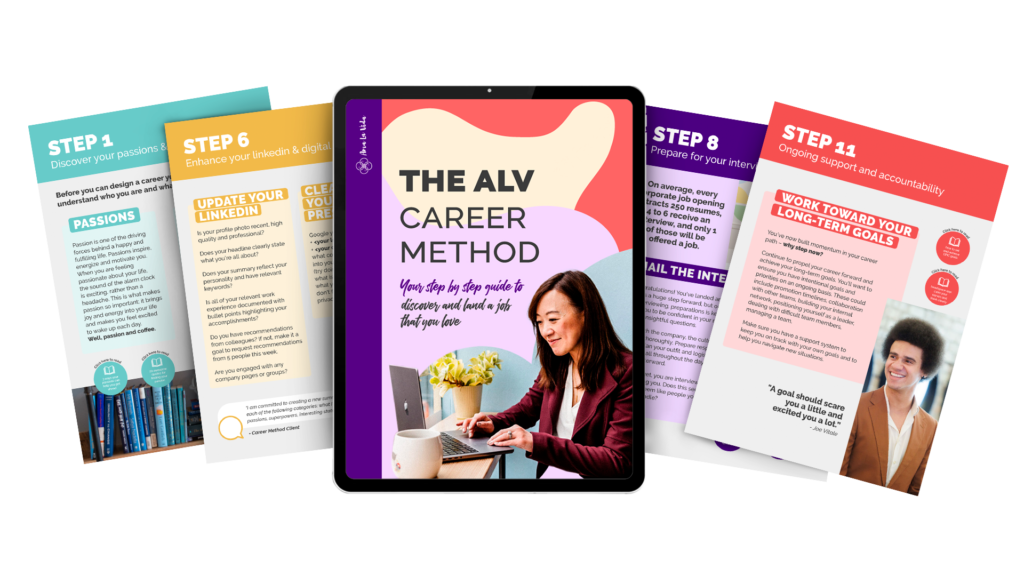
Download our comprehensive step-by-step guide to design and land a job you love!

Images from The ALV Career Method Guide
ALV Method Downloadable Guide

woman looking at computer writing down notes in her journal

Knowing when and how to find a career coach can make all the difference. Let’s face it, no one ever teaches you how to navigate your career. At best, we get half-hearted questions like, “What do you want to be when you grow up?” and “Do you know what you’re going to do when you finish school?” From there, you can try to find a mentor or hope for a great boss who might help you get promoted or otherwise grow in your career. More often than not, though, you’re left to figure it out on your own. And that’s where a career coach can step in. A career coach is someone specially trained to help you navigate your entire career journey. They can help you decide what career you want, create a career plan, and even navigate getting a new job or making a larger career change. But finding the right person to help you along the way can feel daunting. That’s why we’re here to help you understand how to choose the right coach for you! First, though, let’s start with the basics. What is a Career Coach? A career coach guides individuals along their career path. Contrary to popular belief, they are different from mentors and provide a different type of support than consultants. Instead of simply telling you what to do, coaches empower you to leverage your resources and find the best solution for yourself, no matter the challenges you’re facing in your work life. Whether you’re at a crossroads or seeking advancement, they can provide invaluable support tailored to your unique goals and challenges. What Does a Career Coach Do? Career coaches can support you with a number of things from finding clarity around your career path, or finding a new job (think resume review and interview preparation), to confidence building, decision-making and leadership development. If you’re feeling stuck in your current role or seeking more satisfaction in your work life, they will empower you to take aligned action towards your goals. They can also assist in making sense of your professional aspirations and guide you through potential career changes. Through exploration, strategy, and accountability, a career coach helps you move forward with intention to achieve your own unique version of success. Why You Need a Career Coach Figuring out your next career move can feel like a full-time job. Between researching roles, updating your resume, networking, and second-guessing yourself at every turn, it’s easy to feel overwhelmed or stuck. A career coach brings a grounded, objective perspective and stays current on the job market and hiring trends. They help you cut through the noise, clarify what really matters to you, and focus your time and energy where it counts. They’ll help you move forward with more direction and less stress, while supporting you to build confidence, hone your transferable skills, and take meaningful steps toward a career that actually feels right. View this post on Instagram A post shared by Ama La Vida | Online Career Coaches (@alvcoaching) Before You Start Searching, Understand Your Support Needs Before you dive into your search, take a moment to reflect on the following questions to help you pinpoint the specific support you need. Are you looking for clarity on your career path or considering a career change? If you’re reconsidering your career trajectory and exploring a career transition, you’ll need a specific kind of support. This kind of coaching focuses on exploration, getting to know yourself and what a successful career looks like for you. A career coach trained in career exploration may not focus on technical support, but rather self-awareness to guide your decision. Are you looking for a new job in the same industry? Maybe you enjoy your current job, but want a change—whether it’s a new role, a better company culture, higher pay, or more work-life balance. If this is the case, you may want to find a career coach who specializes in your industry. Do you need technical support like resume review or job search guidance? If you’re looking for resume writing, interview prep, or job search strategy, you may benefit more from a coach that also doubles as a career consultant. This type of support is often advice-heavy and focused on helping you navigate the process efficiently. Are you looking to grow within your current role or industry? Career development coaching can support leadership growth, skill-building, and strategic planning. This is great for mid-career professionals to senior leaders who want to advance, become more effective, or explore what’s next in their field. How to Find a Career Coach that Fits Your Needs Understanding how to find a career coach that’s truly right for you can feel overwhelming at first, but it doesn’t have to be. With the right approach, this process becomes an empowering step toward real, lasting professional growth. Instead of spending hours searching online, scrolling through endless bios, and wondering if a coach will “get” you, there’s a simpler way. Let Ama La Vida’s Relationship Strategists Do the Work for You At Ama La Vida, we take the guesswork out of finding your ideal coach. Our coach-matching process is deeply personal and 100% human. You can get started by filling out a quick form about your goals and needs, or jump on a free consultation call with one of our Relationship Strategists. During the call, they’ll ask thoughtful questions to understand your challenges, goals, and preferences. Then, based on that conversation, they’ll hand-select a certified coach from our diverse team of 60+ career experts who best aligns with your needs. You’ll receive a link to their profile, which includes their experience, specialties, and testimonials—plus you can schedule a complimentary coach consultation to make sure it’s the right fit. You’re not limited to just one coach either. Through our “celebrity sessions,” you can meet with other experts on our team to explore topics outside your primary coach’s expertise. It’s full-cycle career coaching, built around your goals. Ask Your Network or Therapist

Read More
Ama La Vida's March 2025 Tech Background on a computer

Hello, March! 🌸 With spring just around the corner, this month is all about renewal and realignment—not just in your career but in every corner of your life. Think of it as a fresh start to shed what no longer serves you and embrace what fuels your growth. Download our free tech backgrounds to dress up your phone and computer, and keep these mantras front and center all month long.

Read More
Mockup of February 2025 mobile organization tech background - pink

Ama La Vida means “Love Your Life”—and what better time to romanticize the life you’re building than right now? ♥️ Fall in love with the little things—your morning coffee, the sound of your favorite playlist, the quiet satisfaction of ticking something off your list. It’s not just about roses and chocolates; it’s about celebrating you—your wins, your dreams, and the moments that make life feel full. Need ideas? Our February To-Do List is here to inspire you. Which one will you start with? ✨

Read More

Despite what you may hear from family and friends, making a career change at 40 is not only possible but can open up a whole new chapter in your life. Even considering a change at this point in your career can enrich your professional life, letting you dream bigger and take control of your career path. If the idea of a midlife career shift intrigues you, you’re in good company! Many Ama la Vida clients have made the leap, discovering their dream careers in their 40s and beyond. In this article we will cover how they conquered their fears and made it happen, and how you can change careers at 40 as well! Why Change Careers at 40? Our priorities change throughout our lives, and a career that fits our needs early on may not be the right option at 40 or even 50. According to the World Economic Forum, the average person has at least 12 jobs before retirement, and the typical career changer is around 39 years old! These numbers suggest that people feel empowered to seek out better professional opportunities throughout their careers. They are no longer willing to settle for a job that isn’t right for them—at any age. Still, many professionals stay in roles that aren’t right for them rather than switch careers because they don’t recognize (or simply ignore) the signs. Even more will stay in their current careers because of beliefs that hold them back— they think they’re “too old,” “too experienced or inexperienced,” or believe their “opportunity to make a move has passed.” Common Reasons for Changing Careers in Your 40s There are a number of reasons you may be thinking about a career shift, regardless of your age. Changing Priorities: Life circumstances, such as family or health, might be steering you toward a career that offers higher income, better balance or more fulfillment. Values Misalignment: Your job may no longer align with who you are or what you stand for, making it hard to stay motivated or feel connected to your work. Opportunities for Growth: Lack of new challenges or opportunities for advancement may leave you feeling stuck or stagnant. Fading Passion: Maybe you’re experiencing the nagging feeling that what you’re currently doing is just not your desired career, or you find yourself daydreaming about a new job. View this post on Instagram A post shared by Ama La Vida | Online Career Coaches (@alvcoaching) Technological Advances: Rapid changes in your industry, such as automation or new technologies, may make your current role obsolete or less fulfilling, prompting the desire for a career pivot. Regardless of the specific reasons, career changers who prioritize their needs wind up in careers that better align with their goals and fit their lifestyles. Why a Career Change at 40 is Actually Perfect Timing There is some very good news for anyone considering a midlife career change: this might be exactly the right time to make a move. By the time you hit 40, chances are you will have decades of personal and professional experience under your belt that have provided you with incredibly valuable and transferrable skills. Need proof? According to researchers from Harvard University, employers often value soft skills like communication and leadership over technical expertise! Benefits of a Career Change in Your 40s A midlife career shift can be an exciting opportunity to flex your skills in a new field or industry, especially if you’re looking for a new challenge or fresh perspectives. More and more professionals are leaving the traditional path of the corporate ladder behind and reshaping their careers in the form of a spiral, or a “squiggle.” In their book The Squiggly Career, Helen Tupper and Sarah Ellis describe how for many workers, the movement from one role or industry to another actually enhances their skills and effectiveness while bringing more career satisfaction. If you’re not feeling challenged or fulfilled at work anymore, exploring new areas of knowledge by taking classes or pursuing a certificate or degree will stave off boredom and may even set you up for a new career path. Not only is intellectual growth in your 40s and beyond important for your brain, the joy of learning and discovery can keep you connected to your “why.” Not to mention that due to your decades of personal and professional experience, you may be less impulsive and better at seeing long-term consequences and opportunities. Those years of experience bring with them the ability to consider various perspectives, and big-picture thinking is a highly transferable skill! Setting Realistic Expectations for Your Career Transition Many of the challenges that come along with the career change process are due to unrealistic expectations. This is why it’s so important to make sure that you’re focused on being flexible which will save a lot of frustration later. A successful career change requires patience and grit. You may need to focus on adding new skills to your repertoire to address any gaps or even pursue further education or training to position yourself as a viable candidate for certain roles. Rather than jumping into a new job with little reflection or planning, consider what’s really important to you in your career transition. This will help you avoid being in this same place a few years or even months down the line. Create a Career Change Plan The career change process can feel overwhelming at times, but a good plan can help! View this post on Instagram A post shared by Ama La Vida | Online Career Coaches (@alvcoaching) That’s why Ama La Vida created the ALV Career Method to keep you on track and help you hold yourself accountable to your professional goals. You can download a free preview of the course and start gaining clarity around your career change here: Below we’ll break down some of the proven steps to help you gain clarity, set goals and start working towards the right career path for you. Setting Clear Goals and Objectives First, identify your

Read More
Woman writing in planner

If you’re here to download a career plan worksheet, chances are you’re feeling stuck in your career. We get it—we’ve been there too. Maybe you never really knew what you wanted, you followed a career path only to realize something was missing, or life is just taking you in a new direction. Whatever has you here, we understand that making a change can feel overwhelming. Before you spend hours filling out job applications or years getting more education or training, we’re sharing our method to help you figure out your next career move. Download our comprehensive career plan worksheet to get started paving a fulfilling career path. We created this free in depth guide to help you begin exploring career options and making a plan that works for you. Understanding Career Transitions For Ama La Vida members, career transitions can be driven by things like the desire for better work-life balance or higher income, job dissatisfaction, or going after their dream job. While our members want to find a job that aligns with their interests, it’s normal for them to feel a mix of emotions from excitement to worry that they wasted time getting to where they are now. Some even worry that the next job won’t be any better than the last. It’s true, making a job transition can be scary, but with a proven strategy you can move forward with confidence. The first step in this process is making a career plan. This part is all about self-reflecting to understand what you truly want for your career and then figuring out the steps needed to achieve it. Let’s get into it! Using Career Plan Worksheets: Your Road to Rediscovery Think of a career worksheet as your personal roadmap. It’s a tool that helps you figure out your work goals and how to reach them. Unlike those quizzes that tell you what job you should have based on your skills and personality, a career plan is all about creating a step-by-step strategy to achieve your specific career dreams. The main parts of a great career plan include: Setting goals helps you know exactly what you’re aiming for, which keeps you motivated. Focusing on skill development means you’re always learning what you need to succeed. And when you have a big, long-term goal, you can break it down into smaller tasks that are easier to tackle. Each part of the worksheet helps create a solid plan, leading you to a career that’s both successful and aligned. Design Your Dream Career with Our Career Plan Worksheet Our downloadable template allows you to explore and identify your best path forward. You’ll reflect on your values (what’s important to you), interests (what you love doing), and skills (what you’re good at). When you understand these things about yourself it’s much easier to narrow down and decide between different careers. By doing research, networking (talking to people in different fields), and having informational interviews (chatting with people about their jobs), you learn a lot about various industries and roles. Taking the time to do this research ensures your future career goals match what is important to you personally and your skills. Not only does career planning help you clarify what jobs interest you, but it also gets you ready for job applications by highlighting your relevant qualifications and experiences. Chances are, you didn’t have a plan when you found your current job. Without a worksheet, your next job search might be all over the place. You could end up applying to jobs that don’t really suit you, feeling lost, and not reaching your full potential. A Harvard Business Review article shared that very few people think about their career over the next five years. This worksheet will help you set long-term career goals—these are the big objectives you want to achieve in your work life. They guide your career path and help you make better short-term decisions. By exploring and planning systematically, career worksheets pave the way to career satisfaction. Overcoming Obstacles and Staying Motivated Balancing career exploration with your current responsibilities can be tricky. It takes good time management and prioritization. To make it work, set aside specific time each week to explore jobs and learn new skills. Sometimes, you might feel scared or doubtful about the process. To overcome these feelings, break your goals into smaller, more manageable tasks. Then, celebrate each small win as you complete them. Having support is also important to stay focused, especially on the tough tasks. Ask mentors, colleagues, and friends for advice and encouragement. Don’t be afraid to seek help or use resources like career coaches and online courses to fill in what you don’t know. Stay interested in your journey by reminding yourself of your long-term goals. You can make a vision board or post reminders for yourself of why this transition is important to you. Don’t forget, by planning methodically and using support, you can achieve your career dreams. Making the Most of Career Plan Worksheets Take time for self-reflection To get the most out of these career plan worksheets, start with honest self-reflection. Really dig into your skills, interests, and values to create a clear career plan. Work your way through the questions in each section of the PDF worksheet guide to help you uncover what’s most important to you. Ask for feedback Share your completed worksheets with mentors or colleagues for feedback. Their insights will help you spot your natural talents. Make it a research project Do thorough career research to understand job requirements and industry trends. This includes having informational interviews to learn about daily life in different roles. Yes, it’s work, but this can also be fun! You’re learning about potential careers that match your own interests. Make sure to take note of what sounds interesting to you! Actioning The Career Planning Process Once you’ve built a career plan, it’s time to put it into action. Here are few ways to get started. Prepare for your job search Keep

Read More
January 2025 tech background mantra version shown on computer

Happy New Year 🤍 2025 is our canvas! Let’s make it bold, purposeful, and ours. 🎨✨  Starting this new chapter with a fresh perspective can change your life permanently. These tech backgrounds are here to remind you: 2025 is YOURS to shape. Whether you’re focused on growing your career, embracing where you are, or building something new, this is the year to align your life with what truly matters. Pick a background and save it as your desktop background or lock screen. Let it ground you when life gets busy and remind you why you’re showing up every day. Which one is speaking to you?

Read More