Category: Career Enrichment

woman working and taking notes

Do you find yourself overwhelmed by the prospect of making a career decision? Have you ever felt afraid that the wrong choice might impact your immediate future, long-term happiness, financial stability, and overall lifestyle? If so, you’re not alone. These feelings are common symptoms of a condition known as career paralysis—a state of feeling stuck due to the fear of making the wrong move. Career paralysis affects individuals of all ages and professional backgrounds. However, by implementing a comprehensive, thoughtful, and strategic career plan, you can navigate the complexities of your career path with confidence and clarity. Shifting Priorities: Career Transitions Driven by Work-Life Balance Over Salary According to Clockify.com, the primary motivation when choosing a career is the desire for a better work-life balance, cited by 56% of respondents. This preference outweighs the pursuit of higher salaries, indicating a significant shift in professional priorities. Flexjob surveyed more than 4600 workers and found compelling career-changing statistics. Professionals who are in the later stages of their careers are leaning into a reevaluation, with 19% considering a career change as a “second act” as they approach retirement. This trend reflects a desire for continued personal growth and contribution beyond traditional retirement age. A notable portion of respondents (17%) expressed a desire to pursue their passions or hobbies when they choose a career for the next season of their lives. This highlights the increasing importance of aligning one’s professional life with personal interests and values. These statistics reflect the need for professionals at all stages of their careers to consider new opportunities, continue learning and growing, and be willing to adapt to evolving circumstances. Career Planning: Laying the Foundation Choosing a career in a different industry or company does not have to be a one-time event; rather, it should be an ongoing process that evolves throughout your professional life. The first step when it’s time to choose a career is self-reflection and introspection—understanding your interests, values, personality traits, and long-term goals. Take the time to assess your strengths, weaknesses, and the skills you possess or wish to acquire. The goal here is to ensure your next job is a good fit and somewhere you will enjoy working, not just a stable job or paycheck. To dig deeper into career planning, read all about it here. Developing a Career Action Plan: Mapping Your Journey Crafting a strategic career action plan is similar to charting a course toward your professional aspirations. It effectively navigates the complex landscape of the job market. It demands meticulous planning and a keen understanding of your goals, strengths, and areas for growth. One of the initial steps in this process involves conducting a thorough self-assessment to identify your skills, interests, values, and what success means to you. Career coaches can create a personalized approach to help you identify your goals and aspirations, and support you as you create an action plan. This introspective exercise serves as the foundation for your career path, enabling you to align your aspirations with actionable steps. Conducting Research: Gaining Insights The next step is to seek out new career ideas. Take the time to explore various industries and job titles. You never know what you may discover as you cast a broad net. As you conduct research, consider data from labor statistics, and informational interviews. You can also find resources provided by career coaches, recruiters, Workforce Development Offices, college alumni job centers, and even AI tools like Perplexity.ai, Chat GPT, and Gemini. Do not shy away from asking friends and family members for ideas as well. Gain insights into different industries, companies, and work environments to determine where you might thrive. Use your research to write a short list of ideas you would like to explore further. Leveraging Soft Skills and Personality Fit Recognize the importance of soft skills—such as communication, problem-solving, and teamwork—in today’s workplace. Ensure that your chosen career path aligns with your personality traits and allows you to leverage your strengths effectively. Consider taking personality and career tests like the 123 Career Aptitude Test, My Next Move Interest Profiler or Career One Stop Skills Matcher to gain further insight into your aptitudes and preferences. Elevating Your Career Strategy: Beyond Practical Steps to Personal Growth Career fulfillment plays a pivotal role in shaping an individual’s personal growth and overall happiness. A positive career choice often intertwines with one’s sense of purpose, self-worth, and satisfaction in life. Engaging in work that aligns with identified passions, interests, and values serves as a driving force, motivating one to strive for excellence and personal growth continually. Unlocking Life’s Potential: The Power of the Passion Principle According to research cited in the Harvard Business Review, over 70% of college-educated individuals prioritize passion-related factors when making career decisions, with nearly two-thirds valuing passion above considerations such as salary and job security. The principle of passion has become a significant factor, leading many workers to engage in the phenomenon known as the Great Resignation. Compared to those with stable employment, individuals who faced job instability during the pandemic showed an even greater inclination toward pursuing their passions. Pandemic Spurs Pursuit of Passion: Flexible Job Market and Existential Urgency Drive Workers Towards Meaningful Careers The combination of a more flexible job market and a heightened sense of existential urgency, prompted by the uncertainties of the pandemic, has made the pursuit of passion seem both more rational and more feasible for a considerable number of workers. The principle of passion encourages us to live authentically and pursue a meaningful career, thus leading to a more enriching, purposeful life. Exploring Career Options: Broadening Horizons Stay informed about the current job market trends in growing, stagnating, or declining industries. You can do this by looking at current job openings and researching industry data. Also, be sure to consider your own short-term goals—like acquiring specific training or education—and your long-term aspirations, like professional advancement and financial stability. Making Informed Decisions: Weighing the Options Ultimately, you need to evaluate professional options based on your own

Read More


In today’s competitive job market, mastering the art of managing up is essential for career advancement and success. But what exactly does it mean to manage up? And how can individuals navigate this skill to thrive in their professional lives? Understanding why managing up is hard can shed light on the intricacies involved in fostering effective relationships with your managers. Let’s debunk common myths, explore the benefits, and review the consequences of neglecting this vital skill. Then we can delve into the five best steps to empower you in how to manage up effectively and propel your career to new heights. Why Managing Up Is Hard Managing up isn’t merely about pleasing your manager; it involves aligning your efforts with their goals, preferences, and communication styles. The dynamic nature of workplace relationships, coupled with varying managerial personalities and expectations, can make navigating this terrain difficult. According to an article by Harvard Business Review, many employees are nervous about managing up because it sounds like extra time that most people don’t have in a day. Continue reading for actionable steps to make it easier. Debunking Myths About Managing Up Before diving into the actionable steps for successfully managing up, let’s address common misconceptions that can hinder your progress. By dispelling these myths, we can pave the way for a clearer understanding of what managing up truly means. Myth 1: Managing up is synonymous with brown-nosing. Reality: Managing up is about building rapport, trust, and collaboration with your superiors, which fosters a mutually beneficial relationship. According to Forbes, effective managing up involves advocating for your ideas and contributing to the success of the team. Myth 2: Managing up is only necessary for career climbers. Reality: A report by Gallup suggests that employees who have one meaningful conversation per week with their managers are more productive and fulfilled in their roles. When your manager sees your desire to support their goals, they will demonstrate more support towards you. Managing up is essential for professionals at all levels, ensuring effective communication, creating alignment, demonstrating your personal brand and productivity within teams. The Benefits of Effective Managing Up Now that we’ve debunked common myths about managing up, let’s explore the significant advantages that mastering this skill can bring to your career. By understanding these benefits, you’ll be motivated to invest time and effort into honing your managing up abilities. Enhanced Communication Skills: Mastering the art of managing up cultivates active listening, clear communication, and empathy, invaluable assets in any professional setting. In research published by Bucata and Rizescu (2017), they determined that effective communication with managers leads to greater organizational performance which is a benefit for you and your employer. Career Advancement Opportunities: A survey by Ladders (2019) found that 86% of “high-earning professionals” felt that managing up positively impacted their ability to be considered for promotions. Managing up will increase visibility, foster trust, and will position you as a valuable asset within your organization, paving the way for career growth and development. Improved Workplace Dynamics: Building strong relationships with your managers promotes a positive work environment, fosters collaboration, and enhances overall team productivity and satisfaction. Improving your manager relationship creates a more efficient workplace with greater team collaboration. Consequences of Ineffective Managing Up Neglecting to manage up effectively can have dire consequences. Miscommunication, misunderstandings, and a lack of alignment with your manager’s expectations can lead to decreased productivity, and missed opportunities for career advancement. Also, poor managing up skills can strain the manager/employee relationship by giving the impression that you are unresponsive, unreliable, or disengaged. This impacts your credibility with your colleagues and your manager. 5 Steps to Successfully Managing Up Now that we’ve explored the benefits of effectively managing up, let’s review five managing up strategies you can take to master this essential skill. By following these steps, you’ll be equipped with the tools and strategies needed to navigate your relationship with your manager and move your career forward. 1. Understand Your Manager’s Goals and Preferences: Take the time to familiarize yourself with your manager’s priorities, communication style, and expectations. Utilize tools like the DiSC assessment to gain insight into your manager’s behavioral preferences and adapt your approach accordingly. Another idea is to schedule a one-on-one meeting with your manager to discuss their short-term and long-term goals, and how you can align your efforts to support them. 2. Communicate Effectively: Maintain open lines of communication with your manager. This includes seeking feedback, and clarifying expectations as needed and, most important, providing proactive updates is key. For example, set up a weekly check-in meeting with your manager to provide updates on your projects and discuss any challenges or concerns you may have. Read this post for more ideas on what proactive communication might look like. 3. Build Trust and Credibility: Demonstrate reliability, accountability, and integrity in your actions, which will allow you to earn the trust and respect of your superiors as referenced in this post. A great tool to assess and enhance your trustworthiness is the ABCD Model by Ken Blanchard, Cynthia Olmstead, and Martha Lawrence. “A” stands for able and you demonstrate that you can complete the task. “B” refers to believable and this comes from your integrity. Being honest about your abilities and keeping your word supports this piece. Connected is what the “C” means in the model. Building connections requires not only your communications skills but also giving trust to others. Finally, the “D” is your demonstration of dependability. This requires that you follow through with what you say you are going to do. Using this model will allow you to build trust with your manager. 4. Adapt to Your Manager’s Style: Tailor your approach to fit your manager’s communication and leadership style, fostering better rapport and collaboration. For example, if your manager prefers concise communication, prepare brief status updates or reports for them instead of lengthy emails or presentations. 5. Be Solutions-Oriented: Instead of dwelling on problems, focus on identifying solutions and opportunities for improvement, showcasing your initiative and

Read More

Can you relate? You’re right out of high school or college, you’ve got the whole world ahead of you, you’re daydreaming about your new career and feel like you have a myriad of career choices in front of you. It feels all lined up, everything is in place, there’s a plan. And then life happens and time passes, and you wake up one day and you find yourself saying “How did I get here?” and “I don’t know what career I want anymore.” Maybe life got so busy, you forgot to pay attention to what you needed, what your interests were, or what you were passionate about. Or maybe yet, you’ve only been out of college for a few years now and the promises of career clarity from your degree program – or the lack of it – have you wondering what you want to do with the rest of your life. Maybe you feel like you don’t know how to get the job you want or what that job even is. Ask yourself these questions to uncover what career you might want Before jumping into a complex job market without clarity around what it is you’re actually looking for, spend some time seeking the answers to these questions. Don’t let the external job market dictate your career path or decisions about what the right career is for you. Instead, conduct internal investigations first: revealing your vision, clarifying your interests, articulating your strengths, filling in any gaps, and deciding what the best fit is for you. For more specifics on a step-by-step guide to asking these important questions, check out Coach Brooke’s breakdown of Ama La Vida’s career transition process. What does my “dream job” look like? Spoiler: there’s no such thing as a “dream job.” Well, at least in the sense you might be thinking about it. Your dream career is the career you decide is the right fit for you that contributes to the overall life you are building and growing. Ask yourself: what are the practical things I need this career to provide? So, instead of starting with “what is the name of the career/job that I need to target,” know what you want out of the practical pieces of your career and get clear about how you need work to function in your life. What industry or industries interest me? Now that you have an understanding of how you want your career to fuel your life, it’s time to focus on what industries or companies have paths that fit. These days, there seem to be as many career options as there are people, so having a focus is key to making progress. Start a list! Whether you’re jotting it down on paper, keeping it in a spreadsheet, or using a job search platform to track, keep a list and look for patterns around what keeps coming up for you. What type of work suits my interests, skills and personality? The sweet spot of a fulfilling career for many people is at the intersection of passions, values, and strengths. Picture it as a Venn diagram of overlapping circles and we’re all aiming for that one little section that overlaps them all. A key point is that clarity around these 3 areas is effective in narrowing down the seemingly limitless possibilities of career choices. Pro tip: Some of us, in different seasons of our lives, don’t necessarily want to fulfill our passions inside our careers. Don’t feel like your work has to be the one and only answer to serving your passions, values, and strengths. Instead, understand these things about yourself. Naming them clearly will help you know how you need work to contribute to them! Research different career paths Now that you’ve focused your inquiry internally, it’s time to turn outward to see what’s out there. You’ll want to explore general information about career paths as well as specific jobs being advertised. You’ll begin to figure out what is a strong match for your needs, your interests, and your path as you continue to investigate. You can engage with O*NET Online, a robust database about all occupations from the Department of Labor. This allows you to understand in-demand careers, requirements for different paths, info on salaries, and growth opportunities for thousands of potential careers. Read different job descriptions Once you have an understanding of what paths could be a good fit, start job researching by looking at ads to see what’s out there. What company keeps catching your eye? What position(s) meet your needs and interests? Keep a list of phrases, keywords, requirements, etc. that you see that matches what you learned about yourself. Soon, you’ll start to piece together an understanding of what’s out there, what employers are looking for, and where your next step might lie. Note: This process of researching is different from searching for jobs. You are not reading every job description you see and scrutinizing it as a potential fit. You are researching what’s out there. Suspend that urge to rule things in or out based on how you feel about your qualifications and ability. Take in information, keep track of what you learn, and then look for patterns. Volunteer Now that you’ve investigated online, it’s time to turn to real-world, people-focused investigation. The best and most informative kind! Volunteering helps you build new skills, gain experience, and understand new worlds of work and impact, and can clue you in on new potential paths and opportunities. Beyond hands-on experience that you can leverage in a new way, you will meet new people in spaces new to you. You can learn from like-minded AND differently-minded people to better understand what a great fit can be for your career path. Consider either using a strength you have to help in an industry new to you OR building a new strength in a familiar industry or initiative. Opportunities abound to volunteer locally and remotely (for example, platforms like Catch a Fire provides skill-based matching

Read More
women networking

Does the idea of working to develop strong networking skills make you feel uncomfortable? Many people react to the idea of going to a networking event with as much enthusiasm as taking a test – a test that they don’t know how to study for. And when you approach networking as if you’re a product that you’re trying to sell, it often leads to that cringe-y feeling of being a shameless self-promoter or a schmoozer. Regardless of how you might feel about it, professional networking provides the opportunity to make authentic connections with people. And if those connections are good ones, they lead to business opportunities and shared success. What if, instead of going to networking events with the intent to sell, you went to them with the intent to create connections that are based on mutual understanding and assistance? An authentic approach to networking This article isn’t about tricky techniques for building professional connections to shamelessly assist your job search or to weasel your way into relationships with companies you want as customers. Yes, networking skills will help you reach your professional goals, but this goes far beyond that. In this article, I’m going to challenge the way you think about professional networking so you can not just meet new contacts, but also build your confidence in networking situations, share your expertise, grow industry knowledge, and maybe even make some new friends. View this post on Instagram A post shared by Ama La Vida | Career, Life & Leadership Coaching (@alvcoaching) What are networking skills? Networking skills are communication skills, like being able to speak clearly and succinctly, being good at active listening, using and reading body language and facial expressions, and even navigating and making the most of social media. But if you don’t know what the purpose of networking is, no amount of skill-building will help you get the most out of it. Networking is, quite simply, the art of creating mutual understanding that enables the creation of mutual benefit. A complete list of networking skills includes knowing the logic behind what to ask and what to share. How to improve your ability to network Sometimes people measure their networking by how many business cards they collect or give away at local events. But if you don’t understand what’s important to the people you’re trading cards with, and if you don’t help other people understand what is important to you, you’re not really networking. Networking is simple to learn but takes practice to master. The first step is to know what the “mission” of networking is. There are three things at a minimum that you want to discover in any networking opportunity – and you want them to discover these things about you, too. 3 things to focus on when you meet people: It’s all about creating mutual understanding and finding shared interests. If you can answer these three questions about someone after talking to them, you know that you are doing well. And if the other person knows these things about you, then you’re on your way to mastery. The foundation of building and maintaining relationships Let’s say you’re networking and you meet someone who is, say, a manager for a local bank. As you make small talk you learn: After hearing this, you might think: “I know someone who does corporate training – maybe I could connect them.” Or maybe you do corporate training, and it’s an opportunity for you. Or maybe you have some advice and thoughts you could share from your unique perspective. No matter what comes to mind, it will be better and more relevant to the other person if you’ve taken the time to understand them first. By first understanding someone and only then trying to help them, you demonstrate your willingness to be of service – which makes a great impression and can be the beginning of a great relationship. What are your personal networking goals? When you network, you’re working to achieve mutual understanding and mutual benefit. You can prepare ahead of time by asking yourself: You might have more than one thing you’re trying to do, but for each thing you are trying to do (#1, above), be ready to talk about its corresponding #2 and #3. And when you talk about these things, be clear and concise. An elevator pitch is approximately 30 seconds to two-and-a-half minutes. Ideally, have a 30-second version, and longer versions if people show more interest. Develop authentic connections When you think of networking as a way to “sell” people on who you are, you miss the opportunity to make an authentic connection. You might hesitate to share what you’re grappling with and what you are looking for. Being vulnerable isn’t part of a typical sales pitch. But networking isn’t selling. It’s connecting. By sharing what you do, as well as your obstacles and aspirations, you give people the opportunity to trust you, understand you, and even to give you assistance, advice or introductions. If you like to help people, don’t forget to be generous and give other people the chance to help you! After all, if you like to help others, don’t you think they might like to help you? The Benjamin Franklin Effect When someone does a favor for another person, they are more likely to feel positively towards the person they helped. Benjamin Franklin once identified a rival legislator who he wanted to win over. Franklin asked if he could borrow a rare book from the legislator’s library. The legislator was flattered and sent the book immediately. Franklin returned it one week later with a thank-you note. The surprising outcome was that this simple request for a favor led to a significant shift in their relationship. They became friends from that point forward. Franklin concluded that the man, having done him a favor, convinced himself that he must like Franklin after all, because why else would he have done him a favor in the first place? By giving someone

Read More
women smiling looking at computer

Let’s face it, changing careers can be scary! But did you know that the average person spends 90,000 hours at a job? If you’ve been unhappy at work, sticking it out won’t get you a medal. Instead it can lead to frustration and burnout. Changing careers can be scary or overwhelming, especially if you’ve been in your current job for a long time, but we’re here to give you a concrete action plan to help you get started. Let’s dig into how to change to a career that makes those 90,000 hours go by a little smoother. How did we get here? Have you been thinking “I need a new career!” but feel stuck? You’re in good company—Oracle did a study that found that 75% of people feel stuck in their current job. There could be several reasons for feeling stuck. Maybe someone talked you into pursuing the career path you’re currently on. Maybe you were enticed because it was prestigious. Maybe you were already on the path and didn’t realize that you didn’t want it until it was “too late. Maybe the problem is just your current situation with a bad boss or bad culture. Maybe it’s just the wrong fit. There could be a myriad of reasons for this, but let’s face it, you need a change. Our career transition process Ama La Vida helps those who are looking for a career change from their current job. They have amazing coaches across numerous industries who will walk with their clients to help them determine their next career move. And it doesn’t hurt that they break it down into 10 easy steps to help their clients with this process that could feel daunting alone. 10 steps to make a career change Starting a career transition can feel like a really big change. This article will give you an overview of The Ama La Vida Career Method process, which walks you through 10 steps in a way that doesn’t feel overwhelming. Our process starts with you as the foundation to determine where to look, and then sees what careers lineup with you. Then we’ll walk you through specific steps to land a new role that aligns with who you are. We also have a team of career coaches who can help by coaching, providing resources, and creating action plans that move you toward your new career path. Ready? Let’s go! Step 1: Passions and gifts Let’s start easy: what do you like and what are you good at? The first step to determining your next career is identifying your passions and your gifts. Explore your passions When you think about your passion, think about what lights you up at work? Where do you lose track of time? What are you interested in doing or learning more about? These are your work passions that bring you energy. Identify your gifts When you think about your gifts, think about what comes naturally to you? What do others compliment you on? Where does your expertise shine? These are your gifts and skills that you bring to the table. Don’t rush this self-assessment – these are the things that you will likely want in your next role. View this post on Instagram A post shared by Ama La Vida | Career, Life & Leadership Coaching (@alvcoaching) Step 2: Values and purpose The next steps of this self-discovery portion are determining what your values are and what your purpose is. Define your values When you think about your values, think about the pillars that you need – if one of these pillars was missing, the house would not stand. You can usually determine what a value is by how you react when that value is violated. For this one, what are the areas of your life that are vital to your happiness or key to your view of the world? This might be family, endurance, loyalty, or grace. Name your purpose A purpose can feel like a very lofty thing, but let’s break it down. Ask yourself, what problem would you like to solve at work? What kind of impact do you enjoy making? What brings you that feeling of success? Use these answers as your starting point to determine what impact you’d like to make in your next role (your work purpose). Step 3: Explore and understand your options Once you’ve laid your foundation that is based on YOU, then you begin to explore your options in finding a new career. Brainstorm career options Start out by making a list of potential jobs. Go through each of the previous categories of personal traits you listed in steps 1 and 2, and write down every possible idea related to each of these. Keep an open mind and come up with a list of potential options – this is where we cast a wide net. Don’t forget to ask others for ideas and advice. Be sure to get input from those who know you best. Ask them what roles they think you’d be good at and why. When making this list, you can even think of roles you’ve previously worked to gather more ideas of what you want. Once you have that long list, you’ll want to narrow it down. Bring in your gifts, passions, values, and purpose to determine what is a good fit and what isn’t. Remember, you want to find a job that’s a good fit for YOU, not the other way around. Once you’ve created your list, you’ll want to understand the roles on your list. You should be able to answer what a day in the life is actually like and what the daily tasks and responsibilities are. You can do this by doing your research to learn the ins and outs of these jobs, asking for information interviews, etc. You’ll also want to fully understand the requirements. What training is required? Will you need to learn a new technology or obtain additional education? Will you have to go back

Read More
women colleagues talking

Raise your hand if you have a boss. That makes two of us! Everyone may not be a manager, but nearly everyone HAS a manager. So managing up is something almost all working people have to deal with. It’s awesome when you have an awesome manager. And at the same time, people are people, and people are flawed. Managers are not perfect, so sometimes it falls to us to “manage” them. It’s a delicate balance that can make a BIG difference for you and for your manager. What does it mean to manage up? Keep reading to learn: Let’s get started! The definition of managing up Managing up is “essentially managing your manager – doing what you can to get what you need from your manager to do the job to the best of your ability,” according to LEADx. When you’re ready to manage up, you’re ready to take control of your work. This is a great skill to learn for your own development and can sometimes even lead to your manager seeing your leadership potential. When you manage up, you’re taking control of the situation and your career. You’re speaking up about what you need, paving the way forward and helping your manager achieve success. What is managing up, really? Basically, managing up involves the things you do to work well with your boss, make their job easier and contribute to their success. Is your boss hard to get a hold of? Like many managers, they’re probably very busy and involved in several other areas of your organization, making their time a commodity. Busy managers can sometimes make their employees feel uncared for unintentionally. Just because they’re busy doesn’t mean you can’t build an effective working relationship with them and do a stellar job. Managing up is about how you use your time with them (and apart) to gain clarity on what success means to them and help them achieve it. It doesn’t just impact your relationship with them. Managing up filters up to your boss’ own manager and leaders across your company. What you do when you manage up can make your boss (and you) look great to upper management because it can make you achieve more, consistenly. Why managing up matters Managing up has lots of benefits across the board. Here are some of the biggest ones. Managing up helps your career development When you start actively managing up, you learn how to work with anyone on anything to get stuff done, which is amazing for your career development. This skill makes you a valuable player and an essential part of the team. It is a fantastic notch in your belt for leadership development (even if you’re not actually in a leadership role). It can also help you avoid surprises because you know what your boss is focused on and can keep your work and priorities in alignment. You can manage your time more wisely by focusing on what matters most and saying no to what takes away from that. Managing up also helps you build trust with your manager, which leads to a healthier relationship with your boss. Doing this makes you more intentional with your work, which means you’ll have an easier time cataloging your impact and success. This is PERFECT performance review fodder. So if you’re starting to manage up at work, be sure to keep track of what you accomplish so you rock your next performance review with strong examples to help you communicate all the awesomeness you’ve accomplished. Managing up builds trust with your manager When you learn to proactively communicate and achieve success with your manager or leader in a way that works for them, they start seeing you as a trusted resource who makes sure nothing slips through the cracks. You help them meet their goals and look good to their own boss. They feel supported and successful because of your contributions. Your manager knows they can rely on you, which is great for your future working relationship. Overall, this is one of the best ways to build a healthy relationship with your boss by making your boss’ life easier and catering to their style. (Plus, it likely makes your own life easier, too.) Managing up works at all levels Yes, it is called managing up but really, these are skills that will help you with everyone around you in your career, not just those higher up. Truly, this approach to work is about understanding how those around you work, what they need to do their job well, and how you can make their job easier with a more proactive and informed communication style. Whether you bring this topic to a meeting with your direct report, manager, or any other employee with whom you work closely, there is so much to learn. You can gain an understanding of the role you play in supporting your boss, team, department and organization hit their goals. This clarity helps you focus on what’s most important to your role so you can contribute in a more meaningful way than just putting out the fires of the day. Using these skills helps you build a positive relationship with people across your organization because this approach ensures both you and those around you are aligned on the work that is being done. It will give you a clear focus, which means you can be more strategic and thoughtful with your partnerships, pull in the right people to get the right things done and increase the visibility of both you and your work. Managing up is key for your reputation Proactive communication is crucial for building trust across your organization, especially with higher ups and senior leaders. By communicating your contributions clearly, you are demonstrating your leadership skills and how you are adding value to the organization as a whole. This approach is also vital if there is ever a mistake or problem with one of your projects. When you can get ahead of the problem

Read More

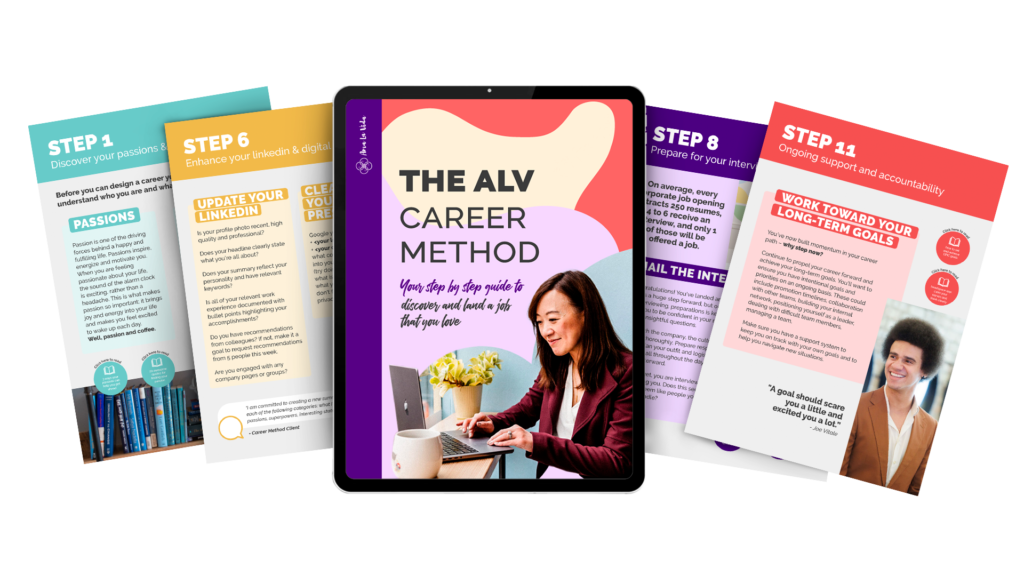
Download our comprehensive step-by-step guide to design and land a job you love!

Images from The ALV Career Method Guide
ALV Method Downloadable Guide

networking and meeting people

The old adage of “it’s all about who you know” was thrown out the window a while ago. Now, it’s all about “who you can GET to know,” which means you have control over opening up doors for yourself. Work trends right now are telling us people are yearning for connection and real human interaction. In fact, according to SHRM, “about 8 out of 10 employees (82 percent) say they have felt lonely at work.” As work-from-home continues to remain a trend, it is increasingly important to seek out ways to authentically build relationships with others. This isn’t just professional networking tips and tricks, but a holistic approach for how to change your thinking so you can get better at networking. We’ll talk not only about how to network better, with tips for beginners, but also how you can take your professional networking to the next level. Don’t worry if you currently hate networking. In this article we’ll share not just how to network effectively, but also some important mindset adjustments you can make to both enjoy the process more and also find a more effective way to go about it. Why Is networking important? Networking is essential to meeting new people who have what you want or are in the spaces you want to be in. It’s also critical to develop not only your connections to other professionals but also enhance your own learning and knowledge base. Advance your career Valuable connections are more effective than any other technique or practice to move closer to your own professional success, gain clarity on your career path, and land the job you desire. It’s also one of the best ways to access the “hidden job market” and learn about job leads and new opportunities that may not be posted publicly. The fact is, an ongoing approach to networking can have a meaningful impact on your long-term career growth. Advance your knowledge Networking isn’t just about connecting with others to get a leg up on a new job. Networking is very much about: Searching the internet will only get you so far in understanding trends in certain industries. Staying up to date requires you speak to real people doing the real work you’re interested in learning about. This helps you determine what skills you could grow and plug into to reach your career goals. Learning how to network successfully can grow your connections to other professionals, your knowledge of the job market, your industry of interest, and what trends are going to help you get where you ultimately want to go. Why does networking get a bad rap? Most people have an initial “ick” response when networking is suggested to help advance their career, and some people flat out hate the idea of networking. We get it! Of course, if your vision of networking is walking into a crowded event full of people in suits handing out business cards and making cringy small talk, it’s understandable why you aren’t interested in that. Let’s turn to how you can learn to network effectively in ways that match your values and authentic self that feels less that about personal gain only and more about building true connections with others. How to network effectively When we look for ways to expand our network, we want to focus on building relationships, not just through formal networking events, and incorporate some networking advice into our daily lives, regardless of whether we’re on the job market or not. These are muscles and skills you can develop over time!  Here are some tips on how to network step-by-step: Change your mindset The first step in taking a new approach to networking is to change your mindset. Instead of networking representing a focus on a one-sided agenda to drive your personal gain only, try shifting your thinking to these three simple truths about networking that are adopted by the most effective networkers: Start at work One of the best ways to meet people is to begin with those closest to you professionally: your work colleagues. Not sure where to start? Here are our tips: Learn the business First, focus on learning about the landscape of roles and jobs at your company who spend all their time, or at least some of their time, doing work that you want to learn more about. Because you have a shared work place, it will be easier to meet people, connect, and further build relationships. Leverage Slack, Teams, and other group-chat tools Second, use your shared internal communication channels to reach out to initiate conversations and get to know your colleagues. An introductory ask might look as simple as a Teams message to a colleague you’d like to get to know that says, “I noticed that our work intersects quite a bit and I’d like to learn more about the full scope of what you do and who you partner with across our company. Do you have time for a Zoom coffee so I can learn more about your work?” Stay open-minded Third, you never know when just the right person will pop up in your time at work and you suddenly have the opportunity to connect, learn something new, and share about your own professional goals and accomplishments. Be on the lookout for opportunities so you don’t miss the chance to connect with someone new! Attend industry events Attending events is one of the most traditional ways we think about networking, and industry events do serve as great ways to meet people. Industry events, whether in your current industry or a new industry of interest, provide a similar situation to meet people as at work because you already have something in common with the people there. Think outside of the box when it comes to finding industry events for meeting new people (including potential clients) and making new connections. In addition to traditional industry networking events, seek out opportunities to attend online learning events, workshops, listening sessions, new product launch events, focus

Read More
woman working on coach with laptop

Creating a fulfilling career requires more than just a day-to-day approach. In this blog post, we’ll dive into the practical aspects of crafting a clear career plan. By envisioning where you want to be in five years and establishing long-term goals, career planning becomes a tool that directs your path to professional fulfillment. What is a career plan? A career plan is a strategic roadmap that guides your professional journey from aspirations to reality. Think of it as a practical approach to understanding yourself and the opportunities around you. Why do I need a career plan? As we delve into this exploration, two key reasons emerge, shedding light on the significance of thoughtful career planning. From navigating the complexities of making decisions to the pursuit of the most aligned job, the answers lie in creating a life that resonates with our unique definition of success and strategically setting ourselves up for long-term career goals. Create a job that aligns with your definition of success If you’re going to spend ⅓ of your life doing something, you might as well make it something you’re interested in! Investing time and effort into a career plan helps you to consciously mold a career that aligns with your own personal definition of success. This involves a deep dive into your values and interests, ensuring that the choices you make are driven by genuine passion rather than external expectations. Your career plan is about being actively interested in what motivates you, and crucially, not solely relying on well-meaning advice from family members or friends. To craft a fulfilling career, you must chart a course based on your unique compass, steering clear of external pressures and embracing a path that authentically represents your aspirations. Set yourself up for long-term career goals Most people only think about career planning when they’re already actively looking for a new job, yet it is having a strong strategic foundation that offers you long-term success. Whether defining a specific career path, contemplating further education through graduate school, or deciding the next course of action, a well-thought-out plan is indispensable. By deciding thoughtfully today, you can pave the way for a successful and fulfilling professional future. When to start the career planning process It’s never too late When it comes to intentional career development, the notion that it’s never too late to start exploring is a liberating idea. Career planning is not a rigid framework; instead, it’s an adaptable concept that accommodates individuals at any juncture of their professional lives. Whether you find yourself contemplating a change in career field or transitioning into a new phase of your career altogether, the key is to begin the process of exploration. By exploring career options, you open yourself to a myriad of possibilities and ideas, which can give you a sense of empowerment and control over your career trajectory. It’s about acknowledging that the journey is ongoing, and every moment presents an opportunity to initiate change and set a new course towards a more fulfilling professional life. It’s never too early On the flip side, recognizing that it’s never too early to begin the career planning process is crucial, especially for those stepping into the workforce or considering entry-level positions. Starting to formulate and complete initial career plans at this stage is a proactive move. While the early phase of a career might seem like an exploration in itself, having a clear vision and pursuing defined goals can significantly impact long-term success. By initiating your career planning early on, students and entry-level workers can proactively shape their career paths, ensuring that each step aligns with their aspirations. Whether you’re pursuing a specific career field or actively pursuing opportunities, the key is to begin developing a career plan, laying the foundation for a resilient and purpose-driven professional journey. One example would be strategically planning your extracurricular activities or choosing a focus for the courses you take in school. If you already have an idea of the position or jobs you’re targeting, it can help you achieve your goals much faster. The career planning process While there are various ways to approach creating a career plan, a structured method provides a solid foundation to begin the process. Step 1: Set career goals Embarking on your career planning journey begins with a critical first step: setting clear and meaningful career goals. Here are a few reflection questions you can use to develop some clear career planning goals: Setting these career goals not only establishes a roadmap for your immediate actions but also lays the foundation for a purpose-driven and fulfilling long-term path. By answering these reflection questions, you can gain a deeper understanding of your aspirations and set goals that resonate with your values, interests, and ambitions. Step 2: Do some research Now that you have a clearer vision, it’s time to delve into the realm of research for some career exploration. There are many ways you can start researching what opportunities might be a good fit for you based on your goals, but here are a few of our favorites: Online resources and websites: There are so many wonderful resources online to help you easily understand what different career paths can involve. Networking and informational interviews: Once you’ve narrowed down some of your career options that interest you, you can dig a little deeper by talking to people with more experience in those roles or companies to help you decide which ones you’d like to pursue. Educational and training programs: Not all careers require additional education, but developing new skills can be a wonderful way to expand your career options and even improve your personal fulfillment at work. Remember, the key is to gather a diverse range of information from multiple sources. This will enable you to make well-informed decisions about your career path, aligning your skills and interests with the demands of the job market. Step 3: Work backward Once you have some goals and ideas running around in your head, you may start

Read More
woman happy and working on laptop

As you think about your personal and professional growth, you need to think about how to invest time and funding into your career development. There’s a misconception that professional development tools or resources require a hefty budget, and it can keep many people from taking advantage of the incredible benefits they offer. In this post, we’ll explore how you can support your own career goals, no matter your budget. Let’s talk about professional development funding Before we go too far into options and costs, we would be remiss if we didn’t let you in on a secret: most companies have budget line items set aside for professional development for their employees. While investing in your personal and professional growth can pay dividends for years to come in your career, it’s even better if you can get your company to pay for it! What is a professional development stipend? Essentially, a professional development stipend is funding the company has set aside to invest in developing its existing employee base. Each organization might call it something different—learning and development stipend, professional development budget, education stipend, learning stipend, perk stipend—the list goes on, but the key trait is that this budget line item is specifically intended to help their existing employees grow their skills, learn new things, and stay ahead of trends. Why do companies offer learning and development stipends? They offer these education stipends for all kinds of reasons. But here are just a few: Employee productivity Simply put, as the current staff fill skill gaps, they’re able to be more effective in their current roles. This budget is straight investment into their company growth. Rather than investing in additional headcount, services or technology, learning and development stipends are designed to improve employee performance. Employee retention and recruiting capabilities Companies recognize the immense value of investing in employee development as a strategic initiative. Employee development is not just about honing skills; it’s about nurturing lifelong learners and fostering a culture of growth within the organization. By offering learning stipends and other education-focused employee perks, companies demonstrate their commitment to supporting the potential career growth of their workforce. This investment pays off in multiple ways, enhancing employee retention and bolstering recruiting capabilities by attracting top talent seeking opportunities for both personal and professional development. Employee morale Closely related to employee retention is employee morale. A crucial aspect of creating a happy workforce lies in fostering a culture of continuous learning and development. Employees who are provided opportunities for both professional and personal development tend to experience higher job satisfaction and are more likely to stay committed to their career goals within the organization. Offering a professional development stipend or covering professional development expenses communicates a powerful message – that the company values its employees’ growth and is invested in continually expanding their skill sets. How does a professional development budget work? Most companies have a specific process for requesting a professional development budget, so you absolutely should ask your HR representative or boss. These processes often involve submitting a proposal outlining the intended learning or development activity, along with an estimated budget. Once approved, employees can utilize the stipend for a variety of purposes related to professional growth, such as attending workshops, enrolling in courses, purchasing learning materials, or even hiring a career coach. The organization may have guidelines specifying eligible expenses and the maximum amount that can be claimed. After utilizing the stipend for their chosen development activities, employees often provide documentation of their expenditures and proof of participation or completion of the intended development initiative. This documentation is typically submitted to the appropriate department or individual for review and reimbursement. By implementing a structured process for the utilization of professional development stipends, companies ensure that employees make meaningful investments in their growth while aligning with the organization’s objectives and budget allocations. This approach nurtures a learning-centric environment and encourages a proactive approach to career advancement. Top professional development resources Let’s get into some of our favorite ways we’ve seen employees spend available funding from their company’s education stipend or professional development. Here are a few ideas on how to spend professional development funds. 1. Career coaching Yes, we’re a bit biased, but when it comes to enhancing your professional journey, investing in a career, leadership or executive coach can be a game-changer. Career coaching provides personalized, one-on-one support tailored to your unique ambitions and circumstances. A skilled coach helps you identify your specific goals, align them with both your personal aspirations and your organization’s objectives. Once you’ve set your goals, career coaches act as a guide, supporting you in creating a well-defined plan to achieve your goals. They provide insights, strategies, and feedback, ensuring your plan is practical and effective. Importantly, they help you stay accountable, pushing you to persist even when faced with setbacks. One of the key aspects of career coaching is its ability to focus on soft skills like building communication skills. These skills are often underestimated but play a critical role in future success. Investing in a career or leadership coach is an investment in your personal growth and, ultimately, your career success. It’s a proactive step toward realizing your potential and making a meaningful impact in your professional sphere. If you’re seeking to elevate your career trajectory and develop essential skills, engaging with a career coach is a choice worth considering, whether you’re investing for your own personal development or tapping into a professional development budget. Investment Different coaching programs can range from a few hundred dollars a month to tens-of-thousands for some of the most elite executive coaches. Ama La Vida is committed to democratizing coaching and making it available to a broader community. We couple one-on-one coaching with our unique eCoaching technology to provide reliable results and personalized support to employees beyond just the C-suite. There are so many factors to consider as you choose a coach. Here’s a helpful roundup if you’re thinking of hiring a coach, or you can book a

Read More
person on a zoom conference call with a colleague

Whether you’re aiming for employee performance goals that align with organizational objectives, or you’re intrigued by the idea of setting SMART goals for yourself, this post is your roadmap. Let’s dig into the secrets behind effective goal setting, the importance of measurable goals, and the transformative power of aligning your performance goals with your values and ambitions. What exactly are performance goals? Performance goals, often referred to as objectives, targets or key performance indicators (KPIs), are specific, measurable, and time-bound aims that individuals or organizations set to achieve a desired outcome or level of performance. It’s about making sure you have clear goals, for yourself, your team members, and your organization. They play a crucial role in various aspects of personal and professional development, including career growth, employee motivation, and organizational success. There’s an old saying, “What gets measured, gets managed,” which is why having clear annual goals with your manager is the foundation for your professional development and career advancement. Why are performance goals so important in personal and professional growth? Performance goals aren’t just checkboxes on your to-do list; they’re like a GPS for your journey of self-improvement and career success. When you incorporate targets or metrics into your goal-setting process, you can more specifically define your growth and your impact on company objectives. Whether you’re looking to up your game in self-management skills, achieve your personal employee goals, or simply enhance your workplace performance, these goals define what exactly you’re going to be doing and how you know if you’re successful. This detail is the key to staying motivated, engaged, and ready to tackle your next performance review with confidence (and metrics). What do performance goals have to do with my annual performance reviews? Annual performance reviews aren’t just about reflecting on past achievements; they’re your moment to shine by showcasing your alignment with the company’s organizational goals so you can continue to reach your own personal development goals. When your personal development goals match the company goals, you both win. But especially you. When your accomplishments directly contribute to achieving business objectives, you’re not just proving your worth; you’re building a compelling case for future advancement. By connecting the dots between your goals and the company goals, you’re not only growing personally but also creating a business case for why the company should invest back in you. Your consistent pursuit of professional development goals, coupled with your achievements in employee performance, positions you as a driving force behind the company’s success. These metrics will then put you in a stronger negotiating position when the time comes to discuss promotions, salary increases, and new opportunities within the organization. So how do you actually set impactful employee performance goals? Let’s dig in. Crafting Effective Employee Performance Goals Crafting effective performance goals is about setting clear, doable targets that keep you motivated. There are several approaches you can take to goal setting, and also a few things you should keep in mind. The SMART Goals framework Traditionally, performance goals use the SMART goals framework as a way to measure success. SMART is an acronym for: Specific SMART goals are well-defined and leave no room for ambiguity. They answer the question of “what” needs to be achieved. Measurable Goals should include quantifiable criteria that allow progress to be tracked and success to be objectively assessed. Achievable While SMART employee goals should be challenging, they also need to be realistic and attainable within a given time frame. They stretch individuals or teams without setting them up for failure. Relevant A key element to consider as you write SMART goals is they should align with the broader objectives of an individual, team, or organization. They should be directly related to the desired outcome or performance improvement. Time-bound SMART performance goals have a clear deadline or time frame for achievement. This adds a sense of urgency and focus to the goal-setting process. By writing SMART goals, you can transform your aspirations into actionable steps, ensuring that your path is crystal clear and your achievements are tangible. This goal-setting process turns your dreams into concrete realities with precision and purpose. When you create a SMART goal, you’re not just aiming for success—you’re strategically navigating your way there. The EPIC framework At Ama La Vida, we go beyond SMART goal setting to a process we like to call EPIC goals. The EPIC approach ensures your employee performance goals are not just action items for your job responsibilities, but also align with your personal passions and the larger business goals. It’s a framework for meaningful goals. Elevating Do these goals genuinely inspire you? Think about whether they’re not just tasks but instead they genuinely motivate you and map to your own professional development goals. Practical Can you realistically achieve success? Similar to SMART goals, it’s crucial to set challenges that are both attainable and exciting within a reasonable time frame. Impactful Will reaching these goals make a difference? Your time and effort are precious, so pursuing impactful goals is essential for making meaningful progress in your career and personal development. Clear How will you measure success? As with the SMART goal approach, establishing clear success metrics enables you to track your progress and stay on track. EPIC goal setting to improve employee retention Incorporating the EPIC layer into your goals isn’t just about objectives; it’s about working toward aligned employee performance goals that map to your own goals personally. By taking the time to align your personal motivations, or those of your direct reports, with the broader organizational goals as part of your goal-setting process, you reach that sweet spot where employee performance goals not only drive business success, but also job satisfaction, employee engagement and retention. So, once you have a clear definition of your employee performance goals, you’ll next need to take the extra step to align them with your organizational goals. Aligning your own professional development goals with organizational business objectives Aligning your professional development goals with the key results you’re responsible

Read More
woman working a desk in front of laptop thinking

As leaders, we are time constrained to the max. We are making sure our direct reports have what they need, our superiors or peers have insight to our work, all while trying to get something on our own checklist accomplished here and there. It’s easy to go go go and forget to pause and reflect. The risk of this is, without taking the time to reflect and question our actions, we can find that we’ve run a million miles an hour in the wrong direction. Or that the direction was right but we missed something or someone along the way. These 5 questions are critical for leaders to be regularly asking themselves to help ensure their time is well spent, their team is well aligned and their wellbeing is taken care of. What can only I do? Leader or not, we are all wrestling with a never ending challenge to prioritize our time and activities. Especially in small companies, you may find yourself doing things, not because they make sense for you to do, but because there is simply no one else to do them. It’s easy to get sucked into stuff because there is a need, but without putting those asks through some sort of filter, they can quickly consume all of your time, leaving nothing left for your priorities. Ask yourself, “What can only I do?” What are the things that you uniquely have knowledge, relationships or expertise around? These are the things you need to prioritize. Which also means you’ll need to figure out how to delegate or let go of some others. It can be difficult to let something slip that ought to be done. But if those things collectively are preventing you from doing the things that need to be done by you, they’ve got to go. Does everyone know the one big thing? At any given point in a business, there is a major headline. It might be a focus on preparing to go public. It might be a season of cost-cutting and profitability. It might be building brand awareness at just about any cost. Regardless of which team you lead, your team should know the headline. Everyone should know the “one big thing” and how their work contributes to it. If you ask three people on your team, they should say the same thing. And they should have a general sense of how well that thing is going. If they aren’t sure, and especially if you aren’t sure, it’s a great time to refocus on the key priority and ensure your communication is clear and repeated regularly. Who needs attention? Especially in a remote or hybrid environment, it can be difficult to sense when someone on your team is struggling. And if it’s not top of mind to be checking in and considering who might need support, your team members could be feeling alone on an island. Regularly ask yourself who on your team needs attention. Attention might mean recognition. It might mean a chance to grow in a new way if they’ve been doing the same thing for quite some time. It might be reassurance that they are doing a good job, even in the face of challenges. It might mean some additional hand-holding and feedback if they are falling short. Make sure you have regular one-on-ones and pulse check with your direct reports on these categories. While not with the same intensity, consider how you can support those who report into your direct reports. Skip levels can be powerful both to help you support your managers but also to motivate those below them. You might be surprised at how much a quick 30-minute meeting or pulling someone into a project can do to drive engagement and excitement for the work. What am I missing? This is tricky because in most cases, if there was something else to be done to move the business forward, we would have done it already! It’s not easy to see your blind spots personally and strategically. Challenge yourself with even deeper questions about what you might be missing. What’s happening outside our 4 walls in the world or industry that might impact us in the near future? What have I been so sure about that I’ve forgotten to pressure test my assumptions? What have we been doing simply because that’s what’s always been done? When trying to push initiatives or results forward, our temptation is often to apply more pressure, to put more fuel on the fire rather than take a step back to determine where we can remove friction. Could that be more impactful? Is there a different approach altogether? Even just taking this brief moment to challenge your work and assumptions and consider what you might be missing can unlock a new burst of genius. How am I taking care of myself? Leadership can be a lonely job. It can feel isolating to keep a team of people motivated and engaged when facing difficult or uncertain times. It can be exhausting to not just drive work and initiatives forward, but to be responsible for people’s emotions and the team morale as well. Make sure you are taking care of you. Ask yourself, “What do I need?” That might mean being in community with other leaders. It might mean seeking support from a coach or therapist. It might mean some time off. All of these options require time and investment, but we know that without prioritizing your wellbeing along with your work, burnout is sure to follow. Take the time to pause and ask these key questions. Better yet, build it into a habit like something you do on your train ride to work or something you do every Friday as you wrap up the week. Systematize your reflection so it becomes part of your work routine. I promise, you’ll never regret taking the time to stop and question. A brief pause to check in and recalibrate can prevent so much rework or regret

Read More
person holding calendar filled with appointments

In the midst of hectic schedules and competing work priorities, it’s easy to feel overwhelmed and disconnected from what truly matters to you. That’s where working with a coach comes in. When you’re busy, it may seem counterintuitive to add another commitment to your plate. You may look at your week and think that there’s simply no way to add one more thing to your calendar. But the truth is, taking time to engage with your coach can be the game-changer you need to let go of the overwhelm and instead focus on what’s most important so you can progress toward your goals. At Ama La Vida, we know that how you’re feeling in one area of your life directly impacts how you’re feeling the rest of the time. Our innovative coaching approach is designed to help you navigate a never-ending to-do list while creating meaningful, measurable change. In this blog post, we’re going to unpack the unexpected benefits working with a coach can bring when you’re very busy, and how it can transform your approach to life and work. The Importance of Coaching Let’s be clear: coaching conversations are not the same as regular conversations, which is why conversations with your coach are so different from those you have with any of the other relationships you have. Coaching training programs teach coaches to ask good questions so they can get to the root of your motivation and clarify what you need and want to move forward in the direction of your goals. A conversation with your coach isn’t about getting advice. Instead, they’ll help you identify what works for you so that you can get out of your own way and become the person you always hoped you could be. If you invest your time in coaching when busy, you’re creating the opportunity to open doors you never expected or thought possible. So, with that, here are just a few of the ways that working with a coach can help improve your performance and ease your overwhelm. 1. Prioritization Support The first thing a coach will help you gain clarity on are your priorities. When things are feeling hectic and overwhelming, it’s easy to lose sight of what truly matters. The very first part of working with your coach is to identify your core passions, skills, values, goals, and aspirations. By understanding what is most important to you, you can allocate your time and energy accordingly. This focused approach empowers you to tackle the most crucial tasks first and make progress toward the future you want to build. This process is about optimizing your performance, so you can spend time on what truly matters to you and where you’ll make the biggest impact so that you can optimize your time and energy to bring you the results that matter. 2. Clarity on Your Goals When your world is feeling overwhelming or chaotic, it’s easy to lose sight of what truly matters most to you. Conversations with your coach act as a guiding light, illuminating your path toward what aligns with your values and aspirations. Through thought-provoking conversations and insightful questioning, coaches dive deep into understanding your core values, ambitions, and long-term vision. With this heightened self-awareness, you can make informed decisions about how to allocate your time and energy to your advantage. Your coach will help you differentiate between urgent tasks and those that contribute to your long-term goals. By gaining goal clarity, you can experience a newfound sense of direction and purpose. At Ama La Vida, we set EPIC goals that will not only keep you on track but also inspire you and move you further toward your personal and professional purpose. These goals will serve as your compass, keeping you focused and driven in your daily endeavors. Remember, goal clarity is not about following someone else’s agenda or societal expectations. It’s about gaining a deep understanding of what brings you joy, fulfillment, and a sense of purpose. 3. Time Management Mastery Yes, certain circumstances are outside your control. However, when it comes to managing your time efficiently, a coach can be your secret weapon. They offer personalized support and guidance to help you navigate the demands of a busy schedule. Coaching provides a unique opportunity to develop effective time management skills. Your coach can introduce you to proven strategies and techniques, but more importantly, they can help you identify a process that’s unique to you and your needs and ways of working. They will help you streamline your processes, eliminate time-wasting activities, and find innovative ways to boost your productivity. With their guidance, you’ll learn how to prioritize effectively, delegate tasks, and make the most of the resources available to you, so that your weeks become productive and meaningful. Your coaching sessions will help you to transform your relationship with time. Say goodbye to feeling overwhelmed and hello to a more balanced, fulfilling life. 4. Make Better Decisions Take a moment and just imagine how much time you’d save if you could make decisions faster. Or make better decisions faster, with fewer mistakes and less rework. This is exactly why coaching is so very valuable. Your coach can assist you in developing a systematic approach to decision-making. During your coaching sessions, they’ll help you explore your options, consider potential outcomes, and weigh the pros and cons so you’ll be able to make informed choices aligned with your goals and values. Additionally, during your sessions, you can also explore how to manage uncertainty and navigate risks. Your coach will assist you in evaluating the potential consequences and identifying potential obstacles. With their support, you can develop contingency plans and mitigate potential obstacles, allowing you to move forward with confidence. Moreover, coaching provides a valuable sounding board for exploring different scenarios and potential results. It will help you envision the short-term and long-term implications of your choices, as well as seeing things differently. Through this process, you can gain clarity on the path that aligns with your aspirations

Read More