Category: Leadership Coaching

coach peggy working on the computer

The benefits of coaching span far beyond what most people initially envision when they find themselves Googling “career coach near me” late at night after a frustrating day at work. Our clients typically come to us with a specific and fairly surface-level goal in mind, like hitting their career goals or finally feeling aligned in both their personal and professional life. But what inevitably happens is that a great coaching program helps you not just accomplish what you want but also address the things you need in order to thrive in both your personal and professional development. This might be building your confidence, getting clarity about your career path or overcoming analysis paralysis. They are all enablers of goal achievement that coaching quickly dials in on to help you get where you want to go. The Real Benefits of Coaching (That Might Surprise You) 76% of our clients have never worked with a coach before when they reach out to us. They have a vague idea of what a coaching relationship can do for them, but they’re not entirely sure. Before we dive into specific types of coaching, let’s pull back the curtain on what coaching actually looks like. Whether it’s career, life, or leadership coaching, the coaching process creates a powerful container for personal and professional growth, career development, and good old-fashioned self reflection. It’s not about getting advice—it’s about having the space to think clearly, challenge yourself, and grow in ways you didn’t expect. A Safe Space with Zero Judgment (and 100% Truth Bombs) While many of us are lucky to have wonderful support systems around us of friends and family, each of these people has a distinct perspective on our lives which is shaped by their relationship with us. Coaches, however, have no such bias. Coaches are there solely to help us achieve success and personal growth on our own terms. In a professional environment, we often can’t explore ideas with colleagues and bosses due to the impact it may have on them, and we may not feel comfortable opening up about our insecurities. Having a safe space in a coaching session to explore these ideas, test new behaviors and evaluate different decisions is an invaluable resource. A client shared with me, “As a leader I love that I have a safe space to say what is on my mind and either get validation or feedback to think through.” Coaching is often the only space where employees develop the confidence to talk through the hard stuff—no office politics, just honest insight. This helps empower individuals to find to their own answers (not just take advice) and boosts individual performance, which is one of the most unexpected benefits of coaching. Accountability That Doesn’t Feel Like a Shame Spiral Many of our clients have shared that they initially felt embarrassed that they needed their coach to keep them accountable. They would say things like, “Shouldn’t I just be able to do that on my own?” No! External accountability is critical for most people to accomplish what they set out to do. This is especially true in today’s busy world with many competing demands for our attention. Throughout your youth, external accountability was abundant: school deadlines, parents holding us accountable, guidance counselors reminding us of due dates. But in adulthood, we are largely on our own to set deadlines and accomplish our goals. Having a coach support you with this is a smart strategy to ensure you stay on task. The focus with your coach isn’t pressure, it’s progress, with actionable steps tailored to help you move forward confidently. But it’s also so much more than just project management. It’s about doing the right things, not just checking a box. When we are moving a million miles an hour, we often measure our contributions in terms of how many things we crossed off the to-do list. But moving from one task to the next without taking time to reflect can actually cause you to miss opportunities to learn, derive insights and make better decisions in the future. Dedicated time for reflection helps you better plan for the future. Coaching creates a space in your day where you can slow down and be both reflective and intentional. It can break down a behavioral pattern you’ve sunk into and allow you to purposefully design a more optimal behavior. Instead of just moving along to the next thing and potentially repeating the same mistakes, dedicating this time to reflection with a skilled professional can help you generate frameworks and philosophies that lead to better decisions going forward. Better Problem Solving (Without the Mental Ping-Pong) So much of life’s angst comes from stressing about what might happen. Whether it’s making a big life decision or figuring out how to tackle a problem at work, a prolonged mental swirl can bring about a lot of unnecessary anxiety. These decisions are tough to make, and there is always fear about making the wrong choice. Coaching combats this challenge head on. It brings clarity to overthinkers, helping to structure decision-making, and boosting creative thinking, especially in high-stakes situations. I tend to be an overthinker and a ruminator. I often enter my coaching sessions with a cacophony of thoughts swirling around my brain that are exhausting me. This causes me to not show up as my best self for my team. Coaching helps me make sense of the noise, organize my thinking, and make decisions with more self-confidence and clarity. I often say that my favorite coaching sessions are the ones where nothing has changed and yet everything has changed. I didn’t actually do the thing I’ve been swirling about during my coaching session. But I walked in completely overwhelmed and stressed, and I walked out with clarity and a confident path forward. It truly makes all the difference when it comes to time management, problem solving and decision making. Shine a Flashlight for Your Blindspots You don’t know what you don’t know—until a coach helps you

Read More
woman on a performance review

The mid-year review process typically causes employees to roll their eyes, feeling that their boss is just checking another box off their list. In fact, did you know that according to Gallup only 14% of employees are motivated and inspired by the outcome of a performance review? Here at Ama La Vida, we believe in reframing this mindset. After all, if we have to check the “mid-year review” box, why not turn them into a strategic tool for career growth instead of just going through the motions? Let’s explore what a mid-year review is and how you can be part of the 14% that not only enjoys the process but gains professional development from it. It’s your career, so you need to take an active role! And, if you are a manager that wants to ensure your employees fall into that 14% category, be sure to check out our article: Maximizing Performance Reviews as a Manager. What is a Mid-Year Review? Well, a mid-year review isn’t just an annual review split in half. 🤪 So then, what is it? Let’s start from your manager’s perspective. Hopefully they see the mid-year review as a check-in regarding goal progress, employee performance, and real-time positive feedback. It’s also an opportunity to discuss any areas for improvement. For you, the mid-year review should also include a discussion regarding your employee development and engagement, go through any support you may need on projects, and touch on any feedback you have for your manager. (This process goes both ways after all.) And, when needed, it allows you an opportunity to discuss course correction before the review cycle ends. Briefly Breaking Down the Review Process The mid-year review is the ideal time to evaluate if annual goals need to be tweaked, to have a transparent conversation regarding performance, to celebrate accomplishments, and to discuss professional development plans. The process should encourage a dialog regarding your performance. However, the key to having a successful outcome is for you to take ownership of the conversation. Typically, your company or manager will create a document to review the goal status for each direct report on a team, as well as share any acknowledgements received. These meetings tend to be less formal than an annual review and the flow tends to be focused on discussion about goals. Why Mid-Year Reviews Matter for Your Career As previously described, both the mid-year review and the annual performance reviews are often driven by your manager. Let’s focus on what a mid-year review looks like to you, the direct report. From Gallup, it has been discovered that 53% of employees don’t have a clear understanding of what is expected of them.  The mid-year review is your opportunity to gain clarity on expectations, align on priorities, and ensure you’re on the right track with your goals. The Role of Constructive Feedback in Career Growth Your boss will most likely want to provide both positive and constructive feedback, even if you take control of the mid-year review process. Keep in mind that actionable feedback is a gift that you get to choose how to use. Gaining your manager’s perspective on your performance will help you better understand the expectations for your role and identify key skills to develop for future growth within the organization. The reality is it can be hard to receive constructive feedback on your job performance, so learning how to receive feedback well is an important skill set. In this article, the acronym SIFT (Source, Impact, Frequency, and Trends) is shared to approach what to do with the feedback you receive. Once you receive the actionable feedback, thank your manager for sharing it with you. You can say something like “thank you for sharing this with me because I know it isn’t always easy. I want to take some time to digest what you have said.” This allows you to respond later after having thought it through. Leverage Employee Development Through Mid-Year Reviews Another way to leverage career growth through the mid-year review process is discussing your professional development plan. What opportunities will help you grow and expand your skills? Share a few options with your manager that focus on your skills development while supporting the goals of your team and the organization. For example, if you want to develop your data analysis skills and your organization has expanded into a new market, offer to work with the data analysis team to build market research insights. It’s a win-win: the company gains insights, and you get to network with the experts in data analytics. Common Mistakes to Avoid in Mid-Year Reviews There are some common mistakes that employees make during performance reviews. Being aware of and avoiding these missteps can help you turn your review into a productive conversation for both parties. Below, we’ll explore the mistakes we often see our clients make, and in the next section we’ll dive into strategies to ensure you come prepared for a meaningful discussion. Keep in mind that the best way to avoid any unwanted surprises during your mid-year review is to ask for consistent ongoing feedback from your manager frequently. Don’t wait until the evaluation or the mid-year review to discuss your performance. Let’s dive into what the mistakes are and how to handle them. Avoiding Difficult Conversations It might not be fun to receive constructive criticism; however, without it you won’t be able to achieve the success you desire. In their book *Difficult Conversations,* Stone, Patton, and Heen highlight the importance of sharing the impact a difficult conversation had on you and inquiring about the intention behind it. What this means is if your manager provides improvement suggestions, share with them the impact of that feedback and ask what their intention was in sharing it. Most managers have positive intent when sharing feedback but may struggle with how to deliver it sensitively and effectively. Reframing these discussions from being intimidating to thinking about feedback as a gift will help you succeed. Ignoring or Hiding Missed

Read More
person taking notes while looking at computer

Let’s be honest—questions like “Where do you see yourself in five years?” can feel downright intimidating. But understanding the importance of career planning is the first step toward creating a future that excites you. While it’s perfectly normal to feel unsure about what you really want, having a clear plan helps turn uncertainty into opportunity. Whether it’s funding a lifestyle you love, finding fulfillment in your work, or creating work-life balance, career planning gives you a roadmap to get there. Without it, those big dreams can stay just that—dreams. Already convinced? Download your free career planning PDF now to gain clarity, solidify your goals, and take aligned action toward your dream career! What Is Career Planning? Think of career planning as your personal GPS for professional success. It takes getting really clear on your dream job(s) and mapping out the steps to make them a reality. Having a career plan isn’t just a nice idea—it’s your secret weapon for being purposeful and strategic about where you’re headed. A solid career plan includes both long-term and short-term goals. By connecting the dots between your short-term actions and long-term vision, you’ll create a clear path to go from “What’s next?” to “I’ve got this!” View this post on Instagram A post shared by Ama La Vida | Online Career Coaches (@alvcoaching) Your Career Path Doesn’t Have to Be Linear Many of us have been taught that a career should be linear—think, climbing the corporate ladder. For some, it certainly can be! But consider the idea that career planning is a fluid process and something that must be revisited as you, your life and your priorities change. Career planning does not necessarily mean that you always stick to your plan. Effective and intentional career planning is often flexible. It involves regularly reassessing your goals, adjusting your plans as needed, and being open to new opportunities that come your way. You may go through the same process multiple times throughout your professional journey as your needs and priorities shift! Why Is Career Planning Important? Finding success and happiness in your career starts with clarifying what truly matters to you—and planning to make it happen. By taking a closer look at what you love, what you’re good at, and what you want to achieve, you can set yourself up for a fulfilling career that aligns with your passions, strengths and goals. Investing time in creating a clear career plan lays the groundwork for making informed decisions about your future career moves. As you consider options like additional education (hello, graduate school!), training opportunities, and various career choices, you can always come back to your career plan for guidance. You’re Likely to Spend One-Third of Your Life at Work Did you know that the average person spends around 86,400 hours of their life at work?! 🤯 If you’re not happy with your job and professional life, in the short-term it may not seem like it matters all that much. You might think it’s fine, for now, but over time it can lead to frustration, burnout, and even depression. The good news? With a solid career plan, your work can become more than just a paycheck—it can be a source of inspiration, fulfillment, and purpose. Take Ownership of Your Career Journey Smart companies get it—they know that offering professional development programs is a win-win. They support their employees to define their career paths while providing the training needed to develop new skills and make progress toward their career goals. But here’s the thing: While it’s great to have support from your organization, your family, your professional network, or mentors, this is your career. At the end of the day, you are the one who has to take responsibility for your own career growth. View this post on Instagram A post shared by Ama La Vida | Online Career Coaches (@alvcoaching) In order to take ownership of your career journey, you’ll need to be proactive, stay focused, and plan ahead to make well-informed decisions that shape your career one step at a time. 5 Benefits of Career Planning Need further convincing? Here are five powerful benefits of career planning and reasons why you shouldn’t wait to create yours. 1. Your Career Plan Is the Compass for Your Professional Journey Think about it: it’s hard to get somewhere if you don’t know where you are going! View this post on Instagram A post shared by Ama La Vida | Online Career Coaches (@alvcoaching) Just as you would not get into your car and drive aimlessly with no destination in mind, it would be equally inefficient to make career decisions without knowing what direction you want to pursue. Career planning provides valuable insights and self-awareness, helping you evaluate different job opportunities in relation to your bigger-picture goals. 2. Having a Career Plan Will Help You Stay Motivated Throughout your career, it’s normal to experience fluctuations in motivation and job satisfaction. Changes in work responsibilities, organizational alignment, and managerial relationships can all impact how you feel about your current job. And when these feelings of insecurity and self-doubt arise, they may prompt questions about your career path. Having a clear vision can serve as a source of motivation amidst these uncertainties enabling you to stay focused and continue on your path with confidence. Even if these times of doubt lead you to pivot careers, knowing your priorities and long-term goals will help you weigh your options and identify your best next steps. 3. A Career Plan Will Help You Be Flexible in a Competitive Job Market “Just because you made a good plan, doesn’t mean that’s what’s gonna happen.” – Taylor Swift Your professional journey is constantly evolving. True career planning involves recognizing this fluidity and embracing it. A proper plan will include actions aligned with your interests and objectives, such as focusing on skill development through additional education or training, professional networking through industry events, and joining relevant professional associations. As you continue with professional growth and self development,

Read More
woman looking at computer writing down notes in her journal

Most of us entered the workforce thinking that just putting our heads down and doing the work would get us noticed and promoted. Fast forward a few years, we find ourselves in a work environment that is not inspiring, fulfilling, or (even worse) meeting our financial needs! The Big Lie about career success Even though times are changing, many companies are still not explicitly encouraging employees to be proactive in taking ownership of your career at work. The reality is, as an employee, it is no one’s job but your own to ensure your needs are met. The key to finding success in your career is letting go of the idea that someone is coming in to save you. Yes, there are employees who get lucky with wonderful bosses who support and advocate for them. But the reality is, if you’re waiting for the perfect manager, you’re putting your fate in someone else’s hands. Whether you’re seeking a leadership role, looking for more autonomy, hoping to work on a dream project, or maybe even just looking for a better work-life balance, taking ownership for your own success at work is crucial. By taking ownership of your own career progression, you can break out of this cycle and create real change. Why is taking ownership of your career path important? The reality is, if you’re leaving your fate in the hands of a manager, you’re at risk. You might not get the promotion you’ve been working toward for years. You might get laid off with no prospects on the horizon (as so many job seekers are experiencing these days!). You might just end up hating your job with no way out. So many employees think this is the only way to move through their careers, but the reality is you can take ownership of your work experience, and at the end of the day, you are the only one with responsibility for your own success. By taking ownership of your work, you can become accountable for achieving your career goals and also potentially instigate change within the culture of your organization. What ownership looks like at work Taking ownership at work goes beyond just managing your projects proactively and problem-solving effectively. Instead, when you have true ownership of your full career you have options and control over your work-life, rather than feeling stuck if your job goes south (or away!). To take ownership is to know: And then setting goals and systems to move you in the direction of those things. So, how do you take ownership of your career? It can seem overwhelming, but taking ownership of your career is absolutely possible. With the right strategies, you can take control of your professional life. Here are five steps you can take to assume responsibility for your work trajectory and build a job you love. 1. Craft your career vision The very first step to taking ownership of your career is to define what success would look like for you. View this post on Instagram A post shared by Ama La Vida | Online Career Coaches (@alvcoaching) Remember that work is a resource to serve your life, not the other way around. Having a clear perspective on what success means to you is the foundation for setting professional goals that align with your personal values and ambitions. Consider the bigger picture, think beyond just your job title or salary, and instead consider the impact you want to have on your industry, your community, or even the world. Set aside time to develop a sense of what matters most to you in life, how you want to contribute, and what you want to achieve. Then write it down. 2. Create alignment between your behavior and your vision Once you have a clear understanding of your personal vision for success, the next step is to bring your job into alignment with your goals. Here are a few ways to bring your job into alignment with where you’re going: Job crafting Even if your current job role doesn’t necessarily match your dream, it doesn’t mean you need to quit. Consider job crafting, where you and your manager redesign your job responsibilities to better align with your strengths and interests. It’s true—bringing your job into alignment with your vision for success will require good communication with your manager, and even your teammates or direct reports. While it’s important to be respectful of company goals and culture, you can also discuss how gaining additional experience in certain areas can benefit both you and the organization. This might include new projects, new job roles, and (hopefully!) more growth opportunities for you! Many companies are excited at the prospect of employees taking ownership at work because it often means that their employees feel empowered and will do great work, rather than just the bare minimum. Setting boundaries Too often we see employees who are burned out, miserable and deeply frustrated with their company culture—only to realize that they are part of the problem! This isn’t to take accountability away from a bad boss or toxic workplace, but setting boundaries can go a long way. View this post on Instagram A post shared by Ama La Vida | Online Career Coaches (@alvcoaching) Setting boundaries is about establishing clear guidelines for how you want to be treated, when and how you’re willing to work or what tasks you are willing to take on—and establishing how you will enforce them. If you’re establishing new boundaries, it’s important to communicate these to your manager to get buy-in and ask for support in maintaining them. By having open and honest communication with your manager, you can work together to find a solution that meets both your needs and the company’s goals. Honoring your own boundaries is essential to avoid burnout and ensure that you are making progress toward your bigger-picture goals. 3. Show up (authentically) as your personal brand As you bring your current job into alignment with the long-term vision for

Read More
women networking

Does the idea of working to develop strong networking skills make you feel uncomfortable? Many people react to the idea of going to a networking event with as much enthusiasm as taking a test – a test that they don’t know how to study for. And when you approach networking as if you’re a product that you’re trying to sell, it often leads to that cringe-y feeling of being a shameless self-promoter or a schmoozer. Regardless of how you might feel about it, professional networking provides the opportunity to make authentic connections with people. And if those connections are good ones, they lead to business opportunities and shared success. What if, instead of going to networking events with the intent to sell, you went to them with the intent to create connections that are based on mutual understanding and assistance? An authentic approach to networking This article isn’t about tricky techniques for building professional connections to shamelessly assist your job search or to weasel your way into relationships with companies you want as customers. Yes, networking skills will help you reach your professional goals, but this goes far beyond that. In this article, I’m going to challenge the way you think about professional networking so you can not just meet new contacts, but also build your confidence in networking situations, share your expertise, grow industry knowledge, and maybe even make some new friends. View this post on Instagram A post shared by Ama La Vida | Career, Life & Leadership Coaching (@alvcoaching) What are networking skills? Networking skills are communication skills, like being able to speak clearly and succinctly, being good at active listening, using and reading body language and facial expressions, and even navigating and making the most of social media. But if you don’t know what the purpose of networking is, no amount of skill-building will help you get the most out of it. Networking is, quite simply, the art of creating mutual understanding that enables the creation of mutual benefit. A complete list of networking skills includes knowing the logic behind what to ask and what to share. How to improve your ability to network Sometimes people measure their networking by how many business cards they collect or give away at local events. But if you don’t understand what’s important to the people you’re trading cards with, and if you don’t help other people understand what is important to you, you’re not really networking. Networking is simple to learn but takes practice to master. The first step is to know what the “mission” of networking is. There are three things at a minimum that you want to discover in any networking opportunity – and you want them to discover these things about you, too. 3 things to focus on when you meet people: It’s all about creating mutual understanding and finding shared interests. If you can answer these three questions about someone after talking to them, you know that you are doing well. And if the other person knows these things about you, then you’re on your way to mastery. The foundation of building and maintaining relationships Let’s say you’re networking and you meet someone who is, say, a manager for a local bank. As you make small talk you learn: After hearing this, you might think: “I know someone who does corporate training – maybe I could connect them.” Or maybe you do corporate training, and it’s an opportunity for you. Or maybe you have some advice and thoughts you could share from your unique perspective. No matter what comes to mind, it will be better and more relevant to the other person if you’ve taken the time to understand them first. By first understanding someone and only then trying to help them, you demonstrate your willingness to be of service – which makes a great impression and can be the beginning of a great relationship. What are your personal networking goals? When you network, you’re working to achieve mutual understanding and mutual benefit. You can prepare ahead of time by asking yourself: You might have more than one thing you’re trying to do, but for each thing you are trying to do (#1, above), be ready to talk about its corresponding #2 and #3. And when you talk about these things, be clear and concise. An elevator pitch is approximately 30 seconds to two-and-a-half minutes. Ideally, have a 30-second version, and longer versions if people show more interest. Develop authentic connections When you think of networking as a way to “sell” people on who you are, you miss the opportunity to make an authentic connection. You might hesitate to share what you’re grappling with and what you are looking for. Being vulnerable isn’t part of a typical sales pitch. But networking isn’t selling. It’s connecting. By sharing what you do, as well as your obstacles and aspirations, you give people the opportunity to trust you, understand you, and even to give you assistance, advice or introductions. If you like to help people, don’t forget to be generous and give other people the chance to help you! After all, if you like to help others, don’t you think they might like to help you? The Benjamin Franklin Effect When someone does a favor for another person, they are more likely to feel positively towards the person they helped. Benjamin Franklin once identified a rival legislator who he wanted to win over. Franklin asked if he could borrow a rare book from the legislator’s library. The legislator was flattered and sent the book immediately. Franklin returned it one week later with a thank-you note. The surprising outcome was that this simple request for a favor led to a significant shift in their relationship. They became friends from that point forward. Franklin concluded that the man, having done him a favor, convinced himself that he must like Franklin after all, because why else would he have done him a favor in the first place? By giving someone

Read More
women smiling looking at computer

Let’s face it, changing careers can be scary! But did you know that the average person spends 90,000 hours at a job? If you’ve been unhappy at work, sticking it out won’t get you a medal. Instead it can lead to frustration and burnout. Changing careers can be scary or overwhelming, especially if you’ve been in your current job for a long time, but we’re here to give you a concrete action plan to help you get started. Let’s dig into how to change to a career that makes those 90,000 hours go by a little smoother. How did we get here? Have you been thinking “I need a new career!” but feel stuck? You’re in good company—Oracle did a study that found that 75% of people feel stuck in their current job. There could be several reasons for feeling stuck. Maybe someone talked you into pursuing the career path you’re currently on. Maybe you were enticed because it was prestigious. Maybe you were already on the path and didn’t realize that you didn’t want it until it was “too late. Maybe the problem is just your current situation with a bad boss or bad culture. Maybe it’s just the wrong fit. There could be a myriad of reasons for this, but let’s face it, you need a change. Our career transition process Ama La Vida helps those who are looking for a career change from their current job. They have amazing coaches across numerous industries who will walk with their clients to help them determine their next career move. And it doesn’t hurt that they break it down into 10 easy steps to help their clients with this process that could feel daunting alone. 10 steps to make a career change Starting a career transition can feel like a really big change. This article will give you an overview of The Ama La Vida Career Method process, which walks you through 10 steps in a way that doesn’t feel overwhelming. Our process starts with you as the foundation to determine where to look, and then sees what careers lineup with you. Then we’ll walk you through specific steps to land a new role that aligns with who you are. We also have a team of career coaches who can help by coaching, providing resources, and creating action plans that move you toward your new career path. Ready? Let’s go! Step 1: Passions and gifts Let’s start easy: what do you like and what are you good at? The first step to determining your next career is identifying your passions and your gifts. Explore your passions When you think about your passion, think about what lights you up at work? Where do you lose track of time? What are you interested in doing or learning more about? These are your work passions that bring you energy. Identify your gifts When you think about your gifts, think about what comes naturally to you? What do others compliment you on? Where does your expertise shine? These are your gifts and skills that you bring to the table. Don’t rush this self-assessment – these are the things that you will likely want in your next role. View this post on Instagram A post shared by Ama La Vida | Career, Life & Leadership Coaching (@alvcoaching) Step 2: Values and purpose The next steps of this self-discovery portion are determining what your values are and what your purpose is. Define your values When you think about your values, think about the pillars that you need – if one of these pillars was missing, the house would not stand. You can usually determine what a value is by how you react when that value is violated. For this one, what are the areas of your life that are vital to your happiness or key to your view of the world? This might be family, endurance, loyalty, or grace. Name your purpose A purpose can feel like a very lofty thing, but let’s break it down. Ask yourself, what problem would you like to solve at work? What kind of impact do you enjoy making? What brings you that feeling of success? Use these answers as your starting point to determine what impact you’d like to make in your next role (your work purpose). Step 3: Explore and understand your options Once you’ve laid your foundation that is based on YOU, then you begin to explore your options in finding a new career. Brainstorm career options Start out by making a list of potential jobs. Go through each of the previous categories of personal traits you listed in steps 1 and 2, and write down every possible idea related to each of these. Keep an open mind and come up with a list of potential options – this is where we cast a wide net. Don’t forget to ask others for ideas and advice. Be sure to get input from those who know you best. Ask them what roles they think you’d be good at and why. When making this list, you can even think of roles you’ve previously worked to gather more ideas of what you want. Once you have that long list, you’ll want to narrow it down. Bring in your gifts, passions, values, and purpose to determine what is a good fit and what isn’t. Remember, you want to find a job that’s a good fit for YOU, not the other way around. Once you’ve created your list, you’ll want to understand the roles on your list. You should be able to answer what a day in the life is actually like and what the daily tasks and responsibilities are. You can do this by doing your research to learn the ins and outs of these jobs, asking for information interviews, etc. You’ll also want to fully understand the requirements. What training is required? Will you need to learn a new technology or obtain additional education? Will you have to go back

Read More

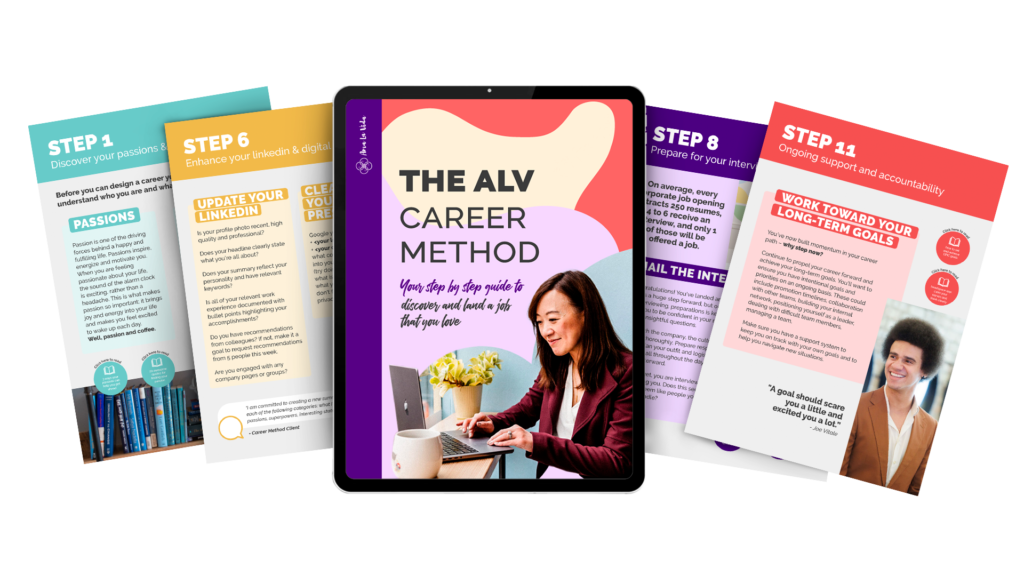
Download our comprehensive step-by-step guide to design and land a job you love!

Images from The ALV Career Method Guide
ALV Method Downloadable Guide

women colleagues talking

Raise your hand if you have a boss. That makes two of us! Everyone may not be a manager, but nearly everyone HAS a manager. So managing up is something almost all working people have to deal with. It’s awesome when you have an awesome manager. And at the same time, people are people, and people are flawed. Managers are not perfect, so sometimes it falls to us to “manage” them. It’s a delicate balance that can make a BIG difference for you and for your manager. What does it mean to manage up? Keep reading to learn: Let’s get started! The definition of managing up Managing up is “essentially managing your manager – doing what you can to get what you need from your manager to do the job to the best of your ability,” according to LEADx. When you’re ready to manage up, you’re ready to take control of your work. This is a great skill to learn for your own development and can sometimes even lead to your manager seeing your leadership potential. When you manage up, you’re taking control of the situation and your career. You’re speaking up about what you need, paving the way forward and helping your manager achieve success. What is managing up, really? Basically, managing up involves the things you do to work well with your boss, make their job easier and contribute to their success. Is your boss hard to get a hold of? Like many managers, they’re probably very busy and involved in several other areas of your organization, making their time a commodity. Busy managers can sometimes make their employees feel uncared for unintentionally. Just because they’re busy doesn’t mean you can’t build an effective working relationship with them and do a stellar job. Managing up is about how you use your time with them (and apart) to gain clarity on what success means to them and help them achieve it. It doesn’t just impact your relationship with them. Managing up filters up to your boss’ own manager and leaders across your company. What you do when you manage up can make your boss (and you) look great to upper management because it can make you achieve more, consistenly. Why managing up matters Managing up has lots of benefits across the board. Here are some of the biggest ones. Managing up helps your career development When you start actively managing up, you learn how to work with anyone on anything to get stuff done, which is amazing for your career development. This skill makes you a valuable player and an essential part of the team. It is a fantastic notch in your belt for leadership development (even if you’re not actually in a leadership role). It can also help you avoid surprises because you know what your boss is focused on and can keep your work and priorities in alignment. You can manage your time more wisely by focusing on what matters most and saying no to what takes away from that. Managing up also helps you build trust with your manager, which leads to a healthier relationship with your boss. Doing this makes you more intentional with your work, which means you’ll have an easier time cataloging your impact and success. This is PERFECT performance review fodder. So if you’re starting to manage up at work, be sure to keep track of what you accomplish so you rock your next performance review with strong examples to help you communicate all the awesomeness you’ve accomplished. Managing up builds trust with your manager When you learn to proactively communicate and achieve success with your manager or leader in a way that works for them, they start seeing you as a trusted resource who makes sure nothing slips through the cracks. You help them meet their goals and look good to their own boss. They feel supported and successful because of your contributions. Your manager knows they can rely on you, which is great for your future working relationship. Overall, this is one of the best ways to build a healthy relationship with your boss by making your boss’ life easier and catering to their style. (Plus, it likely makes your own life easier, too.) Managing up works at all levels Yes, it is called managing up but really, these are skills that will help you with everyone around you in your career, not just those higher up. Truly, this approach to work is about understanding how those around you work, what they need to do their job well, and how you can make their job easier with a more proactive and informed communication style. Whether you bring this topic to a meeting with your direct report, manager, or any other employee with whom you work closely, there is so much to learn. You can gain an understanding of the role you play in supporting your boss, team, department and organization hit their goals. This clarity helps you focus on what’s most important to your role so you can contribute in a more meaningful way than just putting out the fires of the day. Using these skills helps you build a positive relationship with people across your organization because this approach ensures both you and those around you are aligned on the work that is being done. It will give you a clear focus, which means you can be more strategic and thoughtful with your partnerships, pull in the right people to get the right things done and increase the visibility of both you and your work. Managing up is key for your reputation Proactive communication is crucial for building trust across your organization, especially with higher ups and senior leaders. By communicating your contributions clearly, you are demonstrating your leadership skills and how you are adding value to the organization as a whole. This approach is also vital if there is ever a mistake or problem with one of your projects. When you can get ahead of the problem

Read More
Nicole and Foram speaking at the Ama La Vida Chicago office

Becoming a leader reminds me of bringing your first baby home from the hospital. You can’t help but think, “Shouldn’t there have been more training for this? You’re trusting me with the well-being of this other human?” And even once you get your feet under you, leadership is not for the faint of heart. You are endlessly wedged between seemingly contradictory forces pushing you to drive performance while also supporting each individual’s unique needs. It can be confusing. It can be exhausting. And it can also be so meaningful and rewarding. If you’re lucky, you can think of that great boss you had who inspired you, challenged you, and made you feel seen. This person may have even changed the trajectory of your career. We each have the opportunity to be that person for someone else. But the path to get there isn’t always clear. That’s why personalized leadership coaching is so critical. The support, feedback, and guidance that you need to be a great leader is undoubtedly different from what your peer requires or what I need. And it’s also why we here at Ama La Vida launched the Honest Leadership series. We have access to some top leaders and brilliant minds in the leadership space, and we want to download the lessons they’ve learned over time into our own brains. You don’t have to navigate through leadership alone, and this event series is a great way to connect with other leaders, take some of the insights shared by these experts, and apply them to your own work and leadership style. In every single interview I conducted this year, I had ah-ha moments that I took back with me and integrated into my approach to leading Ama La Vida. I’m a more confident leader and Ama La Vida is a better place to work as a result. Here are some of those highlights for me: Kelly Balch – Celebrity Photographer and Author Be intentional and maintain your energy throughout your various life seasons. I loved when Kelly thoughtfully corrected me for asking about “managing” burnout (which in and of itself sounds like a burden) and instead reframed it to maintaining energy and passion. They explained how the various seasons throughout the year impact business and allow Kelly to be in a headspace that matches the need. We chatted about how it’s okay to have seasons in your life and career beyond business seasonality where you shift more to certain aspects of your life over another. You can attract the types of people you want to work with and that makes all the difference in terms of your well-being and how much you enjoy your work. What ****you put out in the world is what you get back. That’s why it’s so important to be clear on your truth and what you stand for. It’s not your job to manage other people’s reactions. Your job is to share authentically. The people who engage are your people, and working with them will be fun and joyful because they are already friends. Natalie Franke – Bestselling Author and Head of Community at Flodesk No two people experience the same event in the same way. It is always put through a personal filter which might lead to two totally different conclusions about what occurred. Keep this in mind when building connections, especially with your team. There is no universal truth. There is only each person’s truth. Building connection starts with vulnerability, which has inherent risk involved; you’re opening yourself up to both good and bad reactions. It has a disarming effect, and the other person typically starts to let their guard down too. Their response is not your responsibility. Your job is simply to share a piece of you and open the space for them to connect with what you’ve shared. You’ll be surprised that people connect with your emotions even if not your specific experience. Atarah Styles – Award-Winning Plus Size Wardrobe Stylist Treat your internal monologue like a soundtrack. I love how Atarah mentioned that when you listen to something over and over, it sticks with you. You remember the tone and the cadence. The same is true for how you talk to yourself. Small rejections strengthen you for higher stakes. It’s inevitable that rejection will come at some point in your career. If you aren’t getting small doses of it along the way, it might crush you when it comes at a high-stakes time. Keep track of the little rejections you receive and see how you evolve over time. Things that really hurt years ago won’t even make you flinch as you continue to strengthen that muscle. Jill Eid – Executive Director of Girls on the Run – Chicago You don’t have to be the expert to be the leader. In fact, challenge yourself not to be. When Jill stepped into her first official leadership role with AmeriCorps, she had zero experience with the activities her team was tasked with. In not being able to rely on having the answers, she grew her leadership muscle to build team camaraderie and tap into the expertise of her team members. She learned how to lead with and through versus spouting out answers from the top. Create space for humanity. It’s not just right, it’s good business. I completely agree with Jill that human-centered workplaces where people can bring their full selves and feel safe to do so are ideal. But I had never thought about it as also a means of efficiency. It takes a ton of mental energy to try to mask who you are or be someone you’re not. Being exactly who you are frees up your brain space to focus on the task at hand. L’Oreal Thompson Payton – Award-Winning Journalist, Brand Storyteller, Author and Speaker We’re all walking around doubting if we’re good enough. From Michelle Obama to your writer idol to your absolutely incredible best friend, we all have self-doubt. You don’t have to wait for

Read More
two colleagues talking about performance reviews

Performance reviews can be a stressful experience for both the person being reviewed and the reviewer. A lot can be riding on them including compensation and promotions, so it’s a heightened experience, often with a lot of emotions surrounding it. Frequently as managers, we are not given any training as to how to handle these most effectively and to make them as productive an experience as possible. Here are some important guidelines for how to really maximize performance reviews as a manager and set your team up for success. Be Prepared It doesn’t feel great when you’ve spent a ton of time thinking about your review and writing your self-appraisal only to meet with your boss and realize that they haven’t even read it. This process may be very meaningful for your employees and their careers, so in most cases they have likely taken this seriously. To demonstrate your respect and appreciation for them, it’s critical to come prepared having read their submissions and organized your own thoughts. Just like we would instruct an individual to be tracking their accomplishments in real time to make performance reviews more streamlined, you can do the same as a manager. Start a document or tracker of some sort for each of your direct reports with a running list of accomplishments, improvements and development opportunities. It’s easy to suffer from recency effect or draw a complete blank about what your team has been up to when the performance cycle comes. This will be a great cheat sheet to help you prepare. In addition to preparing your own thoughts and talking points, try to anticipate what your direct report might say or how they will respond. Ama La Vida Coach Maddie Deamer says, “Anticipate what the response/reaction may be – consider all the possibilities and go with an open mind to manage your own reactions.” She adds that before the meeting you should “consider what biases you may have.” Minimize Surprises This process and conversation should be a focused opportunity for a deeper discussion but not one that hasn’t happened prior. Ama La Vida Coach Kristin Simon says, “This should NOT be the first time that you have discussed any of the points that you are providing. The performance review is just that, a REVIEW and summary of the past feedback and conversations that have happened throughout the year.” The worst thing you can do is blindside someone with constructive feedback that you’ve been holding onto for this moment. This should be a time for reflection and a summary of key themes, not a time to air grievances. Coach Maddie says, “Direct reports should always know where they stand and how they can be growing, so they aren’t caught off guard in a review.” Best practice is to provide feedback in real-time and regularly have coaching conversations with your direct reports. It’s important that in those conversations you and your direct report consistently realign on expectations. “Having set the right expectations from the outset of the performance management cycle is important. You and your report should be operating with the same understanding of what good (and great) looks like,” shares Ama La Vida Coach Stephanie Bilodeau. “Learning about each other’s communication style is a good way to minimize surprises.” Ama La Vida Coach Peggy Wu Consider the Emotional State of Your Direct Report Even if there is a healthy culture in your organization, your employee may be bringing baggage from previous organizations and managers. Perhaps they have been burned in the past or felt that reviews were merely a check-the-box activity. They may not be approaching them from the same mindset that you are, and so it’s important to challenge your assumptions and be mindful that this may be an incredibly scary experience for them. Coach Peggy Wu shares, “The timing of the review makes a difference for a direct report who’s dealing with a tough life issue. Can the review wait? If not, show acknowledgement of the direct report’s situation and let the direct report tell you if they feel they have the capacity for a meaningful conversation at this time about their performance.” If you get into the conversation and unexpected emotions arise, pause for a minute. You can check in with your employee and ask them what they are feeling and if they would prefer to pick up the conversation again later. Encourage Them to Take the Lead This process is about your team’s growth and development, not about you giving them a report card. You may need to ask questions to prompt the conversation, and of course this is a time to deliver feedback, but they should be doing the majority of the talking. For more junior employees or those who have had different experiences in the past, this may not be obvious. “Help them understand their role in the performance review, what you expect of them and HOW they can prepare, even if it’s just a list of questions for them to answer on their own before coming to the conversation. Guide them with some self-reflection structured homework. Then the employee will know WHAT they can do to prepare and feel more confident when you encourage them to take the lead in the conversation,” says Ama la Vida Coach Brenna Chambliss. Ama La Vida Coach Betsy Westhoff encourages us to be intentional about what questions we do ask both in preparation and in the meeting. “It is so easy to get in our own heads and be in a single minded perspective. What kinds of questions might you consider asking your direct reports so that they are as open as they can be in sharing what is really going on for them?” Elizabeth Martinez, who leads our Client Success team here at Ama La Vida, reminds us that by letting your employee drive the conversation, you are enabling them to take ownership of their career path. “Empowering your employees to lead their performance reviews, granting them ownership, fostering self-assessment,

Read More
team gathered around listening to the leader

Congratulations! You’ve landed the big job you’ve been wanting. Now the real work begins. Starting any new role can be intimidating, but this can be exacerbated when the person who held it before you left big shoes to fill. Perhaps that person was an absolute rockstar at their job or maybe they had been there forever and were a total legend or maybe they had a big personality that everyone loved. So how can you step into this role gracefully, successfully and pick up where they left off in a way that makes an impact while feeling authentic to you? Here are some tips to get you started: Remember, you have to be you. It’s tempting to constantly compare yourself to your predecessor and assume any delta in your performance or approach is a shortcoming. But that’s simply not the case! Don’t try to mimic their style; enhance yours! Take the time to really understand your strengths and leadership style and lean into them. Separate competence from experience. Know that just because you don’t have the same historical knowledge doesn’t mean you don’t have the same capabilities. I’ve seen this become crippling for new leaders, especially in industries where deep expertise and years of experience are valuable. It’s easy to make the mental leap from, “Wow they know so much” to “I’ll never be as good as them.” This is also challenging when you’re stepping into a role where your direct reports have more subject matter expertise than you do. You were hired or promoted for a reason. You bring critical thinking, innovation, and new context to the role. The subject matter can and will be learned in time, and I guarantee your predecessor didn’t know much more in their first week and months either. Be a quick study. Part of your 90-day plan should be to figure out the gaps in your knowledge and craft a roadmap to learn what you don’t. This could be everything from acronyms to stakeholders and contacts to new technology. Build relationships with people who can help you gain the knowledge you need, and don’t let your ego prevent you from asking questions. Find someone you trust to ask the “silly” stuff. Resist the urge to come in and shake everything up. A new leader can bring new ideas, new solutions, and new energy to the team which can really reinvigorate a group. And also, coming in and changing a bunch of stuff all at once with little context can feel disrespectful. It can send the message that you know best or better without taking the time to first learn. When you initially step into your role, be patient. Of course, add value and solve problems where you can, but spend most of your early days asking questions and learning what people are doing. Be a fly on the wall before implementing new stuff. If you have direct reports, take the time to meet with each person and gain context and feedback including insights on what was working well and what could be better. Then, formulate your plans for the future. These will be shaped by context and empathy after having gotten to really understand the needs of the team. Build a relationship with your predecessor (if it’s appropriate). Of course, there will be circumstances where this might not be appropriate, and in that case, skip to the next tip as a proxy. But in the event this person retired or moved up in the company or even left for a different company, reach out to them! How wonderful to get to have a sounding board in someone who knows your role better than anyone else. Be respectful of their time (learning is still your responsibility), but draw from their wisdom to help you navigate these new waters… even when they’re not new anymore. Connect with your new peers. Tap into LinkedIn, professional associations, or networking groups to find peers to connect with. There is so much to be learned from others in your role at various organizations: what they’re doing, what they’re buying, and who they’re hiring. Try to specifically seek out folks who are not just in your department but at your seniority. They will understand the upward and downward pressures you’re facing. Get a coach. From understanding what your authentic leadership style even is to navigating those tricky workplace relationships, your coach is your lifeline. Leadership coaching helps you gain self-awareness, make big decisions and stay accountable to goals. Even the most elite athletes have coaches, and you deserve one for your craft too. If you can, negotiate this as part of your promotion or new hire package so that your employer sponsors it. This is an exciting time and a wonderful opportunity for you. You get to shape the future of the team, not try to shape yourself to fit the past. If you bring humility, a growth mindset, and a hunger for connection you’ll be well on your way to success.

Read More
a boss holding a coffee with a laptop open with statistics listening intently to their colleague

As a leader of an organization that has a wellbeing orientation, it can be tempting for me to over-index on empathy and prioritize employee happiness and wellbeing above all else. I truly do care about my team and fundamentally believe that what’s good for people is good for business. But what’s good doesn’t necessarily mean what’s easy. Or comfortable. Or popular. Your team needs to be challenged. Your team needs to be held accountable. Your team needs to be stretched. Your team’s incentives need to be aligned with business performance. And some of these things, while incredibly important, don’t always feel good in the moment. It’s easy to point to the problems with the extremes in either direction, but as with so many aspects of leadership, the right answer lies somewhere in the middle between two seemingly contradictory forces and behaviors. You have to prioritize wellbeing and lead with empathy while also holding folks accountable and driving business results. It’s no easy task. Here are a few tips I’ve learned over time in building an organization that cares deeply about people but also is on a high-growth trajectory: Communicate context and intent. Communication is always key, but it’s critical when delivering unpopular or challenging news. That might be in clearly stating what is required to hit a goal or even when you might have to change a person’s role or income in an unfavorable way. Anchor folks around the why of these decisions, how they enable business success and how they were carefully evaluated. Without context, people can quickly jump to misguided assumptions, making a difficult transition much worse. Flex your approach to the individual’s style and needs. Some people on your team might need to really understand how a change impacts their future while others simply just need to be clearly told what to do, and they will do it. Consider your audience and their style and preferences when communicating goals and holding team members accountable to them. Remember that people are motivated by different things so challenge yourself to really understand what drives each team member and consider those motivators in how you drive performance. Celebrate effort, but don’t lose sight of results. It’s the absolute worst, as an individual contributor and as a leader, when hard work doesn’t pay off in terms of results. We want to believe that effort guarantees outcomes, but that’s not always the case. As a leader, it’s important to recognize this. We should be celebrating our teams when we see dedication and hard work. And also, it’s important not to celebrate the effort so much that the message that we’re still falling short gets lost. No one wants to feel unappreciated, so call out the right behaviors whether or not they lead to the optimal outcomes. And also don’t water down your message with fluffy, celebratory language. Be clear about where the organization is missing the mark and what needs to happen going forward. Be both principled and practical. It’s important as a leader to have principles, guardrails that keep you on a proven path. You might have firm stances in what you approve, how you compensate and what you reprimand. And also, sometimes you need to be practical and bend your own rules to get a job done or support a specific person in an unusual scenario. Don’t be so principled that you get in your own way. And do be so wishy washy that you bend to every plea and request. Trust your gut to know when each is appropriate. Pay attention to seasons and cycles. No one can operate at 110% all the time. Humans crave starts and finishes, periods of intensity and periods of relief. There will be times in business when you need all hands on deck to hit a target or launch an initiative. Make sure everyone knows the importance of that. And also, though no time is ever “easy,” sense when there’s space to exhale and invite your team to enjoy it. Remind them to take vacation, encourage them to reflect on and celebrate wins, give them permission to downshift. This might be a time when you can focus a team meeting on connection or self-awareness versus business activity and outcomes. Tune into your team’s cycles of energy and output, and try to align messaging, content and direction with the current need. Do what you can when you can. It’s easy to feel like an investment in wellbeing and recognition needs to be formal or expensive. But sometimes the small, personal touches go a lot further than the formal reviews or company-wide programs. A $100 spot bonus or a $10 venmo for a cup of coffee goes such a long way. Sending an email to celebrate someone’s work or telling your direct report to take the day off when they are going through something difficult can make such an impact. Don’t wait for the big moments to invest in wellbeing – the smaller the better. Remember that business performance is an enabler of wellbeing. When a mentor of mine said this very directly to me, it rocked my world. I had been thinking about these things as contradictory: either your team is happy and relaxed and the business suffers or you’re working them to death and the business is doing well. Those are certainly two common scenarios, but they aren’t the only ones. It is really difficult for employees to truly have wellbeing at work when the business is struggling and not meeting goals. What happens? Perks get cut. People become reactive. Stress rises. It may feel more challenging in the moment to work harder, receive tough feedback or try a new approach, but if those are the things driving positive business outcomes, then they are also drivers of wellbeing. Balancing empathy and accountability is no easy task and it can be confusing at times to determine what is “right.” Working with a coach can help you test your assumptions, right-size problems and move

Read More
woman working a desk in front of laptop thinking

As leaders, we are time constrained to the max. We are making sure our direct reports have what they need, our superiors or peers have insight to our work, all while trying to get something on our own checklist accomplished here and there. It’s easy to go go go and forget to pause and reflect. The risk of this is, without taking the time to reflect and question our actions, we can find that we’ve run a million miles an hour in the wrong direction. Or that the direction was right but we missed something or someone along the way. These 5 questions are critical for leaders to be regularly asking themselves to help ensure their time is well spent, their team is well aligned and their wellbeing is taken care of. What can only I do? Leader or not, we are all wrestling with a never ending challenge to prioritize our time and activities. Especially in small companies, you may find yourself doing things, not because they make sense for you to do, but because there is simply no one else to do them. It’s easy to get sucked into stuff because there is a need, but without putting those asks through some sort of filter, they can quickly consume all of your time, leaving nothing left for your priorities. Ask yourself, “What can only I do?” What are the things that you uniquely have knowledge, relationships or expertise around? These are the things you need to prioritize. Which also means you’ll need to figure out how to delegate or let go of some others. It can be difficult to let something slip that ought to be done. But if those things collectively are preventing you from doing the things that need to be done by you, they’ve got to go. Does everyone know the one big thing? At any given point in a business, there is a major headline. It might be a focus on preparing to go public. It might be a season of cost-cutting and profitability. It might be building brand awareness at just about any cost. Regardless of which team you lead, your team should know the headline. Everyone should know the “one big thing” and how their work contributes to it. If you ask three people on your team, they should say the same thing. And they should have a general sense of how well that thing is going. If they aren’t sure, and especially if you aren’t sure, it’s a great time to refocus on the key priority and ensure your communication is clear and repeated regularly. Who needs attention? Especially in a remote or hybrid environment, it can be difficult to sense when someone on your team is struggling. And if it’s not top of mind to be checking in and considering who might need support, your team members could be feeling alone on an island. Regularly ask yourself who on your team needs attention. Attention might mean recognition. It might mean a chance to grow in a new way if they’ve been doing the same thing for quite some time. It might be reassurance that they are doing a good job, even in the face of challenges. It might mean some additional hand-holding and feedback if they are falling short. Make sure you have regular one-on-ones and pulse check with your direct reports on these categories. While not with the same intensity, consider how you can support those who report into your direct reports. Skip levels can be powerful both to help you support your managers but also to motivate those below them. You might be surprised at how much a quick 30-minute meeting or pulling someone into a project can do to drive engagement and excitement for the work. What am I missing? This is tricky because in most cases, if there was something else to be done to move the business forward, we would have done it already! It’s not easy to see your blind spots personally and strategically. Challenge yourself with even deeper questions about what you might be missing. What’s happening outside our 4 walls in the world or industry that might impact us in the near future? What have I been so sure about that I’ve forgotten to pressure test my assumptions? What have we been doing simply because that’s what’s always been done? When trying to push initiatives or results forward, our temptation is often to apply more pressure, to put more fuel on the fire rather than take a step back to determine where we can remove friction. Could that be more impactful? Is there a different approach altogether? Even just taking this brief moment to challenge your work and assumptions and consider what you might be missing can unlock a new burst of genius. How am I taking care of myself? Leadership can be a lonely job. It can feel isolating to keep a team of people motivated and engaged when facing difficult or uncertain times. It can be exhausting to not just drive work and initiatives forward, but to be responsible for people’s emotions and the team morale as well. Make sure you are taking care of you. Ask yourself, “What do I need?” That might mean being in community with other leaders. It might mean seeking support from a coach or therapist. It might mean some time off. All of these options require time and investment, but we know that without prioritizing your wellbeing along with your work, burnout is sure to follow. Take the time to pause and ask these key questions. Better yet, build it into a habit like something you do on your train ride to work or something you do every Friday as you wrap up the week. Systematize your reflection so it becomes part of your work routine. I promise, you’ll never regret taking the time to stop and question. A brief pause to check in and recalibrate can prevent so much rework or regret

Read More