Category: Life Coaching

What are your professional goals? It’s a question that can make even the most seasoned professionals pause. Whether you’re just starting out or well into your career, setting professional goals is crucial. It’s about more than just climbing the corporate ladder. It’s worth taking the time to figure out your professional goals. This process is the first step to making a career plan which will be vital for your career success and personal happiness. Professional goals give direction to your career. They help you make informed decisions about job opportunities and skill development. But how do you set these goals? And once you’ve set them, how do you achieve them? In this comprehensive guide, we’ll dig into how to set career goals that are meaningful, and also how to write them so you’re set up for success. Whether you’re a recent graduate or a mid-career professional, this guide is for you. Understanding Professional Goals Professional goals are objectives you set to guide your career path. They’re milestones you aim to reach in your professional journey. These goals can be as broad as aspiring to a certain job title, or as specific as mastering a new skill within a set timeframe. Professional goals are unique to each individual. They’re shaped by your interests, values, and career aspirations. But regardless of what your goals are, they all serve a common purpose. They provide a roadmap for your career. Here are some examples of professional goals: When to Set New Career Goals Sometimes it can be hard to admit that your goals may have changed. It doesn’t make you a quitter, and it won’t get better if you just ride it out.⁣ Here are 6 signs it may be time to revisit your goals: View this post on Instagram A post shared by Ama La Vida | Online Career Coaches (@alvcoaching) Short-Term vs. Long-Term Career Goals Short-term and long-term career goals serve different purposes. But they’re both essential in your professional development. Long-term goals are your ultimate career aspirations. They’re what you aim to achieve in the long run, say in five, ten, or even twenty years. Short-term career goals are objectives you aim to achieve in the near future. This could be within the next few months or a couple of years. These goals are often stepping stones towards your long-term goals. As you’re considering your short-term career goals, it can be helpful to think about your long-term vision. Then consider what steps you can start now to help you along the path. Balancing short-term and long-term goals is key. It ensures you’re making progress while keeping your ultimate career objectives in sight. Still not sure what direction you want to take your career? Here is a great place to start when you don’t know what career you want. How to Identify Your Professional Goals Identifying your professional goals is a personal and introspective process. It requires self-reflection and a deep understanding of your career aspirations. Here are a few questions you can ask yourself to help you explore your career goals: Your answers to these questions can provide valuable insights. They can help you identify your unique professional goals. View this post on Instagram A post shared by Ama La Vida | Online Career Coaches (@alvcoaching) Once you have an idea of your personal career goals, the next step is to write them down to give you even more clarity and direction. Research shows that people who take the time to write down their goals are 1.2 to 1.4 times more likely to achieve them. Here’s how to start. Writing Your Professional Goals Statement Not sure how to write career goals? You’re not alone. A professional goals statement is a powerful tool. It articulates your career objectives and the steps you plan to take to achieve them. Writing a goals statement requires clarity and precision. You need to clearly define your goals and how you plan to achieve them. Your goals statement should be specific and measurable. It should outline the steps you plan to take and the timeline for achieving your goals. It should also be realistic and achievable. Set goals that challenge you, but are within your capabilities. At Ama La Vida, we take SMART goals even further. We call them EPIC goals. These are goals that are elevating, practical, impactful and clear. Before you take the time to create SMART job goals, check them against the EPIC framework. At the end of the day, it’s not just enough for your goals to be achievable, as the SMART framework lays out. They should also be impactful and inspiring to you personally. Tips for Writing a Compelling Goals Statement Writing a compelling goals statement can be challenging. Here are some tips to guide you: First, be specific. Clearly define your goals and the steps you plan to take to achieve them. Avoid vague statements and generalizations. Second, be concise. Your goals statement should be brief and to the point. Avoid unnecessary jargon and complex language. Finally, be authentic. Your goals statement should reflect your unique career path and personal values. It should resonate with who you are and what you aspire to be. Setting Your Career Goals with the SMART Framework The SMART framework is a popular tool for setting career goals. It stands for Specific, Measurable, Achievable, Relevant, and Time-bound. Specific goals are clear and well-defined. When you’re setting goals, make sure each one answers: What do I want to achieve? Why is it important? Who is involved? Where is it located? Measurable goals can be tracked and assessed. Answer, “How will I know when it is accomplished?” Achievable goals are realistic and within your capabilities. Ask yourself, “How can I accomplish this goal?” Relevant goals help you reach your bigger vision of success. Consider, ” How does this short-term career goal get me closer to my long-term goals?” Finally, time-bound goals have a deadline. Make sure you can answer, “When will I reach this goal?” Examples of

Read More
woman holding a journal with a flower in it

Enough is as good as a feast. I’ve been thinking about this quote a lot. A little while back I wrote about my recent molar pregnancy experience. It’s a rare chromosomal abnormality in a pregnancy that leads to you growing a tumor instead of a fetus. Not only did I lose the pregnancy that I had been so desperately trying for, but my type of molar pregnancy presented a 20-25% chance that the pregnancy tissue would become malignant and evolve into a form of cancer.  The way they can track if the cells are growing or not is by measuring your HCG levels (pregnancy hormone) in your blood. Ideally, this level drops from sky-high to 0 over the course of the next couple months after the issue is identified and the tissue is removed surgically. The first few weeks after surgery my HCG level was dropping, dropping, dropping. I was moving past the pregnancy loss and starting to get hopeful again about the future. And then… It jumped up.  I got the test results on a Saturday morning and didn’t hear from my doctor until Monday. For those 48 hours, I was an absolute lunatic. I devoured every blog post, clinical study, and medical document the internet had to offer. I talked to everyone I knew who had medical expertise even remotely relevant to my situation. I recalibrated my future plans knowing that I was headed for chemo and with that came a very prolonged timeline for when I could try for a baby again. I cried. A lot. Monday came and doc said we won’t head straight for chemo. We will wait at least another week to see how my blood work continues to evolve. The next week, my level went down.  Then it went up again. Then down again. Then up. Then it stalled. I was eventually referred to the oncologist. I’m happy to report that after 14 weeks, my HCG finally dropped to 0. There’s still a chance it could reappear, but for now, this is great news.  This experience was a special form of torture for me. I’m a pretty adaptable person. I can change course quickly and don’t get too hung up on the past. I can face anything in front of me. I just need to know what it is.  For me, the waiting is what’s miserable. The not knowing if I’d be doing chemo or not. A 6 month wait to try for another baby or a year-and-a-half long wait. Any of these options was manageable. I just hated waiting and waiting and waiting to find out which one it would be. When I first wrote about my molar pregnancy, my biggest fear was that I’d get so fixated on it, and trying for a second child, that I’d miss out on the joy of spending time with my two-year-old. I don’t think I’ve done that. I’ve been having so much fun with her and managing to remain present as a parent. But I largely sank into a slump. If anyone asked, “How are you doing?” they had better brace for impact. “Not great and here’s why.” Couple this oversharer with an ongoing health issue that occupied a tremendous amount of brain space, and anybody and everybody was going to get a lesson in pregnancy hormones.  I had become so one note. It had become my excuse for everything. I was over me. And reaching that point is usually a good catalyst for change. In my mind, I was incredibly justified in feeling crappy. And to some extent that’s true. I have been through a lot and I need to give myself grace for not always being at my best. And simultaneously, things can not be perfect and still be good. I can be going through something tough and still be joyful. I can get out of survival mode and thrive even when life doesn’t go my way.  Because what is thriving? Is it abundance? Is it having everything you want? Or is it your posture toward life? Is it a headspace you occupy?  So I keep coming back to, “Enough is as good as a feast.” It’s not about having everything; it’s about having your needs met. And being grateful for that. I’ve always been a striver. Working toward that next goal. Pushing myself a little bit harder. And while that characteristic is largely what’s made me successful, it’s also responsible for making me unhappy. And so I’m working to balance ambition and vision with gratitude and contentment. It’s starting to become clear to me in so many aspects of my life. Am I back to my pre-baby physique or weight? No. But I’m healthy (I mean ish. Molar pregnancy aside). I can carry my daughter. I can fulfill my responsibilities. For today, that’s enough. Is my business making money hand over fist? No. But it’s growing. It’s making an impact in people’s lives. It’s creating long-lasting friendships. For today, that’s enough.  Am I pregnant with my second child, rounding out my ideal four-person family? No. But I love the three of us together. If another child never comes, that will always be enough. Our coaches will tell you that while you can’t always control your thoughts, you can control the power and validity you give them. You can control which thoughts become the narrative you share. And the narrative you share so often becomes the reality you see. Last year when people would ask me how business was, I would often say, “It’s really hard.” And it felt hard. And the more I said it, the harder it felt. And I was so drained by that. Things haven’t gotten easier this year on paper, but they’ve become lighter for me emotionally because I’ve intentionally changed that narrative. I can tackle difficult challenges but still do them with a sense of ease.  I’m working on making this same shift personally. I can be in this weird, long, scary health thing and

Read More
Nicole speaking with microphone

My husband often describes himself as a “toes in the sand” kind of person. He means that he doesn’t get pre-excited for vacations because it’s not real for him yet. It’s not until his toes are literally in the sand that it feels real and he starts to get excited about the fun that lies ahead. I’m the opposite. Half of the enjoyment for me is in the anticipation and planning. I get excited thinking about the experience, researching things I want to do and places I want to eat. It feels real for me from the second I say out loud that we’re going. These roles hold true for us during pregnancy and are exacerbated by the fact that I’m the one who is physically feeling how real it is. From the second I think I might be pregnant, my brain races. I’m envisioning this person. I’m planning their room. I’m planning our lives. Throughout the entire day, as I feel all the changes in my body, the reality of this future life vision gets solidified. It makes the let down of pregnancy loss that much more challenging. I’m not just losing this person I’ve grown for a few days or weeks or months, I’m losing an entire life I’ve built with them in my mind. And the grief that comes with that is very real. The all-consuming nature of this experience can make focusing on work challenging. You’re physically there, but your mind is elsewhere. You’re often grieving something without most people around you even knowing about it. Coping with pregnancy loss at work can feel like bottling up the emotions that come with deep loss because it’s taboo to discuss or it feels like the expectation is you should be able to carry on like normal. If you’re anything like me and you’ve experienced a miscarriage, you will say, “I’m fine.” And you will feel mostly fine. And you will keep things moving mostly fine. And you are mostly fine. Until you’re not. Until it bubbles over and you break down. Until you’re forced to realize that maybe you weren’t as fine all along as you thought you were. Now having gone through two pregnancy losses, I’ve learned a bit about what helps me cope when returning to work. These steps help me grieve in a healthy way and not get to the point where things boil over.  With my most recent pregnancy, I learned that it wasn’t viable at my first prenatal appointment at about 8.5 weeks. I was supposed to come into the office that day, and my team knew I was headed to this appointment first. After receiving the news that I was experiencing a Molar Pregnancy, I just couldn’t bring myself to go to the office that day. I gave myself the rest of the day off to be sad.  For me, I just needed an afternoon and then looked forward to getting back to work. I knew that I couldn’t be productive that day or have regular conversations without crying and also that I like to stay busy when I’m going through something tough. For you, this might look different. You may wish to take a few days to yourself – if that is feasible for you, do it. Taking time to acknowledge your feelings can give you the space to grieve without forcing yourself to get right back to it and act like nothing happened. You may not feel comfortable sharing what you’re experiencing if you are newer to a role, don’t have trusting relationships with colleagues, or were very early on in your pregnancy. That’s okay. You have to trust your gut in terms of what you feel comfortable sharing and with whom. For me, sharing my experience was a key part of my recovery and a way I allowed my colleagues to have a glimpse into my headspace and behavior. Days when I seemed short, sad, or distracted, I probably was. And this sharing allowed them to fully consider what might be on my mind and not internalize it as a reflection of them.  The outpouring of support I received when I shared very openly about my loss (via a blog post) was truly heartwarming and helped me to connect with others and feel less alone. Even the experience of writing my feeling down was cathartic. If you’re not up for sharing it, journaling what you’re going through might be helpful in and of itself. I asked a colleague, Shelby Davis, what helped her after having a late-stage pregnancy loss. “I think feeling open to talk about it is what helped me the most so I didn’t feel like I had to stuff it all down and act like everything was fine and nothing happened. I had conversations with my direct boss and his boss to let them know what had happened and that it would take me some time to be back to my normal bubbly self. They told me to take the time I needed and if I needed anything throughout the process to let them know. They were very understanding, and my team that I managed was so thoughtful.” While opening up can be extremely scary and uncomfortable, you might be surprised at the support you receive and who provides it. Pregnancy loss and infertility are so pervasive that many people, even those you don’t suspect, have had their own journey with these experiences and are incredibly empathetic. People’s reactions will vary widely when they learn of your news, and some people won’t have the capacity or awareness to support you how you’d like. This can be very disappointing. At the same time as I mentioned above, others may show up for you in ways you never expected.  Many of my closest friends responded with “Oh so sorry” and not a whole lot else because they didn’t know what to say or probably didn’t think much about it after the initial news. That’s okay! Not

Read More
nicole wood smiling looking up to the sky

I just had my second miscarriage.  I went in for my first OB appointment of the pregnancy at 8.5 weeks as is standard practice. With my daughter, we thought on that first scan that she looked like the cutest little gummy bear. While nervous given the last pregnancy didn’t work out, I was so excited to see that wiggly, tiny little baby on the screen. Already at this point, I was in deep. I had: I walked into that appointment buzzing with excitement to see my baby for the first time. Instead, in the span of 15 minutes, I received a whirlwind of news that left me with no baby and a cancer scare instead. I had a rare occurrence called a molar pregnancy. It’s a chromosomal abnormality that leads to your body growing a mass of cells instead of an embryo. There’s no chance of a viable pregnancy, and instead there’s a real risk that, even after a d&c, those cells continue to grow (cancer) and require chemo to combat. Through my research and consultation with my doctor, I was made aware that no matter what happened post-d&c, this is a very treatable condition, and I will ultimately be totally fine. That’s certainly a relief. I know I’m going to be okay.  But it is unsafe for me to try to conceive again for many months, potentially over a year, depending on the course of my treatment and recovery. And who knows what will happen then.  The summer maternity leave I was planning for… gone. The 2.5 year apart siblings growing up together… gone. The family of four I thought I’d soon have… gone. And quickly replaced with massive doubt that it will ever come. So what now? I’m giving myself some time to be sad. And angry. And jealous. And heartbroken. Because I am all of those things and they deserve a space in this process. And then… I’m putting one foot in front of the other and continuing to move forward. With each day it gets easier. I’m spontaneously crying less… so that’s something. But my biggest fear in all of this isn’t that I’ll have cancer or even that I’ll never be able to have another child. It’s that I’ll squander years of my life, precious years of my daughter’s toddlerhood, waiting and wanting for something else. That I’ll be so focused on the next step toward recovery and trying for the next baby that I’ll be unable to fully enjoy the one I have right in front of me. And I can’t let that happen. I know my situation is unique, but in so many ways it’s not. You’ve felt this before. The struggle of trying to enjoy life when you feel like you’re waiting for a big part of it to start. You’ve had your version of it. Maybe you’re living it now. Waiting to land that amazing job so you can ease your financial strains and be able to contribute your talents meaningfully. Waiting to get through this seemingly never-ending project at work so things can calm down and you can make plans again. Waiting for your business to find solid footing so you can prove that your idea wasn’t crazy. Waiting to find the one so your life with a partner can begin. Waiting to get even that first positive test so you can become the parent you know you were meant to be. Waiting for something to happen that may almost entirely be out of your control, that you feel is standing in the way of you living the life that you truly want for yourself. It sucks. It really sucks. This isn’t a “5 Steps to Overcome…” type of post. Today, I have no advice. All I have is my story.  All I can do is share that if you are feeling similarly, I see you, I have hope for both of us, and I believe that no matter how difficult it is, our lives today are worth living fully just as they are. I can remind us that no matter what’s missing, there’s so much good stuff here already. I can tell you that you’re justified in cursing the world for its injustice, just as I am. And that you’re not foolish for holding onto hope for what might be. I unfortunately cannot tell the future. I don’t know if or when what each of us wants will come our way. But my wish for you today and always is that in the midst of the waiting, you don’t forget to keep living.

Read More
woman smiling waving at computer

“People are like stained-glass windows. They sparkle and shine when the sun is out, but when the darkness sets in their true beauty is revealed only if there is light from within.” Elisabeth Kubler-Ross It’s pretty common that most of us feel pretty confident when we do something well, or get positive feedback, or someone else approves of what we have done. But what about the times that we’re not feeling so hot, or we make a mistake, or when we do well, and everyone compliments us, and we still feel like an imposter? Those moments call for tapping into self-compassion to increase your self-confidence and develop a deeper level of high self-esteem. Before we dive into the how, let’s get clear on some of the terms we’re going to be talking about.  A Three-Piece Band Self-Confidence is your belief in yourself and your abilities. This can change depending on the situation. It’s normal to feel quite confident in some circumstances and less confident in others. Self-Esteem refers to whether you appreciate and value yourself. Your self-esteem develops and changes as a result of your life experiences and interactions with other people. Self-Compassion: Instead of mercilessly judging and criticizing yourself for various inadequacies or shortcomings, self-compassion means you are kind and understanding when confronted with personal failings or challenges. While these three terms are sometimes used interchangeably, they actually are more like three members of a band, building on each other and creating a certain type of harmony. When one of them is off, the rest can’t quite fall into rhythm either. But when we take the time and care to fine-tune one, it encourages the others to follow the beat 🙂  Today, we’ll focus on a few simple tips to tap into self-compassion in your day-to-day life so you can start to see your self-confidence grow and start to build a deep-rooted sense of self-esteem.  Treat Yourself as You Would a Friend Imagine if a friend called you before a big presentation or interview for a job, and you spoke to them the way you speak to yourself. “Oh, you’re nervous? Well, you’re probably going to fall flat on your face anyways, and everyone will think you’re a phony. You’re definitely not good enough to do this” Can you imagine ever saying this out loud to someone you love? No way!  Next time that your self-confidence needs a little bump, show up with kindness and love. What would you actually say to a friend? Maybe it’d be something like: You’re going to do great, I heard you practice – you got this! Or, Oof, I feel you! Interviews are always nerve-wracking. Want to go to a yoga class in the morning to get grounded? This may seem simple, and it’s probably not the first time you’ve heard this, but if you’re not your own best friend, then who are you to yourself? Increasing your self-confidence is a lot like flexing a muscle, and the more practice we have in speaking kindly to ourselves, showing up in moments that feel scary, and proving to ourselves that we will be okay, self-confidence follows suit.  Zoom Out and Focus on Others Whenever something happens that causes our confidence to take a hit: some constructive criticism at work, a social faux paux, or a rejection email from a job opportunity – we tend to zoom in and focus on everything that is wrong with us. The invitation here is to shift the focus from you and your narratives to others and your community.  This isn’t a “get over yourself” type of thing, but rather it’s actively creating space in between your experience and its importance while also connecting with your community and making an impact.  This can look like volunteering to pick up trash, doing a grocery run for an elderly neighbor, watching your sister’s kids for free, or paying for the coffee of the person behind you in the drive-through.  When we start to focus on what’s around us, we notice that our value is much deeper than a job title, some positive feedback, or a raise. The magic of being human really exists in our relationships to each other, and in nurturing those we can start to take our insecurities a little less personally and move with more ease and a sense of connection.  Use Mindfulness to Reap the Benefits of Comparison I know what you’re thinking… You want me to compare myself to others?! Nope, not quite. But I do know that naturally, you probably will. And it’s not always bad. Comparative thinking plays an ever-present role in person perception and social cognition. In other words, to compare is to be human.  Bringing mindfulness into this is the key to turning it from a vicious cycle of negative thinking to positive and motivating observations. Usually, when we see or think of a person that “has the life that we want”, we see it as very all-or-nothing, they have it, we don’t. That mindset makes any path towards growth very challenging. Besides, we usually don’t really ask ourselves what is “it” and why do I want it? Cue mindfulness. The next time you see someone or something that makes you feel not good enough, go through these questions to check in: What is “it” that they have that I want? Be specific here, you can’t say “they have a perfect life” What do I believe would be better/different about my life if I had that? What are some current obstacles that keep me from having that? What part do I play in not having that? How am I getting in my way? Once you’ve slowed down and assessed the comparison by breaking it down, take a deep breath. Then another one.  Now, ask yourself one more question: What is one thing I could do today to get a tiny bit closer to feeling the way I want to feel if I had that thing in my life? Bonus point if

Read More
two people talking to each other at a table

Why is it so simple to avoid difficult conversations? We are SUPER uncomfortable with conflict. We don’t want to come across as mean, opinionated, or stubborn.  Sometimes we are not even sure we have the authority or are right. And so, we get comfortable avoiding conflict. We convince ourselves that living with the status quo is easier or good enough. But then time goes by, and the un-resolved issues persist, disrupting our productivity and negatively influencing our behavior. At work having these seemingly charged conversations can feel particularly challenging. Though we have a sense that tough situations will improve with honest dialogue, it may feel like there is too much at stake to risk the emotion and drama we anticipate.   Much research has been conducted making it clear that conflict, when handled carefully, can show us new ways to work with others, minimize the risk of having new issues arise, and generate more creative ideas. We’ve all had that feeling where we “swallow” a grievance, begin to make false assumptions about another person, and carry our resentment into the future. It feels like a heavyweight at best and is counterproductive. There are 3 ways to prepare for having difficult conversations that can build your confidence and lead to results that will be beneficial to all. It isn’t easy work but it’s important. Decide what a positive outcome from the conversation will be. In most cases the outcome of a difficult conversation is greater understanding between both individuals. From this place of understanding and reduced tension next steps can be clarified and agreed to. To anticipate what a positive outcome for you might be you can ask yourself questions like: What am I likely not to know about what is driving this person’s behavior or action? What is my role in this situation?   What information are we interpreting differently, and why? If we were able to get to a calmer and clearer place what would be different for each of us?  This is a great time to imagine how this conversation could go. Take some time to remember what it means to bring your best listening skills with you. Remind yourself what it feels like when someone comes to a conversation, prepared to listen whole heartedly to what you have to say – How can you do that for someone else?  Declare your intention out-loud. This is an important step in getting clear about your intentions, clarifying your emotions and practicing. It will require some vulnerability on your part. You may want to tell the other person (a trusted co-worker, friend or coach) your perception of how you got to this place, what presumptions you feel you are making, what emotions are being triggered for you and what you are concerned may get in the way of having this conversation. Challenge yourself to tell this trusted person what is at stake if you do not have the conversation. For many, writing their thoughts before having the conversation is productive. If that is you, go for it! Finding the Gem What is one thing the two of you can agree on?   I am working with a client who needs to have a difficult conversation with a direct report who is new to the company. The new team member is a critical hire, and the entire team is excited to have her bring her experience and expertise to the organization. Though the team has a flex policy about working hours, there are expectations of clear communication around availability. The new person has been asked to share her calendar several times but has failed to do so and is often not available when others need her.  In planning for a difficult conversation my client was able to find this gem: “I can tell you care a lot about adding value to our team, and that means a lot to all of us.” She shared the Gem statement with her team member right off the bat. She told me she instantly felt like the energy in the room shifted from high anxiety and expectation to something much more like shared anticipation. During the brief conversation she learned that her new team member had a child suffering “school anxiety” resulting in many unanticipated calls for early pick-ups that were disruptive several times per week. Her direct report acknowledged that she was concerned about her absences but could not come up with a better plan to manage her personal and professional commitments. While she became a bit emotional, at the end she thanked my client for her clarity and concern. The two agreed to stay in closer communication until things settled into more of a rhythm.   The gem gives you a great starting point for the conversation. To be effective, it must be truthful. Importantly it helps to avoid the “and yet…” That might look like this: “I can tell you care a lot about adding value to our team, and though that is great, the fact that you never tell me where you are is a huge problem.”  From there, you’ll be ready to practice more related skills so that you can stay present in the conversation, anticipate diversions, and bring conversations to closure. I love this article from Psych that helps with tons of practical detail on this and more. Summary: Building confidence to have difficult but important conversations is a skill that can be practiced. Once you have a clear objective formulating a game plan will become much simpler. Working with a leadership coach is a great way to understand how your own emotions may get in the way as you formulate and practice your plan.

Read More

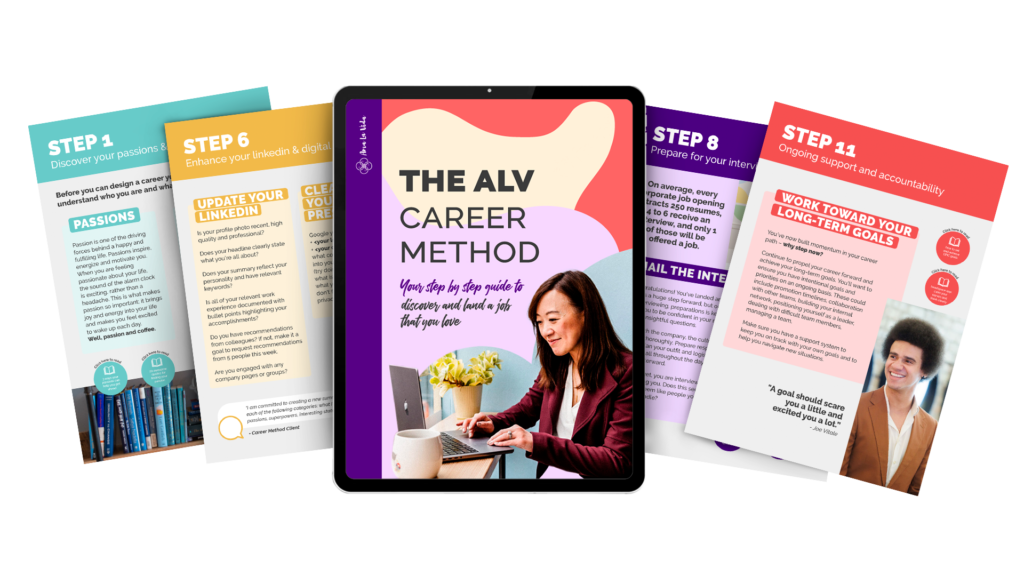
Download our comprehensive step-by-step guide to design and land a job you love!

Images from The ALV Career Method Guide
ALV Method Downloadable Guide

three colleagues high fiving

“I got this.” Words of Wisdom from a 4-year-old When I thought about writing this post related to self-confidence, I kept racking my brain for famous quotes and words of advice from inspirational leaders. I then realized that the inspiration was living under my roof and under four feet tall. My 4-year old daughter has a crazy amount of self-confidence. Her coined term whenever she is attempting something new is “Mom, I got this”. This summer her new thing was swimming without floaties. She has taken some swim lessons over the past couple of years but for a mom that worries (spoiler alert- that’s me) I felt like if she was going to be in the pool without an adult an arm’s length away, she needed some sort of floatation device. We went on vacation in June and the kids spent the majority of the time in a pool. Despite my persistent attempts to force her to wear her floatie, she kept taking it off and insisting, “I got this!” To give you a visual, when she “swims”, she looks to a bystander like she doesn’t quite have a handle on it. Her head goes under the water and then pops out just when you are planning to jump in and save her, her confident smile stretching across her cute little face. Watching this performance time and time again, I have had to learn to trust in her confidence in herself. I have tried to imagine what is going on in her 4-year-old brain of hers to be able to have so much confidence in this and other new activities, when even her parents seem a bit rattled. The obvious answer is that because she is so young, she cannot envision the bad things that could happen should situations go south. Without this fear, she is able to see her goals more clearly and drive towards them without distractions. What fears can you let go of so that you too can see more clearly and say with confidence, “I got this”? ~ Coach Kristin

Read More
woman smiling in front of a wall of colorful heart shapes

“Owning our story and loving ourselves through that process is the bravest thing that we’ll ever do.” Brené Brown The most important relationship you’ll have in your life is the one you have with yourself. Think of all the relationships you encounter in your lifetime. Whether it be the one with a partner, your friends, your siblings, your co-workers, or society as a whole, each one is affected by one common denominator: You. The way we think, engage, listen, love, and react is all derived from the relationship we have developed and cultivated within ourselves. Similar to how the connection and relationship we have with other people takes time and investment, so does the one we have with ourselves. This is especially true for the people we care about the most. We seek to care for them, protect them, and nurture them. It’s common to put ourselves last and not extend the same love and compassion we do for others to ourselves. The benefit of building a relationship with yourself is an undervalued and underutilized skill. Here are 5 tips to help you build a better relationship with yourself because let’s face it, it is the longest relationship you’ll ever have. Tip #1: Trust yourself. This means trusting yourself and your intuition. You have the answers inside yourself. Acknowledging this will get you closer to your purpose and help you live in alignment with your values. Tip #2: Love Yourself. This means knowing your flaws, knowing who you are (your core values, your strengths), and believing that your capabilities are limitless. Tip #3: Challenge yourself. With any great relationship, you need someone who is going to challenge you to grow so you can be the best version of yourself. If you stay in your comfort zone, you won’t develop character, strength, patience, humility, or confidence. Tip #4: Treat Yourself the Way You Deserve to be Treated. You set the bar of how others treat you based on how you treat yourself. Do you value yourself and all the things that make you unique? You teach people how to treat you based on the way you treat yourself so be kind to yourself. Tip #5: See Yourself Through the Lens of Another. Being in a relationship with yourself is a lifelong journey. Our lives are filled with ups and downs. We all make mistakes. We are human. If you can’t see that you are lovable or even likable, try to view yourself through someone else’s eyes. Experiment with bringing to mind someone who loves you, who always has your back. Embody them. Whether you know it or not, you are truly valued by someone in this lifetime. Want to get closer to building and cultivating the relationship you have with yourself? Life coaching might be exactly what you need. Book a free consultation here. ~ Coach Cait

Read More
two woman looking at a computer screen

Before diving into some tips, let’s establish what self-confidence is. Simply put, it’s your perception of YOU – what you think and how you feel about the constellation of talents, skills, abilities, experiences, personality, etc. that are uniquely you. It includes a positive view of self, neither exaggerated or deflated, and a feeling of trust in yourself. It’s certainly not an all or nothing way of being.  Most, if not all, of us have times and/or situations when we feel more self-confident than others for a variety of reasons, both external and internal.  When self-doubt creeps in, you’re second guessing yourself, you feel inferior, you notice you’re especially sensitive to criticism, imposter syndrome is holding you hostage, or you find yourself in a state where you feel disempowered, deflated, down or just want to hop in a crock pot and pull the lid over to simmer, here are 10 suggestions to help you flip the script, and lift yourself up and forward. Challenge Negative Self-Talk What are the negative messages looping in your head? I’m not smart enough. I’m not capable. I’m not lovable. I’m so dumb for making that decision. Who do I think I am going after this goal? I can’t do that. I’m just not enough. Whatever the message, challenge it. Is it yours, or does it belong to someone else? Follow the breadcrumbs of that message, and you’ll probably find it originated with someone else, and you’ve claimed and now carry it. Challenge it. Is it true? And even if you decide, for whatever reason, to conclude it is true, realize that it is NOT always true. Practice positive self-talk instead.  Snip the Perfectionism Cord Trying to be perfect results in a direct hit to our confidence. First of all, no one is perfect. Strive for excellence instead. Do your best and let it go. Be kind and gentle with yourself when you make a mistake; isn’t that how we respond to others? You’re just as worthy of compassion. Haven’t you found that there’s gold hidden in those mistakes? When you lay out lessons learned when hitting the mark versus when you miss it, there’s no comparison. Reframe the mistake as a great opportunity to learn and grow versus a chance to spotlight your flaws.  Save Some Yeses For You Sometimes we find ourselves overwhelmed and drained because we give away our YESES too freely. Years ago, I heard someone explain it this way. We have so many yeses in a given day, if we give all of our yeses away to others over the course of the day we have none left for ourselves. Are you a YES person? When you say YES to something or someone, what or who are you saying NO to? If the one on the short end of the YES stick is you, remember, save some YESES for yourself. Let the Comparisons Go Comparisons can wreak havoc on our self-image. Recall the statement above about the constellation of talents, skills, abilities, experiences, personality, etc., that make up you. Comparing ourselves to others when we’re each clearly unique just doesn’t add up. Yes, we’re steeped in a cultural environment that coaxes us to compare ourselves to others on a daily basis. Social media is notorious for this. As you scroll through Tik Tok, Instagram, Facebook, or some other social media platform, all you see are opportunities to compare your outer and inner life to someone else’s “posted” outer life, all fancy, exciting, and in living color. Really give serious consideration to the futility of comparing yourself to others and let the comparisons go. Instead, compare yourself to the next best version of yourself.  Stretch Yourself a Bit Building self-confidence is like building muscle. Every time we achieve a goal, especially one that stretches us a bit, it feels amazing, and gives us a confidence boost. Where do you need to build your self-confidence? Identify a small goal that challenges you. Perhaps you’d like to improve as a speaker, exercise more, expand your professional network, go to bed earlier, read more; wherever you identify an opportunity to learn and/or grow, set a small goal and achieve it. It’s not about the size, it’s about the transformative power of making it happen.  Play What Am I Great At When was the last time you sat down to review your accomplishments, your achievements – both large and small? Here’s a fun and simple way to get started. Get some sticky notes, a pen/pencil, and a whiteboard, or find a wall to stick them on. Now, write down as many of your accomplishments as you can. No matter how small. If you accomplished it, jot it down on a sticky note and proudly slap it on that whiteboard or wall. Start from when you were a kiddie pop, move through your teens and into adulthood, and don’t leave any period out; if it mattered to you and made you feel good, great, and confident, it’s fair game to post. You’ll be surprised what a boost this exercise can be to how you see yourself. Have fun with this! Take this a step further by taking a pic of your sticky note on a whiteboard or wall for a visual reference. Refer to it when doubt and fear show up and you feel unsure of yourself. It’ll make you smile! Take Good Care of Yourself Improving our quality of life makes us feel better and can be a big ‘ol self-confidence boost – physically, mentally, emotionally, and spiritually. Whenever we eat well, get our ideal amount of sleep, move our bodies in ways that we enjoy, learn new things, express ourselves and own our power in healthy ways, and nurture our spirit, it’s a good thing. Take a quick assessment and identify where you can make some small improvements in one or more of these areas. You’re worth it! Get Curious I don’t know about you, but learning something new and expanding my knowledge on

Read More
woman smiling looking away from computer

The names and circumstances behind this case study have been altered to maintain client confidentiality.  Can working with a coach help boost your confidence? What is your success rate in improving the confidence level of your clients? What are some examples of transformational stories that you’ve had in working with clients who struggle with Imposter Syndrome?  ​​I get asked these types of questions all the time when meeting with prospective clients.  So today, I want to share with you all a case study in just how life coaching can help to boost your confidence and overcome imposter syndrome.  Before I dive in, I think it’s important to understand the distinction between Confidence and Imposter Syndrome. Confidence is something that we are all born with. It’s a muscle that we can strengthen and weaken over time. In essence, confidence is having faith in yourself. Confidence is a result of how we’ve been brought up and what we’ve been taught about the world. Our confidence is a result of our experiences and the people who have influenced us along our journey. Because of this, confidence is a feeling that is individualized, and it can mean a lot of different things to different people. Confidence is not static. Our confidence can increase and decrease over time, and some days we will feel more confident than others.  Imposter syndrome is defined as doubting your accomplishments, skills, or talents, and feeling like you don’t deserve to be where you are. This idea of being an imposter comes directly from the inner dialogue of our inner critic. Ultimately, imposter syndrome is fear. The inner critic tries to keep us safe from fear, but it can prevent us from taking the necessary steps to living a fulfilled life. In order to get to where we want to go, we must address this inner dialogue and befriend our inner critic by acknowledging them as our inner imposter. Through doing so, we build the muscle of confidence and learn to get out of our way.  There are many reasons people want to boost their confidence and overcome imposter syndrome. From advancing in your career to having the courage to go on a date, being more confident in yourself will not only open up multiple opportunities, but it will also help you get more out of life. By being able to combat imposter syndrome, you’ll be able to step out of self-doubt and live the life you deserve.  Bottom line: Building your confidence can be life changing. The truth is, no one will build confidence through talking about their insecurities alone, but that is a critical part of how coaching can help boost your confidence and combat your imposter syndrome. Now I realize that so many people run (or want to run) away from tough conversations. Coaching requires a level of vulnerability and openness in order to be effective. This work is not a quick fix, one size fits all approach.  “Can working with a coach help boost your confidence?”  “What is your success rate in improving the confidence level of your clients?”  “What are some examples of transformational stories that you’ve had in working with clients who struggle with Imposter Syndrome? These are all great questions, so let’s dive into it using a real life client success story.  Meet Claudia. Claudia has been a professor for 15 years. She’s been an expert in her field, but she’s noticed that now when she stands in front of her classroom she trips over her words, can’t think on her feet, and shakes uncontrollably. This has been going on for 4 years now. Claudia feels like an imposter, like she doesn’t have any of the answers or expertise, despite over a decade of experience and receiving countless accolades for her research. She has an unwavering fear that she will be found out, that she’d somehow tricked her colleagues and her students that she was capable, and that anything she said would demonstrate that she is a fraud and an imposter.  Many of us can connect with Claudia’s story. In fact, research indicates that 70% of humans experience imposter syndrome at some point in their lives. My first step with Claudia was to truly understand what is happening, and helping Claudia understand her triggers and beliefs that are unintentionally hindering her performance.  When do you feel the imposter syndrome coming in?  What happens in your body when you feel it?  When can you remember first experiencing this sensation?  Through a series of inquiries, Claudia realized that this sensation first stemmed from an experience where a professor, who she perceived was a lot smarter than her, challenged her in the classroom. She froze. She was “found out.” Finally, someone had validated the insecurities that were deep within her. From that moment forward, she felt paralyzed. That experience had embedded a belief that she wasn’t a skilled professor, and she certainly didn’t know what she was talking about.  Now, I’m not going to get into too many details here, but here’s where I get into deep work with my clients: understanding limiting beliefs. A limiting belief is defined as a state of mind, belief, or conviction that you think is true that limits you in some way. It could be something about you, how you interact with other people, or the world as a whole. Over time, these beliefs negatively impact us. They keep us from making positive decisions, taking on new opportunities, and most importantly, they inhibit us from reaching our full potential. You can learn more about limiting beliefs and confidence here.  Claudia recognized that that experience had created a belief that was limiting her and hindering her well-being. It meant a great deal to be able to overcome this limiting belief to step into her confidence and combat her imposter syndrome. Instead of dwelling on the past, coaching seeks to focus on the client’s present and how they want to move forward and be in the future, and that’s exactly what

Read More
woman outside sitting on a rock journaling

“Sometimes we need to be brave enough to outgrow the life we’ve built.” Unknown Life is a series of challenges, opportunities, crossroads and realizations. We all navigate these daily. When it gets really painful, a critical juncture may call for a rebuild. We know we’re past that expiration date when we start to feel restless, frustrated, unmotivated, disheartened and/or sometimes just really sad. We may justify why it’s best to stay where we are but deep down we know it’s time to make a move. When was the last time you experienced zooming right past an expiration date in a relationship or in your work life? It can be so scary to let go of what is clearly not serving you or anyone else, for that matter. Early on, when this happened to me, I’d white knuckle it because that’s what you’re supposed to do. Culturally acceptable adages like “winners never quit,” “quitters never win” and “hang in there” looped in my mind, and I just couldn’t admit that I had outgrown the life I had built. The reality is that sometimes you have to quit and rebuild, which means releasing what no longer serves you. It’s also important to remember that it’s not always about us; oftentimes when something isn’t serving us, it’s probably not serving others involved either. Perhaps we tell ourselves that it will get better, or it will pass, and everything will work out. We keep justifying, yet the longer we stay past the expiration date the more we compromise our wellbeing in a situation that is clearly in decline and deteriorating. We can see it, we can feel it, and yet we still hang on.  It takes courage to say, ‘I’m ready to move on,’ ‘This isn’t working,’ ‘I quit’. That last one, “I quit” seems to pack the biggest punch because we’ve bought into that cultural adage that if we quit, we lose, we’re losers…ouch!  Knowing when it’s time to release and rebuild is actually a sign of courage, not cowardice. Yes, it’s brave to let go and free up space for something better. I’ve yet to commit to a life rebuild that didn’t result in a better outcome. I actually find myself wondering why I didn’t start the process sooner.  I love the Zen Proverb, “Let go or be dragged.” It reminds me that holding on to what does not contribute to my overall well-being and expansion will eventually cause me even more pain than acknowledging the truth of the situation, facing my fear, and taking action.  Do you need to outgrow a relationship? Do you need to outgrow the work-life you’ve been hanging on to for months, perhaps years even though you know the time to let go is way past the expiration date?  First, stop and get really honest with yourself. If it’s clear that your life is out of alignment, you can tell, there are plenty of signs (I mentioned a few above). Additionally, you may feel overwhelmed, burned out, resentful, listless, or unsatisfied.  When it’s clear that you have sped past the expiration date muster some courage to begin the rebuild process. One approach that always reframes the situation and prepares me for what’s ahead is to adopt the attitude of Bilbo Baggins in The Hobbit: An Unexpected Journey, “I’m going on an adventure.” ~ Coach Robbi

Read More

So, you’ve decided you’re ready to work with a life coach, you’ve met the right person to be your coach, and your first session is scheduled. Now what?! Today, we’ll go over what you can expect from your first life coaching session. Of course, this will look different for every coach depending on their style, approach, and structure, but for the most part, this outline should give you a good idea of what’s ahead so you can feel excited and prepared for your first session! Jitters and Initial Questions Before and during your first life coaching session, you may feel jitters or nerves – that’s okay! We know it can be nerve-wracking to try something new, share personal experiences with a stranger, and have video meetings in general! Your life coach will do everything in their power to create a safe and open space for you to explore the various topics you’ll have in mind!  To break the ice, feel free to prepare any questions you may have about your coach, their background, or how things work. If anything is unclear and making you uncomfortable, feel free to share it right off the bat so your coach can answer questions, address concerns, and get to know you better! Ground Rules & Expectations After you get the initial questions out of the way, you and your coach will go over some ground rules and expectations. This can include anything from scheduling logistics, discussing cancellation policy, and going over what to expect from your coach and sessions moving forward.  This is also a great time for you to set your own expectations about what you need from your coach in your sessions and beyond. Your life coach is here for you, and many of their ground rules and expectations are set to make sure they create a great environment for your personal development and growth – however, you are ultimately the expert on your life, so don’t hesitate to ask for what you need to succeed.  Who Are You? Once logistics and ground rules are reviewed, you’ll jump into the good stuff: getting to know YOU! Your first life coaching session is all about your coach getting to know who you are and what works and doesn’t work for you.  Your coach may ask a lot of questions to learn more about you. Rest assured that your coach comes from a place of openness and curiosity and never judgment. This is definitely the time for you to express any needs you may have when it comes to feeling seen or heard so your coach can better adjust their approach and coaching to your unique needs! Why Are We Here? At this point, you may have met your coach during a consultation or it may be your first time talking to them! It’s important that your coach learns what led you to coaching and what’s motivated you to seek coaching at this moment in time.  Goal Alignment Life coaching, from wherever you look at it, is about you; what matters are your goals, your obstacles, and your dreams. In your first life coaching session, you’ll take time to make sure you and your coach are aligned on what your goals are. Every coach does this slightly differently, but the purpose is to make sure that both you and your coach are clear on what you want. To prepare for this, you can reflect on some of the following questions: What do you want that you don’t currently have? Tangible or intangible! How would your life be different if you achieved your goals? Have your goals changed recently? What led to this change? What have you tried in the past? What worked? What didn’t? Your coach will support you in getting clear on your goals, so don’t worry if they’re blurry and jumbled up before your session. Setting clear goals isn’t a one-and-done deal, and this will be the first conversation of many that you will have around goal setting. Takeaways & Next Steps Because life coaching is all about you, you’ll always have some time to reflect at the end of each session. What are some of your biggest takeaways from today’s session? What did you learn about yourself? From there, you and your coach will define your action steps. Some, you may set for yourself based on your session and goals. Others, your coach will challenge you to do; such as completing one of Ama La Vida’s eCoaching Modules or doing some journaling to reflect on a particular topic or theme.  Are You Ready? Facing the unknown of life coaching and what to expect can be daunting and scary. We hope that you are now feeling more prepared and at ease as you approach your first life coaching session! As always, let us know if you have any questions before you get started – we’re happy to help!

Read More