Category: Life Coaching

woman smiling sitting outside

Over the last few years, the conversation around mental health has been shifting from silent and stigmatized to open and commercialized and everything in between. I, for one, am so glad we’re starting to talk about mental health. It’s not just about being healthy or struggling with mental illness, there is a big area in the middle that tends to be forgotten.  Today, we’re going to talk about improving your mental health the way you would improve your physical health if you’re already a relatively healthy individual. How do you show up to the “mental gym” and what sorts of things do you do to flex muscles that may be a little weak? Let’s dive in! Note: Mental health is on a spectrum and before we dive into some ways you can improve and care for your mental health, we want to call out that sometimes the best answer to this is to seek help. If you feel like you need professional help with your mental health, please call a mental health provider or seek out immediate help through the SAMHSA National Help Hotline.  1. Lower Your Expectations Every time I say this to my clients, they laugh. Lower my expectations? Why? Well, odds are that your expectations of yourself are way too high. Much higher than the expectations you hold of others or anyone else holds of you. So, lower them.  We expect ourselves to give our 100% ALL of the time and if we don’t, we beat ourselves up for not doing enough or being enough. So I say, lower your expectations. A good way to frame this is by coming up with your goal and then breaking it down into three categories.  Your first category is your expectation of yourself when you’re feeling your best – this can be your “ideal”  The second category is your expectation of yourself if something else were to come up – a busy week, a last-minute deadline, or a head cold And the final category is your expectation of yourself if something major happens – a family emergency or a more serious illness like the flu or covid Now, that third category is your new goal.  Anything beyond that, categories 2 and 1, is exceeding your expectations, not meeting them. Anything you do that’s the third category or more, you celebrate! If you don’t meet that level of expectation, you reflect: what happened, what got in the way, what type of support do I need? In none of these circumstances, do you ever beat yourself up. Got it? 2. Stay Present “If you are depressed you are living in the past. If you are anxious you live in the future. But if you are at peace you are in the present” Lao Tzu Living in the moment or mindfulness has been and still is a hot topic of conversation. We all know we should do it, but how do we do it when our minds are reeling, going a million miles a minute? One of my favorite mindfulness practices is a practice called “Orienting.” It’s simple and you can do it anywhere, anytime. I encourage you to have scheduled moments in which you orient (set an alarm or match it up to a thing you do every day like drinking coffee, eating lunch, or brushing your teeth).  Before starting this exercise, pay attention to your breathing. Take slow, deep, long breaths – in through your nose and out through your mouth. Breathe deeply for about 3-5 breaths and then go through the following steps: 5: Acknowledge FIVE things you see around you. It can be anything, don’t worry about judging it or bringing any memories or stories in. Don’t start thinking “I see my room, it’s so messy and there is clutter and I should’ve cleaned it” Simply acknowledge 5 things. Ex. I see a pen. I see a plant. I see a computer. I see a tree. I see a couch. 4: Acknowledge FOUR things you can touch around you. It could be your hair, a pillow, or the ground under your feet. Again, no judgment or stories just state facts. Ex. I can feel the ground on my feet, it feels cold and solid. I feel the pillow in my hand, it is soft and fuzzy.  3: Acknowledge THREE things you hear. This could be any external sound around you or near you.  Ex. I can hear the whirring of a helicopter. The sizzle of a pan. I hear my dog snoring. 2: Acknowledge TWO things you can smell. Maybe you are in your office and smell pencils, or maybe you are in your kitchen and smell food. If you need to take a brief walk to find a scent you could smell soap in your bathroom, or nature outside. Ex. I smell my coffee, it is nutty and strong. I smell my shampoo, it smells like coconut. 1: Acknowledge ONE thing you can taste. What does the inside of your mouth taste like—gum, coffee, or the sandwich from lunch? Ex. I can taste my toothpaste.  Once you acknowledge these things, bring your focus back to your breath. How do you feel now? Where do you feel those feelings in your body?  You can also do this exercise in the moment when you feel anxiety, stress, or any other intense emotion come in. This simple exercise gets you out of your thinking brain into your feeling body and hopefully supports you in de-escalating emotions that may be too intense or negatively affecting you in your day to day. 3. Move Your Body Moving our bodies has proven benefits for our minds and bodies. It helps release endorphins, move emotions through our bodies, strengthens the mind-body connection, and get us out of our heads. Like everything, there are helpful and harmful ways to do this and for the sake of improving your mental health, we want to focus today on intuitive movement, what it means, and how to embrace

Read More

I am a recovering people-pleaser. There was a time in my life when I was afraid to say no because I wanted everyone to like me. I avoided conflict to a fault. I didn’t speak up for myself. I subscribed to this toxic mindset because I saw this type of behavior equal success. Over the years, I’ve met countless people-pleasers just like me who have come to me for coaching. Over time, people-pleasing became the default for them. When discussing their reluctance to change often they’d say things like, “I just want to be a good person and say yes,” or “I want them to like me,” or “I have to say yes because I don’t want to hurt their feelings.” This unhealthy behavior over time wears on People-pleasers. Consequently, people take advantage of this type of behavior. Over time, through this repeated behavior, people-pleasers realize that they aren’t pleasing anyone at all. While people-pleasing can be a hard habit to break, with some good coaching and identifying the right tools that are going to support you, you can recover from this toxic mindset.  What is people-pleasing? At the core, people-pleasing means putting someone else’s needs before your own. People-pleasers are naturally in touch with the needs of others and are agreeable, helpful, and kind. Helpfulness and kindness are generally positive traits we want to see in other human beings, but taking it too far has its pitfalls. People-pleasers are known for doing whatever it takes to make others happy. Going too far to please others can leave one feeling emotionally drained, stressed, and anxious. As a result, people-pleasers may struggle with self-advocacy, which can lead to harmful patterns of self-neglect and self- sabotage. The Risks of People-pleasing: We can’t talk about how to overcome people-pleasing until we fully understand the risks. While it might seem harmless to be a people-pleaser, overtime this behavior can have damaging consequences. It can lead to serious mental and physical health risks.  The Signs You Might Be A People-pleaser: There are several signs that you might be a people-pleaser. In order to know how to recover from people-pleasing it’s important to answer these questions. Do you… If you answered yes to most of these questions, chances are you suffer from people-pleasing. Learning How to Say No Putting an end to people-pleasing requires us to learn how to say No. There are several reasons why we must learn to say no: Now you know why, it’s important to learn how to say no. Here are a few tips: 7 Tips to Recover From People-Pleasing  While saying no is a critical step in healing from people-pleasing, there are a number of other steps you can take to recover. These steps will help you learn how to find a healthy balance in helping others without sacrificing your own needs.  1. Establish Boundaries In order to recover from people-pleasing it’s important to know your limits and communicate those limits. Boundaries are for us. Be clear and specific about what you are willing to say yes to. If it feels like someone is asking too much, let them know it’s beyond your limits of what you are willing to do and say no. We have a great resource on how to establish boundaries which can be found here.  2. Small Steps For people-pleasers these behavioral changes will feel big because they are. You have to retrain your conscious response pattern while also teaching those around you to honor your boundaries. Because of the complexity, it can be helpful to start small. That might sound like practicing saying no to smaller requests or challenging yourself to ask for something small that you need. Every time you take a small step away from your tendency to please, you’ll gain confidence.  3. Positive Self-Talk This is one of my favorite tools in building confidence, and can be applied to people-pleasers. If you start to feel overwhelmed or tempted to say yes when you really mean no, remind yourself that you deserve to have time for yourself. You deserve joy. You deserve to spend time and energy on the things that get you closer to your goals.  4. Set goals Name your priorities. Where do you want to spend your time? What goals are you trying to accomplish? Who do you want to spend time with? If something or someone is depleting your energy go back to your boundaries.  5. Pause Similar to the notion of “blaming your calendar,” when someone asks for a favor, tell them you will think about it and get back to them. Saying yes without pausing can lead you to feeling obligated and overcommitted. By giving yourself space to respond you can decide if it’s something that you really want to do. Furthermore, research shows that a pause between making a choice increases-decision making accuracy. Ask yourself, “Is this something I really want to do and if I say yes how stressed will I be?”  6. Reciprocity It’s important to remember that strong, healthy relationships involve reciprocity. If you’re the one always giving and the other person is taking, that is no way to live. Even if you truly enjoy pleasing the other person, it’s important to remember that relationships are about give and take and they should give you something in return.  7. Help You don’t have to give up being helpful and kind and you don’t have to say no to everything for the sake of saying no. The key is to understand your intentions. Don’t help only because you want approval. Keep doing kind things, but do it on your own terms. It will demonstrate greater authenticity on your behalf and you’ll be able to live a more congruent life.  None of us are perfect. If your people-pleasing is standing in the way of your own happiness, it’s crucial that you set boundaries and take back your time. You’re human. You can’t possibly please everyone. Working with an Ama La Vida certified life coach

Read More

“And that’s okay.” – Shari Santoriello I couldn’t find a quote that really resonated with me to include in this week’s blog. The phrase “and that’s okay” kept running on a loop in my head – I gave myself permission to be okay with not having a quote. I realized that I have been using this phrase a lot recently, both personally and professionally. Why is this becoming a new mantra for me and why have I been sharing it? I, like many of us, am feeling fatigued – virus-fatigued, ZOOM-fatigued, politics-fatigued, pressure-fatigued. I am just all around overwhelmed, overstimulated, and fatigued by all of the things! “And that’s okay” feels like a simple way to give myself (and others) a quick out without explanation or repercussion. When I say “and that’s okay” it doesn’t feel like I am less than or like I’m not accomplishing something. I realize I am not looking for a full-on exit strategy. I know I will revisit whatever this is and resolve whatever the challenge is. But for now, I need a little space to not keep up with it all. And those three words feels comfortable enough to give me the clarity to move forward and acknowledge that what I am doing is perfectly acceptable. Some of my clients are using meditation, journaling and affirmations in conjunction with saying ”and that’s okay”. What are you doing this week to feel okay with it all?

Read More

It’s no mystery that building daily habits is difficult. We create lists of all the things we “should” be making a priority and never seem to find the time to get around to them. We make excuses. We let fear take over. We blame busyness. The truth is, often the anticipation of creating a new habit or the act of thinking about instilling a new habit can be far worse than actually doing it.  Habits become easier through repetition and through patience. It’s about pushing through the “this is difficult” phase and making them a part of your routine. Studies show that it can take on average 66 days to build a new habit. From my experience, this can vary, and the number of days doesn’t really matter. Ultimately, there’s a reason you’re reading this and it’s likely because you want to do something about your current behavior. These five daily habits are small improvements that overtime have the power to change your life.  Habit #1: Reading a Book If you’re reading this article, you’re on the right track. How many times have you been asked, “What was the last book you read?” Most people would say, “I can’t remember.” We have information at our fingertips all the time between blogs, tweets, Facebook rants, but reading a book is different. It takes time and patience. It is essential to support our brain health.  The best way I’ve found to create a habit of reading is to have it take the place of the “mindless scrolling” time. That could look like bringing a book with you so it’s handy during waiting times. When you’re waiting in line at the grocery store or the dentist, you could pull out your book. When you’re on the subway, instead of mindlessly scrolling, pick up your book. Anywhere you’d mindlessly check your phone, pick up your book instead. Over time, reading will become an escape and something you love to do.  Habit #2: Waking Up Early  If you’re not a morning person, you’re properly reading this one and thinking “no way.” Of all the habits we “should” do, this one is on most people’s list. As a life coach, I’m constantly talking about the importance of routines to my clients. Many people go wrong in the “waking up early” habit when they set their alarm for 5am, but still go to bed at midnight. 5am rolls around and your bed is warm and your inner voice says, “absolutely not.”  When working to instill this daily habit, people think it’s all about waking up early. It’s actually about going to bed earlier. Waking up early truly starts the night before. Set a routine that allows you to wind down. Give yourself the permission to slow yourself down. Read a book instead of scrolling, meditate or take a shower. Do the things that are intended to relax and move you into sleep so you can wake up fresh the next morning. Over time, waking up early will be something you “just do.”  Habit #3: Setting 3 Daily Priorities  Focus brings us closer to achieving our goals. The problem is our days are filled with endless distractions. This habit is more about productivity than anything else. Limiting our options is how we focus in a world full of distractions. Each morning, ask yourself what you want to achieve. Then commit to 3 essential tasks. Take everything above and beyond that list as a bonus.  In creating the Daily Priority habit, start the day before. Write down the 3 essential tasks for tomorrow. This can be a particularly effective way to close the day and transition from work to home. From there, make sure this list is visible the next day. By limiting our focus to 3 priorities, we increase our chances of success.  Habit #4: Walking for 30 minutes Walking is good for you and keeps your body moving. As an avid walker, I’ve found it breaks up the monotony of daily life. There’s nothing wrong with the daily monotony but getting outside forces you to engage with the outer world. It heightens your senses. You feel the air in your lungs, you start to notice the cyclical pattern of the seasons.  Many people find walking first thing in the morning to be the best because they don’t procrastinate or skip it as they might later in the day. Others find it helpful to incorporate walking into their workday by taking calls on the go or leveraging their lunch break for this time. Some find it is helpful to walk in the afternoon or evening to clear their minds after their day. Go alone or with a friend, but either way get out and enjoy. It will soon become a refreshing daily habit.  Habit #5: Practice Presence  So many of us are focused on the future that we forget to enjoy the present moment. We say, “I’ll be happy when….” Don’t get me wrong. As coaches, we live in the future possibilities. At the same time, the future can bring up anxiety and isn’t always guaranteed. Studies show that an individual’s disposition to staying present is linked to numerous health benefits including lower levels of perceived stress, anxiety and depression, improved mood, and a sense of improved well-being. Because we are so focused on “what’s next,” we forget to enjoy the present moment. A tip I offer my clients in practicing presence is finding a trigger that brings you back to the present moment when you feel yourself being stuck in the future. This could be a quick check in with your five senses and naming what you see, hear, feel, taste and smell. Once you start to think of being in the present moment as a conscious practice, your approach will start to change. The moments when you are frustrated become opportunities to react mindfully.  You can change your life, starting now.  Daily habits don’t change overnight. Who you are and the way you react to

Read More

If you’re here, maybe you’ve just googled, “What do I want to do with my life?” or “I feel stuck and don’t know where to start” or “Why should I hire a life coach?”  Welcome, you’ve found the right place. Life coaching has been gaining momentum over the last few years and is carving its space in the personal development world. Unlike therapists, life coaches don’t delve into psychological disorders or deep trauma, nor do we dive into the past and stay there in order to heal. However, we do work with individuals to support them in getting clear on who they are and what they want, exploring what’s been getting in the way, and moving them forward to create a life they love. You can read more about the differences between therapy and coaching here. Today, we’ll dive into 5 reasons to hire a life coach and explain a little more of what life coaching is all about.  1. Explore Ideas in a Safe Space Do you ever get an idea about something and then share it with someone close to you and get discouraged or overwhelmed when their response is filled with opinions, doubts, and fears? Even though most of us have at least one person in our lives that we can talk to about anything, that person still brings their own biases and fears into it because they are (even in the smallest ways) personally involved with what you do and how you do it.  Working with a life coach offers a safe and unbiased space to explore any and all ideas that come to your mind. This space looks different for everyone, and life coaches are open and flexible, so your coaching time can be everything that you need to feel comfortable and safe to dive into some of your wildest ideas. Your coach is on your team 100% of the time, whether that means picking one thing and working on tiny action steps towards it or having a million ideas and trying them out to see which one fits. A life coach leaves judgment, preconceived notions, and biases at the door so they can show up fully for YOU. 2. Challenge your Mindset So much of the work that life coaches do is mindset work. Many of our clients know what they want or have an idea of the general direction, but they get stuck or feel lost as to where to start. As coaches, we believe every one of our clients is creative, resourceful, and capable to do what they set their mind to, but sometimes our minds are exactly what gets in the way.  Life coaching is a powerful way to evaluate and challenge your thoughts and beliefs about yourself and the world around you. It helps shift your mindset into one that helps you thrive. Life coaches can support you in taking the time to slow down, digest what your mind is telling you, and work towards uncovering what it is that you need to succeed. They’re there every step of the way to then support you in shedding the old mindset and embodying the one that will help you achieve your goals.  3. Get Unstuck through Powerful Questions I always love hearing a client tell me, “That’s a really good question,” and then silence fills the room as they think deeply about what the answer is. That’s how I know we’re getting somewhere good. Powerful questions evoke discovery or insight and usually challenge the client’s assumptions. Sometimes, it’s the simplest of questions that evoke the biggest “a-ha” moments. Having the space to ask and reflect on things instead of assuming and going through the motions is a great tool to lean into when feeling stuck or lost.  A life coach has an arsenal of questions that curiously and empathetically probe at assumptions and beliefs that help you unlock what’s already there. Many people believe that it’s the coaches that have the answers, but the true power of coaching is asking questions that help individuals arrive at their own answers and feel empowered in that moment to continue exploring what they discover.  4. Have an Accountability Partner As you probably already know, new habits are really easy to think of but not so easy to develop. Creating a new habit, undoing an unhealthy one, or trying something new takes time and commitment. It means showing up for yourself every day and working towards that end goal in big and small ways.  With a life coach, you have an accountability partner that can not only help you in setting those smaller milestones and checkpoints, but can dive deep with you when things don’t go according to plan with zero judgment. Accountability is not just about having someone who keeps you checking the boxes, but it’s about being able to reflect on what worked, what didn’t, and what got in the way so you can continue to grow and move forward as you learn more about yourself.   5. Gain Confidence through Action Humans are thinking creatures. We like to have everything “figured out” in our heads before we feel confident enough to take action. Yes, a lot of the work you do with a life coach is about thoughts, feelings, and mindsets, but a life coach also supports you in increasing your confidence through action. They do this by taking small steps and embodying the version of yourself you’re working towards becoming. Your coach will encourage you to come up with action items every time you meet to build on the awarenesses and reflections you gain from each session. They will also be by your side as you explore and try things on, and celebrate your wins so you can gain confidence in your ability to be the person you want to be.  In its most basic form, the purpose of life coaching is to empower you to take responsibility for your life and keep you accountable for taking a structured and disciplined

Read More

“Trust the process.” – Anonymous For the past three years, one of my kiddos has struggled with some less-than-great eating habits. Her pediatrician was unconcerned and told me to just wait it out. But as a mother who values the six main food groups, I started her in OT at the age of 2. At a high level, my immediate goal was to get her to eat more nutritious food. I figured this might take six months, at the most. Fast forward 1.5 years. She can tolerate being near food she doesn’t like, smell it and sometimes even touch it. These months have been very frustrating for both of us. Weekly visits and eating exercises at each meal are mentally and emotionally draining. The OT sessions were very different from what I had imagined. She would often just hang out, touch, and smell new foods. I found myself wondering, “When will she actually EAT the food”. While the progress has been excruciatingly slow to me, her OT celebrates the little wins. She points out the progress made every session since day 1. She continually reminds me to trust the process.  For me, trusting the process means leaning into where you are in the moment. It means acknowledging that maybe you have a long way to go to achieve what you desire. But it also means acknowledging how far you’ve come. It is a reminder to be grateful for all you have overcome; to recognize that your journey has been no easy task. It is providing yourself with grace and understanding that you are exactly where you are supposed to be. The rest will come in time. You will learn from all of the bumps and challenges along the way, and that’s the point. Perseverance will not only make you grow as a person, but will make the reward of achieving your goals that much sweeter. If you pay attention to the small steps leading up to achieving your goal, you may even find that you’re enjoying yourself. Reflecting on this, it would be a huge step for my daughter to go from not wanting to even look at the food she doesn’t like, to willingly putting it in her mouth, chewing, and swallowing it. The therapy process was encouraging her to become comfortable with new food, experimenting at her own pace, and taking small manageable steps forward.  Trusting the Process When it Comes to Your Career I think this can be a good reminder for those that are frustrated in their careers, but feel like transitioning to a new career is insurmountable. For those of you who are impatient like me, deep down you know that trolling job boards day in and day out is not going to help you find what you are looking for, and yet you find yourself endlessly looking anyway. It may seem that if you don’t actively apply to jobs—whether or not you were truly interested in them—then you didn’t take any tangible actions that day toward finding a new job. The reality is, while it might take longer and require more patience, taking the time to do the self-analysis to identify who you are and what you value is a pivotal step toward figuring out the next step in your career. Those tiny steps that you take every day will eventually lead you toward your seemingly impossible goal. You will get there—just don’t forget to enjoy the ride while you’re trusting the process.  ~ Kristin

Read More

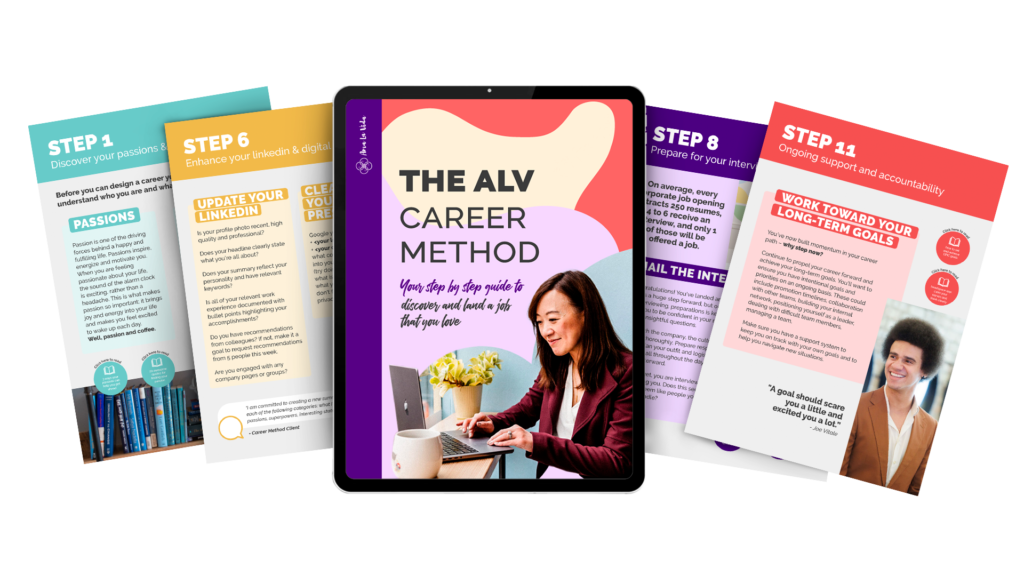
Download our comprehensive step-by-step guide to design and land a job you love!

Images from The ALV Career Method Guide
ALV Method Downloadable Guide

How To Befriend Your Inner Impostor to Build Confidence   I remember the day I decided to resign from my secure corporate gig to follow my passion. I’d spent countless hours visualizing my future if I continued on the path I was on and countless hours visualizing the path less traveled: pursuing my dream of being a full-time coach.  “I don’t know enough, I don’t have enough experience, how on earth will you ever make money?” These thoughts were like a horrible ride that I couldn’t escape. If I was going to be a coach to others, how would I be able to get myself off this ride? There was no way this chatter would allow me to be effective in my work.  Simultaneously, there was another voice. “No one ever looked back on their life saying ‘I’m really glad I made that safe decision’… Go for it, Cait!” Ultimately, this story has a happy ending, but that wasn’t without the constant inner dialogue, judgment and feelings of inadequacy. My inner impostor was the biggest thing standing between me and my confidence.  We all experience inner dialogue or “chatter”, and it’s become more commonly known on the internet today as “Impostor Syndrome”. While we hope that our inner coach will lift us up, more often than not the voice of our inner critic is much louder. The inner critic keeps us safe, but they don’t always get it right. Our inner critic holds the microphone for our deepest fears, doubts, and judgements, which can actually cloud our judgment more often than not and keep us in a cycle of feeling stuck.  What is Impostor Syndrome? Impostor syndrome is defined as doubting your accomplishments, skills, or talents, and feeling like you don’t deserve to be where you are. This idea of being an impostor comes directly from the inner dialogue of our inner critic. Ultimately, impostor syndrome is fear. The inner critic tries to keep us safe from fear, but it can prevent us from taking the necessary steps to living a fulfilled life. In order to get to where we want to go, we must address this inner dialogue and befriend our inner critic by acknowledging them as our inner impostor. Through doing so, we build the muscle of confidence and learn to get out of our way.  6 Tools to Befriending Your Inner Impostor: There are countless ways to build confidence by befriending your inner impostor. Not every tool will work for everyone. The key here is to experiment and find what works best for you. These techniques will help you befriend your inner impostor instead of allowing them to hold you back.  Tip 1: Give Your Impostor a Name  When it comes to Impostor syndrome, a helpful tool can be to name your impostor. There are five different types of “impostors”: The Super Person, The Soloist, The Expert, The Natural Genius, and The Perfectionist. By taking the time to identify which persona your inner impostor takes on and giving them a name, you’ll humanize them and release their control over your every move.  Tip 2: Use Their Voice as a Motivator The next time you hear your inner impostor doubting you, try treating their voice as a motivating factor to drive you to do the opposite of what they are telling you. Think of your nerves as a reminder that you are growing. Deliberately embrace experiences that your inner impostor encourages you to shy away from. It’s through getting out of your comfort zone that you grow.  Tip 3: Reframe  Our inner impostor is often the loudest when we interpret a situation to be a threat or something we believe we can’t manage. Reframing means reinterpreting the situation as a challenge that you can handle. Instead of letting fear, doubt and judgment overwhelm you, remind yourself of how you’ve successfully overcome challenges in the past. By reframing what our inner impostor is telling us, we can begin to realize and reach our potential.  Tip 4: Give Your Friend Advice Ask yourself, “What would you say to a friend experiencing the same problem.” Think of this advice thoughtfully and then apply it to your situation. Studies show that by using distanced self-talk and referring to ourselves in the second-person, we are less activated. By playing this game with your inner impostor, you’ll improve your performance under stress.  Tip 5: It’s Okay to Not Know The Answer  Instead of obsessing over not knowing enough or having the answers, remind yourself that it’s okay to not have the answers. And the truth is if you have a question about something, chances are that someone else is thinking the same thing. Remember, everyone has an inner impostor. By saying “I don’t know the answer, but I’ll find out” makes you appear more confident in your abilities. It shows you have the courage to say what you didn’t know and the humility to admit you don’t have all the answers.  Tip 6: Ask Your Inner Impostor Why You’re Afraid  When your inner impostor is making you fearful, ask them, “why are you afraid?”. Is it that you are worried about failing? If so, it’s probably a good sign that you should take action because our inner critic might be inhibiting us from having a tremendous growth opportunity. But the key with this one is to not go overboard. Prioritize experiences that will stretch you while also helping you get closer to your goals.  Normalizing Your Experience   This list of tips is by no means exhaustive. The biggest takeaway I’ve learned through coaching is that the majority of people have an inner impostor and are walking around wondering, “Am I good enough?”. Knowing that you’re not alone in your experience can be the most effective way to befriend your own inner impostor. Despite how awful our inner impostor can make us feel, our mind is a muscle that can be strengthened. By befriending your inner impostor, you can train it to speak to you with

Read More

“If you fight for your limitations, you get to keep them.” — Jim Kwik My health took some big hits this past month. I started out strong with more soccer and taekwondo until I tweaked my ankle. Then my knee started hurting. Then I pulled my groin muscle. Before I knew it, I was unable to participate fully in any of the activities that bring me joy. I’ve been down this path before, so I know it can go one of two ways. If I fight for my limitations, I may experience more injury, feel sorry for myself, or throw the rest of my health routines out the window. If I fight for my health, I may be reinvigorated to reframe my perspective and focus on my recovery. I refused to embrace the limiting belief that I was broken and couldn’t do anything about it. I chose to fight for my health and adapt my move-forward recovery plan accordingly. I’m currently a work-in-progress focused on rest and healing. While I haven’t made it to the finish line just yet, I know I’ll be stronger—both physically and mentally—for it. This is the belief I need to keep cultivating in order to keep moving forward. Start Moving Forward Are you ready to stop feeling stuck with your goals and start moving forward? If so, I invite you to reflect on the following:  What limitations are holding you back? If these weren’t true, what would you be doing instead?  What is one thing you are willing to try now to start making progress? What do you need to believe in order to move forward? I invite you to toss your limitations aside and embrace your possibilities instead. Take care and here’s to your happiness and health! ~ Coach Sara

Read More

“Whenever you feel uncomfortable, instead of retreating back into your old comfort zone, pat yourself on the back and say, ‘I must be growing,’ and continue moving forward.”- T. Harv Eker I recently shared with my coach (yes, coaches need a coach, too!) that I learned something new and valuable through dealing with a challenging situation and negative feedback. My coach said, “Good, that challenge was a gift to you.” Although every fiber of my being wants to disagree, she was absolutely right. I don’t enjoy managing challenging situations or receiving negative feedback. To be honest, I dread receiving anything but positive feedback as I tend to correlate those to criticism. Underneath the discomfort is the fear of not being good enough. Reframing I want to reframe my thinking around these types of situations, so I asked myself these three questions: Is feedback a bad thing? What am I missing if I shy away from things I don’t wish to hear? I know getting feedback is not a bad thing. Avoiding it means I might be missing critical information that could help me thrive. So then, how do I deal with the discomfort associated with feedback? Believing that there is a reward on the other side of discomfort is the answer! We can’t control how other people give feedback, but we can decide how we take it. Attacks with hurtful words are crap that we shouldn’t waste our time on. Well-intended messages from people we trust deserve to be heard. We can use what we learn from others to our advantage. Here is my process for handling feedback: Be an observer and notice if what you hear feels triggering. If yes, check in with yourself. Is what am I feeling an old wound? There is no need to suppress your feelings or justify them. Just let the emotions flow and observe. Set your emotions aside and reflect on the feedback. Ask yourself, “What is something new here that I haven’t thought of before, and what is an existing pattern that people want me to pay attention to?” Evaluate what is helpful and what you can gain from the lesson. Embrace who you are and how far you’ve come. Give yourself credit for trying and cultivating personal growth. Have compassion for yourself. Apply what you learned from the feedback and move on. Not everyone knows how to give or receive feedback. Both require practice and the willingness to learn. Instead of steering away from hearing someone point out your blind spots, focus on the value of personal growth. The target outcome is to expand yourself and be the best version of yourself, a reward that’s on the other side of discomfort. ~ Peggy

Read More

The most frustrating thing about confidence is how effortless it appears for the people who have it to those who struggle with it. Everyone has that coworker who appears to have no problem speaking up in meetings. Or the friend who has no fear of chatting with new people at a party. While some people might be more naturally confident than others, it’s always possible to improve your confidence. We are going to dig into how to overcome your limiting beliefs to gain confidence. Confidence is a muscle. We all have it. Over time it can grow and strengthen. Conversely, if we don’t flex our confidence muscles, they can weaken. There are many factors that go into developing confidence, but one of the biggest obstacles many people face is the beliefs they hold about themselves and about confidence itself. By learning to identify these beliefs, you’ll be closer to replacing them with healthier thought patterns that will build your confidence muscles.  What are Limiting Beliefs?  A limiting belief is defined as a state of mind, belief, or conviction that you think is true that limits you in some way. It could be something about you, how you interact with other people, or the world as a whole. Over time, these beliefs negatively impact us. They keep us from making positive decisions, taking on new opportunities, and most importantly they inhibit us from reaching our full potential. Ultimately, limiting beliefs keep us stuck in a negative state of mind and hinder us from living a life we love. With these beliefs standing in our way, it makes it difficult for us to build confidence. The good news? We don’t have to keep self-sabotaging. It’s possible once we can identify these beliefs to rewrite them to something more productive and restorative.  Common Limiting Beliefs About Confidence & Tips to Overcome  “I need to feel confident to act.”  I see this time and time again with my clients. The belief that I need to feel confident to act confident holds us back from taking any action at all. The truth is you build confidence by taking action. The key here is to start. Want to speak up more in a meeting? Yes, it would be nice to feel confident, but are you capable of doing it regardless of how you feel? The answer is yes. Remember, just because something feels hard it has nothing to do with your ability to do it. Feeling confident is great, but it’s not necessary for action. You’ll only be able to start when you embrace the new belief that “you can do hard things without feeling ready.”  Tip: You’re probably thinking, “That’s me! I’m not going to let this limiting belief hold me back anymore.” The brain won’t be convinced until it gets proof. Actions, not words, change beliefs. Make your actions more courageous. Difficult things are always going to be difficult, but you don’t need to be ready to take action. Action builds confidence.  “But what will people think?”  As a leadership, life, and career coach, I spend a lot of time with clients who are what I call recovering people pleasers. Our culture is rooted in the belief that other people’s opinions of us matter. As a coach, I want to normalize this belief and help my clients work through it. Humans are complex, connected and empathetic creatures, and therefore it makes sense that we carry this belief around with us. The challenge here is to discern when and where it’s holding us back.  Tip: If you are someone who is worried about what others think and it’s inhibiting you from taking action, the most important thing you can do is not judge yourself for it. Acknowledge that it’s normal to feel anxious and care about what others think and, despite feeling that way, make a decision. Instead of “but what will people think?”, rewrite it to ”It’s normal to care what others think because it shows I care.” This removes judgement and allows us to make decisions. The act of making decisions while freeing ourselves of judgement allows us to build that confidence muscle.  “People think I’m more confident than I actually am” I hear it all the time: “I feel like an imposter.” This limiting belief holds people back because it implies that our confidence is dependent on other people’s beliefs about how confident we are. Have you ever been in an interview and are worried that even though you know you’re qualified, maybe the interviewer will think you’re not confident? Or perhaps you have presentation anxiety. Despite hours of preparation, you’re scared others will “find you out” and that you actually have no idea what you are talking about. This limiting belief sabotages our confidence because it judges the validity of confidence on external factors.  Tip: Allow yourself to decide what confidence means to you. Confidence is a feeling that only you know. Don’t give others the authority to decide that for you. Recognize that most people are walking around this earth wondering “am I good enough.”  What’s Next?  In order to feel more confident, it’s important to identify the limiting beliefs that are sabotaging your confidence. I’ve highlighted a few, but there are so many more. Confidence starts with you and inviting yourself to identify and unpack your limiting beliefs. This work isn’t simple, but I can guarantee you it will change your life and allow you to be more of who you already are. 

Read More

“The future belongs to those who believe in the beauty of their dreams.” – Eleanor Roosevelt When was the last time you were flooded with excitement about something that was all yours? Something that set you on fire and drove you to jump out of bed in the morning? It could be from an accomplishment, a hobby, or a happy feeling based on something you did. If not, is there a chance this passion in your life is on pause or that you feel stuck from an experience that was different than what you expected?  I felt a little stuck A little over five years ago, I had to find a new way to re-infuse joy into my life after I stopped working for a couple of years for my kids. While it was a good long-term decision, it felt like my life had become all about cooking and cleaning. I was mourning the loss of glamorous trips to San Francisco and New York for market research and the money and freedom that came with it. WHY would I give up such a wonderful situation, which was practically a dream job for me? It was out of love that I had decided to pause some of my own passions so I could be there for my three kiddos more. But over time, I started to feel restless and needed a change. Fast forward five years later. I’m truly happy that I have found a way to channel my ambition into other things. I grew my own interests (such as coaching, competing in Olympic and sprint triathlons, learning to row on a 24’ boat, and other adventures) while watching my kids quickly grow. I’m happy I was home to see my 16-year-old learn to drive. Any my 10-year-old play the trumpet out of the bus window on the way to school. And my 14-year-old decide that she was meant to live in the ’80s (in a time before everyone was on social media – ha!). So, my question today is, have you pressed pause on your dreams? Or have you felt a loss of unmet expectations and what you thought things should be? Or maybe you paused your passions during the past couple of years due to the pandemic? Are you now ready to reignite your passions? Are you willing to dream a little and take some steps toward feeling energized and excited again? If so, I believe it is your time to thrive and shine!  Questions for you to consider What did you dream about being or doing when you were 10-years-old? What did you definitely NOT dream of being or doing? This week, could you schedule a time to unplug and dream, journal about it, and then take one step in that direction?  Begin! I’ve always felt the first step is the hardest and most intimidating. Once you write down your dreams, focus on the first step, not what will be required for the next 10 steps. Start with the first week, not the first year. Begin with a plan for the month and the rest of the year will fall into place. 2022 can be a great time to make some of your dreams a reality!  ~ Kristi

Read More

“Anything you can imagine, you can create.” Oprah Winfrey A fresh start to the year can bring renewed and reflective energy, making it the perfect time for goal setting. I enjoy reviewing the previous year with my clients because it’s a time when we celebrate successes, acknowledge challenges, and reflect on progress. This context helps us build goals for the year ahead. It also helps us build a foundation to set our vision for the future. Why vision setting matters To quote one of my clients, “Vision is the glue that connects goals to tactics.” In other words, clarifying your vision builds the motivation and specificity that is needed to build our goals roadmap. We need to understand why we want to do something in order to take action. Connecting with this vision is a key strategy to reaching your goals. It’s also known to be almost as effective as physical practice is with athletes! Why? Visualization is a mental rehearsal for our success. Are you ready to set your 2022 vision and make your goals a reality? If so, I invite you to explore and reflect on the following: Identify one of your big goals for 2022. Close your eyes and envision the future, the end of 2022, when you have achieved this goal. Explore this mental vision – What are you doing? How are you feeling? What are your surroundings like? Who are you with? Repeat this process regularly throughout the year to keep your vision alive as you work towards your goal. I look forward to what’s next for you. Take care and here’s to your happiness and health! Until next time.   ~ Coach Sara

Read More