Category: Life Coaching

In the age of technology, we are accustomed to things moving quickly. Instant gratification is the name of the game. If we are hungry, we can have food delivered to our door with a few clicks. If we miss someone, we can immediately video chat with them. The virtue of patience is quickly fading from society. Regardless of the pace at which the world moves around us, patience is still a skill we all need to hone and develop. Patience is a superpower. Regardless of what life throws our way, we all need a significant dose of patience to advance in life.  But how does one cultivate patience? Like many invaluable virtues, patience doesn’t magically appear overnight. It’s something that must be nurtured over time. The good news? Here are 6 simple steps to cultivate patience: Change Your Perspective — This means taking the time to analyze your perspective from another point of view.  Understand How Short Term Actions Impact Long Term Goals — Ask yourself, “What did I do today to get closer to my long-term goals?” By asking yourself this question, you’ll learn that growth takes time, and waiting for measurable gains is a part of the journey.  Be Still — Whether this means walking, journaling, or meditating, make sure you take breaks for at least 10 minutes, let yourself calm down, and then come back to the situation.  Name Your Triggers — Write down your patience killers. By naming them, you’ll be more aware when they come up. Reframing — Everything is a matter of perception and you have the power to control those perceptions. Name how you are looking at the situation and re-write that viewpoint to something more positive.  Self-Care — To become more patient, you need to prioritize self-care. This can be as simple as having a restorative bedtime routine which consists of putting the phone away and reading a book. Remember, it will look different for everyone. ~ Cait

Read More

Life is busy! And somehow, it seems to get busier and more demanding. Whether you’re a new hire at a company, parent of three, or a high-level executive, trying to do it all can be challenging. You are only one person. You have a finite amount of time and can only do so many things in a day or workweek. That’s why it’s so important to prioritize. Prioritizing allows you to accomplish what you need to do, recognize what is important, and stay sane along the way.  Take some time each week to step back and analyze. Think about what is going on, what are your deadlines, and what is the big picture. After that, think about what is important to you in life and your values. Write everything down and assign them a category.  Priority #1: These are your most important tasks—things that must be done this week. Priority #2: These are tasks that need to get done at some point this month. Priority #3: These tasks are low priority but shouldn’t fall off the radar. Once you have your tasks categorized by priority level, write them down in a place where you’ll remember them (and actually take action on them). I use my Google calendar to prioritize my days. It’s a great visual for me and I see it every single day. Find something that works for you!  Remember to take deep breaths, prioritize effectively, and record your tasks in a way that you’ll remember them. Communicate your priorities to others when you need to and recognize that you are doing your best! “It is not a daily increase, but a daily decrease. Hack away at the inessentials.” – Bruce Lee ~ Brooke

Read More

I am a voracious reader. Yet, this past year has left me drained of energy to tackle a larger book with lots of “meat”. I found myself gravitating toward fluffy, feel-good stories. This left me with a hole in my learning cycle , as I am typically a large consumer of professional and personal skill enhancing fare.  Enter the ALV Blog! These short form articles have provided me the content I crave without the commitment of a book that I do not have the energy or inclination to pick up right now. I have learned much from my colleagues over the past year! They are all subject matter experts and freely share their expertise. Here at Ama La Vida Coaching, we coach across four main vertical markets: career, leadership, life, and health & wellness (with lots of overlap)! Here are my favorite ALV Blogs from 2021 within each vertical: Career Blogs Career coaching takes on many forms, from exploration, developing new skills, networking, creating an effective resume and building a personal brand. As coaches we are often asked what we really do? Coach John, in this blog,  shares some ways that a career coach can help you work on career discovery that may not be viewed as the “norm”. And don’t miss his blog about answering those tricky interview questions. Networking is a critical piece of the job search process, and the last two years have changed the way we approach it! Coach Brooke shares the strategy needed to network in a remote work in this blog.  Looking for what essential skills you may need in the upcoming year? Check out my blog about essential skills needed for 2022. Leadership Blogs This isn’t just for leaders! Leadership coaching works with skills for people who are looking to improve their professional presence in the workplace. It can look different for many types of workers, from managing a team, to managing yourself, to providing feedback and improving communication. While 2020 gave a lot of us new professional experiences, we were settling into some new routines for 2021. In this blog, Coach Bijal guides you on the best ways to onboard new employees and build trust in the remote world. We have been hearing the term “servant leader” a lot within the last couple of years and many clients ask what it really means! Check out Coach Cait’s blog about how to become a servant leader. This powerful blog from ALV’s Chief Coaching Officer, Coach Foram, helps you grow your team into the leaders you want them to be! Life Blogs We all need a little “life” support! What I love about our life coaches here at ALV is that their strategies and expertise support you personally and professionally! Not sure what Life Coaching is and can do, check out Coach Cait’s blog! Confidence is one of these areas that traverses work and home life! Coach Jill gives some great tips on how to begin to grow your self confidence in this blog. Not sure how to identify where you may need some improvement? Let Coach Bijal guide you how to find your blind spots in this blog. Feeling more uncertain this year more than ever? Me too! I found this blog by Coach Kristin super helpful about how to navigate and get more comfortable with uncertainty. Health & Wellness Blogs I do not coach in the Health & Wellness vertical and am always amazed at the coaches at ALV who do this effortlessly, check out some of their words of wisdom. Wanting to make a change and then making one are two very different things, both important pieces to a journey of good mental health. Start with Coach Sara’s blog about getting ready for change and then move to Coach Cait’s blog about how to change your mindset. This is a “do not miss” read! Coach Natalia keeps it real while giving real life tips to tame your inner critic.  My personal goal this past year was learning how to set boundaries and reframing my “shoulds”. These two blogs helped me so much! Check out this blog from Coach Natalia, and this one from Coach Sara. Bonus Blogs: While the ALV Blog is my favorite, here are some other blogs that get honorable mentions: The Opportunity Machine: written by ALV’s own Coach John. Got a thought? Coach John has one on the same topic, I guarantee it! His easy to read and relate style always has me coming back for more! Seth’s Blog: written by renowned author, marketing strategist and all-around business expert Seth Goldin. Always on point and to the point! While not technically blogs, all things Adam Grant and Brene Brown are a worthwhile pursuit!

Read More

I love this time of year! From Thanksgiving until New Year’s, time seems to speed up in a lot of ways while also slowing down. I love the different pace and feel that work and play has, along with the different activities like tree hunting, decorating, lights-watching, gingerbread making, feasting, zoo lights, and family and friend time. While it can be an exciting time, it can also be a stressful time. It can bring about that feeling of “shoulds”. I “should” do this and I “should” do that. So today, we are talking about how to “should” less over the holidays! The Holiday Shoulds Oftentimes, these stressors are described as “shoulds”. Here are a few for example’s sake: What’s Wrong With “Shoulds”? Do you relate to any of the above “shoulds”? No matter the “should”, they all imply some sort of judgment. According to the Oxford Languages Definition, should is a verb “used to indicate obligation, duty, or correctness, typically when criticizing someone’s actions.” The challenge with judgment is that it can stop us from taking action. Should keeps us focused on what we feel like we’re supposed to do, not necessarily what we want (or need) to do. These feelings of guilt, pressure, stress, and lack of control often keeps us stuck, instead of helping us take the actions that would ultimately make us feel better. So how can we effectively manage our “shoulds”? By exploring and breaking them down into 4 key steps, we can shift our focus to a more empowered mindset and help us prioritize what we really want and need over the holidays.  The 4 Steps to Quit “Shoulding”: What’s Next? Are you ready to explore your shoulds and start taking action? If so, I invite you to explore and reflect on the following: In Conclusion While the holidays bring more joy they often bring more stress into our days as well. So as you look to the month ahead, I encourage you to take note of the pressure your “shoulds” are creating for you and take intentional action towards shifting these statements. Stop “shoulding yourself” to death. Whatever your ideal holiday season looks like, here’s to much happiness, health, and fun ahead for you! Take care and I look forward to what’s next for you.  ~Coach Sara

Read More

Over the last few weeks, many of my clients have wanted to talk through how to re-enter social situations. As Covid-19 lockdown restrictions lift, we have to manage the good, the bad, and the ugly that comes with it. So today, I’m sharing 5 tips to support you in re-entering the social world as things begin to open up.  First, I want to acknowledge that everyone will be coming into this from a different starting point. Re-entry social anxiety in a post-lockdown world can mean many different things to everyone. Some may be itching to go dancing in a crowded bar or travel all over the world, yet their comfort level around people may have shifted over the past years. Others may have secretly enjoyed the safety of being cooped up at home and are facing the reality of going back to “normal”. There is no right place to be or right way to feel. All of your emotions, whatever they are, are valid and worthy. Whether it’s going back to the office or facing the holidays with family, I hope these tips will help you reflect on what you need and let go of what isn’t serving you as we head into 2022. 1. Accept it will look different We all have clear pictures in our heads of how it used to be. We know what we liked and didn’t like, where we felt comfortable and what we avoided — that has all changed. It may not feel like it, but the last couple of years have literally altered our brains, and how we show up and move around the world has inevitably shifted. Regardless of what you’re venturing back into, it’s important to first and foremost accept that it will not look the same as before. The truth is, there’s still a lot of unknown even as things open up and we resume activities as we used to. Half the battle is accepting that all of these experiences will look and feel different. The point isn’t to change them or wish they were just as before, but rather to figure out how to best live through what is. That means letting go of all expectations and leading with curiosity and kindness as we navigate this new social landscape. Your outings might be shorter, your conversations may feel awkward, and you might realize you like or dislike new things. Let go and accept it! 2. Start small If you’re not even sure how you’re going to feel when you re-enter social situations, start small!  Think of one thing you feel comfortable with right now: that might be meeting a trusted friend for an outdoors walk or getting coffee with a coworker. There’s no right or wrong answer—what feels comfortable for me might not be comfortable for you. Start with the least intimidating thing and check in at the end of it: how did that feel? Would you do it again? What’s the next step? Take your time and be honest with yourself here – baby steps is the way to go! 3. Create space to recharge One thing I’ve noticed is that as soon as things started to open back up, I went back to my old ways of overcommitting to plans. I quickly said yes to every opportunity and just like that, every day I had something to do. It was exhausting! After the last two years, we’ve realized that getting back into the swing of things can take a lot out of you – that’s okay. Make space for it and prioritize recharging. You can do this by setting certain boundaries, like only making plans 2 times a week, or consciously creating a wind down routine before or after socializing. The key here is to know what types of activities help you recharge. The theme to all of these tips is individuality and realizing we all have different needs. What types of things feel like self-care to you? If you need a little help you can see self-care tips by your Enneagram Type or your Myers-Briggs type. 4. Know what’s in your control (and let go of what isn’t) As you re-enter social situations, remember you get to choose what you’re comfortable with. Whether that is indoors or outdoors, mask or no mask, small get together or big parties – YOU DO YOU! You can feel empowered in making decisions about what serves you and choosing what works for you. Take some time to reflect on this. Don’t be afraid to communicate with your friends and family about your needs and boundaries. This can come especially handy as holidays are around the corner. Some things you can consider: What is the group size I feel comfortable with? Do I want to wear a mask indoors? Outdoors? What things do I not feel comfortable with? What do I need to prepare for this social event? The flip side of this coin is that what other people do or think is not under your control. That means you can’t control whether everyone around you wears a mask, or if they agree with you or not. Stay firm on your boundaries but also honor others’ boundaries and let go of what is not under your control. 5. Embrace the awkward  After more than a year of video calls and working from home, there might be some awkwardness in how we all interact with coworkers, family, friends, and strangers. Embrace it! Naming your emotions takes their power away so say something like, “This is weird, huh?” or “I forgot how to talk to humans, didn’t you?” Adding some humor into an awkward situation can put everyone (including yourself!) at ease and bring some light into an otherwise very serious or anxiety-inducing situation.  Whether this re-opening is something you’re looking forward to or dreading, remember to be kind to yourself. These past couple of years have been tough on everyone and the route into our new normal won’t be easy. Honor your

Read More

There is no denying that these are truly unprecedented times. Collectively, we are exhausted, stressed, and burned out. Many of us are at a crossroads. This point in history has caused many people to ask themselves questions like, “If I have one life to live, what do I want to do with it? What do I need out of life to be my optimal best?” Many are in need of a Life Coach right now, but we aren’t clear exactly what is life coaching, how they do it, and the benefits of seeking a life coach. This blog is intended to clear up any confusion and answer your top questions about Life Coaching.  What is a Life Coach?  Life coaches are partners who hold their clients accountable, provide encouragement and motivation so that their clients can achieve the desired results for their lives. At Ama La Vida, our life coaches are certified to help clients realize and reach their full and true potential. Life coaches act as sounding boards to support and challenge their clients. Life coaches enable their clients to develop a deeper awareness and take action toward their goals. Through all of this, life coaches empower their clients to be better versions of themselves while maximizing happiness and success in all aspects of their lives.  What Does A Life Coach Do? Many individuals who find their way to life coaching find that they are stuck and can’t keep going down the path they are on. This calls for the partnership of a life coach. To all my potential clients I say, Life coaching is less about the why and more about the how. Life coaches offer support, tools, and actionable steps to address and solve many of life’s common obstacles. So, what exactly does a life coach do? A great Life Coach listens thoughtfully to their client’s situation and helps them grow by analyzing their mindset, uncovering any limiting beliefs, and highlighting any blind spots or obstacles getting in the way of the client reaching the goals they have set for themselves. Sometimes this comes in the form of the client not being aware of what their goals are, in which case a coach will be there to deepen the client’s self-awareness. From there, Life Coaches partner with their clients to determine the client’s vision, goals, and action steps to achieve the client’s desired outcomes for their lives. Life coaches do not give advice, consult, counsel, or mentor. Rather they are there to help their clients come to the answers themselves and motivate them to be the best version of themselves.  What Does the Relationship Between A Client & Life Coach Look Like?  The relationship between coach and client can be described as the client being the driver of the car and the life coach being the passenger. In this analogy, the passenger is not your backseat driver. The passenger is there to support, advocate, challenge, and act as a non-biased sounding board to the driver, helping them address potential obstacles, but ultimately it is the driver who is steering the wheel and pushing the gas and brakes. The goal is to have the driver feel so confident in the direction they are heading that the passenger can get out of the car, giving their driver the tools, resources, and clarity, they need to drive forward and succeed.  What are the Benefits of Hiring a Life Coach?  It’s important to note that the benefits of hiring a life coach depend on the client’s goals, but common benefits include:  Clearly defining a vision for yourself and for your future  Identifying and achieving meaningful goals that align with your vision of success  Increased self-awareness, self-acceptance, and self-love  Developing, courage, confidence, and self-worth Reframing negative self-talk  Uncovering limiting beliefs  Developing stronger and more connected relationships  Managing life transitions in a healthy and meaningful way Obtaining work-life balance Establishing and maintaining healthy routines Establishing and maintaining healthy boundaries  Identifying your triggers and blind spots and developing strategies to overcome them Defining Core Values and living in alignment with those values  How Does Life Coaching Work? Now you have a better understanding of what is life coaching and the benefits of hiring a life coach, what can you expect? Great life coaches leverage a system within their coaching but will work with their clients to set an action plan based on the specific goals and needs of their clients.  At Ama La Vida, this system starts with defining a vision for success. A life coach might ask questions like, “What does this goal mean for you?” or “What is driving you to make these changes?” From there, the coach will work alongside their client to identify any obstacles standing in the way of their client’s vision and reality. Through this process, the coach will help the client craft strategies to overcome these obstacles. A great coach will spend quite a bit of time here. I always say to prospective clients that this is the part of coaching that is the messiest and most uncomfortable, but it is the part that is the most transformative. Obstacles holding us back from living up to our potential can be anything from fixed mindsets to unhealthy thought patterns to the relationship we have with ourselves. Coaches may offer homework, strategies, and tools to help their clients overcome these internal obstacles. From there, the coach will work with the client to set short-term, mid-term, and long-term goals and ultimately create a plan of action for their client. The client decides what steps to take and when they will take them while the coach holds them accountable, motivates them, and empowers their client to stay committed.  Who Needs Life Coaching?  Our lives are made up of a series of events and milestones. Sometimes these moments require more than just ourselves. Beneath the surface, there are behaviors and obstacles that get in our way of achieving our goals. More simply put, we sometimes don’t know how what we are

Read More

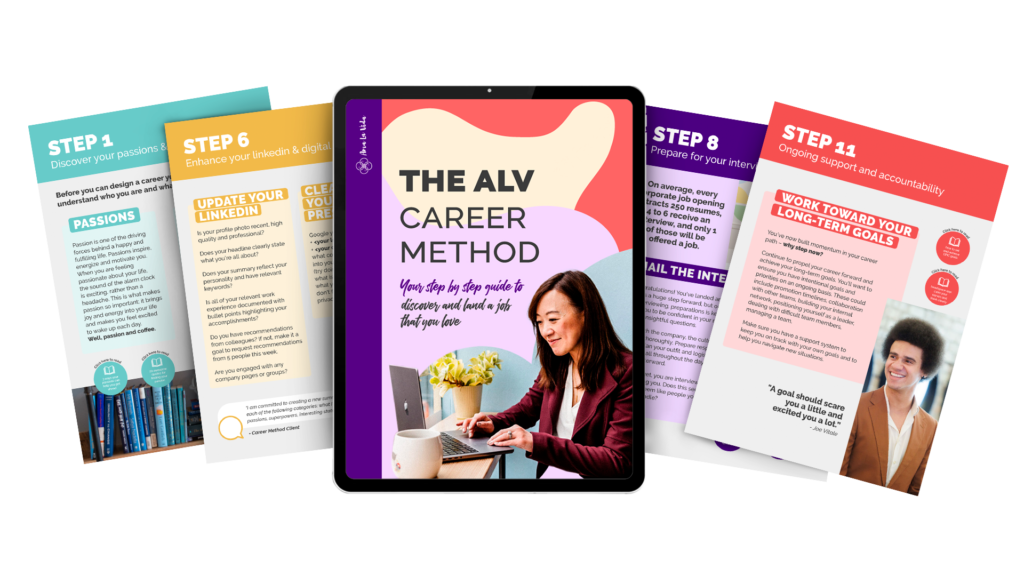
Download our comprehensive step-by-step guide to design and land a job you love!

Images from The ALV Career Method Guide
ALV Method Downloadable Guide

It’s the most wonderful time of the year – beautiful seasonal decor, quality time with family and those lovely dinner table conversations. The holiday season can be challenging for many though, from family drama to splitting time between families to the political chatter at the dinner table. The holidays can often require sharing time and energy with many close loved ones. This makes putting boundaries in place during the holidays more important than ever. Nedra Glover Tawwab, NYT best-selling author of Set Boundaries, Find Peace, defines boundaries as “parameters for how a person can engage, interact and treat you.” Setting these parameters is key to ensure you protect your energy and well-being during the season of heightened events and family activity. Yet, they can be especially tough to set and it can be extra difficult to say ‘no’ when it comes to family members. With the holidays almost here, what better time to get ahead on setting boundaries to most enjoy this wonderful time of year without sacrificing your own needs. Boundaries During The Holidays Recently, I’ve heard countless clients express concerns or challenges surrounding boundaries. Many of us feel obligated to say ‘yes’ to others at the expense of ourselves. The irony is that the benefits of setting boundaries and honoring our needs spiral outwards to all those around us. Yet, boundaries are not easy! They can be uncomfortable and require practice, especially when putting them in place for the first time. I like to refer to boundaries as a muscle that you continue to flex until it strengthens and happens with more ease.  Before even getting started with your boundary setting, it’s important to take some time for self-reflection. Self-knowledge is key to improving your boundaries practice. First, take time to make sure you understand yourself, your needs and what may be getting in the way of those needs being met.  Here are some questions to ask yourself: What’s most important to you? What areas do you find yourself often saying ‘yes’ when you actually want to say ‘no’? Where do you feel discomfort in your interactions with others? What specific areas of your life do you feel need more protection? What limits do you need to put in place to guard that? Boundaries require putting yourself first. Yet, don’t mistake this for a selfish act. By putting yourself first and prioritizing your needs, you’re ensuring that you can best show up for those around you. They are a method of self-protection to guard your well-being. Here are three steps to set boundaries before the holidays hit: Reflect on what’s important to you (see questions above) Write out your non-negotiables.  A non-negotiable is something that is core to you and is not open to discussion or negotiation.  Determine what rules, limits, or guidelines are needed to support and protect your non-negotiables. Here’s an example of how this boundary-setting process can play out during the holiday season: Let’s say you usually head home for the holidays and spend the week in your family’s home. You’ve noticed that each year, the extended time with family leaves you feeling drained and depleted. You find yourself constantly helping out with family errands and favors. Let’s go through each step mentioned above.. Reflect – During reflection, you realize that you value and need your alone time. You notice that jumping between family events and supporting family members leaves you no space for yourself. Create a non-negotiable – ‘I need an hour a day completely to myself.’ Create a rule or limit to support that – ‘I will block off my schedule from 3 to 4pm daily to have an hour to myself.’ You block it off in your schedule for that week and communicate it to your family members. Other examples of boundaries during the holiday season could include: Limiting time with certain family members Eliminating certain controversial conversation topics from table conversations Avoiding certain family events The key to setting boundaries is clear communication. It’s essential that you’re first clear on these boundaries before putting them into action. If it supports, do the three-step activity above and write it out. Writing out your boundaries can serve as a written contract with yourself. Once you’re clear on them, it’s time to communicate to others and move to action. Ensure that you communicate these boundaries with your family members and loved ones. If you feel comfortable, you can share your written out list. Whether it’s verbally or through putting them straight into action, it all starts with you.  Here is your opportunity to proactively create boundaries to maintain your energy and leave the holidays feeling rejuvenated and refreshed.

Read More

You’ve heard it before and you’ll hear it again: setting boundaries is really important. Many of the issues my clients bring to coaching are in some way related to their boundaries. Specifically, their lack thereof. Boundaries can seem complex and nebulous, which makes them hard to define and implement for a lot of us. So I wanted to simplify how to establish your boundaries. The process can be easy as ABC* *Disclaimer: setting and honoring your own boundaries is no easy feat. But I hope that these tips support you in establishing your needs! Establish Your Boundaries Awareness Half the battle of boundary setting is being aware that a lack of boundaries is not serving you. This can look a little different for everyone. But here are some questions that you can ask to reflect on this and shine a light on your needs. Do you struggle with making decisions, even small daily things? Are you exhausted at the end of the day and not sure why? Are you feeling resentful towards your friends, family, or coworkers? Do you feel like your life is one long endless to-do list? Do you say “yes” when you want to say “no” to things? Are you taking on more than you can handle? Do you find yourself overly concerned with what others think of you? If any of these resonate, you might lack boundaries. Personal boundaries are much like physical boundaries. Think of a fence or property line — these things signal some sort of limit to something. They let us know if we can or cannot enter (and how) or if we’ve gone too far. If these physical boundaries don’t exist, we might swim in really deep and troubled waters or step on our neighbor’s garden. Without an awareness of boundaries, we can find ourselves in hurtful situations.  It’s important to reflect on our feelings and situations we find ourselves in and ask, “Is there a need that is not being met here? Do I feel attacked or violated in some way?” In this step, there is no need to jump into action just yet, the goal is to grow in our awareness of what a lack of boundaries looks and feels like, so we can start to identify what we want it to look and feel like instead. Beliefs Whenever I hear a client of mine say that they have trouble saying “no” to people, I always ask, “What thoughts are going through your head when you say ‘yes’ when you mean ‘no’?” Some common answers are: I want to prove my worth, I want this person to like me, and I want to be helpful. Boundaries and beliefs go hand-in-hand. What we believe about ourselves will directly affect the boundaries we do or do not establish.  If we have a need for alone time to recharge, but we believe that our worth as a friend is measured by how much time we spend at a party, we will violate our boundary of needing a solitary wind-down routine every night in order to stay out a little longer.  If we want to prioritize time with our family after work, but we believe our value as a professional means taking on a last-minute request from our boss at 4:50pm, we will violate our boundary of logging off at 5pm to spend time with our kids to make sure we are seen by our commitment to work.  This might work if we make these sacrifices once or twice. But when we find ourselves consistently breaking our commitments to ourselves because we believe that our worth and value is measured by what others think of us, we will grow to be exhausted and resentful of the people in our lives.  What beliefs are keeping you from identifying and honoring your own boundaries? What other belief could be true instead? Remember that the thoughts that go through our heads are not inherently true. They are “For Sale” signs up in our headspace and we get to choose which ones we buy into.  Communication You’ve grown in your awareness and identified limiting beliefs when it comes to setting healthy boundaries – good work! But a boundary cannot be honored if it’s not openly communicated. If your boss doesn’t know that you won’t be checking emails after 6pm, they will continue to email you. If you’re always available to drop everything to support a friend (even when it is detrimental to your mental health), your friends will continue to expect you to show up.  We are constantly teaching others how to treat us. By being clear with what we need, what we tolerate, and when we need a break, we are allowing others to have clear expectations of us and how we want to be treated. YOU have all the power to set, honor, and communicate your boundaries.  Sometimes we avoid communicating our boundaries because we’re afraid of what others will think of us. Revisit what beliefs you’re buying into and reassess. If you’re concerned with being a good friend, which belief serves you more: Being a good friend means saying ‘yes’ to everything my friends need from me Being a good friend means taking care of myself so I can show up wholly to my friendships Do you see how different those two beliefs are? Which belief do you think encourages setting and communicating healthy boundaries? Do It Again Setting healthy boundaries is much like flexing a muscle – you have to do it over and over again in order to gain strength and power. That means checking in with your needs before committing to something or telling a friend or coworker exactly what you can and cannot take on.  None of this is to say that this will be easy. Much like working out, setting boundaries can be challenging and we may stumble as we go along. The important thing is to reset and do it again and continue to grow into this new

Read More