Category: Self Awareness

woman looking at computer writing down notes in her journal

Knowing when and how to find a career coach can make all the difference. Let’s face it, no one ever teaches you how to navigate your career. At best, we get half-hearted questions like, “What do you want to be when you grow up?” and “Do you know what you’re going to do when you finish school?” From there, you can try to find a mentor or hope for a great boss who might help you get promoted or otherwise grow in your career. More often than not, though, you’re left to figure it out on your own. And that’s where a career coach can step in. But finding the right person to help you along the way can feel daunting. That’s why we’re here to help you understand how to choose the right coach for you! First, though, let’s start with the basics. What is a Career Coach? Instead of simply telling you what to do, coaches empower you to leverage your resources and find the best solution for yourself, no matter the challenges you’re facing in your work life. Whether you’re at a crossroads or seeking advancement, they can provide invaluable support tailored to your unique goals and challenges. What Does a Career Coach Do? Career coaches can support you with a number of things from finding clarity around your career path, or finding a new job (think resume review and interview preparation), to confidence building, decision-making and leadership development. If you’re feeling stuck in your current role or seeking more satisfaction in your work life, they will empower you to take aligned action towards your goals. They can also assist in making sense of your professional aspirations and guide you through potential career changes. Through exploration, strategy, and accountability, a career coach helps you move forward with intention to achieve your own unique version of success. Why You Need a Career Coach Figuring out your next career move can feel like a full-time job. Between researching roles, updating your resume, networking, and second-guessing yourself at every turn, it’s easy to feel overwhelmed or stuck. A career coach brings a grounded, objective perspective and stays current on the job market and hiring trends. They help you cut through the noise, clarify what really matters to you, and focus your time and energy where it counts. They’ll help you move forward with more direction and less stress, while supporting you to build confidence, hone your transferable skills, and take meaningful steps toward a career that actually feels right. View this post on Instagram A post shared by Ama La Vida | Online Career Coaches (@alvcoaching) Before You Start Searching, Understand Your Support Needs Before you dive into your search, take a moment to reflect on the following questions to help you pinpoint the specific support you need. Are you looking for clarity on your career path or considering a career change? If you’re reconsidering your career trajectory and exploring a career transition, you’ll need a specific kind of support. This kind of coaching focuses on exploration, getting to know yourself and what a successful career looks like for you. A career coach trained in career exploration may not focus on technical support, but rather self-awareness to guide your decision. Are you looking for a new job in the same industry? Maybe you enjoy your current job, but want a change—whether it’s a new role, a better company culture, higher pay, or more work-life balance. If this is the case, you may want to find a career coach who specializes in your industry. Do you need technical support like resume review or job search guidance? If you’re looking for resume writing, interview prep, or job search strategy, you may benefit more from a coach that also doubles as a career consultant. This type of support is often advice-heavy and focused on helping you navigate the process efficiently. Are you looking to grow within your current role or industry? Career development coaching can support leadership growth, skill-building, and strategic planning. This is great for mid-career professionals to senior leaders who want to advance, become more effective, or explore what’s next in their field. How to Find a Career Coach that Fits Your Needs Understanding how to find a career coach that’s truly right for you can feel overwhelming at first, but it doesn’t have to be. With the right approach, this process becomes an empowering step toward real, lasting professional growth. Instead of spending hours searching online, scrolling through endless bios, and wondering if a coach will “get” you, there’s a simpler way. Let Ama La Vida’s Relationship Strategists Do the Work for You At Ama La Vida, we take the guesswork out of finding your ideal coach. Our coach-matching process is deeply personal and 100% human. You can get started by filling out a quick form about your goals and needs, or jump on a free consultation call with one of our Relationship Strategists. During the call, they’ll ask thoughtful questions to understand your challenges, goals, and preferences. Then, based on that conversation, they’ll hand-select a certified coach from our diverse team of 60+ career experts who best aligns with your needs. You’ll receive a link to their profile, which includes their experience, specialties, and testimonials—plus you can schedule a complimentary coach consultation to make sure it’s the right fit. You’re not limited to just one coach either. Through our “celebrity sessions,” you can meet with other experts on our team to explore topics outside your primary coach’s expertise. It’s full-cycle career coaching, built around your goals. Ask Your Network or Therapist for Referrals Another great way to find a career coach is to tap into your network, as they can offer valuable recommendations based on their own experiences. Talk with people who you trust, discussing your career goals, and ask if they can recommend any reputable coaches. Additionally, if you’re currently seeing a therapist, they may also be a helpful resource. Leverage Coaching Directories and Social Media If you’d

Read More
Woman writing in planner

If you’re here to download a career plan worksheet, chances are you’re feeling stuck in your career. We get it—we’ve been there too. Maybe you never really knew what you wanted, you followed a career path only to realize something was missing, or life is just taking you in a new direction. Whatever has you here, we understand that making a change can feel overwhelming. Before you spend hours filling out job applications or years getting more education or training, we’re sharing our method to help you figure out your next career move. Download our comprehensive career plan worksheet to get started paving a fulfilling career path. We created this free in depth guide to help you begin exploring career options and making a plan that works for you. Understanding Career Transitions For Ama La Vida members, career transitions can be driven by things like the desire for better work-life balance or higher income, job dissatisfaction, or going after their dream job. While our members want to find a job that aligns with their interests, it’s normal for them to feel a mix of emotions from excitement to worry that they wasted time getting to where they are now. Some even worry that the next job won’t be any better than the last. It’s true, making a job transition can be scary, but with a proven strategy you can move forward with confidence. This part is all about self-reflecting to understand what you truly want for your career and then figuring out the steps needed to achieve it. Let’s get into it! Using Career Plan Worksheets: Your Road to Rediscovery Think of a career worksheet as your personal roadmap. It’s a tool that helps you figure out your work goals and how to reach them. Unlike those quizzes that tell you what job you should have based on your skills and personality, a career plan is all about creating a step-by-step strategy to achieve your specific career dreams. The main parts of a great career plan include: Setting goals helps you know exactly what you’re aiming for, which keeps you motivated. Focusing on skill development means you’re always learning what you need to succeed. And when you have a big, long-term goal, you can break it down into smaller tasks that are easier to tackle. Each part of the worksheet helps create a solid plan, leading you to a career that’s both successful and aligned. Design Your Dream Career with Our Career Plan Worksheet Our downloadable template allows you to explore and identify your best path forward. You’ll reflect on your values (what’s important to you), interests (what you love doing), and skills (what you’re good at). When you understand these things about yourself it’s much easier to narrow down and decide between different careers. By doing research, networking (talking to people in different fields), and having informational interviews (chatting with people about their jobs), you learn a lot about various industries and roles. Taking the time to do this research ensures your future career goals match what is important to you personally and your skills. Not only does career planning help you clarify what jobs interest you, but it also gets you ready for job applications by highlighting your relevant qualifications and experiences. Chances are, you didn’t have a plan when you found your current job. Without a worksheet, your next job search might be all over the place. You could end up applying to jobs that don’t really suit you, feeling lost, and not reaching your full potential. A Harvard Business Review article shared that very few people think about their career over the next five years. This worksheet will help you set long-term career goals—these are the big objectives you want to achieve in your work life. They guide your career path and help you make better short-term decisions. By exploring and planning systematically, career worksheets pave the way to career satisfaction. Overcoming Obstacles and Staying Motivated Balancing career exploration with your current responsibilities can be tricky. It takes good time management and prioritization. To make it work, set aside specific time each week to explore jobs and learn new skills. Sometimes, you might feel scared or doubtful about the process. To overcome these feelings, break your goals into smaller, more manageable tasks. Then, celebrate each small win as you complete them. Ask mentors, colleagues, and friends for advice and encouragement. Don’t be afraid to seek help or use resources like career coaches and online courses to fill in what you don’t know. Stay interested in your journey by reminding yourself of your long-term goals. You can make a vision board or post reminders for yourself of why this transition is important to you. Don’t forget, by planning methodically and using support, you can achieve your career dreams. Making the Most of Career Plan Worksheets Take time for self-reflection To get the most out of these career plan worksheets, start with honest self-reflection. Really dig into your skills, interests, and values to create a clear career plan. Work your way through the questions in each section of the PDF worksheet guide to help you uncover what’s most important to you. Ask for feedback Share your completed worksheets with mentors or colleagues for feedback. Their insights will help you spot your natural talents. Make it a research project Do thorough career research to understand job requirements and industry trends. This includes having informational interviews to learn about daily life in different roles. Yes, it’s work, but this can also be fun! You’re learning about potential careers that match your own interests. Make sure to take note of what sounds interesting to you! Actioning The Career Planning Process Once you’ve built a career plan, it’s time to put it into action. Here are few ways to get started. Prepare for your job search Keep a log of your accomplishments and add to it often. You can use these to update your resume to match your goals and new

Read More
two Ama La Vida Employees sitting at a computer

Are you feeling stuck in your job search because you lack a college degree? You’re not alone. In fact, according to CNBC “62% of Americans don’t have a degree.” The good news? There are countless jobs with no degree required, and it’s entirely possible to build a rewarding career at any age without one! Actually, contrary to popular belief, there are many high-paying jobs that do not require a four-year college degree. Here’s how you can get a new job at any age by building a strong personal brand, focusing on transferable skills, engaging in your network and embracing lifelong learning without going back to school. The Importance of a Strong Personal Brand Knowing your personal brand is crucial in today’s competitive job market. It helps you stand out from other candidates and showcases your value to potential employers. You can incorporate your experience and professional persona which allows you to be memorable and trustworthy. It helps companies and potential employers value your character and experience, regardless of a degree. Here are two steps to help you get started building a strong personal brand. Define Your Unique Value Proposition What specifically sets you apart from other people in your field? Think about your skills, strengths, and experience and focus on your unique qualities. Take some time to reflect on what you enjoy doing, what people ask you for help with, and even what you have done in previous work—inside or outside the office. Do not limit yourself to traditional work experience! For example, you have probably been responsible for key duties on a team in some capacity, maybe even led one. That is a valuable strength you can showcase, no matter what your formal background is. Or maybe you were responsible for training new volunteers or managing personal event logistics. These are all experiences and skills worth highlighting. Just because your previous experience may not have been paid, that doesn’t mean it wasn’t valuable! Want some more help? Download our free Career Method Guide to get full workbook of questions. Once you have a sense of what sets you apart from other people around you, write a clear and concise statement that explains who you want to be known for professionally. This statement becomes the foundation of your own personal brand and guides how you present yourself in your resume, cover letter, and what you talk about in interviews. Develop Your Online Presence These days, most networking and job searching happens online. Whether you’re using LinkedIn or another social media tool or website, by putting yourself out there and making a connection with more people, you’re bettering your chances of learning about new career opportunities you might not have otherwise known. Take the time to build out your professional profile on whichever site you decide to use. You can keep your unique value proposition close as you do it to remind yourself what you want to highlight. Then, take time to find other people who talk about what you’re interested in learning more about and connect with them. You can respond to what they write or post, share your own thoughts, and maybe even form a real connection with them. You can create a simple personal website or portfolio to showcase your experience, skills, or certifications. For example, if writing is something you enjoy, you can also create content of your own on a blog to position yourself as an expert. You can dig in deeper to developing your personal brand right here. Leverage Transferable Skills When you don’t have a degree, leveraging transferable skills becomes essential because it allows you to demonstrate your ability to perform job functions effectively based on your previous experiences, even if they weren’t paid. If you’ve ever had to collaborate on a team project—whether at work, volunteering, or even in a hobby group—you already have transferable skills. These skills show employers that you have the practical capabilities to succeed in the job, regardless of your education. To do this, look up job postings and descriptions that you are interested in and read what the hiring managers are looking for in candidates. Don’t get overwhelmed at the long list of criteria—no one meets those 100%! Instead, look for key themes and repeated experiences. Many of those you may already have or be able to learn through an online course or simply reading a book from the library. Next, tailor your resume to highlight your experience that is most relevant to that role. Remember to share the outcome, not just the task. For example, if the role focuses on process improvement or project management, you can highlight how you led projects that consistently delivered under budget or within a tight timeline. Be specific and use numbers when possible to illustrate your strengths. Network for Career Success Imagine having access to a wealth of career opportunities that never make it to online job boards. For someone without a degree, having a professional network is even more critical—it opens doors that may otherwise remain closed, creates connections that bypass formal education requirements, and often leads to your next great career move. Building a professional support system or team of mentors and peers can make all the difference. Stay connected to industry events and meetups for your selected field. As you speak with people, ask for advice on what the newest trends are and what skills are the most important. Continue the connection on the appropriate social media platforms, especially LinkedIn. Building professional connections is important because it allows you to tap into the hidden job market, gain valuable industry insights, and build relationships that can advance your career. Embrace Lifelong Learning Even people with advanced degrees need to keep learning new things. In fact, life-long learning is a trait that many employers look for as they’re hiring. It’s no secret that technology is advancing at a quicker and quicker pace. As overwhelming as this can seem, it’s also an amazing opportunity. With all these advancements, most people

Read More
woman smiling looking at herself in the mirror

Self-doubt and overthinking are a bit of a chicken-and-egg situation. Self-doubt fuels overthinking, and overthinking, in turn, amplifies self-doubt. Self-doubt is the feeling of not trusting yourself—your voice, your ideas, or your ability to figure things out. Overthinking involves pondering on the “what ifs” and focusing on the possibility of things going out of control or what is lacking. They tend to grow louder when: Here’s the tricky part: self-doubt and overthinking don’t always shout. They often conspire with each other and show up as your brain’s way of protecting you. They hide behind beliefs like: They manifest through: When layers of doubt stack up, overthinking sets in. When you immerse yourself in endless “second thoughts,” self-doubt swallows you. You told yourself you were “being careful” or “being strategic about risks,” but in reality, you were trying to avoid the pain of not feeling enough. Real Client Stories Greg, a former athlete working in finance, often compared himself to others and worried about how he was perceived by them. If he wasn’t outperforming his peers, he felt like he was falling behind. Without external validation, his self-doubt grew louder. He felt stuck, measuring his worth by his achievements and comparing himself to others. Patty, an operations manager, believed that anything less than perfect meant failure. She would triple-check every email, over-prepare for meetings, and shut down when things felt chaotic. She doubted her ability to handle tough situations. The constant overthinking left her mentally and physically drained. Different stories, same struggle: self-doubt and overthinking. They worry about not being enough. What Causes Self-Doubt and Overthinking at Work? To understand the root cause of self-doubt and overthinking, you must first recognize that they affect all of us to some degree. Within a trauma-informed context, the analogy of the survival brain vs. the thinking brain shows how the brain prioritizes safety and bypasses rational thought. In moments we perceive as dangerous—physically or emotionally—the survival brain triggers the fight-or-flight response. Connecting the dots, self-doubt and overthinking are a form of psychological flight response. Maybe we were told, directly or indirectly, that making mistakes wasn’t okay. That being wrong meant something was wrong with us. If we were slower at learning, we were seen as less capable than those who were faster and sharper. We may have also witnessed others being judged or shamed for not conforming to our cultural norms, and we play it safe to follow all the rules. We started measuring our value through overachievement or external praise. We learned not to rock the boat or upset anyone to maintain a sense of control and perfection. If we grew up in a family affected by generational trauma, past pain, fear, or silent suffering, it can get passed down. No one talks about it, and we normalize it, live through it, and potentially pass it down to our next generation. Self-doubt and overthinking become even more prevalent in toxic work cultures and competitive environments where psychological safety is lacking. It can feel like others are constantly judging you and every day is a high-stakes performance. Eventually, burnout happens. Mental and physical depletion become a theme. Constant anxiety begins to compromise our overall well-being. The Vicious Cycle: Negative Thoughts and the “What Ifs” When self-doubt and overthinking take root, it creates an endless feeling of “not ready yet” or “I’m not enough yet.” No matter how careful you are, you still worry about doing it wrong. No matter what you accomplish, you downplay it. No matter how far you’ve come, you focus on what’s still missing. Your brain is wired to run through a list of “what ifs,” looking for flaws and chasing a moving target of “enoughness.” It’s a vicious cycle that slowly erodes your confidence. Another Real Client Story Charlotte has a harsh inner critic that constantly reminds her of her flaws. With that critical voice playing in the background, she struggles to celebrate wins or receive compliments without deflecting or downplaying them. She couldn’t bring herself to send out her resume because she didn’t think it was “ready.” She assumed her past work experience wasn’t enough. She spent hours revising, hesitating, and over-preparing, rather than actually applying. Staying stuck in this loop of negative self-talk holds Charlotte back and stops her from even giving herself the chance to let new opportunities become possible. How Self-Doubt Impacts Your Confidence (and Career) Self-doubt and overthinking might feel personal, but they’re incredibly common, especially in the workplace. You might feel like a fraud or constantly seek others’ opinions because you trust them more than yourself. These are classic signs of low self-esteem that often go unnoticed in high-achievers. You might find it hard to celebrate wins and harder to receive a genuine compliment without deflecting or diminishing it because you don’t think you truly earned it. Your work takes longer to complete as you spend too much time predicting every possible outcome. You are on high alert and fear failure, so you don’t raise your hand as the stake is too high to put yourself out there. If this resonates with you, you are not alone. These behaviors exist even in people you you see as more “successful” than you. However, these tendencies hurt your growth and impact your productivity. The biggest loss? Missed opportunities. You second-guess yourself and avoid challenges that could help you grow. The more uncertain you feel, the less motivated you are to pursue new possibilities. That inaction turns into regret, which then reinforces more doubt and frustration. Practical Strategies to Stop the Spiral Self-doubt and overthinking can’t be entirely eliminated—they’re part of your inner safety system. But they don’t have to run the show. Think of them as signals and reminders to pause, reflect, and make more conscious choices. When you find yourself going down the spiral, break away from your thoughts by taking a few deep breaths and bringing your attention back to the present moment. You can try noticing the five senses (sight, sound, smell, taste,

Read More

Career Clarity isn’t just about choosing the “right job.” It’s about finally being able to exhale because something clicks. It’s about knowing that you’re on the right path, not just chasing someone else’s version of success. Many people who come to us for career transition coaching are already ambitious, accomplished, and “doing great” on paper. But on the inside? Something feels off. Take Alexandra. On paper, she had it all together. But she told us, “I was in a job I didn’t love and had no idea what I wanted to do with my career.” She wasn’t lazy, wasn’t lacking talent. She was just tired. Tired of mindlessly scrolling the job boards and receiving half-baked advice. Tired of trying to figure it all out without a clear roadmap. So, she intentionally made a change and got support. Using the process outlined in this article, Alexandra stopped spiraling and found the clarity and confidence she was looking for. And guess what? She didn’t just land the right role—she found that deeper sense of alignment she’d been chasing. If you’re nodding along right now, this article’s for you. Let’s cut through the noise and help you find the career clarity (and confidence) you’ve been craving. View this post on Instagram A post shared by Ama La Vida | Online Career Coaches (@alvcoaching) Why Having Career Clarity Matters Getting clear on who you are now—what drives you, what’s changed, and what’s holding you back—isn’t just a fluffy “self-help” exercise. It’s the foundation of a fulfilling, sustainable career. Without it, you’re throwing darts in the dark. As a Career Coach, one of the most common (and costly) mistakes I see most people make: You’re feeling stuck or downright miserable in your current job, so you panic-search LinkedIn, start eyeing roles that look almost identical to the one you’re trying to escape and mass apply with the same outdated copy of your resume. Sound familiar? If you don’t slow down to gain career clarity and figure out why you’re unhappy in the first place, you’re just going to carry that confusion with you, into the next role, the next team, the next “maybe this time it’ll be better” leap. It’s like moving across the world to “start fresh,” only to realize you packed all your problems in your carry-on. (I know from experience. 😬) You don’t need another job you’ll dread in six months. You need a clear direction, purpose and a career path that feels like it was actually created for you. This is exactly why the first phase of the Ama La Vida Career Method is all about looking inward before you launch your job search. Because a successful career transition doesn’t start with scrolling job boards, it starts with getting radically honest with yourself. Look Inward First: Explore Your Strengths, Interests & Values At Ama La Vida, we break career clarity into four parts: your passions, purpose, values, and gifts (aka your strengths). We’ve learned what works from experience guiding thousands of clients through career transitions. The magic is truly in the self-reflection. As our COO, Foram puts it: “Our clients find the most insight during their self-exploration, which not only helps them figure out a career path that they may not have thought out but also allows them to carry these insights into their daily life. It’s a win-win!” The clarity you uncover now won’t just help with your next career move. It will support you for the long haul in different areas of your life. So before you scroll through another job board or rewrite your resume, start here: What Lights You Up? (Your Passions & Interests) You don’t have to turn every passion into a paycheck, but weaving some of them into your work will keep things fun and fulfilling. These are the things that make you lose track of time. The things you’d do even if no one paid you (but, please, still get paid). Think hobbies that you pursue in your free time, topics that energize you, or the kinds of work that leave you buzzing rather than burned out. Reflection questions: What Are You Naturally Good At? (Your Gifts & Talents) These are the technical skills, strengths, and quirks that make you, well, you. Maybe you’re the go-to for keeping calm amidst the chaos. Or the one who can build a killer project plan spreadsheet in under 10 minutes. These gifts are the secret sauce that make you shine. Reflection questions: What Matters Most? (Your Values) This is the piece almost everyone skips. But ignoring it is like building the foundation for your dream home on quick sand. (Spoiler: it won’t hold.) Your values pretty much influence everything you do. And if they don’t, you’re most likely feeling misaligned. Values should come into play when you make any kind of decision, including assessing career choices, what kind of work culture best fits you, and whether or not you’ll feel aligned in your role. Not everybody will thrive in a highly structured, rules-driven organization. But on the flip side, not everyone feels comfortable in a fast-moving, loosely defined environment either. If you value creativity, innovation, and agility, a workplace bogged down by red tape probably won’t be the best fit. But if you crave stability, clear expectations, and a dependable routine, a startup-style culture with constant pivots might leave you feeling overwhelmed. Knowing your values helps you recognize what’s truly non-negotiable. It’s what keeps you grounded when making tough decisions or evaluating options, and helps you understand why something may feel off. Reflection questions: Why Does It All Matter? (Your Purpose) Before you panic and try to write a life manifesto, take a deep breath. This isn’t about solving all the world’s problems. It’s about identifying the kind of impact you want to make in this season of your career. Your purpose probably will change and evolve along with you. What matters is that it’s meaningful to you in some way. Reflection questions: But, What If

Read More
expert on her computer

Wondering if you’re experiencing imposter syndrome? Our Imposter Syndrome Quiz is designed to help you find out. If you’ve ever felt like a fraud, convinced that despite your achievements, someone will eventually discover you’re not capable or deserving of where you are, you’re not alone. Imposter syndrome is a silent epidemic impacting many of us. Research published in the International Journal of Behavioral Science indicates that about 70% of individuals will experience imposter syndrome during their professional lives—but my coach’s intuition tells me that number is even higher. Imposter syndrome creates a cycle of self-doubt, anxiety, and negative self-talk that can hold you back from embracing new opportunities and achieving career success. It can even affect your mental health. If these feelings resonate with you, it’s time to take action. Take our Imposter Syndrome Quiz now to uncover how imposter syndrome manifests for you. Start breaking free from the mental barriers standing in the way of your success! Throughout this article, we use the spelling “imposter syndrome,” though you’ll also see it written as “impostor syndrome.” Both are commonly used interchangeably to describe the same experience. We use “impostor” when directly referencing the work of others who have used that spelling. For example, Dr. Valerie Young, who identified and introduced the five types of Impostor Syndrome in her book. What is Imposter Syndrome? Imposter syndrome is the persistent feeling that you’re not as competent or talented as others believe you to be—despite clear evidence of your achievements. How does experiencing imposter syndrome feel? It often shows up as self-doubt, anxiety, and fear of being “exposed” as a fraud, even among high achievers who have a strong track record of success. This internal struggle fuels negative self-talk and can make it difficult to fully embrace accomplishments or take actionable steps forward in life. What Causes Imposter Syndrome? The imposter phenomenon, a term from clinical psychology, stems from a mix of personal experiences, societal expectations, and workplace pressures. While anyone can experience imposter feelings, research shows that high-achieving women are especially vulnerable. A recent meta-analysis of over 100 studies confirmed that women experience imposter feelings more often than men, highlighting just how widespread this is. This builds on the original work by psychologists Pauline Clance and Suzanne Imes, who first identified the “impostor phenomenon” in 1978, noting that many successful women attribute their achievements to luck rather than to their own abilities. Several factors contribute to the development of imposter syndrome: Upbringing & Parenting Styles Growing up with impossibly high standards, excessive praise, or constant comparisons can shape the belief that success is never enough—or simply a stroke of luck. Parents who emphasize achievement may unintentionally instill a fear of failure and patterns of negative self-talk. Work Environment & Cultural Expectations As a career and life coach, I believe early work experiences strongly shape our beliefs about career potential. Competitive job markets, perfectionist cultures, and limited diversity in leadership often reinforce imposter feelings—especially for high-achieving women, who may feel constant pressure to prove their worth. Perfectionism & Overworking “You can be anything if you try hard enough.” It’s a familiar mantra, but it often fuels overwork and the belief that effort must be endless to be worthy. This mindset is linked to stress, burnout, and depression—common outcomes of internalized perfectionism. External Factors & Social Conditioning Cultural norms, gender expectations, and other environmental factors can set unrealistic standards of success and amplify feelings of imposter syndrome. These narratives can lead individuals to downplay their accomplishments and live in fear of being “found out.” Overcoming imposter syndrome begins with recognizing the influences and other external factors that shape our self-doubt. When we acknowledge these pressures while focusing on what we can control, our mindset, we unlock incredible potential. By challenging negative thoughts, reframing limiting beliefs, and fostering a more empowering workplace culture, we can break free from “impostor feelings” and step into leadership with confidence. How Imposter Syndrome Sabotages Your Career Imposter syndrome is not a diagnosis, but rather a thought pattern. These thought patterns can create mental roadblocks that hinder confidence, professional growth, and leadership potential. When you feel like an imposter, it’s not just an internal struggle—it actively leads to self-sabotage, holding you back from advancing in your career. Imposter syndrome can create a self-fulfilling prophecy, reinforcing the belief that you’re not good enough, even when you have the skills and experience to succeed. Over time, this mindset can limit your growth, impact your confidence, and prevent you from seizing new opportunities. Imposter syndrome can sabotage your career success in many ways. Here are a few examples that might sound familiar: Reluctance to Apply for a New Job Many professionals hesitate to go after new opportunities, believing that because they don’t meet 100% of the qualifications, they can’t apply. This is fear of rejection or “not being ready” and can keep you stuck in roles that don’t challenge or fulfill you. Hesitation to Negotiate Salary or Ask for Promotions When doubt creeps in, you may struggle to advocate for yourself. Imposter syndrome convinces you that you’re lucky to have your position and should just be grateful, making it difficult to ask for the raise or promotion you deserve. Avoidance of Leadership Roles Many high performers feel frustrated watching less-experienced colleagues move into leadership positions because they don’t see themselves as “leadership material.” Part of this is avoiding going after the next leadership opportunity because imposter syndrome may cause a fear of being exposed as a fraud or fear of failure. Withdrawing from Networking or Speaking Opportunities A toxic work environment can reinforce imposter syndrome, making individuals afraid to voice their opinions in meetings or avoid networking events where they feel they don’t belong. Over time, this self-doubt and withdrawal can isolate you and limit your professional growth. By recognizing these patterns, you can start to challenge the negative beliefs that are holding you back. So, what’s the first step to breaking free? Understanding how imposter syndrome manifests in your life. Take

Read More

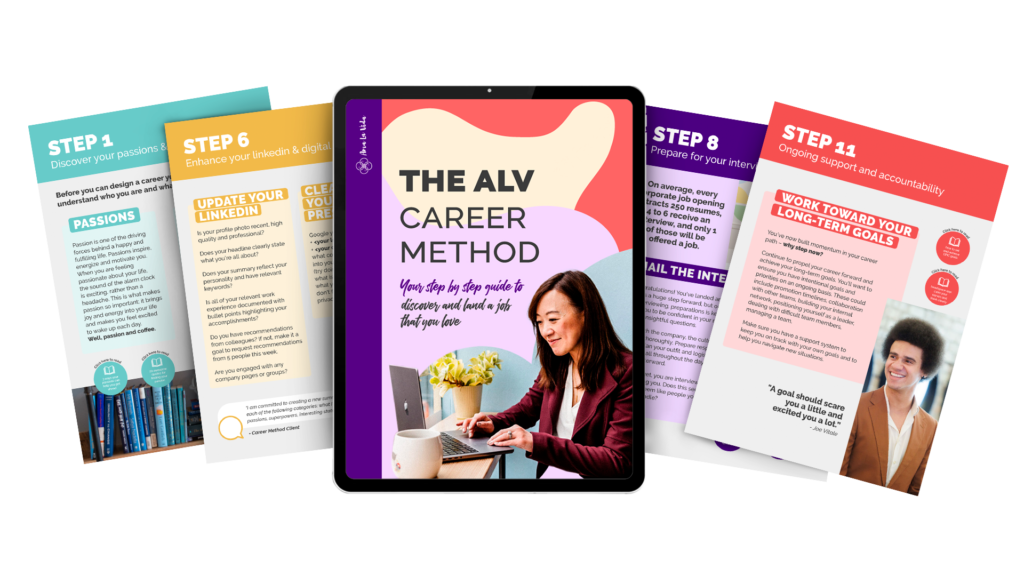
Download our comprehensive step-by-step guide to design and land a job you love!

Images from The ALV Career Method Guide
ALV Method Downloadable Guide

woman looking at computer writing down notes in her journal

Knowing when and how to find a career coach can make all the difference. Let’s face it, no one ever teaches you how to navigate your career. At best, we get half-hearted questions like, “What do you want to be when you grow up?” and “Do you know what you’re going to do when you finish school?” From there, you can try to find a mentor or hope for a great boss who might help you get promoted or otherwise grow in your career. More often than not, though, you’re left to figure it out on your own. And that’s where a career coach can step in. A career coach is someone specially trained to help you navigate your entire career journey. They can help you decide what career you want, create a career plan, and even navigate getting a new job or making a larger career change. But finding the right person to help you along the way can feel daunting. That’s why we’re here to help you understand how to choose the right coach for you! First, though, let’s start with the basics. What is a Career Coach? A career coach guides individuals along their career path. Contrary to popular belief, they are different from mentors and provide a different type of support than consultants. Instead of simply telling you what to do, coaches empower you to leverage your resources and find the best solution for yourself, no matter the challenges you’re facing in your work life. Whether you’re at a crossroads or seeking advancement, they can provide invaluable support tailored to your unique goals and challenges. What Does a Career Coach Do? Career coaches can support you with a number of things from finding clarity around your career path, or finding a new job (think resume review and interview preparation), to confidence building, decision-making and leadership development. If you’re feeling stuck in your current role or seeking more satisfaction in your work life, they will empower you to take aligned action towards your goals. They can also assist in making sense of your professional aspirations and guide you through potential career changes. Through exploration, strategy, and accountability, a career coach helps you move forward with intention to achieve your own unique version of success. Why You Need a Career Coach Figuring out your next career move can feel like a full-time job. Between researching roles, updating your resume, networking, and second-guessing yourself at every turn, it’s easy to feel overwhelmed or stuck. A career coach brings a grounded, objective perspective and stays current on the job market and hiring trends. They help you cut through the noise, clarify what really matters to you, and focus your time and energy where it counts. They’ll help you move forward with more direction and less stress, while supporting you to build confidence, hone your transferable skills, and take meaningful steps toward a career that actually feels right. View this post on Instagram A post shared by Ama La Vida | Online Career Coaches (@alvcoaching) Before You Start Searching, Understand Your Support Needs Before you dive into your search, take a moment to reflect on the following questions to help you pinpoint the specific support you need. Are you looking for clarity on your career path or considering a career change? If you’re reconsidering your career trajectory and exploring a career transition, you’ll need a specific kind of support. This kind of coaching focuses on exploration, getting to know yourself and what a successful career looks like for you. A career coach trained in career exploration may not focus on technical support, but rather self-awareness to guide your decision. Are you looking for a new job in the same industry? Maybe you enjoy your current job, but want a change—whether it’s a new role, a better company culture, higher pay, or more work-life balance. If this is the case, you may want to find a career coach who specializes in your industry. Do you need technical support like resume review or job search guidance? If you’re looking for resume writing, interview prep, or job search strategy, you may benefit more from a coach that also doubles as a career consultant. This type of support is often advice-heavy and focused on helping you navigate the process efficiently. Are you looking to grow within your current role or industry? Career development coaching can support leadership growth, skill-building, and strategic planning. This is great for mid-career professionals to senior leaders who want to advance, become more effective, or explore what’s next in their field. How to Find a Career Coach that Fits Your Needs Understanding how to find a career coach that’s truly right for you can feel overwhelming at first, but it doesn’t have to be. With the right approach, this process becomes an empowering step toward real, lasting professional growth. Instead of spending hours searching online, scrolling through endless bios, and wondering if a coach will “get” you, there’s a simpler way. Let Ama La Vida’s Relationship Strategists Do the Work for You At Ama La Vida, we take the guesswork out of finding your ideal coach. Our coach-matching process is deeply personal and 100% human. You can get started by filling out a quick form about your goals and needs, or jump on a free consultation call with one of our Relationship Strategists. During the call, they’ll ask thoughtful questions to understand your challenges, goals, and preferences. Then, based on that conversation, they’ll hand-select a certified coach from our diverse team of 60+ career experts who best aligns with your needs. You’ll receive a link to their profile, which includes their experience, specialties, and testimonials—plus you can schedule a complimentary coach consultation to make sure it’s the right fit. You’re not limited to just one coach either. Through our “celebrity sessions,” you can meet with other experts on our team to explore topics outside your primary coach’s expertise. It’s full-cycle career coaching, built around your goals. Ask Your Network or Therapist

Read More

Despite what you may hear from family and friends, making a career change at 40 is not only possible but can open up a whole new chapter in your life. Even considering a change at this point in your career can enrich your professional life, letting you dream bigger and take control of your career path. If the idea of a midlife career shift intrigues you, you’re in good company! Many Ama la Vida clients have made the leap, discovering their dream careers in their 40s and beyond. In this article we will cover how they conquered their fears and made it happen, and how you can change careers at 40 as well! Why Change Careers at 40? Our priorities change throughout our lives, and a career that fits our needs early on may not be the right option at 40 or even 50. According to the World Economic Forum, the average person has at least 12 jobs before retirement, and the typical career changer is around 39 years old! These numbers suggest that people feel empowered to seek out better professional opportunities throughout their careers. They are no longer willing to settle for a job that isn’t right for them—at any age. Still, many professionals stay in roles that aren’t right for them rather than switch careers because they don’t recognize (or simply ignore) the signs. Even more will stay in their current careers because of beliefs that hold them back— they think they’re “too old,” “too experienced or inexperienced,” or believe their “opportunity to make a move has passed.” Common Reasons for Changing Careers in Your 40s There are a number of reasons you may be thinking about a career shift, regardless of your age. Changing Priorities: Life circumstances, such as family or health, might be steering you toward a career that offers higher income, better balance or more fulfillment. Values Misalignment: Your job may no longer align with who you are or what you stand for, making it hard to stay motivated or feel connected to your work. Opportunities for Growth: Lack of new challenges or opportunities for advancement may leave you feeling stuck or stagnant. Fading Passion: Maybe you’re experiencing the nagging feeling that what you’re currently doing is just not your desired career, or you find yourself daydreaming about a new job. View this post on Instagram A post shared by Ama La Vida | Online Career Coaches (@alvcoaching) Technological Advances: Rapid changes in your industry, such as automation or new technologies, may make your current role obsolete or less fulfilling, prompting the desire for a career pivot. Regardless of the specific reasons, career changers who prioritize their needs wind up in careers that better align with their goals and fit their lifestyles. Why a Career Change at 40 is Actually Perfect Timing There is some very good news for anyone considering a midlife career change: this might be exactly the right time to make a move. By the time you hit 40, chances are you will have decades of personal and professional experience under your belt that have provided you with incredibly valuable and transferrable skills. Need proof? According to researchers from Harvard University, employers often value soft skills like communication and leadership over technical expertise! Benefits of a Career Change in Your 40s A midlife career shift can be an exciting opportunity to flex your skills in a new field or industry, especially if you’re looking for a new challenge or fresh perspectives. More and more professionals are leaving the traditional path of the corporate ladder behind and reshaping their careers in the form of a spiral, or a “squiggle.” In their book The Squiggly Career, Helen Tupper and Sarah Ellis describe how for many workers, the movement from one role or industry to another actually enhances their skills and effectiveness while bringing more career satisfaction. If you’re not feeling challenged or fulfilled at work anymore, exploring new areas of knowledge by taking classes or pursuing a certificate or degree will stave off boredom and may even set you up for a new career path. Not only is intellectual growth in your 40s and beyond important for your brain, the joy of learning and discovery can keep you connected to your “why.” Not to mention that due to your decades of personal and professional experience, you may be less impulsive and better at seeing long-term consequences and opportunities. Those years of experience bring with them the ability to consider various perspectives, and big-picture thinking is a highly transferable skill! Setting Realistic Expectations for Your Career Transition Many of the challenges that come along with the career change process are due to unrealistic expectations. This is why it’s so important to make sure that you’re focused on being flexible which will save a lot of frustration later. A successful career change requires patience and grit. You may need to focus on adding new skills to your repertoire to address any gaps or even pursue further education or training to position yourself as a viable candidate for certain roles. Rather than jumping into a new job with little reflection or planning, consider what’s really important to you in your career transition. This will help you avoid being in this same place a few years or even months down the line. Create a Career Change Plan The career change process can feel overwhelming at times, but a good plan can help! View this post on Instagram A post shared by Ama La Vida | Online Career Coaches (@alvcoaching) That’s why Ama La Vida created the ALV Career Method to keep you on track and help you hold yourself accountable to your professional goals. You can download a free preview of the course and start gaining clarity around your career change here: Below we’ll break down some of the proven steps to help you gain clarity, set goals and start working towards the right career path for you. Setting Clear Goals and Objectives First, identify your

Read More
Woman writing in planner

If you’re here to download a career plan worksheet, chances are you’re feeling stuck in your career. We get it—we’ve been there too. Maybe you never really knew what you wanted, you followed a career path only to realize something was missing, or life is just taking you in a new direction. Whatever has you here, we understand that making a change can feel overwhelming. Before you spend hours filling out job applications or years getting more education or training, we’re sharing our method to help you figure out your next career move. Download our comprehensive career plan worksheet to get started paving a fulfilling career path. We created this free in depth guide to help you begin exploring career options and making a plan that works for you. Understanding Career Transitions For Ama La Vida members, career transitions can be driven by things like the desire for better work-life balance or higher income, job dissatisfaction, or going after their dream job. While our members want to find a job that aligns with their interests, it’s normal for them to feel a mix of emotions from excitement to worry that they wasted time getting to where they are now. Some even worry that the next job won’t be any better than the last. It’s true, making a job transition can be scary, but with a proven strategy you can move forward with confidence. The first step in this process is making a career plan. This part is all about self-reflecting to understand what you truly want for your career and then figuring out the steps needed to achieve it. Let’s get into it! Using Career Plan Worksheets: Your Road to Rediscovery Think of a career worksheet as your personal roadmap. It’s a tool that helps you figure out your work goals and how to reach them. Unlike those quizzes that tell you what job you should have based on your skills and personality, a career plan is all about creating a step-by-step strategy to achieve your specific career dreams. The main parts of a great career plan include: Setting goals helps you know exactly what you’re aiming for, which keeps you motivated. Focusing on skill development means you’re always learning what you need to succeed. And when you have a big, long-term goal, you can break it down into smaller tasks that are easier to tackle. Each part of the worksheet helps create a solid plan, leading you to a career that’s both successful and aligned. Design Your Dream Career with Our Career Plan Worksheet Our downloadable template allows you to explore and identify your best path forward. You’ll reflect on your values (what’s important to you), interests (what you love doing), and skills (what you’re good at). When you understand these things about yourself it’s much easier to narrow down and decide between different careers. By doing research, networking (talking to people in different fields), and having informational interviews (chatting with people about their jobs), you learn a lot about various industries and roles. Taking the time to do this research ensures your future career goals match what is important to you personally and your skills. Not only does career planning help you clarify what jobs interest you, but it also gets you ready for job applications by highlighting your relevant qualifications and experiences. Chances are, you didn’t have a plan when you found your current job. Without a worksheet, your next job search might be all over the place. You could end up applying to jobs that don’t really suit you, feeling lost, and not reaching your full potential. A Harvard Business Review article shared that very few people think about their career over the next five years. This worksheet will help you set long-term career goals—these are the big objectives you want to achieve in your work life. They guide your career path and help you make better short-term decisions. By exploring and planning systematically, career worksheets pave the way to career satisfaction. Overcoming Obstacles and Staying Motivated Balancing career exploration with your current responsibilities can be tricky. It takes good time management and prioritization. To make it work, set aside specific time each week to explore jobs and learn new skills. Sometimes, you might feel scared or doubtful about the process. To overcome these feelings, break your goals into smaller, more manageable tasks. Then, celebrate each small win as you complete them. Having support is also important to stay focused, especially on the tough tasks. Ask mentors, colleagues, and friends for advice and encouragement. Don’t be afraid to seek help or use resources like career coaches and online courses to fill in what you don’t know. Stay interested in your journey by reminding yourself of your long-term goals. You can make a vision board or post reminders for yourself of why this transition is important to you. Don’t forget, by planning methodically and using support, you can achieve your career dreams. Making the Most of Career Plan Worksheets Take time for self-reflection To get the most out of these career plan worksheets, start with honest self-reflection. Really dig into your skills, interests, and values to create a clear career plan. Work your way through the questions in each section of the PDF worksheet guide to help you uncover what’s most important to you. Ask for feedback Share your completed worksheets with mentors or colleagues for feedback. Their insights will help you spot your natural talents. Make it a research project Do thorough career research to understand job requirements and industry trends. This includes having informational interviews to learn about daily life in different roles. Yes, it’s work, but this can also be fun! You’re learning about potential careers that match your own interests. Make sure to take note of what sounds interesting to you! Actioning The Career Planning Process Once you’ve built a career plan, it’s time to put it into action. Here are few ways to get started. Prepare for your job search Keep

Read More
Woman sitting at desk thinking

Changing Careers When You Don’t Know What You Want Not knowing what job or career you want is typical. At some point in their life, most people find themselves at this crossroads, feeling stuck, discouraged, and saying, “I want to do something different, but I just don’t know what that is.” It’s OK to feel this way, you’re not alone. This moment is an opportunity to clarify your why, sharpen your observation skills, heighten your curiosity, and start experimenting. You don’t need to be in a dead end job, sacrificing your health or relationships or completely burned out to want to make a career change. Instead, actually, it is much better to start when you’re just beginning to feel the call for your next career move. Here are some practical steps to get you started as you get ready to change careers. Exploration Preparation for a Career Change First, relax your shoulders, breathe, and release any tension and pressure related to identifying what you want. Oftentimes, we put so much pressure on ourselves to have the answer, know the next steps, and achieve that next goal. Ironically, easing up and stressing less about finding the answer often leads us to it. Then, try replacing “work” or “career” with the word “contribution.” This small change can shift your perspective, expand possibilities, and ease any feelings of overwhelm. The truth is: we often know what we want. The challenge could be: Taking the time to explore who you are now in your professional life, understand what may be holding you back, identify what you need to thrive in your next career path, and clarify what you want is crucial! Curiosities, Interests, Preferences, Strengths How many times have we all heard, “Follow your passion and you’ll never work a day in your life?” If you’re like me, it’s a lot! Has this advice worked for some? Absolutely! Does this advice work for everyone? No! If the pressure to “do what you love,” “follow your passion,” or “follow your purpose” causes serious anxiety, you’re not alone. Create a list As a first step, start by creating a list of what you’re curious about, what you’re interested in, your preferences, times when you enjoyed what you were doing, situations where you feel appreciated, and what you’re good at (strengths). Sometimes, seeking out a so-called “dream job” is just too overwhelming. When you shift to simpler questions, the insights become easier. During this self-reflection, you can also include topics you’re interested in reading and listening to in your spare time. And, don’t forget to add what you’re drawn to when browsing social media, videos, streaming services, etc. This may be a great place to begin exploring. Free yourself of the limitations of your previous experience, and perhaps any limitations and assumptions (for now) around money, ability, or any other details that might hold you back from considering them. This is just about you and what you’re interested in exploring. Review and Assess Now, carefully review your list and honestly assess your curiosities, interests, preferences, and strengths. Consider if each aligns with what is valued in the marketplace. Write down your answers to the following ten questions: “How can I be useful, of what service can I be? There is something inside me, what can it be?” Vincent Van Gogh I Still Don’t Know What Career I Want, Now What? Dig deeper into a career reflection with our free Career Method Guide. Take a Career Assessment Career assessments or career aptitude tests focus on a variety of areas and are designed to help you identify a path that aligns with your curiosities, interests, preferences, and strengths. They go beyond personality type are designed to help you uncover jobs you may not have considered. Many people like the idea of career assessments because they seem so scientific. We do caution, though, that these tools are wonderful to help you find jobs you may not have considered, but they are not magic. No one, especially an online course or tool, can know you as well as you do! Trust your instincts about yourself and which career paths are right for you. That being said, an assessment is a wonderful place to start when you feel stuck. Explore one or more of the following to get started. Explore What’s Holding You Back Maybe you’re hesitant to pursue what you truly want due to external pressures from well-meaning loved ones, friends, or respected colleagues, or internal pressures like fear. Laurence G. Boldt in his book, Zen, and the Art of Making A Living, suggests that there are “’reasons’ why you might not want to know what your life’s work is.” He lists nine ways fear can show up that may be holding you hostage: Do one, two or more of these ring true for you? “Action is the antidote to fear. If you want to play the game, you have to act.” Diane Windingland It’s time to step out of paralysis and into action. Dive into learning and experimenting until you uncover what’s next. I’ve included a few ideas below. Take Advantage of Volunteer Opportunities Volunteering is a great way to explore new career paths without the same commitment of a full time job. Through volunteer work, you can also acquire and hone relevant new skills, and build relationships with professionals and organizations in different fields. Explore sites like GreatNonprofits.org and VolunteerMatch.org for suggestions and immediately available volunteer opportunities. Conduct Informational Interviews Wondering what it’s really like to work in an industry you’re curious about? Talk to people who are in your target role to get an idea of their background, day-to-day experience, and advice on getting into the industry. Their real life experience can save you a lot of time as you explore! How to do to an informational interview Tip #1: Tap into your network and identify several people who are engaged in work that you think you might be interested in. Tip #2: Whether directly or indirectly

Read More
Woman writing on sticky notes on window

Changing careers can feel overwhelming. Whether you’re considering a career change for personal growth or new opportunities, you might ask yourself if returning to school is necessary for your career shift. The answer isn’t always a simple yes or no. The fact is, you can change careers without going back to school. It’s important to assess the shifting job market, explore non-degree alternatives, and carefully weigh your options before making a decision. First, let’s explore some factors to consider: What Education is Necessary vs. Beneficial When you’re considering whether going back to school is the right career choice, it’s essential to consider if it is truly necessary or even beneficial for your career goals. View this post on Instagram A post shared by Ama La Vida | Online Career Coaches (@alvcoaching) For example, in some fields like accounting, finance, architecture, education, engineering, healthcare, law, research science, psychology, and counseling, specific degrees are often required for entry-level jobs, according to the (Bureau of Labor Statistics). If the job you want requires a solid understanding of core concepts, a degree program can provide that critical foundation. Gather Information About New Careers A great first step is to look at a job description for roles to understand the specific skills and qualifications employers seek. This will help you determine if additional education or certifications are necessary. If you aim for a career change with higher salary potential, remember that degrees often lead to higher-paying jobs. Research salary data for your target careers, both with and without more education. Remember: although a college degree is valuable, it is not always mandatory to change careers. Many exciting and lucrative careers are accessible without a traditional four-year or two-year degree. Make sure to consider options like community college or even completing coursework as part of your high school diploma. Understanding the requirements and benefits can guide you in making an informed decision about further education. Self-Discovery and Goals When you think about a new job, it can be easy get caught up thinking about career paths that you’ve heard are secure, pay well, or have great benefits. Maybe they even just seem glamorous to you. These are all good reasons to consider your career options, but before you go down that path, make sure to take into account what’s most important to you. If there are things you don’t like about your current job, what do you hope to find when you switch careers? These might be things like more autonomy, a new challenge, or more flexibility. Exploring what you truly want and value most is crucial when considering your next career move. The fact is, even the best paying job won’t always make you happy if it doesn’t match your own needs, interests and values. Consider what kind of work environment you are seeking. Do you crave the fast pace of a startup, the closer work environment of a small to mid-sized company, or the stability of a large corporation? If you have obligations outside of work, like taking care of family members, or even just want more flexibility, some work environments are more conducive to that than others. There is no right or wrong answer to any of these questions. Instead, it’s about what matters most for your life. Get practical about your new career. Think about your salary expectations. Certain careers offer higher earning potential, which might influence your decision. Will your future salary cover your investment into a new career? Additionally, how much time and money can you realistically invest in earning a new degree? Be sure your expectations align with your goals and current life situation. You can use online resources like the Bureau of Labor Statistics Occupational Outlook Handbook to research potential careers with promising growth and salary potential. Also, connect with professionals working in your desired field on platforms like LinkedIn or at networking events. Well-planned informational interviews can provide valuable insights into the daily aspects of a job. By aligning your career goals with your values and resources, you can create a clear path toward your career of choice. Now, let’s explore some alternatives. Skills-Based Careers There are many interesting and high-paying careers that don’t need a degree or prior experience. Fields such as web development, digital marketing, graphic design, or project management are worth considering. Switching to these careers may not happen overnight, but with a focus on transferable skills and some training and study on your own time, it’s very possible! You can look up labor statistics to explore which industries have the best job outlook, meaning they’re growing and have a larger number of open roles. Think outside the box. Many jobs in the trades have excellent prospects and do not require you go back to school. For example, jobs associated with wind turbines grew 45% in 2022. With the increasing presence of AI in the workplace, many view the jobs in the trades as more secure. For the average worker, this prospect can be very appealing for a career transition. If you’re going to change jobs, it’s good to know that role is in high demand! Here are a few other places to start. Look into skill development programs offered by community colleges or non-profit organizations, which provide targeted training without the commitment of a degree program. Become a web developer by learning in-demand programming languages like Python or JavaScript through boot camps and online courses. Master online advertising and social media marketing with courses and certifications offered by platforms like LinkedIn Learning, Google or Facebook. Or, develop your creative skills in graphic design software like Adobe Photoshop and Illustrator through online tutorials and certificate programs. By focusing on skill-based careers, you can build your resume in your free time and build a rewarding career without the need for grad school or even any other higher education. Grow at Your Current Company Most people assume that to switch careers or move to a different career path you need a completely new job. It’s

Read More
Woman talking to another woman near a window

“What I’d really love to do is X, but to do so I’d have to take a pay cut…so forget it” If I had $1 for every time I’ve heard that statement from a client, friend, or family member, I’d be typing this from a yacht in the South of France. Yes, there might be instances where making a career change or changing jobs does necessitate taking a pay cut. But before you start rationing your fancy wrinkle cream in sacrifice to your new career, let’s look at the bigger picture. There are a lot of resources out there to help you navigate the potential financial implications of a new career path (see Ama La Vida’s Instagram post on this very topic!). Before you begin your research, let’s take a step back and explore some of the reasons why we might anticipate a pay cut in the first place. View this post on Instagram A post shared by Ama La Vida | Online Career Coaches (@alvcoaching) Common reasons for pay cuts Anticipating a pay cut stems from both legitimate and perceived (hello limiting beliefs!) instances and scenarios. Here are some common instances where people are most likely to consider a pay cut (or think they’ll need to take a pay cut): More opportunities Let’s say you work for a small, family-owned company with 100 employees. The pay is great, but there are no clear opportunities for growth and advancement. Moving to a company of 1,000+ people, with multiple departments or functional areas and more long-term opportunities for promotion and career growth, might be a more attractive option, even if it requires a pay cut in the short term. More flexibility Perhaps you’re working for a company that requires staff to be in office 5 days a week, with a long commute on both ends of your work day. If achieving better work-life balance is one of your main drivers for seeking new employment, you might be comfortable taking a pay cut to work for a company that allows staff to work remotely. Better benefits Maybe your current company offers all the standard benefits (health insurance, vision, dental) you’d expect, but nothing more. You might be comfortable accepting a lower salary at a company whose benefits package includes things like: IVF fertility coverage, long-term care insurance, gym and fitness membership allowances, and reimbursement for your Ama La Vida career coaching membership. Switching industries Not all industries are incompatible when it comes to salary offerings and ranges. However, there are instances where you might need to accept a pay cut to move to your desired industry. Consider this example: You’re an ER doctor at a big city hospital, but it’s been your life-long dream to be a stand up comic. Moving from a doctor’s salary to that of a stand up comic who is just starting out in the industry might require a downgrade in pay. Not keen on taking a pay cut for a new job? There are ways to minimize the possibility. How to minimize (or avoid!) taking a pay cut for a new job There are things you can do to avoid taking a pay cut. Transferable skills Consider your current job and how the skills, tools, and strategies you regularly use align with the responsibilities of the role you’re looking to step into. Things like: These universal strengths can be applied to almost any job with just a small amount of customized upskilling based on industry or field. Upskilling Looking to pursue additional training as a means to beef up your resume and potentially mitigate the pay cut that might result from that skill gap? Check with your current employer to see if tuition reimbursement is an option. Stay put (sort of) Feeling stagnant in your role but love the company you’re working for? Consider looking internally for your next job. Leveraging your current salary and knowledge of the business work in your favor when negotiating a new salary internally. As covered in Ama La Vida’s Instagram post, it’s not always simply about salary. The above process helps clients uncover exactly what they want and create a strategy to attain it. How to negotiate your job offer to maximize your compensation package It’s important to think beyond salary and instead consider the full compensation package. The idea of a lower salary and having less money each month can be a scary thought for most of us. But, it’s important to evaluate the big picture to see what we might stand to gain outside of dollars and cents. For example, the bonuses and regular raises paid to employees at the new company you’re considering might be significantly higher than the annual percentages you’re entitled to at your current company. Or, maybe the amount of paid time off you’ll receive right out of the gate is double what you have at your current company. Another thing to consider is the amount of work you’ll have on your plate compared to what you have now. Will your workload and other responsibilities be reduced considerably? The new role may also bring a drastic difference in your out-of-pocket benefits expenditures. Will your health benefits come at a lower cost to you personally, with coverage that is in line, or even better, than what you have at your current company? Lastly, there’s always wiggle room to negotiate any of the above, in addition to salary, no matter what a recruiter or hiring manager tells you. Don’t be afraid to (gently) push back and advocate for yourself. So, what other questions might you need to ask yourself before considering a pay cut? Questions to ask yourself before taking a pay cut As with any financial decision, taking a pay cut is a deeply personal choice that requires thorough investigation into your own unique financial situation and circumstance. Honest introspection and exploratory work will ensure you’re accepting a pay cut with your eyes wide open. Whether you’re exploring new professional possibilities or navigating your existing

Read More