Category: Self Awareness

woman upset looking down at computer holding her head

Professional coaching is pretty fantastic. It shouldn’t be very controversial that I have that opinion; I am, after all, a professional coach myself. Years of doing this kind of work have taught me (just a little) humility, though. So I recognize that no product or service is universal, and there might be all sorts of reasons why coaching might not have a positive impact on a particular person. I’ve compiled a list of some of those reasons, and today I’m sharing them with you. Take a look and decide for yourself. If these things seem to describe your reality, then coaching probably won’t work for you, and you’d be wasting your time – and mine. Hopefully, this saves us both a headache! Reason 1: You Want Instant Results Professional coaching can help you improve almost any aspect of your life. For example, I’m a career coach, so I help people improve their careers. There are health coaches, dating coaches, learning coaches, leadership coaches – if it can improve your life, chances are good that a trained coach exists for it. Coaching absolutely will not work for you if you believe changing any of these things is easy and quick. I sell professional coaching services, not snake oil. I don’t have any magic tonics that will grant you the career you want overnight. Potential clients sometimes lay out their truly awesome ambitions about their careers to me in our initial meeting and then completely destroy my enthusiasm when they tell me their timeline for the change is 2-4 weeks. Don’t get me wrong – that doesn’t mean you won’t see any improvement at all until you’ve been part of a coaching program for years. But it does mean that coaching won’t work for you at all if you expect to be “done” in a few weeks. Which brings me to … Reason 2: You Have a Fixed Mindset, Not a Growth Mindset Coaching absolutely will not work for you if you think of yourself as a project to complete rather than as a human on a journey. There’s no specific end point to your growth. No one who is serious about physical training ever reaches a particular amount they can deadlift and then cheers that they never have to train again. If you’re serious about improving some sphere of your life, then that requires you to stay serious about it. These things require effort; if they came naturally, you’d already have them. That doesn’t mean that you’ll need a professional coach by your side for your entire journey (don’t worry, our membership isn’t a lifetime commitment), but it does mean that you won’t get anything out of coaching if you approach it thinking that you’re just trying to solve one or two discrete problems and then you’re finished. “Becoming a more effective leader” is a very different goal than “get my unruly team under control.” A coach can help you with the former, so you’re better at the latter (and goals like it). Reason 3: You Want Someone Else to Do the Heavy Lifting Of course, some people don’t actually want that, which is another reason coaching won’t work for you. Coaching definitely won’t work for you if you’re the kind of person that expects someone else to do all the heavy lifting of your self-improvement. If you’ve been paying attention to the first two reasons, this won’t be shocking. Coaching is about helping you improve in an area of your life so that you can better tackle the challenges within that sphere. It’s about helping you get stronger, not lifting the weights for you. When you’re first seeking out a professional coach, ask yourself: “am I looking for someone to help me grow, or am I looking for someone to solve this problem for me?” If it’s the latter, coaching definitely won’t work for you. I can dramatically improve your career, but I can’t go with you on your interviews or submit job applications for you. Reason 4: You Want an Unbreakable Guarantee In the same way that you might want someone else to do all the work, you also might want someone else to shoulder all the responsibility. That’s another reason coaching won’t work for you – you’re the kind of person that needs an iron-clad guarantee, provided by someone else, that their work will get you exactly the results you want. A guarantee that means if you don’t get everything you dreamed about from coaching, that it’s someone else’s fault. Coaching definitely will not work for you if you think that. This extends logically from every other reason. I can’t guarantee success because “success” isn’t a discrete point in time. I can’t guarantee success because I’m not the one doing the work. I can’t guarantee you’ll even still have the same goals over time because people aren’t carved from stone like that. What I can guarantee, what every good coach feels comfortable promising, is this: If you put in the work, I will help you grow. Skepticism is fine; many of my clients were skeptical of processes they’d never tried before. But all of the ones who were happy with their results shared something in common: they did the work, even despite their skepticism. Reason 5: You Want Validation Of course, not everyone wants to work at all. That’s the last (and maybe biggest) reason coaching won’t work for you: you just want someone to tell you it’s not your fault. You want a sympathetic ear to tell you that success was never possible, that the world conspired against you, and that there’s literally nothing you could change now to improve. Coaching will absolutely not work for you if what you truly want in life is “justified laziness.” I don’t validate. I listen, absolutely. I hear. I sympathize, and I empathize. But then together, we grow. And growth is uncomfortable! It’s challenging and requires effort. It takes accountability and humility. Some people don’t have those things, or

Read More
coworkers hanging out together looking at computer screen

“No one can make you feel inferior without your consent.” Eleanor Roosevelt When I read this quote, it sounds like such a simple concept, until that icky feeling of “not feeling good enough” overtakes me. (And, yes, Coaches can feel inferior too!) So, what can we do? It’s a question I get asked a lot as a coach. There is no one easy answer – there are a lot of things that go into having confidence in yourself. One of the biggest things that I always start with are the expectations I set for people about how I want to be treated. For example, this past week a client and I were working on building her confidence in the workplace: what triggers to look for, how to reframe limiting beliefs, and what action she may take. We talked through different tactical steps and did some role play. It all came down to communicating with people about how you want to be treated. This holds true for professional and personal relationships. We often teach others how to treat us. If we don’t set a boundary or clear expectation, or stop unwanted behavior, we send a message that says “it is okay to continue doing this and I will accept it.” So step one – decide how you want to be treated. Step two: begin teaching people and communicating with them what this looks like. Make your messaging clear, easy to understand and often! Wondering where to start? Need some help? I hosted a free coaching hour where we talked through all of this, and more! Click here to watch replay. ~ Coach Shari

Read More
man looking at computer smiling

Let’s be honest, many, if not most, would agree that the concept  “Career Advancement made easy” is a pipe dream. Thinking about career advancement may evoke resentful feelings of hopelessness and frustration at not finding a future role or work culture in which they feel valued and fulfilled.  Career advancement looks different to everyone. For many, it might mean continuing to be promoted into higher-level roles with increased compensation. For others, it might look like periodically transitioning into roles that help that individual build cross-functional skills that will help them grow into broader roles. Some may even view career advancement as a winding path in which they are constantly trying new and different things that are completely unrelated but that bring them joy and purpose. Whatever that looks like to you, what follows are 5 key activities that can be integrated into someone’s life and career that hopefully will help alleviate the stressors associated with career advancement.  1.  Build Relationships – Both Professionally AND Personally (admittedly the other word for this is networking but I’m trying to sound less scary) An eye-opening statistic: Networking alone is responsible for filling as many as 85% of all jobs. (Source: FinancesOnline) Job seekers have more success finding employment through networking, based on current networking statistics for finding jobs. Between 70 and 80% of all jobs aren’t even posted. This means that because most people spend up to 80% of their time browsing the internet for jobs, they could be missing out on great opportunities. 20 Eye-Оpening Networking Statistics for 2022 (techjury.net) Click here to check out a podcast episode from Adam Grant which not only normalizes the nervousness many individuals feel when they think about networking but also provides some realistic examples of how to build relationships without the awkwardness. 2. Stay Flexible You can draft all of the detailed goal plans that you like, but sometimes things may happen that derail you. Likewise, opportunities may arise that you weren’t expecting or weren’t part of your plan, but this doesn’t mean they aren’t valuable. And that’s okay. I love this account of two dentists, and the twists and turns they encountered on their career journeys.  Career paths: Expecting the unexpected – New Dentist Blog (ada.org) 3. Take ownership of your development You are in the driver’s seat. If you don’t care enough to take steps to grow and develop yourself, it’s unlikely that anyone else will step up to do so. What’s more, it is very easy to get swept up in the “go go go” daily grind. Many times it may seem like your development is not the highest priority given the requests and demands that are coming your way. Tip: Set aside time monthly on your calendar to think about your development goals. Do not reschedule or move because something seemingly more urgent pops up. Treat this time as if it is scheduled with someone hard to get on their calendar because isn’t that the truth?!  4. Check yourself: Be aware when something is out of alignment  Over time you may come to realize that something is not quite right. Perhaps you feel like you aren’t utilizing the skills that you want to when you are working, or maybe you have been receiving negative performance feedback from your manager. Maybe you start to realize that the organizational culture and values are not consistent with your own. Whatever the case may be, it is critical to take a step back and consider what it is that you want or need to be fulfilled in your career and what steps you may need to take to alter your path at that point. A career coach can help you to think through these steps in making a change that will bring you closer to working in a career and organization that enables you to love your life. 5. Commit to being a lifelong learner Read books of interest. Listen to podcasts on topics you know nothing about. Watch TED talks! Whatever medium you choose, the key is to keep learning no matter your age or profession. The benefits of lifelong learning are endless not only as it relates to professional development but also in your personal life. The idea is to keep these 5 activities top of mind all the time and not just pull them out of the toolbox when you become desperate for a change. By making just small efforts in these areas continually, developing your career becomes more of a lifestyle instead of a dreaded activity.  In summary, don’t wait until your co-workers are driving you nuts, you are so bored you are falling asleep at work, or you are so burnt out that you feel like you can’t tolerate one more work day at that job. These tips are things that you can weave into your daily habits and schedule, in the now, to ensure it doesn’t get to that point. Now doesn’t that sound “easy”!?

Read More
group of three women high fiving at work

Having worked in my HR role for two years I was eager to advance to the next level. Given my successful performance track record, I felt fairly confident that I would be the selected candidate for the internal promotion I had applied to. When I found out that I did not receive the promotion, I felt a range of emotions, starting with disappointment, then anger, and finally confusion as to what to do next. It took me a couple of days to be able to process what happened, but as someone with a background in HR, I knew this much: it came down to 1 of 2 reasons for which I may not have been selected, either timing and circumstance, or I didn’t have the skills or competencies necessary for the role. Thinking through these two scenarios helped me to calm my emotions and react positively versus letting them continue to bring me down. 1.Maybe the decision was made solely due to timing and circumstance – Depending on the situation, there is a strong likelihood that the fact that I did not get the promotion had nothing to do with me personally or my specific performance. While I was working hard to exceed expectations and develop the required skills to advance to the next level, there were potentially others in the same situation competing for the same role.  Perhaps it was the “right” timing for someone else to get the promotion, and it wasn’t yet “my time”. Additionally there is always the possibility that there were other changes happening within the organization structure, and it made more sense for someone else to move into the new role . Regardless, the point is that the decision could have been made based on factors that were outside of my control. 2. Maybe there was a gap  in my skills/competencies, and this IS in my control – While there may have been some determining factors that were out of my control, there is a likelihood, of course,  that I wasn’t in fact the strongest candidate for the role. While this was a hard pill to swallow, I understood that I needed to do some investigation to find out where any gaps could have been between the requirements of the role, and my skills and experience. A combination of self reflection and seeking advice and feedback from trusted leaders within my  organization, helped me to uncover blindspots of areas that I needed to develop in order to have a better chance at being selected for a similar role in the future. The above recap of my own experience and learnings hopefully provides a strategy of how to reframe the situation and react both rationally and professionally when faced with what seems like a career setback.  The key learning is to understand the steps to take that are in their control versus being weighed down by those that aren’t. All of this said, if you are repeatedly turned down for broadening job opportunities it might be a good time to step back and think more broadly about: Whether or not this type of work is really what you are best cut out to do? Why is this your career goal? Is there another type of industry or organizational culture in which you might be better suited to succeed? Are you in a career track and work environment that leverages your key strengths? As a final thought, a career is a journey that has many stops, starts, and turns.  There are potentially many roads that will take you to your destination. It can be discouraging to get hung up on the idea that there is only one way to get to your career goal. As long as you have a final destination in mind – and are focused on continuing growth and development, chances are you will eventually get to your career destination. A certified career coach can help you develop the necessary skills to land that promotion and stay accountable to your goals and continue to build success and fulfillment. Controlling what you can, staying positive, and being a lifelong learner will generally lead to career success, whatever that means for you.

Read More

It’s scary to take on anything new. Change is difficult. Even when a change is necessary and it’s clear that a failure to change would create even more challenges, it’s still hard. It means releasing something that we may hold dear for any number of reasons. Sacrifice comes as a calling asking us to give up something and there are no guarantees on the other side. The mere ask to forfeit our comfort is like wrestling a favorite toy from a child.  Change is necessary to grow. No change, no shift means no possibilities and no benefiting from cool opportunities. If we want to expand, challenge ourselves, and experience renewal in some way, we have to embrace change. There are times when we can’t not change, as noted in one of my favorite quotes: “And the day came when the risk to remain tight in a bud was more painful than the risk it took to blossom.” Anais Nin When we arrive at a crossroads and it becomes clear that our only expansive option is to change, it’s time to nudge the process forward by taking several intentional steps. First, figure out your who, what, and why, then determine the when, where, and how. Know Thyself My guess is that we’ve all heard or read this maxim attributed to Socrates. Isn’t it interesting how much more fascinated we seem to be, generally speaking, in getting to know others? For some reason, though, we’re not taught early on to really get to know ourselves, well. I mean really understand how we’re wired, what makes us tick, what makes us happy and healthy; not just physically, but also emotionally, mentally, and spiritually. No one helps us truly understand what makes us blossom. There’s an amazing book related to self-acceptance I often recommend to women, titled, “I Know I’m In There Somewhere” by Helene Brenner. One of my favorite innercises in this little gem is called, Write Your Own Plant Tag. Typically when you purchase a plant, there’s a little plastic tag stuck in the dirt that provides some instructions on how to take care of the plant. I think you know the rest. She’s encouraging the reader to consider what makes them blossom. I’ve seen the transformative results of this simple innercise up close and personal on many occasions. It can serve as a powerful first step when you commit to really getting to know yourself from the inside out. Know Your Preferred Work Orientation I read an interesting research article years ago that shifted how I view work life. Dr. Amy Wrzesniewski discussed three orientations towards work – the job orientation, viewing work as a means to an end; the career orientation, viewing work as a ladder that propels you forward to achieve the success, recognition, and money desired; and the calling orientation, viewing work as part of your perfect self-expression where you experience meaning and fulfillment. Considering these three orientations and the one you have your sights set on is key. What are you looking to experience as you make your shift? Really give some thought to your orientation of choice. Do You Need a Mindset Reset? Our thoughts have a powerful influence on our lives. Ralph Waldo Emerson is credited with the words, “You become what you think about all day long.” Hmmm, what are your 10s of thousands of thoughts looping on a daily basis? Are you spending most of your time thinking about the past, what you didn’t do, what you should have done, and why you did what you did?  Seriously consider how much time you spend thinking about the past, present, and future. Go ahead, give it some thought and come up with what I call the “thought spread.” What percentage of time do you spend thinking about the past, present, and future? Is your “thought spread” working for you? Is it supporting your vision of success or sabotaging it? Only you can determine the best “thought spread” for you, one that allows you to engage with your past, present, and future in a healthy way that supports your shift and moves you closer to realizing your work-life goals. Starting Over Doesn’t Always Mean Starting Over So many feel that starting over ultimately means shelving all you’ve learned, acquired, accomplished, etc. That you must start at the bottom and work your way up all over again, perhaps go back to school and secure another degree to get what you want. In many, if not most, cases this is just not necessary. Depending on whether you’re looking to make a lateral move or kick your current industry and/or position to the curb for a new one, know that you are NOT starting from scratch. You stand on a solid foundation of knowledge, experience, talent and skills acquired that no one can take away from you. It’s, no doubt, time to reframe your situation. Take a good look at how far you’ve come and note what you’ve accomplished. You have much to offer. It’s time to determine what you can take along with you to make that shift. It’s often a lot more than you think. Setting Aside Time To Prepare for Your Shift A plane requires a runway to build speed and momentum before takeoff. How much runway do you have before you take off? Ask yourself, can I see myself where I’m situated now for the next six months, a year, three years…really give this some thought. Your answer will determine how much time you have to prepare for your shift. Which brings us to your exit strategy, do you have one? Have A Clear Exit Strategy An exit strategy is basically a plan to transition out. What do you need to release and when? Have you checked in to see how you’re feeling about all of this? What are you willing to let go and what are you not willing to let go? What obstacles do you need to be aware of that

Read More

“On the night you were born, the moon smiled with such wonder that the stars peeked in to see you and the night wind whispered, ‘Life will never be the same.’ Because there had never been anyone like you… ever in the world.” – Nancy Tillman My mother-in-law bought this book for my daughter and I find myself tearing up whenever I read it. My whole world changed the day Isabelle was born and there never was, nor ever will be, someone exactly like her on planet Earth. So many of her books have such sweet, confidence-building messages. And I laugh because I think I’m reading them more for me than her sometimes. At 16 months old, she has confidence in spades. She smooches my phone every time she sees a picture of herself, and her own name, “Izzy,” is among her top three favorite words. It’s me who needs these loving reminders as I battle my own feelings of insecurity and impostor syndrome. Growing up, I was a competitive dancer and for a couple of years, I did a trio with two other young women. Two of us had very similar builds and skillsets as dancers. The third was about six inches shorter than we were and had a completely different style and set of skills. She was frustrated one day as we were learning the routine and said to our choreographer, “I’m never going to be like Nicole and Dana. I can’t do that.” He replied, “No you won’t.” We froze. Until he continued, “You’re Becky. You only need to worry about what Becky can do.” She ended up having solo portions of the dance, which really showcased her talents, while Dana and I did the same steps. Ultimately, we all had sections to uniquely shine. This moment has always stayed with me and I dig it up from my mental archives whenever I get sucked into the comparison game or find myself feeling less than. We’re social creatures so it’s impossible not to see how you stack up against those around you. But it’s so pointless because I’m never going to be like anyone else. I’m Nicole. I only need to worry about what Nicole can do. To think that in a world of 7+ billion people, no one else is quite like you… it feels almost miraculous. Focus on what you can do, what makes you unique, and do THAT the best that you can. And when all else fails, ask a toddler for a pep talk. ~ Nicole

Read More

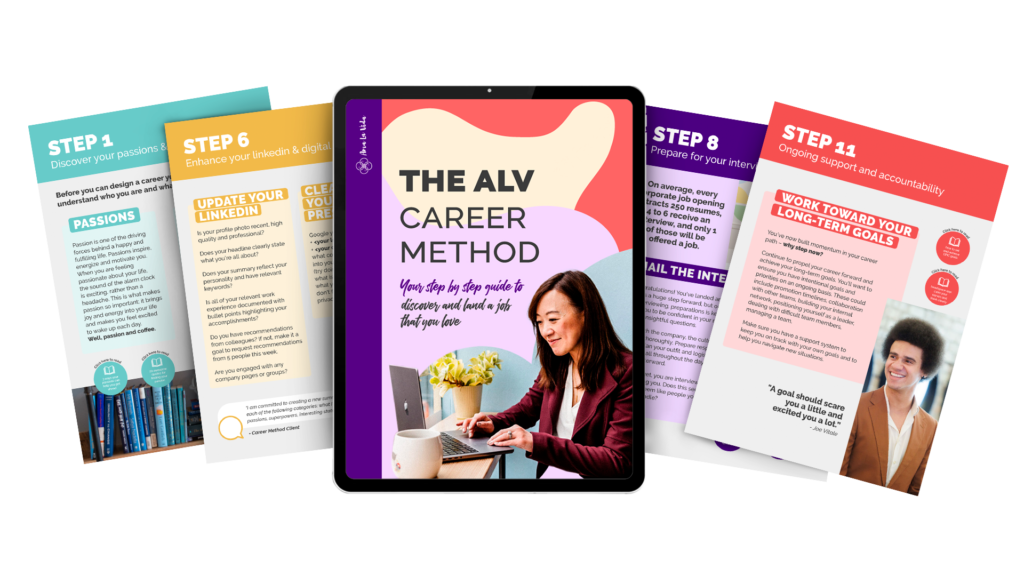
Download our comprehensive step-by-step guide to design and land a job you love!

Images from The ALV Career Method Guide
ALV Method Downloadable Guide

“The future belongs to those who believe in the beauty of their dreams.” – Eleanor Roosevelt When was the last time you were flooded with excitement about something that was all yours? Something that set you on fire and drove you to jump out of bed in the morning? It could be from an accomplishment, a hobby, or a happy feeling based on something you did. If not, is there a chance this passion in your life is on pause or that you feel stuck from an experience that was different than what you expected?  I felt a little stuck A little over five years ago, I had to find a new way to re-infuse joy into my life after I stopped working for a couple of years for my kids. While it was a good long-term decision, it felt like my life had become all about cooking and cleaning. I was mourning the loss of glamorous trips to San Francisco and New York for market research and the money and freedom that came with it. WHY would I give up such a wonderful situation, which was practically a dream job for me? It was out of love that I had decided to pause some of my own passions so I could be there for my three kiddos more. But over time, I started to feel restless and needed a change. Fast forward five years later. I’m truly happy that I have found a way to channel my ambition into other things. I grew my own interests (such as coaching, competing in Olympic and sprint triathlons, learning to row on a 24’ boat, and other adventures) while watching my kids quickly grow. I’m happy I was home to see my 16-year-old learn to drive. Any my 10-year-old play the trumpet out of the bus window on the way to school. And my 14-year-old decide that she was meant to live in the ’80s (in a time before everyone was on social media – ha!). So, my question today is, have you pressed pause on your dreams? Or have you felt a loss of unmet expectations and what you thought things should be? Or maybe you paused your passions during the past couple of years due to the pandemic? Are you now ready to reignite your passions? Are you willing to dream a little and take some steps toward feeling energized and excited again? If so, I believe it is your time to thrive and shine!  Questions for you to consider What did you dream about being or doing when you were 10-years-old? What did you definitely NOT dream of being or doing? This week, could you schedule a time to unplug and dream, journal about it, and then take one step in that direction?  Begin! I’ve always felt the first step is the hardest and most intimidating. Once you write down your dreams, focus on the first step, not what will be required for the next 10 steps. Start with the first week, not the first year. Begin with a plan for the month and the rest of the year will fall into place. 2022 can be a great time to make some of your dreams a reality!  ~ Kristi

Read More

Let’s start with a question: Would you rather break up with someone or tell a coworker that you’re bothered by something they did? In a survey, most people picked the dumping over the difficult work-related conversation (No Hard Feelings, pg. 139). In my opinion, there is something seriously wrong with that data point. How can it be that we’re so terrified and avoidant of hard work-related conversation? My clients and I always talk about interpersonal problems and how to become a better communicator in the workplace. Their thoughts sounds a lot like: Joe from Accounting is getting on my nerves. Sara from Marketing is SO cold (she must hate me). I think everyone thinks I’m the office bitch… I always ask my clients to show me the evidence, and guess what? There usually is none! No hard facts to prove their assumptions – just lots of emotions. I want to share a tool that will support you in becoming a better communicator at work and doing something about it without getting emotional. Let’s dive in! You Know What They Say About Assuming… Have you ever brought up an issue to another person and found yourself completely dumbfounded by the fact that they couldn’t see it from your perspective? That’s because we tend to jump to conclusions through a mental model called the “Ladder of Inference.” First described by organizational psychologist Chris Argyris, and later popularized by Peter Senge, the model explains how we quickly and unconsciously move from the facts of a situation to a conclusion (and why our conclusions are sometimes wrong). Check Yourself… …you know the rest! It’s so easy to send a passive-aggressive email or stew in the frustration of miscommunication and let resentment build up. The Ladder of Inference teaches us that we’re really good at unconsciously moving from observation to action.  If you take only one thing away from this blog post, let it be this: Give yourself time to slow down. When something happens at work, whether it’s a comment from a coworker that rubbed you the wrong way or a missed deadline, take a moment to label what you’re feeling. Are you hurt, frustrated, disappointed? Dive deeper by trying to understand where your feelings are coming from and check where you are on the Ladder of Inference.  The Ladder of Inference in Action We’ll be taking the role of Malia. Malia is the manager of a development team at a mid-sized technology company, and her whole department has been under a lot of stress lately. They have a lot of projects and not enough capacity, with tight deadlines looming above their heads. Malia’s direct report, Jack, walks in nearly half an hour late and quickly thanks to the office manager for taking his call. Malia decides to take action right away, and as soon as Jack is settled at his desk, she tells him that being late is unacceptable and that if it happens again, they will have to have a serious discussion about it.  Let’s review how Malia arrived at her decision to take the action of confronting Jack right away. 1. Observing available data There are facts and reality all around us. The first step is to observe data. Example: Jack shows up 20 minutes late, looking frazzled and frustrated, and stops by to thank the receptionist for taking his call. 2. Selecting your data or reality Our realities are based on what we choose to gather as data. Step 2 is where we choose the data that fits our perspective. Example: Jack shows up 20 minutes late. 3. Interpreting what it means After we select our reality, we assign meaning to it based on our past experiences, memories, and biases. Example: Malia has struggled with employee engagement in the past. The first sign of their disengagement was showing up late and having no respect for timelines. They were hard to work with and ended up leaving the company after a nasty disagreement. 4. Making or testing assumptions Then, we make assumptions based on the meaning we created. Example: Malia assumes that Jack is late because he has no regard for schedules or the deadlines they are under. 5. Drawing conclusions From our assumptions, we conclude what needs to be done or what the right next step is. We haven’t considered all the facts, but we choose to come up with a conclusion based on our interpreted meaning. Example: Malia decides Jack must be reprimanded for being late so this does not turn into a bigger issue and create problems the way it did for the past employees. 6. Adopt beliefs Our conclusions lead us to cement a belief about the situation. We tend to use this belief over and over again when selecting data in the future, which becomes very problematic as our perspective narrows. Example: Malia decides every employee that shows up late has no regard for schedules or deadlines and must be dealt with accordingly. 7. Take Action Here is where we take action. You will notice that the action we take is usually based on our assumptions and conclusions, rather than facts. Example: Malia immediately reprimands Jack and gives him a strict warning about respecting schedules and deadlines. Check yourself and take a few deep breaths! Pause and Reflect Now that you’ve identified where you are on the ladder, it’s time to make your way down the ladder. Our goal is to go down to the “observable data and facts” rung, so we can untangle ourselves from our (perhaps incorrect) assumptions and stubborn beliefs into what’s actually there and what’s really true. Below are some questions you can ask yourself and reflect on as you make your way down the ladder of inference. Start at the level you identified yourself to be on and work down from there: Reset and Rework Congratulations! You made it to the bottom of the ladder. Hopefully, even just taking a little time to pause and reflect has already left you

Read More

You know that voice inside your head; the one that’s always pointing out all the things you’re doing wrong, and all the things you could do better? Yep, that’s your inner critic, and we all have one. Much like everything else in life, your inner critic has good intentions (always bettering!) but is only beneficial in moderation. When that nagging voice begins to take a toll on your mental wellbeing, confidence, or self-esteem, it’s time to take the reins and tame your inner critic.  1. Name It Many studies have shown the importance of naming your emotions. Taking the time to name a feeling or emotion that comes up and labeling it, it’s helpful. Researchers have seen a reduction of activity in our amygdala. This is responsible for detecting fear and setting off a number of biological responses (think fight, flight, or freeze). There are many emotions that may come up with your inner critic. The first step to taming your critic is to name it by closing your eyes whenever you hear that voice come up. Imagine what it looks and sounds like, and then coming up with a name for it.  Questions to help you name your inner critic: You can name it anything you want! Some of my clients have named their inner critics Karen, Charlie, the wolf, and Judgemental Judy – it’s up to you! I always like to think of the movie Inside Out, my inner critic can look a lot like Mindy Kaling’s character, Disgust and that helped me give it a shape and look. Naming your inner critic allows you to get some space from that negative voice and realize that you are not a problem that needs to be fixed, but rather your inner critic is something outside of you that is showing up for some reason. This key differentiation starts to diminish the power of your inner critic so you can begin to tame it. 2. Fact Check  Beck’s cognitive model, also known as the Cognitive Triangle, proposes that events are not directly responsible for the way we feel. Rather, it is our interpretation of events that influences how we feel and view the world. This model implies that we can change the way we feel by changing the way we think. The first step is changing the way we think by fact-checking our thoughts with reality. It is easy for us to believe our inner critic right away and take everything it says as fact, but just as we would fact check a news article or a really unbelievable trivia answer, we should fact check our inner critic.  To fact check your inner critic, follow these steps (based on Cognitive Behavior Therapy): You can practice fact-checking in the moment for an instant de-escalation of your inner critic or as part of your daily journaling routine to deeply reflect and plan for the next time it shows up. Feel free to use this worksheet!  3. Talk to Yourself One thing we’re good at as humans, especially when we’re in a vulnerable headspace, is listening to ourselves and taking everything we think or feel as the whole truth. Now that you’ve named your inner critic and identified and reflected on your negative automatic thoughts, it’s time to take control back and talk to yourself.  Next time your inner critic speaks up, how can you talk back? What does your inner critic need to hear to quiet down its fears? If you’re working out and your inner critic says, “You can’t do this, you’re so out of shape.” Speak back with kindness and say, “Thank you for your concern, Charlie, I feel strong and determined and I know my body will take care of me” or it may be something more like, “You’re right, Charlie, this is really tough and I haven’t exercised in a while. I’m going to take a break, drink some water, and get back into it!” It may sound or feel silly at first, but I urge you to embrace the silliness — the whole point is for you to shift your relationship with your inner critic and you can start the process by doing the talking instead of only listening. Talking to yourself can take many different shapes. Here are some ideas on how to integrate this idea: Moving forward Lastly, part of taming your inner critic is to elevate your wins and be your own biggest fan. Make sure you’re celebrating your wins—big or small— so you can build a collection of feel-good moments that highlight your successes and remind you of how capable and strong you are and save those for a rainy day to help get you out of a funk.  Taming your inner critic is not a one-and-done thing. It is constant work and requires you to stay present, engaged, and active in your own life. Naming your inner critic is step one, and step 2 and 3 are meant to be used in a wash, rinse, repeat cycle. Add these tools to your toolbox, integrate them into your daily routine, and be kind and compassionate with yourself through the process! Remember, we’re always here if you need some help!

Read More

Even though we live in modern society, we still have prehistoric brains that respond with instincts before logic and causes us to sometimes struggle to make the right choices. This is because our instincts work faster – way faster – than the thinking parts of our brains. Today, we’re talking about how to tame your instincts to make the right choices. What exactly is an instinct? An instinct is an inherited tendency to make a specific response without thinking, usually to protect us physically. Just like lightning flashes before we hear thunder, instincts fire before rational thought.   Translating this to practical terms – we cannot out-think our instincts, because instincts don’t originate in the thinking part of our brains. Kind of a relief, if you ask me, because then I don’t have to beat myself up when I realize a part of me wants to run away from difficult emotional situations. Every. Single. Time. How do we resolve this dilemma, so our outdated instincts don’t trip us up? The first step is to accept that our minds filter the world through this lens of survival and protection. The second step is to tame our instincts because we’ll never fully eliminate them. Our Instincts Below I highlight three prehistoric instincts that are still alive in us today and an idea to tame each one if it is no longer serving you: Instinct #1: “I cannot survive alone!”  Humans evolved in tribes and still feel safer in a group when threatened. Perhaps this is one reason why social isolation as a result of the pandemic is so difficult on an emotional level.  Tame it: Build a habit of staying in touch with your extended family, friends, community. Each day, connect with at least one person in your “tribe”. Instinct #2: “There is not enough!”  Humans evolved in a time of scarce resources. This results in a tendency towards a scarcity mindset when stressed. We’ve all read about instances at work when people act unethically to get ahead. When someone is deeply in the scarcity mindset and feeling like there’s not enough money, praise, resources to go around, instinct can take over and rational behavior can go out the window.  Tame it: When you catch yourself feeling unsatisfied with what you have, don’t go on autopilot. Stop complaining and refer back to your “why” or your values. Focus on how you are living your truest values instead of maintaining a scarcity mindset. Instinct #3: “React now!”  The primitive brain prioritizes dealing with the immediate situation, not long-term growth and learning. Can you see this tendency in people who focus on transactional day-to-day tasks, but ignore longer-term planning? Or perhaps in yourself at times when you are dealing with urgent but not really important tasks?  Tame it: At the end of each week, take some time to reflect. Look for patterns and plan for the upcoming week—not just tasks but also how you want to feel, how you want to spend your time, what will bring meaning to you in the upcoming week.  Additionally, we are driven by some basic needs and instincts that have been hardwired into our brains. For instance, the primal drive of survival will supersede thriving or happiness any day of the week. Unlike our computer software, we cannot just change the code – not that I could change the code on any software anyway! As I share with my coaching clients, stop fighting these basic instincts and instead use them as a stepping stone to reach your goals or change behaviors.  I remember growing up and going to the bowling alley after school some days. No matter how hard I tried, my ball would always veer left. Eventually, I realized I could just release the ball about 6 inches to the right. Then when the ball veered left, it was right at the middle of the pins. In a similar way, you can adjust your behavior knowing your caveman tendencies. Primal Tendencies Below I share some of the basic primal tendencies I have learned or observed as an organizational psychologist and coach. Survival trumps happiness Mother Nature wants her species to survive. She doesn’t care if they are happy, just that they don’t die. If left to its default operating system, your brain will choose the option that ensures survival. In modern society you don’t really need to worry about surviving, and yet you are still not focused on thriving by default. You have to be deliberate about it. Default mode network This is psychologists’ term for mental chatter. You are primed to plan, worry, jump from one thought to another. That’s our default. No wonder it’s so hard to follow meditation instructions to clear your mind. Comfort Zone In order to feel safe, we will do and choose the same. You are wired to feel uncomfortable trying something outside of your comfort zone. Your brain is unconsciously thinking, “Hey, if we are alive now, it must have worked so let’s keep doing it.” This is why people will sometimes stay in a job they are not happy with, instead of taking the leap with a new job. Negativity bias Your brain will notice what is wrong. This is another survival tendency that served humanity well living on the savannah, but is not serving you in modern-day society. Negatives will stick like Velcro, and positives will slide away like Teflon. That’s just the way humans are wired. You may have had 100 things go right in your day, but one email or conversation will throw you into a tailspin. But you can intentionally focus your brain on the good by prompting yourself. Need  Support? Do you feel like you struggle to tame your instincts and make the right choices? Do you need some help overcoming primal instincts and tendencies? Talk to one of our relationship strategists about coaching and how working with a coach can help!

Read More

We all have blind spots. No one would question the existence of them when driving. Yet people are often oblivious or in denial about their blind spots in relationships, conversations, even projects and tasks. Blind spots are how you are deceiving yourself. You may say you want one thing, but in the moment, your actions do not reflect this wish. Like my client who said she doesn’t have enough time to “get it all done”…but spends an hour in the morning and more than an hour at night on social media and watching the news. Or the client who wants to lose weight…but never makes time for movement or eating healthy. I’m the first person to say adults are free to live their lives in any way they want as long as it doesn’t harm others but make it a deliberate choice.  Avoid the emotional dissonance that comes up when you say you want one thing, but your actions don’t reflect it. That can lead to frustration, anger, disappointment, resignation. Maybe you can relate to one or more of those emotions. One reason for this dissonance is your blind spots. It’s like a part of your brain doesn’t want anything to change, so it hides these sabotaging behaviors, habits, beliefs, and ways of being from your awareness. What’s scary is that generally everyone around you knows your blind spots – everyone that is, except you! So the question is, how do you find your blind spots? 1. Ask Those Around You: One of the most direct routes to finding your blind spots is to ask people what they are. Yes you will feel vulnerable, and yes that conversation will take courage. What’s ironic is that people will probably respect you more for inquiring, but in the words of Brené Brown, “People hate to feel vulnerable themselves, but they easily connect with others who show vulnerability..” Not many people take a leap of faith and ask others in their world, “I want XYZ but am failing. What is my blind spot about this?” For example, “I want to be more patient, but am still angry all the time. What am I missing?” Know that your initial reaction to the input may be denial or defensiveness. That’s normal, but don’t act on it. Instead respond “Thank you for sharing that with me. 2. Take an Assessment There are a number of online assessment tools you can capitalize on. At Ama La Vida we use many internal questionnaires to help clients take a macro look at all the areas of their life. We’ve recently added a leadership assessment to the list of tools. Even if you aren’t a leader it’s a great way to take stock in how you approach things and to pinpoint what some potential blind spots may be. It takes about 15 minutes to complete and produces one of two leadership styles. You’ll receive an email with your results upon completion that outlines your style, strengths and blind spots. This is a great tool to identify what you may need to draw attention to that perhaps you weren’t aware of. 3. Focus on Your Strengths This may seem counterintuitive but thinking about your strengths is often the quickest way to to identify your blind spots.  Let us give you a couple of examples: Strength: Highly Strategic Blind spot might be: unable to execute, avoids details, doesn’t see the impact at the lower level. Strength: Love developing others Blind spot might be: too focused on people and not on tasks, doesn’t develop self well. Strength: Highly empathetic Blind spot might be: easily drained in conversation, not direct with others, concerned about what others think of me. These are just a few possible examples, but you can see how knowing what you are good at might give you an indication of what your blind spots may be.  4. Work with a Coach A skilled coach can be helpful to highlight blind spots and patterns when you know something is getting in the way of reaching your goals, but you cannot quite put your finger on it.  A coach will ask deep questions that will help you to take a macro view of your life. What is so dear to you that you are not including in your life? What goal do you have that is getting no love? What are you not facing in your life that needs attention? What do you value that gets no energy? What is your purpose and are you living it out? Your answers will be pointers to your blind spots. Schedule a complimentary consult to work with a coach to find your blind spots! Examples of Blind Spots: Here are common blind spots we hear from clients: problems making decisions, talking too much, not listening enough, controlling others, rigidity, overly task (vs. relationship) oriented, working excessively to avoid difficult conversations at home, resistance to change, overcommitting, impatience, tendency to be melodramatic, and many more. Once you identify your blind spots, name it to tame it. Naming the blind spot is critical. It’s through awareness that intentional change happens. Once you’ve named your blind spots you can work on taking the steps necessary to overcome them. 

Read More

Being an impactful leader takes more than business acumen and intelligence – it also requires emotional smarts and self-regulation. Author and psychologist Daniel Goleman, author of “Emotional Intelligence”, helped popularize the term and create more awareness of it in the 90’s. Goleman believes that success in life requires more than IQ alone. His research showed that almost 67% of competencies required for high-performing leaders were related to emotional intelligence. As if that weren’t compelling enough, Goleman also believes that IQ only contributes to 20% of our success in life.The remaining 80% comes from emotional intelligence! Understanding the 5 key emotional intelligence skills enables us to build our own leadership strength and effectiveness. Today we are focusing on one of the 5 key emotional intelligence skills of self-regulation. Emotional Intelligence Defined  While multiple definitions of emotional intelligence abound, Goleman identified 5 elements of EQ that contribute to successful leadership: self-awareness, self-regulation, motivation, empathy, and social skill. Through his evaluation of EQ in the workplace, he observed that the higher the level leader within an organization, the greater the impact of EQ on their overall effectiveness. Technical skills and cognitive abilities (IQ) were also important capability areas that were evaluated to determine the ingredients of effective leaders. While these other two areas also mattered, emotional intelligence was shown to be twice as important! Today we will explore one of the very important 5 EQ dimensions to understand what it means, how it shows up in the workplace, and how to strengthen your own self-regulation skill and better lead your team: Self-Regulation  What It Means Goleman defines self-regulation as “the ability to control or redirect disruptive impulsive and moods, and the propensity to suspend judgment (to think before acting.)” In the most basic sense, self-regulation simply involves controlling one’s behaviors, emotions, and thoughts. It means thinking before we act or speak, and being in control of our emotions rather than simply reacting to our environment. What It Looks Like Individuals with a high level of self-regulation pause and think before acting. They adapt to new situations and embrace ambiguity with a growth mindset vs. a fixed mindset (they define their destiny vs. a reactionary approach.) They are able to control their emotions, and effectively regulate their thoughts and communication accordingly.  Self-Regulation In Action Self-regulation applies to all areas of life. It involves acting in accordance with your long-term goals and values, both personally and professionally. For example, if we value your health and fitness (a long term goal and value), even when it’s tough to wake up early, we will motivate yourself to get up in the morning to work out. At work, self-regulation often shows up with our emotional regulation. For example, an employee might say something that comes across as rude and hurtful. Instead of reacting quickly and saying something we may regret later, when we use our self-regulation skills we may pause, write some notes, and take a moment to collect our thoughts then reply with a healthy feedback statement instead of an angry, snarky reply. How To Better Lead Your Team Here are several ways you can start flexing your self-regulation muscle today: Active Listening Engage in active listening with your team with a focus on pausing before engaging. Ask more questions instead of just giving your opinion to ensure team alignment and connection to the topic at hand. Get curious, and begin your responses with a question vs. an answer. Asking thoughtful questions is a powerful tool to effectively influence and drive change. Knowing what to ask and when is not always easy, but it is truly a game-changer to create rewarding and impactful conversations. Flexibility Focus on being flexible to change, and encourage the same value in your team. Adapt to your environment, support one another, and don’t let your initial emotional response keep you stuck in the past. Instead, shift your mindset by asking empowering questions (i.e. What’s most important right now? What’s the ideal outcome I am looking to achieve? What do I need to believe or feel to support my goal?) Culture Lead by Example and do what you say you will do. Demonstrate what it means to be a great leader. Pull your team together and openly discuss the culture of the company and the team. Communicate openly with your team by being clear, transparent and honest. This will create a psychologically safe work environment and build even more trust.  By creating a culture that promotes trust you will together have formed a team that as a whole can think before they act. Take a moment today and ask yourself, can my team think before they act? Have I created a trusting environment? Does everyone feel safe speaking up and sharing? Consider these questions and take note of what areas you need to develop.   Looking for Leadership Support? Building your emotional intelligence is an ongoing practice, and self-regulation is a key trait under this umbrella. Just like building physical muscle, building mental muscle requires many reps to develop results, and coaching can help! Partnering with a coach is such a powerful tool to help you set and achieve your goals. If you are ready to take your leadership to the next level, schedule your free leadership coaching consult today! We look forward to connecting with you.

Read More