I’ve been there. My business partners have been there.  Half of my clients have been there. The majority of my friends have been there too. The qarter-life-crisis is a real thing, and it’s happening all around the world.  But it doesn’t necessarily have to be a bad thing, and from my experience, in most cases, the quarter life crisis is an important trigger for powerful and positive change (even though it can feel daunting and exhausting at the time).  Here are four key tips for not only dealing with a quarter-life-crisis, but actually embracing (and maybe even enjoying) it! Change Your Mindset When people experience a quarter life crisis, their default reaction is to panic. They often become anxious and overwhelmed and these feelings only work to exasperate the crisis.  In fact, a crisis is a signal that something needs to change and this can be a really positive thing. Sometimes people have been doing something they don’t enjoy for far too long, and this tipping point is just what they need to finally take action. Perceive the crisis as an important prompt – remember, your mindset matters! This is your chance to transform your life and/or career in a really positive way. Focus Inward Before Going Outward When people find themselves in a quarter life crisis, they look everywhere around them for help and guidance. They might bury themselves in distractions, seek the advice of friends (typically over one too many cocktails) or anxiously search job boards for something that might relieve them of their situation.  These are all band-aid solutions. The most important first step is to understand what’s going wrong. Are you doing something you hate? Are you with a company completely misaligned to your values? Are you feeling a lack of passion or purpose? Only once you understand what is going wrong can you take the necessary steps to overcome it. Surround Yourself with Supportive and Empowering people When we are feeling a certain way, our default is sometimes to surround ourselves with others feeling that way so that we feel less alone.  This can be dangerous because it only feeds your negative feelings and emotions.  Find people that believe in you and support you. Attend inspirational events and gatherings.  Think about your most inspiring friends or colleagues and organize coffee with them. Hire a coach who will support and empower you.  Whatever you do, don’t wallow. Surround yourself with people who will help lift you out of your funk. Three Words: Bite Sized Pieces It can be incredibly overwhelming to think about how on earth you are ever going to get yourself out of a quarter life crisis. At the time, you feel in a very dark and confusing place and nothing feels clear.  This can affect your confidence and self-worth which then makes things feel even worse.  The key is to take very small steps each day.  Don’t spend too much time dwelling on the end goal, just think about what you need to do next.  Perhaps it’s something as small as writing down everything you’re feeling. When we break big goals into small pieces, it helps diminish overwhelm and anxiety.  It’s great to have a vision, but focus just on your next step If you’re in the throes of your quarter life crisis, I can definitely relate and understand this can be a difficult and confusing time. But the result of it might be a catalyst to move you forward in your life and career. Look for opportunity in the chaos, and you’re sure to find something amazing.

Read More


hands with yellow sweater and silver bracelets tying on a laptop

I have worked with people finding, building and changing careers for many many years. I know there are thousands (if not millions) of resources and tips out there telling you what to do and what not to do.  I’m not suggesting mine are any better than anyone else’s, but what I do know is that these ones actually work. These ones actually make all the difference. I know this, because I have seen it first hand. Of course, if you follow these five, you are not a shoe-in for your dream job (you also need to have a kick-ass resume, great interview skills, a stand-out online profile and polished professional etiquette). These are the things that are less spoken about and, from my experience, less known. But once you know them, and once you do them, it really will make all of the difference. 1. Start your job search from the inside out. Often when people are searching for a job, the first place they look is the job boards. This may sound like a logical approach, however without knowing exactly what you’re looking for, you risk landing a job that you later realize is completely misaligned with your passions and strengths. The key is to first understand who you are, where you can add value and what exactly you are looking for. It is crucial to identify your passions, your gifts, your core values and your purpose before starting the job search. This way, you will have a far clearer understanding of the types or roles and companies that will bring you fulfillment and success. 2. Try a non-traditional approach to job hunting.  When you apply for a job through the standard process, you are up again hundreds, if not thousands of other applicants. Often the company even ends up hiring internally and you never hear back which can be bother draining and defeating.  I encourage people to reflect on which companies they most want to work for and to write a list of their top 10 to 20. Then, find the relevant contact at that organization and send a thoughtful letter including who you are, why you want to work for them and how you believe you could add value.  This shows initiative, intention and will help you stand out against the crowd. Even if you don’t land a job, perhaps you’ll make a valuable contact.  And after all, you’ve got nothing to lose. 3. Network network network.  It’s no secret that most people build their career through their network not through standard job sites.  It’s never too soon to start networking. Remember that networking doesn’t need to happen at traditional networking events.  Networking can happen in a coffee shop or on the bus – you never know where you are going to meet people that could become incredibly valuable contacts.  Also remember that those people don’t need to be directly related to your field. They may know just the right person to put you in touch with.  Treat every person as if they are just the person you need to know in that moment and watch you network grow and expand in powerful ways. 4. Make time for self-care.  The job application process can be incredibly draining and defeating. Make sure to take care of yourself mentally, emotionally and physically. This is not only important for your well-being, but it is also important for you to perform at your best in applications and interview. Identify what you need to do and schedule time in your calendar to make time for it. Perhaps it’s a 20 minute run each day or 30 minutes to watch an inspiration TED talk. There is no wrong or right as long as you make time to recharge. 5. Shift your mindset – job searching is a marathon not a sprint.  Remember that you may not get the first job you apply for (or the second or the third or the eighth) and that is ok.  You career is going to be long. Very long.  Think carefully about your vision for your career and what you want it to look like in five years or ten years time. As long as you are meeting the right people and moving in the right direction, it doesn’t matter if one specific job fell through.  Just keep your eye on the longer vision and take proactive steps to achieve it.

Read More

I recently returned home from my second trip to Belize. Absolutely stunning country. Bursting with interesting history, a curious mix of cultures and ocean views to die for. But while abundant in beauty, it’s lacking in options. There’s certainly no Silicon Valley. Barely a university. No Home Depot. Not even a McDonald’s. Its people, however, are kind and proud. They will gladly show you the sites and welcome you into their homes, as our newly made friends down there did this trip. Our friend Mirsa invited us over. While I sat and played with her dog, her little cousin Shanies walked into the living room and went straight to grab something from the kitchen. Shanies lived in a separate unit in the same building. Knock on the front door? Don’t be ridiculous. She simply climbed over the barrier on the balcony and walked right in the open doorway. At only 15 years old, she was gorgeous. But I got the feeling she didn’t know it yet. Ed, my husband, teased her from the moment she walked in, as is typical for him to do, and she didn’t so much as flinch. I liked her already. After a 13-hour workday on her feet, Shanies’s mom came home, and we had a nice chat. She bragged about how smart Shanies was. “She makes all A’s in school!” I turned to Shanies and said, “That’s incredible! What do you want to be when you grow up?” Given my profession and being a privileged white person in America, it was a natural question to ask. With a shrug, “I don’t know.” My initial thought was “Ah teenagers…don’t think these things through.” But very quickly I realized, there wasn’t much thinking to do. Shanies’s mom went on to explain that college is not an option. Tuition is far too high. With minimum wage at $1.65/hr in Belize, mom could work as many 13-hour shifts as her feet could handle and never come close to paying for higher education. In fact, only 75% of students in Belize even make it to high school, with less finishing all four years. So Shanies would likely go on to cook. Or serve at a restaurant. Or work at a hotel. All perfectly fine professions. But what angered me was that her options were so limited. I wanted to stuff her in my suitcase and take her home with me. It was only a few hours on a plane separating her from top-notch education and endless opportunity. Who knows if she would have even wanted it. I’m not so US-centric that I can’t see that there are many ways life in Belize is preferable to life here. I just wanted her to have the choice. Shanies might be the next Oprah. Or Elon Musk. Or Tory Burch. Or Sheryl Sandberg. I don’t know who or what she could be, but I know that she has the right to try. Thinking about her on my plane ride home and gearing up for a full day of work in the morning, I realized that it is my duty to build my business for her. It is my duty to help my clients achieve all they can. To help our coaches prosper and make an impact. To work with the same hustle and endurance as Shanies’s mom does. Simply because I can. Because I was given the gift of being born in a place and family where I was taught to dream about my future and was told that college was expected. Because I was given the choice. And I’m going to make the right one. I’m not sure yet how Ama La Vida will help Shanies and the many young women around the world like her, but I’m for damn sure going to explore it. For now, I’ll put my head down and keep working. Keep building my business so it can afford me with a greater platform to make a change in the hopefully not-so-distant future. But know I’m thinking of you. I’m scheming. And you can bet your asses I’ll be back.

Read More

This month, the ALV team is centering on “healthy body, healthy mind” which presents a perfect opportunity to provide further insight to the somewhat broad concept of “wellness”.  My philosophy is that people who live most healthful are also the happiest.  With this premise in mind, I both inspire and guide people towards conscientious, healthful living behavior and decision making. Below are the primary dimensions of wellness. Your mindset falls within these dimensions, particularly the intellectual and emotional petals. It is important to understand that these dimensions will intertwine.  Identifying ways to utilize that overlap between the mind and other physiological functionality to support overall wellness is a trending area in lifestyle health and healthcare approaches.  For example, appropriate nutrition, limiting or avoiding environmental aspects that may be adverse in nature, and paying attention to your social environment are all means of supporting the system which powers your mood and well-being. But a key component to favorable lifestyle health is human behavior.  Changing behaviors which are non- or less supportive of health and wellbeing can be incredibly challenging.  Motivational triggers and barriers, social support, and even the environment in which a person lives can impact our ability to make lasting behavioral changes. According to Dr. Cynthia Sholes, PhD of the Mind Wave Institute, behaviors, habits, and mental function are largely the result of automated, unconscious activity within the nervous system. In other words, behaviors can be so hard to change because we largely conduct them without even being conscious of it! However, similar to strength training muscles, concerted effort can be exercised to best activate the processes that are not on auto-pilot and, therefore, instigate stronger will power and analytical thinking.  This is otherwise known as training the mind. Mind training helps you increase awareness and serves as a gateway to the parts of the mind that are automated in nature, putting you on the right path to be able to influence your behaviors.   A great exercise for starting to bring greater awareness to our mental function and behavior, as you may have heard from one of your ALV coaches, is to examine the impact of the stories we tell ourselves.  It is important to ask ourselves what behaviors these stories are reinforcing in us by asking the following questions: Are they clarifying our level of understanding for something or making our mindset cloudy? Do the stories encourage us to move forward, accept circumstances we can’t control, but motivate us to make effective change for those we can? On a personal level, practicing mind training exercises that bring about focus on awareness has played a critical role in keeping me focused on supportive lifestyle decisions and protocols related to my health as I worked to overcome challenges presented by autoimmune conditions. In doing so, I had to take a concerted look at the story I was telling myself.  Practicing a conscience approach to knowledge and acceptance of my circumstances led me to stay positive, motivated, and structured while I made the behavioral changes I needed to make in response to my health conditions. I also needed to make changes to my dietary plan given that nutrition triggers a range of physiological activity associated to mental performance, muscle function, energy levels, and sleep quality.  Furthermore, quality of dietary intake can impact memory, thinking and learning, clarity, and coordination which tie into productivity, creativity, resilience, and social connections. It didn’t stop there. I altered my personal care and household products, sleep schedule, and even how I engaged in my social environment. All of these elements were contributing factors to help me not only be healthy but happier and more productive in my work. Below are four take-aways to increase your level of awareness and engagement in supportive, healthful living practices: Train the mind like a muscle. Behavior science has taught us that repetition and duration (like an exercise plan) are important.  Scientists call this “dose”.  Visionary tactics such as retelling one’s story can further support this activity. Practice living well. Knowledge for dimensions of wellness can support your journey and guide decision making. It doesn’t take a science lesson every day, but acceptance that lifestyle health is definitely a sum of inter-connected parts.  An action taken in one dimension will have respective effects across other dimensions.  This is part of what we mean when we use terms such as “whole health” or “holistic” with regards to health and healthcare approaches. Pay special attention to the nutrition. This may be a health coach’s bias; however, it is one that is thoroughly backed by science. Appropriate intake across phytonutrients, such as antioxidants and enzymes, and amino acids from food are foundational to physiological mechanisms within our biochemistry.  Appropriately trained professionals can help you come up with dietary intake strategies best suited to your lifestyle and individual circumstances. Consider a structured program. According to Dr. Sholes, people like to stick to a program and a 30-day plan is ideal to form a stable habit. This also aligns well to many scientific studies centered on human behavior change and health outcomes. Want more from Ama La Vida? Sign up for our newsletter 🙂

Read More

I work with people every day helping them achieve their goals. I would say that one third of my clients have goals around their weight and physical health. They work extremely hard day in and day out ensuring that they abide by the right diet and exercise plan to reach their desired weight. Now I am all for physical health and wellness. I too watch what I eat. I do my best to stick to a lean and clean diet and try to opt for organic produce when possible. I also walk or run for at least an hour every day (most days) and try to sneak in some sit ups and push ups as well. However, what I have noticed over my years of being a coach is that people are a lot more lax with their mental diet and exercise than they are with their physical. They don’t care nearly as much about what’s on their mind as what’s on their plate, and while it may be obvious that going to the gym builds physical strength, the idea of building mental strength through changing habits and thought patterns seems almost foreign. This is understandable. We grew up being told to watch what we eat, not watch what we think. We grew up being told to work out our abs not work out our minds. What if we were as careful with our thoughts as we are with our food? What if we could watch what we feed our mind as much as we watch what we feed our bodies?  This is not a hypothetical question. I want you to actually take a moment – to think about it and to answer it. I like to practice what I preach, and so I did so too. I took a moment, I thought about it and I answered it. Here are some thoughts and ideas that I arrived at: We would love ourselves more Self-love can sound like a bit of a fluffy, maybe even idealistic concept. The idea of “loving yourself” gets thrown around a lot and is rarely substantiated by practical ways to actually achieve it. Our quest for self-love is a long and challenging one. One that certainly doesn’t happen over night. One that takes months, years and sometimes decades of challenging and confronting work. Self-talk is a crucial driver (or detractor) of self-love. Think back over the day you had. What are some of the things you told yourself? Perhaps that those jeans hardly fit you anymore because you’ve gained weight. Or that your presentation sucks, and no-one is going to like it. Perhaps you talked yourself out of going to that party because you wouldn’t fit in. Would you say these things to the person that you love the most in the world? Of course you wouldn’t. What if you spoke to yourself in the same way that you spoke to the people you love? What if you monitored your thoughts and blocked out the ones that were critical and only entertained those that were positive or constructive? I challenge you to try it. I challenge you to start accepting and rejecting the digestion of certain thoughts in the same way you would food. When you see a cream-filled donut, you’re able to say “no” because it doesn’t serve your health goals. So when you see a hate-filled criticism, why not block it out in the same way? For the next week, only allow in the kale smoothie equivalent of your thoughts, and just watch what happens. We would have far stronger relationships Think about the last time you felt in a crappy mood. How did you treat the people around you? How much love did you show your boyfriend, girlfriend or spouse? How did you treat your friends, colleagues and even strangers? Now contrast that to the last time you felt awesome. When we are feeling happy and confident, we treat those around us with kindness, love and respect. And what makes us feel happy and confident? Well, obviously many things, but some of the big drivers of how we feel are the things we are reading, the things we are watching and the people we are surrounding ourselves with. When we feed ourselves encouraging and inspirational videos and articles, we feel great and want others to as well. When we surround ourselves with people who lift us up and not shut us down, we feel a greater sense of confidence and worth and this energy has a ripple effect on all of the people around us. Start paying attention to your environment and whether it’s clearing or polluting your mind.  Amend accordingly. We would have greater courage and confidence The food we put in our bodies gives us (or takes away from us) energy and strength. Similarly, the food we feed our mind provides (or detracts) from our levels of courage of confidence. If you spend your days looking at celebrities in mansions and models with airbrushed bodies, how do you start to feel about your own world and life? Probably pretty inadequate. If you spend your life reading all of the crisis stories that big news channels feed us, how do you feel about the world? Probably pretty low and disheartened. I’m not saying stop watching the news entirely but know that for every doomsday story, there is a story of brilliance, of innovation and of restored faith in humanity. Of course, the news channels don’t focus on those ones…but that doesn’t mean you can’t. Today we have an abundance of information – blogs, podcasts, Youtube. I challenge you to find at least one empowering blog or podcast and split your time between that and your traditional channels. Try it for one week and notice how it makes you feel. When we discover the amazing things that people are doing in the world (and trust me, people are doing amazing things!) we feel inspired and empowered! At the end of this article, I’ve provided a list

Read More

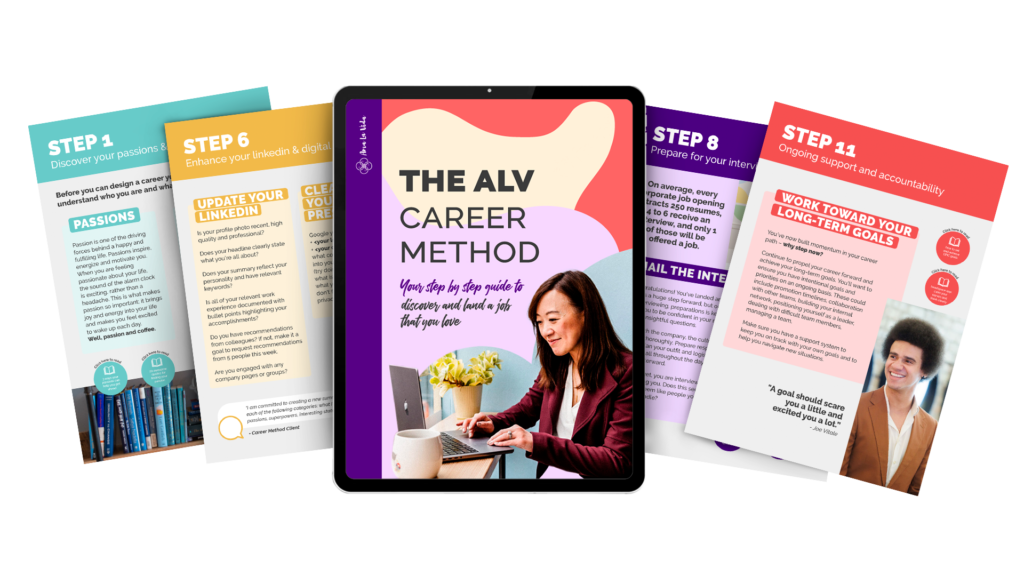
Download our comprehensive step-by-step guide to design and land a job you love!

Images from The ALV Career Method Guide
ALV Method Downloadable Guide

A little bit of anxiety here and there is a fairly common and normal emotion. First day on the job… going on a blind date… the night before your wedding. These are all things that may cause a little bit of anxiety. After all, it is your body’s natural response to stress. But when anxiety begins to become prolonged, extreme or severe, it can be very challenging and at times even debilitating. Most of us know someone who struggles with anxiety. But most of us don’t always know what to say or do when they are feeling anxious, particularly if they are having a panic attack. There are certain things we can say that can make them feel better. For example, when someone suffering from anxiety feels heard, loved and understood, it helps them to deal with the anxiety and its symptoms.  On the flip side, when someone feels judged, belittled or excluded, it makes the anxiety far worse – sometimes even paralyzing. So what should you avoid saying to someone with anxiety so that you don’t make it harder for them than it already is? Here are 11 things NOT to say to someone with anxiety: Don’t say “Just get over it.” This is one of the most common, insensitive and ineffective things to say to someone with anxiety. If they could simply “just get over it” then of course they would.  Alas, it is not so simple.  You would never say to someone with a broken leg, “Whatever, just walk on it.” Yet because we cannot “see” anxiety, it is hard for people that have never experienced it to understand it. A person experiencing anxiety has perceptions and thought patterns which are broken and distorted. Just like it is difficult and damaging to try and walk normally when you have a broke leg, it is equally difficult and damaging to just try and think normally when you are suffering from anxiety.  Instead of saying “just get over it,” a better thing to say is, “Is there anything I can do?” or “Know that I am here for you.”  This helps the other person to feel heard, valued and supported. Don’t say “It’s all in your head.” Even though the thoughts that create anxiety definitely start in one’s mind, the implications of anxiety are very real – both physically and emotionally.   Telling someone with anxiety that it is all in their head can in fact exasperate their feelings of anxiety and make matters far worse.  Even though their thinking patterns may be distorted, in that very moment, it is extremely difficult for someone who has anxiety to see that.  A much better thing to do is to help them calm down by finding someplace quiet and supporting them to take deep breaths. Don’t say “Weirdo” or any other name (even if seemingly in jest). When someone is suffering anxiety, they may look like they are getting worked up about something relative small or seemingly insignificant. What’s important to remember is that in that very moment, it is not small or insignificant to that person. Anxiety feels large, dark and overwhelming.  Even if their behaviors may be seem strange to you, it is important not to make them feel that they are weird or crazy. This will also exacerbate the anxiety.  Instead, help them feel supported and less alone by asking them how you can help or just letting them know that you are there for them. Don’t say “Calm down.” Never in the history of calming down has anyone ever calmed down by being told to calm down.  Whether you’ve experienced anxiety or not, at some point in your life, chances are you’ve experienced anger or frustration, and someone has told you to calm down.  How did it make you feel? Likely not calmer. In fact, it likely made you feel ever more angry or frustrated.  The same is true for anxiety.  Telling someone who is experiencing anxiety to calm down will just make them feel more anxious. Instead, try giving them simple, specific and practical tips such as taking a deep breath, counting to 10 or listening to some music. Don’t say “At least you…” Sometimes people, with the best intentions, try to make someone else feel better by comparing their situations to others who might be worse off or by highlighting something good in the hope of helping them see less need to be anxious. For example, if someone is feeling anxiety about an upcoming social event, you might want to say something like, “Well at least you are invited to these types of things” or “At least you don’t have to be the one hosting.”  While these comments may be well-meaning, the use of “at least” can diminish what someone is feeling by making it seem comparatively a lesser deal. Instead, validate their fear and emotion and once again, simply ask if there is anything you can do to help. Don’t say Nothing. When you’re with someone who has serious anxiety or is suffering a panic attack, it’s hard to know exactly what to do or say. Because of this, sometimes people just do nothing. Or worse still, walk away. This signals to the person with anxiety that you don’t really care (even though you do!). You don’t need to do or say anything grand, but a few words or a small gesture to let them know you care can go a long way. Even just putting your arm around them or giving them a hug show that you are there for them and that you truly care. Don’t say “Just…” Just breathe. Just go for a walk. Just calm down. Just call your mom. Telling someone with anxiety to “just” do something, suggests there is an easy solution and diminishes the seriousness of what they’re feeling and going through. If it were that easy, trust me, they would have done it! It also communicates to them that you think you know the answer, which if you’ve never had anxiety, can feel frustrating and alienating to someone who deals with it frequently. It will likely make them feel alone and

Read More

I have worked at companies or on specific projects where I would come up with an idea that I thought was pretty good.  An idea to solve a business problem. To attempt to fill a hole that would otherwise sit there and gobble up time and money. So, in a burst of inspiration, I’d take charge and propose a solution. Perhaps not a perfect solution but a starting point. I’d begin to discuss it with others whose approval I’d require or whose functional expertise I’d need to draw on. And the more I’d discuss it with others, the worse the idea would become. I’d hear “no” after “no” – all reasons why the idea wasn’t perfect. All obstacles standing in the way of it filling the hole. All completely valid statements, for the record, but unproductive ones. So I’d have to change the idea to keep it moving, lest it die right then and there. With each “no” the idea would get more watered down, to the point that it became unrecognizable, and at the end it was hardly an idea at all. While at first my plan was to fill the hole, the idea had become more like laying a piece of paper over it. Why bother. At Ama La Vida, coming up with ideas is fun. We have no shortage of business problems; everywhere we look there are holes to be filled.  But now when I propose a solution, even a mediocre or outlandish one, I have faith it will grow into something that fills the hole and solves the problem. I’ll share the idea with my team, and the more I talk to others about it, the bigger and better it becomes. It gets more power behind it. The crappy parts get striped away. It gets shinier and shinier as it gains momentum. Before you know it, it becomes real. The difference in the experiences is represented by this visual: If you want to make progress, be innovative, beat the competition and keep your customers happy, you want your company to be an Idea Fueler not an Idea Diluter. Sure it’s much easier to be a Fueler when you are still very small. Fewer stakeholders. Fewer customers impacted. Fewer approvals required. But if you care enough, you can be a Fueler at any size. And if you aren’t careful, you can be a Diluter at any size too. Here are some ways ALV has built a culture of idea fueling that I welcome you to explore. We’re obsessed with our customer – The more you care about your customer, the more the holes to be filled are even visible to you. And the less you’re willing to tolerate them being around, especially if they are harming your customer experience. When I let a customer down, and of course this is inevitable, I treat it like I let my best friend or family member down, regardless of how well I know them or how much they spend with us. I fix the problem, I’m transparent and I’m apologetic. I put my heart into making it right and then some, not just because I want to preserve the relationship but because I truly give a shit about that person’s life. And the whole ALV team operates this way. The first step to fueling ideas to fix business problems for you and your customer is to build a culture of people who are obsessed with solving them. A culture of people who take business problems personally. We talk about idea fueling and practice it – It may seem unnatural to try and teach your team this behavior, but if you don’t discuss it, you can’t expect them to do it. I have talked to my team very directly about the importance of fueling each other’s ideas, and I have led them in exercises to help us practice it in a safe environment. We create a safe space – Whenever someone presents an idea, no matter how seemingly crazy or unrealistic, we entertain it. Even if we don’t immediately accept it, we approach it with curiosity and encourage the idea generator to tell us more. This creates a space where people feel comfortable, even excited, to share their ideas. We call out bad behavior – Sometimes your knee-jerk reaction will still be to shoot down an idea. To jump right to the “we can’t’s’” instead of the “what if’s.” To immediately reply that the idea is just too out there or too expensive. It happens. It happens to us sometimes. But when we make that mistake, someone on the teams calls it out. “Hey guys, you just crapped on my idea. That’s not how we do things here.” And we all acknowledge that person’s feelings and assessment of the situation. They’re right. We apologize and give them the floor. We make the same call out for one another if we see idea diluting happening to a peer. If you want to build a good behavior as standard practice, you can’t let the bad behavior fly. We’re faced with unreasonable challenges – As a self-funded startup with an incredibly lean team, we face challenges on a daily basis which are beyond unreasonable for us to solve with so few people and resources. But we get creative, and we work our butts off to solve them every time. I hope as we grow, we continue to have more resources to make more delicate and seamless solutions. But I want to ensure that we never lose that scrappiness. That ability to create something from nothing because nothing’s all we had to work with at the time. I will continue to challenge my team to propose solutions and build them with not enough time, people or money. It’s the opposite of spending a budget because you have it. It’s building a solution with less than you have because it’s possible. Don’t forget, the more you dilute ideas, the less likely your people are to

Read More
Woman on couch with social anxiety.

Catching up with some friends for dinner tonight? Going to a wedding next weekend? Perhaps just meeting a few colleages for an after work drink? These all sound like fun experiences to look forward to, right? Not for everyone! Social anxiety is a real and debilitating disorder affecting approximately 15 million American adults. It doesn’t necessarily mean that you don’t like socializing, or that you’re not good at it. It simply means that the idea of being around other people can create feelings of fear, judgment, self-consciousness and inadequacy. Experiencing these emotions almost every time you’re about to step out for a “fun” night can certainly suck the joy out of things. The good news is that there are many things that can be done to help tame the anxious beast.  Our coaches have worked with many clients struggling with social anxiety, and below are five key strategies that have made a tremendous difference. Best Case / Worst Case Mental Preparation. People who experience social anxiety often over-analyze and catastrophize what is going to happen in a social setting. They draw unsubstantiated assumptions that no one is going to like them or that they are going to say something stupid, and everyone will laugh at them.  Of course, these things very rarely, if ever, materialize. However, it doesn’t stop our minds from entertaining the detrimental thoughts. I encourage clients to mentally prepare for social situations by realistically imagining the very worst thing that could happen. I then encourage them to consider how they would recover from that if it ever happened. Next, I ask them to consider the very best thing that could happen.  Perhaps they will sign a huge business deal or meet the love of their life.  When they do this, they realize that potential downfall from the worst case scenario is actually pretty minor compared to the potential opportunity of the best case scenario, and so they really have nothing to lose.  It is a good idea to keep reminding yourself of this “nothing to lose” concept during the social gathering. Get Outside of Your Head. Often when we feel social anxiety it is because we are so intensely focusing on ourselves – what if we do the wrong thing, say the wrong thing, respond the wrong way and so on.  It can really help to redirect your focus onto the person or people you are speaking to. Listen intently to what they are saying, ask thoughtful questions and take a genuine interest in their life and story.  Our brain cannot be anxious and intensely focused at the same time, so when you give your mental energy to others, you rob your anxiety of its power. Exposure Therapy. The more we avoid things that we are afraid of, the more afraid of them we become.  One of the best ways to tackle social anxiety is to keep putting yourself in social situations.  To take things one step further, it is also a good idea to reflect on the situation after the event and ask yourself,  “Did my fears eventuate? What were some positive outcomes from the situation?” When we do this over and over again, we begin to realize that our anxiety is driven by false fear, and the upside of social gatherings is far greater than the downside. Cognitive Behavioral Therapy (CBT). CBT is the process of analyzing, challenging and reframing a situation. It helps our brain build new perceptions and associations and is a powerful strategy for tackling social anxiety.  One effective way to apply CBT is by using the ABCDE model.  A is for “Activating Event” – What is causing you anxiety(e.g., a friend’s party)? B is for “Belief” – What thoughts are you associating to this event? For example, “No one is going to like me.” C is for “Consequence”- How is your belief affecting your behavior? For example, because you feel that no one is going to like you, you don’t talk to anyone. D is for “Dispute” – What evidence do you have to support your belief, and can you reframe? For example, “I have always made friends at parties, and instead I am going to have the belief that maybe I’ll meet some great people.” E is for “Effect” – What is the outcome of this new thought? In this case, you’ll feel more optimistic about making friends and therefore speak to more people. Social anxiety arises from distorted thinking, and therefore the most effective way to address it is by changing and reframing our thoughts. Remember you’re not alone. Millions of people around the world struggle with social anxiety.  Just knowing that you’re not alone can in and of itself help you to feel calmer.  When we think we are the only ones with a problem, that problem is exacerbated by the perception that we are strange or crazy. However, when we realize that we are surrounded by millions of people who are also feeling equally anxious, we realize we are not strange or crazy; we are just human.  Next time you are at an event or a party, remember that there are many other people there feeling the same way that you are, and instead of focusing on your own social anxiety, perhaps you can instead try to ease theirs. Remember that we are here to help! If you are looking for support on overcoming anxiety, increasing your confidence and smashing your goals, fill out this form to be matched with a coach for a free consultation.

Read More

Often I work with clients who aren’t quite ready to make a huge transition but who want to somehow find more passion and meaning through their work.  A side hustle is becoming more and more common in this situation – a great way to do something you’re passionate about and earn some extra cash while at it. It’s not just my clients. More than 44 Million people in the US now have side hustles. These rates are even higher among Millennials. One out of two Millennials have income generating work outside of their day jobs. Half of side hustlers hope it will become their full-time job, and many are simply just doing it for the extra cash. A side hustle certainly isn’t for everyone. You first have to decide if you have the time, patience and drive to run a side hustle. But if you do decide that you have what it takes, then a side hustle can be a great way to honor your passions and find greater fulfillment, bother personally and professionally. Below are some tips to help you get started! Start With Passion.  The most fulfilling and successful side hustle is going to be one that you’re passionate about. After all, you need to be prepared to work on this thing after a long day and even on weekends so you want to ensure it’s something that truly inspires you. Starting a side hustle because it sounds like a fun thing to do is not going to be enough to get you through the twists and turns along the way. Figure out who you are and what you love and use that as your foundation. It is also a great idea to write down your vision and your “why.” Look back to this during the difficult times to re-energize and remind yourself why you started. If you’re struggling to come up with things you’re passionate about, ask yourself what you do when you procrastinate. Or what you do that makes you lose track of time. Brainstorm Ideas. Once you have a few ideas that excite and motivate you, think about what opportunities there are in this space.  You can even google something as simple as “[your passion]” and “job” or “side hustle” to open your mind to different ideas.  This list provides 50 side hustle ideas to get you started. Remember to focus on ideas that allow for flexibility. For instance, if your passion is writing, perhaps your side hustle could be blogging.  Or if you love photography, maybe you can start taking photographs at friends’ weddings. Remember that it is ok to start small and gradually build it up over time. This photo courtesy of James Bold. Research the Market.  Once you have some ideas in mind, it’s time to do your research. Look at websites and social feeds and seek inspiration from other people doing a similar thing. Think about what you want your side hustle to look like and how you can make that happen. If you know anyone who already works in the space you choose, talk to them! Find out more about the business and the industry, including not only what they love but also the greatest challenges. If you don’t know anyone yet, reach out to people! It is a great way to network and learn more the industry you’re getting yourself into. Maybe they won’t respond… but what if they do? You really have nothing to lose! Build a Plan. Breaking big ideas into mini goals, or bite-sized-pieces, helps the idea feel much more manageable and achievable and prevents you from feeling overwhelmed. Break the idea into as many small actionable steps as you can so that you have a clear and achievable plan which will help you get started. Also do your best to set time frames and find someone to hold you accountable. A side hustle can be a lot of work but having someone on side to check-in and encourage you along the way makes a huge difference. Hiring a great coach, of course, is a great way to achieve this! Leverage New, Cheap and Easy Platforms. If you’re looking to start your own thing, use platforms to market yourself. Back in the day, it used to cost tens of thousands of dollars to build a website of an app. Nowadays there are lots of cheap and easy ways to get going, such as WIX or SquareSpace. There are also great design platforms to help you with your marketing material such as Canva. Here is a list of 41 tools to help with your side hustle. As you start bringing your idea to life, make sure you are constantly evaluating how things are working. Build, test, measure, build, test, measure. The best way to fail is to do it quick and early. Eventually, you’ll learn enough from your early failures to establish long-term success! Stay Open Minded and Enjoy the Journey.  Maybe this will stay your side hustle or maybe it will even become your career. Who knows? One of my clients started a side hustle in writing and is now published all over Australia and half-way through his second book.  Learn as much as possible and enjoy the ride (and trust me, it will be a ride!), but it will also be a ride that, I’m pretty sure, you will never regret! As you embark on this journey, remember that accountability is key. It is easy to have a burst of inspiration and then let things slide when you start to get busy or when building your side hustle gets tough. We are here to help! If you want support kick-starting your side hustle, fill out this form to be matched with an ALV coach for a complimentary consultation. Your coach will be your side hustle wing woman (or man) and will help you stay on track with your goals. Kudos to you for even being here considering a side hustle – can’t wait to see what you build! Looking for ideas to help you start a side hustle

Read More

  Many of my clients have great business ideas and a passionate desire to get them started, however they tell themselves damaging excuses which prevent them from taking that first crucial step.  One year from now, you’ll be happy you started today, so here are some of the most common excuses I hear as well as some tips for how to overcome them. You’ve got this! Not Enough Time. This is certainly one of the most common excuses I hear. However, we all have the same amount of time, and it is not at all a matter of time but rather a matter of priorities. When I hear this excuse from my clients, I first ask them how important this dream or passion project is to them.  Typically I hear that it is very important.  I then do a time-audit on their average day and week – how much time they’re spending on what activities – and ask them how important each of those activities are to them.  I almost always find that they are spending a lot of time on things that are not important to them, i,e. television and social media..  So we replace every unimportant activity with time for their side-hustle and we see that actually they have plenty of time (and no longer any excuse). Not Enough Money. Money is a big excuse that I often hear people tell themselves.  However, for most businesses, money is actually very unimportant in the early days. Back in the day it used to cost tens of thousands of dollars to build a website of an app. Nowadays there are so many cheap and easy ways to get going, such as SquareSpace for a website or Canva for marketing material. Also remember that you don’t actually need to go into production in order to test your idea. Eric Ries has some great tools and strategies for how to start quick and cheap in his book,  “The Lean Startup” Not Knowing How.  Even with google at our disposal, this is still an excuse I hear a lot.  My first piece of advice is to build a plan.  Break your big ideas into milestones or “bite-sized-pieces” to help the vision feel more manageable and achievable. Then, even within each milestone, break it down again into small actionable steps so that you have a very clear and structured outline.  I typically advise 1 goal, 6 milestones with 3 or 4 action steps under each milestone.  Once you have your steps, do you research to help you achieve them.  There are thousands of amazing resources out there on how to start and build a business. The key is to just get started! Fear of Failure. This is the mother of all excuses.  Sometimes it is not actually verbalized as an excuse but still sits behind almost every other excuse, whether it be “not enough time” or “not enough money.”  This fear is very natural and we all feel it, but the most important part is to push past it. One of the most effective ways to do this is to very deeply reflect on the worst possible thing that could happen. This might sound counter-intuitive but when we image the worst thing that can happen, and put in place a plan for us to recover, we trick our mind into feeling more certainty and therefore less fear as uncertainty is actually one of the biggest drivers of fear.  Next, deeply reflect on the best possible thing that could happen. Imagine all of the things that you will learn, the people that you will meet, the ways that you will make an impact. When people do this, they often realize two things: One, that the potential downside is so incredibly minimal compared to the potential upside, and really they have nothing to lose.  And two, that even if the business is not successful, the possibilities and opportunities that it opens up will make it all worthwhile regardless.   Remember that we are here to help! If you want support kickstarting your business, schedule a complimentary coaching session with me here. No time like the present! Katie

Read More

“The two most important days in your life are the day you are born and the day you find out why.” — Mark Twain When we think about why we do what we do, it sometimes scares us or makes us feel uncomfortable. We may think, I’m not Mother Teresa or Martin Luther King or Mahatma Gandhi or Nelson Mandela with a grand sense of Purpose. That’s okay. You and I are not expected or required to have a magnificent Purpose statement. We simply need to understand our Purpose, big or small, own it and live it. Purpose is a very personal thing – it’s why you do the things you do, whether at work, home or in your community. It’s the ultimate driving motivator for you. Purpose provides clarity, meaning and direction and is your constant around everything you have done and will do. This doesn’t mean that your Purpose is the same throughout life; a common misconception about Purpose is that it is just one definitive thing. It isn’t. Purpose can take many different forms – some people may be finding their Purpose for the first time while others may be re-Purposing. Let me provide an example. Remember when you were in college and you were trying to figure out what you wanted to do and why you want do it? To answer those questions, you were thinking about your Purpose possibly for the first time. As we go through life, major events change our perception and how we view ourselves in the world. When kids leave the nest house, parents feel alone at home or when we are on the verge of retirement, we may ask ourselves, what is my Purpose now? As life changes and events occur, your Purpose may take another form or iteration. Allow yourself to explore that and understand how you can live out your Purpose in your current reality. So how does one find their Purpose? We’ve already given you the definition of Purpose but haven’t provided the background on how to get there. In order to understand your Purpose, we suggest thinking about what we at GenIN Solutions have identified to be the three core elements of Purpose: Passions – Understanding what makes you excited and gives you energy To understand your Passions, ask yourself, what are the things I do that make me lose track of time? Gifts – Understanding your unique strengths and talents To understand your Gifts, ask yourself, what do I get complimented on often? Values – Understanding your guiding principles To understand your Values, ask yourself, when faced with tough decisions, what factors do I consider to make the decision? Passions, gifts and values all work together to inform your Purpose and help you live your Purpose. When looking at it individually, passions fuel your Purpose, gifts support your Purpose and your values guide your Purpose. By articulating these three elements, you can begin to arrive at your Purpose. This Purpose should be a narrative that’s unique to you, informed by your strengths, your passions and your values. Purpose doesn’t have to be only one thing – it can be divided into Purpose at work and home. Let it be simple, let it be unique to you; there is no wrong or right Purpose, as long as it connects with you and what you want your life to be about. When you define your Purpose, you’ll find that you are more engaged at work, you have a greater sense of meaning and fulfillment both in life and at work. The Purpose movement is real – we are shifting from doing what society says we should do to finding our own path and creating our own map to get there. We urge you find your Purpose, own it, and live it.    [wd_hustle id=”webinar-sign-up”]

Read More