In 2015, Lauren moved to Chicago to study Art Education at the School of the Art Institute of Chicago. She had worked previously as an Art Teacher and thought she wanted to pursue a career in the museum field. After grad school, Lauren looked for a museum education job for two years without any luck. She applied for hundreds of postings and eventually heard back from less than five museums with no prospective offers. She took unpaid internships to boost her resume and worked part-time jobs for minimum wage to supplement her income, which at age 29, felt like a step backward for her. ALV: WHAT LED YOU TO DECIDE, “OKAY, IT’S TIME FOR A CHANGE?” LAUREN: What finally pushed me to make a change was realizing that the museum field is incredibly saturated with other really smart, well education people – especially white women. Unfortunately, this often leads to a culture where only people of privilege, who can afford to pursue graduate degrees and take unpaid work, end up in the field. While I know some kick-ass men and women of color that are actively disproving these pre-requisites, it’s definitely a very slow, uphill battle. As a white woman, I just didn’t feel right about breaking my back to perpetuate this system. *** Lauren talked to many empathetic mentors and peers about her experiences, but she wasn’t sharing anything they didn’t already know, which only confirmed to her that she was making the right decision to leave. ALV: WHICH INDUSTRY OR ROLE WERE YOU HOPING TO TRANSITION TO? LAUREN: I knew I wanted to get back to something creative. I have a degree in art and have spent my entire life making and writing things. I thought maybe I would even want to become an art teacher, but the prospect of going back to school again to get my credential made me cringe. So I kept it broad: I wanted to do something where every day, my job involved making something new. *** When she started her search for a new career, Lauren realized she was interested in working with other people who were really passionate about doing their jobs well. She wanted to go to work with colleagues who cared about their jobs and did the best they could, while also being able to talk about other things (beyond work) during happy hour. Lauren had heard of ALV coaching through Brit + Co and after a little research, she was impressed by the way ALV focuses on helping our clients figure out what they wanted to do, rather than helping them land any old job. ALV: WHAT WAS THE BIGGEST BENEFIT OF WORKING WITH ALV? LAUREN: I have some work-related trauma in my past that I really needed to work through. With kindness and respect, my ALV coach, Mandy, asked me to reflect on experiences with a previous boss who made me feel like I was not just a bad employee, but a bad person. Through my reflections, I came to the realization that these accusations said much more about my former boss than they did about me. The imposter syndrome that I experience in my work life is really painful, but if I focus on the things I do well that make me unique – that I can communicate effectively through a variety of mediums, that I care about my work no matter what I’m doing, that I create unity around me – I can overcome those bad feelings long enough to be successful. *** It took 6 months for Lauren to transition into her new career, and it took her just one interview to land her current position as a Content Producer/Strategist for a branding and ecommerce consulting company. In short; she now writes stuff! ALV: DURING YOUR INTERVIEW, WHAT WAS YOUR MOST EFFECTIVE ANSWER TO THE QUESTION “WHY DO YOU WANT TO LEAVE YOUR CURRENT ROLE?” LAUREN: I think it’s really important to sell your interviewer on how this job is fundamentally different – as opposed to better – than your current role. You don’t want them to think that you’re just looking at a grass-is-greener opportunity, but that you’re trying to make a definitive, life-altering decision to switch gears. *** Lauren’s best interview tip is this: Don’t let imposter syndrome make you feel like you don’t have enough experience to be an interesting candidate. By the same token, be honest about your experiences without being overly negative. You can thoughtfully explain why you left your previous field in a way which makes you sound wiser! ALV: WHAT WAS THE HARDEST PART OF YOUR CAREER TRANSITION: LAUREN: It was hard to let go of my seat at the table. I didn’t want to keep my foot in the door of the museum world, I wanted to be able to let go completely, and after four years of obsessively thinking about cultural institutions, that was really challenging. I’m finally getting to a place where I can just be a spectator in the museum world, and I remember that being an enthusiast is fun. ALV: WHAT ADVICE DO YOU HAVE FOR OTHER CAREER TRANSITIONERS? LAUREN: There are two voices in your head that you can listen to. The quieter one says, “I think I might be really good at this other thing.” The louder one says, “you’re not good enough to do that.” Listen to the quieter one.  

Read More

Overcommitting is a serious problem that often flies under the radar, especially for women. Somewhere along the road the idea emerged that you as a woman had to do it all (and do it perfectly with grace). Oh, and you are supposed to look good while you do it. Here’s the thing, trying to be everything to everyone is impossible. Being involved in every extra-curricular activity is exhausting. Joining every committee is draining. A lesson I learned a long time ago was this – just because it works on paper, does not mean it will work in reality.  Just because you can fit all those committees and meetings and activities and social commitments on your weekly calendar does not mean you should do them all. If you do, chances are you won’t be able to do them all well. When we over commit, we think we are doing good by giving of ourselves, but maybe there are others who want to serve and be involved. Maybe saying no is a way to pass the serving opportunity to them? Wanting to be involved in everything possible, whether it be due to FOMO or because you’re trying to live up to the expectations of others, usually doesn’t work out for the greater good. It typically leads to burnout and overall poor performance. It’s easy to fall into the pressure of saying yes to everything and everyone. You go back to that idea that we should do it all and make yourself feel guilty when you turn down opportunities to be involved. Not only does guilt distract your focus, but you’re not going to be able to give 100% if you’re tired and drained and only able to function at a minimal percentage. There must be a balance. You need to define your boundaries. You get to choose what you want to do instead of giving in to what you think you’re “supposed to do.” You have the choice to truly design your life! So how do you know if you’re overcommitting or being an active member of society? Where do you draw the line? Here are a few questions you can ask yourself when trying to determine what to add to your plate and what to pass on: Do I sometimes dread following through? Sure, we have all said yes to a commitment that we felt obligated or pressured into doing. However, if you are finding yourself constantly checking your inbox and text messages hoping for a cancellation notification when it is time to fulfill your commitment, it could be a sign that you’re doing too much. Am I cutting corners or just doing the bare minimum? When you are working on a project and you start to calculate how little effort you can put in or how few words you can write and the finished product still be acceptable, it may be time to re-evaluate those commitments. Is my calendar so full that I don’t have time to serve myself? Maybe you find that your to do list is getting longer rather than shorter. Maybe you cannot remember the last time you had unscheduled time to do something for yourself. These are all signs you might be overcommitting. Am I spending more time fulfilling commitments than I am with my family? This is where you need to re-evaluate your priorities. If you are consistently so tired when you finally do get home that you are too tired to play with your kids or have meaningful conversations with your spouse, maybe it’s time to start saying no to things outside of your home and say yes to your family. Does the thought of dropping everything sound amazing? Maybe you daydream about quitting all of your responsibilities and running far away. Perhaps you have called out of a commitment with a made-up excuse. True, that is not the responsible thing to do, but it makes your burden feel a little lighter. If that’s the case, it’s clear this falls into the category of overcommitting. *** It’s okay to commit to less so that you can do those things with excellence. You’re allowed to pick things that fill you up. You should choose the things that excite you the most. Do things because YOU want to, not because you think OTHERS want you to! How do you do that? How do you decide where to say yes and invest your time? Before committing to something ask yourself questions like these: Is this going to be life giving? Drawing personal and professional boundaries is vital to a thriving healthy life. When deciding whether or not to say “yes” to a commitment, take a step back and evaluate. Saying yes to things that will leave you fulfilled is important. Does this commitment align with my core values? Your core values are your fundamental beliefs or principles. We all operate out of a few core values, whether we know it or not. You shouldn’t feel the pressure to say yes immediately simply because an opportunity sounds good. Take some time to gauge how this lines up with what you value. Am I committing to this because I WANT to? This goes back to feeling the pressure to do and be all things. If you are saying yes to something, it’s important to ensure it is something you truly want to be a part of, not because you feel pressured to participate in it. Does this genuinely excite me? It’s no secret that time is a limited and valuable resource. The “extra” things and commitments you spend your time on should be fulfilling and exciting for you! Granted there will be tasks you don’t enjoy, but overall the things you spend your time doing should be something you look forward to. Is this going to grow me personally OR  professionally? There is nothing wrong with doing something simply because it will grow you. If participating in an after-hours work event will present you with the chance to

Read More

Here at Ama La Vida, we believe in setting big goals, very big goals. Some may even call them “EPIC.” We wanted to share a little more about the EPIC framework we use (if you’ve heard of SMART goals, it’s similar but more… epic), and how you can apply our proprietary strategy to your next big adventure. ELEVATING. Your goal should connect with your personal vision and purpose (some people call it something like “my why”). By linking your goal to a bigger plan, you’re building in motivation. When you want to give up, having a goal that is ELEVATING helps you to keep your reason for starting in mind. And, if you don’t quite know what your purpose is…well, you know who to turn to for some guidance! PRACTICAL. Sure, becoming CEO is a fantastic goal – but if it’s your first day on the job, you still need to develop skills before getting to that next level. Your goals should be a stretch – perhaps landing a promotion, or negotiating a mentorship with an esteemed leader in your organization – but they still need to be realistic. IMPACTFUL. Your goal should strategically and visibly move you toward your long-term vision. If your next big adventure is running a marathon but the only marathoning you’ve been doing is the latest season of OITNB, you might set a goal of running a 5k or even getting out for a lunchtime walk several times each week. It’s critical for your short-term goals to serve as momentum along your journey of change. CLEAR. This part can be tricky if you’re not careful. The best goals are specific to deadlines. If not, it’s easy to fall short of your original intent but let that slide due to your goal being too vaguely defined. Once you have the individual components of your goal identified, along with the deadlines by which you’ll have them achieved, take your plans a step further and pop them into your calendar. Your future self will thank you. The Challenge Check in with yourself and the goals you currently have set. Where are you falling short? Review your goals and see if they’re EPIC. If not, revise and keep moving toward long-term success. We’re rooting for you. Have a ton of goals and not sure where to start? Our team of experienced coaches can help you create a personalized plan of action! Click here to book your complimentary consult!   If you are interested in learning more, here are some of our favorite resources: Read: 47 Simple Time Management Tips(5 min, to help you get your life together and get focused on your goals) Read: Girls Who Dream Become Women with Vision (5 min) Watch: 23 and 1/2 Hours (10 min, a must watch if your goals are at all health-related) Read: Setting Goals Like a Boss (4 min)

Read More

Having done this now for nearly 25 years, one of the things that has delighted me the most; not too surprisingly, is meeting and working with some of the most talented, dedicated, and awesome people in the world. And these people come to me from many, many different directions. For example, a week doesn’t go by that I don’t get a call or an email from someone interested in switching sectors and changing up their career. I love these calls and emails! I really do. There is no greater joy in one’s work than making a difference in the lives of others. And if I can help someone make a career change and experience that joy for themselves, then what could be better? HERE ARE 5 BITE-SIZED PIECES OF ADVICE & GUIDANCE FOR YOU! Find an issue that you are passionate about. There are so many non profits doing amazing work in a wide variety of  areas. Housing and homelessness. Hunger. Youth development. Education. International development. Music, visual arts, or fine arts.  Global health. Disease Eradication. Poverty alleviation. Animal welfare. Healthcare. This is but a brief listing. There are so many more that you are bound to find something that you truly connect with. Identify the leading organizations in your local area (and beyond) that are working to address this issue. Then choose the one that appeals to you most and research volunteer opportunities with that organization. This is why I suggested starting locally. You will have a far greater chance of success finding a volunteer opportunity with an organization close to home. We’ll return to the organizations outside your area a little later. Board service. If you aspire to take on a leadership role within a non profit at some point, I’d suggest exploring opportunities to join a Board of Directors or Trustees. If you don’t have the time to commitment to full Board service, consider volunteering for a Board committee. Many non profits have non Board members on their Board committees. This can range from Finance to Fund Development to Programs to ad hoc committees constituted for a specific task (event planning, etc.). Some non profits even require committee service before they will consider having you join the Board itself. There is a whole lot more on the topic of Board service, but I’ll save that for another post. Be a good, reliable, productive contributing volunteer. Do the work you are asked to do and do it well. This will allow you to get to know people inside this organization and gain a better understanding of the different roles inside a non profit. As you do good work and are recognized for it, you will be asked to take on more and more important and responsible roles. A brief anecdote, I was working with a non profit a few years ago (not my first project with this particular organization either). Part of the work involved talking with the internal leadership team one-on-one. About 80% of the people I met with told me they started as volunteers. This was the team of Directors, the senior most leaders in the agency, and they had started as volunteers. Set reasonable expectations. While some have done it, you are unlikely to join a new sector at a leadership level. It’s hard to walk into any organization as the CEO. When you throw switching sectors on top of that, your chances are reduced further. You may need to take a step back or – best case – take a lateral step in your career to move from one sector to another. You may very well need to pay your dues in the non profit sector all over again if you wish to make this change.

Read More

Have you ever experienced something that shook your confidence? Maybe your boss gave you some harsh feedback at work. Maybe your significant other broke up with you. Or maybe you just said something embarrassing. The good news is you are not alone! Even the most confident person can suffer from self-doubt in certain situations. It’s natural for us to begin questioning ourselves when encountering stress and uncertainty. When this happens, our inner critic gets REALLY good at going through negative “what if” scenarios, our fight or flight response starts to kick in, and overthinking often leads to more stress and anxiety. At this point we may also start giving ourselves a hard time about how we’re feeling, but this does nothing to actually solve the situation and, instead, usually makes us feel worse! Let’s walk through three strategies which can help you rebuild your confidence! 3 Ways To Rebuild Your Confidence 1. SHIFT YOUR FOCUS Let’s say you have a big presentation coming up. Your less confident self focuses on the negatives and starts to worry about what will happen if you fail the presentation. You worry that if you aren’t prepared, you will sound unintelligent, your boss will think less of you, and your credibility will be compromised. You see this presentation as a struggle. INSTEAD, TRY TO SHIFT YOUR FOCUS TO THE POSITIVES. WHAT IF THIS PRESENTATION IS AN OPPORTUNITY TO SHINE INSTEAD OF A POTENTIAL FAILURE? RATHER THAN FIXATING ON THE PRESSURE, YOU MAY INSTEAD FEEL EXCITED ABOUT THE POSSIBILITIES THIS COULD CREATE FOR YOU – PERHAPS GREATER RESPONSIBILITY OR A PROMOTION AFTER YOUR BOSS SEES YOU PERFORM WELL. BY SHIFTING YOUR LANGUAGE, YOU CAN SHIFT YOUR FOCUS, AND A POSITIVE FOCUS WILL HELP REBUILD YOUR CONFIDENCE. 2. MOVE YOUR BODY Changing your mindset often starts with changing your body. Have you ever heard the saying “fake it till you make it”? Embrace this and you will soon learn why it is a key strategy to help you rebuild your confidence! Whenever you start feeling less confident, visualize how you want to feel. HOW DOES THE CONFIDENT VERSION OF YOURSELF STAND (STRAIGHT UP OR HUNCHED OVER?), BREATHE (DEEP AND RELAXED, OR SHORT AND SHALLOW?), ANDTALK (SMILING WITH EYE CONTACT AND A LOUDER VOICE, OR FROWNING, LOOKING DOWN AND SPEAKING SOFTLY?)? Embody the more confident version of yourself and you will naturally start to feel more confident. Focus on a couple of moves (like deep breaths and standing tall) before you head into your next big presentation and notice how it strengthens your confidence! 3. UPGRADE YOUR BELIEFS Rebuilding confidence also requires a shift in your beliefs. If you believe you might fail that big upcoming presentation, this thought could become your reality. Instead of focusing on a belief that doesn’t serve you, replace it with one that does. What if you shifted your belief from “I may or may not fail this presentation” to “A successful presentation is my only option”? Once you’ve created a positive belief, lock it in by repeating this statement to yourself daily. The more you focus on a positive belief, the more it will build your confidence and become your reality. CONFIDENCE IS A MINDSET RATHER THAN A PERMANENT STATE OF BEING. INCREASING IT REQUIRES CONSISTENT EFFORT. WITHOUT THIS FOCUS, WE CAN FIND OURSELVES IN A CONFIDENCE CRISIS – A DARK HOLE OF SELF-DOUBT THAT BECOMES HARDER TO DIG OURSELVES OUT OF. IT’S IMPORTANT TO UNDERSTAND HOW TO REBUILD YOUR CONFIDENCE TO MINIMIZE THE TIME YOU SPEND IN THIS HOLE, SO YOU CAN INSTEAD SPEND MORE TIME LIVING AND LOVING LIFE!

Read More

When was the last time you asked for a salary increase? If your answer is “never,” you’re not alone; a recent survey revealed that less than half of all employees have asked for a raise in their current field. However, just because you’re in good company doesn’t mean you want to belong to this group. Since the late 1980s, companies have been spending increasingly less money on employee raises (and extra perks aren’t making up the difference). The gender pay gap might be even wider than we thought, and the chasm continues to grow when we analyze the data focusing on wages for women of color. So, the onus is on you to ask for what you deserve, and strategize appropriately so you can give yourself every advantage throughout the process. Here are our best tips for asking for the raise you deserve. Start building the framework for your ask several months in advance. If you don’t already have a regularly scheduled feedback meeting with your superiors, this is a great time to get that on the books. During these conversations, you should use some of the time to highlight your accomplishments, ask for creative feedback, and brainstorm growth opportunities. Start planting the “I deserve a raise” seeds long before you actually ask the question, and your boss will start seeing you as a highly productive team member who is worthy of a salary bump. Set up a meeting to discuss your request. Most companies are only offering small cost-of-living or merit-based raises (if they even offer them at all). If you’re looking for a significant increase in your take-home pay, you’ll likely have to directly ask for it. If your company makes pay decisions on a regular schedule (for instance, everyone gets their annual 2% raise in the spring), schedule your meeting a few months in advance so your supervisors can have the chance to work your ask into their budget. Provide concrete data when it comes to the value you add to your company. During this meeting, the focus shouldn’t be on what you want to do for the company, but what you already have done. This is not the time to be modest. Come prepared with a list of accomplishments you’d like to highlight and direct links to how they serve the company’s broader mission. Even better, bring along measurable data – for instance, if you met 125% of last quarter’s sales goals, or brought in $400k in grant funding for your team’s project, use this information to clearly demonstrate the value of your work. Come prepared with a thoughtful ask. Before you ask for a raise, do your homework. What do other people with your level of training and job responsibility generally make? Don’t forget that salaries can vary drastically based on location and size of the company. By completing market research, you’ll be able to ask for a number that is reasonable and in line with what you could expect to be offered. Leave your personal needs out of it. You might be finally taking the leap and asking for a raise because you’re in a financial bind, or a family member is ill and you’re taking over some of their bills. Even though these can be emotionally wrought topics, keep your own personal situation out of your ask for a raise. Your employer is ultimately concerned with what you bring to the table as a member of the team, not with your dwindling bank account. (And, by all means, when you get that raise- celebrate your success and get yourself out of your financial bind!) By following these steps, you’ll be able to thoughtfully and reasonably ask for the salary bump you deserve. Trust us – your bank account will thank you.  

Read More

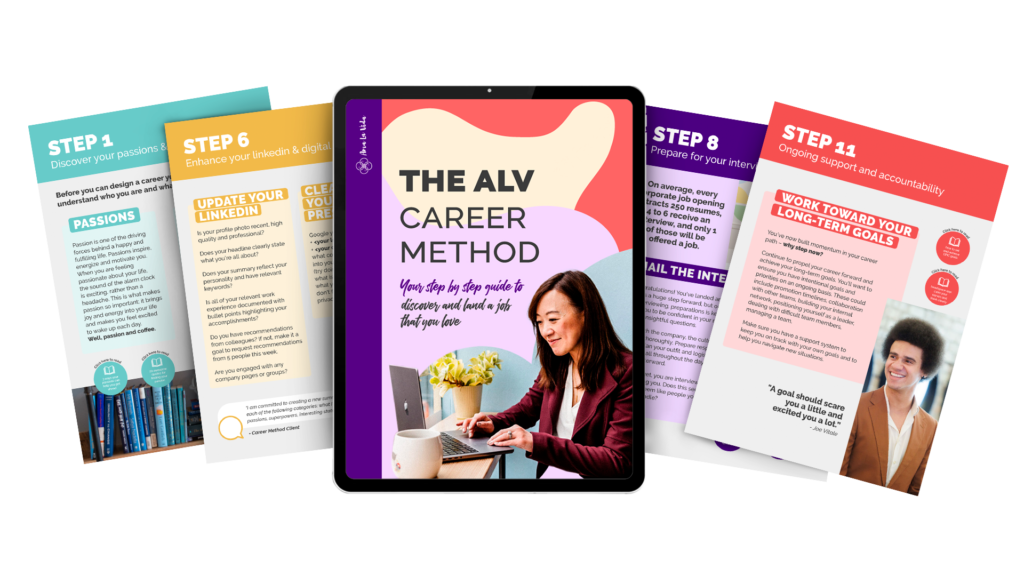
Download our comprehensive step-by-step guide to design and land a job you love!

Images from The ALV Career Method Guide
ALV Method Downloadable Guide

It is insanely difficult to be the go-getter you want to be at work while also prioritizing your family, friends and relationship. Managing your career and relationship can seem impossible! Just ask Andrea from the Devil Wears Prada. Andrea: My personal life is falling apart. Nigel: That’s what happens when you start doing well at work.Let me know when your entire life goes up in smoke, then it’s time for a promotion. I too have first-hand experience navigating these confusing waters. My husband and I are very different. He is risk-averse and financially conservative. He looks for predictability and consistency in his work so he can enjoy his life outside of it. I’m a risk-taker. I’m willing to sacrifice a bit now for a long-term gain. I crave excitement and a dynamic work environment. I’m more than happy to work ridiculously long hours if it’s for something I’m passionate about. Two years ago I quit my corporate job to start Ama La Vida. I walked away from a steady paycheck to make no money for an indefinite time. We were in the process of planning our wedding which really is just a year-long series of financial decisions. Which invitations? Which tablecloths? Do we pay for this or not? These significant life experiences and financial implications all happening at one time certainly caused a lot of friction in our relationship. I was working more than ever, getting paid less than ever and dropping balls at home. I could see that this would all be worth it in the long run, but the math just wasn’t adding up for the hubby. Here’s how we got through it. Managing Your Career and Relationship Talk about it! Don’t let your differences of opinion fester. For you to be able to support one another throughout this trying time, you have to first understand what each other is going through. If you don’t discuss it, you may send the message that you don’t care what your partner is sacrificing, and you also may not get to fully understand how your work commitments are impacting them. Talking things out really helps set the two of you up for success while you are managing your career and relationship. Set Boundaries It’s likely that your partner doesn’t hate your career; they hate the impact your career is having on your relationship. Find out their biggest trigger points and set boundaries around those. Maybe they’re fine with you staying at the office an extra hour or two if it means you won’t take our your phone at home. Make that a rule. Maybe they are less concerned about you working on weekends but want to ensure you still prioritize vacation time and travel. Learn what is most important to them that your job may be interfering with and get creative with how you can prioritize the things that matter most and set boundaries to honor their requests. Discuss the Timeline In the moment, things may feel all-encompassing, but it is important to remember that life will take you through different seasons and chapters, and they are all temporary. Maybe, you agree up front to try out starting a business for two years. Maybe you have determined it is worth it to take on graduate school for three. Or maybe you’re working your tail off to earn a promotion which will be decided in six months. None of these things will last forever, so make sure you remind yourselves and each other of that and ensure you discuss what will happen if the timeline extends or things don’t go according to plan. Remember Your Values (and share them) It may be hard for your partner to understand why the heck you’re even doing this in the first place. My husband values stability. I value adventure and achievement. He would never pursue something in entrepreneurship because it doesn’t align with his values, and yet I have thrust him into this lifestyle. When I tell him why I’m so passionate about the work I’m doing and the people Ama La Vida is serving, he gets it. When he reminds me how he scrimped and saved for decades to set himself up for a stable financial future and retirement, I’m reminded of how hard this is for him. Have open conversations about your values and try to see it from your partner’s perspective. Discuss and Evaluate Your Goals Remember to constantly revisit your goals and ensure they are truly the ones you want to achieve. For example, you could be working your tail off for a promotion, but you realize you don’t even like where the company is headed and actually want to work someplace else. Take some time to pause and reflect and ask yourself if what you’re working toward is truly important to you and what you want your life to be about. Make it a habit of reevaluating your career path and goals at least once per year. Managing your career and relationship is difficult. When you’re giving your absolute all at work the last thing you want to do is be punished for it at home. But don’t forget that this is temporary. You can get through it together, and your relationship will be all the more stronger for it.

Read More

I talk to people all the time who are just starting businesses or are considering it, and one of my top pieces of advice is always to find a great co-founder. I can say with 100% certainty that if I were not working with Foram and Katie and had to build ALV all on my own I would have given up by now. It’s not because I’m not a smart enough or capable enough individual; it’s because starting a business is freaking hard. It requires such a wide variety of skills, but most importantly, it requires unrelenting stamina, both physical and emotional. It’s unfair of me, however, to just say, “Find a great co-founder, and you’ll be fine!” It’s a gross oversimplification of the work that goes into making a healthy co-founding team function (keep in mind, that most of this is applicable to any senior leadership team).  Just like a marriage, we work at it. We constantly evolve it. As icky as it may feel (for me anyway) we talk about our feelings. Here are some of my tips for maintaining a high-functioning, highly supportive co-founding team: Have the tough conversations. Let’s just get this one right out in the open because it’s obvious but also something so many people avoid. It is incredibly rare that major issues just work themselves out. I dare you to find one co-founder who swept a significant issue or disagreement under the rug, and it went away on its own. You spend your life with these people. Your livelihood depends on these people. Issues are amplified, and most of the time if they aren’t addressed they fester. To the point where you can physically feel yourself getting mad when even something tangential to the issue gets brought up. As uncomfortable as it may be, you need to discuss it. At ALV we have quarterly partner meetings where we force ourselves to take a step back from the day-to-day operations and discuss, you guessed it, our partnership. We also talk strategy and goal-setting, but a core objective, one that we never allow to fall off the agenda is to talk about our relationship, what’s working and what’s not. Some things we always discuss: What’s happening in our personal lives which may be relevant to the business (e.g., family planning, financial considerations, moves, health considerations with us or our families). It may feel unnecessary to discuss this stuff, but the reality is these things do impact your energy, your work and your availability. They are things which, if not out in the open, can lead to false assumptions and bitterness. If I know you’re out every Friday because you’re taking care of a sick parent versus throwing back champagne at brunch (though I personally have respect for both), my response to you being out of office will be quite different. We go around in a circle and share what we think each co-founder is doing really well. This is not only a feel-good exercise, but it helps us to identify things we didn’t necessarily know we were strong at or were contributing to the team. It helps us reprioritize for the future. We also share what we think each co-founder can improve upon. When this is offered in this safe, supportive space versus a piece of feedback fired off in the heat of the moment, it is always so much more well-received. Separate from skills and leadership, we also discuss opportunities for improvement from a strictly “what am I doing that’s pissing you off” standpoint. It could be something as simple as “I hate when you misuse this word” to “you’re constantly five minutes late for meetings.” It’s these little things that build into resentment over time. Get ’em out there. Get ’em resolved. What new partnership strategies we need to implement. For example, we recently introduced the act of stating our care factor (1 being not that important and 5 being very important) before voicing an opinion about a decision. We found that we could have a passionate debate for a long time only to find out an hour later that no one was actually all that passionate about the thing we were discussing. We were debating because we had an opinion, not because we cared all that much about the outcome. Our new, simple strategy of saying “I’m a one on this” helps us give more time and energy to the things that actually matter to us and helps us resolve disagreements more easily when it’s clear that one founder cares about that particular thing a lot more than the other. Treat your business with the same professionalism as any other company. It’s easy to slip into this mentality that because it’s your business, you don’t have to be quite so buttoned up. In some ways it’s true. After all, I wear sweatpants to 90% of my meetings (video conferencing is a beautiful thing). Things like timing and location of work, you have a lot more flexibility on. But things like how you show respect to colleagues should be no different. If we have to cancel a meeting or miss a business trip, we send a formal communication to the relevant parties and help them plan coverage. If we want to take a Tuesday off because our spouse has some time off, we do it, but first we circulate the idea with the team to ensure there is nothing that will fall through the cracks. Sure we could all say, “Well technically I’m my own boss so I don’t have to ask permission,” but that’s not the point. The point is to hold one another with the same regard and show the same respect that we would to any other colleague. Find the time and place. You most certainly don’t want to wait for quarterly meetings to provide feedback – timeliness is important for many things. That being said, you always have to remember that your team will pick up on your

Read More

Back when I was working in Corporate Strategy for a digital marketing agency, I was preparing for a meeting with a potential strategic partner. It was that lull before the meeting begins when you awkwardly make small talk. Someone mentioned wanting water and that we should grab some water bottles for our guests. I was the most junior person in the room, so I probably should have been the one to go get them. But I was also the only female in the meeting, on either side of the table. I knew if I went and got those waters that I would be viewed throughout that meeting as the girl who’s there to get stuff. To make sure everyone is taken care of. I wanted to be respected just like everyone else. I wanted my ideas and questions taken seriously. And so I sat there. Didn’t move an inch. Did that thing you do when you don’t want the teacher to call on you, and so you don’t make direct eye contact. My boss went and got the waters.   This may seem like a silly story and like I was way overthinking it. And I may have been. But these are the silly things that we as women have to think about. Will my fetching a few water bottles or the color of my shirt or the shade of my lipstick impact the ability of those around me to respect me for my brain? It’s wrong. It’s so wrong. In fact, it’s complete bullshit. But sadly it is still our reality.   So I walk two tracks in tandem. One track is strategically navigating the corporate world in which we live today. I don’t get the water. I don’t wear hot pink to a meeting with a conservative company just in case that causes their perception of me to subconsciously or consciously be shaped not in my favor. And I advise women around me to do the same. To be cognizant and considerate about the biases that still exist and the tendencies we as women often have which can sometimes decelerate our career trajectory relative to our male counterparts. Being more collaborative in nature, many women give credit to the team in performance reviews and try to avoid coming across conceited. I say brag. When there’s an administrative task to be done which is in no one’s job description, women are often assigned or even volunteer. It’s nice to be nice, but it takes time and energy away from more strategic activities. I say don’t volunteer – at least not more than anyone else. Women tend to shy away from applying for jobs or going for promotions when the job description uses the word “expert.” I’ll bet you are an expert, and if not yet, then you can quickly become one. I say go for it.   The second track I walk is one which doesn’t accommodate the status quo. It’s longer-term. It’s putting myself in a position of influence, so I can continue to fight against the system which is making track one even a thing. It’s putting myself at the head of the table, so even if I get the waters, people know I have every right to be there. It’s building my credibility over time. It’s letting my work speak for itself. It’s doing work which speaks so loudly that there’s no way a conversation about my shirt could even be heard.   Like you, I’m upset that women have to trouble themselves with these things. That I’m even writing a blog post about who fetches water bottles. You may think it’s trivial, and I’d agree. Which is why I’m frustrated. But it’s also why I work every day to put more women in positions of influence. To teach them how to navigate track one so they too can work to eliminate it. Help me. If color of attire gets brought up in a debrief, shut it down. If you’re assigning administrative work, spread it among men and women alike. If you’re at a table full of strong opinions and personalities, pause to see who can’t get a word in. Ask them what they think.   I know we’re moving in the right direction. And I know the more we educate and spread awareness the quicker we’ll get there. So grab yourself a water, stay hydrated, and let’s sprint down track two.  

Read More

I’m now a year into my startup journey, a natural point for review and reflection, and though starting a business has been and continues to be incredibly difficult, the bottom line is I’m happy. I certainly wasn’t miserable in my previous jobs. I had high visibility. Great career trajectory. Amazing friends at the office. The difference is, it felt to me like I was just going through the motions. Like I was working hard day after day but toward something I wasn’t sure how much I really impacted. Or even cared about for that matter. Sure I could afford nice things, and so I’d buy them. And then I’d chat with friends and colleagues, all equally decorated with nice things, and we’d complain again and again about the same stuff. As it turned out, Kate Spade and J Crew weren’t enough to make us happy.  We were an army of well-dressed, highly capable professionals all quickly becoming disillusioned with the life of middle management. My soul craved something more. I had to abandon my post. To me mediocrity is worse than failure. Monotony worse than crisis. I need to feel alive and on a mission. And boy did I set out on one. I left my job and launched Ama La Vida in September of 2016. We are building a business that we hope…know will transform the coaching industry and the way people think about investing in themselves. We are attracting talented coaches from all over the world who are passionate about helping people achieve their own successes and break free from the posts they’ve been scared to leave for far too long. I light up thinking about the future, but I still live in the here and now. We are still tweaking our operations and figuring things out. We certainly aren’t making the big bucks. We have big, bold plans for the future, and so most of our income gets reinvested in the business. I don’t buy nice things anymore. I don’t go to dinner and order the $42 fish. I don’t get pedicures or the new boots at Nordstrom. But I also don’t get sick. I actually get sleep. I get outside in the middle of the day and see the sun. I get excited to face each day’s adventure and challenges. I work on problems I deeply care about, and I get to share my greatest gifts with my team and the world on a daily basis. My toenails have seen better days, but my body, soul and mind are thanking me. I constantly see new studies telling me I’m not alone. That a lot of you are sitting at your desks, wearing and carrying your nice things, but wanting something different. Don’t let your dreams dissolve over time. Don’t let another day go by convincing yourself that your post is your only option. It’s not. You don’t need to be an entrepreneur to be happy or do something as drastic as I did. You just have to do what it is that your soul has been craving. Take the pay cut for the role you really want. Sacrifice a couple month’s salary to go on that trip you’ve been dreaming of. Put up some capital to give your business idea a try. Sacrifice one pair of shoes in your closet to have someone help you figure out what your mission is. I promise you, it’s worth it to feel alive.  

Read More

Congratulations! You landed a job. Maybe you even thought this was going to be your dream job… but it’s turning out not to be at all what you thought you wanted. Don’t worry, you’re definitely not the only one who ends up feeling this way.  The difference between barely surviving the work day to actually thriving is in your control more than you might think.  Of course there are times when it’s just not the right fit, and you may want to consider a program to help you transition to something else. But sometimes you can make some tweaks to your actions and your outlook that will make all the difference. Regardless of whether you ultimately stay or go, here are some things you can do to make that not-so-great job into something awesome! Change your attitude.  You have to want to make the situation better for yourself; it won’t happen on its own.  Recognize it for what it is, but turn your focus toward what you could still get out of the experience by allowing yourself to see it as a building block to your ultimate career. There are a small number of people who magically will land their dream job after college.  For the rest of us, your first job is the probably best option you have at graduation. Not liking it is normal, what you do with it makes the difference!   Step back and evaluate. Chances are you don’t hate everything about the job.  Take a step back, reflect and make a list of specific things you love about the job, things you could learn to like and things you definitely do not like.  What does your list look like? I can guarantee there are some components you do love or want to like, otherwise you would not be here.  When I got out of school, I got a job as an underwriter at an insurance company. Unbeknownst to me it required a lot of sales.  I had done everything I could while job hunting to make sure I didn’t end up in a sales job because I was such an introvert! Instead of giving up,  I did my own reflection.  I realized I loved creative problem solving, analyzing information, making tough risk decisions and helping others.  I also had a really good boss and was in an industry that was recession-proof. Once I focused on the positive aspects, work became a much better place for me.   Find opportunities to do more of what you love.  Tell your manager and co-workers! They can’t read your mind. Talk about what you love and ask them to keep a look-out for projects where you know you will shine.  You never know what comes out of the woodwork when you let others know what you want.  I turned out to be a really good underwriter (minus the sales part) and because of the expertise I developed focusing on what I did well, I was the go-to person my coworkers approached when they were stuck with their work.   Learn more about the things you don’t like. Often times we don’t like something because we don’t understand it or we just don’t know how to do it well.  There will be parts of your job you don’t like, but you’ll have to do anyway.  Again, this is where attitude comes into play.  Why not commit yourself to learn and understand the task when you’re doing it instead of focusing on how much you don’t want to do it.  This is an area where you will grow the most from! I ended up leaving underwriting to pursue a different position that didn’t require sales.  Many years down the road, I was able to finally make the connection that sales was really about relationship building, listening to the customer and understanding their needs.  If I had given myself time and energy to understand more about how sales is about relationships more so than selling things, I would’ve kicked ass! Turns out it’s not much different than leadership coaching.   Relationships, relationships, relationships. No matter your feelings about a job, it is always important to build relationships with the people around you.  They’re the people you spend most of your time with and you never know when you might need them in the future.  Even beyond your everyday job, find ways to meet people outside your area.  I took opportunities to run the recruiting team at my first job and volunteered through work whenever I could.  It gave me the opportunity to take a break from my desk and also meet a variety of people across the company.  I was able to do things like run a workshop with our top human resources executive.  He was responsible for 30,000 employees, yet he knew me by name after that day. I also met people in other functions and it came in handy when I needed to get things done.  Like the guy from finance who was an Excel master.  (Pro-tip: Always find a friend who knows Excel really well.)   Walk-away. You can only try so much and it’s important to be happy at your job.  If you can’t find ways to make it work, you have to be able to walk-away.  Quitting a job is much harder than you think, even when you don’t like it.  When you’re faced with the choice, it could be easy to justify staying.  The fear of the unknown often prevents people from leaving something they’re familiar with. I know this first hand.  I didn’t leave my first job when I should’ve, I stayed an extra 2 years after I knew it wasn’t right anymore.  My last year there was miserable and it affected all areas of my life leading me to depression.  I often ask myself how far I’d be  in my career if I had the courage to leave earlier. And I’m telling you, it’s not worth it to stay where you know you

Read More

If you’re like me, you have a bucket list for everything ! One for career goals, one for new restaurants to, one for places to travel to, and even one for ambitions. My bucket-lists are growing constantly. I’ll hear about some amazing thing from someone and decide, “Woah, I want to do that!”. Whether your bucket list is in your head or written down, we all have things we want to achieve in life. We all want to live a damn good life! In the past, these lists used to get me flustered. I would see a long whirlwind of things I wanted to accomplish, but I was never making any traction. I was getting caught up in the daily hustle of life, focusing on the short-term outcomes instead of my dreams. Constantly I thought, how am I supposed to do ALL this when there are only 24 hours in a day? Well, as a college professor of mine once said, “24 hours a day is all you got. It’s all anyone gets. It’s up to you what you do with them.” My professor taught me the importance of this statement and changed the way I view and use my 24 hours. He talked about the simple act of writing yearly goals. Now I am not talking about New Year’s resolutions. Most New Year’s resolutions are open ended and unquantifiable. For example, “I’m going to get in shape.” or “I’m going to spend more time with my family.”. But, what does “in shape” really mean and how much time is “more time”? According to US News, 80% of New Year’s resolutions are forgotten by February. So, how is my version different? My yearly goals are written, measurable, realistically attainable objectives, and this helps ensure my success. Here’s how I do it: Step 1: Every year, starting the first week of December, I begin a process of self-reflection. Throughout the month, I dedicate time to evaluate my successes and failures and to determine goals for the next. This year, the hierarchical buckets I am focusing on are health and wellness, career, extracurricular passions, and relationships. Step 2: Within each of these buckets, I have formulated realistically attainable, but measurable goals. Some of which include: meditating at least 2 times per week, reading the news for at least 15 minutes a day, traveling to 2 new countries, and reaching out to 1 individual in my network every week. Step 3:  To achieve them, I have devised a variety of creative tactics to ensure success. For example, I signed up for an app, Headspace, which has 10-minute meditating sessions and provides reminder notifications to me on the daily. I added weekly recurring alarms on my phone as a reminder to sync up with someone in my network. I also signed up for Flipboard, a news website, and made the website my home browser so it’s the first thing I see. But, I’m not perfect. Step 4: If I don’t remind myself of my priorities, I know I’ll forget. Since, like many, I live by my calendar, I have scheduled quarterly calendar check-ins to remind myself of my targets and adjust any previously set goals if necessary. Some years, I succeed 100%, other years, I don’t. But for me, setting goals is not about the success rate. It is about utilizing my time and energy to focus on things that matter. It has made me accountable to take actions on all that I say I want to do in life instead of just dreaming and talking about it. And, the satisfaction of achieving a goal gives me motivation to do more. Think about this. When you’re retired, sitting on your porch with a glass of wine, reflecting about life, is your first thought going to be… “I wish I would have…” Or, is it going to be “Damn, I got to live a good life”? I don’t know about you, but I know which one I choose. This is why I set goals. They remind myself to aim my short-term actions towards my version of life’s bigger picture and to live a good, full life!

Read More