Job description sounds good. Check! Salary is a-o-kay. Check! Commute is easy. Check! What more could you want? Take the job! Right? Hold up – let’s pump the brakes. While the role may sound great on paper, the values and culture of the company you are considering will have a significant impact on your job satisfaction, ability to succeed and personal well-being. And yet, values alignment is such an undervalued criterion for most people when selecting a job… if they consider it at all. The difference between a good and bad day at work usually isn’t because your job description changed. Sure sometimes you may work on something you’re more passionate about, but within any given week, where your work remains fairly consistent, you can have extremely good days and extremely bad days based solely on the behavior of those around you. And that behavior is a reflection of professional values. Professional values are more than just the inspiring words written on the office wall, the themes in your employee handbook given to you on day one or the words rattled off by executives in town hall meetings. They are the observable behaviors of your colleagues. Of leadership.  Not just what they say but how they act. They are what drives decision making and Are their behaviors ones you want to be around? Ones you want to emulate? Ones that inspire you to do your best work? Values have the ability to drive culture and behavior so much more than rules. It’s the difference between doing something because you believe in it and doing something because you’re told to. When strong, positive values are instilled at a company, and when those values align with your own, you are highly motivated to work and achieve. The environment brings out your best qualities, and you are excited to work toward the company’s mission. On the flip side, conflicting values can be so damaging that you are unable to work for the company. Perhaps you don’t agree with the way the company treats its customers or the environment. Perhaps the company values achievement so much more than work/life balance that you have to put your family second. Perhaps the company shows no value for innovation and so your new ideas are always turned down. Values alignment is the difference between empowering and suffocating. Between energizing and demoralizing. Between inspiring and unsettling. It is the key factor behind your ability to be proud of where you work. So when you’re interviewing, here are some things to be on the lookout for: What do people wear? How is the office arranged? Where does leadership sit? On their own floor, in offices, with the staff? What does the energy feel like? What time are people coming and going? How many people are in meetings versus working independently? What are people’s emotions as they exit meetings? What kind of amenities does the office have? What type of equipment do people have on their desks? How are your interviewers and the employees treating each other? And here are some things to directly ask in an interview: What are the company’s values? And what are some examples of how those values show up? How would you describe the culture here? What are the characteristics of people who typically succeed here? How is performance evaluated? What behaviors get rewarded? How are promotions determined? What do you like most or dislike most about working here? When it comes to our happiness and motivation, the way we do work is often much more important than what we do.  When you’re interviewing a company, you may have to read between the lines. Study the behavior more than the words. Seek out companies which promote values that align with your own. When it’s a match, you’ll be on the fast-track. When it’s not, it likely won’t be long before you’re on the hunt for a new job again.

Read More

I, like many others I know, have a tendency to want what I don’t already have. Not necessarily in material goods, but in attributes and skills. When I moved to the US at a young age, I noticed the increased level of creativity my fellow classmates exhibited. They seemed so skilled at creating beautiful art and making cool crafts. I could never get my art to look like theirs. I didn’t have the same extraordinary imagination, the eye for colors, the technique to paint (inside) the lines. While I tried and tried, but I was barely mediocre. I would get frustrated that I couldn’t do what the other kids could. I questioned myself and my abilities – why am I not as good? After all, society and people often give you feedback on what you need to be better at, not what you’re already good at. I invested all of my energy and time into practicing and trying to be better, but that only frustrated me more. I would get upset and feel crappy that I wasn’t as good as the other kids. After observing my habits for years, my dad (who continues to be a big influence and my coach in life) sits with me and says:  “You have your weaknesses and you have your strengths. While you need to improve your weaknesses, don’t spend your life trying to make up for them. Do something that uses your strengths and people will recognize you and you’ll be happier.“ He was right. No matter how hard I try, I will never be Picasso. Nor will I be anything close to my talented classmates. It just isn’t my thing. I find that when we only focus on our weaknesses and ignore our gifts, we start losing confidence and feel more frustrated – I see this almost daily with my clients. What Are Your Strengths? As a coach, the majority of my conversations with clients start with them saying, “Here are all of the things I need to work on.” They then give me a plethora of things they want to work on. And while that’s great self awareness and dedication to improve, I respond back with, “Tell me about your strengths. What are they?” This catches my clients off guard.  They respond with uncertainty and hesitation, eventually providing me a list with a few strengths.  This list is typically half of the size of the things they want to improve on. I encourage my clients to flush out their strengths and once we have a comprehensive list of both strengths and weaknesses, we discuss how they can use those strengths to work on the things that need improving. For example, I recently had a client who wanted to be more assertive. This client identified empathy as a big strength, which led us to set strategies on how to be assertive while using empathy. She became particularly skilled at being assertive when needed while making sure it was done in a way that made the recipient feel heard and respected. Where Is Your Energy? In life – at work, at home – we all need to work on the things that we’re not good at. There’s no denying that. I often hear from clients that they need to be better with having difficult conversations. That’s a critical skill to have at work and outside of work and you should absolutely have the skills to have those difficult conversations. The problem I encounter is when all of the energy and effort is put into making the weakness a strength. You can work months and months on being able to have a difficult conversation; you do it so it’s not a detriment to you and your work and personal life. At the end of it, most likely, you’re not going to transform into the expert in having difficult conversations. Realistically, it might still be uncomfortable for you but manageable and no longer a detriment to you and your development. But all this time, what happened to your strengths? They were put on the backburner while you focused only on your weaknesses. Embrace Yourself: Be More Of Who You Are Now think Sheryl Sandberg. What comes to mind? Probably her remarkable book Lean In, her leadership at Facebook and her advocacy to build resilience and support women. Rightfully so – you recognized her for what she’s known for. One of Sheryl’s greatest strengths is being authentic. She embraces her strengths and she acknowledges her weaknesses. What if Sheryl spent all of her time working on her weaknesses? What if she didn’t use her strength of being authentic and speaking out against gender bias? If Sheryl Sandberg did not embrace her gift for being authentic and standing up for what she believes in, I’m not sure if Lean In would have been published. I’m not sure if the movement she created would exist. Sheryl Sandberg spent more time on her strengths rather than only focusing on her weaknesses and this contributed to the impact she has today. Often times I tell my clients to think of strengths as a muscle. You have to keep working it out so that it gets stronger and more defined. The more time and effort you can put into your strengths, defining it and refining it, the more you will be happier, confident and successful. After all, your strengths are what make you unique. Your strengths give you recognition. They make you more confident. We all know what Sheryl Sandberg is known for. What are you known for? “You cannot be anything you want to be – but you can be a whole lot more of who you already are.” ― Tom Rath

Read More

How (and Why) to Recruit Millennials for Your Small Business. Foram shares her insights in a recent article published by NCR Silver.  NCR Silver is a point of sale system that hosts a blog called “Small Business Smarts” that has features on business tech, employee relations, growing your business, running a business, managing money and more. Read the full article here.  

Read More

Everyone has big dreams. Some bury theirs deeper than others. Deep down under a lifetime of experiences telling them their dreams aren’t possible. Some days the dreamer in you might take over and think, “Wouldn’t it be incredible if…,” but you shut it down right away before that dream can even manifest itself into a goal. You discredit it as crazy and unrealistic in an effort of self-preservation, so you’re not disappointed if it does not come to fruition. You force yourself to forget about the incredible and return to the “good enough.” Henry Miller once wrote, “One of the reasons why so few of us ever act, instead of react, is because we are continually stifling our deepest impulses.” He questioned, “Why are we so full of restraint? Why do we not give in all directions? Is it fear of losing ourselves? Until we do lose ourselves there is no hope of finding ourselves.” Fear is a powerful motivator. It is scary to make a change or pursue a dream. Allowing our dreamer to be heard by the world makes us vulnerable. For she is a reflection of our truest self, the one without a restraint-driven façade. When we finally let go and allow ourselves to get lost in the dream, that is when we really start to create something special. Life often has a dilution effect on dreams. When we were younger we let the dreamer have a voice. We’d say, “I want to be president.” Or “I want to be a famous artist.” Or “I want to be an inventor.” But societal pressures take over, and we are taught to believe that the dreamer in us is not the voice of brilliance but rather the voice of irresponsibility. And this leads us to settling for a watered down version of our vision. But what if we gave our dreamer a platform? What if we let her speak? What would our lives look like? After years of silencing my dreamer, I decided to give her a mic. I quit my well-paying job and my upward career trajectory to start back at the bottom, building my own business from nothing more than an idea. The journey has not been easy, but it has been oh so worth it. Every day now feels like I’m adventuring around my own personal playground. Sure, sometimes I still fall and skin my knee, but I get right back up and swirl around a colorful slide with a big ole smile on my face. It’s my playground. And I’ve built it to have all the things I want in it. I’m no longer going down the same straight metal slide over and over again in some public park. Sure, leaving the comfort of a slide already built and a consistent ride was scary, but for me the thought of going down that same metal slide for 30 or 40 more years was even scarier. There’s a recipe for building the life you want which I tapped into to craft my ideal workday. I have to be passionate about what I’m doing. I have to read about my industry out of choice, not obligation. Because I’m so passionate about my work, I don’t struggle to find motivation to work but rather struggle to keep boundaries in place for when to shut down. I have to be utilizing my unique skills, the things which make me shine, feel valued, feel accomplished. I have to work in an environment which aligns with my values. For me, I need an organizational culture which fosters innovation, demands authenticity, celebrates humor.  And I have to know that more days than not, my work is directly correlated with my personal purpose, what I want my life to be about and how I want to make an impact on this world. Now that I have built a life where I am following my passion, engaging my skills, honoring my values, and living my purpose, I sleep better. I laugh more. I care more. I show up more. I’m more the person I want to be because I’m living the life I want to live. You don’t need to quit your job to do this. You just need to start listening to that little voice you’ve told to “shh” for so long. You need to muster the courage. And then, you need to get building. I don’t want your dreams to be diluted versions of what they once were. I want to help you make them potent. Palpable. Unable to be ignored. I don’t want you to succumb to practicality instead of passion. Not anymore. Let’s let your dreamer sing. Let’s entertain the what if’s. Because when you build them into reality, and you will, it sure is incredible.  

Read More

These days, when you run into a friend on the street and ask them how they are, the answer is rarely “good.”  The answer is more often “busy.” We live in a society addicted to busyness. Some of it may be real, but a lot of it is self-created. With so much external stimulus, we have become prone to creating hectic lifestyles to avoid any kind of real thought or contemplation. We have a fear of what “non-busy” even looks like. What? To be left with our own thoughts? This has become many people’s worst nightmare. Unfortunately, however, our addiction to busyness has come at a huge cost – our health. We have to break your addiction to busy! The most obvious and significant consequence of our constant busyness is stress. Stress not only has serious implications for our mental health but also can dangerously affect our physical health, upsetting our immune system, digestive system and cardiovascular system.  But perhaps just as bad as the consequence of stress is the regret of a life less lived.  I work day everyday with “busy” professionals, and I see first-hand how many of us have become so busy making a living, that they have forgotten to make a life.  The ability to set priorities, set boundaries and say “no” is crucial to overcoming our addiction to busy, improving our health and creating a life that we are truly proud of.  Here are some of the ways I help my clients achieve these things: Know Your Values Values are a grossly underestimated tool in decision making and prioritization.  Often when we make life decisions, we write out long lists of pros and cons.  When we prioritize, we consider factors such as urgency and importance.  But how often do we take a step back and ask ourselves how these life decisions and priorities actually align with who we are and what is important to us?   From my experience with coaching individuals, these questions rarely come up. However, this disconnect between how we live and what we value is one of the deepest sources of anxiety and inner turmoil.  Once we take the time and invest the energy into really defining our core values, and then sorting them in order of importance, we unlock a huge opportunity for greater clarity, confidence and significantly reduced anxiety.  For example, if “family” is your top value, and a weekend work call conflicts with your daughter’s graduation, the decision becomes far easier. There is no longer anxiety about which to accept and which to turn down because it is clear which of these engagements better aligns to your core values. When we live in alliance with our values, it is amazing how much lighter we feel. When we live in alliance with our values, it’s so much easier to break the addiction to busy.  So next time you need to make an important decision, try ditching the pros and cons list and instead draw a hierarchy of your core values.  Explore them, define them and then use them as your compass. Embrace the Space Between Stimulus and Response Another implication of our crazy busy world is that we are scared of silence: verbal and mental.  We are scared to stop or to pause. We are scared to take a moment where we actually just reflect, because if we are not speaking or doing then we no longer appear “busy.” As a result, we strive to fill every second. In doing so, we eliminate an extremely valuable gap between what happens to us and how we respond.  What if we were able to use that gap? When we effectively use the space between stimulus and response, we take back the wheel as driver – we no longer let the tides and currents direct our life, but we own the decisions that we make (and don’t make).  Next time you are in a situation – perhaps you are asked to do take on another project or to join a friend for work drinks. Before you immediately say “yes,” try pausing. Try using the gap between stimulus and response to ask yourself if it is really want you want or can realistically take on. If it is not, simply say “no.”  And don’t say “no” timidly. You are in front of the wheel… own your direction! Which brings me to my next point: Own It Many of us are scared of saying no. Perhaps we feel like we are letting people down. Perhaps we feel like we are inadequate if we can’t do it.  However, the truth is the most admirable and respectable leaders of all time are the ones that are able to say “no,” the ones that know their limits and their boundaries.  It is a sign of strength not weakness to be able to say no. It is also a sign of self respect.  And, in the long run, you will let more people down by saying yes to everyone than you will by carefully choosing your commitments. Why? Because when we always say yes, we do a little bit of everything and a lot of nothing.  This not only affects our mental health – we feel stressed, guilty, overwhelmed – but it also affects other people who do not get your full attention or presence. When we commit to fewer things, we are able to truly invest in them – mentally and physically – and from this, everybody wins.  Seneca once said that, “No one pursuit can be successfully followed by a man who is preoccupied by many things.” We must remember that learning to say “no” to less important commitments opens our life to pursue more important things.  So set your prioritizes, set your boundaries and when you decide to say no – break the addiction to busy and own it! Remember that you are not disrespecting other people’s needs, but instead, you are respecting your own. Prioritize Prioritization Prioritization pops up in almost every personal and professional development article we see.  And

Read More

The job search and interview process is not fun. Let’s call a spade a spade. In fact, it can be downright miserable. Not only are you hyper-conscious of your empty wallet, you’re putting yourself in a constant position of being evaluated, judged and critiqued. And when things don’t go as planned and you get passed over for whatever reason, it can be a big blow to your self-confidence. It’s difficult not to take the outcome personally, and you may start to question your abilities and potentially your decision to make a career change or pursue this career path. When you’re feeling like you’re ready to just throw in the towel, here are some tips to boost your morale and get you back on track toward landing that next job: Use the time to reflect – are you being intentional about your search? Sometimes when we are unhappy in a job or lose our position, we’re in a mad dash to get a new one and try to find something similar to our last role or “good enough.” ALV Coach and Co-founder Katie Bennett says, “When we’re looking for work, we tend to look for all of the opportunities available and then apply for as many as possible. When we approach the application process this way, we are less intentional about what we are looking for. We throw mud everywhere just to see what sticks. Instead, I encourage clients to reverse the traditional application process.  First decide what role or what company you want to work for. Don’t even look at the job boards yet. Just decide what you want. Next, research your top ten organizations with roles in the relevant area. Really study and understand each organization – their background, their competitive advantage, the projects they’re working on and so on. Next, find the relevant person at the organization to reach out to.” Being intentional about your search will not only increase your likelihood of finding a position you love, it will make your case stronger as an applicant as your passion and intention for this company and role will shine through. Get creative We often get stuck in a confined way of thinking based on how we think the job search process is supposed to go. Submit resume. Get interview. Go on interview. Get job offer. And while that process may be pretty typical when securing your first job out of college, the process becomes a lot less standardized as you continue through your career. Very rarely, in fact, does the process look exactly like that. You may need to make a personal connection, attend an event, cold call, utilize LinkedIn to get an introduction to the company. Depending on your industry, you may want to assemble a portfolio, build a personal website, share samples of your work to demonstrate your skills and qualifications. Very rarely, if ever, does being over-prepared or overcommitted work against you. Think outside the box about how you can both get your foot in the door and stand out from the competition. Make the process your own. Use your network You may be sick of sending your resume off into the digital void with no sense of whether or not a human ever takes a look at it. Personal connections and referrals are the most effective way to get an interview. So make sure you are sharing your interests and goals with your friends and family to see if they know anyone who may be able to support your pursuit. That being said, you do not necessarily need to know the person intimately to get a referral. Remember, recruiting is an expensive process, and the company wants to fill vacant positions with qualified candidates as soon as possible. If you are able to make a genuine connection with someone at your target company and can demonstrate your sincere interest in the role and your qualifications for the position, you are doing them as much of a favor as they are doing for you (and they may even get a referral bonus if you land the job!). Utilize LinkedIn to see if you have connections at the company or if you are connected with someone who does, and ask for an intro. Check out your target company’s website and social media accounts to see if they have any upcoming events you can attend. Think about industry events or conferences they may be involved with. If and when you do meet someone there, they will respect your drive and proactivity. Remember your gifts You are uniquely gifted, and you bring something special and valuable to the table. Reconnect with the things you tend to get complimented for, the things you have excelled at in the past, the things that come naturally to you, the things people come to you for help on, the things that you do differently. Dig deep and you are sure to remember something, if not many things, that you do well. Remind yourself that no job interview will take that away from you. And be sure in your next one to call out these gifts. Incorporate them into your responses and anecdotes. Your confidence will naturally begin to show through, and your stories will be compelling because they are unique to you. If you are still struggling to identify and articulate your gifts, enlist the support of a career coach or explore our online career program to get a clear picture of what makes you unique and valuable to an employer. Do the ALV 999 If you’ve been searching for a job for weeks or months, it may feel like an eternity. This is probably exacerbated by my previous point about the process being an unpleasant one. Take a look at the big picture and how small this time is when compared with your whole life. Do the ALV 999. Think, will this job search frustration matter 9 minutes from now (likely yes), 9 months from now (probably not), 9 years

Read More

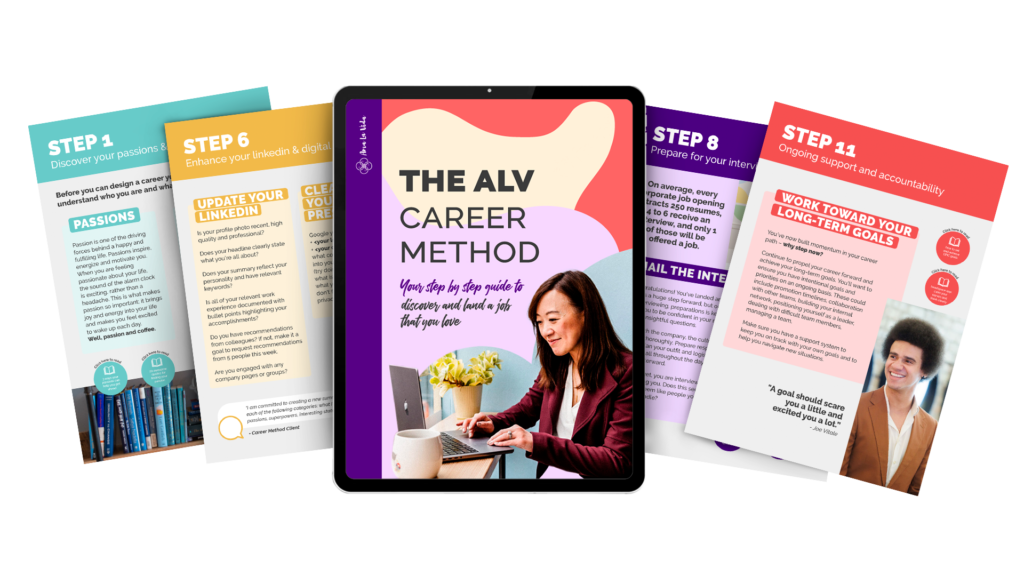
Download our comprehensive step-by-step guide to design and land a job you love!

Images from The ALV Career Method Guide
ALV Method Downloadable Guide

Houston is a trainer, speaker and kindness advocate. He travels the country speaking to schools and organizations about creating lives filled with compassion, character, purpose, and love. We were honored to pick Houston’s brain about what kindness means and how we can better practice it in our everyday lives.  Houston’s insights were profound and inspirational. Enjoy!

Read More

This month our ALV theme is Kindness. It’s a theme that really excites me because it’s one that I’m very passionate about. Personally, I have a lot of room to grow when it comes to kindness… but when I have demonstrated kindness in my life, I have found that the impact has been just as beneficial – if not more – for me as the giver as it was for the receiver. Kindness is in our nature, but sometimes in the busyness and craziness of everyday life, it is forced to take a back seat as we struggle to find time to eat lunch let alone check-in on a friend or buy flowers for our spouse on the way home.  Beyond just being an admirable character strength, kindness is incredibly good for our well-being, and if we can go out of our way to find an organic cafe or make time to go to the gym, then I’m sure we can find time to be kind. And let’s be honest… it really doesn’t take much!  Compliment a stranger, smile at the bus driver, carry an elderly lady’s groceries across the road. Kindness comes in all shapes and sizes, and sometimes the biggest impact can come from the smallest gestures. How do you demonstrate kindness in your everyday life? Truly think about it.  Just like brushing our teeth or driving a car, kindness becomes a habit that we can nurture and develop.  And as you do, you might start to notice these five things happen: You feel happier Kindness stimulates the production of serotonin in our brains (the same chemical targeted by anti-depressants) and helps us calm down and feel happy. The best part is that this is true for the giver, the receiver and everyone who witnesses it. Beyond serotonin, kindness also releases endorphins which is the same chemical released when we eat a delicious block of chocolate. So next time you’re reaching for a snickers, do something kind instead 😉 You feel healthier Kindness also releases the hormone oxytocin (also know as the “cuddle hormone” which plays a significant role in the cardiovascular system). Oxytocin causes the release of nitric oxide in blood vessels which makes them dilate which reduces blood pressure. Oxytocin also makes you feel calm, generous, trusting and strengthens the immune system! You becomes more attractive A new study by Yan Zhang and colleagues assigned participants to three groups and had them rate 60 photographs of unfamiliar female faces, all with neutral expressions. There was no significant difference in rating among the three groups. After two weeks, the participants rated the same pictures again, but this time one group of participants were given positive personality descriptors of the people in the photographs, another group was given negative descriptors, and the third was given no information at all. The group that had been given the positive personality descriptors rated the photographs as more attractive and those that had been given negative personality descriptors gave the lowest ratings to the photographs highlighting that kindness really does make us more attractive. You age slower Aging is caused by many things, but two main culprits are free radicals and inflammation. Well, you know that oxytocin hormone we were just talking about? Well it also reduces inflammation and levels of free radicals, thus slowing down two of the key drivers of aging. You begin to see kindness all around you Kindness is not only healthy, it’s contagious! More contagious than the flu! As mentioned earlier, kindness stimulates the production of serotonin in our brains and helps us calm down and feel happy. The best part is that this is true for the giver, the receiver and everyone who witnesses it. Just think about it… how do you feel when you see someone pick up a bill a stranger dropped, or help an elderly person onto the bus. It warms your heart right? Makes you want to go out there and be kind too! Or when someone does something kind for you? Makes you want to reciprocate, true? The more we demonstrate kindness, the more others show kindness too…. and while we can’t guarantee the whole world will get kinder overnight, we feel pretty confident that at least your world certainly will! So then… what are you waiting for? And if you’re not sure how to be kind, here are 102 awesome ideas to spread kindness. One of my personal favorites is this awesome movement by moreloveletters where you can write and send love letters to strangers who are lonely or going through difficulty. Check out their site and send a love letter today. And if you’re looking for more awesome tips, tools and kindness challenges, join our family by becoming an ALV member. They say that a single ripple of kindness can go on to create a large wave… let’s go and make some ripples! Katie Want more from Ama La Vida? Sign up for our newsletter 🙂 And before you go, if you can spare three minutes, this short video will certainly warm up your heart.

Read More

Have you ever walked into your colleague’s office looking for that very important time sensitive document only to find yourself in front of piles and piles of documents and scattered food remains? Imagine it – what’s going through your head? If you’re anything like me, you’re feeling anxious, stressed out about meeting your deadline, frustrated, and you curse out your colleague. How can he be so messy?! Now let’s imagine another scenario. You walk into your colleague’s office looking for that very important time sensitive document. You see the shelf with labeled binders and folders. You quickly search for the folder name, retrieve the document – find other documents that might help – and rush over to your desk to complete your task. How are you feeling now? What are you thinking? Besides the obvious of an organized workplace allowing for quick retrieval of documents, there are several physical and mental benefits, such as: It compartmentalizes your work. Consider our example above with an organized office – the document was quickly found because it was in its rightful, clearly labeled folder. And there were additional supporting documents that were not even considered before, which turned out to be helpful. Organizing your office/desk/cubicle helps separate the clutter of the many simultaneous deadlines, projects, and clients, allowing us to focus on the specific client or project at hand. It reduces stress. The physical appearance of clutter brings about anxiety, therefore leading to stress, a sense of feeling overwhelmed and frustrated. An organized workplace allows for quick retrieval of the right document at the right time not only for yourself but for others in the office such as coworkers, bosses and clients. It shows you care. You don’t ever walk into the office with disheveled hair. Why not? You don’t want to look sloppy and of course you want to show off your beautiful hair. Your physical workplace is a reflection of you. And others form perceptions of you based on your workplace. An organized workplace shows pride, loyalty, a sense of caring and responsibility. Next time you contemplate whether or not you want to organize your workplace, think about that one person in the office who is always dressed immaculately. Either you hate this person for being so damn put together or you’re this person. Either way – people know you care about yourself, how you look, and you seem very polished. And that’s just an outfit. Imagine what people may perceive when the workplace is organized. It saves time. You had your Friday outfit all planned on Thursday night. You wake up Friday morning and walk over to your closet for that new shirt. You can’t find it. You frantically start looking everywhere and you still don’t find it. You then go through the 5 stages of grief – you even negotiate to skip happy hour to find that top but you still don’t find it. You’re left with no choice and you pick another outfit, ruining your whole day. Pretty rough day, huh? Similarly, with an organized workplace, you’ll find things more quickly, you feel less frustration, and you’ll find yourself saving time that would have otherwise been wasted looking for that lost document. Tip 1: Organize your digital life I remember an instance where I needed to create a deliverable for a client. I had done something very similar at a previous project so I search my laptop, my emails and of course I couldn’t find it. I spent three hours putting together a document that I had already done before. I was so irritated. This is when I got my butt into gear and decided to organize my files. Take a look at your desktop right now. Do you have files covering every inch of your screen? Do you struggle to find documents or have short term memory like me and don’t remember where you saved something? This can be fixed by organizing your digital life. Here’s how: Step 1: Categorize all projects and recurring actions Think about your day yesterday. What were you doing? How did you spend your time? You may be involved in several projects, some internal initiatives, and you have to submit time and expenses. For all recurring projects and activities, create folders with clear labels for easy access. Step 2: Create a filing system For any emails or documents pertaining to a category created, be sure to file only under that folder. This organized system will help you review documents at a glance, put together summaries or refresh your memory when you need it. This filing system will save you time, energy and chaos of seeing 291293 emails in your inbox, leaving you with only the very important follow up emails in your inbox and space on your screensaver for those very cute golden retrievers. Step 3: Have a consistent naming convention I can’t stress this one enough. There will be times that you forget where you stored that document. By labeling your documents the same way every time, it also avoids any version control issues. My suggestion for naming convention is this: TOPIC_TITLE_ _DATE_VERSION. Having a version such as draft_v2 will prevent you (hopefully) from working on draft_v1 – an outdated draft. Trust me, this may happen when you’re working late nights so avoid the hassle by being diligent about your naming convention. Doing this will not only save you HOURS of time from having to reinvent the wheel but it will also save you a lot of frustration and stress. You’ll also look like the hero when you respond to an email right away because you were able to find the exact information you needed. Not to mention, the next time your boss asks for a document while hovering over you, you can get it to him immediately so he backs off, allowing you to do more important work, like stalking your ex on Facebook. Tip 2:  Organize your to-do list: When you walk into the office in the morning,

Read More

Our 9 hottest tips for how to achieve your goals and take charge of the year ahead   Our ALV theme in January was “Take Charge” – a very fitting theme for the beginning of the New Year. Research shows that 92% of people do not achieve their goals, which is a shame because research also shows that people who set and achieve goals are a lot more productive and successful! So how do you make that happen? Don’t worry, we’ve done the hard work for you. During the month, we conducted vigorous research and spoke to experts in the field in order to find the most valuable tips, advice and insights. We also conducted our very first ALV community call where we spoke with our members and heard from our coaches about what does and doesn’t work when setting and achieving goals. So without further adieu… here are our 9 key take-aways to help you achieve your goals and take charge of your future! Start with “Why?” Most of the time when we set our goals, we start with “what” and we then quickly move to “how.” While these two steps are crucial, they can easily become misguided unless we first ask ourselves, “Why?” “Why do I want to achieve this?” This question serves two purposes: Firstly, it ensures that we are working on the right things. Secondly it emotionally connects us to the goal.Let’s use an example. Say I set a goal to “Get a Promotion.” Next I ask myself why I want a promotion. After thinking carefully about this, I discover that the reason I want a promotion is because I want to feel more accomplished at work. Now, because I understand the “why” I can ensure that my steps to achieve this goal include things that will help me feel this way – such as working on more meaningful projects, seeing my work become implemented and so on. I can even speak to my manager about these things. If I had not determined the “why”, I may have tirelessly lobbied to get a title-change only to realize that the nature of my work had not changed and I still felt the same emptiness and lack of accomplishment, rendering the goal somewhat useless. Furthermore, now that I understand the “why,” the goal has far more emotional significance, making me feel more inspired, motivated and connected to the goal. Make sure your goal is EPIC EPIC is a set of criteria we use at Ama La Vida to ensure goals are effective and powerful. It stands for: Elevating, Practical, Impactful and Clear. Let’s start with Elevating. Is the goal going to inspire and elevate you? If not, chances are you’re going to lose motivation. Ensure the goal is one that you are genuinely excited about. If it’s not, how can you adjust the goal? Next, ensure that you can practically achieve the goal within your desired time frame. Here at Ama La Vida, we are all for ambitious goals, but if you set something so ambitious that it is impractical, then chances are that you will end up feeling like a defeated failure. Try to ensure your goal is stretching, but not so stretching that it becomes unrealistic. “I” is for impactful. Is the goal going to positively impact your life? If not, then what is the point? Make sure you set a goal that, when achieved, will have positively and powerfully transformed your life in that area. And finally, make sure your goal is Clear. This is an obvious one but one that we often neglect. Obviously a deadline and time frame is important, but it is also important to have a measurable component so that you know when you have achieved your goal. This measurable component doesn’t have to be a number necessarily, but it should help you identify when the goal is completed. For instance, if you want to improve work life balance, maybe the measurable component is that you stop checking emails in the evenings and on weekends. I recommend investing considerable time and energy into setting the right goal. There’s no point getting on the fastest train to the wrong destination. Set a Buzz Word As human beings, emotions are our greatest drivers (and detractors) from achieving (or not achieving) a goal. So then, it is important that we stay emotionally connected to a goal as this helps maintain our passion and motivation. One way to do this is by setting a “buzz word.” Think about why you want to achieve that goal and how you will feel when you have achieved it. Close your eyes and imagine yourself having accomplished your goal – what are you feeling? What one word best encapsulates this feeling? This is your buzz word! Write it on post-it notes and put it around your house, set reminders in your phone, make it a sceen-saver on your laptop. Whenever you see this buzz word, you will not only remember to keep working on your goal, but you will also reconnect with why this goal is important to you which will internally incentivize you to keep on going! The Less the Merrier Most things in life abide by the rule “the more the merrier” – people, chocolates, handbags and so on. But when it comes to goals, the reverse is true. When we set too many goals for ourselves, we lose focus and become overwhelmed by everything that needs to be achieved. I recommend setting roughly one goal for every twelve weeks. Twelve weeks is a nice sweet spot because it’s not so far away that we procrastinate and defer getting started, but it’s still far away enough to achieve something meaningful. Of course, you need to set a time frame that is appropriate for your specific goal, but the key is to ensure you are only working on one or two (maximum three) goals at any given time. Bite Sized Pieces Research shows that one of the biggest

Read More

Our theme this month is productivity. I haven’t written a post in so long and so I really wanted to ensure that I wrote something this month. But when it came to the time, I felt incredibly reluctant and resistant. Why? Because, to be honest, the topic of productivity makes me want to fall asleep. Ask me to write about positive psychology, emotional intelligence, resilience, grief, joy. Any of these things and I will feel genuinely excited. But productivity and being productive? Really? How am I meant to write something engaging about productivity? Hear me out. I am certainly not saying that productivity is not important. Boy is it important! I don’t get excited about brushing my teeth every day either, but hey, that doesn’t mean it’s not important. Nevertheless, in the process of not wanting to write about productivity, I actually learned something very important about productivity: Productivity is fueled by passion When I think about the days I’m most productive, it is always when I’m feeling passionate. When I actually want to work on that thing. We often seek out fancy apps and systems to make us more productive, but I think the answer can at times be a little simpler. Find passion. When I am working on something I don’t connect to, I could try every single app and system under the sun, and I still wouldn’t be productive. On the flip side, when I am working on things I love, I actually don’t need any tools or apps at all. I just get shit done and I get it done well because I actually want to. As we know, motivation is a huge driver of productivity, and it makes sense that passion is a huge driver of motivation. So then, what are you passionate about? How can you make your tasks and projects more about these things? If you’re lying on the couch eating potato chips and feeling unproductive because you don’t want to go to the gym, perhaps it’s time to try a dance class or soccer team instead? We often assume that we need to tick certain boxes without thinking about alternative ways to get to the same outcome. How can you find a more fun and passionate way to arrive at your destination? Five Tips For Being Productive Ok, so right now you’re probably thinking “well that’s great Katie, but what about when I have to do shit that there’s simply no way of sugar coating?” And yes, I get it, that’s a fair point! We can’t be passionate about everything on our to-do list, and so these are my tips for you. Work less intensively and more intentionally Science has shown that breaking your workload down into 90 minute work segments followed by 20 minute break segments is far more effective than tirelessly trying to stay focused throughout the whole day. Of course, the timing doesn’t have to be exact, but you get the point. Work, then break, work then break, work then break. The breaks allow us to recharge and provide us with the fuel we need to tackle the next task or project. This method also allows us to stay focused on important things throughout the day, rather than starting fast and strong, then depleting all of our mental energy and spending the afternoon hiding behind a screen pretending to do work. C’mon, we’ve all been there. Just get started! Not tomorrow or next week, today. Just get started! Science has shown that when we think of a task or a project that we have to get done, we think about the most challenging parts of that project and we get completely overwhelmed which prevents us from taking the first step. Instead, we do meaningless “work” like check emails and run errands to make us feel like we’re busy. But something amazing happens once we get started and it’s called “The Zeigarnik Effect.” The zeigarnik effect is what happens when we’ve started something that we haven’t finished – it makes us feel a little anxious and distressed and so compels us to finish what we started. Long story short, get started! Get Creative!! Sometimes we think we can’t find passion in certain thing, but really? So what if your passion is music and your task is our taxes. Can you blast your favorite tunes while doing your taxes? Or reward yourself with a two hour jam session when you’re done? How can you creatively try to link your passions to the stuff you need to get done? Stop Multitasking The logic behind it makes sense. I could call my husband while making my presentation, or I could call my husband and then make my presentation. Duh. If I do them both at the same time, I am finished quicker right? Wrong. Science has shown over and over again that trying to do more than one task at a time (particularly complex tasks) takes a huge toll on productivity. The brain was simply not designed to multi-task and trying to force it actually makes us slower and more prone to mistakes. So the key is prioritize rather than multitask – figure out which task or project is more important and urgent and then focus on just that. Three words: Bite. Sized. Pieces This is something I use all the time with my clients. First we set the big, stretching crazy goals, and then we break the big goal down into mini goals. Breaking projects and tasks down into bite size pieces achieves two things. Firstly, it makes the project far less daunting. Instead of seeing only where you are now, and comparing it to that distant vision of where you want to be, all you have to do is look to the next step – the next bite size piece. The next bite seems a lot manageable and makes us feel more compelled to get going. Secondly, the actual process of breaking down the project forces us to think carefully about the

Read More

Well, I’m doing it. I’m actually going to write down the words: I am a different person after having a baby. I want to have a career. I want to be a physically (and mentally) present wife and mom. I want to do things for me. I want my son to look up to me. I want MORE……PHEW! That was hard. Wanting more once you’re a mom, and actually saying out loud that you want more – and acting on that, are very different things. When I came back to work after 10 months of maternity leave, I admit that I was VERY conflicted. I wasn’t ready to leave my baby, but at the same time, I was (SO) ready to be among adults again. I was ready to use my brain in a different way again and I was ready to be needed in a different way again. What I didn’t see coming was just how different I would be once I did come back to work. My priorities are different. The way I approach my team is different. The way I think is different. The way I work is different. I am not the same person anymore, and that simple term that I used to love, Team Queen, hit me like a TON OF BRICKS. After 4 months of floundering and trying to “rediscover my work self,” I have realized that I forgot about the very premise of my “Queen of My Success” blog! Define what success means to you. Remember that it’s okay to have varying definitions of success because it’s your success. I want a career. I want to grow personally and professionally – for me. BUT I also want to grow for my family. I want my son to believe that you can get what you are looking for in life if you work hard, and if you believe in yourself. I want to lead by example for him. So that he not only believes it, but so that he also knows it. Okay so now that that is sorted out, all I have to do is figure out what success means to me now that I’m a mom – easy, right? Ummm, not so easy. I will say that while I haven’t figured out my complete definition of success, I have started with my non-negotiables. I’m starting with working through the answer of the type of lifestyle I am looking for, and then using that to define where I want to go both personally and professionally. Because life is different for me now, I need to approach defining what success means for me in a different way. As much as I wish I had realized this fact 4 months ago, I believe that I had to go through this adjustment period (a.k.a. “the floundering period”) in order to best define (and believe) my non-negotiables: I want to have a career. I want to be a physically (and mentally) present wife and mom. I want to do things for me. I want my son to look up to me. Before I close, I thought it would be important…No – critical for me to say that these 3 paragraphs have taken me over a month to write. Not because I didn’t know what to write, but because I was terrified of the fact that writing it down would make it real. I’d be admitting to what I originally thought was some form of failure. Becoming a mom is the most challenging, stressful, depressing, exhausting, hair-falling-out-make-me-crazy, absolutely incredible and mind-blowing thing that has ever happened to me – all at the same time! My biggest learning (in the last month) has been: Cut yourself some slack, Taslim! So, to the future moms, almost moms-to-be, new moms, experienced moms – to all of you: Cut yourself some slack! We grow HUMANS!! Granted, I often forget to do this very simple act of breathing and cutting myself that little bit of slack, but now, I know it. Now, I believe it a little bit more everyday. Finally, let’s recap: 1. Cut yourself some slack! 2. Define your non-negotiables 3. Start defining your success Can’t wait to hear what you think and what success looks like for you! — Want more from Ama La Vida? Sign up for our newsletter 🙂

Read More