Here at Ama La Vida, we are no strangers to the unpleasant, anxiety-inducing, and downright scary feelings that the job search can bring on. For one, we’ve built our business on coaching people through important career transitions. But we’ve also done it ourselves! (If you haven’t read our story, now is a great time to do so. The road to career fulfillment wasn’t easy, and we continue to work at it every single day.) In honor of Halloween, we’re sharing four scary job-search scenarios and our best tips for getting back on track. You’re stuck in a job you hate – and aren’t doing anything to get unstuck. It can be really unpleasant to wake up one morning and realize you haven’t been in the driver’s seat of your own life. However, the only thing worse than knowing you’re unhappy at work is not doing anything to change your situation. If the goal is landing a new job you’re proud of, make an actionable plan to get yourself there – and then hold yourself accountable. For some people, this means creating a vision board and for others, it’s creating a daily plan that doesn’t end until you’re walking in on your first day. You know yourself best, so create action steps that work in your favor. And then get started! You’re trying to network, but your attempts are falling flat. There are a ton of ways to network – informational interviews, attending events, and taking advantage of mutual connections, to name a few. It helps to be crystal clear with your elevator speech and your ask – when attending networking events (heck, or meeting people in line at a coffee shop) you should be able to quickly and concisely explain who you are, why that matters, and what you’re asking for from them. If you’re not confident in yourself, how can you effectively market yourself to others? It’s also important in networking to give a little, too. For instance, when following up on an informational interview, share an article that’s relevant to the conversation you had. Make sure your network knows you care about them, too. You’re landing interviews, but not receiving that final job offer.  This situation can be particularly rough – in my experience, it feels like a personal rejection. Luckily, there are a ton of strategies to get past this hurdle. If you’re not already, I highly recommend recording yourself doing a mock interview – some people cringe at watching themselves, but this is a useful tool to learn if you have any nervous habits or tend to mumble. I also coach a lot of clients around how to answer interview questions effectively, and I highly recommend the STAR method (Situation, Task, Action, & Result). Don’t forget to highlight your individual accomplishments (vs. what your team got done) and point out the specific value you added to your workplace. If you have data to back up your claims, even better. The fact that you’re getting the interviews is hugely promising and signals that you’re close to landing the offer with a bit of work. You’re doubting yourself and getting into your own head – you wonder if you’ve bit off more than you can chew or if you even deserve a new job. It’s normal to feel overwhelmed by this process. Nothing good comes without hard work and a bit of courage, and finding a new job is no exception. When it gets to this point (and unless you’re a robot, it will), dig deep and remember your why. Think back on everything you’ve overcome so far and the adversities you’ve overcome. If you’re feeing burned out by the job search process, let yourself take a break for an afternoon or evening. Perhaps you need to dive into a new book from the library or go for a walk with your friend. Let your mind wander to things besides the job hunt, and then get back at it from a refreshed point of a view. We hope these tips have made the job search process a bit less mysterious. Now, we’re off to put on our Superhero Coach costumes and eat way too much Halloween candy. Here are this week’s favorite articles on other workplace challenges. “The psychological stress of the commuting experience can take a serious toll on employees, both mentally and physically.“ “Show me a person who doesn’t have a fear of public speaking or getting up in front of a crowd.“ “The greatest victims of layoffs are none other than the folks whose jobs are eliminated.“ “I’ve been to conferences where women were so outnumbered that they turned the ladies’ room into a men’s room.”

Read More

The job search in and of itself is a job! It requires commitment in time and mental efforts. Scheduling your calendar to reflect the job search, connecting with your network, writing emails, drafting your documents to send to possible employers, etc. The time spent nourishing yourself during your efforts to find and secure a job will only add to the process. Today, we’re talking about how to practice self care during job search. Taking care of yourself during the job search is about creating a positive space for the search. Your positive outlook and the time you create for self-care are synonymous. Not having an established self-care practice, you may learn to go without, causing mental or emotional burnout. Having a positive, growth mindset around the job search, you are open to continuous learning and growth. In this case, we’re talking about learning to give yourself attention outside of the job search to connect with YOU. To learn more about strengthening your mental game, ALV Co-Founder Katie Bennett shares the power of the Mind Diet here. Self-Care Tips 1. Define your self-care Self-care looks and feels different for everyone. While the concept of self-care can be incorporated into every aspect of your daily routine, create time within your job search schedule to take mindful breaks. This may be a brief walk outside, surrounding yourself by nature, watching a Ted talk (I really love this one here!), or a one-hour break to read an inspirational book (or a combination of the two – go take your book outside!). This is your time to recharge and stay in a positive headspace during the job search. Additionally, what can you change about your job search routine? Instead of sinking hours and hours behind your computer screen, change your scene while keeping your network in mind: invite a friend to coffee, take some refreshing deep breathes, or meet someone for an informational interview at one of your favorite lunch spots. 2. Seek the truth within and have support around You are the most important part of your job search process. Staying true to yourself during this time will also allow you to stay committed to the job opportunities truly suited for you and your purpose. But you are not in this alone! Keep close to those who know your talents and strengths. Searching, applying, and interviewing for jobs can be long and disheartening at times. You may have moments where you question your self-worth and abilities. You might even forget what you have accomplished. Having people who know what you can do and how you add value will encourage you. They will remind you of all that you have to offer. In my past job searches, I have had a job-hunting accountability partner. This is someone you can turn to when the search is arduous and who also rightfully cheers you on to celebrate victories such as getting a call back from a company for an interview. Leaning on support during this time will keep you committed to your search and may, in fact, encourage you to recognize yourself even more, by focusing on your own strengths and taking ownership of the process. 3. Celebrate your wins! Celebrate your wins, whether big or small! The job search can be draining and at times defeating, so it is important to recognize little wins, whether it be a call back for an interview, or even just your effort and time commitment to the process. Have fun with this! Develop weekly and monthly job search goals and include rewards when reaching those goals. Maybe the weekly goal is to connect and meet with two individuals in your industry. My clients notice that when creating and reaching goals each week, they have increased motivation to stay committed to the process, while also shining a light on how they are showing up for themselves and doing the work, reward included! 4. Collect your thoughts and set intentions Self-care really is about you! You are the witness to your mental, emotional and physical well-being. You know yourself best. Therefore, document your feelings and thoughts around the job search; what is working, what are the challenges and how are these challenges helping you and/or limiting you? Take these thoughts to a journal where you can then also reflect on “3 Good Things” that occurred in that day. This can be related to the job search (you tailored your resume to fit your dream job or you spent 1 hour every day this week researching companies).  Remember that you are defining this process and it will look and feel how you want your job search to look. Ask yourself, “What is my intention today?” It may seem simple, but as you ask yourself this at the beginning of each day, it can help you create more space and compassion for yourself as you dig deeper in this process. 5. Visualize your outcome Get clear on your wants and needs during and after this search. This will help support a positive mindset. I encourage you to visualize what you are looking for in a job and understand what excites you about the industry you are most interested in. It is important to get clear and have a vision-which aligns with the process of taking care of yourself! In order to help you visualize rocking the interview, securing the position, completing the work tasks, and walking into the office, look at these vision board ideas to get started. And while creating this vision, I recommend you listen to this great guided career meditation to imagine all that is possible for your career. “You know yourself best” – my mantra to you as you explore and research job opportunities, network, interview and lean in to the entire process. Meet yourself wherever you are each day, continue to learn from yourself and those in your network, have fun and stay committed to this process. And not only for the job search process, but also having an established self-care practice. My intention is to support you in all ways with your job search, where we can explore how to create a positive space for your job search. If you are ready

Read More

Erin had a career in Hollywood for many years, and in 2011 she decided to leave it behind to pursue something new. She wasn’t really sure what she wanted to do, but she moved to Chicago in 2012 and started working for a Certified Financial Planner (CFP) who needed help marketing his business. Even though she hadn’t had any prior experience in marketing, Erin helped him successfully grow his business using various marketing strategies that she intuitively implemented. She continued on with her career following the role with the CFP and became an administrative assistant at a law firm. It was a well-paying job, but she had enjoyed the marketing work she had done and could see herself making that her long-term career path. She wanted to learn more about the field of marketing from an academic perspective. Erin was intrigued by Northwestern University’s Master’s in Integrated Marketing Communications and decided to apply. She got in! She was on her way to an exciting new career path, but she had to navigate some tricky situations back at work. ALV: Was there anyone at your organization you spoke to before deciding to go back to school? Erin: “I kept it a secret from my bosses for the first six months I was in grad school (I attended class at night twice a week), because I didn’t want them to think it was affecting my job performance. Also, once they found out that I was in school, they would be made aware that staying at that company in my role was not in my long term plans.” ALV: What were the most important things you were looking for in a new company? Erin: “I wanted to work for a company that made a real commitment to its employees to invest in them and help them grow. My current company has won various awards for being one of the world’s most ethical companies, one of the best companies for LGBT equality and one of the top companies for working mothers. These values were very much in alignment with my own.” *** Erin was in the throes of the job search process for months, having gone on about 12 different interviews. She wanted to be sure she found the position that was going to be the right fit and a great strategic step in her career. During this time, Erin turned to ALV for support with her career transition, and she worked with Coach Teague Simoncic through the “Get That Job” program. ALV: What made you decide to work with ALV to help you achieve your career transition goals? Erin: “I was frustrated that I had been going on interviews, but not receiving any offers. I felt I was doing all the necessary things to get another job, but nothing was clicking.” ALV: What were some of the benefits of working with your ALV coach? Erin: “Between working with Teague and going through the modules, the “Get That Job” program really helped me think through the job search process in a way that I wasn’t necessarily able to do on my own. I enjoyed the assistance on my resume and the tools to jazz up my LinkedIn profile (funnily enough, I discovered my current role via a LinkedIn job posting!), as well as the weekly check-ins with Teague.” *** The hardest part of Erin’s career transition was getting prospective employers to see that while she didn’t have very much experience in marketing, her education had properly prepared her to transition into a marketing role. She found that it was important to tell her story effectively about the reason why she wanted to transition her careers and to be patient. Erin knew that she really wanted a career in marketing and she believed that persistence would eventually get her to where she wanted to be. Erin has successfully transitioned her career from an administrative assistant to a Senior Associate of Integrated Marketing Communications at a large commercial real estate firm. She applied for her current role after seeing a job posting for it on LinkedIn. It took around 6 months from when Erin started the job search process until she received her offer. ALV: Do you have any advice for other people looking to transition their careers? Erin: “I think it’s important to note that it’s not easy making a career transition. I think as business professionals, we all want to appear that we’re confident and we have it all figured out, but it is challenging! I think talking to other people about these challenges is the best way to work through them. There’s no need to be ashamed or embarrassed because we’ve all been there!” *** We could not be more excited for Erin as she continues to establish herself as a skilled marketing professional. She put in a lot of hard work to land her dream job, and we know this is just the beginning of her success story! If you’ve been considering making a career transition and want to work with Coach Teague like Erin did, you can book a free introductory consultation with her here!  

Read More

The coach training world is confusing, convoluted and extremely difficult to navigate. We get questions all the time from coaches who would like to join the ALV team but don’t yet have their coaching credential. We are happy to provide guidance to help explain the industry and help you find the best coaching training program for you. There are a couple things for you to think about before you start diving into the specific training programs: What are your goals? Are you looking to start your own coaching practice? Or perhaps you want to join a larger coaching organization like ALV? Maybe you want to be an internal coach within an organization or you simply want to utilize coaching skills to be better at your job. Your vision for the future and how you plan to utilize your coaching skills will impact which training program you should select. For example, some programs teach skills to build a coaching practice for those who want to have their own coaching business. If you want to do this, you may seek that type of program out. If you want to work internally in a company, this may not be as relevant. Is it ICF accredited? Unlike some of our sister fields like counseling, there is very little governance and regulation of the coaching industry. For example, to call yourself a therapist, you legally need to have a certain level of training and hold an official credential. There is no equivalent regulation for coaches. Anyone can call themselves a coach, whether or not they have been through a coach training program. However, there is an organization called the International Coach Federation (ICF) which accredits coach training programs and ensures they meet a certain standard. This can be an effective vetting process as you evaluate prospective training program. There are still plenty of fantastic training programs which aren’t ICF accredited, so you’ll need to determine if this is a priority for you based on your goals. If you are attracted to a program which is not ICF accredited, I would encourage you to do a thorough review of the curriculum to ensure it is comprehensive and covers the skills you want to learn. You can compare it to the ICF core competencies which are listed here. You can view the database of ICF accredited programs here. Does it have a specialty? Perhaps you know that you want to focus on career coaching or you have a particular interest in coaching executives. Many coach training programs have a specialty they are aligned with, and others have multiple tracks which you can choose from based on your area of interest. What is the time frame? Most coach training programs span six-months to one-year. There is no right or wrong length; it is simply what works with your timeline and commitments. However, the ICF requires that you complete a minimum of 60 hours of training and 100 hours of coaching to meet the lowest credential level. Even if you decide not to register your credentials with the ICF or go with an ICF accredited program, this is still a good baseline to ensure your program is thorough enough to teach you the skills you’ll need to be successful. What is the format? The majority of today’s top coach training programs involve a combination of in-person and remote training. Some, however, are purely online. Make sure that as you do your research and narrow down your list, you think about how you best learn. Is it important to you to have face-to-face interaction? Do you like the flexibility of completing work online in your own time? The other important structural factor to consider is type of cohort. Are you aligned with a cohort of 6 or 60? Are you aligned with a cohort at all? What is the tenure and demographics of the other students in this program? Are these people you can learn from and who will be additive to your network? Understand the different formats included in the programs you’re considering, and select a program with a format that works for you. Who are the instructors and coaches? The best coaches are also self-aware and coached themselves. So does the coach training program give you a coach for you to work with? Who are these coaches and what is their experience level? Make sure the coaches you are working with and the trainers involved with the program are people whose careers you respect and would like to emulate, since they will be the ones helping you pave your own coaching career path. What does it cost? Cost may also factor in here. Most coach training programs cost $8-$10k. It is good to be aware of these costs up front so you can begin to budget for the program of your choice. Here are some coaching training programs which we highly recommend based on our own research and where we have hired coaches from to join the ALV team: Coaches Training Institute (CTI) Description: A 12 month, ICF-accredited program, consisting of five in-person experiential workshops, followed by a six-month virtual certification program. Why we like it: CTI is one of the oldest and most reputable coach training programs, having trained over 55,000 coaches. It takes a holistic approach to coaching which will successfully prepare you to coach in a variety of contexts from health to career to leadership. Visit website to learn more. iPEC Description: The iPEC coach certification program consists of 3 phases. Each phase launches with a 3-day in person training followed by 8-12 weeks of virtual training. The program spans about 9 months in total and is available in 20 different cities throughout the US and Europe. Why we like it: iPEC is a well-respected, comprehensive program with different tracks depending on your preferred specialty (e.g., executive coaching, relationship coaching, career coaching). It trains you on not just coaching skills but also what you will need to build a successful practice, so it is great for those interested

Read More
people drawing on a whiteboard to get to yes and

Have you ever been to an improv comedy show? The nature of these performances is that the entire scene is on the fly, and the actors continue to deliver no matter how absurd or unbelievable the content or scenario becomes. The troupe works collaboratively as they dive fully into their work, not letting denial or hesitation get in their way. It’s not uncommon for companies to have their teams trained in improv techniques (I went through a nerve-wracking 6-session training a few years ago!) as this ability becomes more and more necessary to manage our ever-changing work landscape. One of my very favorite improv rules is the simplest – “yes, and.” This powerful statement banishes denial and invites adventure and possibility. Imagine (yes, pull out your creative caps) that I say to our CEO Nicole, “Hey! Don’t you love flying in this alien spaceship? Look out the window – a two-headed unicorn!” As we roll through the scene she might say something back like, “Yes! And, we better speed up – that two-headed unicorn looks like he’s trying to crash our ship!” By saying yes (acknowledging the value of my thoughts) and and (building upon what I provided and adding richness to our journey) the scene is able to progress. Contrast that with a response like, “uh huh…” or even worse, “nah, we’re just in a regular car,” and the scene is a total dud. That’s how “yes, and” works in an improv setting – but how can it translate to your daily work? Easy. Think about the next time you’re problem-solving a particularly tricky situation. Instead of shooting down ideas that aren’t immediately feasible, or even just acknowledging solutions and then moving on without properly digging in, try saying “yes, and” as you build upon the idea and explore the opportunity presented. Or, consider the last time you were meeting with a colleague or stakeholder. When presenting as part of a team, the pressure can be on – you want to make sure you’re representing yourself well and that your team does the same. So what if a team member says something you don’t agree with, or brings up a topic you don’t want to focus on during this meeting? Instead of shutting them down (this is awkward and makes you look like you’re not on the same page as your colleague), sprinkle in a “yes, and” – “Yes, Nicole, we are preparing something exciting for our ALV clients and their loved ones in the new year. And, we have a meaningful opportunity for our investors to consider in the here and now.” This quick phrase can provide powerful reframe and direction during meaningful conversations. Bet you never thought you’d be getting an improv lesson in an ALV blog post! Yes, and…bet you’re glad you did. If you are interested in learning more, here are some of our favorite resources: Read: Yes, And … 5 More Lessons In Improv-ing Collaboration And Creativity From Second City (5 min) Place a hold at the library: Bossypants by Tina Fey (get the audiobook if you can; she references her improv training throughout) Watch: Getting to Yes, And with Brené Brown (39 min) Read: Five Things that Kill the Scene in Improv and in Life (4 min) Read: When it Comes to Ideas, Fuel Them Don’t Dilute Them, by ALV CEO Nicole (4 min)

Read More
Woman in coffee shop on laptop building her side hustle.

Well done! You’ve made the decision to invest in yourself and sign up for coaching. This is an incredible step toward achieving your goals. Kudos to you! This is where the fun starts, and it is also where your work begins. Your coach will do everything in his/her power to support you, but there are a number of things you can do as well to get the most from your coaching engagement. Doing these things will maximize your return on investment and will help you see tangible progress toward your goals more quickly. Get the most from your sessions. Prepare for the session. You will soon learn that your 45 minute session flies by VERY quickly. Every second is extremely valuable so take some time in advance to prepare what your priorities are for that session. What do you want to focus on? What do you want to walk away with? Communicate these things with your coach so that you can both work together to ensure that you both use the time in the most valuable way possible. Clear the space. When you go into your coaching session, ensure you have put aside all other mind-clutter (e.g., that project that needs to get finished, what you’re going to have for dinner). Give yourself a moment to take a deep breath and allow yourself to be fully present – physically, mentally, and emotionally – for the session. Coach Katie says, “Distraction is the enemy of progress!” What happens in between sessions is just as important! Make sure you carve out time. Coaching doesn’t end after a session. That is when the real work begins! Make sure you set aside time in your calendar to “bust your butt on those next steps!” as Coach Danielle says and make progress toward your goals. “Challenge yourself in between sessions to learn, try and try again, and use this as a guide to make the most out of your conversations with your coach,” advises Coach Foram. Keep in contact with your coach. If you ever feel stuck or need some encouragement, don’t wait until the coaching session. Email or text your coach and tell them what’s going on. “My favorite emails are updates from clients on what they’ve tried, what’s working and where they might be feeling stuck. This helps us dig right in during our sessions, making them that much more productive,” Coach Foram told me. Get the most from your coaching relationship Be honest with your coach and trust her/him. Remember that you and your coach are on the same team. They are your partner! Part of the appeal of coaching is that you finally have an unbiased supporter whose sole purpose is to help you succeed. Being as honest as possible with yourself and your coach. They are not there to judge you or assess you. They are there to empower you. Remember that when they ask a question or make a suggestion, it is only to help you grow or perhaps consider something from a new light. Your session is judgment-free zone. “Be open and honest with your coach so that they can support you to the best of their ability, and remember that they are on your side! Your goals are their goals!” – Coach Katie “Your coach is on your side and is rooting for you. They want to see succeed and achieve big things! So use your coach & take full advantage of the accountability.” – Coach Danielle Give your coach feedback. Your coach will ask you for feedback on a periodic basis, but you don’t have to wait for them to ask! If there is something that worked really well for you or if something felt a little off, let your coach know. This will help them flex their style to best support you and utilize coaching techniques that are most effective in helping you make progress. Get the most from the process! Keep an open mind. Some of the techniques and action steps may stretch you out of your comfort zone. Try to embrace the process and stay open to the opportunities and ideas which may arise along the way. I remember when I first worked with a coach, I was super skeptical. Some of the exercises my coach had me do felt a little wacky or out there to me. As I let myself enjoy the journey and stop being judgmental, I got more out of it than I ever could have imagined. Keep your mind open to both the techniques your coach will use and the new thoughts and approaches they will challenge you to try. Prepare for discomfort. Coaching will challenge you. It will stretch you. It will sometimes feel a little uncomfortable. But that is how you know that positive and meaningful change is around the corner. Coach Katie always says, “Our comfort zone is a beautiful place but not much ever grows there.” Coach Danielle says, “Coaching sessions are a safe place. Don’t be afraid to dream big, be vulnerable, mess up, learn, & grow!” Be prepared to get comfortable with discomfort, but know that the return will be worth it! Hustle hard but also be patient. Remember that coaching is not a quick fix. Coaching is a deep and rich process, and the results don’t show up overnight. Every session will uncover new nuggets of insight, and over time, you will begin to see an amazing transformation.  Coach Teague says, “Trust the process! Give yourself the time and space you need to grow.” At the end, you’ll look back in awe of how far you’ve come! Remember your why. It may get challenging along the way. You may stumble at times, and unforeseen obstacles may arise. If you start to get lost or frustrated as you’re working through your coaching, remind yourself of why you started. What is the goal you’re working toward? What is the emotion you’ll feel when you reach it? Print a picture of your why

Read More

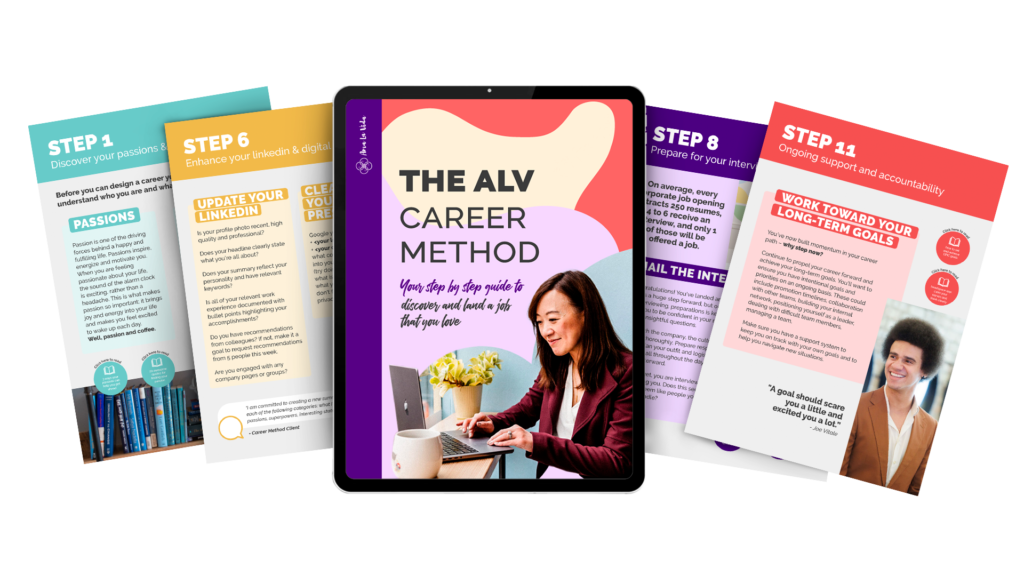
Download our comprehensive step-by-step guide to design and land a job you love!

Images from The ALV Career Method Guide
ALV Method Downloadable Guide

I love learning about words from different languages that have no direct translation in English. Although we fit the translation into simple terms, the meanings go much deeper and always offer such rich information about a culture. For example, the word, fika, in Swedish, translates to “a coffee and cake break” but it refers to a concept about making time during the day to stop working and socialize with friends and colleagues while having a coffee or tea and something to eat. This ritual is a critical part of Swedish culture and demonstrates its value on community. A couple of years ago, I learned about the word, ikigai, and it changed the course of my career. Ikigai translates from Japanese, to “reason for being” or “what gets you out of bed in the morning”. Ikigai is not a concept solely tied to career fulfillment. In Japan, it is a life practice or pursuit that makes a life worth living. It encompasses a balanced view of what it takes to achieve a fulfilling work life, which when realized, should provide a purposeful life, happiness, and longevity. For me, ikigai gave a framework that I could connect with at a time when I felt stuck in my career as a lawyer. It seemed like I was always searching for the right position – one in which I felt engaged and excited, challenged and supported by colleagues and supervisors, and was contributing in a meaningful way. Finally, a sense of dread came over me when I realized that maybe a career in law wouldn’t provide me with what I wanted out of my work life. As a lawyer, I had been trained to think analytically. I took only calculated risks. The idea of changing my career after more than a decade in it, seemed overwhelming (what would I even do?), unwise (how would I make sufficient money?), and unattainable (how would I even do it?). Ikigai offered me a logical approach in exploring a career change. During my first attempt at leaving law, I focused on my interests. Everyone says, “Follow your passions and you will be successful.” But I couldn’t figure out how to translate my interests into a meaningful, paid position. The ikigai framework for a fulfilling life is a balance of four elements: Your interests or what you love Your strengths or what you are good at Your contribution or what the world, society and community needs, and What you can be paid for The goal is to find a balance of all four elements in your work. If you’re doing work that you’re passionate about and that you are good at, but it’s not meaningful and you aren’t paid at a sufficient level, you will not feel fulfilled in the long run. If you’re doing work that you’re good at, that is meaningful, and you’re paid well, but you don’t really have any interest in it, then you will not ultimately feel fulfilled. So how do you become clear on how the four elements play out for you? Here are some ways to help get you started. Your interests It seems easy enough, right? What do I like? However, if you went from school to work, with your head down and following the path of success that was drawn out for you, it’s not surprising if you don’t know what you like anymore. So here are some questions to ask yourself: What websites or social media sites do I visit regularly? What did I like to do when I was around age 10? What do I get excited about doing? What would I do even if I am dead tired or super busy? Your strengths Similar to interests, you may not know what your strengths are. You may have started studying for a career early in life, building skills for a particular subject, but never spent the time to understand what you’re good at. You can develop and nurture skills, but what are those strengths that come naturally to you? Here are some questions to get you started: What do your friends and family come to you for when they need help? What were you good at when you were around 10 years old? What do your work colleagues come to you for when they need help? What have your teachers or supervisors indicated as strengths in your work? Your contribution This one was a big one for me as I was considering my career change. I wanted to make a meaningful contribution and be able to see my impact. This can seem like an overwhelming concept, but here are some questions that may help focus you: What do you want your legacy to be? How would you want to be remembered? What does the world need that you want to contribute to? How would you like to make a difference in society? Your income You may find that when you get to the point of wanting to make a career change, the biggest hold up is the financial issue. And at times, it’s because you may be considering a career that doesn’t take into account the fact that you still need to pay the bills. When I learned about this element of ikigai, I was actually relieved. I thought that leaving law would mean leaving my only avenue to make money. Ikigai holds a place for it and made it acceptable for me to include making money as an integral part of my search for a new career. It made my decision much easier to navigate. When you land upon some career options, ask yourself: Would the work serve a need for a specific audience? Would the audience pay for the services or product? Are there others who provide this product or service and do they get paid for it? How much are my expenses and what is my goal income? I found that when I spent time in exploring the four elements of ikigai and how

Read More

Congratulations! You’ve been promoted to a manager because you’re a rockstar, you did your job really well and you nailed it at being a subject matter expert. You’ve outgrown your role, and the next step up is being a manager. This is probably the biggest career step most people will make – the promotion from being an individual contributor to a manager. But now comes all of the responsibility. You’re responsible for managing a group, and what got you promoted will not be the same skills you need to succeed as a manager. Here’s what needs to change: 1. Your definition of success When you were an individual contributor, your definition of success looked in the form of “I need to do X really well and show results.” Your success revolved around tactical work and your personal contributions. As a manager, it’s a whole new ball game. Your definition of success is no longer about you; it’s about your team. This leads us to reframe our mindset and think about success through the performance and development of others. Your success is directly linked to helping your team members excel individually and bringing the team together to collectively work towards a common goal to advance your organization. 2. Invest in yourself Managing people is hard. There’s no manual, rule book or a one size fits all approach. Each individual is different, complex and has his/her own motivators, derailers, strengths, and opportunities. In order to navigate the people side of managing (which is 97% of managing), think about investing in yourself to learn the skills and build the confidence on how to cultivate effective leaders within your team and help them thrive. Seek out a coach to develop yourself so that you can coach others. The best way to teach is to be taught. 3. Step out of the details As an individual contributor, you were responsible for every single detail of your work. It was your job to be in the micro, and that’s what made you successful. Now that you’re managing other people, it’s nearly impossible for you to be in that level of detail. In fact, it’s dangerous for you and your team if you’re in that type of detail. A key part of your role is to keep a pulse on what’s going on with each team member, how it’s impacting the organization, communicate that to your boss and course correct as needed. Now that’s a lot to remember and keep moving forward. This is why you’ll have to take a step back and think about the bigger picture. Ask yourself, what’s the organizational goal and strategy right now? What’s our function’s role and strategy to support the organizational goal? What is my team’s part in supporting the function and organization forward? Once you have those questions answered, every action should support it. At any given time, you should be able to answer and frequently communicate how your team fits into the bigger picture and how your team is contributing to the bigger mission. 4. Don’t be the hero (or the martyr) It was nice as an individual contributor to be recognized for providing your manager a much needed analysis. Your manager saw a need for the analysis and recognized the impact it could have, so you stayed in the office until 10pm to get it done and save the day. That’s no longer your role. So now it’s your job to identify what the team, the customers or organization needs and identify the best person in your team who can deliver that. You are now supporting the hero and creating opportunities for your team to shine. It’s no longer about you burning the midnight oil for fame and glory but instead to allow your team to step up to have opportunities to learn and grow and to be recognized for their contributions (hopefully not at 10pm). 5. Recognize and celebrate every success and failure In this economy, people are wanting more for less. It can be hard to see the immediate impact or satisfaction, so remember to celebrate success every step of the way. Recognize others for their efforts, their strengths and for a job well done. And when things don’t go the way you originally planned, use that as an opportunity to learn about how to improve next time around. In safe environments, encourage taking chances as it will allow your team members to stretch themselves and innovate. 6. Know when to coach and manage There’s a big difference between managing and coaching. When you’re in a management position, it might seem natural to give out commands and let your team members know exactly what needs to be done and how. While this is appropriate sometimes, don’t let this be a default. Instead, think about coaching your team members to think the way you’re thinking about problem solving and empower them to come up with their own solutions. At Ama La Vida, we follow the RISE methodology for determining when to coach and when to manage. If there is a Right or wrong answer, if a team member is Inexperienced, if there is a Specific course of action that needs to be taken or if it is Essential to complete the task perfectly, then it is appropriate to manage and give clear instruction. In all other situations, do your best to coach your team member instead of manage. 7. Work yourself out of your role This might sound scary at first. You’ve just been promoted, and now I’m asking you to work yourself out of your role. An indicator of a good manager is how many people the manager is able to develop into new managers. Your manager helped you step into the management role by providing you with the opportunities you needed to step up. Now it’s your turn! Start with thinking through how you succeeded. You first had to master your role as a subject matter expert. Help your team members do the

Read More
someone on the phone

We often provide coaching for how to nail your interviews. We share how you should prepare and respond to questions. But now we are turning the tables and talking about when you are interviewing others. It can be very tricky to evaluate a candidate in the limited time you have with them. In this post we will talk about the value of phone interviews and how you can maximize your use of them. If you haven’t interviewed anyone yet, you surely will soon, so read on! Have you ever identified a candidate who seemed perfect for your open role based on their resume and cover letter, then turned out to be a total dud when you brought them in for an interview? This process can be even more frustrating when you’ve spent a ton of time coordinating your interview panel and rearranging schedules so everyone can be present. If you can relate, you’re not alone – but there is a crucial step to your interviewing process you might be neglecting. Phone and even video interviews are becoming increasingly more popular, and they’re a great tool to screen out candidates before investing a lot of time with them. Here are our best tips for how to get the most out of your phone screening process so it’s not just a formality but a true filter for bringing in the best-aligned talent. Don’t treat the phone screen as a full interview. This isn’t the time where you have multiple interviewers on the line asking tough, technical questions. A preliminary phone interview shouldn’t last more than 30 minutes (15-20 minutes is more common). These can be done on the fly if a candidate answers the phone on the first try, or could also take place at a scheduled time within a few days. Sometimes recruiters are best at conducting these phone screens, but if your team is small, consider utilizing the hiring manager, team lead, or supervisor in this role. The phone screen should be a two-way street. This first conversation is the perfect time to give candidates more information about the specific role you’re hiring for. Some job descriptions are vague at best, and it’s easiest to convey necessary information over the phone. This is a way for candidates to self-select out of the interview process if the job just won’t be the right fit. Likewise, you’ll get to learn more about their interest in the role and gather some preliminary data on why they might be a good match for your team. During this phone conversation, you can also clarify salary band, office location, or other technical concerns. Ask a few vital questions to get a thorough picture of your candidate. The phone screen is not the time to make sure the applicant is absolutely perfect for the role, but you can use this brief conversation to get a good feel for their qualifications and personality. The standard questions like “tell me about yourself,” “what excites you about this role,” and “why are you leaving your current position” are fine places to start. Take note not just of their responses, but also their communication style and ability to get their point across. Use the phone interview to gather data that you couldn’t obtain just by reviewing a resume, such as culture fit. The preliminary phone interview is a quick and easy process to eliminate wasted time and resources from conducting in-person interviews with tons of candidates who end up not quite fitting the bill. This strategy is advantageous for job searchers and employers alike. Drop us a line and let us know your favorite phone screen questions and techniques! If you are interested in learning more, here are some of our favorite resources: Read: Why Employers Do Phone Interviews (5 min) Read: Phone Interview Questions and Best Answers (9 min) Watch: Google’s Toughest Job Interview Questions (3 min) Read: 5 New Interview Techniques That You Should Start Using (7 min; moving beyond the phone screen)  

Read More

These days it seems like every third person on Instagram is a coach of something. It can be incredibly difficult to discern which online life coaches are high quality coaches and which ones are just trying to make a buck. On top of that, how do you know which coach is the right one for you? How do you find an online life coach who will work best with to help you reach your goals? These are common questions we get asked as our clients do their research and try to find the perfect life coach for them, and so we wanted to share our guidance to help demystify the process and help you not just find a life coach, but the right life coach for you. 1. Make sure a Life Coach is actually what you’re after Before you do anything, it’s important to make sure that a life coach is what you actually need. Coaching is often confused with other related disciplines like mentorship or therapy. However, it is actually quite different, and each of these has unique characteristics. This graphic pinpoints some of the key differences between life coaching, mentorship and therapy. Therapy has a past orientation, helping you understand why you are the way you are. Coaching is much more future-oriented. Your life coach won’t spend much time digging into your past experiences. There is still certainly a self-awareness component, helping you understand who you are and why, but all with the intention of using that self-awareness for the future. “Okay, I know these things about myself, how can I create strategies and habits to help me progress toward my goals given all I’ve learned?” Additionally, it should also be noted that only a therapist is qualified to support you with mental illness, significant trauma, or other me Unlike a mentor, a life coach is not there to offer guidance and advice based on his/her own experiences. Sure, they might occasionally offer a suggestion or two, but for the most part, your life coach will ask powerful questions to help you find the right answers and solutions for you. It’s important to note that none of these disciplines are better or worse than any other – you simply need to understand the differences and have appropriate expectations for what will be accomplished with each provider. Now let’s talk about how to get a life coach! 2. Figure out what type of coach you want to work with Once you’ve determined a coach is what you’re looking for, it will help your search to narrow down what type of coach you want depending on your coaching goals. Many people jump straight into looking for a life coach, but if you can narrow down the area of your life you want to focus on you may be able to hone your search for potential coaches. Different types of coaches include career coach, leadership coach or executive coach, relationship coach, business coach, or wellness coach. These coaches have narrowed their area of expertise to a more specific field and may have special programs or approaches to how they manage their coaching sessions. Because they focus on one particular area of coaching, they may come with a good understanding of your particular challenges and be able to provide better insights. For example, if your focus is on personal growth, you may seek a coach who can help you build your self confidence, create work life balance, or identify ways to support your mental health in your daily life. Most successful life coaches will focus in on these areas. On the other hand, if you are starting your own business, you might chose a life coach who primarily works with small business owners. An executive coach or leadership coach will help you navigate the challenges that come with leading a team at work. A career coach may be focused on helping you find a new job, but there are others who can help with larger or ongoing goals like working toward a promotion, creating and realizing a vision for your career, or navigating all the intricacies of your workplace. A wellness coach may focus on your physical health, nutrition, and exercise, but they may also support your mental health priorities as well. All of these types of coaches can bring a positive change into your life. It’s important to know what you’re personally hoping to achieve in working with a life coach so that you can find the skillset for what you need. Once you’ve narrowed down your search, you can then identify a few potential coaches to research further to find the best life coach for you. 3. Determine if they are thoroughly trained and certified Coaching is based on scientific research, and well-trained coaches utilize evidence-based coaching models in their work. In order to learn this research and these techniques, coaches need to go through an in-depth training program. Unlike therapy, there is very little governance and regulation of the coaching industry. For example, to call yourself a therapist, you legally need to have a certain level of training and hold an official credential. There is no equivalent regulation for coaches. Anyone can call themselves a coach, whether or not they have been through a coach training program. However, there is an organization called the International Coaching Federation (ICF). This organization accredits coach training programs and ensures they meet a certain standard. When you begin meeting with life coaches, ask them which training program they completed and if it is accredited by the International Coaching Federation. At Ama La Vida, we only hire coaches who have been through an intensive coach training program; once they join our team, they undergo an additional 3-months of training on our proprietary methodologies and programs. Make sure to ask about their credentials when you choose a life coach. 4. Ask them about their coaching style Each life coach coaches differently based on their personality and training. Some coaches’ sessions are very organized and structured,

Read More
someone at a computer with breakfast on either side of them

You’ve probably spent hours revamping your resume or may have even sought out a specialist to help you do it. Now comes time for the dreaded cover letter. You’ve been told you should write a cover letter, but where do you start? What do you say and how do you say it? Do hiring managers and recruiters actually read them?   According to a 2015 study by the Addison Group, only 18% of hiring managers read cover letters. I believe this to be true in large companies, but for small companies, the hiring managers definitely read them. As for recruiters, according to a Jobvite data survey, only 26% of recruiters consider cover letters as important in their decision to hire an applicant. Based on this information, should you write one? If a company is asking for a cover letter, then they are probably using it to evaluate your candidacy for the position. Even if your cover letter is not requested, it can be a handy tool to use when you haven’t heard back from the recruiter after applying through the company’s ATS (applicant tracking system) or when you are an unexpected candidate for the position. It gives you an opportunity to provide more context for your application and tell the story of why you are the right person for the job. Cover letters can also be helpful with explaining your situation, especially if you’ve been out of the workforce for a while or are seeking a lesser role, and vice versa.  If you have an email address for a contact within the company, you can send the cover letter as the body of your email and attach your resume. You can also send it to the recruiter or hiring manager through LinkedIn messenger. Even if your cover letter is not read initially, it may be read by the hiring manager or recruiter if your resume makes it to the final stack, so it’s important to craft one that’s eye catching.  So what do you put on the cover letter to make sure it gets seen? Address the hiring manager or recruiter directly. To stand out from the rest of the applicants, start by addressing the hiring manager or recruiter directly. Sometimes this can be hard to discover, but if you network or do some research on LinkedIn, you can probably find out. Addressing the cover letter to “Whom It May Concern” is impersonal and may send the message that you didn’t take the time to learn more about the company and who the position reports to. In worst case scenarios, address the letter to either the “Hiring Manager” or “Recruiter.” Keep the letter short and to the point. I’ve seen cover letters that range from half a page to a full page, but it’s best to keep them to the point and not tell your entire career story. One to three paragraphs or even listing a few sentences with bullet points will suffice. Make sure to always include the position you are applying for so there is no guesswork, especially if your cover letter gets separated from your resume (which can and does happen). Tell them why you are qualified for the job. Typically what hiring managers want to know is why you are interested in the position, why you think you are qualified, and why they should consider you for the position. It’s the perfect time to point out your accomplishments and show the direct correlation between your skills and what the company needs. Be the problem solver. Remember the company is hiring someone because they have a need or a problem – you are it! So show them that in the letter. Make the letter specific. Don’t use the same exact letter for multiple jobs and companies. It is easy to tell when a candidate just copies and pastes. Tailor your letter to this specific company and role. Recruiters and hiring managers want to know why you’re the right person for the job but also why you want to work at this particular company and in this particular job so they feel confident you will accept an offer if given one and will be an engaged employee. Double Check For Errors. No one’s perfect, but your resume and cover letter must be error-free. If you do have an error and notice it afterwards, don’t panic. If you have multiple typos, then that can definitely be a reason for you to receive a “Thanks, but No Thanks” letter, especially if the position requires a high attention to detail. I’ve actually used cover letters as part of the screening process for evaluating a candidate’s written communication ability, so correct grammar is essential. Always make sure you’re sending the correct cover letter. I’ve received many cover letters indicating a candidate’s interest in a job that didn’t exist at the company. Not to mention, they stated the wrong company and how they desired to work there. Lastly, if you do find the name of the recruiter or hiring manager, double check the spelling of their name. I’ve had a few people send me cover letters addressing me as “Christ.” Although I am Christian, I’m definitely not Him. ALWAYS double or triple-check for errors so that you are presenting yourself in the best possible way. *** If you’re struggling to edit your resume or need help with your cover letter, Ama La Vida offers a Get That Job program that can help you determine your personal branding strategy and create your perfect elevator pitch, which can be used to develop your cover letter. I’d love to work with you to write a stellar, stand-out cover letter, so please feel free to book a free consultation with me here if you are ready to land an exciting new job!

Read More

Working remotely. Telecommuting. Working from home. Whatever you call the act of not being physically present at your workplace, the practice is growing. In fact, a recent study revealed that 70% of people around the world work outside of the office at least one day each week. In the US, the amount of remote employees increased by 4% from 2012 to 2016. Working from home is a new phenomenon that’s rapidly growing in popularity, and statistics suggest employees who work from home feel more satisfied and are more productive. There are tons of positives to telecommuting, but it can also be an adjustment for many reasons. This post is all about how to develop focus and maintain productivity when working outside of a traditional office setting. Here are three of my top tips and some of my favorite resources: Make sure you have the tools and technology you need to perform your job just as well as you would in the office. If you require lightning-speed Internet to host video conferences throughout the day, make sure your service provider can handle the task. If juggling multiple spreadsheets is a daily occurrence, will your laptop be sufficient, or do you need a spare monitor and mouse at home? If printing documents out before reviewing them is part of your normal routine, ensure you have access to a printer. Sometimes you work will include these additional supplies as part of your employment, and other times you’ll be expected to pay out of pocket. Hate to break it to you, but if you’re struggling to get going in the mornings, you might need to change out of your pajamas. Yes, a huge perk to working from home is that you don’t need to spend time in the morning looking presentable. However, if productivity is an issue and you can’t seem to stay focused, you might have to do some pretending. Create a routine and take a shower, put on clean clothes (yoga pants allowed!), and sip a beverage that helps you jumpstart your morning; doing small tasks between the time your alarm goes off and getting down to work will help you signal to yourself that the workday has officially begun. Hanging out at home is distinctly different than working from home, so do your best to limit distractions. Distractions come in all shapes and sizes (Netflix, kiddos, neighbors passing by your house), and telecommuting means you’ll have to work even harder at not getting sucked into the fun going on around you. Some common distraction points for my clients include lunchtime (set a timer, eat in the kitchen, and then get back to work), spouses (remind them that just because you’re at home doesn’t mean you’re available to chat all day), and social media (this happens everywhere, but the fact that your boss won’t swing by your cubicle for a random check-in makes it even easier to succumb to the scroll). When you notice yourself losing focus, take stock of what is distracting you and brainstorm solutions to get back on track. Over the next few months, we’ll be dedicating a few of our newsletters and blog posts to our work from home readers. We have some hot topics we can’t wait to discuss (how to get your socialization fix when you’re all alone; creating a firm separation between work and home life), but would love to hear from you about the areas where you feel stuck. Drop us a line using our Ask an ALV Expert tool and we’ll be sure to address your needs in a future post! And if you can’t wait until then and want to keep learning more, here are some of my favorite resources: Read: LinkedIn’s 10 Commandments for Remote Working (3 min) Watch: Go Ahead, Tell Your Boss You Are Working From Home (15 min) Read: How to Work From Home When You Have Kids (10 min) Read: How to Design a Healthy Home Office that Increases Productivity(7 min)

Read More