Category: Career Enrichment

A friend of mind recently shared this article with me which talks about the virtues of having fun and argues that fun is not indulgent but necessary in a full and happy life. It challenges, “Imagine you had control of another person’s life, and could dictate their activity every hour of the day. Would you condemn them to spend 80% of their waking hours at a desk?” Let’s make sure that workaholism wins no more! Great question. It’s a question I’ve never asked myself before: If I had complete control over another person’s life and choices like that Friends episode where Monica controls Rachel’s, would I choose for them to live the way I do? I love to have fun. But I also love what I do and “grew up” in the consulting world where putting in the most hours was a badge of honor. It’s always tempting for me to just respond to one more email or Slack chat today instead of tomorrow. Now I have to physically stop myself from overworking. Unless I force it to shift focus, my brain is always at work. Because I love Ama La Vida and because that is my nature. I try to stop myself from talking about how late I was at the office or how long that deck took me to finish because I don’t want to even seem like I’m glorifying workaholic behavior. If I write a bunch of emails on Sunday, I’ll keep them in drafts and send on Monday. To protect the receiver’s weekend but also to not send the signal that we should be working on the weekend. And I schedule uninterrupted time with my friends and family to do fun stuff. I try to keep my phone off the table. I’m present in the moment. I go on long vacations. I drink all the champagne. How do you police your own workaholism? This week’s challenge: Carve out time for fun to make sure that workaholism wins no more. Seems counterintuitive to schedule your fun, but it doesn’t need to be that clinical. It can simply mean booking in a dinner with friends or signing up for a workout class you love. Make one commitment to having to good old fashioned fun this week. We know you want to learn more. Here are some of our favorite additional resources: Read: Why You Need More Fun In Your Life, According To Science Try: A Dabble Class Near Your! Watch: How To Make Work Life Balance Work Read: Do You Need More Fun In Your Life

Read More
someone working a job that is not my dream job with a plant and a laptop

I had two majors in college: Biology for my parents, French for me. After undergrad, I started a masters program in public health and landed my dream job of teaching French to kids in an afterschool program. I had wanted so badly to use my French, especially after everyone said it was a useless major. The job was everything I wanted. It was part-time, so I could still focus on my graduate program. I used my French language skills, so that I could put my degree to use. It uncluded purpose-driven work because I was teaching kids. And it promised to be fun and engaging as the program used artwork and other creative resources to teach. I was thrilled! I told everybody who questioned what I’d do with my French major about the job and started it with gusto. Only to realize, within the first few weeks, that my job was as a glorified babysitter. I hadn’t signed up for that. So, what do you do when you realize that your dream job isn’t your dream job? Whether you’re three weeks, three months, or three years into the job, don’t panic. This is more common than you’d think. It could be that you take a job that doesn’t match up to your expectations. Or maybe you grow as you work and realize that you want different things than what your job can offer. Once you start pressing snooze 8 or 9 times in the morning and negotiating or downright bribing yourself in ways to get out of bed and to work, you know it’s time to regroup. First off, the fact that this is a job that you call your dream job makes it hard, embarrassing, scary, and hundreds of additional negative adjectives that make it difficult to admit you are unhappy. This is the job that you searched for months to find. You’ve researched like crazy, made connections when you hate networking, and spent hours on producing a polished cover letter and resume. You’ve prepared for your interviews and knocked them out of the park. You got the offer, and you shouted it from the treetops. But remember that the only person that gets hurt if you don’t own the fact that the job no longer is working for you is yourself. You owe it to yourself and your career to reflect and explore the problem. Getting Clear Before taking any action, get clear on what you don’t like about the job. What makes it not your dream job anymore? For example, if your response to that question is there’s a negative work environment, then spend some time breaking that down and identifying what elements makes a positive environment for you. If your response is that you’re not doing the type of work you thought you’d be doing, then write down what work you want to be doing. If your response is that you’re working way more hours that you thought you would, think about what an ideal work-life balance looks like for you. It’s important that you go beyond the superficial in your investigation. Considering Next Steps Once you have a good understanding of what is making your dream job no longer your dream job, your next steps become clearer. Generally, these steps will fall into three categories: – The issue is temporary and may resolve itself – The challenge you’re having is potentially fixable if you take steps to address it – The problem is intrinsic to the job and it’s time to go. Temporary glitch After your reflection, you may realize that the problem is temporary. If you’re miserable because of a specific project or client, then you know that the job will get its shiny glow back soon enough. In the meantime, consider ways that can make this period of time more palatable. Could you communicate your challenges to your manager so that your workload could be shifted allowing for it to be more manageable? Could you ask co-workers for help? Maybe you could plan something you love doing on the weekend so that you have something to look forward to? However, if these periods of time start adding up and outweigh the times that your dream job is still your dream job, then you may want to re-evaluate. Fixer upper After you are clear with the issues you’re having, you could see that they can be addressed and resolved. Say you no longer find the work you’re doing to be challenging since you’ve been doing it for three years straight. Are there opportunities at your company to get involved in other work which would allow you to learn something new and develop in another area? Perhaps you’re a new manager and you’re really struggling with your direct reports. It’s keeping you from doing your own work and making you miserable. Ask management if there’s a new leader program you can attend. Consider exploring some online classes that could provide tips and tools of how to manage employees. Or maybe there’s an opportunity to work with a coach to help you navigate being a first-time manager and develop your authentic management style. If, however, your attempts to develop aren’t being addressed, then you may want to reassess. Get out Once you’re clear on why you’re unhappy, it’s time to search for a different job. This could be a tough realization. In my case, after evaluating why the French teaching job wasn’t for me, it was clear to me that I had to search for a new position. It took a little while to admit that to myself because I was so proud that I found a position that used my French. Especially when I had so many people saying I wouldn’t. In the long run, it was for my own happiness that I knew it was critical that I let go. It’s okay if your dream job isn’t your dream job. It may feel discouraging, but it’s only helped you become clearer on what

Read More
spring time with flowers

Did you let out a big sigh of relief last Wednesday? I know I can’t be the only one who is ready for a change in this ridiculous winter weather. Spring is officially here, and with this new season comes longer days, less hurried walks between the car and the office door, and a reminder that growth and change are underway. You know I couldn’t make it through a time of transition without a newsletter talking all about it, right? Here are my thoughts on what spring means to me, and suggestions on how to embrace all that this season has to offer no matter what stage of life you’re in. Release what is no longer serving you. Spring cleaning doesn’t just apply to your physical space – it applies to your personal life as well. Throw open the windows of your mind and let go of what you don’t need. Negative self-talk that holds you back from taking the next step in your love life? A half-finished resume that isn’t landing you any interviews? A cluttered workspace that distracts you from getting into the zone? Whatever doesn’t have a purpose or a place is worth considering whether it’s truly worth the space and effort. Plant seeds that will grow into flowers. When I think of spring, I imagine strong and steady development. As the season passes, the magic of what’s been brewing underground – complicated systems of roots, nutrients, soil, and water – begins to poke upwards toward the sun and reminds us that good things are worth waiting for. Consider this time as preparation for things your future self will thank you for. Want to be in a new role by summer? It’s time to tighten up your application materials. Dream of being healthy enough to chase your kids around the yard until they wear themselves out? Lace up your shoes and get moving. Practice patience as you form habits that will build upon themselves. Know that the work you are putting in today will pay off – and enjoy the process along the way. Connect and celebrate the ties that bond us. With winter officially on its way out, it’s easier to make and keep plans without weather getting in the way. Now is time to emerge from your cocoon and reconnect with the ones you love. Remember that function is more important than form, so if your house isn’t perfect or your meal isn’t Martha Stewart approved, it’s all good as long as you’re acting from a place of love. Some of my favorite ways to connect in the spring are potlucks with friends (what light and fresh recipes have you been eyeing?) and networking with folks in my industry (this includes mentorship, taking continuing education classes, and attending events to meet movers and shakers in my field). Shake off the dust and get out there. Cheers to winter for the coziness and slow moments it brought, and welcome spring in all its new and bright and sunny (!!) glory. –Coach Teague This week’s challenge For each of the three categories above – releasing the excess, focusing on personal growth, or strengthening connections – choose a meaningful and achievable goal that you can accomplish within the next week. Feel overwhelmed by the prospect of doing something outside your comfort zone? That’s okay – it’s where the magic happens. Starting now, you’re a person who gets things done even when they’re not easy. (Bonus points if you forward this email to a friend and work on your goals collaboratively. Teamwork makes the dream work!) We know you want to learn more. Here are some of our favorite additional resources: “Virtually every time I push my clients to go deeper with their gathering’s purpose, there is a moment when they seem to wonder if I am preparing them for World War III. Yet forcing yourself to think about your gathering as stand-taking helps you get clear on its unique purpose.” A 6 Step Guide to Spring Cleaning Your Social Media Feeds, because our closets aren’t the only cluttered spaces “My question is what, if anything, is wrong with being chilly? It seems like a good, efficient way to get along.” Spring Cleaning: Meditation to Tidy Up the Mind (initiate zen state now!) Declutter your life and make room for possibility (by ALV Coach Erin)

Read More

Touchdown, through sleepy eyes I looked out the window as we landed in Guatemala City. My first thoughts were, “I hope they have wifi. Please tell me they have wifi,” since finding an Uber asap was top of mind. I had heard about Guatemala City being unsafe and was paranoid that this was my first place of arrival as a solo female traveler. I collected my oversized backpack, walked outside in a fog from the lack of sleep and anxiety meds, and hopped into the first cab I could find to head to Antigua, Guatemala. As I sat down, it settled in that this was happening. I was here, and there was no turning back. An expected one-month backpacking trip transformed into three months of unforgettable, life-changing adventure through Central America and Colombia. I entered a timid, SF Marina girl who could barely navigate her way a few hours outside of her own city and left a strong, courageous solo female traveler who felt she could take on almost anything. If you want to gain perspective and grow, throw yourself into the unknown and get really uncomfortable. The beauty lies in the transformation from the challenges that you overcome. So let’s take a journey down the bumpy, winding, jerky (often held up by roadblocks) but sometimes smooth, memory lane of my backpacking adventure. The Beginning (Guatemala): Antigua, Guatemala The adventure began in the beautiful Spanish colonial looking city of Antigua, Guatemala. A small town in Southern Guatemala full of colorful buildings and cobblestone streets surrounded by volcanoes. Volcan Acatenango: My trip started with a bang when I booked an excursion for an overnight hike of Volcano Acatenango on Day 2. Acatenango is a volcano towering 13,041 ft over Antigua, Guatemala. This urban hiker had no idea what she was getting herself into signing up for this hike. Following the directions of the hostel, I packed for the overnight trek and ended up loading ⅓ of my body weight onto my back. I had heard it was challenging but oh my, was I in for a surprise as I walked up in my Nike Frees and saw the other hikers tie up their hiking boots. I made two mistakes on this hike that I would advise anyone under 5’2 and of petite stature not to repeat: 1.) I chose to carry all of my things rather than pay someone to help. (They have seasoned local hikers who offer to haul your things at a cost.) 2.) I didn’t buy a walking stick at the hike entry. (I guess I was overly confident in my abilities, or I just didn’t do my research.) Thankfully, the amazing local guide broke off a tree branch for me to use as a hiking stick mid-way through the hike. Unfortunately, I had to carry my things the entire time. Four hours into the hike, I was close to tears as I climbed the volcano taking one step up and sinking two steps back. My Nikes filled with dirt as my backpack weighed me down and dragged me backward along with the force of gravity. I contemplated turning around to head back multiple times, but I couldn’t imagine failing the first challenge I set out for myself. So I pushed on through the hours of sweat and aching calves to finally reach our campground. The struggle was all worth it as our group bonded sipping hot chocolate around the campfire that night. Our guide awakened us from our slumber to watch the spontaneous eruptions of the neighboring peak of Volcan del Fuego. I watched in awe as the red and orange active lava spouted from the earth and flowed down the sides of the peak. The next morning we hiked the final steep 45-minute climb with the sunrise, watching as the sky transformed from a watercolor painting of pink to orange. At the top, I stood on the edge of the volcano looking down at a surreal view of clouds and neighboring volcanoes peaks. This hike challenged both my physical and emotional limits beyond what I imagined I would experience on Day 2 of solo traveling. I finished feeling stronger, extremely sore and with some great new friends from all over the world. Lake Atitlan, Guatemala After Antigua, the next stop was Lake Atitlan, Guatemala. A beautiful crater lake surrounded by villages that each have their own unique flair. Throughout my time here I was able to visit local markets, practice yoga, hike Volcano San Pedro, meet like-minded travelers and relax on the docks overlooking the beauty of Lake Atitlan. The highlight of my time on the lake was a homestay with a local Guatemalan family in the village of San Pedro and daily Spanish classes at Orbita Spanish School. I was living with a family of four: a mother, father, son and young daughter. While living with them, I attended 4 hours of daily 1:1 Spanish class and had afternoons free to study and explore. In those 4 hour sessions, I didn’t just improve my Spanish grammar and conversation skills. My tutor taught me about Guatemalan cultural values, the challenges he faced growing up in the country, and the struggle to maintain the culture in modern society. These conversations expanded my mindset and gave me a greater sense of self-awareness. Certain things I would say to a friend back home may not come across the same to someone with a different cultural upbringing or native language. One of my favorite things throughout my travels was hearing stories like his that introduced me to new perspectives and transformed my way of thinking.   Two weeks flew by, and I gained perspective on the simplistic happiness of family life on the lake. The mother prepared all of the meals and played the traditional role of homemaker. The father worked as a teacher during the day and played on a local fútbol team some evenings. Dinner was a meal that the entire family attended and we would go

Read More

After you’ve given so much of yourself to a job, it can be very difficult to say goodbye. You don’t want to burn bridges, and you want to go out with grace. But how do you do it? No one teaches you how to quit your job! Luckily we do! And the fact that you’re here reading this tells me that you have a lot of loyalty to your employer and respect for the people there, so even if you don’t follow my advice precisely, you will be just fine. So take a deep breath and read on. I’ll break down for you everything you need to know about how to quit. When Not To Do It You’re not going to like this, but I’m going to start my guidance out with an ‘it depends!’ But before we get into the different options for when you should give your notice, here are a few times not to do it: When you’re in the heat of the moment It’s never good to quit when emotions are high. You may say things you regret. In this Refinery29 article, we hear from 8 people who rage-quit their jobs. Though it’s not a good look or an ideal scenario, what I love about this is how positive most of these people are now. Again this is reassurance that even if this process doesn’t go exactly according to plan, you are moving onward and upward! When the team has a huge deadline the next day When it’s all hands on deck, dropping your news could make the stress level go off the charts. That being said, if your team seems to always be in crisis mode, then you need to move forward with your plan regardless of what’s going on. If you’re out on a vacation and give less than 2 weeks This is very unprofessional. It may be tempting if you are very unhappy, but you need to have the courtesy of wrapping things up in person. In my opinion, the tried and true two weeks notice still stands. I wouldn’t give less than two weeks, but in some cases, it may make sense to give more: If you have project-based work If you know you are moving on but want to see a project through to completion, it may make sense to give notice sooner. You can let your employer know so they can plan accordingly as they staff future projects, but you can wrap up your current one. If you plan to take time off and your timing is flexible If you plan to be “funemployed” after you leave, and you have no set timeline for this to begin, you can give your notice and make your end date somewhat negotiable based on the company’s needs. Maybe they will ask you to stay on through a certain meeting or maybe they will wish you well and have you depart in 2 weeks time. This is a courteous thing to do, but be careful not to let it drag on. Even though you don’t have a firm deadline, you have committed to this time for yourself, so make sure you have a cutoff date that you won’t let work slip into. If you are in a very senior role… and you want to be active in supporting the company to backfill. When you are in a VP or C-suite position, it takes way more than 2 weeks to find your replacement. You may want to give a significant amount of notice so that you can help recruit and interview your replacement and ensure a smooth (as smooth as can be!) transition. One thing to note is that there is definitely a mental shift that takes place once your news is out in the open. This can be good because your excitement for your new path can grow, and you are less phased by the things currently happening around you (especially if you are in a less than ideal work environment). However, it can also be challenging to stay focused. Keep this in the back of your mind because even though some degree of disengagement is expected, you want to show that you aren’t slacking off because you’re leaving. Who To Talk To In most cases, the first person you should tell is your direct supervisor. They are who you have the closest working relationship with and who will be most impacted by your news. You’ll want to tell your boss first and then discuss with them when and how to tell the rest of your team. In some cases, it may make sense to speak with someone else first or involve others in the conversation. For example, if you work in consulting where you don’t have quite the same formal reporting relationship, I’d recommend that you start with the person who is responsible for your career development. Then you can tell the person you are reporting to directly on your current project. Then finally it’s time to formally report your news to HR. Alternatively, if you work in a very small company, you may want to include your boss and a founder right off the bat. This is completely situation dependent. Think about it like this, who would you not want to find out your news from someone else? Make it a priority to tell those people first. Who Not To Talk To Depending on your role, the news of you leaving could cause some concern and confusion within the company. Of course, it is your news to tell, and who you share it with is ultimately up to you. But it is courteous to have the conversation with your boss about the best time and place to break the news to the team. How To Quit It is best to have this conversation in person if possible to show respect to the person and the company. By looking the person in the eye when you deliver the news, it shows that

Read More

Last time we chatted we talked about how to approach networking and how to have a great experience meeting new people. This time, I want to give you my favorite tips about how to crush the follow-up.  via GIPHY  Get the Business Card Have you ever tried to follow up with someone without contact information? Chances are you haven’t because you can’t. If you don’t have contact information of some sort, I don’t even know how to go about following up with them? Maybe you rent a billboard and put your number on there? Aside from the logistical nightmare of publicly displaying your contact info, there is the whole other train of thought that they may not even see it. You can bypass all this by just asking for a business card! Be prepared to give one of yours, however, it’s best to take ownership of the follow-up and make sure that you don’t leave the ball in their court.  Connect on LinkedIn. If you aren’t a huge fan of business cards, make sure that you pull out your LinkedIn app and get a connection request sent. You can either do the classic name search or you can follow these simple steps and use the LinkedIn QR code option. In the LinkedIn App, you can push that little icon in the search bar box and this screen will pop up. You can either show people your code or tap the word “scan” to scan someone else’s. LinkedIn has made connecting easier than ever!  Take some action. If you went the business card route, let’s talk about that email. Try to send a follow-up email within a few days. It doesn’t have to be an over the top email, however, make it clear that you had a great chat and are looking forward to chatting/seeing them again soon. I recommend using a subject line like “Nice meeting you at <place you met them>” or “Super Glad we got to chat at <place you met them>.” Make it easy for them to know what the email is regarding before they even open it. If you haven’t connected on LinkedIn yet it’s helpful to take the same approach in a note when you send a connection request. Be intentional about where you met them and potentially suggest another day to reconnect.  Follow up, again. I know, you’re probably thinking, “Randi, this whole article is about following up, I don’t understand.” Well, let me assure you and hopefully regain your trust. People are busy. They are really busy. Chances are your email may get lost in their inbox, or after you connect on LinkedIn the conversation may drop off. Don’t be afraid to shoot them another email or another LinkedIn Connection request after a week or so. Ready to put your networking and follow up skills to practice? Here are some of my favorite networking groups in Seattle for you to check out! Group Name: General Assembly Seattle Where you can find them: @generalassembly Why I like them: I love General Assembly because they are at the forefront of teaching technical skills to the majority of society. They believe that you don’t have to work a technical role to have the skills and knowledge to work in a technical company. They are always busy hosting workshops, events, and classes to help you launch your career. Group Name: The Riveter Where you can find them: @theriveterco Why I like it: The Riveter is a female-founded co-working space in Seattle, Los Angeles, and soon to be Austin! They are a great place for members and non-members alike with classes, events, and programs for all. They are the best of both worlds when it comes to connections and community. Group Name: The Creativity Loft Where you can find them: @thecreativityloft Why I like it: The Creativity Loft is an up and coming space for women to work, meet, and take classes in. It’s a female-founded space created for artist expression and healing. Founded right after tragedy struck this space is both a dream come true and an adventure waiting to happen. With a full calendar of events for artists, creatives, and entrepreneur’s maybe it’s time we joined a co-working space!  Group Name: Seattle Womxn Collaborative Where you can find them: @SeaWomxnCollab Why I like it: This group plans events that are across women’s groups. My friend personally knows the women in charge. Events are hosted quarterly around the city. An informal collection of professional women’s groups in Seattle coming together to build a supportive, resourceful community. Group Name: Collective Seattle Where you can find them: @thecollectiveseattle Why I like it: The Collective Seattle is a diverse community of members built on adventure, shared ideas, and purpose. It’s a genuine place to cultivate relationships and find a voice for conversation. They pride themselves on being a refuge from an active busy life creating space to reset and reenergize with lots of evolving experiences. Group Name: Women Catalysts – Seattle Where you can find them: @womencatalysts Why I like it: With mottos like “Networking doesn’t have to suck” & “kick ass, take names, send thank you notes” how can you not love this group already? With events in SEA, LA, and SF they are catalysts for women all over the west coast. So, what are you waiting for? Sign up, show up, be curious, collaborate, and celebrate! Event Name: Daring Women Seattle Where you can find them: @daringwomensea Why I like it: Here the most fearless females in Seattle will come together to talk innovation, growth, inspiration, and leadership, where women from across all industries will share stories on the challenges and triumphs in business and life. The conference will feature interactive panel discussions and talks by executives on diversity and inclusion, owning your leadership style, cultivating a balanced culture and challenging standards. The day will conclude with a power hour cocktail party to build authentic connections and a community of Daring Women.

Read More

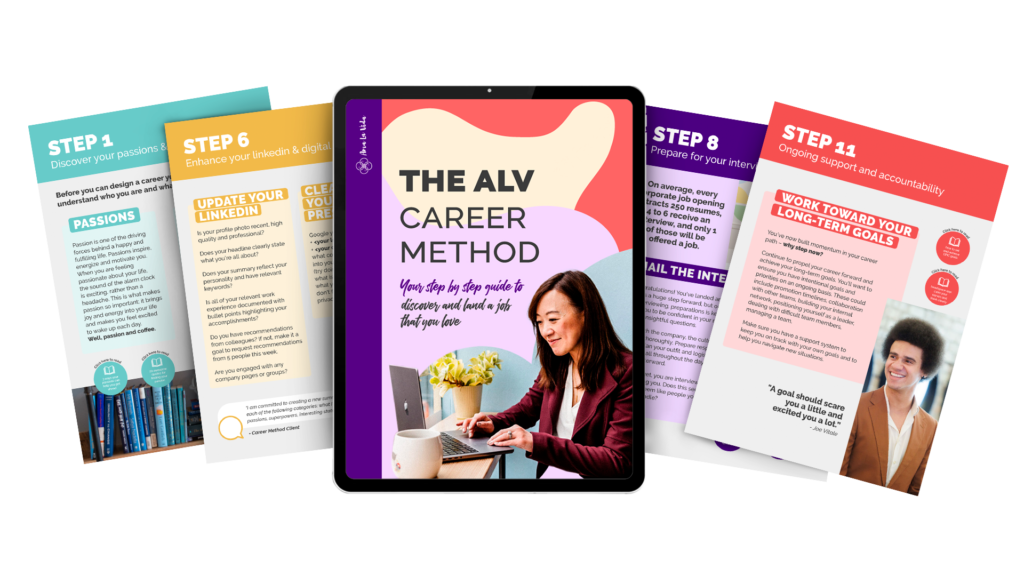
Download our comprehensive step-by-step guide to design and land a job you love!

Images from The ALV Career Method Guide
ALV Method Downloadable Guide

I don’t know about you but I’m like a kid in a candy store when it comes to life. I want everything – I want the light chocolate, dark chocolate, white chocolate, chocolate covered almonds, espresso chocolate, hazelnut chocolate. All the chocolates. I love chocolate and I don’t want to have to choose. This is how most people I know are about life. It’s a stark realization when you think about all the things you want in life and realize that it’s just not physically, mentally and emotionally possible to have everything at the same time. You can have anything you want if you work for it but you can’t have everything. We want a promotion at work, to be more present with family and friends, to have more time to exercise and build better relationships – does this sound like you? This is a lot to ask for and for me, an impossible task. I’m learning this the hard way. As a new mother, an entrepreneur of a growing business and a dreamer of wanting the perfect harmony of life and work, I’ve driven myself crazy to find my harmony. When I’m at work, I’m driven with guilt thinking about my daughter and what I might be missing out on. When I’m at home, I’m thinking about the clients I want to check in with. And when I’m with my husband, I’m thinking about how I need to go work out. When I’m with friends, I’m thinking about how I should spend more time with my parents. It’s emotionally and mentally exhausting. Finding Balance Imagine a seesaw. There are two sides: life & work. With pressure from both sides, it’s difficult to maintain a steady balance. Typically, one side is going to be weighed down compared to the other. And when that happens, we find ourselves being pulled to achieve our balance again. Let’s say work has been crazy for you and you’ve been slammed with meeting deadlines. The work side of your seesaw is low to the ground. You recognize that and double down on the life side so that you can get to some balance. What’ll end up happening is now the life side will be low to the ground and you realize you need to shift your focus on work. Our seesaw shifts again, and it’s a cycle causing us to be frustrated that we haven’t found a balance. I was recently watching Final Table, a show on Netflix that selects up and coming chefs across the world and makes them compete with one another with the goal of being seated with the best chefs in the world. I learned a lot about chefs and the food business and the incredible amount of sacrifices chefs make to build a brand and establish themselves in their industry. More importantly, I learned a very important life lesson. I learned that no matter what profession or vocation you have – whether you’re a stay at home parent, working in corporate, an entrepreneur – you have to sacrifice something when you’re building yourself up. You sacrifice to first learn the craft. You then sacrifice to maintain your status quo and for the go-getters, you sacrifice to climb the ladder or to perfect your craft. All of which require time, energy and money. The sacrifices aren’t small. You miss out on vacations, holidays, quality time with friends and family. You do it because at that moment, that’s what is important to you. And you shouldn’t feel guilty about it. You made a choice based on the information available to you and you made a conscious decision on what matters at that moment. For example, currently, my seesaw is towards work. It’s a critical time in the business and I want to give it my all to make sure we’re growing and building on the momentum we have. This is a conscious decision. Do I feel a pull towards wanting to dedicate more time towards life? Absolutely. I’ve realized that as long as there is no one extreme, then it’s okay. Everything is okay in moderation.  And I’m done feeling guilty about finding a balance. I’m in control of my seesaw. If you’re staying true to yourself and acknowledge the sacrifices you will make in order to achieve your goal, then perhaps you should take it easy on yourself when you make that choice. Recognize that this is a temporary time in your life and temporary is a subjective term. Temporary could be a day or weeks or years. During the growth stages of our lives, we won’t always achieve perfect harmony. We won’t have a work/life balance. But we made that choice because that is what was important to us at that time. What does this mean for the new parent or the newly married couple or the consultant who wants to enjoy life and make money? It means that there will be moments when you’ll have one of a lot. For the new parent, this could mean a lot of baby time and not enough time for yourself or your partner. The newly married couple, it could mean a lot of quality time together and not enough time for your existing friends. And for the single consultant, this could be a lot of hours away from home and not much time for a healthy lifestyle. What do you do when you’re guilty about your one-sided seesaw? Know that we live in a state of equilibrium When we aren’t finding the balance in life, we somehow find a way to get back to equilibrium. We either define it as a new normal or we pivot to bring back a sense of peace. It doesn’t happen simultaneously or when you want it to happen without proactive action. Recognize you’re too far on one side and get back to moderation. And equilibrium doesn’t mean perfect balance. It means having just enough from the other side so that you don’t feel that void.

Read More

I grew up in the suburbs of Philadelphia. My town bordered the city. It didn’t feel so much like a blend of urban and rural but like a battle between the two. We sometimes walked through metal detectors on the way into school, but you could see a deer pass at any time. Sandwiched between my subdivision and the strip mall on the main road nearby sat a small wooded area. “The woods.” Just enough space to get lost in childhood adventure but not enough to worry your parents when you played there. I remember going there with the neighborhood kids to play for hours. An entire day could pass of us building forts, finding creatures, jumping back and forth across the creek (or “crick” as most people called it). When I see kids now entranced by their phones and iPads, my heart often breaks a tiny bit wondering if they ever have space for imagination and adventure. If they ever invent their own game or create their own language. If their aptitude for technology isn’t coming at the cost of their sense of wonder. Then again, I image all generations feel this same heartbreak as they contemplate the upcoming one. Get Creative What’s funny is, I’m currently depriving myself of this type of joy as an adult. I’m always on my phone. I’m always double-screening. And I’m rarely left alone with my own thoughts and imagination. I often do my best thinking in the shower. I thought perhaps it could be related to the calming nature of it. How relaxed I am. But could it honestly be the fact that it’s one of the only places in my life where I physically cannot bring my phone? Even as I sit here and write this, I’m on a Spirit Airlines flight with no wifi (#entrepreneurlife). Even 30k feet in the air, I’m still usually distracted. Responding to emails. Sending off a slide deck. Watching a movie. If I’m very very lucky, asleep. But on this flight, none of those was an option. Today I just sat here (forcibly) alone with my thoughts. And it was magical. I thought of a million new ideas for ALV (stay tuned!). I unintentionally crafted 5 notes of gratitude to people in my life (not as a set practice but simply because I felt compelled to). Taking off I felt exhausted. Now I feel completely energized. I want that for you. Find a way to force it. Go somewhere in nature. Lock yourself somewhere away from devices. Take a Spirit Airlines flight for Pete’s sake. I don’t care how you do it. But let your brain go play in the woods. This week’s challenge Spend one hour of uninterrupted time to get creative. Put the phones and gadgets away, and do something that awakens your creative spirit. It can be as simple as reading a book, journaling, coloring, you name it! Just give yourself the time and space for your brain to wander. We know you want to learn more. Here are some of our favorite additional resources: Take a class: Sign Up For a Creative Class With Dabble Here’s some screen time to help you to spend less screen time: 6 TED Talks That Will Change the Way You Look at Your Phone Immerse yourself in nature: Forest Bathing: How Talking to Trees Helped Me Heal Get Creative: 9 Ways to be More Creative in the Next 10 Minutes Unsure where to stay when it comes to finding ways to get creative? In this video, Coach Danielle explains the concept of passions and why they are so important in our lives and careers. She then walks us through 3 questions to help us identify them!

Read More

What a lot of people don’t know about me is that I was a competitive figure skater for 13 years. My childhood dream was to be an Olympic level skater. I wanted to be the next Sasha Cohen, Michelle Kwan, or Tara Lipinski. I had my Olympic year picked out – I would be a part of the US team for the 2018 Winter Olympics. No one tells you when you want to be a figure skater, you are actually signing up to become a professional faller. You see, when you start taking lessons, the first thing an instructor teaches you is how to fall. Now you may be thinking, “I don’t need any help falling. I’m already clumsy, and when you add in a slippery surface it’s bound to happen!” While your experience with falling may be inconvenient, there is a good chance it’s never hurt for more than a few minutes, or at worst, a few days. You may rest a few days, but eventually, you get back to life as you know it. What most people forget is that some falls can be detrimental if you don’t know what you’re doing. The ice hurts. It’s unrelenting and unforgiving. If you fall once, it does nothing to ensure that it hurts less the second time. In fact, because you’re already sore, it will actually hurt more every time after. I know what you’re thinking. “Why are you telling me this? I have no desire to become a figure skater, nor do I want to have to learn how to fall!” The point, however, is that if you don’t know how to fall correctly, you can really hurt yourself. It’s not because the figure skating world wants to make all newbies feel dumb; it’s because we want to make sure you don’t get hurt. We want to make you a “smart” faller. Think of it this way, if you slip and fall landing on your hip, it’s going to hurt a lot more than if you land on your butt. When you learn to fall you practice falling onto your butt again and again and again. The point is to build a habit of falling on the most protected part of your body. They lay the groundwork of skating by showing you how to fall so it doesn’t hurt as much. Then you have a much smaller chance of getting hurt. If they never taught us how to fall, I wouldn’t have made it through my figure skating career without major injury. No matter where you fall, at the rink or in life, it can be detrimental. How many of you would say you’re willing to fall for multiple hours on end every day in the slim hopes that you will catch the right edge on your landing and stay on your feet? I spent anywhere from 10-25+ hours a week at the rink growing up. If you ask my mom how much of that time was spent quite literally with me “on” the ice, versus skating she will admit a large majority of it. When you spend that much time falling you’re bound to learn a thing or two. So here is what I learned from 12 years of falling: Resilience. Call it resilience, call it persistence, call it grit, call it a never give up attitude! When “practice” means going to commit yourself to falling for hours on end, you learn a lot about how to stick with something until you get it right. Trying a new jump, chances are you’ll be throwing it about 100 times a day for 2-3 weeks until you can “land” it. When I started making cold calls I could make a hundred calls and they all would flop, hard. The sting of rejection is a beast to manage. But after you land the jump, it’s another series of 100 times a day for 2-3 weeks until you can call it consistent. The more I practiced cold calling, the more consistently I’m able to wrangle the conversation, predict the outcome, and get a meeting. Skating taught me that there is a really big difference between landing a jump once and landing it consistently.  Consistency. Speaking of consistency, I was taught at a young age the importance of delivering steadily. You can have the best program but if you can’t execute the skills almost flawlessly every time, you won’t win. The judges don’t care about your last performance, or how you did last week, they only care about now. Learning to show up every time you step on the ice is challenging. No matter what’s going on outside of the rink, you have to clear your mind, focus, and execute the task at hand. The bottom line is that the judges don’t care if you didn’t sleep well, or if you feel sick, or tight, or if you are having problems with your best friend. They only care about how well you’re going to perform right here, right now. I would attribute the character trait of consistency to my past academic achievements. I mean, you don’t graduate with a GPA of 4.2 if you don’t know how to show up on every paper, every assignment, and every project. This ability to give the tasks at hand my all each and every time I’m asked has also directly affected the amount of success I have in my current job at Ama La Vida.  Courage. I’m sure you all know the saying “you have to get back on the horse when you fall.” The same goes for skating. You have to throw the jump again. You have to be open to knowing that you’re going to fall and be willing to try it again. Courage, as Harper Lee says, “is when you know you’re licked before you begin and choose to see it through no matter what.” Nothing builds courage like knowing you’ll be working on a jump for two weeks before even having

Read More

What words come to mind when you think about doing something you’re passionate about?  Happy… Alive… Joyful… Energized… Excited…  When we think about the concept of embracing our passions, it is typically driven by the desire for more happiness and fulfillment in our lives.  And for good reason.  Introducing more of your passions into your life and work will most certainly bring you greater fulfillment.  But, it will also do something else, and that is what I want to focus on. Pursuing your passion builds skills that are often overlooked. Outside of the feelings of joy and excitement, these skills will help you smash your goals and accelerate your career. Let’s dive a little deeper: Motivation Motivation is your driving fuel. When your fuel is running out, you start to slow down and if it depletes completely, you guessed it – you stop. It becomes pretty obvious then that we can’t speed ahead without any gas.  Think about the last time that you were doing something that bored you. Were you focused, energized and motivated? Or were you watching the clock? Now think about the last time you did something you were truly passionate about. Did you get up early to finish it and work even when you weren’t supposed to?  Passion is what gives you the fuel you need to truly step on it! Resilience This is one of the most crucial, and often underestimated, skills critical to your success. When life gets hard – which we all know it does – it is resilience that helps us dust ourselves off, get back up and keep on movin’.  So what does passion have to do with resilience?  Passion makes things all worthwhile. It keeps us determined and committed.  If I am working on a project that hardly interests me and my computer crashes and I lose it, how inclined am I going to be to start again? Or if I’m giving a presentation on something I don’t care about and I totally choke, will I want to talk on that topic again?  The answer to both of these questions is likely “no.”  Sure, if I have to get the work done, then I will. But I may do it with a lot of groaning, frustration and only just do enough to get by. But what if the project was something close to my heart, or the presentation was something I was truly passionate about? Chances are that, even though I would feel upset and frustrated, I would start over or try again because it’s worth it! Passion makes it worth it, and when it’s worth it… we get back up! Creativity When we’re passionate about something, chances are we spend a lot more time thinking about it than when we’re working on something that bores us.  And when we spend time reflecting and caring to make it better, we arrive at innovative ideas and solutions The most creative concepts are born from passion.  The Wright Brothers were infatuated by aviation.  Bill Gates was obsessed with computers.  Rarely will you find an entrepreneurial success story whose main character was not driven by passion. Passion drives innovation and innovation drives transformation, so if you’re looking to make a meaningful impact, your best bet is to first find your passion! When we look back over these three powerful qualities – Motivation, Resilience, and Creativity – we notice that they are three of the most crucial drivers of success Think about any successful people you know. Do they do something they hate? Or do they do something they’re wildly passionate about? Your passions are more than a nice way to catch a little more joy in life. They are the vehicle that will drive your success.  So, I would like to leave you with two questions to think about: Are you currently doing something you are truly passionate about? If not, what opportunities for success are you missing out on and how can you better align your career to your passions? What are you doing on a daily basis to incorporate your passions into your life? What more can you do and how might this improve both your happiness and They say that people with great passion can make the impossible happen. I challenge you to test that theory.

Read More

Do you love hopelessly skimming through radio stations on repeat to find something—anything—to listen to? How about never having enough sit-down time to focus on learning something new? If you answered with a concrete ‘NO!’ to both, then rest assured, you’re not alone. To fill that void, podcasts arrived at the scene, seemingly sweeping through the nation in recent years with hit shows like Serial, This American Life, The Joe Rogan Experience, and too many more to count. In fact, there are now over 500,000 podcasts available on iTunes, and the number of weekly podcast listeners went up by 6 million last year. It shouldn’t really come as a surprise, of course. Podcasts serve a variety of functions. Whether you’re in need of entertainment for long commutes or are looking to keep your mind sharp with educational content, podcasts have your back. And if you’re a creator (like me) then you can utilize them as an outlet to share your big ideas in greater detail that engages your audience while solidifying your voice in your given industry. So how do you do it? It isn’t as easy as pressing a button, but it’s not calculus, either. At the end of this post, you’ll know not only how to launch a podcast, but also how to avoid the walls that I ran into when starting out.  Choose a topic This step is straight forward, but you may want to give it extra thought. You don’t want to pile a bunch of ideas together followed by picking one out of a hat; if you’re serious about starting a podcast, the topic must be something you’re willing to commit to. When I was at this stage, these were the types of questions and answers I found myself with: What are you interested in? Stories, psychology, living purposely in a practical manner… Why make a podcast about those things? I’m curious about them and want to understand them on a deeper level. The truth that I unearth from my intellectual digging will enrich my lifestyle, and sharing said truth with my audience might do the same for them. When deciding on your topic, you want to begin with ideas you’re passionate about, but afterward, try to filter those with topics on which you have some knowledge. Once you’re there, consider whether your topic’s niche is over-saturated because, if it is, you’re going to be fighting an uphill battle for people’s attention.  Decide on your podcast’s name If you have a blog or a business, giving your podcast the same title would make a lot of sense, but you’re also allowed be creative. The process for deciding my own title looked like this: What are you doing with your podcast? I’m considering ideas, human behavior, and the relationship between the two. How do you do that? By asking ‘why’ when confronted with perplexing concepts until I get to the core of what’s going on. After thinking it through, I took a step back, poured myself a 3rd cup of coffee, and decided that Considering Why was good enough for me.   Another important note to consider (one that I didn’t at the time) is that iTunes is a search engine. When you’re hoping to get your podcast found, it’s not a bad idea to include relevant keywords in your title. For instance, if you were making a podcast about Life Coaching, a good search engine optimized (SEO) title might be Empowerment: Learn to Grow Your Best Life. That way, if someone were to open iTunes and search for “learn to grow” or “best life,” your podcast would be more likely to show up.  Figure out your format and style What should you do about format? Is an interview set up the best to use, or would a solo or co-hosted show be better? Interviews are popular and great for acquiring a ton of new listeners (especially if the person you’re meeting with is a thought leader), but remember to consider all your options. Some people say that there’s a strict format for how you should structure your podcast. When it comes down to it, I say do whatever works for you and run with it. You can always revise as you go along. Personally, I opted for a mostly solo style, much of my inspiration coming from a little-known show called Let’s Know Things by Colin Wright.   Design your cover art Your cover art dictates the first impression people will get as they browse through different podcast apps like Stitcher, Apple Podcasts, or more recently, Spotify. What I did for my cover was, firstly, going to this website to obtain a free, high-quality image. Some of my best thoughts have been had over a good cup-o-joe, so I decided to go with this: a minimalist picture of coffee. After that, I took the image to this free online photo-editing site and, after making some subtle changes, slapped my stylized title on the image. Behold, the finished product: It was that easy. Of course, I’m a minimalist, so I wasn’t looking for anything too fancy. However, should you require something with a bit more zest (and have a small budget to invest in cover art), I’d advise you to check out the services offered at 99designs.com.  Get a microphone This step is important. One of the worst things you can do to your listeners is force them to strain to hear what you’re saying. Do yourself and your audience a favor by getting a decent microphone. If you don’t have one built into your computer that produces a quality sound, then a good one to start out with is the Audio-Technica ATR 2100 USB. You can get it for less than $100 over here. Record your first 3 episodes Why the first three, you ask? When you find a show on Netflix that you like, do you prefer to watch just one and be done? Or do you prefer to go through the entire

Read More

The practice of yoga is dynamic. Yoga offers strength and lessons that can be adapted to many areas in our lives.  Yoga has become integrated into our culture as more than a physical practice. It also offers mental health benefits in connecting the mind and body.   For those of you that are new to the practice or idea of yoga, you can start at any time and find a style that works for you! I personally practice two specific types of yoga. One more so for the mental and physical elements that it provides, and the other for meditative and spiritual experiences. When engaged with yoga, I find myself becoming stronger as I flow with intention. But on the same account, I am gentle toward my limitations. I soften my expectations and express gratitude toward myself through the difficult poses, knowing that I can come to my mat to let my life unfold (literally!). Yoga and Your Career As I share with you the benefits of yoga, I will also guide you through some of my personal takeaways and how I incorporate yoga into career planning as a Career Specialist. I want to guide you through my own practice and essence of a yoga practice. All of which can help you find calmness and resolution with your career goals. Here are some of the most powerful lessons I’ve taken from yoga (and you can too!): 1. Be intentional. Yoga begins and ends with intentions. What is your intention, today? That is a question I often ask myself, as I am often asked to set an intention every time I enter a yoga class. As I write this, my intention is to share my loving, sometimes gentle, and sometimes a bit intense (I’ve been known to take 2 classes a day!) practice of yoga with you. It’s the why behind the practice, and how these practices can be integrated with your career. Such as decision-making and transitioning, the job search and everything in between. My practice offers balance among the physical, emotional and mental areas of my life. The depth of where yoga can transform thinking and physical limits in a certain amount of time is what continues to bring me back to the practice, to the present moment and to a space of gratitude. Being intentional is incredibly important in our lives and careers. Time can pass by so quickly when we just sit back and let life happen to us without taking an active and intentional role in shaping our career paths. When I work with clients who are lost in their path or struggling to land a job, the first thing I often do is take a pause to help them think through what they want their career to be about, to feel like and the impact they want to make. This makes the path forward much clearer. If you’ve been caught up in the hustle and bustle, take a minute today to reflect and consider, “What impact do I want to make in my career?” and then start acting with intention. 2. Find your calm. Allow yourself time away from your mental processing. Statistics show that on average we move through 48 thoughts per minute. Yoga fosters mindfulness, awareness to our thoughts with a focus on allowing those thoughts to pass and enter a state of mental calmness. Where in your life is there added stress? Not surprisingly, most people have stress around their careers. Whether that is related to the role itself, often due to lack of flexibility or work and life imbalance. In order to help de-stress, where in your day can you find your sense of calm? Now that we have some intention in our careers, what’s one word that brings you back to that clarity? When you are feeling stressed at work or overwhelmed by career decisions, you can find your calm by focusing on that word. 3. Engage with your breath, Pranayama. I like to practice deep breathing. Why? It is intentional and integrates mindfulness. This is a process of deep inhalation followed by deep exhalation, sometimes pausing in between, eyes closed, allowing to feel the breath move to the belly, then to the lungs, within and out. This has been the most powerful tool I have come to find. What is powerful about the breath is that it can be practiced strengthening the mind! The breath opens spaces in our capacity to stretch a bit longer and allow our mind to stay focused on the current pose. What a great practice to integrate literally and figuratively. Challenge yourself to take a pause throughout the day. Taking just 5 deep breaths throughout the day will help you keep focus and will re-energize you for your work. 4. Don’t be afraid of the challenge poses. What is unique about yoga is that you have what can be a demanding physical practice. Especially if it is taught in a heated room. Most often you find yourself trying to keep pace with fellow yogis that surround you. I truly enjoy when I find myself in sync with the others next to me and can keep the “flow” and breath moving together. Holding each other accountable to follow and finish the flow as one. What counters this is that yoga is very individualized. Your body may need to lay flat on the mat while the class continues to move through poses. Challenge yourself but also know your limitations. Challenge yourself to try something new in your career. Think big and outside of the box to deliver a wild idea or create time to work on a project in your current role that would allow you to flex more creativity or ownership. I challenge you to set aside any doubts and push yourself outside of your current comfort zone. 5. Radical Acceptance. When I fall in yoga, I often laugh it off and try again. That makes it easier to transition into the next pose,

Read More