Category: Get That Job

woman on a performance review

The mid-year review process typically causes employees to roll their eyes, feeling that their boss is just checking another box off their list. In fact, did you know that according to Gallup only 14% of employees are motivated and inspired by the outcome of a performance review? Here at Ama La Vida, we believe in reframing this mindset. After all, if we have to check the “mid-year review” box, why not turn them into a strategic tool for career growth instead of just going through the motions? Let’s explore what a mid-year review is and how you can be part of the 14% that not only enjoys the process but gains professional development from it. It’s your career, so you need to take an active role! And, if you are a manager that wants to ensure your employees fall into that 14% category, be sure to check out our article: Maximizing Performance Reviews as a Manager. What is a Mid-Year Review? Well, a mid-year review isn’t just an annual review split in half. 🤪 So then, what is it? Let’s start from your manager’s perspective. Hopefully they see the mid-year review as a check-in regarding goal progress, employee performance, and real-time positive feedback. It’s also an opportunity to discuss any areas for improvement. For you, the mid-year review should also include a discussion regarding your employee development and engagement, go through any support you may need on projects, and touch on any feedback you have for your manager. (This process goes both ways after all.) And, when needed, it allows you an opportunity to discuss course correction before the review cycle ends. Briefly Breaking Down the Review Process The mid-year review is the ideal time to evaluate if annual goals need to be tweaked, to have a transparent conversation regarding performance, to celebrate accomplishments, and to discuss professional development plans. The process should encourage a dialog regarding your performance. However, the key to having a successful outcome is for you to take ownership of the conversation. Typically, your company or manager will create a document to review the goal status for each direct report on a team, as well as share any acknowledgements received. These meetings tend to be less formal than an annual review and the flow tends to be focused on discussion about goals. Why Mid-Year Reviews Matter for Your Career As previously described, both the mid-year review and the annual performance reviews are often driven by your manager. Let’s focus on what a mid-year review looks like to you, the direct report. From Gallup, it has been discovered that 53% of employees don’t have a clear understanding of what is expected of them.  The mid-year review is your opportunity to gain clarity on expectations, align on priorities, and ensure you’re on the right track with your goals. The Role of Constructive Feedback in Career Growth Your boss will most likely want to provide both positive and constructive feedback, even if you take control of the mid-year review process. Keep in mind that actionable feedback is a gift that you get to choose how to use. Gaining your manager’s perspective on your performance will help you better understand the expectations for your role and identify key skills to develop for future growth within the organization. The reality is it can be hard to receive constructive feedback on your job performance, so learning how to receive feedback well is an important skill set. In this article, the acronym SIFT (Source, Impact, Frequency, and Trends) is shared to approach what to do with the feedback you receive. Once you receive the actionable feedback, thank your manager for sharing it with you. You can say something like “thank you for sharing this with me because I know it isn’t always easy. I want to take some time to digest what you have said.” This allows you to respond later after having thought it through. Leverage Employee Development Through Mid-Year Reviews Another way to leverage career growth through the mid-year review process is discussing your professional development plan. What opportunities will help you grow and expand your skills? Share a few options with your manager that focus on your skills development while supporting the goals of your team and the organization. For example, if you want to develop your data analysis skills and your organization has expanded into a new market, offer to work with the data analysis team to build market research insights. It’s a win-win: the company gains insights, and you get to network with the experts in data analytics. Common Mistakes to Avoid in Mid-Year Reviews There are some common mistakes that employees make during performance reviews. Being aware of and avoiding these missteps can help you turn your review into a productive conversation for both parties. Below, we’ll explore the mistakes we often see our clients make, and in the next section we’ll dive into strategies to ensure you come prepared for a meaningful discussion. Keep in mind that the best way to avoid any unwanted surprises during your mid-year review is to ask for consistent ongoing feedback from your manager frequently. Don’t wait until the evaluation or the mid-year review to discuss your performance. Let’s dive into what the mistakes are and how to handle them. Avoiding Difficult Conversations It might not be fun to receive constructive criticism; however, without it you won’t be able to achieve the success you desire. In their book *Difficult Conversations,* Stone, Patton, and Heen highlight the importance of sharing the impact a difficult conversation had on you and inquiring about the intention behind it. What this means is if your manager provides improvement suggestions, share with them the impact of that feedback and ask what their intention was in sharing it. Most managers have positive intent when sharing feedback but may struggle with how to deliver it sensitively and effectively. Reframing these discussions from being intimidating to thinking about feedback as a gift will help you succeed. Ignoring or Hiding Missed

Read More
women networking

Does the idea of working to develop strong networking skills make you feel uncomfortable? Many people react to the idea of going to a networking event with as much enthusiasm as taking a test – a test that they don’t know how to study for. And when you approach networking as if you’re a product that you’re trying to sell, it often leads to that cringe-y feeling of being a shameless self-promoter or a schmoozer. Regardless of how you might feel about it, professional networking provides the opportunity to make authentic connections with people. And if those connections are good ones, they lead to business opportunities and shared success. What if, instead of going to networking events with the intent to sell, you went to them with the intent to create connections that are based on mutual understanding and assistance? An authentic approach to networking This article isn’t about tricky techniques for building professional connections to shamelessly assist your job search or to weasel your way into relationships with companies you want as customers. Yes, networking skills will help you reach your professional goals, but this goes far beyond that. In this article, I’m going to challenge the way you think about professional networking so you can not just meet new contacts, but also build your confidence in networking situations, share your expertise, grow industry knowledge, and maybe even make some new friends. View this post on Instagram A post shared by Ama La Vida | Career, Life & Leadership Coaching (@alvcoaching) What are networking skills? Networking skills are communication skills, like being able to speak clearly and succinctly, being good at active listening, using and reading body language and facial expressions, and even navigating and making the most of social media. But if you don’t know what the purpose of networking is, no amount of skill-building will help you get the most out of it. Networking is, quite simply, the art of creating mutual understanding that enables the creation of mutual benefit. A complete list of networking skills includes knowing the logic behind what to ask and what to share. How to improve your ability to network Sometimes people measure their networking by how many business cards they collect or give away at local events. But if you don’t understand what’s important to the people you’re trading cards with, and if you don’t help other people understand what is important to you, you’re not really networking. Networking is simple to learn but takes practice to master. The first step is to know what the “mission” of networking is. There are three things at a minimum that you want to discover in any networking opportunity – and you want them to discover these things about you, too. 3 things to focus on when you meet people: It’s all about creating mutual understanding and finding shared interests. If you can answer these three questions about someone after talking to them, you know that you are doing well. And if the other person knows these things about you, then you’re on your way to mastery. The foundation of building and maintaining relationships Let’s say you’re networking and you meet someone who is, say, a manager for a local bank. As you make small talk you learn: After hearing this, you might think: “I know someone who does corporate training – maybe I could connect them.” Or maybe you do corporate training, and it’s an opportunity for you. Or maybe you have some advice and thoughts you could share from your unique perspective. No matter what comes to mind, it will be better and more relevant to the other person if you’ve taken the time to understand them first. By first understanding someone and only then trying to help them, you demonstrate your willingness to be of service – which makes a great impression and can be the beginning of a great relationship. What are your personal networking goals? When you network, you’re working to achieve mutual understanding and mutual benefit. You can prepare ahead of time by asking yourself: You might have more than one thing you’re trying to do, but for each thing you are trying to do (#1, above), be ready to talk about its corresponding #2 and #3. And when you talk about these things, be clear and concise. An elevator pitch is approximately 30 seconds to two-and-a-half minutes. Ideally, have a 30-second version, and longer versions if people show more interest. Develop authentic connections When you think of networking as a way to “sell” people on who you are, you miss the opportunity to make an authentic connection. You might hesitate to share what you’re grappling with and what you are looking for. Being vulnerable isn’t part of a typical sales pitch. But networking isn’t selling. It’s connecting. By sharing what you do, as well as your obstacles and aspirations, you give people the opportunity to trust you, understand you, and even to give you assistance, advice or introductions. If you like to help people, don’t forget to be generous and give other people the chance to help you! After all, if you like to help others, don’t you think they might like to help you? The Benjamin Franklin Effect When someone does a favor for another person, they are more likely to feel positively towards the person they helped. Benjamin Franklin once identified a rival legislator who he wanted to win over. Franklin asked if he could borrow a rare book from the legislator’s library. The legislator was flattered and sent the book immediately. Franklin returned it one week later with a thank-you note. The surprising outcome was that this simple request for a favor led to a significant shift in their relationship. They became friends from that point forward. Franklin concluded that the man, having done him a favor, convinced himself that he must like Franklin after all, because why else would he have done him a favor in the first place? By giving someone

Read More
women smiling looking at computer

Let’s face it, changing careers can be scary! But did you know that the average person spends 90,000 hours at a job? If you’ve been unhappy at work, sticking it out won’t get you a medal. Instead it can lead to frustration and burnout. Changing careers can be scary or overwhelming, especially if you’ve been in your current job for a long time, but we’re here to give you a concrete action plan to help you get started. Let’s dig into how to change to a career that makes those 90,000 hours go by a little smoother. How did we get here? Have you been thinking “I need a new career!” but feel stuck? You’re in good company—Oracle did a study that found that 75% of people feel stuck in their current job. There could be several reasons for feeling stuck. Maybe someone talked you into pursuing the career path you’re currently on. Maybe you were enticed because it was prestigious. Maybe you were already on the path and didn’t realize that you didn’t want it until it was “too late. Maybe the problem is just your current situation with a bad boss or bad culture. Maybe it’s just the wrong fit. There could be a myriad of reasons for this, but let’s face it, you need a change. Our career transition process Ama La Vida helps those who are looking for a career change from their current job. They have amazing coaches across numerous industries who will walk with their clients to help them determine their next career move. And it doesn’t hurt that they break it down into 10 easy steps to help their clients with this process that could feel daunting alone. 10 steps to make a career change Starting a career transition can feel like a really big change. This article will give you an overview of The Ama La Vida Career Method process, which walks you through 10 steps in a way that doesn’t feel overwhelming. Our process starts with you as the foundation to determine where to look, and then sees what careers lineup with you. Then we’ll walk you through specific steps to land a new role that aligns with who you are. We also have a team of career coaches who can help by coaching, providing resources, and creating action plans that move you toward your new career path. Ready? Let’s go! Step 1: Passions and gifts Let’s start easy: what do you like and what are you good at? The first step to determining your next career is identifying your passions and your gifts. Explore your passions When you think about your passion, think about what lights you up at work? Where do you lose track of time? What are you interested in doing or learning more about? These are your work passions that bring you energy. Identify your gifts When you think about your gifts, think about what comes naturally to you? What do others compliment you on? Where does your expertise shine? These are your gifts and skills that you bring to the table. Don’t rush this self-assessment – these are the things that you will likely want in your next role. View this post on Instagram A post shared by Ama La Vida | Career, Life & Leadership Coaching (@alvcoaching) Step 2: Values and purpose The next steps of this self-discovery portion are determining what your values are and what your purpose is. Define your values When you think about your values, think about the pillars that you need – if one of these pillars was missing, the house would not stand. You can usually determine what a value is by how you react when that value is violated. For this one, what are the areas of your life that are vital to your happiness or key to your view of the world? This might be family, endurance, loyalty, or grace. Name your purpose A purpose can feel like a very lofty thing, but let’s break it down. Ask yourself, what problem would you like to solve at work? What kind of impact do you enjoy making? What brings you that feeling of success? Use these answers as your starting point to determine what impact you’d like to make in your next role (your work purpose). Step 3: Explore and understand your options Once you’ve laid your foundation that is based on YOU, then you begin to explore your options in finding a new career. Brainstorm career options Start out by making a list of potential jobs. Go through each of the previous categories of personal traits you listed in steps 1 and 2, and write down every possible idea related to each of these. Keep an open mind and come up with a list of potential options – this is where we cast a wide net. Don’t forget to ask others for ideas and advice. Be sure to get input from those who know you best. Ask them what roles they think you’d be good at and why. When making this list, you can even think of roles you’ve previously worked to gather more ideas of what you want. Once you have that long list, you’ll want to narrow it down. Bring in your gifts, passions, values, and purpose to determine what is a good fit and what isn’t. Remember, you want to find a job that’s a good fit for YOU, not the other way around. Once you’ve created your list, you’ll want to understand the roles on your list. You should be able to answer what a day in the life is actually like and what the daily tasks and responsibilities are. You can do this by doing your research to learn the ins and outs of these jobs, asking for information interviews, etc. You’ll also want to fully understand the requirements. What training is required? Will you need to learn a new technology or obtain additional education? Will you have to go back

Read More

“If you tie your self worth to your career, the successes and failures you experience will directly affect your self-worth.” Anne Wilson (professor of psychology at Wilfrid Laurier University) When I considered a career transition out of the HR profession, I initially feared that once I was no longer in a role as an HR Business Partner as I had been for so many years, that I would be lost without direction and not know who I was anymore. This idea, that my identity was directly tied to my job in HR, made me feel like if I were to leave my role or start over and make a change, that I would no longer be valued by myself or anyone else.  A pivotal moment for me… was when I realized that I had developed the critical skills and capabilities to be a successful HR professional, but that was not my identity. Whether or not I was employed with the title of HR Business Partner, I was still the same person that had all of the experiences that had led to the growth and development of my skills. I would continue to build meaningful connections with people by leading with curiosity and empathy. Active listening and clear communication would always be strategies I would utilize to solve problems in whatever role I found myself in. This awareness of who I am as a person and the experiences that I have had that have gotten me to this point in my career help me see how I contribute and add value to people and organizations in other capacities. In this way, I continue to work toward changing my pattern of thinking. Instead of deriving my self worth from my current career/title/role, I find it more helpful to focus on my achievements, experiences, and skills developed that have brought me this far. These are the critical parts of me that I will never leave behind. ~ Kristin

Read More

It’s scary to take on anything new. Change is difficult. Even when a change is necessary and it’s clear that a failure to change would create even more challenges, it’s still hard. It means releasing something that we may hold dear for any number of reasons. Sacrifice comes as a calling asking us to give up something and there are no guarantees on the other side. The mere ask to forfeit our comfort is like wrestling a favorite toy from a child.  Change is necessary to grow. No change, no shift means no possibilities and no benefiting from cool opportunities. If we want to expand, challenge ourselves, and experience renewal in some way, we have to embrace change. There are times when we can’t not change, as noted in one of my favorite quotes: “And the day came when the risk to remain tight in a bud was more painful than the risk it took to blossom.” Anais Nin When we arrive at a crossroads and it becomes clear that our only expansive option is to change, it’s time to nudge the process forward by taking several intentional steps. First, figure out your who, what, and why, then determine the when, where, and how. Know Thyself My guess is that we’ve all heard or read this maxim attributed to Socrates. Isn’t it interesting how much more fascinated we seem to be, generally speaking, in getting to know others? For some reason, though, we’re not taught early on to really get to know ourselves, well. I mean really understand how we’re wired, what makes us tick, what makes us happy and healthy; not just physically, but also emotionally, mentally, and spiritually. No one helps us truly understand what makes us blossom. There’s an amazing book related to self-acceptance I often recommend to women, titled, “I Know I’m In There Somewhere” by Helene Brenner. One of my favorite innercises in this little gem is called, Write Your Own Plant Tag. Typically when you purchase a plant, there’s a little plastic tag stuck in the dirt that provides some instructions on how to take care of the plant. I think you know the rest. She’s encouraging the reader to consider what makes them blossom. I’ve seen the transformative results of this simple innercise up close and personal on many occasions. It can serve as a powerful first step when you commit to really getting to know yourself from the inside out. Know Your Preferred Work Orientation I read an interesting research article years ago that shifted how I view work life. Dr. Amy Wrzesniewski discussed three orientations towards work – the job orientation, viewing work as a means to an end; the career orientation, viewing work as a ladder that propels you forward to achieve the success, recognition, and money desired; and the calling orientation, viewing work as part of your perfect self-expression where you experience meaning and fulfillment. Considering these three orientations and the one you have your sights set on is key. What are you looking to experience as you make your shift? Really give some thought to your orientation of choice. Do You Need a Mindset Reset? Our thoughts have a powerful influence on our lives. Ralph Waldo Emerson is credited with the words, “You become what you think about all day long.” Hmmm, what are your 10s of thousands of thoughts looping on a daily basis? Are you spending most of your time thinking about the past, what you didn’t do, what you should have done, and why you did what you did?  Seriously consider how much time you spend thinking about the past, present, and future. Go ahead, give it some thought and come up with what I call the “thought spread.” What percentage of time do you spend thinking about the past, present, and future? Is your “thought spread” working for you? Is it supporting your vision of success or sabotaging it? Only you can determine the best “thought spread” for you, one that allows you to engage with your past, present, and future in a healthy way that supports your shift and moves you closer to realizing your work-life goals. Starting Over Doesn’t Always Mean Starting Over So many feel that starting over ultimately means shelving all you’ve learned, acquired, accomplished, etc. That you must start at the bottom and work your way up all over again, perhaps go back to school and secure another degree to get what you want. In many, if not most, cases this is just not necessary. Depending on whether you’re looking to make a lateral move or kick your current industry and/or position to the curb for a new one, know that you are NOT starting from scratch. You stand on a solid foundation of knowledge, experience, talent and skills acquired that no one can take away from you. It’s, no doubt, time to reframe your situation. Take a good look at how far you’ve come and note what you’ve accomplished. You have much to offer. It’s time to determine what you can take along with you to make that shift. It’s often a lot more than you think. Setting Aside Time To Prepare for Your Shift A plane requires a runway to build speed and momentum before takeoff. How much runway do you have before you take off? Ask yourself, can I see myself where I’m situated now for the next six months, a year, three years…really give this some thought. Your answer will determine how much time you have to prepare for your shift. Which brings us to your exit strategy, do you have one? Have A Clear Exit Strategy An exit strategy is basically a plan to transition out. What do you need to release and when? Have you checked in to see how you’re feeling about all of this? What are you willing to let go and what are you not willing to let go? What obstacles do you need to be aware of that

Read More

What the heck is a “soft” skill?? I don’t hate easily, but I really, really don’t like the term “soft skills”. What is “soft” about these skills? Soft indicates mushy and yielding. While these terms aren’t deemed as unpleasant, in the professional workplace we assign them a negative connotation. So I’m proposing we call them key skills, or core skills or better yet – essential skills. Essential means extremely important, necessary and fundamental. Isn’t this what you want to bring to your professional role – things that are essential for success? As a hiring manager, don’t you want prospects that have skills that could be viewed as fundamental to the role? They are so much more than just “soft”! So as we start looking ahead to the 2022 job market and how workspaces are changing, we need to look to see what employers will be looking for. According to a McKinsey report, essential [“soft”] skills are progressively in demand in the contemporary job market and its demand will continue to increase till 2030.  Our professional environments are not static – they are flexible and dynamic. And there is an increasing need for our skill sets to do the same! So here are the seven most in-demand essential skills that employers will be looking for in 2022 (and beyond). 1. Empathy, Emotional Intelligence & Emotional Quotient (EQ) The last few years have shown us that the ability to understand, use, and manage emotions in the workplace is critical to a productive working environment. This includes giving feedback, having difficult conversation and the general ability to manage emotions in a positive way. Those who show high levels of EQ help their team to relieve stress, communicate effectively, empathize with others, and overcome challenges. While this skill used to be seen as only essential for human resource or people operations roles, it’s now deemed fundamental for leaders and other team roles.  2. Growth Mindset & Adaptability Growth vs. Fixed mindset conversations have become more “trendy” in the last few years. It is a newer way of describing the way an employee will view challenges and setbacks. Employers are looking for employees that understand that skill sets and abilities aren’t “fixed”, they are adaptable and can evolve. Skills and abilities can be learned over time and improve with practice and support. This is a growth mindset, and you can change yours to become more adaptable in the workplace! 3. Learning Abilities, Professional Development & Active Learning One of the culture commandments here at ALV Coaching is “be a perpetual student”. While this feels similar to growth mindset and adaptability, they aren’t quite the same, but they are connected! In order to be an active learner, you typically need to have a growth mindset. You also have to set yourself up to be ready, willing and able to learn. Many of us want to continue to learn, but are self-defeating. We are busy criticizing ourselves! We should instead set up an environment where we can learn, create opportunities to develop, and tame our inner critic. 4. Superior Communications Skills I feel like this one should be a given…all the time. The ability to communicate verbally, non-verbally, in presentations, and in writing seems like common sense. This is the case both personally and professionally. However, this skill is often overlooked until we realize it isn’t there. Key components to having effective communications skills is the ability to craft a message, deliver that message, and have the listener understand. This means you have to find out how your audience best takes in information so that you can craft your message for maximum clarity.  5. Critical Thinking, Analysis & Creative Problem Solving Figuring out the “how” for something is important to being able to create the overall strategy. Being able to take the how and translate it into actionable steps takes critical thinking and creative problem solving. Organizations are looking for team members who can identify the challenges and the solutions as seamlessly as possible. Those who excel here typically can recognize mistakes, own them and learn from them. This isn’t always about knowing what to do immediately. It’s about knowing how to find the information and making it usable!  6. Ethical Responsibility & Integrity You may be asking yourself, ”why is this deemed ‘essential’?” Ethics cover a few different areas in the workplace. It can be your personal ethics, the organization’s social responsibility and the integrity of those you are working with and for. Companies are increasingly looking at the whole person when they evaluate a prospective employee. This seemingly abstract quality manifests in many ways that can have a significant effect on productivity and perception in the workplace. A person who has an ethical mind will ask “what kind of a person do I want to be? What kind of people do I want to serve and how? If many adopted this perspective, what would my job, my organization and the world be like?” These types of questions support a team that is willing to go the extra mile to support excellence for themselves, their colleagues, their clients and the environment at large. (Read more about optimizing your professional life through your personal one, here.) 7. People & Interpersonal Skills “People” skills is like a catch-all for the characteristics of working together harmoniously that don’t fit into any of the categories above! Can you build and maintain effective, productive relationships? Are you able to give and receive feedback successfully? Do you build trust and accountability within the team? Can you respect differences in opinion, culture or behaviors? A skill common to answering ‘yes’ to all these questions is active listening. If you can master this, answer ‘yes’ to these questions, then you possess the people skills that employers are looking for! So if your personal brand doesn’t include these essential skills, it’s time to start developing them. You can look for opportunities inside and outside your workplace to start learning, practicing and putting these skills

Read More

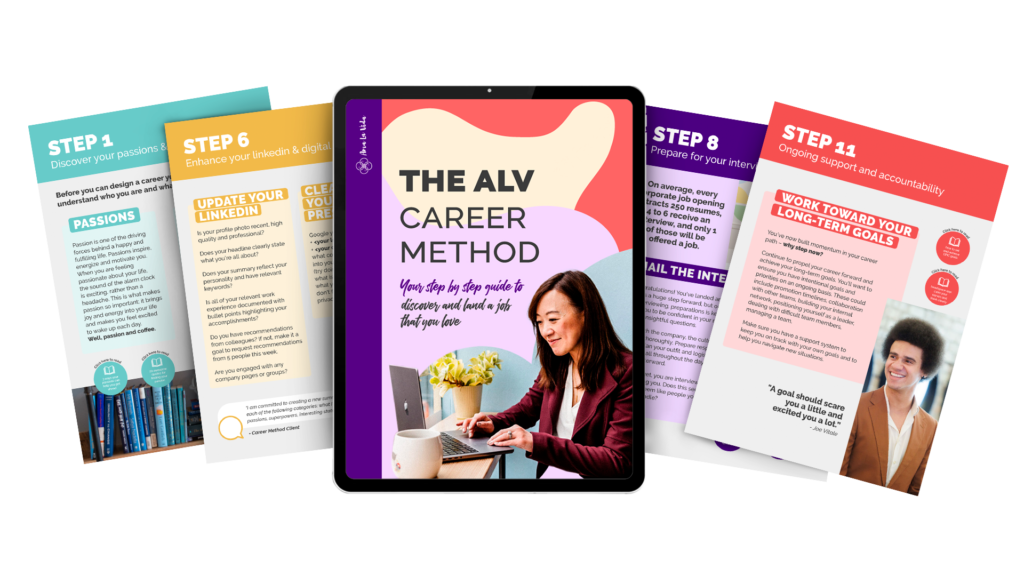
Download our comprehensive step-by-step guide to design and land a job you love!

Images from The ALV Career Method Guide
ALV Method Downloadable Guide

People tend to focus the most on their careers when they’re in a slump. That makes about as much sense as trying your best to harvest food from your farm in the middle of winter, rather than learning to optimize in the good times. In order to have the best chance at a prosperous, successful “total career,” you need to be doing certain things during the good times that (in my experience) almost no one does. And as a result, the lean times are shocking, disruptive, stressful and painful for just about everyone. Here’s the good news: statistically speaking, you’re probably going to have way more good times than bad. At least on net. So if you’re in a rough patch now, these tips can help make sure it’s one of the last ones. And if you’re not in a rough patch – then this advice is exactly for you to act on to optimize the good times, starting today! Tip #1: Get Out of Your Tower When people are gainfully employed, the tendency is strong for them to just stop paying attention to the outside world. Especially if they’re relatively satisfied with that employment. Job market conditions, industry trends, up-and-coming voices? All blissfully ignored. Whenever the inevitable employment change is forced upon them, suddenly they feel like they don’t understand the world anymore. People complain that recruiters try to headhunt them when they’re employed, only to complain that they aren’t headhunting them enough when they’re jobless! So don’t blow off those recruiters. You don’t have to be looking for a new job to have a good conversation with someone. And that conversation creates a connection, which leads to more, which becomes a network. Set some specific goals for yourself, like: Goals like these keep you accountable to being “out there” well in advance of truly needing to be. There’s a reason that we hear the clichéd phrase “dust off the resume;” because things like resumes and LinkedIn profiles sit around collecting dust for most people until they’re needed. Guess what – you’ll always need it eventually, so keep the dust off! When the lean times come, you won’t be starting from scratch after a ten-year absence. Make sure to optimize the good times. Instead, you’ll have a thriving network and platform ready. You’ll have the awareness of both the general state of the market and of possible opportunities. And you’ll the confidence to navigate it all! Tip #2: Create Your Brag Book Remember the last time you had to update your resume? Someone told you that it’s important to have tangible accomplishments and results on there (it is!). Remember when you wracked your brain for hours trying to remember the specifics? What about that really touching email you received from a retiring coworker, telling you how much you taught and inspired them? That’s now forever lost on your old work email server, which you can no longer access? If you stop to pay attention, your life is filled with small reminders of your success and competence. But they’re often small enough – and in fact, numerous enough – that we ignore them. They’re nice to see when you see them, but then quicky forgotten. We see positive quarterly feedback forms, thank-you letters from clients, or a blurb about us in the company newsletter. But almost no one saves those things. You should!  “Show, don’t tell” If you can show someone “social proof” of your ability to do a job well, that will open many more doors than a simple resume. But it’s extremely hard to go back and get those things after the fact. They often disappear, and even if they haven’t, you may no longer have access to them. Imagine after losing your job, calling up your old manager to ask them to dig through the archives to find every positive review you’ve received over the last 5 years and send them to you. Think it’ll happen? You need to have a folder (on your own computer) where you save these things. Send copies of emails to yourself. Save all of your reports and projects, screenshots of “great job” texts and any other signs of your success. Save it all! You never know which piece will be the perfect capstone to a future presentation or application. And as a bonus, it can really help drive off impostor syndrome to occasionally open up that file folder and look at the huge volume of your successful endeavors! Now, I can already hear at least a few of you saying “this tip is great in theory, but I never get any praise. What should I do?” Tip #3: Your Annual “Review of You” When you first settle down into a hot tub, it’s blissful. Relaxing and soothing, it immediately has a tremendous positive impact on your mood and physical state. And for a while you really enjoy it. But after a while, you decide it’s time to get out. Why? The temperature of the hot tub didn’t change. The outside temperature didn’t change either. Nothing external had to change. Your body just told you that it was no longer correct to be in the hot tub, and you listened. The change was internal, and it drove your actions. We don’t do that enough in our careers. We fear uncertainty, and for many of us unemployment equals uncertainty. So even as we grow and change, we ignore the effect that has on our alignment with our current role. We ever so subtly lower the bar for what we consider “good” until it looks a lot like “not bad” and then “could be worse” and then “at least I’m not unemployed”. Until finally, it’s “this is so horrible I have to escape.” That means you ignore progressively redder flags, like not receiving accolades or needing increasingly longer “decompression” times after each workday. And by the time it’s finally added up to enough to shake us out, we’re in such a state of fear,

Read More

We are all well aware that these are “unprecedented times” and that there is no playbook for how to navigate them. That has left many of our clients confused about how to approach next steps in their careers. How do I approach the job search in a pandemic? Can I still negotiate my salary? Do I have to go back to the office? We’ve rounded up a list of the most common and pressing questions from our career coaching clients. Our amazing team of coaches have provided answers to these questions so that you can keep progressing toward your goals. Job Search Questions I’m seeing postings for interesting jobs that I feel under/overqualified for. Should I still apply? Yes. Why do you need anything else?  That’s the whole answer.  Okay, more seriously… absolutely you should. You’re not always the best, most impartial judge of your own abilities, and writing qualifications for a job posting is far from a scientific process. The reality is that if you can create value, that’s the only real qualification – so don’t eliminate yourself! –John Roccia How do I not submit applications 800 times?  The unfortunate answer is being super intentional with networking and crafting applications. Use it as a test – if you’re not interested in the job enough to spend time on the application, skip it. Don’t treat it like a to-do list with prescribed checkboxes. There’s no “right” way to do things, only effective and ineffective ways.  Effective ways aren’t one-size-fits-all, they’re customized.  Make friends and conversations, not applications. Throwing spaghetti at the wall to see what sticks doesn’t get you any closer to a job, especially a meaningful one. Those fire-and-forget applications drain your morale and energy but add nothing to your process. Don’t get pulled into the trap of thinking this is a numbers game – it isn’t.  – John Roccia Does anyone read my cover letter?  Yes, your cover letter is getting read. And not only by the recruiter or hiring manager. Sometimes your cover letter has been forwarded to your potential boss, or another department altogether. It is important to include a cover letter as it gives the reader the basic information about who you are, why you are interested in the company and what you have to offer. In some instances, a cover letter makes you distinctive as other applicants won’t/can’t be bothered with it. Check out some cover letter resources here.  –Shari Santoriello Does my resume format matter?  Yes!!! If you are applying through a “apply now” button, just know that your materials are going through an applicant tracking system (ATS). The best format for any online application is a word document, void of graphics, column, tables and borders. Use of bullets and commas are okay. While the online application may say that a PDF file is okay, I would still avoid it, if possible. I know there are so many stylized resume formats to adopt and they look great, but unfortunately not all of them can be parsed through an ATS system. That puts you out of the running before you get started. Watch out for these resume mistakes!  For those in a creative field, having two different-formatted resumes is a great idea. You can have one straight Word document for online applications. Then craft a second stylized, creative resume for sending directly to people, or highlighting on your website.   -Shari Santoriello I know I’m a skilled person. Why can’t I get a job?  This is my least favorite yet most commonly asked question these days.  The tough reality is it may be timing. The world is tough right now. Things are changing rapidly.  Companies that appear to be hiring may just be recalling laid off or furloughed employees back. Companies you see growth in may have formerly asked employees to take pay cuts and are finally able to increase salaries and grow their current staff. So even when you see growth out there it may not have the outwardly impact you’re expecting. Patience is critical in these times. It may not happen overnight, or as rapidly as it has for you in previous booming employment years. It’s important to remember that a delay in hiring doesn’t mean you’re not a great, high-skilled employee.  Tips: Make sure you take your time and apply for every job with intention, tailoring your resume and cover letter.  Work hard to find a connection in the company (six-degrees of separation) so you can get your name to them in multiple ways. Network, network, network, and when you are sick of networking, network some more.  Most jobs are being found these days through networking. This doesn’t mean tracking down a stranger on LinkedIn and asking them to get you a job. This means letting people in your network know you’re looking and asking them to help connect you with other people. Then, let it grow from there.  Treat every conversation you have as a possible opportunity and just see where everyday life leads you! A high skilled VP client of mine recently was very frustrated with the job hunt process. She wasn’t getting any bites and was feeling very stuck in a job she was miserable in.  I told her to pause. Take a break from all the searching and applying. Just take a break, take a breath and when ready just have a couple simple networking calls with people you already know so the pressure is low. She did precisely this, and two weeks later at our next session she told me they had connected her with someone in their network. She had a job interview that week. No applying, no surfing the internet, just a simple conversation with someone she knew. Tap into that network, keep your head high and your confidence up.  –Jennifer Maynard Should I negotiate my offer even in the midst of the pandemic?  Yes! There may not be a budget for what you request, but you should always try. Even if they cannot

Read More

Whether you’re considering a new job or aiming for a promotion, knowing how to negotiate can be key to securing the pay and package you deserve. While it’s critical to know what you should do, it’s just as important to know what you should avoid to prevent blunders blowing up in your face during salary discussions. There are common salary negotiation mistakes that can result in a much lower pay than you expect. Worse, you may end up losing the job offer you’ve worked so hard for. The following seven negotiation mistakes can be easily avoided with some skill and know-how. Salary Negotiation Mistakes: Not Negotiating At All A 2017 survey run by PayScale found that: 57% of people had never negotiated for a higher salary. Over 70% felt they lacked adequate negotiation skills training. About 28% felt uncomfortable negotiating. 19% feared being perceived as pushy. Yet, according to a study by Robert Half Creative Group, over 70% of executives are prepared to negotiate and pay more than their first offer. So when you fail to negotiate, you could literally be leaving money on the table. Don’t make one of the biggest negotiation mistakes by being afraid of butting heads over your compensation package. Negotiation is ethical and expected. When you don’t negotiate, you lose out on a potentially higher salary. In addition, subsequent salary offers may be based on your previous salary. So your initial lower salary might have a snowball effect that may last throughout your career. Not Knowing Your Value Knowing what you’re worth prepares you to justify what you’re asking for. Today, previously hush-hush topics like salary are readily available with a little research. For example, there are online tools to determine how much people in similar positions and with the same training are earning in both yours and competing companies. Walk in to these conversations with a firm grasp of what you should be earning. Remember to have a lowest acceptable salary limit in mind. Once an offer has been made, take time to consider the deal. A little pause helps to put the offer in perspective. If you’re working with a recruiter, they likely have detailed guides on what companies are willing to pay for your skills. Knowing what the company is willing to pay can guide you on how much to ask for, what concessions you can make, and the perks and benefits to expect. Focusing on Self-Serving Needs Rather than Value Often, unskilled negotiators make overly ambitious demands to drive salary offers up. For instance, many feel the temptation to lie and exaggerate about their current salary. However, such tactics can be transparent and come across as self-serving. Rather than focusing exclusively on your needs, consider the company’s needs too. When making a counteroffer against an employer’s offer, focus on creating and claiming value rather than coercive tactics. Take time to build rapport. Share your underlying interests and the value you bring to the role. Find possible trade-offs that enable your employer to see you as a trusted partner. You don’t want to appear as someone who only looks out for their own interests. If there’s an issue you don’t feel strongly about, you can indicate that you’re willing to make a concession in return for something you value more. For instance, you can forego some sick days for greater work-from-home flexibility, with your home office setup being funded by your employer. In all discussions, find ways to create win-win solutions rather than employing a winner-takes-all strategy. Not Negotiating Beyond Money When walking into an interview or salary review, keep in mind that the company seeks to look after its own interests. In maximizing returns, the managers may forget to consider certain employee perks and benefits. By negotiating, the employee brings to light needs that the management may have overlooked. When you don’t negotiate benefits,you stand to lose as much as $500,000 over the course of your working life.  It’s easy to find yourself fixated on gross salary figures, especially when the money isn’t as much as you had hoped for. However, before rejecting an offer based on the salary, make sure you’ve considered the perks and benefits. A higher gross salary may not mean much if your paid family vacation days are withdrawn.  When you decide that all the terms of your employment are open to negotiation, then a world of opportunity awaits. Consider discussing dental cover, company training, pension contributions, life insurance, vacation days, or a car allowance. Many companies nowadays are eager to provide perks and incentives that motivate their employees. Taking It Personally People naturally fear rejection or being perceived as greedy or pushy. Yet in business and career, rejection could simply reflect that you didn’t present a viable proposal. Don’t take the reactions of others personally. Instead, consider whether your argument justified your need for a higher salary. Often, in employment negotiations, a “no” reflects a need for more information. Take heart knowing you might have to sometimes endure a rejection before finally getting a “yes.”If at first you don’t succeed, keep refining your negotiation skills and come back if you feel you’re worth the higher salary. If talks break down, move on graciously. Your professionalism can win you contacts who might influence your other interviews later in your career. Asking For Too Many Changes A few employees make the mistake of asking for too many changes, especially after winning a first round. For instance, you ask for a 7% increase and when granted you then ask for a signing bonus. Then you follow up with a demand for corporate training. It’s perfectly okay to propose changes to your employment contracts. However, too many demands might frustrate your recruiter or employers. Also, expecting an entire overhaul of the contract is unrealistic. Remember: Companies have policies to stick to. Instead, be decisive with your first counteroffer. Pick specific employment terms you want to change in the contract. Propose all the changes you want in one move rather

Read More

Networking has and always will be a little (a lot) difficult. Even so, it’s a major part of the job search process. Networking is something that people struggle with, even during “precedented times”. With things moving online, the networking process has changed a little. Gone are the times of walking in a physical room and shaking hands. So today, we are talking about how to network in a remote world, and how to do it well! Reaching Out Thinking about networking as making connections and having a conversation helps make networking less awkward. Networking has this weird connotation that brings about a lot of pressure. Changing your thought process to have it be more fluid helps break that pressure down. Don’t be afraid to reach out. You even have a built-in conversation starter: the pandemic. And remember, the worst thing that can happen is that you’re ignored. Use the above mentality when reaching out to new connections. It can be intimidating when reaching out to someone you might not know. When doing this, take a deep breath and have a personalized message when connecting. Thank them for accepting your connection, talk about why you’re connecting (friend in common, their work history resonates with you, etc.), and have something to offer them (an article, a connection, etc.). Growing Your Network In a Remote World LinkedIn When it comes to networking online, LinkedIn is one of the best ways. Over 95% of recruiters are on LinkedIn, looking for candidates. When it comes to LinkedIn, you want to make sure that you’re easy to find and that you keep your profile up to date. Have a picture that is up-to-date – people rarely accept profiles without a photo. Make yourself someone others want to network with, instead of just someone who always networks outward. This means being visible online, being welcoming/friendly, being relevant, being a connector, and having a decent “hook”. This could be a tagline, a unique feature about you – just something that makes you stand out a little. Virtual Conferences Virtual is now becoming the norm, and virtual networking and conferences are following suit. Do some research and figure out what networking events are going on in your industry (or desired industry). This also opens up conferences in all locations since you’re no longer restricted to where you live. When you’re on the call, make sure to be engaged, have your video on, and utulize the chat! Share your email or LinkedIn and connect with others on the call. Informational Interviews Informational interviews are a great way to expand your network. Simply put, an informational interview is a conversation with someone who is in your desired field. It’s not about landing a job, it’s about a way to get information about the job/industry and allows you to “interview” without any of the stress. In addition to learning more about the industry, this also builds connections that could be used in the future. Making The Most Of Your Connections Be a Giver, Not Just a Taker You don’t want to come across as self-seeking, you want to bring something to the table as well! This could be an article that you’ve read that you think they’d find interesting or anything of the sort. You want to let people know that you’re not there to take advantage of them, but that you’re an active participant who goes the extra mile. And it might go without saying, but don’t ask for a job in your first meeting. You need to develop a relationship of being a giver before becoming a taker. Do the Legwork If you set up a time to connect, do the logistics. Be the person who sends the invite, is the host of zoom, etc. Also, make sure that you’re genuinely interested in their journey and that your intention comes across. Ask them: “What led you to where you are?”, “What helped get you here?” “What do you wish you knew back then that you know now?”   You want to make sure that you are making it as easy as possible to network with you! Keep Your Contacts On Simmer When it comes to connections you already have, check in and see how they’re doing periodically. You don’t want a job opportunity to come up where they are a connection, but you haven’t talked to them for a year and now you’re asking for a favor. Keep your contacts on simmer so that you’re top of mind when opportunities arise! Networking is tricky and intimidating, but hopefully these tips on how to network in a remote world will help. If you need more support, join us for a special Ama La Vida Members Only networking event!

Read More

Why are we as professionals worth what we’re paid? This question can have as many answers as there are people to ask it – and each of our own answers is unique, but there are similarities. Are you having difficulties with tricky salary negotiations? If you’re looking for advice on how to deal with a prospective employer who doesn’t seem to want to pay you what you’re asking for, here are some things to think about: Hard No Vs. Counter Offer Hard “no”s mean they no longer have an interest in you. But, if you’re getting a counter-offer, you’re hearing “we want you, but at this compensation.” Make sure you have clarity on this fundamental difference before going down any assumption rabbit holes. If it’s not clear from their words or behavior, you may need to ask them outright: “I’m not sure whether you’re rejecting my offer, or making me a counter-offer. Could you please clarify?” It’s perfectly acceptable to ask this, and will usually result in a more straightforward answer than their previous communication. Just remember: a hard rejection is different than a counter-offer. Realistic Salary Expectations There’s always the chance you’re asking for a higher salary than any company is willing to pay. Have you done your compensation research? If not, go search your target job title(s) on PayScale.com and Glassdoor.com/salaries. Make sure you’re within the right range. A note about location-based salaries: Location only matters if the company isn’t hiring remotely. If you’re negotiating salary with a fully remote company, do not let geography influence the number. It does not matter whether you decide to live in an expensive city or low-cost rural area. If you know your asking rate is in the correct range, it’s time to dig into why the employer isn’t thinking along the same lines as you. Understand Their Reasoning The better we understand others’ beliefs, motivations, and limitations, the better equipped we are to move forward towards an outcome we’re happy with. To understand why someone might not say “yes” to the salary you’re asking for, we need to first understand the factors that people use to make buying decisions. This isn’t a faceless company we’re referring to. This is one (or more) human being(s) reaching a conclusion based on the information they currently have. Based on the information you have, why do you believe they decided not to say “yes”? (If they shared their reasons, do they make sense to you?) Here are some common reasons they might be: They might simply be negotiating Negotiations are a game, not a war. We negotiate based on a belief that we can earn more—or pay someone less—and we’re usually right. You probably want more money, not less. And they’d like to pay less, not more—if they can. Basic supply and demand will dictate a general range of salaries, and buying decisions always mean “What I’m buying is worth more to me than what I’m paying for it.” Assume good intentions and try to play the game—not the war. They might not be able to afford your rate Sometimes, organizations can’t afford to pay us what we’re worth. This is common with local (“mom and pop”) businesses, early-stage tech startups, and nonprofits funded by grants and donors. There are usually alternative benefits to making less in these roles: local business owners can teach you a lot about business; startups offer equity—worth a lot if the company succeeds; nonprofits help you have your student loans forgiven. If an employer literally can’t afford what you’re asking, your decision will be: are you willing to take less? They might not think you’re worth it Though we don’t like talking about it, this is probably the most common one. We don’t always do the best job of “selling ourselves,” or, as Christopher Lochhead puts it: “being the only choice.” Think carefully about this part: Have you proven that you’re worth what you’re asking? This doesn’t necessarily come in the form of work experience on a résumé. You simply must make the other person believe that you’re going to be worth more to the company than they’re paying for you. Remember, we all make buying decisions based on a belief that “What I’m buying is worth more to me than what I’m paying for it.” The employer is no different, and will only agree to your rates if they believe you will “pay yourself off” over time. (By the way, this is not to belittle or reduce human beings to pure economic value—we are valuable far beyond the dollars we generate or save.) Make sure your personal website and online/social presence (at the very least, LinkedIn) are resounding testaments to the quality of work you’ve produced, the value and contributions you bring, and what it’s like to work with you. Then, make them an offer to prove it: “Let’s start with one project together, so I can prove I’m worth this rate. If you still feel otherwise afterward, pay me what you felt it was worth and we’ll part ways as friends.” This is incredibly powerful in tricky work and salary negotiations, and has personally resulted in some of the best professional relationships I’ve ever had. They might just be low-balling you Some companies string candidates along, make low-ball offers, and end up hiring the person who will take the least amount of money to do the job. Red flags can include: not providing clear reasons for rejecting your asking price; taking a long time to respond; appearing unprofessional in other ways throughout the interview experience. Ask yourself honestly whether the company (and the person(s) you’ve been interacting with) seem serious about this process. If you’re seeing some of these red flags, take Jenny’s advice and run, Forrest, run. Stay Confident During These Tricky Salary Negotiations Remember that there are other fish in the sea. Even when you’re navigating tricky salary negotiations with your absolute dream employer, remember there are just as great of companies out there. You may not know of

Read More

Google the word “resume” and you get about 636,000,000 results in 0.72 seconds. That will give you close to one billion different opinions and options on how best to build a resume. With that many different options, resume mistakes are bound to occur – that is very overwhelming! In the words of Heidi Klum: “Keep it simple. You don’t want to overdo it with too much makeup or crazy, over-the-top hairstyles. Let your natural beauty show through.” This is exactly what a resume should do, allow your “natural beauty” and capabilities to show clearly, without all the extra fuss. Mistake #1: Too much! Your resume isn’t a menu for a diner, not everything needs to be listed on there. Your resume should be no longer than two pages, preferably a single page. (Unless you are writing a CV, but that’s a blog for another time!) You should be choosing the best accomplishments and results you have to offer on your resume. This should not be a list of tasks! A resume is a sales piece and should showcase your value and impact, quickly & simply. You have about six seconds to catch the reader’s eye. You want your resume chockful of your most results-oriented skills, not a list of tasks and other information not relevant to the job. Plus, you want to leave room to expand your narrative over the course of the job search and get the chance to tell the stories connected to the results! Mistake #2: Using the same resume for every job You need to hone in on the skills and results you want to showcase, for THE PARTICULAR JOB YOU ARE APPLYING FOR AT THE TIME. I already hear the groaning, but it isn’t as hard as it sounds. Format your resume in such a way that the bottom two-thirds (from experience down) stays basically the same from application to application. The top third (your summary, key skills and notable accomplishments) can change to accommodate the language and needs listed in the job description. This is called optimization. It starts by acknowledging that the applicant tracking system (ATS) exists and it is likely that your resume will need to go through one! This is a computer system that is programmed to look for key words and terms in your resume so that it can determine if you are a good candidate for the job, based on only those terms! (Think Google and search engine optimization!) The challenge with this is that it is static and doesn’t allow for you to explain a lot of things. (And yes, even smaller companies use it!) The best way to work with the ATS is to give it what it wants. Be sure that you are using the language and lingo that the job description uses! One way to help with this is to build a word cloud from the job description and then be sure that your resume features the terms used most. (As long as it is the truth!) Mistake #3: Stylized, Graphic Resume Not everyone needs a stylized resume! If you are in a creative career space, feel free to show off your skills with a stylized resume. Be sure that it is going directly to a person’s email, and not through the ATS. Remember the ATS is a computer system programmed to parse out information into a standard form that works for the viewer. Very often a stylized, PDF document will trip up the system. As the user, you have no idea how robust the system is and how it’s set up to grab your information. Take away the first barrier to getting your resume seen. If you are applying online and are not 100% sure it is going directly to someone’s in box, then go with a word document. Remove as many of the graphic elements that you can. This can be vertical separators, symbols for phone, email, socials, horizontal separators, columns, tables, highlight boxes and diamonds. Use bullets and commas to separate information. Format with an easy font that most computers have: Calibri, Calibri Light, Arial, Times New Roman, Helvetica, Garamond. Stick to the basics! A stylized resume can seem like a good idea in theory, but can be one of the biggest resume mistakes in actuality. Here is a list of great resources to see if your resume will pass through an ATS easily. Mistake #4: Physical Address and Objective Two things that are now antiquated are your physical address and the listing of an objective. There is no need to list a physical address on your resume anymore. If you want to let an employer or recruiter know that you want to stay in a geographical location, then list “New York City, NY” or “Chicago, IL”. With many jobs being location ambivalent combined with privacy concerns and implicit biases, it is no longer imperative to have your physical address listed on a resume. The same goes for an objective. The employer or recruiter isn’t as interested in what you are looking for, but much more so what you can bring to the organization. This is where you want your summary to do the hard work! Be sure that your summary is a show your impact rather than a tell what you want to do! It is also important to get specific and personal in your summary. This is a three to five sentence paragraph to show off your value and contribution that you will bring to this employer! Mistake #5: Lying This is an absolute no-no and one of the biggest resume mistakes! It will always come back to you negatively. Be honest and clear about who you are and what you can do. Feel free to use action words, clear numbers, percentages and qualitative words to describe your skills. You want to be able to talk to your resume confidently and comfortably once you secure an interview! No need to wade through over half a million Google results to create

Read More