Category: Mindset & Mindfulness

So, you’ve decided you’re ready to work with a life coach, you’ve met the right person to be your coach, and your first session is scheduled. Now what?! Today, we’ll go over what you can expect from your first life coaching session. Of course, this will look different for every coach depending on their style, approach, and structure, but for the most part, this outline should give you a good idea of what’s ahead so you can feel excited and prepared for your first session! Jitters and Initial Questions Before and during your first life coaching session, you may feel jitters or nerves – that’s okay! We know it can be nerve-wracking to try something new, share personal experiences with a stranger, and have video meetings in general! Your life coach will do everything in their power to create a safe and open space for you to explore the various topics you’ll have in mind!  To break the ice, feel free to prepare any questions you may have about your coach, their background, or how things work. If anything is unclear and making you uncomfortable, feel free to share it right off the bat so your coach can answer questions, address concerns, and get to know you better! Ground Rules & Expectations After you get the initial questions out of the way, you and your coach will go over some ground rules and expectations. This can include anything from scheduling logistics, discussing cancellation policy, and going over what to expect from your coach and sessions moving forward.  This is also a great time for you to set your own expectations about what you need from your coach in your sessions and beyond. Your life coach is here for you, and many of their ground rules and expectations are set to make sure they create a great environment for your personal development and growth – however, you are ultimately the expert on your life, so don’t hesitate to ask for what you need to succeed.  Who Are You? Once logistics and ground rules are reviewed, you’ll jump into the good stuff: getting to know YOU! Your first life coaching session is all about your coach getting to know who you are and what works and doesn’t work for you.  Your coach may ask a lot of questions to learn more about you. Rest assured that your coach comes from a place of openness and curiosity and never judgment. This is definitely the time for you to express any needs you may have when it comes to feeling seen or heard so your coach can better adjust their approach and coaching to your unique needs! Why Are We Here? At this point, you may have met your coach during a consultation or it may be your first time talking to them! It’s important that your coach learns what led you to coaching and what’s motivated you to seek coaching at this moment in time.  Goal Alignment Life coaching, from wherever you look at it, is about you; what matters are your goals, your obstacles, and your dreams. In your first life coaching session, you’ll take time to make sure you and your coach are aligned on what your goals are. Every coach does this slightly differently, but the purpose is to make sure that both you and your coach are clear on what you want. To prepare for this, you can reflect on some of the following questions: What do you want that you don’t currently have? Tangible or intangible! How would your life be different if you achieved your goals? Have your goals changed recently? What led to this change? What have you tried in the past? What worked? What didn’t? Your coach will support you in getting clear on your goals, so don’t worry if they’re blurry and jumbled up before your session. Setting clear goals isn’t a one-and-done deal, and this will be the first conversation of many that you will have around goal setting. Takeaways & Next Steps Because life coaching is all about you, you’ll always have some time to reflect at the end of each session. What are some of your biggest takeaways from today’s session? What did you learn about yourself? From there, you and your coach will define your action steps. Some, you may set for yourself based on your session and goals. Others, your coach will challenge you to do; such as completing one of Ama La Vida’s eCoaching Modules or doing some journaling to reflect on a particular topic or theme.  Are You Ready? Facing the unknown of life coaching and what to expect can be daunting and scary. We hope that you are now feeling more prepared and at ease as you approach your first life coaching session! As always, let us know if you have any questions before you get started – we’re happy to help!

Read More


Employee retention has never felt more critical than it does today. We are inundated with “great resignation” articles and headlines about the hot job market for employees. A March Pew Research article tells us the nation’s quit rate reached its highest point last November and doesn’t appear to be slowing down. As a Career and Leadership coach, I can say the majority of my clients are considering career shifts – mostly due to feeling under-resourced, overwhelmed, and under-appreciated. Organization stress and pressure are at an all-time high. And every time a talented leader or team member leaves – the effect is dramatic on team morale and performance. Not to mention the productivity loss in dollars and time.  Organizations need to retain their talent. Period. Full stop. They can’t afford to lose their current employees – the ones who know their business/product best, who have established the right relationships in/outside the company, and who have already grown and developed within the company’s culture and structure. So what can companies do to stop the exodus? My suggestion is to invest in your leaders  with coaching before you lose them.   An investment, not a cost  I am using the word invest strategically, and here is why. Yes, coaching costs money. But you need to remove the word cost from your thinking and replace it with investment. Coaching is an investment in your leaders, and this is important because the positive impact of coaching your leaders reverberates to the teams they manage. This article in Forbes backs up my thinking by sharing “The leadership team undoubtedly makes or breaks a company’s culture and an employee’s experience. Regardless of how great a manager or one’s team is, leadership sets the tone for the workplace. If leadership is only focused on profit and limits the investment into employees whether that be through benefits, developmental opportunities, or engagement initiatives, it’s felt by all.” Get ahead of issues Many organizations make the mistake of only bringing in outside coaches when they are trying to address a problem. Or they are reorganizing and want to get alignment on next steps. These are excellent examples of how coaching has helped organizations. But I want you to consider coaching as a proactive investment instead of a reactive one. Think about other investments you make in life like a new car or a fancy computer. In all of these examples, you are on board with the preventative maintenance it takes to keep these items running smoothly and optimally. You do this via checkups, scheduled/routine updates, and enlisting the support of experts to ensure you are taking care of your investment. Why can’t this same mindset apply to your leaders and teams? In this blog post, Ama La Vida founder Foram Sheth builds a case for investing in your leaders early before problems exist. She says “…we should support our leaders with the individualized care and support they need to thrive in alignments with your team, culture, and organization.” I echo this wholeheartedly and feel like now is really the time – as the pressures are more intense than ever before.  What exactly is coaching? Said simply, coaching unlocks a person’s potential to maximize their performance.  In practice, that looks like – clients partnering with a professional coach via 1:1 sessions. Coaches use active listening, empowering questions, and other tools to help raise awareness, empower choice and support goal setting and accountability to move things forward. Tell me more about the ROI? If you need more reasons to reward them for staying by investing in them, then think about this return. According to the International Coaching Federation (ICF), 86% of organizations saw an ROI on their Coaching engagements, and 96% of those who had an Executive Coach said they would repeat the process again. As a coach, I have witnessed the following tangible impacts for my clients whose companies sponsored their coaching. Improved productivity Clarity on their opportunities to elevate their leadership skills Awareness of their strengths and blindspots Opportunities and goals around delegating Actionable steps to improve workplace relationships  Enhanced job satisfaction Increased attention on organizational goals and their specific role in moving things forward More accountable to self and others Improved preparedness for pitches/presentations/meetings Effective navigation of increased responsibilities, business challenges and new positions/promotions  And these same clients had a number of intangible benefits that came out of coaching like: Feelings of being cared for, supported, heard Increased confidence More fulfilled, happier This is a powerful list, and it’s not even inclusive of everything that is possible with coaching. And don’t forget about the exponential gains for the teams these leaders are managing. When the leader improves, the team improves too.  I want to learn more Leaders require unique and personalized support. One-to-one coaching is a great way to offer this support to your leaders. If you are inspired and want to help your leaders thrive in today’s environment while demonstrating your investment in them,  use this form to get in touch with us to learn more.

Read More
two women co-working

“It always seems impossible until it is done.” Nelson Mandela People often give you the advice to take “baby steps” to accomplish a goal. Before having a baby of my own, I always thought that meant breaking down a large goal or complex situation into smaller, more manageable. But now that I have a 16 month old who just learned how to walk, this metaphor has a much more important message for me. Watching my son learn to walk, he would stumble, fall down and get incredibly frustrated. And yet, I’ve never seen someone more persistent in achieving what they want, despite the setbacks along the way. When you start working toward a new goal or behavioral shift with your coach, think about taking baby steps. Break it down into tiny pieces, and also mentally prepare yourself for the fact that the process will not be linear. You’ll find your stride and start moving forward, and then you’ll lose your footing, wobble and maybe even fall flat on your bum. Think of a baby learning to walk and accept the trials and tribulations along the way because they are a part of the learning process. Stay diligently focused on your goal and you’ll come out stronger in the end. If my son called it quits when he faced challenges, he’d be sitting on the floor the rest of his life. Instead, I’m trying to keep up as he runs all over the place and sees the world in an entirely new way. I want that for you, too.

Read More
woman smiling sitting outside

Over the last few years, the conversation around mental health has been shifting from silent and stigmatized to open and commercialized and everything in between. I, for one, am so glad we’re starting to talk about mental health. It’s not just about being healthy or struggling with mental illness, there is a big area in the middle that tends to be forgotten.  Today, we’re going to talk about improving your mental health the way you would improve your physical health if you’re already a relatively healthy individual. How do you show up to the “mental gym” and what sorts of things do you do to flex muscles that may be a little weak? Let’s dive in! Note: Mental health is on a spectrum and before we dive into some ways you can improve and care for your mental health, we want to call out that sometimes the best answer to this is to seek help. If you feel like you need professional help with your mental health, please call a mental health provider or seek out immediate help through the SAMHSA National Help Hotline.  1. Lower Your Expectations Every time I say this to my clients, they laugh. Lower my expectations? Why? Well, odds are that your expectations of yourself are way too high. Much higher than the expectations you hold of others or anyone else holds of you. So, lower them.  We expect ourselves to give our 100% ALL of the time and if we don’t, we beat ourselves up for not doing enough or being enough. So I say, lower your expectations. A good way to frame this is by coming up with your goal and then breaking it down into three categories.  Your first category is your expectation of yourself when you’re feeling your best – this can be your “ideal”  The second category is your expectation of yourself if something else were to come up – a busy week, a last-minute deadline, or a head cold And the final category is your expectation of yourself if something major happens – a family emergency or a more serious illness like the flu or covid Now, that third category is your new goal.  Anything beyond that, categories 2 and 1, is exceeding your expectations, not meeting them. Anything you do that’s the third category or more, you celebrate! If you don’t meet that level of expectation, you reflect: what happened, what got in the way, what type of support do I need? In none of these circumstances, do you ever beat yourself up. Got it? 2. Stay Present “If you are depressed you are living in the past. If you are anxious you live in the future. But if you are at peace you are in the present” Lao Tzu Living in the moment or mindfulness has been and still is a hot topic of conversation. We all know we should do it, but how do we do it when our minds are reeling, going a million miles a minute? One of my favorite mindfulness practices is a practice called “Orienting.” It’s simple and you can do it anywhere, anytime. I encourage you to have scheduled moments in which you orient (set an alarm or match it up to a thing you do every day like drinking coffee, eating lunch, or brushing your teeth).  Before starting this exercise, pay attention to your breathing. Take slow, deep, long breaths – in through your nose and out through your mouth. Breathe deeply for about 3-5 breaths and then go through the following steps: 5: Acknowledge FIVE things you see around you. It can be anything, don’t worry about judging it or bringing any memories or stories in. Don’t start thinking “I see my room, it’s so messy and there is clutter and I should’ve cleaned it” Simply acknowledge 5 things. Ex. I see a pen. I see a plant. I see a computer. I see a tree. I see a couch. 4: Acknowledge FOUR things you can touch around you. It could be your hair, a pillow, or the ground under your feet. Again, no judgment or stories just state facts. Ex. I can feel the ground on my feet, it feels cold and solid. I feel the pillow in my hand, it is soft and fuzzy.  3: Acknowledge THREE things you hear. This could be any external sound around you or near you.  Ex. I can hear the whirring of a helicopter. The sizzle of a pan. I hear my dog snoring. 2: Acknowledge TWO things you can smell. Maybe you are in your office and smell pencils, or maybe you are in your kitchen and smell food. If you need to take a brief walk to find a scent you could smell soap in your bathroom, or nature outside. Ex. I smell my coffee, it is nutty and strong. I smell my shampoo, it smells like coconut. 1: Acknowledge ONE thing you can taste. What does the inside of your mouth taste like—gum, coffee, or the sandwich from lunch? Ex. I can taste my toothpaste.  Once you acknowledge these things, bring your focus back to your breath. How do you feel now? Where do you feel those feelings in your body?  You can also do this exercise in the moment when you feel anxiety, stress, or any other intense emotion come in. This simple exercise gets you out of your thinking brain into your feeling body and hopefully supports you in de-escalating emotions that may be too intense or negatively affecting you in your day to day. 3. Move Your Body Moving our bodies has proven benefits for our minds and bodies. It helps release endorphins, move emotions through our bodies, strengthens the mind-body connection, and get us out of our heads. Like everything, there are helpful and harmful ways to do this and for the sake of improving your mental health, we want to focus today on intuitive movement, what it means, and how to embrace

Read More

“It’s not the destination, it’s the journey.” Ralph Waldo Emerson Why Are Goals Important It sounds simple, but goals help you achieve things. They give you a focus, a direction, a vision of how you want your life to be. They can be larger, like finding a job you’re passionate about. Or they can be smaller, like getting into the gym 3 times per week (which isn’t always a small thing). All goals, larger and smaller, help move you in a direction that you want to go. I’ve been taking a leadership course through Cornell, and one of the topics was centered around how to get things done. When we think about getting things done, we tend to focus on the outcome, but not on the process. What I learned through my course was that process goals (or intermediate, in-between goals) are key to achieving your overall goals. What Are Process Goals Process goals are mini goals that are markers of your overall goals to help you stay on track. They are there to measure the effort that you are putting into achieving your overall goal. Let’s use the goal of getting into the gym as an example. In this instance, a process goal could be waking up at 6 am to be able to get into the gym before work. The point of the process goal is to support the overall main goal. Tips For Setting Process Goals They should be attainable, but challenging: your process goals should move you forward. If they’re too challenging, you might never begin.  Make them specific: take all the guesswork out of what you’re trying to accomplish, when, and how. Create accountability: talk to a friend about your goals. An American Society of Training and Development study found that you have a 65% increase of achieving a goal if you tell someone. Have a method of feedback, such as a tracker: this allows you to know what happened if you didn’t achieve your overall goal. Example: You know you didn’t make it to the gym because you didn’t wake up at 6 am most mornings, as seen on your tracker. We tend to focus on the outcome, but not on the process. Process goals are what allows you to get to where you want to go and understand what went wrong if you didn’t achieve your overall goal.

Read More

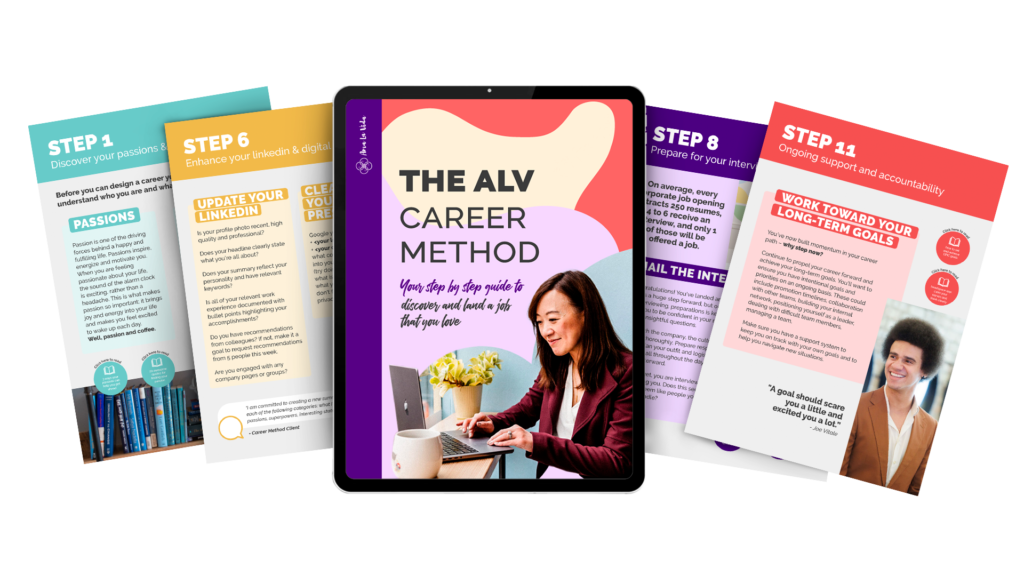
Download our comprehensive step-by-step guide to design and land a job you love!

Images from The ALV Career Method Guide
ALV Method Downloadable Guide

“You know what’s fire? Cultivating relationships with people who genuinely want to see you win and pouring that same type of love back into them. Building community with the right people.” Michell C Clark The most confident I ever was in my idea, my business plan and myself was the day I left my corporate job to work on Ama La Vida full time. I was convinced that the world needed what ALV was providing and that I was scrappy and stubborn enough to build it into a successful business. Every day since, I’ve doubted myself. I’ve doubted my ability to steer this ship. I’ve questioned why people would want to work for ALV. I’ve worried if we would make it financially. At times I’ve even gotten so lost in the nuance and slog of the day-to-day that I’ve forgotten why we were doing this in the first place. Building a business is a ridiculously difficult undertaking. I don’t care how experienced you are or how well-funded you are. It can feel like a constant battle, and it’s easy to get lost in your own mind. What brings me back to a place of clarity, sanity and optimism is almost never the numbers on the page or the dollars in the bank. It’s the people around me. What’s even gotten the numbers on the page and the dollars in the bank in the first place is not the brilliant business plan I wrote. It’s the people around me. In addition to having the good fortune of an amazing co-founder, I’m surrounded by other smart, caring and generous humans. My group text with some of my closest girlfriends is filled not only with “I believe in you’s” but also with “I’m recruiting for this role. Know anyone’s?” and “I’m struggling to get this deal closed. What advice do you have for this meeting’s?” It’s these ladies that give me the willpower to keep going when it all feels too much.  From legal to sales to PR, I’ve had friends donate time, energy and connections to help get ALV off the ground and continue to grow. When I’ve needed a creative approach to recruiting or a new software to fill a gap, it’s people in my network who have given me answers, solutions and resources. When I’m having one of those – why the heck did I even do this days – it’s other founders who lift me back up and encourage me to stay the course. Networking can feel like a chore. No one hates small talk and awkward exchanges more than I do. But building friendships, alliances and your community is anything but awkward… it’s life-giving. It’s not just an extracurricular activity to do when you have time. It *is* your job. My network (or honestly I prefer to just call them my friends) has given me more answers than Google, more leads than ads and more motivation than any quote on the wall. It’s the people who know us, love us and want us to success that will help ensure it is so. So when you’re ruthlessly trying to decide how to prioritize the bazillion possible things you as a founder can do with your time today, make sure connecting with friends, old and new, is at the top of the list. And the upcoming Founding Females event featuring Disha Gulati, of Here Here Market, will be a perfect opportunity to not only get your questions answered, but be in community with other entrepreneurs and grow your network. Be sure to join us! With love,Nicole

Read More

“It’s not the destination, it’s the journey.” Ralph Waldo Emerson Why are goals important It sounds simple, but goals help you achieve things. They give you a focus, a direction, a vision of how you want your life to be. They can be larger, like finding a job you’re passionate about. Or they can be smaller, like getting into the gym 3 times per week (which isn’t always a small thing). All goals, larger and smaller, help move you in a direction that you want to go. I’ve been taking a leadership course through Cornell, and one of the topics was centered around how to get things done. When we think about getting things done, we tend to focus on the outcome, but not on the process. What I learned through my course was that process goals (or intermediate, in-between goals) are key to achieving your overall goals. What are Process Goals Process goals are mini goals that are markers of your overall goals to help you stay on track. They are there to measure the effort that you are putting into achieving your overall goal. Let’s use the goal of getting into the gym as an example. In this instance, a process goal could be waking up at 6 am to be able to get into the gym before work. The point of the process goal is to support the overall main goal. Tips for Setting Process Goals They should be attainable, but challenging: your process goals should move you forward. If they’re too challenging, you might never begin.  Make them specific: take all the guesswork out of what you’re trying to accomplish, when, and how. Create accountability: talk to a friend about your goals. An American Society of Training and Development study found that you have a 65% increase of achieving a goal if you tell someone. Have a method of feedback, such as a tracker: this allows you to know what happened if you didn’t achieve your overall goal. Example: You know you didn’t make it to the gym because you didn’t wake up at 6 am most mornings, as seen on your tracker. We tend to focus on the outcome, but not on the process. Process goals are what allows you to get to where you want to go and understand what went wrong if you didn’t achieve your overall goal. ~ Brooke

Read More

“If you tie your self worth to your career, the successes and failures you experience will directly affect your self-worth.” Anne Wilson (professor of psychology at Wilfrid Laurier University) When I considered a career transition out of the HR profession, I initially feared that once I was no longer in a role as an HR Business Partner as I had been for so many years, that I would be lost without direction and not know who I was anymore. This idea, that my identity was directly tied to my job in HR, made me feel like if I were to leave my role or start over and make a change, that I would no longer be valued by myself or anyone else.  A pivotal moment for me… was when I realized that I had developed the critical skills and capabilities to be a successful HR professional, but that was not my identity. Whether or not I was employed with the title of HR Business Partner, I was still the same person that had all of the experiences that had led to the growth and development of my skills. I would continue to build meaningful connections with people by leading with curiosity and empathy. Active listening and clear communication would always be strategies I would utilize to solve problems in whatever role I found myself in. This awareness of who I am as a person and the experiences that I have had that have gotten me to this point in my career help me see how I contribute and add value to people and organizations in other capacities. In this way, I continue to work toward changing my pattern of thinking. Instead of deriving my self worth from my current career/title/role, I find it more helpful to focus on my achievements, experiences, and skills developed that have brought me this far. These are the critical parts of me that I will never leave behind. ~ Kristin

Read More

It’s scary to take on anything new. Change is difficult. Even when a change is necessary and it’s clear that a failure to change would create even more challenges, it’s still hard. It means releasing something that we may hold dear for any number of reasons. Sacrifice comes as a calling asking us to give up something and there are no guarantees on the other side. The mere ask to forfeit our comfort is like wrestling a favorite toy from a child.  Change is necessary to grow. No change, no shift means no possibilities and no benefiting from cool opportunities. If we want to expand, challenge ourselves, and experience renewal in some way, we have to embrace change. There are times when we can’t not change, as noted in one of my favorite quotes: “And the day came when the risk to remain tight in a bud was more painful than the risk it took to blossom.” Anais Nin When we arrive at a crossroads and it becomes clear that our only expansive option is to change, it’s time to nudge the process forward by taking several intentional steps. First, figure out your who, what, and why, then determine the when, where, and how. Know Thyself My guess is that we’ve all heard or read this maxim attributed to Socrates. Isn’t it interesting how much more fascinated we seem to be, generally speaking, in getting to know others? For some reason, though, we’re not taught early on to really get to know ourselves, well. I mean really understand how we’re wired, what makes us tick, what makes us happy and healthy; not just physically, but also emotionally, mentally, and spiritually. No one helps us truly understand what makes us blossom. There’s an amazing book related to self-acceptance I often recommend to women, titled, “I Know I’m In There Somewhere” by Helene Brenner. One of my favorite innercises in this little gem is called, Write Your Own Plant Tag. Typically when you purchase a plant, there’s a little plastic tag stuck in the dirt that provides some instructions on how to take care of the plant. I think you know the rest. She’s encouraging the reader to consider what makes them blossom. I’ve seen the transformative results of this simple innercise up close and personal on many occasions. It can serve as a powerful first step when you commit to really getting to know yourself from the inside out. Know Your Preferred Work Orientation I read an interesting research article years ago that shifted how I view work life. Dr. Amy Wrzesniewski discussed three orientations towards work – the job orientation, viewing work as a means to an end; the career orientation, viewing work as a ladder that propels you forward to achieve the success, recognition, and money desired; and the calling orientation, viewing work as part of your perfect self-expression where you experience meaning and fulfillment. Considering these three orientations and the one you have your sights set on is key. What are you looking to experience as you make your shift? Really give some thought to your orientation of choice. Do You Need a Mindset Reset? Our thoughts have a powerful influence on our lives. Ralph Waldo Emerson is credited with the words, “You become what you think about all day long.” Hmmm, what are your 10s of thousands of thoughts looping on a daily basis? Are you spending most of your time thinking about the past, what you didn’t do, what you should have done, and why you did what you did?  Seriously consider how much time you spend thinking about the past, present, and future. Go ahead, give it some thought and come up with what I call the “thought spread.” What percentage of time do you spend thinking about the past, present, and future? Is your “thought spread” working for you? Is it supporting your vision of success or sabotaging it? Only you can determine the best “thought spread” for you, one that allows you to engage with your past, present, and future in a healthy way that supports your shift and moves you closer to realizing your work-life goals. Starting Over Doesn’t Always Mean Starting Over So many feel that starting over ultimately means shelving all you’ve learned, acquired, accomplished, etc. That you must start at the bottom and work your way up all over again, perhaps go back to school and secure another degree to get what you want. In many, if not most, cases this is just not necessary. Depending on whether you’re looking to make a lateral move or kick your current industry and/or position to the curb for a new one, know that you are NOT starting from scratch. You stand on a solid foundation of knowledge, experience, talent and skills acquired that no one can take away from you. It’s, no doubt, time to reframe your situation. Take a good look at how far you’ve come and note what you’ve accomplished. You have much to offer. It’s time to determine what you can take along with you to make that shift. It’s often a lot more than you think. Setting Aside Time To Prepare for Your Shift A plane requires a runway to build speed and momentum before takeoff. How much runway do you have before you take off? Ask yourself, can I see myself where I’m situated now for the next six months, a year, three years…really give this some thought. Your answer will determine how much time you have to prepare for your shift. Which brings us to your exit strategy, do you have one? Have A Clear Exit Strategy An exit strategy is basically a plan to transition out. What do you need to release and when? Have you checked in to see how you’re feeling about all of this? What are you willing to let go and what are you not willing to let go? What obstacles do you need to be aware of that

Read More

I am a recovering people-pleaser. There was a time in my life when I was afraid to say no because I wanted everyone to like me. I avoided conflict to a fault. I didn’t speak up for myself. I subscribed to this toxic mindset because I saw this type of behavior equal success. Over the years, I’ve met countless people-pleasers just like me who have come to me for coaching. Over time, people-pleasing became the default for them. When discussing their reluctance to change often they’d say things like, “I just want to be a good person and say yes,” or “I want them to like me,” or “I have to say yes because I don’t want to hurt their feelings.” This unhealthy behavior over time wears on People-pleasers. Consequently, people take advantage of this type of behavior. Over time, through this repeated behavior, people-pleasers realize that they aren’t pleasing anyone at all. While people-pleasing can be a hard habit to break, with some good coaching and identifying the right tools that are going to support you, you can recover from this toxic mindset.  What is people-pleasing? At the core, people-pleasing means putting someone else’s needs before your own. People-pleasers are naturally in touch with the needs of others and are agreeable, helpful, and kind. Helpfulness and kindness are generally positive traits we want to see in other human beings, but taking it too far has its pitfalls. People-pleasers are known for doing whatever it takes to make others happy. Going too far to please others can leave one feeling emotionally drained, stressed, and anxious. As a result, people-pleasers may struggle with self-advocacy, which can lead to harmful patterns of self-neglect and self- sabotage. The Risks of People-pleasing: We can’t talk about how to overcome people-pleasing until we fully understand the risks. While it might seem harmless to be a people-pleaser, overtime this behavior can have damaging consequences. It can lead to serious mental and physical health risks.  The Signs You Might Be A People-pleaser: There are several signs that you might be a people-pleaser. In order to know how to recover from people-pleasing it’s important to answer these questions. Do you… If you answered yes to most of these questions, chances are you suffer from people-pleasing. Learning How to Say No Putting an end to people-pleasing requires us to learn how to say No. There are several reasons why we must learn to say no: Now you know why, it’s important to learn how to say no. Here are a few tips: 7 Tips to Recover From People-Pleasing  While saying no is a critical step in healing from people-pleasing, there are a number of other steps you can take to recover. These steps will help you learn how to find a healthy balance in helping others without sacrificing your own needs.  1. Establish Boundaries In order to recover from people-pleasing it’s important to know your limits and communicate those limits. Boundaries are for us. Be clear and specific about what you are willing to say yes to. If it feels like someone is asking too much, let them know it’s beyond your limits of what you are willing to do and say no. We have a great resource on how to establish boundaries which can be found here.  2. Small Steps For people-pleasers these behavioral changes will feel big because they are. You have to retrain your conscious response pattern while also teaching those around you to honor your boundaries. Because of the complexity, it can be helpful to start small. That might sound like practicing saying no to smaller requests or challenging yourself to ask for something small that you need. Every time you take a small step away from your tendency to please, you’ll gain confidence.  3. Positive Self-Talk This is one of my favorite tools in building confidence, and can be applied to people-pleasers. If you start to feel overwhelmed or tempted to say yes when you really mean no, remind yourself that you deserve to have time for yourself. You deserve joy. You deserve to spend time and energy on the things that get you closer to your goals.  4. Set goals Name your priorities. Where do you want to spend your time? What goals are you trying to accomplish? Who do you want to spend time with? If something or someone is depleting your energy go back to your boundaries.  5. Pause Similar to the notion of “blaming your calendar,” when someone asks for a favor, tell them you will think about it and get back to them. Saying yes without pausing can lead you to feeling obligated and overcommitted. By giving yourself space to respond you can decide if it’s something that you really want to do. Furthermore, research shows that a pause between making a choice increases-decision making accuracy. Ask yourself, “Is this something I really want to do and if I say yes how stressed will I be?”  6. Reciprocity It’s important to remember that strong, healthy relationships involve reciprocity. If you’re the one always giving and the other person is taking, that is no way to live. Even if you truly enjoy pleasing the other person, it’s important to remember that relationships are about give and take and they should give you something in return.  7. Help You don’t have to give up being helpful and kind and you don’t have to say no to everything for the sake of saying no. The key is to understand your intentions. Don’t help only because you want approval. Keep doing kind things, but do it on your own terms. It will demonstrate greater authenticity on your behalf and you’ll be able to live a more congruent life.  None of us are perfect. If your people-pleasing is standing in the way of your own happiness, it’s crucial that you set boundaries and take back your time. You’re human. You can’t possibly please everyone. Working with an Ama La Vida certified life coach

Read More