Category: Self Awareness

January is my least favorite month of the year. This deep-rooted dislike stems from a few places. However, the main reason is that everyone insists on committing to at least one unrealistic way to change their life. I feel very strongly that you can change your life any day of your choosing whether it be January 1st, June 19th, or December 26th. Change happens in our life throughout the whole year, not just in January. I believe in steady habit change. One achievable habit at a time. I’ll admit I’m all about the easiest way to make a habit change instead of uprooting my entire life over one habit. To my dismay, I can’t control the world (shocker, I know right!). However, when my world seems to change, I do get to choose how I’m going to react to it. I can embrace the change or fight it tooth and nail. The ALV Chicago team just recently moved into a new office! It was loads of fun despite being chaos for a day or two. We have cute new lamps, llama mugs and lots of lucky cats. Despite all these great new amenities, change can be hard. I’ve spent enough of my life-fighting change, so this time I decided to embrace it. Here are 4 of my favorite ways to embrace change, leverage a new space and create healthy new habits: 1) Build a new starting work routine Sometimes it’s really easy to go into work and start each and every day the same way. We spend too much time looking at emails and catching up on notifications that we lose so much of the day. Before we know it, it’s almost noon and we haven’t even started our real work. Chances are those emails can wait 30 minutes to an hour, just enough time for you to kick start your day be accomplishing a whole task. Pick something on your todo list and start your morning off with completing things, in place of looking at 20+ unread emails that are screaming for your attention. For me, it’s 20 minutes first thing in the morning to go over my to-do list, find the smallest/quickest/easiest thing I can accomplish and do it. Then, I think through my day and begin tackling the bigger things. 2) Create a distraction-free environment When we get comfortable in a location it seems like the littlest things can be a distraction from our daily responsibilities. Our lamp is turned 90 degrees to the left, our desk is ½ an inch to the right, someone disorganized all your pens. It’s really easy to let those things distract us. Use this opportunity to create a working space that is only the necessities. If you only need one pen, put the rest out of sight. Embrace the unknown and uncomfortable feelings of a new space to recreate and refine the environment. Take time to design a space you can be the most productive in. 3) Refocus your leaving work routine I’m sure we have all heard the stats about how important it is to manage your “work-life balance,” and we have all read an article or two on how to create a leaving work routine to help you unplug, but let’s be real. It’s incredibly easy to get caught up in all our responsibilities; it’s hard to make a clean cut when we leave work. We want to be on top of things, catching up on emails, and setting ourselves up for success in the days to come. Adjusting to a new space gives you a natural chance to redefine and implement a better leaving work routine. For me, it’s leaving work at work. I don’t care if I spend another 45 minutes to an hour here, but once I’m out, I’m out. Don’t expect me to reply to emails, be working on projects, or reading blog post submissions. 4) Assess your work schedule. For me, I know I can’t focus on Friday afternoons but I work incredibly well in the mornings. Since my commute is shorter I wanted to start leveraging my mornings and seeing what I could do about my Friday afternoons. I’ve been able to rebuild a routine that allows me to be here when I’m focused and be gone when I’m not. This week’s challenge Pick one of the things I’ve listed above and implement it! Maybe you aren’t actually moving to a new space, but how can you remove distractions and create a place for your productivity to thrive? How can you rethink and redesign your schedule to make sense for your personality? What could be better about the way you start your day? Write down one commitment about how you’re going to make a cleaner cut from work to home. We know you want to learn more. Here are some of our favorite additional resources: Unplug: 3 Ways to Unplug After Work Hours Set yourself up for a great week: Monday Morning Begins on Sunday Evening Adjust your schedule: 5 Steps to Asking for the Perfect Flexible Schedule Stay positive: 7 Tips for Creating a Positive Workplace Culture Come See Us In Person! The new office I describe above is open and ready for business! It was important to us that this wasn’t just a place to conduct business and hold coaching sessions – we wanted this to be a hub for happiness and growth and development in the community. Here’s how: 1. Book Swap Take a book, leave a book. You can come by at any time to get your read on and not spend a bunch of money or clutter your apartment with books. Share with the ALV community instead! 2. Dear Universe We know that when you write down a goal, you immediately become more committed to it. Write down your goal and drop it in our Dear Universe box so that you can send your dream out into the world, even if in a small way. 3. Weducation We will be hosting Wednesday evening learning sessions and round table discussion to continue our mantra

Read More

Is it hard for you to say no? Do you sometimes find yourself spending an excessive amount of time making your work products just right? Are you commonly rushing from one task to the next? Do you commonly neglect celebrating yourself and your successes? If so, congratulations! You might be a perfectionist, you are most certainly a human being, and you fit right in with the overachievers here in our ALV community. The thing about responsibilities, though, is that they will just keep coming whether or not we have the time or mental capacity for them. And, if you have a dream or a vision or a wild passion, you don’t want them to stop! However, a growth-oriented life doesn’t mean you have to run yourself ragged. Sure, you might have late nights or stressful days, but those can’t be the norm – they simply aren’t sustainable. It helps to have strategies that combat the need to always-be-doing. For me, I need to constantly switch up my routine. A tool that helped me refocus a month ago might not be what I need right now. In case you’re someone who also benefits from a ton of tools in your toolbox, I’ve included some of the ways I’m slowing down below. Taking 60 seconds for deep breaths. When I set this goal for myself, I felt overwhelmed by finding the time to fit it in – and then almost immediately, felt like that was the wake-up call I needed. Even one simple minute of deep breathing or mindfulness can make a huge difference in my day. At work, I’m a go-to for lots of issues, so it can be hard to have uninterrupted time. My strategy has been to set timers – 4 throughout the day, scheduled around meetings and other obligations – and when those go off, I take a quick walk to fill up my water bottle or escape to the restroom and make the time to breathe. Practicing time blocking. We’ve all seen the articles that warn us about multitasking – specifically, that it doesn’t work. Argh! Time blocking is a powerful alternative that helps me actually get things done. In a nutshell, time blocking is the simple practice of dedicating certain amounts of time (I work best in 1-3 hour time spans) on a single task or project. This helps to keep your attention on what’s truly important instead of being faced with constant distractions and task-switching. At the beginning of each week, I look at the projects I need to complete and find blocks of time in my schedule (rare!), then physically set a block on my calendar to work on them. When the time comes, I turn off email, put on a playlist that gets me in the zone, and fully turn myself over to the work. Getting enough sleep. I can’t overstate the importance of sleep for my personal productivity. I don’t notice a huge burst in energy after my second cup of coffee, but I do fall victim to the 2 pm slump if I haven’t gotten enough rest the night before. I also notice that in general, I have a harder time concentrating and digging into my creative side if I’m feeling sleep deprived. Making sure that I’m getting enough zzz’s can require some sacrifice – perhaps I shorten (or skip!) my workout, I grab healthy takeout instead of cooking dinner, or my dirty laundry sits in the basket for another night. Once I’m back on track with my sleep, I can get back on track with everything else in life. Life happens, and that’s what’s exciting and beautiful about it. It’s okay to take a step back to remind yourself of what truly matters. Don’t be afraid to slow down, recharge, and get ready to dig into the work that’s really important. This week’s challenge This one can be done right here, right now. Get your phone out and set a timer for 60 seconds. Close your eyes, breathe, and allow your thoughts to wander where they may. When the timer goes off, take your final deep breath – and then get back to work. In our insanely hectic lives, getting one minute to yourself to simply be is such a treat. Give that gift to yourself. Repeat as necessary and reap the benefits. We know you want to learn more. Here are some of our favorite additional resources: Unpacking this controversial concept: “Finding the type of self-care that resonates with you is key. But what comes next?” Yes, it’s awkward. Yes, you still need to do it: 4 Mindset Changes That’ll Make Networking Feel Way Less Fake and Horrible Listen, implement, repeat: On Saying Yes If you’re in it for the long haul: Toxic Workers Are More Productive, But the Price Is High

Read More

What words come to mind when you think about doing something you’re passionate about?  Happy… Alive… Joyful… Energized… Excited…  When we think about the concept of embracing our passions, it is typically driven by the desire for more happiness and fulfillment in our lives.  And for good reason.  Introducing more of your passions into your life and work will most certainly bring you greater fulfillment.  But, it will also do something else, and that is what I want to focus on. Pursuing your passion builds skills that are often overlooked. Outside of the feelings of joy and excitement, these skills will help you smash your goals and accelerate your career. Let’s dive a little deeper: Motivation Motivation is your driving fuel. When your fuel is running out, you start to slow down and if it depletes completely, you guessed it – you stop. It becomes pretty obvious then that we can’t speed ahead without any gas.  Think about the last time that you were doing something that bored you. Were you focused, energized and motivated? Or were you watching the clock? Now think about the last time you did something you were truly passionate about. Did you get up early to finish it and work even when you weren’t supposed to?  Passion is what gives you the fuel you need to truly step on it! Resilience This is one of the most crucial, and often underestimated, skills critical to your success. When life gets hard – which we all know it does – it is resilience that helps us dust ourselves off, get back up and keep on movin’.  So what does passion have to do with resilience?  Passion makes things all worthwhile. It keeps us determined and committed.  If I am working on a project that hardly interests me and my computer crashes and I lose it, how inclined am I going to be to start again? Or if I’m giving a presentation on something I don’t care about and I totally choke, will I want to talk on that topic again?  The answer to both of these questions is likely “no.”  Sure, if I have to get the work done, then I will. But I may do it with a lot of groaning, frustration and only just do enough to get by. But what if the project was something close to my heart, or the presentation was something I was truly passionate about? Chances are that, even though I would feel upset and frustrated, I would start over or try again because it’s worth it! Passion makes it worth it, and when it’s worth it… we get back up! Creativity When we’re passionate about something, chances are we spend a lot more time thinking about it than when we’re working on something that bores us.  And when we spend time reflecting and caring to make it better, we arrive at innovative ideas and solutions The most creative concepts are born from passion.  The Wright Brothers were infatuated by aviation.  Bill Gates was obsessed with computers.  Rarely will you find an entrepreneurial success story whose main character was not driven by passion. Passion drives innovation and innovation drives transformation, so if you’re looking to make a meaningful impact, your best bet is to first find your passion! When we look back over these three powerful qualities – Motivation, Resilience, and Creativity – we notice that they are three of the most crucial drivers of success Think about any successful people you know. Do they do something they hate? Or do they do something they’re wildly passionate about? Your passions are more than a nice way to catch a little more joy in life. They are the vehicle that will drive your success.  So, I would like to leave you with two questions to think about: Are you currently doing something you are truly passionate about? If not, what opportunities for success are you missing out on and how can you better align your career to your passions? What are you doing on a daily basis to incorporate your passions into your life? What more can you do and how might this improve both your happiness and They say that people with great passion can make the impossible happen. I challenge you to test that theory.

Read More

Before one embarks on any major change or transition in life, it’s important to make space for the possibility by clearing the clutter to declutter your life. “Stuff” has the capacity to keep us stuck where we are, regardless of whether or not we’re happy with it. And I’m not just talking about physical stuff, but mental and emotional stuff. The first step in moving forward in any direction is to cleanse your life of the stuff that no longer serves you. Accept that letting go is an integral part of the process, so you can move forward in a more fulfilling direction with greater ease. Start by taking an honest look at your current lifestyle and examine those areas that seem to hold you back, whether it be your home or work environment, your health, relationships, or finances. It’s important to start by taking note of where and when you feel stress, overwhelm, and lacking in energy. Even though they’re negative feelings, you can thank them for bringing awareness to areas that may need to change. The following are some common areas that keep people stuck where they are. If any of them resonate with you, make an action plan to clear the clutter and create space for new possibilities. Work Environment Maybe you’ve heard before that your external environment reflects your internal world. Excess clutter has the potential to clutter the mind, making it difficult to cultivate any meaningful change. The first place to start making space for possibility is to physically clear out the stuff you no longer need or use. Start with one of these ideas: Do you have stacks of papers that you haven’t even looked at for months cluttering your desk at work? File it or get rid of it. Is your email inbox out of control with subscriptions you don’t even click on? Unsubscribe. A clean workspace and a clean slate declutters the mind, so you can think clearly about necessary steps toward your next achievement.   Health – Nutrition Say you recently had an epiphany and said, “This is the year I’ll get my health on track. I’ll eat the right foods and exercise at home for 20 minutes a day.” Ambitious goals, but it can be done if you just create the space. Your home environment may need a cleanse if you want a healthy life. Kitchen cabinets and refrigerators have a tendency to collect stuff over time. Have some fun and throw out all the junk and processed food that’s most definitely expired or just plain bad for you. Then have even more fun filling that space with fruits and veggies, proteins and essentially nutritious, non-processed items. You’ll feel lighter when you do and motivated to make healthy meals. Even better, you won’t be tempted by the Oreos… Need help? Ask a health coach! Health – Exercise You also decided to work out at home, but where? Pick an area of the house that might currently be cluttered, but unused space. It’s just a storage area for stuff you don’t need. Clear that space and create your own personal workout room with whatever equipment you’ll need to stick to your routine. Decorate it if you need extra motivation and transform it into a place you surprisingly want to be. Time How many instances during a week do you say, “I don’t have the time!”? Well, I don’t believe that’s true. What it really means is you may be overcommitting or hesitating out of fear. What activities in your life magically take up valuable time without you noticing? “Netflix and chill”, anyone? (And don’t get me started on social media.) Of course, relaxing on the couch may be necessary for self-care when you’ve had a rough day, but notice how often you make that excuse. Is it really true? The hard part is learning where the line is between self-care and excuses. Some of our favorite ways to audit our schedules are: Taking a look at your schedule and think about the commitments you make. Are they contributing in any meaningful way to your bigger picture goals? If not, you can probably let those go to make time for more important things. Give yourself some compassion and let go of the guilt you may feel when saying “no.” It can be a powerful word. Finances I know, no one really wants to talk about their finances. What you may not know is that statistics show that 55% of Americans are “financially coping.” It’s actually a lot more common than you would think. If you struggle to manage money and budgets, it’s best to simplify your financial life. I find it most effective to: Organize all of your financial documents in easy to find folders and shred or delete any documents you no longer need. Reduce the number of open accounts you have and consolidate debt. Automate payment on all of your bills and consistently monitor your bank accounts. Simplifying your financial life will also save you valuable time. Relationships Are there people in your life that seem to live in a perpetual state of negativity? Do you notice that you have less energy when you’re with them? Do they have you second-guessing your potential? Ask yourself if these relationships are serving you in any way. You most likely won’t be able to cut the cord on every draining relationship. However, you do have the choice to: Spend less time with them, or ask them to adjust their attitude when you do spend time together. Seek out and spend more time with people who believe in what’s possible for you. Having relationships that build you up is essential. They will lift you up when you feel you’re not making much progress, encouraging you to keep going. They want to see you succeed. Success in any endeavor is more likely to occur when one is surrounded by supportive relationships. Negative Thinking Sometimes it’s your own mind that’s the culprit in holding you

Read More

Congratulations on surviving the polar vortex of 2019! If you didn’t experience the sub-zero temperatures and feet of snow, consider yourself lucky. Since we’re nowhere near the end of winter, here are my recommendations for the next time you’re working through a bout of bad weather. Use your commute for good. I used to have an epic drive to and from work – it was so extreme that I would routinely hear gasps when I told coworkers where I lived. I also absolutely hate driving, but there were no public transit opportunities available to me. This was a bad combination! I quickly learned to make the best of my commute and was able to put this skill to use as I spent time stuck in snowy traffic over the last week. Utilizing podcasts and audiobooks helps me to work on personal development even when trapped in my Honda Civic (and driving is the only way I can focus on listening to something). For our entrepreneurs, I highly recommend The Pitch by Gimlet Media, Side Hustle School, and RISE by Rachel Hollis to help stretch your creative muscles. Get clear about work-from-home expectations. As Nicole mentioned in her last letter, remote work is on the rise, though this isn’t yet a standard for every employer. If you’re unsure about how to handle work when the roads are bad (or if your children don’t have school for the third day in a row, or your car dies because it’s so cold…), ask! Some employers are willing to make exceptions based on extraordinary circumstances, and we saw a lot of that happening over the last two weeks. Some basics for sporadic remote work: Make sure you have an Internet connection and can access all necessary documents and computer programs (perhaps you can use your home computer, or you’ll need to take a work laptop home) Stay in contact with your team (sending your cell number out as the day begins and staying logged onto any Skype/Slack/Messenger programs is helpful) Communicate what you’re working on with your boss (so she knows you’re not just sipping tea and watching the snow fall). Use found time to focus on what matters. In the case of bad weather, things tend to slow down around the office. Perhaps your coworkers are deemed non-essential and don’t need to come in, or customers are unable to make their appointments. When you find pockets of quiet time during these chaotic days, make use of them. I was able to get some work done on a long-term project since I finally had some uninterrupted time to focus, and I was able to thoughtfully check-in with some of my newer team members about the growth I’d seen in them lately. Last but not least – I called my grandma. Talking to her is always the highlight of my day, and I loved escaping to the break room and taking in a peaceful view of snowy trees while laughing with her and making sure she was safe at home. Cheers to knowing that warmer weather will eventually come our way again – but until then, leaning into the coziness and slower pace that winter can bring. This week’s challenge This recent wild weather has me considering the value of hygge – I certainly can’t pronounce it right, but I know the concept is all about embracing the freezing cold (instead of fighting it!) and giving yourself what feels good and cozy throughout the winter season. What else are you fighting? What current state of being would be easier to accept instead of resist? I’m not talking about monumental issues that deserve advocacy, but smaller ones – like hating your commute, or dreading your email inbox. This week, identify one aspect of life you’ve been dreading to accept – and then lean in and embrace it. We know you want to learn more. Here are some of our favorite additional resources: Embracing vulnerability over perfection…: Do You Keep a Failure Résumé? Here’s Why You Should Start. …while making sure you don’t get too vulnerable: “When does sharing become oversharing?“ The latest from LinkedIn: New Ways to Keep a Pulse on the Companies You Care About Because love is in the air: This American Life | Episode #486: Valentine’s Day

Read More

I’m not ashamed to point out my flaws – I don’t exercise regularly enough, I take on way too many projects and then get cranky, and I’m always a consistent 5 minutes late to meetings. However, I never hesitate to pat myself on the back when it comes to my reading habits. Books have always been friends to me – I love transporting myself into new worlds, learning new concepts, and living the world through someone else’s eyes. I love spending a few quiet moments each morning with a hot cup of coffee and a chapter of a book, and wake up hours before the sun rises in order to make this happen. Creating that space for myself is a non-negotiable. In no particular order, here are three books that were worth waking up for as I made my way through them over the last few weeks. Refinery29 Money Diaries: Everything You’ve Ever Wanted To Know About Your Finances… And Everyone Else’s by Lindsey Stanberry. I’m an avid reader of the Refinery29 Money Diaries series, probably because it satisfies my need to be nosy into other people’s lives. However, I loved the book version of this project as it weaved in important financial lessons along with comprehensive records of how people spend their money. I particularly appreciate the focus on women’s financial success as Stanberry walks you step-by-step through the process of getting your money (and life) together. An American Marriage by Tayari Jones. To be honest, I’m not even sure where to begin with telling you about this book. My appetite for this novel was absolutely insatiable and I found myself creating pockets of time to get through just a few more pages. However, when I realized I was approaching the final chapter, I closed the book and it sat on my coffee table for almost a week – because I just wasn’t ready for it to end. This novel is devastating and raw, and I highly recommend it (so does Oprah, as it was one of her 2018 Book Club selections). Dare to Lead by Brené Brown. If you’re a client of mine, or – let’s be real – if we’ve ever even had a brief conversation, you know how much of an influence Brené Brown has had on me. When I learned she was writing a book focused on leadership, I was embarrassingly excited. Her data-driven and heart-led work asks us to be courageously vulnerable role models at work and to be willing to dig in and do this difficult exploration alongside each and everyone one of your team members. In particular, I truly appreciate her Engaged Feedback Checklist and have utilized this powerful tool when I know I need to check myself. If you’re not convinced, let me share this last tidbit – each of my family members got a book by Brown for the holidays and were conveniently subjected to a mini-lecture about how much I love her and how they need to as well. This week’s challenge Books are the way I learn new things and explore concepts unknown to me. They align with my commitment to ongoing personal growth and development. How about you – how do you learn and grow and experiment with fresh ideas? This week, engage in whatever helps you progress. If it’s a walk in the woods with a good podcast, a silly chat with your toddler by which you can see the magic of the world through their eyes, or a phone call to a wise older relative, make that happen this week. Keep learning, growing, and receiving new knowledge that takes you outside of your comfort zone. We know you want to learn more. Here are some of our favorite additional resources: When you realize it’s time for a bold move: How I Used a Cold Email to Find My Dream Career Mentor We loved this no-nonsense interview: “A lot of businesses, though, however, typically they hold things close to their chest. They think everything’s proprietary and important, and it’s not. So we just share.” If you’re ready for creative growth: Morning Pages by Julie Cameron Shoutout to CEO Nicole’s alma mater: “Research suggests that about 40 percent of our well-being and happiness is within our control, something we can adapt through our actions and the way we behave.”

Read More

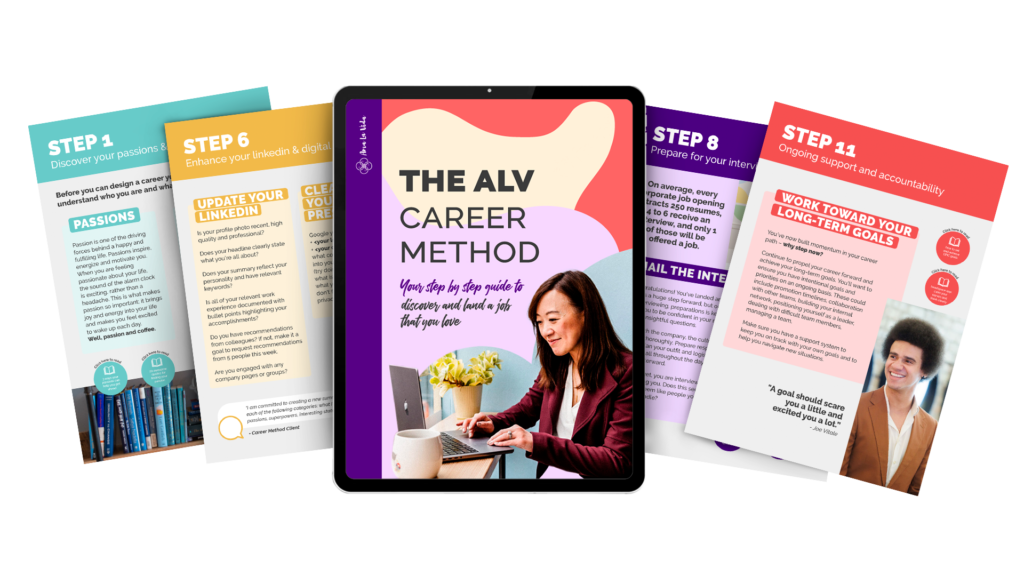
Download our comprehensive step-by-step guide to design and land a job you love!

Images from The ALV Career Method Guide
ALV Method Downloadable Guide

Buckle up and get ready to take some notes, today we hear all about my interview with ALV Co-Founder, Foram.  Foram and her family moved to the United States from India when she was 9 years old, and she had the impactful experience of watching her parents make incredible sacrifices in order to create a full and happy life for her and her brother. Foram’s drive to do things well for others led her to a career in healthcare consulting, and she ultimately knew coaching was her best next step when she worked with a leadership coach during her master’s program. She states, “Change was always hard for me, and I hadn’t made any significant improvements in myself personally even though I’d read books and articles and attended workshops. I experienced the power of coaching and its impact when I was being coached. I immediately began making behavior changes and I fell in love with the impact that coaching can have. I knew I needed to go into coaching to be a catalyst for individuals in their development.” I love that Foram’s career path wasn’t crystal clear when she started out. It was a big leap to go from healthcare consulting to business and leadership coaching – and an even bigger leap to co-found her own company. Fortune certainly favors the bold! When I asked her about what wisdom she would share with her younger self (one who I bet looked a lot like her absolutely precious six-month-old daughter), she had a lot to say. “You have a gift for paving your own unique path – so own it, and don’t doubt it, and remember that everything happens for a reason. And for the love of God, calm the F down and enjoy life a bit more!” If I was planning on a new tattoo, those might be the very words I’d get on my body. But I digress. Foram also notes, “Enjoy the journey when you’re on your way to achieving something and take pride in being a learner.” What really struck me during my interview with Foram is that she continually lives out Ama La Vida’s culture commandment #7 – if you’re waiting for the dust to settle, you’ll be waiting forever. Her plans didn’t always guarantee success, and in both business and in life, she takes big leaps without always knowing where she’ll land. Foram’s courage is a driving force in our company, and we are so glad to have her. I hope this glimpse into her world and her wisdom serves as inspiration for you in your next great adventure.   This week’s challenge We’d love for you to experience the power of our Ama La Vida culture commandments. This week, we challenge you to live out #7 that Foram does so well with. In what area of your life are you waiting for the dust to settle before taking your next leap? Maybe it’s your job, or your relationship, or your home environment – this week, we want you to get crystal clear on where you’re dragging your feet. What can you do to kick the dust up and keep making progress?   We know you want to learn more. Here are some of our favorite additional resources: Watch: “Do you know why you get out of bed every morning?” Read: 13 Ways to Encourage Employee Development (and Strengthen Your Team) Read: “I realized I had allowed small moments, hurtful words, and painful memories from my childhood to create the soundtrack by which I would live my most sacred relationships.” Listen: Gimlet’s The Pitch podcast (because Foram is no stranger to making her start-up dreams a reality)

Read More

At the end of every year, I love to reflect on the prior months and acknowledge all the accomplishments I’ve made, where I may have stayed stuck, and how I envision moving “onward and upward” in the new year. January provides that metaphorical clean slate, the opportunity to start fresh with lessons learned and new ambitions to achieve. Over the years, I’ve learned that habits are a necessary element of successful achievement of any goal. However, it’s not always easy to build the powerful habits that fuel success. Any item on our “to-do” list requires energy, but the beautiful thing about habits is that they are naturally ingrained in us after a period of continuous repetition and a drain in energy becomes less of an obstacle. Not all habits become effortless of course, but there are trouble-shooting techniques for those times when you need an extra boost of motivation. So, how can you create powerful habits that could change your life? 1. Self-Awareness “New Year’s resolutions” don’t usually stick because they don’t become habits. We pick those resolutions we always hear about; eat a low-carb diet, exercise five days a week, wake up extra early every morning, for example. But how do you know that will work for you? A lot of the time it won’t, so building self-awareness around what works for you and what doesn’t through trial and error is essential. Obviously, if you’re naturally a night owl, becoming an early-riser may not be one of your resolutions. 2. Step Back Take a step back and understand how even the seemingly insignificant habits are actually powerful and can have a massive impact for you over time. For years, I wouldn’t make my bed or keep an empty kitchen sink every day, thanks to college. But as I got older, I started to realize the few times I did, I felt calmer. My world was a little less chaotic at the end of the workday. I started to do it daily and now I can’t leave my place without a made bed and a clean kitchen. It became part of my mindless getting-ready-in-the-morning routine. I come home and can sigh some relief that my place is straightened up and I’m ready to cook a healthy dinner in peace. It motivates me to cook a healthy dinner, rather than GrubHub from the nearest pizza place. Bigger picture, people! 3. Identify Your “Why” Speaking of bigger picture, know WHY you want to change a habit or build a new one. Will it serve a greater purpose in your life? How will it help you achieve your long-term goals? How important is that to you? If it’s very important, write it down and post it on your fridge so you don’t lose sight of its bigger purpose. Waking up an hour earlier to get your workout in doesn’t sound like much so it’s easily skipped, but if you do it consistently and daily, the beneficial effects will compound over time (check out The Compound Effect summary here). Your WHY is in the long-term, and yes, each day does matter. 4. Don’t Give Up There’s no rule that New Year’s resolutions or intentions need to start on January 1st (and suddenly end in February…). Don’t feel like a “failure” if you discovered your resolutions don’t work for you, prompting you to just give up. Adjust your intentions accordingly and try, try, again, with compassionate patience. Each day presents an opportunity to start new, even if it’s June! It may take time to figure out that sweet spot of powerful habits you can get on board with. It took me years to figure out that yoga and running were my exercise modalities of choice. Now I find it easy to get to the yoga studio or put my running shoes on, most days… let’s be real. And if you’re feeling the overwhelm, work on one habit at a time. You may find better success that way. 5. Daily Disciplines To be honest, habits just don’t form unless we do them daily. I don’t believe that there is an exact science to how long it takes for a habit to become routine, but it does require consistency. It requires showing up when you’re not feeling it, every single day. That’s the hard part, but it also goes back to number one above. If you notice your life is not being improved by a habit you’re trying to change or build, it may not be right for you. Try a different one that helps you achieve the same greater purpose. However, if it is improving your life, stick with it. That’s the most important thing. 6. Scheduling Maybe you need some help in keeping a daily “practice” or one of your goals is to finish those work-related projects that you find hard to accomplish without some discipline. Schedule it! When you block out time on your calendar for weekly to-dos including exercise, you’re more likely to do it. Better yet, physically write everything down in a planner or on a calendar that’s hung wherever you’ll consistently see it. Block the time and truly commit to it. Remember your WHY and consider that time sacred. 7. Tracking What’s even more fun than writing and scheduling your to-do list? The physical act of crossing it off as done! Jerry Seinfeld used the “Don’t Break The Chain” technique when he committed to writing comedy every day. He would hang a year-at-a-glance calendar on a wall, and every day that he wrote new material, he’d cross the day off with a big red X. As the chain grew longer, the more motivated he was to keep showing up daily to write. Ideally, habits never break the chain. Many ways exist to track your progress when building a habit. Just Google “habit tracking apps” and apparently there are the “24 Best Habit Tracking Apps” for 2019, according to lifehack.org. Who knew! If you use a planner to schedule, you can

Read More

I don’t know about you, but all of us here at Ama La Vida are still basking in the glow of the new year. You don’t have to have your entire year figured out by January 1st, but rather, taking the entire month to really dig into what’s important can help you be mindful about the success you are cultivating in the months to come (this is the approach our Fresh Start participants are taking, and it’s been pretty epic so far). If you know that you want to set some career-related goals and intentions this year, but aren’t sure where to start, read on for some inspiration that moves beyond the standard “get a new job” and “ask for a raise” go-to’s. Say yes. Impostor syndrome, fear of failure, or dragging your feet – whatever phrase you use, it’s absolutely normal to not live up to your full potential in the workplace. However, just because this phenomenon is commonplace, that doesn’t mean it’s right – or that it will work for you and the brilliance you can bring to your role. Do some soul-searching and figure out how you’ve been getting in your own way. Perhaps you’ve been passing up challenging projects because you think someone else can do them better, or you haven’t been attending networking events due to lack of confidence. What will it take for you to become the person you were meant to be in your industry or field?  Say no. We often overextend ourselves for a variety of reasons – perhaps we fear disappointing others by turning down requests, or maybe we want to make sure that everything is done just right. However, by never setting limits or boundaries, you’re risking overworking yourself and burning out – or looking like you don’t know how to prioritize what’s truly important. Especially in leadership roles, the ability to delegate (and, subsequently, let your team make mistakes and then use that as a learning opportunity) is critical. You simply can’t do it all yourself. What are you holding onto that needs to be released?  Ask for feedback. Setting your own goals is important, but obtaining outside perspective on how you’re doing and what you should focus on is a humbling and vital experience. Understanding what your leadership needs from you can ensure that your goals are aligned with your company’s big-picture vision. In addition, asking for ongoing input ensures that there are no surprises when it comes to annual reviews. Demonstrating that you can accept feedback gracefully, and subsequently incorporate it into your workflow, is a great look. Whose needs are you responsible for meeting, and how are you ensuring you’re getting feedback from them in a timely and useful manner?  Give feedback. Any career success you’ve achieved – big or small – is probably not due to your efforts alone. We consistently receive guidance and mentorship from those around us in order to grow into the leaders we want to be. The opportunity to pay that gift forward is incredibly rewarding, and also ensures that the generation of workers to come after you is equipped for greatness. Michelle Obama once said, “When you’ve worked hard, and done well, and walked through that doorway of opportunity, you do not slam it shut behind you. You reach back and you give other folks the same chances that helped you succeed.” Who are you holding the door open for?  Challenge yourself. The new year is an incredible time to set audacious goals – if not now, when? Get crystal clear about the huge success you want to achieve this year – is it expanding your patient panel, increasing revenue for your small business, or growing your team? Whatever is on your list, take your goal and then make it a little bigger. Challenge yourself to exceed your wildest dreams and create an achievable path to make your vision a reality. If you want big things to happen, you need to first declare your intentions. What will you do this year that will absolutely blow your mind?  Get comfortable. It’s okay to take a breather. There – I said it! There are seasons where we pour everything we have into our careers, and seasons where we take a step back and begin to reap the rewards of our hard work. Perhaps this is the year you explore what the elusive concept of work-life balance means for you, or maybe you need to dial back due to family or health obligations. You can’t do it all, and sometimes making a conscious decision to slow down on your work means that your career is sustainable in the long-term. What do you need to give yourself permission to step back from? Enjoy your first full work-week of 2019. We can’t wait to see what this year brings you and your career and look forward to helping you be more mindful and intentional as you define what success looks like.   This week’s challenge Set an intention for your new year as it relates to your career. We promise you’re not too old, too young, too stuck, or too fast-paced to determine what you really need to focus on in 2019. Know that this intention can grow and shift throughout the months to come, but commit to beginning the process. You deserve this.   We know you want to learn more. Here are some of our favorite additional resources: Support your favorite local bookstore: Better Than Before by Gretchen Rubin Read: “We set resolutions believing that our thoughts drive our behavior, even though we are often motivated to action by our emotions.” Food for thought: New Years Resolutions at Work, Can Work For working moms: “Rather than trying to connect with Sheryl Sandberg or Hillary Clinton via your neighbor’s sister-in-law’s coworker, use your energy getting to know the power players in your everyday life.”

Read More
Someone in a hammock forest bathing

2017 should have been an amazing year. After a variety of exciting professional experiences, I set a goal to go back to school. I was achieving that goal, graduating from college and on the honor roll. But it turned out to be a terrible year. I was assaulted a few weeks before my final semester. On the surface, it didn’t seem like a big deal (to me). I had been hurt before, and my motto was, “Just buck up babe.” Because that had been my experience. I started taking care of myself at 6 years old. I have a strong will. I am a fearless woman, but I have never been able to obtain for myself what I have provided for others; nurturing love and protection. Things got dark. The level of stress resulting from the attack took its toll. And it wasn’t even that particular experience, but that event surfaced for me other abuses I had previously had to endure that I avoided acknowledging for many years. I turned into girl who couldn’t leave her apartment. I didn’t feel safe. I wouldn’t sleep for days. I was plagued with headaches, vomiting, infections, cold sores, while psoriasis took over my scalp, back, and arms. I even went a few days without food multiple times. I didn’t tell anyone for a while. My therapist, my boyfriend, and two others were it. I was determined to keep being “perfect.”  I didn’t want the label of a victim and the inevitable badge of shame that comes with it. I wanted to be normal and to be treated normally. I didn’t want the unbearable awkward moments of sharing and watching someone stumble for words. There are few people in this world who can truly empathize with what I have experienced. So most of the time I avoided sharing. How I started healing My therapist, Tami, suggested that I go on a camping trip in West Texas surrounded by bison and canyons. And she wanted me to talk to a tree. I asked her if she was on drugs. She laughed, said no and preceded to tell me about all the benefits and blah blah blah. Resolved, I said I would do the trip, but I wasn’t going to do tree talking. I felt this was a ridiculous request at the time and completely stupid. Fueling my refusal to talk to a tree was the fear of allowing myself to experience imagination. Something I felt I lost a long time ago. Finding my tree There was a hike Tami made me lead from our campsite. I found a spot in an empty river bed to take a break. She read a poem to me while we soaked up warmth from the sunbaked rocks. After that, she sent me off alone. She said go find your tree. As I was packing up my gear, I told her no. Tami responded, “You’ll find one.” I walked off and a few 100 feet away I yelled, “I’m not talking to any fucking trees!” I looked back with a half-smile and she watched me walk off. I walked along the riverbed looking at trees wondering how one talks to a tree. Like how would I know which of these is my tree? And finally, it happened. I was looking up the side of a steep cactus covered incline when I saw her, my tree. I remember saying, “Oh, you’re pretty.” It was nearly impossible to get to her, but I eventually did and sat down next to my tree.   It was awkward. I looked over the horizon as I was sulking with the assignment. I told the tree, “Tami said I had to talk to you, and I think this is stupid.” My tree and I chatted for a while, and the moments that followed were transformational. I had unlocked the sway of Forest Bathing. What is Forest Bathing? Well, it’s not a spa treatment and it also doesn’t require water or suds. The practice originated in Japan in the 1980s. There it is called shinrin-yoku and translates to you guessed it…Forest Bathing! Forest bathing is simply being in nature. This practice evolved as a Japanese work culture led to an abundance of stress and health issues from being overworked and constantly indoors. What I love about this practice is the simplicity of it, walking amongst nature allowing my body and mind to wander. The only thing this practice requires is time and maybe a small commute to a public garden or park (at minimum). The only intention you set is to be in nature; the rest of it is letting yourself follow your senses. Your practice of Forest Bathing should be a reflection of you. How I reap the benefits of Forest Bathing may not be the way you do. I particularly have an affinity for our beautiful hill country here in Texas, where you may prefer a lush manicured garden or forest. In my practice, I roam with the intention of seeing the moment as a child would. Curiosity takes over, I’ll follow a butterfly, talk to a turtle, birds, trees. There is a rhythm, and you will develop yours. If my way doesn’t resonate with you there are other ways you can enjoy your practice in nature:     Write in a journal     Do something artistic like sketch the scene in front of you     Practice meditation or yoga     Do some breathing exercises     Even take a nice nap How forest bathing helped me At first, I didn’t know if it was working. I rambled aimlessly, but what stood out was my realization that I’m always rushing to get somewhere, rushing to please someone, rushing to be happy, rushing to accomplish something. In talking to my tree, I finally slowed down. I started reflecting on the dynamic I needed in relationships, and I realized that I needed to become my own person. I needed to stop being the chameleon that transformed into what my partner, agents, or employers

Read More

For years, researchers and business analysts were baffled by the success of leaders who weren’t traditionally seen as capable of achieving greatness. They weren’t the smartest on paper, or they weren’t the loudest and most engaging person in the room. We’ve now been able to hone in on that “secret sauce” behind some of our most inspiring leaders. They have what social scientists call emotional intelligence. This incredibly important attribute can lead to improved communication within teams, better understanding of client needs and even an impact on the quality of healthcare. Emotional Intelligence So what exactly is emotional intelligence? Its vital components can be summed up by two competencies: personal competence and social competence. Personal competence focuses on self-awareness (accurately identifying your emotions as they arise) and self-management (the ability to use that awareness to act in a positive and flexible way). Social competence focuses on social awareness (correctly identifying the emotions others are experiencing) and relationship management (using your self and social awareness to manage interactions and relationships). Here’s some good news: emotional intelligence is a skill that can be intentionally developed! Here are a few ways you can take your EQ for a test drive: 1. Observe your thoughts and feelings during times of calm and times of stress.  We so often rush between commitments, and avoid truly experiencing our feelings. Simply noticing how you feel can help you develop that vital skill of self-awareness. A helpful tip is noticing and not judging your feelings! 2. Notice how those thoughts and feelings affect your actions.  If you’re feeling overwhelmed, are you more likely to snap at your colleague? When you get long overdue praise and are feeling proud and thankful, are you all smiles even in rush hour traffic? Developing an awareness of the connection between your thoughts and behaviors will help you practice meaningful self-management. 3. Put yourself in someone else’s shoes.  Empathy is a powerful tool in practicing social competency. As Brené Brown breaks down sympathy versus empathy. Sympathy sounds like, “I see your pain” while empathy sounds like, “I feel your pain.” Being vulnerable with others (heck, even with ourselves) can feel like a tall order and maybe not even something that belongs in the workplace. But our ability to deeply connect with others helps to build longstanding connections, improves communication and leads to increased employee satisfaction. It pays to be kind, friends.   This week’s challenge: Start by taking Harvard Business Review’s Emotional Intelligence Quiz. These questions might feel strange, especially if you’re not used to talking about feelings or emotions in the workplace. When you obtain your results, take a few moments to really reflect. Ask yourself: are you where you want to be when it comes to this vital workplace (and, let’s be honest, life) characteristic? Take a moment to celebrate your successes and also identify areas of improvement. Then – you knew this was coming – set a clear and achievable goal to get better. You’ve got this. We know you want to learn more. Here are some of our favorite additional resources: Why good leaders make you feel safe (12 min TED Talk) “Want to be happier, healthier, and more physically attractive? Be kind.”(5 min article) Be kind to yourself (and others) by using the 10/10/10 rule made famous by Warren Buffett (5 min article) “Emotionally intelligent entrepreneurs are more successful.” (8 min article)

Read More

I love learning about words from different languages that have no direct translation in English. Although we fit the translation into simple terms, the meanings go much deeper and always offer such rich information about a culture. For example, the word, fika, in Swedish, translates to “a coffee and cake break” but it refers to a concept about making time during the day to stop working and socialize with friends and colleagues while having a coffee or tea and something to eat. This ritual is a critical part of Swedish culture and demonstrates its value on community. A couple of years ago, I learned about the word, ikigai, and it changed the course of my career. Ikigai translates from Japanese, to “reason for being” or “what gets you out of bed in the morning”. Ikigai is not a concept solely tied to career fulfillment. In Japan, it is a life practice or pursuit that makes a life worth living. It encompasses a balanced view of what it takes to achieve a fulfilling work life, which when realized, should provide a purposeful life, happiness, and longevity. For me, ikigai gave a framework that I could connect with at a time when I felt stuck in my career as a lawyer. It seemed like I was always searching for the right position – one in which I felt engaged and excited, challenged and supported by colleagues and supervisors, and was contributing in a meaningful way. Finally, a sense of dread came over me when I realized that maybe a career in law wouldn’t provide me with what I wanted out of my work life. As a lawyer, I had been trained to think analytically. I took only calculated risks. The idea of changing my career after more than a decade in it, seemed overwhelming (what would I even do?), unwise (how would I make sufficient money?), and unattainable (how would I even do it?). Ikigai offered me a logical approach in exploring a career change. During my first attempt at leaving law, I focused on my interests. Everyone says, “Follow your passions and you will be successful.” But I couldn’t figure out how to translate my interests into a meaningful, paid position. The ikigai framework for a fulfilling life is a balance of four elements: Your interests or what you love Your strengths or what you are good at Your contribution or what the world, society and community needs, and What you can be paid for The goal is to find a balance of all four elements in your work. If you’re doing work that you’re passionate about and that you are good at, but it’s not meaningful and you aren’t paid at a sufficient level, you will not feel fulfilled in the long run. If you’re doing work that you’re good at, that is meaningful, and you’re paid well, but you don’t really have any interest in it, then you will not ultimately feel fulfilled. So how do you become clear on how the four elements play out for you? Here are some ways to help get you started. Your interests It seems easy enough, right? What do I like? However, if you went from school to work, with your head down and following the path of success that was drawn out for you, it’s not surprising if you don’t know what you like anymore. So here are some questions to ask yourself: What websites or social media sites do I visit regularly? What did I like to do when I was around age 10? What do I get excited about doing? What would I do even if I am dead tired or super busy? Your strengths Similar to interests, you may not know what your strengths are. You may have started studying for a career early in life, building skills for a particular subject, but never spent the time to understand what you’re good at. You can develop and nurture skills, but what are those strengths that come naturally to you? Here are some questions to get you started: What do your friends and family come to you for when they need help? What were you good at when you were around 10 years old? What do your work colleagues come to you for when they need help? What have your teachers or supervisors indicated as strengths in your work? Your contribution This one was a big one for me as I was considering my career change. I wanted to make a meaningful contribution and be able to see my impact. This can seem like an overwhelming concept, but here are some questions that may help focus you: What do you want your legacy to be? How would you want to be remembered? What does the world need that you want to contribute to? How would you like to make a difference in society? Your income You may find that when you get to the point of wanting to make a career change, the biggest hold up is the financial issue. And at times, it’s because you may be considering a career that doesn’t take into account the fact that you still need to pay the bills. When I learned about this element of ikigai, I was actually relieved. I thought that leaving law would mean leaving my only avenue to make money. Ikigai holds a place for it and made it acceptable for me to include making money as an integral part of my search for a new career. It made my decision much easier to navigate. When you land upon some career options, ask yourself: Would the work serve a need for a specific audience? Would the audience pay for the services or product? Are there others who provide this product or service and do they get paid for it? How much are my expenses and what is my goal income? I found that when I spent time in exploring the four elements of ikigai and how

Read More