Category: Self Awareness

Did you know that May has officially been “Mental Health Awareness Month” in the United States since 1949? Yeah, me either. I find that both terribly sad and wildly exciting. Sad because something so important took 70+ years to gain attention, and exciting because finally, mental health awareness is getting the spotlight and voice it deserves. Mental health is so critical and so close to my heart that trying to pinpoint the correct words and tone is difficult. So, I’m going to write this article under the lens of being something I wish I could have read when I was 20 years old and thought I was losing my mind. This is My Story: The newly coined term “Sunday Scaries” resonates to my core. I remember as a child I would cry, meltdown, even make myself sick because I couldn’t handle the anxiety of going to school on Monday. I’d get so angry with my parents for their lack of understanding and convince myself that it was all their fault, but I would always go and it would always be fine. I can remember passing notes to my best friend in Junior High and asking her on a daily basis if I was still her best friend. She would get so annoyed by being asked the same question repeatedly, and honestly, I can’t blame her. I recall lying awake at night in my childhood twin size bed with quiet tears streaming down my face as I contemplated my parent’s impending deaths. These are definitely not normal behaviors for a young girl to have, but I didn’t know that. I had always been a stellar student and the majority of the pressure to succeed was put upon myself by myself. Going to University was no different. I studied hard and excelled, but something happened when I was 20 years old that would forever change the shape of my life. I’m not sure if it was a mental break down or a panic attack, but it was for sure alarming. I skipped class (something I’d never done, ever), was crying inconsolably, felt paralyzed with fear, and called my parents to let them know that I just didn’t think I could finish school. I was absolutely overwhelmed and totally losing my grip with reality. The details are hazy now, but I know that I ended up in a doctor’s office. I told her how I felt completely crippled and emotionally out of control, but I couldn’t express why I had these feelings. There was nothing happening to me that was particularly horrible. I was going to school, seeing my friends, living in a sorority house, had a long-term boyfriend – life was good. There was nothing to create this horrible sense of dread. She then explained to me how NORMAL this was, especially for people my age…Normal…Something I’d never felt farther from, but so calmed by the reassurance. She gave me some stats that I can’t remember now and ultimately told me that I was suffering from Generalized Anxiety Disorder and prescribed me medication. It changed my life. Finally, FINALLY, I started to feel relief from emotions and sensations I had never pinpointed because I had no idea I had practically been in a permanent state of Fight or Flight. I was happier, I could handle stress and deadlines with so much more finesse, and I could focus! It was truly a miracle. Fast-forward about 5 years to when I decided I was cured. I had a very successful career, a beautiful apartment, friends and family who loved me, a new puppy – life was awesome! Clearly (I thought) I had outgrown the need for this “crutch”. I was stronger than a pill! So I took myself off of my miracle medicine (NEVER DO THIS WITHOUT DOCTOR ASSISTANCE). I began to feel “zaps” throughout my body like being momentarily electrocuted, I had blips in my vision, and bouts of dizziness. I chalked this up to being dehydrated or sleep deprived (seriously, Ashley?). Then one day, a couple of months after I stopped the meds, I found myself in such a depressed state that I couldn’t get out of bed or even shower. I called in sick to work. I stayed inside. And I didn’t tell anyone. My mom discovered me this way and marched me back to the doctor where they put me right back on medication. And what do you know, in a few weeks time I was sorted. I really struggled with the realization that I was incapable of helping myself. Here I am a smart, strong, independent woman that can’t function properly without a pill – how embarrassing, how weak, how devastating. HOW WRONG! The Stigma: 20 year old me was embarrassed by my new diagnosis. I didn’t tell a single soul besides my parents that I now required a pill to make me feel “normal”. I didn’t talk about anxiety or depression with anyone. The thought that someone else out there – a friend, a classmate, a stranger – could be suffering just like I was didn’t enter my mind. I didn’t understand that my embarrassment and secrecy was a part of a much bigger problem, The Stigma. To be honest with you, I had to look up the meaning of the word stigma. I thought it meant something like “perception”, but it is so much more than that. Even more shocking is that I’m guilty of its perpetuation, but no more! Stigma – adj. – 1a strong lack of respect for a person or a group of people or a bad opinion of them because they have done something society does not approve of; 2a mark of disgrace associated with a particular circumstance, quality, or person; 3a mark of shame or discredit I would say that I’m personally guilty of the third definition, feeling shame. To this day I still struggle with feelings of inadequacy and questioning why I can’t properly function without the help of a

Read More

Choosing what kind of career to have in the future is an important life decision. More often than not, the career you’ll choose will be the basis for your course or major in college, and the organizations you’ll join while studying. As much as possible, you want your academic life to become the stepping stone for you to reach your career goals, right? It’ll be easier for you to experience all of these things once you study for your career goals. Everything you’ll learn during this phase can play a significant role in helping you end up with a career that you actually want and enjoy. To paint a clearer picture, here are just some of the reasons why studying for your career goals is important: 1. You’ll gain valuable knowledge. This is one of the most obvious reasons why you should study for your future career goals. When you take an undergraduate or graduate degree based on the career you’d want to have in the future, you’ll have the avenue to learn practical skills and knowledge that you can apply in your workplace. For example, if you want to work as an accountant, taking a course in accountancy or other financial-related degrees can be a good start. You should also look for ways to beat procrastination and focus on making the best out of these degrees. And because the things you’ll learn in school are both factual and practical, applying these lessons in real life can become a breeze. 2. You’ll be able to enhance your soft skills. Although this system is commonly used in Australia, an ATAR guide can help you determine which subject you perform well in and which ones need improvement. Other countries, such as the US, also have a similar system. If you are a student who doesn’t have any idea on what course to take or what career to have in the future, the information you can get from these systems can be a powerful tool. You can use this information to know what your areas for improvement are and how you can improve, which are factors that can influence your career. Aside from your academic excellence, you should also take the time to enhance your soft skills. And you can do just that by studying for your career goals. These soft skills can include your ability to communicate with other people, work within a team, and practice critical thinking. All of these skills can make you a valuable asset to any organization and, eventually, pave the way for promotion. 3. You can demonstrate a strong work ethic. Gone are the days when employers are only looking for skills in their applicants. Today, more and more employers are choosing applicants who have a strong work ethic, even though their skills still need to be honed. If you want to cope with this demand, study for your career goals. Your educational achievement will be something your future employers will value as this can display your drive and initiative to expand your knowledge. This kind of mindset can be beneficial to an organization in the long run. This is especially true if you choose to pursue a master’s or doctorate. 4. You’ll boost your confidence. Aside from your skills and work ethic, confidence can also make or break your chances of building a career. If you’re not confident, even if you have the skills, you might not clearly express yourself during a job interview. Lack of confidence can become the reason for you to be turned down from a job. Fortunately, you can steer away from this direction by studying for your career goals. Because of the things you’ll learn in school—skills, experiences, problem solving, and communication—you’ll eventually increase your confidence, which can radiate in your body language. 5. You can grow your social network. No matter how good your grades are, you can never create a career on your own. More often than not, you’ll need the help of other people for you to reach the peak of success. Studying for your career goals enables you to meet people every day. These people can help you land a stable job, and build a career in the future. Your professor might recommend you to apply within an organization managed by his colleague. Or your classmate might give you advice on which companies are suitable for your skill set. The real world requires networking, so you should start as early as possible. 6. You’ll be able to grow personally and professionally. No one wants to be stuck in the same lifestyle or routine throughout their entire lives. As much as possible, you would want to improve and move forward. But how can you do this if you don’t have any idea how and where? Studying for your career goals can provide answers to these questions. When you have realistic career goals, you’ll know what to strive for and look for ways you can achieve these goals. The information you’ll learn while studying will mold you to become a better person, both in your personal and professional community. You’ll also stray from failure once you properly set your career goals. Most importantly, when you study for your future career, you’ll have the motivation to stay on the right track, learning new things about your career every day. This can inspire you to do more and keep going. 7. You’ll have higher chances of falling into your dream job. You’ll likely have your own passion and interests. You might love socializing with other people, creating intricate programs for companies or marketing products to a specific audience. More often than not, you’ll consider these factors whenever choosing the course or major you’ll take in college. The earlier you’ve decided on your career goals, the higher chances you’ll have of falling into your dream job. Deciding early will give you more time to know more about your career and learn appropriate skills. Everything you’ll learn during this phase can make

Read More

In my role as a coach, I have the unique opportunity to understand workplace issues from multiple perspectives. I help executives develop clear messaging and thoughtful plans for the future. I work with new college grads as they navigate what exactly it means to have a 9-5. From CEO’s to those in their first job, I help people get to where they want to go. Your Employees Matter It’s easy to feel like needs and wants “the boss” and “the newbie” are at different ends of the spectrum. But in this role, I’ve realized that across the board, they can be incredibly similar. One of the issues that comes up over and over is the idea of making people feel cared about. Higher-ups want to retain talent, and people on lower rungs of the career ladder want to feel like they matter. However, I’ve seen some really funky ways to invest in employees that don’t always land well. I’m constantly thinking about how to incorporate humanity into all aspects of the workplace, so the concept of investing in employees and promoting well-being is often at the top of my mind. The New England Journal of Medicine breaks down this issue nicely when it comes to healthcare, though the lessons can be translated to almost any profession. Avoiding burnout comes from a combination of efficiency of practice, a culture of wellness and personal resilience – yet, so often initiatives to engage overworked employees focus solely on the “personal resilience” portion of this equation. Understandably, some feel resentment when they are told to meditate more or carve out time to take a walk as a way to prevent burnout, when contributing factors such as inadequate staffing or a culture that promotes excessive amounts of overtime make it nearly impossible to practice these techniques. Invest in your employees – it absolutely matters. But how you invest is just as important. Their Time  Respect your employees time. Don’t arrive 15 minutes late to meetings as your employees idly wait, and schedule time to provide meaningful and constructive feedback to the people on your team. Their Resources and Training Help your employees when it comes to their training and career advancement. Perhaps your employees can use a yearly tuition budget to cover the cost of interesting and non-mandatory workshops, or don’t count time away in classes toward their PTO bank. Their Advocacy  Systemic changes make a difference (see “efficiency of practice” and “culture of wellness” items above) and they are worth fighting for. I believe we all want what’s best for each other, both personally and professionally. With a bit of thought and intentionality, we can invest our time and energy into what will truly make a difference. This week’s challenge Ask yourself – how do I invest in employees and the people I care about? It doesn’t matter if you’re not a boss (or heck, if you even have a job). Lucky for you, this challenge applies to anyone. Take stock in how you treat others and if you’re really appreciating them in a way that works for them (and not just you!). If you don’t know how to best show that you care, just ask. I bet it will spark some great conversation. We love that you always want more. Here are some of the best articles that crossed our newsfeeds this week: “I am a human being and I need connection with other human beings on a deeper, much more complicated level than what the internet can provide for me.” How to Level-Up Your Emotional Intelligence “It might seem strange to think that the roller-coaster world of entrepreneurship helped me recover from burnout and depression, but it did.” Lizzo’s ‘Cuz I Love You’ is True Self-Care

Read More
Public speaking!

Let’s say you’re a bit like me and you agreed to speak at a public event because you’re ambitious and have something to say. You also have no experience to fall back on when it comes to presenting yourself on stage, so the only thing you have to guide you through this public speaking endeavor is your ingenuity and sheer will. What do you do? The Don’ts Don’t expect this to be easy Public speaking is a craft, dare I say an art. It takes tons of experience for it to become like second nature, so if you aren’t so good at it yet, don’t bang yourself up about it. But you should certainly meet this endeavor with an air of seriousness. After all, you’re serious about giving this talk, aren’t you? Don’t consume a bunch of self-help videos Such content is good click-bait and easy inspiration, but it improves your speaking skills as much as reading a bicycle manual teaches you to ride a bike. At its best, it’ll give you an abstract idea of what it looks like to shine on stage. At its worst, it’ll provide you with false expectations regarding what it takes to deliver a good talk. The Do’s As I said, public speaking is a bit of an art, and all creatives create in their own distinct way. I can tell you a bunch of generalized tips that can apply to everyone, but your situation is unique to you, and generalizations don’t help so much on that front. What I can give you, however, is my own personal account on what I did when I found myself in such a predicament. It’s Okay To Be Afraid. I freaked out because I’d agreed to do something difficult with no prior experience. Yes, I had watched YouTube videos and read articles about it, and even gave presentations in grade school. But this was different. I imagined emulating great speakers like Simon Sinek, Sir Ken Robinson, or Oprah. Imagining is great. It inspired me to do well—helped me believe that I could do well—but inspiration lacks substance. In my fantasies, I could be my ideal and make no scarring mistakes. Real life didn’t feel so safe, and no amount of internal hype would magically make me a public speaking black-belt. In real life, I get nervous. In real life, I’m afraid that if I make a fool of myself, it doesn’t go away by the mere act of waking up from the nightmare. It feels like I’ll have to live with the memory of how badly I did, and depending on the degree of my debacle, I may never wish to go on stage again. So it was critical that I didn’t screw it up because I wanted to do well, and if I did well, maybe someone would benefit from my talk in some meaningful way. If I dropped the ball, they’d never get their wasted time back. It was imperative that I make the talk worth their while, so eventually, I stopped reading about it, stopped watching guides, and started practicing. Practice Practice Practice! Practice won’t make perfect because perfection is impossible, but as the old saying goes, “Shoot for the moon. Even if you miss, you’ll land among the stars.” And that’s better than nothing, right? People go about practicing in different ways. Some go straight to Toast Masters events with a rough sketch of a speech to hone their skills. Others like me began with making a statement that I believed to be true and ought to be said aloud. Why? Because my background wasn’t in public speaking, it’s in writing fiction. Any talk worth remembering tells a story, and to me, any good story will say at least one true thing (thank you, Hemingway). When I gave my talk, that statement was this: “When we try to change people against their will, we’re attempting to force them to adopt the standards we hold to ourselves—i.e. unconsciously attacking a weakness of ours that we see in them.” It took me a whole day to come up with that statement, but once I had it, I was able to outline the rest of the talk around it. From that outline came a rough draft, and from that first draft came . . . a second, slightly less rough draft. It was at this point that the time for writing had come to an end. The next part was to speak. Over preparing is better than under preparing. I read my talk aloud and recorded it with my smart phone so that I could listen to it whenever I wasn’t able to rehearse, like when I was riding the bus, doing a monotonous task at work, exercising, etc. To anyone with any sense, I’d have probably looked obsessed—and you know what? They’d be right. The more obsession, the merrier. I was, after all, on a deadline, and I wanted to be able to recite this thing in my sleep. How often did I rehearse? Whenever I had the chance, really. I’d rehearse to myself multiple times a day, and when my wife got home from work, I’d speak in front of her. I called up a few friends who were willing to spend an hour listening to my talk, and when they weren’t busy, I got my siblings to listen, too. One of my friends even went so far as to coach me on stage presentation—to “stop wobbling back and forth and stand firm with your shoulders back; to not shake and pace too much, because any odd movements will distract the audience from what you’re trying to say.” Things like hand gestures and acting out scenes was fine so long as they were done well, so I practiced that, too. There were times where my co-workers thought I might be losing it given my constant muttering to myself, so I gave them some context for my behavior and told them about the talk.

Read More

For years after college, I struggled with negative moods due to uncertainty on where my life was headed. I started questioning whether I was living my best life. What were my values and was I living in alignment with them? What does it look like to live authentically? Not knowing the answers and still struggling, I was diagnosed with a chronic illness, on top of my discontent. Once your body is hit with a debilitating illness, there’s no choice but to address the underlying issues. Once symptoms were under control, I was able to truly investigate how I was living my life. I looked at each area (physical, social, professional, financial, etc.) and addressed many issues that I had been neglecting: For me, living a more authentic life lead to greater health, presence, joy, and gratitude. So, what is authenticity? Authenticity is the feeling that you are living according to your true self and in alignment with your values and identity; you are not trying to be someone you’re not for the sake of others around you. Brene Brown, psychologist and researcher, has defined authenticity as, “the daily practice of letting go of who we think we are supposed to be and embracing who we actually are, by cultivating the ability to be imperfect, allowing ourselves to be vulnerable, and setting boundaries.” Psychologists and researchers suggest authenticity plays an important role in well-being, and being inauthentic can negatively affect mental health. Many studies have shown that people living more authentic lives report more positive emotions, greater happiness, and higher self-esteem. They also report lower stress, anxiety, and depression. Authentic behavior also leads to better relationships. Fear of rejection can cause people to avoid expressing who they really are, therefore hindering the development of meaningful relationships. Brown states, “In order for connection to happen, we have to allow ourselves to be seen, really seen.” In her research, Brown found that those who felt most connected to others and satisfied in their relationships were able to stay true to themselves. “As a result of authenticity, they were willing to let go of who they thought they should be in order to be who they are.” 1. How can you cultivate more authenticity in your daily life? Identify and prioritize your values. If you need help, try this Values Assessment worksheet. Health became my number one priority, so I focused on nutrition, exercise and stress reduction. It became important for me to find ways to be more peaceful and content, so I had the capacity to be at my best not only for me but for others. It’s important to identify what takes precedence for you, so it can help guide your daily actions. 2. Build self-awareness by observing yourself. With your values in mind, pay attention to how everyday situations make you feel. I began to look at how I treated my body: what food made me feel sluggish or energetic, how lack of exercise affected my energy. I discovered through trial and error I felt my best with a combination of yoga, running, and high-energy foods, while avoiding that which zapped my energy. 3. Practice values-based mindfulness moment to moment. Mindfulness is key in making any positive change. When we slow down to take a moment to breathe, we can tune in more directly to how we feel, physically and emotionally. Our bodies provide valuable feedback and can help you determine if the present moment is aligned with your values. 4. Let your values and intuition, your inner compass, guide your decisions, actions, and interactions with others. When we get in the practice of being mindful, it becomes easier to notice when something isn’t right or when we’re making the best decision for ourselves. I started to shift my old, negative habits, by creating new ones that aligned with my goal of living a healthier life. Ask yourself, what negative habits are holding you back? What can you replace those habits with? What will help you live authentically and in alignment with your values? 5. Speak your truth, without fear. Ask for what you want or need, and maintain your boundaries. Saying “no” can be difficult if you’re in the habit of people-pleasing. But what if your saying “yes” goes against your values? How do you feel in that moment? Sometimes the situation calls for your authentic self to show up and create those boundaries based on what you need to stay true to yourself. In order to live authentically, you have to know and communicate your boundaries. 6. Express vulnerability. Brown suggests re-framing what vulnerability means. Rather than perceiving vulnerability as weakness, embrace it as a brave and courageous act. Finally admitting I was neglecting certain areas of my life gave me the opportunity to ask what I truly want for myself. Who do I want to be and how do I want to show up for others? Being vulnerable was the catalyst for significant change. It’s not easy, but it’s worth it. When I decided to prioritize my health, compassion for myself, and loving-kindness for others, my well-being improved. I learned how to be present and joyful in everyday moments – I learned how to live authentically and true to myself. Cultivating authenticity has the potential to enhance well-being and happiness. I hope these tips can help you on your journey to living your truth. If you’re ready to live more authentically and aligned with your personal vision and purpose, book a free consultation to get matched with a life coach.

Read More

It’s 4:59 pm, you’ve been watching the clock like a hawk, you’re exhausted, you’re irritable, and 5:00 pm couldn’t come soon enough so you can break out of the jail cell also known as your office. Or maybe you’re headed into work on Monday morning and you make a beeline to your office, hurriedly shut the door, grip your latte for dear life, and pray that no one comes to ask you how your weekend went. Or perhaps you’re in the work parking lot, sitting in your car, repeating mantras to yourself, pumping yourself up like a football coach until you can muster the courage to open the car door and drag yourself into work. Does this feeling of dread sound familiar? If you have read this far, you’re probably feeling some sort of discontentment in your work. Maybe you can’t put your finger on it, but something is just not quite right. Let’s be honest, there are negatives to nearly every job, and it is likely that you will have days that you just don’t feel like working. However, how do you decipher between a temporary restlessness in your job and a full-on rut? Diving into a job search or considering a career change is a big decision and should be taken seriously. Here are 6 signs that starting a job search might be your next best step. Are you lacking support? – Similar to the examples shared above, dreading going into the office is one of the first signs that you might be ready for a change. I am not talking about the feeling of wanting to take a sick or personal day here and there. I am speaking about persistent anxiety that makes going to work every day a true struggle. Do you have a boss or supervisor that respects, challenges, and trusts you? Poor leadership is a very common reason that people feel the need to jump ship. Google spent 10 years researching this phenomenon in a study called Project Oxygen. An Inc.com article summarizes this study into 10 behaviors that make a great leader. If you are missing most of these characteristics in your boss or leadership team, it might be time to take a look at whether this is the problem. – Or if there are frequent changes in your leadership team, this can cause discontentment as well. Are you regularly adjusting to new protocols, rules, or policies? Is there confusion among the team? Constantly trying to adapt to a new leadership environment can cause instability and ultimately lead to feelings of insecurity about your job, maybe even your career. Do you find yourself distracted or do you frequently procrastinate while at work? – After you chug your first cup of coffee, give yourself a pep talk, and chat with your colleagues for 45 minutes about a serious case of the Mondays, do you then find yourself off in la la land? Is it hard to tackle your to-do list? You might think that you will get your tasks completed later, but right now you deserve to look at your social media feeds for the 700th time. This is a sign that you are not fulfilled, challenged or interested in the tasks at hand. Again, not every work task is going to be something you want to leap out of bed for every morning, but if you routinely leave at the end of the day and cannot think of one thing you have accomplished, this is a sign that you are distracted or highly bored. Have you considered talking to your boss or leadership team about taking on additional or other types of roles? If possible, take the initiative to find the job duties that do make you feel more fulfilled. If this is not received well by leadership or is not possible within your position, it might be time to consider the severity of these distractions. – Perhaps you are distracted by looking through various job boards on a daily basis? Clearly, job searching, while at work, is a sign that you’re ready for something new. Maybe you’re not the only one though. Are your colleagues also job searching and openly talking about it? Is there a high turnover rate in your organization? All of these things can be incredibly distracting, disconcerting, and another reason to consider a transition. Are you looking for ways to call in sick? – What happens when that alarm goes off in the morning? Are you ready to put your game face on or crawl back into bed and think of any excuse to call in sick? Let’s be honest here, most of us want to snooze a couple of times and get more shut-eye, but if you have that feeling of dread every morning, this could be an issue. Again, taking a sick or personal day here and there to take a break, or to truly rest when you are ill, is perfectly fine. It is that persistent feeling of apprehension that should be examined. – This might also be a critical time to evaluate whether you are experiencing anxiety, depression, or another mental health issue. Perhaps your work is so demanding or stressful, that your health has become impacted.Take this brief assessment, by Mental Health America, to determine if you might be experiencing a mental health issue. You can also visit the American Psychological Association’s Help Center to learn more about ways to deal with mental health issues, including how to find support and assistance. Do you complain about work to loved ones? – A loved one calls to check in on you and asks about work, do you have positive things to say? Or do you talk their ear off for an hour about how overwhelmed you are, or how much you hate your boss, or how hearing Jody nose breath on the other side of your cubicle makes you want to rip your eyelashes out? Listen, we’ve all had those conversations where we

Read More

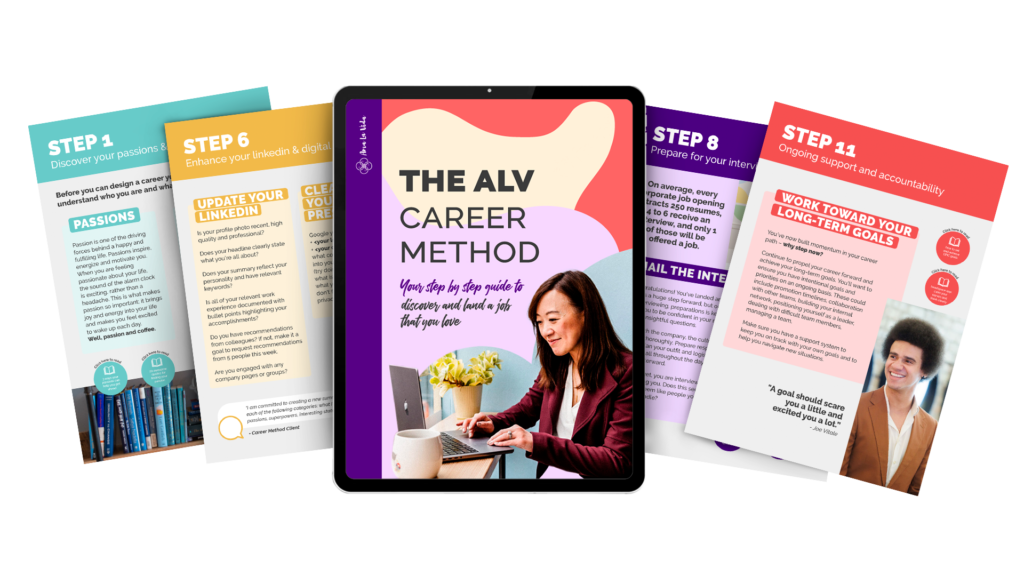
Download our comprehensive step-by-step guide to design and land a job you love!

Images from The ALV Career Method Guide
ALV Method Downloadable Guide

A friend of mind recently shared this article with me which talks about the virtues of having fun and argues that fun is not indulgent but necessary in a full and happy life. It challenges, “Imagine you had control of another person’s life, and could dictate their activity every hour of the day. Would you condemn them to spend 80% of their waking hours at a desk?” Let’s make sure that workaholism wins no more! Great question. It’s a question I’ve never asked myself before: If I had complete control over another person’s life and choices like that Friends episode where Monica controls Rachel’s, would I choose for them to live the way I do? I love to have fun. But I also love what I do and “grew up” in the consulting world where putting in the most hours was a badge of honor. It’s always tempting for me to just respond to one more email or Slack chat today instead of tomorrow. Now I have to physically stop myself from overworking. Unless I force it to shift focus, my brain is always at work. Because I love Ama La Vida and because that is my nature. I try to stop myself from talking about how late I was at the office or how long that deck took me to finish because I don’t want to even seem like I’m glorifying workaholic behavior. If I write a bunch of emails on Sunday, I’ll keep them in drafts and send on Monday. To protect the receiver’s weekend but also to not send the signal that we should be working on the weekend. And I schedule uninterrupted time with my friends and family to do fun stuff. I try to keep my phone off the table. I’m present in the moment. I go on long vacations. I drink all the champagne. How do you police your own workaholism? This week’s challenge: Carve out time for fun to make sure that workaholism wins no more. Seems counterintuitive to schedule your fun, but it doesn’t need to be that clinical. It can simply mean booking in a dinner with friends or signing up for a workout class you love. Make one commitment to having to good old fashioned fun this week. We know you want to learn more. Here are some of our favorite additional resources: Read: Why You Need More Fun In Your Life, According To Science Try: A Dabble Class Near Your! Watch: How To Make Work Life Balance Work Read: Do You Need More Fun In Your Life

Read More
spring time with flowers

Did you let out a big sigh of relief last Wednesday? I know I can’t be the only one who is ready for a change in this ridiculous winter weather. Spring is officially here, and with this new season comes longer days, less hurried walks between the car and the office door, and a reminder that growth and change are underway. You know I couldn’t make it through a time of transition without a newsletter talking all about it, right? Here are my thoughts on what spring means to me, and suggestions on how to embrace all that this season has to offer no matter what stage of life you’re in. Release what is no longer serving you. Spring cleaning doesn’t just apply to your physical space – it applies to your personal life as well. Throw open the windows of your mind and let go of what you don’t need. Negative self-talk that holds you back from taking the next step in your love life? A half-finished resume that isn’t landing you any interviews? A cluttered workspace that distracts you from getting into the zone? Whatever doesn’t have a purpose or a place is worth considering whether it’s truly worth the space and effort. Plant seeds that will grow into flowers. When I think of spring, I imagine strong and steady development. As the season passes, the magic of what’s been brewing underground – complicated systems of roots, nutrients, soil, and water – begins to poke upwards toward the sun and reminds us that good things are worth waiting for. Consider this time as preparation for things your future self will thank you for. Want to be in a new role by summer? It’s time to tighten up your application materials. Dream of being healthy enough to chase your kids around the yard until they wear themselves out? Lace up your shoes and get moving. Practice patience as you form habits that will build upon themselves. Know that the work you are putting in today will pay off – and enjoy the process along the way. Connect and celebrate the ties that bond us. With winter officially on its way out, it’s easier to make and keep plans without weather getting in the way. Now is time to emerge from your cocoon and reconnect with the ones you love. Remember that function is more important than form, so if your house isn’t perfect or your meal isn’t Martha Stewart approved, it’s all good as long as you’re acting from a place of love. Some of my favorite ways to connect in the spring are potlucks with friends (what light and fresh recipes have you been eyeing?) and networking with folks in my industry (this includes mentorship, taking continuing education classes, and attending events to meet movers and shakers in my field). Shake off the dust and get out there. Cheers to winter for the coziness and slow moments it brought, and welcome spring in all its new and bright and sunny (!!) glory. –Coach Teague This week’s challenge For each of the three categories above – releasing the excess, focusing on personal growth, or strengthening connections – choose a meaningful and achievable goal that you can accomplish within the next week. Feel overwhelmed by the prospect of doing something outside your comfort zone? That’s okay – it’s where the magic happens. Starting now, you’re a person who gets things done even when they’re not easy. (Bonus points if you forward this email to a friend and work on your goals collaboratively. Teamwork makes the dream work!) We know you want to learn more. Here are some of our favorite additional resources: “Virtually every time I push my clients to go deeper with their gathering’s purpose, there is a moment when they seem to wonder if I am preparing them for World War III. Yet forcing yourself to think about your gathering as stand-taking helps you get clear on its unique purpose.” A 6 Step Guide to Spring Cleaning Your Social Media Feeds, because our closets aren’t the only cluttered spaces “My question is what, if anything, is wrong with being chilly? It seems like a good, efficient way to get along.” Spring Cleaning: Meditation to Tidy Up the Mind (initiate zen state now!) Declutter your life and make room for possibility (by ALV Coach Erin)

Read More

I sometimes think of my brain like a cul de sac. There are let’s say 10 houses around it, and each one is a component of my life which is currently demanding my attention. Refinancing my house has a spot. Taking the dog that won’t stop puking to the vet – that’s got one right now too. Planning that trip with my parents – haven’t done any maintenance to that one in a while, but I know it’s still there. Running ALV – that’s a big, gaudy mansion that you just can’t miss. There are only so many spots. I can only fit so many things in my brain before it feels like it’s going to explode. Something needs to clear out of a spot before I can let something else in. My husband doesn’t operate like this. He’s a dabbler. He likes to have a million little apartments sitting on his cul de sac. Each day 3 or 4 will grab his attention, but none are so demanding that they require all of his energy. Neither system is right nor wrong. It’s simply how different people function and prioritize. The problem with my cul de sac, however, is that there’s a toxic pollutant in town. Guilt. It’s a thick smoke that can permeate the walls no matter where I am. When I’m worried about spending too much time in one house over another, the guilt seeps in. Feeling bad about all of the things that don’t even currently have a spot on the street? Guilt again. I’d argue that when most people, women especially, become parents, the toxicity of the guilt becomes a crisis. Even for the dabblers. No matter where we are, we’re blinded by the smoke, feeling constantly that we’re doing something wrong. Or not doing enough. An important component of minimizing guilt’s impact is understanding your values and ensuring that the things you allow in your cul de sac, and the corresponding size of each, is a reflection of those values. But I think a bigger solution is just giving ourselves a gosh darn break. We are doing the best we can. We are running this thing with no manual. We are focusing on the things that are most important to us at that time. Why should we feel bad for that? Like mine, guilt may always have a presence in your neighborhood. But please, let’s stop letting ourselves be consumed by it. This week’s challenge Figure out the top 5 things you want in your cul de sac right now. Take a look at your list of values, and determine which 5 things are the most direct reflection of them. For everything else, practice saying no. And practice allowing yourself to say no without feeling guilty about it. We know you want to learn more. Here are some of our favorite additional resources: Read: 5 Tips for Dealing With Guilt Watch: 9 TED Talks to Liberate You Prioritize Your Time: Being Involved or Overcommitting and How To Tell The Difference Read: Daring Greatly, Brene Brown Did You Miss Our Latest Coaching Corner? In this video, Coach Danielle talks about how many employees don’t feel appreciated at work and a few ways to increase that number.

Read More

I don’t know about you but I’m like a kid in a candy store when it comes to life. I want everything – I want the light chocolate, dark chocolate, white chocolate, chocolate covered almonds, espresso chocolate, hazelnut chocolate. All the chocolates. I love chocolate and I don’t want to have to choose. This is how most people I know are about life. It’s a stark realization when you think about all the things you want in life and realize that it’s just not physically, mentally and emotionally possible to have everything at the same time. You can have anything you want if you work for it but you can’t have everything. We want a promotion at work, to be more present with family and friends, to have more time to exercise and build better relationships – does this sound like you? This is a lot to ask for and for me, an impossible task. I’m learning this the hard way. As a new mother, an entrepreneur of a growing business and a dreamer of wanting the perfect harmony of life and work, I’ve driven myself crazy to find my harmony. When I’m at work, I’m driven with guilt thinking about my daughter and what I might be missing out on. When I’m at home, I’m thinking about the clients I want to check in with. And when I’m with my husband, I’m thinking about how I need to go work out. When I’m with friends, I’m thinking about how I should spend more time with my parents. It’s emotionally and mentally exhausting. Finding Balance Imagine a seesaw. There are two sides: life & work. With pressure from both sides, it’s difficult to maintain a steady balance. Typically, one side is going to be weighed down compared to the other. And when that happens, we find ourselves being pulled to achieve our balance again. Let’s say work has been crazy for you and you’ve been slammed with meeting deadlines. The work side of your seesaw is low to the ground. You recognize that and double down on the life side so that you can get to some balance. What’ll end up happening is now the life side will be low to the ground and you realize you need to shift your focus on work. Our seesaw shifts again, and it’s a cycle causing us to be frustrated that we haven’t found a balance. I was recently watching Final Table, a show on Netflix that selects up and coming chefs across the world and makes them compete with one another with the goal of being seated with the best chefs in the world. I learned a lot about chefs and the food business and the incredible amount of sacrifices chefs make to build a brand and establish themselves in their industry. More importantly, I learned a very important life lesson. I learned that no matter what profession or vocation you have – whether you’re a stay at home parent, working in corporate, an entrepreneur – you have to sacrifice something when you’re building yourself up. You sacrifice to first learn the craft. You then sacrifice to maintain your status quo and for the go-getters, you sacrifice to climb the ladder or to perfect your craft. All of which require time, energy and money. The sacrifices aren’t small. You miss out on vacations, holidays, quality time with friends and family. You do it because at that moment, that’s what is important to you. And you shouldn’t feel guilty about it. You made a choice based on the information available to you and you made a conscious decision on what matters at that moment. For example, currently, my seesaw is towards work. It’s a critical time in the business and I want to give it my all to make sure we’re growing and building on the momentum we have. This is a conscious decision. Do I feel a pull towards wanting to dedicate more time towards life? Absolutely. I’ve realized that as long as there is no one extreme, then it’s okay. Everything is okay in moderation.  And I’m done feeling guilty about finding a balance. I’m in control of my seesaw. If you’re staying true to yourself and acknowledge the sacrifices you will make in order to achieve your goal, then perhaps you should take it easy on yourself when you make that choice. Recognize that this is a temporary time in your life and temporary is a subjective term. Temporary could be a day or weeks or years. During the growth stages of our lives, we won’t always achieve perfect harmony. We won’t have a work/life balance. But we made that choice because that is what was important to us at that time. What does this mean for the new parent or the newly married couple or the consultant who wants to enjoy life and make money? It means that there will be moments when you’ll have one of a lot. For the new parent, this could mean a lot of baby time and not enough time for yourself or your partner. The newly married couple, it could mean a lot of quality time together and not enough time for your existing friends. And for the single consultant, this could be a lot of hours away from home and not much time for a healthy lifestyle. What do you do when you’re guilty about your one-sided seesaw? Know that we live in a state of equilibrium When we aren’t finding the balance in life, we somehow find a way to get back to equilibrium. We either define it as a new normal or we pivot to bring back a sense of peace. It doesn’t happen simultaneously or when you want it to happen without proactive action. Recognize you’re too far on one side and get back to moderation. And equilibrium doesn’t mean perfect balance. It means having just enough from the other side so that you don’t feel that void.

Read More

I grew up in the suburbs of Philadelphia. My town bordered the city. It didn’t feel so much like a blend of urban and rural but like a battle between the two. We sometimes walked through metal detectors on the way into school, but you could see a deer pass at any time. Sandwiched between my subdivision and the strip mall on the main road nearby sat a small wooded area. “The woods.” Just enough space to get lost in childhood adventure but not enough to worry your parents when you played there. I remember going there with the neighborhood kids to play for hours. An entire day could pass of us building forts, finding creatures, jumping back and forth across the creek (or “crick” as most people called it). When I see kids now entranced by their phones and iPads, my heart often breaks a tiny bit wondering if they ever have space for imagination and adventure. If they ever invent their own game or create their own language. If their aptitude for technology isn’t coming at the cost of their sense of wonder. Then again, I image all generations feel this same heartbreak as they contemplate the upcoming one. Get Creative What’s funny is, I’m currently depriving myself of this type of joy as an adult. I’m always on my phone. I’m always double-screening. And I’m rarely left alone with my own thoughts and imagination. I often do my best thinking in the shower. I thought perhaps it could be related to the calming nature of it. How relaxed I am. But could it honestly be the fact that it’s one of the only places in my life where I physically cannot bring my phone? Even as I sit here and write this, I’m on a Spirit Airlines flight with no wifi (#entrepreneurlife). Even 30k feet in the air, I’m still usually distracted. Responding to emails. Sending off a slide deck. Watching a movie. If I’m very very lucky, asleep. But on this flight, none of those was an option. Today I just sat here (forcibly) alone with my thoughts. And it was magical. I thought of a million new ideas for ALV (stay tuned!). I unintentionally crafted 5 notes of gratitude to people in my life (not as a set practice but simply because I felt compelled to). Taking off I felt exhausted. Now I feel completely energized. I want that for you. Find a way to force it. Go somewhere in nature. Lock yourself somewhere away from devices. Take a Spirit Airlines flight for Pete’s sake. I don’t care how you do it. But let your brain go play in the woods. This week’s challenge Spend one hour of uninterrupted time to get creative. Put the phones and gadgets away, and do something that awakens your creative spirit. It can be as simple as reading a book, journaling, coloring, you name it! Just give yourself the time and space for your brain to wander. We know you want to learn more. Here are some of our favorite additional resources: Take a class: Sign Up For a Creative Class With Dabble Here’s some screen time to help you to spend less screen time: 6 TED Talks That Will Change the Way You Look at Your Phone Immerse yourself in nature: Forest Bathing: How Talking to Trees Helped Me Heal Get Creative: 9 Ways to be More Creative in the Next 10 Minutes Unsure where to stay when it comes to finding ways to get creative? In this video, Coach Danielle explains the concept of passions and why they are so important in our lives and careers. She then walks us through 3 questions to help us identify them!

Read More

I finally learned how to prioritize my health and wellness after 20 years of struggles with weight, shame, and self-doubt. I am so grateful for all the ups and downs in my journey. They have truly helped me learn how to embrace life to the fullest. Through much trial and error, I learned the right strategies to elevate my health. While there are so many ways we can improve our health and wellness, the following three are the tips I find to be the most impactful for me. Enjoy! Create a Morning Routine The first of our health and wellness tips is creating a morning routine. Most of us begin each day dreading the buzz of our alarm clock. We hit snooze as many times as possible before we begrudgingly start our day. Instead of rushing around doing the basics, try adding some extra time (all you need is 5 minutes) to create your own morning routine. This routine is all about you and doing things you enjoy. Some ideas include reading a good book, listening to a podcast, journaling, or exercise. When you have something to look forward to in the morning, it makes getting up actually enjoyable! (And bonus – you will feel more productive and energized too!) I recommend reading Hal Elrod’s The Miracle Morning: The Not-So-Obvious Secret Guaranteed to Transform Your Life (Before 8 am) if you want to learn more about developing your own Miracle Morning. Prioritize Sleep The second of our health and wellness tips is prioritizing your sleep. According to the National Sleep Foundation (NSF), sleep is essential for a person’s health and wellbeing. And I couldn’t agree more. The latest Sleep in America 2018 Poll highlights this disconnect between the value of sleep and our reality of not making it happen. While most Americans know sleep contributes to the next day’s effectiveness, only 10% of people are prioritizing it. While our individual sleep needs vary, figuring out the average amount of sleep that is best for you (and scheduling that time in) is key. For example, I plan my schedule (as part of my morning routine) to include eight hours of “in-bed time”. If I fall behind my schedule, then I shift the next day as much as possible to maximize sleep. While some of my “in-bed time” is used towards winding down (like reading or listening to an audiobook), I often fall asleep fairly quickly and can count on getting at least 7 ½ hours in. I also recommend turning off your screens at least one hour before bed and creating a simple evening journaling routine. I also take a few minutes to write down what I am grateful for and jot down any to-do items for the next day. This helps clear my mind and de-stress before bedtime. Meditation The third of our health and wellness tips is meditation. Meditation is becoming increasingly popular as more people realize its benefits. A meditative practice is a process of habitually training your mind to focus and redirect your thoughts. There are many ways you can go about meditating, and it can be as simple as taking a few depth breaths to focus on the moment. According to findings from Johns Hopkins University, meditation can help ease psychological stresses like anxiety, depression, and pain. Personally, I enjoy meditating using my headspace app each morning. I also focus on taking a few deep breaths throughout the day anytime I start feeling stressed. This pause helps me get grounded and allows me to disconnect from any thoughts that aren’t serving me. Health is a “state of complete physical, mental and social wellbeing” as defined by the World Health Organization. This definition highlights an important shift we are taking towards a proactive approach to health and wellness. By proactively focusing on your health, you benefit by also improving your overall well-being and quality of life! Who doesn’t like the sound of that? Knowing where to begin can be tough. That is why partnering with a coach is such a powerful tool to help you achieve your goals. With Ama La Vida’s health and wellness coaching, you are guided towards true transformation through self-reflection to gain clarity and focus. This is exactly what your best version of you needs to combat self-sabotage, create healthy habits, and harness your personal power! If you are ready to elevate your health and realize your potential, schedule your free coaching consult with me today! I look forward to connecting with you!

Read More