Category: Self Awareness

5 methods to relieve anxiety

Feeling nervous and agitated every once in a while is normal. When an important change in your life is coming, or a significant event, both good and bad, human beings tend to feel anxious. This is characterized by feelings of stress and the inability to relax or calm down. Unfortunately, for many, these feelings of anxiety can sometimes be recurring. Anxiety disorder is getting more prevalent than it was in the past. Your relationships may suffer; your job may also be put on the line, and so many other possible adverse effects in your life, all stemming from your anxiety.  If you feel like this is you, don’t stress even further. It’s not the end of the world for you. It’s essential to look into and focus on the strategies that can help you to manage your anxiety. Better yet, have total control over it such that your symptoms are relieved. You don’t have to suffer its side effects any longer. And, you can start making positive changes in your life. Whether it’s a big stressor, like a move, or a minor one, like lack of sleep, everyone can benefit from stress and anxiety management. And, the good news is that there are numerous ways for you to relieve your anxiety. It starts with these top 5 methods to relieve anxiety: 1. Practice Lifestyle Change Before making any drastic solutions, it’s time to take a step back and evaluate how you’ve been living your life. Often, health, mental, and emotional difficulties start to happen when people lose control over their life. Their jobs take over their days. Their stressors tend to get the best of them. It feels as if you’ve gotten so used to all the negative situations in your life that you can’t seem to find a way out. Wrong. Many health and mental problems can be solved and managed by starting with a lifestyle change. When you commit to change the way you live your life, you’re creating a habit and attitude of positivity. This helps you own your life again. To help get you started, here are clear-cut ways of how you can make lifestyle changes: If you feel you don’t have the time, moving around doesn’t have to be significant exercises in a gym. Instead of sitting around even more during your lunch and snack breaks, use this to take a pleasant walk around the neighborhood of your office. If there’s a park nearby, utilize it. You’ll never know how much the smell of fresh air and the feeling of moving around can help to ease out your stress. While you’re exercising, you may also be able to think clearly and have a little quiet time. If you have that urge to pick up a slice of cake, first drink a glass of water. That fills you up without taking in unnecessary calories. Have a protein bar ready in your bag all the time, or a healthier snack. Numerous healthy snack options are just as sweet but not as sinful. But, if your anxiety is contributing to your sleep difficulty, here are little tips and tricks to help you sleep easier and better: 2. Consider Taking Natural Supplements Before you jump right into the decision to take medicine, it’s also worth trying out some natural supplements. There are numerous natural supplements, teas, and other herbal infusions that can help ease anxiety. This is achieved through its ability to promote relaxation and tranquility. Often, the recurring difficulty with anxiety is that it becomes difficult for the patient concerned to relax. When thoughts keep pounding through their minds, being at peace with their thoughts is almost always a difficult thing to do. This can be managed through natural supplements like the following: 3. Train Your Mind To Focus On The Positive Is it possible to train your mind to focus on the positive? Yes. Don’t under-estimate the power of what your mind can do. Your mind is one of the important key players in stress management. Often, certain thoughts tend to keep coming back and forth with haunting you because you continue to entertain it. But, how exactly can a person train his mind for the better? Here are some ways: 4. Help Out In The Community You don’t have to be a billionaire for you to contribute to changes in your community. There are many ways for you to help out with what you have and for who you are. And, by helping out, this doesn’t only mean giving out extra money that you have. Actively help out in the physical work. For instance, set one or two weekends in a month for you to volunteer at a charity, feeding program, or a nursing home. Doing this will give you something to look forward to. And, it also adds a sense of purpose in your life. When you help others out without getting anything in return, it adds to your sense of accomplishment and pride. Plus, it’s a natural stress reliever, too, when you see the smiles on the faces of the people that you’ve helped. You may be helping them, but little do you know it, they’re helping you in so many more ways, too. 5. Light A Candle Ever noticed how some of the fanciest and most relaxing restaurants always have numerous candles? There’s just something about candles and the light that it emits that transforms rooms and houses into a mecca of relaxation. After a long day at work, make your home your relaxing haven by lighting a candle here and there. Numerous candle scents help ease out anxiety and stress. They help boost that feeling of relaxation because they’re naturally soothing. Examples of these candle scents include: In summary Many people suffer from chronic stress and anxiety. With the pressure of today’s fast-paced world, this is often an inevitable occurrence. Adding up to this are the personal problems and difficulties that people may also be going through. It’s to no surprise

Read More
practical tips to help you manage stress in the midst of chaos

Did you know that up to 80% of illness and disease is precipitated by stress? While doctors once thought our genes predetermined our destiny, we now know that it’s our internal and external environment which signals our DNA to effectively turn on a disease process. Today I‘d like to talk to you about stress, the long-term effects of stress and finish by sharing some strategies and practical ways to help you with managing stress in the midst of the chaos life can bring. The stress response, also known as the fight or flight response, evolved as an immediate reaction to physical threats in our ancestors’ environment. In a state of stress, our immune system is effectively turned off to put all energy and biological resources to dealing with the situation at hand. Once our ancestors escaped or killed their threat, the body would return to a state of homeostasis, where it was able to rest, relax, and regenerate cells. Our immune system would then turn back on where it would be able to fight off foreign invaders, illness, and disease. Although there are different types of stress, today I’ll focus on emotional stress which is a state of mental or emotional strain resulting from demanding circumstances.  So where did stress go wrong? The answer is in chronic emotional stress.  Chronic stress comes when we believe we have little or no control over managing the stressor. Emotional stressors are things like the kids are yelling, traffic, bills, a breakup or fight with your spouse, or mostly anything else that taxes your system without being an immediate threat to your life. These sort of life matters are normal and don’t necessarily have to trigger a chronic stress response, but in our overworked, overwhelmed, “you are not good enough the way you are” world, they lead to lasting stress which can be detrimental to your long-term health. The fight or flight response kicks on just the same, whether you be in an actual fight for your life or you are dealing with stressors from your spouse, siblings or boss. Work-related stress falls in this bucket too.  Did you know that nearly half of working Americans are chronically stressed on the job? Did you know that Monday morning between 9am-12pm is the time of day and week when we have the most heart attacks in our country? We have to learn to better manage our stress before it consumes our lives.  Unrelieved emotional stress leads to anxiety which can cause depression and physical disease. You can literally be stressed to death, which is why it’s so important to take back control and create calm in the everyday chaos of life.  According to the American Psychological Association, chronic stress is linked to the six leading causes of death: including heart disease, cancer and suicide. Unmanaged stress and emotional trauma is the root cause of many, if not most psychological conditions, as well as addiction to alcohol, substances and food. It leads to anxiety, neuroses, depression and a whole host of preventable and manageable disease processes.  We must be proactive, in order to preserve our long term health, happiness and well being. So while humans are highly adaptive creatures and we can withstand nearly anything, in order to survive the modern world we must start to make stress management a part of our daily lives. I’d like to offer a 5-step framework for you to add to your stress-fighting toolbox to help you effectively manage stress. Framework for managing stress in the midst of chaos:  5 A’s Awareness In order to address a stressor, we must first acknowledge its existence. We must be aware of what is truly causing our stress, before our dis-ease leads to disease. Call the stressor out by name, separating yourself from it, then identify a path around it or straight through to the source. For this to work, it’ll take a willingness to have uncomfortable conversations, ask uncomfortable questions and take on a new approach and perspective to what is truly the cause behind the discomfort. Often times, these are nagging feelings of lack of self worth, a poor self image and unrelieved emotional trauma we’ve been carrying around since we were kids. Fortunately, our mind, just like our bodies, is malleable. Through the power of your own awareness, you can start to face the stressors wreaking havoc on your life. To pinpoint the pain point ask questions like: Acceptance Although we are the creators of our lives, there will be times when things seem unfair, unjust, or downright wrong. Maybe someone cut you off, flipped you off, or you lost a dear friend, family member or your job. Perhaps you misjudged, misspoke or made a mistake. Welcome to the human experience! Dwelling in the past serves no one – neither does worry, judgment, rumination or regret. Let go of the memories and reminders that keep you tied to the stress response. Instead, train yourself to take action using the fuel from the pain of your past to propel you forward. Have the courage to practice forgiveness and acceptance of your current state and know that you are only a few small changes from an entirely different experience in life.  Action Be proactive, instead of reactive, which means taking action to confront your stress before it consumes your life. You must take care of yourself or you will be ineffective in your ability to serve your family, your community and the planet. Self-care is not selfish. It’s vital to our ability to effectively manage stress and become emotionally fit in our increasingly overworked and overwhelmed world. Action is the most important ingredient for the recipe of a stress free life.  Meditate, exercise, journal, preplan, practice, prioritize, go for a walk, or find some other way to proactively address the stressors predictably popping up in your life. Surround yourself with people that bring out the best in you and be sure to create space so you can rest, relax, and feel

Read More
How To Interview Questions

Welcome to the second installment of the How to Interview series!  In the first installment, I discussed the right (and wrong!) mentalities to carry with you into the interview process.  That’s good to read first because having the right mindset will help everything else make sense and make you feel more prepared and confident. In this installment, we’re going to dive into the meat of the interview process: the questions & answers (& questions, as you’ll see)! Interview Questions & Answers… An exhaustive list of every question you could possibly be asked would be impossible to create.  Every interviewer has their own spin and style, and they’ll ask different things. Since that’s true, how can you possibly prepare? Well, the first step is to recognize that even though there are a nearly infinite number of possible questions, there are a few universal ones that you’ll get in virtually every interview.  Questions such as: “Can you tell me a little about yourself? I’m not sure there’s any question more dreaded in an interview process!  As a hiring manager, I’ve asked this question thousands of times, and I dread the answers as much as you do, believe me.  99 out of 100 candidates answer this horribly. Regardless of industry, role, or career level, I get the same response: First, that deer-in-the-headlights look of panic.  Then, a seemingly random list of inconsequential trivia about the candidate, like what town they were born in, how many siblings they had, where they went to school, the fact that they love dogs, skiing, or travel, or that they played some sport fifteen years ago.  They may or may not mention jobs they’ve had, but if they do it’ll just be a repeat or summary of their resume, which I already have. They’ll ramble until they fade away with an unenthusiastic wrap-up, or maybe a sheepish answer of “does that tell you what you want to know?” Sound familiar?  Every hiring manager I’ve ever spoken with tells me the same thing – despite how universal it is, people come into an interview totally unprepared to answer this question in a meaningful way. Fortunately for you, there is a method that turns the most awkward question in the process into an awesome opportunity for you to sell yourself! I once asked a candidate for a sales manager position to tell me a little about himself, and instead of the standard answer I’d come to dread, he gave me the best response I’d ever heard. “I’ve always been defined by ambition.  From the earliest days of my career I took on the most challenging and rewarding projects I could in order to prove myself.  Right now that ambition and drive has made me the number one sales rep in my company, but there’s no path for leadership advancement there.  That’s why I’m here – I want to join a company as ambitious as I am so we can grow together.” I was absolutely blown away by his answer (and needless to say, he got the job)!  After the interview, I spent some time breaking down exactly why his answer was so good, and created a formula so that anyone can duplicate it, regardless of who they are. First, start with a theme.  His theme was “ambition,” and it clearly shone through his entire statement.  He stated it early and often so I could easily connect him with that positive quality in my mind.  It kept him laser-focused and eliminated irrelevant information. And it made him stand out in my memory. Second, define your theme in terms of a journey with three steps – past, present and future.  After stating his theme (“I’ve always been defined by ambition”), he then gave me three concise sentences: one about where his journey began, one about what he’s doing now and why it needs to change, and one about his future – with my company.  All three sentences served the central theme and created a cohesive story. It lead him from where he began all the way to the seat in front of me. It was compelling, and it made me want to see how the rest of the story turned out! Third and last, he shut up!  He knew he’d delivered something powerful, and he didn’t dilute it by saying “so… yeah, that’s it” or anything like that.  He put the ball in my court, and I had to respond. He was controlling the conversation right from the start of the interview, which is what knowing when to shut up allows you to do. Practice this method!  Pick a theme you’d like to define you.  It could be Creativity, Dedication, Compassion, or anything else you feel is a reflection of your best self.  Once you’re ready to declare your theme, create three (and only three!) sentences that reflect that. A sentence about your past that shows where your journey began and why your theme is reflected in that journey.  A sentence about where you are now and how your theme contributed to that, but also why it needs to change. And then a sentence connecting that theme to your future with this company. Write it down and practice it a few times.  It’s a great elevator pitch and opening remark; if you nail this one thing, you’ll set the tone for a great interview! “Why are you looking to leave your current job/why did you leave your last job?” This will come up – there’s no avoiding it.  If you’re not currently working, the interviewer wants to know why your last role ended.  If you are working, they want to know why you want to leave. First, I want to dispel a common myth. It’s not necessarily a good thing if you have a “valid excuse” for your last role ending.  Sure, sometimes your role ends because of forces outside your control. Maybe a company shutting its doors or your position being moved overseas.  Sometimes candidates seem relieved to be able

Read More
how to manage your difficult family members during the holidays

For more than 10 years, I haven’t lived with my family. In fact, I was kicked out of my home during my freshman year in high school and have only ever returned for holidays, birthdays and special occasions. I love my family to death and trust that they are doing the best they can with the knowledge and skills they have, but over the last few years, I started to leave my visits home feeling small, insecure and unsure of who I was. Over time, my defensiveness started to grow and so did resentment for the most important people in my life. Relationships are meant to strengthen and support us. They should not stress out and drain us. With the holidays around the corner, a number of us will be forced to spend time with long lost family members who know just the strings to pull to make us feel insecure, afraid or otherwise uncomfortable around the table.  Whether you’re dealing with anger prone uncles, Debbie-downer friends, closed-minded cousins or a spouse or parent who makes you feel less than you are, I’d like to offer some tips and tricks on how to deal with difficult people around the dining room table and beyond. How can you proactively prepare? Set an intention before showing up. Whether you’re meeting with your future boss or a brother, a neighbor or your 9th grade English teacher, you should set an intention identifying how you want to show up, speak and feel before walking through the door. Get clear through this intention what outcomes are most important to you and to your counterpart. Think about what you can do to build a mutually beneficial relationship that serves both of you best. Then visualize these things unfolding before you step through the door or make the call. A little conscious thought and action on the front end of a conversation will drastically increase the strength and sustainability of a relationship. Along with the likelihood of its success. How can you address an immediate concern? Challenge people in a non-threatening manner. I’m not an advocate for letting your ego run rampant in your communication with others but if someone is belittling you, doing something flat out wrong or otherwise offending you, and you’re not saying something, you are to blame. Speak up for yourself, but do so in a way that avoids defensiveness. Instead of pointing out all of the things wrong with your counterparts’ actions, insults or ideas, ask them for advice on how they would handle a situation where they felt the way you do because of what they said or did. Try something like, “Hey, I’d like to get your advice on something. I noticed __________ and it’s been bugging me. What advice do you have for me?” Asking for advice is a sure-fire way to disarm tension and redirect a relationship to a more positive and productive place.  What if it’s still not working?   Sit and soak in the feelings, and then separate yourself from them. Do not react. Do not engage with the person that is stirring you up, and instead just sit with the feelings. Observe them and notice what’s bringing them up. Is the person tapping into some unresolved insecurities? What’s at the root of your reaction? Stay fully conscious, and know that you do not have to be pulled back to the same patterns of the past.  No-one can harm you with their words without your permission. If you create the awareness to sit with discomforting feelings, separate yourself from them and seek to uncover their root, you will soon open up a door of self- discovery that will allow you to break free from their grasp. Want to go even deeper?  Self-Reflect. One of the most powerful things we can do when we’re around difficult people is to use them as a tool to fuel our own personal development and growth. When you see a character trait or bad behavior in someone else that you would have in the past judged or criticized, check yourself. Semi-conscious people don’t want to see their own faults. We often see in others a reflection of our own insecurities, limiting beliefs and self-destructive behaviors. Instead of outwardly attempting to change the other person, use them as a mirror to look inside yourself and uncover where you’re doing the same thing in your life.   Ask yourself, “Where am I doing _______ in my life?” If you’re not a cop or drill instructor, your job is not to police others. Instead, direct your energy inward when you’re around difficult or destructive people and use the lessons you learn from them as an opportunity for your own understanding and evolution.    What if nothing is working?  Have the courage to cut people out of your life. You can not create a new life carrying the baggage of old people that keep you tied to the past. Those that do not serve you or your mission, do not deserve to be in your life – family, friend or otherwise. In fact, they need to be removed from your life as soon as possible. Their lack of life is draining you from yours.  Everyone needs someone to challenge and support them, to push them to grow and think bigger. Create a new tribe, crew or family that brings out only the best in you! These tricks have all worked for me but they’re still a work in progress. Try them with family, friends, coworkers, and strangers and see what results they bring for you. Relationships are one of the most common points of friction in our everyday lives. With some conscious thought and action, we can start to master them. If you’re still having trouble with difficult people or need more time to discuss these ideas, let’s jump on a call. Otherwise, let me know what works for you and share any insights or ideas you have.  

Read More
how to support someone with a

For so long the topic of mental health has been one that people just don’t talk about. 46.4% of adults in the US suffer from mental illness in their lifetime – that’s almost half of the adult population. We need to talk about it. We’ve finally made some breakthroughs in recent years to bring more awareness to the subject, but we still have room to grow.  My mental health journey started at age 11. I began experiencing symptoms of General Anxiety Disorder, and it’s still something I face every day. Admittedly, some days are great; others, however, I’m terrified to go anywhere because, “What if I have a panic attack and have to explain to people why I abruptly had to leave?” It’s hard. It’s exhausting. It’s difficult to explain to others.  This post isn’t to explain to you why or how you should manage your mental illness. (Which is a conversation worth pursuing if you’re struggling to maintain your mental health.) Instead, I’m speaking to all of the friends, family, and co-workers who don’t have a mental illness themselves but know someone who does.  This is so important because even my husband didn’t fully understand my anxiety for a long period of time. I’m not saying he didn’t try, just that it’s a difficult subject matter to understand. His love for me made it extremely difficult for him to see me suffering and not know what to do.  Eventually, after I discussed what my triggers were and going through many panic attacks in front of him, he began to truly understand. He now knows when I’m on the verge of having a panic attack and what situations to avoid when I’m having an overly anxious day.  Knowing that 46.4% of the US adult population experiences and suffers from mental health symptoms, I’m going to share with you a list of behaviors and actions that I’ve found most helpful from the people that mean the most to me. The things on this list have helped me feel heard, seen, valued, and most of all loved. Here we go! Listen without an agenda Working for a coaching company you soon realized that active listening is a really hard task. Active listening is defined as, “the ability to focus completely on what an individual is saying and is not saying, to understand the meaning of what is said in the context of that individual’s challenges and desires, and to support individual self-expression.” All that said, when someone explains their mental illness to you, take the time to truly listen. Know that when they confide in you it means they trust you. As they are speaking, instead of responding with phrases like “oh, everyone gets depressed” or “just breathe,” try saying “Whatever you need, I’m here for you.” Understand that they probably aren’t looking for advice or commentary at that moment, just someone to listen to what they have to say without judgment. There will be plenty of times later on to give your input, advice and to ask questions.  Seek understanding Once you have listened to what your friend, relative, or co-worker has to say, take time to process and understand. Depending on your relationship with the person, ask questions about the parts that don’t make sense to you, but also understand that there are things that happen to them that they might not understand themselves. Reassure them that if they are uncomfortable talking about it in more detail than they already have, that they are not obligated to do so and move on to a different topic.  Asking questions like: “How can I help?”  “I want you to feel as comfortable as possible when we are together. Are there topics/places that are triggering and we should avoid?” “What helps you on the days that you aren’t feeling well?”  These questions will show them that you are making an effort to be there when they need you. Once you know what they are going through, try your best to not make them feel bad for canceling plans, leaving a triggering situation, or not being themselves some days. That in itself will help them more than you know.  Be observant and react accordingly When you begin to learn the warning signs and know their triggers, be on the lookout for them. If you know that your friend stops texting for days when they are not in a good headspace, call them or even show up to their house with their favorite foods. Tell them you will sit by their side and do nothing if that’s what they want, but let them know that they are loved and you are there for them. If your friend has panic attacks from being in big crowds, know their warning signs and assure them if they have to leave no one will be upset. Realize that some people do not have ‘classic’ signs. Each person has unique side effects. Panic attacks aren’t always hyperventilating, depression isn’t always a constant state of sadness, OCD isn’t always someone constantly cleaning.  Be consistent because you care Whenever people with mental illness have bad days, they tend to think that they are a burden to the others around them. I know that even though I am not always going to feel up to it, I love getting invited to get-togethers. Keep inviting your friends to events even if they aren’t always going to say yes. Keep showing up for them on their bad days. This shows that you still care, you’re still here, and you aren’t leaving.  Consistency and intentionality are major factors in a thriving friendship of any kind. However, they have the power to create an even stronger bond when the other person is fighting their mental health battle.  “What we don’t need in the midst of struggle is shame for being human” – Brene Brown Mental illness isn’t fun. In fact, it’s really hard. But, having someone by your side, who cares during those bad days can

Read More

When I was younger, I played tennis competitively – from an early age, I was a competitor. I was pitted against whoever my opponent was. We weren’t on the same team and were in a battle for every point there was. Tennis is an incredibly mental game. When I was down, I learned to never let my opponent in my head and to not give them the power of my emotions. I was stoic and never showed weakness and that allowed me to win. I learned that vulnerability lost matches and I carried that belief with me for a long time.  Why is Vulnerability Important: What I didn’t know is how Vulnerability is strength and allows us to connect with others. When we show our true selves, our imperfect selves, our silly selves, our messed-up selves, we are met with others’ true, imperfect, silly, messed-up selves. Vulnerability invites vulnerability and when we share all the aspects of who we are, we build deep, life-giving, healthy relationships. Those healthy relationships are vital to our mental and emotional state. We need people who really see us to be our healthiest and happiest selves. The Merriam-Webster definition of vulnerable is:  vul·​ner·​a·​ble | adjective 1: capable of being physically or emotionally wounded 2: open to attack or damage As I grew up, I took what I learned from tennis and allowed it to bleed into my everyday life. I wholeheartedly believed in this damaging definition of vulnerability. I thought that if I showed any weakness, someone would take advantage of that, and I would indeed be wounded and damaged.  Being vulnerable meant I had to be seen.  I never set myself up to be hurt – I mean, what person in their right mind would set themselves up for physical and emotional pain?! But that hardness and stoic-ness that I learned from my youth caused me to put up walls around my heart. It was so difficult and unnerving to let anyone in to see the true me. I didn’t learn for a long time to cut holes in my armor of walls and allow myself to breathe. I had to learn to give myself permission to be vulnerable and seen.  If you’re like me and struggle with vulnerability, ask yourself: “how not being vulnerable serves you?” For me, it served as a false sense of self-protection that allowed people to see me in the way I wanted them to see me. But it also meant that most of my friendships and relationships went only surface deep. They were deprived of full truth, love, and acceptance. I didn’t want to be found out that I didn’t have it all together, I didn’t have all the answers, I wasn’t perfect, and maybe I was less than expected. Grace doesn’t come naturally, we want to be the best and perceived as having it all together. We think perfection is safe and everything else is scary unchartered territory. When we have no grace with ourselves and feel the deep need to be perfect, we wear a mask. The Mask: The mask is something most people are guilty of wearing at one time or the other. It’s a form of self-protection that helps us to feel safe. Unfortunately, there are two big downsides to the mask: You wear the mask and you attract people to the mask and not the real you. People can only wear the mask for so long before they show who they truly are. Once the mask falls off, you feel found out and people who were once drawn to you feel lied to and confused. You wear the mask and you don’t attract the people who would genuinely love the real you beneath the mask. You miss the opportunity for great connection and acceptance. The mask prevents us from connecting with people. What was supposed to protect us is the exact thing that makes us feel isolated in the end.  “Perfectionism is self-destructive simply because there’s no such thing as perfect. Perfection is an unattainable goal.” ― Brené Brown, The Gifts of Imperfection What would it look like to take off the mask of perfection and step into who you really are and let that shine?  What would it feel like to let yourself off the hook, practice grace, and not feel like you have to hide who you really are? Vulnerability takes Courage:  It’s easy for me to sit here on my computer and say “vulnerability is a strength and you should be vulnerable”, but actually being vulnerable is hard! It’s not easy to allow yourself to be fully seen and known, because you may not be accepted by those around you. As humans, one of our greatest needs is to have deep relationships and to be accepted.  So, what happens if we open ourselves up and we aren’t accepted?  It makes me think of the quote from The Velveteen Rabbit: “You become. It takes a long time. That’s why it doesn’t happen often to people who break easily, or have sharp edges, or who have to be carefully kept. Generally, by the time you are Real, most of your hair has been loved off, and your eyes drop out and you get loose in the joints and very shabby. But these things don’t matter at all, because once you are Real you can’t be ugly, except to people who don’t understand.” ― Margery Williams Bianco, The Velveteen Rabbit I want to tell you that it’s okay not to have it all together. You can be imperfect and still worthy of being seen and known. You don’t have to be the best to play the game. When we allow grace to enter our lives, we also allow room for life and freedom. We can choose to let go of the mask we’ve been holding onto and step into who we really are with confidence and self-love. There is strength in vulnerability. Looking for a Vulnerability Challenge? When the feeling of self-protection comes up in a trusted relationship, ask yourself:  What am I hiding?

Read More

Download our comprehensive step-by-step guide to design and land a job you love!

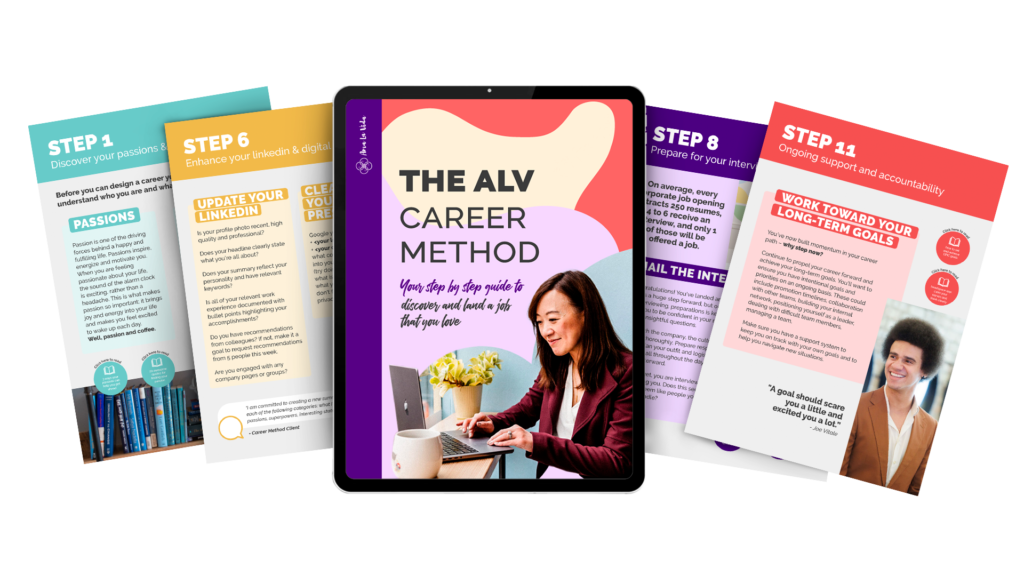
Images from The ALV Career Method Guide
ALV Method Downloadable Guide

a lamp and a bed to help you think about your nightly routine

Did you know what you do the night before significantly affects how you show up the next day? While the morning mindset, movement, and motivation routine will work wonders to shake the cobwebs off, there’s no replacement for a solid amount of shut-eye. I recommend adding these habits and upgrades to your nightly routine to help your mind clear, body relax and sleep improve. I do not buy into the idea that in order to be successful your sleep has to suffer for extended periods of time. After a few days of not getting a solid 6 to 7 hours, I am irritable and angry. The quality of my work, relationships, and life, in general, takes a hit so I’ve made it a priority to create an environment that allows me to fall and stay asleep. Over the years, I’ve tried everything under the sun to get a solid night’s rest. In my experience, I suck at sleeping. It’s like the military and fire department has permanently disrupted my body’s ability to fall and stay asleep. Unlike my fiancé, who drifts off as soon as her head touches down, I used to toss and turn and stand and sit in an attempt to finally fall asleep. I’d turn on the white-noise fan app, put earplugs in, and, even with blackout curtains, still put a shirt over my eyes to catch the chance of any other light. I put magnesium in my chamomile tea and am always on the lookout for supplements that support sleep. I’ve had a lot of experience with restless nights and there are a few things I’ve learned. So how do I nail my nightly routine? Excellent question! The following article goes over habits and rules I’ve implemented into a nightly routine that puts me in a headspace to reduce stress, sleep better, and wake up more refreshed. My hope is that they’ll save your sleep, just as they did mine. Stretch For the same reasons, you’re stretching in the morning add this to your nightly ritual. Stretching will help you destress and unwind before a restful night of sleep. It frees up tension built up in your back, legs, and mind. After a long day’s work, it’s certainly tempting to flop down on the couch. Just don’t miss out on the opportunity to relax your body and unwind your mind so you’re better set up for a night of slumber. If you do sit down and watch TV, slide off onto the floor and do your morning mobility routine once more. Add some static stretching and foam rolling to release all of the energy bound up from a long day’s work. Focus on stretches and exercises that loosen up tight hips and shoulders and relieve back pain. If you sit down a lot, chances are your hip flexors are tight, your hamstrings are overstretched, and your back is weak. Correct these imbalances with a couch stretch, hip bridge, and any and all of these you can do on the floor while catching up on your favorite show. Try this: Spend 10 minutes static stretching and foam rolling each night before bed. Hit all major muscle groups, sinking, slowly into a deep stretch for 20-30 seconds at a time.  Shut off your devices What you do the final hour before bed determines the quality of your rest, the details of your dreams and how you show up the next day. Don’t sabotage your sleep by staring at a screen. Do not be lured in by likes, shares or media that’s manufactured to distract you. We’ve been emotionally conditioned to buy into the illusion that we must always know what’s going on with everybody, at all times, all around the world. We don’t. If you must know the happenings of the world or respond to social media requests, set aside some time during the day to scan the screens.    My favorite thing about a phone is the airplane mode feature. When you’re at work, be ready to respond and react to meet the incoming demands of your clients, customers, and coworkers. Once you get home, especially during the crucial last hour before bed, put your phone in first-class mode and find some time for yourself. Once you do, you’ll start to see your sleep quality improving alongside your memory, focus, and mood the next day. Remember to keep your phone in airplane mode at least until after you’ve wrapped up your morning routine.  Try this: Stick to just one show or a specified amount of screen time then power off and slide your phone into airplane mode, at least 1 hour before bed.   Sit down and reflect Everything you have right now in your life is a culmination of your past thoughts, ideas, and decisions to this point. It can be easy to lose sight of the fact that we’re in charge of where we steer this ship. The final hour before you sleep is a sacred time to remember, reflect on, and learn from the day. Each night brings a new chance to evolve and grow. If you are dissatisfied or after more growth, more love, more freedom or anything else under the sun, take the time to sit down and reflect each night to track how much closer you are to obtaining it. It’s never too late to course-correct. Everything that happens to you is a lesson you need to learn. The faster you learn the lesson, the faster you level up in life. Take some time to reflect, grow and let go each night by asking yourself the following 3 questions. Write down your worries and unfinished to-do’s and look for any silver linings or hidden lessons from the day. Ask yourself: What worked well for me today? What could have gone better? How did I grow? Try this: Make reflection a part of your nightly routine before you go to bed by answering the above-stated questions. Show gratitude Cultivating feelings of gratitude is

Read More
man going for a morning run because he believes in making his mornings matter

Humans are wired for structure and routine. The certainty they provide creates order in the midst of chaos. But I’m not talking about the type that has you thinking, feeling and doing the same thing every day without any conscious thought. I’m suggesting you need a structure that provides you with balance, clarity, energy and focus to actually realize your goals.  Daily structure provides the space we need to maintain our sanity throughout the day. The consciously created morning routine is the calm in the storm. Starting in 6th grade I was regularly getting kicked out of school for fighting, skipping class, and cussing out teachers. My broke, single mom of four kids could barely keep us all afloat. I was reckless, angry and headed down a very dark path until I met a mentor that helped me clean it up just enough to graduate early from high school and join the Marine Corps. Over the next four years, I went on three deployments, was meritoriously promoted twice, and recognized as “Marine of the Quarter.” The military provided the structure missing from my childhood. In the US Marines, structure is a way of life. Wake up call is at 5:30 am and you’re down in formation ready for physical training by 6 am. After the morning run, you clean up, shower and shave before 8 am. Although each day was a bit different, and some were busier than most, there was clear order and a chain of command. We knew where we needed to go, what to do once we got there and who would yell at us if we didn’t get it done. We thrived as a team because we had the structure and sense of direction a team needs to succeed. Comfort Zones and Discipline Leaving the comfort of comradery and unmistakable structure and sense of purpose, many veterans find the transition difficult. There’s no wonder why so many fall on their face once they leave the service. The vacuum caused by a lack of meaningful structure is the reason humans lose their way. Too many return home leaving too much up to chance or circumstance. If you’re not willing or otherwise unable to build systems in your life that will help you succeed, you are destined to fail. But structure and routine aren’t just for Marines and troubled teens. You need them too.  Had I known that it was even possible to alter my mindset, mood, and motivation through my own personal action, my childhood and my military transition would have been quite different. Now, everything has changed. I believe, with the right structure and support, any dream can become a reality for every single person willing and ready to work for it. Coaches, mentors and great friends and family provide the support but, if structure is lacking in your life, you must create it for yourself. Let this morning routine serve as a starting point. The discipline it takes to damn near religiously follow this sort of structure is one of the first steps needed to maintain sustainable success. The following 3 habits are the missing links in your routine to make you more positive, present and proactive so you can enjoy the life you’ve created. Don’t let off now, read on to learn the new habits to take your mind, body, and soul to the next level every single morning.  Adding these to the start of your day is a surefire way to transform your life. These habits should be used in addition to the habits learned in Part 1. If you missed out on that, catch up here.  Now, let’s jump back in!  Mindset – Meditate What? Mindfulness is simply being aware of your thoughts, feelings, emotions and experience. Do you hear the birds chirping? Feel your heart beating? Do you recognize that you’re a bit tired and weary today? Meditation is a life changing practice that brings mindful awareness to all of that. This is not a fad. It’s been bringing peace to people around the world for centuries. No single habit will inject as much space, energy and clarity into your life than regular and consistent practice of meditation. Sit down and enjoy!  Why? Too much stress? Meditate. Anxious or angry? Meditate. Feeling down or depressed? Meditate. Trouble sleeping? Meditate. Short-term memory loss? Meditate. Want to completely and drastically change your life, outlook and perspective in a matter of a few weeks? Meditate. Meditation provides an abundance of mental, emotional, psychological and social benefits. There’s a whole host of scientifically backed benefits of the regular practice of mediation, if you’re into that kind of stuff. Speaking from personal experience, meditation has changed my life, saved my relationships and clarified my path and purpose. With regular practice, I’ll bet it will do the same for you.  How? There are a number of different meditation practices and platforms for learning more. Find the one that best serves you. The 6-Phase Meditation is a great way to learn the fundamentals of different meditation techniques. If you’re interested in a more straightforward way to meditate, and learn about the human mind, try the Waking Up app. For more basic guided meditations, check out Simple Habit or Headspace. Be sure to download our ALV meditation guide. At the most basic form, you can start the practice of mediation by sitting comfortably upright in a quiet room. Next, follow the feeling of your breathe as you inhale and exhale. Your mind will start to wander and once you notice that it has, gently guide your awareness back to the breath. Don’t let those thoughts that say “it’ll never work or “this is stupid” or “meditation isn’t for me” derail you. That’s your ego, and it’s scared of the freedom you will gain once you break from its grasps. Acknowledge the thoughts that pull you up and onwards and let go of the those that no longer serve you. Following the gratitude practice from Part 1, meditate for 5

Read More

Failure is such a scary word for most of us. We shy away from it, run from it, hide from it. Anything we can do to avoid it. But failure is what prompts us to rise. It’s what makes us evolve and become better versions of ourselves. We need to work on getting comfortable with failure. After my fair share of moments where I’ve deemed myself to fail, I’ve realized that they’ve always led me to something else that I wouldn’t have otherwise seen. I think of these times as my “rise up moments.” Here are three things that I’ve learned from “failing” and why I’ve learned to get comfortable with failure. 1. Failing means I’m taking risks and willing to get outside of my comfort zone I realized that if I always sat in my comfort zone, I wouldn’t be faced with failure because everything would always be safe and easy. But when I’ve had to work for something and failed, I’ve learned a lot about myself in the process. When I moved across the country to a city that I had never been to for a new job, it was a huge step outside of my comfort zone. I didn’t know what to expect but I knew that if I didn’t take the risk, I would miss out on a new adventure and a great opportunity for my career. Ultimately, I ended up losing my job after the company had a massive round of layoffs. I felt like a huge failure because I went all the way across the country to seize this exciting opportunity and I felt as though I didn’t do a good enough job. But in hindsight, the opportunity taught me a lot about myself and it grew my career in a very positive way. 2. It’s not failing, it’s being guided in another direction that may be better for me There have been so many instances in my life where I have had my heart truly set on something. Whether it was something as simple as a pair of shoes that I’ve really wanted to buy, a job that I really wanted or a relationship that I really wanted to work out. I’m a big believer that when you put the intention out into the universe, the universe will deliver. And this great quote from Kerry Washington sums it up: “the universe will always give you three answers: yes; yes, but not right now; or no, I have something better for you.” This was a life changing “aha” for me that took many years to fully understand. That last one is a tough pill to swallow when you’re in that moment where you truly want something now. But when things haven’t worked out the way I wanted them to, I was always being directed on another path. Most often when this redirection happened, I was very resistant to it and thought because what I wanted didn’t work out, I had failed. But even though I was going down this new path begrudgingly, something that I didn’t even think was possible for me, has always shown up. And I found myself feeling glad that what I actually wanted didn’t work out. Something that’s a better fit for you will always come along! 3. It’s NOT an overnight process – it takes time and patience to get to where you want to go When we’re working towards a goal like a promotion, being an entrepreneur or even learning a new hobby, when things don’t go according to the timeline that we want, we think we’re failing or that it’s never going to happen. One of the hardest lessons that I’ve had to learn is that nothing great comes without hard work and persistence. There will be many roadblocks along the way, but they’re all meant to help you grow and learn something. As they say, it’s all about the journey, not the destination. I’ve wanted to do nothing but jump from point A to point B quickly and what I’ve learned time and time again is that life just doesn’t work that way. If we want to get from point A to point B we have to go through the peaks and valleys so that we can fully appreciate and understand our destination. We’re not failing because we’re not getting there fast enough, it just means that there are a few more lessons that need to be learned along the way. Stay patient, it will happen! What are some of the lessons you’ve learned when you thought you had “failed” at something? Share your thoughts in the comments below!

Read More

Healthy and productive communication in the workplace can be difficult to nail down, especially when you’re working in a fast-paced environment. But the difference between getting it wrong and getting it right are like night and day. In the former scenario, miscommunication runs amok; few people feel heard and just as many feel misunderstood. Good ideas never get the consideration they deserve, leading to rising frustrations and drops in moral. If no one takes responsibility to fix communication then, at best, your organization loses money. At worst, you lose your people. Or you can take it the other direction. In this scenario, your people don’t simply feel heard—they feel understood, valued, and they aren’t afraid to give their opinion, even if it contrasts your own. In fact, it’s encouraged, because in a work environment where communication is thriving, your team will believe they are safe, acknowledged, and competent. Not sure how to improve communication skills in your workplace? Don’t fret! Communication can be as complicated as it is useful, but by starting with these three habits, you can play an active part in shaping a healthier company culture. Stop Talking and Start Listening It’s easy to assume that communication is all about talking, but below the surface, there’s much more going on. When developing effective communication skills, an often-overlooked skill is the art of active listening. What does this entail? For starters, if someone is speaking to you, stop what you’re doing. Turn away from your computer screen. Put down your phone. Whatever you need to do. Be face-to-face to them your undivided attention, make eye contact, and make sure you’re facing them. While they’re conveying their idea or story or question, don’t be thinking about your response. That’s something that gets a lot of people. Instead, bring your attention to what they’re saying. If you’re confused about something, ask a question. For extra credit, paraphrase what they said back to them to see if you listened well. Although it sounds simple, this exercise can be difficult. It’s going to take some practice before you get it down to a habit. Luckily, you’ll have lots of opportunities to practice at your workplace. Personally, I practice every day when I get to work by asking my coworkers how they’re doing. At first, they’re responses were curt and to the point. But when they realized that I actually cared about what they had to say, they began to open up. And you know what? Everyone feels better for it. It takes more time, but it creates rapport and reinforces relationships. When you get down to it, that’s what business is about. Use Your Body Most people understand that the way you carry yourself leaves a lasting impression on people, and yet, everywhere I go, I still see individuals making simple communication errors that could be fixed with a few tweaks to their body language. I already mentioned some of the basics above: make eye contact. Be face-to-face and avoid your screens when you’re speaking with someone. While these are some easy and straightforward ways to improve communication, if you’re looking to become a communication expert, you’ll have to learn to use your body. Body language isn’t just about avoiding the crossing of your arms and keeping your back straight. It’s also learning to consciously balance your stance, rigidity, and posture until it becomes habitual. It’s expressing non-verbal cues during conversation that allows the speaker to know that you’re actively listening. Things like: Gentle nodding. Raising your eyebrows. Smiling. Leaning forward. When you fail to give conversational feedback with your body language, people may take it as a sign that you don’t care about what they have to say, or worse, that you’re supercilious or condescending. Don’t give the wrong impression—look and behave like someone who cares. Tone It Up Out of all other areas of communication, tonality and articulation are the ones I’ve struggled with most. In high school I once had to repeat myself so many times that the person just told me to drop it.  Pretty bad, right? I could have just berated my previous self’s general communicatory awkwardness, but instead, I learned from him and rounded myself out in that area. You can too by following a few simple principles that include but are not limited to increasing your volume, slowing the pace of your speech, and moderating your tone of voice. The benefits of speaking louder are pretty straight forward. If you raise the volume, more people will hear you, and they’ll be more likely to understand what you’re saying. Doing so also increases the likelihood of you coming off as confident. Here’s another thing: don’t end your statements with question marks. What do I mean by that? It’s when your pitch rises with a sharp upward curve, a tendency that typically occurs when the speaker is uncertain about what they’re saying. Why does this happen? It happens because, while the speaker is articulating their thought, they feel the need to ask questions to fill in gaps of missing information, or when searching for approval of an idea or choice. Is it wrong to do this? Not at all. But it does convey a sense of uncertainty, which doesn’t exactly inspire confidence. Another technique you can use to improve tonality is to slow down your speech and enunciate your words. No one enjoys getting bombarded with thought after thought after thought—instead, give your listeners and yourself breaks. Take time to breathe. Doing so turns your ideas into bite sized Hors d’Oeuvres that end up tasting much better now that they aren’t being forced down their throats. And if you really want to step up your communication so that people listen more attentively to what you’re saying, spice things up. Don’t speak in a dreary monotonous voice—be playful. Give it some color. A lot of people speak with sentences like these that go on and on and on, not really going anywhere, or even if they are, they lose the interest of your listeners like an hour-long broadcast of C-Span. In

Read More

Planned Happenstance, yes where the magic happens. I am hoping to capture all of you career changers (life explorers) with this concept that I guarantee with a bit of curiosity, open-mindedness, and grit will get you exploring your options in no time! The planned piece is perfect for those of you that much prefer to have order and structure to understanding your career journey, and the happenstance piece for those that like me, prefer to go with the flow and allow events to unfold in your life unexpectedly that will later take shape and meaning. I truly believe in the power of planned happenstance. These events are taking shape in everyday moments in life, and the kicker is, they are usually unexpected, yet we have a lot more to do with these events than we give ourselves credit. These events do not happen by luck. These events happen because of the action you take around the unexpected, unplanned part of the equation. What I really want to say is that expect the unexpected, and from there, run towards what is stirring inside of you to take action from that initial excitement, yearning, or draw you feel towards this unexpected encounter, conversation, or event. What makes me excited and engaged in using Planned Happenstance are the key skills that you can implement right now to try this out on your career journey. These five skills connect the theory to practice. Curiosity What are you most curious about? Curiosity allows us to stay open to exploring new learning opportunities and let’s face it, the career transition or job search will ask this of us directly. To help navigate the unexpected in any of these career steps, we do not always know where the next job opportunity may lead us. To remain curious can start with learning about ourselves. You can become curious by exploring conversation and meaning with others in an industry you are exploring, or even taking on a new learning experience by way of a course to learn new skills will keep you feeling motivated and unstuck during this process. To help you create more curiosity, start by asking yourself what other interest areas seem intriguing to explore, starting now! By starting now with curiosity, you will cultivate ways to learn by doing, learn by sharing and improving your skills. Persistence Where can you consistently show up for yourself? To have accountability in your career process may include setbacks, yet despite those setbacks, you are willing to put in the time and effort to show up for the work. Every single one of us has used persistence in some way. You have been persistent with waking up and going to work, going to school, learning a new concept to challenge ourselves, but even more so, we have all faced a challenge and using persistence to overcome those challenges is the skill to continue to learn from past and future unplanned events. What can we do when the going gets tough? Reach out to your support system and be open to recognizing where you can seek help. This quote captures this all too well where writer Ashley C. Ford says on career transitioning, “Ask for help. The worst you will hear is no, and it won’t kill you. But the yeses? The yeses are there and they’re waiting. Go get your yeses.” Flexibility To remain open to possibilities is to remain flexible in our reaction and transparency to opportunity. This key skill here is to remind you that in order to have opportunities present themselves, you will remain open to change and that includes a change in attitude at times. This is not an easy task, as it is comfortable to stick with what we know. How would your life change if you acted? How would your life change if you did nothing? The flexibility you allow yourself to explore and be excited by life sheds light on your openness in changing your attitude toward life. The inner work can prove to be difficult but with the shift in attitude, that same work will become more enjoyable. Optimism Happy thoughts, happy life! To be optimistic and to use this as a skill, you first have to view new opportunities as possible. How would you describe a chance event you wish to happen to you? How can you then act now to increase the likelihood of that desirable event? You can control how you choose to act on any and all chance events and your optimism towards this action. These events may include conversations and chance meetings with someone at the grocery store or gym, or maybe a friend recommends you to connect with someone at their company. To embrace these opportunities (leads) as being possible and attainable is to be optimistic, and this is where you create your own luck. Risk Taking Opportunity to fail? Wait a second, failure is not optimistic. The idea of failure is scary and that comes with the territory of the unknown. Without knowing, how can we be sure our efforts are a success and without failure, will we challenge our depths to explore further? Without discomfort and uncertainty, can we truly grow? Maybe you have a creative risk you have been nervous to start and have self-doubt. Maybe you have always wanted to start a blog and share your work. Starting a blog may not be a huge success right away, however, without starting somewhere, we start nowhere. What is your wildest, spark of joy idea? Whatever it may be, take action to move in that direction. I know I have always wanted to teach yoga in remote locations around the world. Where I can take action now is to continue practicing my yoga and teaching skills and connect with other teachers who have taught abroad, and then, of course, I have to take the leap and actually teach a yoga retreat abroad! Have fun with this skill, see what happens when you allow

Read More

This May, more than ever, I’ve seen many social media posts, marketing campaigns, and articles talk about Mental Health Awareness month. When I read these posts, I can’t help but wonder why it’s only acceptable to feel the feels for 31 days out of the year and not the rest. Our culture tells us that we must appear put together all the time. But there are days when the struggle is real and all we want to do is reach for that cookie, that extra glass of wine or whatever it is that helps us stuff our feelings away. As I’ve gotten older, I’ve realized that people go to great lengths to appear put together because we’ve been told that showing emotion is weak. In the past, when someone would try and share their bad day with me, it made me uncomfortable and I used to shut the conversation down by saying things like “hang in there” or “stay positive.” I now realize saying this only makes things worse. It doesn’t create a safe space for the person who wants to share because we’re telling them it’s not okay to have a bad day. Now, I celebrate my bad days by really sitting through the emotions vs. reaching for something to stuff them away. I also don’t pretend to have it together and give myself a break when I do have a bad day. Here are the three steps that I follow when I’m having a bad day: 1. Don’t Stuff, Feel the Feels My favorite thing to do when I’m having a bad day is to write it all down. Whether it’s on a napkin or in my journal, whatever it is, I just start writing. This helps me release the feelings instead of trying to avoid them by distracting myself. The other thing I like to do is go for a run or lift weights. Both allow me to release the negative energy and practice self-care. If journaling or working out isn’t your thing, listen to a sad song. I used to do this a lot when I was going through a difficult time. Listening to a sad song would always get me to start crying which was a very cathartic way of releasing the emotions. It allowed any weight that I was subconsciously carrying to melt away. It doesn’t matter what your go-to is, but find a healthy way to sit with your feelings and release them. While can be uncomfortable, it always works. 2. Have A Q&A Session With Yourself While I’m journaling or working out, I’ll see that the reason why I’m feeling the way I am is because I’ve been triggered. Whether it’s an old memory or something else, we all have our triggers. Even when we think we’ve worked on them or handled them, they sneak up on us. When I write things down or I’m “pounding the pavement”, I can see why I’m upset or anxious and that allows me to have a dialogue with myself. The first question I ask myself is “what emotion am I feeling?” Is it anger, sadness, fear, disappointment? Giving the feeling a label starts to identify where it might be coming from. The next question I ask myself is “what past event or situation is this bringing up for me?” Once I start to have this Q&A with myself, I can start to see where my feelings are coming from and I can start to do something about it. The Queen of running from my feelings, I used to just let things sit or avoid them. I’ve learned that the feeling only comes back over and over again no matter how much I try and run from it.  Turn inward and start to have a Q&A conversation. 3. Talk to Your Tribe/Trusted Advisor One of the best lessons I’ve learned is knowing who’s part of my trusted inner circle. These are the people you can count on to be there when the struggle gets very real. Cultivating these relationships takes a long time but think about who’s a part of your tribe. It doesn’t have to be a lot of people, it can even be one person like a family member, best friend, therapist, mentor or life coach. But when you’re having a bad day, you should be able to openly share how you’re feeling without judgment or shame with at least one person. It’s taken me a while to find the winning combination of steps to deal with a bad day and feel the feels, but it’s been incredibly helpful. We all have our bad days and it’s completely acceptable. What are some of the ways you deal with a bad day? Leave a comment below! To learn more about mental health and to find resources visit: https://www.mentalhealth.gov/

Read More