Category: Career Enrichment

positive thinking quote "think positive"

One of the first lessons you’re taught in acting school (the first era of my career) is to always say yes. Or ‘Siempre si!’ as one particularly joyful teacher used to say. The word ‘no’ – and by extension, a negative mindset in general – is limiting. It closes doors, builds walls and keeps out opportunities. It closes YOU down. But saying yes and employing a positive mindset can open you up for a world of possibility.  The power of positive thinking has long been known as a useful tool for surviving today’s increasingly stressful work environments. But can positivity help you survive your day-to-day life and help you advance your career?  Having long utilized this frame of mind myself, I am here to tell you that it can. I never had any job remotely related to my acting degree after leaving college. This meant I have often found myself in roles where – because I didn’t have any formal training or education in said role – I had to rely on my other skills to get ahead. And let me tell you, saying yes to positivity time and time again in my various workplaces has opened up significant doors that otherwise would have stayed shut. Here’s what I’ve learned about positive thinking: You’ll be a better problem solver Think about a time when you were faced with a problem. Was that problem easier if you felt angry, resentful or depressed about it? My hunch is that it wasn’t. Having a positive mindset can help you look at a tough situation and overcome it. It helps you look for the possibilities, instead of the problems.  Having a positive mindset also means instead of saying, ‘I don’t know how to do that’ you can say, ‘I don’t know how to do that…yet’. I have often found myself in a workplace situation where I felt like a fish out of water. Instead of focusing on what I didn’t know, I would choose to look at the situation as a chance to grow my knowledge or skillset. And each time, that’s exactly what I did. I learned about everything from drafting a budget and managing a team just by saying yes. Over time, my bosses and peers came to see me as someone who was always up for a challenge, instead of someone who wasn’t quite ready for the task. You’ll be someone others seek out Once you’re known as a proactive problem solver, you’ll be a person that others come to when they need help. This can give you a chance to show off your skills or impress your boss that you might not have otherwise had.  I was once asked to cover a colleague’s duties while he was on vacation; eager to learn about another area of the business I wasn’t familiar with, I said yes. And when that same employee left the company a couple of months later, guess who was promoted to take on that same role? This proved to be a major step-up for me, one I wouldn’t have gotten had I not said yes in that first instance. There is, of course, a caveat – being positive doesn’t always mean you have to say yes to EVERYTHING that might get thrown your way. It is absolutely okay to say, ‘Let me think about that and get back to you,’ and then walk away and evaluate what you want to do. But by not immediately saying no, you present yourself as a person who is open and receptive, not negative and off-putting. You’ll find a lot more chances to showcase your talents this way. And the more chances you can show what a stellar employee you are, the more chances you’ll have to level up. You’ll build your ally base On the flip side, having a positive relationship with your co-workers can mean that when YOU have a problem, you will probably find it a lot easier to find someone to help you out when you need it. You have to spend 40+ hours a week with your colleagues – be someone others (including your bosses) want to be around! And as an added bonus, that could prove to give you the needed edge when it comes time for a promotion. You can help build your own allies by helping build a more positive atmosphere in your workplace. In one office I worked at, I would send Monday Motivational Memes to my team first thing Monday mornings. It helps to start the week on the right foot – a picture of something cute or funny to put a smile on my co-workers’ faces as they start the work week. (I always found pictures of tiny animals with an inspiring quote to be particularly effective).  While this may not be appropriate for every setting, think about ways you can inject a little smile or positive feeling to your office. Asking someone how their weekend was, offering to grab a coffee from the breakroom if you’re going or listening when someone just needs to vent. There are all ways to build a mutually positive relationship and grow your ally base in the workplace. And the more allies you have, the more support you’ll have when you need it. You will succeed – just believe! Above all, stay positive about yourself and your abilities! It’s so much easier to do something you believe you can than something you doubt yourself on. Channel your inner Little Engine That Could and get the thing done! Saying ‘yes’ to myself – even when I was scared out of my mind! – has led me to some amazing experiences (both job & life) that I wouldn’t trade for the world. So, how do you be that positive person in the room? There are many articles dedicated to this very topic, but here’s what I’ve found useful:

Read More


Everyone has moments in their life where they need to lean on someone for guidance. Whether you are going through a career change, working on your mental health, or figuring out what you want to do in your life, there are several options to consider when seeking guidance. Coaching, Therapy, and Mentorship are three big areas that people turn to when they are seeking direction. Here at Ama La Vida, we love helping people through coaching. We have clients come to us from all different backgrounds and different goals. In my role here at Ama La Vida, I am answering questions of potential and current clients. A common question that I often hear is how is coaching different than therapy or mentorship? Understandably, these get mixed up frequently, so let’s take a look at the differences between Life Coaching vs. Therapy vs. Mentorship.  Coaching vs. Therapy Although similar, there are a few major differences between the two.  Time Orientation – Past vs Future Therapy tends to focus on the past while coaching has more of a future orientation. Typically, if you are trying to understand and heal from a traumatic event in your past, therapy is a great way to cope with this. Coaching does not usually dive deep into your past and is more of a reflection on your current self.  Medical Diagnoses Sometimes therapy leads to a diagnosis of some sort which is something only a clinician is qualified for and can help you through. However, if you are looking to develop a plan to meet goals or new habits, coaching would be a great place to start. Keep in mind that coaching is not regulated, and in order to get the best experience you should consider your options and do thorough research. Almost anyone can call themselves a coach, but you have to make sure that they live up to the standards you are looking for. For example, our coaches are certified through a program that is accredited by the international coach federation. This ensures that they are meeting the highest standards and ensure the outcomes that our clients expect and more.  Amount of Time to See Results Therapy can take years to see results while coaching takes less time because it is action-step oriented. Although results might come faster in coaching, it is still a long-term relationship between the coach and coachee as with therapy. It is an ongoing process of creating goals, reaching them, and creating more while having someone there to keep you accountable and talk to when you feel stuck.  Once you have done your research and it is time to make a decision, take a step back and decide if you need therapy or coaching. Sometimes you might need both. Many of our clients have combined the two and it has proven to be very effective. Questions to ask: Coaching vs. Mentorship Another question we often get asked is what is the difference between coaching and a mentor (or mentorship)?  Defining Goals  Both mentorship and coaching help you reach your future goals, and both focus on self-improvement. However, a major differentiation between the two is that coaching takes it one step further and helps you define your goals while mentorship comes into play when you have decided what your goals are. If you aren’t sure what direction you want to go in, coaching may be a great place to begin.  Structure Mentorship is also less structured than coaching and depending on your learning style that may or may not be a good thing. Most times, a mentor is someone who is your superior, meaning they have been in your shoes before and are willing to show you the ropes. While your coach might share a similar story to what you are going through, that is not always the case. Self-guided When you work with a mentor, they are there to give you advice and possibly give you straightforward suggestions. Coaching is not the same in regard to this because it is focused more on guiding you to make your own decisions and conclusions. Put simply, your coach is there to guide you and help you decide what your future goals are, then implement a plan to get there. Your mentor is there to help you reach a specific goal you have already decided you want to reach.  Questions to ask: You now know the differences between Life Coaching vs. Therapy vs. Mentorship. They are all useful tools; it is just a matter of where you are in your life and what are the circumstances you are needing guidance on. You might need more than one at the same time, or you might need to focus on just one for your current situation. Be truthful with yourself when deciding which you might need, but when you decide, follow through. Trust me, you’ll thank yourself later.  Looking into coaching but don’t know what kind of coaching you need? Set up a consultation with an Ama La Vida team member here!

Read More

Have you ever heard of the “coin flip” trick for making decisions?  It might not be what you’re thinking! Here’s how it works: If you’re faced with a decision between two options, assign heads to one and tails to the other, then flip a coin.  Catch it and cover it so you can’t see the outcome yet. That’s the trick.  When you’ve flipped but haven’t looked yet – which side are you hoping for? When it comes right down to the wire, there will be one option you want to happen more than the other; deep in your heart, you’ll be rooting for either heads or tails in that split second before you see.  You can drop the coin without ever looking – you’ve got your answer! Not every decision can be handled this way, of course.  For starters, some decisions are between more than two options!  But the core concept – that we often over-complicate decisions that in reality are simple – remains true. I’m going to talk about how to de-complicate ANY decision, not just the choice between two dinner options! Removing the Obstacles Most of the time, difficulty in making a decision isn’t a matter of not having the information or intelligence to do so.  You’ve got that! It’s usually a matter of an additional, negative aspect impeding the process. If you need more information you can get it, but what do we do when we have all the right info, and it’s just time to pull the trigger?   Over the years I’ve identified three major obstacles that people tend to face when making really tough decisions about their lives, careers, families, or other important topics.  I’m going to talk about each one, and the techniques I’ve used (and helped others to use!) to overcome them. Obstacle Number One:  You’re Way, Way Too Close To The Problem Emotional investment and bias is a major obstacle to decision-making.  When you’re feeling overwhelming negative emotions of any kind, you’re not going to be doing your best work.  Don’t worry – my advice to isn’t going to be something silly like “don’t be sad.” That’s not helpful nor actionable advice!  Instead, I’m going to help separate the parts of your mind that are feeling those stressors from the part of your mind that has to make this decision. First, write down a list of 3-5 generic things about you.  Anything will do! For instance, I might write: “Lives in New Jersey.  Has three kids. Late 30’s. Incredibly handsome. Very funny.” Then, write down another 3-5 things that are relevant to the tough decision.  So, if the decision I was facing was whether to keep my house in the suburbs or move to the city, I might write:  “Likes having a yard. Has a daughter that loves playing outside. Hates having a long commute. Has no pets. Has a wife that wants a cat.”  (If you’ve tried to make a Pros & Cons list for your decision already, that can be a good source for these.) Next, draw a stick figure.  Yes, I’m serious. Just draw a little stick-figure person.  Pick a random first name that isn’t your name, and write “This is [name],” next to that stick figure.  So I would write: “This is Jim.” Then write out all the traits from both your lists, but say “Jim is…” for each.  “Jim is in his late 30’s and lives in NJ with his three kids. Jim’s incredibly handsome and very funny.  Jim loves having a yard but hates commuting to work. Jim’s daughter loves the outdoors. Jim has no pets, but his wife really wants a cat.”  Then write the decision Jim is facing: “Jim is trying to decide whether he should stay in the suburbs, or move to the city where he works. Jim wants your advice.  What should Jim do?” This method takes the same information but presents it to you in a way that removes a lot of the emotional component.  It helps you visualize the problem from the outside, instead of being stuck in the middle. Chances are very good that when presented this way, the answer will seem far more obvious than when you were trying to make the decision for “you.” Obstacle Number Two:  Every Priority Is The Highest Priority We all have things that are important to us.  When we’re making a big decision, we’re trying to pursue those things.  But it’s a simple truth that we can’t have everything – decisions are about change, and change involves compromise. Our brains aren’t wired to take multiple competing concepts and evaluate them against one another fairly and honestly.  Humans just aren’t good at that. If I ask you if good gas mileage is important to you in a car, you might be easily able to say “yes,” because the decision is whether you do or don’t like good gas mileage.  That’s easy. If I ask you if safety is important to you in a car, you can easily say “yes” again for the same reason. But if ask which is more important, suddenly you’re stuck.  That’s natural, but we have to overcome it in order to make a decision. This next exercise is very challenging, but the rewards are tremendous. Write down a list of everything that’s important to you in the realm of the decision you’re making.  So if you’re looking at cars, you can write down “Price, mileage, safety, room,” and anything else you care about.  Don’t use a single sheet of paper – put everything on a separate piece, or on index cards, or post-it notes, or anything that lets them freely move.  Then here’s the challenging part: You’re going to QUANTIFY and PRIORITIZE. Quantify:  You can’t just say “Price.”  That won’t get you anywhere. You have to put a number on it: The maximum price you’re willing to pay.  For gas mileage, you have to put down a number that’s your goal. For safety, put down the rating you’re

Read More
volunteering for good on charity day

Back in 1997, the United Nations declared September 5th the International Day of Charity.#CharityDay is meant to educate and mobilize stakeholders around the world to help others through volunteer and philanthropic activities. In the intervening decades since #CharityDay was first observed, our world has changed considerably. It is now time for our collective concept of “charity” to evolve as well. According to the Oxford Dictionary, charity is the voluntary giving of help, typically in the form of money, to those in need. But this narrow definition implies a problematic power dynamic. One wherein the people in a position of relative wealth and power are making the decisions about how much (and what kind of) help others deserve. At the heart of the act of charity lies a desire to help others. And that is something we should continue to encourage. But we must be thoughtful in the way we act on that desire to ensure that our efforts don’t end up causing more harm than good. We must find a way to go beyond the charity mindset of “helping people” to supporting a truly transformational movement that achieves real change in our communities. To honor the original intent of #CharityDay, use the tips below when searching for your next volunteer opportunity. These will help ensure that you’re engaging in the most respectful, ethical, and sustainable way.  Focus on skills-based volunteering and avoid Voluntourism Voluntourism involves short-term ‘projects’ designed to benefit the volunteer, rather than the community being served. Think: playing with kids at an orphanage or teaching English in vulnerable communities. The practice of voluntourism can erode dignity, create dependencies, and reinforce paternalism – ultimately creating more harm than good. Unlike voluntourism, skills-based volunteering seeks to transfer skills to local groups already developing their own solutions to real problems. This approach keeps the needs of the community being served at the heart of the work.  Factors to consider when choosing a project A quick Google search for “skills-based volunteering” will yield over 73 million results. That’s a lot of options to sort through! To help you narrow things down, here are 8 factors to consider when choosing a volunteer engagement: Skills Make sure there is a strong alignment of an organization’s needs with your skills. Remember to focus on your real skills. A good place to start is with the skills you already use in your day-to-day job. Remember: if you aren’t qualified to do something in your home country, you aren’t qualified to do it abroad just because the regulations may be different!   Timing Find a start date, end date, and duration that is agreeable to all parties. Make sure you do an honest inventory of your commitments and availability so that you don’t overextend yourself. Don’t try and do too much in a short time, or you’ll risk leaving both you and your host dissatisfied.  Motivations Be clear about what you and the hosting organization are each hoping to get out of the experience. The more time you spend discussing this upfront, the more you’ll get out of your time on the ground. This also helps to ensure that expectations are met on both sides! Sustainable Impact Focus your work on projects that have long-term potential. And also where you can build the skills of people to sustain the projects after you leave. For example, if you’re helping a grassroots organization develop a digital marketing strategy, train someone on the local team in social media best practices. This helps them so they can implement the plan after you’re gone. Communication Ensure that you can clearly communicate with each other. If possible, get to know your local point of contact via Skype or email before you arrive on the ground. Doing the pre-work with your host to align around expectations, deliverables, and logistics will pave the way for a successful project.  Commitment Both you and the host should invest time and resources in the engagement and agree to certain outcomes. Your host organization shouldn’t be charging you to volunteer, and ideally, they are able to provide some type of benefits in exchange for your skills (like housing while you’re on-site or meals while at the office.) Ethics Make sure the project is locally-led, doesn’t erode jobs and is in the best interest of the community. This video from LearningService includes a helpful checklist you can use to ensure it’s a responsible volunteer placement. Partnership Work hard to build a partnership that benefits both parties. Before you commit to a project, make sure to begin a dialogue with your host organization to more fully scope and plan your project. A successful engagement is a two-way street!  For additional guidance and more details about the factors above, check out the MovingWorlds Complete Guide to Volunteering.    — Done right, volunteering can have a transformative impact on both the volunteer and the community she’s serving. Taking the time to read this article is a testament to your willingness to help, and with the guidance you’ll be empowered to do so ethically and sustainably this #CharityDay! For more tips and resources about volunteering sustainably, check out the MovingWorlds #MakeVolunteeringMatter series.

Read More

Is there anything worse than landing the perfect job, only to discover the person you report to is a pain in the ass boss? Yeah, there is, but it’s still a major let down. For many employees, the relationship they have with their boss is one of the key components in determining their overall job satisfaction. However, at one point or another, we are likely to wind up working for pain in the ass boss. Fortunately, there are several ways to handle this situation. Here’s how to deal with a pain in the ass boss! Humanize Yourself  Some bosses view their subordinates as little more than instruments required to get the job done. Their relationship with co-workers is similar to a craftsman (or craftswoman) and their hammer. But you are not a hammer, are you? You are a human being, and so is your boss.  Find a way to remind your immediate superior that you’re a person. Chances are, you and your boss have a few things in common. Maybe you have children that are around the same age. Perhaps, the two of you like the same sports team. It’s possible that you are both big-time tropical fish enthusiasts.  Ask around and find out a little bit about your supervisor. Next time you see them in the elevator, try and strike up a conversation about something that isn’t necessarily work-related. This could help remind your boss that you are indeed a real-live human being.  At the end of the day, it’s much harder to be mean to a person than an inanimate object.  Have A Heart-To-Heart In some cases, the direct approach can be the way to go.  Of course, this doesn’t mean you should storm into your boss’s office and tell them they’re a jerk (as tempting as it may be).  Instead, be civil and let them know you aren’t happy with the nature of your professional relationship, but you have a real interest in making it work. Better yet, come up with ideas on ways you can improve the relationship. After all, it’s easy to point out a problem. But addressing it with a solution in mind can often make things easier.  Ultimately, there isn’t a whole lot to lose here; your supervisor was already a jerk.  Understand How You May Contributing To The Situation As human beings, self-awareness can be difficult at times.  Have you had ten different jobs, and all ten of your bosses turned out to be a pain in the ass? Are you consistently the only one in the office that seems to be having an issue with your manager?  If the answer is yes to either of these questions, chances are, your boss isn’t the only problem. You are too.  In this case, it’s time to look in the mirror and try to figure out a new approach. It might be a good idea to get an outside perspective. Consider speaking with a career coach or co-worker you trust and see if you can find a better way to co-exist with your boss.  In truth, not everyone thrives in a team setting or works well with authority figures. Despite workforce pressure to be a “team player,” some of us do our best work alone. If you think you might be one of those people, try finding a remote position where minimal supervision is required or consider becoming an entrepreneur and work for yourself.  Quit The truth is, some relationships can’t be repaired. There are certain people in this world that we simply aren’t compatible with and never will be. If you’ve determined that this is the case, ask to be transferred to another department or, if possible, ask if you can join a new team with a different supervisor.  Sadly, sometimes there aren’t any viable options. If that’s the case, then it may be time to make some hard choices. Of course, quitting isn’t ideal. After all, having to re-enter the job market can be downright stressful. That being said, there may be situations where parting ways with an employer is the best option when dealing with an unbearable boss.  Unsure of how to quit? You may find this blog post helpful!  At the end of the day, whatever choice you make, your happiness and well being are the most important factors. If the person you report to is making your work life unbearable, then you owe it to yourself to address the issue as soon as possible. The sooner you deal with your horrible boss, the sooner you can get back to enjoying your job and loving your work life again. Please don’t hesitate to reach out if you need a little help!

Read More
ways education will change

These past few years, we’ve seen some tremendous changes in the education world. Science innovations have been all over the place. We’ve witnessed tremendous advancements in medicine and constantly changing technology trends. These changes are only bound to grow and become more numerous in the years that follow, which makes it essential for us to think about education.  What kind of changes in education are necessary to keep in touch with these big changes? In this article, you’ll learn what we can expect to happen to education in 2020. It’s coming really close and yet, the inevitable changes are pretty amazing. By 2020, we’ll witness changes in every aspect of education. The ways education will change will start from the learning environment and keep moving toward learners and teachers. As it has been for the past few years, the biggest changes will result from technology invention and advancements. With the unlimited internet access most countries have at this point, education has already become more available and accessible than it’s ever been.  That being said, teachers are reaping the benefits of new career opportunities that don’t just limit them to traditional classroom teaching. Students are enjoying amazing access to free learning materials online. Finally, the degree programs are moving toward a more learner-centric system.  This is the time where education can take you to any place you want to be. You can use it to turn your ideas into reality and become a highly accomplished person. We’ve all noticed these advancements in education today. In the following few months, we can expect the following changes: More Customized Learning Learning is becoming more and more customized every day. There have been all kinds of research that’s shown that a more customized approach toward teaching a student is more successful. This is where it all started. Teachers have started to customize the syllabus based on the pace of learning of their students, use various methods to prompt students to express what they have learned and wand to learn, etc.  For example, instead of just studying materials and writing the occasional paper, education today requires the writing of dozens of different paper types. These aren’t just used to evaluate the students’ progress, but also to build a myriad of different skills, as well as get insight that would help teaches customize the learning process.  In 2020, we can expect this to be even more prominent in the educational system. The number of such assignments that allow students to express themselves will just grow. Because of it, we can also expect a growth in interest in essay maker usa companies. Until the system establishes an equilibrium that gives students enough freedom and time to do what needs to be done, they’ll need some help to meet every deadline. Things like standardized testing have been judged by parents for so long. This is one of the biggest issues of today’s education, especially since private schools manage to create a more personalized learning experience. Naturally, the more customized the learning is, the more benefits it brings to the students.  This is why the following year will bring us new customization tricks and efforts that will mostly be helped by technology (check out this article that explains how technology tools, such as CRM, can also boost education). With the help of technology, this process has come really far in the past decade.  Increased Accessibility Because of the accessibility to learning materials and data online, there are plenty of changes happening in the world of education. Just recently, students have stopped using the traditional books and moved to digital e-book reading. Others eliminated the need to read whatsoever and decided to go for short reviews from people who’ve actually done the reading.  This is definitely not a good result of the increased accessibility, but let’s not forget about the tremendous benefits technology brought us. Once the knowledge and information became accessible to anyone with an internet connection, we’ve experienced a tremendous advantage over students who studied in the past.  In 2020, we can only expect the accessibility to improve, both geographically, and virtually. We’ll still need to establish better system for obtaining the real and relevant information only, but that’s a work in progress.  Remote Communication Will Reduce Real Communication More and more, students and teachers are eliminating the need for actual face-to-face communication. Technology has made it possible for them to access and share educational materials and information easily. However, this has also been detrimental to actual, human communication without the help of technology.  In 2020, we can only expect this bad effect to grow. Students rarely communicate with professors and other students by visiting the offices or working on projects together. Everything is done with the help of technology. They speak to professors via e-mails and messages, work on projects via social media and platforms like Skype, and use messages and phone calls instead of speaking face-to-face.  These are the updates of the modern life, but, despite the many warnings of them eliminating real human communication, we can’t really expect this to improve in the following months. The Need for Teacher Training Will Only Grow Teachers need to keep track of technology changes, and we all know it. Even though technology changes every aspect of life, we are definitely far from the point where teachers are no longer a necessity. This may never happen, but it is why teachers need to go through training to get a better grasp of what modern students need today.  Education is currently driven by technology use. Therefore, the traditional methods, as well as teachers’ training is now outdated and no longer effective. If the need of further training was big now, it will only get bigger in 2020.  We Won’t See the Diploma in the Same Way as Before Student debt is a real issue nowadays. More and more students decide to invest into their education. In the past decades, the competition has grown so much, there’s hardly a person

Read More

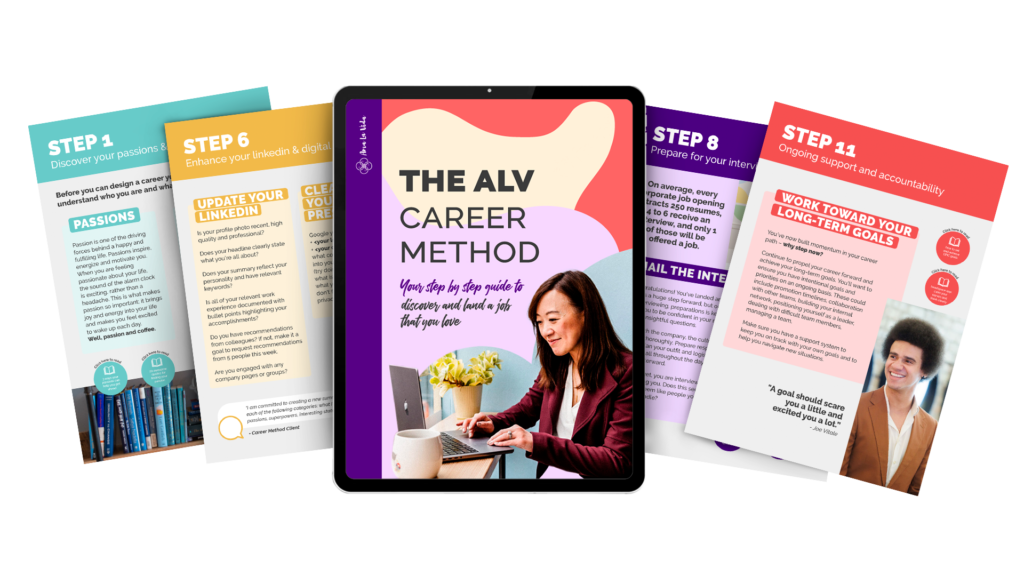
Download our comprehensive step-by-step guide to design and land a job you love!

Images from The ALV Career Method Guide
ALV Method Downloadable Guide

As a Career Coach, I am always asked, “Are cover letters required?” The question when preparing your job materials (resume, LinkedIn, interview prep) seems to be one at large. Then comes further questions, “Where do I begin when writing a cover letter? Is a cover letter relevant or important today?” Since these are questions I’m frequently asked, today, I’ll be sharing with you, my ultimate guide to writing cover letters. Reframe this part of the job process The investment I see in myself and the awesome skills I have developed, projects I have worked on, etc is not going to be shared otherwise. I need to share it with someone!  Well, I hope you are always sharing your career experiences with someone. What a great reminder that the cover letter is a document to do just that, share your career experiences (paid and unpaid, any experience that is relevant), your accomplishments, but more importantly, why it was so important for you to develop that skill, what you learned from overseeing a project on the team, or why it was important that you managed a team.  You can view the cover letter (also known as letter of intent/interest) as a personal letter. It helps recruiters place a face and the human you, to paper. According to Glassdoor, the average job opening attracts 250 resumes! Can you believe it?! Therefore attaching a cover letter with your resume can give you an extra space to stand out. While sharing relevant experience related to the job description and share the essence of who you are.  Here is where the fun begins. I want to inform you of how to get started, what to do before you start writing, and a simple breakdown of what to include on this one-page document.  Before you begin… Review, review, review! Review the company’s website, LinkedIn page, and any news updates about the company to get an overall sense of their values, their mission and upcoming projects (bonus points for aligning yourself with these goals-they want to see that you are paying attention and this shows that you are already interested, giving some of your investment to the company).  Have the job description handy, and you may even want to drop your job description into a word cloud generator like this one here to see which keywords stand out, to include both on your cover letter and resume.  See how you match Next, you want to closely read the job description, highlighting the qualifications you have, but look for what the employer is seeking in a candidate beyond the qualifications. Study the company’s values and learn more about the company in the news. Is there anything that they are doing that is directly aligning with your work values and purpose that is important to you? If so, include this in your letter to make that connection for them and again, show how you will add value to their company.  Don’t be stingy on the details. Be confidently specific and strategic when discussing your experiences with specific focus on things such as keywords that are used in the job description and your personal story. A great example of this is that I once worked with a client who was applying to a Marketing Director role for a well-known food product company. She wove in her personal story with her marketing experience, sharing that she is a mom with a pantry full of their specific brands, where she shares with other moms and kids her pantry and love of the brands.  Understand your “Why” Give yourself time to brainstorm. Before you begin writing the letter, think about how you will connect your past experiences and the interest you have for the company and position, and to understand your “why” for wanting to pursue this position.  Formatting The Cover Letter: Contact Information: One of the first and easy steps, your contact information. Always include your contact information either in the heading (a heading that matches your resume heading) or below your signature, which will close the letter.  Salutation: Include a salutation. I know we all have super investigation skills. We can thank Facebook for teaching us how to stalk. Do yourself a favor and do some background investigation on the department via LinkedIn, the company website. Consider reaching out to any of your direct contacts to find a hiring manager for the position. If all else fails, you can direct your letter to the department that is hiring such as, “Dear Marketing Department Hiring Committee”  Introduction:  Hello, my name is Eden and I am applying for the X position at your company. Wrong. This is too generic, and I know you can introduce yourself with more bravado and grab the reader’s attention. You want to begin your letter with a convincing read me.  Here goes another try: “This last month, I was immersed in an article on the growing number of life coaches that would need to fill the market to solve every human’s problem. This struck me, as I want to help people not only solve problems for themselves but live a life in their careers with engagement, ease, and growth. As I fully invest in the coaching process with my clients, I want to also be part of a team of coaches to support one another with enriching our clients’ lives, all of which is why I want to be part of your dedicated and growing coaching team.”  Middle paragraph (s):  Show your enthusiasm in connecting your experience directly to the job description duties and preferred qualifications. The job asks that you have cross-team collaboration. Great. Share a direct experience that showcases a project you delivered while working cross-functionally with teams to deliver on this project/timeline/etc. You want to be sure you can easily connect the dots for the person reading the letter. Connecting the dots means that the reader can quickly comprehend that your past experience aligns with the common job duties and functions the role entails. It also

Read More
what to look for in an internship team working

Internships are the best way to learn what you do and do not want in a career. You find out the office culture you’re best suited for, the company size that energizes you, and the type of work you’re most skilled at. You might even turn your internship into a full-time job! However, not all internships are created equal. In order to maximize your time and energy, look for an internship that will allow you to grow and develop. Let’s review the five things you should look for when exploring internship opportunities. Find an internship that relates to your long-term career goals Your goal for your internship is to soak up as much knowledge as you possibly can. After all, this internship should give you experience that is transferable to a full-time job, either at the company you interned at or elsewhere.  Think about the work you’re most interested in and find internships that are closely related. You can look at this two ways: a specific type of job or a particular industry.  For example, you might be a college student majoring in operations. Operations roles are very different at a large consumer products company versus a professional services firm. Since you feel confident about your interest in the operations field, you can take an industry-agnostic approach when exploring opportunities. Another example is that you’re passionate about working in non-profit. You don’t know what you want to do at a non-profit, but you’re sure that is the industry you want to work in. This allows you to hone your search in on non-profits, without worrying too much about the actual type of work within the organization.   As long as you’re in an internship that relates to your long-term career goals, you’ll be spending your time wisely. Ensure that you’ll have the structure you need to be set up for success Let’s face it, starting a new job is tough. Not only do you feel a little confused about what work you should be doing, but you’re also still trying to figure out how to login to your new company laptop. We all feel this way starting a job, and it’s especially true when you’re early in your career and new to the working world. A structured internship program helps make these struggles of getting started a little bit more manageable. Look for companies that give you an assigned manager. This person will help you with your work. Ideally, you’ll also have a mentor who can answer those embarrassing questions you don’t know the answer to. Mentors can be on the team you’re working with or a different team within the company.  A structured internship has specific projects with clearly defined objectives and due dates. There should be set milestones that you’re working towards, and clear expectations of what success looks like. This allows you to have enough direction to complete your work efficiently and accurately.  When learning about internship opportunities, ask about the structure of the program to get a feel for how much guidance you would receive with your work. Pay attention to company culture and take note of places where people seem invested in your career Corporate culture is a defining aspect of what it’s like to work at any organization. It is the shared values and standards that set the tone for how people interact with one another. It’s important that the corporate culture appeals to you, so your interviews and conversations with people at the company can give you insight into what makes the culture unique.  As an intern, look for corporate cultures that emphasize mentorship and support. You want to be surrounded by people who are invested in your success. The more people you have who are rallying behind you while offering advice and guidance on how to navigate work and interpersonal relationships, the better off you will be.  Think bigger picture than just your internship Ideally, your internship will lead to a full-time job opportunity either immediately after it ends or sometime in the future. For that reason, look for companies that you are interested in working at full-time as you explore internship opportunities.  Most companies will be transparent about the opportunity for full-time offers at the end of the internship program, but if they aren’t upfront about it you can ask this in your interview. This shows you are eager to contribute and have a long-term mindset about working there. This is music to any hiring manager’s ears! The transition from intern to full-time employee (FTE) is seamless because you will have had the opportunity to test out the job to see if it’s a good fit. The employer is also able to determine if you are a good fit for their company. This is a win-win for you and the company because it’s more likely you’ll stay longer. In fact, people who have interned at a company and return full-time have a 20% higher retention rate than someone who didn’t intern.  Last but not least, evaluate the compensation and the opportunity for scheduling flexibility Compensation is intentionally last on the list of things to focus on when looking for an internship. The reality is, the amount of money you make in your internship will be small potatoes compared to what you make in the long run. So, it’s not something to worry too much about. Your goal should be to earn enough during your internship to support yourself without getting into financial trouble.  This is where scheduling flexibility comes in. If your internship doesn’t pay enough for you to support yourself or doesn’t pay at all, consider doing it part-time and find another part-time job that does pay. When I was a freshman in college I worked 30 hours per week at a low-paying internship and then worked another 25 hours per week as a hostess at the local pizza restaurant. It was a lot of time to devote to work but it really paid off. The internship gave me the

Read More

Founding Females is back with the one and only L’Oreal Thompson Payton, founder of LT In the City, a lifestyle destination for ambitious millennial women at the intersection of work and wellness. It started out as L’Oreal’s personal blog and has since expanded to a brand and media company with a loyal following. ALV: What inspired you to start your business/brand? LTP: At the time I started blogging, I was working full-time as an assistant editor for a luxury home and garden magazine. Let’s just say this was before I discovered my love of HGTV. I wanted to write stories that were important to me and I wanted to tell stories that inspired other women, Black women in particular, so I started blogging and freelancing for outlets that helped me do those two things. *** I love this part of L’Oreal’s story. She didn’t overthink it. Nor did she need a 50-page business plan. She had a knack for storytelling and passion for inspiring other women, and so she started creating opportunities for herself to combine those things in a productive way. LTP: At the heart of my blog is authentic, transparent storytelling. That’s the ultimate goal in everything I write — for women to feel less alone. And the response has been phenomenal, I think we all just crave that human connection and know that we’re not the only ones going through X, Y, Z. *** I can completely relate to this on both sides of the computer screen. I too feel that sharing my thoughts, feelings and story is a powerful way to connect with others. Just ask my husband who will often say, “Are you sure you want to send that personal story to your whole newsletter?” Yes, yes I do. L’Oreal shares this philosophy, and I have felt connected to her through her words time and time again. It has now been nine years of L’Oreal building her company and her following, and yet, it was only recently that she really started viewing it as a business. Like many of us, she has suffered from impostor syndrome. LTP: Even though I’ve been blogging and freelance writing since 2010, I just recently filed for an LLC. Because I have a full-time day job, I never considered myself an entrepreneur … I definitely still carry some impostor syndrome around that word. But I also recognize that I have to practice what I preach, so if I’m encouraging other women to be about their business, I have to walk the walk. These mental hurdles can defeat you if you let them, but I have to remind myself of my talents and what I’ve been able to do. And that helps build that courage muscle so I’m less afraid or intimidated next time I find myself face-to-face with self-doubt. *** I love thinking about courage like a muscle that can be strengthened. More recently I’ve heard the comparison of it to a balloon. You start contracted and rigid, and all you need to do is expand a little bit. Push your boundaries a little further. You learn and can contract back to your comfort zone. The next time you’re more flexible and have the capacity to stretch even further.  And then even further the time after that. But you need to start somewhere! Luckily there has been someone there every step of the way cheering L’Oreal on and encouraging her to think big and act big too. ALV: Who has been most helpful to you on your entrepreneurial journey? LTP: Honestly, my husband. He’s much more business-oriented than I am (I’m definitely more of a creative spirit) and he’s been encouraging me to file for an LLC since forever. He’s always looking out for me, always cheering me on. A friend of mine once said, “The most important business decision you can make is who you choose for a romantic partner,” and I can certainly attest to that. I would not be nearly as successful in my endeavors if I didn’t have him in my corner. *** One of my favorite mantras this year has been to “lift as you rise.” As ALV continues to grow, we are always looking for ways to collaborate with other female-founded businesses or support one another however we can. When you have a platform, why not use it to elevate those around you? L’Oreal lives out this mantra daily, and it really came to the forefront at her anniversary event last year. ALV: What are you most proud of in your business? LTP: Helping women and girls. Last year, I hosted a party to celebrate the fifth anniversary of my blog in its current iteration/my move to Chicago from Baltimore. I was committed to hiring woman-owned businesses as vendors, featuring woman-owned businesses in the swag bags and having the proceeds benefit Polished Pebbles, a mentoring nonprofit for young Black girls on Chicago’s South and West sides. The event was certainly a labor of love, but it was such a great feeling to support small woman-owned businesses and a cause I care about, all while having a great time with my friends and followers! *** In any business venture, you will feel overwhelmed, lost, confused and conflicted at times. It can be easy to move toward the next shiny thing or tempting to quit when the journey gets tough. L’Oreal reminds us that the answers come from the inside out, not the other way around. ALV: What advice would you give to someone who is thinking about starting a business but is scared to? What helped you get started? LTP: It sounds trite, but this journey looks different for everyone. What worked for me may not work for you — and that’s okay. Get clear on your core values and don’t stray from them. Sure, they can evolve over time, but who you are, what you stand for — you mustn’t compromise that for anyone or any paycheck.

Read More

Welcome to part 3, my friends! Now that you know your professional purpose, that one thing you’re known for, that feels meaningful and inspiring to you, here’s how you go about actually making it into a brand. But first, let’s review! In part 1, we talked about what actually is a personal brand and why should you want one. Quick recap: your personal brand is what you want to be known for (usually in the professional world), and it’s important because it helps you connect to other people in meaningful ways. Then in part 2, we discussed how to find your personal brand, which is ultimately the way you are best suited to contribute to an organization; how you best help people. Throughout this article, I’ll refer to you doing “your thing.” That “thing” is your personal brand. If you don’t remember or haven’t defined your brand yet, you should go back to Part 2. Great. Let’s rock and roll. Hold up, why do I need to do this part? Very fair question. Short answer: so you can do the thing you love to do more and better. So you can connect with other people who either are doing the same thing, or who want to help you do your thing, or who want to give you a job doing that thing.  You’re establishing yourself as the person who knows a lot about it. Who cares a lot about it. You’re the expert. It’s your thing. You want people to know.  Become an expert I don’t really care how you consume information, but you need to start consuming information. That might be the radio, podcasts, magazines, books, blogs, YouTube videos, documentaries…there’s a lot of ways to do it. This shouldn’t be painful or hard for you, tbh. You’ve picked the topic that you love the most, that gets you the most excited, in some way, shape, or form, I hope you enjoy learning more about it. If it’s not, please revisit our last post and start over. Remember, it can be music or sports or fashion. It can also be gene-splicing. Whatever gets you excited and happy to dig into the subject in your free time!  Pick your channels Oof. Channels. What the heck are those? Well, if nothing else, when you’re talking about your job, it’s probably LinkedIn and maybe Twitter. Let’s keep it simple, shall we? Channels are ways to talk to other people. LinkedIn and Twitter are the best-known and most widely used of them for networking purposes. Depending on your industry, it could also be Instagram, maybe YouTube, maybe TikTok? I don’t know, I heard it’s something the kids are using these days. Don’t make it complicated. Unless you have reason to believe you need to use something else, stick to LinkedIn. Twitter if you feel so compelled and want to post a whole lot. Your newsletter or blog if you have one. And I hope it goes without saying, it’s also every person you talk to in the real world. At a party, at the grocery store, everywhere. Talk about it Share the information you learned that’s interesting to you! Do it on LinkedIn. Maybe Twitter. In the lunchroom. Definitely with your boss and at that networking event. Talk about it at the grocery store and when you’re stuck between floors on an elevator. You are a wealth of knowledge dedicated to helping people and the world through your very special subject. Don’t be shy! Read, form an opinion, and help others by telling them what you know. And it’s true, not everyone will appreciate it, but that’s ok. You are broadcasting to everyone that you are passionate and knowledgeable about things that excite you. Over time this will open doors to new opportunities for you that will continually excite you and help you grow your career in a direction you actually want to grow. Questions? Thoughts? My two favorite subjects are branding and your career, so please drop a comment below if you’d like to connect. Until next time, my friends! XO, Libby

Read More

Do you want an absolutely perfect job?  Where you make tons of money, have no stress, only do exactly what you love and have complete security?  Don’t worry – Santa Claus and the Tooth Fairy are teaming up to deliver it to you on February 30th.  Or… if you’d rather find an imperfect job that you can still love, read on! “Perfect” Is The Enemy of “Great” When you get right down to it, all jobs fall into one of two categories:  Jobs that fill your needs, and jobs that don’t. The problem is that many people make the false assumption that only a tiny, tiny percentage of jobs fit that first category, and everything else falls into the second.  The reality is almost the opposite. The reason people tend to think this way is they view jobs as if they have to be perfect from day one.  They want their job to be like a beautiful piece of jewelry – perfect from the moment you take it out of the box and put it on, static and unchanging, made by someone else and fitting you exactly right.  Jobs aren’t like that at all! The better analogy is that a great job isn’t like a piece of jewelry; it’s like a gold mine. There’s a ton of value, but it’s not shaped specifically to you – yet. Your technique and effort will matter a lot to how much of that value you can personally capture.  It will always change, but the value will keep growing as well. If you’re turning down a gold mine because you’re waiting for the gold necklace to appear, you’ll be waiting a long time, and you’ll be unhappy while you wait. What does this mean for me? I’ve had many jobs I love.  I’ve even had jobs I would call “ideal.”  Even the ideal jobs probably contained roughly 70% activity that I wouldn’t describe as stuff I loved doing.  For every hour I get to spend coaching and helping people directly (the stuff I love and that gives me deep satisfaction!), there are probably three total hours on average of emails, research, meetings, and administrative tasks that I do in order to keep myself prepared for the “good stuff.”  I don’t love those things, but I recognize their long-term value; they make me a better coach, better at business, and better positioned to help the people I love helping. That’s all jobs.  So why don’t we feel that way? You see all the reality of your own job.  All the gritty details. When you look at other jobs – people on television, your friends on social media, etc. – you’re getting a highlight reel.  You’re getting a glimpse of the “good stuff” I described, but you’re not seeing the boring-but-essential support structure. Ever watch a legal drama on television?  That might give you the impression that a lawyer’s job is glamorous, all high-profile court cases and dramatic speeches. The reality is that it’s 95% contract review and other paperwork, but that doesn’t make for a good show. Does this mean I should just stay in my existing job, and not look for anything better? No way! It just means that when you’re looking to better yourself, you shouldn’t hold out for “perfect.”  You should aim for… well, “better!” Life is about incremental improvements, and if you’re always doing a little bit better than before, you’re in great shape. Many people are presented with many opportunities for something better, and they pass on them or don’t pursue them because the opportunity isn’t “perfect.”  Some people walk right by that gold mine because they don’t like the idea of picking up a shovel to start digging! Process of Elimination Enough theory and analogy – let’s get into actionable steps you can take to find a great job or career without getting in your own way. First, let’s examine the reasons many people eliminate opportunities from consideration.  Here is a list of common reasons I hear people not wanting to even consider a particular job: The job title isn’t glamorous enough/the job isn’t high-status. It doesn’t pay enough, and/or the non-pay compensation isn’t good enough. It’s too far from where I live. The workload is too intense/too many hours. It involves skills I don’t have. I’m not completely passionate about the work itself. Individually, any one of those is perfectly reasonable!  Now consider what you’re saying if you take all of them together, “I’ll only consider high-status, high-paying jobs with great benefits that are close to my home, aren’t difficult and are exactly aligned with my existing skillset and deepest passions.”  When you say it like that, it starts to sound like there aren’t many jobs out there for you, doesn’t it? The reality is, you need to prioritize your deal-breakers.  Think about much more reasonable versions of the above statement, such as, “I’ll only consider high-paying jobs with great benefits, but I’m willing to travel, work hard, and learn new skills in order to get one!”   Or perhaps, “I’ll only consider jobs that are relatively easy and have flexible schedules, but I’m willing to learn new skills and trade some salary for that benefit, which is the most important thing to me.” Your current job might not be giving you any of those things, so trading up is great!  But if you’re waiting for the “perfect” opportunity, you might be stuck in a bad job for a long time, when you could have been in a great one. Over time, you can make each new adjustment a positive one. Consider This Scenario: Instead of waiting for a “perfect” job that meets all those criteria above, you accept a job that you’re passionate about and has the status you want, but is lower pay, farther away, has an intense workload and involves skills you don’t have. After a few months, you’ve picked up those new skills, because you rolled up your sleeves.  So now the job no

Read More

If you know me, you know that I LOVE a good book. I love learning about other people’s stories and exploring the way they have experienced life. I’m obsessed with reading because it allows me to explore and learn through life events and perspectives I’ll probably never come to know. To me, reading is like breathing, it must be done – and it’s best done frequently.  When I was little, it’s really no surprise that I adored Belle. I mean, what more could a young girl ask for? A princess who loved reading as much as I did, heck yes! After reading the most wonderful stories I’ve condensed the list of my favorite books down to 9! So, in honor of #NationalBookLoversDay I’m going to share with you 9 of my all-time favorite books!  To Kill A Mockingbird  Harper Lee  What I love most about To Kill A Mockingbird is that there was a time when I actually hated the idea of reading this book. I was required to read it in school, and I’m pretty sure that if I had the option I would have chosen to pull all my hair out strand by strand in place of reading this book.  The thing about To Kill A Mockingbird is that the more I read it, the more Harper Lee changed me and the way I see the world. The more I understood what it meant to be a mockingbird and what it means to truly experience the world we live in. To Kill A Mockingbird is my hands-down favorite book because if you let it, it will break you down, put you back together, and convince you to try and change something even if you know you can’t. It emphasizes justice, grace, and compassion in ways many of us just can’t realize at the moment. The Giver Lois Lowry  I first read The Giver when I was too young to fully understand it. At the time, it was a really neat story about some made-up place that enforced silly rules. The older I get, the more I appreciate the battle against society to live as your whole and full self. It’s a journey of being unique in a world that values similarity.  The Giver is a story about society and culture. This world values people who are unique but suppresses those trying to show up as their raw and authentic selves. The craziest part of this whole story is that it’s a book that was written so long ago but understands and relates to society as if it were written today. The Importance of Being Earnest Oscar Wilde  To me, comedy, sass, and sarcasm are very much parts of my everyday life. It’s really no surprise that I enjoy books that also incorporate that into the dialogue of the characters. Every time I read this I find another reason to love it. Right now, I think it’s my favorite because it really shows that the best way to live is authentically honest. All the lies will eventually come to unfold and that’s going to be messy.  If you’re looking for your next Sunday afternoon read, I can’t recommend this enough! It’s short, snappy, and most importantly, sassy.  The Creative Curve Allen Gannett A year ago I didn’t even know this book existed. Actually, I’m not even sure if this book was even published a year ago. All that aside, this book is the best representation of creativity come to life that I’ve ever seen. With a mix of science-based creative facts, stories, and untold truths about creativity in general.  This book piqued my interests and was one of the easiest books I’ve read in a while. If you’re looking to explore creativity and understand how it works, what occurs to make you a more creative version of yourself, and learn a thing or two about all the creative “geniuses” you thought you knew, well this would be worth your time. The Lion, the Witch, and the Wardrobe C.S. Lewis  “But someday you will be old enough to start reading fairy tales again.” – C.S. Lewis  The magic of fairy tales far surpasses the age of which one is intended to read them. For that reason, I love the Narnia series more and more every time I read them. The complexity of the characters, the magical traits of the people, and the mystery of the world all come together to provide a timeless and unique experience for the reader. I Know Why The Caged Bird Sings Maya Angelou  I Know Why The Caged Bird Sings is a vulnerable autobiography of the life of Maya Angelou. As I mentioned earlier, I love understanding and knowing other people’s stories because it’s an opportunity for me to broaden and develop a more holistic view of the world.  I’m confident that I’ll never fully understand how other people felt/feel, but I can empathize with them and understand the experience a lot more by reading it and walking in their shoes. While this book is a tear-jerker, it has a home on my must-read list! Think Like A Freak  Steven D. Levitt & Stephen J. Dubner  The first book I read by Levitt and Dubner was “Freakanomics,” and it changed the way I viewed the world. These two shine a light on so many different areas in life where we have tried to diagnose and fix the symptoms versus stepping back and understanding where the problem is coming from.  Think Like A Freak is them teaching you how to practice that kind of thinking in your own life instead of them just writing books on situations where they have used this thinking to understand the problem as a whole. Be prepared to see the world in a whole new light after reading any of their books. The War Of Art  Steven Pressfield  We all have goals. Some of us want to run a marathon, some of us want to write books, most of us just

Read More