Category: Career Enrichment

build healthy habits tips and tricks to do the job!

As we gear up for the holidays and approach the new year, many of us start thinking about our 2020 goals. While we are well-intentioned, why do we so commonly fall through on our goals? We know what we need to do, but we often lose our momentum along the way. If this has ever happened to you, know that you are not alone in building healthy habits. Here are three strategies I’m excited to share with you to help you build healthy habits and achieve your goals. Building Healthy Habits Requires Motivation Building Healthy Habits starts with Motivation. If your goal, for example, is to lose weight, you must know your true purpose behind this goal. Ask yourself “Why?” to uncover this. The deeper you go, the better. Maybe you want to lose the pounds to look better. Why? To feel more comfortable so you will participate in more activities. Why? Because you want to spend more time with your partner and children and feeling better will help you be more active. Why? So you can feel more connected with your family and spend more time with who matters most to you. Ask yourself “Why?” until you are clear on your purpose. Identifying a deeper motivator that you can connect with is the foundation needed to build healthy habits.  Psychologist Dan Ariely expands upon this idea of motivation in his Ted Talk: How to change your behavior for the better. Just like a rocketship needs as much fuel as possible for a successful launch, we need as much motivation as possible to take action and build healthy habits. This motivation can take many forms, including the influence of our family and friends, keeping our purpose top of mind, and loss aversion. The more you can connect your habits to your close social network, the more you can remind yourself of your purpose, and the more you can think of things you will lose by not taking your desired actions, the more successful at building healthy habits you will be.  Remove Friction Motivation alone is not enough to build healthy habits. We also have to identify the barriers to the new actions we want to take. In my coaching sessions, I explore what barriers are causing my clients to be stuck, and together we brainstorm how to overcome them. If a big barrier to weight loss is an abundance of sugary snacks at home, removing these from your environment so they are no longer an option to you is one example of how you might do this. And if the friction you are trying to remove seems too overwhelming, then it is a sign to chunk it down into an even smaller action. Perhaps you first remove the biggest sugary culprits like soda and chocolate, but you incorporate some natural sweet alternatives as a replacement. Remember – small steps compound and ultimately lead to big changes. Taking Dan Ariely’s rocket ship model further, we need to reduce friction in order to send a rocket ship to space. To make the rocket ship as aerodynamic as possible requires changes and every small change matters. Explore where there is friction in your life that is holding you back from your desired behaviors, and see where you can realign your actions to build your healthy habits.  Create Accountability to Sustain Healthy Habits Studies have shown that accountability support also helps us build healthy habits and sustain them. We as humans care about what other people think – so let’s use that to our advantage. One of the key ways I support my clients is through the accountability support I provide inside and outside of our coaching sessions. Knowing that someone is checking in on you makes you more accountable to your goals, and helps you to build your willpower to eventually become even more accountable to yourself.  To build healthy habits and achieve your goals you must start with a commitment to yourself. Understand what truly motivates you to ensure you stay committed to your goals. Remove any friction that is getting in the way of your healthy habits. And create accountability to sustain your habits and keep you in momentum. Once you put these three strategies into place, you will find it much easier and more enjoyable to achieve your goals! I love supporting my clients in achieving their goals, especially this time of year. If you are ready to elevate your health and realize your potential, schedule your free coaching consult with me today! I look forward to connecting with you!

Read More


how to reduce workplace stress

Keeping busy is not only encouraged but also expected in today’s workplace. If you feel pressure to wear multiple hats in both your personal and professional life, you’re not alone. However, overexerting yourself can have serious consequences on your wellbeing. Learning how to reduce workplace stress is the best way to ensure you don’t feel too overwhelmed, no matter the time of the year.  Stress may be especially apparent toward the end of the year when you’re wrapping up projects and facing tight deadlines. At the same time, at home, your time is spent juggling family get-togethers, dinners, and everyday life. Given all of these responsibilities, it’s no wonder almost everyone feels more stressed around the holidays.  Getting through the busy season may be tough, but it’s not impossible. Here are six simple ways you can maintain balance and reduce stress at work during the holidays and beyond: Don’t Bite Off More Than You Can Chew Everyone wants to excel in their career, but overworking yourself can lead to faster burnout and decrease productivity. That’s why it’s important to be honest with yourself and your colleagues about your work capacity.  With competing deadlines and responsibilities, it may not be possible to do it all. And that’s okay! Get comfortable with saying “no” when you don’t have enough time to take on additional tasks, and don’t be afraid to ask for help when you have too much on your plate. You owe it to yourself to set personal boundaries.  If you’re unclear on or can’t complete everything that’s asked of you, schedule a meeting with your manager to discuss expectations so you’re both on the same page. Setting realistic goals for yourself, and communicating those goals with others, will help you to better manage your workload and avoid stressful situations.  Establish A Consistent Morning Routine Your morning routine sets the tone for the rest of your day. While you may not have as much control over your day-to-day at work, you can start each day off right by eating a healthy breakfast, listing out your priorities, and indulging in a few moments of silence.  It may be tempting to check your inbox the moment you wake up. However, reading through work emails may stress you out and put you in a bad mood from the get-go. Do your best to strike a balance between your personal and professional lives. When you’re home, only focus on your personal life, and avoid checking your email until you’re in the office. This will help keep you from feeling overwhelmed, especially when your plate is already full.  Begin each morning by listing out your priorities to help you focus on what’s most important. To ease your mind, find a quiet setting where you can meditate or stretch. Taking time to be mindful will help give you a calmer, more positive outlook heading into work. Make sure to plan enough time to eat a balanced breakfast, get ready, and indulge in these activities. Once you master your morning routine, you’ll set yourself up to have a productive day.  Take Care of Your Body  You already know that excess stress can take a toll on your mental wellbeing, but did you know it can impact your physical health, too? As stress increases, your immune system may become less effective, leaving your more susceptible to illness. That’s why it’s important to prioritize your physical needs during times of stress.  Recognize symptoms of stress like headaches, changes in appetite, nausea, and low energy, and be sure to address them as soon as you notice something feels off. Listen to your body, and don’t push yourself past your limits. If you begin to feel overwhelmed, take a step back and tend to your mind and body.  You may also want to take extra steps to prevent and treat visible signs of stress, such as weight gain, acne, and hair loss. Tending to these symptoms may be as simple as adding an acne-clearing treatment to your morning routine or eating healthy foods to reduce stress. Everyone experiences stress differently, but understanding your individual needs will help ensure you maintain your health through the busiest times.  Get Enough Sleep  There’s a cyclical relationship between stress and sleep. While managing competing deadlines and multiple obligations, you may find yourself losing out on much-needed sleep. However, sleep deprivation can cause irritability, low energy levels, and heightened feelings of stress and anxiety.  Sleep is essential for recharging your brain and restoring your energy. No matter how packed your schedule may become, it’s important to commit to a consistent sleep schedule. Aim to get seven to nine hours of sleep per night, and make it a point to be in bed at the same time each night so you know you’re getting adequate rest.  If you feel overly-tense at night, make a conscious effort to relax before bed. Prepare yourself for sleep by practicing calming activities like yoga or meditation, and power down all devices to help you unwind. By sticking to a consistent sleep schedule, you’ll ensure you’re ready to take on the next day with full energy.  Focus On One Task at a Time Many people believe that multitasking is the best way to get everything done at once, but research has proven that it can actual have long-term negative effects on brain function. Your brain isn’t wired to take on more than one task at a time, so why try to force it?  When you spread yourself too thin, you’re not able to give your full attention to the task at hand. That’s why those who multitask often have a harder time organizing their thoughts and tend to be less efficient in their work. Whenever possible, try to focus solely on one project at a time. Doing so will allow you to improve productivity and the quality of your work. On the days that you need to multitask to get everything done, consider using the 20-minute rule. Rather than changing up your

Read More
veterans day

Since separating from the US Marines I’ve lost brothers to suicide, murder charges, and drug overdose. I’ve battled anxiety, depression, PTSD, substance abuse and suicidal thoughts myself.  As more and more of the men and women I served with lose or take their lives, I see this day as a time to reflect on my time in service, remember my veteran brothers and sisters, and question the current trajectory of our democracy. I see it as a time to ask myself if I am promoting the solutions needed in our society, or if I am still sitting on the sidelines a part of the problem. To all my fellow veterans, patriots, and Americans, on this Veterans Day, I ask you to do the same. When I got out of the Marines in 2011, coming on the heels of my 3rd and final deployment, I was ecstatic. I thought that for the next few years, I’d sit around, smoke weed, collect unemployment checks and do just enough to get a passing grade at community college. I could survive on disability, free dinners and other handouts, offered up by well-meaning patriots and businesses. What a dream! Fresh out of combat, I returned home invincible and entitled. These choices and my attitude landed me at the lowest point of my life. I spent too much time and money on people and things that didn’t matter. I used drugs and drinking to distract me from myself. There was no doubt that I was depressed, angry and completely lost. I had no direction or sense of purpose, and everybody I knew and loved was scattered throughout the country.  I thought my life was over. Then I realized it was over only because I was sitting on the sidelines.  I’ve come to believe that the best measures of a life lived well are how much you give, how much you grow and how far you go.  This new philosophy opened up doors I didn’t know existed,  but only after I stood up to the plate. It took me on a trip around the world, put me on a path to a Master’s degree and allowed me to create a life that would make Paul, Ben, Ian, Giles, Will, Dean-O, Donahue, and the rest of my brothers who will never have the gift of life again proud.  I feel like my life finally began nearly nine years after my EAS date. It’s around that time I started barfing up all of the bullshit belief systems force-fed to me since birth. It’s the year I realized I had the freedom to choose how my life turned out. I understood that I must create a life that is my own because these people I knew and loved will never get the chance to again. So must you. To my fellow veterans, the greatest battle starts close to home. It’s upstairs, in your own mind. My advice is to not ignore that gnawing feeling in your gut saying that there has to be more to life than this. There is! It’s time to repurpose yourself and find a new passion and new mission to focus your energy. A purpose to pursue something that is larger than yourself is the true pathway to the freedom you have fought for. The world needs you to create a legacy that will live onto the next generation now more than ever. There is literally nothing you can’t do, but you can’t do it carrying around sea bags full of baggage from your time in service.  If you choose to wait for or rely on handouts you are sabotaging your own ability to enjoy the freedoms your friends have fought and died for. No one owes you a thing, but you owe it to them to live your life to its fullest potential. Who will greet you at the gates of Valhalla? What will they say once you get there? There are actually things you can do to improve your situation, no matter what you are going through, where you’ve been, or where you fear you may be going. You simply must choose to course correct and create a different life for yourself and your community. Anyone experiencing anything can alter their trajectory, starting with the assumption of responsibility for the life they live. You no longer have to be a victim of genetics, a poor upbringing, a shady past, or trauma sustained in service to your country. It took me 30 years to realize that fact. It doesn’t matter who died, what diagnosis you received or what dire circumstances have befallen you. These challenges can transform you, and your story of service and sacrifice can help create the community of connection and contribution that you crave. Life is a transition. Do not become disillusioned with the idea that you will someday reach a point where you can just stop caring, trying or otherwise serving something larger than yourself. In the civilian sector, just as in the Marines, “Complacency Kills.” Seeking comfort, instead of a challenge, is the surest way to squander your dreams. Separating from the military is the start of your new life, not the end. No matter how long it’s been since you’ve separated, it’s never too late to stand up from the sidelines and start up something new once again. Start by taking full responsibility for your own health and happiness and find the courage to face yourself. I live by the motto, Give, Grow, Go and here’s how it works. Give: Trade–in your self-imposed seclusion for contributions to your community. What gifts and experiences are you holding back? Challenge the status quo and the current trajectory of your life.  Grow: What skills and talents must you learn and develop? Dream of all the possibilities, people and potential found all throughout our planet.  Go: What faraway places have you always wanted to visit? Then go out and take action!  You have the power to create anything you want in this life

Read More

LinkedIn is an incredibly powerful tool. So you’re likely wondering how to harness it. Well, this post is going to help you make your LinkedIn work for you. As many of us know, LinkedIn can easily be the most powerful resource available to you as a jobseeker, and even beyond the job hunt it’s a fantastic way to ensure your network is so robust that you never have to suffer through the endless mire of the “application grind” again. But how, exactly, do you make Your LinkedIn work for you? Most people aren’t getting the maximum benefit out of LinkedIn.  How do I know? Because more than 90% of the activity generated on LinkedIn is generated by around 5% of the user base.  That means that there’s a LOT of room for you to stand out and make this network work for you! If you’re in the professional world, you’ve probably heard plenty of advice along the lines of “use LinkedIn more.”  But that’s too vague to be actionable, even if true. One thing I believe in is actionable advice – so this article is going to describe step-by-step what you should do in order to radically increase the benefit you’re seeing from your LinkedIn account. In turn, I’m going to teach you how to make your LinkedIn work for you. We’re going to cover three sections together: The Basics (what your account needs to be in order to serve as a landing page for you), Your Feed (how exactly do you find the content that matters to you?), and Making It Happen (creating an ACTIVE network that will drive your career).  Ready? Let’s go! The Basics I see it all the time: LinkedIn profiles that are as basic as possible, have zero activity, and look exactly like your resume.  LinkedIn is so much more than that! If you’re using it as just a storage site for a copy of your resume, you’re underutilizing it.  The purpose of most of your job searching activity is to drive people to your LinkedIn “landing page” – so when they arrive here, you want them to be impressed!  If all they find is a copy of a resume they already have, that’s impressing exactly no one. LinkedIn is social media.  Treat it that way!  Create an actual profile that’s exciting.  Don’t worry about being stuffy – be human. Professional and polite, yes – but real. You absolutely need to have the following: For more information about how to create these pieces in a way that tells a cohesive story, check out our great series on Personal Branding.  Once you have your landing page ready to engage people, it’s time to find the people to engage with! Your Feed Okay, your landing page looks great!  Now what? Now it’s time to find all those other people who you want to interact with!  You want to create a news feed that reflects all the people you want to interact with, so that all that information is right at your fingertips.  There are two ways to do that, and you’re going to use both. We’ll call them the Direct and Indirect methods. The Direct Method! Job sites like Indeed are great search engines, but they’re usually terrible ways to get in contact with companies.  They’re a labyrinth of gate-keeping, keyword tracking software, and competition. If your only way to interact with a company was through those job boards, the search would be a bleak thing. Fortunately, it’s not!  Use those boards to search for roles you’re interested in (they’re great aggregators of data in that way), but when you find something you’re interested in, hold off on clicking that ‘Apply’ button just yet.  First, look up that company’s website – their actual website, not their Indeed page or their page on whatever board you’re on. If you scroll to the bottom of nearly any company website, you’ll see a button like this:  See that little round button that says “in” with all the other social media icons?  That will take you right to the company’s LinkedIn page – and most companies have one.  The first thing you should do is click “Follow” and that company’s posts will now show up in your feed.  Great first step, but we’re not finished. Somewhere in the upper right-hand corner, there will be a blue link that says “See all 345 employees on LinkedIn.”  (Obviously that number will vary.) Clicking on that will bring you to a search page with all employees of that company that have LinkedIn profiles already found!  If it’s a small company, you can “follow” everyone, but for a larger company, you should definitely follow senior leadership, people in talent/recruiting/HR, and people in the department you’d like to join.  Now THEIR activity shows up in your feed as well! To find people in this way, you can click on the “All Filters” button near the top of the page: this will give you options to search by title, among other things. (And don’t worry about feeling like you’re creeping – the whole point of LinkedIn is to network like this, and companies are thrilled to get the outreach and attention.  You’ll never get a negative response from this!) Every time you find a role you’re interested in, you should do this.  Your feed will gradually fill with people and companies you’d like to work with. This is exactly the activity you need to engage with in order to reach those people.  But before we talk about that engagement, let’s talk about the other way to fill your feed as well! The Indirect Method! At the top of your screen on the LinkedIn home page, there’s a search bar.  If you click on that text field without typing anything in, a drop-down will appear giving you several options. If you click on “Content” it will take you to the search screen but show you random stuff, since nothing is typed in the field yet.  Now type any

Read More
9 cool jobs to help with your career transition

Today’s edition of 9 cool jobs is featuring 9 Cool Jobs: To Help You Make Your Career Transition! We know our clients and community are looking for unique jobs in a fun environment. That’s why we created 9 cool jobs, to help you find a company that prioritizes people and culture while providing exciting ways to make an impact! You’ll quickly notice that most of these jobs don’t follow a traditional career path. Which makes them the perfect job for a career transitioner. If you know of a cool job that you think would be great for us to share with our community of driven career-transitioners, you can submit it here for us to consider for a future post! Now, for the list of 9 cool jobs to help you make your career transition! Title:  Marketing and Events Intern Company: Sondermind Location: Greater Denver Area Why we like it: SonderMind is redesigning behavioral health to become more accessible, approachable and utilized. To do this, they are building a national, integrated network of behavioral health providers and allowing them to thrive in private practice, while also creating a seamless, technology-enabled experience for consumers to find the best therapist to meet their needs. Sondermind is looking for someone who is at least a sophomore in college who shares a passion for mental health. Bonus points if you have event planning experience.  Read more and apply here. Title: Digital Marketing Specialist Company: Clearcover Location: Chicago, IL Why we like it: Clearcover is the smarter car insurance company. They use powerful technology to offer everyday drivers better coverage for less money. While they are looking for a handful of roles right now, the one that caught my attention is their digital marketing position. They are looking for someone who will bring a strong marketing campaign and operations background across paid advertising, email marketing, and customer lifecycle marketing. Their ideal candidate will be flexible and have excellent communication skills. On the fence about applying? Maybe I should mention there is unlimited vacationed, dental and vision, and they invest in your 401K for you!  Read more and apply here. Title: Senior Photographer  Company: Abercrombie & Fitch Location: Columbus, OH Why we like it: At Abercrombie & Fitch, we’re on a mission to inspire our customers to be confident, feel comfortable, and face their fierce, and our goal is to create relevant products and brand experiences that allow them to define the narrative of their own stories. A&F is looking for someone who is passionate about capturing timeless, candid portraiture and relevant fashion lifestyle imagery. In conclusion, if you’re great at embodying being a team player, positivity, and proactive on-set skills, this could be your dream job! Read more and apply here. Title: Product Manager – Ordering Integrations Company: GrubHub Location: Greater Boston Area Why we like it: Grubhub is dedicated to giving diners the most convenient way to order food from their favorite restaurants. While Grubhub is food-obsessed, they are also customer-obsessed. This role will work closely with cross-functional teams including engineering, product, finance, logistics, and operations to build and enhance solutions for our clients. In addition, this role offers unlimited PTO, a casual office, and great snacks – this cool job has the foodie in me very excited!  Read more and apply here. Title: Recruiting Coordinator Company: G2 Location: Chicago, IL Why we like it: G2.com is revolutionizing the way businesses discover, buy and manage software and services. More than three million users per month rely on G2 to help them find and buy the best software for their businesses. G2’s ideal candidate will be team and customer service oriented, with a keen eye for detail, and a can-do attitude. In this role, they will play a critical role in helping us bring in the best candidates possible, which is key to our growth and success as a company. The person who gets this job will have strong attention to detail and organization skills, excellent written and verbal communication skills. Along with being able to efficiently prioritize multiple tasks effectively. If this sounds like you, check out the whole job description below! Read more and apply here. Title: Senior Video Producer Company: RealSelf Location: Seattle, WA Why we like it: RealSelf’s mission is to help millions of people make smart, confident decisions about cosmetic treatments and procedures. Above all their ideal candidate is a creative and resourceful person who can conceive and execute compelling short-form digital video content for our website and digital platforms. Above all, this role is complete with professional development benefits, casual office attire, family medical leave, and the perfect combination of paid sick days and PTO.  Read more and apply here. Title: Learning and Development Manager Company: Glu Mobile Location: San Fransico, CA Why we like it: This a super unique job because you get to work with both the leaders at Glu and their Business Partners. The ideal candidate embodies and upholds a learning mindset and is open to some international travel on occasion. Glu is looking for someone who is a strong communicator and loves to think creatively. In conclusion, the only question left is, anyone else down to go to India? Read more and apply here. Title: Software Engineer Company:  Gridewise Location: Pittsburgh, PA Why we like it: Gridwise is one of the fastest-growing startups in Pittsburgh. They’ve developed a mobile platform that empowers over 60k rideshare drivers across 25 cities and counting. Along with improving the way people move about in cities. They are looking for a Software Engineer who enjoys having autonomy, seeing their work directly impact the lives of others, and is as ambitious as we are in capturing a multi-billion dollar opportunity in the mobility industry. In addition to all that you get, unlimited PTO (minimum 2 weeks required), company-sponsored professional development budget, and rideshare credits, this job is a win! Also – they are located right in the strip district so lunch will likely be tasty!  Read more and apply here. Title:

Read More

When you want to be more productive there are so many different articles out there that it can be hard to know where to look. That’s why we’ve focused on one particular area that’s been shown, over and over again, to help boost personal productivity: handwriting.  You might think that it’s old fashioned. Perhaps it’s something you did in school? Maybe you think it’s too low tech when you have a keyboard ready and waiting, but there’s still a place for it in the digital age. In fact, we’re going to convince you that handwriting is the missing piece of the productivity puzzle you’ve been searching for. Take a look at these 11 reliable ways it can boost your personal productivity, and you’ll be a convert by the time you get to the bottom of the page.  You can improve your concentration First things first, we need to mention the grave issue of concentration fragmentation. This is something that’s risen sharply with smartphones, apps, and particularly social media. If you’re constantly exposed to a never-ending supply of novel stimuli (alerts, messages, updates, etc) then you’re never going to be able to sit there and concentrate on a high-value task.  What you think is only a 30-second glance at Facebook is actually a dip in your concentration. This dip can dampen down your productivity for the next 30 minutes. That means you’re just not getting the most out of yourself — it’s like trying to work in second gear all day long when everyone else is cruising at top speed.  Handwriting sets you free to get creative  Imagine if you want to embark on a career transition that takes working life in an exciting new direction. If you were only ever used to doing the same thing, day after day, and never looked up from your word processor or spreadsheet then you’d never be able to see the other opportunities out there, would you?  That’s exactly what happens when you limit yourself to sitting at your desk, typing away, every single day. Handwriting is a free-flowing and creative experience that allows you to add flourishes of style whenever the mood takes you. It’s about expressing yourself and getting creative, and they’re what will open up new ideas and sparks of inspiration for you.  It helps boost your memory Your memory is one of your greatest assets in the workplace, so why aren’t you using it more? When you’re sat in front of your Mac and it autocorrects and recommends constantly, you’re not really having to think all that much about the content you’re producing.  When you handwrite, on the other hand, you have to think for yourself so much more. Granted, when you first start it’s going to feel a little slower, but that’s because you’re actually giving your brain a workout. In time you’ll find that your memory has taken a step up and you can cruise through your day so much easier.  “I try to handwrite for at least 30 minutes a day. It’s something that I find really pays dividends over the long term because I can feel my memory getting better, and my concentration and focus improving. I’d recommend it to anyone who hasn’t tried it, you’ll be surprised how effective it really is!” — says Marie Fincher, Head of Content at TrustMyPaper.  It’s the simple way to reduce screen time There’s a whole host of apps out there that will send you reminders to limit your screen time so you can give your eyes a rest. We all know there’s really no substitute for pulling out a pen and paper. You’re instantly disconnected from the online world — and the myriad distractions it offers — and left to focus on one task. There’s a lot to be said for this back-to-basics approach, so why not give it a try? Planning your workload becomes so much easier  If you want to be productive you’re going to have to be able to plan your workload like a pro, there’s just no getting away from that. Many people resort to complex electronic calendars and scheduling apps that ping reminders at them all day long. However, there’s a much more effective way than that.  By having a handwritten to-do list on your desk you can quickly and easily make changes to your schedule. Allowing you to react to the events of the day. Circling key tasks, crossing out others, and grouping jobs as you rearrange your day is so quick and easy it’s a wonder more people don’t do it.  Inspiration is only ever a doodle away  One of the great things about handwriting is that it’s so quick and easy to stumble across a spark of inspiration that seems to just jump out at you. If you let your mind wander when you’re thinking over a problem, you’ll find your pen starts leading the way as it glides across the paper. A quick sketch, doodle, a couple of key phrases noted down; they can all add up to that big breakthrough you would have never have found if you were staring at a screen and refreshing your inbox.  Getting strategic is what it’s all about  Picture yourself going through a personal rebrand, what would that look like? Well, the point we’re making is that right now you probably don’t know, and that’s fine. Faced with a screen you would think for 5 seconds and then ask Google. If you were armed with only a pen and paper, however, you’d start thinking about the nuances involved. Gradually you would piece together a bespoke approach that’s better tailored to your needs. Once you start doing that you’re strategizing! Which is what all of the world’s most productive people do on a daily basis.  Free-writing lets your thoughts flow onto the page  Sometimes all you need to do is let your imagination run away with you as you put pen to paper. Free-writing is all about letting a stream of consciousness flow

Read More

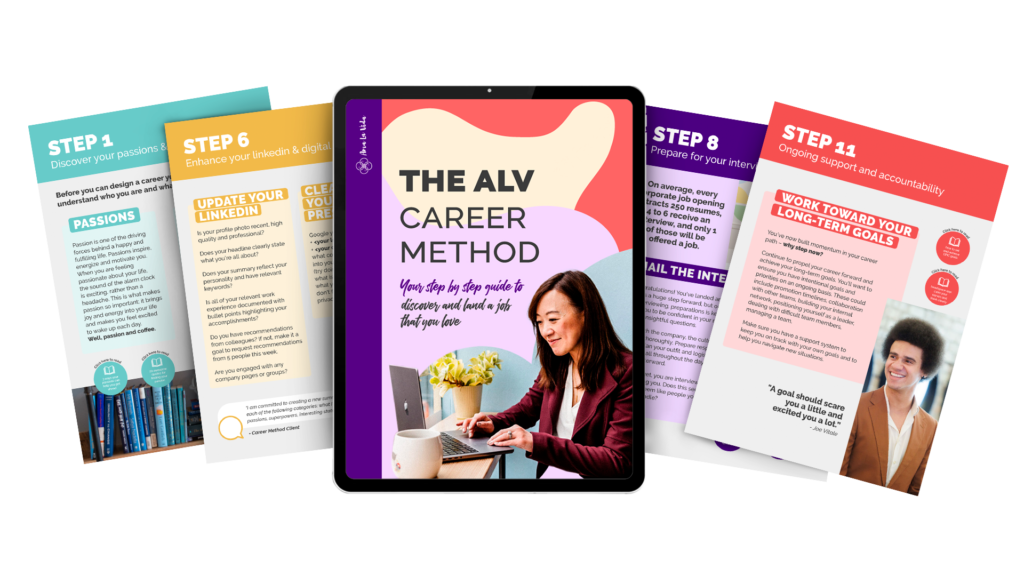
Download our comprehensive step-by-step guide to design and land a job you love!

Images from The ALV Career Method Guide
ALV Method Downloadable Guide

I started at Ama La Vida last October. I remember being an over-eager young employee who moved too fast and made a lot of silly mistakes. However, like most things, once I got into the flow of start-up life I really found my groove and have since exponentially grown. Here is a quick rundown of what I learned in one year at a startup and how I got to where I am today.  October 2018  Being fast doesn’t mean anything if you’re wrong. You can reply to an email in 30 seconds, great! Did you spell their name right? Did you forget to capitalize something? What about your call to action? Is it vague?  People want to work with professionals. Misspelled words, typos, and bad grammar aren’t professional. I learned how to slow down and reply with intentionality and speed.  My takeaway: Doing quality work is more important than doing all the work. November 2018  Persistence is key. This month, I did a lot of cold calls and I left a lot of voicemails. I also received the best compliment I could have ever asked for. “Thanks for being so persistent.” When you’re in sales, the reality is, people are busy, and they really don’t want to talk to you. However, when you follow up and follow up again, and again, you may just earn enough of their respect to have a conversation.  My takeaway: If someone hasn’t told you to go away, keep asking.  December 2018  As the weather got gross, we started working from home a little more. This month, I learned how to work remotely. To communicate over text/emails/and video chat along with staying in communication about what I’ve done and what I’m working on. More importantly, I learned how to change my space up frequently enough to stay productive.  My takeaway: Your space is a reflection of your mind. Finding new ways to keep it neat and clean help you stay focused and in the zone when it matters.  January 2019  New routines help you create new habits and patterns. With the year fresh and a new office space secured, I learned how to create a “logging off” routine to create a cleaner work/life balance break. For me, no matter where I am this routine looks like shutting off my Slack notifications, closing my laptop, and cleaning up my workspace!  My takeaway: Since most startup employees work long hours it’s important to create a routine that helps you step away allows you to bring more back to the team when you return.  February 2019  You are your best advocate. Have you ever wondered why you work the hours you work? Or maybe you have wondered if there is any way to not work those hours? Well, Friday afternoons are not my favorite. I’m always daydreaming about the weekend and accomplishing nothing. By leveraging my powers of persuasion, I was able to negotiate to come into work an hour earlier every morning because I’m more productive in the morning and leaving at 12 on Fridays before my brain slump occurs. Everyone won, and I get an afternoon nap every Friday. 🙂  My takeaway: The people around you don’t know what you need to be successful unless you communicate it to them. Don’t be afraid to ask! The worst thing that happens is that they say no and nothing changes.  March 2019  You have the power to create your own job. I really LOVED doing marketing, so while I maintained a level of excellence when it came to my actual job, I also pursued side projects related to marketing tasks. Around the end of the month, I was able to transition into a more marketing-based role by simply doing a little bit of marketing work well.  My takeaway: A) Similar to what I took away in February, no one but you knows what you really love doing. If you never talk about it, they won’t ever know! B) Taking the time to go above and beyond may feel like more work in the present, but it also proves you can do the job you really want.  April 2019  April saw my second successful event planning endeavor leading to the event we all know and love, Weducation! I learned how to communicate, promote, and recap an event. My new event workflow came from thinking about what I would like to know before attending an event. I like to be informed on how to get there, how to get in the building, where to go once I’m in and what to expect while I’m there. I also thought about spaces I like to be in, for me – those are spaces with background music and good lighting. Lastly, I thought about how to communicate further announcements, events, and resources after they leave.  My takeaway: I learned how to think critically/logically around what makes people feel welcome, how to communicate and spread information to event attendees successfully. When event planning, you have to think 3 steps ahead of your attendees.  May 2019  This month taught me how to work remotely for a more extended time period while handling different time zones. I was in Pennsylvania for 12 days and managed to keep things going smoothly and make major headway on a few projects. Communication really is key!  My takeaway: When you are working 8 hours away from everyone else you have to be thoughtful about time zones and communication. It’s always better to over-communicate rather than under-communicate. It’s best to remove any possibility of confusion/ambiguity.   June 2019  I spoke on a panel about marketing! It was really strange being the “expert” in a room. This event was a super special event because it was run and facilitated by a dear friend. I can’t thank her enough for giving me the opportunity!  My takeaway: Growth is often strange and it’s awkward as you move from being the beginner to an “expert” or “thought-leader” in a sense.  July 2019  New hires are

Read More
some ideas to help you make the most of your senior year

If you’ve invested in your education by going to college, I bet you’re feeling some pressure by your senior year to have the career-defining results you hoped for.  As a senior, it’s likely that you are anxious to graduate and you’re questioning whether or not you’ve done everything you could to be ready for what comes next. Did you choose the right major? Is this the right career path? So many questions only you have the answers to! College is truly what you make of it. Sure you studied, but what you do with that knowledge? We all know experience is what carves your path and makes you different from everyone else. This is true especially during senior year when you start to feel the slide. You know what I’m talking about, the feeling when you are so close that you feel SO DONE.  Here are a few things you can focus your energy on to keep that momentum, make the most of your senior year and close out your days as a student, strong! I urge you to take matters into your own hands and stay motivated instead of hoping that motivation comes to you! Intern Have you ever gotten caught up in that chicken versus egg conundrum? You know the one where you need some experience to get a job, but you need a job to gain experience? Internships are the GAME CHANGER.  This experience counts! Internships offer the win-win of trying out a job for a few months or a year to see if it is a fit with you and they allow you to learn something along the way. Whether that be an understanding of the field, confirmation that you do or don’t want to pursue the career, or improved results in your work, and a better understanding of what professionalism is. Take advantage of leadership opportunities  If you have joined student groups that align with your interest throughout college, take opportunities to lead others in that group! More responsibilities and chances for you to problem solve, work on a team and manage only grow you in ways your older self will thank you for.  Network with people in your prospective field Admit it, sometimes our understanding of jobs comes from what we’ve seen on TV, or what your parents/family members do for work. Has anyone else become curious about surgeons because of Grey’s Anatomy? Me too. The best way to gauge what a day in the life is actually like is to talk to someone who does the work. I suggest, making it a habit to reach out to people in your sphere of influence or using LinkedIn. The pro here is that you can learn more about yourself and the work you’re pursuing. Build or update your LinkedIn profile If you haven’t used this platform a lot in your college career, my suggestion is to start now. LinkedIn is a way for you to show your experience and interest in your field. It allows you to create a network of people you strive to be like. As a daughter of a machinist and a homemaker, LinkedIn was where I created a network I wouldn’t have otherwise had. During your senior year it’s important to start shaking hands with people. As the saying goes, “it’s more about who you know than what you know. This day and age, you CAN reach out to know as many people as you can.  Utilize your school’s Career Services Every college campus has a career development office. If you’re feeling lost, and you might be, career concepts aren’t always a part of courses in all majors. There is no shame in leveraging the expertise of the career services team to coach and support you through this otherwise really stressful and foreign arena! Remember: You do not have to do it alone! Above all, give yourself permission to stumble Face it, you’ve been in school for about 17 years, you’re not going to be great at the job search and career part of your journey just yet. We all like to do things and do them well. Chances are that you’ve mastered a rhythm that allows you to approach school, assignments, and schedules with excellence.  It will take some time to find your career groove as well, and the sooner you embrace that, the less painful this change will be.  Hire a career or life coach You are new to this arena and feeling lost is more so the standard than the rule. It can be stressful and you don’t have to do it alone. All great athletes have coaches, and you’ll want one for career and life as well! Coaches are in your corner to support, challenge you while helping you focus on what it is that makes your life fulfilling and successful.  Lastly, just remember. This path is yours and success is relative. Imagine the life you want to live and let that guide your actions, not a commercial or an Instagram account. YEP. I SAID IT. While I’m sure we all hope that our senior year will be convenient or a straight shot, please know it rarely happens this way. It’s pretty messy and never free of curveballs. Take all of them in stride.  Remember, this is the youngest you’ll ever be, note the mistakes you make and let the things you go through lay the foundation on which your success story will stand. There really isn’t only one right way to navigate all of this. I’m giving you some steps to start with, but most of all, add your flair, and have as much fun as you can!

Read More

I don’t know about you, but something about fall screams book weather. It’s time to curl up with a cozy blanket, a hot cup of coffee or tea, and a good book, so today let’s talk about what books have become career books for the ALV Team.  Randi’s List:  The Magnolia Story  There is something really special about a story that starts with a vision and ends with a borderline empire. Reading this story inspired me to hustle, take chances, and be a part of building something that I love.  Don’t Do Things You Hate  It’s really easy for young professionals especially to get caught up in the yes’s of obligation. Before we know it we’re 10 years into a career we can’t stand! Don’t do things you hate is a quick read about the bigger understanding of what you hate, why you hate it, and how to reframe it into a task you can enjoy! The Creative Curve  If you know me, you know I’m obsessed with the creative process. The Creative Curve breaks the process down and debunks all of your favorite creative myths. I love Allen Gannett because he brings an element of humor to the crazy insightful process of how to develop and level up your creativity.  Nicole’s List:  The Hard Thing About Hard Things If you are a founder of any kind, or a leader in a startup, this is a must-read. So many business books focus on the ideal world – how to operate when things are going right. But what about when all hell breaks loose as it often does in the startup world? Ben Horowitz provides extremely practical advice for everything from how to fire someone to how to prevent politics and red tape from forming in your business. Creativity Inc. There are two facets to my love for this book: I loved reading Pixar’s origin story and hearing about the role Steve Jobs played in it (is tech history a genre?), and Pixar’s founder, Ed Catmull, shares an incredible wealth of advice on how to build a creative organization and then sustain it. Pixar literally never has a flop. This isn’t an accident. The organization has been built thoughtfully to cultivate the best ideas and shut down bureaucracy that may get in their way. There are great takeaways for how to run any kind of organization or team. Rework Written by Jason Fried, founder of popular software startup 37signals, Rework helps anyone reimagine the way we show up and operate at work. Do we need to schedule meetings like TV show time slots in 30 or 60-minute increments? What if we had a day of the week where we all operated in silence? This book gets you questioning the habits and customs of the modern workplace and dreaming up new practices that could make you happier, healthier and more productive at work. Foram’s List:  Thinking Fast and Slow Understanding ourselves and the way we work is complex. Daniel Kahneman breaks down the way we think and why we often make errors that could have been prevented. He explains the two ways we think: System 1 (our gut reactions) and System 2 (critical thinking). We spend most of our time in System 1 thinking and that serves us well in many situations but not all. This is a fascinating read for anyone who is looking to be more self-aware and intentional about their actions. Decisive  We all know that making decisions is hard. And the way we make decisions (especially important decisions) can be irrational and driven by emotion. Dan and Chip Heath provide practical advice on how to become better at making decisions in your everyday life – decisions that are small or decisions that have a lasting impact.   The Trusted Advisor  If you are client-facing, this is a must-read for you. The Trusted Advisor is engaging and practical. The book does a fantastic job of walking through what you need to be a partner and a confidant to your clients in a way that produces better results for you and the client. I find myself referencing this book not only professionally but personally.  Gabby’s List: The War Of Art  We all have dreams and desires that we want to pursue. However, most of us face an obstacle and just keep dreaming. Pressfield digs deep into how resistance, coupled with other factors, can be a huge hindrance in actually going for your goals. If you want to learn how to get out of that rut and kick resistance in the ass you need to read this book! It’s such a quick read that there is no excuse not to.  Niche Down  This one is for all the entrepreneurial minds in the world. So many people who want to become successful entrepreneurs but aren’t because they do not have the correct approach. Niche Down challenges you to think and observe the world differently so that your invention can stand out. One of my favorite parts of the book is where Lochhead mentions that “categories make brands.” It’s much easier to stand out when you create something unique instead of trying to create something that is “better.”  Divergent  While this one isn’t directly career-related there are so many lessons that can be drawn from this book. The biggest one being – if you don’t fit into one category that’s okay! Working at a coaching company we have so many people say “I have so many interests and I don’t know which one to choose.” The good news is that you might not have to dismiss your different interests. Many times these interests can become one job or you can even create your own side hustle. Divergent shows us that the world may try to place us in one category but sometimes you have to defy this mindset and go your own way. 

Read More
people talking about how to land the internship of their dreams

Most people view getting any internship as difficult. But landing the internship of your dreams? Now that sounds downright impossible. What if I told you it’s not impossible. Actually, it’s quite simple. All it takes is a good strategy, a lot of persistence, and an investment of your time. I’m going to tell you exactly how to set yourself up for career success so you can get the top internships as early as freshman year of college.  Gone are the days of applying for jobs through an online application and waiting patiently for an interview invitation. We are living in a time where thousands of people, from all over the world, apply for one single job. You can’t possibly differentiate yourself by just submitting a resume and cover letter through an online application portal. Instead, you have to network your way into a company. According to the Business Dictionary, networking is the creation of “a group of acquaintances and associates and keeping it active through regular communication for mutual benefit. Networking is based on the question ‘How can I help?’ and not with ‘What can I get?’”  This definition highlights the importance of networking being the act of building relationships over time. Which is why you need to start doing it BEFORE you are ready for your internship (or before you need a new full-time job!). Think long-term and start preparing months before you will be ready to start your internship. I was recently speaking to a room of a couple hundred freshmen at Indiana University’s Kelley School of Business. At the end of my presentation, one student nervously came up to me and asked how she could start networking now in order to get an internship for the following summer.  Ask for the Informational Interview My answer: start doing at least one informational interview every week, beginning immediately. Informational interviews are conversations you request with someone who works in the industry or company you’re interested in so you can learn about their career and build the foundation of a professional relationship. LinkedIn is a great way to find people who you want to talk to. Do a LinkedIn search for companies, roles, or industries you’re interested in. Then, find someone who you have a mutual connection with, or at least something in common with. A commonality could be that you grew up in the same city or went to the same university. When you find someone who looks like they could have a good perspective for you, send them a LinkedIn message. Your message might say something like: Hi Sara, I noticed you also went to Northwestern. I’m a sophomore at NU and am interested in a career in brand management. It looks like you are a brand manager at Kraft Foods – do you have 20 minutes for a phone call so I can hear what your job is like and how you got into this line of work? Let me know what dates and times work for you. Thanks, Elise This message clearly states WHY you are reaching out and makes it a small commitment by only asking for 20 minutes of their time. Send out messages like this one to a few people each week and you’ll be surprised how many responses you get.  Prepare for Your Informational Interview When it’s time to have your informational interview, be sure to have questions prepared in advance. You’ll be driving the conversation. Strong questions include: Tell me a little bit about your career path. I noticed you have your MBA from Michigan. Do you think you would have landed a job in brand management without having your MBA? What is your favorite part of the job? At the end of the conversation, once you’ve established a rapport, ask how you might align yourself for an internship at their company. You might say: Everything you’ve talked about reinforces my excitement about a career in brand management. I’d love the opportunity to intern at Kraft this summer. Do you know if Kraft has interns? And if so, how I can best position myself for the position? Ideally, the person you’re talking with will offer to pass your resume along to the hiring manager for their internship program. This instantly boosts your likelihood of getting an interview because your resume has been personally delivered by someone who already works at the company. You’ll notice that this approach does not involve reaching out to people in HR to ask for an internship. This is because HR is inundated with resumes and applications. By reaching out to someone who works in the department you’re interested in, you’re not only getting the inside scoop on how to align yourself for the job but you’re also gaining an ally who can advocate for you within the company. Double win! Stay In Touch The most important part of networking, which is also the most skipped over part, is staying in touch. After your informational interview, or any networking conversation, be sure to keep a record of the conversation and make an effort to maintain communication over time. My general rule is to have three touchpoints each year with every person in your network. Touchpoints can include phone calls, emails, coffee dates, or meetings. Anything that allows you to actively maintain a relationship. If we look back at our example from earlier – the informational interview with a brand manager at Kraft – we can see how this conversation was the foundation of a professional relationship. The initial conversation was introductory. Let’s imagine Sara says she will talk to HR about your interest in the internship. A few weeks go by and you don’t hear anything back, so you send Sara an email to follow-up. You learn that applications aren’t open for a few months. Make a note in your calendar to reach out to Sara 3 months from now to ask how she is doing and to see if the application is open. This will

Read More

Welcome to the first in our series of articles on mastering the interview process. If you’re like most people, interviews are not something you look forward to! Chances are, that’s because you’re approaching them with the wrong mindset. Most people do. I’ve conducted thousands of interviews, both “live” and in training scenarios. There are certain patterns I’ve observed and approaches I’ve witnessed time and again, and they not only hurt your enjoyment of the process, they hurt your chances as a result. Seeing the same mistakes happening over and over again made me start to wonder where these mistakes were coming from. Why People Interview Badly Unfortunately, interviewing as a skill is something very few people get any formal training on. Sure, maybe someone gave you some helpful but generic advice like “don’t slouch” or “dress professionally,” but beyond that, most people don’t ever get trained on this, despite the fact that it’s a fundamental part of career planning. For most people, the only experience you’ll ever get is on an actual interview. While I support “live learning” in most circumstances, interviews aren’t the best environment for this. First, there’s virtually no feedback – if you don’t get the job, that’s usually all you learn. How can you improve without feedback? Second, you interview infrequently; years might pass between short bursts of interviewing for most people. And of course, most people aren’t interviewing with the goal of getting better at it – in fact, most people are trying to interview specifically so they won’t have to again, at least for a long time! Put all together, that means most people have very few natural ways to develop interviewing skills. Without that process, people instead turn naturally to scenarios that they felt were similar, trying to draw lessons that they can transfer. This is, I’m sure, the heart of the problem. Why? Because for most people, the most similar scenario they can think of is taking a test. Superficially it makes sense – you can draw a lot of surface-level parallels between an interview and the last time a high school or college professor really tested you on something difficult. In both cases, there’s someone you want to impress in a position of professional authority or influence. In both cases, you’re trying to demonstrate your expertise in a satisfactory way. And in both cases, you feel like it’s not the core thing you want to do, but rather an impediment standing between you and what you really want – the grade or the job. So for many, many people, they approach an interview the way they approached finals day. And if you do that, you will be an absolutely terrible interviewer. An Interview Is Not A Test Apart from those superficial similarities, an interview is nothing like a test in school. The goals and motivations of each party are totally different. So the first step to being a great interviewer is to eliminate those bad habits. Even if you’re not consciously making that association, chances are very good that you’re doing one or more of these things in your interview process. Don’t “Cram” For Your Interview An interview isn’t something you can study for. Cramming works for tests where you’ll only have to retain the material for long enough to pass the test and then in many cases not use it again. Sure, that’s being a lousy student, but it gets you the grade. Not only will that not help you in your job, but it won’t even help you in the interview. The interview isn’t a multiple-choice test with “right” answers. They’re looking at you as a total professional, not testing a snapshot of your current knowledge. You can’t fundamentally change who you are in a few hours. If you practice anything, it should just be your body language and diction, like you were warming up for a play. Anything else is probably wasted and will just make you tense and nervous. Don’t Try to Give “Correct” Answers There are no correct answers. When a professor asks you questions, they know exactly what answer they’re looking for – after all, they told you what the answer was, earlier in the class. They’re not looking for your input, they’re looking to see if you absorbed the information. That is completely different than the interview process. The interview process is about the interviewer and the candidate getting a better professional understanding of one another in a much deeper way. There are no “right” and “wrong” answers. Even if you had some magical ‘cheat sheet’ that told you exactly what to say to get the job, you probably wouldn’t want to use it; you don’t want a job you’re not a good fit for. Don’t Elevate Your Interviewer Above You There’s an inherent hierarchy between a student and a professor; after all, you’re learning from them, and that’s the nature of the relationship. That’s not the case between a candidate and interviewer. They aren’t “above” you, and you’re not trying to suck up to them. You’re both professionals, and you’re meeting to see if there’s the possibility for healthy collaboration. Things like respect and politeness should be given to anyone, regardless of status, so of course, I’m not saying you don’t need to show those things. But you don’t need to show them by showing up hat in hand, acting like someone looking for a handout.  You’re a professional, and in many cases, you’ll know more than your interviewer about your topic. That’s why they’re hiring someone – unlike your professor, they have a problem they need to solve. They’re not grading you; they need you! Okay, get those things out of your mind! Ditch the supplication and approach the interview with the full confidence in your ability to do the job. Now I’ve told you what not to do, I’m going to draw a few analogies that are much better suited to what an interview is really like. Use these to shape your thinking and preparation. An Interview Is A Sales Pitch My experience as a hiring manager for many years taught me that salespeople are

Read More
birthday reflections on what matters most

Every year around my birthday, I always take time to do a little year in review. I write down important milestones, lessons learned and things that I’m proud of.  The number one question I ask myself is, am I staying true to the values that really matter to me? As I’ve thought about this question over the last few years, I’ve found it to be a helpful exercise. It keeps me grounded and always ensures that my personal journey is rooted in some sort of purpose.  My list is still a work in progress. I’m sure that it will continue to change over time. However, here are the three things that I always come back to when I think about what matters most to me: Don’t Sweat The Small Stuff  I’ll be the first to admit that I can recall times where I’ve been so caught up in the small details of something, that I’ve let those small things get the best of me. Whether it led me to get annoyed or frustrated with a situation or a person, sometimes I’ve let those things consume my energy more than they needed to. Now, when I find myself in that place, I tell myself to take a step back. I ask myself if this is something that’s really going to matter. Is this something that’s really going to matter in 10 months or 10 years? More often than not, the answer is no. Checking myself helps me let go of whatever it is that’s draining my energy.  Savor the Magic in Moments  When I’d take the train back to the city from visiting my grandfather, I would always remember some of our special moments. Whether it was teaching me how to ride my first tricycle, catching me red-handed in the backyard while I was cutting my doll’s hair, showing me that math problems were fun (we never did agree on this!) or beaming with pride when I told him about getting my first job in NYC after grad school. Those were the moments that I will forever hold onto.   What matters most to me is experiencing new things, seeing more of the world, and enjoying moments that make my heart full. Memories that I can look back on fondly and smile to my heart’s content. That value will always matter to me more than any material item. Live Without Regret  During my time in New York City, I was sacrificing what I really wanted in order to conform to a norm or a checklist. I was failing miserably at it because I was unhappy. In a book by Bronnie Ware, The Top Five Regrets of the Dying, the number one regret of the people that she interviewed was not living a life that was true to them, but living the life that others expected of them. If it’s one thing that I’ve never been able to do is live my life based on a checklist. It’s never worked out for me even when I’ve desperately tried to fit in.  I’ve found that I am much happier living the life that I want because I’m more fulfilled. Even though I’ve made my fair share of mistakes or decisions haven’t turned out the way that I’ve wanted them to, I have always felt it was the right thing for me to do. Now, I always ask myself, is this something you’re going to regret if you don’t do it? If the answer is a very loud “yes,” I go for it. No matter how far it strays from “the norm.” There’s only one definition of normal in my book and that’s how I’ve chosen to define the term.  I’m sure there will be many more things to add to this list as I figure out what’s right for me, but these are some great daily reminders. What are some of the values that matter most to you? Share yours in the comments below! 

Read More