Category: Mindset & Mindfulness

As a female-founded small business with a passion for helping others achieve their dreams, we believe in celebrating the wins of our community. Every month, we feature one Founding Female and the golden truths they acquired throughout their journey. We are endlessly inspired by the courage, grit, determination, and impact that our fellow Female Founders make on the community, and we hope you find that their stories inspire you, too. Check out May’s feature, with Megan Wholey, below! – Early in my career (and every once in a while now!), I would find myself intimidated by a client or a prospect. Our team works with successful CEOs, business owners and their families – people who have built incredible careers and amassed significant wealth. I’d want to show up to my meetings with these clients firmly in my role as “expert”, with the right answer to every question, and data to back it up. What I’ve learned, and continue to remind myself, is that the most important thing that my clients are looking for is a thought partner. I may not have the perfect answer on the spot – and that’s OK. What clients need in an advisor is someone who asks curious questions, helps present ideas and options for consideration, and has their family’s best interests at heart. Saying something like, “I’d love to run this question by our experts,” doesn’t tell the client that I’m not capable, it assures them that I’m doing my research and considering all angles. This can be uncomfortable for people who tend towards people-pleasing and perfectionism – I know it is for me, but I encourage women entrepreneurs and business owners to be less concerned with “being right”, and instead focus on “doing right” by clients, team members and other partners. ~ Megan

Read More

It’s no mystery that building daily habits is difficult. We create lists of all the things we “should” be making a priority and never seem to find the time to get around to them. We make excuses. We let fear take over. We blame busyness. The truth is, often the anticipation of creating a new habit or the act of thinking about instilling a new habit can be far worse than actually doing it.  Habits become easier through repetition and through patience. It’s about pushing through the “this is difficult” phase and making them a part of your routine. Studies show that it can take on average 66 days to build a new habit. From my experience, this can vary, and the number of days doesn’t really matter. Ultimately, there’s a reason you’re reading this and it’s likely because you want to do something about your current behavior. These five daily habits are small improvements that overtime have the power to change your life.  Habit #1: Reading a Book If you’re reading this article, you’re on the right track. How many times have you been asked, “What was the last book you read?” Most people would say, “I can’t remember.” We have information at our fingertips all the time between blogs, tweets, Facebook rants, but reading a book is different. It takes time and patience. It is essential to support our brain health.  The best way I’ve found to create a habit of reading is to have it take the place of the “mindless scrolling” time. That could look like bringing a book with you so it’s handy during waiting times. When you’re waiting in line at the grocery store or the dentist, you could pull out your book. When you’re on the subway, instead of mindlessly scrolling, pick up your book. Anywhere you’d mindlessly check your phone, pick up your book instead. Over time, reading will become an escape and something you love to do.  Habit #2: Waking Up Early  If you’re not a morning person, you’re properly reading this one and thinking “no way.” Of all the habits we “should” do, this one is on most people’s list. As a life coach, I’m constantly talking about the importance of routines to my clients. Many people go wrong in the “waking up early” habit when they set their alarm for 5am, but still go to bed at midnight. 5am rolls around and your bed is warm and your inner voice says, “absolutely not.”  When working to instill this daily habit, people think it’s all about waking up early. It’s actually about going to bed earlier. Waking up early truly starts the night before. Set a routine that allows you to wind down. Give yourself the permission to slow yourself down. Read a book instead of scrolling, meditate or take a shower. Do the things that are intended to relax and move you into sleep so you can wake up fresh the next morning. Over time, waking up early will be something you “just do.”  Habit #3: Setting 3 Daily Priorities  Focus brings us closer to achieving our goals. The problem is our days are filled with endless distractions. This habit is more about productivity than anything else. Limiting our options is how we focus in a world full of distractions. Each morning, ask yourself what you want to achieve. Then commit to 3 essential tasks. Take everything above and beyond that list as a bonus.  In creating the Daily Priority habit, start the day before. Write down the 3 essential tasks for tomorrow. This can be a particularly effective way to close the day and transition from work to home. From there, make sure this list is visible the next day. By limiting our focus to 3 priorities, we increase our chances of success.  Habit #4: Walking for 30 minutes Walking is good for you and keeps your body moving. As an avid walker, I’ve found it breaks up the monotony of daily life. There’s nothing wrong with the daily monotony but getting outside forces you to engage with the outer world. It heightens your senses. You feel the air in your lungs, you start to notice the cyclical pattern of the seasons.  Many people find walking first thing in the morning to be the best because they don’t procrastinate or skip it as they might later in the day. Others find it helpful to incorporate walking into their workday by taking calls on the go or leveraging their lunch break for this time. Some find it is helpful to walk in the afternoon or evening to clear their minds after their day. Go alone or with a friend, but either way get out and enjoy. It will soon become a refreshing daily habit.  Habit #5: Practice Presence  So many of us are focused on the future that we forget to enjoy the present moment. We say, “I’ll be happy when….” Don’t get me wrong. As coaches, we live in the future possibilities. At the same time, the future can bring up anxiety and isn’t always guaranteed. Studies show that an individual’s disposition to staying present is linked to numerous health benefits including lower levels of perceived stress, anxiety and depression, improved mood, and a sense of improved well-being. Because we are so focused on “what’s next,” we forget to enjoy the present moment. A tip I offer my clients in practicing presence is finding a trigger that brings you back to the present moment when you feel yourself being stuck in the future. This could be a quick check in with your five senses and naming what you see, hear, feel, taste and smell. Once you start to think of being in the present moment as a conscious practice, your approach will start to change. The moments when you are frustrated become opportunities to react mindfully.  You can change your life, starting now.  Daily habits don’t change overnight. Who you are and the way you react to

Read More

We’re kicking off our March Mindfulness Challenge! Mindfulness has a plethora of benefits, but a few of our favorites include: improving memory and cognitive ability; decreasing depression, stress, and anxiety; creating a better sense of well-being; and allowing for better emotional regulation. Each week, we have a handful of practices and resources for you to explore, which we’ve detailed below in this newsletter. You can also follow our Instagram channel for ongoing inspiration and a community of other professionals taking part in the challenge. Use #alwaysbebettering to share how it’s going! These practices are meant to be exploratory. What works for one person may not work for everyone. Take what works for you and leave the rest. At the end of the month, we hope you’ll walk away with new habits and tools to help you live a better life. Week 1: Daily Mindfulness Routines Week 2: Mindfulness for Burnout Week 3: Mindfulness for Combatting Impostor Syndrome & Building Confidence Week 4: Being Mindful When Talking and Listening to Others (and Yourself!) Week 5: Mindfulness for the Corporate World

Read More

“Trust the process.” – Anonymous For the past three years, one of my kiddos has struggled with some less-than-great eating habits. Her pediatrician was unconcerned and told me to just wait it out. But as a mother who values the six main food groups, I started her in OT at the age of 2. At a high level, my immediate goal was to get her to eat more nutritious food. I figured this might take six months, at the most. Fast forward 1.5 years. She can tolerate being near food she doesn’t like, smell it and sometimes even touch it. These months have been very frustrating for both of us. Weekly visits and eating exercises at each meal are mentally and emotionally draining. The OT sessions were very different from what I had imagined. She would often just hang out, touch, and smell new foods. I found myself wondering, “When will she actually EAT the food”. While the progress has been excruciatingly slow to me, her OT celebrates the little wins. She points out the progress made every session since day 1. She continually reminds me to trust the process.  For me, trusting the process means leaning into where you are in the moment. It means acknowledging that maybe you have a long way to go to achieve what you desire. But it also means acknowledging how far you’ve come. It is a reminder to be grateful for all you have overcome; to recognize that your journey has been no easy task. It is providing yourself with grace and understanding that you are exactly where you are supposed to be. The rest will come in time. You will learn from all of the bumps and challenges along the way, and that’s the point. Perseverance will not only make you grow as a person, but will make the reward of achieving your goals that much sweeter. If you pay attention to the small steps leading up to achieving your goal, you may even find that you’re enjoying yourself. Reflecting on this, it would be a huge step for my daughter to go from not wanting to even look at the food she doesn’t like, to willingly putting it in her mouth, chewing, and swallowing it. The therapy process was encouraging her to become comfortable with new food, experimenting at her own pace, and taking small manageable steps forward.  Trusting the Process When it Comes to Your Career I think this can be a good reminder for those that are frustrated in their careers, but feel like transitioning to a new career is insurmountable. For those of you who are impatient like me, deep down you know that trolling job boards day in and day out is not going to help you find what you are looking for, and yet you find yourself endlessly looking anyway. It may seem that if you don’t actively apply to jobs—whether or not you were truly interested in them—then you didn’t take any tangible actions that day toward finding a new job. The reality is, while it might take longer and require more patience, taking the time to do the self-analysis to identify who you are and what you value is a pivotal step toward figuring out the next step in your career. Those tiny steps that you take every day will eventually lead you toward your seemingly impossible goal. You will get there—just don’t forget to enjoy the ride while you’re trusting the process.  ~ Kristin

Read More

How To Befriend Your Inner Impostor to Build Confidence   I remember the day I decided to resign from my secure corporate gig to follow my passion. I’d spent countless hours visualizing my future if I continued on the path I was on and countless hours visualizing the path less traveled: pursuing my dream of being a full-time coach.  “I don’t know enough, I don’t have enough experience, how on earth will you ever make money?” These thoughts were like a horrible ride that I couldn’t escape. If I was going to be a coach to others, how would I be able to get myself off this ride? There was no way this chatter would allow me to be effective in my work.  Simultaneously, there was another voice. “No one ever looked back on their life saying ‘I’m really glad I made that safe decision’… Go for it, Cait!” Ultimately, this story has a happy ending, but that wasn’t without the constant inner dialogue, judgment and feelings of inadequacy. My inner impostor was the biggest thing standing between me and my confidence.  We all experience inner dialogue or “chatter”, and it’s become more commonly known on the internet today as “Impostor Syndrome”. While we hope that our inner coach will lift us up, more often than not the voice of our inner critic is much louder. The inner critic keeps us safe, but they don’t always get it right. Our inner critic holds the microphone for our deepest fears, doubts, and judgements, which can actually cloud our judgment more often than not and keep us in a cycle of feeling stuck.  What is Impostor Syndrome? Impostor syndrome is defined as doubting your accomplishments, skills, or talents, and feeling like you don’t deserve to be where you are. This idea of being an impostor comes directly from the inner dialogue of our inner critic. Ultimately, impostor syndrome is fear. The inner critic tries to keep us safe from fear, but it can prevent us from taking the necessary steps to living a fulfilled life. In order to get to where we want to go, we must address this inner dialogue and befriend our inner critic by acknowledging them as our inner impostor. Through doing so, we build the muscle of confidence and learn to get out of our way.  6 Tools to Befriending Your Inner Impostor: There are countless ways to build confidence by befriending your inner impostor. Not every tool will work for everyone. The key here is to experiment and find what works best for you. These techniques will help you befriend your inner impostor instead of allowing them to hold you back.  Tip 1: Give Your Impostor a Name  When it comes to Impostor syndrome, a helpful tool can be to name your impostor. There are five different types of “impostors”: The Super Person, The Soloist, The Expert, The Natural Genius, and The Perfectionist. By taking the time to identify which persona your inner impostor takes on and giving them a name, you’ll humanize them and release their control over your every move.  Tip 2: Use Their Voice as a Motivator The next time you hear your inner impostor doubting you, try treating their voice as a motivating factor to drive you to do the opposite of what they are telling you. Think of your nerves as a reminder that you are growing. Deliberately embrace experiences that your inner impostor encourages you to shy away from. It’s through getting out of your comfort zone that you grow.  Tip 3: Reframe  Our inner impostor is often the loudest when we interpret a situation to be a threat or something we believe we can’t manage. Reframing means reinterpreting the situation as a challenge that you can handle. Instead of letting fear, doubt and judgment overwhelm you, remind yourself of how you’ve successfully overcome challenges in the past. By reframing what our inner impostor is telling us, we can begin to realize and reach our potential.  Tip 4: Give Your Friend Advice Ask yourself, “What would you say to a friend experiencing the same problem.” Think of this advice thoughtfully and then apply it to your situation. Studies show that by using distanced self-talk and referring to ourselves in the second-person, we are less activated. By playing this game with your inner impostor, you’ll improve your performance under stress.  Tip 5: It’s Okay to Not Know The Answer  Instead of obsessing over not knowing enough or having the answers, remind yourself that it’s okay to not have the answers. And the truth is if you have a question about something, chances are that someone else is thinking the same thing. Remember, everyone has an inner impostor. By saying “I don’t know the answer, but I’ll find out” makes you appear more confident in your abilities. It shows you have the courage to say what you didn’t know and the humility to admit you don’t have all the answers.  Tip 6: Ask Your Inner Impostor Why You’re Afraid  When your inner impostor is making you fearful, ask them, “why are you afraid?”. Is it that you are worried about failing? If so, it’s probably a good sign that you should take action because our inner critic might be inhibiting us from having a tremendous growth opportunity. But the key with this one is to not go overboard. Prioritize experiences that will stretch you while also helping you get closer to your goals.  Normalizing Your Experience   This list of tips is by no means exhaustive. The biggest takeaway I’ve learned through coaching is that the majority of people have an inner impostor and are walking around wondering, “Am I good enough?”. Knowing that you’re not alone in your experience can be the most effective way to befriend your own inner impostor. Despite how awful our inner impostor can make us feel, our mind is a muscle that can be strengthened. By befriending your inner impostor, you can train it to speak to you with

Read More

“If you fight for your limitations, you get to keep them.” — Jim Kwik My health took some big hits this past month. I started out strong with more soccer and taekwondo until I tweaked my ankle. Then my knee started hurting. Then I pulled my groin muscle. Before I knew it, I was unable to participate fully in any of the activities that bring me joy. I’ve been down this path before, so I know it can go one of two ways. If I fight for my limitations, I may experience more injury, feel sorry for myself, or throw the rest of my health routines out the window. If I fight for my health, I may be reinvigorated to reframe my perspective and focus on my recovery. I refused to embrace the limiting belief that I was broken and couldn’t do anything about it. I chose to fight for my health and adapt my move-forward recovery plan accordingly. I’m currently a work-in-progress focused on rest and healing. While I haven’t made it to the finish line just yet, I know I’ll be stronger—both physically and mentally—for it. This is the belief I need to keep cultivating in order to keep moving forward. Start Moving Forward Are you ready to stop feeling stuck with your goals and start moving forward? If so, I invite you to reflect on the following:  What limitations are holding you back? If these weren’t true, what would you be doing instead?  What is one thing you are willing to try now to start making progress? What do you need to believe in order to move forward? I invite you to toss your limitations aside and embrace your possibilities instead. Take care and here’s to your happiness and health! ~ Coach Sara

Read More

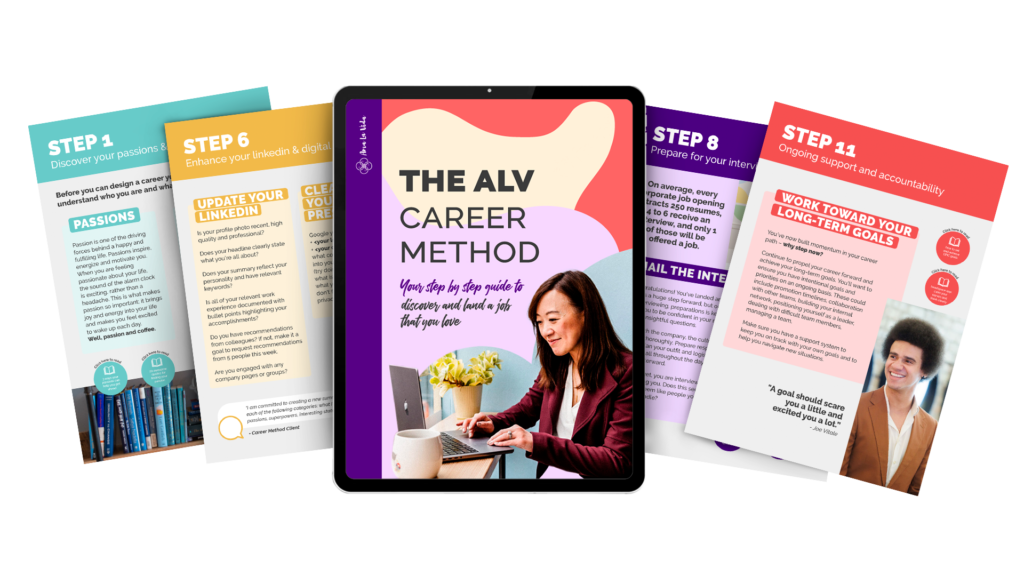
Download our comprehensive step-by-step guide to design and land a job you love!

Images from The ALV Career Method Guide
ALV Method Downloadable Guide

“Whenever you feel uncomfortable, instead of retreating back into your old comfort zone, pat yourself on the back and say, ‘I must be growing,’ and continue moving forward.”- T. Harv Eker I recently shared with my coach (yes, coaches need a coach, too!) that I learned something new and valuable through dealing with a challenging situation and negative feedback. My coach said, “Good, that challenge was a gift to you.” Although every fiber of my being wants to disagree, she was absolutely right. I don’t enjoy managing challenging situations or receiving negative feedback. To be honest, I dread receiving anything but positive feedback as I tend to correlate those to criticism. Underneath the discomfort is the fear of not being good enough. Reframing I want to reframe my thinking around these types of situations, so I asked myself these three questions: Is feedback a bad thing? What am I missing if I shy away from things I don’t wish to hear? I know getting feedback is not a bad thing. Avoiding it means I might be missing critical information that could help me thrive. So then, how do I deal with the discomfort associated with feedback? Believing that there is a reward on the other side of discomfort is the answer! We can’t control how other people give feedback, but we can decide how we take it. Attacks with hurtful words are crap that we shouldn’t waste our time on. Well-intended messages from people we trust deserve to be heard. We can use what we learn from others to our advantage. Here is my process for handling feedback: Be an observer and notice if what you hear feels triggering. If yes, check in with yourself. Is what am I feeling an old wound? There is no need to suppress your feelings or justify them. Just let the emotions flow and observe. Set your emotions aside and reflect on the feedback. Ask yourself, “What is something new here that I haven’t thought of before, and what is an existing pattern that people want me to pay attention to?” Evaluate what is helpful and what you can gain from the lesson. Embrace who you are and how far you’ve come. Give yourself credit for trying and cultivating personal growth. Have compassion for yourself. Apply what you learned from the feedback and move on. Not everyone knows how to give or receive feedback. Both require practice and the willingness to learn. Instead of steering away from hearing someone point out your blind spots, focus on the value of personal growth. The target outcome is to expand yourself and be the best version of yourself, a reward that’s on the other side of discomfort. ~ Peggy

Read More

The most frustrating thing about confidence is how effortless it appears for the people who have it to those who struggle with it. Everyone has that coworker who appears to have no problem speaking up in meetings. Or the friend who has no fear of chatting with new people at a party. While some people might be more naturally confident than others, it’s always possible to improve your confidence. We are going to dig into how to overcome your limiting beliefs to gain confidence. Confidence is a muscle. We all have it. Over time it can grow and strengthen. Conversely, if we don’t flex our confidence muscles, they can weaken. There are many factors that go into developing confidence, but one of the biggest obstacles many people face is the beliefs they hold about themselves and about confidence itself. By learning to identify these beliefs, you’ll be closer to replacing them with healthier thought patterns that will build your confidence muscles.  What are Limiting Beliefs?  A limiting belief is defined as a state of mind, belief, or conviction that you think is true that limits you in some way. It could be something about you, how you interact with other people, or the world as a whole. Over time, these beliefs negatively impact us. They keep us from making positive decisions, taking on new opportunities, and most importantly they inhibit us from reaching our full potential. Ultimately, limiting beliefs keep us stuck in a negative state of mind and hinder us from living a life we love. With these beliefs standing in our way, it makes it difficult for us to build confidence. The good news? We don’t have to keep self-sabotaging. It’s possible once we can identify these beliefs to rewrite them to something more productive and restorative.  Common Limiting Beliefs About Confidence & Tips to Overcome  “I need to feel confident to act.”  I see this time and time again with my clients. The belief that I need to feel confident to act confident holds us back from taking any action at all. The truth is you build confidence by taking action. The key here is to start. Want to speak up more in a meeting? Yes, it would be nice to feel confident, but are you capable of doing it regardless of how you feel? The answer is yes. Remember, just because something feels hard it has nothing to do with your ability to do it. Feeling confident is great, but it’s not necessary for action. You’ll only be able to start when you embrace the new belief that “you can do hard things without feeling ready.”  Tip: You’re probably thinking, “That’s me! I’m not going to let this limiting belief hold me back anymore.” The brain won’t be convinced until it gets proof. Actions, not words, change beliefs. Make your actions more courageous. Difficult things are always going to be difficult, but you don’t need to be ready to take action. Action builds confidence.  “But what will people think?”  As a leadership, life, and career coach, I spend a lot of time with clients who are what I call recovering people pleasers. Our culture is rooted in the belief that other people’s opinions of us matter. As a coach, I want to normalize this belief and help my clients work through it. Humans are complex, connected and empathetic creatures, and therefore it makes sense that we carry this belief around with us. The challenge here is to discern when and where it’s holding us back.  Tip: If you are someone who is worried about what others think and it’s inhibiting you from taking action, the most important thing you can do is not judge yourself for it. Acknowledge that it’s normal to feel anxious and care about what others think and, despite feeling that way, make a decision. Instead of “but what will people think?”, rewrite it to ”It’s normal to care what others think because it shows I care.” This removes judgement and allows us to make decisions. The act of making decisions while freeing ourselves of judgement allows us to build that confidence muscle.  “People think I’m more confident than I actually am” I hear it all the time: “I feel like an imposter.” This limiting belief holds people back because it implies that our confidence is dependent on other people’s beliefs about how confident we are. Have you ever been in an interview and are worried that even though you know you’re qualified, maybe the interviewer will think you’re not confident? Or perhaps you have presentation anxiety. Despite hours of preparation, you’re scared others will “find you out” and that you actually have no idea what you are talking about. This limiting belief sabotages our confidence because it judges the validity of confidence on external factors.  Tip: Allow yourself to decide what confidence means to you. Confidence is a feeling that only you know. Don’t give others the authority to decide that for you. Recognize that most people are walking around this earth wondering “am I good enough.”  What’s Next?  In order to feel more confident, it’s important to identify the limiting beliefs that are sabotaging your confidence. I’ve highlighted a few, but there are so many more. Confidence starts with you and inviting yourself to identify and unpack your limiting beliefs. This work isn’t simple, but I can guarantee you it will change your life and allow you to be more of who you already are. 

Read More

“Anything you can imagine, you can create.” Oprah Winfrey A fresh start to the year can bring renewed and reflective energy, making it the perfect time for goal setting. I enjoy reviewing the previous year with my clients because it’s a time when we celebrate successes, acknowledge challenges, and reflect on progress. This context helps us build goals for the year ahead. It also helps us build a foundation to set our vision for the future. Why vision setting matters To quote one of my clients, “Vision is the glue that connects goals to tactics.” In other words, clarifying your vision builds the motivation and specificity that is needed to build our goals roadmap. We need to understand why we want to do something in order to take action. Connecting with this vision is a key strategy to reaching your goals. It’s also known to be almost as effective as physical practice is with athletes! Why? Visualization is a mental rehearsal for our success. Are you ready to set your 2022 vision and make your goals a reality? If so, I invite you to explore and reflect on the following: Identify one of your big goals for 2022. Close your eyes and envision the future, the end of 2022, when you have achieved this goal. Explore this mental vision – What are you doing? How are you feeling? What are your surroundings like? Who are you with? Repeat this process regularly throughout the year to keep your vision alive as you work towards your goal. I look forward to what’s next for you. Take care and here’s to your happiness and health! Until next time.   ~ Coach Sara

Read More

In the age of technology, we are accustomed to things moving quickly. Instant gratification is the name of the game. If we are hungry, we can have food delivered to our door with a few clicks. If we miss someone, we can immediately video chat with them. The virtue of patience is quickly fading from society. Regardless of the pace at which the world moves around us, patience is still a skill we all need to hone and develop. Patience is a superpower. Regardless of what life throws our way, we all need a significant dose of patience to advance in life.  But how does one cultivate patience? Like many invaluable virtues, patience doesn’t magically appear overnight. It’s something that must be nurtured over time. The good news? Here are 6 simple steps to cultivate patience: Change Your Perspective — This means taking the time to analyze your perspective from another point of view.  Understand How Short Term Actions Impact Long Term Goals — Ask yourself, “What did I do today to get closer to my long-term goals?” By asking yourself this question, you’ll learn that growth takes time, and waiting for measurable gains is a part of the journey.  Be Still — Whether this means walking, journaling, or meditating, make sure you take breaks for at least 10 minutes, let yourself calm down, and then come back to the situation.  Name Your Triggers — Write down your patience killers. By naming them, you’ll be more aware when they come up. Reframing — Everything is a matter of perception and you have the power to control those perceptions. Name how you are looking at the situation and re-write that viewpoint to something more positive.  Self-Care — To become more patient, you need to prioritize self-care. This can be as simple as having a restorative bedtime routine which consists of putting the phone away and reading a book. Remember, it will look different for everyone. ~ Cait

Read More

I love this time of year! From Thanksgiving until New Year’s, time seems to speed up in a lot of ways while also slowing down. I love the different pace and feel that work and play has, along with the different activities like tree hunting, decorating, lights-watching, gingerbread making, feasting, zoo lights, and family and friend time. While it can be an exciting time, it can also be a stressful time. It can bring about that feeling of “shoulds”. I “should” do this and I “should” do that. So today, we are talking about how to “should” less over the holidays! The Holiday Shoulds Oftentimes, these stressors are described as “shoulds”. Here are a few for example’s sake: What’s Wrong With “Shoulds”? Do you relate to any of the above “shoulds”? No matter the “should”, they all imply some sort of judgment. According to the Oxford Languages Definition, should is a verb “used to indicate obligation, duty, or correctness, typically when criticizing someone’s actions.” The challenge with judgment is that it can stop us from taking action. Should keeps us focused on what we feel like we’re supposed to do, not necessarily what we want (or need) to do. These feelings of guilt, pressure, stress, and lack of control often keeps us stuck, instead of helping us take the actions that would ultimately make us feel better. So how can we effectively manage our “shoulds”? By exploring and breaking them down into 4 key steps, we can shift our focus to a more empowered mindset and help us prioritize what we really want and need over the holidays.  The 4 Steps to Quit “Shoulding”: What’s Next? Are you ready to explore your shoulds and start taking action? If so, I invite you to explore and reflect on the following: In Conclusion While the holidays bring more joy they often bring more stress into our days as well. So as you look to the month ahead, I encourage you to take note of the pressure your “shoulds” are creating for you and take intentional action towards shifting these statements. Stop “shoulding yourself” to death. Whatever your ideal holiday season looks like, here’s to much happiness, health, and fun ahead for you! Take care and I look forward to what’s next for you.  ~Coach Sara

Read More

It’s the most wonderful time of the year – beautiful seasonal decor, quality time with family and those lovely dinner table conversations. The holiday season can be challenging for many though, from family drama to splitting time between families to the political chatter at the dinner table. The holidays can often require sharing time and energy with many close loved ones. This makes putting boundaries in place during the holidays more important than ever. Nedra Glover Tawwab, NYT best-selling author of Set Boundaries, Find Peace, defines boundaries as “parameters for how a person can engage, interact and treat you.” Setting these parameters is key to ensure you protect your energy and well-being during the season of heightened events and family activity. Yet, they can be especially tough to set and it can be extra difficult to say ‘no’ when it comes to family members. With the holidays almost here, what better time to get ahead on setting boundaries to most enjoy this wonderful time of year without sacrificing your own needs. Boundaries During The Holidays Recently, I’ve heard countless clients express concerns or challenges surrounding boundaries. Many of us feel obligated to say ‘yes’ to others at the expense of ourselves. The irony is that the benefits of setting boundaries and honoring our needs spiral outwards to all those around us. Yet, boundaries are not easy! They can be uncomfortable and require practice, especially when putting them in place for the first time. I like to refer to boundaries as a muscle that you continue to flex until it strengthens and happens with more ease.  Before even getting started with your boundary setting, it’s important to take some time for self-reflection. Self-knowledge is key to improving your boundaries practice. First, take time to make sure you understand yourself, your needs and what may be getting in the way of those needs being met.  Here are some questions to ask yourself: What’s most important to you? What areas do you find yourself often saying ‘yes’ when you actually want to say ‘no’? Where do you feel discomfort in your interactions with others? What specific areas of your life do you feel need more protection? What limits do you need to put in place to guard that? Boundaries require putting yourself first. Yet, don’t mistake this for a selfish act. By putting yourself first and prioritizing your needs, you’re ensuring that you can best show up for those around you. They are a method of self-protection to guard your well-being. Here are three steps to set boundaries before the holidays hit: Reflect on what’s important to you (see questions above) Write out your non-negotiables.  A non-negotiable is something that is core to you and is not open to discussion or negotiation.  Determine what rules, limits, or guidelines are needed to support and protect your non-negotiables. Here’s an example of how this boundary-setting process can play out during the holiday season: Let’s say you usually head home for the holidays and spend the week in your family’s home. You’ve noticed that each year, the extended time with family leaves you feeling drained and depleted. You find yourself constantly helping out with family errands and favors. Let’s go through each step mentioned above.. Reflect – During reflection, you realize that you value and need your alone time. You notice that jumping between family events and supporting family members leaves you no space for yourself. Create a non-negotiable – ‘I need an hour a day completely to myself.’ Create a rule or limit to support that – ‘I will block off my schedule from 3 to 4pm daily to have an hour to myself.’ You block it off in your schedule for that week and communicate it to your family members. Other examples of boundaries during the holiday season could include: Limiting time with certain family members Eliminating certain controversial conversation topics from table conversations Avoiding certain family events The key to setting boundaries is clear communication. It’s essential that you’re first clear on these boundaries before putting them into action. If it supports, do the three-step activity above and write it out. Writing out your boundaries can serve as a written contract with yourself. Once you’re clear on them, it’s time to communicate to others and move to action. Ensure that you communicate these boundaries with your family members and loved ones. If you feel comfortable, you can share your written out list. Whether it’s verbally or through putting them straight into action, it all starts with you.  Here is your opportunity to proactively create boundaries to maintain your energy and leave the holidays feeling rejuvenated and refreshed.

Read More