Category: Presence

the link between sleep and productivity

Approximately 45 percent of American adults slept poorly in the last week. Without the recommended seven hours of sleep, reasoning, emotional stability, and work productivity take a serious hit. Even those who got the right quantity of sleep may not have gotten the quality necessary for the body to be fully rested. Better sleep opens the door to better efficiency, productivity, and work satisfaction, including improved professional relationships.   More Sleep = Less Stress Sleep deprivation, that’s anytime sleep hours drop below seven hours, makes anything that triggers a stress response more difficult to handle. Something as simple as an unexpected phone call can be enough to cause stress, anger, or irritability when running low on sleep.  There are physiological reasons behind the emotional changes that accompany sleep deprivation. When you don’t get enough rest, the brain’s emotional response center becomes highly sensitive to negative thoughts, emotions, and situations. The response to negative stimulation increases in this part of the brain when you’re tired.  Normally, when you’ve had enough sleep, the brain’s logical center regulates these emotional responses. However, when you’re sleep-deprived, the logical part of the brain becomes less active. That leaves people more susceptible to irritability, aggression, and other intense negative emotions.  Getting more (and better) sleep equips you to stay calm and cool in the workplace. That stability allows you to address customer and client concerns with your full mental and emotional reasoning in place. The ability to handle workplace stress can also enhance your relationships with co-workers. Arguments, disagreements, and misunderstandings are less likely and/or can be resolved more quickly when everyone gets the rest they need.   Less Stress = Better Work Performance Anything that can help you reign in your stress will benefit you both in and out of the workplace. A 2013 American study that questioned doctors about their patients’ well-being estimated that 60 to 80 percent of patients reported a stress-related component that affected their health. Forty-four percent of patients reported an increase in stress over the prior five years. Prolonged or chronic stress leads to a number of health issues, including increased inflammation that can compromise the immune system and contribute to anxiety and depression.  More Sleep = Better Health We’ve briefly mentioned the mental health benefits of more sleep but your physical health relies on sleep too. The human body uses sleep time to rebuild the immune system. It makes and redistributes antibodies so they’re ready to tackle any bacteria and viruses that you encounter during the day. The more you sleep, the better you will feel the next day. Overall, better sleep means less sick time, fewer medical bills, and more productivity at work.  Less Stress + Better Healthier = More Efficient Many people don’t realize the effects that sleep deprivation takes on their bodies until they’ve started to get better sleep. More than the emotions and immune system are get rejuvenated while you’re unconscious. The brain’s cleaning system, called the glymphatic system, is 90 percent more active while you sleep versus when you’re awake.  This system flushes the tiny interstitial spaces in the brain with spinal fluid to remove the waste proteins that buildup during the day. Lack of sleep can leave many of those toxins in place, slowing down brain signals with all the clutter.  Sleep deprivation also affects reflexes and physical performance. A study done among college-level basketball players found that increasing sleep time decreased sprint times and improved shooting percentages. You may not be shooting baskets or sprinting down a court, but you need your physical and mental reflexes to quickly respond to unexpected situations. Whether it’s an unhappy customer or another driver while you’re out for a delivery, sleep will keep you centered and focused when you need your full mental and physical abilities.   How To Improve Your Sleep: Update Your Bed  Everything about your bed affects your sleep, including the mattress, pillows, and bedding. If you don’t know the last time you replaced your pillows or mattress, it’s probably time for a change. Mattresses should be replaced approximately every 8 years and pillows about every year. Make sure your mattress truly offers you the support you need. If you wake up achy and sore, an old mattress could be the culprit.  Side sleepers generally need softer mattresses to cushion and relieve pressure at the shoulder and hips. Stomach sleepers, on the other hand, need firmer support to prevent their hips from sinking into the mattress and putting too much pressure on the lower back. Back sleepers have the easiest time finding a mattress since they maintain a relatively neutral spinal position throughout the night. However, your weight and personal preferences also affect how the mattress feels to you. Try out a few models and look for one that meets your specific needs.  Change Up the Bedroom As much as your bed influences your sleep, it’s not the only thing in the bedroom that can make or break your sleep cycle. The body needs complete darkness for sleep hormones to flow as needed. Blackout curtains, heavy drapes, blinds, and shades to keep sun and street light out at night can help you fall asleep faster and stay asleep longer.  If you live on a noisy street, a white noise app or machine to drown out the sound makes a huge difference. Finally, try to keep the room temperature between 60 to 68 degrees. Your body temperature drops at night and a lower room temperature helps the body maintain and regulate that change.  Put Work Away After Hours There is a reason that labor unions fought tooth-and-nail for a 40-hour workweek. Once you hit 40 hours for the week, your productivity goes down. You only have so much to give and knowing those boundaries can actually make you more efficient.  It’s also not healthy for you to be focused on work all the time. With so many remote work options, it can be easy to get caught up in the loop of checking and answering one

Read More
key milestones to celebrate

Committing to change a habit, a pattern or a belief about ourselves is HARD work. The decision to make the change is a long, arduous dialogue with our inner selves. When we finally embark on the journey to make the change, it’s easy to feel unmotivated or completely give up when we don’t see progress, because of that, I’ve discovered some key milestones to celebrate along the way! In my personal effort to create new habits and let go of self-limiting beliefs, I’ve quit many times only to find myself wanting to start over again. After a few times of starting, stopping and restarting, I am now trying a new way to keep myself motivated along the journey. This involves naming key milestones to celebrate on my personal growth journey so I can show myself how much progress I’ve made even when I feel nothing has happened or I’m stuck.  While there are many ways to define your progress, these are the three key three milestones that I like to celebrate.   The 21st Day  I love the number 21 because in today’s culture we’ve made it synonymous with change and growth. If you commit to a change for 21 days, there’s a greater likelihood that you’ll continue practicing it until it eventually becomes a habit. If that doesn’t convince you, in numerology, 21 signifies success, completion and the fulfillment of a desire. This is why I love marking the 21st day when I’m working on a new habit, like incorporating a new exercise in my workout routine.  Getting to 21 doesn’t seem as daunting as a full month. It also allows me to focus on one day at a time because if you start at the beginning of the month, you still have 10 or 11 days left in the month to feel accomplished and continue with your journey.  Yay 21!  The ‘Middle of The Tunnel’ Feeling When we’ve made it past the first 21 days and we’re still continuing along our journey, we’re bound to have days where we feel frustrated or it feels like we’re stuck in the middle of a deep, dark tunnel and we don’t know when we’re going to walk out on the other side.  I’ve had many moments like this, especially when I was struggling to stay on track with a consistent workout schedule. That’s a point in my journey when I’ve always had to take a big step back to see how far I’ve come. It may seem like there hasn’t been a change or it’s slow, but when I’ve turned around in this theoretical tunnel, this shift in perspective has always shown me how much progress I’ve made.  For me, that was seeing how consistently I had started working out and how much more energy I had. These are small changes but taking a step back to see them motivated me to keep going instead of getting impatient and quitting, which is what I would have done in the past. I am much farther along my journey than when I first started out; even though I still have a ways to go, I can walk through the tunnel with the knowing that I am eventually going to get to the destination of reaching my goal weight.  Do you have any practical tips/reflection questions you ask in this phase to help you focus on the bigger goal? The First ‘Aha Moment’  This is the part when things really start to get real. When we walk out of the tunnel and we start to see the light, we’re so busy focused on maintaining our new change, that we don’t even realize we’re doing it. Inevitably, there’s always a moment where you find yourself thinking differently or choosing to react differently after what seems like an exorbitant amount of time working on the change.  That’s what I call the first ‘aha moment’ because you realize you’ve reacted or chosen differently in a moment where you could have reverted to your old way of doing something.  For me this was when I realized I was actively choosing to work out instead of sleeping in and had made working out a mandatory part of my day. But this could also be when you realize you’re reacting differently in a moment without even trying instead of getting angry or impatient. This is a moment to reward yourself! It means you’re integrating the change that you want to make into your life without thinking too much about it. We don’t pay much attention to these small moments, but they are huge. And we need to celebrate them more often.  I have definitely struggled to change habits and patterns that I know aren’t serving me well over the years. There are days and moments where I still and will struggle, but I am happy to always celebrate progress over perfection. Thinking about these 3 milestones to reward myself along the way has kept me motivated, even when giving up was the easy and comfortable choice. What are some of the ways you reward yourself on your journey? Leave a comment below! 

Read More
how to reduce workplace stress

Keeping busy is not only encouraged but also expected in today’s workplace. If you feel pressure to wear multiple hats in both your personal and professional life, you’re not alone. However, overexerting yourself can have serious consequences on your wellbeing. Learning how to reduce workplace stress is the best way to ensure you don’t feel too overwhelmed, no matter the time of the year.  Stress may be especially apparent toward the end of the year when you’re wrapping up projects and facing tight deadlines. At the same time, at home, your time is spent juggling family get-togethers, dinners, and everyday life. Given all of these responsibilities, it’s no wonder almost everyone feels more stressed around the holidays.  Getting through the busy season may be tough, but it’s not impossible. Here are six simple ways you can maintain balance and reduce stress at work during the holidays and beyond: Don’t Bite Off More Than You Can Chew Everyone wants to excel in their career, but overworking yourself can lead to faster burnout and decrease productivity. That’s why it’s important to be honest with yourself and your colleagues about your work capacity.  With competing deadlines and responsibilities, it may not be possible to do it all. And that’s okay! Get comfortable with saying “no” when you don’t have enough time to take on additional tasks, and don’t be afraid to ask for help when you have too much on your plate. You owe it to yourself to set personal boundaries.  If you’re unclear on or can’t complete everything that’s asked of you, schedule a meeting with your manager to discuss expectations so you’re both on the same page. Setting realistic goals for yourself, and communicating those goals with others, will help you to better manage your workload and avoid stressful situations.  Establish A Consistent Morning Routine Your morning routine sets the tone for the rest of your day. While you may not have as much control over your day-to-day at work, you can start each day off right by eating a healthy breakfast, listing out your priorities, and indulging in a few moments of silence.  It may be tempting to check your inbox the moment you wake up. However, reading through work emails may stress you out and put you in a bad mood from the get-go. Do your best to strike a balance between your personal and professional lives. When you’re home, only focus on your personal life, and avoid checking your email until you’re in the office. This will help keep you from feeling overwhelmed, especially when your plate is already full.  Begin each morning by listing out your priorities to help you focus on what’s most important. To ease your mind, find a quiet setting where you can meditate or stretch. Taking time to be mindful will help give you a calmer, more positive outlook heading into work. Make sure to plan enough time to eat a balanced breakfast, get ready, and indulge in these activities. Once you master your morning routine, you’ll set yourself up to have a productive day.  Take Care of Your Body  You already know that excess stress can take a toll on your mental wellbeing, but did you know it can impact your physical health, too? As stress increases, your immune system may become less effective, leaving your more susceptible to illness. That’s why it’s important to prioritize your physical needs during times of stress.  Recognize symptoms of stress like headaches, changes in appetite, nausea, and low energy, and be sure to address them as soon as you notice something feels off. Listen to your body, and don’t push yourself past your limits. If you begin to feel overwhelmed, take a step back and tend to your mind and body.  You may also want to take extra steps to prevent and treat visible signs of stress, such as weight gain, acne, and hair loss. Tending to these symptoms may be as simple as adding an acne-clearing treatment to your morning routine or eating healthy foods to reduce stress. Everyone experiences stress differently, but understanding your individual needs will help ensure you maintain your health through the busiest times.  Get Enough Sleep  There’s a cyclical relationship between stress and sleep. While managing competing deadlines and multiple obligations, you may find yourself losing out on much-needed sleep. However, sleep deprivation can cause irritability, low energy levels, and heightened feelings of stress and anxiety.  Sleep is essential for recharging your brain and restoring your energy. No matter how packed your schedule may become, it’s important to commit to a consistent sleep schedule. Aim to get seven to nine hours of sleep per night, and make it a point to be in bed at the same time each night so you know you’re getting adequate rest.  If you feel overly-tense at night, make a conscious effort to relax before bed. Prepare yourself for sleep by practicing calming activities like yoga or meditation, and power down all devices to help you unwind. By sticking to a consistent sleep schedule, you’ll ensure you’re ready to take on the next day with full energy.  Focus On One Task at a Time Many people believe that multitasking is the best way to get everything done at once, but research has proven that it can actual have long-term negative effects on brain function. Your brain isn’t wired to take on more than one task at a time, so why try to force it?  When you spread yourself too thin, you’re not able to give your full attention to the task at hand. That’s why those who multitask often have a harder time organizing their thoughts and tend to be less efficient in their work. Whenever possible, try to focus solely on one project at a time. Doing so will allow you to improve productivity and the quality of your work. On the days that you need to multitask to get everything done, consider using the 20-minute rule. Rather than changing up your

Read More
5 methods to relieve anxiety

Feeling nervous and agitated every once in a while is normal. When an important change in your life is coming, or a significant event, both good and bad, human beings tend to feel anxious. This is characterized by feelings of stress and the inability to relax or calm down. Unfortunately, for many, these feelings of anxiety can sometimes be recurring. Anxiety disorder is getting more prevalent than it was in the past. Your relationships may suffer; your job may also be put on the line, and so many other possible adverse effects in your life, all stemming from your anxiety.  If you feel like this is you, don’t stress even further. It’s not the end of the world for you. It’s essential to look into and focus on the strategies that can help you to manage your anxiety. Better yet, have total control over it such that your symptoms are relieved. You don’t have to suffer its side effects any longer. And, you can start making positive changes in your life. Whether it’s a big stressor, like a move, or a minor one, like lack of sleep, everyone can benefit from stress and anxiety management. And, the good news is that there are numerous ways for you to relieve your anxiety. It starts with these top 5 methods to relieve anxiety: 1. Practice Lifestyle Change Before making any drastic solutions, it’s time to take a step back and evaluate how you’ve been living your life. Often, health, mental, and emotional difficulties start to happen when people lose control over their life. Their jobs take over their days. Their stressors tend to get the best of them. It feels as if you’ve gotten so used to all the negative situations in your life that you can’t seem to find a way out. Wrong. Many health and mental problems can be solved and managed by starting with a lifestyle change. When you commit to change the way you live your life, you’re creating a habit and attitude of positivity. This helps you own your life again. To help get you started, here are clear-cut ways of how you can make lifestyle changes: If you feel you don’t have the time, moving around doesn’t have to be significant exercises in a gym. Instead of sitting around even more during your lunch and snack breaks, use this to take a pleasant walk around the neighborhood of your office. If there’s a park nearby, utilize it. You’ll never know how much the smell of fresh air and the feeling of moving around can help to ease out your stress. While you’re exercising, you may also be able to think clearly and have a little quiet time. If you have that urge to pick up a slice of cake, first drink a glass of water. That fills you up without taking in unnecessary calories. Have a protein bar ready in your bag all the time, or a healthier snack. Numerous healthy snack options are just as sweet but not as sinful. But, if your anxiety is contributing to your sleep difficulty, here are little tips and tricks to help you sleep easier and better: 2. Consider Taking Natural Supplements Before you jump right into the decision to take medicine, it’s also worth trying out some natural supplements. There are numerous natural supplements, teas, and other herbal infusions that can help ease anxiety. This is achieved through its ability to promote relaxation and tranquility. Often, the recurring difficulty with anxiety is that it becomes difficult for the patient concerned to relax. When thoughts keep pounding through their minds, being at peace with their thoughts is almost always a difficult thing to do. This can be managed through natural supplements like the following: 3. Train Your Mind To Focus On The Positive Is it possible to train your mind to focus on the positive? Yes. Don’t under-estimate the power of what your mind can do. Your mind is one of the important key players in stress management. Often, certain thoughts tend to keep coming back and forth with haunting you because you continue to entertain it. But, how exactly can a person train his mind for the better? Here are some ways: 4. Help Out In The Community You don’t have to be a billionaire for you to contribute to changes in your community. There are many ways for you to help out with what you have and for who you are. And, by helping out, this doesn’t only mean giving out extra money that you have. Actively help out in the physical work. For instance, set one or two weekends in a month for you to volunteer at a charity, feeding program, or a nursing home. Doing this will give you something to look forward to. And, it also adds a sense of purpose in your life. When you help others out without getting anything in return, it adds to your sense of accomplishment and pride. Plus, it’s a natural stress reliever, too, when you see the smiles on the faces of the people that you’ve helped. You may be helping them, but little do you know it, they’re helping you in so many more ways, too. 5. Light A Candle Ever noticed how some of the fanciest and most relaxing restaurants always have numerous candles? There’s just something about candles and the light that it emits that transforms rooms and houses into a mecca of relaxation. After a long day at work, make your home your relaxing haven by lighting a candle here and there. Numerous candle scents help ease out anxiety and stress. They help boost that feeling of relaxation because they’re naturally soothing. Examples of these candle scents include: In summary Many people suffer from chronic stress and anxiety. With the pressure of today’s fast-paced world, this is often an inevitable occurrence. Adding up to this are the personal problems and difficulties that people may also be going through. It’s to no surprise

Read More
veterans day

Since separating from the US Marines I’ve lost brothers to suicide, murder charges, and drug overdose. I’ve battled anxiety, depression, PTSD, substance abuse and suicidal thoughts myself.  As more and more of the men and women I served with lose or take their lives, I see this day as a time to reflect on my time in service, remember my veteran brothers and sisters, and question the current trajectory of our democracy. I see it as a time to ask myself if I am promoting the solutions needed in our society, or if I am still sitting on the sidelines a part of the problem. To all my fellow veterans, patriots, and Americans, on this Veterans Day, I ask you to do the same. When I got out of the Marines in 2011, coming on the heels of my 3rd and final deployment, I was ecstatic. I thought that for the next few years, I’d sit around, smoke weed, collect unemployment checks and do just enough to get a passing grade at community college. I could survive on disability, free dinners and other handouts, offered up by well-meaning patriots and businesses. What a dream! Fresh out of combat, I returned home invincible and entitled. These choices and my attitude landed me at the lowest point of my life. I spent too much time and money on people and things that didn’t matter. I used drugs and drinking to distract me from myself. There was no doubt that I was depressed, angry and completely lost. I had no direction or sense of purpose, and everybody I knew and loved was scattered throughout the country.  I thought my life was over. Then I realized it was over only because I was sitting on the sidelines.  I’ve come to believe that the best measures of a life lived well are how much you give, how much you grow and how far you go.  This new philosophy opened up doors I didn’t know existed,  but only after I stood up to the plate. It took me on a trip around the world, put me on a path to a Master’s degree and allowed me to create a life that would make Paul, Ben, Ian, Giles, Will, Dean-O, Donahue, and the rest of my brothers who will never have the gift of life again proud.  I feel like my life finally began nearly nine years after my EAS date. It’s around that time I started barfing up all of the bullshit belief systems force-fed to me since birth. It’s the year I realized I had the freedom to choose how my life turned out. I understood that I must create a life that is my own because these people I knew and loved will never get the chance to again. So must you. To my fellow veterans, the greatest battle starts close to home. It’s upstairs, in your own mind. My advice is to not ignore that gnawing feeling in your gut saying that there has to be more to life than this. There is! It’s time to repurpose yourself and find a new passion and new mission to focus your energy. A purpose to pursue something that is larger than yourself is the true pathway to the freedom you have fought for. The world needs you to create a legacy that will live onto the next generation now more than ever. There is literally nothing you can’t do, but you can’t do it carrying around sea bags full of baggage from your time in service.  If you choose to wait for or rely on handouts you are sabotaging your own ability to enjoy the freedoms your friends have fought and died for. No one owes you a thing, but you owe it to them to live your life to its fullest potential. Who will greet you at the gates of Valhalla? What will they say once you get there? There are actually things you can do to improve your situation, no matter what you are going through, where you’ve been, or where you fear you may be going. You simply must choose to course correct and create a different life for yourself and your community. Anyone experiencing anything can alter their trajectory, starting with the assumption of responsibility for the life they live. You no longer have to be a victim of genetics, a poor upbringing, a shady past, or trauma sustained in service to your country. It took me 30 years to realize that fact. It doesn’t matter who died, what diagnosis you received or what dire circumstances have befallen you. These challenges can transform you, and your story of service and sacrifice can help create the community of connection and contribution that you crave. Life is a transition. Do not become disillusioned with the idea that you will someday reach a point where you can just stop caring, trying or otherwise serving something larger than yourself. In the civilian sector, just as in the Marines, “Complacency Kills.” Seeking comfort, instead of a challenge, is the surest way to squander your dreams. Separating from the military is the start of your new life, not the end. No matter how long it’s been since you’ve separated, it’s never too late to stand up from the sidelines and start up something new once again. Start by taking full responsibility for your own health and happiness and find the courage to face yourself. I live by the motto, Give, Grow, Go and here’s how it works. Give: Trade–in your self-imposed seclusion for contributions to your community. What gifts and experiences are you holding back? Challenge the status quo and the current trajectory of your life.  Grow: What skills and talents must you learn and develop? Dream of all the possibilities, people and potential found all throughout our planet.  Go: What faraway places have you always wanted to visit? Then go out and take action!  You have the power to create anything you want in this life

Read More
How to Embrace the Holiday Spirit while Staying Sane 4 tips from coach Teague!

The holiday season is fast approaching and I am fully leaning in. As much as I love this time of year, I find it pretty stressful. Between family celebrations (my parents are divorced, plus I have in-laws), work parties, Friendsgivings, and – oh yeah – the normal day-to-day responsibilities of life, it’s easy to arrive at January 1st feeling burned out and needing a holiday from your holidays. Since it’s in my DNA to analyze stressful situations and identify a plan to make them go smoothly (and, dare I say, enjoyable), I’ve spent the last few holiday seasons figuring out how to manage the chaos in order to make it to New Years Day in one piece. Because it’s also in my DNA to share the wealth, below are my top four tips to embrace the holiday spirit while staying sane. Plan it out. In early November, take a look at your calendar and figure out what obligations you’re committing to for the rest of the year. For me, this includes several family get-togethers, an epic football rivalry game over Thanksgiving weekend (Go Blue!), work gatherings for my small team as well as our larger organization, Friendsgiving, and adopting a family.  Next, make your plan of attack – what food are you bringing, who do you need to buy gifts for, when is the best time to take PTO, and how will you get everywhere you need to be? If you’re hoping to show off your cooking skills on Thanksgiving, consider setting aside some time for a test-run. When it comes to gifts, I prefer making a giant spreadsheet with everyone I’m buying for, an estimated budget, and some ideas. Once you have everything on paper, you can make sure that the events ahead of you are in line with how you want to spend your time – remember you can always say “no” to things that don’t work for you. Make time for yourself. It seems like there is a direct correlation between the moment holiday music starts playing in stores, and when we ditch all of the good habits we’ve fostered over the previous 10 months of the year. What I’ve learned, though, is when I’m feeling chaotic inside, I can’t help but add to the chaos that goes on around me.  This holiday season, consider what self-care might look like for you. Whether it’s moving your body, eating vegetables, or spending less time on your phone, it’s important to treat yourself with respect so that you can bring your best self to the (Thanksgiving) table. I’m a huge fan of meditating, and make it a point to wake up 5-10 minutes earlier each morning to squeeze in some mental zen before the day unfolds. I also try to avoid mindless eating – pretty tricky when it comes to holiday potlucks – and focus on fueling my body with things that actually taste good and make me feel good, too. Create a new tradition for yourself and your family. I’m sentimental, and one of my favorite parts of the holiday season is how predictable it can be. My heart is happy when I think about the traditions my family has participated in since before I was born. A few years ago, my husband and I added our own special tradition that makes the holidays feel even more like us.  On Christmas Eve, between family gatherings (mine in the morning, his in the afternoon), we drive into Detroit and grab a drink at the bar in our old building. We watch the snow fall, reminisce, and take some quiet time before jumping back into the madness. This intentional decision helps me to feel thankful for the little family I’ve created. It reminds me of all the fun he and I have ahead of us. Friendly reminder, too, that family can be singular – you, as one person, can be your own family, make your own traditions, and do things exactly the way you want them to be. You’re in charge! Do it for your family! Find the joy. Take a breath and acknowledge, right now, that you don’t have control over how the holidays pan out. You can buy the most thoughtful gifts, and get your oil changed before your cross-state roadtrip, and meditate diligently every morning – and yet, something could still go wrong. That’s life, and if you’re able to embrace the chaos that it brings, you’ll have a far more pleasant experience than if you try to fight it. When everything seems to be going wrong, find humor in it. Laugh about the nonsense, and notice how things are always a bit lighter when we can find something to smile about. Lean into the chaos and find the joy within it. The best memories are made when we’re least expecting them. There you have it, friends. I hope these tips are helpful for you as the temperatures get colder and the days get shorter. I’m wishing you a safe, happy, fun-when-you-embrace-the-chaos holiday season.

Read More

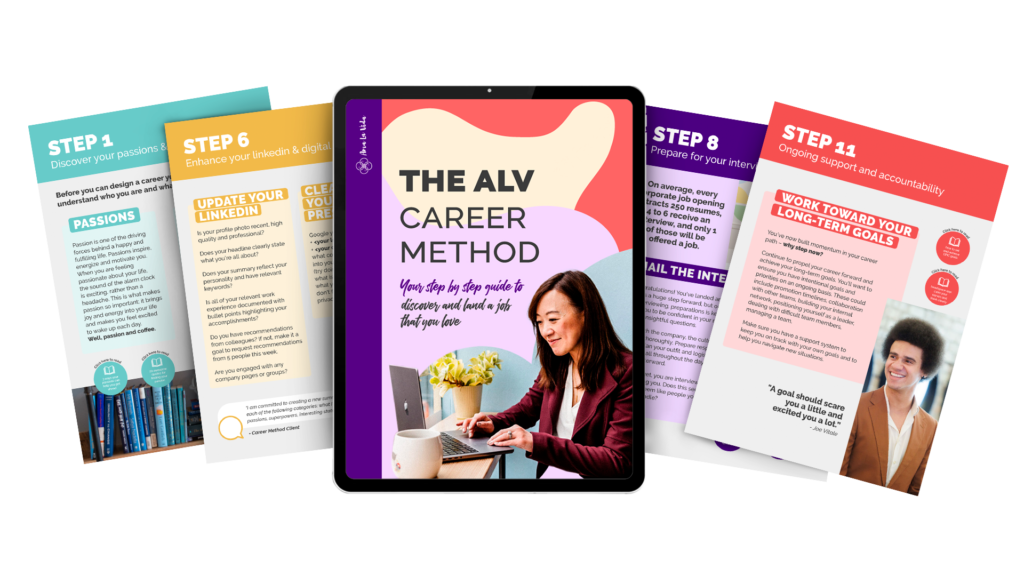
Download our comprehensive step-by-step guide to design and land a job you love!

Images from The ALV Career Method Guide
ALV Method Downloadable Guide

practical tips to help you manage stress in the midst of chaos

Did you know that up to 80% of illness and disease is precipitated by stress? While doctors once thought our genes predetermined our destiny, we now know that it’s our internal and external environment which signals our DNA to effectively turn on a disease process. Today I‘d like to talk to you about stress, the long-term effects of stress and finish by sharing some strategies and practical ways to help you with managing stress in the midst of the chaos life can bring. The stress response, also known as the fight or flight response, evolved as an immediate reaction to physical threats in our ancestors’ environment. In a state of stress, our immune system is effectively turned off to put all energy and biological resources to dealing with the situation at hand. Once our ancestors escaped or killed their threat, the body would return to a state of homeostasis, where it was able to rest, relax, and regenerate cells. Our immune system would then turn back on where it would be able to fight off foreign invaders, illness, and disease. Although there are different types of stress, today I’ll focus on emotional stress which is a state of mental or emotional strain resulting from demanding circumstances.  So where did stress go wrong? The answer is in chronic emotional stress.  Chronic stress comes when we believe we have little or no control over managing the stressor. Emotional stressors are things like the kids are yelling, traffic, bills, a breakup or fight with your spouse, or mostly anything else that taxes your system without being an immediate threat to your life. These sort of life matters are normal and don’t necessarily have to trigger a chronic stress response, but in our overworked, overwhelmed, “you are not good enough the way you are” world, they lead to lasting stress which can be detrimental to your long-term health. The fight or flight response kicks on just the same, whether you be in an actual fight for your life or you are dealing with stressors from your spouse, siblings or boss. Work-related stress falls in this bucket too.  Did you know that nearly half of working Americans are chronically stressed on the job? Did you know that Monday morning between 9am-12pm is the time of day and week when we have the most heart attacks in our country? We have to learn to better manage our stress before it consumes our lives.  Unrelieved emotional stress leads to anxiety which can cause depression and physical disease. You can literally be stressed to death, which is why it’s so important to take back control and create calm in the everyday chaos of life.  According to the American Psychological Association, chronic stress is linked to the six leading causes of death: including heart disease, cancer and suicide. Unmanaged stress and emotional trauma is the root cause of many, if not most psychological conditions, as well as addiction to alcohol, substances and food. It leads to anxiety, neuroses, depression and a whole host of preventable and manageable disease processes.  We must be proactive, in order to preserve our long term health, happiness and well being. So while humans are highly adaptive creatures and we can withstand nearly anything, in order to survive the modern world we must start to make stress management a part of our daily lives. I’d like to offer a 5-step framework for you to add to your stress-fighting toolbox to help you effectively manage stress. Framework for managing stress in the midst of chaos:  5 A’s Awareness In order to address a stressor, we must first acknowledge its existence. We must be aware of what is truly causing our stress, before our dis-ease leads to disease. Call the stressor out by name, separating yourself from it, then identify a path around it or straight through to the source. For this to work, it’ll take a willingness to have uncomfortable conversations, ask uncomfortable questions and take on a new approach and perspective to what is truly the cause behind the discomfort. Often times, these are nagging feelings of lack of self worth, a poor self image and unrelieved emotional trauma we’ve been carrying around since we were kids. Fortunately, our mind, just like our bodies, is malleable. Through the power of your own awareness, you can start to face the stressors wreaking havoc on your life. To pinpoint the pain point ask questions like: Acceptance Although we are the creators of our lives, there will be times when things seem unfair, unjust, or downright wrong. Maybe someone cut you off, flipped you off, or you lost a dear friend, family member or your job. Perhaps you misjudged, misspoke or made a mistake. Welcome to the human experience! Dwelling in the past serves no one – neither does worry, judgment, rumination or regret. Let go of the memories and reminders that keep you tied to the stress response. Instead, train yourself to take action using the fuel from the pain of your past to propel you forward. Have the courage to practice forgiveness and acceptance of your current state and know that you are only a few small changes from an entirely different experience in life.  Action Be proactive, instead of reactive, which means taking action to confront your stress before it consumes your life. You must take care of yourself or you will be ineffective in your ability to serve your family, your community and the planet. Self-care is not selfish. It’s vital to our ability to effectively manage stress and become emotionally fit in our increasingly overworked and overwhelmed world. Action is the most important ingredient for the recipe of a stress free life.  Meditate, exercise, journal, preplan, practice, prioritize, go for a walk, or find some other way to proactively address the stressors predictably popping up in your life. Surround yourself with people that bring out the best in you and be sure to create space so you can rest, relax, and feel

Read More
how to manage your difficult family members during the holidays

For more than 10 years, I haven’t lived with my family. In fact, I was kicked out of my home during my freshman year in high school and have only ever returned for holidays, birthdays and special occasions. I love my family to death and trust that they are doing the best they can with the knowledge and skills they have, but over the last few years, I started to leave my visits home feeling small, insecure and unsure of who I was. Over time, my defensiveness started to grow and so did resentment for the most important people in my life. Relationships are meant to strengthen and support us. They should not stress out and drain us. With the holidays around the corner, a number of us will be forced to spend time with long lost family members who know just the strings to pull to make us feel insecure, afraid or otherwise uncomfortable around the table.  Whether you’re dealing with anger prone uncles, Debbie-downer friends, closed-minded cousins or a spouse or parent who makes you feel less than you are, I’d like to offer some tips and tricks on how to deal with difficult people around the dining room table and beyond. How can you proactively prepare? Set an intention before showing up. Whether you’re meeting with your future boss or a brother, a neighbor or your 9th grade English teacher, you should set an intention identifying how you want to show up, speak and feel before walking through the door. Get clear through this intention what outcomes are most important to you and to your counterpart. Think about what you can do to build a mutually beneficial relationship that serves both of you best. Then visualize these things unfolding before you step through the door or make the call. A little conscious thought and action on the front end of a conversation will drastically increase the strength and sustainability of a relationship. Along with the likelihood of its success. How can you address an immediate concern? Challenge people in a non-threatening manner. I’m not an advocate for letting your ego run rampant in your communication with others but if someone is belittling you, doing something flat out wrong or otherwise offending you, and you’re not saying something, you are to blame. Speak up for yourself, but do so in a way that avoids defensiveness. Instead of pointing out all of the things wrong with your counterparts’ actions, insults or ideas, ask them for advice on how they would handle a situation where they felt the way you do because of what they said or did. Try something like, “Hey, I’d like to get your advice on something. I noticed __________ and it’s been bugging me. What advice do you have for me?” Asking for advice is a sure-fire way to disarm tension and redirect a relationship to a more positive and productive place.  What if it’s still not working?   Sit and soak in the feelings, and then separate yourself from them. Do not react. Do not engage with the person that is stirring you up, and instead just sit with the feelings. Observe them and notice what’s bringing them up. Is the person tapping into some unresolved insecurities? What’s at the root of your reaction? Stay fully conscious, and know that you do not have to be pulled back to the same patterns of the past.  No-one can harm you with their words without your permission. If you create the awareness to sit with discomforting feelings, separate yourself from them and seek to uncover their root, you will soon open up a door of self- discovery that will allow you to break free from their grasp. Want to go even deeper?  Self-Reflect. One of the most powerful things we can do when we’re around difficult people is to use them as a tool to fuel our own personal development and growth. When you see a character trait or bad behavior in someone else that you would have in the past judged or criticized, check yourself. Semi-conscious people don’t want to see their own faults. We often see in others a reflection of our own insecurities, limiting beliefs and self-destructive behaviors. Instead of outwardly attempting to change the other person, use them as a mirror to look inside yourself and uncover where you’re doing the same thing in your life.   Ask yourself, “Where am I doing _______ in my life?” If you’re not a cop or drill instructor, your job is not to police others. Instead, direct your energy inward when you’re around difficult or destructive people and use the lessons you learn from them as an opportunity for your own understanding and evolution.    What if nothing is working?  Have the courage to cut people out of your life. You can not create a new life carrying the baggage of old people that keep you tied to the past. Those that do not serve you or your mission, do not deserve to be in your life – family, friend or otherwise. In fact, they need to be removed from your life as soon as possible. Their lack of life is draining you from yours.  Everyone needs someone to challenge and support them, to push them to grow and think bigger. Create a new tribe, crew or family that brings out only the best in you! These tricks have all worked for me but they’re still a work in progress. Try them with family, friends, coworkers, and strangers and see what results they bring for you. Relationships are one of the most common points of friction in our everyday lives. With some conscious thought and action, we can start to master them. If you’re still having trouble with difficult people or need more time to discuss these ideas, let’s jump on a call. Otherwise, let me know what works for you and share any insights or ideas you have.  

Read More

Time management is a crucial skill in essentially every job, and it’s even more important for entrepreneurs and small business owners. As the leader of your business, you’re likely responsible for a wide range of tasks that are critical to your company’s success, from getting a small business loan to managing inventory. Strong time management skills enable you to get more out of each workday and allocate your resources more efficiently. These are some of the most effective time management tips for entrepreneurs. Take Advantage of Digital Solutions Every entrepreneur occasionally has to work long hours, but working harder doesn’t always lead to better results. There are a number of free and affordable online training software options to help entrepreneurs spend less time on tedious tasks and more on things that truly matter to their businesses. These powerful time management apps, for example, make it easier than ever to notice inefficiencies in the way you spend your time. Similarly, marketing analytics solutions enable you to closely monitor performance and make more informed decisions for your business. Make a Schedule Entrepreneurs often have a wide range of things to do on a single workday, and this can quickly become overwhelming if you don’t have a way to keep track of your responsibilities and prioritize the most important tasks. Whether you use a physical planner or an app like iCal or Google Calendar, you’ll find it much easier to manage your schedule when you have it written down. Many digital options integrate with other applications. Google Calendar, for example, automatically imports events from Gmail and adds them to your schedule. Give Yourself Time to Focus on Work It’s easy to get some things done while multitasking, but other responsibilities demand your full attention. You should give yourself some distraction-free time where you give the most important tasks your focus. Without dedicated time for specific tasks, you’ll probably end up switching between responsibilities and not making enough progress on any individual thing. It’s often tempting to try to get everything done at once, but you’ll be more effective if you work on major tasks separately. Finish the Most Important Tasks First People commonly work on the simplest or shortest jobs first before moving on to more time-consuming and difficult responsibilities, but this strategy will only make it harder to accomplish the things that really matter. Instead, you should consider completing tasks in descending order of importance. The easiest way to do this is to categorize jobs based on their relevance and whether they can be delegated. Important tasks that you have to do yourself should always be your top priority. From there, you can move on to other duties depending on your schedule. Don’t be afraid to delegate if you don’t have time to finish everything yourself. Take Breaks It’s easy to assume that working more will help you get more done, but pushing too hard often has the exact opposite effect. In fact, regular breaks are associated with significantly better performance, and you start becoming less productive after a few hours of working on the same thing. With that in mind, you should step away from work at least every hour to keep your mind fresh. In addition to these short breaks, try to get a longer rest once or twice per day. Ten minutes sometimes isn’t enough to cool down, especially if you’re working on high-impact projects. If you work 10 AM –  6 PM, for example, consider eating lunch at 12:30 PM and taking another break around 3:30 PM or 4. Splitting your day into two or three sessions will also help you schedule specific tasks for those times rather than working aimlessly throughout the day. You should have a clear idea of what you want to accomplish between breaks. Get Started as Soon as Possible Getting started is the hardest part of any task, especially when you have a lot on your plate. Things usually get easier once you begin moving in the right direction and gathering momentum. When you have an especially tough workload, try to put some time toward each task as quickly as you can, even if it’s just five or ten minutes. It might not seem like much at the time. However, it’s a lot better than putting things off until the last minute. Similarly, simply making a few changes in your time management habits will go a long way. You won’t be able to perfect your approach to time management overnight. At least you now have a place to start. If you’re not currently keeping a schedule, for example, download a time management app right now rather than waiting. The simplest way to improve the way you spend your time is to stop procrastinating. Time management might not be on your mind on busy days. However, it’s one of the most important skills for entrepreneurs to master. We’re hoping these tips will help you start using your time more efficiently. So you can get more done by the end of each day.

Read More
how to support someone with a

For so long the topic of mental health has been one that people just don’t talk about. 46.4% of adults in the US suffer from mental illness in their lifetime – that’s almost half of the adult population. We need to talk about it. We’ve finally made some breakthroughs in recent years to bring more awareness to the subject, but we still have room to grow.  My mental health journey started at age 11. I began experiencing symptoms of General Anxiety Disorder, and it’s still something I face every day. Admittedly, some days are great; others, however, I’m terrified to go anywhere because, “What if I have a panic attack and have to explain to people why I abruptly had to leave?” It’s hard. It’s exhausting. It’s difficult to explain to others.  This post isn’t to explain to you why or how you should manage your mental illness. (Which is a conversation worth pursuing if you’re struggling to maintain your mental health.) Instead, I’m speaking to all of the friends, family, and co-workers who don’t have a mental illness themselves but know someone who does.  This is so important because even my husband didn’t fully understand my anxiety for a long period of time. I’m not saying he didn’t try, just that it’s a difficult subject matter to understand. His love for me made it extremely difficult for him to see me suffering and not know what to do.  Eventually, after I discussed what my triggers were and going through many panic attacks in front of him, he began to truly understand. He now knows when I’m on the verge of having a panic attack and what situations to avoid when I’m having an overly anxious day.  Knowing that 46.4% of the US adult population experiences and suffers from mental health symptoms, I’m going to share with you a list of behaviors and actions that I’ve found most helpful from the people that mean the most to me. The things on this list have helped me feel heard, seen, valued, and most of all loved. Here we go! Listen without an agenda Working for a coaching company you soon realized that active listening is a really hard task. Active listening is defined as, “the ability to focus completely on what an individual is saying and is not saying, to understand the meaning of what is said in the context of that individual’s challenges and desires, and to support individual self-expression.” All that said, when someone explains their mental illness to you, take the time to truly listen. Know that when they confide in you it means they trust you. As they are speaking, instead of responding with phrases like “oh, everyone gets depressed” or “just breathe,” try saying “Whatever you need, I’m here for you.” Understand that they probably aren’t looking for advice or commentary at that moment, just someone to listen to what they have to say without judgment. There will be plenty of times later on to give your input, advice and to ask questions.  Seek understanding Once you have listened to what your friend, relative, or co-worker has to say, take time to process and understand. Depending on your relationship with the person, ask questions about the parts that don’t make sense to you, but also understand that there are things that happen to them that they might not understand themselves. Reassure them that if they are uncomfortable talking about it in more detail than they already have, that they are not obligated to do so and move on to a different topic.  Asking questions like: “How can I help?”  “I want you to feel as comfortable as possible when we are together. Are there topics/places that are triggering and we should avoid?” “What helps you on the days that you aren’t feeling well?”  These questions will show them that you are making an effort to be there when they need you. Once you know what they are going through, try your best to not make them feel bad for canceling plans, leaving a triggering situation, or not being themselves some days. That in itself will help them more than you know.  Be observant and react accordingly When you begin to learn the warning signs and know their triggers, be on the lookout for them. If you know that your friend stops texting for days when they are not in a good headspace, call them or even show up to their house with their favorite foods. Tell them you will sit by their side and do nothing if that’s what they want, but let them know that they are loved and you are there for them. If your friend has panic attacks from being in big crowds, know their warning signs and assure them if they have to leave no one will be upset. Realize that some people do not have ‘classic’ signs. Each person has unique side effects. Panic attacks aren’t always hyperventilating, depression isn’t always a constant state of sadness, OCD isn’t always someone constantly cleaning.  Be consistent because you care Whenever people with mental illness have bad days, they tend to think that they are a burden to the others around them. I know that even though I am not always going to feel up to it, I love getting invited to get-togethers. Keep inviting your friends to events even if they aren’t always going to say yes. Keep showing up for them on their bad days. This shows that you still care, you’re still here, and you aren’t leaving.  Consistency and intentionality are major factors in a thriving friendship of any kind. However, they have the power to create an even stronger bond when the other person is fighting their mental health battle.  “What we don’t need in the midst of struggle is shame for being human” – Brene Brown Mental illness isn’t fun. In fact, it’s really hard. But, having someone by your side, who cares during those bad days can

Read More
birthday reflections on what matters most

Every year around my birthday, I always take time to do a little year in review. I write down important milestones, lessons learned and things that I’m proud of.  The number one question I ask myself is, am I staying true to the values that really matter to me? As I’ve thought about this question over the last few years, I’ve found it to be a helpful exercise. It keeps me grounded and always ensures that my personal journey is rooted in some sort of purpose.  My list is still a work in progress. I’m sure that it will continue to change over time. However, here are the three things that I always come back to when I think about what matters most to me: Don’t Sweat The Small Stuff  I’ll be the first to admit that I can recall times where I’ve been so caught up in the small details of something, that I’ve let those small things get the best of me. Whether it led me to get annoyed or frustrated with a situation or a person, sometimes I’ve let those things consume my energy more than they needed to. Now, when I find myself in that place, I tell myself to take a step back. I ask myself if this is something that’s really going to matter. Is this something that’s really going to matter in 10 months or 10 years? More often than not, the answer is no. Checking myself helps me let go of whatever it is that’s draining my energy.  Savor the Magic in Moments  When I’d take the train back to the city from visiting my grandfather, I would always remember some of our special moments. Whether it was teaching me how to ride my first tricycle, catching me red-handed in the backyard while I was cutting my doll’s hair, showing me that math problems were fun (we never did agree on this!) or beaming with pride when I told him about getting my first job in NYC after grad school. Those were the moments that I will forever hold onto.   What matters most to me is experiencing new things, seeing more of the world, and enjoying moments that make my heart full. Memories that I can look back on fondly and smile to my heart’s content. That value will always matter to me more than any material item. Live Without Regret  During my time in New York City, I was sacrificing what I really wanted in order to conform to a norm or a checklist. I was failing miserably at it because I was unhappy. In a book by Bronnie Ware, The Top Five Regrets of the Dying, the number one regret of the people that she interviewed was not living a life that was true to them, but living the life that others expected of them. If it’s one thing that I’ve never been able to do is live my life based on a checklist. It’s never worked out for me even when I’ve desperately tried to fit in.  I’ve found that I am much happier living the life that I want because I’m more fulfilled. Even though I’ve made my fair share of mistakes or decisions haven’t turned out the way that I’ve wanted them to, I have always felt it was the right thing for me to do. Now, I always ask myself, is this something you’re going to regret if you don’t do it? If the answer is a very loud “yes,” I go for it. No matter how far it strays from “the norm.” There’s only one definition of normal in my book and that’s how I’ve chosen to define the term.  I’m sure there will be many more things to add to this list as I figure out what’s right for me, but these are some great daily reminders. What are some of the values that matter most to you? Share yours in the comments below! 

Read More

When I was younger, I played tennis competitively – from an early age, I was a competitor. I was pitted against whoever my opponent was. We weren’t on the same team and were in a battle for every point there was. Tennis is an incredibly mental game. When I was down, I learned to never let my opponent in my head and to not give them the power of my emotions. I was stoic and never showed weakness and that allowed me to win. I learned that vulnerability lost matches and I carried that belief with me for a long time.  Why is Vulnerability Important: What I didn’t know is how Vulnerability is strength and allows us to connect with others. When we show our true selves, our imperfect selves, our silly selves, our messed-up selves, we are met with others’ true, imperfect, silly, messed-up selves. Vulnerability invites vulnerability and when we share all the aspects of who we are, we build deep, life-giving, healthy relationships. Those healthy relationships are vital to our mental and emotional state. We need people who really see us to be our healthiest and happiest selves. The Merriam-Webster definition of vulnerable is:  vul·​ner·​a·​ble | adjective 1: capable of being physically or emotionally wounded 2: open to attack or damage As I grew up, I took what I learned from tennis and allowed it to bleed into my everyday life. I wholeheartedly believed in this damaging definition of vulnerability. I thought that if I showed any weakness, someone would take advantage of that, and I would indeed be wounded and damaged.  Being vulnerable meant I had to be seen.  I never set myself up to be hurt – I mean, what person in their right mind would set themselves up for physical and emotional pain?! But that hardness and stoic-ness that I learned from my youth caused me to put up walls around my heart. It was so difficult and unnerving to let anyone in to see the true me. I didn’t learn for a long time to cut holes in my armor of walls and allow myself to breathe. I had to learn to give myself permission to be vulnerable and seen.  If you’re like me and struggle with vulnerability, ask yourself: “how not being vulnerable serves you?” For me, it served as a false sense of self-protection that allowed people to see me in the way I wanted them to see me. But it also meant that most of my friendships and relationships went only surface deep. They were deprived of full truth, love, and acceptance. I didn’t want to be found out that I didn’t have it all together, I didn’t have all the answers, I wasn’t perfect, and maybe I was less than expected. Grace doesn’t come naturally, we want to be the best and perceived as having it all together. We think perfection is safe and everything else is scary unchartered territory. When we have no grace with ourselves and feel the deep need to be perfect, we wear a mask. The Mask: The mask is something most people are guilty of wearing at one time or the other. It’s a form of self-protection that helps us to feel safe. Unfortunately, there are two big downsides to the mask: You wear the mask and you attract people to the mask and not the real you. People can only wear the mask for so long before they show who they truly are. Once the mask falls off, you feel found out and people who were once drawn to you feel lied to and confused. You wear the mask and you don’t attract the people who would genuinely love the real you beneath the mask. You miss the opportunity for great connection and acceptance. The mask prevents us from connecting with people. What was supposed to protect us is the exact thing that makes us feel isolated in the end.  “Perfectionism is self-destructive simply because there’s no such thing as perfect. Perfection is an unattainable goal.” ― Brené Brown, The Gifts of Imperfection What would it look like to take off the mask of perfection and step into who you really are and let that shine?  What would it feel like to let yourself off the hook, practice grace, and not feel like you have to hide who you really are? Vulnerability takes Courage:  It’s easy for me to sit here on my computer and say “vulnerability is a strength and you should be vulnerable”, but actually being vulnerable is hard! It’s not easy to allow yourself to be fully seen and known, because you may not be accepted by those around you. As humans, one of our greatest needs is to have deep relationships and to be accepted.  So, what happens if we open ourselves up and we aren’t accepted?  It makes me think of the quote from The Velveteen Rabbit: “You become. It takes a long time. That’s why it doesn’t happen often to people who break easily, or have sharp edges, or who have to be carefully kept. Generally, by the time you are Real, most of your hair has been loved off, and your eyes drop out and you get loose in the joints and very shabby. But these things don’t matter at all, because once you are Real you can’t be ugly, except to people who don’t understand.” ― Margery Williams Bianco, The Velveteen Rabbit I want to tell you that it’s okay not to have it all together. You can be imperfect and still worthy of being seen and known. You don’t have to be the best to play the game. When we allow grace to enter our lives, we also allow room for life and freedom. We can choose to let go of the mask we’ve been holding onto and step into who we really are with confidence and self-love. There is strength in vulnerability. Looking for a Vulnerability Challenge? When the feeling of self-protection comes up in a trusted relationship, ask yourself:  What am I hiding?

Read More