Category: Presence

I don’t know about you but I’m like a kid in a candy store when it comes to life. I want everything – I want the light chocolate, dark chocolate, white chocolate, chocolate covered almonds, espresso chocolate, hazelnut chocolate. All the chocolates. I love chocolate and I don’t want to have to choose. This is how most people I know are about life. It’s a stark realization when you think about all the things you want in life and realize that it’s just not physically, mentally and emotionally possible to have everything at the same time. You can have anything you want if you work for it but you can’t have everything. We want a promotion at work, to be more present with family and friends, to have more time to exercise and build better relationships – does this sound like you? This is a lot to ask for and for me, an impossible task. I’m learning this the hard way. As a new mother, an entrepreneur of a growing business and a dreamer of wanting the perfect harmony of life and work, I’ve driven myself crazy to find my harmony. When I’m at work, I’m driven with guilt thinking about my daughter and what I might be missing out on. When I’m at home, I’m thinking about the clients I want to check in with. And when I’m with my husband, I’m thinking about how I need to go work out. When I’m with friends, I’m thinking about how I should spend more time with my parents. It’s emotionally and mentally exhausting. Finding Balance Imagine a seesaw. There are two sides: life & work. With pressure from both sides, it’s difficult to maintain a steady balance. Typically, one side is going to be weighed down compared to the other. And when that happens, we find ourselves being pulled to achieve our balance again. Let’s say work has been crazy for you and you’ve been slammed with meeting deadlines. The work side of your seesaw is low to the ground. You recognize that and double down on the life side so that you can get to some balance. What’ll end up happening is now the life side will be low to the ground and you realize you need to shift your focus on work. Our seesaw shifts again, and it’s a cycle causing us to be frustrated that we haven’t found a balance. I was recently watching Final Table, a show on Netflix that selects up and coming chefs across the world and makes them compete with one another with the goal of being seated with the best chefs in the world. I learned a lot about chefs and the food business and the incredible amount of sacrifices chefs make to build a brand and establish themselves in their industry. More importantly, I learned a very important life lesson. I learned that no matter what profession or vocation you have – whether you’re a stay at home parent, working in corporate, an entrepreneur – you have to sacrifice something when you’re building yourself up. You sacrifice to first learn the craft. You then sacrifice to maintain your status quo and for the go-getters, you sacrifice to climb the ladder or to perfect your craft. All of which require time, energy and money. The sacrifices aren’t small. You miss out on vacations, holidays, quality time with friends and family. You do it because at that moment, that’s what is important to you. And you shouldn’t feel guilty about it. You made a choice based on the information available to you and you made a conscious decision on what matters at that moment. For example, currently, my seesaw is towards work. It’s a critical time in the business and I want to give it my all to make sure we’re growing and building on the momentum we have. This is a conscious decision. Do I feel a pull towards wanting to dedicate more time towards life? Absolutely. I’ve realized that as long as there is no one extreme, then it’s okay. Everything is okay in moderation.  And I’m done feeling guilty about finding a balance. I’m in control of my seesaw. If you’re staying true to yourself and acknowledge the sacrifices you will make in order to achieve your goal, then perhaps you should take it easy on yourself when you make that choice. Recognize that this is a temporary time in your life and temporary is a subjective term. Temporary could be a day or weeks or years. During the growth stages of our lives, we won’t always achieve perfect harmony. We won’t have a work/life balance. But we made that choice because that is what was important to us at that time. What does this mean for the new parent or the newly married couple or the consultant who wants to enjoy life and make money? It means that there will be moments when you’ll have one of a lot. For the new parent, this could mean a lot of baby time and not enough time for yourself or your partner. The newly married couple, it could mean a lot of quality time together and not enough time for your existing friends. And for the single consultant, this could be a lot of hours away from home and not much time for a healthy lifestyle. What do you do when you’re guilty about your one-sided seesaw? Know that we live in a state of equilibrium When we aren’t finding the balance in life, we somehow find a way to get back to equilibrium. We either define it as a new normal or we pivot to bring back a sense of peace. It doesn’t happen simultaneously or when you want it to happen without proactive action. Recognize you’re too far on one side and get back to moderation. And equilibrium doesn’t mean perfect balance. It means having just enough from the other side so that you don’t feel that void.

Read More

I grew up in the suburbs of Philadelphia. My town bordered the city. It didn’t feel so much like a blend of urban and rural but like a battle between the two. We sometimes walked through metal detectors on the way into school, but you could see a deer pass at any time. Sandwiched between my subdivision and the strip mall on the main road nearby sat a small wooded area. “The woods.” Just enough space to get lost in childhood adventure but not enough to worry your parents when you played there. I remember going there with the neighborhood kids to play for hours. An entire day could pass of us building forts, finding creatures, jumping back and forth across the creek (or “crick” as most people called it). When I see kids now entranced by their phones and iPads, my heart often breaks a tiny bit wondering if they ever have space for imagination and adventure. If they ever invent their own game or create their own language. If their aptitude for technology isn’t coming at the cost of their sense of wonder. Then again, I image all generations feel this same heartbreak as they contemplate the upcoming one. Get Creative What’s funny is, I’m currently depriving myself of this type of joy as an adult. I’m always on my phone. I’m always double-screening. And I’m rarely left alone with my own thoughts and imagination. I often do my best thinking in the shower. I thought perhaps it could be related to the calming nature of it. How relaxed I am. But could it honestly be the fact that it’s one of the only places in my life where I physically cannot bring my phone? Even as I sit here and write this, I’m on a Spirit Airlines flight with no wifi (#entrepreneurlife). Even 30k feet in the air, I’m still usually distracted. Responding to emails. Sending off a slide deck. Watching a movie. If I’m very very lucky, asleep. But on this flight, none of those was an option. Today I just sat here (forcibly) alone with my thoughts. And it was magical. I thought of a million new ideas for ALV (stay tuned!). I unintentionally crafted 5 notes of gratitude to people in my life (not as a set practice but simply because I felt compelled to). Taking off I felt exhausted. Now I feel completely energized. I want that for you. Find a way to force it. Go somewhere in nature. Lock yourself somewhere away from devices. Take a Spirit Airlines flight for Pete’s sake. I don’t care how you do it. But let your brain go play in the woods. This week’s challenge Spend one hour of uninterrupted time to get creative. Put the phones and gadgets away, and do something that awakens your creative spirit. It can be as simple as reading a book, journaling, coloring, you name it! Just give yourself the time and space for your brain to wander. We know you want to learn more. Here are some of our favorite additional resources: Take a class: Sign Up For a Creative Class With Dabble Here’s some screen time to help you to spend less screen time: 6 TED Talks That Will Change the Way You Look at Your Phone Immerse yourself in nature: Forest Bathing: How Talking to Trees Helped Me Heal Get Creative: 9 Ways to be More Creative in the Next 10 Minutes Unsure where to stay when it comes to finding ways to get creative? In this video, Coach Danielle explains the concept of passions and why they are so important in our lives and careers. She then walks us through 3 questions to help us identify them!

Read More

I finally learned how to prioritize my health and wellness after 20 years of struggles with weight, shame, and self-doubt. I am so grateful for all the ups and downs in my journey. They have truly helped me learn how to embrace life to the fullest. Through much trial and error, I learned the right strategies to elevate my health. While there are so many ways we can improve our health and wellness, the following three are the tips I find to be the most impactful for me. Enjoy! Create a Morning Routine The first of our health and wellness tips is creating a morning routine. Most of us begin each day dreading the buzz of our alarm clock. We hit snooze as many times as possible before we begrudgingly start our day. Instead of rushing around doing the basics, try adding some extra time (all you need is 5 minutes) to create your own morning routine. This routine is all about you and doing things you enjoy. Some ideas include reading a good book, listening to a podcast, journaling, or exercise. When you have something to look forward to in the morning, it makes getting up actually enjoyable! (And bonus – you will feel more productive and energized too!) I recommend reading Hal Elrod’s The Miracle Morning: The Not-So-Obvious Secret Guaranteed to Transform Your Life (Before 8 am) if you want to learn more about developing your own Miracle Morning. Prioritize Sleep The second of our health and wellness tips is prioritizing your sleep. According to the National Sleep Foundation (NSF), sleep is essential for a person’s health and wellbeing. And I couldn’t agree more. The latest Sleep in America 2018 Poll highlights this disconnect between the value of sleep and our reality of not making it happen. While most Americans know sleep contributes to the next day’s effectiveness, only 10% of people are prioritizing it. While our individual sleep needs vary, figuring out the average amount of sleep that is best for you (and scheduling that time in) is key. For example, I plan my schedule (as part of my morning routine) to include eight hours of “in-bed time”. If I fall behind my schedule, then I shift the next day as much as possible to maximize sleep. While some of my “in-bed time” is used towards winding down (like reading or listening to an audiobook), I often fall asleep fairly quickly and can count on getting at least 7 ½ hours in. I also recommend turning off your screens at least one hour before bed and creating a simple evening journaling routine. I also take a few minutes to write down what I am grateful for and jot down any to-do items for the next day. This helps clear my mind and de-stress before bedtime. Meditation The third of our health and wellness tips is meditation. Meditation is becoming increasingly popular as more people realize its benefits. A meditative practice is a process of habitually training your mind to focus and redirect your thoughts. There are many ways you can go about meditating, and it can be as simple as taking a few depth breaths to focus on the moment. According to findings from Johns Hopkins University, meditation can help ease psychological stresses like anxiety, depression, and pain. Personally, I enjoy meditating using my headspace app each morning. I also focus on taking a few deep breaths throughout the day anytime I start feeling stressed. This pause helps me get grounded and allows me to disconnect from any thoughts that aren’t serving me. Health is a “state of complete physical, mental and social wellbeing” as defined by the World Health Organization. This definition highlights an important shift we are taking towards a proactive approach to health and wellness. By proactively focusing on your health, you benefit by also improving your overall well-being and quality of life! Who doesn’t like the sound of that? Knowing where to begin can be tough. That is why partnering with a coach is such a powerful tool to help you achieve your goals. With Ama La Vida’s health and wellness coaching, you are guided towards true transformation through self-reflection to gain clarity and focus. This is exactly what your best version of you needs to combat self-sabotage, create healthy habits, and harness your personal power! If you are ready to elevate your health and realize your potential, schedule your free coaching consult with me today! I look forward to connecting with you!

Read More

Is it hard for you to say no? Do you sometimes find yourself spending an excessive amount of time making your work products just right? Are you commonly rushing from one task to the next? Do you commonly neglect celebrating yourself and your successes? If so, congratulations! You might be a perfectionist, you are most certainly a human being, and you fit right in with the overachievers here in our ALV community. The thing about responsibilities, though, is that they will just keep coming whether or not we have the time or mental capacity for them. And, if you have a dream or a vision or a wild passion, you don’t want them to stop! However, a growth-oriented life doesn’t mean you have to run yourself ragged. Sure, you might have late nights or stressful days, but those can’t be the norm – they simply aren’t sustainable. It helps to have strategies that combat the need to always-be-doing. For me, I need to constantly switch up my routine. A tool that helped me refocus a month ago might not be what I need right now. In case you’re someone who also benefits from a ton of tools in your toolbox, I’ve included some of the ways I’m slowing down below. Taking 60 seconds for deep breaths. When I set this goal for myself, I felt overwhelmed by finding the time to fit it in – and then almost immediately, felt like that was the wake-up call I needed. Even one simple minute of deep breathing or mindfulness can make a huge difference in my day. At work, I’m a go-to for lots of issues, so it can be hard to have uninterrupted time. My strategy has been to set timers – 4 throughout the day, scheduled around meetings and other obligations – and when those go off, I take a quick walk to fill up my water bottle or escape to the restroom and make the time to breathe. Practicing time blocking. We’ve all seen the articles that warn us about multitasking – specifically, that it doesn’t work. Argh! Time blocking is a powerful alternative that helps me actually get things done. In a nutshell, time blocking is the simple practice of dedicating certain amounts of time (I work best in 1-3 hour time spans) on a single task or project. This helps to keep your attention on what’s truly important instead of being faced with constant distractions and task-switching. At the beginning of each week, I look at the projects I need to complete and find blocks of time in my schedule (rare!), then physically set a block on my calendar to work on them. When the time comes, I turn off email, put on a playlist that gets me in the zone, and fully turn myself over to the work. Getting enough sleep. I can’t overstate the importance of sleep for my personal productivity. I don’t notice a huge burst in energy after my second cup of coffee, but I do fall victim to the 2 pm slump if I haven’t gotten enough rest the night before. I also notice that in general, I have a harder time concentrating and digging into my creative side if I’m feeling sleep deprived. Making sure that I’m getting enough zzz’s can require some sacrifice – perhaps I shorten (or skip!) my workout, I grab healthy takeout instead of cooking dinner, or my dirty laundry sits in the basket for another night. Once I’m back on track with my sleep, I can get back on track with everything else in life. Life happens, and that’s what’s exciting and beautiful about it. It’s okay to take a step back to remind yourself of what truly matters. Don’t be afraid to slow down, recharge, and get ready to dig into the work that’s really important. This week’s challenge This one can be done right here, right now. Get your phone out and set a timer for 60 seconds. Close your eyes, breathe, and allow your thoughts to wander where they may. When the timer goes off, take your final deep breath – and then get back to work. In our insanely hectic lives, getting one minute to yourself to simply be is such a treat. Give that gift to yourself. Repeat as necessary and reap the benefits. We know you want to learn more. Here are some of our favorite additional resources: Unpacking this controversial concept: “Finding the type of self-care that resonates with you is key. But what comes next?” Yes, it’s awkward. Yes, you still need to do it: 4 Mindset Changes That’ll Make Networking Feel Way Less Fake and Horrible Listen, implement, repeat: On Saying Yes If you’re in it for the long haul: Toxic Workers Are More Productive, But the Price Is High

Read More

The practice of yoga is dynamic. Yoga offers strength and lessons that can be adapted to many areas in our lives.  Yoga has become integrated into our culture as more than a physical practice. It also offers mental health benefits in connecting the mind and body.   For those of you that are new to the practice or idea of yoga, you can start at any time and find a style that works for you! I personally practice two specific types of yoga. One more so for the mental and physical elements that it provides, and the other for meditative and spiritual experiences. When engaged with yoga, I find myself becoming stronger as I flow with intention. But on the same account, I am gentle toward my limitations. I soften my expectations and express gratitude toward myself through the difficult poses, knowing that I can come to my mat to let my life unfold (literally!). Yoga and Your Career As I share with you the benefits of yoga, I will also guide you through some of my personal takeaways and how I incorporate yoga into career planning as a Career Specialist. I want to guide you through my own practice and essence of a yoga practice. All of which can help you find calmness and resolution with your career goals. Here are some of the most powerful lessons I’ve taken from yoga (and you can too!): 1. Be intentional. Yoga begins and ends with intentions. What is your intention, today? That is a question I often ask myself, as I am often asked to set an intention every time I enter a yoga class. As I write this, my intention is to share my loving, sometimes gentle, and sometimes a bit intense (I’ve been known to take 2 classes a day!) practice of yoga with you. It’s the why behind the practice, and how these practices can be integrated with your career. Such as decision-making and transitioning, the job search and everything in between. My practice offers balance among the physical, emotional and mental areas of my life. The depth of where yoga can transform thinking and physical limits in a certain amount of time is what continues to bring me back to the practice, to the present moment and to a space of gratitude. Being intentional is incredibly important in our lives and careers. Time can pass by so quickly when we just sit back and let life happen to us without taking an active and intentional role in shaping our career paths. When I work with clients who are lost in their path or struggling to land a job, the first thing I often do is take a pause to help them think through what they want their career to be about, to feel like and the impact they want to make. This makes the path forward much clearer. If you’ve been caught up in the hustle and bustle, take a minute today to reflect and consider, “What impact do I want to make in my career?” and then start acting with intention. 2. Find your calm. Allow yourself time away from your mental processing. Statistics show that on average we move through 48 thoughts per minute. Yoga fosters mindfulness, awareness to our thoughts with a focus on allowing those thoughts to pass and enter a state of mental calmness. Where in your life is there added stress? Not surprisingly, most people have stress around their careers. Whether that is related to the role itself, often due to lack of flexibility or work and life imbalance. In order to help de-stress, where in your day can you find your sense of calm? Now that we have some intention in our careers, what’s one word that brings you back to that clarity? When you are feeling stressed at work or overwhelmed by career decisions, you can find your calm by focusing on that word. 3. Engage with your breath, Pranayama. I like to practice deep breathing. Why? It is intentional and integrates mindfulness. This is a process of deep inhalation followed by deep exhalation, sometimes pausing in between, eyes closed, allowing to feel the breath move to the belly, then to the lungs, within and out. This has been the most powerful tool I have come to find. What is powerful about the breath is that it can be practiced strengthening the mind! The breath opens spaces in our capacity to stretch a bit longer and allow our mind to stay focused on the current pose. What a great practice to integrate literally and figuratively. Challenge yourself to take a pause throughout the day. Taking just 5 deep breaths throughout the day will help you keep focus and will re-energize you for your work. 4. Don’t be afraid of the challenge poses. What is unique about yoga is that you have what can be a demanding physical practice. Especially if it is taught in a heated room. Most often you find yourself trying to keep pace with fellow yogis that surround you. I truly enjoy when I find myself in sync with the others next to me and can keep the “flow” and breath moving together. Holding each other accountable to follow and finish the flow as one. What counters this is that yoga is very individualized. Your body may need to lay flat on the mat while the class continues to move through poses. Challenge yourself but also know your limitations. Challenge yourself to try something new in your career. Think big and outside of the box to deliver a wild idea or create time to work on a project in your current role that would allow you to flex more creativity or ownership. I challenge you to set aside any doubts and push yourself outside of your current comfort zone. 5. Radical Acceptance. When I fall in yoga, I often laugh it off and try again. That makes it easier to transition into the next pose,

Read More

Congratulations on surviving the polar vortex of 2019! If you didn’t experience the sub-zero temperatures and feet of snow, consider yourself lucky. Since we’re nowhere near the end of winter, here are my recommendations for the next time you’re working through a bout of bad weather. Use your commute for good. I used to have an epic drive to and from work – it was so extreme that I would routinely hear gasps when I told coworkers where I lived. I also absolutely hate driving, but there were no public transit opportunities available to me. This was a bad combination! I quickly learned to make the best of my commute and was able to put this skill to use as I spent time stuck in snowy traffic over the last week. Utilizing podcasts and audiobooks helps me to work on personal development even when trapped in my Honda Civic (and driving is the only way I can focus on listening to something). For our entrepreneurs, I highly recommend The Pitch by Gimlet Media, Side Hustle School, and RISE by Rachel Hollis to help stretch your creative muscles. Get clear about work-from-home expectations. As Nicole mentioned in her last letter, remote work is on the rise, though this isn’t yet a standard for every employer. If you’re unsure about how to handle work when the roads are bad (or if your children don’t have school for the third day in a row, or your car dies because it’s so cold…), ask! Some employers are willing to make exceptions based on extraordinary circumstances, and we saw a lot of that happening over the last two weeks. Some basics for sporadic remote work: Make sure you have an Internet connection and can access all necessary documents and computer programs (perhaps you can use your home computer, or you’ll need to take a work laptop home) Stay in contact with your team (sending your cell number out as the day begins and staying logged onto any Skype/Slack/Messenger programs is helpful) Communicate what you’re working on with your boss (so she knows you’re not just sipping tea and watching the snow fall). Use found time to focus on what matters. In the case of bad weather, things tend to slow down around the office. Perhaps your coworkers are deemed non-essential and don’t need to come in, or customers are unable to make their appointments. When you find pockets of quiet time during these chaotic days, make use of them. I was able to get some work done on a long-term project since I finally had some uninterrupted time to focus, and I was able to thoughtfully check-in with some of my newer team members about the growth I’d seen in them lately. Last but not least – I called my grandma. Talking to her is always the highlight of my day, and I loved escaping to the break room and taking in a peaceful view of snowy trees while laughing with her and making sure she was safe at home. Cheers to knowing that warmer weather will eventually come our way again – but until then, leaning into the coziness and slower pace that winter can bring. This week’s challenge This recent wild weather has me considering the value of hygge – I certainly can’t pronounce it right, but I know the concept is all about embracing the freezing cold (instead of fighting it!) and giving yourself what feels good and cozy throughout the winter season. What else are you fighting? What current state of being would be easier to accept instead of resist? I’m not talking about monumental issues that deserve advocacy, but smaller ones – like hating your commute, or dreading your email inbox. This week, identify one aspect of life you’ve been dreading to accept – and then lean in and embrace it. We know you want to learn more. Here are some of our favorite additional resources: Embracing vulnerability over perfection…: Do You Keep a Failure Résumé? Here’s Why You Should Start. …while making sure you don’t get too vulnerable: “When does sharing become oversharing?“ The latest from LinkedIn: New Ways to Keep a Pulse on the Companies You Care About Because love is in the air: This American Life | Episode #486: Valentine’s Day

Read More

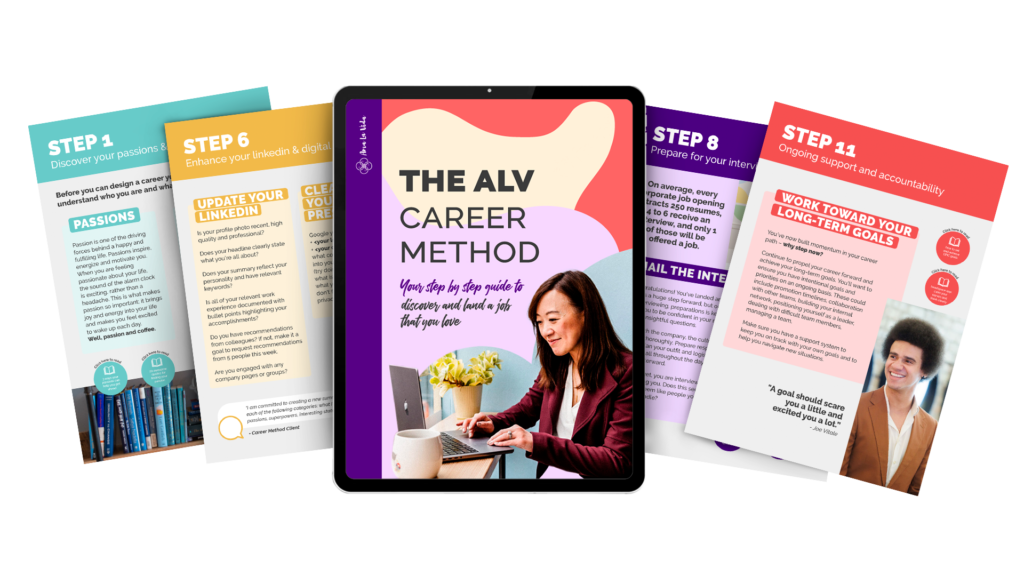
Download our comprehensive step-by-step guide to design and land a job you love!

Images from The ALV Career Method Guide
ALV Method Downloadable Guide

I said it in last week’s newsletter, but it bears repeating – January is a month for growth and for determining how you want your year to look. This month’s coaching interview truly speaks to that need to look inward and uncover your “why,” while coupling those big dreams with thoughtful action steps to make them happen. We’re featuring Career Specialist Eden, an incredible member of our team who has a knack for helping her clients to address what they truly want out of life and work while equipping them with tangible skills to achieve epic career success. Let’s get started! First of all, let’s start this interview by saying that when we asked Eden what her signature party trick is, she responded, “I love to meditate, and will guide anyone who wants to give it a shot – any place, any time – through a guided visualization.” Eden, can you please invite all of us to whatever parties you’re going to? That quote truly sums up who Eden is; she is a coach who makes meaningful growth easy and accessible, and has some fun along the way. Eden made it clear that all of the buzzwords around purpose, doing what you love, and finding your purpose are truly meaningful as you think about your long-term career path. She notes, “Passion ignites us and drives us forward. It can keep us motivated in times when things may be uncertain.” Picture the moments when you’re the last one at the office or are feeling overwhelmed by everything on your plate. One driving factor that can keep you going is the reason you started this journey in the first place. Calling upon your “why” can be a powerful tool when it seems easier to simply give up. True to form, Eden didn’t only want to touch on purpose and passion in her interview. She also has some key interview tips to share with the ALV community. Key takeaways from our time together include: Prepare by practicing developed answers that you plan ahead of time. Review behavioral-based questions, as this is how employers learn about you from your past experiences, based on the behavior and the why behind your actions in your previous roles When providing examples, don’t forget to focus on your strengths and link your past experiences to the current role you are interviewing for. If you can bridge that connection, you make it easy for the employers to see why you are the right candidate for the position. Let them picture you in the role and understand exactly what you’ve done to prepare you for this new role. Know that interviewing is an investment on the employer’s side of things. The company spends valuable time and resources to interview potential new hires. Therefore, they’re likely not wasting their time in bringing you to their office to invest in potentially bringing you on board.  Interviewees make their first impression within the first couple of minutes. Look polished and professional, and engage with enthusiasm. A good handshake helps! Do not forget to follow-up by sending a professional thank you note after your interview (email is just fine) I truly loved this interview because it encompassed the purpose-driven work that we do here at Ama La Vida, as well as included actionable steps for our community to improve their job search skills. That’s where we find our sweet spot – developing people and equipping them with what they need to go after what they want. Thanks again, Eden, for sharing your wisdom and spirit. We’ll see the rest of you back here next week! This week’s challenge We’re mixing it up this week and incorporating a challenge that anyone in our community can take on. Feeling bummed that you won’t be at a party with Eden so you can practice her party trick? Have no fear! Guided meditation is free, easy, and convenient – and as an added bonus, science tells us it’s helpful for a variety of reasons. Some of our favorite resources for practicing are Simple Habit, Calm, and Yoga with Adriene. Your challenge this week is to give it a try. We can’t wait to hear what you think.   We know you want to learn more. Here are some of our favorite additional resources: Support your favorite local bookstore: Callings: The Purpose and Passion of Work by Dave Isay Give it a try: “In my journey, I have given myself permission slips to be imperfect and to make mistakes throughout the day.” If you’re on the job hunt: 7 Trends Job Seekers Can Expect in 2019 We’re loving this week: “We talk to various moms from across the US in various walks of life about their childcare, work-life balance, mom hacks, and more.”

Read More

To be present is not just about being there but by being aware and responsible for the choices you make, all your interactions with other people, and even your own decisions. If you’re able to manage these aspects, you’ll find that your relationships with those around you may improve. I think it’s safe to say that we are all aware that we should be more present in our daily lives. However, the execution of being present is where the lines get blurred. How do we stay connected while being present? How do we observe while staying informed? How do we unplug without becoming unreachable? These are all challenging questions, here are my top 9 ways to stay more present in your everyday life. Know What’s Important In Your Life To be more present is really an issue of knowing what’s important in your lives. If your priorities change, you’ll need to know that you can adapt by learning to adjust your behavior and attitudes accordingly. You might realize that you don’t want to do a certain thing and that it won’t help you solve your problem. But if you don’t know the consequences of your actions, you can’t change them. So, learn to be more open to possibilities and understand what it means to put priority and emphasis on those that truly matter the most. Accept That Presence is Hard Not many people wake up each day and think to themselves “right, I’m going to be present today!” The reason they don’t do this is because they think that it’s a given – our natural way. The truth is that presence is hard. Really hard. Sure, it can become your default, but that takes a lot of practice – particularly in today’s world when we’re constantly bombarded with emails, text messages, social events, work projects and the list goes on. So then, the first step is acknowledging it’s hard. Real hard. Once we acknowledge this, we allow ourselves more effort to practice it and achieve it. Take Responsibility For Your Actions When you know how to be present, you can start taking responsibility for your actions. The first thing that comes to mind when a person who has never taken responsibility for their actions before is to blame themselves for whatever they do. Don’t do this, though. Remember that every action you make affects others and, therefore, you should be willing to do what you can to change the way you act or feel. Practice Every Day Unfortunately, there is no switch for presence. We can’t turn it on and off as we please. Our mind learns behaviors and thought patterns over time and it takes a lot of practice to train the mind to be still. To be present. Most of us don’t even notice when our mind is in the past or the future so the first step is paying attention. Notice when your mind wanders – where is going? How is this making you feel? And then practice bringing it back into the present moment. Don’t worry if you don’t catch it every time and don’t worry if you don’t reel it back every time. The key is to work on it little by little each day. And sometimes it’s okay for your mind to wonder At times, mind wandering can be healthy and even the source of creativity. If we are constantly in the here and now, when will we allow our imagination to run wild? It is during these times that we can find a job, peace and often creativity. So then, when is it ok for your mind to wander? Again, it comes back to being mindful. If your mind is wandering into a place of regret associated to the past or anxiety associated to the future, then this will not serve you and it is important to find a strategy (more on this soon) to real it back. If your mind is wandering to a place of unicorns and rainbows, let it run free. Find what works for you There are plenty of different strategies you can use to stay present. The one I like is very simple. When I find myself mulling over the past or making assumptions about the future, I use my five senses and find something in my immediate environment to bring me back. Maybe it’s the smell of the neighbors baking that I didn’t even notice, or a beautiful bird that I almost walked straight by because I wasn’t paying attention. When our mind is elsewhere, we miss out on beautiful things around us and it can be helpful to use those beautiful things as anchors to draw you back. Of course, this isn’t for everyone. Other people might like to take five deep breaths so that their mind comes back to the here and now. There are many many different tools and strategies online (a quick google search is all you need). My advice would be to try a few different things and see what works best for you. For instance, there are many who have sworn by the power of crystals and other stones as it helps them become more present and aware of their surroundings. One of the most popular ones is fluorite. If you want to know more about it, you can learn more about the fluorite meaning here. Own your technology (don’t let it own you) Technology has taken over many of us. It’s time to take it back. Be intentional about which notifications you allow and when. Be intentional about when you take out your phone (and when you don’t!) Sometimes we are so caught up in emails and social media that we miss out on the real world around us. One way to take back ownership is to not let technology start your day. A while ago, I did an interview with Sarah McClean who stressed the importance of not sleeping with your phone, and starting your day focused on

Read More

Welcome back to our three-part series on the art of working from home. In October’s installment, we focused on how to be productive when working remotely. This month, we’re doing a 180 and speaking to those of you who can’t seem to disconnect when your work day is over. This is an incredibly common issue that gets magnified when there are no clear boundaries between work and home. If you find yourself nodding as you hear that telecommuters often work longer hours than their in-house colleagues, you’re spot on, and this newsletter is for you. Studies show that 45% of Americans check their work email after business hours, and people who are able to successfully unplug from work are more likely to be physically and mentally healthier. Read on for my top three tips I give to clients who can’t seem to shut off when work and home are in the same place. Create a done-with-work ritual. Without a commute, walk to your car, or even a door to close behind you that signals you’re leaving your office, it can be really hard to declare the workday over. To combat this issue, develop a ritual you use every day to mark the end of one part of your day and the beginning of the next. Some people like to change clothes (even if it’s just from one athleisure outfit to another), others will listen to an upbeat song and have a mini dance-party, and still, others take it one step further and literally get outside to have a breath of fresh air. It doesn’t matter what this ritual or routine looks like, as long as it helps you and your brain realize that work is over. Establish a dedicated work area, and only make use of it during work hours. In an ideal world, you’ll have a full office in your home that can remain untouched with the door closed outside of normal business hours. However, that’s rarely possible – and that’s okay! There are still tons of options to create a space that is officially for work only. You might be able to snag a corner in a guest room (or even in your own bedroom), or perhaps you can claim a closet as your office. When I worked from home one day each week out of a 500-square-foot apartment, I would simply take my big file folder out of my work bag and set it on the counter, and mentally declare that my workspace for the day. When the clock hit 5, I closed my laptop and put that file folder away. You might have to get creative with your work-from-home setup, but carving out your own space is so worth it. What’s most important is that you don’t use that space when you’re not actually trying to work. Purposefully disconnect, and let your team know about that plan. When working from home, the boundaries can get blurry. It’s easy to convince yourself to just get started on emails right when your alarm goes off instead of waiting until your normal work hours begin. However, just as most employees in a traditional office setting are expected to do the bulk of their work when they’re in the office, you also are allowed to set those boundaries even though your office is only 10 steps away from your bed. Set clear expectations with your team members and staff to let them know you’re reachable via all means during business hours (you can figure out what exactly that looks like for you) and by phone for emergencies outside of that window. Once you have those guidelines in place, stick to them! This is role modeling appropriate work-life balance and also giving yourself some freedom from being connected. Creating a leaving work routine is a powerful tool whether you work remotely, in an office, or a combination of both. This article has some really great ideas (I loved the Mr. Rogers comparison) to get you started. We can’t wait to hear what you come up with! If you are interested in learning more, here are some of our favorite resources: Folk Rebellion’s Instagram account focuses on “finding freedom, IRL.” Remote Office Tours: A Look Into 10 Home Setups of Remote Workers “It is essential to understand what is important or what is just perceived to be so.” 7 Beautiful Coworking Spaces that Offer Babysitting, Too

Read More
people drawing on a whiteboard to get to yes and

Have you ever been to an improv comedy show? The nature of these performances is that the entire scene is on the fly, and the actors continue to deliver no matter how absurd or unbelievable the content or scenario becomes. The troupe works collaboratively as they dive fully into their work, not letting denial or hesitation get in their way. It’s not uncommon for companies to have their teams trained in improv techniques (I went through a nerve-wracking 6-session training a few years ago!) as this ability becomes more and more necessary to manage our ever-changing work landscape. One of my very favorite improv rules is the simplest – “yes, and.” This powerful statement banishes denial and invites adventure and possibility. Imagine (yes, pull out your creative caps) that I say to our CEO Nicole, “Hey! Don’t you love flying in this alien spaceship? Look out the window – a two-headed unicorn!” As we roll through the scene she might say something back like, “Yes! And, we better speed up – that two-headed unicorn looks like he’s trying to crash our ship!” By saying yes (acknowledging the value of my thoughts) and and (building upon what I provided and adding richness to our journey) the scene is able to progress. Contrast that with a response like, “uh huh…” or even worse, “nah, we’re just in a regular car,” and the scene is a total dud. That’s how “yes, and” works in an improv setting – but how can it translate to your daily work? Easy. Think about the next time you’re problem-solving a particularly tricky situation. Instead of shooting down ideas that aren’t immediately feasible, or even just acknowledging solutions and then moving on without properly digging in, try saying “yes, and” as you build upon the idea and explore the opportunity presented. Or, consider the last time you were meeting with a colleague or stakeholder. When presenting as part of a team, the pressure can be on – you want to make sure you’re representing yourself well and that your team does the same. So what if a team member says something you don’t agree with, or brings up a topic you don’t want to focus on during this meeting? Instead of shutting them down (this is awkward and makes you look like you’re not on the same page as your colleague), sprinkle in a “yes, and” – “Yes, Nicole, we are preparing something exciting for our ALV clients and their loved ones in the new year. And, we have a meaningful opportunity for our investors to consider in the here and now.” This quick phrase can provide powerful reframe and direction during meaningful conversations. Bet you never thought you’d be getting an improv lesson in an ALV blog post! Yes, and…bet you’re glad you did. If you are interested in learning more, here are some of our favorite resources: Read: Yes, And … 5 More Lessons In Improv-ing Collaboration And Creativity From Second City (5 min) Place a hold at the library: Bossypants by Tina Fey (get the audiobook if you can; she references her improv training throughout) Watch: Getting to Yes, And with Brené Brown (39 min) Read: Five Things that Kill the Scene in Improv and in Life (4 min) Read: When it Comes to Ideas, Fuel Them Don’t Dilute Them, by ALV CEO Nicole (4 min)

Read More

Here at Ama La Vida, we believe in setting big goals, very big goals. Some may even call them “EPIC.” We wanted to share a little more about the EPIC framework we use (if you’ve heard of SMART goals, it’s similar but more… epic), and how you can apply our proprietary strategy to your next big adventure. ELEVATING. Your goal should connect with your personal vision and purpose (some people call it something like “my why”). By linking your goal to a bigger plan, you’re building in motivation. When you want to give up, having a goal that is ELEVATING helps you to keep your reason for starting in mind. And, if you don’t quite know what your purpose is…well, you know who to turn to for some guidance! PRACTICAL. Sure, becoming CEO is a fantastic goal – but if it’s your first day on the job, you still need to develop skills before getting to that next level. Your goals should be a stretch – perhaps landing a promotion, or negotiating a mentorship with an esteemed leader in your organization – but they still need to be realistic. IMPACTFUL. Your goal should strategically and visibly move you toward your long-term vision. If your next big adventure is running a marathon but the only marathoning you’ve been doing is the latest season of OITNB, you might set a goal of running a 5k or even getting out for a lunchtime walk several times each week. It’s critical for your short-term goals to serve as momentum along your journey of change. CLEAR. This part can be tricky if you’re not careful. The best goals are specific to deadlines. If not, it’s easy to fall short of your original intent but let that slide due to your goal being too vaguely defined. Once you have the individual components of your goal identified, along with the deadlines by which you’ll have them achieved, take your plans a step further and pop them into your calendar. Your future self will thank you. The Challenge Check in with yourself and the goals you currently have set. Where are you falling short? Review your goals and see if they’re EPIC. If not, revise and keep moving toward long-term success. We’re rooting for you. Have a ton of goals and not sure where to start? Our team of experienced coaches can help you create a personalized plan of action! Click here to book your complimentary consult!   If you are interested in learning more, here are some of our favorite resources: Read: 47 Simple Time Management Tips(5 min, to help you get your life together and get focused on your goals) Read: Girls Who Dream Become Women with Vision (5 min) Watch: 23 and 1/2 Hours (10 min, a must watch if your goals are at all health-related) Read: Setting Goals Like a Boss (4 min)

Read More

These days, when you run into a friend on the street and ask them how they are, the answer is rarely “good.”  The answer is more often “busy.” We live in a society addicted to busyness. Some of it may be real, but a lot of it is self-created. With so much external stimulus, we have become prone to creating hectic lifestyles to avoid any kind of real thought or contemplation. We have a fear of what “non-busy” even looks like. What? To be left with our own thoughts? This has become many people’s worst nightmare. Unfortunately, however, our addiction to busyness has come at a huge cost – our health. We have to break your addiction to busy! The most obvious and significant consequence of our constant busyness is stress. Stress not only has serious implications for our mental health but also can dangerously affect our physical health, upsetting our immune system, digestive system and cardiovascular system.  But perhaps just as bad as the consequence of stress is the regret of a life less lived.  I work day everyday with “busy” professionals, and I see first-hand how many of us have become so busy making a living, that they have forgotten to make a life.  The ability to set priorities, set boundaries and say “no” is crucial to overcoming our addiction to busy, improving our health and creating a life that we are truly proud of.  Here are some of the ways I help my clients achieve these things: Know Your Values Values are a grossly underestimated tool in decision making and prioritization.  Often when we make life decisions, we write out long lists of pros and cons.  When we prioritize, we consider factors such as urgency and importance.  But how often do we take a step back and ask ourselves how these life decisions and priorities actually align with who we are and what is important to us?   From my experience with coaching individuals, these questions rarely come up. However, this disconnect between how we live and what we value is one of the deepest sources of anxiety and inner turmoil.  Once we take the time and invest the energy into really defining our core values, and then sorting them in order of importance, we unlock a huge opportunity for greater clarity, confidence and significantly reduced anxiety.  For example, if “family” is your top value, and a weekend work call conflicts with your daughter’s graduation, the decision becomes far easier. There is no longer anxiety about which to accept and which to turn down because it is clear which of these engagements better aligns to your core values. When we live in alliance with our values, it is amazing how much lighter we feel. When we live in alliance with our values, it’s so much easier to break the addiction to busy.  So next time you need to make an important decision, try ditching the pros and cons list and instead draw a hierarchy of your core values.  Explore them, define them and then use them as your compass. Embrace the Space Between Stimulus and Response Another implication of our crazy busy world is that we are scared of silence: verbal and mental.  We are scared to stop or to pause. We are scared to take a moment where we actually just reflect, because if we are not speaking or doing then we no longer appear “busy.” As a result, we strive to fill every second. In doing so, we eliminate an extremely valuable gap between what happens to us and how we respond.  What if we were able to use that gap? When we effectively use the space between stimulus and response, we take back the wheel as driver – we no longer let the tides and currents direct our life, but we own the decisions that we make (and don’t make).  Next time you are in a situation – perhaps you are asked to do take on another project or to join a friend for work drinks. Before you immediately say “yes,” try pausing. Try using the gap between stimulus and response to ask yourself if it is really want you want or can realistically take on. If it is not, simply say “no.”  And don’t say “no” timidly. You are in front of the wheel… own your direction! Which brings me to my next point: Own It Many of us are scared of saying no. Perhaps we feel like we are letting people down. Perhaps we feel like we are inadequate if we can’t do it.  However, the truth is the most admirable and respectable leaders of all time are the ones that are able to say “no,” the ones that know their limits and their boundaries.  It is a sign of strength not weakness to be able to say no. It is also a sign of self respect.  And, in the long run, you will let more people down by saying yes to everyone than you will by carefully choosing your commitments. Why? Because when we always say yes, we do a little bit of everything and a lot of nothing.  This not only affects our mental health – we feel stressed, guilty, overwhelmed – but it also affects other people who do not get your full attention or presence. When we commit to fewer things, we are able to truly invest in them – mentally and physically – and from this, everybody wins.  Seneca once said that, “No one pursuit can be successfully followed by a man who is preoccupied by many things.” We must remember that learning to say “no” to less important commitments opens our life to pursue more important things.  So set your prioritizes, set your boundaries and when you decide to say no – break the addiction to busy and own it! Remember that you are not disrespecting other people’s needs, but instead, you are respecting your own. Prioritize Prioritization Prioritization pops up in almost every personal and professional development article we see.  And

Read More