Category: Presence

“Trust the process.” – Anonymous For the past three years, one of my kiddos has struggled with some less-than-great eating habits. Her pediatrician was unconcerned and told me to just wait it out. But as a mother who values the six main food groups, I started her in OT at the age of 2. At a high level, my immediate goal was to get her to eat more nutritious food. I figured this might take six months, at the most. Fast forward 1.5 years. She can tolerate being near food she doesn’t like, smell it and sometimes even touch it. These months have been very frustrating for both of us. Weekly visits and eating exercises at each meal are mentally and emotionally draining. The OT sessions were very different from what I had imagined. She would often just hang out, touch, and smell new foods. I found myself wondering, “When will she actually EAT the food”. While the progress has been excruciatingly slow to me, her OT celebrates the little wins. She points out the progress made every session since day 1. She continually reminds me to trust the process.  For me, trusting the process means leaning into where you are in the moment. It means acknowledging that maybe you have a long way to go to achieve what you desire. But it also means acknowledging how far you’ve come. It is a reminder to be grateful for all you have overcome; to recognize that your journey has been no easy task. It is providing yourself with grace and understanding that you are exactly where you are supposed to be. The rest will come in time. You will learn from all of the bumps and challenges along the way, and that’s the point. Perseverance will not only make you grow as a person, but will make the reward of achieving your goals that much sweeter. If you pay attention to the small steps leading up to achieving your goal, you may even find that you’re enjoying yourself. Reflecting on this, it would be a huge step for my daughter to go from not wanting to even look at the food she doesn’t like, to willingly putting it in her mouth, chewing, and swallowing it. The therapy process was encouraging her to become comfortable with new food, experimenting at her own pace, and taking small manageable steps forward.  Trusting the Process When it Comes to Your Career I think this can be a good reminder for those that are frustrated in their careers, but feel like transitioning to a new career is insurmountable. For those of you who are impatient like me, deep down you know that trolling job boards day in and day out is not going to help you find what you are looking for, and yet you find yourself endlessly looking anyway. It may seem that if you don’t actively apply to jobs—whether or not you were truly interested in them—then you didn’t take any tangible actions that day toward finding a new job. The reality is, while it might take longer and require more patience, taking the time to do the self-analysis to identify who you are and what you value is a pivotal step toward figuring out the next step in your career. Those tiny steps that you take every day will eventually lead you toward your seemingly impossible goal. You will get there—just don’t forget to enjoy the ride while you’re trusting the process.  ~ Kristin

Read More

In the age of technology, we are accustomed to things moving quickly. Instant gratification is the name of the game. If we are hungry, we can have food delivered to our door with a few clicks. If we miss someone, we can immediately video chat with them. The virtue of patience is quickly fading from society. Regardless of the pace at which the world moves around us, patience is still a skill we all need to hone and develop. Patience is a superpower. Regardless of what life throws our way, we all need a significant dose of patience to advance in life.  But how does one cultivate patience? Like many invaluable virtues, patience doesn’t magically appear overnight. It’s something that must be nurtured over time. The good news? Here are 6 simple steps to cultivate patience: Change Your Perspective — This means taking the time to analyze your perspective from another point of view.  Understand How Short Term Actions Impact Long Term Goals — Ask yourself, “What did I do today to get closer to my long-term goals?” By asking yourself this question, you’ll learn that growth takes time, and waiting for measurable gains is a part of the journey.  Be Still — Whether this means walking, journaling, or meditating, make sure you take breaks for at least 10 minutes, let yourself calm down, and then come back to the situation.  Name Your Triggers — Write down your patience killers. By naming them, you’ll be more aware when they come up. Reframing — Everything is a matter of perception and you have the power to control those perceptions. Name how you are looking at the situation and re-write that viewpoint to something more positive.  Self-Care — To become more patient, you need to prioritize self-care. This can be as simple as having a restorative bedtime routine which consists of putting the phone away and reading a book. Remember, it will look different for everyone. ~ Cait

Read More

Whenever life feels stagnant or I feel like I’ve plateaued working towards a goal, it’s easy to fall into a spiral of critical thoughts. Instead of beating ourselves up trying to figure out what we’re doing wrong, what if we just flip the script and ask different, more intentional questions to help improve our self-awareness?  Researchers love to study happiness and daily habits of successful people. What studies consistently uncover is that people who reach the end of their lives feeling grateful and fulfilled with limited regrets do so by being intentiona in how they show up every day and in their relationship with others. But more importantly, in their relationship with themselves. Here are some self-reflection questions that can help us improve our self-awareness and be more honest with how we’re showing up and the directions we’re taking. Questions to Improve Your Self-Awareness 1. Am I doing this for myself or for the opinions of others? Anytime clients come to me to work on self-confidence, this is always one of the first questions I ask them to honestly answer. Living in a society that puts so much pressure on performance and appearance, it’s easy to fall into the trap of making choices based on how we want people to see us. But when we depend on others to make us feel a certain way, those external opinions end up controlling a lot of our lives. Take back your power and start making decisions for yourself. It might feel weird to refer to yourself first and what you truly want, but self-confidence and self-awareness is a muscle. We have to use it to strengthen it! 2. Are my goals my own or influenced by other people? For any goal you set for yourself, always get brutally honest and ask yourself this question. Setting goals is a huge part of life, but if we’re choosing them because we think it’s what we should be doing, or because we think we want what other people want, those goals probably won’t feel too inspiring or motivating.  Take a good look at your goals. If there are any that don’t feel inspiring, ask if these are goals you really want to be working towards.  3. Why are each of my life goals important to me? You’d be surprised how many people have a hard time answering this question. When it comes to any goals, asking “why” can help determine if this what we truly want or not. Uncovering your “why” creates an emotional connection to your goals. Our “why” is what gets us out of bed in the morning. It helps us maintain habits. It’s what lights a fire in bellies to take action when our brain is trying to convince us otherwise.  4. Am I afraid of failing or am I really afraid of succeeding? Failure is a regular part of life. It’s normal and it happens all the time. Think about this, we arbitrarily make up a goal in our head, and then we decide what’s going to happen. But if the goal doesn’t happen, we get upset and can be hard on ourselves. In reality, the definition of failure is almost always self-invented. So the question is, are we really afraid of failing, or are we self-sabotaging because we’re actually afraid of succeeding? If success isn’t something we’re used to, we might actually fear that more than failure.  Next time you fear failure, envision what it would feel like to actually succeed and see what comes up for you. 5. What do I need to say “no” to in order to protect my “yes”? We’ve heard it before “‘No’ is the new ‘Yes’,“ but are we actually practicing that? The pandemic forced a lot of us to reconsider how we spend our time, with who and doing what. Of all the things we used to schedule, what do we actually miss, if anything? Take a look at your calendar and see if there are any social plans that you aren’t thrilled about. If you were to cancel, what would you rather be spending your time doing? How can intentionally saying ‘no’ allow for more of what you want in life? 6. Am I being true to my values? Have you ever felt that nagging feeling in your gut like something just feels off? Whenever our behaviors go against our values, our body can sense that, hence the gut feeling. If spending quality time with our family and loved ones is one of our core values, working late can create conflict and trigger that nagging feeling.  Pay attention to when those feelings surface. When they do, just check-in to see if your behaviors are aligned with your values.  7. How can I be grateful for what I have, while still working towards what I want? Gratitude is Queen. Besides numerous studies proving that gratitude literally rewires your brain for happiness, improves anxiety, stress, overwhelm, sleep, mood, energy, and endless other health benefits, it just feels really darn good. Like really good. If we only find ourselves expressing gratitude for achievements or major life milestones, those moments might only come a handful of times. But if we find ourselves being grateful every day for the small and big things, that’s an entire lifetime of little moments of happiness.  There is tremendous power in being grateful for what is right now, even if we’re working towards something else. Remember, consistency and intentionality is the key.  Asking the hard questions can feel uncomfortable, but we can’t learn or improve our self-awareness by sticking with what’s comfortable. Embrace the uncomfortableness because that’s where the real change is. 

Read More

Oh hello, uncertainty! We meet yet again. It seems like you return more quickly every time. Webster’s dictionary defines uncertainty as “not known, not certain to occur, and not clearly identified or defined.” Depending on the lens that you’re looking through, uncertainty can take on many forms. I used to loathe uncertainty. Every time it crept up, whether it was deciding if I should leave my role, which city to relocate to, or just what to have for dinner, I’d feel a heaviness creep over as an unknown approached. Being a Libra, indecision and difficulty facing uncertainty was already mapped out in my astrological chart.  When uncertainty arises, we often immediately go to the endless what-ifs, hypothetical situations and those terrifying worst-case scenarios. Yet, what if we looked at uncertainty from a different perspective? What if we switched out those lenses? How about looking at uncertainty with wild curiosity and awe of the vast realm of possibility it provides? How about asking yourself, what can I create here? As Margaret Drabble said, “when nothing is sure, everything is possible.” Easier said than done, though. It can be challenging to go from the analysis paralysis of uncertain scenarios to embracing possibility. Here are a few tips to help shift this perspective from overwhelm to lightness. 1. Keep an Open Mind  Keep an open mind but don’t allow yourself to get trapped in analysis paralysis. Stay open to the opportunity it provides but don’t get caught in the overwhelm of breaking down every possible outcome in detail. If you feel it’s necessary to go through potential scenarios, give yourself an analysis time limit. For example, allow yourself 15-30 minutes to map out the possible outcomes and then stop. Maybe even rip up and throw away the paper after. You don’t want to dwell on negative outcomes or worst-case scenarios. You want to avoid consuming yourself with what is out of your control. This next tip can also help prevent the downward spiral of analysis.  2. Focus on Acting ‘As If’ Rather than focusing your attention on the endless ‘what ifs’ of potential outcomes, redirect that energy to acting ‘as if’ you have your desired result. If you are uncertain about leaving your role to find another, don’t focus on how long the job search could take or potential rejections. Instead, focus on how it would feel to be in a role that you love and enjoy. Visualize how this would look and feel to you and concentrate on that feeling. If you are uncertain about whether to go for a promotion, avoid thinking about negative scenarios that could play out. Instead, focus on how it would feel to land the promotion, expand your impact in the organization, increase your income capabilities, etc.  While uncertainty can often breed fear and doubt, acting ‘as if’ is a great tactic to combat this and focus on your desired outcome. 3. Loose Planning When faced with uncertainty, make loose and flexible plans for your desired outcome. Focus on what you can control and plan around that. Loose planning provides the flexibility to adjust as the scenario can change or evolve. Loose planning was one of my key takeaways from 2020 after the pandemic impacted my work/travel plans, just like the plans of many. It involves creating plans around what you can control.  For example, rather than booking flights and planning locations far out in advance, I’ll book a flight to my next destination and an accommodation (Airbnb) for a month. This allows me to get to my next destination, feel it out and decide if I want to stay longer or move on from there. Also, given the limitations on travel, I am only booking places where it is currently possible (in my control).  Let’s take another example of the uncertainty of a job search. Rather than starting with a detailed plan of the exact role title, the date you need to start by, etc, focus on the first step in your control. Update your resume or start a resume dump of experience. Block off time on your calendar for the job search. Reach out to someone in your network to connect and get the conversations started. Focus on the first step and loosely plan how you’d ideally like your search to go. Set a target date for this new position but leave room for the possibilities that uncertainty provides. You’ll likely be surprised at how your ideal role can evolve in the process. 4. Presence! Rather than getting caught up in fear of the future unknowns, ground yourself in the present moment. It’s great to plan ahead, yet as the past year has taught us, nothing is certain. Dwelling on the future only takes peace away from the present. Mindfulness is a great tactic to bring you back to the present moment. Focus on your breath and practice deep breathing. Expand your awareness by taking note of your surroundings. Take note of what you see, hear, feel and smell in that moment.  As soon as you feel yourself thinking ahead, bring yourself back to the present.  5. Find Calm Relax! Whatever brings you calm, do that. Maybe it’s getting some fresh air, exercising, meditating, or just lighting a candle and taking a few deep breaths. Uncertainty can lead to a great deal of stress and anxiety. Know yourself and what provides you calm in stressful times. For some, this may be alone time and for others, it may involve connecting with others. Find your calm. 6. Trust Your Intuition Finally, trust yourself and your inner guide. In times of uncertainty, we often look to everyone else for answers or guidance. While it can be helpful to seek advice or outside opinions, don’t forget that only you know what is best for you. Connect within, what is that gut feeling telling you? Follow and trust your gut.  The more I’ve learned to embrace uncertainty, the more magic that has followed. From the adventure of moving

Read More

2020. This year has been full of adjustments and changes. Most of the changes have been difficult to deal with and now that the holidays are upon us and look different, these changes feel even more drastic. It is an understatement to say that the holidays are different this year. I found myself getting upset because I did not keep traditions with my daughter. This is her third Christmas and I wanted to do Santa photos, buy a custom ornament from the Christkindlmarket, take her to see lights and so on. I’m still functioning in the sense of what I should be doing.  I have not re-aligned with my current reality. It is hard to do that. This holiday season is a slap in your face reminder that we cannot be with our loved ones. We cannot do what we traditionally do. But we can still re-magine it. To do that, we need to adjust to our reality. Here are a couple of things that might help when enduring all of this years’ changes. Embrace your pod With all the travel restrictions, seeing family might not be in the cards and you have to spend your holidays with your ‘pod’ instead of your family. If you can’t travel, spend time with those who you are already quarantined with. Also, remember to get some virtual facetime with your family if possible! Pick and choose your old traditions Uphold the traditions that are important to you, even if the holidays look different. If that’s watching Jingle All The Way (yes, it’s a Soni family tradition), do a virtual movie night at a set time. If it’s decorating your tree, grab your pod and decorate the crap out of your tree. Figure out what tradition has been important to you, and make sure that tradition is here to stay. Make some new traditions This year is different, so it could be a good time to embrace a new holiday tradition. Perhaps this year it might mean not having to be in the kitchen for hours. Instead, you order in, relax and read a book. Maybe it might mean that you do an art project together or play a new game. Find something that brings you joy and make it happen! Lean into your emotions Don’t force yourself to be happy. Be sad if you need to. It’s important to acknowledge our feelings and feel what we need. Not everyone is going to be celebrating this year. In addition to everything being different, maybe you had a loss in the family. Shut off social media, disconnect and do what you need to process and grieve. I’m here to tell you that it’s okay to lean into those emotions and not put a fake smile on. Let it go Remember to let go of what you may not be able to control this year. We cannot change the external forces around us (as much as we would like to). This means constantly reminding ourselves that “I’m doing the best I can”. I am focused on what I can control and I am reminding myself to let go of everything I can’t.  Kindness Be kind to yourself. When you find the negative self-talk creeping in, shut it down. Reframe the narrative in your head and cut yourself some slack. It’s okay if you didn’t wake up at 5:00am to work out. It’s even okay if you didn’t do all the things you did last year, the holidays look different this year. Today is your day off. Rest Take a nap, take a bath, read a book, go for a walk. Do something to relax and rest because your body needs it. Your brain needs it. Your sanity needs it. Figure out what will give you the R&R you need, and prioritize it! Do something for you What is one thing that you have been putting off this year? What is something you’ve had your eye on, but didn’t feel justified in getting it? Do something for yourself this holiday season. It doesn’t have to be expensive or big. Just a small gesture that reminds you that you matter, that you are worthy of good things, and that you have to care for yourself. Give back If you can, find ways to give back to someone. Maybe it’s sending a handwritten note to someone saying you’re thinking of them, or making some hot chocolate for your neighbor who has had a tough year. By giving back, we feel euphoric and feel a sense of accomplishment and spread joy to those around us who might not have gotten it otherwise. *** This year is all sorts of crazy and the holidays look different. It has been really hard for most of us, and we’ve spent so much time in angst and worry. It is okay to take a step back, breathe, reflect inward and veer from tradition because that may be required this year. Remember, the holidays are meant to be a celebration of something. It’s easy to get so caught up in the traditions and logistics of it that we forget about what they’re all about in the first place.

Read More

Ask any group what is one of the things they wish their leader did better. One of the answers is almost always that they want to be heard. The leader looks on in surprise at this answer and says, “I hear you!” But, as leaders, do we listen? Do we really practive active listening as a leader? Or just receive the sound stimuli into our ears and answer with whatever we think is being asked? While listening is an activity that we all do inherently throughout each day, are we doing it well? Many of us probably aren’t. We’re busy and distracted! We fill in the blanks because we think we know what’s being said, and therefore, don’t really need to listen. Active listening as a leader is a process and needs practice to perfect the technique. Here’s five tips to help you hone this skill and start truly listening to your team. Tip #1: Remove Distractions and Pay Attention This is the hardest part of the listening process. We are all busy and have lots of distractions from work, news, deadlines, personal challenges. It doesn’t help that our phone is blowing up every second. Plus, we’re not always sure when we need to listen. When we were children, we were always told when to listen. As we grew up, we stopped getting the reminder. (Imagine if you were able to tell your leader, “123, eyes on me” when you needed their attention??) This is an area that a leader can make the most noticeable improvement. When a team member wants to chat, take notice of the context surrounding the request and be prepared to give them your undivided attention. This means closing email, putting down your phone, facing your body and eyes in the direction of the person speaking. Try to clear your mind of self-talk and internal dialogue. (This is especially hard as we are often thinking of our response instead of truly paying attention.) If you can’t pay attention in that moment, be honest and tell the speaker: “I’m interested in what you have to say, but now is not a good time and I would like to give you my full attention”. Then set a time that works better. The key is to follow through! This will build you a lot of credibility and good will with your group. Tip #2: Understand What’s Being Said So often we answer what we think is being said, and not actually what is being said. That’s because we often do not confirm the meaning of the message. There are a few reasons for this, but more often than not, we didn’t actually pay attention. Sometimes we, as listeners, are fearful of asking someone to repeat what they said or clarifying a meaning as we don’t want to be perceived negatively! Being sure that you understand what is being said is critical to being successful at active listening as a leader. It is also one of the easiest parts of the listening process. It can be as simple as asking the speaker “what?”. Other ways to confirm the meaning is to paraphrase what is being said to you and straight-forwardly ask if this is what was meant. This way you can get an answer before the conversation goes any further and has potential for not being a positive or productive experience. Tip #3: Remember What’s Being Said This is not dissimilar to paying attention, but is a more internal process. If you have been successful at clearing your mind to active listening as a leader, you will want to be sure that you remember what the crux of the conversation is about so that you can respond appropriately. While taking actual written notes is a great way to remember, it isn’t always feasible to when someone is speaking to you. Here’s some other ways to start conditioning your mind to remember the message: Tip #4: Evaluate Appropriate Responses Does this team member require empathy? Direction? A solution? The most appropriate response isn’t always top of mind. It takes a moment to analyze the message and the outcome the speaker is looking for. Take into account the meaning of the initial message and be sure that your response will continue to send a consistent message and support the expectations that you have set for your team. You must also consider the speaker and what you know about them and how they receive information. Being able to adapt to the different styles of your team will help make your conversation more productive. Tip #5: Respond and Give Feedback Once you decide on the most appropriate response, feel free to engage in conversation with your team member. Watch for nonverbal cues to know if your response has been well-received. It’s important that your response lets your team know that you took the time to actively listen to what they had to say and that it was important to you. Feel free to ask for feedback so you can be sure that you understood the message and they understand your response. If you didn’t hit the mark, repeat the cycle as many times as it takes to ensure the speaker feels heard. Teams will typically work more efficiently, harmoniously and productively if they feel empowered that their voice can and will be heard. Practicing active listening as a leader will often be rewarded with open communication, innovation, objectives being met and a cohesive work group. Remember to put your “listening ears” on!

Read More

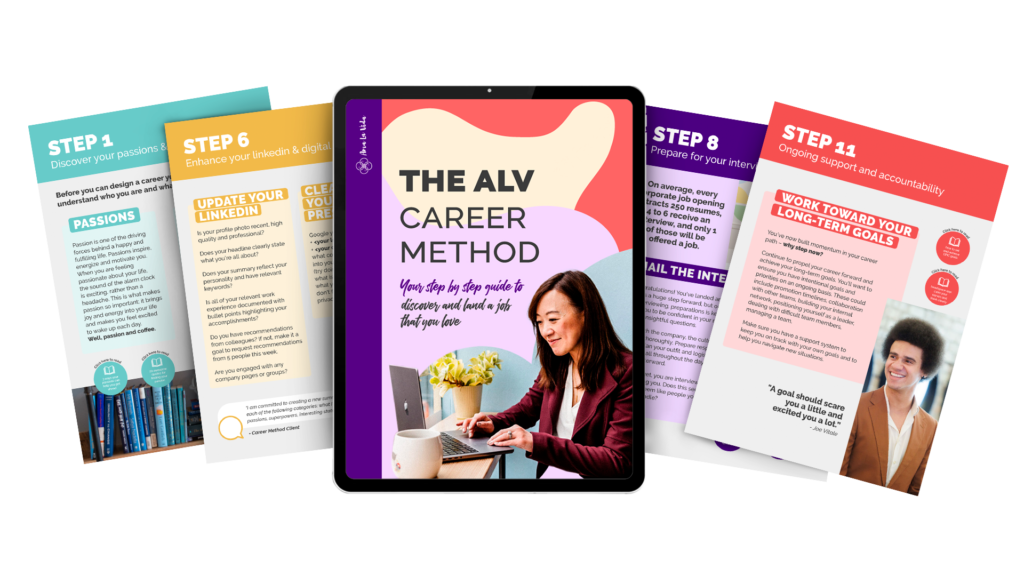
Download our comprehensive step-by-step guide to design and land a job you love!

Images from The ALV Career Method Guide
ALV Method Downloadable Guide

There are probably as many reasons for learning to meditate as there are people in the world. It seems every day a new study comes out touting a new benefit of meditation. Some of the basics are simply reducing stress and increasing your performance in everyday life. We know that through both breathing exercises and focused thought practices you can trigger your parasympathetic nervous system. This is what triggers that decrease in your stress levels. You can also train your brain to be less reactive. This is what allows you to have more control over your responses to your environment and improve performance. Learning to meditate is one of those things that most of my clients have on their “should” list due to its benefits. Some of them have had regular meditation practices in the past, but have struggled to keep it going once their lives changed. Other clients have always aspired to the practice without much success. Meditation is HARD As a certified yoga instructor and life coach, let me just lay this out there: meditation is hard.  Much like going to the gym in the beginning, nothing will make you feel more out of shape than trying to work out after a long break. Similarly, nothing makes you realize how stressful and chaotic your thoughts are than trying to focus your mind for even 5 or 10 minutes. However, just like going to the gym, it’s the practice of focusing your mind over and over again that brings the benefit. Every time you bring your mind back to the present moment, that’s a rep. Your mind wanders off, you bring it back, that’s rep #2, and so on. It’s not about actually getting your mind to be quiet, though over time that may start to happen for fleeting moments. It’s the reps that make the difference. Every time you can retrain your brain to recognize your thoughts separately from yourself, you help your mind and body do that in times of stress. The more you do it, the easier it gets. Beyond shifting your expectations, though, here are my top tips for starting a meditation practice that will hopefully make it a little easier for you.  Beginner Tips: Don’t Try to be Perfect at It It can be very uncomfortable to sit and really watch your thoughts. It’s normal not only for thoughts to be chaotic, but also very negative. Rather than expecting it to stop or even to feel “blissful” right away, instead try to accept that these thoughts are normal. You’re practicing ignoring them. You’re practicing not following the train. That’s the whole point!  Stick to Guided in the Beginning Like I said, it’s hard. Guided meditations are easier because the audio gives your mind a dynamic place to rest, rather than silence where your mind will naturally wander. Whether it’s a meditation app or recorded meditations on Spotify or YouTube, there are endless options to help guide you in your practice. Don’t make it harder on yourself! Try a “Learn to Meditate” Program I love Headspace and Waking Up for how accessible they are, though there are also many, many more. Both of these programs specifically are focused on the practice instead of any Eastern philosophy or religious concepts, which is great for most people starting out. You can trial each for free to see which style you like better. And the meditations are only 10 minutes a day for either of them. These programs are great for a few reasons. First, they will teach you different meditation practices. This is great so you don’t have to sit there going “Am I doing this right??” Second, they provide structure for you. The fewer decisions you have to make every time you want to meditate, the fewer barriers there are to starting your daily practice. Many of them will even send you a push notification to remind you!  If You Can’t Sit Still, Move! Sometimes sitting still is just too much, especially if the voices that creep up are particularly painful. This is very common! For people dealing with anxiety, depression, trauma, or even just life, the things that come up in meditation might just be too intense to sit through. Totally normal and not wrong. Running, walking, vinyasa yoga, painting….anything that keeps your mind in the present moment is a perfect place to start. Work with Your Own Routine One of the most important things I ask my clients to do with any new habit is to think about what habits work for them. If you’re not a morning person, don’t try to force yourself to get up early to meditate; try it out for 10 minutes before you go to bed. If you don’t like sitting on the floor or don’t have a cushion, sit on your couch or chair. Find a system that works for you. It can be helpful to think about what worked when you’ve successfully picked up other habits. Then apply those habits to meditation. Remember, this is not about being perfect. Meditation is about giving yourself what you need and reducing your stress. Learning to meditate is about actively training your mind to come back to let go of your train of thought over and over again. Be sure to check out our workshop on Meditation and Mindfulness! Also, we’d love to hear your thoughts on meditation – what’s worked for you?

Read More
compassion in a crisis

“We are in the same storm but not the same boat.” – Anonymous This global pandemic is the storm of the century, and we’re not all in the same boat. While many of us are doing our best to weather the storm, the harsh reality is some are doing better than others, to no fault of their own. For some, this is more like a vacation. They no longer have to go to a job they hate, and they’re getting paid to relax, enjoy daily virtual happy hours and tend to their hobbies. For others, this is destroying their families and putting them in the most dangerous position of their lives, mentally, physically, emotionally and financially. There might be elements of commonality – we are all in the same storm – but at the end of the day, we’re still individuals trying to survive in our different boats. Because our circumstances are different, our needs are different. We’re coping, grieving, expressing and surviving in our own ways. For some, this is the most productive they’ve ever been, while others can’t seem to accomplish the most simple task. Some might be practicing deep, spiritual healing, while others find themselves on an emotional rollercoaster that won’t seem to end. No matter how we look at this storm, it’s important for us all to recognize that we’re each experiencing and processing this storm in our own way. It’s easy to compare ourselves to others, but remember that we don’t know what it’s like on their boat. With this in mind, let’s focus on compassion, ease and grace.  And while we take care of ourselves, let’s also make sure we take care of each other. A few easy ways to do this are: Share If you have extra money, food or supplies, share with those who don’t. You can talk to your neighbors and community or you can donate to food banks and local drives who are accepting cleaning supplies, clothes and other essentials.  Volunteer virtually  Plenty of organizations and nonprofits are still working to help provide for those in need. Idealist.org is a great place to look for COVID-19 and remote volunteer opportunities. You can also search for nonprofits in your area and see what virtual or contactless options they have available. Here is another list of nonprofit organizations that need our help – How You Can Help – Washington Post Shop local A lot of our local and small businesses won’t make it out on the other end of this. Visit your local grocery stores and small businesses before you hit the bigger stores. Small businesses need our love and support more than ever. If you can’t afford to shop local or spend the extra cash, you can still support your favorite local small businesses by liking and commenting on their social media content, sharing their posts and telling your friends about them. Ask Reach out to friends and family regularly. Send a text, email, write a letter or schedule virtual happy hours. A simple message can go a long way. Talk to your neighbors and see if anyone needs help getting groceries and supplies. You can also post signs around your neighborhood with your contact information offering help for those in need. Kindness We all could use a little more love and kindness right now. Say hi to your neighbors and smile when you can. Thank your local businesses and everyone who still has to go to work. They are putting their health at risk to save ours. Spreading positive energy benefits us and those around us as well. We can’t change the past and we can’t predict the future but we can appreciate today. Let’s focus on how we can show up right now, for ourselves, our families and our communities. We might be weathering this storm in different boats, but we are all in this together. 

Read More
handle unmet expectations

Something that almost all people struggle with are forming expectations and having those expectations be unmet. Unmet expectations begin with a lack of communication and an inability to define your needs which can lead to frustration and resentment. Popular ways and places that unmet expectations show up are at work, with loved ones, and with yourself. Let’s dig into those! At Work Maybe you thought that this job was going to be one thing, and it turned out to be completely different. Perhaps you were supposed to have more responsibilities than you were told, and now you’re feeling overwhelmed. Maybe you thought your relationship with your boss was going to be easier, but it’s not and you’re feeling unsupported. You may feel blindsided and maybe even lied to. You have two options: you can have a bad attitude or a good one. It’s important to remember that you control how you show up and respond when things don’t go the way you expected or imagined. Here are a couple of tips to help with that: Think about the unspoken expectations that you had for this position and challenge them. Ask yourself: why do I have these expectations? What was actually communicated in the interviews? Do others have similar expectations that I do? Was it a miscommunication? Regardless of what I expected, how do I want to show up at work? Have a meeting with your boss to ensure that you’re clear on what the expectations are. Here are some example questions for your meeting: What is my role/objective? What am I responsible for? What are the expectations for this role? How do I grow in this role? What does success look like? What do appropriate boundaries look like? How can I ask for help in a constructive way? Move forward. Now that you have a clear idea of what the expectations are, you can establish new norms and hit the ground running so that you are truly successful in this role! Remember there is something to be learned in every situation! Now, let’s move on to some tips and tricks to handle unmet expectations with your friends, family and loved ones. With Loved Ones Expectations are the enemy of healthy relationships, especially when they are unspoken and therefore unmet. It’s easy to say “never have any expectations” – you’d be happier and you would feel less disappointed overall. But not having any expectations is a lofty goal to obtain. So, here are a couple tips on how to best manage your expectations with loved ones: Think about what expectations you actually have for the loved ones in your life. Are these expectations you have realistic and appropriate? If not, think about why you have these lofty expectations. If they are realistic, the next step is to… Express your needs! Unspoken expectations are unfair for everyone involved. They set your loved ones up for failure and will leave all the parties involved hurt. It’s important to communicate the things that you need in a loving and safe way. Make sure that you listen to what the other needs as well! While setting expectations upfront can be helpful, chances are you will get off-beat every now and then. When this happens, it’s time for point 3, getting on the same page. Get on the same page. Have a conversation about what it looks like to have your needs met, and also what grace looks like when they’re not. No one is perfect, but we are trying to figure out how to love each other in the best way possible! Lastly, there will be times in your life when you have to handle unmet expectations with yourself, and that’s okay – it happens to the best of us, So here’s how to recover when you don’t quite hit the bar. With Yourself You say you’re going to do something – finally get in shape, eat right, put yourself out there, etc. – and then it falls flat and you don’t achieve your goal – you feel like you let yourself down. This can lead to feelings of disappointment, guilt, and defeat. The good news is that it doesn’t have to stop there! Here are a couple tips on how to best manage your expectations for yourself: Think about what your true motivation is and connect with that instead. Why do you have these expectations for yourself? Are these internal or external motivators? What do you actually want/need? Why is it important? Connecting with your true motivation is essential and can help you figure out what is actually blocking you. Grace! Give yourself some compassion. Remember that you can’t always be on or ever achieve becoming “perfect”. People make mistakes and fall short, it’s okay! How you rebound is what really matters. Remind yourself that you’re doing the best you can. Create new norms in a realistic way. If losing weight is your goal, it’s not reasonable to lose 20 pounds overnight! Come up with a sustainable plan that will give you the results you desire and set yourself up for success.   Remember, you are not alone in experiencing or having to handle unmet expectations, almost every person has either had them or let others down by not meeting them.  “Two things can destroy any relationship: Unrealistic Expectations and Poor Communication.” – Unknown Hopefully you are now more prepared to manage and establish new realistic expectations, communicate them fully and have a true dialogue, and practice grace for yourself and others if (and when) those expectations are unmet. 

Read More
how to stay calm ama la vida

“Is this real life?!” I thought to myself as I scrambled to translate my long list of grocery items to the masked man through the cracked door of my local Buenos Aires mercado. I quickly google translated tumeric to Spanish and repeated “cúrcuma” 3x until he finally understood what my gringa accent was requesting. He gave me an unfortunate head shake “no” and looked back at the line of masked people waiting to shop behind me. This was not the time for a complicated order. When I first started hearing the news in China and Europe, I remember telling friends that this could not be real. Every article and news update I read felt like it was straight out of the script of a Black Mirror episode or a new SciFi movie. A movie or episode I wouldn’t want to watch, let alone partake in. It still feels surreal as I walk through the eerily quiet streets of Buenos Aires past masked and gloved people and realize yes, this IS real life.  It’s a strange feeling living abroad when going home doesn’t feel like the safest option. This is a global situation, and I know we are all feeling the effects. The unifying force of global awareness to #stayhome is inspiring. It’s amazing to see global acceptance as we learn to adapt to this new normal. No doubt that this is a time of uncertainty for all that can fill us with emotions of fear, doubt and insecurity. Yet, I challenge you to shift this perspective. Uncertainty and I have gotten real close over the past few years, and I’ve learned that leaning into it and embracing change always leads to greater courage, resilience, learning and growth.  As Margaret Drabble said, “When nothing is sure, everything is possible.” We have the power to decide the role this current reality plays in our lives. I’m choosing to focus on what I can control, keep an open mind, spread positivity and stay calm! What are you choosing? Either way, I know we will all come out of this stronger, more united, and more appreciative than ever…for a simple handshake, hug or as they do here in Argentina *kiss on the cheek*. Here are a few things bringing me peace and calm during times of uncertainty: Catching up with family and friends Between Zoom calls, text updates and Instagram meme shares, I am now in closer contact with friends and family back home than my almost two years of living abroad. I’m so grateful for virtual methods to connect and support each other through the emotions of change. It also gives me peace of mind knowing that friends and family are safe and healthy. Here are my favorite tools to virtually connect: Zoom– As a remote worker, this is nothing new to me. However, it’s amazing to see how Zoom is now playing a bigger part in everyone’s lives worldwide. From meetings to workout classes to virtual birthday parties, Zoom is allowing us to stay connected and stay home.  FaceTime– If catching up with one or two people, I also love to use FaceTime to make a call and see a familiar face. It remains a great way to have a quick ‘face to face’ catch up. Virtual workouts I’ve really missed my workout classes from San Francisco living abroad. The abundance of online options from home during this time are a new opportunity for me to take my favorite workouts and instructors from a distance. Also, the need for movement in quarantine has caused me to work out more than usual. Here are some great virtual workout options: Karma Yoga SF was one of my favorite SF workout studios and I’ve loved taking my close friend Shelley Newhouse’s hot pilates and yoga classes from a distance. It’s also been a great way to connect and workout with friends from home via Instagram live. Here is a list of some free virtual workout options to take from home. Here is a great spreadsheet of virtual workout options from The Nudge. Investing in new skills and passion projects This year I wrote down a goal to cook more frequently and, unfortunately, was working from cafes and eating out way too often to live up to it. Yet, ironically, cooking is now my only option and the quarantine has forced me to put this goal into action. After finally stepping up my culinary game, I’ve found it fun and therapeutic. I’m also eating much healthier than the carne-filled menu options eating out here in Argentina. What’s one thing you’ve been itching to try? What’s a passion you rarely find time for? Is there a project you’ve been wanting to finish? Now is a great opportunity to invest in new skills or passions at home. Meditation Meditation is an excellent way to soothe anxiety and clear the mind. Now more than ever I aim to keep a morning meditation practice to start the day with a calm, clear mind. I love Vishen Lakhiani of MindValley’s guided 6 phase meditation. Some other great resources for meditation include: Deepak Chopra’s 21-day meditation challenge The Calm App Waking Up with Sam Harris ALV’s Meditation Guide Community Abroad The current situation in the world has heightened my level of community here with other friends and expats in Buenos Aires. We support each other by sharing local updates, Zoom support calls and sharing humor to keep each other calm and sane. I am beyond grateful for our international network to lean on, share advice and support each other in navigating times like these far away from “home”. Global Unity As someone who now considers myself a “citizen of the world”, one of the most refreshing things about this challenging time is the unity created in local and global communities. I am living for the countless positive stories like music being shared across balconies in Italy, letters of advice from one country to another and people donating supplies to local hospitals.

Read More
habits of successful people

It’s common for people to want a little more out of life. Many are typically harder on themselves than they are on anyone else around them, so when you’re stuck in your day-to-day routine and you feel like you’ve lost direction, you can find comfort in knowing you’re not alone. Oftentimes, some of your biggest role models in this world have all gone through the same obstacles you have. If you want to change and grow for the better, it’s time to start thinking about your lifestyle and how it encourages success. Success is a hard word to define because it’s vastly different for everyone. There are numerous ways to measure it; some of us see success in the amount of money we have while others think of it in terms of their career. One agreeable way to characterize success, however, is one’s quality of life. In other words, if you’re happy, healthy, and living life to your best potential, chances are you’re on the right track. Here are some habits of successful people that you should pick up. The 6 Habits of Successful People: Budget While money isn’t the only measure of success, the way you handle your money can definitely make your life more or less comfortable. Managing your finances to be able to go shopping, go on vacation, and pay your mortgage at the same time is an acquired talent– one that comes with much time and effort. So, it’s important to teach yourself to limit spending and save money so you can do the things you want to without digging yourself into a hole. The first step to successful budgeting is assessing your needs and wants. What can you live with and what can’t you live without? Cut out those pesky monthly payments from services you rarely use or minimize the expenses you can’t go without by doing your research and opting for cheaper alternatives. Did you know major payments like mortgages can be reduced through refinancing? This can give you more freedom to spend or save as you please and live your happiest life. Invest Many well-off individuals who have few concerns when it comes to money have something in common– they have two sources of income. While having a side hustle is a sure-fire way to pull in more money, not everyone has the amount of free time a second job requires. An easy way to increase your wealth without working two jobs is to invest the money you already have.  Investing isn’t as scary as it seems initially. If you don’t know much about it, there are still ways to invest with little prior knowledge or little money, and you might even be doing it already. Efforts could be as small as putting your money into a savings account to generate a nest egg plus interest from the bank. You can also allocate a portion of your salary to your company’s retirement plan, which similarly builds interest the longer time passes. Or, look into some common investing apps that will guide you through your first investment.  Seek new learning opportunities It’s easy to coast through the day going through the motions. Workdays become monotonous, motivation is lacking, and you’re used to doing the bare minimum. However, whether at work, in school, or out in the real world, there is so much to discover. Successful people find time each and every day to seek new learning opportunities, no matter how small.  The best way to stand out amongst others in the professional world is to expand your knowledge and find ways to utilize it, especially when it involves your career. Pursuing new information and refining skills so that you can share it with others demonstrates leadership qualities and helpfulness. It can stimulate your thinking and encourage growth, so when you see something you could learn more about, take that chance and better yourself.  Help others So many well-known people claim that the greatest gratification in life doesn’t come from money, but from helping others. Many find a greater purpose in putting efforts toward making other people’s lives better, whether that means volunteering, donating to charity, or simply being kind.  Find ways to help your peers in your everyday routine. Volunteer your time or just a shoulder to lean on when you notice someone in need. Not only will the gratification lift your spirits, but it can make someone’s day, or even be a major saving grace for others. Offer kind words, let others know how much you appreciate them, and you’ll find that your mood improves along with your interpersonal relationships. Spreading happiness and good vibes can be contagious, so start the trend if you want an overall better life.  Think positive People of all backgrounds and qualifications go through tough times. Life throws obstacles at you that make you want to throw in the towel. It doesn’t matter if you’re a CEO or it’s your first day on the job. What sets you apart from the rest is the way you handle the difficult situations you’re faced with. Instead of getting upset, complaining, or quitting altogether, you should change your way of thinking.  When your car breaks down, you’re passed up for a promotion, or you’re simply in a bad mood, force yourself to change your mindset. It can be hard, but when your car dies, think of how thankful you are that you’re safe and sound. When you don’t receive the promotion, come up with ways to become a better employee. Twist your normal ways of thinking to be more positive. A positive mindset will help you stand out and make for a happier life. Set goals If you don’t have a sense of where you want your life to go, it can be difficult to find the motivation to grow. Even if you don’t have a specific vision for your future, it’s still helpful to set smaller goals. This gives you a sense of direction and motivation. It can drive your focus

Read More
Why You Keep Giving Up On Your Resolutions

It’s the time of year again! It’s Resolution Time. As the year comes to a close, we naturally look back on everything that happened, and then dream of what we’d like to do differently in the year to come. “This will be the year….”  And we should give ourselves credit because we DO the things! We go to the gym and we eat more vegetables. We stop smoking and we start looking for a new job. Well, for a few weeks.  And then for some weird reason, we stop. So…why? If you’re asking “why do I keep giving up on my resolutions?” You are not alone. We ask why, because ultimately, we want to find a way to actually keep these resolutions. And there are really 2 major reasons why resolutions are dropped as quickly as they are made. 1) The resolutions don’t fit into your current lifestyle or 2) the resolutions don’t actually mean that much to you.  So here are a few things you might want to consider on your path to not giving up on your resolutions this year.  Reason 1: Your resolutions don’t fit into your current lifestyle. It’s about setting realistic, appealing goals that make sense for you and your life. I’m personally obsessed with Atomic Habits by James Clear, and what I love is how Clear breaks down what makes habits stick. Some big themes he hits upon are making your new habits appealing and obvious, letting go of perfectionism, and ensuring you have the right support to do them. First, your habits need to be appealing for you to keep it up. If you absolutely hate doing something, you’re not going to stick to it. So, for example, if you hate going to the cheap, dingy gym in your building but love going to the fancy spin studio down the street, it’s probably worth the money to invest in the spin classes since you will actually use them! Paying money for a gym you hate will get you nowhere toward your goals. Similarly, don’t promise to eat salad for lunch every day if you hate salad. Do some research for a few healthy dishes you will actually enjoy making (or a place you can buy them if you don’t like to cook). The point is, if you’re trying to change a habit, at least in the beginning, you need to want to take on the new habit. Second, make it obvious. Integrate this new habit into your regular routine. Some examples of this are stopping by the gym on your way home from work, using your regular, every-day to-do list or calendar to remind yourself of what you want to do, or maybe try stacking your new habit onto something you already do like brushing your teeth. This step is important because it’s easy to forget or make excuses for new habits that aren’t part of your daily life yet.  Third, let go of the idea that you need to do it perfectly. It’s ok to “mess up.” When you skip a day or miss your new goal, try using how you feel without it as a reminder of how much you actually enjoy the benefits of your new lifestyle. Instead of saying, “You’re such a screw up! You’ll never become one of those gym-going people!” you can tell yourself, “Ugh, I wish I could have made it to the gym today! It always makes me feel so much better!” Ok, so maybe that’s a stretch for some of us, but you can at least offer, “That’s normal to miss a day when building a new habit.” And then actually go back tomorrow. Not all is lost, my friend! I usually aim for 80% compliance with my habits. Doing them most of the time is better than letting one little misstep throw off your entire year. Last thing I’ll say here, get some support! If you’re trying to quit smoking, maybe spend some time away from your friends that smoke. Maybe you want to go to the gym more (sticking with our theme), I suggest getting a gym-buddy. If nothing else, avoid the people who tell you that you’re never going to do it. That’s just rude! You don’t need to be around that energy. But bigger than that, this ties back to the first rule, make it appealing. As social creatures, it is easier to do something with the support of those around you. Build up your network so you’re not just relying on yourself to keep you motivated. For more on the practicalities of keeping your resolutions, I absolutely recommend Clear’s book.  But for some people, all the practicalities in the world won’t get you to keep this new habit of yours. Which brings me to our next point. Reason 2: The resolutions aren’t meaningful to you. That might sound harsh, I’m sorry, I don’t mean it to. But with any good goal, it’s important to ask yourself a few questions in the beginning: Why do it? Why now? How will this impact my life? How will this impact other areas of my life, for better or worse? Is this something I’m doing because I want to, or because I feel guilty not doing it? And be honest! Because if you’re not honest, you’re setting yourself up for a resolution you’ll drop quickly. Regardless of how busy you are, regardless of all the things swirling around you in your life, if something is truly important to you, you will make time for it. Especially if you follow the guidelines under the previous section.  Making new habits is hard. It’s uncomfortable. It requires rewiring your brain and pushing yourself (often physically) outside of your comfort zone. Don’t beat yourself up for dropping habits that aren’t going to have a big, meaningful change in your life. Yes, working out and quitting smoking and all the other great resolutions may be something that your doctor or partner or friend or favorite TV show

Read More