Category: Productivity

There are times in life where we feel totally in control. We’re hitting the gym before the sun rises, packing nutritionally-balanced salads for lunch, having meaningful conversations with friends at post-work happy hours, and getting to bed at a time that doesn’t make us dread the alarm going off the next morning. During these times, staying committed is hard and it’s easy to give our all at work. Being balanced in our personal lives frees up brain space to tackle complicated projects and fully engage in growing ourselves professionally. Then there are times in life where things feel absolutely chaotic. Perhaps we’re caring for a relative, planning an epic wedding, or returning to work after giving birth. When we fall out of our routines due to changing life circumstances, it can feel impossible to be present and productive at work. How could we be, with so much on our plates? For me, the life events that threw me out of whack last summer were moving from a bustling city to a quieter college town, purchasing a home in said college town, and planning a destination weekend-long wedding extravaganza. I did all of these in the span of less than three months (79 days, to be exact). At times, it felt like I was going to burst from stress due to all of these competing obligations. And that doesn’t include my actual job. My professional identity is incredibly important to me, so I knew I had to come up with a plan to keep my nonstop personal demands from interfering with my performance at work. I know I’m not the only one who has struggled with this, so I’d like to share my three most powerful tips for managing the chaos and maintaining your professional productivity. How to manage chaos and maintain your productivity Get to Work When we’re stretched thin outside of work, it can be really difficult to focus when we’re actually in the office. However, making that commitment to be all in when at work is vital. Here are some great ways to do that: Leave Work at Work When we feel like we didn’t accomplish enough during the workday, the tendency can be to pack up our computers and make a half-hearted attempt at finishing up as we eat a bag of chips on the couch and cry watching This Is Us (…or is that just me?). I challenge you to make an effort to not work at home if you’re not fully engaged. Otherwise, your work isn’t up to par, and you’re not really enjoying your weekly emotional release during primetime TV. Here’s what to do instead: Make a not-yet-done list before you leave work. The act of listing all the things you need to tackle the next day can help. This releases the guilt associated of not burning the midnight oil to get it done. And you’re able to walk into work the next day able to jump right in. Create a leaving work ritual. When I’m feeling particularly overwhelmed by work obligations, I’ll allow myself to fret and worry during my short commute home. Once I pull into my driveway, though, that’s it. I take a few deep breaths, listen to a Beyonce song if I’m really needing some extra motivation, and release the stress of the day. If you want more on how to create a leaving work ritual check out this blog post! Limit checking emails outside of work. In some roles, it’s totally acceptable to stay off of emails when you’re not in the office. If so, resist the urge to check and know those emails will still be waiting for you the next day. In other positions, you might need to be more accessible to your team. Reducing the frequency of email checking to once an hour, or communicate to your staff that vital issues that can’t wait until the next day should be communicated to you via text or phone call. Take Good Care of Yourself During busy times outside of work, it seems that things that can help us to function at our best are those that are easily abandoned in favor of more urgent responsibilities. However, maintaining at least some balance in your personal life will allow you to be more present and focused when you walk into your workplace. Try these simple tips: Maintain good habits through healthy eating and gentle movement. It’s no secret that wellness and workplace productivity are linked, but the challenge usually lies in finding the time to keep up with this practice. In this case, it’s more important to set small, achievable goals instead of attempting a complete lifestyle overhaul. My go-to tricks are choosing a healthy lunch if I’m dining out (a salad packed with veggies and protein instead of pizza or a gigantic sandwich) and challenging myself to some movement each day (a walk around my office complex if I’m wearing the right shoes, or an at-home yoga session with the incredible Yoga with Adriene to help me wind down at night). Practice good nighttime habits to make it easier to fall asleep and stay asleep. For babies or young children, we call it a bedtime routine – a warm bath, a calming song, and a quiet and comfortable environment. Now that we’re adults, we refer to this practice as sleep hygiene, and it includes limiting screen time before bed, sticking to a consistent sleep schedule (even on the weekends), and avoiding alcohol and caffeine as bedtime approaches. You can find more sleep tips here!  Carve out time that’s just for you. When we’re wrapped up in professional and personal obligations, can often come at the expense of focusing on our own needs. In times of stress, I find it incredibly helpful to wake up 15 minutes earlier than I need to and spend that time sipping a hot cup of coffee and reading my latest library book. Creating this quiet space is vital in my quest for

Read More
someone on the phone

We often provide coaching for how to nail your interviews. We share how you should prepare and respond to questions. But now we are turning the tables and talking about when you are interviewing others. It can be very tricky to evaluate a candidate in the limited time you have with them. In this post we will talk about the value of phone interviews and how you can maximize your use of them. If you haven’t interviewed anyone yet, you surely will soon, so read on! Have you ever identified a candidate who seemed perfect for your open role based on their resume and cover letter, then turned out to be a total dud when you brought them in for an interview? This process can be even more frustrating when you’ve spent a ton of time coordinating your interview panel and rearranging schedules so everyone can be present. If you can relate, you’re not alone – but there is a crucial step to your interviewing process you might be neglecting. Phone and even video interviews are becoming increasingly more popular, and they’re a great tool to screen out candidates before investing a lot of time with them. Here are our best tips for how to get the most out of your phone screening process so it’s not just a formality but a true filter for bringing in the best-aligned talent. Don’t treat the phone screen as a full interview. This isn’t the time where you have multiple interviewers on the line asking tough, technical questions. A preliminary phone interview shouldn’t last more than 30 minutes (15-20 minutes is more common). These can be done on the fly if a candidate answers the phone on the first try, or could also take place at a scheduled time within a few days. Sometimes recruiters are best at conducting these phone screens, but if your team is small, consider utilizing the hiring manager, team lead, or supervisor in this role. The phone screen should be a two-way street. This first conversation is the perfect time to give candidates more information about the specific role you’re hiring for. Some job descriptions are vague at best, and it’s easiest to convey necessary information over the phone. This is a way for candidates to self-select out of the interview process if the job just won’t be the right fit. Likewise, you’ll get to learn more about their interest in the role and gather some preliminary data on why they might be a good match for your team. During this phone conversation, you can also clarify salary band, office location, or other technical concerns. Ask a few vital questions to get a thorough picture of your candidate. The phone screen is not the time to make sure the applicant is absolutely perfect for the role, but you can use this brief conversation to get a good feel for their qualifications and personality. The standard questions like “tell me about yourself,” “what excites you about this role,” and “why are you leaving your current position” are fine places to start. Take note not just of their responses, but also their communication style and ability to get their point across. Use the phone interview to gather data that you couldn’t obtain just by reviewing a resume, such as culture fit. The preliminary phone interview is a quick and easy process to eliminate wasted time and resources from conducting in-person interviews with tons of candidates who end up not quite fitting the bill. This strategy is advantageous for job searchers and employers alike. Drop us a line and let us know your favorite phone screen questions and techniques! If you are interested in learning more, here are some of our favorite resources: Read: Why Employers Do Phone Interviews (5 min) Read: Phone Interview Questions and Best Answers (9 min) Watch: Google’s Toughest Job Interview Questions (3 min) Read: 5 New Interview Techniques That You Should Start Using (7 min; moving beyond the phone screen)  

Read More

These days it seems like every third person on Instagram is a coach of something. It can be incredibly difficult to discern which online life coaches are high quality coaches and which ones are just trying to make a buck. On top of that, how do you know which coach is the right one for you? How do you find an online life coach who will work best with to help you reach your goals? These are common questions we get asked as our clients do their research and try to find the perfect life coach for them, and so we wanted to share our guidance to help demystify the process and help you not just find a life coach, but the right life coach for you. 1. Make sure a Life Coach is actually what you’re after Before you do anything, it’s important to make sure that a life coach is what you actually need. Coaching is often confused with other related disciplines like mentorship or therapy. However, it is actually quite different, and each of these has unique characteristics. This graphic pinpoints some of the key differences between life coaching, mentorship and therapy. Therapy has a past orientation, helping you understand why you are the way you are. Coaching is much more future-oriented. Your life coach won’t spend much time digging into your past experiences. There is still certainly a self-awareness component, helping you understand who you are and why, but all with the intention of using that self-awareness for the future. “Okay, I know these things about myself, how can I create strategies and habits to help me progress toward my goals given all I’ve learned?” Additionally, it should also be noted that only a therapist is qualified to support you with mental illness, significant trauma, or other me Unlike a mentor, a life coach is not there to offer guidance and advice based on his/her own experiences. Sure, they might occasionally offer a suggestion or two, but for the most part, your life coach will ask powerful questions to help you find the right answers and solutions for you. It’s important to note that none of these disciplines are better or worse than any other – you simply need to understand the differences and have appropriate expectations for what will be accomplished with each provider. Now let’s talk about how to get a life coach! 2. Figure out what type of coach you want to work with Once you’ve determined a coach is what you’re looking for, it will help your search to narrow down what type of coach you want depending on your coaching goals. Many people jump straight into looking for a life coach, but if you can narrow down the area of your life you want to focus on you may be able to hone your search for potential coaches. Different types of coaches include career coach, leadership coach or executive coach, relationship coach, business coach, or wellness coach. These coaches have narrowed their area of expertise to a more specific field and may have special programs or approaches to how they manage their coaching sessions. Because they focus on one particular area of coaching, they may come with a good understanding of your particular challenges and be able to provide better insights. For example, if your focus is on personal growth, you may seek a coach who can help you build your self confidence, create work life balance, or identify ways to support your mental health in your daily life. Most successful life coaches will focus in on these areas. On the other hand, if you are starting your own business, you might chose a life coach who primarily works with small business owners. An executive coach or leadership coach will help you navigate the challenges that come with leading a team at work. A career coach may be focused on helping you find a new job, but there are others who can help with larger or ongoing goals like working toward a promotion, creating and realizing a vision for your career, or navigating all the intricacies of your workplace. A wellness coach may focus on your physical health, nutrition, and exercise, but they may also support your mental health priorities as well. All of these types of coaches can bring a positive change into your life. It’s important to know what you’re personally hoping to achieve in working with a life coach so that you can find the skillset for what you need. Once you’ve narrowed down your search, you can then identify a few potential coaches to research further to find the best life coach for you. 3. Determine if they are thoroughly trained and certified Coaching is based on scientific research, and well-trained coaches utilize evidence-based coaching models in their work. In order to learn this research and these techniques, coaches need to go through an in-depth training program. Unlike therapy, there is very little governance and regulation of the coaching industry. For example, to call yourself a therapist, you legally need to have a certain level of training and hold an official credential. There is no equivalent regulation for coaches. Anyone can call themselves a coach, whether or not they have been through a coach training program. However, there is an organization called the International Coaching Federation (ICF). This organization accredits coach training programs and ensures they meet a certain standard. When you begin meeting with life coaches, ask them which training program they completed and if it is accredited by the International Coaching Federation. At Ama La Vida, we only hire coaches who have been through an intensive coach training program; once they join our team, they undergo an additional 3-months of training on our proprietary methodologies and programs. Make sure to ask about their credentials when you choose a life coach. 4. Ask them about their coaching style Each life coach coaches differently based on their personality and training. Some coaches’ sessions are very organized and structured,

Read More

Working remotely. Telecommuting. Working from home. Whatever you call the act of not being physically present at your workplace, the practice is growing. In fact, a recent study revealed that 70% of people around the world work outside of the office at least one day each week. In the US, the amount of remote employees increased by 4% from 2012 to 2016. Working from home is a new phenomenon that’s rapidly growing in popularity, and statistics suggest employees who work from home feel more satisfied and are more productive. There are tons of positives to telecommuting, but it can also be an adjustment for many reasons. This post is all about how to develop focus and maintain productivity when working outside of a traditional office setting. Here are three of my top tips and some of my favorite resources: Make sure you have the tools and technology you need to perform your job just as well as you would in the office. If you require lightning-speed Internet to host video conferences throughout the day, make sure your service provider can handle the task. If juggling multiple spreadsheets is a daily occurrence, will your laptop be sufficient, or do you need a spare monitor and mouse at home? If printing documents out before reviewing them is part of your normal routine, ensure you have access to a printer. Sometimes you work will include these additional supplies as part of your employment, and other times you’ll be expected to pay out of pocket. Hate to break it to you, but if you’re struggling to get going in the mornings, you might need to change out of your pajamas. Yes, a huge perk to working from home is that you don’t need to spend time in the morning looking presentable. However, if productivity is an issue and you can’t seem to stay focused, you might have to do some pretending. Create a routine and take a shower, put on clean clothes (yoga pants allowed!), and sip a beverage that helps you jumpstart your morning; doing small tasks between the time your alarm goes off and getting down to work will help you signal to yourself that the workday has officially begun. Hanging out at home is distinctly different than working from home, so do your best to limit distractions. Distractions come in all shapes and sizes (Netflix, kiddos, neighbors passing by your house), and telecommuting means you’ll have to work even harder at not getting sucked into the fun going on around you. Some common distraction points for my clients include lunchtime (set a timer, eat in the kitchen, and then get back to work), spouses (remind them that just because you’re at home doesn’t mean you’re available to chat all day), and social media (this happens everywhere, but the fact that your boss won’t swing by your cubicle for a random check-in makes it even easier to succumb to the scroll). When you notice yourself losing focus, take stock of what is distracting you and brainstorm solutions to get back on track. Over the next few months, we’ll be dedicating a few of our newsletters and blog posts to our work from home readers. We have some hot topics we can’t wait to discuss (how to get your socialization fix when you’re all alone; creating a firm separation between work and home life), but would love to hear from you about the areas where you feel stuck. Drop us a line using our Ask an ALV Expert tool and we’ll be sure to address your needs in a future post! And if you can’t wait until then and want to keep learning more, here are some of my favorite resources: Read: LinkedIn’s 10 Commandments for Remote Working (3 min) Watch: Go Ahead, Tell Your Boss You Are Working From Home (15 min) Read: How to Work From Home When You Have Kids (10 min) Read: How to Design a Healthy Home Office that Increases Productivity(7 min)

Read More

Overcommitting is a serious problem that often flies under the radar, especially for women. Somewhere along the road the idea emerged that you as a woman had to do it all (and do it perfectly with grace). Oh, and you are supposed to look good while you do it. Here’s the thing, trying to be everything to everyone is impossible. Being involved in every extra-curricular activity is exhausting. Joining every committee is draining. A lesson I learned a long time ago was this – just because it works on paper, does not mean it will work in reality.  Just because you can fit all those committees and meetings and activities and social commitments on your weekly calendar does not mean you should do them all. If you do, chances are you won’t be able to do them all well. When we over commit, we think we are doing good by giving of ourselves, but maybe there are others who want to serve and be involved. Maybe saying no is a way to pass the serving opportunity to them? Wanting to be involved in everything possible, whether it be due to FOMO or because you’re trying to live up to the expectations of others, usually doesn’t work out for the greater good. It typically leads to burnout and overall poor performance. It’s easy to fall into the pressure of saying yes to everything and everyone. You go back to that idea that we should do it all and make yourself feel guilty when you turn down opportunities to be involved. Not only does guilt distract your focus, but you’re not going to be able to give 100% if you’re tired and drained and only able to function at a minimal percentage. There must be a balance. You need to define your boundaries. You get to choose what you want to do instead of giving in to what you think you’re “supposed to do.” You have the choice to truly design your life! So how do you know if you’re overcommitting or being an active member of society? Where do you draw the line? Here are a few questions you can ask yourself when trying to determine what to add to your plate and what to pass on: Do I sometimes dread following through? Sure, we have all said yes to a commitment that we felt obligated or pressured into doing. However, if you are finding yourself constantly checking your inbox and text messages hoping for a cancellation notification when it is time to fulfill your commitment, it could be a sign that you’re doing too much. Am I cutting corners or just doing the bare minimum? When you are working on a project and you start to calculate how little effort you can put in or how few words you can write and the finished product still be acceptable, it may be time to re-evaluate those commitments. Is my calendar so full that I don’t have time to serve myself? Maybe you find that your to do list is getting longer rather than shorter. Maybe you cannot remember the last time you had unscheduled time to do something for yourself. These are all signs you might be overcommitting. Am I spending more time fulfilling commitments than I am with my family? This is where you need to re-evaluate your priorities. If you are consistently so tired when you finally do get home that you are too tired to play with your kids or have meaningful conversations with your spouse, maybe it’s time to start saying no to things outside of your home and say yes to your family. Does the thought of dropping everything sound amazing? Maybe you daydream about quitting all of your responsibilities and running far away. Perhaps you have called out of a commitment with a made-up excuse. True, that is not the responsible thing to do, but it makes your burden feel a little lighter. If that’s the case, it’s clear this falls into the category of overcommitting. *** It’s okay to commit to less so that you can do those things with excellence. You’re allowed to pick things that fill you up. You should choose the things that excite you the most. Do things because YOU want to, not because you think OTHERS want you to! How do you do that? How do you decide where to say yes and invest your time? Before committing to something ask yourself questions like these: Is this going to be life giving? Drawing personal and professional boundaries is vital to a thriving healthy life. When deciding whether or not to say “yes” to a commitment, take a step back and evaluate. Saying yes to things that will leave you fulfilled is important. Does this commitment align with my core values? Your core values are your fundamental beliefs or principles. We all operate out of a few core values, whether we know it or not. You shouldn’t feel the pressure to say yes immediately simply because an opportunity sounds good. Take some time to gauge how this lines up with what you value. Am I committing to this because I WANT to? This goes back to feeling the pressure to do and be all things. If you are saying yes to something, it’s important to ensure it is something you truly want to be a part of, not because you feel pressured to participate in it. Does this genuinely excite me? It’s no secret that time is a limited and valuable resource. The “extra” things and commitments you spend your time on should be fulfilling and exciting for you! Granted there will be tasks you don’t enjoy, but overall the things you spend your time doing should be something you look forward to. Is this going to grow me personally OR  professionally? There is nothing wrong with doing something simply because it will grow you. If participating in an after-hours work event will present you with the chance to

Read More

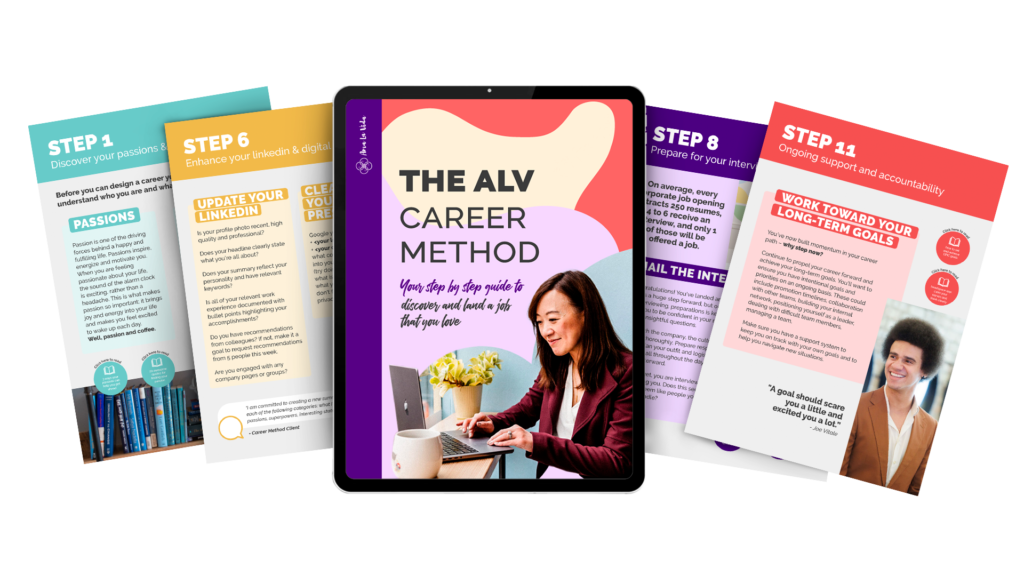
Download our comprehensive step-by-step guide to design and land a job you love!

Images from The ALV Career Method Guide
ALV Method Downloadable Guide

Have you ever walked into your colleague’s office looking for that very important time sensitive document only to find yourself in front of piles and piles of documents and scattered food remains? Imagine it – what’s going through your head? If you’re anything like me, you’re feeling anxious, stressed out about meeting your deadline, frustrated, and you curse out your colleague. How can he be so messy?! Now let’s imagine another scenario. You walk into your colleague’s office looking for that very important time sensitive document. You see the shelf with labeled binders and folders. You quickly search for the folder name, retrieve the document – find other documents that might help – and rush over to your desk to complete your task. How are you feeling now? What are you thinking? Besides the obvious of an organized workplace allowing for quick retrieval of documents, there are several physical and mental benefits, such as: It compartmentalizes your work. Consider our example above with an organized office – the document was quickly found because it was in its rightful, clearly labeled folder. And there were additional supporting documents that were not even considered before, which turned out to be helpful. Organizing your office/desk/cubicle helps separate the clutter of the many simultaneous deadlines, projects, and clients, allowing us to focus on the specific client or project at hand. It reduces stress. The physical appearance of clutter brings about anxiety, therefore leading to stress, a sense of feeling overwhelmed and frustrated. An organized workplace allows for quick retrieval of the right document at the right time not only for yourself but for others in the office such as coworkers, bosses and clients. It shows you care. You don’t ever walk into the office with disheveled hair. Why not? You don’t want to look sloppy and of course you want to show off your beautiful hair. Your physical workplace is a reflection of you. And others form perceptions of you based on your workplace. An organized workplace shows pride, loyalty, a sense of caring and responsibility. Next time you contemplate whether or not you want to organize your workplace, think about that one person in the office who is always dressed immaculately. Either you hate this person for being so damn put together or you’re this person. Either way – people know you care about yourself, how you look, and you seem very polished. And that’s just an outfit. Imagine what people may perceive when the workplace is organized. It saves time. You had your Friday outfit all planned on Thursday night. You wake up Friday morning and walk over to your closet for that new shirt. You can’t find it. You frantically start looking everywhere and you still don’t find it. You then go through the 5 stages of grief – you even negotiate to skip happy hour to find that top but you still don’t find it. You’re left with no choice and you pick another outfit, ruining your whole day. Pretty rough day, huh? Similarly, with an organized workplace, you’ll find things more quickly, you feel less frustration, and you’ll find yourself saving time that would have otherwise been wasted looking for that lost document. Tip 1: Organize your digital life I remember an instance where I needed to create a deliverable for a client. I had done something very similar at a previous project so I search my laptop, my emails and of course I couldn’t find it. I spent three hours putting together a document that I had already done before. I was so irritated. This is when I got my butt into gear and decided to organize my files. Take a look at your desktop right now. Do you have files covering every inch of your screen? Do you struggle to find documents or have short term memory like me and don’t remember where you saved something? This can be fixed by organizing your digital life. Here’s how: Step 1: Categorize all projects and recurring actions Think about your day yesterday. What were you doing? How did you spend your time? You may be involved in several projects, some internal initiatives, and you have to submit time and expenses. For all recurring projects and activities, create folders with clear labels for easy access. Step 2: Create a filing system For any emails or documents pertaining to a category created, be sure to file only under that folder. This organized system will help you review documents at a glance, put together summaries or refresh your memory when you need it. This filing system will save you time, energy and chaos of seeing 291293 emails in your inbox, leaving you with only the very important follow up emails in your inbox and space on your screensaver for those very cute golden retrievers. Step 3: Have a consistent naming convention I can’t stress this one enough. There will be times that you forget where you stored that document. By labeling your documents the same way every time, it also avoids any version control issues. My suggestion for naming convention is this: TOPIC_TITLE_ _DATE_VERSION. Having a version such as draft_v2 will prevent you (hopefully) from working on draft_v1 – an outdated draft. Trust me, this may happen when you’re working late nights so avoid the hassle by being diligent about your naming convention. Doing this will not only save you HOURS of time from having to reinvent the wheel but it will also save you a lot of frustration and stress. You’ll also look like the hero when you respond to an email right away because you were able to find the exact information you needed. Not to mention, the next time your boss asks for a document while hovering over you, you can get it to him immediately so he backs off, allowing you to do more important work, like stalking your ex on Facebook. Tip 2:  Organize your to-do list: When you walk into the office in the morning,

Read More

Our 9 hottest tips for how to achieve your goals and take charge of the year ahead   Our ALV theme in January was “Take Charge” – a very fitting theme for the beginning of the New Year. Research shows that 92% of people do not achieve their goals, which is a shame because research also shows that people who set and achieve goals are a lot more productive and successful! So how do you make that happen? Don’t worry, we’ve done the hard work for you. During the month, we conducted vigorous research and spoke to experts in the field in order to find the most valuable tips, advice and insights. We also conducted our very first ALV community call where we spoke with our members and heard from our coaches about what does and doesn’t work when setting and achieving goals. So without further adieu… here are our 9 key take-aways to help you achieve your goals and take charge of your future! Start with “Why?” Most of the time when we set our goals, we start with “what” and we then quickly move to “how.” While these two steps are crucial, they can easily become misguided unless we first ask ourselves, “Why?” “Why do I want to achieve this?” This question serves two purposes: Firstly, it ensures that we are working on the right things. Secondly it emotionally connects us to the goal.Let’s use an example. Say I set a goal to “Get a Promotion.” Next I ask myself why I want a promotion. After thinking carefully about this, I discover that the reason I want a promotion is because I want to feel more accomplished at work. Now, because I understand the “why” I can ensure that my steps to achieve this goal include things that will help me feel this way – such as working on more meaningful projects, seeing my work become implemented and so on. I can even speak to my manager about these things. If I had not determined the “why”, I may have tirelessly lobbied to get a title-change only to realize that the nature of my work had not changed and I still felt the same emptiness and lack of accomplishment, rendering the goal somewhat useless. Furthermore, now that I understand the “why,” the goal has far more emotional significance, making me feel more inspired, motivated and connected to the goal. Make sure your goal is EPIC EPIC is a set of criteria we use at Ama La Vida to ensure goals are effective and powerful. It stands for: Elevating, Practical, Impactful and Clear. Let’s start with Elevating. Is the goal going to inspire and elevate you? If not, chances are you’re going to lose motivation. Ensure the goal is one that you are genuinely excited about. If it’s not, how can you adjust the goal? Next, ensure that you can practically achieve the goal within your desired time frame. Here at Ama La Vida, we are all for ambitious goals, but if you set something so ambitious that it is impractical, then chances are that you will end up feeling like a defeated failure. Try to ensure your goal is stretching, but not so stretching that it becomes unrealistic. “I” is for impactful. Is the goal going to positively impact your life? If not, then what is the point? Make sure you set a goal that, when achieved, will have positively and powerfully transformed your life in that area. And finally, make sure your goal is Clear. This is an obvious one but one that we often neglect. Obviously a deadline and time frame is important, but it is also important to have a measurable component so that you know when you have achieved your goal. This measurable component doesn’t have to be a number necessarily, but it should help you identify when the goal is completed. For instance, if you want to improve work life balance, maybe the measurable component is that you stop checking emails in the evenings and on weekends. I recommend investing considerable time and energy into setting the right goal. There’s no point getting on the fastest train to the wrong destination. Set a Buzz Word As human beings, emotions are our greatest drivers (and detractors) from achieving (or not achieving) a goal. So then, it is important that we stay emotionally connected to a goal as this helps maintain our passion and motivation. One way to do this is by setting a “buzz word.” Think about why you want to achieve that goal and how you will feel when you have achieved it. Close your eyes and imagine yourself having accomplished your goal – what are you feeling? What one word best encapsulates this feeling? This is your buzz word! Write it on post-it notes and put it around your house, set reminders in your phone, make it a sceen-saver on your laptop. Whenever you see this buzz word, you will not only remember to keep working on your goal, but you will also reconnect with why this goal is important to you which will internally incentivize you to keep on going! The Less the Merrier Most things in life abide by the rule “the more the merrier” – people, chocolates, handbags and so on. But when it comes to goals, the reverse is true. When we set too many goals for ourselves, we lose focus and become overwhelmed by everything that needs to be achieved. I recommend setting roughly one goal for every twelve weeks. Twelve weeks is a nice sweet spot because it’s not so far away that we procrastinate and defer getting started, but it’s still far away enough to achieve something meaningful. Of course, you need to set a time frame that is appropriate for your specific goal, but the key is to ensure you are only working on one or two (maximum three) goals at any given time. Bite Sized Pieces Research shows that one of the biggest

Read More

Our theme this month is productivity. I haven’t written a post in so long and so I really wanted to ensure that I wrote something this month. But when it came to the time, I felt incredibly reluctant and resistant. Why? Because, to be honest, the topic of productivity makes me want to fall asleep. Ask me to write about positive psychology, emotional intelligence, resilience, grief, joy. Any of these things and I will feel genuinely excited. But productivity and being productive? Really? How am I meant to write something engaging about productivity? Hear me out. I am certainly not saying that productivity is not important. Boy is it important! I don’t get excited about brushing my teeth every day either, but hey, that doesn’t mean it’s not important. Nevertheless, in the process of not wanting to write about productivity, I actually learned something very important about productivity: Productivity is fueled by passion When I think about the days I’m most productive, it is always when I’m feeling passionate. When I actually want to work on that thing. We often seek out fancy apps and systems to make us more productive, but I think the answer can at times be a little simpler. Find passion. When I am working on something I don’t connect to, I could try every single app and system under the sun, and I still wouldn’t be productive. On the flip side, when I am working on things I love, I actually don’t need any tools or apps at all. I just get shit done and I get it done well because I actually want to. As we know, motivation is a huge driver of productivity, and it makes sense that passion is a huge driver of motivation. So then, what are you passionate about? How can you make your tasks and projects more about these things? If you’re lying on the couch eating potato chips and feeling unproductive because you don’t want to go to the gym, perhaps it’s time to try a dance class or soccer team instead? We often assume that we need to tick certain boxes without thinking about alternative ways to get to the same outcome. How can you find a more fun and passionate way to arrive at your destination? Five Tips For Being Productive Ok, so right now you’re probably thinking “well that’s great Katie, but what about when I have to do shit that there’s simply no way of sugar coating?” And yes, I get it, that’s a fair point! We can’t be passionate about everything on our to-do list, and so these are my tips for you. Work less intensively and more intentionally Science has shown that breaking your workload down into 90 minute work segments followed by 20 minute break segments is far more effective than tirelessly trying to stay focused throughout the whole day. Of course, the timing doesn’t have to be exact, but you get the point. Work, then break, work then break, work then break. The breaks allow us to recharge and provide us with the fuel we need to tackle the next task or project. This method also allows us to stay focused on important things throughout the day, rather than starting fast and strong, then depleting all of our mental energy and spending the afternoon hiding behind a screen pretending to do work. C’mon, we’ve all been there. Just get started! Not tomorrow or next week, today. Just get started! Science has shown that when we think of a task or a project that we have to get done, we think about the most challenging parts of that project and we get completely overwhelmed which prevents us from taking the first step. Instead, we do meaningless “work” like check emails and run errands to make us feel like we’re busy. But something amazing happens once we get started and it’s called “The Zeigarnik Effect.” The zeigarnik effect is what happens when we’ve started something that we haven’t finished – it makes us feel a little anxious and distressed and so compels us to finish what we started. Long story short, get started! Get Creative!! Sometimes we think we can’t find passion in certain thing, but really? So what if your passion is music and your task is our taxes. Can you blast your favorite tunes while doing your taxes? Or reward yourself with a two hour jam session when you’re done? How can you creatively try to link your passions to the stuff you need to get done? Stop Multitasking The logic behind it makes sense. I could call my husband while making my presentation, or I could call my husband and then make my presentation. Duh. If I do them both at the same time, I am finished quicker right? Wrong. Science has shown over and over again that trying to do more than one task at a time (particularly complex tasks) takes a huge toll on productivity. The brain was simply not designed to multi-task and trying to force it actually makes us slower and more prone to mistakes. So the key is prioritize rather than multitask – figure out which task or project is more important and urgent and then focus on just that. Three words: Bite. Sized. Pieces This is something I use all the time with my clients. First we set the big, stretching crazy goals, and then we break the big goal down into mini goals. Breaking projects and tasks down into bite size pieces achieves two things. Firstly, it makes the project far less daunting. Instead of seeing only where you are now, and comparing it to that distant vision of where you want to be, all you have to do is look to the next step – the next bite size piece. The next bite seems a lot manageable and makes us feel more compelled to get going. Secondly, the actual process of breaking down the project forces us to think carefully about the

Read More

I read a pretty darn good analogy about stress, that I will attempt to paraphrase. It started with the question, how heavy is a glass of water? If you hold it for a minute not very heavy at all. If you hold it for an hour it starts to get quite burdensome. If you try and hold it for a day, your arm might fall off (to read the non-Nicole version click here). That water is the stressors in your life. Hold onto them for a little while and you’re okay. But the longer you try and hold them, the more difficult it becomes. And in my mind, that glass of water is one type of stress, let’s say your boss. What if you piled on top of that glass a book and a cantaloupe and a bowl. This random assortment of objects is my weird mind’s representation of other stressors in your life like your relationship, your house, money.  If you keep that arm out trying to hold all those things up forever, your arm will eventually give in. And that give may be physical, mental and emotional. No bueno. This analogy could have been written about me. One thing goes wrong or stresses me out and I behave like the fucking queen. I am like, “Wow I am a vision of patience and manners.” Two things go wrong, and I start thinking, “How the hell does the queen do this?” A handful of stressors kick in, and I lash out like a teenager who just got her phone taken away. I’m a real B-I-T-C-H. Though they may all individually be small, together and over time they collapse me. And it is not a pretty sight – for myself or for those around me. Just ask my fiancé. So I, myself, am working now on our ALV stress management approach. I recognize that there will never be a point in life where stress doesn’t exist, so you and I need to find the tools and build the practices that help you deal with it in a healthy, non-B-I-T-C-H way. A way to let the air out of the balloon before it pops. Our approach is called CALM: call it, ask for help, laugh, meditate. I’m certainly no master at it (yet!), but I can share what has worked for me. Call It. Sometimes this is the hardest part. Whether it’s noticing it or admitting it, it’s hard to say out loud, “I can’t handle this.” We feel like we need to just deal with it and do it all. Seems like everyone else does. So why can’t we handle all of this without exploding? Well we all get stressed out by different things, and so we can’t compare ourselves to what others do. You have to get to know your own body, your own stressors and recognize when you’re in an unhealthy situation for you and only you. I can feel when I’m tensing up. When my back starts to hurt. When I can feel my grays growing in and my wrinkles forming in my forehead. And I sure as shit don’t want to look like I’m 50 when I’m 30 so that’s usually the trigger point for me to say, “Okay, I’m overwhelmed.”  But the trick is to recognize these symptoms before it gets to that point. Before you lash out on your loved ones. Before you end up in tears. Start to identify those warning signs earlier and earlier, and don’t be afraid to admit when stress is starting to take hold of you. Which leads me to the second part of our framework… Ask for help. Get someone to hold the glass for you for a while. There ain’t nothin wrong with delegation. In fact, it’s a pretty valuable skill to develop. Can you ask a colleague to support you with something at work? Can you temporarily offload some housework on your partner? Can you say no to attending some events until things have calmed down? Prioritization is key, and no one will be mad at you for being open and honest about how you’re feeling. And guess what? The world will still go round if that housework doesn’t get done or if my fiancé folds something wrong (which is inevitable). It’s okay. I repeat. It’s okay. Laugh. Watch a funny movie. Force yourself to smile. Laugh at yourself and your situation. Your body will immediately relax, even if for a brief moment, and it will give you the energy you need to power through. Katie, Foram and I just chatted about this because we are each doing more in one year than most people do in 5. This year alone, I have quit my job, started two businesses, bought 2 condos, sold one, planned a wedding.  As much as I try to be, I can’t be great at all of it. I’m a shitty bride. I have to just laugh at that. I’m sure my place settings will be ugly AF. But I’m going to have to just laugh at that too. Though it is something so simple, it is amazing how powerful a quick laugh can be in transforming you from stressball-you back to calm-you. When the weight of life is pushing down, it is laughter that will be your support beam. Meditate. This may sound a little “out there”, but it doesn’t need to mean that you sit legs crossed, middle finger and thumb touching. For me this just means that you do whatever you can to quiet the stressors in your mind. Take a walk. Play with your dogs. Write. Listen to music. Take a bath. Do whatever works for you to make that stress take a temporary back seat. When I do try to go for the more traditional approach, I have found that focusing on the sounds around me works for me (I learned this practice on our Ecuador retreat #signuptoday). I hear a car noise, a dog bark,

Read More