Category: Productivity

person drawing renovation plans

We’ve been renovating my condo for a year and a half. It pains me to say this, as my husband and I thought it would be a 3-month job.  We’ve done some of the work ourselves and have hired out a few things to specialists, but the vast majority of the work has been done by our contractor, George. George has been in construction just about his whole life. He has built homes from the ground up. He knows everything. Electrical, plumbing, woodworking, you name it. He’s magical. Throughout this project, my husband, Ed, has been George’s apprentice. Ed is a pretty handy guy to begin with, but he’s learned so much from working with George. Ed is the most meticulous person you’ll ever meet. If something is a millimeter off, it will drive him insane. He will go nuts over a scratch or a smudge that I can’t even see. He wants everything to be just so. In front of our house, a few stairs come up from the street to our front porch and front door. Under those stairs is a strange space that doesn’t really have much of a purpose right now. We got the idea to clear it out and make a little wine room with a wet bar. The first step was to build a reservoir for the future sink we’d install, add some plumbing and then pour a concrete floor. I was honestly in shock watching this process take place. You feel like it should be so official. That there’s a right piece of equipment to use for this reservoir and a right way to attach the piping. Maybe even an Ikea-style kit for putting this thing together. Nope. They used a bucket. One of those orange 5-gallon buckets you get a home depot. They cut some holes in it to attach some pvc pipes and caulked around the edges to make it waterproof. No offense to Ed and George, but this thing looked like a kid’s science fair project. And not even a good one. But it worked just fine. When I took a second to relax the look of shock from my face and reflect a bit, I started to realize that this is what I do at work too. And what I am constantly talking to my team about. We all want there to be a right way to do things. We want insights to the nth degree before building the marketing campaign. We want 40 years of historical data before building the budget. We want the Ikea kit to help us build the new product. We want the perfect solution to execute or automate the process. But that’s just not reality. We don’t have the time or money for the level of research we want to do. We’ve only been around for 6 years and each has been so different, so we just don’t have the historicals we’d want. No technology exists to do the thing we’re trying to do, so a frankenstein solution may be our best bet. Just like with building the house, so much comes down to accepting that there’s no perfect solution and having the courage to go for it anyway. Here’s what I’ve learned from building my business and from George: 1. Rely on principles and frameworks, not memorization. While the bucket solution may have looked haphazard, it wasn’t a random guess. There needed to be something to collect water, a tube for the water to flow and a mechanism to seal it. Though they creatively put something together with materials we could easily acquire that would meet our needs, there was a thorough understanding of the physics at play and the systems required to meet the goal. I’m not saying you should go making stuff up and entirely winging it. Learn principles, learn history, understand best practices and methodologies. And then use the resources you have to create a solution that works for you and your business. Don’t completely wing it, and also don’t try to memorize exactly what worked someplace else and expect it to work for you too. Understand theory and then adapt. 2. Find people who’ve seen it before and know when to challenge their thinking. Having guidance and insights from those who have expertise in your area or who have done something similar before is invaluable. They not only can teach you lessons and tactics, they are tremendous at putting things in perspective. When an issue with our construction feels catastrophic, George always has an anecdote that helps right size the problem. Business mentors and coaches can do the same. Be as open minded and curious as possible and soak up as much knowledge as you can. But don’t take every single thing as gospel. Countless times throughout this project, Ed’s newbie status has served him. George will have a tried and true approach, and Ed will ask, “Wait, can’t we just…” Sometimes there will be a reason we can’t, but often Ed’s fresh take will actually find a better, more efficient solution. Regularly seek out the wisdom of others, but also put it through your own critical thinking filter. 3. Get data, proxies and customer insights, but challenge your temptation to want 100% perfection. We always want to be making data informed decisions. We should absolutely be striving to gather data, conduct research and talk to our customers instead of just hypothesizing. And also, this can be a slippery slope. Especially in cash constrained, quickly moving startups, we don’t have the luxury of taking months and months to gather information before acting. We have to do what we can and then make the best decision possible with the information on hand. I often say it’s easy to disguise procrastination as research. Be honest with yourself about when you truly need more information to be able to move forward and when your fear of being wrong is actually what’s holding you back. 4. Figure out small ways to test

Read More
person typing on computer

Seeing all of the news of the layoffs at a variety of different companies over the past few weeks is heartbreaking. There are so many amazing professionals out there now ready to work, and are starting to think about next steps. It is absolutely OK not to be OK right now. Grieve, cry, scream, sleep in, eat some comfort food, work out, meditate, drink some water, binge some media of your choice, take a break – do whatever it is you need to do for you during this time of transition. And when you are ready, there is a great network of people out here to help. We wanted to offer up some of the resources here at Ama La Vida to those who may be in a state of transition: 1. The Ultimate Career Transition Guide Ready to land a job you love? Download our ALV Career Method guide that was created to help you manage your career so you can get unstuck and land your dream job! Click here to download for free today. 2. Check out our popular job search strategies Gain instant access to our full library of top job searching strategies, including insights on how to discover open opportunities all the way to interview and application support. Access our library here. 3. Read our blog articles, in particular, we’d like to highlight these: 4. Connect with us across social Come hangout with us on Instagram and LinkedIn. We’re always sharing resources on these channels that can help you build your toolbox! 5. The ALV Career Method eCourse Ready for a career change? Join thousands of our students who have successfully career transitioned using our proprietary methodologies. Click here to join for $99 today. 6. Coaching Support 1:1 Private Career Coaching Ready to design a career you love with individualized and custom-tailored support? Our most popular coaching packages offers you the opportunity to work 1-on-1 with a career specialists and coach to guide you through our 4-part process to help you build a career you are passionate about. Click here to learn more. Community Membership Group Coaching Maybe you’re not quite ready for individual coaching, but you’d still love to work with a coach (and group of people) who are able to help you stay accountable to your goals. Click here to learn more about how our Community Membership can help you.

Read More
woman looking down at computer

November 2022 is National Career Development Month. November 14-18 is National Career Development Week! What better way to kick off celebrations than by talking about learnership? Have you ever heard of this concept? What is Learnership? Put simply, learnership is the skill of learning. Yes, a skill. Not a task, a prescription, or something someone said you had to do. In her book ‘Promotions are so Yesterday’, Julie Winkle Giulioni even calls it “today’s meta-skill.”  Learnership is about: Learnership also includes the idea that you actively take charge of your learning and do not rely heavily or solely on your manager, leadership, or other people in your network. The learning path(s) you choose will be centered around your unique interests and curiosity, and you will strategically choose what will support your personal and professional evolution, as your work or business requires you to evolve.  This is the perfect moment to let go of people-pleasing and focus on your net self-promoter score! Instead of choosing a prescribed training, following a pre-set curriculum, or moving through levels and modules, you strategically decide what new skills, habits, or content you want to learn to achieve a larger personal or professional goal. Decide what you are personally interested in, think about how it will serve you next, and what is the best format for your learning. Remember that what you decide to do today, will help you be more successful tomorrow.  Reflection: Let’s pause here. Take a few seconds to write down what you are currently actively learning or thinking about learning to become better at what you do or to achieve a career goal. What comes up for you? Regardless of your situation or level in your organization, think about what skills you want to acquire next, to feel engaged in your work, or to get to the next level.   How to get there?  Here are some general tips to start on your learnership journey.  Agility Collaboration Communication Conflict resolution Creativity Cultural Awareness Customer Service Design Thinking Digital fluency Emotional Intelligence Financial acumen Giving and receiving feedback Hybrid competence Inclusion Influence Innovation Leadership Listening Negotiation People Management Problem Solving Project Management Get started on your learnership journey! By now, you should have a clear understanding of the concept of learnership, and where you stand in your own leadership journey. Maybe you have already identified a learning goal, maybe you are still struggling to come up with ideas. I am hoping you feel ready and motivated to explore and take action. Remember, learnership starts with your unique passions, interests, and goals. Enlist the support of a coach if you need some personalized support to define what learnership means to you. Use this link to schedule a call with a team member to learn more. Reference: Promotions are SO Yesterday, Julie Wingle Giulioni

Read More
team looking at their boss talking

It was an absolute joy speaking with my friend and mentor, Disha Gulati, the founder of Here Here Market, for our Founding Females interview series. Disha is brilliant, generous and perhaps what I love most, keeps it very real. Here are my key takeaways from our conversation on How to Motivate Your Team When You Can’t Throw Money at the Problem. Before we got to the discussion around motivating your team, I, of course, wanted to know more about her entrepreneurial journey. Entrepreneurship is objectively an insane career path. Why does anyone subject themselves to something so risky, exhausting and all-consuming? And even if you do decide to pursue it anyway, how do you make it happen? 1. The way in which you work is more important than what you do. I talk to Ama La Vida clients about this all the time. People tend to focus on the company, the job title and the job description. But so often, those things just describe “what” and completely ignore “how.” Do you like to work on a team or independently? Are you okay with ambiguous instruction, or do you need the steps spelled out? Can you thrive in a long-term project environment, or do you need to see wins on the board and boxes checked each day or week?  For Disha, even though the exact business idea was fuzzy, it didn’t matter. She knew that she wanted to be a business owner and wanted the style of work that allows you to move around different departments and problems all day long. This is as important as being passionate about the business idea itself. 2. Create a glide path. There is so much you can do while still employed to build your business and create the pathway that leads you to be a full-time entrepreneur. You can build your network, identify resources, run tests, and build a community. All of these things are invaluable as a business owner, and it makes it a lot less scary to quit your job and make the transition when you already have a network and resources behind you.  But be careful not to go into analysis paralysis. As Disha says, the “business plan goes out the window on day 3.” Don’t create a “zombie business plan” that’s hundreds of pages long and keeps getting tweaked. You need to actually take action and start something before you can tell if your hypotheses are true. There will be a time when you do need to go full-time, so get it as far as you can and then take the leap. “Very few side projects have ever become unicorns.” 3. A big part of starting a company is the village that you have to support you. When Disha started her first business, she had no idea how to find developers, had no clue that investors in her type of business largely don’t reside in the Midwest, and wasn’t super connected in the space she was entering. Now, as a veteran entrepreneur, she sees how valuable having that village around you is. They are the ones who give you feedback, open doors, provide resources, and help you stay on track. Building your network is something you can do now and for free to set you up for success in the future. We then moved on to discuss Disha’s style as a leader and how she motivates her team. While Here Here Market has secured external capital, it in no way compares to the budgets large companies have. She has had to get creative with how to motivate her team, especially when her entire business model got turned upside down during the pandemic. 4. Transparency is key. Here Here Market, initially started a group dining app. When COVID hit, not only did group dining disappear; it became illegal. Imagine trying to get a business off the ground when overnight its ability to operate gets completely erased. Instead of sweeping her fears under the rug, Disha was open with her team. She recognized that no one, not even CEOs, knew what was going to happen. Instead, she invited her team to rethink the business with her. “We rebuilt this company together.” The fact that the team wasn’t in the dark or lied to encouraged them to work hard to figure out how to keep the thing going.  5. Anchor on the mission. One of the many benefits of Here Here is the opportunities it creates for restaurant owners, chefs, mixologists, and others in the food and beverage industry. It’s a new outlet to bring their products to consumers and one that was actually an option when restaurants were closed and quickly going out of business. Disha always reminds her team about that mission. Her whole team knows that each day they show up to work, they are there to help the hospitality industry. She said, “If we can make money that’s great.” But even if not, they were doing something to help this industry and the people in it. That helped every employee to feel and act not just like an owner in the business but in the outcome, we are creating in the world.  Not every business has an altruistic mission or is changing the world, but this lesson can still apply. I recently toured Buffalo Trace distillery and loved a quote they had on the wall. “We make fine bourbon. At a profit, if we can. At a loss, if we must. But always fine bourbon.” In this case, they aren’t saving the world or keeping businesses afloat. They are making whiskey. But the employees here know that the mission is to create an incredible product, and that’s why they come to work and how they show up. 6. Motivation is not one size fits all. You have to understand what motivates each and every team member in the organization. Disha mentioned that for some of her employees that motivation comes from the mission, transforming the industry. For others,

Read More
woman upset looking down at computer holding her head

Professional coaching is pretty fantastic. It shouldn’t be very controversial that I have that opinion; I am, after all, a professional coach myself. Years of doing this kind of work have taught me (just a little) humility, though. So I recognize that no product or service is universal, and there might be all sorts of reasons why coaching might not have a positive impact on a particular person. I’ve compiled a list of some of those reasons, and today I’m sharing them with you. Take a look and decide for yourself. If these things seem to describe your reality, then coaching probably won’t work for you, and you’d be wasting your time – and mine. Hopefully, this saves us both a headache! Reason 1: You Want Instant Results Professional coaching can help you improve almost any aspect of your life. For example, I’m a career coach, so I help people improve their careers. There are health coaches, dating coaches, learning coaches, leadership coaches – if it can improve your life, chances are good that a trained coach exists for it. Coaching absolutely will not work for you if you believe changing any of these things is easy and quick. I sell professional coaching services, not snake oil. I don’t have any magic tonics that will grant you the career you want overnight. Potential clients sometimes lay out their truly awesome ambitions about their careers to me in our initial meeting and then completely destroy my enthusiasm when they tell me their timeline for the change is 2-4 weeks. Don’t get me wrong – that doesn’t mean you won’t see any improvement at all until you’ve been part of a coaching program for years. But it does mean that coaching won’t work for you at all if you expect to be “done” in a few weeks. Which brings me to … Reason 2: You Have a Fixed Mindset, Not a Growth Mindset Coaching absolutely will not work for you if you think of yourself as a project to complete rather than as a human on a journey. There’s no specific end point to your growth. No one who is serious about physical training ever reaches a particular amount they can deadlift and then cheers that they never have to train again. If you’re serious about improving some sphere of your life, then that requires you to stay serious about it. These things require effort; if they came naturally, you’d already have them. That doesn’t mean that you’ll need a professional coach by your side for your entire journey (don’t worry, our membership isn’t a lifetime commitment), but it does mean that you won’t get anything out of coaching if you approach it thinking that you’re just trying to solve one or two discrete problems and then you’re finished. “Becoming a more effective leader” is a very different goal than “get my unruly team under control.” A coach can help you with the former, so you’re better at the latter (and goals like it). Reason 3: You Want Someone Else to Do the Heavy Lifting Of course, some people don’t actually want that, which is another reason coaching won’t work for you. Coaching definitely won’t work for you if you’re the kind of person that expects someone else to do all the heavy lifting of your self-improvement. If you’ve been paying attention to the first two reasons, this won’t be shocking. Coaching is about helping you improve in an area of your life so that you can better tackle the challenges within that sphere. It’s about helping you get stronger, not lifting the weights for you. When you’re first seeking out a professional coach, ask yourself: “am I looking for someone to help me grow, or am I looking for someone to solve this problem for me?” If it’s the latter, coaching definitely won’t work for you. I can dramatically improve your career, but I can’t go with you on your interviews or submit job applications for you. Reason 4: You Want an Unbreakable Guarantee In the same way that you might want someone else to do all the work, you also might want someone else to shoulder all the responsibility. That’s another reason coaching won’t work for you – you’re the kind of person that needs an iron-clad guarantee, provided by someone else, that their work will get you exactly the results you want. A guarantee that means if you don’t get everything you dreamed about from coaching, that it’s someone else’s fault. Coaching definitely will not work for you if you think that. This extends logically from every other reason. I can’t guarantee success because “success” isn’t a discrete point in time. I can’t guarantee success because I’m not the one doing the work. I can’t guarantee you’ll even still have the same goals over time because people aren’t carved from stone like that. What I can guarantee, what every good coach feels comfortable promising, is this: If you put in the work, I will help you grow. Skepticism is fine; many of my clients were skeptical of processes they’d never tried before. But all of the ones who were happy with their results shared something in common: they did the work, even despite their skepticism. Reason 5: You Want Validation Of course, not everyone wants to work at all. That’s the last (and maybe biggest) reason coaching won’t work for you: you just want someone to tell you it’s not your fault. You want a sympathetic ear to tell you that success was never possible, that the world conspired against you, and that there’s literally nothing you could change now to improve. Coaching will absolutely not work for you if what you truly want in life is “justified laziness.” I don’t validate. I listen, absolutely. I hear. I sympathize, and I empathize. But then together, we grow. And growth is uncomfortable! It’s challenging and requires effort. It takes accountability and humility. Some people don’t have those things, or

Read More

“Sometimes, it’s the journey that teaches you a lot about your destination.” Drake Big goals can be exciting, but they don’t come to fruition overnight. It’s easy to say, “I’m going to travel to 5 countries this year” or “I’m going to land that promotion this quarter,” but that doesn’t tell us what we are going to do today. Thinking about the journey is essential especially at the beginning when we are setting out to achieve our goals. Let’s take the example of traveling. If you’re setting out on a travel adventure, you’d need to do some preparation prior to the trip. What do you take on this trip? What do you need to do in preparation? You’d have to figure out the flights, accommodation, who’d you’d be traveling with, where you’d be going, and what you’d be doing. Focusing on the journey helps us map out the milestones and sub-goals we’ll need to achieve along the way. At the outset if we focus solely on the final destination we can feel discouraged and overwhelmed especially if we don’t have our bags packed and a clear path forward. Setting milestones gives us immediate direction, allows us to celebrate wins along the way, and helps us determine what we enjoy about the journey and what is right for us in the next phase of the journey. A journey mindset refers to enjoying the journey and celebrating progress along the way. A destination mindset refers to the notion that you’ll be happy once you reach a destination. Are you going to be happy once your trip is over and behind you or are you going to enjoy each step of the journey? You are right here, now. There’s so much to learn and be grateful for about where you are today. As you explore your path, having a coach to help you navigate your options and stay on track can be an incredible resource. If you’re ready to take the next step on your journey, get matched with a coach today.

Read More

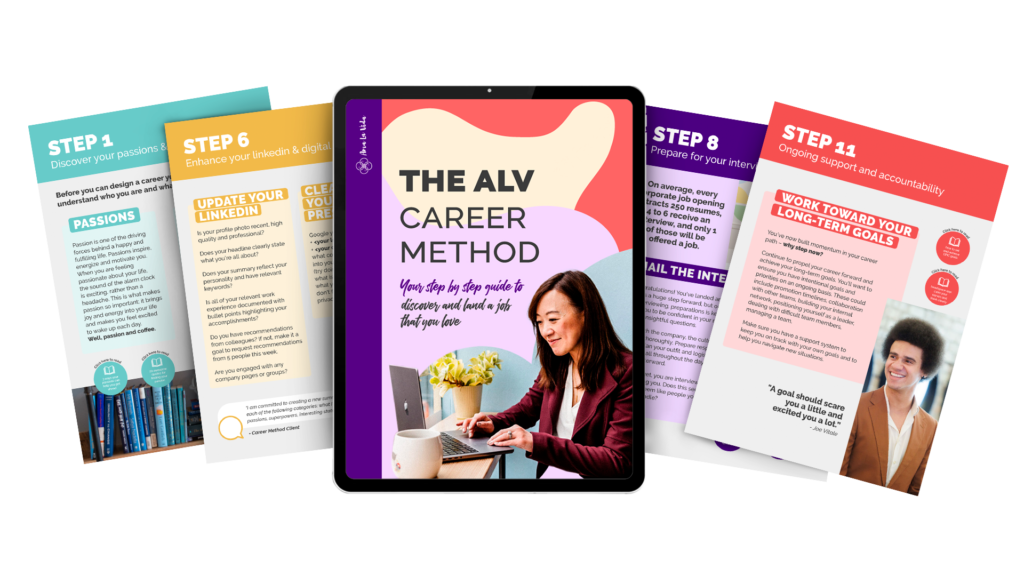
Download our comprehensive step-by-step guide to design and land a job you love!

Images from The ALV Career Method Guide
ALV Method Downloadable Guide

Employee retention has never felt more critical than it does today. We are inundated with “great resignation” articles and headlines about the hot job market for employees. A March Pew Research article tells us the nation’s quit rate reached its highest point last November and doesn’t appear to be slowing down. As a Career and Leadership coach, I can say the majority of my clients are considering career shifts – mostly due to feeling under-resourced, overwhelmed, and under-appreciated. Organization stress and pressure are at an all-time high. And every time a talented leader or team member leaves – the effect is dramatic on team morale and performance. Not to mention the productivity loss in dollars and time.  Organizations need to retain their talent. Period. Full stop. They can’t afford to lose their current employees – the ones who know their business/product best, who have established the right relationships in/outside the company, and who have already grown and developed within the company’s culture and structure. So what can companies do to stop the exodus? My suggestion is to invest in your leaders  with coaching before you lose them.   An investment, not a cost  I am using the word invest strategically, and here is why. Yes, coaching costs money. But you need to remove the word cost from your thinking and replace it with investment. Coaching is an investment in your leaders, and this is important because the positive impact of coaching your leaders reverberates to the teams they manage. This article in Forbes backs up my thinking by sharing “The leadership team undoubtedly makes or breaks a company’s culture and an employee’s experience. Regardless of how great a manager or one’s team is, leadership sets the tone for the workplace. If leadership is only focused on profit and limits the investment into employees whether that be through benefits, developmental opportunities, or engagement initiatives, it’s felt by all.” Get ahead of issues Many organizations make the mistake of only bringing in outside coaches when they are trying to address a problem. Or they are reorganizing and want to get alignment on next steps. These are excellent examples of how coaching has helped organizations. But I want you to consider coaching as a proactive investment instead of a reactive one. Think about other investments you make in life like a new car or a fancy computer. In all of these examples, you are on board with the preventative maintenance it takes to keep these items running smoothly and optimally. You do this via checkups, scheduled/routine updates, and enlisting the support of experts to ensure you are taking care of your investment. Why can’t this same mindset apply to your leaders and teams? In this blog post, Ama La Vida founder Foram Sheth builds a case for investing in your leaders early before problems exist. She says “…we should support our leaders with the individualized care and support they need to thrive in alignments with your team, culture, and organization.” I echo this wholeheartedly and feel like now is really the time – as the pressures are more intense than ever before.  What exactly is coaching? Said simply, coaching unlocks a person’s potential to maximize their performance.  In practice, that looks like – clients partnering with a professional coach via 1:1 sessions. Coaches use active listening, empowering questions, and other tools to help raise awareness, empower choice and support goal setting and accountability to move things forward. Tell me more about the ROI? If you need more reasons to reward them for staying by investing in them, then think about this return. According to the International Coaching Federation (ICF), 86% of organizations saw an ROI on their Coaching engagements, and 96% of those who had an Executive Coach said they would repeat the process again. As a coach, I have witnessed the following tangible impacts for my clients whose companies sponsored their coaching. Improved productivity Clarity on their opportunities to elevate their leadership skills Awareness of their strengths and blindspots Opportunities and goals around delegating Actionable steps to improve workplace relationships  Enhanced job satisfaction Increased attention on organizational goals and their specific role in moving things forward More accountable to self and others Improved preparedness for pitches/presentations/meetings Effective navigation of increased responsibilities, business challenges and new positions/promotions  And these same clients had a number of intangible benefits that came out of coaching like: Feelings of being cared for, supported, heard Increased confidence More fulfilled, happier This is a powerful list, and it’s not even inclusive of everything that is possible with coaching. And don’t forget about the exponential gains for the teams these leaders are managing. When the leader improves, the team improves too.  I want to learn more Leaders require unique and personalized support. One-to-one coaching is a great way to offer this support to your leaders. If you are inspired and want to help your leaders thrive in today’s environment while demonstrating your investment in them,  use this form to get in touch with us to learn more.

Read More
two women co-working

“It always seems impossible until it is done.” Nelson Mandela People often give you the advice to take “baby steps” to accomplish a goal. Before having a baby of my own, I always thought that meant breaking down a large goal or complex situation into smaller, more manageable. But now that I have a 16 month old who just learned how to walk, this metaphor has a much more important message for me. Watching my son learn to walk, he would stumble, fall down and get incredibly frustrated. And yet, I’ve never seen someone more persistent in achieving what they want, despite the setbacks along the way. When you start working toward a new goal or behavioral shift with your coach, think about taking baby steps. Break it down into tiny pieces, and also mentally prepare yourself for the fact that the process will not be linear. You’ll find your stride and start moving forward, and then you’ll lose your footing, wobble and maybe even fall flat on your bum. Think of a baby learning to walk and accept the trials and tribulations along the way because they are a part of the learning process. Stay diligently focused on your goal and you’ll come out stronger in the end. If my son called it quits when he faced challenges, he’d be sitting on the floor the rest of his life. Instead, I’m trying to keep up as he runs all over the place and sees the world in an entirely new way. I want that for you, too.

Read More

“It’s not the destination, it’s the journey.” Ralph Waldo Emerson Why Are Goals Important It sounds simple, but goals help you achieve things. They give you a focus, a direction, a vision of how you want your life to be. They can be larger, like finding a job you’re passionate about. Or they can be smaller, like getting into the gym 3 times per week (which isn’t always a small thing). All goals, larger and smaller, help move you in a direction that you want to go. I’ve been taking a leadership course through Cornell, and one of the topics was centered around how to get things done. When we think about getting things done, we tend to focus on the outcome, but not on the process. What I learned through my course was that process goals (or intermediate, in-between goals) are key to achieving your overall goals. What Are Process Goals Process goals are mini goals that are markers of your overall goals to help you stay on track. They are there to measure the effort that you are putting into achieving your overall goal. Let’s use the goal of getting into the gym as an example. In this instance, a process goal could be waking up at 6 am to be able to get into the gym before work. The point of the process goal is to support the overall main goal. Tips For Setting Process Goals They should be attainable, but challenging: your process goals should move you forward. If they’re too challenging, you might never begin.  Make them specific: take all the guesswork out of what you’re trying to accomplish, when, and how. Create accountability: talk to a friend about your goals. An American Society of Training and Development study found that you have a 65% increase of achieving a goal if you tell someone. Have a method of feedback, such as a tracker: this allows you to know what happened if you didn’t achieve your overall goal. Example: You know you didn’t make it to the gym because you didn’t wake up at 6 am most mornings, as seen on your tracker. We tend to focus on the outcome, but not on the process. Process goals are what allows you to get to where you want to go and understand what went wrong if you didn’t achieve your overall goal.

Read More

When we begin anything new, it can be scary. Question after question may swarm in our minds until we find ourselves doubting if we can actually do it. This is definitely the case when we become a manager for the first time. By intentionally leading with purpose, you can be a successful leader and gain the respect of your team and others in the organization. Purpose is defined as “the reason for which something is done or created or for which something exists.” So I ask you, what is your purpose? Why do you want to be a leader? What do you hope to accomplish as a leader? When you discover your why, you can then begin to craft your leadership vision. Strategic Thinking Whenever we begin a new journey, it’s good to think strategically about what success looks like. This will enable you to then carve out your vision of success. Becoming a strategic thinker will help you tremendously as a first-time manager. Focusing on the big picture rather than the small details will assist you in building a team that will support you and also produce great results for the company. Set aside time at the start of each day to consider what you want to accomplish for the day and how those tasks will contribute to your overall goals for the week. Growth Mindset Now that you are a manager, your mindset will require a shift. Adopting a growth mindset is essential to becoming a great leader. As an individual contributor, you no doubt were used to contributing to the team and completing assigned tasks and projects. As a manager, you now set priorities and expectations. Building on the skills and strengths of your team will allow the team to grow and handle challenges successfully. Setting clear expectations upfront will let your team know what is expected and keep you from becoming a micro-manager. When everyone is clear on the goal, they can be innovative and encourage new ideas and growth among the team.  Delegation Whenever possible….delegate, delegate, delegate! As a first-time manager, you may want to do everything yourself. You want to make sure everything is done right, and what better way to do that than to do it yourself, right? Wrong! Relinquishing control and allowing your direct reports to take on new tasks not only shows that you trust them but it also gives them the opportunity to grow and learn. Feedback As a first-time manager, feedback is your best friend. Ask for feedback often and be open to accepting it. When meeting with your manager, ask them for positive and critical feedback. This is one of the fastest ways to discover areas that you excel in and also identify areas for improvement. When meeting with direct reports, ask them for feedback and really listen to what they share. Is there anything you can do to assist them? What challenges are they currently facing? Also, don’t be afraid to give feedback. This will assist them in their personal development and show that you are invested in their personal career growth. Mentor Seek out a mentor to help you navigate this new journey. A mentor can provide great insights and advice and share with you what they have learned and what has worked well for them. Look for leaders in your organization that you admire and want to learn from. Reach out to them and ask them if they would like to be your mentor and meet for coffee chats monthly. Not only will you build a great relationship, but you will gain more knowledge about the company and learn more about how to lead with purpose.   Communication Being an empathetic listener is a quality of many great leaders. Having an open-door policy and really listening to your direct reports will build strong relationships. When employees feel heard, they trust and respect you. A leader that is not respected by their team will not go far, but when they know that even though you may not always agree, you will listen to suggestions and recommendations. Being transparent with the team and communicating changes will also assist in building trust.  Motivation Take time to get to know each of your direct reports. Discovering what motivates them will help you assist them in developing and reaching their goals. When managers are invested in their employee’s growth and career path, the employee will be invested in supporting the manager and going the extra mile for them. Ask them how they like to be recognized, this is important because one employee may prefer private recognition versus public recognition. Recognizing them in the way that matters to them will endear them to you and build strong team rapport.  These are just a few tips to guide you as you take on your first leadership role. Partnering with a certified leadership coach can help you build self-awareness, develop your leadership capabilities and maximize team performance. Your coach will help keep you motivated and accountable as you consider new perspectives embodying the leadership attributes you value. You may doubt yourself at times, but be confident, believe in yourself and remember the hard work that got you there!

Read More

“It’s not the destination, it’s the journey.” Ralph Waldo Emerson Why are goals important It sounds simple, but goals help you achieve things. They give you a focus, a direction, a vision of how you want your life to be. They can be larger, like finding a job you’re passionate about. Or they can be smaller, like getting into the gym 3 times per week (which isn’t always a small thing). All goals, larger and smaller, help move you in a direction that you want to go. I’ve been taking a leadership course through Cornell, and one of the topics was centered around how to get things done. When we think about getting things done, we tend to focus on the outcome, but not on the process. What I learned through my course was that process goals (or intermediate, in-between goals) are key to achieving your overall goals. What are Process Goals Process goals are mini goals that are markers of your overall goals to help you stay on track. They are there to measure the effort that you are putting into achieving your overall goal. Let’s use the goal of getting into the gym as an example. In this instance, a process goal could be waking up at 6 am to be able to get into the gym before work. The point of the process goal is to support the overall main goal. Tips for Setting Process Goals They should be attainable, but challenging: your process goals should move you forward. If they’re too challenging, you might never begin.  Make them specific: take all the guesswork out of what you’re trying to accomplish, when, and how. Create accountability: talk to a friend about your goals. An American Society of Training and Development study found that you have a 65% increase of achieving a goal if you tell someone. Have a method of feedback, such as a tracker: this allows you to know what happened if you didn’t achieve your overall goal. Example: You know you didn’t make it to the gym because you didn’t wake up at 6 am most mornings, as seen on your tracker. We tend to focus on the outcome, but not on the process. Process goals are what allows you to get to where you want to go and understand what went wrong if you didn’t achieve your overall goal. ~ Brooke

Read More

Now that you are in charge, the staff is looking to you to make great things happen, and yet as a new manager, you are just trying to remember to turn right for the breakroom and left for the restroom! There is so much to do. Even the first staff meeting is overwhelming because you want to share everything with the staff. Use these tips to help you have an incredible first staff meeting that will set the tone for the culture you are building for the department. All eyes are on you as the new manager. The staff wants your guidance and your experience to help lead them to new success, and senior management needs you to drive the mission of the organization at the boots on the ground level. Being a new people leader can be a balancing act with great rewards. The first opportunity to set the right tone is during the first staff meeting. How do you share all the information during this meeting without making it overwhelming? You don’t. Instead, follow these three simple tips to make your first staff meeting amazing. “You have a meeting to make a decision, not to decide on the question.” Bill Gates TIP #1: PURPOSE What is the purpose of the meeting? Every meeting should have a clearly articulated purpose; without a purpose, the meeting is a waste of valuable time. This is your first chance to build the culture you want to establish for the team and while it might be tempting to cover all the lofty goals that you proposed to get the new role, the first step is to allow your team to get to know you. Establish time to share who you are, what is important to you, and why you are looking forward to working with this group to achieve great things. Take the time to find out what the team feels is the most pressing concern and why. Keep the focus of the meeting to the top one or two items and know that there is plenty of time to lay out your plan in the future. For the first meeting, make the team the priority. TIP #2: AGENDA When you applied for this role, did you walk into the interview prepared with data, examples of successful implementation you lead, and stories to explain how you support team members for growth, or did you wing it? Chances are you prepared, and you prepared a lot! It shows that’s the reason you were given the role. Now, prepare for your first meeting with the same intensity. After you have fine-tuned the purpose of the initial staff meeting, create an agenda to keep the topic on point. Meetings are an important part of the business world and because so many people feel it’s okay to “wing it”, meetings get a bad reputation of being time-wasters. Don’t let your meetings have this reputation – be intentional with your time. Determine how much time should be spent discussing the purpose of the meeting – your introduction to the team. By doing this activity, if you begin to get nervous during the meeting you can rely on the agenda to keep you on task, within time, and create a culture of appreciating your team members’ valuable time as well. That’s a win, win, win for all! There are several agenda templates available online for you to create one that will meet your needs. TIP #3: FOLLOW UP During the meeting, ask someone to be the note-taker so that you can focus on the conversation and not need to multitask. The key to note-taking is to ensure any outstanding topics are followed up on. For example, if part of your agenda includes asking for the top priority of the team and you need to follow up on resources to help make the top priority an easier process, make sure you provide feedback to the team on what you discovered. This follow up can take several forms: 1) email to the team with updates regarding topics discussed during the meeting and what you have discovered; or 2) if not urgent, it might be a line item of “old business” on the agenda during the next meeting that can be reviewed. The important aspect here is to ensure that you are building credibility by following up on items that you said you would investigate and reporting back to the team regarding the results of your inquiry. Team members appreciate leaders who do what they say and say what they do. “If you aren’t meeting regularly with your team, you don’t have a team. What you really have is a collection of boxes on an org chart.” Barbara Burke A bonus tip – these three steps should be used for each meeting you have, not just for the first team meeting. By getting into the habit of having a concise purpose for the meeting, an agenda that provides a guideline for the team, and finally following up on action items from the meeting you will build the culture that you want with the team and gain credibility through the process. Partnering with a certified leadership coach can help you build self-awareness, develop your leadership capabilities and maximize team performance. Now, go crush your first team meeting!

Read More