Category: Self Awareness

How many of us can honestly say we’re not happy with life? How many of us can say that if we had the choice to improve our happiness, we would? One of the most common feelings people struggle to find is happiness and the real question is: why is happiness so hard to find? Is it because things didn’t work out like planned? Is it the lack of finances? Lack of significant other? From an external point of view, those reasons plus more could be the determining factor. BUT from an INTERNAL point the answer is NO. So many of us place our happiness in the hands of situations, people, successes and the #1 factor we believe is money. But why is it majority of the richest people aren’t happy either? It can’t just be from materialistic things, it’s deeper than that. Happiness Robbers I read a book by Marci Shimoff called “Happy For No Reason,” who stated there are three different types of happiness robbers: blaming, complaining, and feeling shame. Instantly, I had an aha moment and realized – wow, this is exactly what makes me feel sad! When I blame others for my mishaps, shame myself for mistakes I’ve made, or complain about what’s not going right, my happiness decreased! So if we want to learn how to have and keep happiness, we must be mindful of those three things. Blame Blaming people for our past or current circumstances and situation can be detrimental for our happiness. When we blame others or our circumstances when we choose to make excuses, we give up our power. It doesn’t allow us to take responsibility for what we can do NOW to improve our current conditions. It also blocks us from having clarity and without clarity how could we gain the proper solution? Coaching Tip: Every time you blame something or someone, take a moment to stop yourself and try to focus on the solution rather than blaming. You can also ask yourself the following quick questions to gain more insight for a solution: *What is the issue? *What is it that I don’t understand about the issue? *What is it I’m really feeling? *What can I do about it?  Shame Let’s face reality here: we all mess up. We all make mistakes that sometimes can’t be fixed the way we want them to be fixed. What we choose to do after can elevate or hesitate our growth. Those times where you have a human moment and want to shame yourself, take the challenge to stop yourself in the midst of your shaming party and ask yourself: “What can I learn from this?” ”What can I do about it now to move forward?” A lot of times identifying something positive or a lesson from a mistake will help ease the judgment and give you a better perspective rather than playing the victim. When we play victim and shame ourselves, we lose our power once again. Complaining Complaining is the #1 way to block your blessings. It instantly puts you in a funky mood and robs the joy you seek. Nobody wants to attend a pity-party, so it’s best for us to stop sending out the invites. When we complain, we’re focusing on things we don’t want or don’t like and when we hone in our energy on these things, we attract more of it. It’s like a pity-party that can last an entire lifetime if we let it and that kind of partying 24/7 gets tiring. The best advice is: when you’re complaining or feeling ungrateful, look for things that ARE going right or things you do like and celebrate that. Always remember what we CHOOSE to focus our energy on is what we’ll attract. By eliminating these 3 things out of our lives, we will not only learn how to be more appreciative, responsible for our own outcomes and actions and not give other people our power, but we will begin to see a shift with our inner happiness. Quote of the month: Happiness is letting go of what you think your life is supposed to look like and celebrating it for everything that is. –Mandy Hale! Affirmation of the month: I am grateful that I allow myself to experience a deep sense of happiness and peace everyday!

Read More

Ask any group what is one of the things they wish their leader did better. One of the answers is almost always that they want to be heard. The leader looks on in surprise at this answer and says, “I hear you!” But, as leaders, do we listen? Do we really practive active listening as a leader? Or just receive the sound stimuli into our ears and answer with whatever we think is being asked? While listening is an activity that we all do inherently throughout each day, are we doing it well? Many of us probably aren’t. We’re busy and distracted! We fill in the blanks because we think we know what’s being said, and therefore, don’t really need to listen. Active listening as a leader is a process and needs practice to perfect the technique. Here’s five tips to help you hone this skill and start truly listening to your team. Tip #1: Remove Distractions and Pay Attention This is the hardest part of the listening process. We are all busy and have lots of distractions from work, news, deadlines, personal challenges. It doesn’t help that our phone is blowing up every second. Plus, we’re not always sure when we need to listen. When we were children, we were always told when to listen. As we grew up, we stopped getting the reminder. (Imagine if you were able to tell your leader, “123, eyes on me” when you needed their attention??) This is an area that a leader can make the most noticeable improvement. When a team member wants to chat, take notice of the context surrounding the request and be prepared to give them your undivided attention. This means closing email, putting down your phone, facing your body and eyes in the direction of the person speaking. Try to clear your mind of self-talk and internal dialogue. (This is especially hard as we are often thinking of our response instead of truly paying attention.) If you can’t pay attention in that moment, be honest and tell the speaker: “I’m interested in what you have to say, but now is not a good time and I would like to give you my full attention”. Then set a time that works better. The key is to follow through! This will build you a lot of credibility and good will with your group. Tip #2: Understand What’s Being Said So often we answer what we think is being said, and not actually what is being said. That’s because we often do not confirm the meaning of the message. There are a few reasons for this, but more often than not, we didn’t actually pay attention. Sometimes we, as listeners, are fearful of asking someone to repeat what they said or clarifying a meaning as we don’t want to be perceived negatively! Being sure that you understand what is being said is critical to being successful at active listening as a leader. It is also one of the easiest parts of the listening process. It can be as simple as asking the speaker “what?”. Other ways to confirm the meaning is to paraphrase what is being said to you and straight-forwardly ask if this is what was meant. This way you can get an answer before the conversation goes any further and has potential for not being a positive or productive experience. Tip #3: Remember What’s Being Said This is not dissimilar to paying attention, but is a more internal process. If you have been successful at clearing your mind to active listening as a leader, you will want to be sure that you remember what the crux of the conversation is about so that you can respond appropriately. While taking actual written notes is a great way to remember, it isn’t always feasible to when someone is speaking to you. Here’s some other ways to start conditioning your mind to remember the message: Tip #4: Evaluate Appropriate Responses Does this team member require empathy? Direction? A solution? The most appropriate response isn’t always top of mind. It takes a moment to analyze the message and the outcome the speaker is looking for. Take into account the meaning of the initial message and be sure that your response will continue to send a consistent message and support the expectations that you have set for your team. You must also consider the speaker and what you know about them and how they receive information. Being able to adapt to the different styles of your team will help make your conversation more productive. Tip #5: Respond and Give Feedback Once you decide on the most appropriate response, feel free to engage in conversation with your team member. Watch for nonverbal cues to know if your response has been well-received. It’s important that your response lets your team know that you took the time to actively listen to what they had to say and that it was important to you. Feel free to ask for feedback so you can be sure that you understood the message and they understand your response. If you didn’t hit the mark, repeat the cycle as many times as it takes to ensure the speaker feels heard. Teams will typically work more efficiently, harmoniously and productively if they feel empowered that their voice can and will be heard. Practicing active listening as a leader will often be rewarded with open communication, innovation, objectives being met and a cohesive work group. Remember to put your “listening ears” on!

Read More

What’s the first word that comes to mind when you hear the phrase “self care”? If you would have asked me that question a few years ago, I would have replied with a list of actions: practicing yoga, doing an at-home facial, or treating myself to a massage. As the founder of Inner Workout, self care is now my life’s work, and I regularly get to play this self care word association game with others. Their answers are never too far off from the answers I gave in the past.  I want to be clear that there’s nothing wrong with these practices and experiences. A massage sounds particularly appealing in this current moment. However, I believe that we’re doing ourselves a disservice if we treat self care as just another item on a long list of tasks. In doing that, we’re limiting our own ability to care for ourselves if we only focus on the physical body. Your self care practices should support your entire being.  What Self Care Actually Means My first foray into self care was a regular Sunday night bath. I’d close my laptop, disengage with my phone, and spend some much needed quality time with myself. I wouldn’t reengage with the outside world until Monday morning. And, while I was consistent in the Sunday evening practice, each Sunday night looked slightly different. Some nights I’d soak with a bath bomb. Other nights I’d create my own concoction of Epsom salt and essential oils. Some weeks I’d soak for over an hour with a book. Other weeks I’d take a quick dip and listen to music before going to bed.  In the beginning, the bath was the act of self care. Over time, it became clear that the real act of self care was me checking in to see what I needed each Sunday night. A new definition of self care began to crystallize, one that Inner Workout continues to use to this day:  Self care is listening within and responding in the most loving way possible.  It’s not about doing a particular workout or skincare routine. It’s not about taking a certain amount of vacation days or getting a massage every month. Self care is an ongoing conversation that you have with yourself – it’s a skill that you build. If self care is a skill that you need help building, BetterHelp can help! That simple mindset shift can create a world of change. Instead of seeing self care as being tied to a specific action, I began to see invitations to take care in my day to day:  I learned how to lovingly respond to my own needs instead of ignoring them in the name of efficiency or productivity.  What Led Me Here: One day, I was sitting on my yoga mat, and a question popped into my head, “What if there was a class that helped people build the skill of self care?” I researched, and I couldn’t find anything that was quite what I wanted. And that’s how Inner Workout came to be.  I enrolled in a nine month yoga teacher training program, and I was quickly introduced to the yogic concept of the koshas, the layers of being. This was the missing piece.  My relationship to self care had expanded beyond caring for my physical body, but I didn’t have the language to describe it. Now, there was a framework through which I could make sure that I was actually caring for my whole self. The koshas, which we talk about as the five dimensions of wellbeing, became the foundation for Inner Workout:  When we engage with each dimension of wellbeing, our self care becomes that much more meaningful. It becomes as multidimensional as you are. It starts to honor where you’re at in any given moment.  Shifting Dimensions We’re dynamic beings living in an ever changing world, which means that our relationship to each dimension is constantly shifting. There are days when I feel really in tune with my emotions but out of touch with my physical body. I go through seasons where I can hear my intuition so clearly, but I feel disconnected from anything beyond me.   The framework of the five dimensions of wellbeing has helped me better understand where I need to focus my care, but that sensitivity to my own needs took time and intention. Inner Workout’s namesake class helped me build that skill. Each class is centered around an intention and blends movement, breathwork, journaling, meditation, and flow.  Unlike another mindbody practices, everything an Inner Workout facilitator offers is a starting point. You’re the expert on your own needs, and each class is an opportunity for you to practice listening within and responding with love.  One of my favorite parts of facilitating Inner Workout classes is looking up and seeing everyone doing something slightly different. People linger in movements or find a different movement entirely that supports their needs. Participants find the position in breathwork or meditation that best serves them. That’s the goal! It means the inner work is working.  Self Care Questions to Ask Yourself: Whether or not you join Ama La Vida’s upcoming Inner Workout class. I hope you begin to broaden your relationship to self care so that it can be as multidimensional as you are. Here are some questions to ponder:  Continue to build the skill of self care. Keep listening. Keep responding.

Read More
compassion in a crisis

“We are in the same storm but not the same boat.” – Anonymous This global pandemic is the storm of the century, and we’re not all in the same boat. While many of us are doing our best to weather the storm, the harsh reality is some are doing better than others, to no fault of their own. For some, this is more like a vacation. They no longer have to go to a job they hate, and they’re getting paid to relax, enjoy daily virtual happy hours and tend to their hobbies. For others, this is destroying their families and putting them in the most dangerous position of their lives, mentally, physically, emotionally and financially. There might be elements of commonality – we are all in the same storm – but at the end of the day, we’re still individuals trying to survive in our different boats. Because our circumstances are different, our needs are different. We’re coping, grieving, expressing and surviving in our own ways. For some, this is the most productive they’ve ever been, while others can’t seem to accomplish the most simple task. Some might be practicing deep, spiritual healing, while others find themselves on an emotional rollercoaster that won’t seem to end. No matter how we look at this storm, it’s important for us all to recognize that we’re each experiencing and processing this storm in our own way. It’s easy to compare ourselves to others, but remember that we don’t know what it’s like on their boat. With this in mind, let’s focus on compassion, ease and grace.  And while we take care of ourselves, let’s also make sure we take care of each other. A few easy ways to do this are: Share If you have extra money, food or supplies, share with those who don’t. You can talk to your neighbors and community or you can donate to food banks and local drives who are accepting cleaning supplies, clothes and other essentials.  Volunteer virtually  Plenty of organizations and nonprofits are still working to help provide for those in need. Idealist.org is a great place to look for COVID-19 and remote volunteer opportunities. You can also search for nonprofits in your area and see what virtual or contactless options they have available. Here is another list of nonprofit organizations that need our help – How You Can Help – Washington Post Shop local A lot of our local and small businesses won’t make it out on the other end of this. Visit your local grocery stores and small businesses before you hit the bigger stores. Small businesses need our love and support more than ever. If you can’t afford to shop local or spend the extra cash, you can still support your favorite local small businesses by liking and commenting on their social media content, sharing their posts and telling your friends about them. Ask Reach out to friends and family regularly. Send a text, email, write a letter or schedule virtual happy hours. A simple message can go a long way. Talk to your neighbors and see if anyone needs help getting groceries and supplies. You can also post signs around your neighborhood with your contact information offering help for those in need. Kindness We all could use a little more love and kindness right now. Say hi to your neighbors and smile when you can. Thank your local businesses and everyone who still has to go to work. They are putting their health at risk to save ours. Spreading positive energy benefits us and those around us as well. We can’t change the past and we can’t predict the future but we can appreciate today. Let’s focus on how we can show up right now, for ourselves, our families and our communities. We might be weathering this storm in different boats, but we are all in this together. 

Read More
5 things to do instead of emotional eat

Current events have turned our lives upside down. We’re facing unprecedented circumstances and uncertainty. We’re mostly stuck inside, many of us have lost our jobs, we’ve been forced to create an entirely new way of living, and day by day it is becoming harder to see a future that is certain and “normal” again. Stress at this magnitude can bring a lot of emotions to the surface, some more unpleasant than others. In response to this uncertainty and if you’re like most of us, you might seek comfort in a familiar place: the kitchen. Eating when we feel emotions can be one of the easiest and most immediate ways to make ourselves feel better in stressful times, but if we continue to ignore certain emotions, bigger issues might arise down the road. Think about it this way: you wouldn’t fill your gas tank with water and expect your car to run properly, right?  You probably wouldn’t put more gas in your tank than your car could handle either. Cars require maintenance and care just like humans do. If we ignore the “check engine” light long enough, our car will start making funny noises, other parts will stop working, and we could eventually break down. Think of emotions like stress, anxiety and overwhelm like a “check engine” light. It’s our body’s way of letting us know it’s time to check under the hood.  Food is a huge part of our lives.  It’s a necessary part of our existence and for many, our culture. We eat to celebrate. We express ourselves through food. Usually, we share love through food. We gather with friends and family over food. It can bring so much happiness and excitement into our lives, which is why it’s natural for us to resort to food when we’re sad and want to feel joy. Psychologically, eating comfort food when things get tough can help us feel better, also called emotional or stress eating. However, this is only a temporary solution. Our “check engine” light might stop flashing for a little bit, but it’s not fixing the actual problem. Biologically, eating can also help regulate energy levels when feeling stressed and overwhelmed. Stress is associated with changes in cortisol levels so we tend to crave foods higher in fat and simple carbohydrates because our bodies crave additional energy to function while under stress. If you’ve noticed any changes in your eating patterns since the start of this uncertain and overwhelming time, your body is doing a great job of keeping you alive. Our external environment can affect how we feel internally, so if there is fear and scarcity around the availability and accessibility to food, it can affect our eating patterns. Take this for example: one might be likely to eat more than normal when feeling overwhelmed as a means to cope. Some might find themselves snacking throughout the day, while others might severely restrict food intake in an attempt to feel in control.   Although emotional eating feels good at the time, it’s not helping us get to the root cause of our stress or unpleasant emotions.  If we continue to suppress those emotions with comfort food, we’re creating more health problems. For example, when we find ourselves emotionally eating food with little nutrition and minimal health benefits, it can weaken our immune systems, deplete our energy levels and affect our mental health at a time when protecting our bodies and our mindset is particularly important. If we don’t take care of ourselves and fuel our bodies with proper nutrition, we will suffer. Have you ever felt “butterflies” in your stomach when you’re nervous or looking forward to something? Have you ever dreaded doing something that feels “gut-wrenching?” This communication between our brain and our stomach is called our “gut-brain connection,” which explains how what we eat affects our mental health. A healthy, well-functioning gut has a balance of “good” and “bad” bacteria.  When we overeat food that lacks nutritional value, like processed foods, added sugar and simple carbohydrates, it increases the amount of “bad” bacteria in our gut. Since “bad” bacteria feeds off unhealthy foods, the more we consume those foods, the more intense our cravings become. That’s why when we eat fast food, we tend to crave more of it. Stress is another factor that depletes good bacteria. Since 70% of our serotonin production is in our gut, when the “good” and “bad” bacteria are out of balance, it can create more stress in our bodies, which affects our brain. This doesn’t mean that we should avoid unhealthy foods all together. It means that we should observe how certain food affects our mood and energy so we can create a healthy balance that works with our lifestyle.  So how do we fix the “check engine” light? When we have a thought, our brain sends neurochemicals and hormones to our bodies, which creates emotions. Our emotions influence our actions and behaviors, which in turn creates our reality. If we want to prevent those unpleasant emotions from negatively impacting our lives, we have to find ways to release our emotions.  My physics teacher always told us “what we resist persists.”  If we use food or other distractions to suppress our emotions, they will always surface. Think about it this way: when we’re happy and excited, we express our excitement by cheering, yelling, sharing with friends and family, celebrating, doing things we enjoy. This is how we release our emotions. Even when we experience unpleasant feelings, we want to vent to friends and family because we usually feel better after doing so. But when we hold onto stress, anxiety, worry, fear, it stays bottled up inside us. That emotional energy needs to be released. It’s physics! Every day we should be checking in with our emotions and observing how we’re feeling throughout the day. Pay attention to your hunger cues. When you feel hungry, choose nutritious food that’s enjoyable and will keep you energized. If you find yourself emotional eating,

Read More
how to stay calm ama la vida

“Is this real life?!” I thought to myself as I scrambled to translate my long list of grocery items to the masked man through the cracked door of my local Buenos Aires mercado. I quickly google translated tumeric to Spanish and repeated “cúrcuma” 3x until he finally understood what my gringa accent was requesting. He gave me an unfortunate head shake “no” and looked back at the line of masked people waiting to shop behind me. This was not the time for a complicated order. When I first started hearing the news in China and Europe, I remember telling friends that this could not be real. Every article and news update I read felt like it was straight out of the script of a Black Mirror episode or a new SciFi movie. A movie or episode I wouldn’t want to watch, let alone partake in. It still feels surreal as I walk through the eerily quiet streets of Buenos Aires past masked and gloved people and realize yes, this IS real life.  It’s a strange feeling living abroad when going home doesn’t feel like the safest option. This is a global situation, and I know we are all feeling the effects. The unifying force of global awareness to #stayhome is inspiring. It’s amazing to see global acceptance as we learn to adapt to this new normal. No doubt that this is a time of uncertainty for all that can fill us with emotions of fear, doubt and insecurity. Yet, I challenge you to shift this perspective. Uncertainty and I have gotten real close over the past few years, and I’ve learned that leaning into it and embracing change always leads to greater courage, resilience, learning and growth.  As Margaret Drabble said, “When nothing is sure, everything is possible.” We have the power to decide the role this current reality plays in our lives. I’m choosing to focus on what I can control, keep an open mind, spread positivity and stay calm! What are you choosing? Either way, I know we will all come out of this stronger, more united, and more appreciative than ever…for a simple handshake, hug or as they do here in Argentina *kiss on the cheek*. Here are a few things bringing me peace and calm during times of uncertainty: Catching up with family and friends Between Zoom calls, text updates and Instagram meme shares, I am now in closer contact with friends and family back home than my almost two years of living abroad. I’m so grateful for virtual methods to connect and support each other through the emotions of change. It also gives me peace of mind knowing that friends and family are safe and healthy. Here are my favorite tools to virtually connect: Zoom– As a remote worker, this is nothing new to me. However, it’s amazing to see how Zoom is now playing a bigger part in everyone’s lives worldwide. From meetings to workout classes to virtual birthday parties, Zoom is allowing us to stay connected and stay home.  FaceTime– If catching up with one or two people, I also love to use FaceTime to make a call and see a familiar face. It remains a great way to have a quick ‘face to face’ catch up. Virtual workouts I’ve really missed my workout classes from San Francisco living abroad. The abundance of online options from home during this time are a new opportunity for me to take my favorite workouts and instructors from a distance. Also, the need for movement in quarantine has caused me to work out more than usual. Here are some great virtual workout options: Karma Yoga SF was one of my favorite SF workout studios and I’ve loved taking my close friend Shelley Newhouse’s hot pilates and yoga classes from a distance. It’s also been a great way to connect and workout with friends from home via Instagram live. Here is a list of some free virtual workout options to take from home. Here is a great spreadsheet of virtual workout options from The Nudge. Investing in new skills and passion projects This year I wrote down a goal to cook more frequently and, unfortunately, was working from cafes and eating out way too often to live up to it. Yet, ironically, cooking is now my only option and the quarantine has forced me to put this goal into action. After finally stepping up my culinary game, I’ve found it fun and therapeutic. I’m also eating much healthier than the carne-filled menu options eating out here in Argentina. What’s one thing you’ve been itching to try? What’s a passion you rarely find time for? Is there a project you’ve been wanting to finish? Now is a great opportunity to invest in new skills or passions at home. Meditation Meditation is an excellent way to soothe anxiety and clear the mind. Now more than ever I aim to keep a morning meditation practice to start the day with a calm, clear mind. I love Vishen Lakhiani of MindValley’s guided 6 phase meditation. Some other great resources for meditation include: Deepak Chopra’s 21-day meditation challenge The Calm App Waking Up with Sam Harris ALV’s Meditation Guide Community Abroad The current situation in the world has heightened my level of community here with other friends and expats in Buenos Aires. We support each other by sharing local updates, Zoom support calls and sharing humor to keep each other calm and sane. I am beyond grateful for our international network to lean on, share advice and support each other in navigating times like these far away from “home”. Global Unity As someone who now considers myself a “citizen of the world”, one of the most refreshing things about this challenging time is the unity created in local and global communities. I am living for the countless positive stories like music being shared across balconies in Italy, letters of advice from one country to another and people donating supplies to local hospitals.

Read More

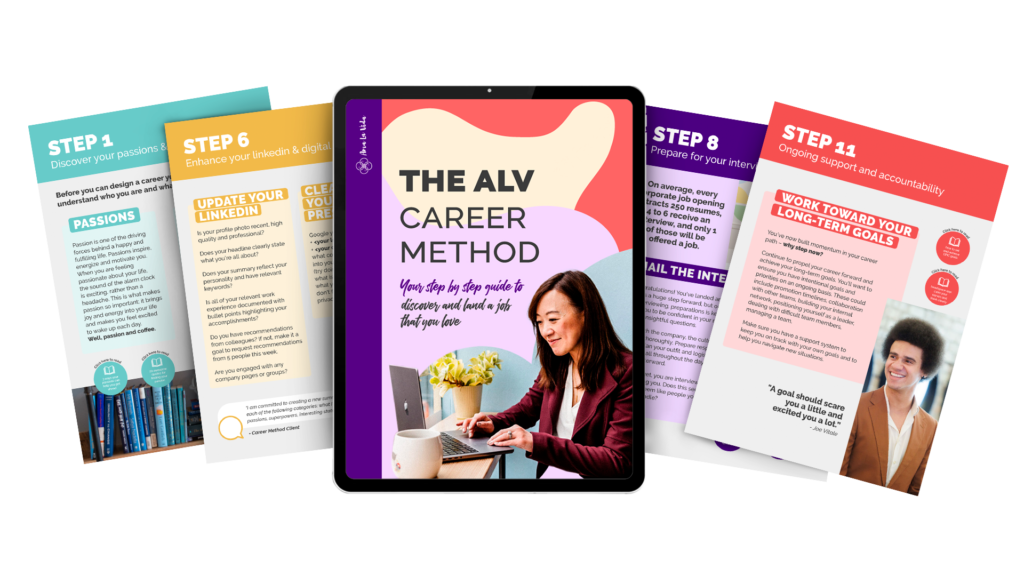
Download our comprehensive step-by-step guide to design and land a job you love!

Images from The ALV Career Method Guide
ALV Method Downloadable Guide

habits of successful people

It’s common for people to want a little more out of life. Many are typically harder on themselves than they are on anyone else around them, so when you’re stuck in your day-to-day routine and you feel like you’ve lost direction, you can find comfort in knowing you’re not alone. Oftentimes, some of your biggest role models in this world have all gone through the same obstacles you have. If you want to change and grow for the better, it’s time to start thinking about your lifestyle and how it encourages success. Success is a hard word to define because it’s vastly different for everyone. There are numerous ways to measure it; some of us see success in the amount of money we have while others think of it in terms of their career. One agreeable way to characterize success, however, is one’s quality of life. In other words, if you’re happy, healthy, and living life to your best potential, chances are you’re on the right track. Here are some habits of successful people that you should pick up. The 6 Habits of Successful People: Budget While money isn’t the only measure of success, the way you handle your money can definitely make your life more or less comfortable. Managing your finances to be able to go shopping, go on vacation, and pay your mortgage at the same time is an acquired talent– one that comes with much time and effort. So, it’s important to teach yourself to limit spending and save money so you can do the things you want to without digging yourself into a hole. The first step to successful budgeting is assessing your needs and wants. What can you live with and what can’t you live without? Cut out those pesky monthly payments from services you rarely use or minimize the expenses you can’t go without by doing your research and opting for cheaper alternatives. Did you know major payments like mortgages can be reduced through refinancing? This can give you more freedom to spend or save as you please and live your happiest life. Invest Many well-off individuals who have few concerns when it comes to money have something in common– they have two sources of income. While having a side hustle is a sure-fire way to pull in more money, not everyone has the amount of free time a second job requires. An easy way to increase your wealth without working two jobs is to invest the money you already have.  Investing isn’t as scary as it seems initially. If you don’t know much about it, there are still ways to invest with little prior knowledge or little money, and you might even be doing it already. Efforts could be as small as putting your money into a savings account to generate a nest egg plus interest from the bank. You can also allocate a portion of your salary to your company’s retirement plan, which similarly builds interest the longer time passes. Or, look into some common investing apps that will guide you through your first investment.  Seek new learning opportunities It’s easy to coast through the day going through the motions. Workdays become monotonous, motivation is lacking, and you’re used to doing the bare minimum. However, whether at work, in school, or out in the real world, there is so much to discover. Successful people find time each and every day to seek new learning opportunities, no matter how small.  The best way to stand out amongst others in the professional world is to expand your knowledge and find ways to utilize it, especially when it involves your career. Pursuing new information and refining skills so that you can share it with others demonstrates leadership qualities and helpfulness. It can stimulate your thinking and encourage growth, so when you see something you could learn more about, take that chance and better yourself.  Help others So many well-known people claim that the greatest gratification in life doesn’t come from money, but from helping others. Many find a greater purpose in putting efforts toward making other people’s lives better, whether that means volunteering, donating to charity, or simply being kind.  Find ways to help your peers in your everyday routine. Volunteer your time or just a shoulder to lean on when you notice someone in need. Not only will the gratification lift your spirits, but it can make someone’s day, or even be a major saving grace for others. Offer kind words, let others know how much you appreciate them, and you’ll find that your mood improves along with your interpersonal relationships. Spreading happiness and good vibes can be contagious, so start the trend if you want an overall better life.  Think positive People of all backgrounds and qualifications go through tough times. Life throws obstacles at you that make you want to throw in the towel. It doesn’t matter if you’re a CEO or it’s your first day on the job. What sets you apart from the rest is the way you handle the difficult situations you’re faced with. Instead of getting upset, complaining, or quitting altogether, you should change your way of thinking.  When your car breaks down, you’re passed up for a promotion, or you’re simply in a bad mood, force yourself to change your mindset. It can be hard, but when your car dies, think of how thankful you are that you’re safe and sound. When you don’t receive the promotion, come up with ways to become a better employee. Twist your normal ways of thinking to be more positive. A positive mindset will help you stand out and make for a happier life. Set goals If you don’t have a sense of where you want your life to go, it can be difficult to find the motivation to grow. Even if you don’t have a specific vision for your future, it’s still helpful to set smaller goals. This gives you a sense of direction and motivation. It can drive your focus

Read More
Why You Keep Giving Up On Your Resolutions

It’s the time of year again! It’s Resolution Time. As the year comes to a close, we naturally look back on everything that happened, and then dream of what we’d like to do differently in the year to come. “This will be the year….”  And we should give ourselves credit because we DO the things! We go to the gym and we eat more vegetables. We stop smoking and we start looking for a new job. Well, for a few weeks.  And then for some weird reason, we stop. So…why? If you’re asking “why do I keep giving up on my resolutions?” You are not alone. We ask why, because ultimately, we want to find a way to actually keep these resolutions. And there are really 2 major reasons why resolutions are dropped as quickly as they are made. 1) The resolutions don’t fit into your current lifestyle or 2) the resolutions don’t actually mean that much to you.  So here are a few things you might want to consider on your path to not giving up on your resolutions this year.  Reason 1: Your resolutions don’t fit into your current lifestyle. It’s about setting realistic, appealing goals that make sense for you and your life. I’m personally obsessed with Atomic Habits by James Clear, and what I love is how Clear breaks down what makes habits stick. Some big themes he hits upon are making your new habits appealing and obvious, letting go of perfectionism, and ensuring you have the right support to do them. First, your habits need to be appealing for you to keep it up. If you absolutely hate doing something, you’re not going to stick to it. So, for example, if you hate going to the cheap, dingy gym in your building but love going to the fancy spin studio down the street, it’s probably worth the money to invest in the spin classes since you will actually use them! Paying money for a gym you hate will get you nowhere toward your goals. Similarly, don’t promise to eat salad for lunch every day if you hate salad. Do some research for a few healthy dishes you will actually enjoy making (or a place you can buy them if you don’t like to cook). The point is, if you’re trying to change a habit, at least in the beginning, you need to want to take on the new habit. Second, make it obvious. Integrate this new habit into your regular routine. Some examples of this are stopping by the gym on your way home from work, using your regular, every-day to-do list or calendar to remind yourself of what you want to do, or maybe try stacking your new habit onto something you already do like brushing your teeth. This step is important because it’s easy to forget or make excuses for new habits that aren’t part of your daily life yet.  Third, let go of the idea that you need to do it perfectly. It’s ok to “mess up.” When you skip a day or miss your new goal, try using how you feel without it as a reminder of how much you actually enjoy the benefits of your new lifestyle. Instead of saying, “You’re such a screw up! You’ll never become one of those gym-going people!” you can tell yourself, “Ugh, I wish I could have made it to the gym today! It always makes me feel so much better!” Ok, so maybe that’s a stretch for some of us, but you can at least offer, “That’s normal to miss a day when building a new habit.” And then actually go back tomorrow. Not all is lost, my friend! I usually aim for 80% compliance with my habits. Doing them most of the time is better than letting one little misstep throw off your entire year. Last thing I’ll say here, get some support! If you’re trying to quit smoking, maybe spend some time away from your friends that smoke. Maybe you want to go to the gym more (sticking with our theme), I suggest getting a gym-buddy. If nothing else, avoid the people who tell you that you’re never going to do it. That’s just rude! You don’t need to be around that energy. But bigger than that, this ties back to the first rule, make it appealing. As social creatures, it is easier to do something with the support of those around you. Build up your network so you’re not just relying on yourself to keep you motivated. For more on the practicalities of keeping your resolutions, I absolutely recommend Clear’s book.  But for some people, all the practicalities in the world won’t get you to keep this new habit of yours. Which brings me to our next point. Reason 2: The resolutions aren’t meaningful to you. That might sound harsh, I’m sorry, I don’t mean it to. But with any good goal, it’s important to ask yourself a few questions in the beginning: Why do it? Why now? How will this impact my life? How will this impact other areas of my life, for better or worse? Is this something I’m doing because I want to, or because I feel guilty not doing it? And be honest! Because if you’re not honest, you’re setting yourself up for a resolution you’ll drop quickly. Regardless of how busy you are, regardless of all the things swirling around you in your life, if something is truly important to you, you will make time for it. Especially if you follow the guidelines under the previous section.  Making new habits is hard. It’s uncomfortable. It requires rewiring your brain and pushing yourself (often physically) outside of your comfort zone. Don’t beat yourself up for dropping habits that aren’t going to have a big, meaningful change in your life. Yes, working out and quitting smoking and all the other great resolutions may be something that your doctor or partner or friend or favorite TV show

Read More
How To Interview: The Follow Up

Welcome back to our How To Interview series!  In the last installment, I covered how to nail the all-important question-and-answer process that will make up the bulk of your interview experience.  But as any hiring manager will tell you, that process is only the first stage in winning the job. In order to explain why, I’m going to give you a “peek behind the curtain” and reveal a little about how a hiring manager thinks. This edition of how to interview is focused on the follow up. Let’s go! First, always remember that the interview process is inherently a competitive one – you don’t get to see your opponents, but you’re competing against them all the same.  The other candidates want the same job you want, but there are limited spaces available at any given company. That means (as I mentioned in Part 1!) that you’re not just trying to pass some test and get a good enough “grade” to get a job.  You have to be the best candidate out of all those that apply! That means the interview process has a few built-in disadvantages for you. Disadvantages: One. Every candidate gets an interview.  Yes, your performance can be better than theirs (and if you’re keeping up with all the resources we’re giving you, it will be!), but they still get to shoot their shot, the same as you.  The questions will be the same, they’ll get the same face time with the hiring manager. No matter how good you are, someone else might also be great. Two. In the mind of most hiring managers, the purpose of the interview is to eliminate candidates.  I don’t encourage this kind of thinking, but the fact remains that most hiring managers do it this way – if a hiring manager interviews ten people for one role, their goal is to disqualify nine candidates.  That means that if you “pass” this round, you’re in the same position still as everyone else sill in the process. That means that if you really want to land that job, you can’t “just” deliver a great interview.  You have to go above and beyond – so in addition to delivering fantastic performances in all the mandatory steps of the interview process, you have to do the things that aren’t mandatory to set yourself apart, and that’s what we’ll talk about here. The Extra Mile Here’s a simple thing to know: the more mandatory something is, the less credit you get for doing it. In other words, everything that’s mandatory becomes the “bare minimum,” and you don’t score points by just doing the bare minimum.  That’s just what you have to do to even qualify. You don’t get points for wearing clean clothes to the interview, but you sure lose points if you don’t. The way to get extra points is to do things you don’t, strictly speaking, have to do.  And if you do them well, you’ll give yourself a huge lead over your competition. First, the most basic of these steps: the follow-up email! I’m going to tell you a secret that may shock you – or at least, I hope it does.  I have conducted thousands upon thousands of interviews in my career. I have received a follow-up email from roughly 1% of them. That’s not a typo.  One percent. That’s because you don’t have to do them.  They’re not mandatory. But I’ll tell you another secret – the percentage of people who send a follow-up email that then advance to the next round is closer to 90%. Why are these so powerful?  Because they enormously improve your average.  My impression of you as a hiring manager is naturally limited; I’ve only gotten to know you via your initial application and resume, perhaps a brief phone call (if I was even the one to conduct the phone screen), and then a 30- to 60-minute conversation.  That’s not a lot of time to get to know someone, but I’ll make a judgment all the same. I have to; it’s my job. If you’ve ever left an interview feeling like you didn’t give your best self to the other person, and wished so hard that you could just show them who you really are… you can!  Send that email and improve your odds! If your interview was stellar, a follow-up email can’t hurt you unless it’s utterly atrocious (and don’t worry, I’m going to give concrete steps to make sure that doesn’t happen!), and if the interview was not, the email can be! More than the content of the email, however, is the simple fact that you sent it.  You spent additional, optional effort to reach out, connect yourself further, add more to the discourse.  You added more familiarity to your name in the mind of the interviewer. (And that’s important: Because of the Exposure Effect).  You demonstrated the exact skills almost every employer is looking for. Do’s and Don’ts for a great follow-up email! Do: Don’t: I’m going to put this all together for you and give you two examples.  First, a great example that a hiring manager would be thrilled to get, then a truly terrible follow-up email (one so bad it might actually count against you to send!). The Good… Dear Sandra, Thank you so much for the great conversation today!  I thoroughly enjoyed our verbal tour of the company, especially your role in the early growth.  I’ve attached that sales plan we discussed so you can take a look – I’d be thrilled to hear what you and your team think of its applicability to the role.  I can’t wait to meet the rest of your team after you come back from Disney World; have a wonderful time with your family! All the best, Randalyn The bad… Dear Mr. Rocia, I hope you didnt misunderstand my answer about my experience with databases. What I was trying to say is that I new them very well but it came out sounding like

Read More

We are continuing our conversation about transition tips, and today we are talking about when your family dynamics shift. If you asked people to list what’s most important to them, most people would include family on that list. In the past, it was thought that family meant two parents, a couple of kids, and throw in a golden retriever while you’re at it! But over time, the term family has shifted and embodies so much more. To me, Marvin Lazenbury describes family perfectly: Your family is the support system around you, and sometimes that support system can shift. Today, we will be talking about commons ways family dynamics shift, what can make these shifts difficult, and how to make them easier. When Can It Happen in Life Marriage You take the time and get to know someone. You fall in love and decide to get married – what a beautiful thing! The merging of lives together can be amazing. But like anything else, it comes with its ups, like love, support, communication, companionship, and downs, like sharing finances, discord, communication issues. This family dynamic shift is hopefully a positive one that fills you with joy and support and love.  Divorce Unfortunately, sometimes things don’t work out in your marriage, and you decide to split up with your spouse. Not only are you splitting from your spouse, you are splitting up your assets and potentially time with your children. This separation will cause a huge shift in your family dynamic and potentially in your identity. Children  When we think about family dynamic shifts, this is probably the first thing that comes to mind –children. Deciding to have children or adopt is no small decision – it is one that will impact the rest of your life. Soccer practice, ballet, bake sales, middle school drama, college – all these things will be new realities for you. Your time is no longer your own; children will test you, and make you go a little insane, but they are such a gift. Children will absolutely shift your family dynamic. Moving Maybe it’s for a job, a new adventure, or to be closer to family – whatever it is, moving is definitely a shift. Your entire scenery and all your patterns change, and that will have an effect on you. You have new norms, new friends, new schools, heck even new grocery stores and dry-cleaning places. Moving is a big change, and that stress can have an impact on your family dynamic.  Sickness and Death Sickness and death of family members are unfortunately a part of life. It is heart-breaking when this happens to those close to you. Grief and sadness can be present for quite some time, and the loss of loved ones will change you and your family. Know that it is okay and encouraged to talk to someone if your grief becomes too much to bear.  What Makes These Transitions Hard This is New Territory Whatever piece of the family dynamic is shifting, it’s going to be brand new! You don’t know exactly what to expect. Know that this will be a new, uncomfortable, and probably overwhelming time, and lean into it. Humans are creatures of habit, but choosing to do something new could open a door into a world that is right where you belong.  Stress  With this phase being new, stress is bound to occur! Stress can result from positive or negative shifts going on in your life. It’s going to be important to know what relieves your stress, because stress is bound to happen! Is it spending time with people you love, reading a book, going on a run, taking a bath? Find out what those stress relievers are for you and put them into action! Unmet Expectations Maybe you thought your marriage was going to be one thing, and it turned into the complete opposite. Or maybe you thought having a kid was going to be easy, and it definitely wasn’t. Or you thought a move would solve so many problems, but it only brought more on. Before making a decision that changes your life and the lives of those around you, make sure you count the cost. Do your research and know more about what you can expect. Change is a beautiful thing, but make sure it’s the right time and that it’s right for you!  How to Make This Transition Easier Communication These changes that you’re making are very big and will affect you, your time, your future, and those around you. Have conversations about what next steps, realistic expectations, and support look like. Making sure everyone is on the same page, and having a solid support system while you embark on this new adventure will be beneficial in achieving success.  Know that it’s normal At least one of these family dynamic shifts will happen in your lifetime, and probably more than just one. Lean into the process of figuring out your new normal. Some days will feel great, full of love, and you will be confident in the decision you made. Other days will feel miserable and you will doubt everything. These feelings are normal. Ride the wave, communicate, and know that you are not alone! It’s okay to get help These shifts and changes are really hard and stress-inducing. Know that it is okay and is healthy to talk to someone when things get hard and overwhelming. Seek out and get support from trusted friends, or even a therapist. I am personally a verbal processor, so talking things out really helps me align myself, choose how I want to show up, and determine the next steps. Know that there is no right or wrong way to be a family Families come in all shapes and sizes. Maybe you’re married with children, maybe you’re a single mother who decided to adopt, maybe the friends around you are your family. People might have opinions about how your family looks and what it should or should

Read More
build healthy habits tips and tricks to do the job!

As we gear up for the holidays and approach the new year, many of us start thinking about our 2020 goals. While we are well-intentioned, why do we so commonly fall through on our goals? We know what we need to do, but we often lose our momentum along the way. If this has ever happened to you, know that you are not alone in building healthy habits. Here are three strategies I’m excited to share with you to help you build healthy habits and achieve your goals. Building Healthy Habits Requires Motivation Building Healthy Habits starts with Motivation. If your goal, for example, is to lose weight, you must know your true purpose behind this goal. Ask yourself “Why?” to uncover this. The deeper you go, the better. Maybe you want to lose the pounds to look better. Why? To feel more comfortable so you will participate in more activities. Why? Because you want to spend more time with your partner and children and feeling better will help you be more active. Why? So you can feel more connected with your family and spend more time with who matters most to you. Ask yourself “Why?” until you are clear on your purpose. Identifying a deeper motivator that you can connect with is the foundation needed to build healthy habits.  Psychologist Dan Ariely expands upon this idea of motivation in his Ted Talk: How to change your behavior for the better. Just like a rocketship needs as much fuel as possible for a successful launch, we need as much motivation as possible to take action and build healthy habits. This motivation can take many forms, including the influence of our family and friends, keeping our purpose top of mind, and loss aversion. The more you can connect your habits to your close social network, the more you can remind yourself of your purpose, and the more you can think of things you will lose by not taking your desired actions, the more successful at building healthy habits you will be.  Remove Friction Motivation alone is not enough to build healthy habits. We also have to identify the barriers to the new actions we want to take. In my coaching sessions, I explore what barriers are causing my clients to be stuck, and together we brainstorm how to overcome them. If a big barrier to weight loss is an abundance of sugary snacks at home, removing these from your environment so they are no longer an option to you is one example of how you might do this. And if the friction you are trying to remove seems too overwhelming, then it is a sign to chunk it down into an even smaller action. Perhaps you first remove the biggest sugary culprits like soda and chocolate, but you incorporate some natural sweet alternatives as a replacement. Remember – small steps compound and ultimately lead to big changes. Taking Dan Ariely’s rocket ship model further, we need to reduce friction in order to send a rocket ship to space. To make the rocket ship as aerodynamic as possible requires changes and every small change matters. Explore where there is friction in your life that is holding you back from your desired behaviors, and see where you can realign your actions to build your healthy habits.  Create Accountability to Sustain Healthy Habits Studies have shown that accountability support also helps us build healthy habits and sustain them. We as humans care about what other people think – so let’s use that to our advantage. One of the key ways I support my clients is through the accountability support I provide inside and outside of our coaching sessions. Knowing that someone is checking in on you makes you more accountable to your goals, and helps you to build your willpower to eventually become even more accountable to yourself.  To build healthy habits and achieve your goals you must start with a commitment to yourself. Understand what truly motivates you to ensure you stay committed to your goals. Remove any friction that is getting in the way of your healthy habits. And create accountability to sustain your habits and keep you in momentum. Once you put these three strategies into place, you will find it much easier and more enjoyable to achieve your goals! I love supporting my clients in achieving their goals, especially this time of year. If you are ready to elevate your health and realize your potential, schedule your free coaching consult with me today! I look forward to connecting with you!

Read More
how to reduce workplace stress

Keeping busy is not only encouraged but also expected in today’s workplace. If you feel pressure to wear multiple hats in both your personal and professional life, you’re not alone. However, overexerting yourself can have serious consequences on your wellbeing. Learning how to reduce workplace stress is the best way to ensure you don’t feel too overwhelmed, no matter the time of the year.  Stress may be especially apparent toward the end of the year when you’re wrapping up projects and facing tight deadlines. At the same time, at home, your time is spent juggling family get-togethers, dinners, and everyday life. Given all of these responsibilities, it’s no wonder almost everyone feels more stressed around the holidays.  Getting through the busy season may be tough, but it’s not impossible. Here are six simple ways you can maintain balance and reduce stress at work during the holidays and beyond: Don’t Bite Off More Than You Can Chew Everyone wants to excel in their career, but overworking yourself can lead to faster burnout and decrease productivity. That’s why it’s important to be honest with yourself and your colleagues about your work capacity.  With competing deadlines and responsibilities, it may not be possible to do it all. And that’s okay! Get comfortable with saying “no” when you don’t have enough time to take on additional tasks, and don’t be afraid to ask for help when you have too much on your plate. You owe it to yourself to set personal boundaries.  If you’re unclear on or can’t complete everything that’s asked of you, schedule a meeting with your manager to discuss expectations so you’re both on the same page. Setting realistic goals for yourself, and communicating those goals with others, will help you to better manage your workload and avoid stressful situations.  Establish A Consistent Morning Routine Your morning routine sets the tone for the rest of your day. While you may not have as much control over your day-to-day at work, you can start each day off right by eating a healthy breakfast, listing out your priorities, and indulging in a few moments of silence.  It may be tempting to check your inbox the moment you wake up. However, reading through work emails may stress you out and put you in a bad mood from the get-go. Do your best to strike a balance between your personal and professional lives. When you’re home, only focus on your personal life, and avoid checking your email until you’re in the office. This will help keep you from feeling overwhelmed, especially when your plate is already full.  Begin each morning by listing out your priorities to help you focus on what’s most important. To ease your mind, find a quiet setting where you can meditate or stretch. Taking time to be mindful will help give you a calmer, more positive outlook heading into work. Make sure to plan enough time to eat a balanced breakfast, get ready, and indulge in these activities. Once you master your morning routine, you’ll set yourself up to have a productive day.  Take Care of Your Body  You already know that excess stress can take a toll on your mental wellbeing, but did you know it can impact your physical health, too? As stress increases, your immune system may become less effective, leaving your more susceptible to illness. That’s why it’s important to prioritize your physical needs during times of stress.  Recognize symptoms of stress like headaches, changes in appetite, nausea, and low energy, and be sure to address them as soon as you notice something feels off. Listen to your body, and don’t push yourself past your limits. If you begin to feel overwhelmed, take a step back and tend to your mind and body.  You may also want to take extra steps to prevent and treat visible signs of stress, such as weight gain, acne, and hair loss. Tending to these symptoms may be as simple as adding an acne-clearing treatment to your morning routine or eating healthy foods to reduce stress. Everyone experiences stress differently, but understanding your individual needs will help ensure you maintain your health through the busiest times.  Get Enough Sleep  There’s a cyclical relationship between stress and sleep. While managing competing deadlines and multiple obligations, you may find yourself losing out on much-needed sleep. However, sleep deprivation can cause irritability, low energy levels, and heightened feelings of stress and anxiety.  Sleep is essential for recharging your brain and restoring your energy. No matter how packed your schedule may become, it’s important to commit to a consistent sleep schedule. Aim to get seven to nine hours of sleep per night, and make it a point to be in bed at the same time each night so you know you’re getting adequate rest.  If you feel overly-tense at night, make a conscious effort to relax before bed. Prepare yourself for sleep by practicing calming activities like yoga or meditation, and power down all devices to help you unwind. By sticking to a consistent sleep schedule, you’ll ensure you’re ready to take on the next day with full energy.  Focus On One Task at a Time Many people believe that multitasking is the best way to get everything done at once, but research has proven that it can actual have long-term negative effects on brain function. Your brain isn’t wired to take on more than one task at a time, so why try to force it?  When you spread yourself too thin, you’re not able to give your full attention to the task at hand. That’s why those who multitask often have a harder time organizing their thoughts and tend to be less efficient in their work. Whenever possible, try to focus solely on one project at a time. Doing so will allow you to improve productivity and the quality of your work. On the days that you need to multitask to get everything done, consider using the 20-minute rule. Rather than changing up your

Read More