It’s that time again! We’ve got 9 cool jobs for you to check out. Even if you’re in the beginning phases of your job search, give these a look. You may find a new idea or inspiration! Our clients and community are looking for unique jobs in a fun environment. These jobs should reside within organizations which prioritize people and culture and provide exciting ways to make an impact beyond the mundane 9-5. We are particularly interested in positions which don’t neatly fit into an obvious career path box (e.g., doctor, lawyer, accountant). If you know of a job that you think would be great for us to share with our community of driven career-transitioners, you can submit it here for us to consider for a future post! Title: Organizational Effectiveness Consultant Company: Levi Strauss & Co. Location: San Francisco, CA Why we like it: In this role, you’ll have the opportunity to work closely with senior business leaders and HR Business Partners to deliver practical OE/OD results and solutions as part of a small but mighty team. This is a high-impact full-time employee position. You will build out and pioneer a new Organizational Effectiveness approach and tools from scratch for a growing business and iconic brand. Read more and apply here. Title: Operations Specialist Company: Convoy Location: Seattle, WA Why we like it: This is a great role to understand Convoy, a tech startup in the freight and supply chain logistics industries from the ground up. Previous people in this role have grown into various other positions throughout the company (product, content and training, account management, sales operations, team management) so it’s a great place to launch your career. Convoy has been named one of Washington State’s top places to work and has won BOTH Geekwire’s Startup of the Year (2017) AND Geekwire’s Next Tech Titan (2018). They are also one of Business Insider’s 2018 Top Enterprise Startups To Bet Your Career On. This company is going places! On Dec 14, they are hosting an Interview SuperDay – get your applications in quick. Read more and apply here. Title: Director, Beverage Research and Design Company: Bevi Location: Boston, MA Why we like it: Bevi is a Series B startup bringing customizable, healthy hydration to commercial spaces across the US and Canada. Bevi’s co-founders are on a mission to protect the planet by avoiding waste generated by plastic bottles and have already saved the waste generated by over 52 million bottles. This position will push the limits of beverage design to create new and exciting flavors. We at Ama La Vida can vouch for the impact you’ll make in this role – when the Bevi is out of honey ginger and strawberry lemon grass, we’re not quite sure what to do with ourselves. Read more and apply here. Title: Online English Teacher Company: Teach Away Location: Remote Why we like it: This position allows you to create your own schedule in a remote work environment. You’ll have a unique cultural experience teaching English to Chinese students. Teach Away was voted one of Canada’s best places to work. This role is perfect for a flexible full-timer or a side hustle. Read more and apply here. Title: Leader, Learning and Development Global Talent Acquisition Company: Amazon Location: Seattle, WA Why we like it: Amazon’s recruiting team is 3,000 strong. It is critical that their hiring practices are scalable and efficient while delivering a great experience. This role provides learning and development to this army of recruiters. If talent development is your superpower, and you’re excited to join an innovative but stable tech company, this is the place for you. Read more and apply here. Title: Customer Supply Chain Manager Company: RXBAR Location: Chicago, IL Why we like it: RXBAR has a unique, “No B.S.” value proposition in a rapidly growing health food market which has the company positioned for growth. The no B.S. theme carries through into the culture – listen to the story of how Peter Rahal founded and grew the company on the How I Built This podcast here. This role encompasses a variety of supply chain activities and will provide opportunities for learning and growth as the company continues to expand. Also cell phone and fitness membership reimbursement and unlimited bars.Yes, please. Read more and apply here. Title: Chief of Staff Company: Create & Cultivate Location: Los Angeles, CA Why we like it: In this role, you’ll have direct access to CEO. You will have a wide variety of work, and you’ll be instrumental in shaping the culture of a fast-growing company. You’ll have plenty of opportunities for travel, and get ready for lots of free swag. Read more and apply here. Title: Data Scientist II Company: Trunk Club Location: Chicago, IL Why we like it: Passionate about shopping and data? This is the role for you. You’ll get the excitement of the start-up feel within a larger company (Nordstrom). There’s a great office vibe and exciting data science work. Also…Nordstrom discount. Mic drop. Read more and apply here. Title: Manager, Finance and Analytics Company: GrubHub Location: Chicago, IL Why we like it: This is an exciting finance role for all you foodies out there. At GrubHub, you’ll enjoy unlimited paid vacation days, and you’ll never go hungry with weekly GrubHub/Seamless credit. This position provides the opportunity for cross-functional partnership within the nation’s leading online and mobile food ordering company. Not your average finance job. Read more and apply here. If you’re excited about one of these roles, but you’ve been struggling to get the attention of employers, book a free consultation with us here. Our career coaches are standing by ready to help you land very a cool new job!

Read More
Someone in a hammock forest bathing

2017 should have been an amazing year. After a variety of exciting professional experiences, I set a goal to go back to school. I was achieving that goal, graduating from college and on the honor roll. But it turned out to be a terrible year. I was assaulted a few weeks before my final semester. On the surface, it didn’t seem like a big deal (to me). I had been hurt before, and my motto was, “Just buck up babe.” Because that had been my experience. I started taking care of myself at 6 years old. I have a strong will. I am a fearless woman, but I have never been able to obtain for myself what I have provided for others; nurturing love and protection. Things got dark. The level of stress resulting from the attack took its toll. And it wasn’t even that particular experience, but that event surfaced for me other abuses I had previously had to endure that I avoided acknowledging for many years. I turned into girl who couldn’t leave her apartment. I didn’t feel safe. I wouldn’t sleep for days. I was plagued with headaches, vomiting, infections, cold sores, while psoriasis took over my scalp, back, and arms. I even went a few days without food multiple times. I didn’t tell anyone for a while. My therapist, my boyfriend, and two others were it. I was determined to keep being “perfect.”  I didn’t want the label of a victim and the inevitable badge of shame that comes with it. I wanted to be normal and to be treated normally. I didn’t want the unbearable awkward moments of sharing and watching someone stumble for words. There are few people in this world who can truly empathize with what I have experienced. So most of the time I avoided sharing. How I started healing My therapist, Tami, suggested that I go on a camping trip in West Texas surrounded by bison and canyons. And she wanted me to talk to a tree. I asked her if she was on drugs. She laughed, said no and preceded to tell me about all the benefits and blah blah blah. Resolved, I said I would do the trip, but I wasn’t going to do tree talking. I felt this was a ridiculous request at the time and completely stupid. Fueling my refusal to talk to a tree was the fear of allowing myself to experience imagination. Something I felt I lost a long time ago. Finding my tree There was a hike Tami made me lead from our campsite. I found a spot in an empty river bed to take a break. She read a poem to me while we soaked up warmth from the sunbaked rocks. After that, she sent me off alone. She said go find your tree. As I was packing up my gear, I told her no. Tami responded, “You’ll find one.” I walked off and a few 100 feet away I yelled, “I’m not talking to any fucking trees!” I looked back with a half-smile and she watched me walk off. I walked along the riverbed looking at trees wondering how one talks to a tree. Like how would I know which of these is my tree? And finally, it happened. I was looking up the side of a steep cactus covered incline when I saw her, my tree. I remember saying, “Oh, you’re pretty.” It was nearly impossible to get to her, but I eventually did and sat down next to my tree.   It was awkward. I looked over the horizon as I was sulking with the assignment. I told the tree, “Tami said I had to talk to you, and I think this is stupid.” My tree and I chatted for a while, and the moments that followed were transformational. I had unlocked the sway of Forest Bathing. What is Forest Bathing? Well, it’s not a spa treatment and it also doesn’t require water or suds. The practice originated in Japan in the 1980s. There it is called shinrin-yoku and translates to you guessed it…Forest Bathing! Forest bathing is simply being in nature. This practice evolved as a Japanese work culture led to an abundance of stress and health issues from being overworked and constantly indoors. What I love about this practice is the simplicity of it, walking amongst nature allowing my body and mind to wander. The only thing this practice requires is time and maybe a small commute to a public garden or park (at minimum). The only intention you set is to be in nature; the rest of it is letting yourself follow your senses. Your practice of Forest Bathing should be a reflection of you. How I reap the benefits of Forest Bathing may not be the way you do. I particularly have an affinity for our beautiful hill country here in Texas, where you may prefer a lush manicured garden or forest. In my practice, I roam with the intention of seeing the moment as a child would. Curiosity takes over, I’ll follow a butterfly, talk to a turtle, birds, trees. There is a rhythm, and you will develop yours. If my way doesn’t resonate with you there are other ways you can enjoy your practice in nature:     Write in a journal     Do something artistic like sketch the scene in front of you     Practice meditation or yoga     Do some breathing exercises     Even take a nice nap How forest bathing helped me At first, I didn’t know if it was working. I rambled aimlessly, but what stood out was my realization that I’m always rushing to get somewhere, rushing to please someone, rushing to be happy, rushing to accomplish something. In talking to my tree, I finally slowed down. I started reflecting on the dynamic I needed in relationships, and I realized that I needed to become my own person. I needed to stop being the chameleon that transformed into what my partner, agents, or employers

Read More
number 12 hanging on a wall

12 years. 12 years is the average length of time between when individuals are promoted to management, and when they receive their first personalized leadership training. When employees are promoted their responsibilities include managing others, driving goals, engaging and developing their team. Most new managers don’t have any idea how to effectively accomplish any of these tasks. Why do we wait so long to invest in our managers when they are first given this responsibility? That is like helping your kid learn how to ride a bike at 17 years old after they’ve had 12 years on their own to figure it out and develop habits that they thought made sense. Can you image your kid at the age of 5 on their own trying to figure out how to balance, move the pedals, navigate the handles, and understand the right speed? I bet it’s nerve-wracking, chaotic and frightening. That’s similar to what new managers are feeling when they are given this enormous yet exciting responsibility of helping others succeed. Time and time again we see a common set of challenges when a new manager is promoted without appropriate personalized leadership training:  Bad habits set in. Similar to the bike example, Coach Katie warns, ”If you teach yourself to ski (or play tennis or anything else) without proper training, you build bad habits that become hard to break. That becomes your way of doing things. The same is true for managers. It’s easier to build good habits than it is to break bad ones and building good habits requires proper training and development.”  They are lost in their new role. An individual is typically promoted when she is successful in her role as an individual contributor; she has mastered the tactical aspects of her job. Once mastery is achieved, we naturally think it’s time to move on to the next challenge – to enable other people to be high achieving individual contributors towards a collective goal. While this comes with a better title and a pay bump, the newly promoted manager is off to the races trying to understand her new role, redefine what success looks like as a manager, what success looks like for her team, understand how to motivate her team members, along with learning how to have difficult conversations and the list goes on. Coach Teague adds, “New managers who are promoted into this role because they were successful in what they were doing often have zero training in how to actually manage. This can be disastrous!” ALV CEO Nicole experienced this and says, “I was fortunate enough to receive a lot of training on certain managerial topics: how to run a meeting, what to do if you have an HR issue, how to project manage. But I feel like these didn’t end up being the things I struggled with as a new manager like being promoted to lead a group of my former peers who were all older than I was. I wish I had more one-on-one support to navigate those types of situations.” By investing in your new managers in a personalized way, like through coaching, you are not just investing in their personal development – you’re improving the experience of their employees and ultimately impacting your company’s success.  They get frustrated. Newly promoted managers get frustrated and feel like they have been set up to fail because they aren’t excelling when that’s all they are used to. Due to the frustration and lack of training, newly promoted managers negatively impact team morale, the organizational culture and are likely to be a flight risk. Coach Sara says, “Too often companies wait until there is an issue before investing in developing the new manager.” By this time, emotions and conflicts have heightened and it takes more time and money to get back on track. They negatively impact the people around them. When an individual contributor is struggling on the job, it often just impacts their work product. But when a manager is struggling, that means a whole team of people is often impacted. This can be detrimental to the organization’s culture, morale, and team retention. It only takes one under-developed manager to cause turmoil and cost the organization more money than what it would cost to invest in coaching. We wholeheartedly believe that new managers need personalized and in-depth coaching to learn the leadership skills needed to enable themselves, their team, and the organization to run effectively and function highly. New managers need to learn skills beyond how to conduct performance management reviews and run effective meetings. Today, most new managers undergo management training which consists of E-learnings and/or workshops. E-learnings have a completion rate of 13% and one-off workshops are not personal enough or consistent enough to develop good habits. Managers cannot be given one-time E-learning or workshop. They need personalized coaching to understand themselves as a leader and how to utilize their strengths to positively engage their team members. When newly promoted managers are given personalized leadership coaching, it results in:  Feeling supported. In our current workforce, everyone is looking to be developed to be the best they can be. They want to have an impact and enable those around them. When you provide the personal attention and support managers need, they feel supported to succeed in their new role. Coach Ngoc says, “Coaching is a mirror for them to talk through situations and reflect. They might not have that type of outlet or support at work. If people run into challenges, they need to talk through it or else frustration can get pent up, leading to unhealthy behaviors. It’s also a place of no judgment and allows them to work through their challenges instead of being given an answer.” When this happens, there is an increase in confidence and they know they’ve been provided the tools they need to be set up for success in their new role. This leads them to want to do more and go above and beyond for

Read More

Almost 3 years ago, Foram Sheth and I were leading a retreat in Otavalo, Ecuador. Ama La Vida was just becoming formalized, and we were piloting coaching retreats as a service line. We visited the home of two artists, a married couple, for lunch and a lesson on local art. I saw a wooden mask for sale that I fell immediately in love with. The middle of it looked like a regular, face-shaped mask. But the top of its head broke into different shapes stacked on top of one another with various carvings on them. It was called “Pensamientos.” “Thoughts” in Spanish. I asked Juan, its creator, what the meaning behind it was. He said that entire civilizations can be built on nothing more than a thought. Damn. There I was, about to embark on the journey of a lifetime to build a company which at that moment was very little more than a thought. I was inspired. And with no convincing or haggling, I was the proud new owner of a piece of Ecuadorian art. Juan was absolutely right. Ama La Vida is still in its infancy, and we still have a ways to go to achieve even a fraction of our long-term vision. And yet I still have moments where I think, “Wow. Three years ago this didn’t exist. Because of something I built, people’s lives are changing. People are forming bonds and friendships. People are making an income. What not too long ago was just a thought is now something real.” I’m so incredibly humbled by that. There is an important distinction to make here, however. Civilizations and businesses can be built from nothing more than a thought. But thoughts don’t just become businesses. Thoughts have to become actions, and actions have to lead to more actions, bigger actions, bolder actions, and then they become businesses. People ask me all of the time how you get from an idea to how to start your business. When I respond with, “You just start doing stuff,” they are incredibly disappointed… as you can imagine. So that’s a ridiculous over-simplification of how I would actually guide someone through the steps of starting a business, but the point of the conversation isn’t about getting the details right. It’s about helping people to understand that to turn an idea into reality, you have to take action. I think what people are hoping I will say is, “Go to Amazon. Type in ‘Magic Business Starting Kit,’ and order the first item that shows up. In two business days, you’ll be on your way to having the company of your dreams!” They are hoping I will tell them about some trick. A hack they haven’t heard about yet. Something entrepreneurs know that they don’t, and once they are in the know, they will be in the club. But what I always find is that it’s fear that’s holding people back, not a magic kit they haven’t ordered yet. We all talk about taking risks and welcoming failure. We pin quotes telling us to just go for it. But I don’t think we fully comprehend how scary that feeling is when the time actually comes. No quote can prepare you for the moment when you have to sit down with your boss and tell them you are quitting to start this crazy business venture they never knew you were working on. It can’t prepare you for the conversation with your conservative parents telling them you are leaving a salary for the unknown. Or the months that follow when you watch your savings dwindle down as you chase your dreams. Or the months that follow that, when you question yourself at every turn wondering if your idea really is good or if you have been nuts all along. So it’s safer to just sit there and think. Safer when it’s just you and your pensamientos. Keeping your business idea tightly locked away in your mind to save for another day. The day when your magic kit arrives and makes the whole thing a lot less scary. So now that I’ve sufficiently terrified you (yes, beginning to start a business truly is scary) and told you that there is no magic kit on Amazon (unless there’s something incredible I am unaware of), it’s probably time that I give you some guidance on what you can do to move forward. The secret of how to start a business isn’t magic – it’s momentum. Here are 8 tips on how to start your business: Take one small step at a time. It’s less about getting the first step exactly right and more about getting the wheels in motion. If starting a business feels overwhelming, then just do one small thing each day. A little market research i.e., you can learn from online courses and get a Business Analyst certification. Buy a domain. Create a social media account. Start a one-page business plan. You won’t get it all exactly right, and you may have to go back and revisit some things later, but you will get yourself to a place where you feel like you’re starting to make something real. My co-founder Katie advises that no matter what steps you take, make sure you get specific with what you plan to do. “The more vague your plan is, the less likely it is that things will get done.” Prioritize. Katie adds, “You’re going to have A LOT of ideas and a LOT to do. Write them all down, but don’t do them all. Think about your number one objective for that month or quarter, and then go through your long list and circle the ones that actually propel you forward and help you achieve it. The rest can wait.”  Even a few years into business we continue to have to remind ourselves of this. It is easy to get distracted by new and exciting ideas, but you need to constantly edit your to-do list to focus only on the things

Read More

Why is resume writing so hard?  What seems like a fairly straightforward part of the job search process can sometimes be the most difficult.  Have you ever found yourself with a major case of writer’s block when it comes to creating or updating your resume?  And why is it so much easier to help someone else with their resume, but when it comes to writing your own you don’t know where to even start?  And how is it possible to spend hours and hours perfecting your resume when a hiring manager may only glance at it for 30 seconds (maybe less)? The resume writing process can make you want to pull your hair out.  There has to be a better way! There is a better way. I am going to provide you with five steps to make the resume writing process, easier, relatively pain-free, and most importantly, effective. Stick with me. I am going to help you polish your resume and get it the attention it deserves.     Tailor it. If you were to take only one thing away from this post (this is only hypothetical, I know you’re an overachiever and will read this post from start to finish) this is it.  Are you paying attention? Tailor. Your. Resume. What does this mean? It means don’t even think about sending out a zillion generic resumes because you want to apply to as many positions as you possibly can.  This is a huge waste of your precious time. What is your target? What type of position, industry, or company are you applying to? Who will your audience be? Who will be reading your resume? Do you like spending time reading things that don’t interest or pertain to you?  I didn’t think so. Neither do hiring managers. They read hundreds and hundreds of resumes. Like everyone else, hiring managers figure out how to gather the information they need from your resume in a very short amount of time. A productive job search will yield many, many different versions of your resume.  Some versions will only vary slightly from the other, especially if you are applying for similar types of positions in the same industry, but having just one, generic resume will not do it.  Remember, it’s about the quality of your resume, not the quantity sent out that counts. Create a targeted, polished resume that keeps the hiring manager interested. Pro tip!  Generate and maintain a master resume.  The master resume is used for your own personal reference.  The master will help you keep a running list of your experiences, skills, and accomplishments.  When you are ready to apply for your dream position, you can pick and choose which pieces from your master resume that you will include on your tailored version. Formatting is key. Have you ever opened up a website on your browser and it is a just a hot mess?  What did you do? I bet in .5 seconds you closed that page down and moved on to the next.  Well, you guessed it, the same goes for your resume. If your resume is messy and hard to read, the hiring manager will move on to the next resume in the stack.  Formatting your resume, however, can be a nightmare. You’re fighting with tables, indentations, spacing between lines, etc. You may even give up and use a template.  But here’s the thing: simple is better. The fancier you try to make your resume, the messier it can look. Remember, that a hiring manager is going to take roughly 30 seconds (some studies report much less than 30 seconds) to skim through your resume.  A simple, clean, and organized document will make for easy reading.  If your resume is too cluttered, the font is too big or too small, or the format is not consistent, you are going to lose that reader, and fast.     Pro tip!  Use bold fonts for your heading and section titles.  Italics, underlining, and symbols can also help create a clean format (take a look at this template as a general guide)  As a rule of thumb, use standard font types, avoid boxes and tables, and do not use colored fonts other than black.  You may choose to also adapt a more stylized version of your resume (that includes color or a more creative format) to be used at networking events or when emailing a recruiter directly.  However, just be sure that you are using a simplified version of your resume when submitting an online application (learn more about Applicant Tracking Systems here).  When you take a look at your finished resume product, do you have a good balance on your document?  Meaning, is there unused white space, have you scrunched everything onto the left hand side? If so, re-format so that you have a good use of space.  I also highly recommend bullet points within your experience sections. Make it easy for the reader gather the information they need quickly. Sections draw attention. Here’s the thing.  Your section titles are going to make or break your resume.  How do you get the hiring manager interested in actually reading your resume?  You make the section titles interesting and pertinent to the position in which you are applying.  And you must arrange the sections in an order that makes sense. What are the most relevant pieces of your resume?  Is it your experience or skills section? If so, are those towards the top of your resume or hiding at the bottom? Remember when we talked about templates in #2?  Not all templates are going to be set up for your particular resume needs. Don’t be afraid to manipulate the section order and naming of section titles to catch the reader’s eye. Pro tip!  Consider two experience sections on your resume.  One section might be “Relevant Experience” or “Technical Experience” or “Financial Experience” and another might be “Other Experience” or “Additional Experience”.  It is far better to have multiple experience sections than to have one

Read More

“Everybody is a genius. But if you judge a fish by its ability to climb a tree, it will live its whole life believing that it is stupid.” – Albert Einstein Education is one of those seemingly simple but very complex situations. At the root, education is supposed to teach us something. Nowhere in its definition does it specify a place, a style, or a specific way that education is to be facilitated. The education system falls short when we attempt to take a vague definition and impress a closed system upon it. Like most people, I grew up in a broken education system. I was hurt at an early age by a system that told me I was too young to be that smart. It was a system that wanted to dictate my success based on my age, not my ability. It was a system that wanted this fish to climb a tree, not swim the ocean. The education system that I grew up in wasn’t a fan of me. To be successful, I was required to become a people pleaser. I was forced to think inside the box, to move at the speed of the class; I had to become something I wasn’t. This education system robbed me of my passion to learn. It stole my love of reading, and most of all it told me that I didn’t have options. Thankfully for me, I was never good at being told what to do. So, I learned how to operate outside of the box. As my time in high school was coming to a close, I began exploring post-secondary education options. I was terribly uncomfortable with the thought of going to college. I knew that I wouldn’t fit in the system, and I wasn’t sure I wanted to pay hundreds of thousands of dollars to be miserable. So I made a bold choice. I decided to take a gap year. If you’re interested in learning more about gap years and why you should consider them click here. For me, I was already open to exploring other options because of my experience with the education system. I really only had to ask myself one question before I decided to pursue it. – What did I have to lose? Nothing. I was 16, I wasn’t losing anything by taking time off. Check out this article if you’re wondering what you have to lose. After I decided that I wanted to go for it, I needed to make the time useful. I followed up by asking myself these questions which allowed me to really get the most out of it. – What was something in life that I wanted to pursue? For me, it was community involvement. So I got an internship under a lady that handled community involvement and relations at the church I was attending at the time. – What was something I needed to improve on? If we’re being honest, people are hard to handle; but interacting with them is critical in almost every career path, so I got a job that made me interact with people. In classic Randi style, I was looking for a challenge. So, instead of just interacting with them, I got a job as a lifeguard where my responsibilities included learning how to enforce and convey rules to keep people safe. – How was I going to practice creating value? I loved social media, so I also got a job managing social media for a local small business. Not only did it give me a chance to get some great experience, but it also allowed me to take something off the business owner’s plate; it was a win win scenario. I’m sure most of you haven’t had as terrible of an experience with the school system as I did, in which case a gap year could be intimidating. If you want a more in-depth resource, here is an article that gives you a bunch of FAQs about a gap year. To me, a gap year quickly became less about a period in time and more about a lifestyle. After my “year” I made another bold choice. I decided to opt out of college. In this article, Derek Magill states that the future of education is heading towards human-centric learning instead of programs. I couldn’t agree more. Humans are unique. We are created differently, and serving the same system to millions of people is just setting some of them up for failure. The challenge is learning to love yourself enough to be willing to find your ocean, not your tree. Now you may be thinking, “How is this chick doing anything with her life? She needs a degree!” The reality is, college has become such a norm that we have over-engineered the system. I don’t want to be a lawyer, a doctor, or an accountant, career paths which all require a degree. I just want to do work that is purposeful to me. This article really touches on the concept that college isn’t for everyone, and that’s totally okay! Did you know that a lot of very reputable companies no longer require degrees to be considered for employment? We’re not talking small potatoes; we’re talking Google, Apple, Whole Foods, IBM, Nordstrom and a few other big names you’ve probably heard of! I’m sure you’re wondering about whether you can be successful or be taken seriously without a degree. I really recommend checking out this blog post. It expands on 5 really common misconceptions about not going to college. I mean, who wouldn’t want to know how much you can make, or if you can actually find yourself without going to college?!  Maybe a salary goal isn’t what’s holding you back. It’s really the fact that the arguments people in your life make for college are really compelling. Well, this video series breaks some of the most popular arguments and gives you some solid points as to why not going can be more valuable

Read More

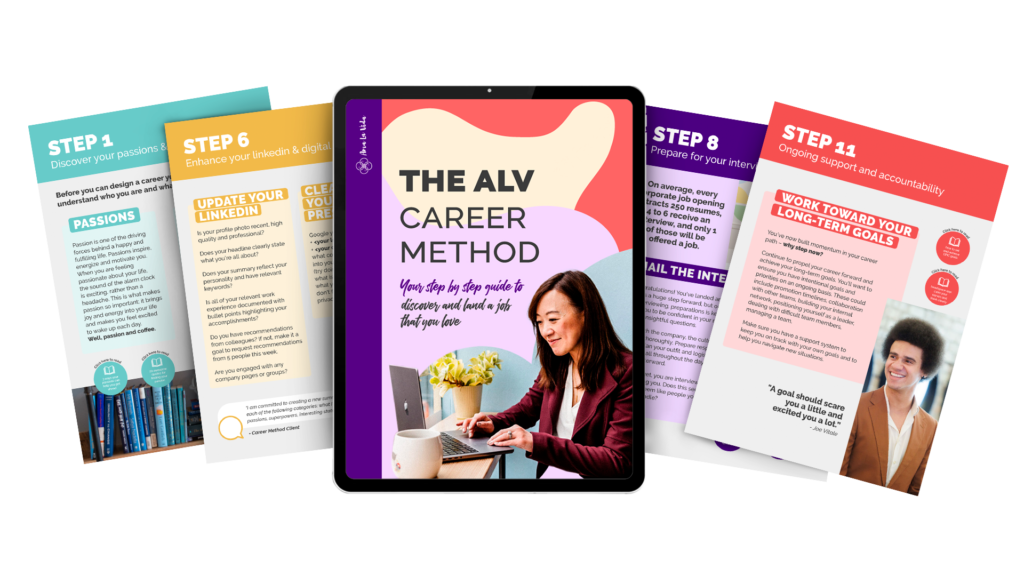
Download our comprehensive step-by-step guide to design and land a job you love!

Images from The ALV Career Method Guide
ALV Method Downloadable Guide

It’s November and the holiday decorations are already out around town and you think, “How can it be?!” Our Halloween costumes are still lying on our bedroom floors. You start to feel the subtle pit of dread in your gut. For many of us, the holidays can be the most stressful time of year. The planning and budgeting and shopping and cooking… and family. It can all be a bit overwhelming. So how can you find some sanity through it all and bring you back to the true meaning of the holidays? Avoid trigger foods Your first thought may be to grab for that glass of red wine to relax after running around and spending too much while shopping for loved ones. One glass is good for the heart, after all, right? But alcohol can actually exacerbate symptoms of stress and anxiety, after the good feelings have worn off. (Not to mention, zap your energy!) Caffeine, on the other hand, being a stimulant could possibly increase those “fight or flight” responses and contribute to worsening symptoms of anxiety. It’s no news that sugar can cause a roller coaster of energy, with highs and lows, causing you to spring for those unhealthy snacks to satisfy some craving. All of these can exacerbate the stress you are feeling. While your body is under constant stress, the hormone cortisol increases in production, which is associated with decreased regulation of inflammation, weight gain, and malabsorption of healthy nutrients. Be mindful of what you are putting into your body, and remember your body is way better at handling stress when it is fully nourished with vegetables, protein and healthy fats. Focusing on a balanced, wholesome diet, while avoiding the trigger foods, may give you the energy you need to take on the holiday season with greater ease. Get the heart pumping The better way to go is to start moving, even if it’s a brisk walk around the block. The fresh air alone could give you a moment of relief! Exercise can decrease the production of cortisol and increase the release of endorphins, the “feel good” chemicals. You’ll also feel good after a brisk walk or a run knowing that you didn’t choose the more unhealthy options discussed above! I know I’m proud of myself when I make the better choices! For those who say they don’t have time for exercise, let’s talk this through. If you “don’t have time,” it may be because you are neglecting yourself in some way. You’re not prioritizing your health or your energy. It’s admirable when you’re dedicating the bulk of your time to your loved ones, to your work, to anyone else but yourself. However, your energy will be drained, your stress will rise, and you’ll eventually realize (hopefully!) you are just as important. How are you able to give your best when you lack the energy? It starts with you making the decision that your health and your energy are valuable and necessary to giving your all to everyone else. Take 20 minutes a day for a brisk walk, or a run, or a swim or whatever gives you joy in movement. Hell, dance in your bedroom naked if it’ll give you the energy you need to take on the day! Take time for self-care So what if you really, really don’t have the energy to go for a run, let alone a walk? Tune in because this is the time your body is telling you to slow down. You may need to break out the essential oils and candles for a nice bubble bath. Not your thing? Maybe you just need to give yourself a break, be a bit more compassionate towards yourself and realize you can’t do it all in this moment and that’s perfectly okay. Take out the journal and write the first thoughts that come to mind. Make sure they’re kind! Maybe you decline an invitation, so you can spend less time traveling from one place to the next. Let go of any guilt you may feel by doing so. Ask for help if you need it or talk it out with a great listener. Maybe all you really need is just one family member to take on making the casseroles this year, or watch the kids for a bit while you relax with your favorite hot chocolate by the fire. That’s a lovely feeling to sit in peace and quiet, with a good cup of cocoa. Be mindful and breathe Before we begin to truly immerse in the beauty and true meaning of the holidays, slowing down is key. During times of stress, we may forget what makes the holidays so special, and taking a moment to breathe can be just what you need. When you become mindful of tension in your body or a fast heart rate, take a step back and use the 5-5-7 breath as a way to anchor yourself. Sit comfortably with a straight spine. With a slow and steady rhythm, inhale through the nose for a count of 5 seconds and hold for 5, then exhale through the mouth for 7. Repeat for at least two minutes or as many times as needed to slow the heart rate. The counting not only distracts you from your thoughts, but slow, deep breaths send a signal to your parasympathetic nervous system to turn off your sympathetic nervous system and “fight or flight” responses, and activate the relaxation or “rest and digest” response. (This is also helpful right before a massive holiday meal for slow, mindful eating!) The good thing about the 5-5-7 breath is that you can use it anywhere, at any time; while sitting in traffic, at the holiday dinner table (no one will even know!), or right before bed. Taking time to breathe, if even for two minutes, will help reduce those stressful feelings and instill calm when you need it most. Focus on gratitude Gratitude has a slew of benefits. Research has shown it can

Read More

Welcome back to our three-part series on the art of working from home. In October’s installment, we focused on how to be productive when working remotely. This month, we’re doing a 180 and speaking to those of you who can’t seem to disconnect when your work day is over. This is an incredibly common issue that gets magnified when there are no clear boundaries between work and home. If you find yourself nodding as you hear that telecommuters often work longer hours than their in-house colleagues, you’re spot on, and this newsletter is for you. Studies show that 45% of Americans check their work email after business hours, and people who are able to successfully unplug from work are more likely to be physically and mentally healthier. Read on for my top three tips I give to clients who can’t seem to shut off when work and home are in the same place. Create a done-with-work ritual. Without a commute, walk to your car, or even a door to close behind you that signals you’re leaving your office, it can be really hard to declare the workday over. To combat this issue, develop a ritual you use every day to mark the end of one part of your day and the beginning of the next. Some people like to change clothes (even if it’s just from one athleisure outfit to another), others will listen to an upbeat song and have a mini dance-party, and still, others take it one step further and literally get outside to have a breath of fresh air. It doesn’t matter what this ritual or routine looks like, as long as it helps you and your brain realize that work is over. Establish a dedicated work area, and only make use of it during work hours. In an ideal world, you’ll have a full office in your home that can remain untouched with the door closed outside of normal business hours. However, that’s rarely possible – and that’s okay! There are still tons of options to create a space that is officially for work only. You might be able to snag a corner in a guest room (or even in your own bedroom), or perhaps you can claim a closet as your office. When I worked from home one day each week out of a 500-square-foot apartment, I would simply take my big file folder out of my work bag and set it on the counter, and mentally declare that my workspace for the day. When the clock hit 5, I closed my laptop and put that file folder away. You might have to get creative with your work-from-home setup, but carving out your own space is so worth it. What’s most important is that you don’t use that space when you’re not actually trying to work. Purposefully disconnect, and let your team know about that plan. When working from home, the boundaries can get blurry. It’s easy to convince yourself to just get started on emails right when your alarm goes off instead of waiting until your normal work hours begin. However, just as most employees in a traditional office setting are expected to do the bulk of their work when they’re in the office, you also are allowed to set those boundaries even though your office is only 10 steps away from your bed. Set clear expectations with your team members and staff to let them know you’re reachable via all means during business hours (you can figure out what exactly that looks like for you) and by phone for emergencies outside of that window. Once you have those guidelines in place, stick to them! This is role modeling appropriate work-life balance and also giving yourself some freedom from being connected. Creating a leaving work routine is a powerful tool whether you work remotely, in an office, or a combination of both. This article has some really great ideas (I loved the Mr. Rogers comparison) to get you started. We can’t wait to hear what you come up with! If you are interested in learning more, here are some of our favorite resources: Folk Rebellion’s Instagram account focuses on “finding freedom, IRL.” Remote Office Tours: A Look Into 10 Home Setups of Remote Workers “It is essential to understand what is important or what is just perceived to be so.” 7 Beautiful Coworking Spaces that Offer Babysitting, Too

Read More

We are kicking off a new series called “9 Cool Jobs to Put On Your Radar.” Many of our clients come to us to support their journey to discover a new career path through our signature ALV Method coaching program. We’ve seen time and time again that it can be challenging to identify creative new job options that you haven’t already thought of. This series will help to get those creative juices flowing and to help you open your mind to new career possibilities. Many of these job postings will be inspired by the new chosen fields our clients have landed on through our career transition coaching. We hope you enjoy this series and find it useful! Our clients and community are looking for unique jobs in a fun environment. These jobs should reside within organizations which prioritize people and culture and provide exciting ways to make an impact beyond the mundane 9-5. We are particularly interested in positions which don’t neatly fit into an obvious career path box (e.g., doctor, lawyer, accountant). If you know of a job that you think would be great for us to share with our community of driven career-transitioners, you can submit it here for us to consider for a future post! Title: Senior Experience Design Consultant Company: Slalom Location: San Francisco, CA Why we like it: This position offers the variety and fast-paced nature of consulting with no travel! Slalom’s innovative consulting model is highly focused on culture and its people. This consulting role offers the opportunity to work with the Bay Area’s top companies on experience and design. Read more and apply here. Title: Yoga Retreat Leader Company: Trip Tribe Location: Multiple Why we like it: This is a great side-hustle option for yoga instructors or those with a passion for travel and a yoga teaching certification. Trip tribe also has the ability to lead a variety of different types of retreats which you can browse here. Travel to all of your bucket list locations with a group of other like-minded travelers and make money while doing it! Read more and apply here. Title: Product Manager Company: InVision Location: Remote Why we like it: Well remote work opportunity for starters! This position offers the opportunity to work cross-functionally and provides the satisfaction of seeing your work come to life. InVision offers a competitive salary and additional perks like a coffee house budget. Read more and apply here. Title: Process Improvement Manager Company: ShipBob Location: Chicago, IL Why we like it: This role offers a variety of experiences from process design to project management to implementation. You will work closely with cross-functional leadership in a growing startup environment. There is an opportunity for some travel and company stock options. Read more and apply here. Title: Client + Production Manager Company: Work + Shelter Location: Chicago, IL Why we like it: If you want to make an impact in women’s lives, this is an incredible opportunity for you. Work + Shelter produces customizable promotional items via its facility in India which provides job opportunities to women. This role will offer a lot of variety day-to-day, opportunities to travel to India and a great feeling of satisfaction knowing you are making a difference. Read more and apply here. Title: Senior Talent Development Specialist Company: West Monroe Partners Location: Chicago, IL Why we like it: West Monroe Partners provides the resources of a big firm but with a startup feel. In this role you’ll work with smart people, receive competitive pay and get to build out core curriculum and develop next generation of leaders. Read more and apply here. Title: Senior Environmental Designer, Experiential Marketing (3D) Company: Refinery29 Location: New York, NY Why we like it: Could we find a more fun company and a more fun role?! Join Refinery29’s experiential marketing team, and dive right into the exciting times happening in experiential events and installations like 29 Rooms. You’ll get to challenge your creative limits and see your dreams come to life! Read more and apply here. Title: Financial Analyst Company: DRW Location: Chicago, IL Why we like it: As DRW self-describes, this job lies at the intersection of finance and technology. The company has a great culture as evidenced by its Glassdoor scores and offers an interesting opportunity for those who want to use their analytical skills in an innovative way. Read more and apply here. Title: Email & CRM Marketing Manager Company: BlueMercury Location: Washington D.C. Why we like it: Hello… discounts! This role offers a unique combination of creativity and analytics. Live and work in DC’s cool Georgetown neighborhood and join a quickly growing beauty brand. This is the perfect marketing opportunity for you beauty junkies out there! Read more and apply here. Even if these particular postings aren’t exactly right for you, we hope they help you generate some new ideas and get excited about the job market. If you’d like to chat with a certified career coach on our team about your transition, fill out this form, and we will match you with the right coach for you. If you have a job opportunity that you think would be a great fit for our community, share it with us here!

Read More

Earning my black belt in taekwon-do was a true test of my strength and confidence. As with any goal, my journey to black belt had its ups and downs, and learning how to channel my inner badass guaranteed my success. The following 4 strategies to channel your inner badass will keep you feeling motivated and focused with any goal you aim to achieve. Enjoy! Visualize Success Seeing is believing! Studies cited in Imagery in Sports and Physical Performance support the benefits of visualization (also known as mental rehearsal) to improve mental and even physical performance. Many athletes like Michael Phelps and Tiger Woods use vivid, detailed imagery to prepare for their wins. Visualize a goal you want to achieve with as much detail as possible – the more you rehearse it the more real it will become, and the more prepared you will be for your actual performance.  Know your Purpose No matter how confident or motivated we are, we all get tested from time to time and find ourselves stuck. Knowing your purpose (i.e. why you want to achieve your goal) and reminding yourself of it will keep your inner badass on track and going strong. Find a physical “anchor” that reminds you of your purpose and carry it with you wherever you go. A picture or a small object are a couple ways to help your inner badass stay focused.  Move your Body One way to channel your inner badass is by moving your body. Envision your better self, then act the part! How does your inner badass stand (hunched over or straight and tall), breathe (short and shallow, or deep and relaxed), and talk (speaking softly while looking down, or speaking confidently with eye contact?) Embody your inner badass and you will naturally start to feel like your true badass self. According to the Association of Psychological Science, something as simple as smiling has been proven to induce happiness and reduce stress. I encourage you to try this one simple step today! Shift your Focus Asking yourself the right questions can shift your mental state from negative to positive, from stuck to unstuck. When in doubt, ask yourself questions to help get you focused. For example, what would your inner badass do now? What’s important to focus on in this moment? Let these answers be your guide when you’re feeling stuck!  This is why partnering with a coach is such a powerful tool to help you achieve your goals. With any Ama La Vida one-on-one coaching session or online eCoaching program, you are guided through self-reflective questions to gain clarity and focus. This is exactly what your inner badass needs to kick self-doubt and lack of motivation to the curb! In the months leading up to my black belt test, I mentally rehearsed passing the test every day. I carried a picture of a black belt with me everywhere. I created my own power pose to combat feelings of self-doubt. I asked myself “What would badass black belt Sara do?” any time I was uncertain of what to do next. Each of these steps helped lead to my greatest accomplishment, and I look forward to what these steps will unlock for you. If you are ready to unleash your inner badass, elevate your mindset, and realize your potential, schedule your free coaching consult with me today! I look forward to connecting with you!

Read More

For years, researchers and business analysts were baffled by the success of leaders who weren’t traditionally seen as capable of achieving greatness. They weren’t the smartest on paper, or they weren’t the loudest and most engaging person in the room. We’ve now been able to hone in on that “secret sauce” behind some of our most inspiring leaders. They have what social scientists call emotional intelligence. This incredibly important attribute can lead to improved communication within teams, better understanding of client needs and even an impact on the quality of healthcare. Emotional Intelligence So what exactly is emotional intelligence? Its vital components can be summed up by two competencies: personal competence and social competence. Personal competence focuses on self-awareness (accurately identifying your emotions as they arise) and self-management (the ability to use that awareness to act in a positive and flexible way). Social competence focuses on social awareness (correctly identifying the emotions others are experiencing) and relationship management (using your self and social awareness to manage interactions and relationships). Here’s some good news: emotional intelligence is a skill that can be intentionally developed! Here are a few ways you can take your EQ for a test drive: 1. Observe your thoughts and feelings during times of calm and times of stress.  We so often rush between commitments, and avoid truly experiencing our feelings. Simply noticing how you feel can help you develop that vital skill of self-awareness. A helpful tip is noticing and not judging your feelings! 2. Notice how those thoughts and feelings affect your actions.  If you’re feeling overwhelmed, are you more likely to snap at your colleague? When you get long overdue praise and are feeling proud and thankful, are you all smiles even in rush hour traffic? Developing an awareness of the connection between your thoughts and behaviors will help you practice meaningful self-management. 3. Put yourself in someone else’s shoes.  Empathy is a powerful tool in practicing social competency. As Brené Brown breaks down sympathy versus empathy. Sympathy sounds like, “I see your pain” while empathy sounds like, “I feel your pain.” Being vulnerable with others (heck, even with ourselves) can feel like a tall order and maybe not even something that belongs in the workplace. But our ability to deeply connect with others helps to build longstanding connections, improves communication and leads to increased employee satisfaction. It pays to be kind, friends.   This week’s challenge: Start by taking Harvard Business Review’s Emotional Intelligence Quiz. These questions might feel strange, especially if you’re not used to talking about feelings or emotions in the workplace. When you obtain your results, take a few moments to really reflect. Ask yourself: are you where you want to be when it comes to this vital workplace (and, let’s be honest, life) characteristic? Take a moment to celebrate your successes and also identify areas of improvement. Then – you knew this was coming – set a clear and achievable goal to get better. You’ve got this. We know you want to learn more. Here are some of our favorite additional resources: Why good leaders make you feel safe (12 min TED Talk) “Want to be happier, healthier, and more physically attractive? Be kind.”(5 min article) Be kind to yourself (and others) by using the 10/10/10 rule made famous by Warren Buffett (5 min article) “Emotionally intelligent entrepreneurs are more successful.” (8 min article)

Read More
woman looking at computer working remotely

The traditional office environment is disappearing with remote teams and the gig economy taking over. Recent studies show that 63% of employers have a remote team. Also, Gallup research indicates that those workers and spending more and more of their time working remotely. This talent structure has many benefits: flexibility, time saved not commuting, can hire the best talent wherever they are. It also has its challenges. If you are leading a remote team, you have to adapt your managerial style to accommodate the new format. You don’t have the luxury of swinging by someone’s desk to ask a quick question or keeping a pulse on the team’s morale by just seeing how they are acting. It requires much more intentional effort to keep your team happy, engaged and high-performing. At Ama La Vida, our team is almost 100% remote. Our coaches are spread out through the US. So we not only are separated geographically, we are also operating within opposite time zones. We’ve learned a lot over the past couple years about how to manage this most effectively and how to still create a strong workplace culture even though we are miles and miles and miles apart. *Map of locations of our US-based team Be intentional. Strong corporate cultures of any kind typically don’t just happen on their own. It takes a concerted effort to cultivate the type of culture you want see. Write down what you want your team’s culture to feel like. Base this on your organization’s values and your own leadership values. Then think about how you can reinforce those values through your actions. For example, if you want to create a really collaborative team culture, then you need to think about how you can facilitate collaboration and how you’ll recognize and reward it when it happens. This is true of any environment, but the actions required in a remote environment will look different. To get started, write down the top 5 values you want your culture to demonstrate. And come up with one action you will take to help reinforce each. Make (more!) time for one-on-ones. When leading team members remotely, you don’t have the ability to sense someone’s mood by being around them. They can’t stop by to ask a question, so they might hold back and wait for a meeting to ask. This makes it more difficult to see how people are feeling and how they are progressing on their work. You can also become a bottleneck in their workflow. Now more than ever, making time for one-on-ones is critical. Some things you’ll want make sure you cover: How they are progressing on their tasks. Of course it’s always important for you to be in the loop on your team’s progress and to give them an opportunity to surface any questions they have for you in order to proceed. However, in a remote team structure, they may actually be waiting for your one-on-one in order to speak with you about their work, so it’s important that you meet at regular intervals. How they are feeling. Are they stretched too thin? Bored? Are they feeling disconnected? This is something important to check in on every now and then with every employee. But when you don’t have body language and visual cues to alert you, you simply have to ask! Work times and outside commitments. A true beauty of remote work is flexibility. But without fully understanding someone’s schedule you may reduce your assessment of their commitment to whether or not you see some sort of green light showing that they’re online. To avoid assumptions, make sure you ask. Do they need to take a break to pick up their kids from school but come back online later? Do they have doctor’s appointments the first Monday of the month? It’s be helpful for both of you to share when you’ll be offline, so there’s no guessing game. How the working relationship can continue to improve. You don’t need to discuss this in every single meeting. But it it will benefit both of you to periodically reflect on what’s working well and what could be better. Maybe you have an idea for how they can provide more transparency around their tasks between check-ins. Or maybe they have a request for how you can be more available to support them. It’s important to continue to refine these things to ensure you are working as happily and productively as possible. Utilize a collaboration platform. Slack. Need I say more? There are a variety of online collaboration platforms, but we are completely in love with and dependent upon Slack. For those of you who haven’t used it, Slack is like an instant messenger. Except your conversations are organized by topic and don’t disappear. It has a ton of bots and integrations that can make your life a lot easier as a remote team. Everything from tracking PTO to ordering Taco Bell. For example we have it linked to our calendars so we can see when our team members are in meetings and know not to bug them. We also have it linked to our CRM, Insightly, so when a new client signs up we get a notification publicly, and we can all celebrate that a new client has come on board. *Screen shot from a real Slack chat Soapbox is a platform we recently started using to organize content and action items for team meetings and one-on-one catch-ups. You can connect Soapbox to your calendar so that everything is in sync. You can also connect it to Slack so your team is notified of upcoming meetings and action steps. This makes it easy for them to share agenda items directly from Slack. Regardless of which platform you choose, remember it takes time for people to get comfortable and use it habitually. Don’t worry if it’s crickets for the first couple months. Keep reminding people of what it is, how it will help with collaboration and productivity and how

Read More