Category: Mental Health

Two people walk into a bar… The first sees less than ideal lighting. She sees a drink list that doesn’t exactly excite her. She hates the flooring. It doesn’t seem like her crowd. The bathroom is a little dingy. She has all fair points. The second person notices that the bartender knows everyone personally and remembers their drink orders. She sees they have a popcorn machine – she loves popcorn. She sees people enjoying playing pool together and friends catching up – she excitedly tries a new beer she hasn’t had before. Sorry to those of you who were waiting for a hilarious punchline. Unfortunately, this story isn’t a joke; it’s a reality. The bar is neither good nor bad. The bar is exactly what you perceive it to be and a direct reflection of your mindset.  Maybe person one just really hates dive bars. That’s fine. Maybe she’s had a bad day. That’s fine too. But the fact of the matter is, one way or another she has found herself in the bar, and she has a choice to either embrace it or denounce it. We are constantly exposed to massive amounts of data about our surroundings and experiences. We are in control of which pieces of information we internalize and use to form our opinions. And our mindset as we process this information will shape whether our opinions and experiences are positive or negative. As we learned last week at our Weducation event with Coach Libby, mindset is everything. We learned 7 different mindset levels all the way from self-pity to complete transcendence. Unless you plan on spending  A LOT of time meditating, your goal should be to spend most of your time somewhere in between. There is certainly a time and place for realism. There is an appropriate time to feel sorry for yourself and grieve. And there are times when you need to get angry to be able to move forward. And there are times when caring for others is a noble cause. All mindsets have an appropriate time and place, but the question is, which do you want to be your default? Where do you want to hang out? Two people walk into a bar. Which person has more fun? Which feels better? Who do you want to be around? Two people walk into a bar. Which one are you? This week’s challenge Print out the mindset chart from above, and keep it handy throughout the week. Reference it throughout the day, and determine in which level you reside most often. Assign a daily breakdown to how much time you spend in each mindset level. At the end of the week assess: Is the breakdown what you thought it would be? Is the breakdown what you’d like it to be? How can you catch yourself when you are going into a less desirable mindset? What helps you to elevate to your desired mindset?

Read More

This May, more than ever, I’ve seen many social media posts, marketing campaigns, and articles talk about Mental Health Awareness month. When I read these posts, I can’t help but wonder why it’s only acceptable to feel the feels for 31 days out of the year and not the rest. Our culture tells us that we must appear put together all the time. But there are days when the struggle is real and all we want to do is reach for that cookie, that extra glass of wine or whatever it is that helps us stuff our feelings away. As I’ve gotten older, I’ve realized that people go to great lengths to appear put together because we’ve been told that showing emotion is weak. In the past, when someone would try and share their bad day with me, it made me uncomfortable and I used to shut the conversation down by saying things like “hang in there” or “stay positive.” I now realize saying this only makes things worse. It doesn’t create a safe space for the person who wants to share because we’re telling them it’s not okay to have a bad day. Now, I celebrate my bad days by really sitting through the emotions vs. reaching for something to stuff them away. I also don’t pretend to have it together and give myself a break when I do have a bad day. Here are the three steps that I follow when I’m having a bad day: 1. Don’t Stuff, Feel the Feels My favorite thing to do when I’m having a bad day is to write it all down. Whether it’s on a napkin or in my journal, whatever it is, I just start writing. This helps me release the feelings instead of trying to avoid them by distracting myself. The other thing I like to do is go for a run or lift weights. Both allow me to release the negative energy and practice self-care. If journaling or working out isn’t your thing, listen to a sad song. I used to do this a lot when I was going through a difficult time. Listening to a sad song would always get me to start crying which was a very cathartic way of releasing the emotions. It allowed any weight that I was subconsciously carrying to melt away. It doesn’t matter what your go-to is, but find a healthy way to sit with your feelings and release them. While can be uncomfortable, it always works. 2. Have A Q&A Session With Yourself While I’m journaling or working out, I’ll see that the reason why I’m feeling the way I am is because I’ve been triggered. Whether it’s an old memory or something else, we all have our triggers. Even when we think we’ve worked on them or handled them, they sneak up on us. When I write things down or I’m “pounding the pavement”, I can see why I’m upset or anxious and that allows me to have a dialogue with myself. The first question I ask myself is “what emotion am I feeling?” Is it anger, sadness, fear, disappointment? Giving the feeling a label starts to identify where it might be coming from. The next question I ask myself is “what past event or situation is this bringing up for me?” Once I start to have this Q&A with myself, I can start to see where my feelings are coming from and I can start to do something about it. The Queen of running from my feelings, I used to just let things sit or avoid them. I’ve learned that the feeling only comes back over and over again no matter how much I try and run from it.  Turn inward and start to have a Q&A conversation. 3. Talk to Your Tribe/Trusted Advisor One of the best lessons I’ve learned is knowing who’s part of my trusted inner circle. These are the people you can count on to be there when the struggle gets very real. Cultivating these relationships takes a long time but think about who’s a part of your tribe. It doesn’t have to be a lot of people, it can even be one person like a family member, best friend, therapist, mentor or life coach. But when you’re having a bad day, you should be able to openly share how you’re feeling without judgment or shame with at least one person. It’s taken me a while to find the winning combination of steps to deal with a bad day and feel the feels, but it’s been incredibly helpful. We all have our bad days and it’s completely acceptable. What are some of the ways you deal with a bad day? Leave a comment below! To learn more about mental health and to find resources visit: https://www.mentalhealth.gov/

Read More

Did you know that May has officially been “Mental Health Awareness Month” in the United States since 1949? Yeah, me either. I find that both terribly sad and wildly exciting. Sad because something so important took 70+ years to gain attention, and exciting because finally, mental health awareness is getting the spotlight and voice it deserves. Mental health is so critical and so close to my heart that trying to pinpoint the correct words and tone is difficult. So, I’m going to write this article under the lens of being something I wish I could have read when I was 20 years old and thought I was losing my mind. This is My Story: The newly coined term “Sunday Scaries” resonates to my core. I remember as a child I would cry, meltdown, even make myself sick because I couldn’t handle the anxiety of going to school on Monday. I’d get so angry with my parents for their lack of understanding and convince myself that it was all their fault, but I would always go and it would always be fine. I can remember passing notes to my best friend in Junior High and asking her on a daily basis if I was still her best friend. She would get so annoyed by being asked the same question repeatedly, and honestly, I can’t blame her. I recall lying awake at night in my childhood twin size bed with quiet tears streaming down my face as I contemplated my parent’s impending deaths. These are definitely not normal behaviors for a young girl to have, but I didn’t know that. I had always been a stellar student and the majority of the pressure to succeed was put upon myself by myself. Going to University was no different. I studied hard and excelled, but something happened when I was 20 years old that would forever change the shape of my life. I’m not sure if it was a mental break down or a panic attack, but it was for sure alarming. I skipped class (something I’d never done, ever), was crying inconsolably, felt paralyzed with fear, and called my parents to let them know that I just didn’t think I could finish school. I was absolutely overwhelmed and totally losing my grip with reality. The details are hazy now, but I know that I ended up in a doctor’s office. I told her how I felt completely crippled and emotionally out of control, but I couldn’t express why I had these feelings. There was nothing happening to me that was particularly horrible. I was going to school, seeing my friends, living in a sorority house, had a long-term boyfriend – life was good. There was nothing to create this horrible sense of dread. She then explained to me how NORMAL this was, especially for people my age…Normal…Something I’d never felt farther from, but so calmed by the reassurance. She gave me some stats that I can’t remember now and ultimately told me that I was suffering from Generalized Anxiety Disorder and prescribed me medication. It changed my life. Finally, FINALLY, I started to feel relief from emotions and sensations I had never pinpointed because I had no idea I had practically been in a permanent state of Fight or Flight. I was happier, I could handle stress and deadlines with so much more finesse, and I could focus! It was truly a miracle. Fast-forward about 5 years to when I decided I was cured. I had a very successful career, a beautiful apartment, friends and family who loved me, a new puppy – life was awesome! Clearly (I thought) I had outgrown the need for this “crutch”. I was stronger than a pill! So I took myself off of my miracle medicine (NEVER DO THIS WITHOUT DOCTOR ASSISTANCE). I began to feel “zaps” throughout my body like being momentarily electrocuted, I had blips in my vision, and bouts of dizziness. I chalked this up to being dehydrated or sleep deprived (seriously, Ashley?). Then one day, a couple of months after I stopped the meds, I found myself in such a depressed state that I couldn’t get out of bed or even shower. I called in sick to work. I stayed inside. And I didn’t tell anyone. My mom discovered me this way and marched me back to the doctor where they put me right back on medication. And what do you know, in a few weeks time I was sorted. I really struggled with the realization that I was incapable of helping myself. Here I am a smart, strong, independent woman that can’t function properly without a pill – how embarrassing, how weak, how devastating. HOW WRONG! The Stigma: 20 year old me was embarrassed by my new diagnosis. I didn’t tell a single soul besides my parents that I now required a pill to make me feel “normal”. I didn’t talk about anxiety or depression with anyone. The thought that someone else out there – a friend, a classmate, a stranger – could be suffering just like I was didn’t enter my mind. I didn’t understand that my embarrassment and secrecy was a part of a much bigger problem, The Stigma. To be honest with you, I had to look up the meaning of the word stigma. I thought it meant something like “perception”, but it is so much more than that. Even more shocking is that I’m guilty of its perpetuation, but no more! Stigma – adj. – 1a strong lack of respect for a person or a group of people or a bad opinion of them because they have done something society does not approve of; 2a mark of disgrace associated with a particular circumstance, quality, or person; 3a mark of shame or discredit I would say that I’m personally guilty of the third definition, feeling shame. To this day I still struggle with feelings of inadequacy and questioning why I can’t properly function without the help of a

Read More

For years after college, I struggled with negative moods due to uncertainty on where my life was headed. I started questioning whether I was living my best life. What were my values and was I living in alignment with them? What does it look like to live authentically? Not knowing the answers and still struggling, I was diagnosed with a chronic illness, on top of my discontent. Once your body is hit with a debilitating illness, there’s no choice but to address the underlying issues. Once symptoms were under control, I was able to truly investigate how I was living my life. I looked at each area (physical, social, professional, financial, etc.) and addressed many issues that I had been neglecting: For me, living a more authentic life lead to greater health, presence, joy, and gratitude. So, what is authenticity? Authenticity is the feeling that you are living according to your true self and in alignment with your values and identity; you are not trying to be someone you’re not for the sake of others around you. Brene Brown, psychologist and researcher, has defined authenticity as, “the daily practice of letting go of who we think we are supposed to be and embracing who we actually are, by cultivating the ability to be imperfect, allowing ourselves to be vulnerable, and setting boundaries.” Psychologists and researchers suggest authenticity plays an important role in well-being, and being inauthentic can negatively affect mental health. Many studies have shown that people living more authentic lives report more positive emotions, greater happiness, and higher self-esteem. They also report lower stress, anxiety, and depression. Authentic behavior also leads to better relationships. Fear of rejection can cause people to avoid expressing who they really are, therefore hindering the development of meaningful relationships. Brown states, “In order for connection to happen, we have to allow ourselves to be seen, really seen.” In her research, Brown found that those who felt most connected to others and satisfied in their relationships were able to stay true to themselves. “As a result of authenticity, they were willing to let go of who they thought they should be in order to be who they are.” 1. How can you cultivate more authenticity in your daily life? Identify and prioritize your values. If you need help, try this Values Assessment worksheet. Health became my number one priority, so I focused on nutrition, exercise and stress reduction. It became important for me to find ways to be more peaceful and content, so I had the capacity to be at my best not only for me but for others. It’s important to identify what takes precedence for you, so it can help guide your daily actions. 2. Build self-awareness by observing yourself. With your values in mind, pay attention to how everyday situations make you feel. I began to look at how I treated my body: what food made me feel sluggish or energetic, how lack of exercise affected my energy. I discovered through trial and error I felt my best with a combination of yoga, running, and high-energy foods, while avoiding that which zapped my energy. 3. Practice values-based mindfulness moment to moment. Mindfulness is key in making any positive change. When we slow down to take a moment to breathe, we can tune in more directly to how we feel, physically and emotionally. Our bodies provide valuable feedback and can help you determine if the present moment is aligned with your values. 4. Let your values and intuition, your inner compass, guide your decisions, actions, and interactions with others. When we get in the practice of being mindful, it becomes easier to notice when something isn’t right or when we’re making the best decision for ourselves. I started to shift my old, negative habits, by creating new ones that aligned with my goal of living a healthier life. Ask yourself, what negative habits are holding you back? What can you replace those habits with? What will help you live authentically and in alignment with your values? 5. Speak your truth, without fear. Ask for what you want or need, and maintain your boundaries. Saying “no” can be difficult if you’re in the habit of people-pleasing. But what if your saying “yes” goes against your values? How do you feel in that moment? Sometimes the situation calls for your authentic self to show up and create those boundaries based on what you need to stay true to yourself. In order to live authentically, you have to know and communicate your boundaries. 6. Express vulnerability. Brown suggests re-framing what vulnerability means. Rather than perceiving vulnerability as weakness, embrace it as a brave and courageous act. Finally admitting I was neglecting certain areas of my life gave me the opportunity to ask what I truly want for myself. Who do I want to be and how do I want to show up for others? Being vulnerable was the catalyst for significant change. It’s not easy, but it’s worth it. When I decided to prioritize my health, compassion for myself, and loving-kindness for others, my well-being improved. I learned how to be present and joyful in everyday moments – I learned how to live authentically and true to myself. Cultivating authenticity has the potential to enhance well-being and happiness. I hope these tips can help you on your journey to living your truth. If you’re ready to live more authentically and aligned with your personal vision and purpose, book a free consultation to get matched with a life coach.

Read More
spring time with flowers

Did you let out a big sigh of relief last Wednesday? I know I can’t be the only one who is ready for a change in this ridiculous winter weather. Spring is officially here, and with this new season comes longer days, less hurried walks between the car and the office door, and a reminder that growth and change are underway. You know I couldn’t make it through a time of transition without a newsletter talking all about it, right? Here are my thoughts on what spring means to me, and suggestions on how to embrace all that this season has to offer no matter what stage of life you’re in. Release what is no longer serving you. Spring cleaning doesn’t just apply to your physical space – it applies to your personal life as well. Throw open the windows of your mind and let go of what you don’t need. Negative self-talk that holds you back from taking the next step in your love life? A half-finished resume that isn’t landing you any interviews? A cluttered workspace that distracts you from getting into the zone? Whatever doesn’t have a purpose or a place is worth considering whether it’s truly worth the space and effort. Plant seeds that will grow into flowers. When I think of spring, I imagine strong and steady development. As the season passes, the magic of what’s been brewing underground – complicated systems of roots, nutrients, soil, and water – begins to poke upwards toward the sun and reminds us that good things are worth waiting for. Consider this time as preparation for things your future self will thank you for. Want to be in a new role by summer? It’s time to tighten up your application materials. Dream of being healthy enough to chase your kids around the yard until they wear themselves out? Lace up your shoes and get moving. Practice patience as you form habits that will build upon themselves. Know that the work you are putting in today will pay off – and enjoy the process along the way. Connect and celebrate the ties that bond us. With winter officially on its way out, it’s easier to make and keep plans without weather getting in the way. Now is time to emerge from your cocoon and reconnect with the ones you love. Remember that function is more important than form, so if your house isn’t perfect or your meal isn’t Martha Stewart approved, it’s all good as long as you’re acting from a place of love. Some of my favorite ways to connect in the spring are potlucks with friends (what light and fresh recipes have you been eyeing?) and networking with folks in my industry (this includes mentorship, taking continuing education classes, and attending events to meet movers and shakers in my field). Shake off the dust and get out there. Cheers to winter for the coziness and slow moments it brought, and welcome spring in all its new and bright and sunny (!!) glory. –Coach Teague This week’s challenge For each of the three categories above – releasing the excess, focusing on personal growth, or strengthening connections – choose a meaningful and achievable goal that you can accomplish within the next week. Feel overwhelmed by the prospect of doing something outside your comfort zone? That’s okay – it’s where the magic happens. Starting now, you’re a person who gets things done even when they’re not easy. (Bonus points if you forward this email to a friend and work on your goals collaboratively. Teamwork makes the dream work!) We know you want to learn more. Here are some of our favorite additional resources: “Virtually every time I push my clients to go deeper with their gathering’s purpose, there is a moment when they seem to wonder if I am preparing them for World War III. Yet forcing yourself to think about your gathering as stand-taking helps you get clear on its unique purpose.” A 6 Step Guide to Spring Cleaning Your Social Media Feeds, because our closets aren’t the only cluttered spaces “My question is what, if anything, is wrong with being chilly? It seems like a good, efficient way to get along.” Spring Cleaning: Meditation to Tidy Up the Mind (initiate zen state now!) Declutter your life and make room for possibility (by ALV Coach Erin)

Read More

I sometimes think of my brain like a cul de sac. There are let’s say 10 houses around it, and each one is a component of my life which is currently demanding my attention. Refinancing my house has a spot. Taking the dog that won’t stop puking to the vet – that’s got one right now too. Planning that trip with my parents – haven’t done any maintenance to that one in a while, but I know it’s still there. Running ALV – that’s a big, gaudy mansion that you just can’t miss. There are only so many spots. I can only fit so many things in my brain before it feels like it’s going to explode. Something needs to clear out of a spot before I can let something else in. My husband doesn’t operate like this. He’s a dabbler. He likes to have a million little apartments sitting on his cul de sac. Each day 3 or 4 will grab his attention, but none are so demanding that they require all of his energy. Neither system is right nor wrong. It’s simply how different people function and prioritize. The problem with my cul de sac, however, is that there’s a toxic pollutant in town. Guilt. It’s a thick smoke that can permeate the walls no matter where I am. When I’m worried about spending too much time in one house over another, the guilt seeps in. Feeling bad about all of the things that don’t even currently have a spot on the street? Guilt again. I’d argue that when most people, women especially, become parents, the toxicity of the guilt becomes a crisis. Even for the dabblers. No matter where we are, we’re blinded by the smoke, feeling constantly that we’re doing something wrong. Or not doing enough. An important component of minimizing guilt’s impact is understanding your values and ensuring that the things you allow in your cul de sac, and the corresponding size of each, is a reflection of those values. But I think a bigger solution is just giving ourselves a gosh darn break. We are doing the best we can. We are running this thing with no manual. We are focusing on the things that are most important to us at that time. Why should we feel bad for that? Like mine, guilt may always have a presence in your neighborhood. But please, let’s stop letting ourselves be consumed by it. This week’s challenge Figure out the top 5 things you want in your cul de sac right now. Take a look at your list of values, and determine which 5 things are the most direct reflection of them. For everything else, practice saying no. And practice allowing yourself to say no without feeling guilty about it. We know you want to learn more. Here are some of our favorite additional resources: Read: 5 Tips for Dealing With Guilt Watch: 9 TED Talks to Liberate You Prioritize Your Time: Being Involved or Overcommitting and How To Tell The Difference Read: Daring Greatly, Brene Brown Did You Miss Our Latest Coaching Corner? In this video, Coach Danielle talks about how many employees don’t feel appreciated at work and a few ways to increase that number.

Read More

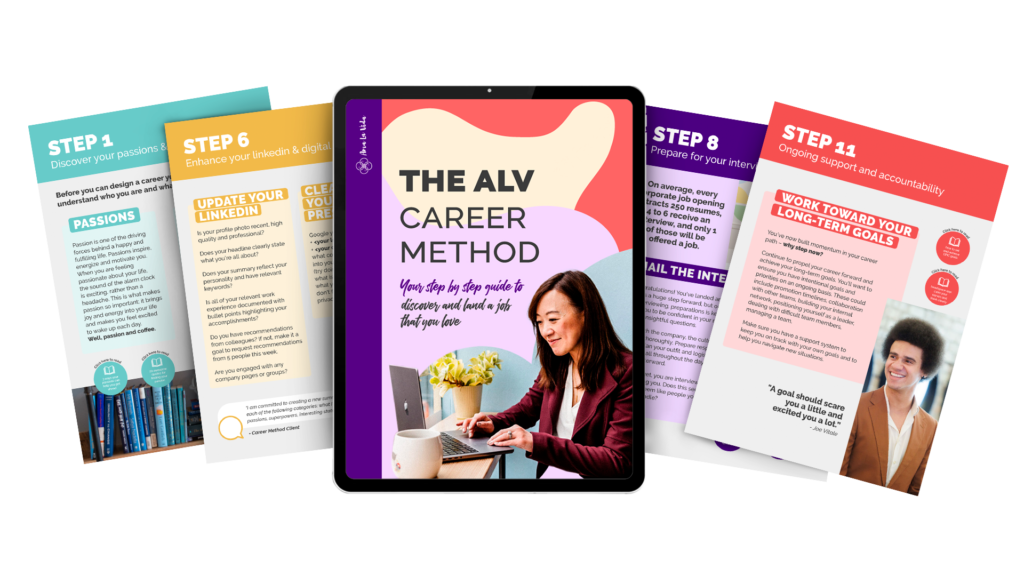
Download our comprehensive step-by-step guide to design and land a job you love!

Images from The ALV Career Method Guide
ALV Method Downloadable Guide

I finally learned how to prioritize my health and wellness after 20 years of struggles with weight, shame, and self-doubt. I am so grateful for all the ups and downs in my journey. They have truly helped me learn how to embrace life to the fullest. Through much trial and error, I learned the right strategies to elevate my health. While there are so many ways we can improve our health and wellness, the following three are the tips I find to be the most impactful for me. Enjoy! Create a Morning Routine The first of our health and wellness tips is creating a morning routine. Most of us begin each day dreading the buzz of our alarm clock. We hit snooze as many times as possible before we begrudgingly start our day. Instead of rushing around doing the basics, try adding some extra time (all you need is 5 minutes) to create your own morning routine. This routine is all about you and doing things you enjoy. Some ideas include reading a good book, listening to a podcast, journaling, or exercise. When you have something to look forward to in the morning, it makes getting up actually enjoyable! (And bonus – you will feel more productive and energized too!) I recommend reading Hal Elrod’s The Miracle Morning: The Not-So-Obvious Secret Guaranteed to Transform Your Life (Before 8 am) if you want to learn more about developing your own Miracle Morning. Prioritize Sleep The second of our health and wellness tips is prioritizing your sleep. According to the National Sleep Foundation (NSF), sleep is essential for a person’s health and wellbeing. And I couldn’t agree more. The latest Sleep in America 2018 Poll highlights this disconnect between the value of sleep and our reality of not making it happen. While most Americans know sleep contributes to the next day’s effectiveness, only 10% of people are prioritizing it. While our individual sleep needs vary, figuring out the average amount of sleep that is best for you (and scheduling that time in) is key. For example, I plan my schedule (as part of my morning routine) to include eight hours of “in-bed time”. If I fall behind my schedule, then I shift the next day as much as possible to maximize sleep. While some of my “in-bed time” is used towards winding down (like reading or listening to an audiobook), I often fall asleep fairly quickly and can count on getting at least 7 ½ hours in. I also recommend turning off your screens at least one hour before bed and creating a simple evening journaling routine. I also take a few minutes to write down what I am grateful for and jot down any to-do items for the next day. This helps clear my mind and de-stress before bedtime. Meditation The third of our health and wellness tips is meditation. Meditation is becoming increasingly popular as more people realize its benefits. A meditative practice is a process of habitually training your mind to focus and redirect your thoughts. There are many ways you can go about meditating, and it can be as simple as taking a few depth breaths to focus on the moment. According to findings from Johns Hopkins University, meditation can help ease psychological stresses like anxiety, depression, and pain. Personally, I enjoy meditating using my headspace app each morning. I also focus on taking a few deep breaths throughout the day anytime I start feeling stressed. This pause helps me get grounded and allows me to disconnect from any thoughts that aren’t serving me. Health is a “state of complete physical, mental and social wellbeing” as defined by the World Health Organization. This definition highlights an important shift we are taking towards a proactive approach to health and wellness. By proactively focusing on your health, you benefit by also improving your overall well-being and quality of life! Who doesn’t like the sound of that? Knowing where to begin can be tough. That is why partnering with a coach is such a powerful tool to help you achieve your goals. With Ama La Vida’s health and wellness coaching, you are guided towards true transformation through self-reflection to gain clarity and focus. This is exactly what your best version of you needs to combat self-sabotage, create healthy habits, and harness your personal power! If you are ready to elevate your health and realize your potential, schedule your free coaching consult with me today! I look forward to connecting with you!

Read More

Is it hard for you to say no? Do you sometimes find yourself spending an excessive amount of time making your work products just right? Are you commonly rushing from one task to the next? Do you commonly neglect celebrating yourself and your successes? If so, congratulations! You might be a perfectionist, you are most certainly a human being, and you fit right in with the overachievers here in our ALV community. The thing about responsibilities, though, is that they will just keep coming whether or not we have the time or mental capacity for them. And, if you have a dream or a vision or a wild passion, you don’t want them to stop! However, a growth-oriented life doesn’t mean you have to run yourself ragged. Sure, you might have late nights or stressful days, but those can’t be the norm – they simply aren’t sustainable. It helps to have strategies that combat the need to always-be-doing. For me, I need to constantly switch up my routine. A tool that helped me refocus a month ago might not be what I need right now. In case you’re someone who also benefits from a ton of tools in your toolbox, I’ve included some of the ways I’m slowing down below. Taking 60 seconds for deep breaths. When I set this goal for myself, I felt overwhelmed by finding the time to fit it in – and then almost immediately, felt like that was the wake-up call I needed. Even one simple minute of deep breathing or mindfulness can make a huge difference in my day. At work, I’m a go-to for lots of issues, so it can be hard to have uninterrupted time. My strategy has been to set timers – 4 throughout the day, scheduled around meetings and other obligations – and when those go off, I take a quick walk to fill up my water bottle or escape to the restroom and make the time to breathe. Practicing time blocking. We’ve all seen the articles that warn us about multitasking – specifically, that it doesn’t work. Argh! Time blocking is a powerful alternative that helps me actually get things done. In a nutshell, time blocking is the simple practice of dedicating certain amounts of time (I work best in 1-3 hour time spans) on a single task or project. This helps to keep your attention on what’s truly important instead of being faced with constant distractions and task-switching. At the beginning of each week, I look at the projects I need to complete and find blocks of time in my schedule (rare!), then physically set a block on my calendar to work on them. When the time comes, I turn off email, put on a playlist that gets me in the zone, and fully turn myself over to the work. Getting enough sleep. I can’t overstate the importance of sleep for my personal productivity. I don’t notice a huge burst in energy after my second cup of coffee, but I do fall victim to the 2 pm slump if I haven’t gotten enough rest the night before. I also notice that in general, I have a harder time concentrating and digging into my creative side if I’m feeling sleep deprived. Making sure that I’m getting enough zzz’s can require some sacrifice – perhaps I shorten (or skip!) my workout, I grab healthy takeout instead of cooking dinner, or my dirty laundry sits in the basket for another night. Once I’m back on track with my sleep, I can get back on track with everything else in life. Life happens, and that’s what’s exciting and beautiful about it. It’s okay to take a step back to remind yourself of what truly matters. Don’t be afraid to slow down, recharge, and get ready to dig into the work that’s really important. This week’s challenge This one can be done right here, right now. Get your phone out and set a timer for 60 seconds. Close your eyes, breathe, and allow your thoughts to wander where they may. When the timer goes off, take your final deep breath – and then get back to work. In our insanely hectic lives, getting one minute to yourself to simply be is such a treat. Give that gift to yourself. Repeat as necessary and reap the benefits. We know you want to learn more. Here are some of our favorite additional resources: Unpacking this controversial concept: “Finding the type of self-care that resonates with you is key. But what comes next?” Yes, it’s awkward. Yes, you still need to do it: 4 Mindset Changes That’ll Make Networking Feel Way Less Fake and Horrible Listen, implement, repeat: On Saying Yes If you’re in it for the long haul: Toxic Workers Are More Productive, But the Price Is High

Read More

The practice of yoga is dynamic. Yoga offers strength and lessons that can be adapted to many areas in our lives.  Yoga has become integrated into our culture as more than a physical practice. It also offers mental health benefits in connecting the mind and body.   For those of you that are new to the practice or idea of yoga, you can start at any time and find a style that works for you! I personally practice two specific types of yoga. One more so for the mental and physical elements that it provides, and the other for meditative and spiritual experiences. When engaged with yoga, I find myself becoming stronger as I flow with intention. But on the same account, I am gentle toward my limitations. I soften my expectations and express gratitude toward myself through the difficult poses, knowing that I can come to my mat to let my life unfold (literally!). Yoga and Your Career As I share with you the benefits of yoga, I will also guide you through some of my personal takeaways and how I incorporate yoga into career planning as a Career Specialist. I want to guide you through my own practice and essence of a yoga practice. All of which can help you find calmness and resolution with your career goals. Here are some of the most powerful lessons I’ve taken from yoga (and you can too!): 1. Be intentional. Yoga begins and ends with intentions. What is your intention, today? That is a question I often ask myself, as I am often asked to set an intention every time I enter a yoga class. As I write this, my intention is to share my loving, sometimes gentle, and sometimes a bit intense (I’ve been known to take 2 classes a day!) practice of yoga with you. It’s the why behind the practice, and how these practices can be integrated with your career. Such as decision-making and transitioning, the job search and everything in between. My practice offers balance among the physical, emotional and mental areas of my life. The depth of where yoga can transform thinking and physical limits in a certain amount of time is what continues to bring me back to the practice, to the present moment and to a space of gratitude. Being intentional is incredibly important in our lives and careers. Time can pass by so quickly when we just sit back and let life happen to us without taking an active and intentional role in shaping our career paths. When I work with clients who are lost in their path or struggling to land a job, the first thing I often do is take a pause to help them think through what they want their career to be about, to feel like and the impact they want to make. This makes the path forward much clearer. If you’ve been caught up in the hustle and bustle, take a minute today to reflect and consider, “What impact do I want to make in my career?” and then start acting with intention. 2. Find your calm. Allow yourself time away from your mental processing. Statistics show that on average we move through 48 thoughts per minute. Yoga fosters mindfulness, awareness to our thoughts with a focus on allowing those thoughts to pass and enter a state of mental calmness. Where in your life is there added stress? Not surprisingly, most people have stress around their careers. Whether that is related to the role itself, often due to lack of flexibility or work and life imbalance. In order to help de-stress, where in your day can you find your sense of calm? Now that we have some intention in our careers, what’s one word that brings you back to that clarity? When you are feeling stressed at work or overwhelmed by career decisions, you can find your calm by focusing on that word. 3. Engage with your breath, Pranayama. I like to practice deep breathing. Why? It is intentional and integrates mindfulness. This is a process of deep inhalation followed by deep exhalation, sometimes pausing in between, eyes closed, allowing to feel the breath move to the belly, then to the lungs, within and out. This has been the most powerful tool I have come to find. What is powerful about the breath is that it can be practiced strengthening the mind! The breath opens spaces in our capacity to stretch a bit longer and allow our mind to stay focused on the current pose. What a great practice to integrate literally and figuratively. Challenge yourself to take a pause throughout the day. Taking just 5 deep breaths throughout the day will help you keep focus and will re-energize you for your work. 4. Don’t be afraid of the challenge poses. What is unique about yoga is that you have what can be a demanding physical practice. Especially if it is taught in a heated room. Most often you find yourself trying to keep pace with fellow yogis that surround you. I truly enjoy when I find myself in sync with the others next to me and can keep the “flow” and breath moving together. Holding each other accountable to follow and finish the flow as one. What counters this is that yoga is very individualized. Your body may need to lay flat on the mat while the class continues to move through poses. Challenge yourself but also know your limitations. Challenge yourself to try something new in your career. Think big and outside of the box to deliver a wild idea or create time to work on a project in your current role that would allow you to flex more creativity or ownership. I challenge you to set aside any doubts and push yourself outside of your current comfort zone. 5. Radical Acceptance. When I fall in yoga, I often laugh it off and try again. That makes it easier to transition into the next pose,

Read More
Someone in a hammock forest bathing

2017 should have been an amazing year. After a variety of exciting professional experiences, I set a goal to go back to school. I was achieving that goal, graduating from college and on the honor roll. But it turned out to be a terrible year. I was assaulted a few weeks before my final semester. On the surface, it didn’t seem like a big deal (to me). I had been hurt before, and my motto was, “Just buck up babe.” Because that had been my experience. I started taking care of myself at 6 years old. I have a strong will. I am a fearless woman, but I have never been able to obtain for myself what I have provided for others; nurturing love and protection. Things got dark. The level of stress resulting from the attack took its toll. And it wasn’t even that particular experience, but that event surfaced for me other abuses I had previously had to endure that I avoided acknowledging for many years. I turned into girl who couldn’t leave her apartment. I didn’t feel safe. I wouldn’t sleep for days. I was plagued with headaches, vomiting, infections, cold sores, while psoriasis took over my scalp, back, and arms. I even went a few days without food multiple times. I didn’t tell anyone for a while. My therapist, my boyfriend, and two others were it. I was determined to keep being “perfect.”  I didn’t want the label of a victim and the inevitable badge of shame that comes with it. I wanted to be normal and to be treated normally. I didn’t want the unbearable awkward moments of sharing and watching someone stumble for words. There are few people in this world who can truly empathize with what I have experienced. So most of the time I avoided sharing. How I started healing My therapist, Tami, suggested that I go on a camping trip in West Texas surrounded by bison and canyons. And she wanted me to talk to a tree. I asked her if she was on drugs. She laughed, said no and preceded to tell me about all the benefits and blah blah blah. Resolved, I said I would do the trip, but I wasn’t going to do tree talking. I felt this was a ridiculous request at the time and completely stupid. Fueling my refusal to talk to a tree was the fear of allowing myself to experience imagination. Something I felt I lost a long time ago. Finding my tree There was a hike Tami made me lead from our campsite. I found a spot in an empty river bed to take a break. She read a poem to me while we soaked up warmth from the sunbaked rocks. After that, she sent me off alone. She said go find your tree. As I was packing up my gear, I told her no. Tami responded, “You’ll find one.” I walked off and a few 100 feet away I yelled, “I’m not talking to any fucking trees!” I looked back with a half-smile and she watched me walk off. I walked along the riverbed looking at trees wondering how one talks to a tree. Like how would I know which of these is my tree? And finally, it happened. I was looking up the side of a steep cactus covered incline when I saw her, my tree. I remember saying, “Oh, you’re pretty.” It was nearly impossible to get to her, but I eventually did and sat down next to my tree.   It was awkward. I looked over the horizon as I was sulking with the assignment. I told the tree, “Tami said I had to talk to you, and I think this is stupid.” My tree and I chatted for a while, and the moments that followed were transformational. I had unlocked the sway of Forest Bathing. What is Forest Bathing? Well, it’s not a spa treatment and it also doesn’t require water or suds. The practice originated in Japan in the 1980s. There it is called shinrin-yoku and translates to you guessed it…Forest Bathing! Forest bathing is simply being in nature. This practice evolved as a Japanese work culture led to an abundance of stress and health issues from being overworked and constantly indoors. What I love about this practice is the simplicity of it, walking amongst nature allowing my body and mind to wander. The only thing this practice requires is time and maybe a small commute to a public garden or park (at minimum). The only intention you set is to be in nature; the rest of it is letting yourself follow your senses. Your practice of Forest Bathing should be a reflection of you. How I reap the benefits of Forest Bathing may not be the way you do. I particularly have an affinity for our beautiful hill country here in Texas, where you may prefer a lush manicured garden or forest. In my practice, I roam with the intention of seeing the moment as a child would. Curiosity takes over, I’ll follow a butterfly, talk to a turtle, birds, trees. There is a rhythm, and you will develop yours. If my way doesn’t resonate with you there are other ways you can enjoy your practice in nature:     Write in a journal     Do something artistic like sketch the scene in front of you     Practice meditation or yoga     Do some breathing exercises     Even take a nice nap How forest bathing helped me At first, I didn’t know if it was working. I rambled aimlessly, but what stood out was my realization that I’m always rushing to get somewhere, rushing to please someone, rushing to be happy, rushing to accomplish something. In talking to my tree, I finally slowed down. I started reflecting on the dynamic I needed in relationships, and I realized that I needed to become my own person. I needed to stop being the chameleon that transformed into what my partner, agents, or employers

Read More

It’s November and the holiday decorations are already out around town and you think, “How can it be?!” Our Halloween costumes are still lying on our bedroom floors. You start to feel the subtle pit of dread in your gut. For many of us, the holidays can be the most stressful time of year. The planning and budgeting and shopping and cooking… and family. It can all be a bit overwhelming. So how can you find some sanity through it all and bring you back to the true meaning of the holidays? Avoid trigger foods Your first thought may be to grab for that glass of red wine to relax after running around and spending too much while shopping for loved ones. One glass is good for the heart, after all, right? But alcohol can actually exacerbate symptoms of stress and anxiety, after the good feelings have worn off. (Not to mention, zap your energy!) Caffeine, on the other hand, being a stimulant could possibly increase those “fight or flight” responses and contribute to worsening symptoms of anxiety. It’s no news that sugar can cause a roller coaster of energy, with highs and lows, causing you to spring for those unhealthy snacks to satisfy some craving. All of these can exacerbate the stress you are feeling. While your body is under constant stress, the hormone cortisol increases in production, which is associated with decreased regulation of inflammation, weight gain, and malabsorption of healthy nutrients. Be mindful of what you are putting into your body, and remember your body is way better at handling stress when it is fully nourished with vegetables, protein and healthy fats. Focusing on a balanced, wholesome diet, while avoiding the trigger foods, may give you the energy you need to take on the holiday season with greater ease. Get the heart pumping The better way to go is to start moving, even if it’s a brisk walk around the block. The fresh air alone could give you a moment of relief! Exercise can decrease the production of cortisol and increase the release of endorphins, the “feel good” chemicals. You’ll also feel good after a brisk walk or a run knowing that you didn’t choose the more unhealthy options discussed above! I know I’m proud of myself when I make the better choices! For those who say they don’t have time for exercise, let’s talk this through. If you “don’t have time,” it may be because you are neglecting yourself in some way. You’re not prioritizing your health or your energy. It’s admirable when you’re dedicating the bulk of your time to your loved ones, to your work, to anyone else but yourself. However, your energy will be drained, your stress will rise, and you’ll eventually realize (hopefully!) you are just as important. How are you able to give your best when you lack the energy? It starts with you making the decision that your health and your energy are valuable and necessary to giving your all to everyone else. Take 20 minutes a day for a brisk walk, or a run, or a swim or whatever gives you joy in movement. Hell, dance in your bedroom naked if it’ll give you the energy you need to take on the day! Take time for self-care So what if you really, really don’t have the energy to go for a run, let alone a walk? Tune in because this is the time your body is telling you to slow down. You may need to break out the essential oils and candles for a nice bubble bath. Not your thing? Maybe you just need to give yourself a break, be a bit more compassionate towards yourself and realize you can’t do it all in this moment and that’s perfectly okay. Take out the journal and write the first thoughts that come to mind. Make sure they’re kind! Maybe you decline an invitation, so you can spend less time traveling from one place to the next. Let go of any guilt you may feel by doing so. Ask for help if you need it or talk it out with a great listener. Maybe all you really need is just one family member to take on making the casseroles this year, or watch the kids for a bit while you relax with your favorite hot chocolate by the fire. That’s a lovely feeling to sit in peace and quiet, with a good cup of cocoa. Be mindful and breathe Before we begin to truly immerse in the beauty and true meaning of the holidays, slowing down is key. During times of stress, we may forget what makes the holidays so special, and taking a moment to breathe can be just what you need. When you become mindful of tension in your body or a fast heart rate, take a step back and use the 5-5-7 breath as a way to anchor yourself. Sit comfortably with a straight spine. With a slow and steady rhythm, inhale through the nose for a count of 5 seconds and hold for 5, then exhale through the mouth for 7. Repeat for at least two minutes or as many times as needed to slow the heart rate. The counting not only distracts you from your thoughts, but slow, deep breaths send a signal to your parasympathetic nervous system to turn off your sympathetic nervous system and “fight or flight” responses, and activate the relaxation or “rest and digest” response. (This is also helpful right before a massive holiday meal for slow, mindful eating!) The good thing about the 5-5-7 breath is that you can use it anywhere, at any time; while sitting in traffic, at the holiday dinner table (no one will even know!), or right before bed. Taking time to breathe, if even for two minutes, will help reduce those stressful feelings and instill calm when you need it most. Focus on gratitude Gratitude has a slew of benefits. Research has shown it can

Read More

Have you ever experienced something that shook your confidence? Maybe your boss gave you some harsh feedback at work. Maybe your significant other broke up with you. Or maybe you just said something embarrassing. The good news is you are not alone! Even the most confident person can suffer from self-doubt in certain situations. It’s natural for us to begin questioning ourselves when encountering stress and uncertainty. When this happens, our inner critic gets REALLY good at going through negative “what if” scenarios, our fight or flight response starts to kick in, and overthinking often leads to more stress and anxiety. At this point we may also start giving ourselves a hard time about how we’re feeling, but this does nothing to actually solve the situation and, instead, usually makes us feel worse! Let’s walk through three strategies which can help you rebuild your confidence! 3 Ways To Rebuild Your Confidence 1. SHIFT YOUR FOCUS Let’s say you have a big presentation coming up. Your less confident self focuses on the negatives and starts to worry about what will happen if you fail the presentation. You worry that if you aren’t prepared, you will sound unintelligent, your boss will think less of you, and your credibility will be compromised. You see this presentation as a struggle. INSTEAD, TRY TO SHIFT YOUR FOCUS TO THE POSITIVES. WHAT IF THIS PRESENTATION IS AN OPPORTUNITY TO SHINE INSTEAD OF A POTENTIAL FAILURE? RATHER THAN FIXATING ON THE PRESSURE, YOU MAY INSTEAD FEEL EXCITED ABOUT THE POSSIBILITIES THIS COULD CREATE FOR YOU – PERHAPS GREATER RESPONSIBILITY OR A PROMOTION AFTER YOUR BOSS SEES YOU PERFORM WELL. BY SHIFTING YOUR LANGUAGE, YOU CAN SHIFT YOUR FOCUS, AND A POSITIVE FOCUS WILL HELP REBUILD YOUR CONFIDENCE. 2. MOVE YOUR BODY Changing your mindset often starts with changing your body. Have you ever heard the saying “fake it till you make it”? Embrace this and you will soon learn why it is a key strategy to help you rebuild your confidence! Whenever you start feeling less confident, visualize how you want to feel. HOW DOES THE CONFIDENT VERSION OF YOURSELF STAND (STRAIGHT UP OR HUNCHED OVER?), BREATHE (DEEP AND RELAXED, OR SHORT AND SHALLOW?), ANDTALK (SMILING WITH EYE CONTACT AND A LOUDER VOICE, OR FROWNING, LOOKING DOWN AND SPEAKING SOFTLY?)? Embody the more confident version of yourself and you will naturally start to feel more confident. Focus on a couple of moves (like deep breaths and standing tall) before you head into your next big presentation and notice how it strengthens your confidence! 3. UPGRADE YOUR BELIEFS Rebuilding confidence also requires a shift in your beliefs. If you believe you might fail that big upcoming presentation, this thought could become your reality. Instead of focusing on a belief that doesn’t serve you, replace it with one that does. What if you shifted your belief from “I may or may not fail this presentation” to “A successful presentation is my only option”? Once you’ve created a positive belief, lock it in by repeating this statement to yourself daily. The more you focus on a positive belief, the more it will build your confidence and become your reality. CONFIDENCE IS A MINDSET RATHER THAN A PERMANENT STATE OF BEING. INCREASING IT REQUIRES CONSISTENT EFFORT. WITHOUT THIS FOCUS, WE CAN FIND OURSELVES IN A CONFIDENCE CRISIS – A DARK HOLE OF SELF-DOUBT THAT BECOMES HARDER TO DIG OURSELVES OUT OF. IT’S IMPORTANT TO UNDERSTAND HOW TO REBUILD YOUR CONFIDENCE TO MINIMIZE THE TIME YOU SPEND IN THIS HOLE, SO YOU CAN INSTEAD SPEND MORE TIME LIVING AND LOVING LIFE!

Read More