Category: Mental Health

Many people think that poor posture only causes back pain, but it can affect many other areas well. One that might surprise people is that poor posture could hurt your mental health. Below you’ll find more information about why this is and some ways you can improve your posture to prevent it.  What Causes Poor Posture? Poor posture can be caused by a handful of different things. Most of the time, it’s the result of prolonged sitting, especially if you need to do so for hours for your work. Poor posture can also be the result of incorrect desk chairs that don’t support your spine.  Side Effects of Poor Posture Incorrect posture can cause numerous side effects. Some of these include: Does Your Posture Affect Your Mental Health? You might be interested to learn that poor posture not only causes pain, but can affect your mental health. Because you’re putting extra strain on your spine, it can make your back muscles contract. This can stress them and cause your body’s cortisol levels to soar.  5 Ways to Improve Your Posture  Wear Supportive Shoes One way to improve your posture is to wear the correct shoes. Many people don’t realize that if their shoes don’t support their feet, it can cause slouching and back pain. This can be especially harmful if you need to move around a lot for your career. Because of this, it’s important to make sure your shoes will keep your spine aligned and encourage you to use correct posture.  Use Lumbar Support If you sit at a desk all day, your spine will take a beating, especially if your chair doesn’t support you very well. Lumbar support is designed to add extra padding to where your back meets the chair. This helps your spine to keep its natural curvature. Most of the time lumbar support can be found on the lower portion of the desk chair.  To tell if the chair’s lumbar support will work for you it’s best to test it out. After sitting in the chair, make sure that it encourages your shoulders and spine to be straight. It should also keep your feet flat on the ground.  If you’re unable to find a desk chair that features lumbar support, you can opt for a lumbar cushion. This item is made out of memory foam and can be placed behind your back to give support and comfort. There are also a few that you can sit on to help keep your spine aligned.  Get Regular Chiropractic Adjustments Another way to help improve your posture is to get regular chiropractic adjustments. Not only will they help to keep your spine free from pain and poor alignment, but they can boost your mental health. As a chiropractor adjusts your body, it will release endorphins and serotonin – two hormones that can make you feel more positive and free of pain.  To help improve your posture, a chiropractor will use various types of spinal manipulations. They will feel up and down your spine to find areas of tension and inflammation. If they find any issues, they will press on that specific area and twist your body in certain ways to help relieve it.  Some of the most commonly used chiropractic adjustments for spinal issues are the direct thrust technique, cervical spine manipulation, and myofascial release.  Some might be a little hesitant to try chiropractic care because they feel that it will be too expensive. So, how much is a chiropractor’s price? Most of the time your visits will be covered by insurance. If not, sessions tend to be around $65 Stretch  Stretching can also be very beneficial when it comes to improving your posture. Stretching can also boost your mental health. As you stretch, your body will release massive amounts of endorphins. These feel-good hormones work to block pain receptors in your brain. This not only will give you more energy, but can significantly improve your mood.  High Plank This stretch works to strengthen your back muscles as well as those in your shoulders and abdomen. To do the high plank stretch, get on on all fours on the floor. Then, put one foot straight behind you and then the other. Try to keep your stomach muscles tight when doing so. Move your palms so they align with your shoulders. Hold the position for about 30 seconds. Make sure to do slow breathing during this stretch to prevent overwhelming your body. Once the 30 seconds has passed, go back to all fours. You should repeat this stretch about three times.  Downward Dog Downward dog is a popular yoga stretch that keeps your hips aligned. To do it, get down on the floor on all fours and then lift your hips high into the air. Slowly move your ankles back behind you so that your body is in a v-shape. Keep your head lowered and try to stretch your neck. Take about three deep breaths and then return to the original position.  Shoulder Rolls One easy stretch to do to improve your posture is shoulder rolls. To do this stretch, stand straight and move your shoulders up toward your ears. Then, gently roll them back. As you roll them, press your shoulder blades as close together as you can. Repeat this stretch about 10 times.  Spine Stretch To do the spine stretch, sit down on the floor with your legs straight out in front of you. While keeping your back straight, lift your arms up and use them to bend your body forward. You should feel a slight pull in your back when doing so. Once you feel this pull, hold it, and then return to the original position.  Take Breaks From Sitting An important thing to do to help keep your spine healthy is to take breaks from sitting. If you sit for too long, it can create pressure on your lower spinal vertebrae. To help stop discomfort caused by this, you’ll probably try to move your

Read More
exercising daily to improve health

Exercise is said to be the remedy to almost every health problem you might have from memory loss, Alzheimer’s illness, depression, and many others. However, due to the hectic and very stressful work schedules, you most likely have found yourself cutting down on exercise. This mostly happens as exercise is often regarded as the least important activity, so you start by scaling it down and eventually stopping altogether. In this article, our fitness.life provides a useful list of some of the reasons you must incorporate exercise in your daily routine. Consequently, you will get to understand why exercising daily has outstanding benefits for your body and brain.  Exercising Daily Helps Lose Weight  Do you wish to lose that excess weight? If you are, then ourfitness.life recommends exercising every day as one of the best ways of achieving your goal. However, for your physical workouts to be effective, you also need to stick to a healthy diet.  It would be best if you started small instead of trying to rush yourself into trying to lose weight all at once. Some of the ways of doing this include taking the stairs, walking around the office, parking farther from your office or grocery store, or taking a walk during lunch break. As time passes, you can gradually advance to more intense workout routines that burn many more calories.  Exercise Helps Reduce Anxiety Levels  Regular exercise boosts your mental and physical energy, relieves stress and tension, and improves your overall well-being by producing endorphins. Therefore, this makes it an effective and natural treatment for anxiety. Exercise does this by getting you up and moving, thereby allowing you to pay close attention to your surroundings rather than zooming out.  For example, as you exercise, you get to notice the feeling of wind rushing through your skin, your breathing rhythm, or your feet’ sensation as they hit the ground. As a result, this adds a mindfulness element into your life that allows you to concentrate on how your body feels while exercising. This then assists you in freeing yourself from continually worrying as well as quickly improve your physical form.  Exercise Helps You Sleep Better  Poor sleeping patterns are usually associated with a broad range of health issues such as depression, diabetes, and cardiovascular illness. It is thus evident that having enough sleep is vital to boost your overall health. One of the most effective and cheap ways of improving your sleep is by exercising regularly.  One research published in the American Journal of Lifestyle Medicine in December 2014 showed that working out resulted in better sleep. This research is further backed by another study published in the Journal of Sleep Research in October 2015. Therefore, if you are looking for an effective solution for your sleep disorder, exercise is, without a doubt, the go-to solution. You not only benefit from better sleep but also other health benefits without having to deal with any adverse side effects.  Exercise Helps Alleviate Certain Health Conditions  Regular exercise is known to be effective in improving your overall health, and this helps deal with particular health ailments. One of the most acclaimed is how exercise helps improve your heart health. It does this by producing high-density lipoproteins, which is the good cholesterol type, whereas lowering the harmful triglycerides. This helps in not only maintaining your cardiovascular health but also averting risks of getting a cardiovascular illness.  Workouts also help prevent specific ailments, including type 2 diabetes, arthritis, stroke, depression, plus types of cancer, for instance, skin, breast, and cervical cancer.  Exercise Sharpens Your Memory  Are you looking to boost your memory? If so, you need to incorporate regular exercise into your daily routine as it sharpens your memory, and this then helps in learning new concepts a lot faster. This usually happens because sweating according to research increases the production of cells in the hippocampus, responsible for learning and memory. It is in line with this that studies connect the brain development of kids to their physical fitness.  This does not, however, mean that exercise for improved brainpower is only beneficial to children. As an adult, training often also sharpens your memory, which is essential in improving your workplace productivity. According to one research, running sprints help improve the retention of vocabulary in healthy grown-ups.  Exercise Helps Prevent And Treat Depression  Whereas depression is currently the main cause of disability worldwide, only a handful of treatments are effective in treating it. Moreover, these effective treatments are either trial and error, hard to find, and need time to take effect. This however, cannot be said of physical activity which research shows to be more effective compared to these other kinds of treatment for certain types of depression.  Research shows that working out each day helps in the treatment of depression. This happens thanks to the antidepressant effect of training that is partly moderated through serotonin, a brain chemical that does this partly through a bone-derived neurotrophic factor and also contains certain antidepressants. In contrast, not being physically active makes you more vulnerable to getting depression.    If you are suffering from depression, exercise is not an appealing activity, which then hampers the treatment of this condition. Exercising helps reduces the risk of getting depression in the first place.  Exercise Ensures The Gradual Aging of Muscles  When you reach your forties and fifties, muscle mass usually begins to reduce due to reduced physical activity and aging. As a result, this causes muscular atrophy, which then leads to several health conditions, for example, joint pain. Therefore, as you get older, it becomes vital to maintain or increase your muscle mass by strength training. By doing this, you will build muscle mass to increase balance and strength as well as burn more calories.  Exercise Helps Tone Your Muscles Exercising daily will not only help in burning excess calories that help you slim but also tones your muscles and removes body fat. This does not necessarily mean achieving the body physique of bodybuilders, which is as a result of targeted and intense workouts. It instead means freeing your body from the

Read More
how to stay calm ama la vida

“Is this real life?!” I thought to myself as I scrambled to translate my long list of grocery items to the masked man through the cracked door of my local Buenos Aires mercado. I quickly google translated tumeric to Spanish and repeated “cúrcuma” 3x until he finally understood what my gringa accent was requesting. He gave me an unfortunate head shake “no” and looked back at the line of masked people waiting to shop behind me. This was not the time for a complicated order. When I first started hearing the news in China and Europe, I remember telling friends that this could not be real. Every article and news update I read felt like it was straight out of the script of a Black Mirror episode or a new SciFi movie. A movie or episode I wouldn’t want to watch, let alone partake in. It still feels surreal as I walk through the eerily quiet streets of Buenos Aires past masked and gloved people and realize yes, this IS real life.  It’s a strange feeling living abroad when going home doesn’t feel like the safest option. This is a global situation, and I know we are all feeling the effects. The unifying force of global awareness to #stayhome is inspiring. It’s amazing to see global acceptance as we learn to adapt to this new normal. No doubt that this is a time of uncertainty for all that can fill us with emotions of fear, doubt and insecurity. Yet, I challenge you to shift this perspective. Uncertainty and I have gotten real close over the past few years, and I’ve learned that leaning into it and embracing change always leads to greater courage, resilience, learning and growth.  As Margaret Drabble said, “When nothing is sure, everything is possible.” We have the power to decide the role this current reality plays in our lives. I’m choosing to focus on what I can control, keep an open mind, spread positivity and stay calm! What are you choosing? Either way, I know we will all come out of this stronger, more united, and more appreciative than ever…for a simple handshake, hug or as they do here in Argentina *kiss on the cheek*. Here are a few things bringing me peace and calm during times of uncertainty: Catching up with family and friends Between Zoom calls, text updates and Instagram meme shares, I am now in closer contact with friends and family back home than my almost two years of living abroad. I’m so grateful for virtual methods to connect and support each other through the emotions of change. It also gives me peace of mind knowing that friends and family are safe and healthy. Here are my favorite tools to virtually connect: Zoom– As a remote worker, this is nothing new to me. However, it’s amazing to see how Zoom is now playing a bigger part in everyone’s lives worldwide. From meetings to workout classes to virtual birthday parties, Zoom is allowing us to stay connected and stay home.  FaceTime– If catching up with one or two people, I also love to use FaceTime to make a call and see a familiar face. It remains a great way to have a quick ‘face to face’ catch up. Virtual workouts I’ve really missed my workout classes from San Francisco living abroad. The abundance of online options from home during this time are a new opportunity for me to take my favorite workouts and instructors from a distance. Also, the need for movement in quarantine has caused me to work out more than usual. Here are some great virtual workout options: Karma Yoga SF was one of my favorite SF workout studios and I’ve loved taking my close friend Shelley Newhouse’s hot pilates and yoga classes from a distance. It’s also been a great way to connect and workout with friends from home via Instagram live. Here is a list of some free virtual workout options to take from home. Here is a great spreadsheet of virtual workout options from The Nudge. Investing in new skills and passion projects This year I wrote down a goal to cook more frequently and, unfortunately, was working from cafes and eating out way too often to live up to it. Yet, ironically, cooking is now my only option and the quarantine has forced me to put this goal into action. After finally stepping up my culinary game, I’ve found it fun and therapeutic. I’m also eating much healthier than the carne-filled menu options eating out here in Argentina. What’s one thing you’ve been itching to try? What’s a passion you rarely find time for? Is there a project you’ve been wanting to finish? Now is a great opportunity to invest in new skills or passions at home. Meditation Meditation is an excellent way to soothe anxiety and clear the mind. Now more than ever I aim to keep a morning meditation practice to start the day with a calm, clear mind. I love Vishen Lakhiani of MindValley’s guided 6 phase meditation. Some other great resources for meditation include: Deepak Chopra’s 21-day meditation challenge The Calm App Waking Up with Sam Harris ALV’s Meditation Guide Community Abroad The current situation in the world has heightened my level of community here with other friends and expats in Buenos Aires. We support each other by sharing local updates, Zoom support calls and sharing humor to keep each other calm and sane. I am beyond grateful for our international network to lean on, share advice and support each other in navigating times like these far away from “home”. Global Unity As someone who now considers myself a “citizen of the world”, one of the most refreshing things about this challenging time is the unity created in local and global communities. I am living for the countless positive stories like music being shared across balconies in Italy, letters of advice from one country to another and people donating supplies to local hospitals.

Read More
How to Start Prioritizing Your Mental Health

With the New Year, come new resolutions that aim towards improving one’s health. In fact, most of Americans’ 2019 New Year’s resolutions were geared towards health and exercise that range from going on a new diet to hitting the gym regularly. And this isn’t surprising, as health is one of the top priorities that influence how people do things on a daily basis. To add to this, self-care has become a trend among many Americans both as a means to take care of themselves and to better themselves in all the other aspects of their life. Indeed, investing in your health will lead to various benefits down the line. So today, we’re going to talk about some easy ways to help you start prioritizing your mental health. However, one important thing to note when discussing health and self-care is that most people tend to focus on the physical aspect of this without addressing the mental side. This becomes increasingly important when you consider the fact that the World Health Organization has officially declared mental burnout as an official medical diagnosis due to its prevalence in the world today. But do we really need to address mental health the same way we approach physical health? Well, the answer to this question is a strong resounding yes. And while we’ve already discussed how you can help others in Gabby Vicas’ article about supporting your loved ones with mental illnesses, today we focus on how you can help yourself improve the state of your mental health. This is because mental health has just as much of an effect on your lives as your physical health. These effects range from your temperament towards everyday activities and can even affect the way you perform at work. Indeed, psychologists at Maryville University detail how the completion of business objectives are very much linked to an employee’s mental wellbeing. The healthier your mind is, the better your performance will be at work. Considering how pivotal mental health is to your daily lives, it would only make sense to take the necessary steps in improving it. So how do you go about this? Well, there are a few steps you can take to start putting your mental health on the top of your list. Read on to know more about how you can start prioritizing your mental health this coming year! Take Breaks As mentioned above, burnout has become a global epidemic. The World Health Organization defines burnout as a syndrome that results from workplace stress that has not been successfully managed. Seeing as that is the case, it only makes sense that to address burnout, one must address the stress. One good way to address this issue is to take breaks regularly. Taking a break can range from going on vacation to smaller things such as taking small breaks in between your workday. An article on Inc about taking breaks, highlights how taking some time off can provide you with a slew of benefits. One way you can sneak quick breaks in throughout the day is by practicing the Pomodoro Technique wherein you supplement 25 minutes of work with five minutes of recreational activity. This way, you’ll be able to remain productive while sneaking in some time off in between. Find A Hobby “All work and no play makes Jack a dull boy” is how the old adage goes. In line with taking more breaks, you might also want to consider picking up a new hobby this year, as it could prove beneficial for your mental health. Not only will it give you a healthy outlet outside of work, but certain hobbies can also provide you with benefits that could improve the state of your overall mental health. Research by the Department of Psychology at New Zealand University has found that creative acts give people emotional relief. They are highlighting the link between creativity and emotional functioning. And while the study didn’t focus on specific activities that the respondents participated in, the researchers informally took note of the activities that provided people with emotional and mental relief. These activities include writing fiction and poetry, knitting, cooking, painting, and music. Set Boundaries Think about it, what has been one of the biggest sources of turmoil when it comes to your mental health? Most of your problems probably stem from the fact that you have been trying to do too much all at once. Trying to overextend yourself will leave you drained and with more issues than you started off with. This is why it’s crucial to set boundaries. So how do you go about doing this? Psychology Today details six steps on how to set healthy boundaries for yourself. The list starts with clarifying what you want outside of other people’s interests. It ends with being able to communicate your desires with other people in a respectful and healthy manner. This is important, as setting boundaries doesn’t entail shutting other people out. Doing things this way will ensure the preservation of your relationships. You’ll learn there are ways of setting boundaries without sacrificing your friends, work friends, and the people you care about. Seek Professional Help And while setting boundaries is a good first step, you might also want to consider getting professional help when it comes to your mental health in the form of therapy. Considering the varying degrees of problems, it only makes sense that there are also a number of different ways that professionals approach it. The National Alliance on Mental Illness enumerates the different types of therapy that could prove beneficial to your mental health. These ranging from the classic psychotherapy or “talk therapy” to more hands-on variations in the form of therapy pets. Currently, one of the biggest hindrances when it comes to seeking professional help is the systemic roadblocks. These stop people from getting the help they need. Psychiatrists from the Perelman School of Medicine highlight how the complicated health insurance landscape makes it harder for people to avail of these

Read More
this is a photo of two people talking about how coaching can help you with your gut health

Do you ever feel sick of a belly that makes you look 6 months pregnant? Does it seem like you have a million food intolerances? Do you feel like you have no control over your unpredictable gut? Maybe you have wondered how coaching can help with your gut health? Or maybe, you feel like you’ve tried EVERYTHING yet you’re STILL left lying on the sofa too uncomfortable to move, not being able to fit into any of your clothes other than your ‘bloat day’ dresses? You think you’ve done so many healthy things for your body, yet still can’t go anywhere without worrying about running to the toilet (or wishing you DID need to go!)? Have you become frustrated because you just can’t figure out how to make yourself feel better. There’s so much information out there but you’re overwhelmed and unsure about where to start? If any of that resonates with you, health coaching could help you. How? I’m going to walk you through what working with an Ama La Vida health and wellness coach actually looks like. Specifically what the process looks like when we explore how coaching can help you with your gut health. What Does Working With A Health Coach Mean? Working with an Ama La Vida health coach starts by defining what health means to you, then developing a personalized plan to get you there. Your coach will be there with you, guiding you through a proven process, and giving you the support and accountability you need to get you to the healthier, happier, less bloated version of you that you want to become. Working with a coach gives you a structured approach to taking control of your gut health and is a built-in accountability system to keep you on track. Even when you encounter roadblocks or struggle to stay motivated, your coach is there every step of the way to help you get back up and keep moving forward. The ALV Health and Wellness Method is our comprehensive, structured health and wellness coaching program. There’s a lot of structure built into it, but also a lot of flexibility within that, so I’m going to share with you exactly what it looks like and why it works to get you the results you’re looking for. Why The Process Matters You may be wondering why we have a process in place around health coaching…why we don’t just go with the flow and take each coaching session as it comes. It’s because following a process gets you results. It’s normal to follow processes at work, to keep us on track and make sure we get stuff done. However, we don’t normally have these in place when it comes to our health. This means that we don’t make changes and end up just soldiering on with our discomfort, never giving it the focus it deserves. It’s time to change that. There are 3 key reasons why this process works: Structure: There is so much information out there on gut health. It’s everywhere at the moment! The problem is, there are so many things out there you could try..food intolerance testing, an elimination diet, yoga, probiotics, etc, the list goes on and on. Chances are you don’t know where to start and then you end up not trying anything..and staying stuck. Having a process gives you a structure to follow, so you don’t need to use your precious time and brainpower trying to figure it out. All you have to focus on is following it. Proven Process: You’re starting from scratch, but we’ve worked with hundreds of clients to help them feel better. We’ve taken everything that’s worked with those clients to give them a flatter, happier belly, to put this process together, so we know it works.  It’s Tailored to You: Yes, we have a process, but our process has flexibility built into it. No two people are the same. Your diet is unique. Your lifestyle is unique and your goals are unique. Our process doesn’t give you a cookie-cutter plan. It gives you a unique plan to meet your goals, that fits in with your diet and lifestyle. The ALV Health and Wellness Gut Health Coaching Process ALV Health and Wellness Coaching is a 12-week long program that takes you step by step through the process of identifying your health goals, coming up with a plan to help you reach them and then supporting you through making the diet and lifestyle changes needed to achieve those goals. We make sure this all fits into your life, so these changes are sustainable for you. Each week your coaching consists of completing online exercises in our proprietary eCoaching platform. Then you meet with your certified health and wellness coach to dive deep into your findings and ensure you are progressing toward your goal of a healthier, happier gut. We work through a framework called the ADIT Method. The framework consists of 4 key phases, which we’ll walk through one by one. Since our coaching is highly personalized, your journey will be different from someone else’s. However, this is a rough overview of how your journey to a happier gut could look. Let’s dig into exactly how coaching can help you with your gut health, we will start with assessing! Assess: It Starts With Understanding Where You’re At We start by assessing where you are right now with a personalized gut health assessment. This happens via a questionnaire and our first coaching session. You’ll complete the questionnaire prior to our first session, which means we can hit the ground running straight away and make the most of your time. In that session, we’ll talk through your answers and go through them in more depth. In this assessment, we’ll go through where you’re at – your current struggles, diet, lifestyle, career, emotions, social life, spirituality, physical activity and more. We’ll also look at where you want to get to and how you want your life to look.  We’ll dive deep, leaving

Read More
5 methods to relieve anxiety

Feeling nervous and agitated every once in a while is normal. When an important change in your life is coming, or a significant event, both good and bad, human beings tend to feel anxious. This is characterized by feelings of stress and the inability to relax or calm down. Unfortunately, for many, these feelings of anxiety can sometimes be recurring. Anxiety disorder is getting more prevalent than it was in the past. Your relationships may suffer; your job may also be put on the line, and so many other possible adverse effects in your life, all stemming from your anxiety.  If you feel like this is you, don’t stress even further. It’s not the end of the world for you. It’s essential to look into and focus on the strategies that can help you to manage your anxiety. Better yet, have total control over it such that your symptoms are relieved. You don’t have to suffer its side effects any longer. And, you can start making positive changes in your life. Whether it’s a big stressor, like a move, or a minor one, like lack of sleep, everyone can benefit from stress and anxiety management. And, the good news is that there are numerous ways for you to relieve your anxiety. It starts with these top 5 methods to relieve anxiety: 1. Practice Lifestyle Change Before making any drastic solutions, it’s time to take a step back and evaluate how you’ve been living your life. Often, health, mental, and emotional difficulties start to happen when people lose control over their life. Their jobs take over their days. Their stressors tend to get the best of them. It feels as if you’ve gotten so used to all the negative situations in your life that you can’t seem to find a way out. Wrong. Many health and mental problems can be solved and managed by starting with a lifestyle change. When you commit to change the way you live your life, you’re creating a habit and attitude of positivity. This helps you own your life again. To help get you started, here are clear-cut ways of how you can make lifestyle changes: If you feel you don’t have the time, moving around doesn’t have to be significant exercises in a gym. Instead of sitting around even more during your lunch and snack breaks, use this to take a pleasant walk around the neighborhood of your office. If there’s a park nearby, utilize it. You’ll never know how much the smell of fresh air and the feeling of moving around can help to ease out your stress. While you’re exercising, you may also be able to think clearly and have a little quiet time. If you have that urge to pick up a slice of cake, first drink a glass of water. That fills you up without taking in unnecessary calories. Have a protein bar ready in your bag all the time, or a healthier snack. Numerous healthy snack options are just as sweet but not as sinful. But, if your anxiety is contributing to your sleep difficulty, here are little tips and tricks to help you sleep easier and better: 2. Consider Taking Natural Supplements Before you jump right into the decision to take medicine, it’s also worth trying out some natural supplements. There are numerous natural supplements, teas, and other herbal infusions that can help ease anxiety. This is achieved through its ability to promote relaxation and tranquility. Often, the recurring difficulty with anxiety is that it becomes difficult for the patient concerned to relax. When thoughts keep pounding through their minds, being at peace with their thoughts is almost always a difficult thing to do. This can be managed through natural supplements like the following: 3. Train Your Mind To Focus On The Positive Is it possible to train your mind to focus on the positive? Yes. Don’t under-estimate the power of what your mind can do. Your mind is one of the important key players in stress management. Often, certain thoughts tend to keep coming back and forth with haunting you because you continue to entertain it. But, how exactly can a person train his mind for the better? Here are some ways: 4. Help Out In The Community You don’t have to be a billionaire for you to contribute to changes in your community. There are many ways for you to help out with what you have and for who you are. And, by helping out, this doesn’t only mean giving out extra money that you have. Actively help out in the physical work. For instance, set one or two weekends in a month for you to volunteer at a charity, feeding program, or a nursing home. Doing this will give you something to look forward to. And, it also adds a sense of purpose in your life. When you help others out without getting anything in return, it adds to your sense of accomplishment and pride. Plus, it’s a natural stress reliever, too, when you see the smiles on the faces of the people that you’ve helped. You may be helping them, but little do you know it, they’re helping you in so many more ways, too. 5. Light A Candle Ever noticed how some of the fanciest and most relaxing restaurants always have numerous candles? There’s just something about candles and the light that it emits that transforms rooms and houses into a mecca of relaxation. After a long day at work, make your home your relaxing haven by lighting a candle here and there. Numerous candle scents help ease out anxiety and stress. They help boost that feeling of relaxation because they’re naturally soothing. Examples of these candle scents include: In summary Many people suffer from chronic stress and anxiety. With the pressure of today’s fast-paced world, this is often an inevitable occurrence. Adding up to this are the personal problems and difficulties that people may also be going through. It’s to no surprise

Read More

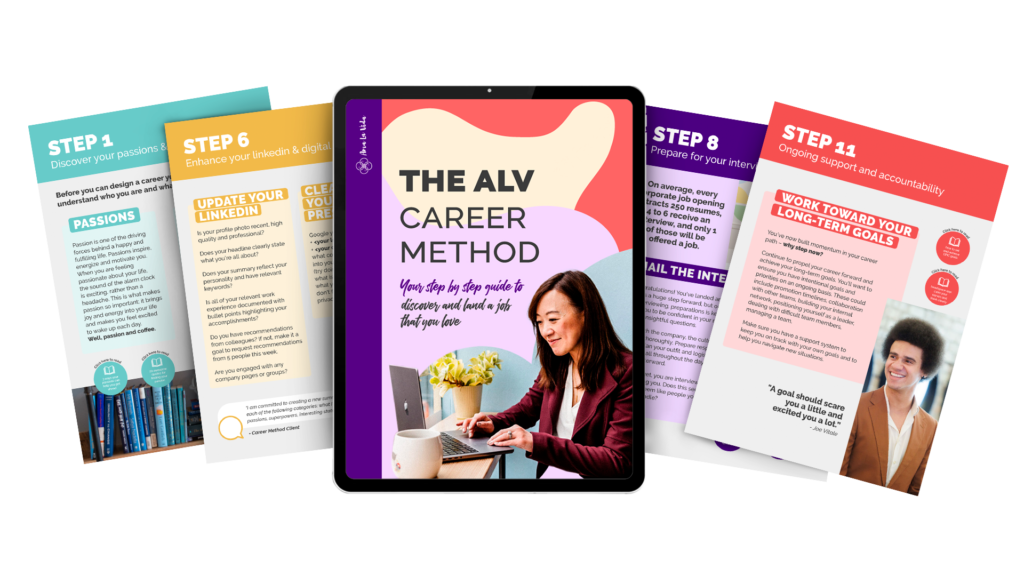
Download our comprehensive step-by-step guide to design and land a job you love!

Images from The ALV Career Method Guide
ALV Method Downloadable Guide

veterans day

Since separating from the US Marines I’ve lost brothers to suicide, murder charges, and drug overdose. I’ve battled anxiety, depression, PTSD, substance abuse and suicidal thoughts myself.  As more and more of the men and women I served with lose or take their lives, I see this day as a time to reflect on my time in service, remember my veteran brothers and sisters, and question the current trajectory of our democracy. I see it as a time to ask myself if I am promoting the solutions needed in our society, or if I am still sitting on the sidelines a part of the problem. To all my fellow veterans, patriots, and Americans, on this Veterans Day, I ask you to do the same. When I got out of the Marines in 2011, coming on the heels of my 3rd and final deployment, I was ecstatic. I thought that for the next few years, I’d sit around, smoke weed, collect unemployment checks and do just enough to get a passing grade at community college. I could survive on disability, free dinners and other handouts, offered up by well-meaning patriots and businesses. What a dream! Fresh out of combat, I returned home invincible and entitled. These choices and my attitude landed me at the lowest point of my life. I spent too much time and money on people and things that didn’t matter. I used drugs and drinking to distract me from myself. There was no doubt that I was depressed, angry and completely lost. I had no direction or sense of purpose, and everybody I knew and loved was scattered throughout the country.  I thought my life was over. Then I realized it was over only because I was sitting on the sidelines.  I’ve come to believe that the best measures of a life lived well are how much you give, how much you grow and how far you go.  This new philosophy opened up doors I didn’t know existed,  but only after I stood up to the plate. It took me on a trip around the world, put me on a path to a Master’s degree and allowed me to create a life that would make Paul, Ben, Ian, Giles, Will, Dean-O, Donahue, and the rest of my brothers who will never have the gift of life again proud.  I feel like my life finally began nearly nine years after my EAS date. It’s around that time I started barfing up all of the bullshit belief systems force-fed to me since birth. It’s the year I realized I had the freedom to choose how my life turned out. I understood that I must create a life that is my own because these people I knew and loved will never get the chance to again. So must you. To my fellow veterans, the greatest battle starts close to home. It’s upstairs, in your own mind. My advice is to not ignore that gnawing feeling in your gut saying that there has to be more to life than this. There is! It’s time to repurpose yourself and find a new passion and new mission to focus your energy. A purpose to pursue something that is larger than yourself is the true pathway to the freedom you have fought for. The world needs you to create a legacy that will live onto the next generation now more than ever. There is literally nothing you can’t do, but you can’t do it carrying around sea bags full of baggage from your time in service.  If you choose to wait for or rely on handouts you are sabotaging your own ability to enjoy the freedoms your friends have fought and died for. No one owes you a thing, but you owe it to them to live your life to its fullest potential. Who will greet you at the gates of Valhalla? What will they say once you get there? There are actually things you can do to improve your situation, no matter what you are going through, where you’ve been, or where you fear you may be going. You simply must choose to course correct and create a different life for yourself and your community. Anyone experiencing anything can alter their trajectory, starting with the assumption of responsibility for the life they live. You no longer have to be a victim of genetics, a poor upbringing, a shady past, or trauma sustained in service to your country. It took me 30 years to realize that fact. It doesn’t matter who died, what diagnosis you received or what dire circumstances have befallen you. These challenges can transform you, and your story of service and sacrifice can help create the community of connection and contribution that you crave. Life is a transition. Do not become disillusioned with the idea that you will someday reach a point where you can just stop caring, trying or otherwise serving something larger than yourself. In the civilian sector, just as in the Marines, “Complacency Kills.” Seeking comfort, instead of a challenge, is the surest way to squander your dreams. Separating from the military is the start of your new life, not the end. No matter how long it’s been since you’ve separated, it’s never too late to stand up from the sidelines and start up something new once again. Start by taking full responsibility for your own health and happiness and find the courage to face yourself. I live by the motto, Give, Grow, Go and here’s how it works. Give: Trade–in your self-imposed seclusion for contributions to your community. What gifts and experiences are you holding back? Challenge the status quo and the current trajectory of your life.  Grow: What skills and talents must you learn and develop? Dream of all the possibilities, people and potential found all throughout our planet.  Go: What faraway places have you always wanted to visit? Then go out and take action!  You have the power to create anything you want in this life

Read More
how to manage your difficult family members during the holidays

For more than 10 years, I haven’t lived with my family. In fact, I was kicked out of my home during my freshman year in high school and have only ever returned for holidays, birthdays and special occasions. I love my family to death and trust that they are doing the best they can with the knowledge and skills they have, but over the last few years, I started to leave my visits home feeling small, insecure and unsure of who I was. Over time, my defensiveness started to grow and so did resentment for the most important people in my life. Relationships are meant to strengthen and support us. They should not stress out and drain us. With the holidays around the corner, a number of us will be forced to spend time with long lost family members who know just the strings to pull to make us feel insecure, afraid or otherwise uncomfortable around the table.  Whether you’re dealing with anger prone uncles, Debbie-downer friends, closed-minded cousins or a spouse or parent who makes you feel less than you are, I’d like to offer some tips and tricks on how to deal with difficult people around the dining room table and beyond. How can you proactively prepare? Set an intention before showing up. Whether you’re meeting with your future boss or a brother, a neighbor or your 9th grade English teacher, you should set an intention identifying how you want to show up, speak and feel before walking through the door. Get clear through this intention what outcomes are most important to you and to your counterpart. Think about what you can do to build a mutually beneficial relationship that serves both of you best. Then visualize these things unfolding before you step through the door or make the call. A little conscious thought and action on the front end of a conversation will drastically increase the strength and sustainability of a relationship. Along with the likelihood of its success. How can you address an immediate concern? Challenge people in a non-threatening manner. I’m not an advocate for letting your ego run rampant in your communication with others but if someone is belittling you, doing something flat out wrong or otherwise offending you, and you’re not saying something, you are to blame. Speak up for yourself, but do so in a way that avoids defensiveness. Instead of pointing out all of the things wrong with your counterparts’ actions, insults or ideas, ask them for advice on how they would handle a situation where they felt the way you do because of what they said or did. Try something like, “Hey, I’d like to get your advice on something. I noticed __________ and it’s been bugging me. What advice do you have for me?” Asking for advice is a sure-fire way to disarm tension and redirect a relationship to a more positive and productive place.  What if it’s still not working?   Sit and soak in the feelings, and then separate yourself from them. Do not react. Do not engage with the person that is stirring you up, and instead just sit with the feelings. Observe them and notice what’s bringing them up. Is the person tapping into some unresolved insecurities? What’s at the root of your reaction? Stay fully conscious, and know that you do not have to be pulled back to the same patterns of the past.  No-one can harm you with their words without your permission. If you create the awareness to sit with discomforting feelings, separate yourself from them and seek to uncover their root, you will soon open up a door of self- discovery that will allow you to break free from their grasp. Want to go even deeper?  Self-Reflect. One of the most powerful things we can do when we’re around difficult people is to use them as a tool to fuel our own personal development and growth. When you see a character trait or bad behavior in someone else that you would have in the past judged or criticized, check yourself. Semi-conscious people don’t want to see their own faults. We often see in others a reflection of our own insecurities, limiting beliefs and self-destructive behaviors. Instead of outwardly attempting to change the other person, use them as a mirror to look inside yourself and uncover where you’re doing the same thing in your life.   Ask yourself, “Where am I doing _______ in my life?” If you’re not a cop or drill instructor, your job is not to police others. Instead, direct your energy inward when you’re around difficult or destructive people and use the lessons you learn from them as an opportunity for your own understanding and evolution.    What if nothing is working?  Have the courage to cut people out of your life. You can not create a new life carrying the baggage of old people that keep you tied to the past. Those that do not serve you or your mission, do not deserve to be in your life – family, friend or otherwise. In fact, they need to be removed from your life as soon as possible. Their lack of life is draining you from yours.  Everyone needs someone to challenge and support them, to push them to grow and think bigger. Create a new tribe, crew or family that brings out only the best in you! These tricks have all worked for me but they’re still a work in progress. Try them with family, friends, coworkers, and strangers and see what results they bring for you. Relationships are one of the most common points of friction in our everyday lives. With some conscious thought and action, we can start to master them. If you’re still having trouble with difficult people or need more time to discuss these ideas, let’s jump on a call. Otherwise, let me know what works for you and share any insights or ideas you have.  

Read More
how to support someone with a

For so long the topic of mental health has been one that people just don’t talk about. 46.4% of adults in the US suffer from mental illness in their lifetime – that’s almost half of the adult population. We need to talk about it. We’ve finally made some breakthroughs in recent years to bring more awareness to the subject, but we still have room to grow.  My mental health journey started at age 11. I began experiencing symptoms of General Anxiety Disorder, and it’s still something I face every day. Admittedly, some days are great; others, however, I’m terrified to go anywhere because, “What if I have a panic attack and have to explain to people why I abruptly had to leave?” It’s hard. It’s exhausting. It’s difficult to explain to others.  This post isn’t to explain to you why or how you should manage your mental illness. (Which is a conversation worth pursuing if you’re struggling to maintain your mental health.) Instead, I’m speaking to all of the friends, family, and co-workers who don’t have a mental illness themselves but know someone who does.  This is so important because even my husband didn’t fully understand my anxiety for a long period of time. I’m not saying he didn’t try, just that it’s a difficult subject matter to understand. His love for me made it extremely difficult for him to see me suffering and not know what to do.  Eventually, after I discussed what my triggers were and going through many panic attacks in front of him, he began to truly understand. He now knows when I’m on the verge of having a panic attack and what situations to avoid when I’m having an overly anxious day.  Knowing that 46.4% of the US adult population experiences and suffers from mental health symptoms, I’m going to share with you a list of behaviors and actions that I’ve found most helpful from the people that mean the most to me. The things on this list have helped me feel heard, seen, valued, and most of all loved. Here we go! Listen without an agenda Working for a coaching company you soon realized that active listening is a really hard task. Active listening is defined as, “the ability to focus completely on what an individual is saying and is not saying, to understand the meaning of what is said in the context of that individual’s challenges and desires, and to support individual self-expression.” All that said, when someone explains their mental illness to you, take the time to truly listen. Know that when they confide in you it means they trust you. As they are speaking, instead of responding with phrases like “oh, everyone gets depressed” or “just breathe,” try saying “Whatever you need, I’m here for you.” Understand that they probably aren’t looking for advice or commentary at that moment, just someone to listen to what they have to say without judgment. There will be plenty of times later on to give your input, advice and to ask questions.  Seek understanding Once you have listened to what your friend, relative, or co-worker has to say, take time to process and understand. Depending on your relationship with the person, ask questions about the parts that don’t make sense to you, but also understand that there are things that happen to them that they might not understand themselves. Reassure them that if they are uncomfortable talking about it in more detail than they already have, that they are not obligated to do so and move on to a different topic.  Asking questions like: “How can I help?”  “I want you to feel as comfortable as possible when we are together. Are there topics/places that are triggering and we should avoid?” “What helps you on the days that you aren’t feeling well?”  These questions will show them that you are making an effort to be there when they need you. Once you know what they are going through, try your best to not make them feel bad for canceling plans, leaving a triggering situation, or not being themselves some days. That in itself will help them more than you know.  Be observant and react accordingly When you begin to learn the warning signs and know their triggers, be on the lookout for them. If you know that your friend stops texting for days when they are not in a good headspace, call them or even show up to their house with their favorite foods. Tell them you will sit by their side and do nothing if that’s what they want, but let them know that they are loved and you are there for them. If your friend has panic attacks from being in big crowds, know their warning signs and assure them if they have to leave no one will be upset. Realize that some people do not have ‘classic’ signs. Each person has unique side effects. Panic attacks aren’t always hyperventilating, depression isn’t always a constant state of sadness, OCD isn’t always someone constantly cleaning.  Be consistent because you care Whenever people with mental illness have bad days, they tend to think that they are a burden to the others around them. I know that even though I am not always going to feel up to it, I love getting invited to get-togethers. Keep inviting your friends to events even if they aren’t always going to say yes. Keep showing up for them on their bad days. This shows that you still care, you’re still here, and you aren’t leaving.  Consistency and intentionality are major factors in a thriving friendship of any kind. However, they have the power to create an even stronger bond when the other person is fighting their mental health battle.  “What we don’t need in the midst of struggle is shame for being human” – Brene Brown Mental illness isn’t fun. In fact, it’s really hard. But, having someone by your side, who cares during those bad days can

Read More

Your physical body is your one and only vehicle through this life. Take care of it because no one else will. We get no do-overs. Although there are many different dimensions of wellness, today, on National Fitness Day, let’s talk about the love it or hate it dimension of fitness. This post is a list of my 5 tips for fitness in your everyday life.  If you’re still fighting fitness, it’s because your subconscious mind says you’ll fail. Fortunately, fitness is a tool that can be used to strengthen and sharpen your mind, and body, so you move to a more connected and congruent state. With practice, fitness will help make you feel more alive.  Whether you work out now or know you should read on to uncover 5 tips on how to make fitness stick. Start small. When a toddler first learns to walk, do we expect them to take one step and then sign up for their first marathon the next day? Of course not. It even took Patrick Makau Musyoki, a few years before he ran his first 5-K. Fitness is an integral part of your health and happiness. If you have a habit of neglecting your fitness routine, start small to build it back up. Day by day start to build exercise into your routine. Over time, this will radically transform the way you think, look and feel. Fall in love with the process, each time you get out of bed and step out the door, and all of the little wins that come with each new milestone and PR will start to taste that much sweeter. Step by step you will be well on your way to freedom from the fitness blocks that prevent you from the long, healthy and vibrant life you were meant to live. Dream big, but start small.  Make it a habit. Do you know you need to exercise, but always find an excuse to not show up? You’re not alone. Humans evolved to talk themselves out of doing much of anything outside of the oh-so alluring comfort zone. We self-sabotage our own success by letting our habitual thought patterns and paradigms tell us we shouldn’t even start. If this describes you, it’s time to rewrite your habits in a way that empowers you to be healthy and free. Once you’ve built the habit, all of the thinking is removed and fitness becomes a part of who you are. Now you’re unstoppable! Fitness is the perfect place to cultivate the discipline that will ripple out to all areas of your life. Take all the overthinking and self-sabotaging away by making fitness a habit. Get outside. I’ll never forget standing above the clouds looking down on Machu Picchu, as the rain cleared and a rainbow stretched across the sky, after a 4-day trek through the Andes Mountains.  Nor will I ever forget the untouched beauty and 80-foot wax palms spanning the Cocorra Valley in the coffee region of Colombia, or trekking the Cocora Valley in Southern Peru while condors flew overhead. The East Rim to Observation Point in Zion National Park is just as spectacular. Have you heard of Humantay Lake? It’s incredible! You simply cannot find views like this inside of a gym or in front of a screen. There’s no telling what you will find inside of yourself or out in the world once you get outside and move. There is an unlimited number of hikes, walks, runs, climbs, swims, bikes and more, in your backyard and all over the world just waiting to be explored.  Take your fitness outside and go find them for yourself! Make a friend. Have you ever thought about making a friend with someone on the trail or at the gym? When we find people with the same goals and interests, we’re more likely to stay focused and accomplish our mission. On this mission of fitness, it’s best not to go at it alone. In all areas of our lives, we need someone to push us to think bigger and dig deeper. Fitness is no exception.  If you bring a friend with you when you workout, you’re more likely to push yourself further, work out longer, try new exercises and laugh harder. For accountability, friendship, teamwork, and the challenge find a new friend and bring them along with you next time you take on the gym, track or trail.  Try something new. Field trip to the trampoline park anyone? I went for my first backflip on a tramp at the age of 28. It was my time.  There’s something about dodgeball fights and backflips that make me come alive. I don’t care if the average age around me is 8. Every time I leave I am hyperventilating and drenched in sweat. It’s amazing! There are a whole lot of events, teams, and opportunities that are waiting for you to take on. I think it’s your time. Pick up basketball, paintball, frisbee golf, cartwheels, dance, and yoga are all things that are healthy for the body and mind. We’ve got softball, kickball, dodgeball, and volleyball. If you like races, there are mud runs, fun runs, tough mud runs, obstacle course runs, triathlons, 5K’s, 10K’s, bike races and more. If you like music check out these runs with DJs or yoga with DJs. Check out the 13 toughest races in the world. What else am I missing? There is truly an event, team or tribe for everyone up for the challenge of fun, sun, sweat and trying something new. If something is missing, maybe you should create it. Discipline is the greatest muscle in the human faculties we can flex to truly master ourselves. Fitness is the perfect realm to play around as you cultivate a deep sense of discipline and respect for yourself. That does not have to mean mindlessly running anywhere on a treadmill, in a box gym that smells of spray tans and overpriced training packages. It’s ok to have some fun to

Read More

When I was younger, I played tennis competitively – from an early age, I was a competitor. I was pitted against whoever my opponent was. We weren’t on the same team and were in a battle for every point there was. Tennis is an incredibly mental game. When I was down, I learned to never let my opponent in my head and to not give them the power of my emotions. I was stoic and never showed weakness and that allowed me to win. I learned that vulnerability lost matches and I carried that belief with me for a long time.  Why is Vulnerability Important: What I didn’t know is how Vulnerability is strength and allows us to connect with others. When we show our true selves, our imperfect selves, our silly selves, our messed-up selves, we are met with others’ true, imperfect, silly, messed-up selves. Vulnerability invites vulnerability and when we share all the aspects of who we are, we build deep, life-giving, healthy relationships. Those healthy relationships are vital to our mental and emotional state. We need people who really see us to be our healthiest and happiest selves. The Merriam-Webster definition of vulnerable is:  vul·​ner·​a·​ble | adjective 1: capable of being physically or emotionally wounded 2: open to attack or damage As I grew up, I took what I learned from tennis and allowed it to bleed into my everyday life. I wholeheartedly believed in this damaging definition of vulnerability. I thought that if I showed any weakness, someone would take advantage of that, and I would indeed be wounded and damaged.  Being vulnerable meant I had to be seen.  I never set myself up to be hurt – I mean, what person in their right mind would set themselves up for physical and emotional pain?! But that hardness and stoic-ness that I learned from my youth caused me to put up walls around my heart. It was so difficult and unnerving to let anyone in to see the true me. I didn’t learn for a long time to cut holes in my armor of walls and allow myself to breathe. I had to learn to give myself permission to be vulnerable and seen.  If you’re like me and struggle with vulnerability, ask yourself: “how not being vulnerable serves you?” For me, it served as a false sense of self-protection that allowed people to see me in the way I wanted them to see me. But it also meant that most of my friendships and relationships went only surface deep. They were deprived of full truth, love, and acceptance. I didn’t want to be found out that I didn’t have it all together, I didn’t have all the answers, I wasn’t perfect, and maybe I was less than expected. Grace doesn’t come naturally, we want to be the best and perceived as having it all together. We think perfection is safe and everything else is scary unchartered territory. When we have no grace with ourselves and feel the deep need to be perfect, we wear a mask. The Mask: The mask is something most people are guilty of wearing at one time or the other. It’s a form of self-protection that helps us to feel safe. Unfortunately, there are two big downsides to the mask: You wear the mask and you attract people to the mask and not the real you. People can only wear the mask for so long before they show who they truly are. Once the mask falls off, you feel found out and people who were once drawn to you feel lied to and confused. You wear the mask and you don’t attract the people who would genuinely love the real you beneath the mask. You miss the opportunity for great connection and acceptance. The mask prevents us from connecting with people. What was supposed to protect us is the exact thing that makes us feel isolated in the end.  “Perfectionism is self-destructive simply because there’s no such thing as perfect. Perfection is an unattainable goal.” ― Brené Brown, The Gifts of Imperfection What would it look like to take off the mask of perfection and step into who you really are and let that shine?  What would it feel like to let yourself off the hook, practice grace, and not feel like you have to hide who you really are? Vulnerability takes Courage:  It’s easy for me to sit here on my computer and say “vulnerability is a strength and you should be vulnerable”, but actually being vulnerable is hard! It’s not easy to allow yourself to be fully seen and known, because you may not be accepted by those around you. As humans, one of our greatest needs is to have deep relationships and to be accepted.  So, what happens if we open ourselves up and we aren’t accepted?  It makes me think of the quote from The Velveteen Rabbit: “You become. It takes a long time. That’s why it doesn’t happen often to people who break easily, or have sharp edges, or who have to be carefully kept. Generally, by the time you are Real, most of your hair has been loved off, and your eyes drop out and you get loose in the joints and very shabby. But these things don’t matter at all, because once you are Real you can’t be ugly, except to people who don’t understand.” ― Margery Williams Bianco, The Velveteen Rabbit I want to tell you that it’s okay not to have it all together. You can be imperfect and still worthy of being seen and known. You don’t have to be the best to play the game. When we allow grace to enter our lives, we also allow room for life and freedom. We can choose to let go of the mask we’ve been holding onto and step into who we really are with confidence and self-love. There is strength in vulnerability. Looking for a Vulnerability Challenge? When the feeling of self-protection comes up in a trusted relationship, ask yourself:  What am I hiding?

Read More
a lamp and a bed to help you think about your nightly routine

Did you know what you do the night before significantly affects how you show up the next day? While the morning mindset, movement, and motivation routine will work wonders to shake the cobwebs off, there’s no replacement for a solid amount of shut-eye. I recommend adding these habits and upgrades to your nightly routine to help your mind clear, body relax and sleep improve. I do not buy into the idea that in order to be successful your sleep has to suffer for extended periods of time. After a few days of not getting a solid 6 to 7 hours, I am irritable and angry. The quality of my work, relationships, and life, in general, takes a hit so I’ve made it a priority to create an environment that allows me to fall and stay asleep. Over the years, I’ve tried everything under the sun to get a solid night’s rest. In my experience, I suck at sleeping. It’s like the military and fire department has permanently disrupted my body’s ability to fall and stay asleep. Unlike my fiancé, who drifts off as soon as her head touches down, I used to toss and turn and stand and sit in an attempt to finally fall asleep. I’d turn on the white-noise fan app, put earplugs in, and, even with blackout curtains, still put a shirt over my eyes to catch the chance of any other light. I put magnesium in my chamomile tea and am always on the lookout for supplements that support sleep. I’ve had a lot of experience with restless nights and there are a few things I’ve learned. So how do I nail my nightly routine? Excellent question! The following article goes over habits and rules I’ve implemented into a nightly routine that puts me in a headspace to reduce stress, sleep better, and wake up more refreshed. My hope is that they’ll save your sleep, just as they did mine. Stretch For the same reasons, you’re stretching in the morning add this to your nightly ritual. Stretching will help you destress and unwind before a restful night of sleep. It frees up tension built up in your back, legs, and mind. After a long day’s work, it’s certainly tempting to flop down on the couch. Just don’t miss out on the opportunity to relax your body and unwind your mind so you’re better set up for a night of slumber. If you do sit down and watch TV, slide off onto the floor and do your morning mobility routine once more. Add some static stretching and foam rolling to release all of the energy bound up from a long day’s work. Focus on stretches and exercises that loosen up tight hips and shoulders and relieve back pain. If you sit down a lot, chances are your hip flexors are tight, your hamstrings are overstretched, and your back is weak. Correct these imbalances with a couch stretch, hip bridge, and any and all of these you can do on the floor while catching up on your favorite show. Try this: Spend 10 minutes static stretching and foam rolling each night before bed. Hit all major muscle groups, sinking, slowly into a deep stretch for 20-30 seconds at a time.  Shut off your devices What you do the final hour before bed determines the quality of your rest, the details of your dreams and how you show up the next day. Don’t sabotage your sleep by staring at a screen. Do not be lured in by likes, shares or media that’s manufactured to distract you. We’ve been emotionally conditioned to buy into the illusion that we must always know what’s going on with everybody, at all times, all around the world. We don’t. If you must know the happenings of the world or respond to social media requests, set aside some time during the day to scan the screens.    My favorite thing about a phone is the airplane mode feature. When you’re at work, be ready to respond and react to meet the incoming demands of your clients, customers, and coworkers. Once you get home, especially during the crucial last hour before bed, put your phone in first-class mode and find some time for yourself. Once you do, you’ll start to see your sleep quality improving alongside your memory, focus, and mood the next day. Remember to keep your phone in airplane mode at least until after you’ve wrapped up your morning routine.  Try this: Stick to just one show or a specified amount of screen time then power off and slide your phone into airplane mode, at least 1 hour before bed.   Sit down and reflect Everything you have right now in your life is a culmination of your past thoughts, ideas, and decisions to this point. It can be easy to lose sight of the fact that we’re in charge of where we steer this ship. The final hour before you sleep is a sacred time to remember, reflect on, and learn from the day. Each night brings a new chance to evolve and grow. If you are dissatisfied or after more growth, more love, more freedom or anything else under the sun, take the time to sit down and reflect each night to track how much closer you are to obtaining it. It’s never too late to course-correct. Everything that happens to you is a lesson you need to learn. The faster you learn the lesson, the faster you level up in life. Take some time to reflect, grow and let go each night by asking yourself the following 3 questions. Write down your worries and unfinished to-do’s and look for any silver linings or hidden lessons from the day. Ask yourself: What worked well for me today? What could have gone better? How did I grow? Try this: Make reflection a part of your nightly routine before you go to bed by answering the above-stated questions. Show gratitude Cultivating feelings of gratitude is

Read More