Category: Reducing Stress

You know that voice inside your head; the one that’s always pointing out all the things you’re doing wrong, and all the things you could do better? Yep, that’s your inner critic, and we all have one. Much like everything else in life, your inner critic has good intentions (always bettering!) but is only beneficial in moderation. When that nagging voice begins to take a toll on your mental wellbeing, confidence, or self-esteem, it’s time to take the reins and tame your inner critic.  1. Name It Many studies have shown the importance of naming your emotions. Taking the time to name a feeling or emotion that comes up and labeling it, it’s helpful. Researchers have seen a reduction of activity in our amygdala. This is responsible for detecting fear and setting off a number of biological responses (think fight, flight, or freeze). There are many emotions that may come up with your inner critic. The first step to taming your critic is to name it by closing your eyes whenever you hear that voice come up. Imagine what it looks and sounds like, and then coming up with a name for it.  Questions to help you name your inner critic: You can name it anything you want! Some of my clients have named their inner critics Karen, Charlie, the wolf, and Judgemental Judy – it’s up to you! I always like to think of the movie Inside Out, my inner critic can look a lot like Mindy Kaling’s character, Disgust and that helped me give it a shape and look. Naming your inner critic allows you to get some space from that negative voice and realize that you are not a problem that needs to be fixed, but rather your inner critic is something outside of you that is showing up for some reason. This key differentiation starts to diminish the power of your inner critic so you can begin to tame it. 2. Fact Check  Beck’s cognitive model, also known as the Cognitive Triangle, proposes that events are not directly responsible for the way we feel. Rather, it is our interpretation of events that influences how we feel and view the world. This model implies that we can change the way we feel by changing the way we think. The first step is changing the way we think by fact-checking our thoughts with reality. It is easy for us to believe our inner critic right away and take everything it says as fact, but just as we would fact check a news article or a really unbelievable trivia answer, we should fact check our inner critic.  To fact check your inner critic, follow these steps (based on Cognitive Behavior Therapy): You can practice fact-checking in the moment for an instant de-escalation of your inner critic or as part of your daily journaling routine to deeply reflect and plan for the next time it shows up. Feel free to use this worksheet!  3. Talk to Yourself One thing we’re good at as humans, especially when we’re in a vulnerable headspace, is listening to ourselves and taking everything we think or feel as the whole truth. Now that you’ve named your inner critic and identified and reflected on your negative automatic thoughts, it’s time to take control back and talk to yourself.  Next time your inner critic speaks up, how can you talk back? What does your inner critic need to hear to quiet down its fears? If you’re working out and your inner critic says, “You can’t do this, you’re so out of shape.” Speak back with kindness and say, “Thank you for your concern, Charlie, I feel strong and determined and I know my body will take care of me” or it may be something more like, “You’re right, Charlie, this is really tough and I haven’t exercised in a while. I’m going to take a break, drink some water, and get back into it!” It may sound or feel silly at first, but I urge you to embrace the silliness — the whole point is for you to shift your relationship with your inner critic and you can start the process by doing the talking instead of only listening. Talking to yourself can take many different shapes. Here are some ideas on how to integrate this idea: Moving forward Lastly, part of taming your inner critic is to elevate your wins and be your own biggest fan. Make sure you’re celebrating your wins—big or small— so you can build a collection of feel-good moments that highlight your successes and remind you of how capable and strong you are and save those for a rainy day to help get you out of a funk.  Taming your inner critic is not a one-and-done thing. It is constant work and requires you to stay present, engaged, and active in your own life. Naming your inner critic is step one, and step 2 and 3 are meant to be used in a wash, rinse, repeat cycle. Add these tools to your toolbox, integrate them into your daily routine, and be kind and compassionate with yourself through the process! Remember, we’re always here if you need some help!

Read More

Burnout is something we have all suffered from at some point. Whether you are the one experiencing the burnout or you are witnessing others experience it – it’s painful. When it comes to helping your employees avoid and overcome burnout there are a few things you can do.  Educate Your Team on the Signs of Burnout Help them understand how to avoid burnout before it occurs. As a leader you can teach and guide your employees. Share with them tools and resources on burnout. Discuss some of the ways they can draw attention to their burnout and overcome it. If you help everyone understand what burnout looks like they are more likely to avoid it. Additionally, this creates an open dialogue between all employees. This means that Bob may sit Sally down and have a conversation with her if he sees signs of burnout. It ensliss the whole team in supporting each other, which can take some of the burden off of you.  Coach Sara wrote a great article on how to avoid burnout. In the article she highlights a few things we can focus on individually that avoid and overcome burnout.  Three of my favorite tips Coach Sara highlighted are: Support Your Team by Asking the Right Questions Asking the right questions is crucial to providing support to your employees. Don’t ask: Instead ask something that is more supportive: Deeper questions that don’t imply the employee is helpless will allow them to ask for the help they need.  Lend an Empathetic Ear Sometimes we just want to be heard. What we hear may be painful for us, but it’s much needed. I know I’ve had times where I just needed a manager to know how I felt and I spent a few meetings back to back letting them know. Eventually I was able to come up with a solution to solve my problem and was able to overcome the burnout. But if they didn’t give me their ear, truly listen and support me with empathy, I would haven’t been able to come out of the spiral.  Be Flexible This can mean many things in today’s world. Flexible schedule, statement of work, expectations, due date. Only you can decide what can be flexed and make it happen. But take a look at how you can flex the world around them to make it more accommodating. This doesn’t mean bending the rules or making permanent changes to process/culture, but it may mean some short term flexibility to help them dig out of a hole.  Assess Your Leadership and Make Changes What are you doing that is contributing to burnout? What could you be doing to help your team avoid burnout? Ask yourself these questions: If you said no to any of these it’s time to take a hard look at your leadership skills and build a plan to set yourself up for success. Helping your employees avoid and overcome burnout will go a long way. If you’d like to talk to one of our relationship strategists about leadership coaching and how working with a leadership coach can help you schedule a free conversation here. 

Read More

So many of us are all too familiar with the term burnout. Burnout is a constant state of physical and emotional stress and exhaustion. With everything going on in the world right now, the burnout feeling is very real. We have our ups and downs, our good days and the bad. Time keeps going and it has a strange surreal feel to it. The days blur together and before you know it, another month has gone by and you wonder what you have to show for it.  With everything going on, it’s normal to feel burned out and like everything is a little harder. Especially when there are so many factors outside of our control. When we are feeling burned out, we are unhappy. It is a disempowering feeling when we focus on how these burnout factors are beyond our control. The good news is there is science out there that suggests there is even more we can control than we may think, despite so many circumstances being outside of our control.  Where Happiness Comes From According to Sonja Lyubomirsky & Kennon M. Sheldon’s book, The How Of Happiness, Happiness is something we can successfully pursue. While they argue that 50% of our happiness comes from our genes, and 10% from our circumstances (like work, COVID, etc.), that leaves a significant 40% left that drives our happiness – and that comes from ourselves! Prescribing to this model gives us more control of our emotions. Today we are going to focus on some of the areas within our control to avoid burnout and stress and instead start to increase our productivity and happiness!  A Formula for High Performance  Avoiding burnout doesn’t have to be complicated. One framework that resonates with me is called the Bulletproof Productivity System. We control what we can to feel our best.  If we focus on what we want to do (clarity) in the right way (efficiency) and are enjoying the journey and the result (fulfillment), then we feel productive instead of burned out. In this model productivity is the goal. The formula is as follows: Productivity = Clarity + Energy + Focus + System – Distractions. Make sure you touch upon all five to feel your best! Clarity Finding clarity is all about shifting your mental state to a clear mind. When we are feeling stressed or overwhelmed, it’s impossible to objectively look at a situation and see what is needed to achieve the outcomes we desire. Shifting our state is key to get into the right headspace to feel and do our best. One simple strategy you can try to shift your state is by taking a few deep breaths when you are feeling overwhelmed and ask yourself a few core questions: What is the outcome I want? What is most important now to achieve this? What do I need to do to make it happen? Our brain will answer the questions we ask it, so keep them objective and empowering and see where those answers take you.  Energy Managing your energy is key to being productive and to avoid burnout. Even if you know what you need to do and the best way to go about doing it, as the saying goes “you cannot pour from an empty cup.” What is one change you can prioritize with your health today? An extra hour of sleep? Optimizing your diet? Or increasing your physical activity? Any of these steps can lead to big energy gains. Focus Improving our focus is another key to productivity and avoiding burnout. When our attention is divided, it is yet another energy drain and we can’t perform at our best. We as humans are meant to be task switchers instead of multi-taskers. Plus studies from UCIrvine and others show that it takes over 23 minutes to resume a solid level of concentration after being interrupted. Other studies show we experience 7-8+ interruptions per hour. With both of these in mind, we are NEVER concentrating well – no wonder we feel burned out! Just recognizing this reality is a way to help avoid this, along with creating structure. Try to focus on one thing at a time, limit distractions, and build your focus through strategies like meditation and planning.  System While you may have the right mindset and environment to avoid burnout and be productive, if you don’t have the right tools or approach you are still out of luck. Making your ideal outcomes a reality requires an organized plan to see you through. Create intentionality with your day by planning ahead, building a schedule, and staying organized.  Distractions Distractions are any sort of thing that gets in the way of you feeling your best and being productive. While we probably can’t change them all, start taking control by developing a plan to start minimizing some of them today. What environmental factors aren’t serving you towards your goals? What will you change?  By leveling up in all five of these areas, we control what we can to feel our best.  Looking for Burnout Support? Building and maintaining your momentum to overcome burnout can be tough, and coaching can help! Partnering with a coach is such a powerful tool to help you set and achieve your tools. If you are ready to overcome your burnout and avoid it for good, with the structure accountability and support of coaching, schedule your free coaching consult with me today! I look forward to connecting with you. 

Read More

It’s difficult to feel secure or safe in the modern job environment. It’s also really difficult trying to be indispensable without burning out at work. For many employees, job security is one of their main concerns, and many people are afraid that they may get laid off without warning. Businesses from different industries outsource their workforce more and more often, trying to minimize their expenses. This also contributes to creating an unsafe work environment where employees are afraid of losing their jobs at any moment. There’s no surprise that determined and well-motivated employees want to become indispensable members of their teams so that the employer won’t consider replacing them with anyone else. Besides, getting recognition from your boss is nice. Everyone likes to be appreciated and to see that their hard work is recognized by others. Working hard is great, but if you work too hard, your physical and emotional well-being can be damaged, and the disadvantages of hard work might overweigh the benefits. Even employees who demonstrate the best performance often experience problems related to overworking. In fact, high-performing employees are 2.2 times more likely to experience burnout. Various success stories from the tech industry, where people have insane schedules and work all the time, motivate many employees to work more, and to work harder. However, such an approach often leads to burnout and other problems, without helping these employees accomplish their career goals. On the one hand, if you’re a dedicated employee, you may want to make a significant contribution and to add more value. On the other hand, you won’t be able to succeed long term if your work undermines your well-being, and you won’t be able to maintain your peak performance all the time, without experiencing burnout. Here are some tips that might help you become indispensable at work without burning out. Think Before You Agree Indispensable employees are always busy. However, there’s a big difference between being busy and being overloaded. If you want to impress others with your productivity, you may quickly agree to anything and take on more responsibilities than you can actually handle. It’s great if you want to contribute to the business’s goals, but it’s also important to be realistic about your capabilities. Ash Rogers, content writer and reviewer at LegitWritingServices has a point: “When your manager is looking for someone who can take on an extra task or when you see a new project on your desk, take your time and think of your motivation. Why should you say yes?. Perhaps, you don’t want to let others down, or maybe, you want to please your boss. You may also want to do this work yourself because you don’t trust other employees. Anyway, if you analyze your motivation, it will be much easier for you to say no.” Don’t be afraid to talk to your manager. Sometimes, your manager may know if they ask too much of you. Still, they may also be too busy and just forget how busy you are. Keep in mind that one of the main functions of managers is to support employees. Supportive managers will understand why you don’t want to take on another project and will even help you navigate managing your load. Deliver Unique Value The only irreplaceable people are those who can make a unique contribution. In business terms, it means that if you want to be irreplaceable, you need to develop your unique selling proposition. It’s something nobody else will do as well as you. For example, it can be a unique skill or combination of skills, both soft and hard. For instance, a salesperson can develop emotional intelligence skills to sense, understand and influence the emotions of buyers. Employees with high emotional quotient do not allow their emotions to dictate their actions. Therefore, an emotional intelligence is something that can make you a good boss or irreplaceable employee, if combined with great professional skills. You can possess a valuable skill that goes beyond your typical responsibilities, or you can combine skills necessary for your position with additional skills. If you perform a task that no one else can complete, make sure that only you know how to do it. Besides, don’t be afraid to advertise your unique skills. However, this doesn’t mean that you should do everything yourself. Learn to delegate responsibilities and don’t be afraid to hand over your authority to be indispensable and reduce burning out. Otherwise you won’t be able to grow as a professional. Adopt the Middle-Ground Approach Many people think that, when they cannot say no, the only other option is to say yes. Therefore, you may find yourself agreeing to take on some work that you know will make you feel exhausted. However, if you want to be useful for your organization, you shouldn’t be tired or overly stressed. According to statistics, stressed and overworked employees lose 550 million workdays every year. You can avoid the negative consequences of overworking for your health and your organization’s budget by adopting a middle-ground approach. There are many ways for you to make a contribution without doing all the work yourself. For example, if your manager asks you to work on tasks you don’t have time for, you can offer to provide support to those who will work on it. You can also work on another task that will take less of your time. Build Relationships Your relationships with your colleagues are no less important than your skills and the contribution that you make. Building the right connections and developing strong relationships with colleagues can not only make you indispensable at work without burning out, but also help your career growth. To improve your relationships with others, listen to them, and share your time with them. We also recommend that you provide valuable feedback, without criticizing, and take feedback easily. Work on your communicative skills, and your career will certainly benefit from them. Save Your Company Money Always look for opportunities to save your employer money. People

Read More

Self care has become such a buzzword lately. To be honest, it’s not just a 2020 thing. Self care has been thrown around rather lightly for years now. However, I think it’s with good reason: it’s important! Taking time to ensure your own needs are met is crucial to ensure you’re able to continue functioning, not just at peak performance, but any performance level during times of stress. Which, let’s be honest, is most of the time for most of us, 2020 or not. Daily self care sets the stress-baseline lower, so that when stressful situations come up, you’re not already at a 9-out-of-10 stress level. You have more capacity to deal with life in a functional way. So, yes, self care is good and important. However, self care is more than just the self-indulgent world of Korean face masks and impulse shopping. I think you know that by now. But then what else is it? My favorite way of identifying self care rituals with my clients is something I learned from Dating Coach Amy Young which she calls the “Sacred 6.” There are two important parts of this process. First, it’s important to define what are rituals in your life that meaningfully make you feel better. Second, you create a set of rituals that you try to do every day, or at least a few times a week, not just when you’re feeling overwhelmed. So here we go. Step 1: Define Your Daily Self Care List It’s great to think about self care habits in 4 different categories. I like to think of it in a matrix, which is handy, because then you can fill it out: Feels good Feels bad Is good for me Group 1 Group 2 Is bad for me Group 3 Group 4 Group 1 This matrix helps you think about all the different behaviors you can have in the day. For example, drinking a cup of black coffee in the morning could go in Group 1 (good for me and feels good) because coffee has a lot of antioxidants, it’s a calming quiet moment for yourself, and it’s delicious. I’d even put eating 1-2 squares of good dark chocolate in Group 1 for similar reasons.  Group 2 Then Group 2 might be things like going for a run, meditating, or organizing your apartment — anything that you don’t necessarily enjoy in the moment but has a meaningful positive impact on how you feel afterward. Now, in the long run this Group 2 stuff might make its way over to Group 1 because you develop some positive associations with it, but anything you know is good for you that you tend to avoid goes in Group 2 for now. Group 3 Group 3 could be things like eating a whole pizza, binge drinking with your friends, or calling up someone you know isn’t really good for you just because you feel lonely. These are choices that might feel good in the moment, and we’ve all definitely done this when we’re in a funk, but long term these actions don’t actually make you feel better. You can do them on a Friday or a Saturday night, but they don’t make going back to the office any easier on Monday.  Group 4 Finally is Group 4. Things that you don’t enjoy and honestly don’t have any positive impact on your life. Calling your toxic friend who belittles you. Burning your hand on the stove. You get the idea. We’ll get back to this last group later. So here’s the action. Take some time, make your own matrix.  Step 2: Make a Plan Here’s where it gets good. Look at Groups 1 and 2. Come up with 6 things from those groups that can become your “Sacred 6” as Young calls it. Six things you can do (ideally) daily for your self care. These are 6 small moments where you know you’re taking care of yourself every damn day.  How do you choose? My recommendation is to identify things that have the biggest positive impact on your mental health, which probably means a lot of stuff from the tricky Group 2, to be honest. For example, here’s my Sacred 6: Wake up early and work out first thing in the morning. Group 2. I honestly don’t like waking up early, and working out that early in the morning is hard. My body is sore and sleepy. Bed is warm and usually the cat is cuddling with me. But if I don’t work out before work, I often find I don’t have energy to do it in the evenings, and I love knowing I did something great for myself before most people are even awake. It sets me up for a good day and makes me feel super productive before it’s even 7am. Shower. Group 1. This one kind of goes without saying because I work out every morning, but even mornings where I had to skip the gym for some (God-forsaken) reason, I still shower. I also will shower sometimes at the end of a day or when I’m in a bad mood because the warm water, the rhythm of it, coming out all clean and cozy, just makes me feel better. Coffee. Group 1. I love my morning coffee. As I mentioned earlier, I skip the sugar and creamer, so I think this gets to fall in Group 1. Great start to the day. Get outside. Group 1-2. It depends on the weather really if I want to go outside or not, but I always feel better if I get out of my apartment, move, and breathe real air. Even if it’s just for 15 or 20 minutes in the rain or freezing cold. Tidy up your apartment. Group 2. I’d really rather not. I’d rather sit on the couch or go straight to bed. But taking 10-15 minutes in the evening to wash all the dishes in the sink, put things back where they belong,

Read More

Life is hard, regardless of being in a pandemic or not! We all have responsibilities, deadlines, bosses, social obligations, family, sleep, meal prepping, and that’s all before noon. There are so many things in a day that stretch us thin and stress us out. Your health is important, because when your health suffers, all other aspects of your life suffer as well. So today, we are talking about how to prioritize your wellness, especially in the midst of stress. I also want to highlight something big here. We easily attribute stress to hard things: work, divorce, financial struggles, too many meetings. But stress can stem from good things as well: vacation, presenting in a meeting, holidays, proposing. A good friend shared the spoon theory with me and compared stress and fatigue to spoons. Weird, right? But stay with me here. What he said was that whether you are eating a delicious bite of ice cream (i.e. “good things”) or forcing down bitter medicine (i.e. “hard things”), each one takes a spoon. Every task you complete or decision you make requires a spoon. Some people have more spoons than others (greater capacity) and others have more efficient dishwashers (quicker recovery time), but every person uses spoons and that use of spoons can fatigue us and stress us out. Knowing this, let’s talk about ways to prioritize your wellness when you’re stressed (and running low on spoons). Breathing Let’s start with something seemingly basic, that we all know how to do. Breathing. We’ve been doing it our entire lives, but when anxiety creeps in, the breaths somehow get shallower. Deep breathing helps to increase oxygen to your brain to stimulate the parasympathetic nervous system. This stimulus promotes a state of calmness. That calmness helps to combat all that stress that we’re feeling and prioritize your wellness, especially in that moment. Box breathing is an awesome deep breathing tool. You exhale for four breaths, hold for four breaths, inhale for four breaths, hold for four breaths, and repeat four times. Movement Movement and exercise increase your health and your sense of wellbeing, which gives you more energy and promotes your overall wellness. Exercise also increases your endorphins, which can help you get more sleep and reduce stress. As the wise Elle Woods once said, “Exercise gives you endorphins. Endorphins make you happy. Happy people just don’t shoot their husbands, they just don’t.” Take a walk, hop on your bike (or e-bike), go for a hike, enjoy some yoga. Move your body in some way that feels good and right for you. Sometimes working out with a friend helps with stress, too! Re-Evaluate Your Priorities Sometimes we get used to saying yes and adding everything onto our plates. As a society, we glorify busyness and are very task oriented, so we can on way more than we should. Take a brief pause to consider what you’re saying yes to. Double check what’s on your priority list and make sure that what’s high on your list is serving you and is beneficial. Don’t forget that self-care should have a regular appearance on this priority list! Remember, you have the power to control your schedule, even when it feels like you don’t. Write down all of your tasks and responsibilities, then literally prioritize them and rank them out. Ask yourself a couple questions to help with this: What has to get done today? Can I delegate something? What isn’t really that important? Boundaries It’s easy to think of boundaries as saying no and separating you from others. Setting boundaries can seem mean, but really boundaries are essentially guidelines for what you do and don’t allow in your life. Think about what those guidelines are, and then enforce them (the trickiest part). Communicating boundaries is key to ensuring that these boundaries will be honored. Establishing and maintaining boundaries helps you prioritize your wellness and honor your time and self. Here are a couple of examples of boundaries: your working hours each week, taking breaks from the news, needing time to process after an argument, etc. Talk to Someone Sometimes, talking to someone is the biggest stress-reliever of them all (speaking as the queen of verbal processing). This can be difficult and vulnerable, but when you’re in a safe environment, it can bring about so much clarity. Reach out to your friends or family who are there to listen, give support, and help you through this stressful time. When chatting with friends and family isn’t cutting it, reach out to a professional, is an option! BetterHelp is a great company that provides online therapy and counseling. Coaching is also an avenue if you need help with clarity, accountability, or moving forward with an action plan. Both can help you greatly in working through hard things to prioritize your overall wellness and reduce your stress. These are just a couple of tips to help you prioritize your wellness – this is by no means an exhaustive list! Take a moment to figure out what will help increase your capacity for more spoons and help to upgrade your dishwasher. Again, life is hard and really stressful. I hope these tools help you priortize your wellness just a little bit better!

Read More

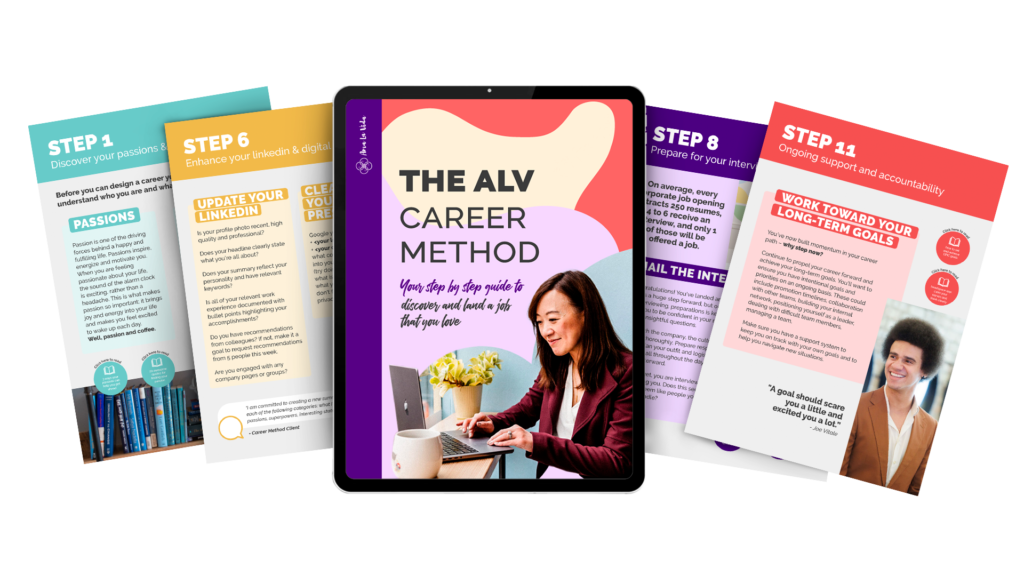
Download our comprehensive step-by-step guide to design and land a job you love!

Images from The ALV Career Method Guide
ALV Method Downloadable Guide

There are probably as many reasons for learning to meditate as there are people in the world. It seems every day a new study comes out touting a new benefit of meditation. Some of the basics are simply reducing stress and increasing your performance in everyday life. We know that through both breathing exercises and focused thought practices you can trigger your parasympathetic nervous system. This is what triggers that decrease in your stress levels. You can also train your brain to be less reactive. This is what allows you to have more control over your responses to your environment and improve performance. Learning to meditate is one of those things that most of my clients have on their “should” list due to its benefits. Some of them have had regular meditation practices in the past, but have struggled to keep it going once their lives changed. Other clients have always aspired to the practice without much success. Meditation is HARD As a certified yoga instructor and life coach, let me just lay this out there: meditation is hard.  Much like going to the gym in the beginning, nothing will make you feel more out of shape than trying to work out after a long break. Similarly, nothing makes you realize how stressful and chaotic your thoughts are than trying to focus your mind for even 5 or 10 minutes. However, just like going to the gym, it’s the practice of focusing your mind over and over again that brings the benefit. Every time you bring your mind back to the present moment, that’s a rep. Your mind wanders off, you bring it back, that’s rep #2, and so on. It’s not about actually getting your mind to be quiet, though over time that may start to happen for fleeting moments. It’s the reps that make the difference. Every time you can retrain your brain to recognize your thoughts separately from yourself, you help your mind and body do that in times of stress. The more you do it, the easier it gets. Beyond shifting your expectations, though, here are my top tips for starting a meditation practice that will hopefully make it a little easier for you.  Beginner Tips: Don’t Try to be Perfect at It It can be very uncomfortable to sit and really watch your thoughts. It’s normal not only for thoughts to be chaotic, but also very negative. Rather than expecting it to stop or even to feel “blissful” right away, instead try to accept that these thoughts are normal. You’re practicing ignoring them. You’re practicing not following the train. That’s the whole point!  Stick to Guided in the Beginning Like I said, it’s hard. Guided meditations are easier because the audio gives your mind a dynamic place to rest, rather than silence where your mind will naturally wander. Whether it’s a meditation app or recorded meditations on Spotify or YouTube, there are endless options to help guide you in your practice. Don’t make it harder on yourself! Try a “Learn to Meditate” Program I love Headspace and Waking Up for how accessible they are, though there are also many, many more. Both of these programs specifically are focused on the practice instead of any Eastern philosophy or religious concepts, which is great for most people starting out. You can trial each for free to see which style you like better. And the meditations are only 10 minutes a day for either of them. These programs are great for a few reasons. First, they will teach you different meditation practices. This is great so you don’t have to sit there going “Am I doing this right??” Second, they provide structure for you. The fewer decisions you have to make every time you want to meditate, the fewer barriers there are to starting your daily practice. Many of them will even send you a push notification to remind you!  If You Can’t Sit Still, Move! Sometimes sitting still is just too much, especially if the voices that creep up are particularly painful. This is very common! For people dealing with anxiety, depression, trauma, or even just life, the things that come up in meditation might just be too intense to sit through. Totally normal and not wrong. Running, walking, vinyasa yoga, painting….anything that keeps your mind in the present moment is a perfect place to start. Work with Your Own Routine One of the most important things I ask my clients to do with any new habit is to think about what habits work for them. If you’re not a morning person, don’t try to force yourself to get up early to meditate; try it out for 10 minutes before you go to bed. If you don’t like sitting on the floor or don’t have a cushion, sit on your couch or chair. Find a system that works for you. It can be helpful to think about what worked when you’ve successfully picked up other habits. Then apply those habits to meditation. Remember, this is not about being perfect. Meditation is about giving yourself what you need and reducing your stress. Learning to meditate is about actively training your mind to come back to let go of your train of thought over and over again. Be sure to check out our workshop on Meditation and Mindfulness! Also, we’d love to hear your thoughts on meditation – what’s worked for you?

Read More

What’s the first word that comes to mind when you hear the phrase “self care”? If you would have asked me that question a few years ago, I would have replied with a list of actions: practicing yoga, doing an at-home facial, or treating myself to a massage. As the founder of Inner Workout, self care is now my life’s work, and I regularly get to play this self care word association game with others. Their answers are never too far off from the answers I gave in the past.  I want to be clear that there’s nothing wrong with these practices and experiences. A massage sounds particularly appealing in this current moment. However, I believe that we’re doing ourselves a disservice if we treat self care as just another item on a long list of tasks. In doing that, we’re limiting our own ability to care for ourselves if we only focus on the physical body. Your self care practices should support your entire being.  What Self Care Actually Means My first foray into self care was a regular Sunday night bath. I’d close my laptop, disengage with my phone, and spend some much needed quality time with myself. I wouldn’t reengage with the outside world until Monday morning. And, while I was consistent in the Sunday evening practice, each Sunday night looked slightly different. Some nights I’d soak with a bath bomb. Other nights I’d create my own concoction of Epsom salt and essential oils. Some weeks I’d soak for over an hour with a book. Other weeks I’d take a quick dip and listen to music before going to bed.  In the beginning, the bath was the act of self care. Over time, it became clear that the real act of self care was me checking in to see what I needed each Sunday night. A new definition of self care began to crystallize, one that Inner Workout continues to use to this day:  Self care is listening within and responding in the most loving way possible.  It’s not about doing a particular workout or skincare routine. It’s not about taking a certain amount of vacation days or getting a massage every month. Self care is an ongoing conversation that you have with yourself – it’s a skill that you build. If self care is a skill that you need help building, BetterHelp can help! That simple mindset shift can create a world of change. Instead of seeing self care as being tied to a specific action, I began to see invitations to take care in my day to day:  I learned how to lovingly respond to my own needs instead of ignoring them in the name of efficiency or productivity.  What Led Me Here: One day, I was sitting on my yoga mat, and a question popped into my head, “What if there was a class that helped people build the skill of self care?” I researched, and I couldn’t find anything that was quite what I wanted. And that’s how Inner Workout came to be.  I enrolled in a nine month yoga teacher training program, and I was quickly introduced to the yogic concept of the koshas, the layers of being. This was the missing piece.  My relationship to self care had expanded beyond caring for my physical body, but I didn’t have the language to describe it. Now, there was a framework through which I could make sure that I was actually caring for my whole self. The koshas, which we talk about as the five dimensions of wellbeing, became the foundation for Inner Workout:  When we engage with each dimension of wellbeing, our self care becomes that much more meaningful. It becomes as multidimensional as you are. It starts to honor where you’re at in any given moment.  Shifting Dimensions We’re dynamic beings living in an ever changing world, which means that our relationship to each dimension is constantly shifting. There are days when I feel really in tune with my emotions but out of touch with my physical body. I go through seasons where I can hear my intuition so clearly, but I feel disconnected from anything beyond me.   The framework of the five dimensions of wellbeing has helped me better understand where I need to focus my care, but that sensitivity to my own needs took time and intention. Inner Workout’s namesake class helped me build that skill. Each class is centered around an intention and blends movement, breathwork, journaling, meditation, and flow.  Unlike another mindbody practices, everything an Inner Workout facilitator offers is a starting point. You’re the expert on your own needs, and each class is an opportunity for you to practice listening within and responding with love.  One of my favorite parts of facilitating Inner Workout classes is looking up and seeing everyone doing something slightly different. People linger in movements or find a different movement entirely that supports their needs. Participants find the position in breathwork or meditation that best serves them. That’s the goal! It means the inner work is working.  Self Care Questions to Ask Yourself: Whether or not you join Ama La Vida’s upcoming Inner Workout class. I hope you begin to broaden your relationship to self care so that it can be as multidimensional as you are. Here are some questions to ponder:  Continue to build the skill of self care. Keep listening. Keep responding.

Read More
handle unmet expectations

Something that almost all people struggle with are forming expectations and having those expectations be unmet. Unmet expectations begin with a lack of communication and an inability to define your needs which can lead to frustration and resentment. Popular ways and places that unmet expectations show up are at work, with loved ones, and with yourself. Let’s dig into those! At Work Maybe you thought that this job was going to be one thing, and it turned out to be completely different. Perhaps you were supposed to have more responsibilities than you were told, and now you’re feeling overwhelmed. Maybe you thought your relationship with your boss was going to be easier, but it’s not and you’re feeling unsupported. You may feel blindsided and maybe even lied to. You have two options: you can have a bad attitude or a good one. It’s important to remember that you control how you show up and respond when things don’t go the way you expected or imagined. Here are a couple of tips to help with that: Think about the unspoken expectations that you had for this position and challenge them. Ask yourself: why do I have these expectations? What was actually communicated in the interviews? Do others have similar expectations that I do? Was it a miscommunication? Regardless of what I expected, how do I want to show up at work? Have a meeting with your boss to ensure that you’re clear on what the expectations are. Here are some example questions for your meeting: What is my role/objective? What am I responsible for? What are the expectations for this role? How do I grow in this role? What does success look like? What do appropriate boundaries look like? How can I ask for help in a constructive way? Move forward. Now that you have a clear idea of what the expectations are, you can establish new norms and hit the ground running so that you are truly successful in this role! Remember there is something to be learned in every situation! Now, let’s move on to some tips and tricks to handle unmet expectations with your friends, family and loved ones. With Loved Ones Expectations are the enemy of healthy relationships, especially when they are unspoken and therefore unmet. It’s easy to say “never have any expectations” – you’d be happier and you would feel less disappointed overall. But not having any expectations is a lofty goal to obtain. So, here are a couple tips on how to best manage your expectations with loved ones: Think about what expectations you actually have for the loved ones in your life. Are these expectations you have realistic and appropriate? If not, think about why you have these lofty expectations. If they are realistic, the next step is to… Express your needs! Unspoken expectations are unfair for everyone involved. They set your loved ones up for failure and will leave all the parties involved hurt. It’s important to communicate the things that you need in a loving and safe way. Make sure that you listen to what the other needs as well! While setting expectations upfront can be helpful, chances are you will get off-beat every now and then. When this happens, it’s time for point 3, getting on the same page. Get on the same page. Have a conversation about what it looks like to have your needs met, and also what grace looks like when they’re not. No one is perfect, but we are trying to figure out how to love each other in the best way possible! Lastly, there will be times in your life when you have to handle unmet expectations with yourself, and that’s okay – it happens to the best of us, So here’s how to recover when you don’t quite hit the bar. With Yourself You say you’re going to do something – finally get in shape, eat right, put yourself out there, etc. – and then it falls flat and you don’t achieve your goal – you feel like you let yourself down. This can lead to feelings of disappointment, guilt, and defeat. The good news is that it doesn’t have to stop there! Here are a couple tips on how to best manage your expectations for yourself: Think about what your true motivation is and connect with that instead. Why do you have these expectations for yourself? Are these internal or external motivators? What do you actually want/need? Why is it important? Connecting with your true motivation is essential and can help you figure out what is actually blocking you. Grace! Give yourself some compassion. Remember that you can’t always be on or ever achieve becoming “perfect”. People make mistakes and fall short, it’s okay! How you rebound is what really matters. Remind yourself that you’re doing the best you can. Create new norms in a realistic way. If losing weight is your goal, it’s not reasonable to lose 20 pounds overnight! Come up with a sustainable plan that will give you the results you desire and set yourself up for success.   Remember, you are not alone in experiencing or having to handle unmet expectations, almost every person has either had them or let others down by not meeting them.  “Two things can destroy any relationship: Unrealistic Expectations and Poor Communication.” – Unknown Hopefully you are now more prepared to manage and establish new realistic expectations, communicate them fully and have a true dialogue, and practice grace for yourself and others if (and when) those expectations are unmet. 

Read More
How to Start Prioritizing Your Mental Health

With the New Year, come new resolutions that aim towards improving one’s health. In fact, most of Americans’ 2019 New Year’s resolutions were geared towards health and exercise that range from going on a new diet to hitting the gym regularly. And this isn’t surprising, as health is one of the top priorities that influence how people do things on a daily basis. To add to this, self-care has become a trend among many Americans both as a means to take care of themselves and to better themselves in all the other aspects of their life. Indeed, investing in your health will lead to various benefits down the line. So today, we’re going to talk about some easy ways to help you start prioritizing your mental health. However, one important thing to note when discussing health and self-care is that most people tend to focus on the physical aspect of this without addressing the mental side. This becomes increasingly important when you consider the fact that the World Health Organization has officially declared mental burnout as an official medical diagnosis due to its prevalence in the world today. But do we really need to address mental health the same way we approach physical health? Well, the answer to this question is a strong resounding yes. And while we’ve already discussed how you can help others in Gabby Vicas’ article about supporting your loved ones with mental illnesses, today we focus on how you can help yourself improve the state of your mental health. This is because mental health has just as much of an effect on your lives as your physical health. These effects range from your temperament towards everyday activities and can even affect the way you perform at work. Indeed, psychologists at Maryville University detail how the completion of business objectives are very much linked to an employee’s mental wellbeing. The healthier your mind is, the better your performance will be at work. Considering how pivotal mental health is to your daily lives, it would only make sense to take the necessary steps in improving it. So how do you go about this? Well, there are a few steps you can take to start putting your mental health on the top of your list. Read on to know more about how you can start prioritizing your mental health this coming year! Take Breaks As mentioned above, burnout has become a global epidemic. The World Health Organization defines burnout as a syndrome that results from workplace stress that has not been successfully managed. Seeing as that is the case, it only makes sense that to address burnout, one must address the stress. One good way to address this issue is to take breaks regularly. Taking a break can range from going on vacation to smaller things such as taking small breaks in between your workday. An article on Inc about taking breaks, highlights how taking some time off can provide you with a slew of benefits. One way you can sneak quick breaks in throughout the day is by practicing the Pomodoro Technique wherein you supplement 25 minutes of work with five minutes of recreational activity. This way, you’ll be able to remain productive while sneaking in some time off in between. Find A Hobby “All work and no play makes Jack a dull boy” is how the old adage goes. In line with taking more breaks, you might also want to consider picking up a new hobby this year, as it could prove beneficial for your mental health. Not only will it give you a healthy outlet outside of work, but certain hobbies can also provide you with benefits that could improve the state of your overall mental health. Research by the Department of Psychology at New Zealand University has found that creative acts give people emotional relief. They are highlighting the link between creativity and emotional functioning. And while the study didn’t focus on specific activities that the respondents participated in, the researchers informally took note of the activities that provided people with emotional and mental relief. These activities include writing fiction and poetry, knitting, cooking, painting, and music. Set Boundaries Think about it, what has been one of the biggest sources of turmoil when it comes to your mental health? Most of your problems probably stem from the fact that you have been trying to do too much all at once. Trying to overextend yourself will leave you drained and with more issues than you started off with. This is why it’s crucial to set boundaries. So how do you go about doing this? Psychology Today details six steps on how to set healthy boundaries for yourself. The list starts with clarifying what you want outside of other people’s interests. It ends with being able to communicate your desires with other people in a respectful and healthy manner. This is important, as setting boundaries doesn’t entail shutting other people out. Doing things this way will ensure the preservation of your relationships. You’ll learn there are ways of setting boundaries without sacrificing your friends, work friends, and the people you care about. Seek Professional Help And while setting boundaries is a good first step, you might also want to consider getting professional help when it comes to your mental health in the form of therapy. Considering the varying degrees of problems, it only makes sense that there are also a number of different ways that professionals approach it. The National Alliance on Mental Illness enumerates the different types of therapy that could prove beneficial to your mental health. These ranging from the classic psychotherapy or “talk therapy” to more hands-on variations in the form of therapy pets. Currently, one of the biggest hindrances when it comes to seeking professional help is the systemic roadblocks. These stop people from getting the help they need. Psychiatrists from the Perelman School of Medicine highlight how the complicated health insurance landscape makes it harder for people to avail of these

Read More
the link between sleep and productivity

Approximately 45 percent of American adults slept poorly in the last week. Without the recommended seven hours of sleep, reasoning, emotional stability, and work productivity take a serious hit. Even those who got the right quantity of sleep may not have gotten the quality necessary for the body to be fully rested. Better sleep opens the door to better efficiency, productivity, and work satisfaction, including improved professional relationships.   More Sleep = Less Stress Sleep deprivation, that’s anytime sleep hours drop below seven hours, makes anything that triggers a stress response more difficult to handle. Something as simple as an unexpected phone call can be enough to cause stress, anger, or irritability when running low on sleep.  There are physiological reasons behind the emotional changes that accompany sleep deprivation. When you don’t get enough rest, the brain’s emotional response center becomes highly sensitive to negative thoughts, emotions, and situations. The response to negative stimulation increases in this part of the brain when you’re tired.  Normally, when you’ve had enough sleep, the brain’s logical center regulates these emotional responses. However, when you’re sleep-deprived, the logical part of the brain becomes less active. That leaves people more susceptible to irritability, aggression, and other intense negative emotions.  Getting more (and better) sleep equips you to stay calm and cool in the workplace. That stability allows you to address customer and client concerns with your full mental and emotional reasoning in place. The ability to handle workplace stress can also enhance your relationships with co-workers. Arguments, disagreements, and misunderstandings are less likely and/or can be resolved more quickly when everyone gets the rest they need.   Less Stress = Better Work Performance Anything that can help you reign in your stress will benefit you both in and out of the workplace. A 2013 American study that questioned doctors about their patients’ well-being estimated that 60 to 80 percent of patients reported a stress-related component that affected their health. Forty-four percent of patients reported an increase in stress over the prior five years. Prolonged or chronic stress leads to a number of health issues, including increased inflammation that can compromise the immune system and contribute to anxiety and depression.  More Sleep = Better Health We’ve briefly mentioned the mental health benefits of more sleep but your physical health relies on sleep too. The human body uses sleep time to rebuild the immune system. It makes and redistributes antibodies so they’re ready to tackle any bacteria and viruses that you encounter during the day. The more you sleep, the better you will feel the next day. Overall, better sleep means less sick time, fewer medical bills, and more productivity at work.  Less Stress + Better Healthier = More Efficient Many people don’t realize the effects that sleep deprivation takes on their bodies until they’ve started to get better sleep. More than the emotions and immune system are get rejuvenated while you’re unconscious. The brain’s cleaning system, called the glymphatic system, is 90 percent more active while you sleep versus when you’re awake.  This system flushes the tiny interstitial spaces in the brain with spinal fluid to remove the waste proteins that buildup during the day. Lack of sleep can leave many of those toxins in place, slowing down brain signals with all the clutter.  Sleep deprivation also affects reflexes and physical performance. A study done among college-level basketball players found that increasing sleep time decreased sprint times and improved shooting percentages. You may not be shooting baskets or sprinting down a court, but you need your physical and mental reflexes to quickly respond to unexpected situations. Whether it’s an unhappy customer or another driver while you’re out for a delivery, sleep will keep you centered and focused when you need your full mental and physical abilities.   How To Improve Your Sleep: Update Your Bed  Everything about your bed affects your sleep, including the mattress, pillows, and bedding. If you don’t know the last time you replaced your pillows or mattress, it’s probably time for a change. Mattresses should be replaced approximately every 8 years and pillows about every year. Make sure your mattress truly offers you the support you need. If you wake up achy and sore, an old mattress could be the culprit.  Side sleepers generally need softer mattresses to cushion and relieve pressure at the shoulder and hips. Stomach sleepers, on the other hand, need firmer support to prevent their hips from sinking into the mattress and putting too much pressure on the lower back. Back sleepers have the easiest time finding a mattress since they maintain a relatively neutral spinal position throughout the night. However, your weight and personal preferences also affect how the mattress feels to you. Try out a few models and look for one that meets your specific needs.  Change Up the Bedroom As much as your bed influences your sleep, it’s not the only thing in the bedroom that can make or break your sleep cycle. The body needs complete darkness for sleep hormones to flow as needed. Blackout curtains, heavy drapes, blinds, and shades to keep sun and street light out at night can help you fall asleep faster and stay asleep longer.  If you live on a noisy street, a white noise app or machine to drown out the sound makes a huge difference. Finally, try to keep the room temperature between 60 to 68 degrees. Your body temperature drops at night and a lower room temperature helps the body maintain and regulate that change.  Put Work Away After Hours There is a reason that labor unions fought tooth-and-nail for a 40-hour workweek. Once you hit 40 hours for the week, your productivity goes down. You only have so much to give and knowing those boundaries can actually make you more efficient.  It’s also not healthy for you to be focused on work all the time. With so many remote work options, it can be easy to get caught up in the loop of checking and answering one

Read More

Stress is a normal part of life. Regardless of your daily responsibilities and lifestyle, you’re bound to experience stress. And while stress can motivate a person to do better, too much of it can compromise a person’s overall health. Poor stress management can increase your risk of developing illnesses and diseases, which can adversely affect the quality of your life. Today, we’re sharing some tips to implement in your life if you’re trying to be free of stress. Every human experiences stress, but this doesn’t mean that you should live your entire life full of it. There are several ways on how you can effectively combat stress and live a healthier life. By making small changes in your daily routine, you can achieve these goals effortlessly. Here’s how you can live a healthier and stress-free life: Always Eat Right Your diet plays can significantly affect your stress tolerance. Poor nutrition can contribute to stress, and stress can usually trigger you to reach for sugary and fatty foods. Improving your physical and mental health can be a near-impossible task if you’re not making any changes with your diet and stress management. If you want to hit two birds with one stone, gradually change your diet. A well-balanced diet can be a powerful tool for you to handle stress better. To help you get started, listed below are tips to help you focus on proper nutrition and help you reduce stress: Lessen caffeine intake Drinking too much coffee can worsen the effects of stress. Caffeine can cause your body to feel “wound up” and can make minor stresses feel and look more intense. When too much caffeine is in your body, small inconvenience can trigger chronic stress and can become the reason why you can’t function well.   If you drink several cups of coffee every day, gradually minimize your caffeine intake by reducing your cups. If you usually drink three cups every day, work on drinking only two cups and then one. Immediately and completely removing coffee from your diet can cause severe headaches and other caffeine withdrawal symptoms. Appreciate mealtimes Regardless of how occupied you are, you should never skip meals or eat hurriedly. Doing any of these can only worsen stress and even put your health at risk. Instead of skipping your meals or eating on the run, utilize mealtimes as a chance to sit down and relax. Enjoy the flavors of the meals in front of you, and reflect on all of the activities you had and will have in the day. If you’re sharing the meal with another person, maximize this time to catch up with the other person. Ask how they are doing, and what’s keeping them busy lately. Besides, meals taste better if you’re sharing it with people close to you, right? Avoid stress eating It’s common for people who are under too much stress to reach for unhealthy foods to comfort themselves. Eating an entire pint of ice cream or munching a huge bag of chips in one sitting can seem relaxing for someone who is stressed. However, stress eating can only result in guilt and overeating. If you see yourself in this kind of situation, discipline yourself to use other platforms in managing stress. Instead of eating large quantities of junk food whenever you’re stressed, play with a pet, engage in physical activities, or treat yourself to a relaxing bath. De-stress by pursuing your hobbies or taking days off from work. These activities are better stress relievers because it frees your mind from any mental exhaustion without harming your overall health. Consider Incorporating Natural Supplements And Therapies For individuals who are always on the go, staying physically active and preparing well-balanced meals can be a struggle. They won’t have the time to work out regularly, and they would prefer meals that are easy to prepare. If you have a very hectic schedule, don’t worry because you can still ward off stress even if you don’t have the luxury of time. Fortunately, there are now natural supplements and therapies that can help you live a stress-free life, such as: CBD-infused products CBD or cannabidiol is a product extracted from the cannabis or hemp plant. Although derived from the same family as marijuana, using CBD doesn’t create any “high” sensation or alter any of the body’s functions. In fact, CBD products are cost-effective because it can treat a wide variety of health conditions such as stress and other mental illnesses. CBD products are known to reduce stress in the human body because it contains natural compounds that boost the brain’s ability to produce serotonin. Serotonin is a chemical neurotransmitter responsible for a person’s mood and social behavior. According to studies, there is a connection between the body’s serotonin levels and stress. The lower serotonin a person has, the more susceptible they are to experience chronic and frequent stress. Having low serotonin levels is a leading factor of anxiety and depression. CBD can positively interact with the human brain, encouraging it to produce more serotonin. Frequent CBD use can guarantee that your brain produces more serotonin. To ensure your entire body gets a sufficient amount of this neurotransmitter. Having a sufficient amount of serotonin in the body can help your mind stay at ease. This will keep stress at bay. Aromatherapy When you think about aromatherapy, think about basking in the ambiance of a luxurious spa. The environment of a spa is one of the reasons why you’re paying your hard-earned money to use this facility. But instead of spending money just to bask in a relaxing environment, why not create the same at home? By investing in essential oils and placing them strategically in different areas, it won’t be long before your home will feel and smell like a spa! Aromatherapy is actually a natural therapy used since ancient times to reduce stress and promote feelings of calmness and relaxation. Inhaling and exhaling certain essential oils is an effective stress reliever because it stimulates the

Read More